A Daily History of Holes, Dots, Lines, Science, History, Math, Physics, Art, the Unintentional Absurd, Architecture, Maps, Data Visualization, Blank and Missing Things, and so on. |1.6 million words, 7500 images, 4.9 million hits| Press & appearances in The Times, Le Figaro, Mensa, The Economist, The Guardian, Discovery News, Slate, Le Monde, Sci American Blogs, Le Pont, and many other places… 5000+ total posts since 2008.

  • Racial Boycott, Los Angeles, 1889: Fear of the Chinese and of Undertaker’s Flies

    JF Ptak Science Books  Quick Post

    This piece of propaganda and racial attack appeared in Los Angeles in 1889.  The National Bakers Union called for a boycott of The Original Coffee House for purchasing their baked goods from a “scab” bakery identified as Brown’s Restaurant and Bakery.  Their crime was magnified by using Chinese people instead of making use of “hundreds of capable and deserving White People” were seeking employment.  The union also made a connection between the next-door undertakers (and the possibility of the seepage of vermin and such) with the use of the Chinese workers.

    Source:  I originally found this post at the Bay Radical website, here, though the image above is a high resolution download from he Library of Congress, here, from their Chinese in California collection.

    The undertakers seem to have survived whatever it was that the Bakers Union threw at them, advertising themselves in 1889 (following), and telling folks to call, day or night, by ringing Number 61:

    “PECK & McCOY, Undertakers and Embalmers, No. 40 NORTH MAIN STREET. Telephone 61. Day or Night, from Los Angeles Herald, Volume 31, Number 145, 25 February 1889 — Page 6 Advertisements Column 1 [ADVERTISEMENT], California Digital Newspaper Collection, here. “

    The Chinese population in L.A. had grown markedly since 1850, and by the mid-80’s there were some 3,000 living in Chinatown in a city of about 50,000 people.  There was a notorious riot and massacre of Chinese people there, in Chinatown, a result of a white man killed accidentally int he crossfire of a gunfight between two rival Tanns.  The establishment went crazy and exacted a gross revenge, burnign amd looting, and killing 19 men and boys. 


    ·Posted by :

    ·in:

  • Drugs Looking for a Need: Heroin, Thorazine and Etc., in Old and New History

    JF Ptak Science Books    Post 1825  

     Follow Me on Pinterest

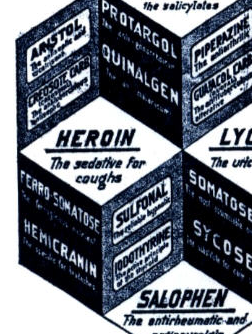
    Ads--heroinLooking at old advertisements for the application of new/improved pharmaceuticals can be an experience in search of an explanation. Certainly we recognize the impact of these drugs today for what they really are, the business-end of their basis unmasked.  But at the time–well, at the time, before revelation, there was hope in the use of them. 

    Opium of course has been used for centuries, but it was synthesized first in 1874 by the English chemist C.R. Alder Wright, though that first application went basically nowhere.  The big push came when it was independently re-synthesized and re-discovered by Fleix Hoffmann who was working at the time for the Aktiengesellschaft Farbenfabriken of Elberfeld, Germany, which is todyay known as Bayer, and which was re-named and marketed under the name, “heroin”. 


    Ads--heroin bayer
    Heroin was sold for nearly two decades as a cough suppressant, a safe replacement for morphine, and also non-addictive.

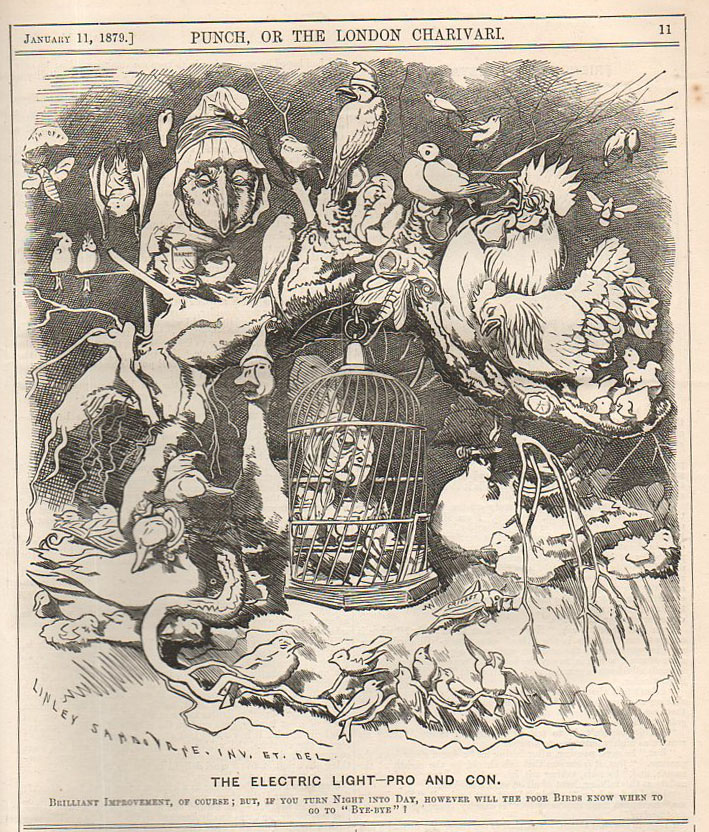
    Narcotics in general however were applied somewhat liberally for complaints of all manner–narcotics not being controlled until 1925, banned by the Single Convention on Narcotics Drugs and the League of Nations (for its signatories, at least).   AS we can see int he detail of this Punch cartoon of 1879, the problems to be brought on by the new applications of electricity (still quite young in its modernistic sense at this time) could be sleeplessness for birds, as the outdoor lights might keep them awake.

    Electricity575

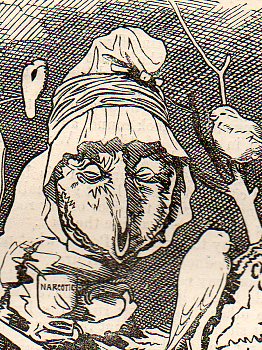
    But in detail, the sleepy old owl might have been dipping a little heavy into one of those bottles with bumps on its sides, its bottle of “narcotics” to help in tracking down sleep:

    Electricity576

  • The Intestinal String Polisher in the Curled Hair Dept.–Armour Meats, 1917

    JF Ptak Science Books   Post 1826

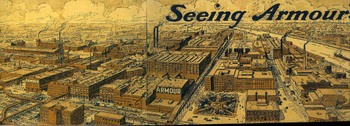
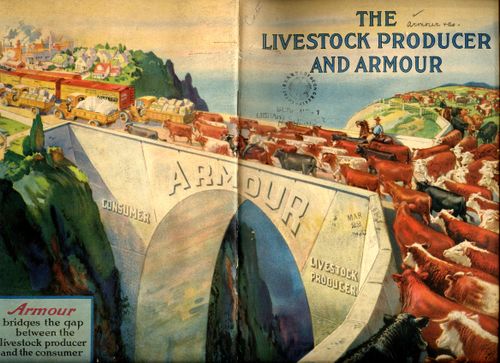
    The following impressions are a result of reading the Armour & Company’s hard-sell-we’re-really-really-clean promotional pamphlet, Seeing Armour’s. (I’m not sure why there is a plural possessive in the title, which is lopped off in the photo below–the pamphlet is actually splayed out here, opened from the 4×7.5 oblong to show both sides of the cover, revealing both halves of  the vastness of the company’s campus).
    Blogsept3_armour488


    Knowing full well The Jungle* story and the insufferable conditions in the livestock killing and processing industry, what really stopped me was this short note on one of the many elements of the company:

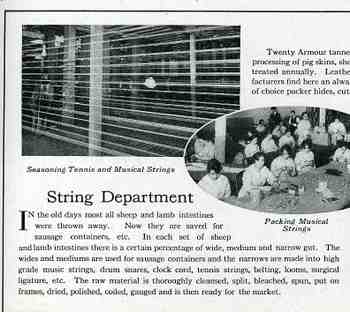
    Blogsept3_string484 the String Department.  (?)  How deflating it is to start thinking about this concept.   Yes, of course, of course there is a string department at the Amour Meat Packing Company, though they’re not making the stuff from field-grown fibers.  This string is just gut, but useful gut:  “In the old days most all sheep and lamb intestines were thrown away.  Now they are saved for sausage containers, etc.”  Et cetera?  I’m not sure if the “etc.” part is more baffling than the originality of the opening sentence (and a sentence which is probably never-before encountered).   There’s wide, medium and narrow gut, as it turns out, and it was cleansed, split, bleached, spun, put on frames, dried, polished, coiled and gauged.  (Now that’s a job title:  intestinal string polisher).
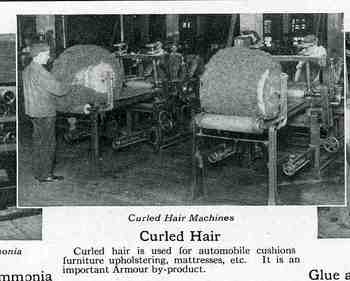
    There were a number of other expected/unexpected surprises.  The Curled Hair room was a surprise. I was expecting the soap room but didn’t expect the huge interior that it filled, with hundreds (?) of young women (all dressed in white) seated at long wide tables with mountains of soap, doing god knows what.  Oleomargarine, bullion, extract of beef, sausage, leaf lard and bacon were expected; the eggs, butter, cheese, grape juice, peanut butter, salmon and fruit syrups departments weren’t.  Armour seems to have been waging a veritable food war, with a little bit of beef/pork/sheep going into a little bit of everything. 

    Blogsept3_hair485

    Finally, having had just about enough of Mr. Armour, I stumbled into the stuff on the killing rooms.  Even though the description is cleaned up i the pamphlet, it still is not pretty, and sharing the photographs is just not necessary.

    20 years a vegetarian, here. 

    *Note:

    The Jungle was written by Upton Sinclair (often referred to as a “socialist” which he definitely, positively, was) in 1906.  It was basically an expose on the living and working conditions of the lower working classes, and is best remembered for bringing to vast public knowledge the grotesque conditions of the meat packing industry.  It is not possible, really, to overstate its importance, which is credited with leading to Meat Inspection Act and the Pure Food and Drug Act of 1906, which established the Food and Drug Administration.

  • The Archaeology and Secret Evolution of Meat–a Collection of Posts

    JF Ptak Science Books    Quick Post

    I’ve collected some of the unusual posts that I’ve done on this blog regarding the hard tendencies and shallow measures of meat. 

    The Ineffable Religiosity of American Meat Memory, here.

    000 meat red 2011


    Women Meat Pioneers of 1943, here.

    4-1 prop meat

     Anatomy of Womanly Desire–Aprons, Plastics and Meat, here.

    Women--growing Kelvinator453

     “The String Department” and “Curled Hair Machines” at the Meat Plant  (here)

    Blogsept3_hair485

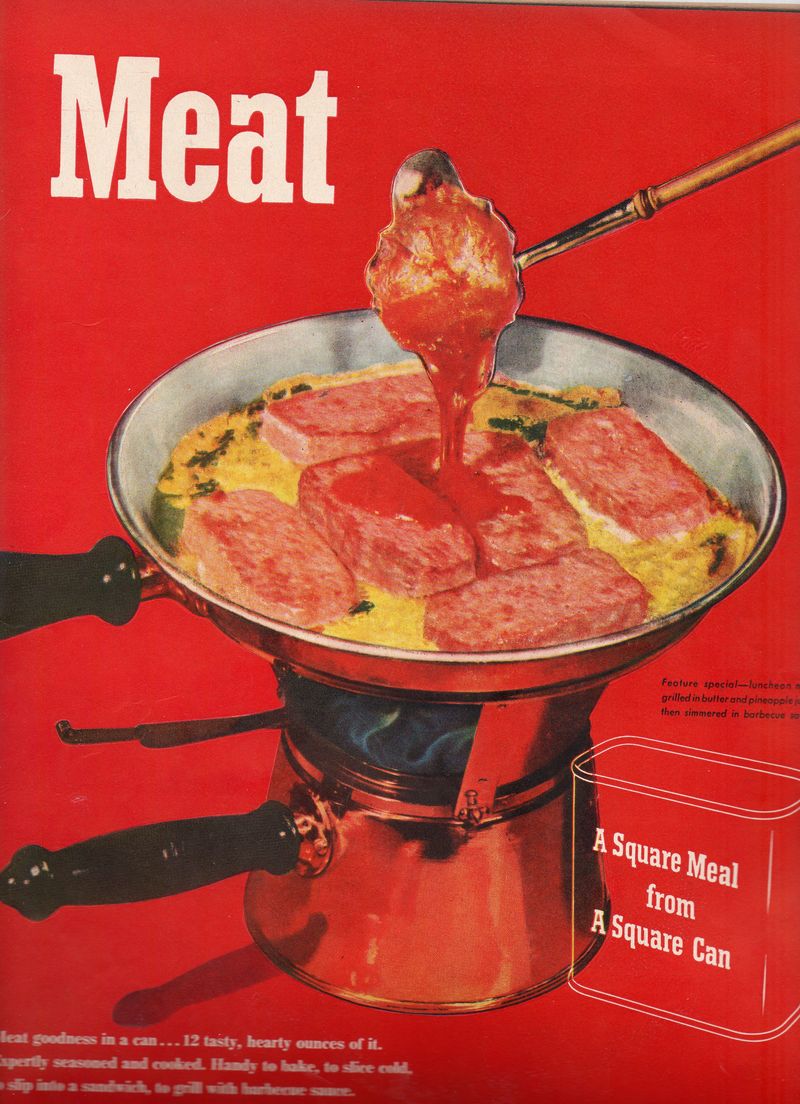
    Spam, Smeat, Spic, Prem, Mor & Arf: Food by Any Other Name  (here)

    +++spam ad

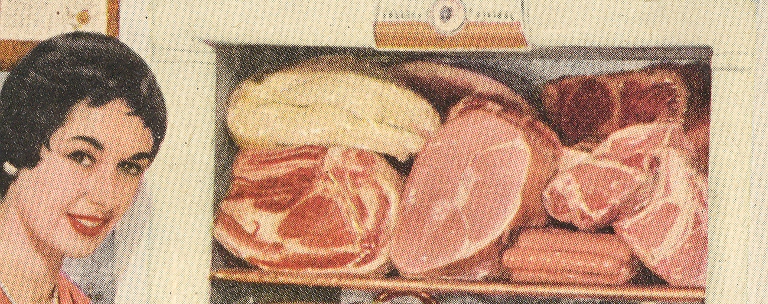
    States of Perfection: the Refrigerated Archaeology of Meat, here.

    March 6 refer meat det

    Food, Food Packaging and Creating Desire: the du Pont Company, WWII. (here)

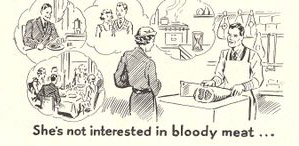
    Selling to Simple Women, 1939:  “She’s Not Interested in Bloody Meat”, here.

    Women--bloody meat

    The Importance of Bridges in the Invisible Evolution of Meat, here.

    + The Kodacolor Bridge of Evolving Meat


  • What a Biologically-Downloaded Intelligencer Virus Might Look Like in 2112.

    JF Ptak Science Books   Quick Books

    Somehow, in some way that is difficult for us to imagine in 2012, these ads were attractive enough in the mid-last-century.  Of course we have our own examples of this behavior, only more-so, I expect, given the vast multiples of advertising we undertake today.  Somehow it feels as though there just isn’t enough space in our own year for the sheer weight and smell of ads, and that some of them must be occupying and stealing oxygen from our time in the future.  Then again, in the future maybe we will all be paying for quiet in our brains so as to not be subjected to nothing but constant streams of commercialism, perhaps inherent in our neurons, ads becoming a part of the very part of the thought process, commercials interrupting our creative process, and popping up at appropriate times in the process of recollection. (Happy thought, that). 

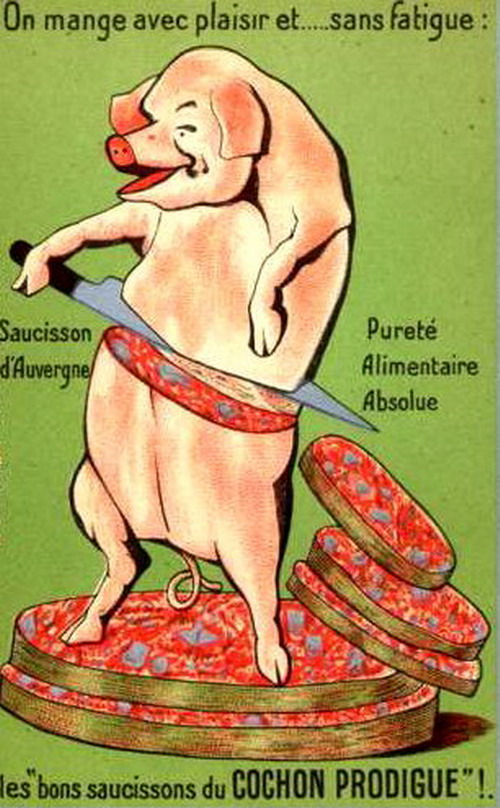
    And so this might look to be an unbelievable, incoherent way of attracting someone to eat pork bellies and eyelids–but at least it appeared in a print ad in 1948 (or whatever), and that was the end of it.  In the future if this was seen once it might be possible for the thing to be incorporated in a memory process that had anything to do with the letters “p” “o” “r” “k” when put together in a row, frontwards or backwards. That’ll be when we have to pay for our memories to be cleaned of commercial sponsors.  

    I can see a short story developing from this, of a person in the year 2112 (on 11 November) having a problem with the artificial memory intelligencer–the things that would make us “smart” in the future–where the biologically-downloaded data contained a virus (literal or figurative) that caused the man to think about this image every time a thought was thunk.  And there was nothing that could be done for him, short of him raising twice the labor exchange units that he had access to in order for this image to be expunged.  No ransom payment meant seeing this pig a thousand times a day.  And so a new crime is born. 

  • Images of the Quick and the “Still”: Trouvelot’s Sparks and Stars, ca. 1890

    JF Ptak Science Books     Post 1827

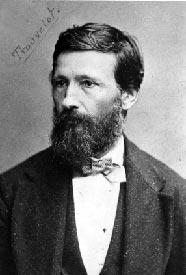
    Etienne Leopold Trouvelot. Trouvelot Figure. Photographic print, c. 1888.

    Etienne Leopold Trouvelot (1823-1895) was an ex-pat Frenchmen who settled in Medford (“Don’t Pronounce the First D”) Massachusetts, and who became a very highly accomplished and deeply skilled astronomical observer and astro-illustrator.  (I’ve included a suite of fifteen of his most accomplished works below, all found in greater detail via their links from their source at  the NY Public Library Digital Collections.)

    Trouvelot covered the spectrum in his art and photography–in addition to making photographs of the deeply settled but still open-to-mystery astronomical objects, he also was the photographer of extremely intransient things.  Among the later are some fantastic images that he made of high-voltage electrical discharges (images of which I found initially at the blog  Translinguisitic Order). 

    The image above is an example of that work, despite it looking like something rather deep-space-y, it is decidedly terrestrial–it is an image that he made of a discharge from either a Ruhmkorff coil or Wimshurst machine, and was produced ca, 1888/9.  It was a signature accomplishment, like photographing lightning or making an atlas of clouds, a watermark of sorts in a decade of photographic highpoint contributions in the sciences. (Some of these accomplishments were found in the work of Etienne Marey, who was able to isolate action in a continuous series of photographic still images, which for its time revealed shocking results.  Not only did the Marey work display the magnificence of motion, it also provided just about the first opportunity in the history of people to show the action in reverse.)

    File:Trouvelot.jpg

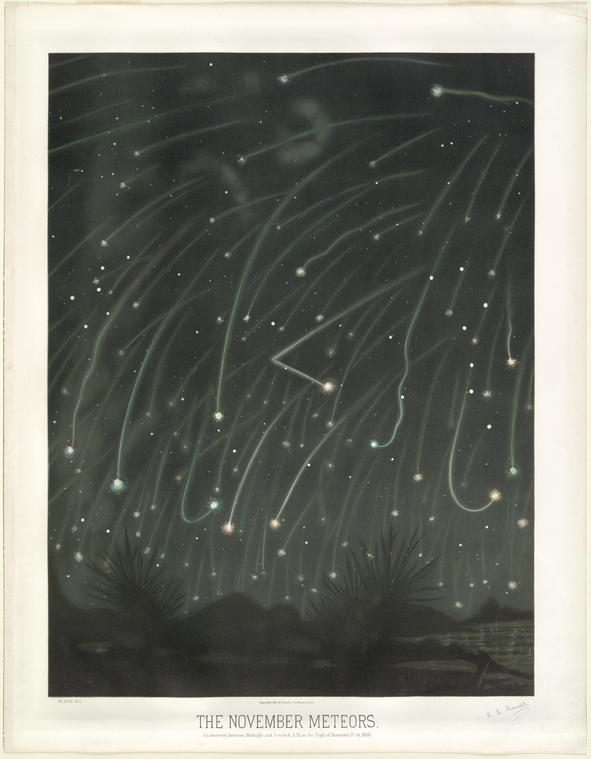
    Trouvelot’s drawing of a meteor shower, which I know has a very certain biological feel to it:

    The November meteors. As observed between midnight and 5 o'clock A.M. on the night of November 13-14 1868.

    Caption from NYPL: “Image ID: trouvelot_012. The November meteors. As observed between midnight and 5 o’clock A.M. on the night of November 13-14 1868. (1881-1882)

    And this spectacular image of the “Great Nebula in Orion” as it used to be called in some textbooks, now better known as Messier 42 or M42 or NCG 1976, which was and probably still may be one of the closest scrutinized things in the sky. It was recognized first perhaps by Niclas Claude F de Peirsec in 1610, with the first published account following in 1618 by Cysatus of Lucerne, though it didn’t get any real traction until it fell into the hands of Christian Huygens (1656) who also published the first image of the big bright spot in the middle of the sword of Orion in 1659.  (This is a little off-target but I like the historical end of the story.)

    The great nebula in Orion. From a study made in the years 1875-76.
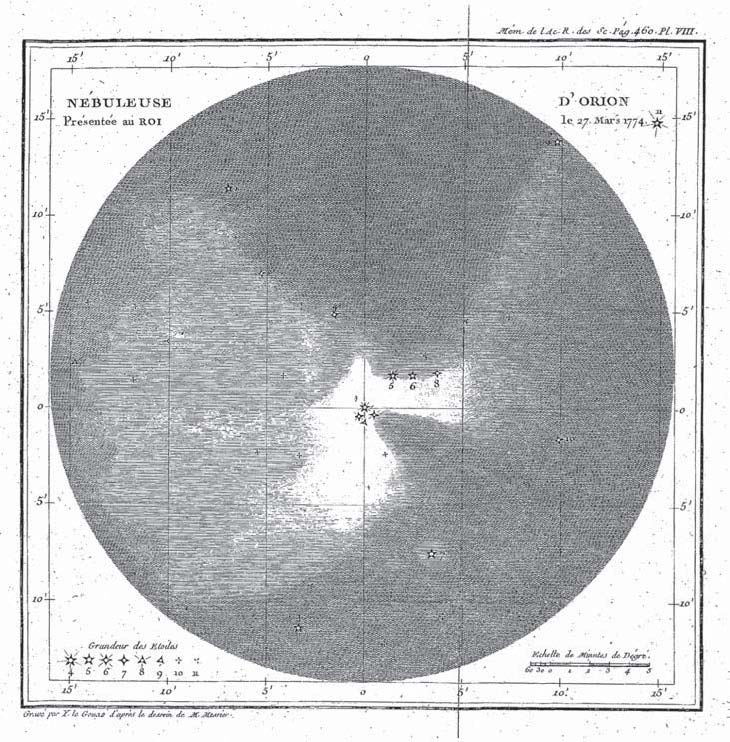
    And just for the sake of it, the Messier drawing:
    File:M42m.jpg
    And Andrew Commons’ photograph of the nebula in 1883 was a great improvement over our old friend Henry Draper’s 1880 groundbreaking attempt:

    File:Orion-Nebula A A Common.jpg

    It is still a little bit of a mystery to me that it took another two decades or so for people to consider that first photo (above) as “art”–perhaps it was the classification of the work as “scientific” and therefore not-necessarily-art, but folks surely made use of this and the Marey and other scientific photography of the 1880’s in their art of the 19-teens.  Trouvelot never lived to see it, though; and perhaps it wouldn’t’ve made sense to him.  I just don’t know. 
    It is also amusing that for this great “finder” the root of the first half of his name in French is “find”.
    The full suite of fifteen images by Trouvelot, below, all thumbnails from NYPL:
  • Daily Dose from Dr. Odd–Future of NYC Underground

    JF Ptak Science Books        Daily Dosage from Dr. Odd 1

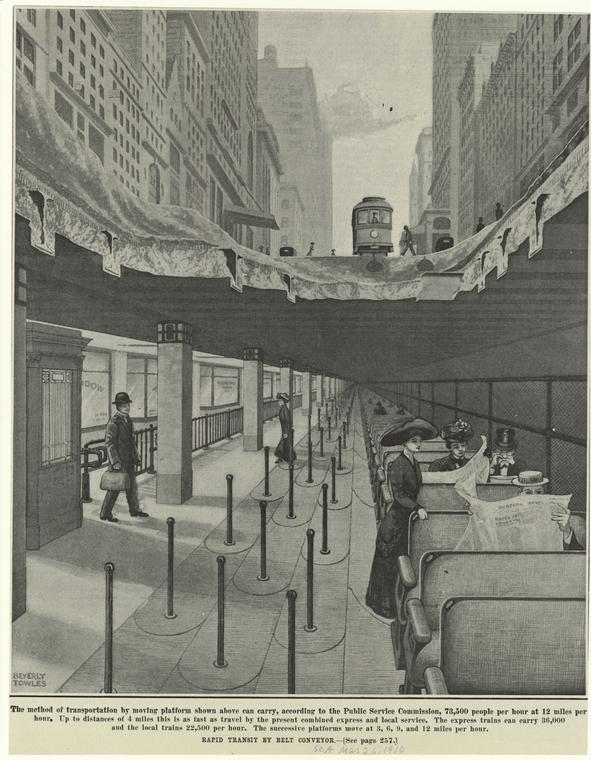
    Rapid transit by belt conveyor.
    This remarkable cutaway (1910) shows what might have been considered a possible future for the future of possible New York Citys .  This one features a very highly respectful continuous conveyor belt of humanity coursing through the Great Underneath, replacing the ideas of subway transport.  A seat would always be available if it was so, just a=one giant beltwork of seat stretching from SOuth Ferry to Uptown and to Brooklyn and so on.  But since it was always moving it would have to move a little slowly for people to hop on and off, so a trip to the then-Uptown might take some time. 
    Source:  New York Public Library Digital Collection, here.
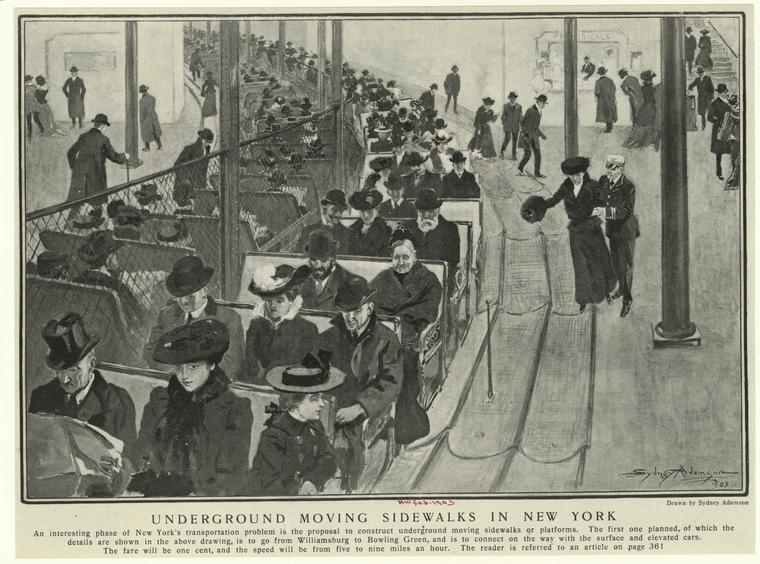
    Not to be out-belted, there was also an image of moving sidewalks (1903):
    Underground moving sidewalks in New York.
    Source:  New York Public Library Digital Collection, here.
  • Daily Dose of Dr. Odd–Future of Air Travel, ca. 1900

    JF Ptak Science Books     Daily Dose of Dr. Odd 2

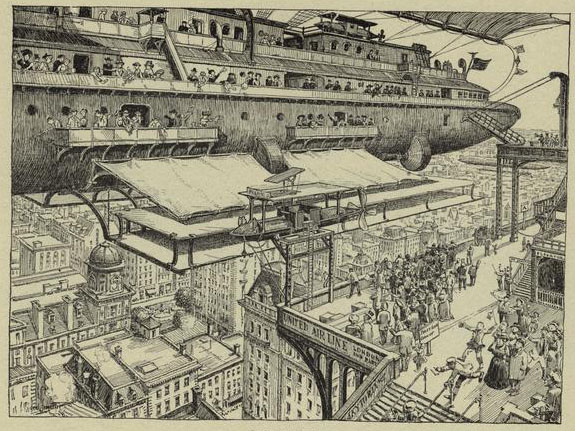
    In today’s quick dose from Dr. Odd we find the “United Air Line” (so close to the name that actually came into being), ca. 1900, featuring an enormous and extraordinarily heavily-bodied airship of a construction of pure speculation.  It is gigantic and weighty, and it seems as though the thing is powered by pulsating awning-like wings and a series of covered propellers, all under what seems to be sail. 

    The crowds bustling beneath the behemoth seem as any other crowd waiting for the subway, or third class, or, well, whatever sort of mass transport would await and was taken for granted.  There are no bands, no fireworks, no fanfare, just the arrival/departure of yet another airship leaving for London from New York City, as much a cause for attention as any airliner traveling overhead.

    Dailydose airship

    Source:  New York Public Library Digital Collections, here.

    Source:  New York City Digital Collection, here.

  • The Future of Building in Manhattan, 1875

    JF Ptak Science Books   Post 1828

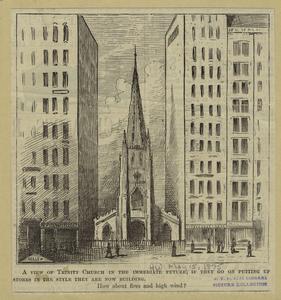
    This is an interesting and somewhat reserve view of the future of Manhattan, as seen from the pre-Centenniel eye of 1875, showing Trinity Church bookended by high-rise structures:

    A view of Trinity Church in the immediate future, if they go on putting up stores in the style the are now building.[Source: Harper’s Weekly, via the New York Public Library Digital Collection, here.]

    It would have been difficult to imagine structures of any greater height here in pre-elevator (and pre-elevator/Westinghouse brakes)  and early post-iron-structure days than the spire of Trinity Church. This Trinity (the third and current occupiers of an old spot at 79 Broadway, the first of the Trinitys going up in 1698 with the help of he block and tackle of Capt. William Kidd, privateer/probably-not-pirate) was the tallest building in Manhattan when it was built in 1846 (at 281′ to the tip of the spire), and remained so the tallest until the construction of the New York World  Building (305′) in 1890. (The World building was torn down in 1955 to make room for another on-ramp for the Brooklyn Bridge.)  So when this image was published it was still another 15 years away from anything being taller than the Trinity tower, which meant it was a pretty fair leap of faith to assume department stores crowding out the church’s airspace back in 1875.

    It is a pretty good approximation of what actually happened, though the canyonesque feel for development is more on Wall Street than it was here contiguous to the church grounds, though almost no one could imagine the dense high-rise growth that is there today:
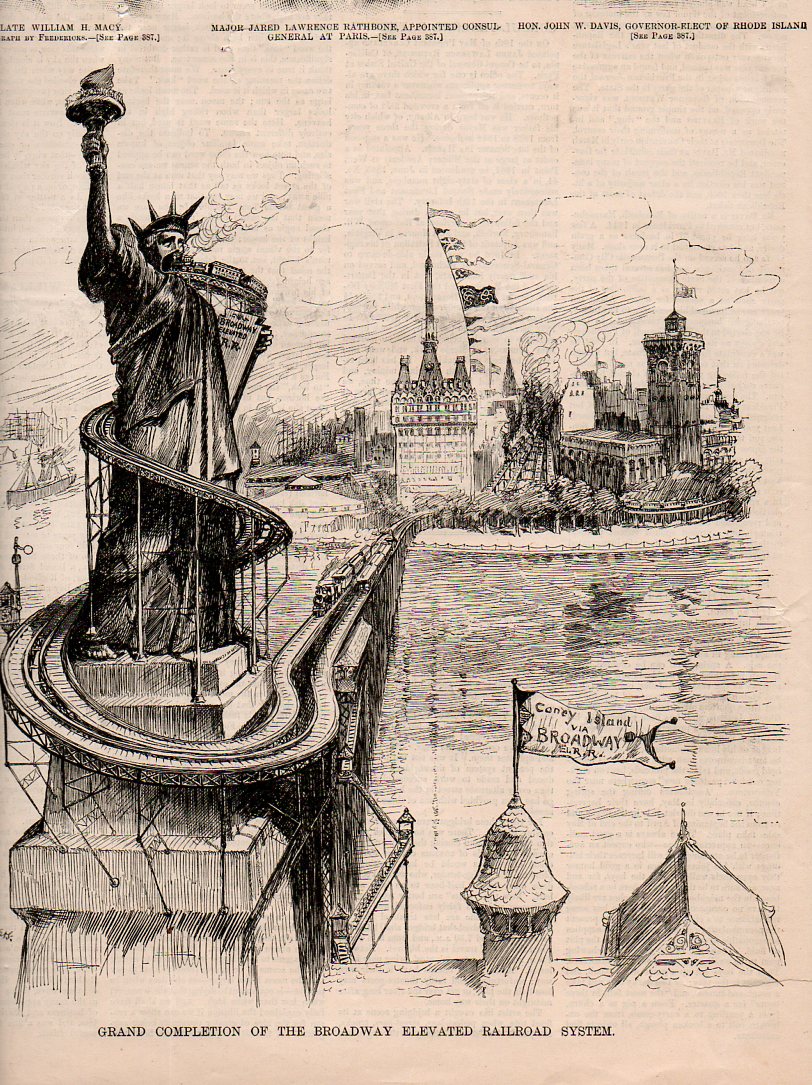
    There are many more colorful approximations of what might happen in Manhattan, one of which I’ve included below, showing the full and complete development of downtown, with trains leading away from the city right through the Statue of Liberty. This peep into a possible future appeared in Harper’s Weekly on 18 May 1887.  It is the work of artist W.A. Rogers and depicts a filling-up lower Manhattan, complete with broad avenues lined by elevated trains whose reach evidently knows no bounds. The new elevated subway winds its way across the harbor to Liberty Island, where it wraps itself around the feet and up the body of the newly–dedicated Statue of Liberty (opened in October of the previous year).  In the foreground is the cupola of a transit station with a fluttering flag advertising “Coney Island via Broadway”–I’m not sure what this is all about, as the placement of the island has nothing to do with anything except making a point in the cartoon.
    https://historyofideasblog.com/a/6a00d83542d51e69e2014e87fca7be970d-pi
    It is interesting to see though that the Trinity spire is still very visible.
  • History of Holes: Making 1=2 or 3, or More (ca. 1700)

    JF Ptak Science Books   Post 1830  Part of the series on the History of Holes. (Apologies for no-para spacing–Typepad is buggy again.)

    A beautiful and inventive way of addressing issues of perspective and un-reality in the centuries before the introduction of electricity was more able to suspend belief in the existing/obvious was via the catopticum1. This object (an example of which is pictured below, taken from the oddball/genius/problematic polymath Athanasius Kircher in his book Ars Magna Lucis et Umbrae…2 printed in 1676), and the name of which is taken from the Greek katoptron, mirror) was an advanced parlor toy and artwork, a sort-of primitive free-standing theatre of multiplied objects, a box that contained things that were seemingly larger than their container. 

    The catoptric theater. From Ars Magna Lucis et Umbrae (1671 ed.), p. 776

    Source:  Kircher at Stanford University, here.

    This image makes the “image engine” a little clearer:

    Primeira PáginaPágina AnteriorDiminuir imagemImagem a 100%Aumentar imagemPróxima PáginaÚltima Página
    desd [757 KB]
    Source:  Tratado da Catoptrica, (manuscript, 1716);  from the Biblioteca Nacional Digital, here.
    It’s a romance of images machine,  a box of antique wonder, a peepshow of centuries before, putting more things into a space than could exist.  It was a relatively simple machine of great ingenuity:  the interior of the free-standing box with rows of holes along its top edge perpendicular to the ground, and was lined with mirrors (as shown above in the Spanish document), with some mirrors set of at 45% angles; when objects were placed within the imaging-area of the angled mirrors, the object was multiplied, and then multiplied over and over as a result of the surrounding mirrors, creating in effect a “hall of mirrors”, leaving the observer with a sense impression of many dozens of objects that were contained within a container that was impossibly too small for what was being seen. 
    This of course is a property of some holes–they tend to make things larger than they could previously possibly “be”. 
    In this case, the viewer would look through a hole into a Borgesian box which would contain a multitude of its possible interiors.  Looking through a hole in the end of a glass and mirror-ended tube and pointing it at the sky at night would reveal an enormous multiplication of a small part of that sky.  In the early case of Galileo, what  was first seen with the telescope was the multiplication of what was believed to be a finite and god-granted sky of perfection–he was seeing into some other sky, into a new vault of heaven, something never before seen, above-and-beyond what was known to exist.  Hooke and Louwenhoeck had a similar experience with their (second generation) microscopes, seeing details and life never before encountered, entire worlds in a place no bigger than the head of a pin. 
    Sometimes a hole is just a dark thing; but more often than not, it isn’t. 
    Notes:

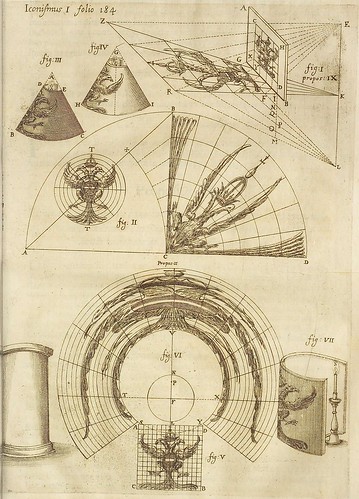
    1.  From the Greek, katoptron, mirror  or pertaining to a reflected image or reflected light, such as from a mirror.  There is another sort of catoptric that has been sort of widely used in antiquarian painting and parlor entertainments, which involves a canonical mirror reflecting a wide-field and distorted image into its proper perspective, which is known as catoptric anamorphosis.  Another version of this sort of optic imaging is optical anamorphosis, which requires the viewer to stand at a particular (usually sharp) angle to a painting containing a semi-hidden image whose proper perspective is revealed only at a particular angle of viewing.

    An example of catoptric anamorphosis, from the Kircher mentioned above:
    anamorphosis - eagle

    See here:  http://hyperphysics.phy-astr.gsu.edu/hbase/geoopt/catoptric.html
    2.  Ars Magna Lucis Et Umbrae In X. Libros digesta. Quibus Admirandae Lucis & Umbrae in mundo, atque adeo universa natura, vires effectusque uti nova, ita varia novorum reconditiorumque speciminum exhibitione, ad varios mortalium usus, panduntur. Editio altera priori multo auctior. The work is presented at Bibliodyssey, here.
    Mr. P.K.hauls out a great quote and summarization of the work of Kircher by Robert Moray in his letter to the great guiding post of the Royal Society, Henry Cavendish, which really captures the spirit of the very busy/very curious and curious old man:
    “Whatsoever Mr. Huygens & others say of Kircher, I assure you I am one of those that think the Commonwealth of learning is much beholding to him, though there wants not chaff in his heap of stuff composted in his severall peaces, yet there is wheat to be found almost every where in them. And though he doth not handle most things fully, nor accurately, yet yt furnishes matter to others to do it. I reckon him as usefull Quarries in philosophy and good literature. Curious workmen may finish what hee but blocks and rough hewes. Hee meddles with too many things to do any exquisitely, yet in some that I can name I know none goes beyond him, at least as to grasping of variety: and even that is not onely often pleasure but usefull.”  (My bold.)
    [Sir Robert Moray in a letter to Henry Oldenburg, 1665]  
  • Daily Dose from Dr. Odd: Superbly Unusual and Beautiful Baseball Portraits

    JF Ptak Science Books   Post 1831

    (Please also see this blog’s post on Women in Sports, from about the same era, here as well as here)

    Strolling through the New York Public Library Digital Collection (here), I came across many hundreds of images of baseball players.  What struck me with some of them were their stubborn, unabashed pride, images made of the ballplayers standing squarely in front of the camera, mostly looking directly into the lens, shoulders set squarely under that, a straight, dead-on shot.  Its not just in cartoons where the full frontal is rare–my experience shows it to be uncommon almost across the board. 

    [Unidentified baseball player in pitching form.]

Recent Posts

Archives

Categories