A Daily History of Holes, Dots, Lines, Science, History, Math, Physics, Art, the Unintentional Absurd, Architecture, Maps, Data Visualization, Blank and Missing Things, and so on. |1.6 million words, 7500 images, 4.9 million hits| Press & appearances in The Times, Le Figaro, Mensa, The Economist, The Guardian, Discovery News, Slate, Le Monde, Sci American Blogs, Le Pont, and many othr places… 5000+ total posts since 2008. Contact johnfptak at gmail dot com

Category: Fear, History of

  • A Dehumanizing Event with the Newly-Invented Telephone (1880)

    JF Ptak Science Books  Quick Post

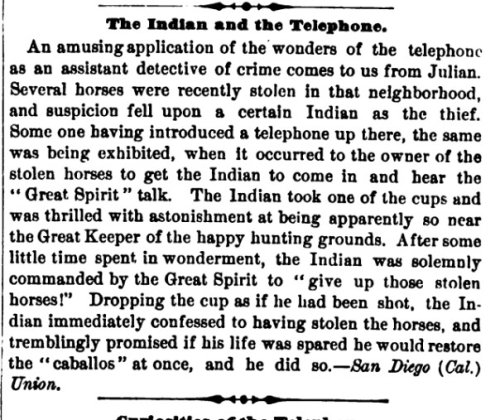
    It seems to me as though I’ve encountered other very unflattering introductions of the less-privileged to new inventions like the telephone along the lines of the following racist/Imperialist story. It isn’t very pretty, but it is worth reading to see the extent to which denominating certain people to the vast under-under class played out even in the introduction of new technologies. This appears in Scientific American, 14 February 1880, p 98.

    Sci Am 1880 Indians telephone


  • Power and Technology of the Year 2000 (from 1927)

    JF Ptak Science Books   Post 2779
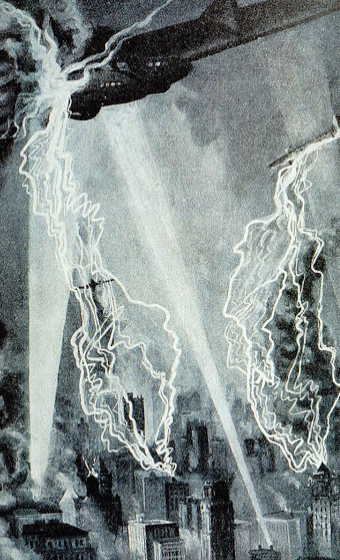
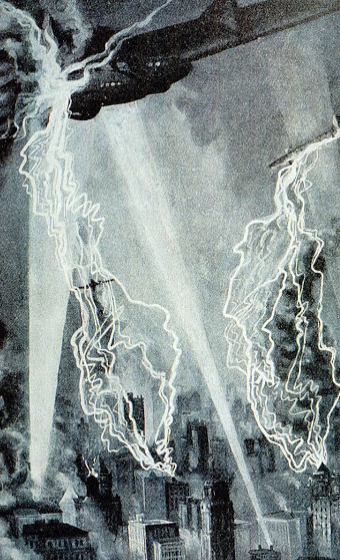
    Lubke IRCRAFT BOMBING

    I found another unexpected source for the initiation of nuclear energy—this one coming in Anton Lubke’s  1927 book, Technik und Mensch im Jahre 2000. The book is thick (372pp) and well-illustrated,  and has what seems to be a  mostly/somewhat progressive look into the future judging what I can cobble together….or from what I can tell, it was at least not terribly negative, though I haven’t been able to determine if the writer gets political, or not. Given the times Lubke (b. 1890) can’t but help to wonder what warfare might look like, and supplies us with one set of possibilities involving vast aircraft (pictured at left) attacking cities with poison gas and electricity. The idea of urban bombing was still pretty new in 1927, as was the idea of attacking cities that weren’t necessarily military targets. Both of the weapons used by Lubke’s aircraft seem as though they would be devastating, and indiscriminate. (Politicians would pull away from the idea of attacking civilian areas and sign treaties to that effect—that all went away with the invasion of China by Japan, and the attack upon cities by Nazi forces in WWII–the Allies followed suit almost immediately thereafter.) Lubke’s image (which appears in the section titled “Der Zukunftskrieg und die Technik”) must have seemed terrifying to his readers of 1927, though they are at least spared the image of the effects on the population in the imagery of the attack. (The Illustrated London News doesn’t hold back from its readers in an issue from 12 November 1932, which shares an exceptionally graphic artist’s interpretation of a poison gas attack on London, right on the front cover.) 

    This is only 16 years removed from what seems to be the first aerial bombing attack of a civilian population on 1 November 1911, when  Lt. Giulio Cavotti dropped the first bomb from a plane on oasis-encamped Libyan troops at Tripoli.  Of course things rapidly in the few years following that, so that by the end of WWI people got a good taste of what it meant to controlling pieces of property without actually occupying them, raining chaos and destruction from above.  20+ years later, in the early 1930’s bombing became more sophisticated, including a new arsenal of poison gas weapons.  The threat from this weapon was agonizing and palpable–the results of gas attacks upon armed combatants in WWI and  the gassing of civilians in the 1920’s and early 1930’s  made a hard strike into the social fabric, an enormous gaping new hole to be filled in the heart of fear.

    There were a number of interwar aerial bombings that took place that kept the issue of mass destruction alive and well.  For example,  Britain used its air arm  very convincingly in Iraq, bombing many places including Bagdhad  in 1923; the Spanish bombed civilians into submission in Morocco, near Tetuan, in 1925, and the French crippled and destroyed  their opponents–both military and civilian, it made no difference–in Damascus, Syria, also in 1925.

    Fiction also harnessed the possibilities of air war, not the least of which included Armageddon-like scenarios for the semi-End of Days through the use of poison gas and “atomic” weapons.  For example, deadly gas used in Anderson Graham’s The Collapse of Homo Sapiens (1923) and Neil Bell’s Valiant Clay (where the poison gas kills 1.5 billion) and Dalton’s Black Death (1934), while Reginald Glossop’s The Orphan of Space (1926) created an alien atomic spaceship which delivered holocaustal death to Soviets and Chinese and Communists in general.  There were many more stories like this, not the least of which were the non-fiction strategy works, like Giulio Douhet, author of Dominion of the Skies (1921), legitimizer of the “strategic” bombing of civilian populations (in spite of the Hague Conference of 1907*), and  JFC Fuller’s The Reformation of War (1923) which emphsized the new importance of air war and power and which also allocated the use of gas, justifying that morality  because it could cause less harm than a conventional attack.

    Back to Lubke: it seems an interesting book, and from what I can see in a very light review there is space devoted to different energy sources than those of 1927: he wrote on solar, wind, tidal, and nuclear (“Atomzertrümmerung”) energy. He also addressed some sort of perpetual motion-something, electrical farming (“Düngung durch Elektrokultur”), and trips to the Moon with the “Mondrakete” (though this adventure into space was already being a well-established part of images of the future in the 1920’s).
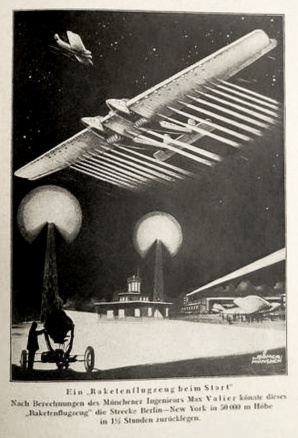
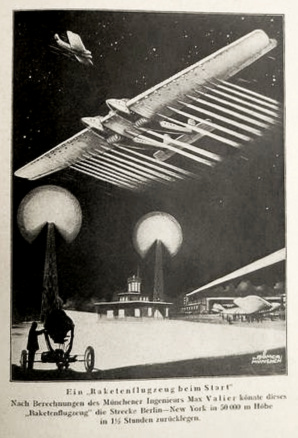
    Lubke aircraftThere’s also this terrific image of a vast rocket plane, the description of which mentions Max Valier, the rocket pioneer, Oberth-popularizer, and founder in 1927 of the (German) Society for Space Travel.  An aircraft/space vehicle like this it is noted could make the Berlin-NYC flight in about 1.5 hours. (Valier was also the first to lose his life in a failed experiment using liquid oxygen, establishing him in a very unfortunate category of “firsts”, becoming probably the first person to lose their lives in rocket flight; this is a similar category to Thomas Selfridge, who became the first person killed in an airplane crash, a 1908 test flight for the army with the pilot Orville Wright.)

    There’s not that much else I can drag out of the Lubke book given my references, though I have just ordered a copy. I’ll get back to this when I’ve had a better look at it. 

    [Image at left from bookseller Versandantiquariat Hans-Jürgen Lange, here:

    https://www.booklooker.de/B%C3%BCcher/Anton-L%C3%BCbke+Technik-und-Mensch-im-Jahre-2000-Erstausg/id/A028NHxY01ZZi]
  • The Car That Makes the Threat of Atomic Attack “Lose Some of its Menace” (1953)

    JF Ptak Science Books   Post 2687

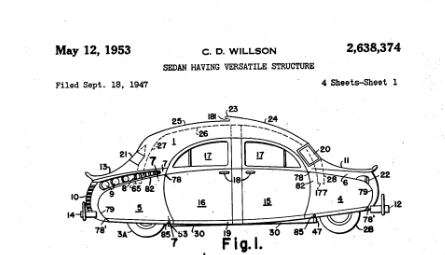
    Patent Atomic bomb car `953When i was a kid I watched a marionette-action show called Supercar–it had a high creep factor to it what with the marionette eyes and mouths and all, but I watched it anyway, I guess, because that was probably the only cartoon being broadcast at that hour. (It was filmed in “Supermarionation”, which utilized electric moving parts in the marionettes in addition to string controls. It was the brainchild of Gerry Anderson, who also brought you Fireball XL5 for which I can still sing the theme song.) And that is what struck me seeing the reasoning for this “atomic bomb car”–it really is just a car with a high creep factor that is outfitted for camping, but it is being sold in the patent as a ways for urban dwellers to survive the coming nuclear holocaust (” our greater areas of human congestion have slowly begun to face the threat of eventual atomic destruction”). Since we find the cost of reallocating everyone and all business everywhere in the US so that there is no real profile for nuclear attack because everything is spread out (or underground), it means that people in targetable cities are more or less doomed because they won’t be able to get out of town when the bombs come.

    [Image source: Google Patents, https://patents.google.com/patent/US2638374A/en]

    The author writes: “It is commonly acknowledged that the physical structures of congested areas are doomed once atomically attacked, The real problem is: how sensibly to save the lives of the inhabitants of cities thus marked for destruction and temporarily house them so that” the business of resistance may go. on in spite of the chaos engendered?”  And since U.S. citizens at the time owned 30 million cars, there was a potential to have 30 million bomb shelters (or  whatever) on wheels. (This is also the first time I have seen the phrase “atomically attacked”.)

    And then this, in classic patentese:  “The primary object of this invention is a practical means of implementing and temporarily maintaining mass diffusion from congested areas threatened with atomic attack, and in a manner related to proved public preferences, to mass production techniques and to prevailing trends”.

    “Yet, once some practical: i. e., simple and economically possible, means is found for making the average car quickly convertible to housekeeping use, then the threat of the atom bomb to our cities loses some of its menace. Once swift mass diffusion is properly implemented, it becomes susceptible to military organization. The city might be bombed, but its population could be saved.

    Anyway, the car is basically a camper, though it is still just a car. I’ve got to give the guy his credit because there are some interesting ways in which seats fold and are made into beds and tables and such.

    There’s enough in this patent to suggest that what we are dealing with is more than a simple salve me fons pietatis, that it is more than just a car with convertible beds that is renamed something like “High Speed Survival Encapsulator and Escape Vehicle”. And the vast dependent clause for the utility of this vehicle to save U.S. civilization is for (1) millions of people to evacuate a high-density location in an orderly fashion and given the time to do that in, and (2) there was no “2”. So, once you get fair warning and make your way out of the city in your bubblecar to the fresh countryside, loaded down with family and water and food and toilet paper for a few weeks and 10 cartons of cigges per person, you’d be on your way to surviving in Tomorrowland.  

    It is a Supercar–it just doesn’t fly, or doing anything particularly special. Probably though you couldn’t fit much else in there because it is already filled to the brim with audacity and hope, and a certain stink. 


  • The Pre-History of Imaginary Robots: Electric Deer, 1892

    JF Ptak Science Books    Post 2566

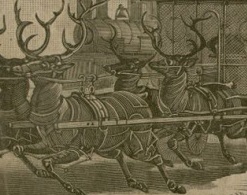
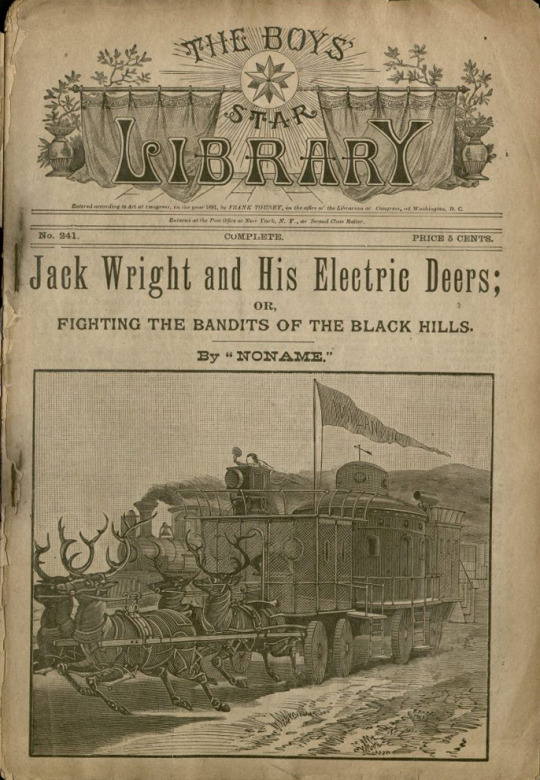
    Rebecca Onion at Slate Vault surfaced this very interesting image of electric breath on her twitter account (@Slate Vault), showing early robotic creatures alive and well and living in the minds of thousands of young kids, placed their partially by stories like this found in the pulpy pages of Frank Tousey’s Pluck and Luck in 1892. The image  (from the special collections library at the University of South Florida (here)) shows yet another work of genius/ingenuity by the endlessly adventurous “Jack Wright” a boy inventor, who seemingly went everywhere, did everything, and had the stuff to make it all happen.

    I’ve posted1 many times on this blog about 19th century imaginary robotics, and had not seen this Wright story and his fabulous “electric deers”. 

    Robot deer detail

    This Jack Wright adventure was written by “Noname”, who turns out to be by Luis Senarens (1863-1939)2, a very prolific and early sci-fi writer, a Brooklyn boy, who had been referred to as an American version of Jules Verne.  Senarens wrote beginning in the 1880’s and was no doubt much taken by the new applications of electricity, and Senarens applied it quite liberally. In a quick browse, he introduced electricity inventively, sprinkling it liberally over powered machinery and introducing his own electric ocean liners, submarines, sledge boats, canoes, air-schooners, locomotives, balloon ships, torpedo rams, horses, and no doubt much else. I’m glad to have caught up to Mr. Senarens’ robots.

    Robot deer

     Notes:

    1. Just search “robot” in the google search box at upper right.
    2. See the Edward T. LeBlanc Memorial Dime Novel Collection for very much expanded info on this and other series:  https://dimenovels.org/Series/734/Show

  • A Good Reminder About What Slavery Was (1863)

    JF Ptak Science Books  Quick Post

    Slavery christian position178

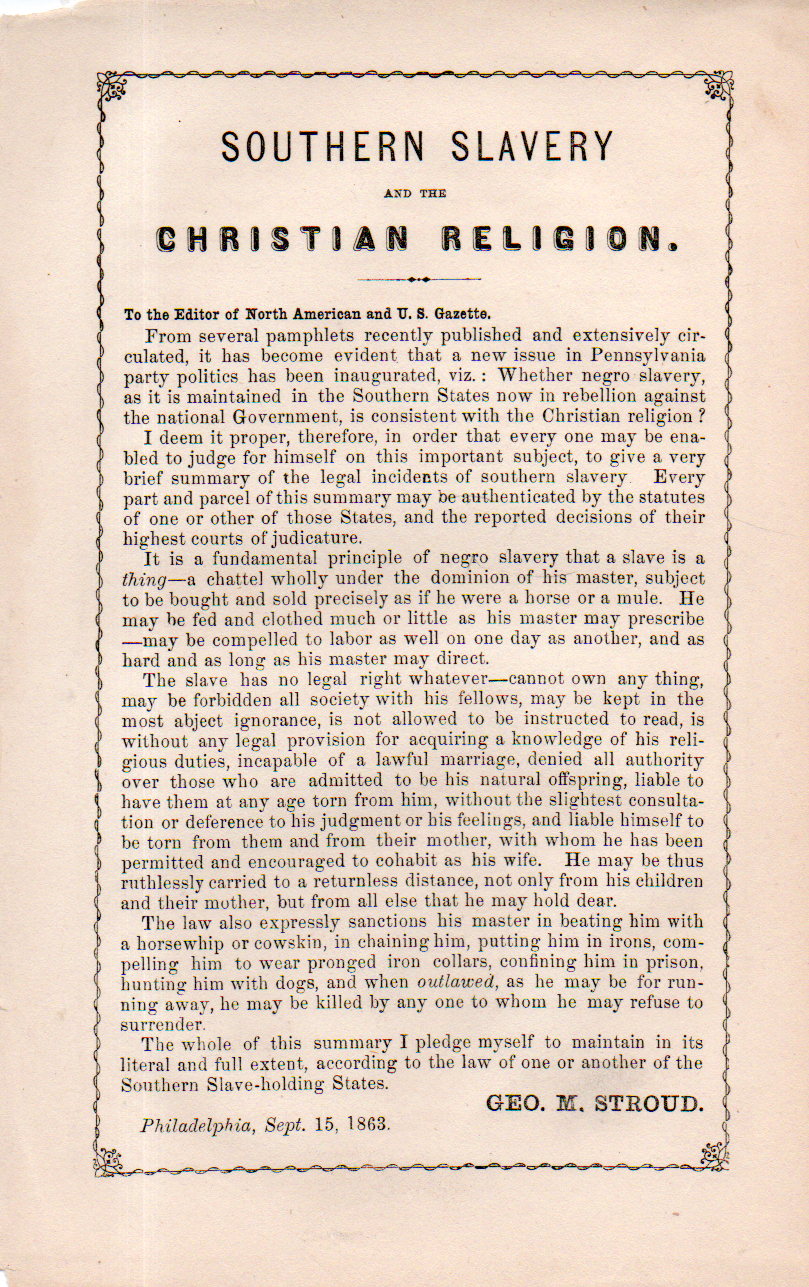
    With all of the recent discussion about the efficacy of displaying the Confederate battle flag and the curious discussions about what the Civil War was, um, “about” (mostly the old and tired and semi retro-historical States’ Rights vs. Slavery argument), I think it would be interesting to have a look at what George M. Stroud wrote regarding slavery and Christianity.

    The medium is a simple broadside/handout, about 8×5 inches, only, and was published in Philadelphia on September 15, 1863.  There’s a lot in those six paragraphs, and it is well worth a read.  (Note:  “negro” appears here uncapitalized, as was the practice to ensure a further inferiority of the race–“Slavery”, on the other hand, is capitalized.  “Negro” would not appear in capitalized form in common use until the 1930’s.)

    Stroud was a legal expert on the issue of slavery and delivered devastating and accurate reports on the slave laws and treatment of slaves in twelve-holding states. This one leaflet is I suspect about as good a summary of slavery on 20 square inches of paper as can be, 

    “Stroud’s Slave Laws had extensive influence upon national legal thinking on the issue of slavery. In a blanket survey of slave codes of the period, he analyzed the statutes of twelve slaveholding states. Stroud’s book exposed to the world, through its publications in 1827 and 1856, the diabolical nature of legal enactments throughout the South that debased both African people and those who held them in bondage.”–from the Black Classics Books, http://www.blackclassicbooks.com/strouds-slave-laws-george-m-stroud/

    And from the Internet Archive is Stroud’s great classic of 1856,  A Sketch of the Laws Relating to Slavery,   https://archive.org/details/asketchlawsrela00strogoog

    ·Posted by :

    ·in:


  • The United States Invaded, 1916-1944

    JF Ptak Science Books  [Expanding an earlier post from 2013]    

    There were 75 entries to this blog in June–see archive at left to access

    • “The cheek of every American tingle with shame as he reads the silly, flat, dishwatery utterances of the man who has been pointed out to intelligent foreigners as the President of the United States”–The Chicago Times, on the Gettysburg Address, 1863

    We all know today what to expect when we hear something referenced as a Gettysburg Address–and we certainly know what something might be if it was referenced as not-the-Gettysburg-Address.

    The address as it was when Lincoln gave it didn’t even have a title, named as it was post  facto by the newspapers and periodicals covering the event (on the spot or remotely).  The speech is considered as being among the greatest ever given by an American, though at the time it its reception was very mixed—in many cases it was seen as a failure and even as an embarrassment to the solemnity of the moment and place. There were many newspapers which panned the speech (as in the case above with the Chicago Times, which at the time was considered more of a Democrat paper than anything else), while others (like the New York Times gave the speech a warm reception.   The speech’s presence in national memory was crafted over time (not unlike Mr. Leonardo), its perception formed into the polished gem that it is seen as being today. 

    The possibility of the implied actions of the titles of the pamphlets below were somewhat similar, though mostly in reverse.  I’m not saying that some of them were always seen as quacky and the works of demented seers; their titles and possible content, though, were not seen as dismissible, and their concerns were real and a possibility. The concerns over “invasion” today depend on what invasion means.  I don’t imagine that people are seriously considering the possibility of a land or air force attacking this country, though other sorts of invasions (biological, chemical, cyber, etc.) are a possibility.    

    ==Blog July 15==bsttle for amer

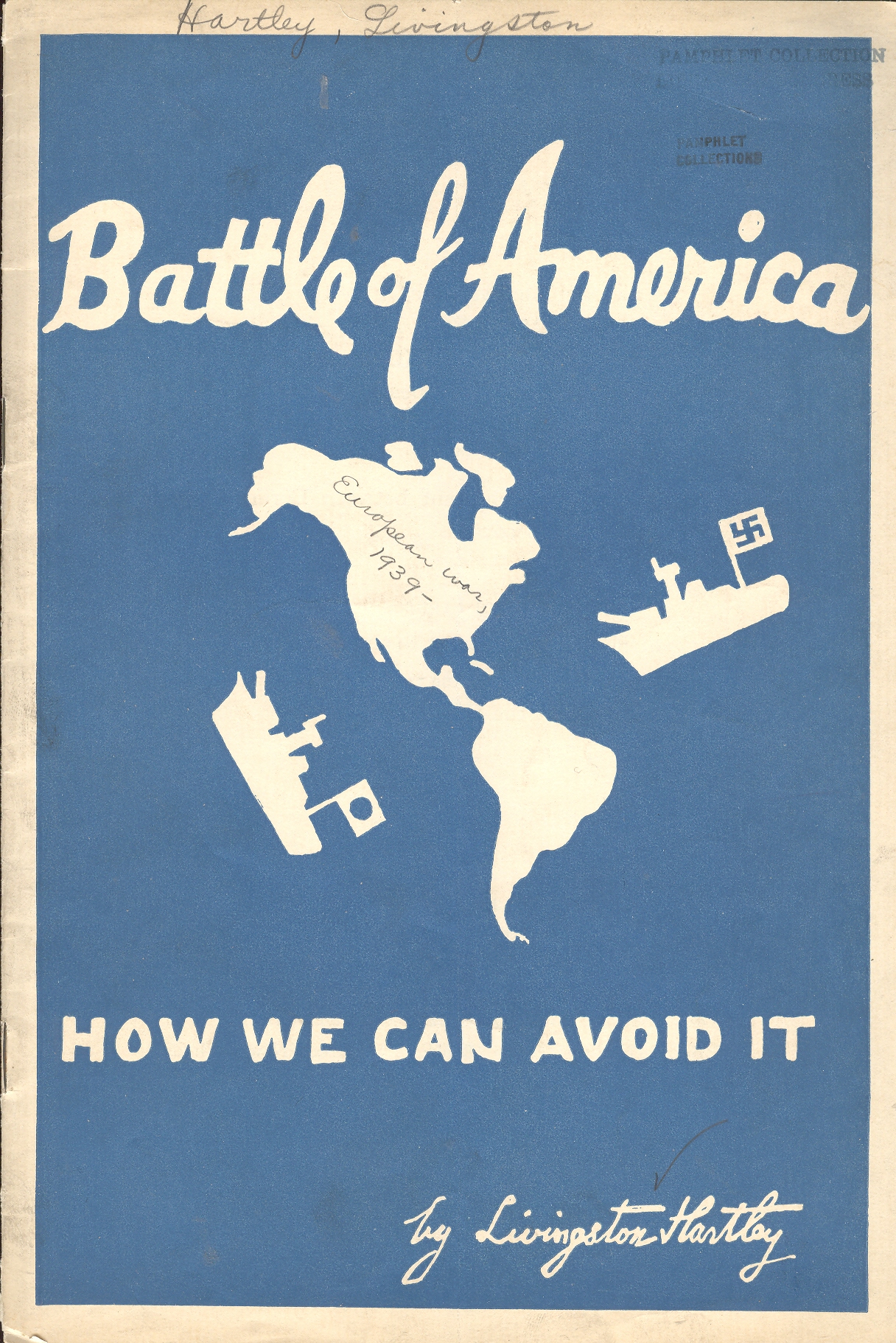
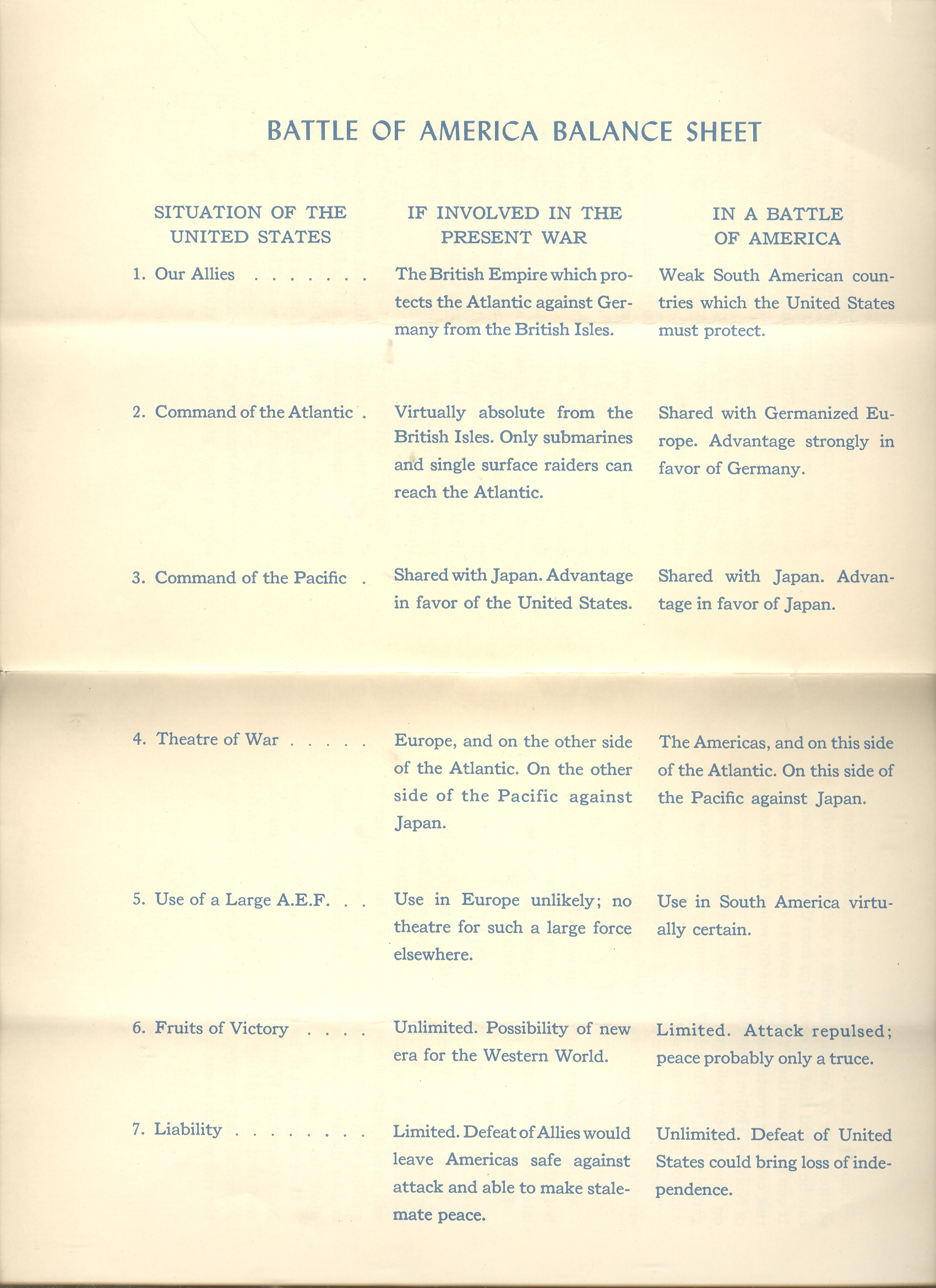
    The Battle for America/How We Can Avoid It (1939) was published by the Committee to Defend America by Aiding the Allies (and headed by William Allen White, iconic middle America newspaper editor and editorialist) which attacked isolationism and advocated strong support of the European effort.  The thinking here was that if America didn’t become involved now it would so later, with battle lines of a Nazi-illuminated truce drawn close to American borders.  So it was a pay-now-or-pay-more-later position from a man who supported the New Deal but whop didn’t support FDR. 

    ==Blog July 15==battle detail


    Much of this thinking looks a bit tenuous to me.  For example the position excluded the use of an American expeditionary force in Europe (“for theatre for such a large force elsewhere”), though if nothing at all were done there would be a “certain” use of the AEF in South America combating Nazism.  Also, if the U.S. backed the Allies with supplies and war materiel the “liability” to the US in the consequence of European defeat “would leave America’s fate against attack and able to make stalemate peace”.  So at the very least, doing a little bit of something would d at least allow us to make a truce with the German/Japanese alliance.   Doing nothing at all in this area would infer “unlimited” liability, and “defeat of the United States could bring loss of independence”. (“Could”?)

    The way aid ourselves in this war “(was) to aid  Britain to hold out to defeat Nazi Germany….the chance for Britain to hold out and win is a good risk for America”.

    America Invaded Tetens166

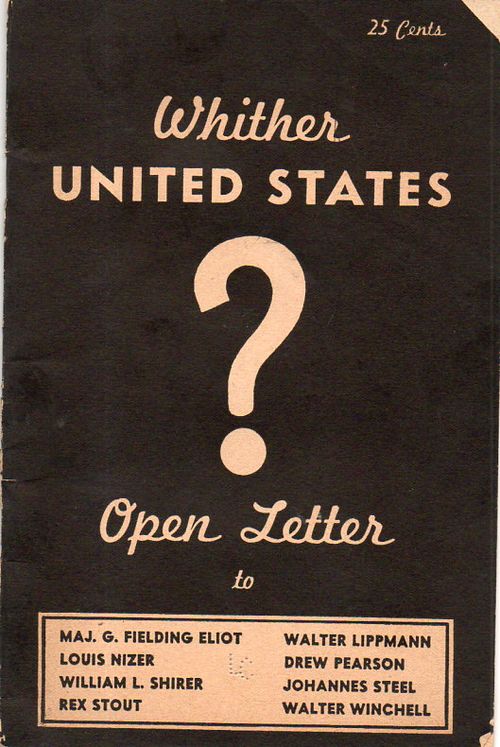
    Then there is Whither United States?, written fairly late in the war (1944) by T.H. Tetens, who was a journalist (born 1899) thrown into a concentration camp in 1933 and who subsequently escaped, making a career in the U.S. The provocative cover brings up a real issue inside, as Tetens questions how people are appointed to sensitive positions in the war-time. His major example is Hans M. Hoffmann, who was appointed to a critical post in the Office of War Information.though Tetens’ investigation shows that Hoffmann was the editor of teh Staats Zeitung, which was pro-Germany and Hitler-supportive through Hoffmann’s tenure there from 1933 to 1941. I don’t know about Hoffmann–he doesn’t show up in any of my references here and doesn’t make an appearance in this capacity on the internet, but Tetens seems to make a very strong point.  And hence, I guess, the large question mark.

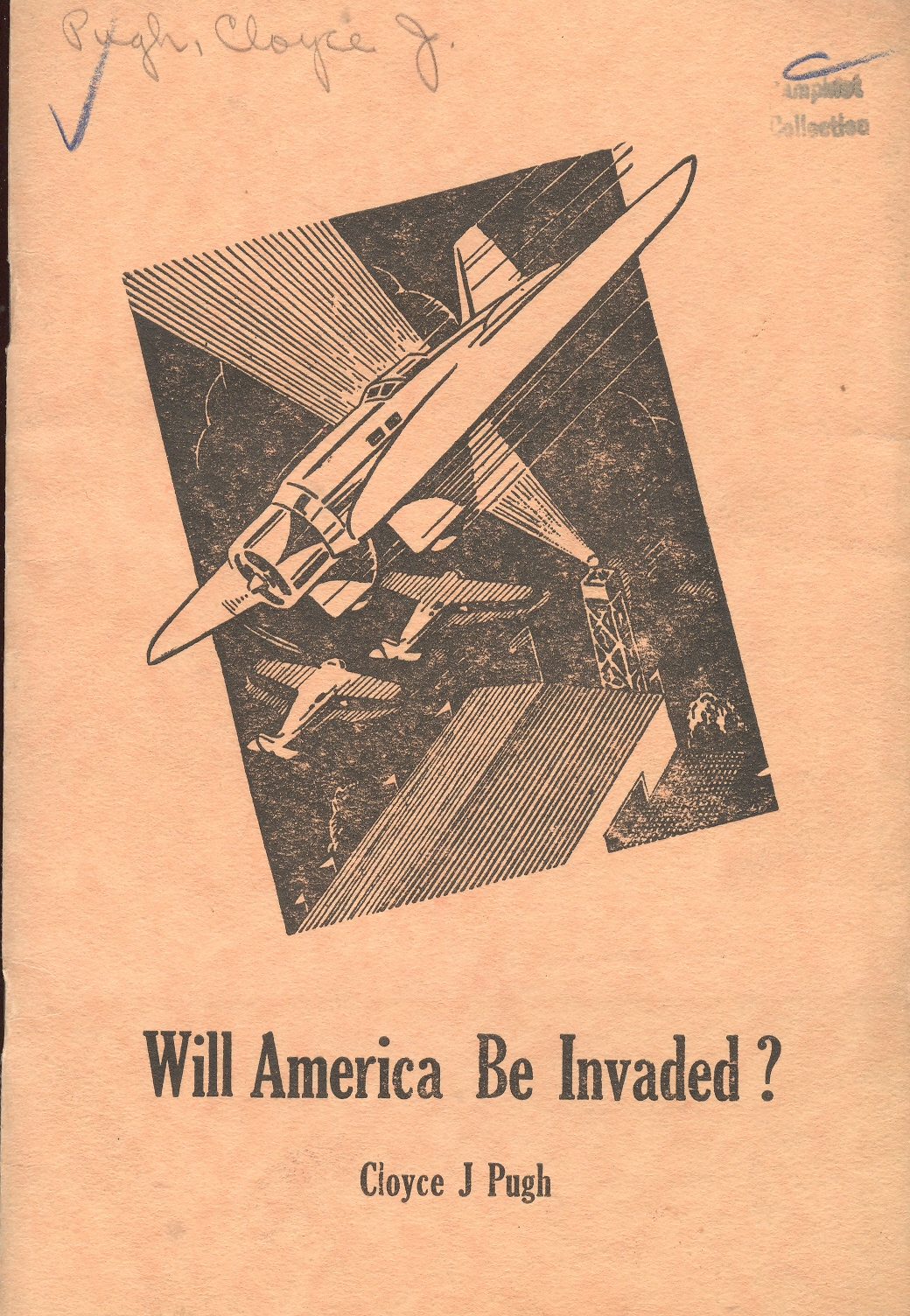
    The next pamphlet, Will America Be Invaded, was published by the Christian Fellowship Press in Akron, Ohio, in 1941, and leans mightily upon scripture to state assumptions about the coming menace to America being presaged in the Bible.  That invasion also seems to be allowed by God (according to prophesies and such) in pursuit of murky results.  The conditions which will prevail “when God permits invasion” (according to this person’s reading of the bible)) include the formation of monopolies, extensive wine and music, “unbelief in God’s judgments”, conceit, “wine and bribes in high places”, and “perverted moral stanfa5rds.  All of this—it is claimed—can be remedied through one medium:  prayer; and prayer through only one mediator, Jesus Christ, who would then take the communications to god’s ear.  

    ==Blog July 15==will america be


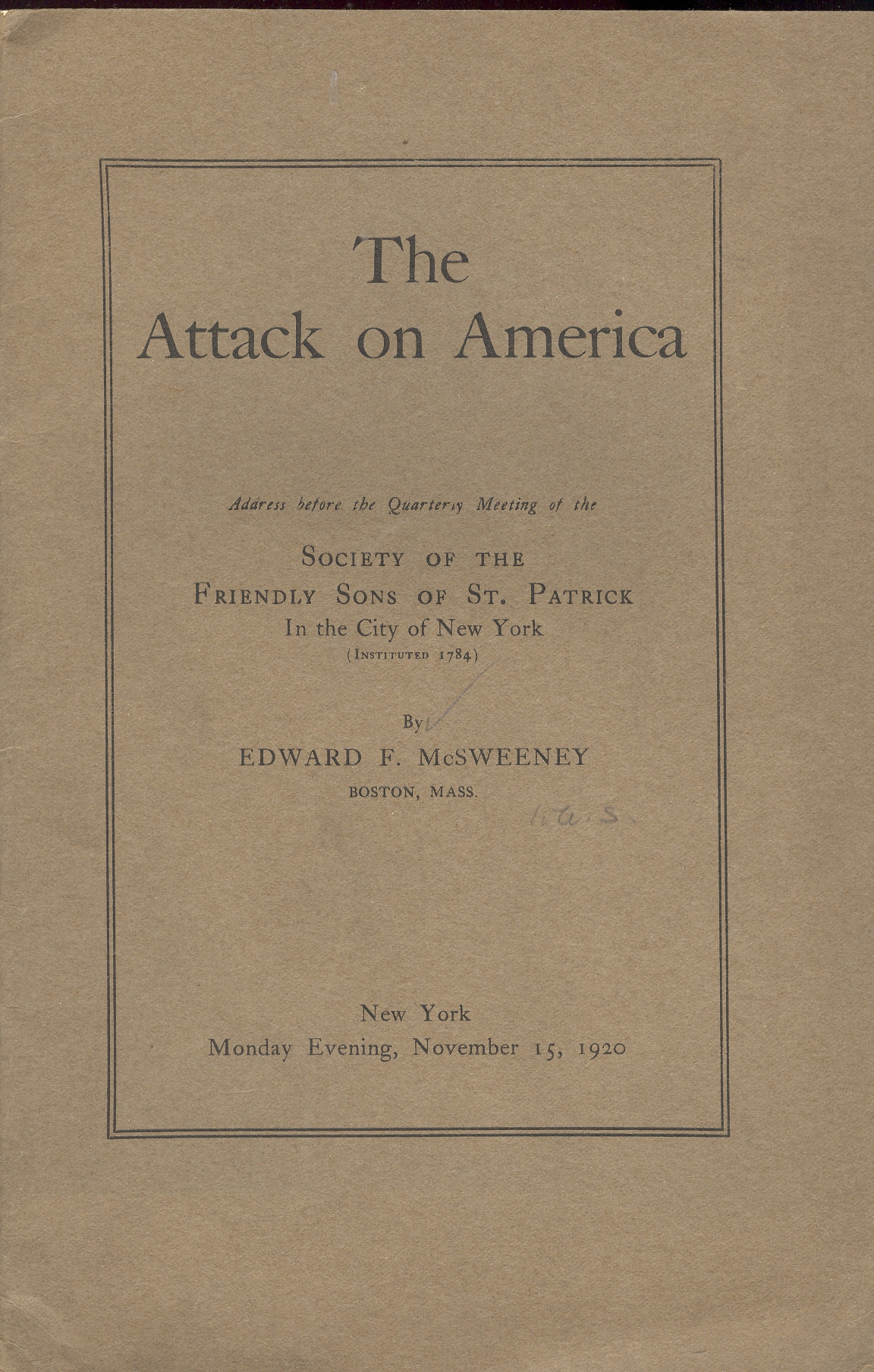
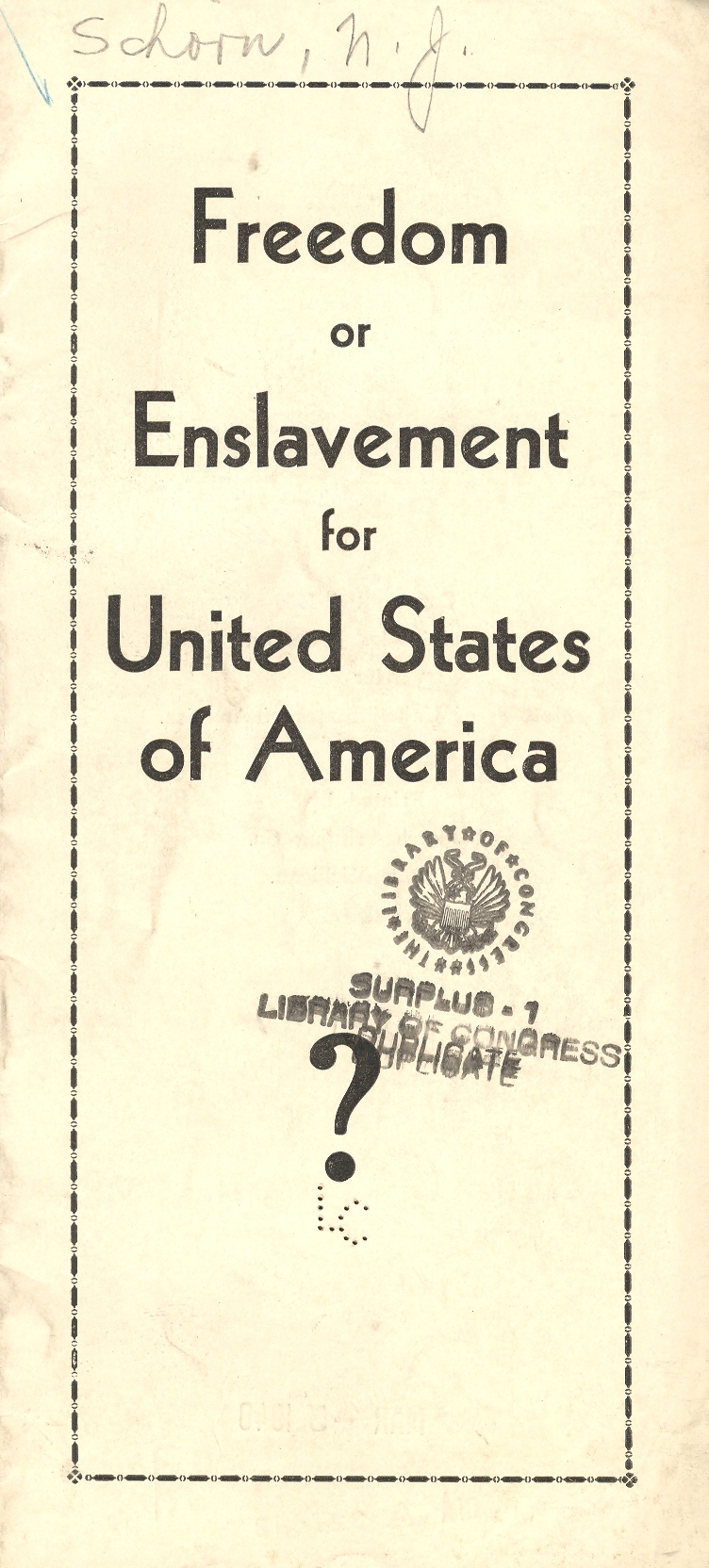
    The Attack on America, published by the Friendly Sons of St Patrick (of NYC), was a cautionary pamphlet published in 1920 warning against certain dispassionate evils of British propaganda in the United States.  Freedom or Enslavement for United States of America (sic), published in 1939 for the Mothers of United States of America (sic) advocated a freedom policy that prohibited conscription in foreign wars and would present a state of permanent neutrality. It also made some pretty vicious anti-Roosevelt attacks, finding him the Socialist root of the coming empire of American evils with a wildly power-mad and legislative-grabbing presidency.

     ==Blog July 15==attack omn amer

    Quite a grouping of pamphleteers concerned with the potential overthrow of the United States, each seeing the unfortunate possibility of national death via divergent and disparate means:  the fall of the country due to not being part of the Allies during the war and also for being in it; biblical ordination of invasion that is only combatable through prayer; British and European propaganda control of the national welfare; and of course the diabolical Socialist menace of Franklin Roosevelt and the imperial presidency as the ruination of the nation’s future.  All of this gently hidden by disturbing titles which really don’t give you a hint about what wildly unexpected ways the end was approaching.  And whatever they were, they were definitely not high-order thinking.

     ==Blog July 15==america slave


    And then there is this:

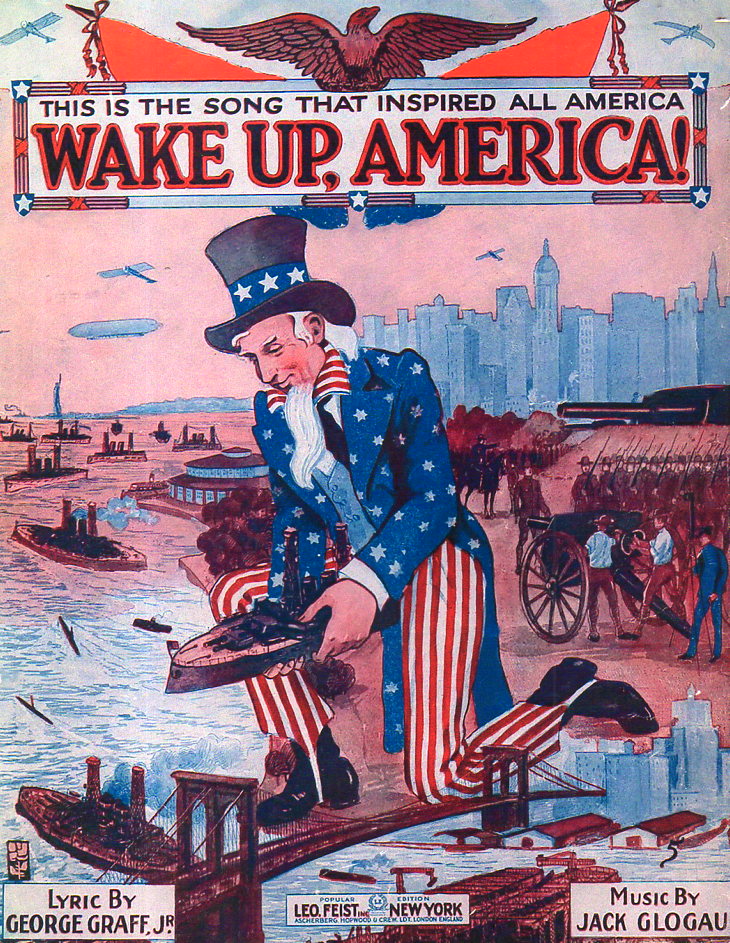
    America Invaded  Wake Up Amerrica 167

     To listen to the song, check out this link to the Library of Congress  (male solo, orchestra), 1916. 


  • Votes for Women, 1872: “When we vote we’ll fix those terrible men”

    JF Ptak Science Books   Post 2468

    In-between research bits I’ve been spending some time moving around in the Levy Sheet Music Collection at Johns Hopkins–there’s a lot of interesting stuff and it has a pretty big online footprint.  I’ve been working on an alphabet of illustrated sheet music covers having to do with the Moon, and collecting some images for tanks and aeroplanes–and just yesterday I posted a great piece of sheet music on the telephone (from 1877).  

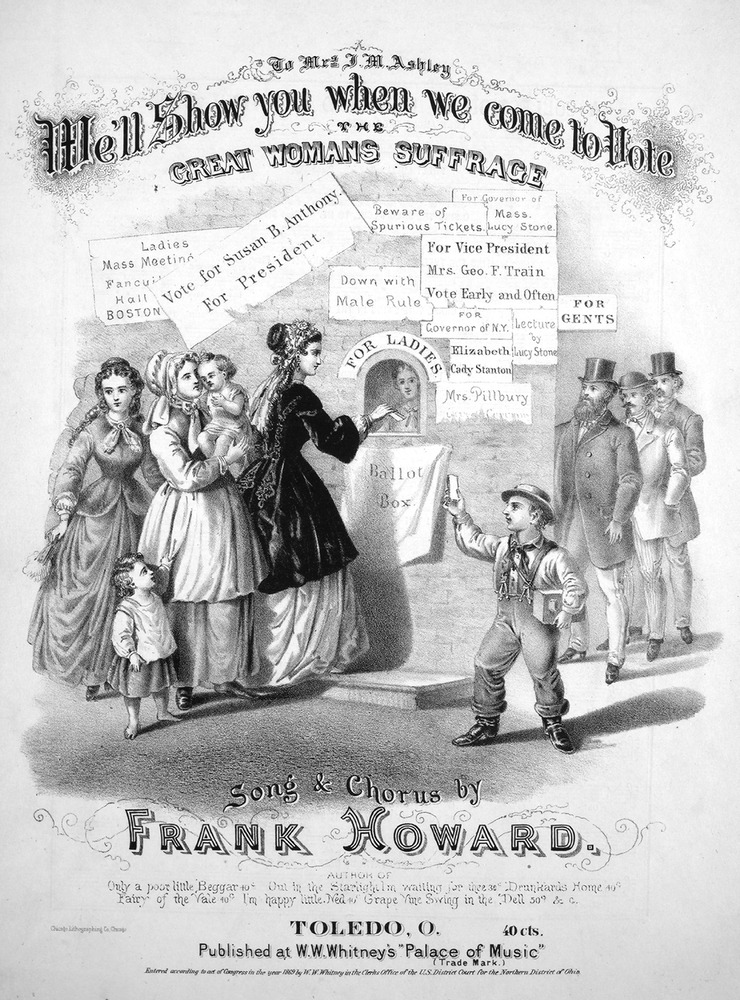
    Music vote for womenSource: Levy Sheet Music Collection, Johns Hopkins, here: http://levysheetmusic.mse.jhu.edu/catalog/levy:016.127

    The unfortunate piece of this is that while searching “Moon” I bumped into a number of severely racist covers. This has happened before, doing benign searches on “comet” and “stars” and such, looking for the physical sciences in pop music in the early 20th century, and finding racist covers among the few bona fide examples located.  It certainly speaks to an endemic and deep racism in general when you can depict a meteor with a terrible caricature of an African American, or a song called  “If the Man in the Moon was a Coon”.  Taking this a little further I did a search under “coon” and found over 100 non-repeating titles with covers from this collection–many of the covers are astonishingly bad. (Another search on an even more odious word turns up more examples.) On the one had they speak to a searing but very accepting and casual race-hatred and are a lesson in themselves, especially when you can scroll through them all in a single pass. On the other hand, I don’t want to be in such close public proximity to these horrible things.  

    The path regarding posting those covers is not clear.

    In the meantime I would like to share this fantastic womens’ suffrage sheet music, published early on (1872) in the fight for the vote, though the lyrics are much more confrontation than the cover art.  (Except of course that the very imagery of women at a polling station–an event mostly entirely not allowed in the U.S. until 1919–which would have been jarring on its own to nearly any uninspired man looking at it.)  Remember too that this is only three years after the first national suffrage organizations were founded (one by Susan B. Anthony and the other by Lucy Stone), so the national attitude towards the idea of women voting as a popular movement was still quite young.

    The lyrics paint a fairly dismal picture for women, “trodden underfoot we’ve always been”, “locked up like slaves”, “wretched”, “treated with contempt and scorn”. On the other hand when given the right to vote, the refrain at the end of each of teh four stanzas is the same save one word describing men:

    “When we vote we’ll fix those terrible men”. The “cruelest knaves” are then  referred to as “those dreadful men”, “those wicked men”, and then finally as “those awful men”.  Probably this was not so far from the truth.


  • An Index of the Treatment of the Insane, 1875

    JF Ptak Science Books    Quick Post    

    History of Fear series

    Insane poor987
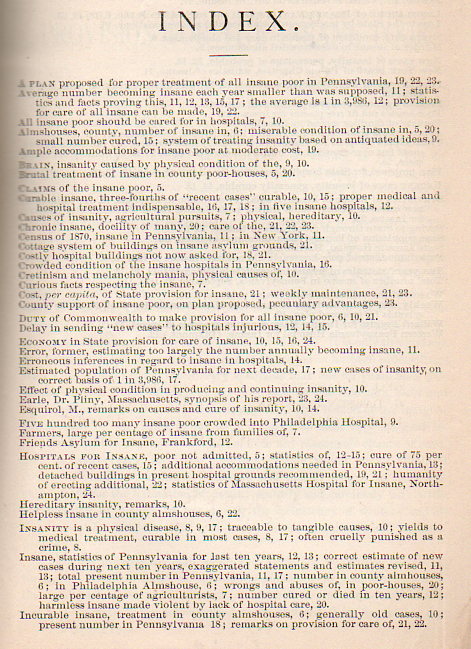
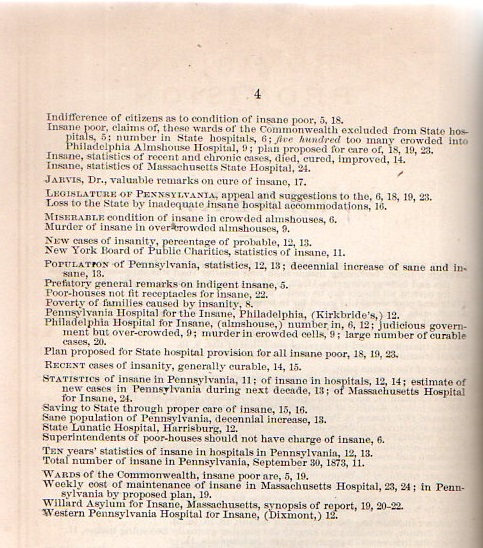
    I wish there was more time so that I could scan and post the contents of this pamphlet, though sometimes you can get a pretty good insight into a work by reading the index–this is one of those times:

    Insane poor986

    • This pamphlet may be purchased through the blog’s bookstore, here.

    It is a tough go.  

    I had a difficult time categorizing this pamphlet outside of the obvious “history of medicine” category (broad, I know, but this is mainly a physics/maths place).  I did choose “History of Fear” as a category because in many cases the insane–and especially the unreachably insane, and beyond even that, the poor and unreachable insane–because there was little these people could “offer” to the world on the other side of their eyeballs other than the reminder that this condition could happen to anybody; that, and of course the state of physical fear because the medical community didn’t know what to do with these people for the most part.  This becomes painfully obvious before a reader makes it past the two pages of the index.  

    Insane poor988


    Notes:

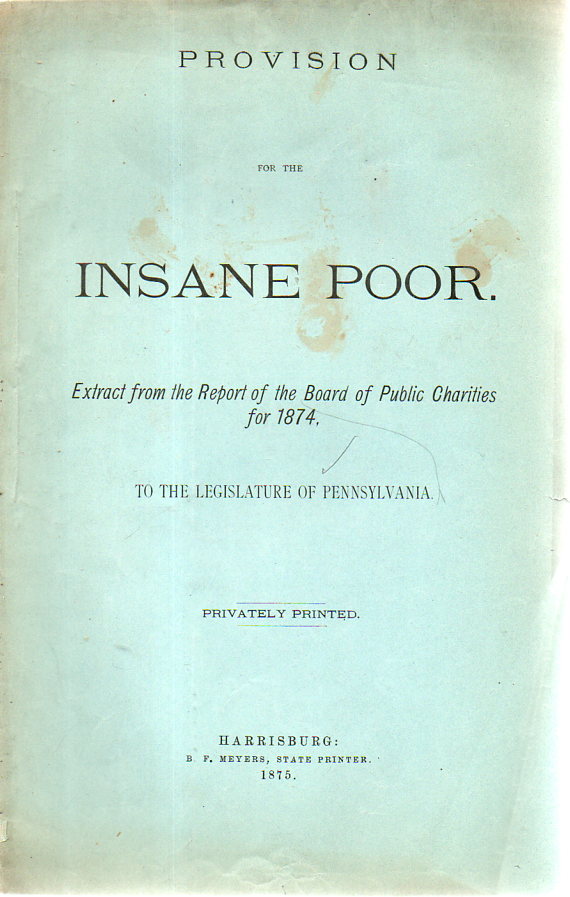
    Provision for the Insane Poor. Extract from the Report of the Board of Public Charities for 1874.  Harribburg; B.F. Meyers, State Printer, 1875.  9×5″, 24pp, original printed wrappers.  Deaccession stamp on rear wrapper; also s small oval “Library of Congress/Smithsonian Deposit” stamp on the title page.  Four copies located by WorldCat: Duke, University Chicago, NY Academy of Medicine, College of Physicians of Philadelphia.  

    ·Posted by :

    ·in:


  • A Note on Hitler and Women, 1933

    JF Ptak Science Books   Quick Post

    I was reading in The Nation, 19331, and stumbled upon the article “German Culture in Exile”, which was poking through the brittle blocks of Hitler’s newly National Socialistically crumbling society.  What caught my eye in particular was this note about the role of women, which although I knew about this still put it all in a different light: 

    Nazi women351

    This was all quite different from the experience  of women in the Weimar society (1919-1933) where the new democratic experience resulted in numerous advances not the least of which was the right to vote.  Nazis in–women, out.  Except, really, for the home and hearth and reproductive part, substantially different from women comprising 35% of the workforce in 1925.   And just for the serendipitous aspect of it I checked out Mein Kampf on the Internet Archive: I did a text search and found only 22 mentions of “women” and eight for “woman”; on the other hand “men” occurs 2839 times, and “man” 2773.  Does this mean something?–well, yes.  But the question about what it means is quite something else, the answer to which I am not privy. But it does seem to support something obvious in and of itself.  


  • History of Fear: Money and Failure in 1933

    JF Ptak Science Books  Post 2317                                                            History of Fear series

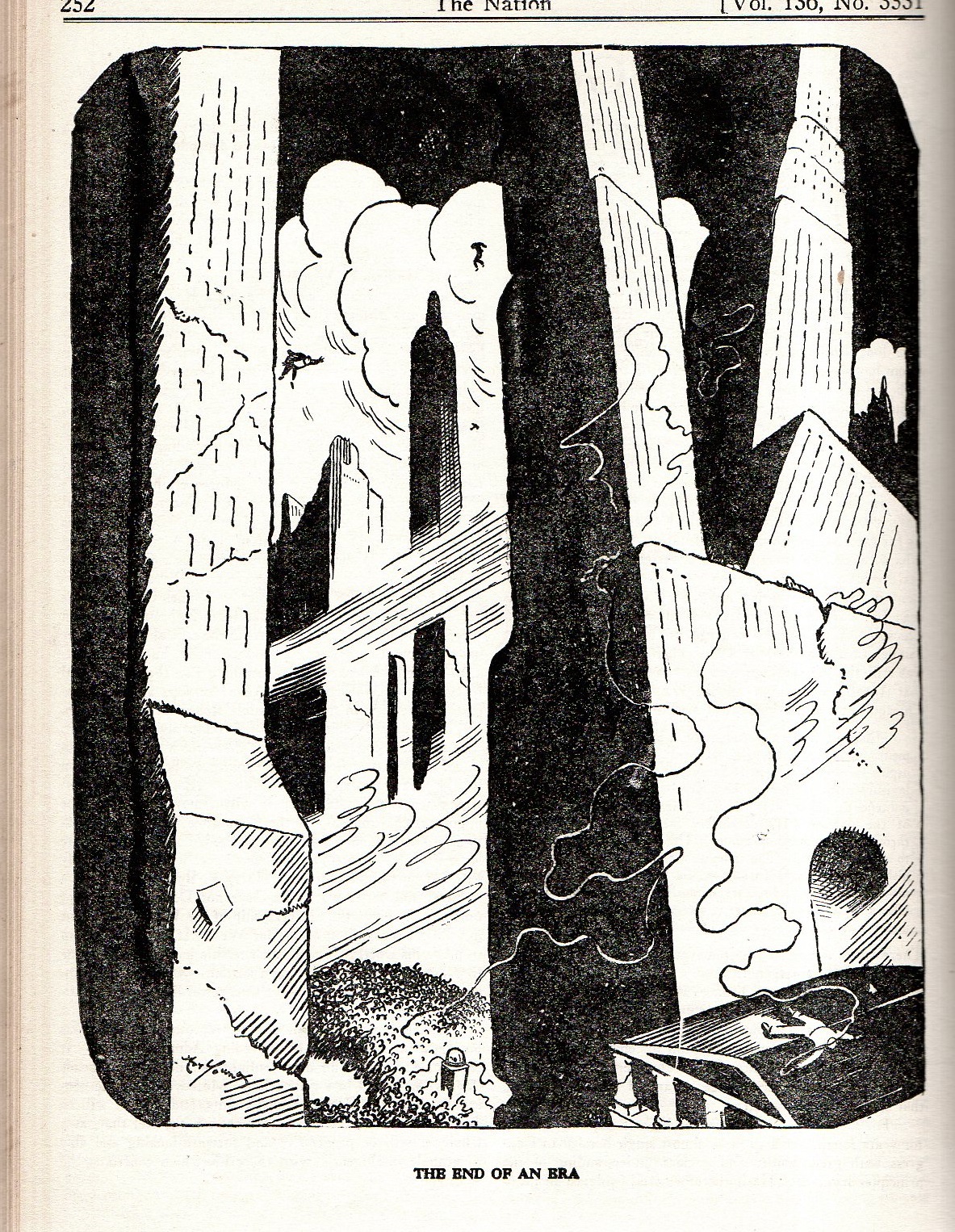
    What this toughly bleak political art is referencing was the gloom and doom of the corruption of the economy, with fortunes and family savings lost, of despondencies, of mass failure. It appeared in The Nation for the issue of March 8, 1933, the first issue printed in the newly inaugurated Roosevelt presidency, four days after the famous inaugural “The only thing we have to fear is fear itself” speech. [See here for text of the speech as well as audio.]

    Nation jumpers317

    So in the first 1100 days or so of the Depression, there was plenty of fear to fear, not the least of which was booming unemployment. The average rate of unemployment for this period went from 3.2% in 1929 to:1930: 8.9%;1931: 16.3%; 1932: 24.1%; 1933: 24.9%; 1934: 21.7%; 1935: 20.1%; 1936: 16.9%; 1937: 14.3%; 1938: 19.0%; 1939: 17.2%.

    There was also the general malaise and partial breakdown of the production of the country as a whole, as measured by the U.S. Gross Domestic Product, which (in current dollars) looked like a retracting landscape, with the pre-crash 1929 figures being $103.6 billion, followed by 1931 at $76.5, 1932 at $58.7, 1933 ($56.4), 1934 ($66 billion and the beginning of the Roosevelt era and through 1937 a period of fantastic recovery and growth); 1935 at $73.3, 1936 at $83.8, 1937 at $91.9,1938 at $86.1, 1939 at $92.1, 1940 at $101 (which was the year that mobilization began in earnest, with huge/record spikes in production); 1941 at $126.7, 1943 at $198.6, 1944 at $219.8, 1945 at $223.

    (And just because I have the figures at hand, the amounts of government spending during the Hoover years were 1929: $9.4 billion; 1930: $10; 1931: $9.9;1932: $8.7; then under Roosevelt in 1933: $8.7 billion: 1934: $10.5; 1935: $10.9; 1936: $13.1;1937: $12.8; 1938: $13.8;1939: $14.8, followed by the war years and buildup, which in itself was explosive growth 1940: $15.0 billion;1941: $26.5;1942: $62.7;1943: $94.8;1944: $105.3; and 1945: $93.  The average government spending as a percentage of GDP under Roosevelt increased to 15% in the 1933-1939 period from 11% under Hoover; during the mobilization the average expanded to about 35%. )

    So, the social commentary by the artist was really a slapping announcement to all readers that the crash of 1929 was still crashing, that the economy was still failing, and that things were getting worse.  Welcome to Washington, Mr. Roosevelt.  

    ·Posted by :

    ·in:

    —