A Daily History of Holes, Dots, Lines, Science, History, Math, Physics, Art, the Unintentional Absurd, Architecture, Maps, Data Visualization, Blank and Missing Things, and so on. |1.6 million words, 7500 images, 4.9 million hits| Press & appearances in The Times, Le Figaro, Mensa, The Economist, The Guardian, Discovery News, Slate, Le Monde, Sci American Blogs, Le Pont, and many other places… 5000+ total posts since 2008.

Category: Future, History of the

  • New York City in Danger of Attack (1917)

    JF Ptak Science Books   Overall post 5149
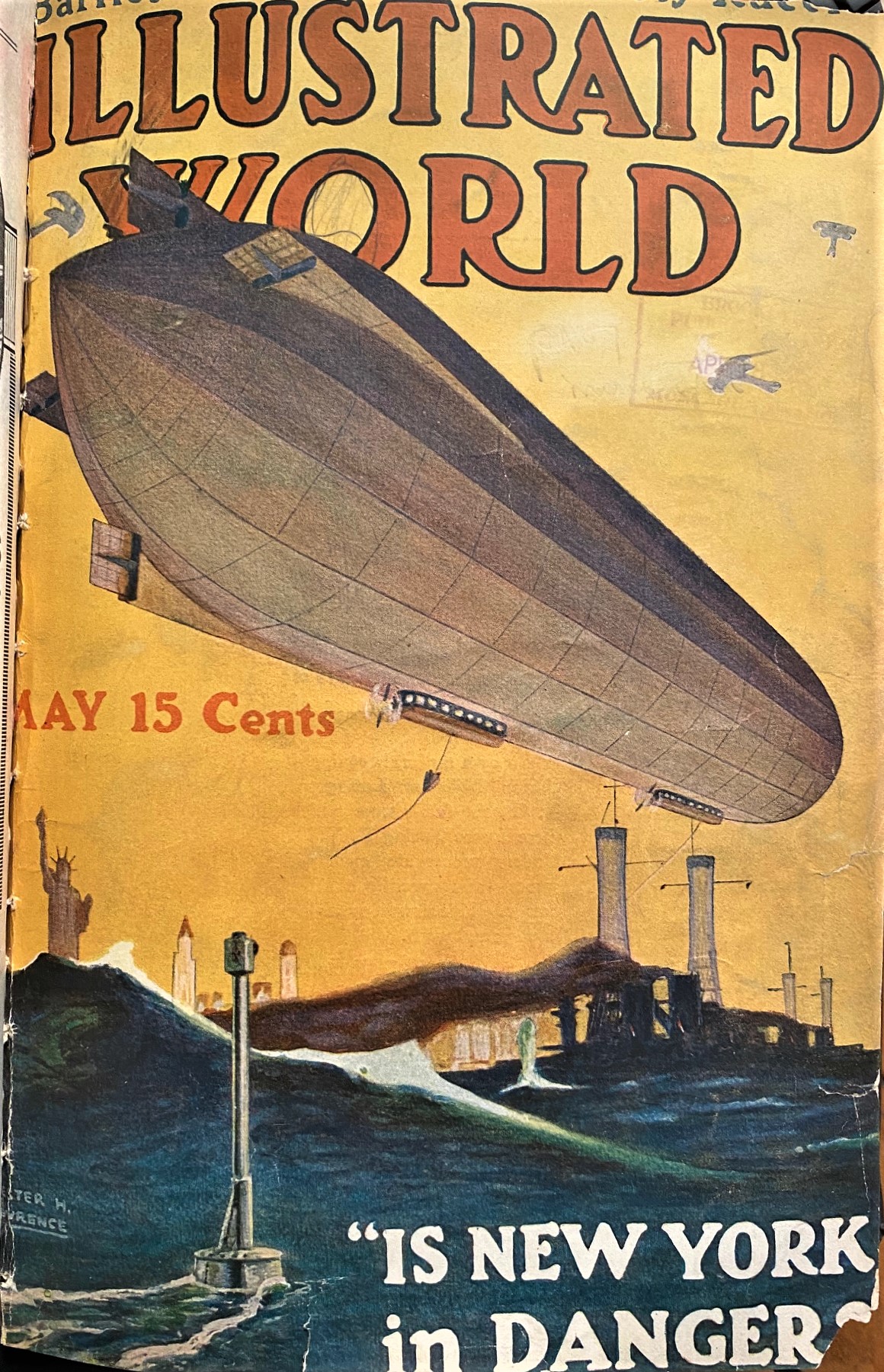
    IMG_8774The New York City harbor looks pretty rough in this picture, tall whitecaps with surprising little reflected in what should be pretty choppy water, meaning that light should be reflecting everywhere, a difficult collection of reflected reflections. 

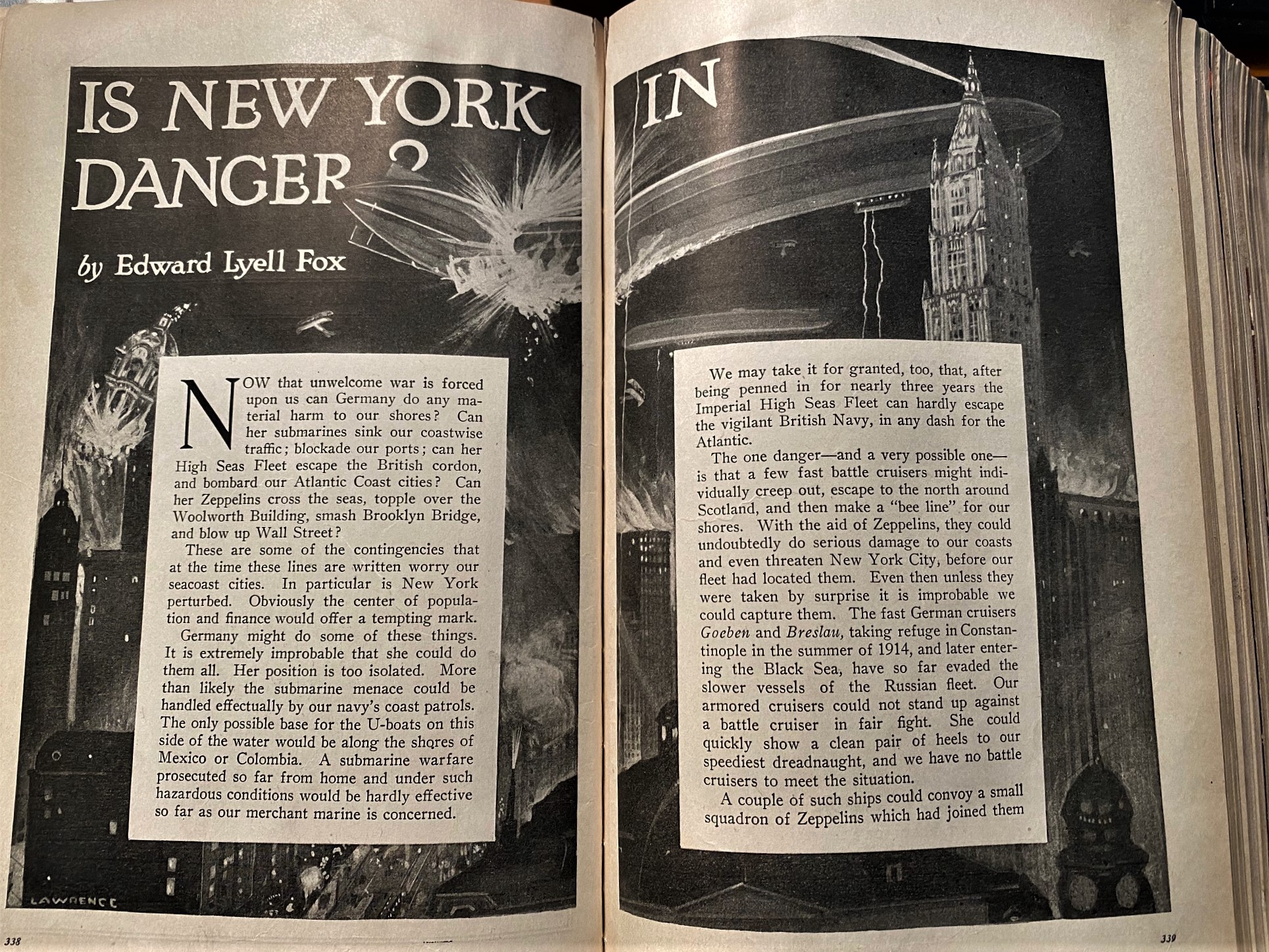
    [Image source:  May 1917 issue of the uncommon magazine, Illustrated World. The entire article is reproduced below.]

     The submarine, battleship  and zeppelin menaces were real, at least in Europe or in the Atlantic–the aeroplanes far less so.  But the applications of these fears directly to American shores were still very distant things, particularly when it came to an attack on New York City–except of course that the U.S. had just declared war against Germany, finally, just a few weeks before this issue was published.

    The war began for real in Europe in August, 1914, so the fighting had been going on there in fratricidal earnestness for two and half years, costing millions and millions their lives and limbs.  America had been isolationist and non-interventionist up until this point, remaining sweatily on the sidelines, until the capture of the infamous Zimmerman telegram, which was a coded message sent from Germany (the German Empire) to Mexico (and taken by the Brits as it was sent, the crypto-folks of Room 40 breaking the thing) suggesting that Mexico join in a war against the U.S.  It hit the American press on 1 March, and the story exploded–literally. This is what the beginning of war looks like, sometimes.
    IMG_8776

    So perhaps there was some amount of yellow journalism involved here, and some inflationary propaganda as well, and some good-old profit-taking on a half-sci-fi story–on the other hand, the German Empire did just sink 800,000 gross tons of shipping during the 30 days of April (1917), so sub fears were in general real and palpable.  The issue of them sighting the Staten Island Ferry though was quite another matter. 

    The first American soldiers would arrive for fighting in June.  The whole thing would be over in 17 months, which is well less than half of the time that the U.S. spent in WWII. 

    The United States would suffer 116,000 military deaths during its part of the war–a small fraction of the overall military deaths (9 million) and a smaller part still of overall deaths including civilians (totaling 16 million).  There would be 205,000 American wounded in this conflict, a little less than 1% of all war military casualties. 

    It would be interesting to see the coverage in England of the American invasion fears.

    [Article continues below]

  • “We Need a Stroke of Genius.” (RPF, 1946)

    JF Ptak Science Books   Quick Post

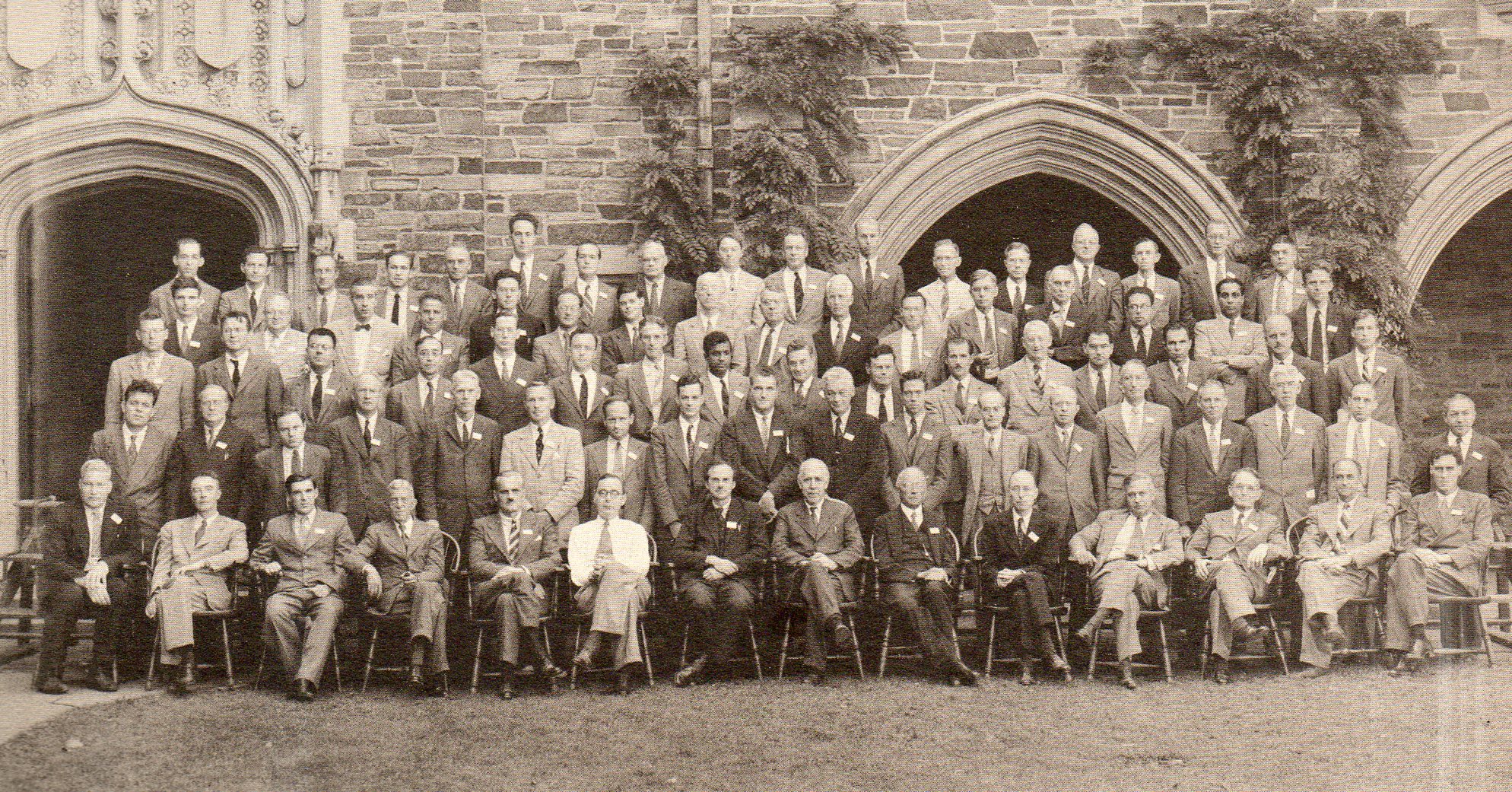
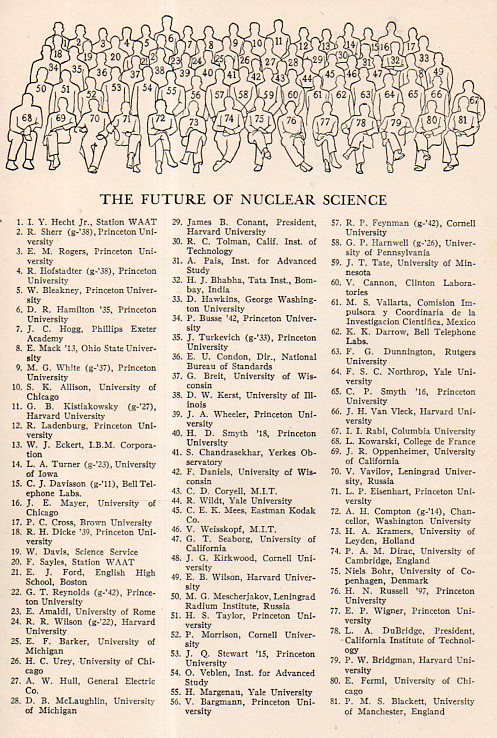
    The Future of Nuclear Science, Princeton University Bicentennial Series, Series I Conference I (1946), with a forward by the director of the conference, E.P Wigner, is mostly just a short (36-page) introduction to the conference, with a few highlights of superstar comments, most notably from Dirac and Feynman (see below). There is a remarkable and seldom scene photo of the conference’s participants–it is a mega-powerhouse of physics people. Perhaps what I enjoy most of the photo part of the publication is the out-of-context artwork in the skeleton/ghost photo that accompanies the image so that you can identify those pictured. It really does take on a life of its own–though I admit I’m partial to these bits.

    Skeleton 716
    It is a considerably heavyweight group of physicists–among them are Hofstadter, S.K. Alison, Kistiakowsky, Ladenburg, W.J. Eckert, L.A. Turner, R.H. Dicke, E. Amaldi, Urey, Conant, Tolman, Pais, Turkevich, Condon, Wheeler, Smyth, Chandrasekhar, Weisskopf, Seaborg, Wilson, Morrison, Veblen, Bargmann, Van Vleck,  Eisenhart, Compton, Kramers, Dirac, DuBridge, Bridgman, Fermi, Blackett, and so on.  Interesting that Feynman stands right behind the seated Dirac, and that Rabi is on the far right, almost out of the picture, leaning away ever so slightly from the group.

    Skeleton det718
    Here’s a relatively-random detail featuring (bottom left -to-right) Compton, Kramers, Dirac, Bohr, plus (middle left-to-right) Margenau, Bargmann, Feynman, Harnwell, Tate, and (third row) Wheeler, Smyth, and Chandrasekhar.  This was an extraordinary group. 

    Skeleton det a718

    Full text via Hathi Trust via Cornell University.

    Here’s an interesting quote from Feynman:

    “Typical were the comments and queries made by R. P. Feynman of Cornell University and Gregory Breit of the 

    University of Wisconsin: “What will the fundamental particles turn out to be- more particles or less particles?

    Or perhaps all of our so- called ‘different’ particles are not ‘different’ particles but different states of the same

    particle.” The final theory of physics must be complicated, but cannot a logically consistent approximation to it be

    expected—like classical mechanics, which is a logically consistent (but experimentally wrong) approximation

    to quantum mechanics?”

    “Maybe the problem involves a fundamental frequency related to the classical electron radius. . . . Or again, 

    perhaps the meson (note: an elementary particle, found in the cosmic rays, and linked by theory to the

     nuclear force fields) and the electromagnetic field may be two manifestations of the same thing, with the 

    link provided by the fact that they both obey Bose-Einstein statistics.”
    But perhaps all this may best have been summed by the comment of Dr. Feynman, “We need an intuitive 

    leap at the mathematical formalism, such as we had in the Dirac electron theory (note: the theory which predicted 

    the positron discovered in 1932); we need a stroke of genius.”


  • Albert Robida, Visionary

    JF Ptak Science Books 

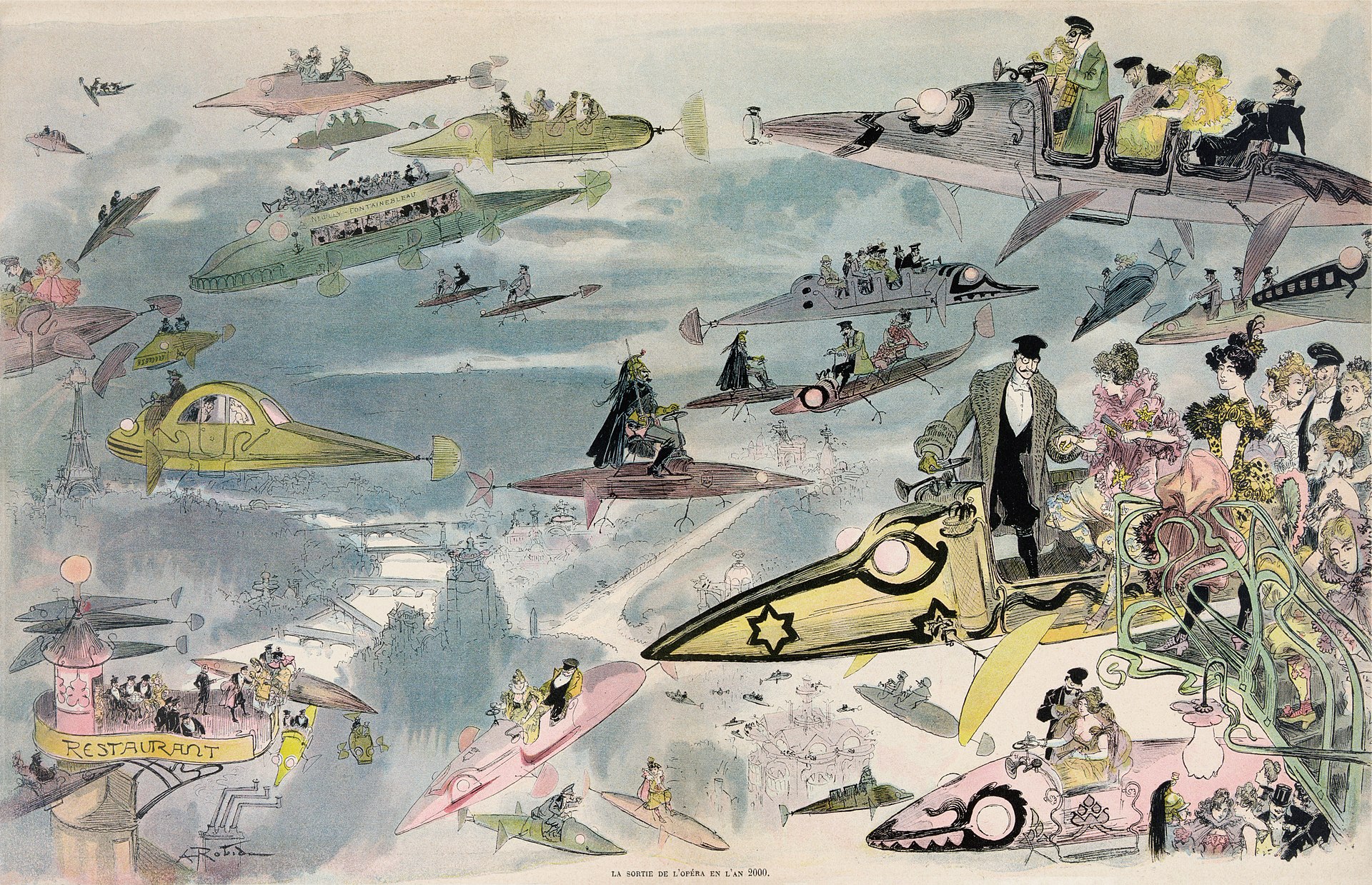
    Albert Robida, a fabulous visionary born in France in 1848 (dying in  1926) was an illustrator, etcher, lithographer, caricaturist, and novelist.  His greatest achievement is his futuristic trilogy, including Le Vingtième Siècle (1883), La Guerre au vingtième siècle (1887) and Le Vingtième siècle. La vie électrique (1890).  In general he has deep, realistic vision, the sort that puts him a similar plain as Jules Verne, but is differentiated from his famous French compatriot in that his creations seem more compatible with possibility, being more common, more fashioned to what the average person might come to expect of their future creature comforts.  In spite of a fantastic and perhaps unparalleled scifi imagination, Verne seems a little beyond the scope of the mortal future, maybe a little too much for their appreciation of whatever common class the future might hold room for.   

    La Sortie de l'opéra en l'an 2000


  • FuturePunk 1887: What is It?

    JF Ptak Science Books  

    Here’s another in this developing and fun series in the What-is-It? category. At first it reminded me of Renaissance woodcuts of various stages of creation anointed by a coy hand of the creator. This one though is late 19th century and has a definite highly au courant “Oriental” theme which so far as I can tell has nothing to do with the telling of the story of this object.  It looks a little like a multi-horned phonograph (already in existence by about a decade at this point), and it also looks a little like a Chinese earthquake detector. It is surprising for what it actually represents, and it is a lot larger than you’d think, with the figure in the background definitely not to scale. Plus, it comes into the world a few years earlier than its gigantically famous counterpart, as though it had gone back in time…

    What is it?

    Time machine


  • The Varied Endings of Human Life on Earth AND the Coming of the Bug People (1877)

    JF Ptak Science Books  Post 2894

    IMG_2077“The Fate of the Last Man”is an interesting and unsigned romp into the deep future of the ending of the human species from the 31 May 1877 issue of Scientific American. It is very exceptionally long-term, looking into the future of up to a billion years hence–which is a captivating thing all on its own, using that kind of a number in the late 19th century. (Also it is interesting to note that even after all that time the author doesn’t have humans flung to one place or another in the galaxy–after all, deep space flight had already been established in fiction for hundreds of years by this point…not commonly so in literature, but definitely there.)  In any event the author works their way into the first of ten examples of Last Man scenarios describing that after epochs the mountains will get worn down with the solid matter flowing into the oceans, which fill the oceans, causing the continents to become islands, the islands to shrink, and so on until there is nothing there but water and a bit of the world’s tallest peak with some guy sitting there on it, until even that is consumed, and our Last Man drowns.  

    As it turns out, the ten scenarios include the last man [sic] dying and the species becoming extinct by drowning, being gassed, gassed and/or blown up, “sunstruck”, suffocated, “burned up”, frozen, crushed, “killed by the crash of orbs”, and then, finally, at #10, we are surprised that “there will be no last man”.  Its a nice piece of thinking, and pretty creative; recognizing that I’ve quoted some of the descriptives for how the end will come.  

    The surprise ending part is this: almost everyone dies, though there is a self-replicating survivor that will be a BugMan of some sort and start the whole “human” thing all over again.

    [The image above and left has nothing to do with the article, but I had to include it because it is so fabulous and it appears in the same year of the SciAm as this article…and it comes close to being some sort of BugMan, or Lobster-something.]


  • A 10,000-Ton Aircraft from the Future of 1934

    JF Ptak Science Books  Quick Post

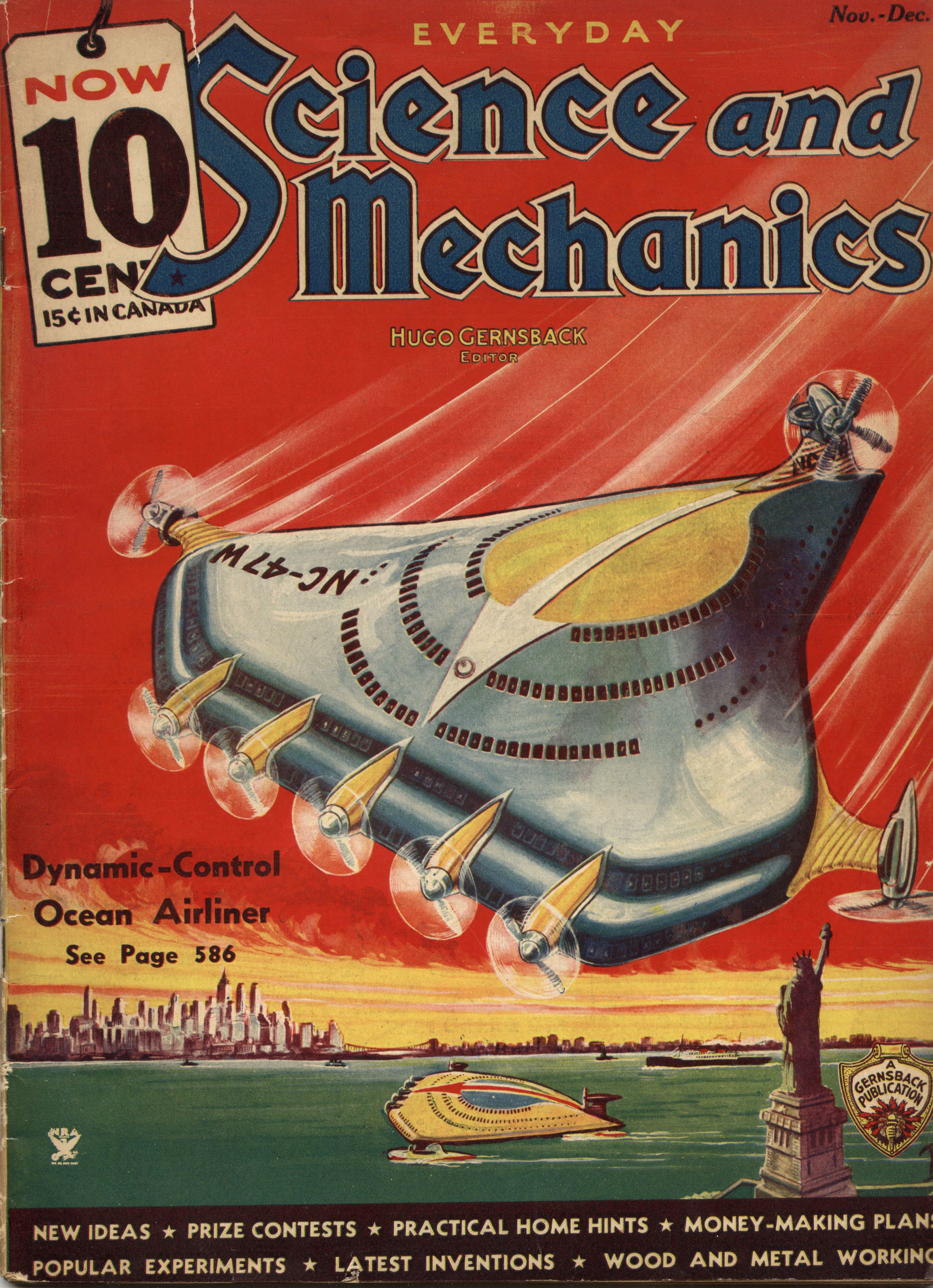
    Science and Mechanics 1934 ocean liner big file

    Science and Mechanics 1934 ocean liner big file

    Hugo Gernsback–(1884-1967)  the very busily creative pioneer in science fiction, author, and editor of some of the finest sci fi, pre-sci fi, and pop science journals from the ‘teens into the 1940’s—though big and very heavy in this consideration of a future flier. The aircraft seems to be enormous, though about the only spec given here is that it would weight 10,000 tons, and that it would probably appear by 1952, if not sooner.

    That’s a lot of tons to be thinking about being airborne, back there in 1934. To put things in perspective the Boeing 747 weighs in at 370 tons (give or take), which nattily works out that it would take 370 747s to equal the weight of the monster Gernsback was thinking about.

    This bit of speculation is found in the page of Everyday Science and Mechanics (Nov/Dec issue for 1934), with Gernsback reasoning for such a spectacular aircraft being based on a logical progression of heavier-than-air aircraft sizes:

    “The tendency at the present time in airplane building is toward constantly increasing size. It is probably realized by all who have concerned themselves with aircraft that the larger machines are not very far in the future. From the earliest Wright airplane, which weighed approximately 1/2 ton, to the present record holder, the DOX, which weighed fifty tons, took a period of some 26 years. The 10,000 ton airplane, projected on a like time-scale, would, therefore, make its appearance not later than the year 1952. However, with the nature of the present-day technique, it is quite possible, at this moment, that the 10,000 ton plane will be here much sooner.”

    Or not.

    That brings us to the other bit of specification mentioned in the article—the tail propeller on this aircraft was 75′, so, using that as a measuring device the plane was about 600’x 600′ and about 150′ tall. The aircraft’s mission was basically like that of an ocean liner, though flying. I guess stripped down it would have made an excellent troop transport, being capable of flying in, what, a vast amount of materiel as well as probably 2-3,000 troops.

    This aircraft still classifies as a mega-behemoth, and there hasn’t been anything in the air (as a heavier-than-air aircraft) that comes anywhere close to this.


  • Shopping at Home in a Store (1916)

    JF Ptak Science Books   Quick Post

    Pop Mech 1916 women dress I’ve made several entries to this blog on the history of the pre-history of the Internet of Stuff and Things, inventions and contrivances that were in their sometimes-quirky ways a taste of the stuff of what was to be…or if you applied some imagination to it, that is what they could seem to be. (Of the things that could be, there are those things that might be, and can be, and of course those that shouldn’t be–but that’s another story.)  In this image, taken from the front page of the magazine Popular Mechanics for March 1916 we see something from the future, though as is usually the case the implemented future-vision that actually takes place is far more elegant than what the imagined-future suggested.  In this instance we see someone sampling clothing and seeing their reflection wearing that clothing though not actually trying any of it on–this is commonplace now, but back in 1916 it wasn’t, and mostly didn’t even exist. Of course you’d still have to go to a clothier to use this device, which means that all of the effort in trying on new clothing would be present except for the final part of actually trying the clothing on.  And given the encumbrances of the technology, the whole thing sounds as though it would take more time to use than the time it was supposed to save.  Anyway the device was interesting, though there are probably failing marks for the temporal economics of the thing.  


  • An Anti-Gravity Space Ship (?) of the Year 2659 (1911)

    JF Ptak Science Books  Quick Post

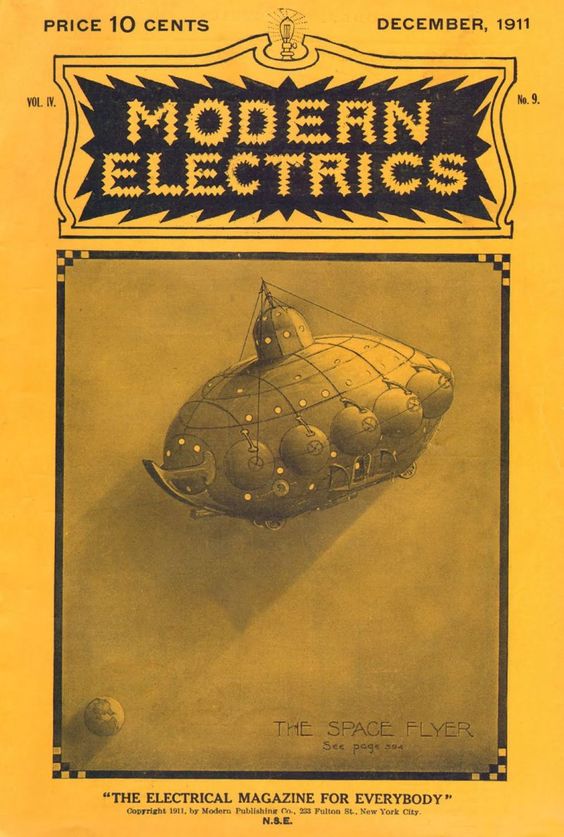
    Modern electrics 1911 _1_I was very curious about the cover illustration for the Hugo Gernsback sci fi story, “Ralph 129 C 41 +”, in Modern Electrics for December 1911 (volume 4 #9).  “129 C 41 +” was the name of a scientist who was working on the discovery by another “famous scientist” named “1246 41”–it seems that they were all involved in looking for a particular “space flyer” (first discovered by “famous scientist” 96929 in the year 2210), but then there was a kidnapped woman involved and talk of an anti-graviton antigravity engine of some sort, and then the whole thing gets a little misty. (It looks like those semi-sphere around the perimeter of the pace ship were the anti-gravity devices.)  All I really want to do here is share the cover, which I think is the best part of the story. Modern Electrics isn’t that familiar a magazine to me, but there seems to be plenty of real stuff in it, not the least of which is a pretty good article on the Bleriot flyer just a few pages after the Gernsback.  

    The entire issue is available at Hathi Trust.  


  • Groundwork for a Post on Cities in the Sky

    JF Ptak Science Books  Developing Post

    “Othello: And O you mortal engines whose rude throats/Th’immortal Jove’s dread clamors counterfeit…” – Line 352

    I’m carving out this space on the blog for a collecting post on the relatively old idea of floating cities/cities in the sky. I was going to try to limit this occasional search and bumped-into-it collective to our sky–Earth’s sky–as opposed to skies elsewhere, or space station-like structures, or orbiting colonies around Mars, or some such, but those examples seem so far to be richer than the terrestrial types, so I’m including them, for now. The story on these things seems to go back at least to the 18th century with the Laputa of Daniel Defoe–but since this is a learning post all of this stuff is subject to change, and there well may be a rich history of floating cities that is pre-Swift. For now I’m simply going to assemble what I find and post it here, and then shape it into something beyond a chronological listing as I go along. (Also for the time being we’ll leave Celestial Kingdoms and Heaven out of this discussion.)

    1726

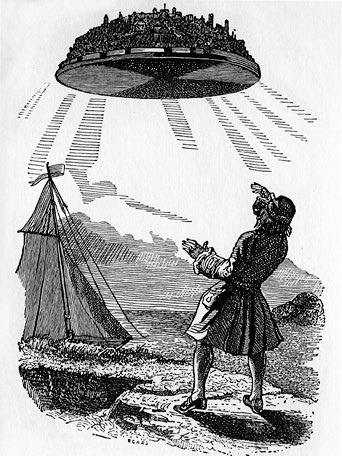
    A fine early example is found in Laputa, the floating island of Jonathan Swift (1667-1745) from his Gulliver’s travels (1726) which is a very strange, advanced, retrogressed, attractive, and repellent place.  It is about 4.5 miles in diameter, and is populated with scientists/scribes/mathematicians and the like, and their wives, with the balance of the population being servants who are the ones who seem to push the mal-contented society going in a semi-positive direction.  The scientists are head-the-the-clouds who cannot make practical contributions in spite of their scientific acumen. They in fact have a hard time getting from place to place, and are accompanied by servants who whack them in the head with a bag full of beans or peas or something to get them to pay attention to what it is in front of them. The wives are interested in travel, to go down to the ground for a vacation from their gravity–defying fortress, but few of them get permission to do so because once off Laputa no one seems to want to return.  Well, there’s also the issue of Laputa (or, “the whore” in Spanish) being lowered to crush enemies beneath it, but that’s another story. 

    City floating laputahttps://en.wikipedia.org/wiki/Laputa#/media/File:Laputa_-_Grandville.jpg
    1912

    L. Frank Baum—the creator of the Oz series—teamed up again with Oz-illustrator John R. Neill to produce Sky Island: Being the Further Adventures of Trot and Cap’n Bill after Their Visit to the Sea Fairies in 1912. Its a kids’ fantasy novel that does introduce a literal island-in-the-sky—unfortunately it is not illustrated, so far as I can find. It is also far sweeter than anything else that I’ve found so far in the massive-floating genre.

    1922

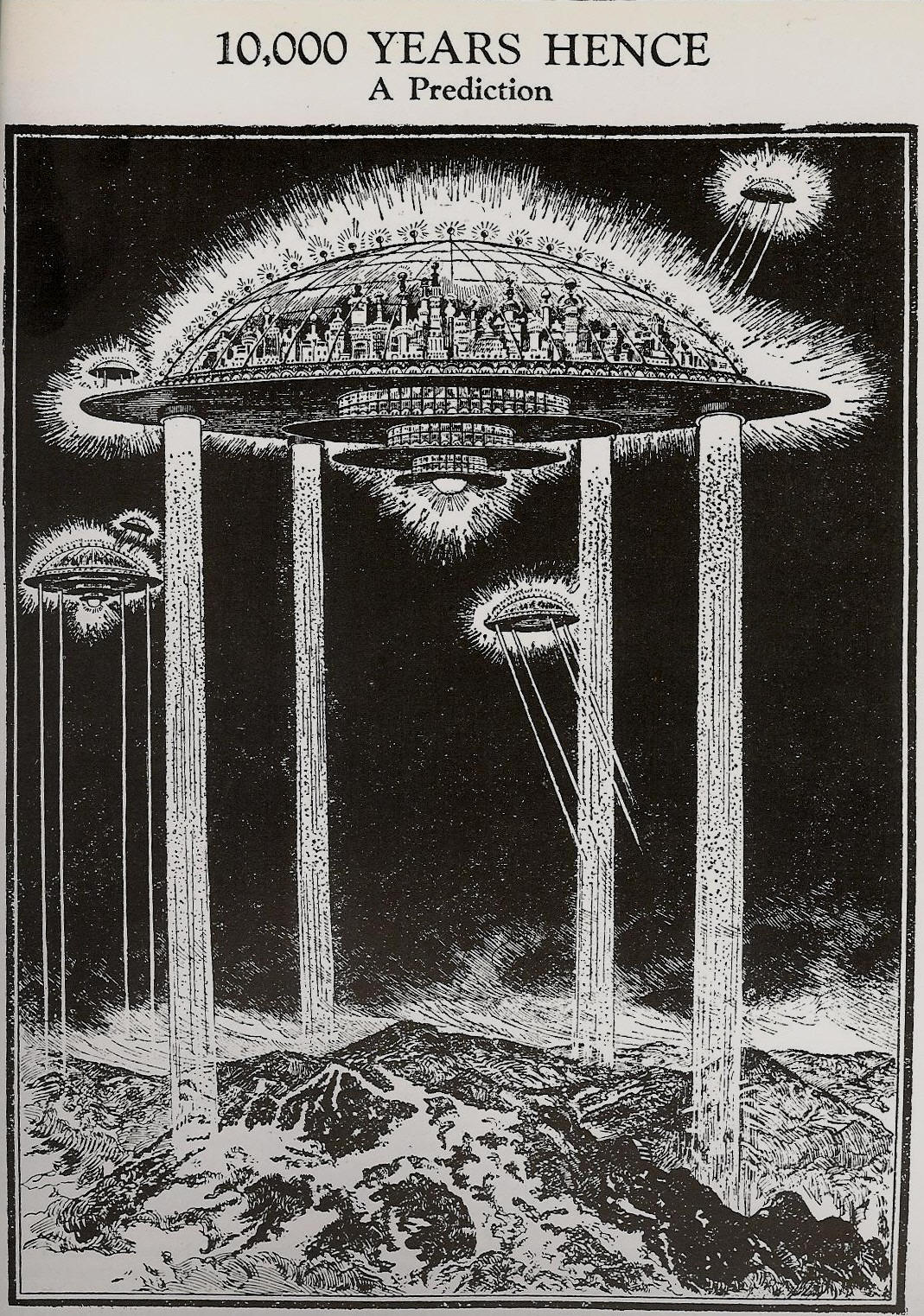
    Hugo Gernsback (1884-1967) was an inventor and also one of the founders of “science fiction” and a big name in 20th century speculative fiction. In this article he presents the possibilities of what the future might hold for somebody or something in 10,000 years, one of which were NYC-sized floating cities. He does make a very good point when thinking about the future, and from his vantage point in 1922 looked back at what the world was like during Napoleonic times in 1822, stating how impossible it was for those folks to foresee what the world of 1922 was like. If such advances were possible in 100 years, what would the next 100 bring? 1000? 10,000?  He makes an excellent point, and one contribution he made to seeing the impossible was this idea of floating anti-grav cities. This would’ve been more interesting if he stated more “why” than “how”, but so it goes.  

    City--floaing gernsback

    • “Our illustration depicts one of the future cities of about the size of New York floating high up in the air, several miles above the earth. The question of sustaining such a large body in a rarefied atmosphere will prove to be of little difficulty to our future electrical engineers. Just as we construct leviathans of the sea today, some of them weighing as much as 50,000 tons, we will construct entire cities weighing billions of tons, which cities will be held in space not by gas balloons, propellers, or the like antiquated machinery, but by means of gravity-annulling devices.”–Science and Innovation, vol 9 #10, February 1922. 

  • The Jevons Logic Machine (1870)

    JF Ptak Science Books  (This is a null post, carried over from the bookstore section of this blog–I’m sharing it in the bookseller format to simply share the info on this fascinating machine.)

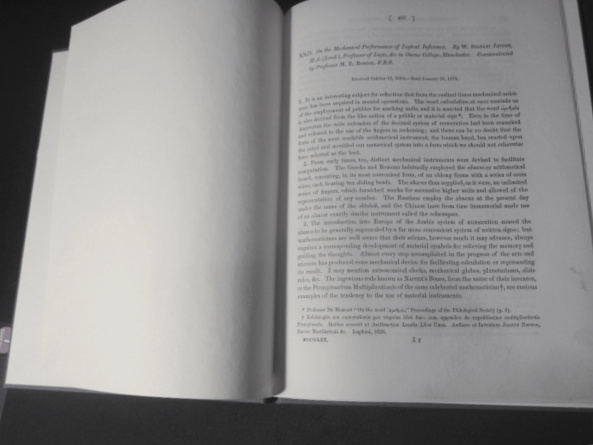
    Jevons logical _4_W. Stanley Jevons, On the Mechanical Performance of Logical Inference, in Philosophical Transactions of the Royal Society, 1870, pp 497–518. This is an extract from the volume, containing the entire article, plus its three engraved plates showing the works and interior of the machine. This is very tastefully bound in paper covered boards with a paper spine label. This is the first description of the one the preeminent. 

    Jevons was a polymath and one of my favorite thinkers of the 19th century. He worked across many fields but seems to be remembered today mostly and unfortunately for his theory of the relationship between sunspots and economics cycles. He is not so well known as the inventor of one of the earliest pre-modern computers and particularly for it being the fastest machine of its kind ever invented.

    “In 1870 a British scholar, W.S. Jevons, built the first computer designed to solve logical problems. Inspired by Boole and Babbage, Jevons built a mechanical device implementing automated deduction…”–Paul Amblard, “A Finite State Description of the Earliest Logical Computer: The Jevons’ Machine”, in the Springer International Series in Engineering and Computer Science book series (SECS, volume 434)

    “The creation of analog computing devices is both relevant and significant to the development of modern computers, but was there no early pure mechanical digital apparatus, given the advent of Boolean logic and Venn diagrams in the 19th century? One individual in particular began a small, but significant movement that transformed digital theory into mechanical devices that, while lacking the sophistication and power of later electronic digital computers, did, nevertheless, function in a digital mode. The person responsible was the Englishman W. Stanley Jevons (1836–1882).”–George Buck and Stephen Hunka, “W. Stanley Jevons, Allan Marquand, and the Origins of Digital Computing” in IEEE Annals of the History of Computing, Vol. 21, No. 4, 1999.