A Daily History of Holes, Dots, Lines, Science, History, Math, Physics, Art, the Unintentional Absurd, Architecture, Maps, Data Visualization, Blank and Missing Things, and so on. |1.6 million words, 7500 images, 4.9 million hits| Press & appearances in The Times, Le Figaro, Mensa, The Economist, The Guardian, Discovery News, Slate, Le Monde, Sci American Blogs, Le Pont, and many other places… 5000+ total posts since 2008.

Category: Aviation & flight

  • Birds and Human Flight

    JF Ptak Science Books    Overall Post 5154
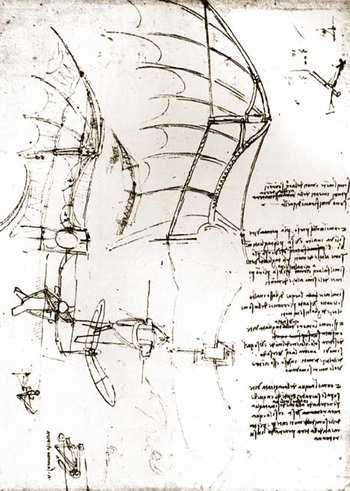
    Blogflightleonardo_2 For thousands of years the most popular fuel of the common idea for humans to achieve flight was through the application of bird flight mechanics.  (The other common vehicle employed balloons of one sort or another—I’ll look at that later.)

    Before the age of the actual application of these principles there were long sustained bird-like semi-humanoid-godlike-birdforms throughout mythology.

    Kings and overarching rulers living and imagined were seen to perform bird-supported and flighted adventures; the Old Testament is populated by winged seraphim and cherubin; Egyptian gods and goddesses were depicted with long, graceful vulture-like wings; in ca. 160 ACE Lucian of Samosata wrote one of the earliest accounts of space flight with Icaromenippus, who reached ultra-great heights with a device employing eagle and vulture wings, using them in an attack upon Heaven;  a Chinese emperor of the Han dynasty reputedly kept an eye on his empire from a flying chariot; the famous Bellerophon took flight on Pagasus (the horse with bird-like wings, and confusing my point some) to spear the Chimera.  Closer to the point is the flight of Daedalus and his waxy birdwings, as well as Thidireks (from a Germanic myth) who uses a suit of artificial feathers to fly; but much closer to the point of this post was the Persian king Keykavus–he oversaw his lands from the comfort of his throne, which was transported by four apparently very muscular eagles.

    Among the many things that Leonardo was working on as he was semi-creating the Renaissance was a system of solo flight for man.  His earliest system was based on a large winged device in which a person would be prone, flapping flexible wings via the use of a pulley system, looking quite birdlike.  Later on Leonardo would develop multi-winged systems, some of which would be quite large and requiring the operator to be upright, making the whole look more like a helicopter than a man-filled bird.
    Blogflight_bird_064

    Perhaps the greatest visionary of techno-anthropormorphic human flight was Cyrano de Bergaerac.  Before he was the object of Edmund Rostand’s 1897 play, de Bergerac was a massively creative author, producing, among other things, the book Histoire des Etats et Empires de la Lune (History of the States and Empires of the Moon, published posthumously in 1657), followed by Histoire des Etats et Empires du Soleil (History of the States and Empires of the Sun, again, published further and deeper into his life’s surrender, 1662), both eventually collected as L’Autre Monde (Other Worlds).  Bergerac introduces us, the humble reader, to one of the most important concepts in the history of literature–namely that we humans were not only not alone in the universe, but that we were not even the dominant culture, and indeed we were actually hated by some of the other more advanced species.

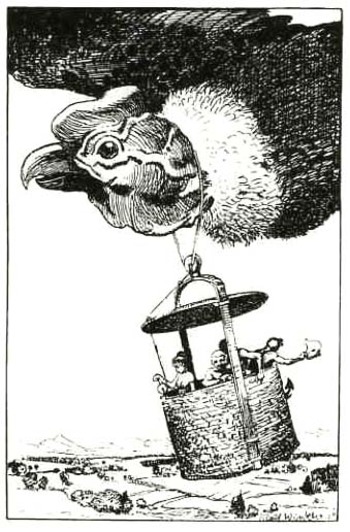
    In a very complicated series of adventures the protagonists are brought to the moon and to the other side of the sun and such by being flown in a basket attached to the neck of a giant bird.  (In one part of the escapade, Cyrano takes us to the moon, which is a paradise, where the adventurer is captured and imprisoned by the intelligent indigenous folks, and from which he escapes by clinging to a soul being removed by the devil. (!))
    Blogflightgodwin

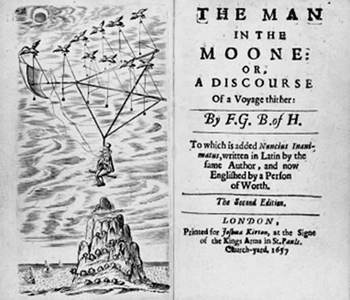
    Another spectacular visionary was Francis Godwin, who brought us about the first book on interplanetary space travel with his The Man in the Moone; or, A Discourse of a Voyage Thither; by F.G., B. of H.; to which is added Nuncius inanimatus, written in Latin by the same author, and now Englished by a person of worth (London, 1657).  Here we encounter the tales of y Domingo Gonsales, who Godwin gets to teh moon on a device powered by captured birds, becoming also one of the earliest literary proponents of the plurality of world’s thesis.

    A quick look at the chronology of imaginary flight shows that there are lots of other attempts at flight—but none that I can identify quickly that use birds to lift and carry its cargo to the sun.

    Fast forward to the 19th century though and we come into the veritable heyday of anthropomorphic flight attempts.  Here we find very notable attempts by George Cayley—who was probably the first person to truly understand the dynamics and physics of flight  creates his first aerial device—a model helicopter with contra-rotating propellers reminiscent of the Leonardo device.
    Blogflighttatin
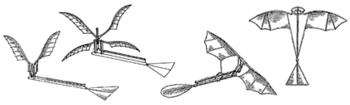
    Victor Tatin’s ornithopter of 1875 actually was a much more sound “read” than it looked.  He had a very advanced idea of the mechanics of flight, understanding the conditions, and physics, and the resistance of the air, and so on, but just couldn’t translate this understanding into a realistic design.  This is especially true when he hit upon one of the key ingredients to the Wright success—a good, powerful but very lightweight engine.  This was pretty big news, though Tatin would up a suicide.

    And speaking of deadly ideas, the exceptional Otto Lilienthal would wind up a victim of his thinking, too, though his end came in practical applications (or impracticable, I guess) rather than unrealized theoretical understanding.  Lilienthal was one of the most important figures in the development of flight in the nineteenth century, making the first heavier than air gliding flights in what looked quite a bit like bird wings.  (Wilbur Wright said of him; “Of all the men who attacked the flying problem in the 19th century, Otto Lilienthal was easily the most important. … It is true that attempts at gliding had been made hundreds of years before him, and that in the nineteenth century, Cayley, Spencer, Wenham, Mouillard, and many others were reported to have made feeble attempts to glide, but their failures were so complete that nothing of value resulted” as found in  The Aero Club of America Bulletin, Sept. 1912 and also in the article on Lilenthal in WIki.)  He would die in 1896 in a gliding accident, falling to a crumpled death.
    Blogflightpilcher
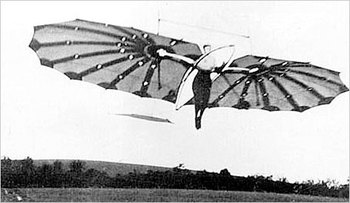
    This was also the fate of Percy Pilcher, a great English aviator, who was also quite close to developing a powered heavier than aircraft, but was killed in 1899 before having a chance to test the craft.

    Note:  The title of this post comes from the World War II (late 1942) patriotic song, with words by Harold Adamson and music by Jimmy McHugh. It tells the tale of a plane struggling home after a bombing raid:

    Comin’ in on a wing and a prayer
    What a show, what a fight
    Boys, we really hit our target for tonight
    How we sing as we limp through the air
    Look below, there’s our field over there
    Though there’s one motor gone
    We can still carry on
    Comin’ in on a wing and a prayer.

  • Cross-Section of an Arctic-Exploring Balloon, 1890

    JF Ptak Science Books  Quick Post  Overall Post 5153

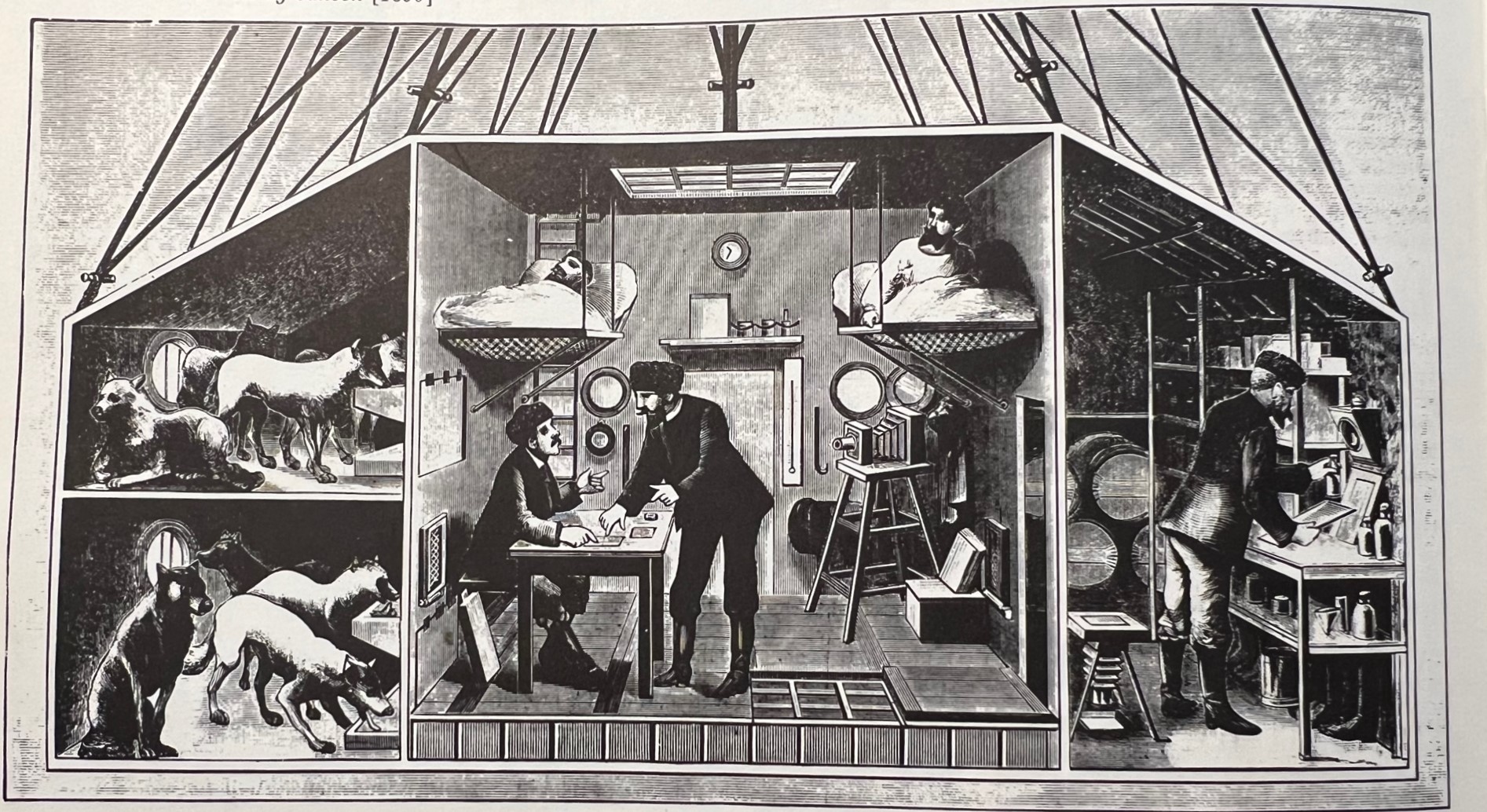
    Answering the great North Call, to reach the North Pole, has been a quest for hundreds of explorers reaching back hundreds of years The image here depicts one iteration from 1890 of an attempt utilizing a 100′ diameter balloon. The pilot adventurers here were Georges Besancon (1866-1934) Gustav Hermite (1863-1914), whose aims were to pilot the 17.5 ton aircraft (complete with a darkroom) to the Pole—and as you can see in the cutaway view of the balloon car, their’s was an ambitious project. But their attempt to fly over the Pole was not to be, as they couldn’t raise the funds to put it all together. They did however concentrate on atmospheric research using balloons and became leaders in that brand-new field, and were successful in establishing the use of balloon in this area. (The attainment of the North Pole came probably in 1909, generally regarding Robert Peary (b. 1852) reaching it in 1909…though Frederick Cook may have done so in 1908. And perhaps it was Matthew Henson, who may have stood at the coordinates before Peary. And so on. Two things seem to be certain in the uncertain list of “firsts” and the North Pole: the first over the Pole was probably Roald Amundsen in 1926, though Richard Byrd flew over the Pole in a Fokker-tri-motor at about the same time. It is a definite thing though that the first under the Pole was the USS Nautilus in 1958.

    IMG_1303

    • [Source: Scientific American, volume 91, 1890.]


  • An Odd Perspective Looking Through the RAF Wellington Bomber (1941)

    JF Ptak Science Books   Overall Post 5141    

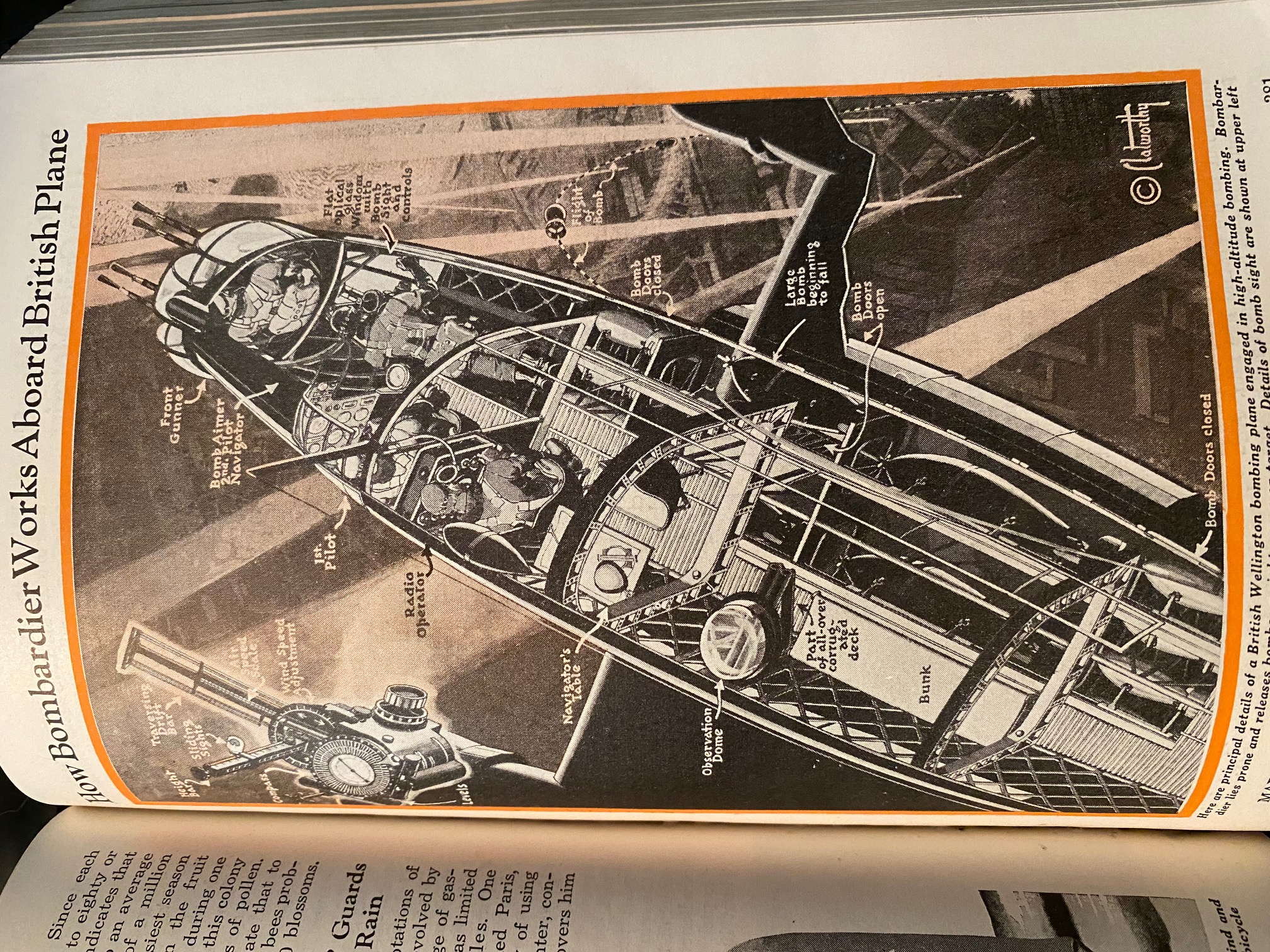
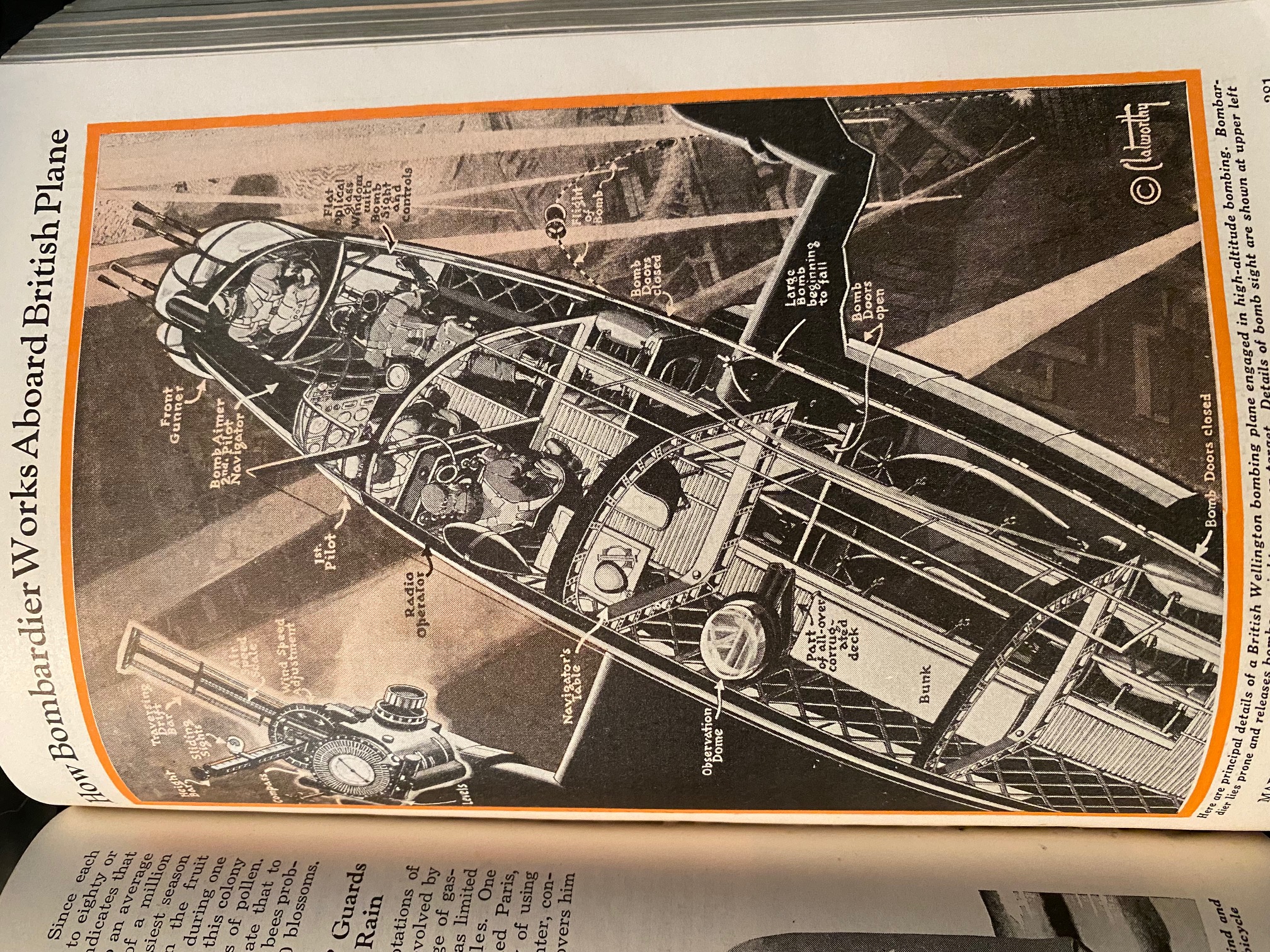
    Here’s a short notice on an unusual perspective in the combined categories of cutaway diagrams and looking-straight-down:  the (almost)-looking-straight-down bird’s-eye cutaway view!  I rarely see these two categories combined…and as a matter of fact I cannot recall the last time I posted something like this. So here it is, direct from the March 1941 issue of Popular Mechanics, showing a very oblique view from above looking through the fore section of a British Wellington bomber:

    IMG_6689

    There is an inset diagram of the sighting instrument, which I was a little surprised to see in a popular magazine published during the war.

    [Note: if you click through on the image it becomes more clear in magnification.]

    ·Posted by :

    ·in:

    —

  • “Small Target Bombing Probabilities”–Bombing Calculator, 1944

    JF Ptak Science Books  Expansion of an earlier post from  2011 

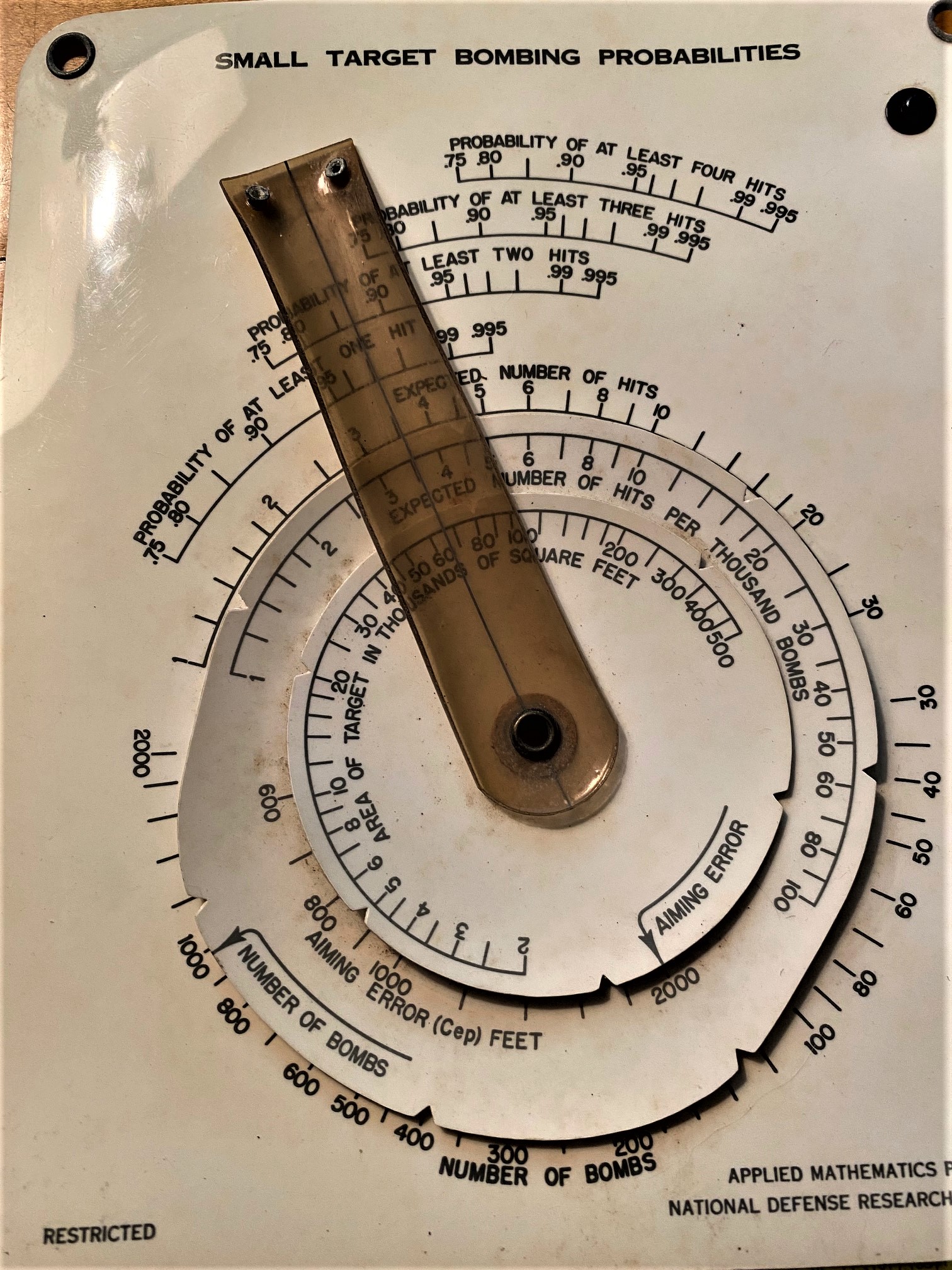
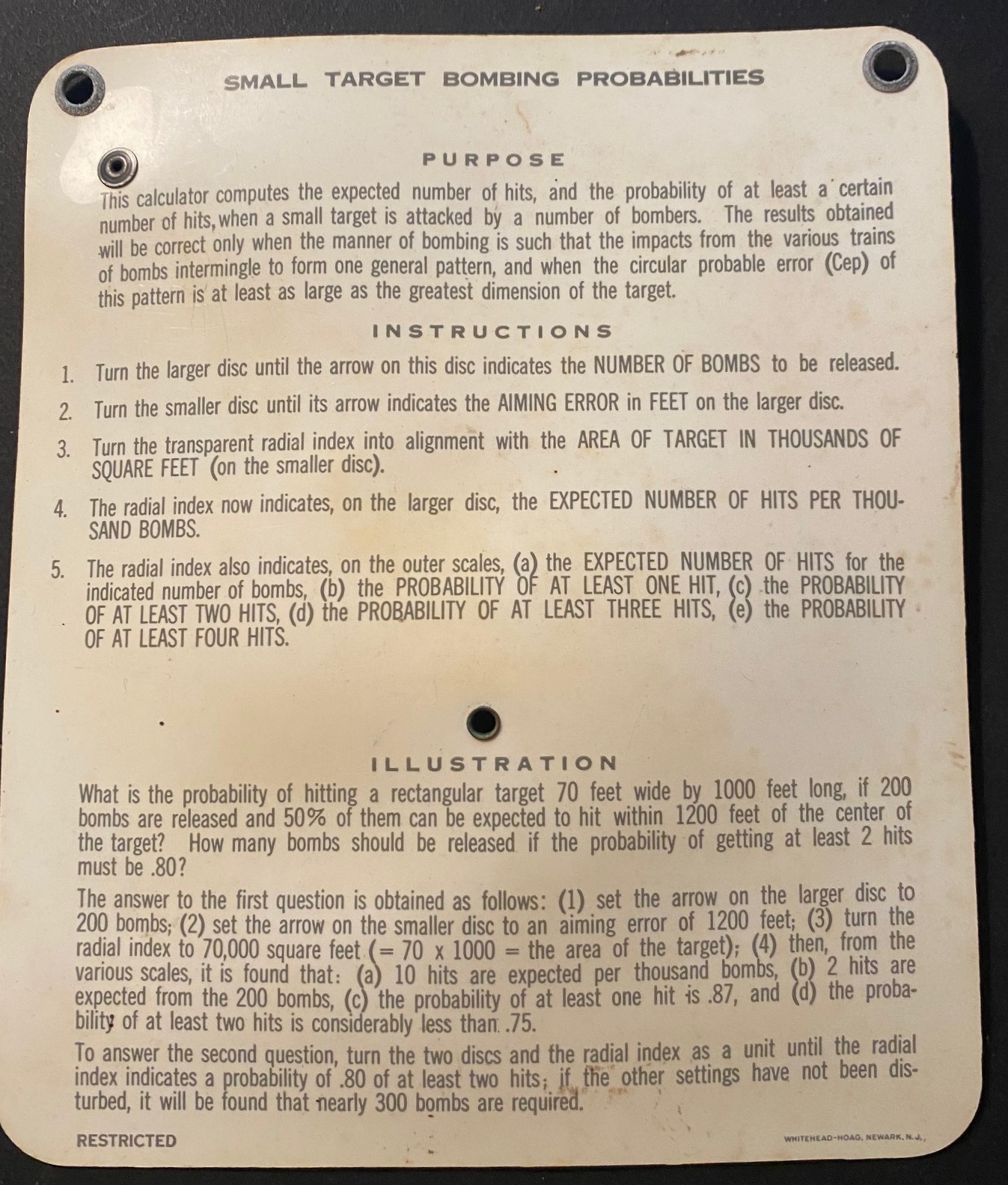
    IMG_5402I found this object in my paper-calculators box (moveable disk calculators made of paper, two going back to  Fr. A. Kircher in the 1680’s)—I’m not sure why it was there as it is not paper, though it is an interesting calculator.

    [Images are greatly expanded in click mode.]

    You can learn or re-learn an interesting lesson from it on bombing accuracy.

    The “Small Target Bombing Probabilities” calculator was issued by the little-known (in the popular sense) Applied Mathematics Panel of the National Defense Research Council (NDRC)1 in the early 1940’s during WWII. 
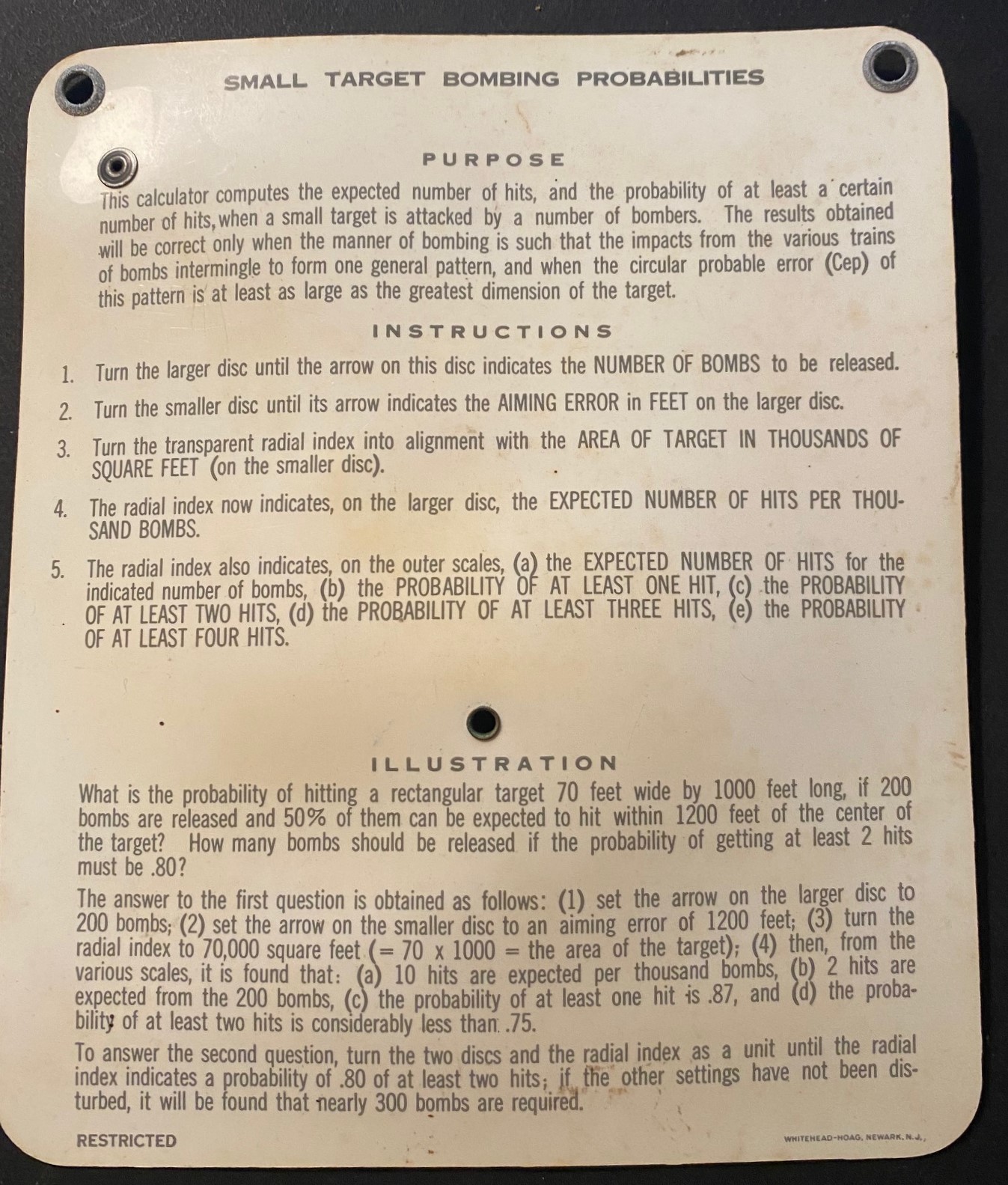
    IMG_5403Marked “Restricted”, it calculated the number of bombs that would successfully be delivered given (1) the number of bombs, (2) the “aiming error”, and (3) target size. It would then generate results for “(a) the expected number of hits for the indicated number of bombs”, (b-e) the probability of at least one hit to four hits.

    What is a little surprising to me was the number of bombs that didn’t find their target. For example, a 65,000 square foot target bombed with 1000 bombs and an aiming error factor of 2000 feet could expect to land 3-4 bombs on the target, with an 88% chance of landing at least two hits, 75% chance of landing three hits, and about 50% of landing at least four hits.  And so the necessity of large numbers of planes dropping a large number of bombs.  

    Notes

    1. The establishment of the NDRC was announced so: “It is announced by Science Service that the following committee has been appointed in the United States to correlate “scientific research on the mechanisms and devices of warfare”: — Nature 146, 191-191 (10 August 1940).

    “Members included: Dr. Vannevar Bush (chairman), president of the Carnegie Institution of Washington, formerly dean of the faculty of engineering at the Massachusetts Institute of Technology; Prof. Richard C. Tolman (vice-chairman), dean of the graduate school and professor of physical chemistry and mathematical physics at the California Institute of Technology; . Dr. Irvin Stewart (secretary), formerly Federal Commissioner for Communications and chairman of the Committee on Scientific Aids to Learning; Rear Admiral Harold G. Bowen, director of the Naval Research Laboratory, Anacostia, D.C.; Conwiy P. Coe, U.S. Commissioner of Patents; Dr. Karl T. Compton, president of the Massachusetts Institute of Technology, formerly professor of physics at Princeton University; Dr. James B. Conant, president, formerly professor of organic chemistry, Harvard University; Dr. Frank B. Jewett, president of the Bell Telephone Laboratories; Brigadier General G. V. Strong, assistant chief of staff, U.S.”

    ·Posted by :

    ·in:

    — —

  • Your Daily Dirigible (1913)

    JF Ptak Science Books  Quick Post  Overall Post 5129

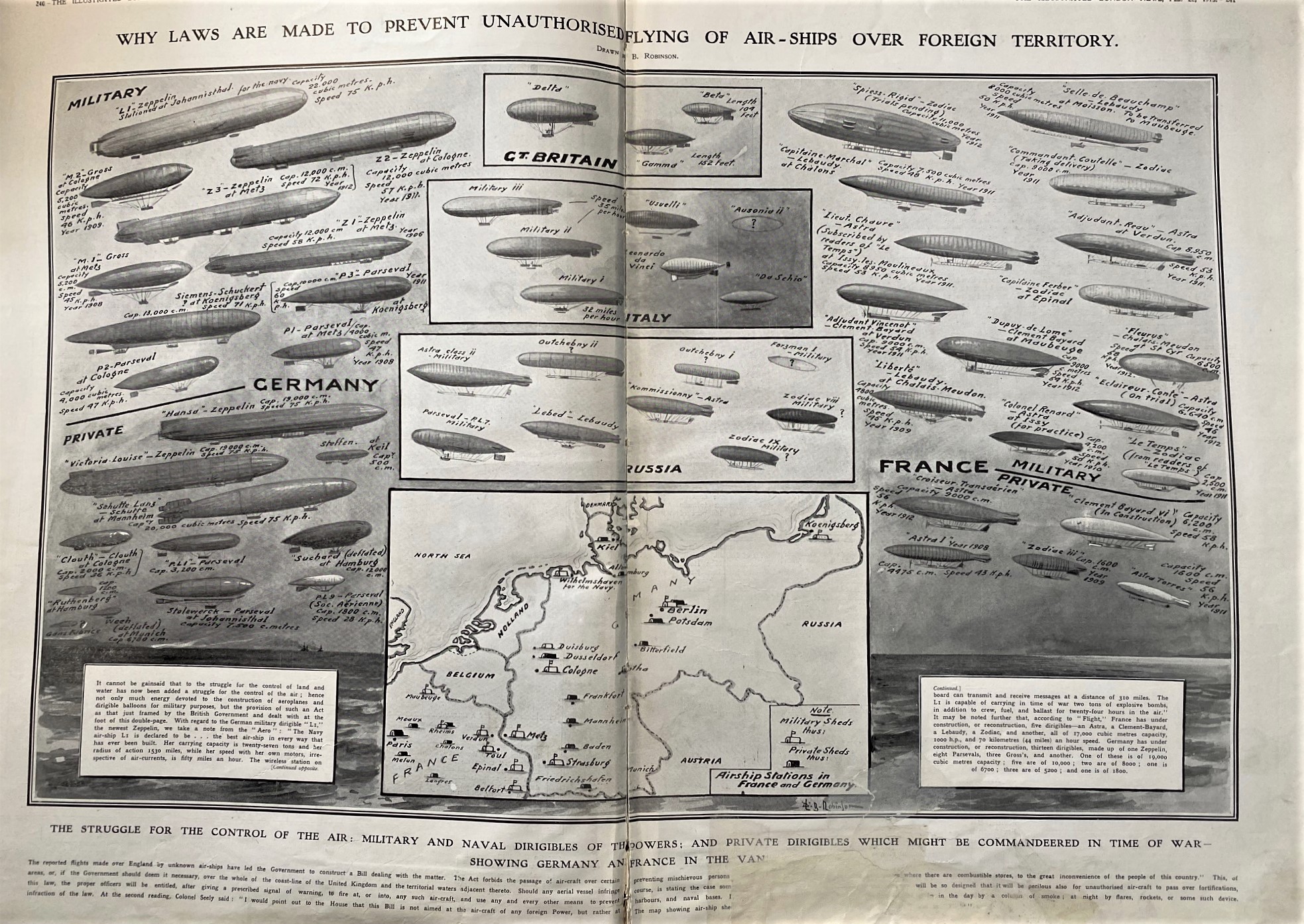
    Well, no, this is not really a “daily” dose of dirigibles, though it is a nice display of the airships. This double-page display is found in the Illustrated London News  from 22 February 1913, illustrating a short article addressing the need for legal reform in the flight of dirigibles, particularly in regards to the airships being used in possible combat.  WWI wasn’t far off at this point, and the ILN takes its readers on a quick tour of who-had-what in regards to the airships, depicting German and French airships and aerodromes. If you click on the images and then click again you’ll see that there is info on individual airships as well.  

    Click to Expand


    IMG_3862

    Details follow:


  • Gliding Flight and The Seventh Seal (1897)

    JF Ptak Science Books  Quick Post (Overall Post 5123)

    Science heavyweight and Nature editor and founder J. Norman Lockyer wrote in 18971 a three-page summary of the recent experimental work of aviation pioneer Percy Pilcher. Mr. Pilcher (1866-1899) was rather more than a “pioneer”–he was an inventor and perhaps Great Britain’s premier experimentalist and visionary in flight at the end of the century—and made significant contributions towards understanding flight dynamics, though he would not live out the century, fatally crashing in a glider flight that was leading towards the launching of a powered glider of his own design.

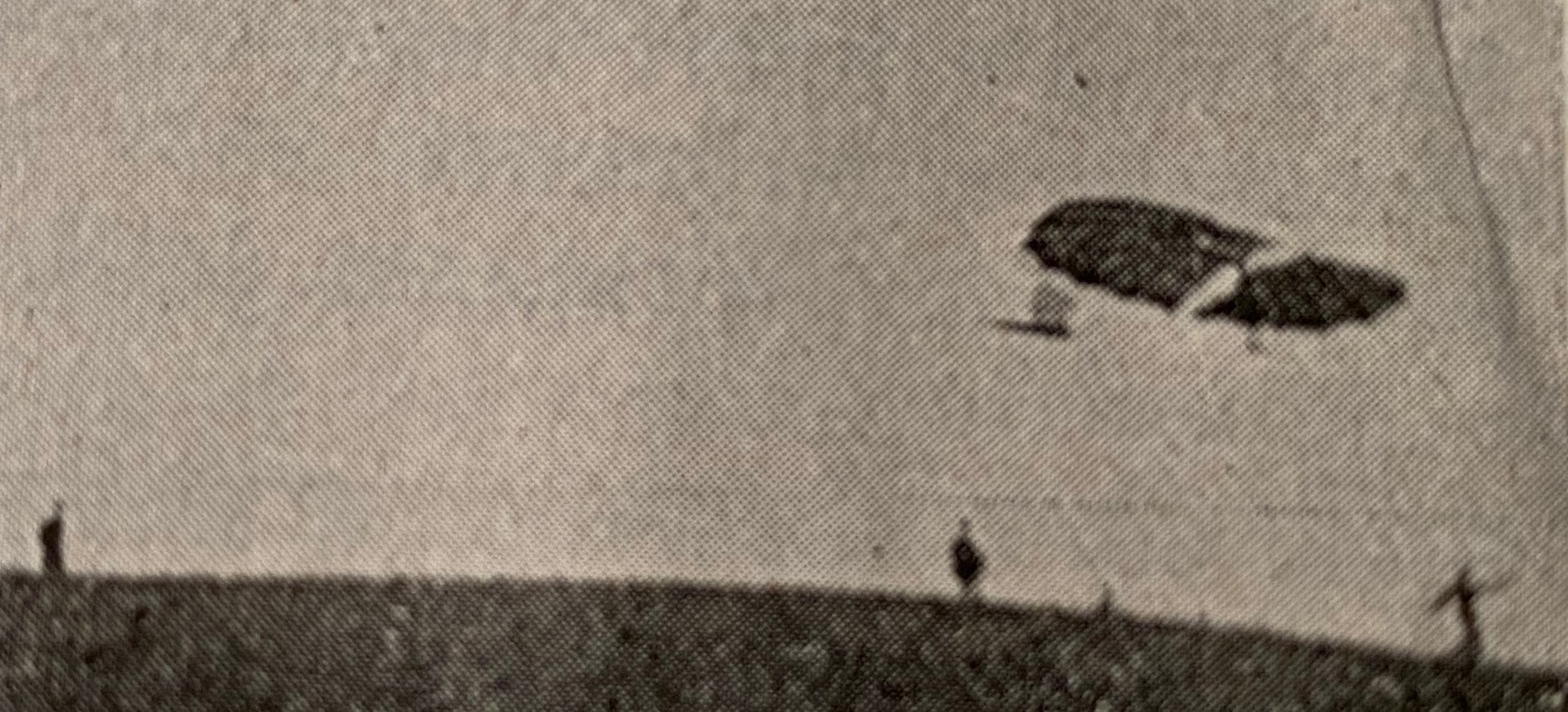
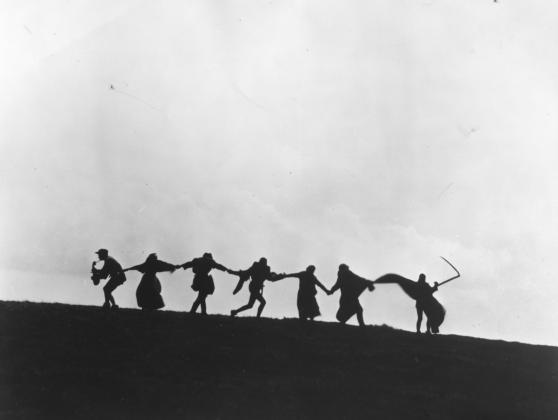
    The article was accompanied by a seven-part rapid-photo series of Pilcher in flight, and what caught my eye in this series were the small figures on the rolling hill under the glider. Enlarging the image quite a bit (the originals in Nature shows figures only 3mm tall) brings proto-post-Swedish-noir to mind, especially the very animated figure on the right and  particularly for a famous scene from Bergman’s Seventh Seal (1957):

    IMG_4836

    Bergman_Seventh-Seal_001_o3


    Notes:

    Sir J. Norman Lockyer (1836-1920), long-time experimentalist/instrumentalist/theoretician who worked in astronomy and spectroscopy and was co-discoverer of helium (found in the atmosphere of the Sun).

    1. (PILCHER, Percy.) Lockyer, William J. “Soaring Flight”, in Nature, a Weekly Illustrated Journal of Science, 12 August 1897, vol 56 no. 1450, pp 344-346 in the issue of pp 337-360.

    And the full series of photos:


  • On Flying Machines–Scientific American, 1848

    JF Ptak Science Books  Quick Post   Overall Post 5120

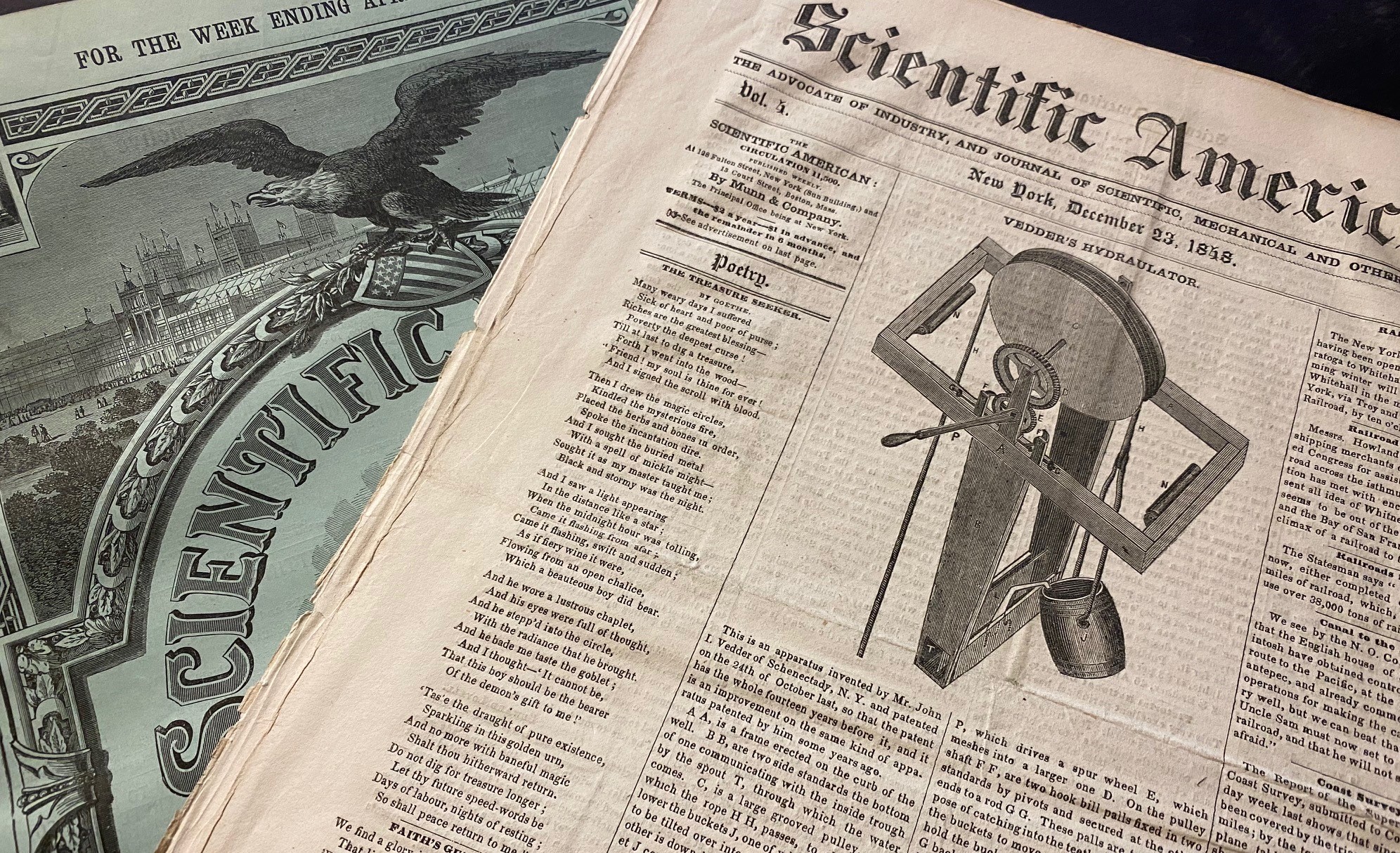
    I found a short article on human flight (“Flying Machines”) in the fourth volume of Scientific American (1848).  It is an interesting and occasionally predictive piece that saw a bit into the future, well past the contemporaneous failures and iron-punk possibilities of sky machines, into a place of “mathematical certainty.  The writer saw the possibility of heavier-than-air flight, only just not in 1848 (or any time soon). “The air furnishes a vast fund of power for the use of mankind, although as yet they have only used it to propel ships and wind-mills. We live in an age of great discoveries and improvements, and among these will certainly be ranked the navigation of the air.” 

    And so some snippets from the article: 

    “Flying Machines and Perpetual Motions are very old and unfortunate acquaintances. No people have invented so many as the Germans, and many a poor fellow has lost his life by his fool hardy confidence in some machines he had invented to ride upon the winds, yet for all the accidents that have taken place to high flyers, from the Dutch Doctor at Ratisbone in 1692 to the unfortunate Englishman who perished a few years ago in London when descending by a parachute, there are still to be found new flying machines coming out every few months. An Austrian made quite a fine display in Cremone Gardens, London last winter, by taking several long jumps with a steam flyer. Since that we have heard no more about it, and presume it has met the fate of its illustrious predecessors…

    IMG_3864 (1)

    “But the end of flying machines is not yet, and here we insert the description of a new and an original one certainly, taken from the Jacksonian published at Pontiac, Michigan… After describing how wings had been tried to beat the lark and eagle, he says:—“As wings then, have failed, and balloons been attended with no better success, men have begun to think that the end is unattainable, and that flying is a victory which man can never achieve.”


  • “The Fine Sport” of Flying, 1893.

    JF Ptak Science Books    Quick Post (Overall Post 5117) 

    Lillienthal

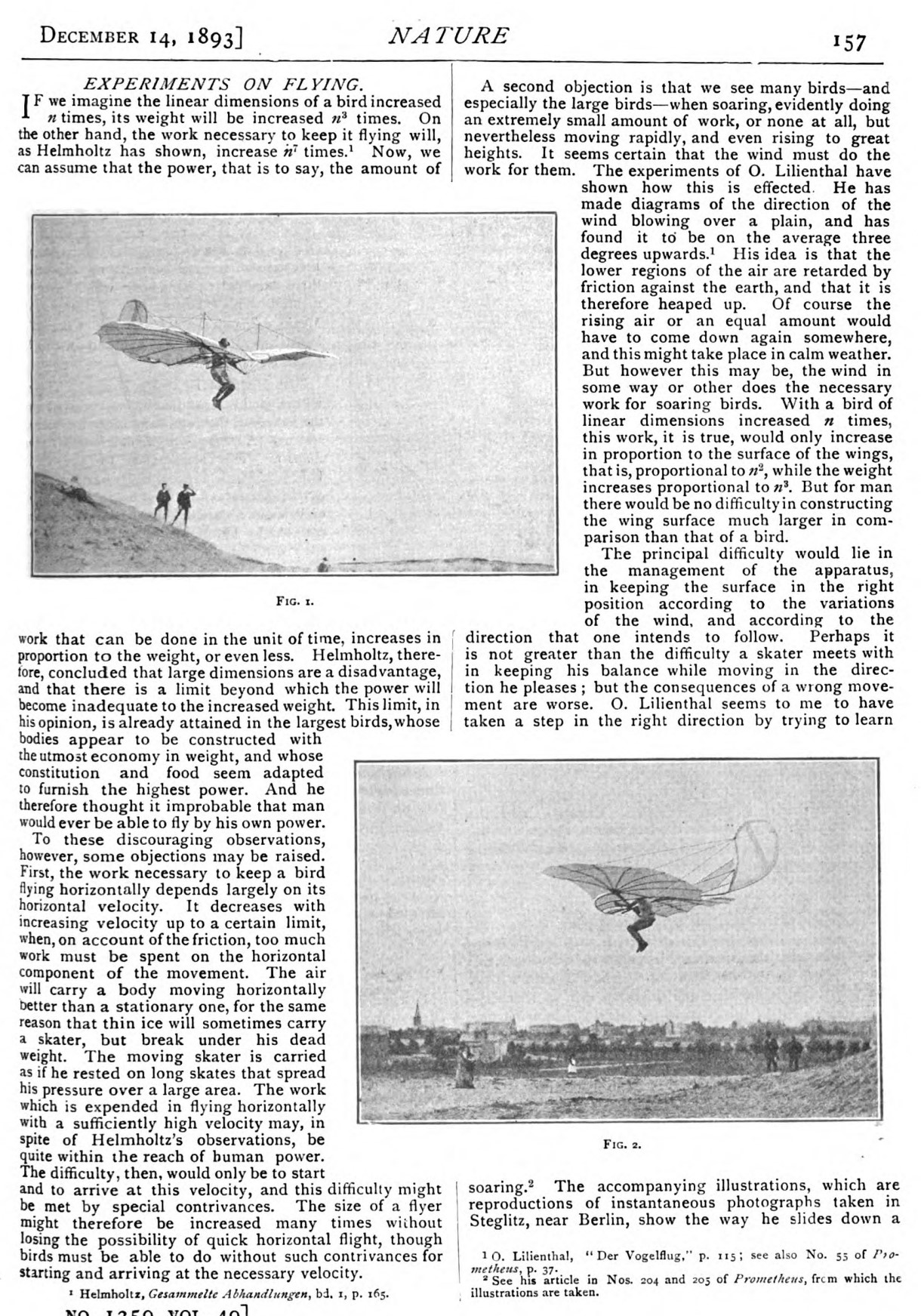
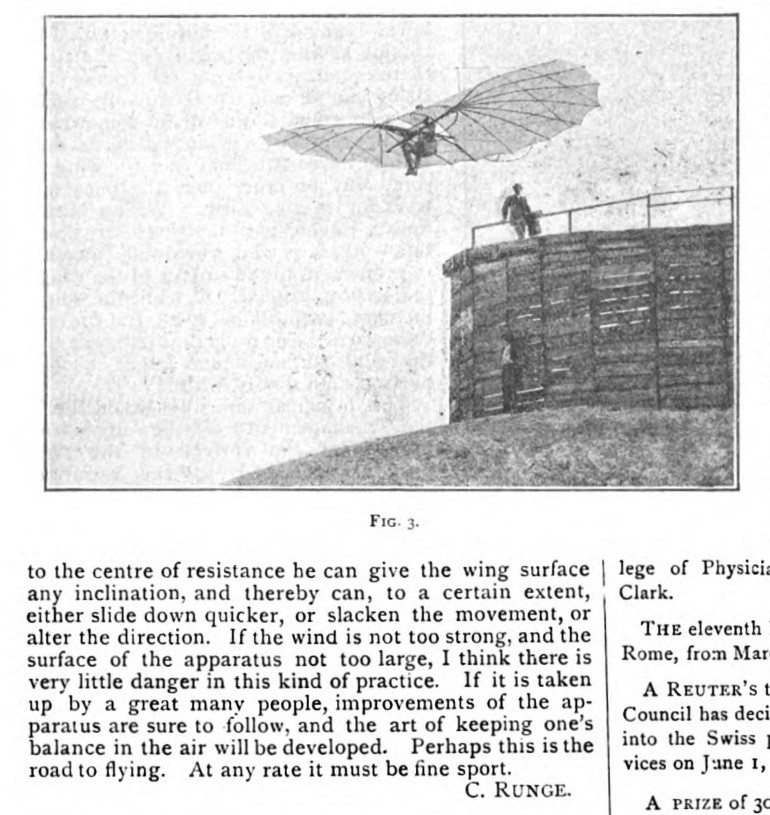
    I found an interesting article in Nature1 just now,  a piece by Carl Runge on 19th century heavier-than-air human flight by the remarkable Otto Lilienthal. 

    Lilienthal was an international authority on human flight, and was known to many as The Flying Man, and The Father of Flight, because, well, he flew. And he flew more often and with more recorded/documented successes in his non-powered flying machines than any other aviation pioneer of the time. In fact, he had a major influence on the Wright brothers (though not necessarily for his experimental data, which they abandoned after a while to create their own in their wind tunnel), with Wilbur Wright saying: “Of all the men who attacked the flying problem in the 19th century, Otto Lilienthal was easily the most important. … It is true that attempts at gliding had been made hundreds of years before him, and that in the nineteenth century, Cayley, Spencer, Wenham, Mouillard, and many others were reported to have made feeble attempts to glide, but their failures were so complete that nothing of value resulted.” (From the Wikipedia article on Lilienthal.)

    Lilienthal was well into making  successful jumps/flights by this time, but would suffer his fatal fall in about two more years, dying August 10, 1896, after a series of 850′ flights. (I’m offering a later paper on Lilienthal, also available on ABE, from Nature for 12 December 1894.)

    The last three sentences by Runge are remarkable:

    “If it [flying or attempting to do so]  is taken up by a great many people, improvements of the apparatus are sure to follow, and the art of keeping one’s balance in the air will be developed. Perhaps this is the road to flying. At any rate it must be fine sport.”

    Notes:

    1. (LILIENTHAL, Otto). Runge, C. “Experiments on Flying”, in Nature, a Weekly Illustrated Journal of Science, 14 December 1893, volume 49 no. 1259, pp 145-168, with the Runge article on pp 157-8, with three photo illustrations of Lilienthal in flight.

    Lillienthal _2_


  • Lunar Space Suits, 1950

    JF Ptak Science Books  Quick Post

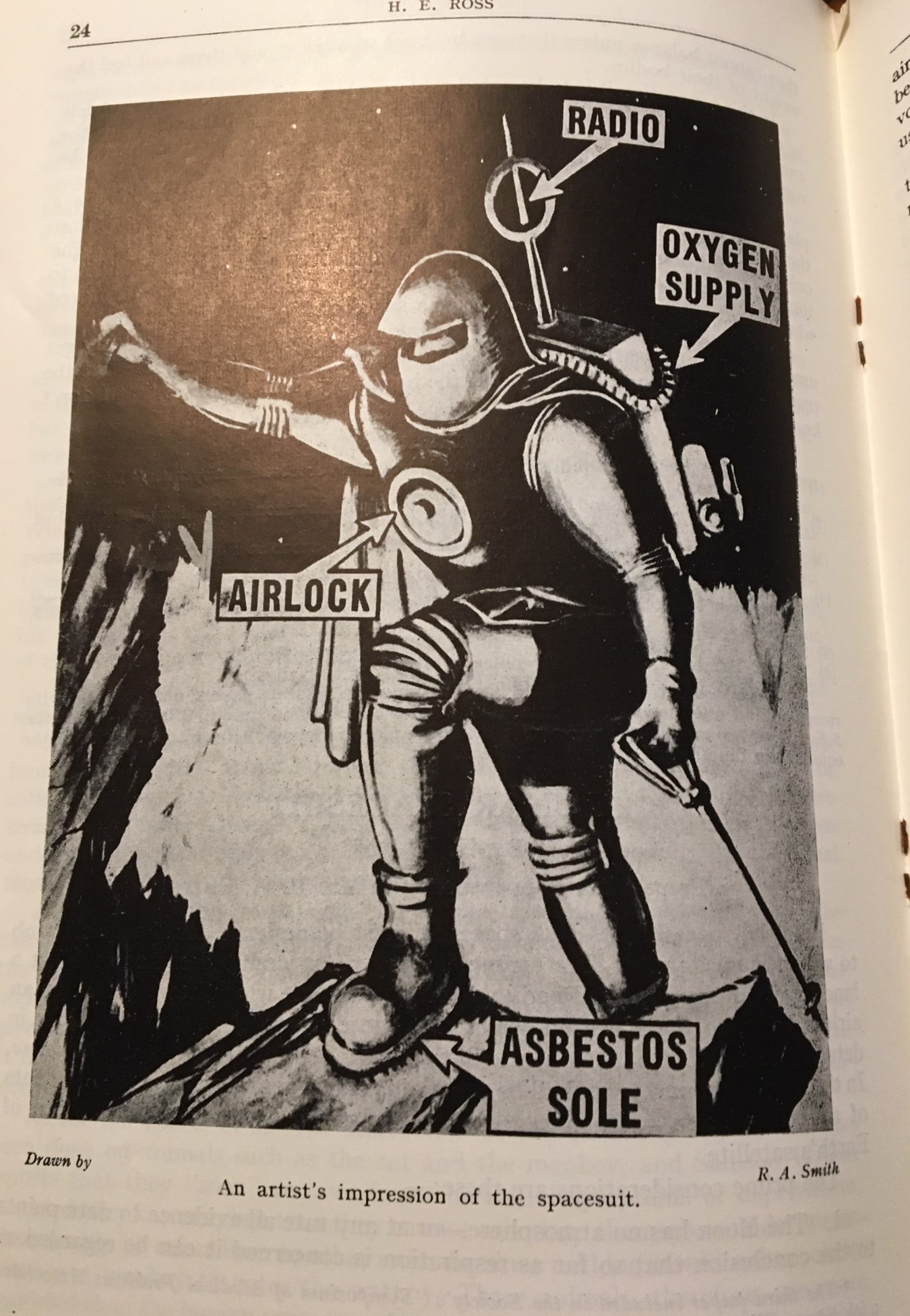
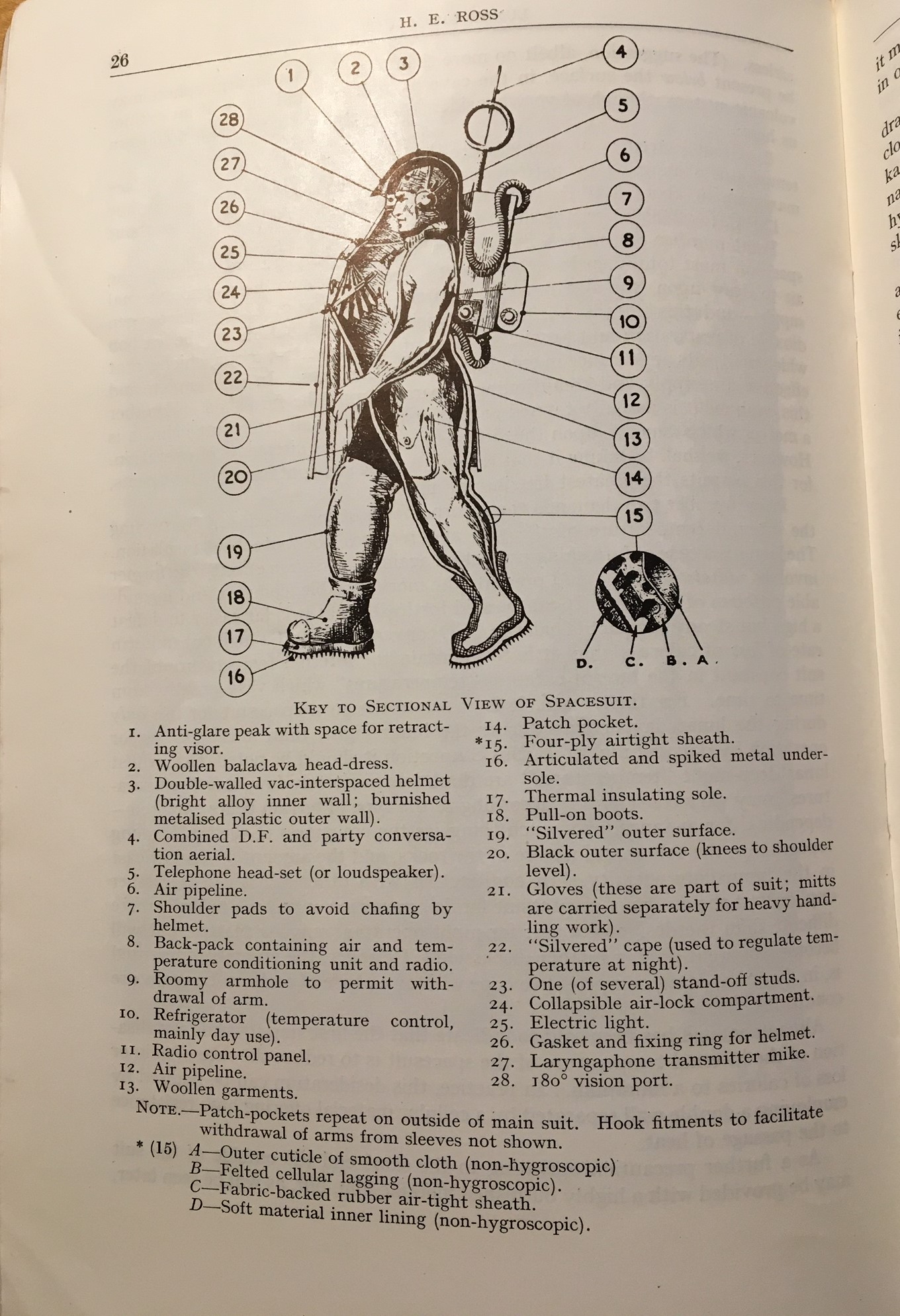
    IMG_2183This is just a very quick post based on a book that I’m trying to sell over on the bookstore end of this blog–the images are arresting and interesting, and I at least wanted to share them here.  These two illustrations are the first serious scientific study of what sort of suit would be needed to survive on the surface of the Moon (according to the Space Centre UK website) and appear in  H.E. (Harry) Ross’ article “Lunar Space Suit” as it appeared in the  Journal of the British Interplanetary Society, (vol 9/1, January 1950) . Enjoy. 

    “In a November 1949 symposium, Harry Ross presented a paper on the “Lunar Space-Suit”. Ross had examined the problem of a 68 kg lunar space suit (equivalent to 11 kg on the Moon) which could be worn for up to 12 hours, within the temperature range of 120 degrees to minus 150 degrees Celsius, representing night and day. The suit design was a 4-ply, made up of a thin exterior skin of closely woven cloth. It had a 1 cm layer of cellular heat-resisting material (Kapok, wool, felt et cetera) and a 1-2 mm main airtight sheath of fabric-backed natural or synthetic rubber. It also had an interior lining of non-hygroscopic material, mainly for comfort and to manage contact between the rubber and skin and absorption of the water-vapour. The exterior of the lunar space suit was to be a highly burnished metallic film, designed to reflect as much heat as possible.”

    IMG_2184“The helmet was to be a light, rigid double-shell structure, with the inner a bright alloy metal and the outer a plastic with burnished metal coating. Lateral vision of 180 degrees was proposed with a minimal vertical extension in order to minimise heat gain or loss. A special glass to prevent heat and actinic Ultra-Violet rays would be employed…”

    “The space suits that were eventually worn by the Project Apollo astronauts are a far cry from this original 1940s design. But the work started out by Harry Ross, led to credible thinking on how humans could survive in a self-contained, mobile habitat. The original paper by Harry Ross is [this paper].” –British Interplanetary Society website


  • Zed + Zero Zeppelins = No Zeppelins at All (1913).

    JF Ptak Science Books  Quick Post

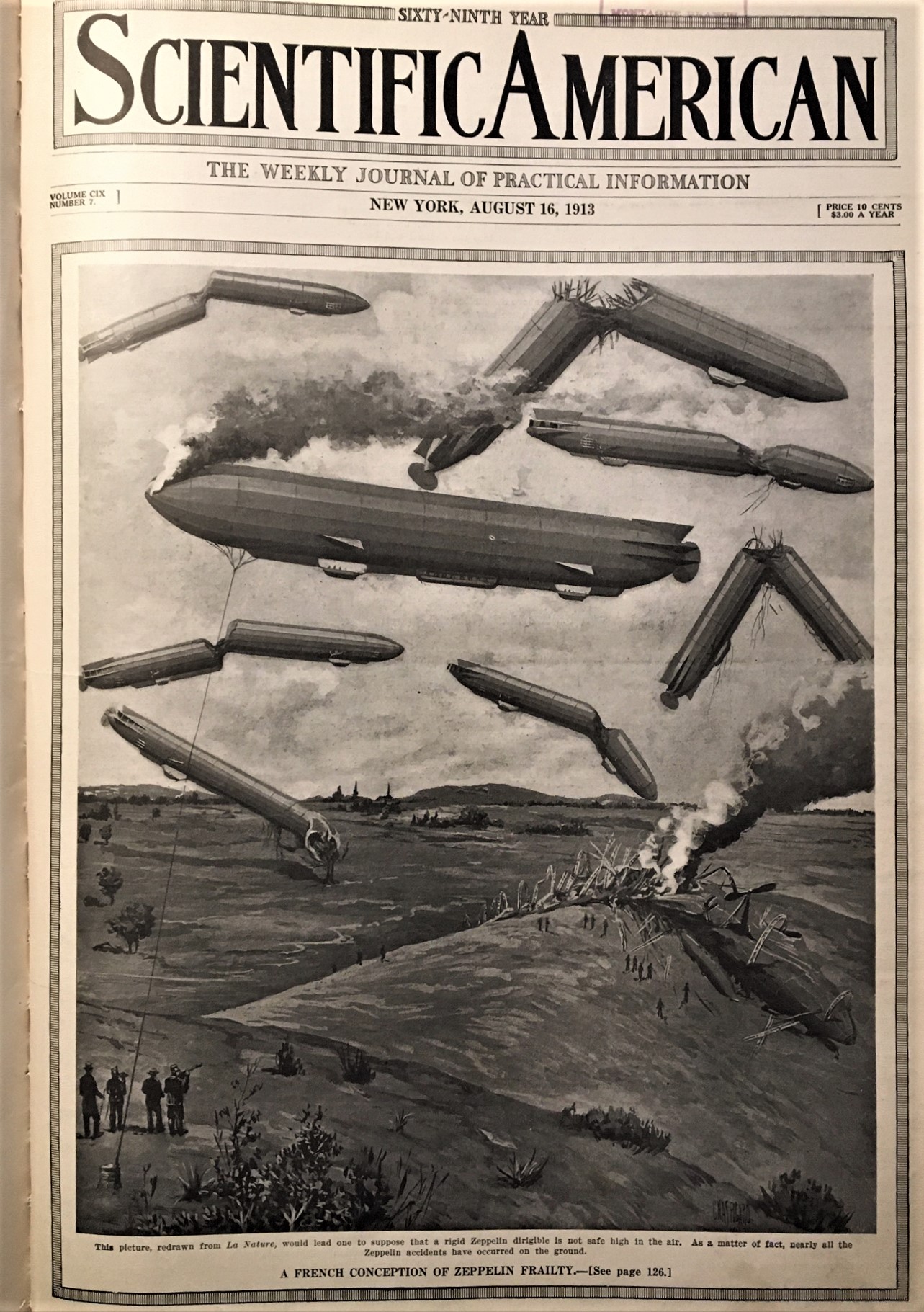
    I knew I needed to do something with this tremendous image (found as you can see in Scientific American for 16 August 1913) and thought it might be nice to make something of it rhyming “zeppelin” all the way through…but there aren’t very many single words that do that, though if you cheat a little you can have a lot of two-word constructions with the second word being “in” that would close the gap. Anyway, that’s not all that fruitful or interesting, so I’m just going to note that this composite image depicts Zepps on their way to be zero and zed following their zigs and zags through the sky. It is an attempt–I think–to show that in spite of their tremendous size and threatening nature, the Zeppelins could break just like everything else.  

    IMG_2293