A Daily History of Holes, Dots, Lines, Science, History, Math, Physics, Art, the Unintentional Absurd, Architecture, Maps, Data Visualization, Blank and Missing Things, and so on. |1.6 million words, 7500 images, 4.9 million hits| Press & appearances in The Times, Le Figaro, Mensa, The Economist, The Guardian, Discovery News, Slate, Le Monde, Sci American Blogs, Le Pont, and many other places… 5000+ total posts since 2008.

Category: History of the Future

  • Colossus in the Colosseum

    JF Ptak Science Books   Quick Post

    Wimshurst machine205

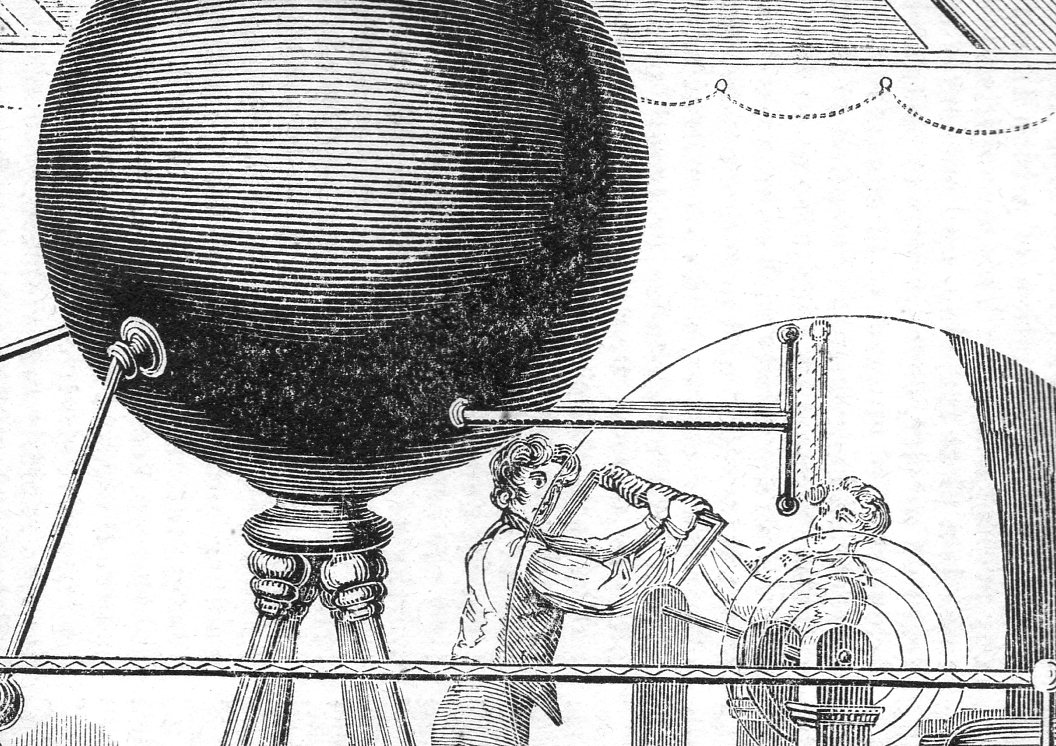
    Here’s an interesting combination of sweat and electricity–an enormous electrical device that was on display in an exhibit of “natural magic” at the Colosseum in Regent’s Park in 1839.  The large disk that the two guys are turning is actually larger in real life, being 7′ in diameter, the conductor being varnished copper, and the conducting balls being gilded–it must have been a very shiny experience, especially when they generated their electric spark.  In 1839 this was the largest electrical generating device in the world.  (I have a tiny version of that device here, something made out of old records coated with copper and found ball glasses acting as Leyden jars, all painted and varnished, the work of an 8 year old in 1925 who went on to a career in astronomy and became the most celebrated eclipse follower in the mid 20th century.)

    This monster is made just 39 years after Volta’s first battery was made,  and not long after Oersted generated the first magnetic field from an electric current in 1820, the same year as Ampere’s solenoid. There were many quick and brilliant development from then to 1839 (also the year in which Daguerre perfected his collaborative work with Niepce to produce the photographic camera), not the least of which was the  Davidson’s creation of the first electric motor car/land locomotive, again in that same full year of 1839:

    ·Posted by :

    ·in:

    —

  • A Scientific/Industrial Vision of the Future City (1842)

    JF Ptak Science Books  

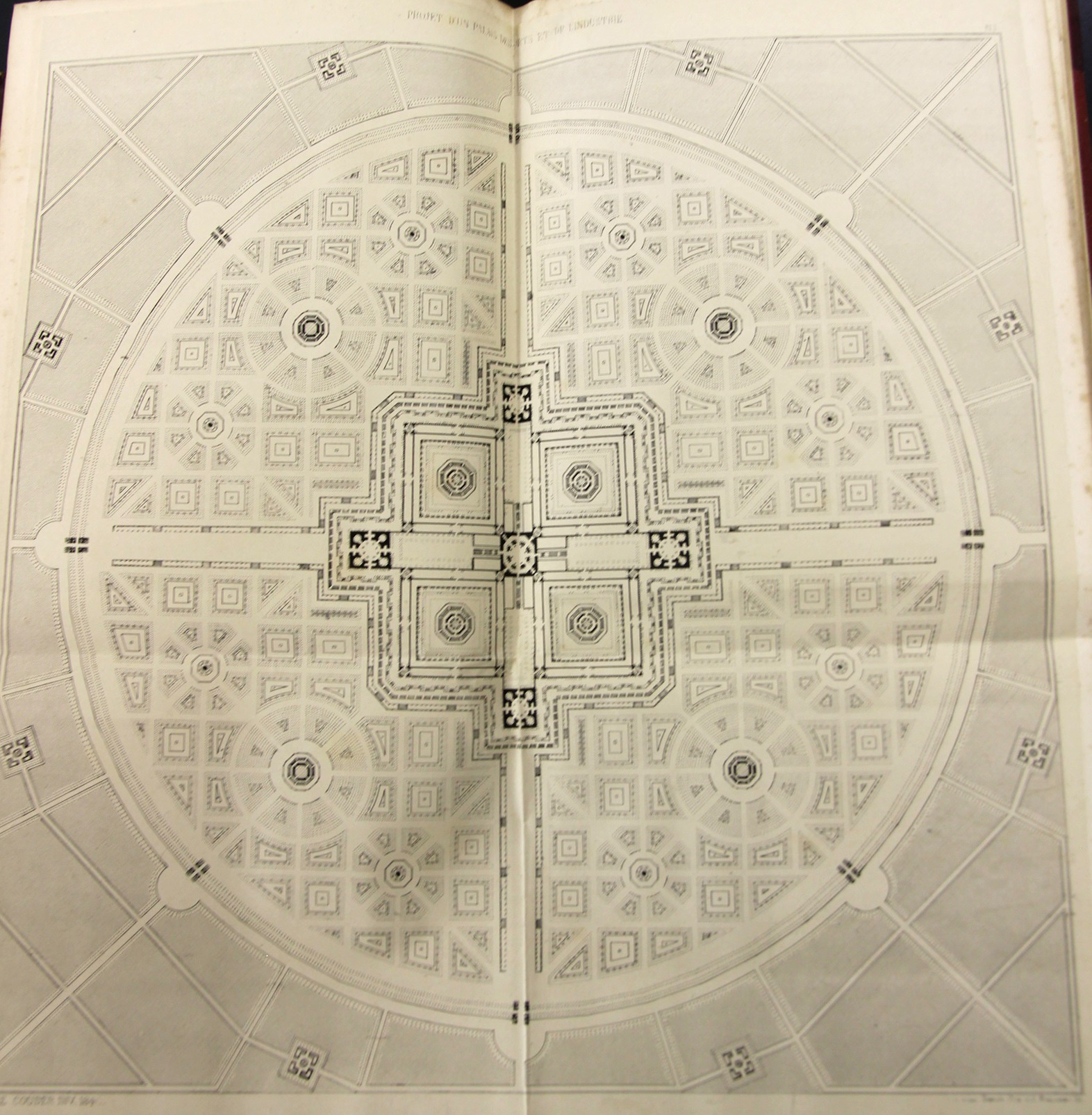
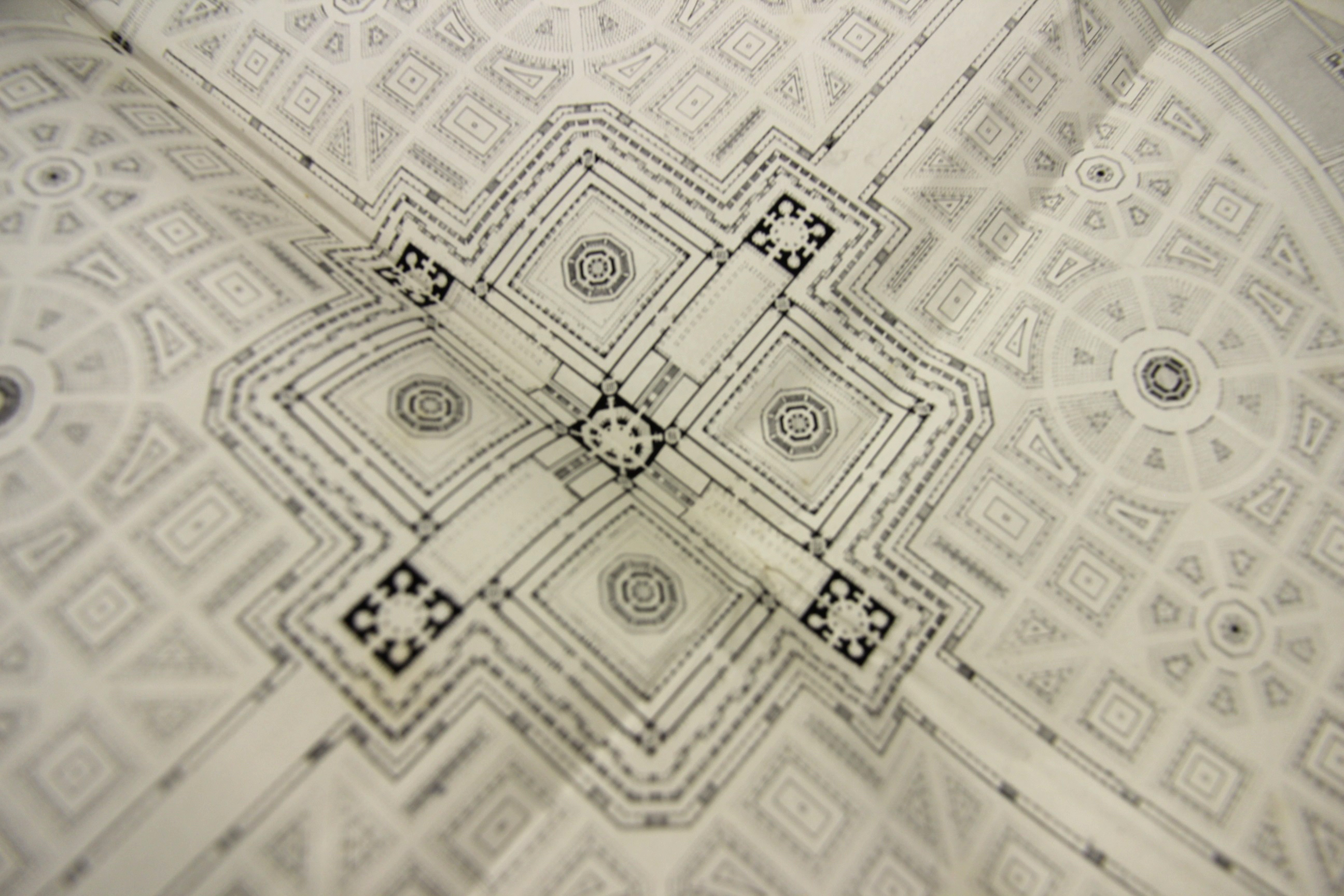
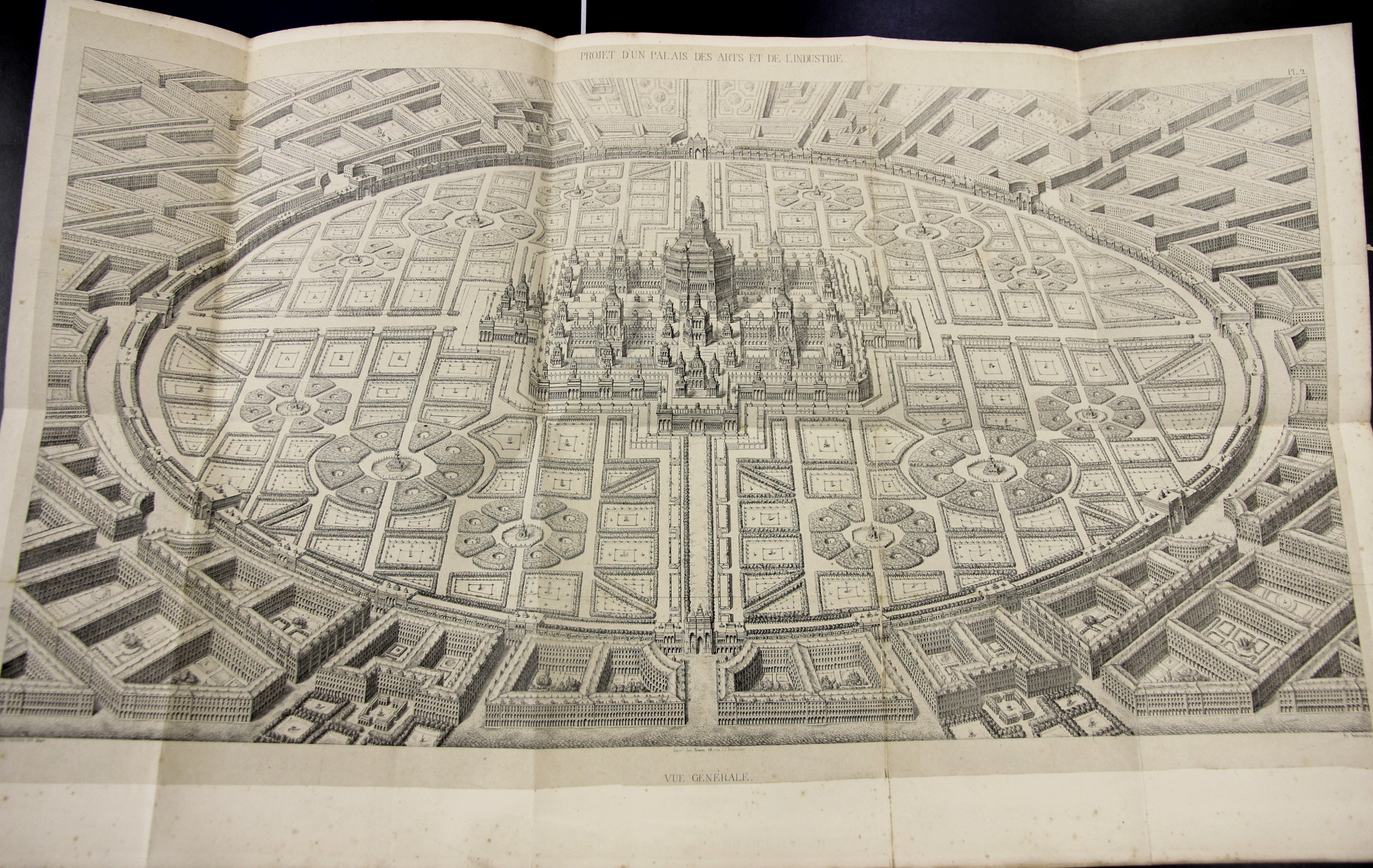
     Amedee Couder wrote L’Architecture et l’industrie comme moyen de perfection sociale, a fine work that was published in Paris (by Brockhaus et Avenarius) in 1842.1  The work presents Couder’s rather stroing visionary plans for a perfect city of industrial and scientific harmony, laid out in suggestively-fractal harmony, with the suggestions of a Renaissance-laden snowflake design. Whatever it was, it was beautiful to look at, at least on paper, though I’m not so certain that I’d care to live in the canyonlands of stone and shadow on the other side of the garden wall of the perfect scientific-industrial conclave. 

    Couder 1

    Couder 2 detail

    Couder 5


  • “We Need a Stroke of Genius.” (RPF, 1946)

    JF Ptak Science Books   Quick Post

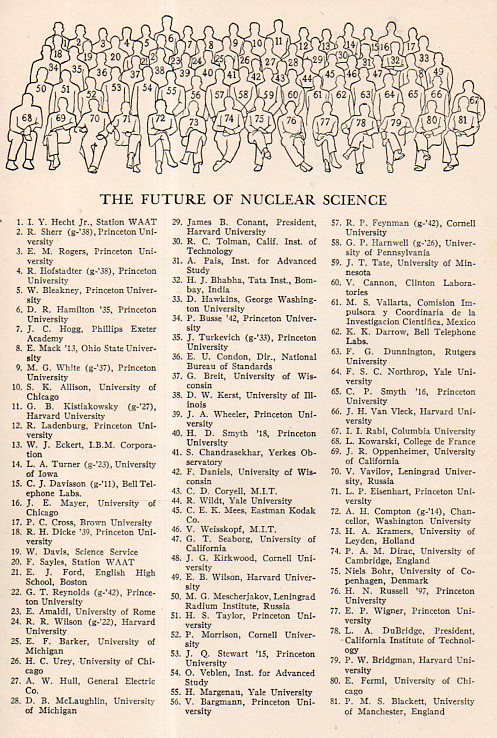
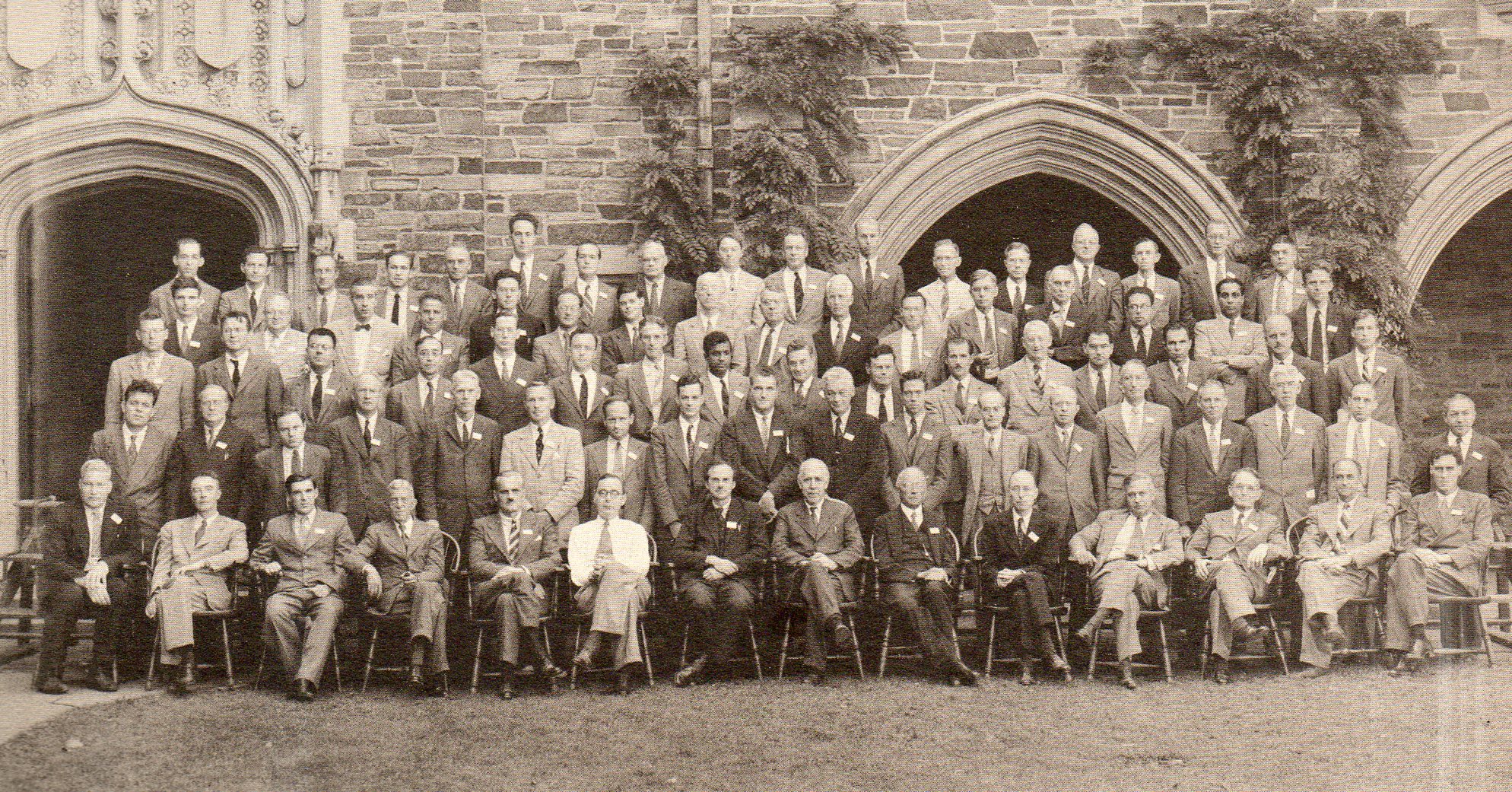
    The Future of Nuclear Science, Princeton University Bicentennial Series, Series I Conference I (1946), with a forward by the director of the conference, E.P Wigner, is mostly just a short (36-page) introduction to the conference, with a few highlights of superstar comments, most notably from Dirac and Feynman (see below). There is a remarkable and seldom scene photo of the conference’s participants–it is a mega-powerhouse of physics people. Perhaps what I enjoy most of the photo part of the publication is the out-of-context artwork in the skeleton/ghost photo that accompanies the image so that you can identify those pictured. It really does take on a life of its own–though I admit I’m partial to these bits.

    Skeleton 716
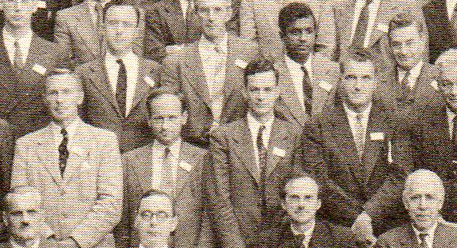
    It is a considerably heavyweight group of physicists–among them are Hofstadter, S.K. Alison, Kistiakowsky, Ladenburg, W.J. Eckert, L.A. Turner, R.H. Dicke, E. Amaldi, Urey, Conant, Tolman, Pais, Turkevich, Condon, Wheeler, Smyth, Chandrasekhar, Weisskopf, Seaborg, Wilson, Morrison, Veblen, Bargmann, Van Vleck,  Eisenhart, Compton, Kramers, Dirac, DuBridge, Bridgman, Fermi, Blackett, and so on.  Interesting that Feynman stands right behind the seated Dirac, and that Rabi is on the far right, almost out of the picture, leaning away ever so slightly from the group.

    Skeleton det718
    Here’s a relatively-random detail featuring (bottom left -to-right) Compton, Kramers, Dirac, Bohr, plus (middle left-to-right) Margenau, Bargmann, Feynman, Harnwell, Tate, and (third row) Wheeler, Smyth, and Chandrasekhar.  This was an extraordinary group. 

    Skeleton det a718

    Full text via Hathi Trust via Cornell University.

    Here’s an interesting quote from Feynman:

    “Typical were the comments and queries made by R. P. Feynman of Cornell University and Gregory Breit of the 

    University of Wisconsin: “What will the fundamental particles turn out to be- more particles or less particles?

    Or perhaps all of our so- called ‘different’ particles are not ‘different’ particles but different states of the same

    particle.” The final theory of physics must be complicated, but cannot a logically consistent approximation to it be

    expected—like classical mechanics, which is a logically consistent (but experimentally wrong) approximation

    to quantum mechanics?”

    “Maybe the problem involves a fundamental frequency related to the classical electron radius. . . . Or again, 

    perhaps the meson (note: an elementary particle, found in the cosmic rays, and linked by theory to the

     nuclear force fields) and the electromagnetic field may be two manifestations of the same thing, with the 

    link provided by the fact that they both obey Bose-Einstein statistics.”
    But perhaps all this may best have been summed by the comment of Dr. Feynman, “We need an intuitive 

    leap at the mathematical formalism, such as we had in the Dirac electron theory (note: the theory which predicted 

    the positron discovered in 1932); we need a stroke of genius.”


  • Thought Machines and the Revenge of the Atoms

    JF Ptak Science Books   Post 2906 (Overall post 5110)

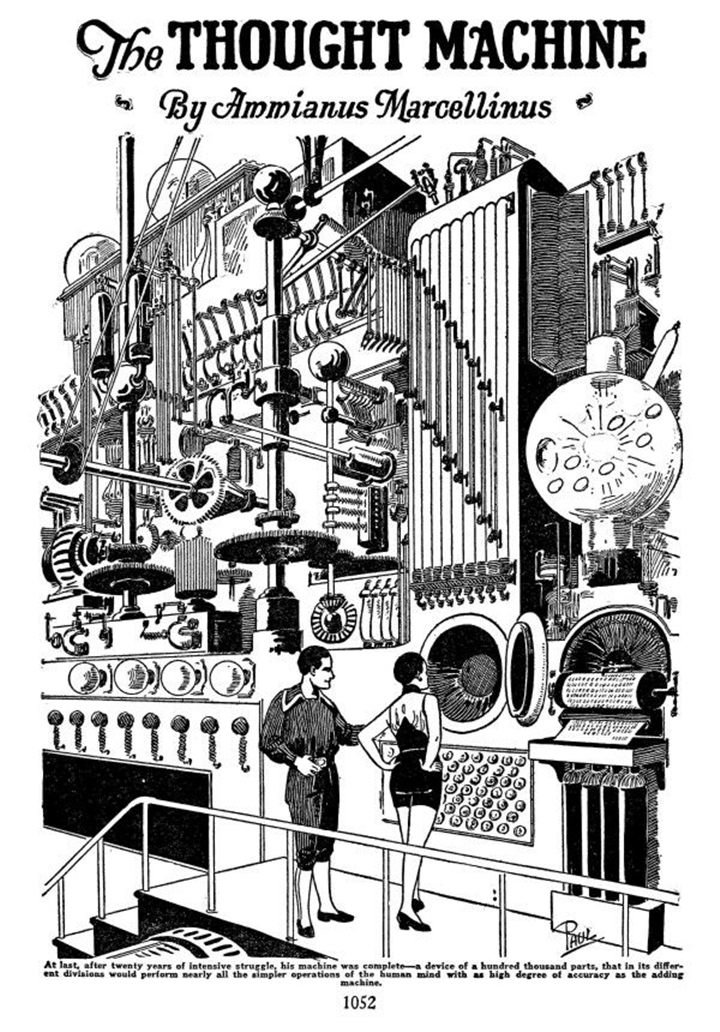
    THought machineIn the past of the past of the Thinking Machine, back when Alan Turing was only 15, the prodigious and fabulous Frank R. Paul was creating this image (left) of such a machine for an almost-adventurous story by “Ammianus Marcellinus” called “The Thought Machine”. The story appeared in Amazing Stories in February 1927, and for me Ammianus (the name of an historian who live in the 4th century CE and who wrote on the later Roman Empire) just did not have the power of persuasion for his tale–perhaps a lot like his 1600-year-old original, who Gibbon found to be boring and tedious). But the legendary work of Mr. Paul was enough for me, and so I’ve reprinted his artwork, which in itself is expansive and techo-lyrical in its many ways. In this one, I was intrigued by some of the thought machine’s components–the most obvious bit being what very much looks like a “Millionaire” calculating machine at bottom right. That, and the Napier’s-Bones-type thing about the bouncing brain of the machine–and then there numerous gears and worms…and what also seems to be like the hints of the power for the whole thing, which are the several belts leading up and away to a larger power conveyer off-picture, which for all I know may have been steam.  

    Atom revolt  of theI looked around in the pulp/sci fi references I have for some other images of “thought machines” from this early <1930 period and came away with very little, though I did find something hopeful called “The Thought Materializer” which was also supposed to be illustrated by Mr. Paul. The story appeared in Science Wonder Quarterly and was published in the spring of 1930–unfortunately the illustration was just a simple and disappointing portrait of the author.  The story was even more disappointing, and the writing was Boy-Wonder-robbed-as-he-knealt-to-pray-about-lonesome-love bad–for example, there is this unpolishable pearl: “Imaginatively, Proctor stepped from the bath”. Ouch.

    That said, looking for that “missing” Paul illustration let me bump into another interesting bit with a title begging question: “The Revolt of the Atoms”.  

    This brings to mind the possibility of “The Revolt of the Adams”, where 17th c Bishop Burnett postulated infinite planets and infinite worlds with infinite people populated by infinite Adams and Eves because as god is perfect each world would be completed with its own A&E.  

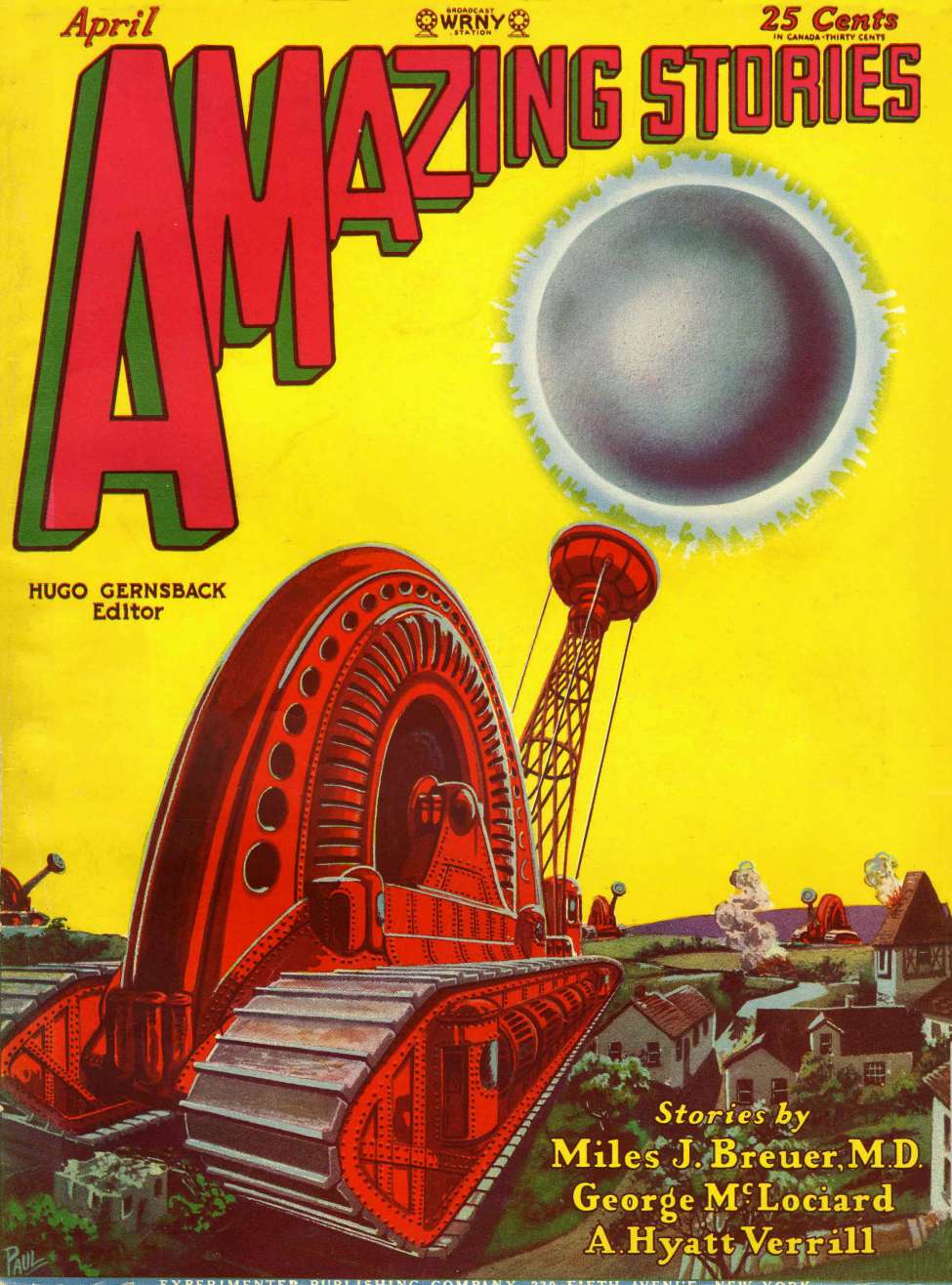
    Getting back to atoms–this story was published in Amazing Stories in their April 1929 issue and was one of the not-many early sci fi bits working around the idea of harnessing the energy of atom. Unlike many, the author, V. Orlovsky, had a go at the dangers of the atoms “rising to power”, the new-found energy becoming an agent in the possible demise of the Earth.  In any event, Something Happens in the story and the atoms run wild, forming a gigantic firey nucleus of a floating monster atom which “swept away everything that was alive”. The giant atom moved across Russia and into Italy, then on to France, destroying everything, threatening the Earth itself with utter destruction. I did not read the whole story, but it does seem as though an eruption of Vesuvius directly beneath the atom and ejected it on an “etherwave” into the Earth’s atmosphere, where it spun itself away and harmlessly so, becoming a small satellite. As I said, it is a disappointing story, though the cover art–again by Frank Paul–saves the day with its drawing of the giant atom being approached by enormous electromagnets to try and do such-and thus to it.  Frankly, I just liked the idea of the killer atom.  


  • Albert Robida, Visionary

    JF Ptak Science Books 

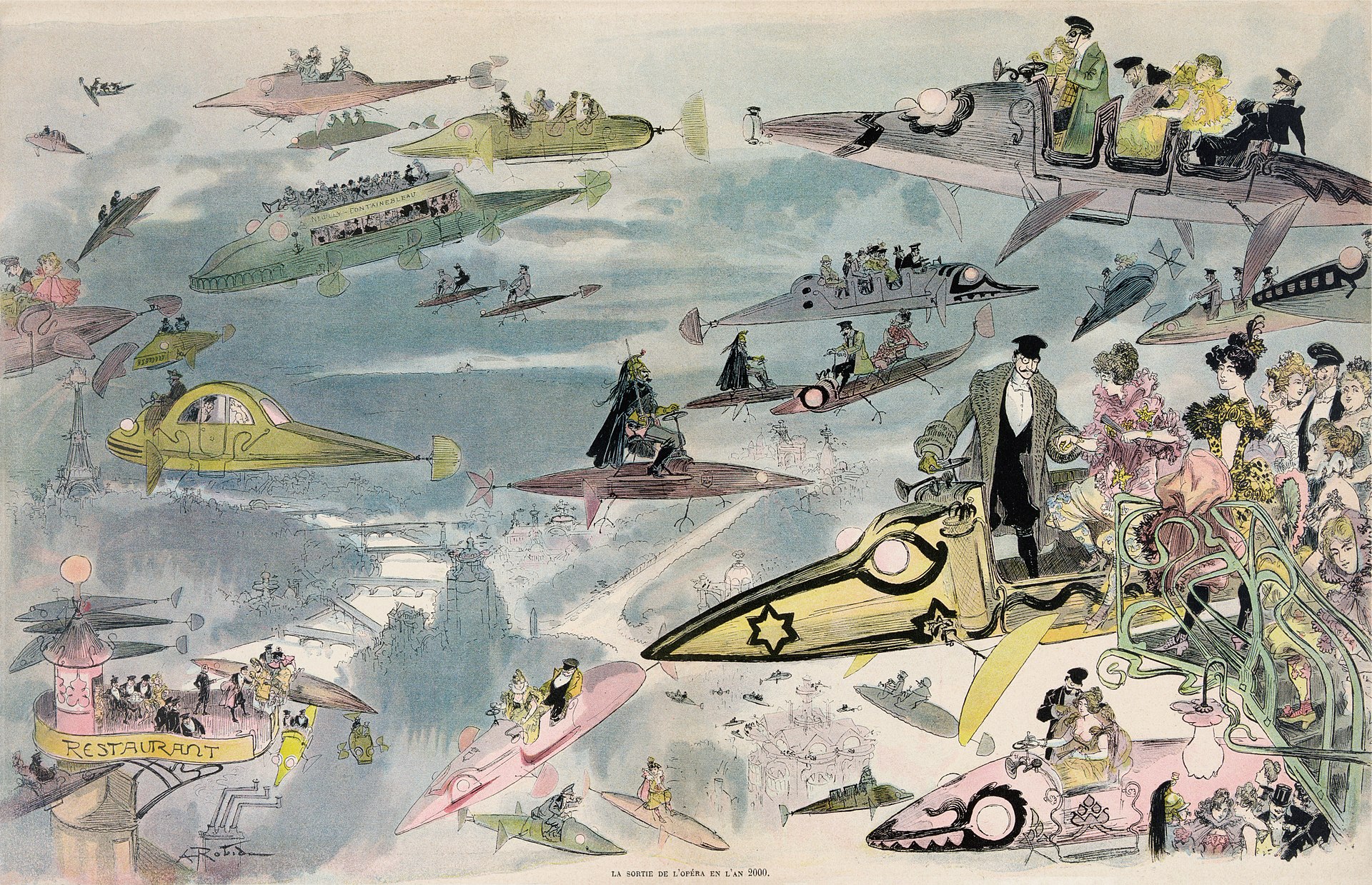
    Albert Robida, a fabulous visionary born in France in 1848 (dying in  1926) was an illustrator, etcher, lithographer, caricaturist, and novelist.  His greatest achievement is his futuristic trilogy, including Le Vingtième Siècle (1883), La Guerre au vingtième siècle (1887) and Le Vingtième siècle. La vie électrique (1890).  In general he has deep, realistic vision, the sort that puts him a similar plain as Jules Verne, but is differentiated from his famous French compatriot in that his creations seem more compatible with possibility, being more common, more fashioned to what the average person might come to expect of their future creature comforts.  In spite of a fantastic and perhaps unparalleled scifi imagination, Verne seems a little beyond the scope of the mortal future, maybe a little too much for their appreciation of whatever common class the future might hold room for.   

    La Sortie de l'opéra en l'an 2000


  • Crazy Cubes, Baseball Cannons, Logic, the 4th Dimension, and Monkey Bars.

    JF Ptak Science Books   (Older post #2248 from July 2014 expanded)
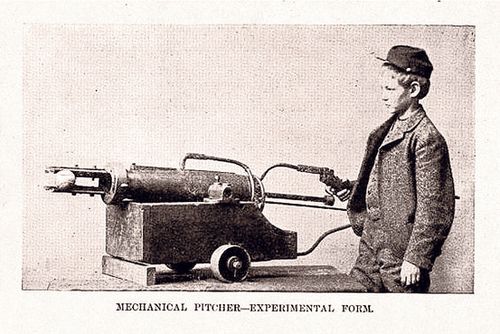
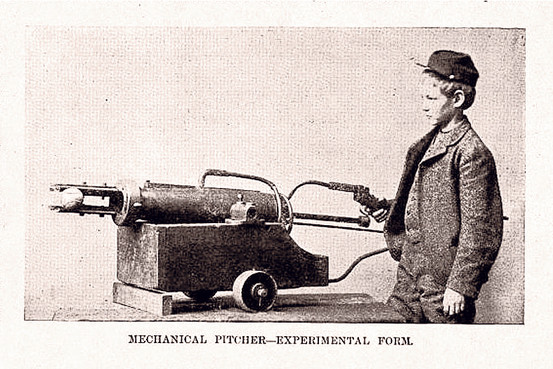
    Hinton cannon[Image source:  Joshua Robinson, “A Machine Before its Time”, Wall Street Journal, June 21, 2010. See below.]

    Somewhat Zelig-like, Charles Howard Hinton (1853-1907) is a sort of shadowy Oxford-educated figure who turns up in the beautiful Jorge Luis Borges’ works, and who married one of  George Boole’s daughters1, and who was a great and very early visualizer of geometries of higher dimensions, and who was the coiner of tesseract, and the inventor of a baseball pitching machine, and a practical joker, and a sci-fi writer, and who deserved an obituary in the New York Sun by the masterful Gellett Burgess2, and who seemed to keep one step ahead of everyone and himself.

    He was also the creator of “crazy cubes”.

    There are many standard-bearers in the history of modern art who probably owe something to Hinton, who published his ideas on the fourth dimension (illustrated!) just at the time when this idea was in it trial runs in the artwork of the modern age.

    And so do baseball players—or at least those at Princeton, where he introduced his machine which evidently was used there for several seasons. The pitching gun really was a cannon, the baseball loaded into the thing with an appropriate cartridge to shoot the ball at pitcherly speeds, which he described it in Harper’s Weekly for March 20, 1897. It was capable of varying speeds, had an adjustable breech, and was capable of throwing a curve. (How Hinton got to Princeton is interesting and a mystery, both; he was an instructor of math in England until he was charged and convicted of bigamy in 1886, whereupon he took his first wife and four (?) sons to Japan to teach in Yokohama for a while, then yadda yadda yadda he starts teaching at Princeton in 1893.)

    Hinton was into a lot of things, with a very inquisitive mind, and very smart. And so he bounced here and there in his careers, from position to position. David Toome, in his fine The New Time Travelers: A Journey to the Frontiers of Physics (2010) gently and wonderfully describes Hinton (in his relations to the exterior world of work) as “buoyant” (page 29).

    In any event, Hinton seems not to have patented the thing, so far as I can determine in 10 minutes of patent searches.

    The cannon seems to have excited a bit of baseball scifi3 in itself, adding to Hinton’s other pleasures.

    In a longer and better article than mine, Joshua Robinson writes in the Wall Street Journal about  Hinton’s machine and the near-roboticized future of baseball:

    “…(I)n 1896, the Los Angeles Times called it a “Frankenstein.” One Washington Post columnist worried it would ring in an age of robots ruining the national pastime—this was a long time before anyone was worried about steroids.

    “There would be the base-burning, high-pressure, anti-friction catcher,” he wrote, “and the shortstop made of aluminum and rivets and filled with cogs, cams, valves, shafts, and belting.”

    Hinton’s pitcher was an interesting idea, but ultimately it proved to be too cumbersome and slow to be of any sustained use. Plus, as Robinson points out, after the cartridge was fired there was a puff of smoke, which caused occasional consternation and confusion for those standing in front of the canon. And ducking. 

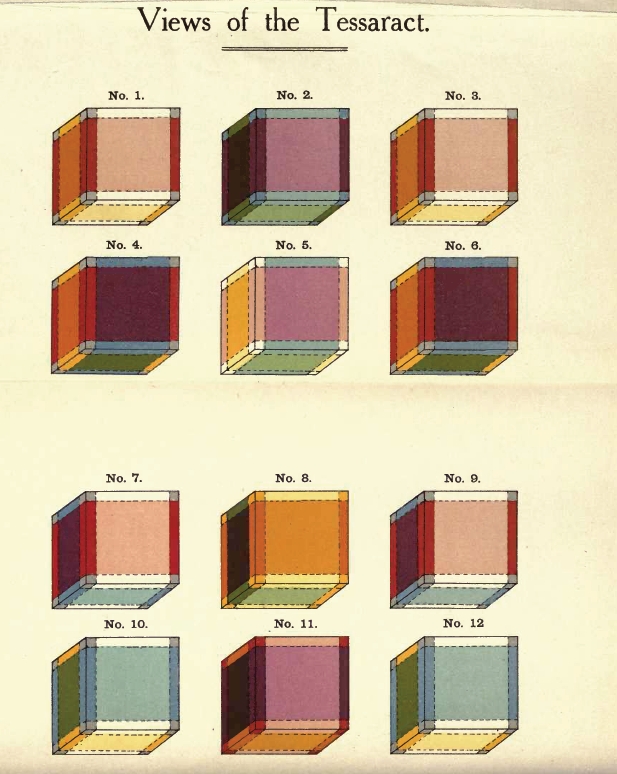
    And the so-called “crazy cubes”?  That moniker is my own creation. These were simply (really not so) creations by Hinton that he said would help people visualize his four dimensional world, as Rudy Rucker (see below) describes as “points moving around in three dimensions might be imagined as successive cross-sections of a static four-dimensional arrangement of lines passing through a three-dimensional plane…”  Evidently the cubes helped many people experience a more internalized world of fantastic difference, some stating that the cubes drove some people insane. Of course they were just colored cubes, pretty in themselves–though the problem of visualization was fairly knotty.4  
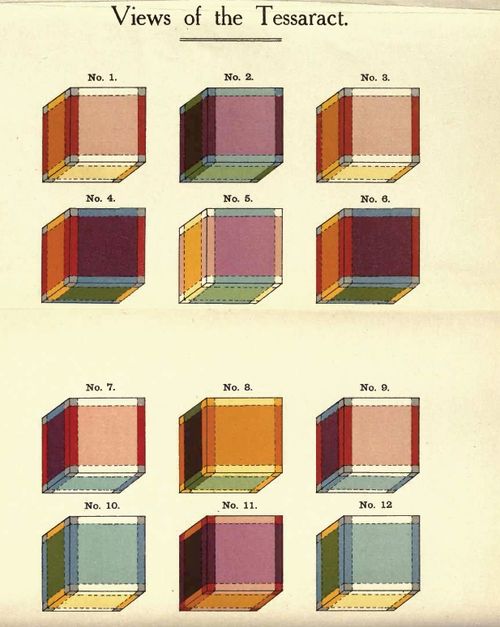
    Hinton tesseract[Source: The Fairyland of Geometry, a Cultural History of Higher Space, 1869-1909, here.]

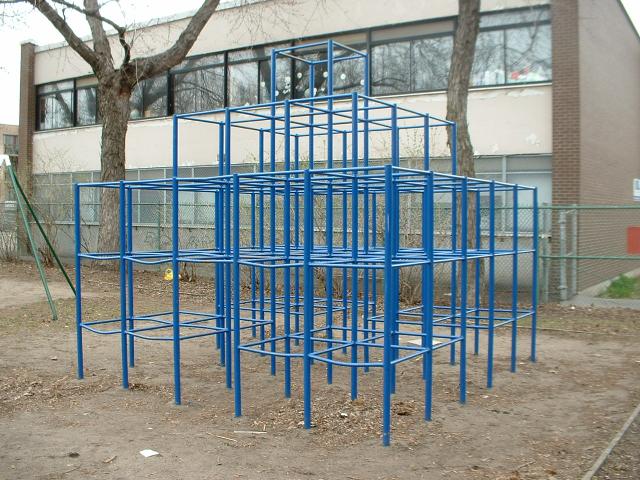
    It MUST be pointed out that there is a very steely concretized example of the Hinton tesseract that is still around, brought into existence by one of Hinton’s sons. Sebastian Hinton (1887-1923) was a lawyer in Chicago who hit on an idea of bringing his father’s work somewhat into the hands of the public-at-large–specifically, into the hands of children, who would be able to play and climb and swing in Charles’ fourth dimensional idea.  He applied for a patent in 1920 which was granted in 1923:
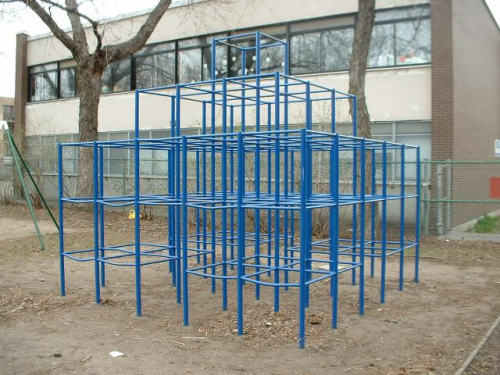
    Jungle gym


    [Image source: Wiki Commons.]

    The “Junglegym”5. 

    Notes:

  • FuturePunk 1887: What is It?

    JF Ptak Science Books  

    Here’s another in this developing and fun series in the What-is-It? category. At first it reminded me of Renaissance woodcuts of various stages of creation anointed by a coy hand of the creator. This one though is late 19th century and has a definite highly au courant “Oriental” theme which so far as I can tell has nothing to do with the telling of the story of this object.  It looks a little like a multi-horned phonograph (already in existence by about a decade at this point), and it also looks a little like a Chinese earthquake detector. It is surprising for what it actually represents, and it is a lot larger than you’d think, with the figure in the background definitely not to scale. Plus, it comes into the world a few years earlier than its gigantically famous counterpart, as though it had gone back in time…

    What is it?

    Time machine


  • Lunar Space Suits, 1950

    JF Ptak Science Books  Quick Post

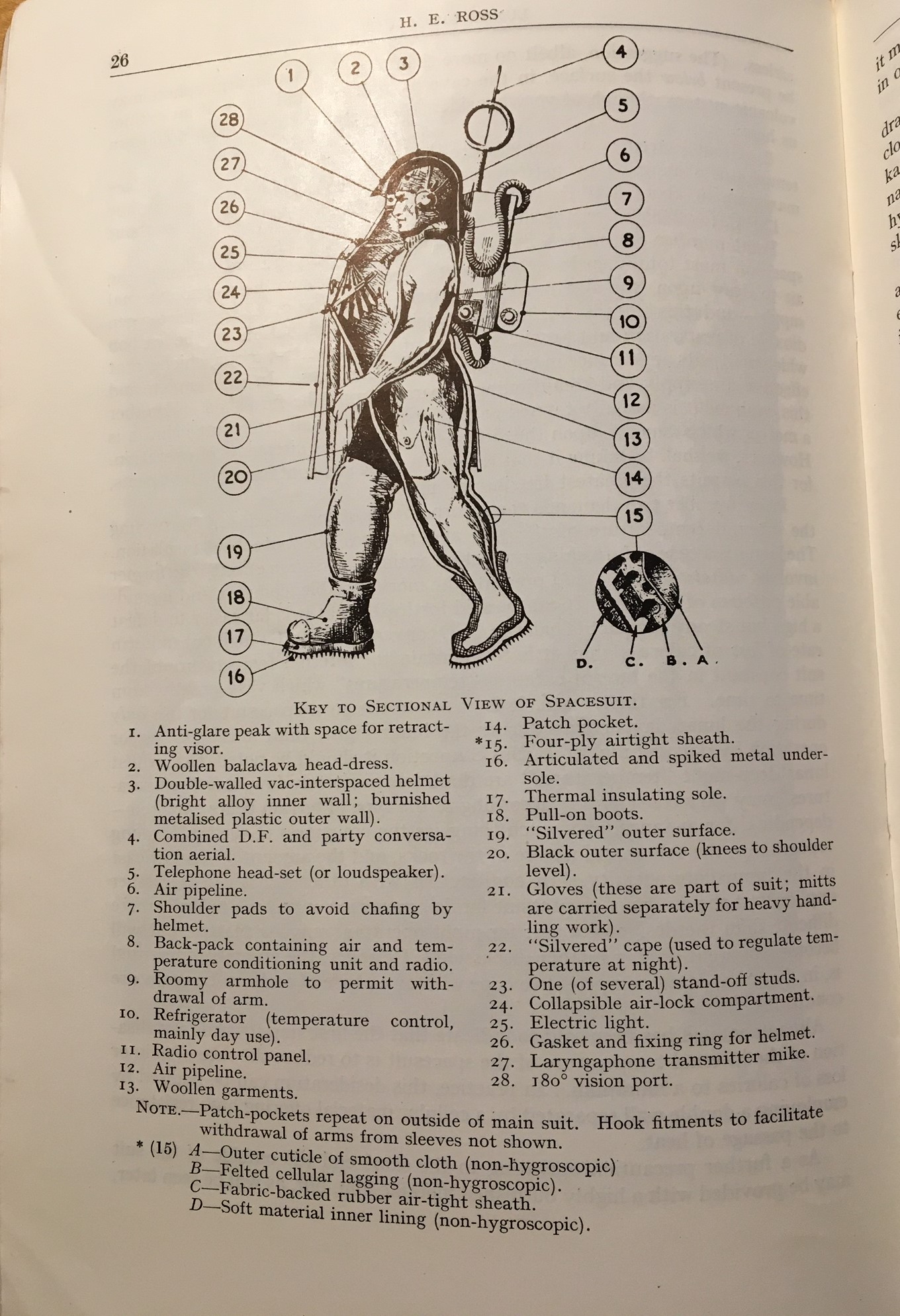
    IMG_2183This is just a very quick post based on a book that I’m trying to sell over on the bookstore end of this blog–the images are arresting and interesting, and I at least wanted to share them here.  These two illustrations are the first serious scientific study of what sort of suit would be needed to survive on the surface of the Moon (according to the Space Centre UK website) and appear in  H.E. (Harry) Ross’ article “Lunar Space Suit” as it appeared in the  Journal of the British Interplanetary Society, (vol 9/1, January 1950) . Enjoy. 

    “In a November 1949 symposium, Harry Ross presented a paper on the “Lunar Space-Suit”. Ross had examined the problem of a 68 kg lunar space suit (equivalent to 11 kg on the Moon) which could be worn for up to 12 hours, within the temperature range of 120 degrees to minus 150 degrees Celsius, representing night and day. The suit design was a 4-ply, made up of a thin exterior skin of closely woven cloth. It had a 1 cm layer of cellular heat-resisting material (Kapok, wool, felt et cetera) and a 1-2 mm main airtight sheath of fabric-backed natural or synthetic rubber. It also had an interior lining of non-hygroscopic material, mainly for comfort and to manage contact between the rubber and skin and absorption of the water-vapour. The exterior of the lunar space suit was to be a highly burnished metallic film, designed to reflect as much heat as possible.”

    IMG_2184“The helmet was to be a light, rigid double-shell structure, with the inner a bright alloy metal and the outer a plastic with burnished metal coating. Lateral vision of 180 degrees was proposed with a minimal vertical extension in order to minimise heat gain or loss. A special glass to prevent heat and actinic Ultra-Violet rays would be employed…”

    “The space suits that were eventually worn by the Project Apollo astronauts are a far cry from this original 1940s design. But the work started out by Harry Ross, led to credible thinking on how humans could survive in a self-contained, mobile habitat. The original paper by Harry Ross is [this paper].” –British Interplanetary Society website


  • Where Suspended Railroads and Elevated Highways Meet: Los Angeles Traffic, 1939

    JF Ptak Science Books  Quick Post

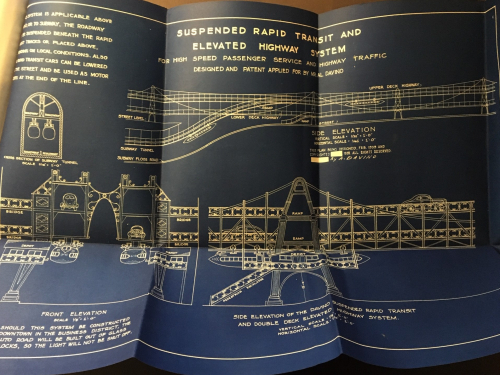
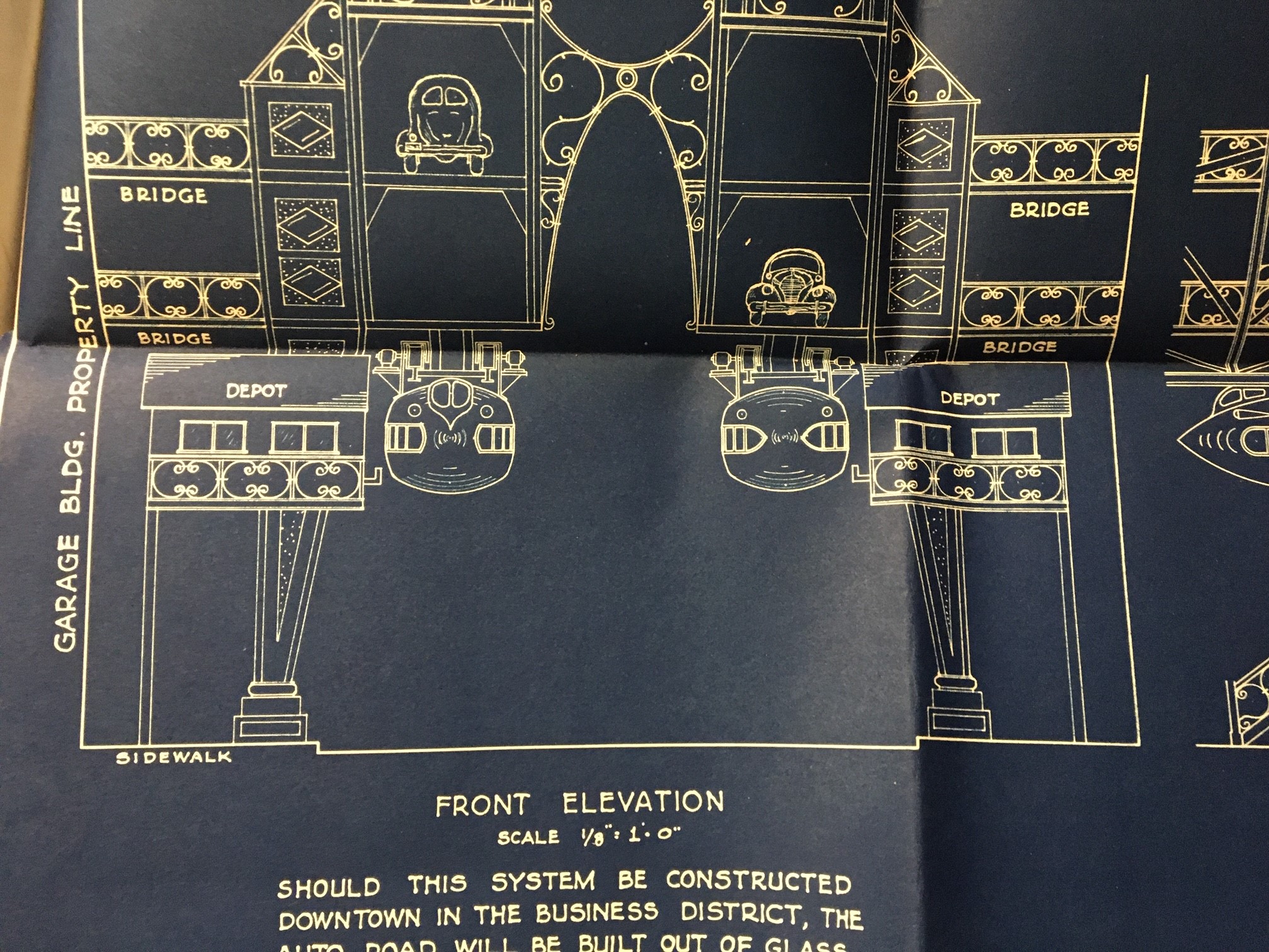
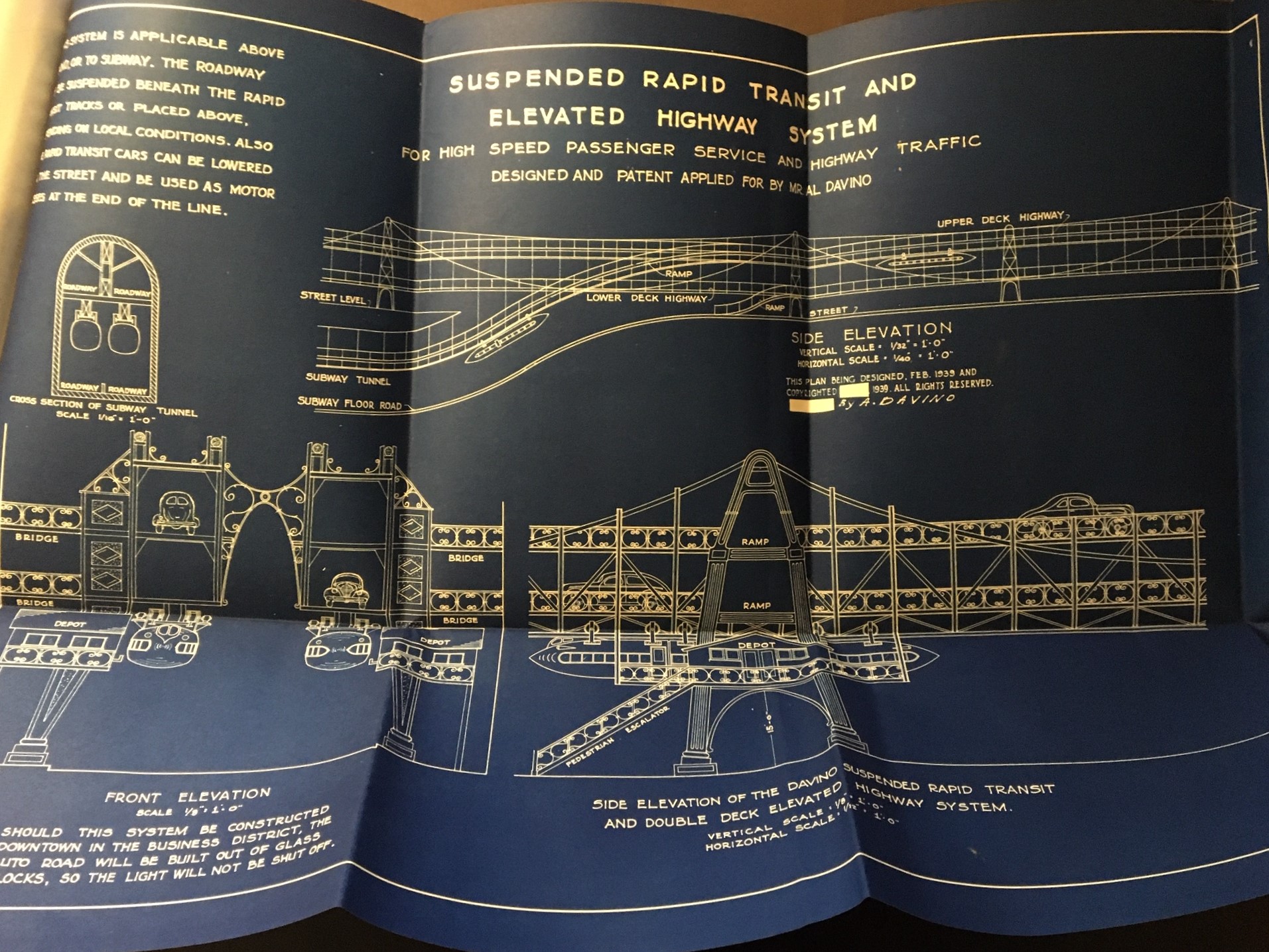
    Here we go: I unearthed a beautiful if not a very good solution to the traffic congestion problems in 1939 Los Angeles. It is a rare, self-published work of what seems to have received almost no attention, suggesting a combination of suspended railways and elevated roads to free up more space on the streets of L.A. It is the work of Alphonso Davino (1888-1965?) who wrote A Brief analysis of the Traffic Congestion Problem and its Economical Solution1 and presented it to city planners in 1939.  Mr. Davino had an entire system of transportation, though he seems to have luck in getting the ideas across a wider population in only occasional and obscure publications. 

    IMG_2251

    I can not find very much at all for Mr. Davino, though he is a patent holder for at least three associated designs/ideas dating from 1926 to 1950. [Semirigid Suspended Railway Structures, 1607875, (1923); Aerial Railway Apparatus patent 2234487 (1943); Suspended Rapid Transit System 2781001A (1950), (suspended vehicles with self-propelled vehicles).] I also found a reference to a suspended transportation system of some sort offered by him through his business “Aerial Apparatus” of Los Angeles (in the Mining Journal, vol 110, 6 November 1920, p 910).

    IMG_2254


  • A Proposed Solution for Traffic Congestion, Los Angeles, 1939: Suspended Roadways and MonorailsÂ

    JF Ptak Science Books  Quick Post

    This Quick Post entry is a simple one, repeating an entry that I’ve made to the bookstore section of this blog–I’m doing so just to make the info available, as the booklet is interesting and rare, and possibly a unique.  It is a work by A(lphonse) Davino, of Los Angeles, who had evidently maintained a lifelong interest in advanced transportation systems for cities–in this case, Mr. Davino approached the city of Los Angeles with his system. From what I can see the Davino System was a series of suspended monorails and auto lanes that would be used in conjunction with existing roads to address the increasing metropolitan congestion. If nothing else, Mr. Davino’s plans are really quite lovely.  Here’s a blueprint for the mainstay structures of the plan:

    IMG_2251