A Daily History of Holes, Dots, Lines, Science, History, Math, Physics, Art, the Unintentional Absurd, Architecture, Maps, Data Visualization, Blank and Missing Things, and so on. |1.6 million words, 7500 images, 4.9 million hits| Press & appearances in The Times, Le Figaro, Mensa, The Economist, The Guardian, Discovery News, Slate, Le Monde, Sci American Blogs, Le Pont, and many other places… 5000+ total posts since 2008.

Category: History of the Future

  • A Vision of the Future: 1911 Takes a Look at 1950.

    JF Ptak Science Books  Post 2802

    While pacing through a volume of Technical World for December 1911 I found an interesting paper on what the world of the future–in 1950–held for the average person in 1911.  

    Introduction

    “Wait! Every ten years in America sees a revolution. Industrial phases assume new proportions, commerce enlarges its borders to rush over strange seas, politics become a tangled web during its evolutionary processes, economic problems broaden their scope. Were the possibilities of the great labor divisions of the world gauged by the strides made during the last fifty years, one would stand in wholesome awe of the vision. The last word in the reconstruction of America is far from being said, though tireless workers of science are constantly forming the new America out of natural forces already largely under their control.”

    Air travel and airplanes

    –“Charles K. Hamilton recently stated that the form of aeroplane now in use can be indefinitely increased in size, and that the speed and carrying power can be proportionately augmented. He believes the limited size of aeroplanes, thus far, to be merely a question of cost,…This will come today or tomorrow, and after that will come the Mauretanias of the air. In 1950 we may have air-ships a thousand feet long, flying at a rate of speed so high as to bring New York and London as near together as New York and Chicago now are.

    –Thomas Edison: “…the most serious difficulty to be overcome in aerial navigation—the difficulty of carrying fuel. “I do not know how to do it,” says the inventor of the phonograph, “but a method will be discovered of wirelessly transmitting electrical energy from the earth to the motor of a machine in mid air. There is no reason to believe it cannot be done.”


  • On the Future of the Telephone as an Instrument for Listening to Music Remotely (Summer, 1876)

    JF Ptak Science Books  Quick Post

    Here’s an interesting piece on the future of the telephone, written just a few months after Bell’s patent was granted him (at the age of 29) on March 7, 1876. “Telephones and other Applications of Electricity”, appearing August 24, 1876 in Nature (volume 14, pp 353-355), written anonymously though probably by the editor (and founder of the journal) J. Norman Lockyer, discusses advancements in telegraphy and then switches to the telephone. It was not Bell’s telephone that the writer was discussing, but (mostly) that of Elisha Gray and “Reuss” (actually meaning Philip Reis).—and as a matter of fact there is no mention whatsoever of Mr. Bell.
    The article turns its interest to the future and to the telephone, and how it may come to be that you could basically dial up any sort of music you’d like to hear, and thus do away with live musical entertainment. Curiously there isn’t an implication for the using the telephone for communication–maybe the absence of Bell is less surprising in a way because Reis’ instrument was actually pretty good at transmitting musical sounds and not-so with voice. Still this is a little odd, given that Bell made his famous demonstrations of the instrument’s efficacy just weeks after his patent was granted.

    The text:

    • “We do not, however, believe that in its [the telephone’s] present state, the invention is so complete that we can, at a distance, repeat on one or more pianos the air played by a similar instrument at the point of departure. There is a possibility here, we must admit, of a curious use of electricity. When we are going to have a dancing-party, there will be no need to provide a musician. By paying a subscription to some enterprising individual, who will, no doubt come forward to work this vein, we can have from him, a waltz, a quadrille, or a galop, just as we may desire. Simply turn a bell-handle, as we do the cock of a water or gas-pipe, and we shall be supplied with what we want. Perhaps our children may find the thing simple enough.”


  • The Plurality of Worlds (1912)

    JF Ptak Science Books   Quick Post

    The following is section is from mathematician/logician Augustus DeMorgan’s (1806-1871) classic Budget of Paradoxes second edition of 1912). It is a short expository on the plurality of worlds and life on them beyond the Earth, looking back over the history of the idea from Lucian, Huygens, Swift, Kircher, and others.  DeMorgan’s footnotes are included at bottom (with a few added comments in italics). 

    “INHABITED PLANETS IN FICTION

    There is a class of hypothetical creations which do not belong to my subject, because they are acknowledged to be fictions, as those of Lucian,[177] Rabelais,[178] Swift, Francis Godwin,[179] Voltaire, etc. All who have more positive notions as to either the composition or organization of other worlds, than the reasonable conclusion that our Architect must be quite able to construct millions of other buildings on millions of other plans, ought to rank with the writers just mentioned, in all but self-knowledge. Of every one of their systems I say, as the Irish Bishop said of Gulliver’s book,—I don’t believe half of it. Huyghens had been preceded by Fontenelle,[180] who attracted more attention. Huyghens is very fanciful and very positive; but he gives a true account of his method. “But since there’s no hopes of a Mercury to carry us such a journey, we shall e’en be contented with what’s in our power: we shall suppose ourselves there….” And yet he says, “We have proved that they live in societies, have hands and feet….” Kircher[181] had gone to the stars before him, but would not find any life in them, either animal or vegetable.

    Fontenelle

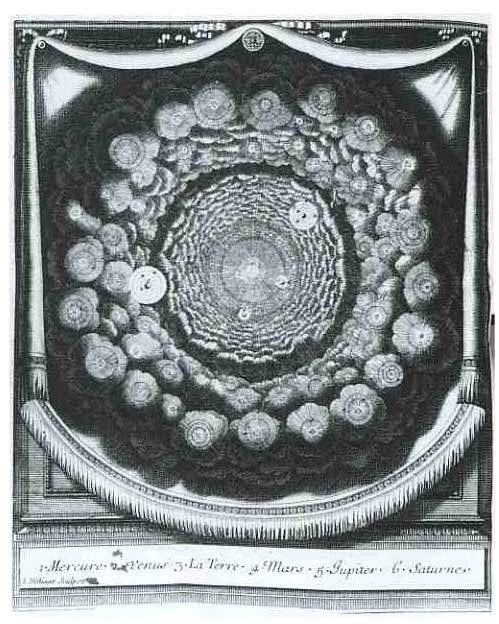
    • [This lovely image belongs to Entretiens sur la Pluralitie de Mondes (Conversations on the Plurality of Worlds), written by the great French philosophe Bernard le Bouvier de Fontenelle in 1686 (just a year before publication of perhaps the greatest work in the history of science, Newton’s Principia Mathematica). The Plurality was a best-seller by the best-selling Fontenelle. An excellent attempt by a rather restricted writer to engage the population-at-large, writing a high-pop book on what was basically the history of astronomy and cosmology of the preceding century. Copernicus was a major feature of his imaginary conversations with a muse as he wandered through a metaphorical garden of questions, with the observations of Galileo and Cassini also very prominently featured.]


  • Electricity and Telegraphy Before the Electric Telegraph: the (Electric) Shock of Recognition (1825)

    JF Ptak Science Books  Quick Post

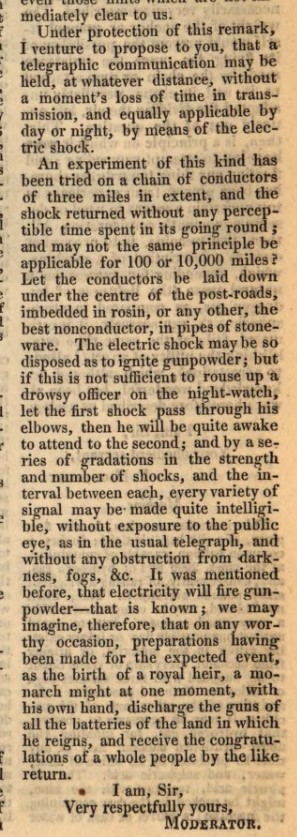
    Electric shockHere’s an interesting twist on electricity and the telegraph, but not quite what you’d expect. The note, written by “Moderator”, appeared in Mechanics’ Magazine for 15 June 1825 (volume iv, p 148). Since this is 1825, the telegraph being referred to here is an “atmospheric telegraph”, or semaphore, the electric telegraph of Morse being another dozen years away and another 5 or 6 before its practical appearance.

    The electricity here was being used in part to alert (where “alert” = “shock”) whoever it was that was snoozily sitting at their post to instantly pay attention to whatever it was being signaled to that point in the semaphore chain:

    “The electric shock may be so disposed as to ignite gunpowder; but if this is not sufficient to rouse up a drowsy officer on the night-watch, let the first shock pass through his elbows, then he will be quite awake
    to attend to the second…”

    I can’t tell if this is being suggested along a A Modest Proposal sympathy, or not. 

    This shock-bit though is preceded by something interesting that I also don’t quite understand, though that is starting to sound like the modern electric telegraph:

    “…and by a series of gradations in the strength and number of shocks, and the interval between each, every variety of signal may be made quite intelligible, without exposure to the public eye…”

    In any event, it is an interesting footnote in the history of communication and those sleeping through it. 


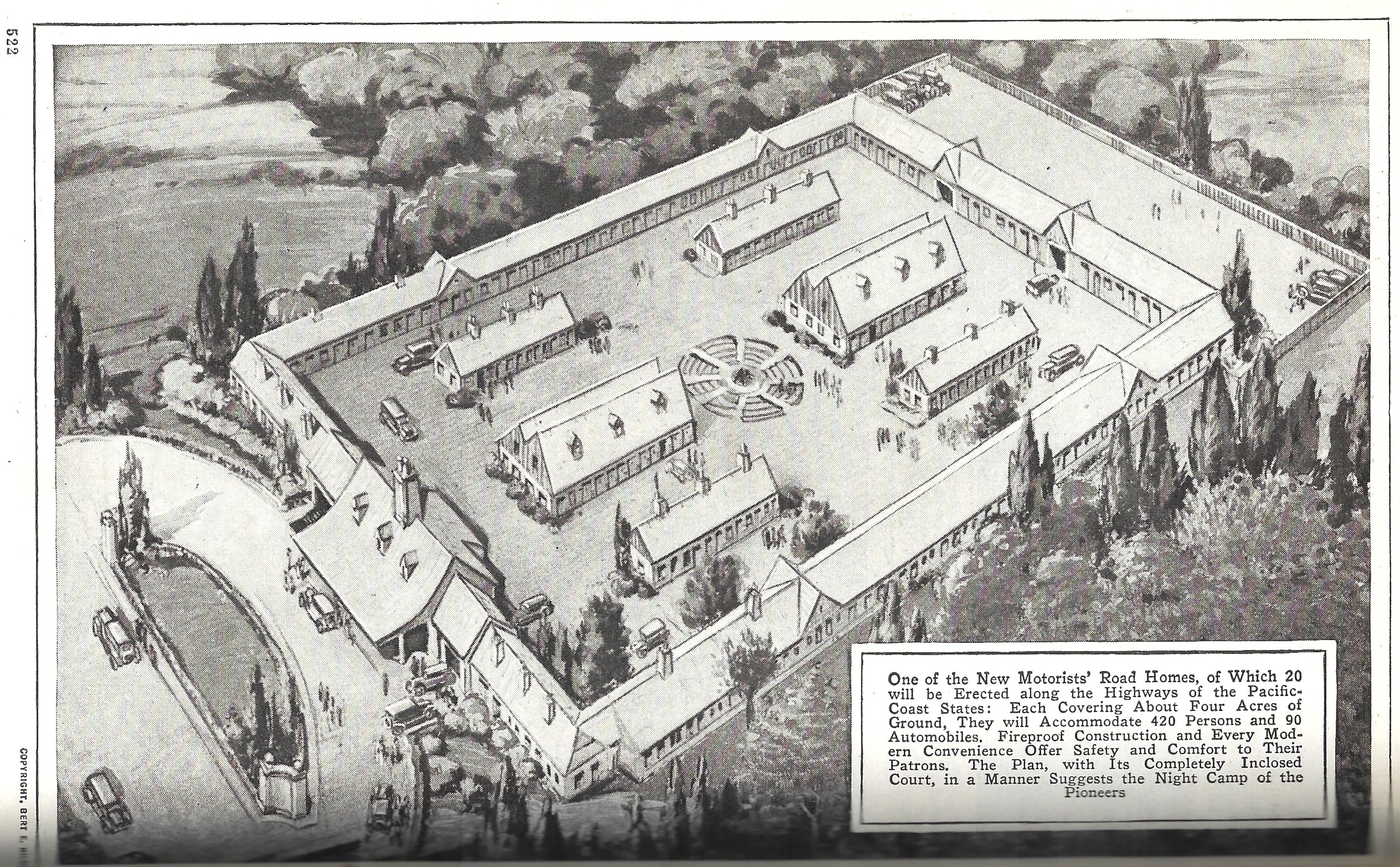
  • Car Travel for No Good Reason Whatsoever and “Motorist Road Homes” To Accommodate That (1922)

    JF Ptak Science Books  Quick Post

    This diagram reminds me of an enormous and mega-completed versions of the imaginary Joey the Juices’ “Stop ‘n Go Inn ‘n Out” motel down on the nice part of Rt. 1.  This exploded version of the motoring motel was meant for West Coast for travelers “aimlessly covering thousands of miles”, a giant influx of people riding the wave of massive new car ownership. This ranch was to welcome 420 people with room for 80 cars–which means, I guess, that people were traveling together–really together–five to a car, which implies that there were a good number of people contributing in an organized way to “aimless” activity. Perhaps people were just doing a lot of serendipitous driving as an organized crew. In any event I’m pretty sure that I’ve not seen plans for a motor lodge of this size, and thought to share it, finding it in the pages of Popular Mechanics for October 1922. 

    Given the birth of a much wider middle class, and the capacity for some disposable income, and access to cheap/affordable transportation and the roads to ride these new cars on, a large part of the working population of the U.S. did have the luxury at this point of travelling for the sheer hell of it. 

    Pop Mech 1922 car ranch


  • A Marching Band Without Instruments, but with an Wireless Master (1922)

    JF Ptak Science Books   Quick Post

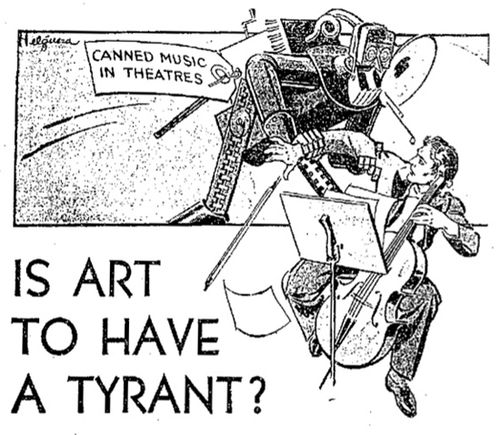
    I’ve written here before about the early incursion of technology into the spheres of human creativity and imagination. Now, some of those bits have stretched the idea a little, but when people (or Our Future Robot Overlords) look back  into the dim dust they may be more prepared to accept some of propositions of these posts as pre-history implications of the future domination of something along the lines of AI or universal intelligence. For example, one of the posts dealt with the replacement of live music in theaters with “robot music” , which was simply “canned”, or recorded music replacing the live players. (See https://historyofideasblog.com/thesciencebookstore/2016/10/robot-songs-of-love-.html for example.) 

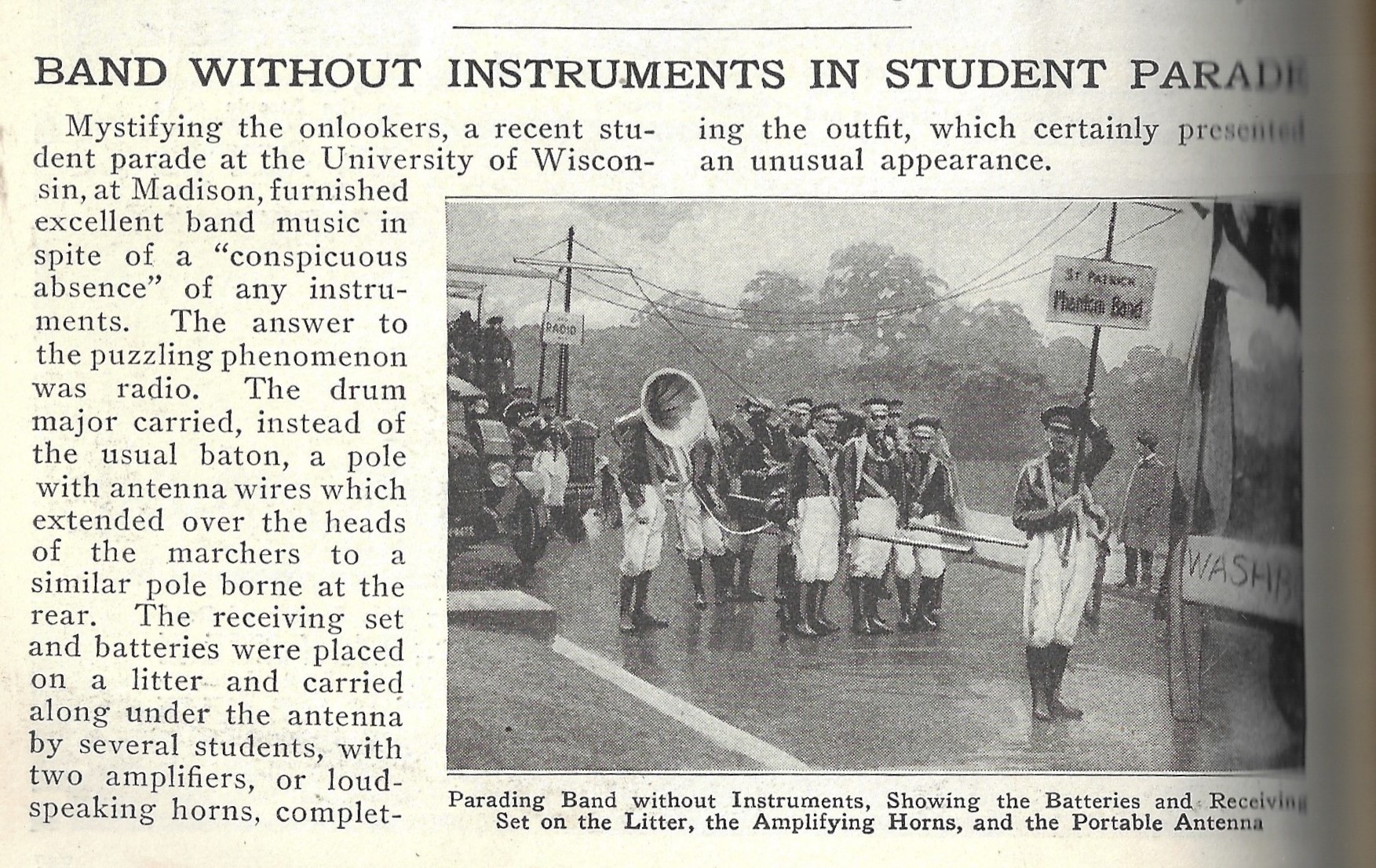
    Along these lines came  another example today, this one from 1922 (just a year after the creation of the word “robot” from Karel Capek’s R.U.R.): the marching band with no instruments. This was the “Phantom Band” depicted in the pages of Popular Mechanics in March 1922 and shows a band identified so, marching with a radio set playing the music rather than the human performers. (If you look closely you can see the drum major is carrying an antenna, and the sousaphonist is actually carrying a loudspeaker, and somewhere in there are folks carrying the battery set, and so on. There’s no clue in this short article why this demonstration was taking place, but it did.  

    Pop Mech 1922 marching band

    And another example of “robotic” music (1929):

    Robot songs of love

    ·Posted by :

    ·in:


  • To the Moon on a Plume of U-235

    JF Ptak Science Books  Quick Post    

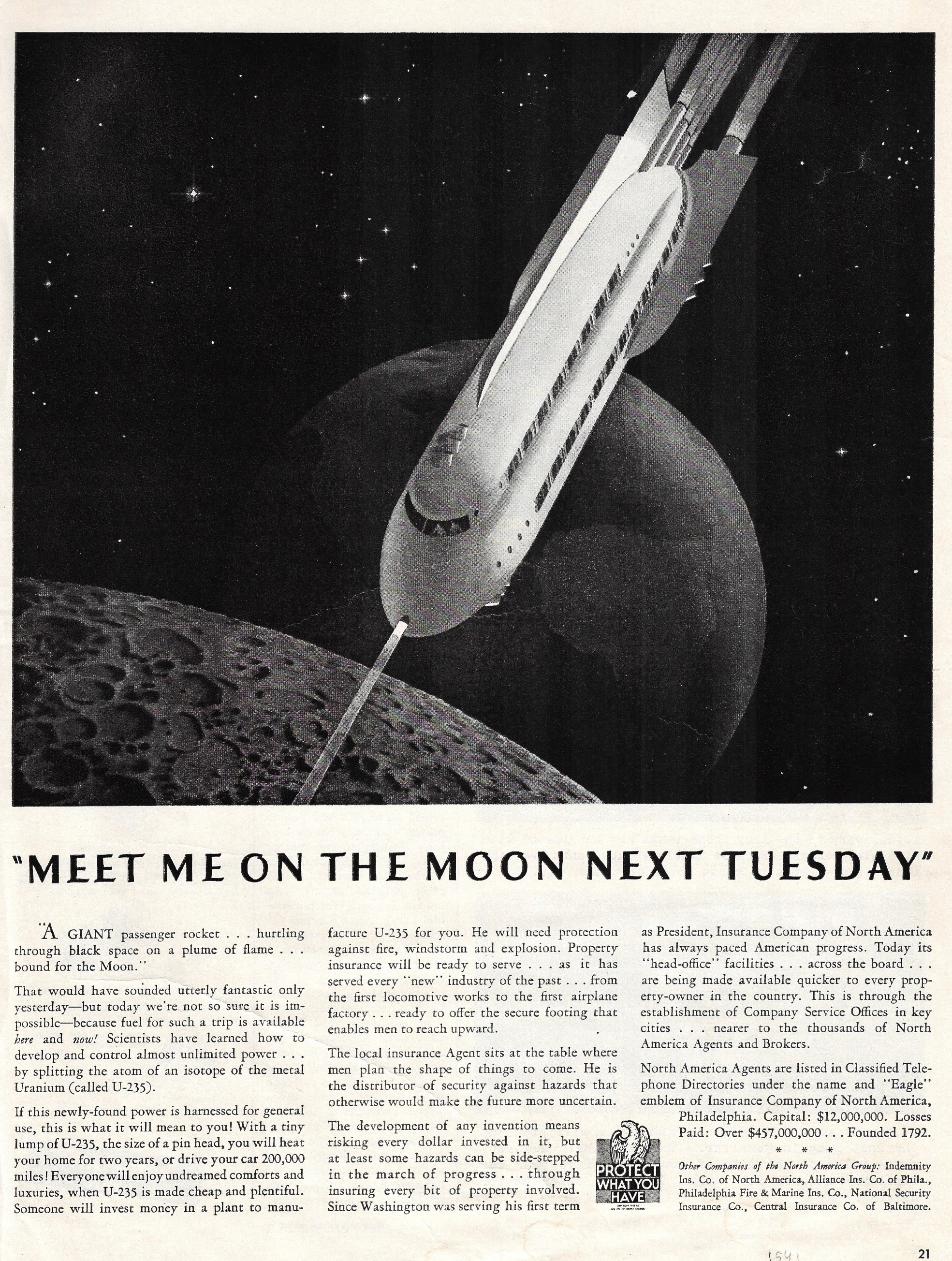
    This reaching image appeared as an ad for a life insurance company (?) in the pages of Life magazine for 1942. What the company latched on was the uranium isotope 235U (uranium discovered in 1789 by Klaproth and its radioactive state found by Henri Becquerel in 1896, 235U discovered by the mass spectrometer guy Dempster in 1935, and soon followed by the nuclear fission paper of 1938 by Hahn/Strassmann/Leitner) and how it would effectively be the power source (“cheap and plentiful) for, well, a lot, including cars and spaceflight. Anyway, the drawing is neat even if the Earth is way out of proportion, and so on:

    Space flight 1942

    ·Posted by :

    ·in:


  • Word Images on the Longevity of Coal (1859)

    JF Ptak Science Books Quick Post

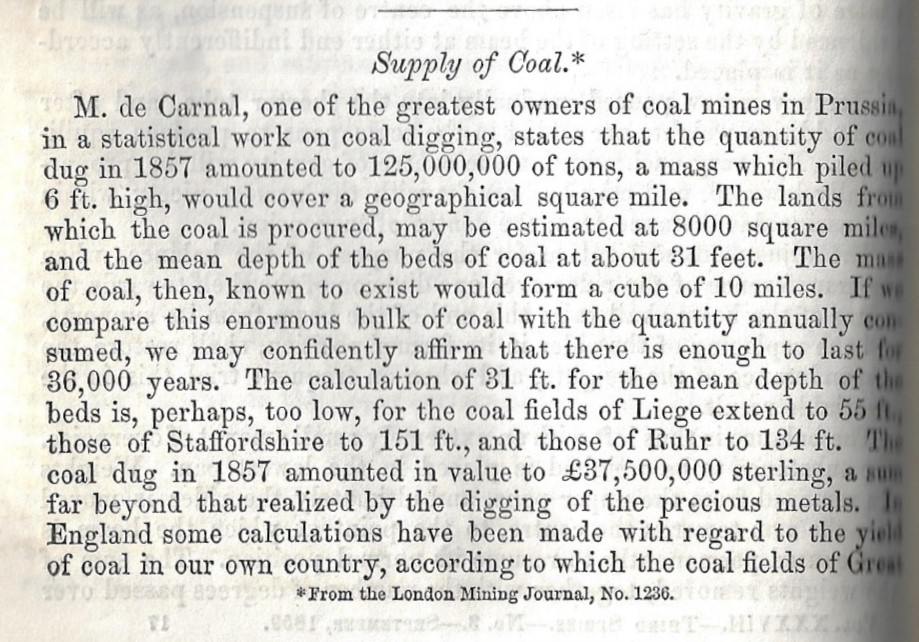
    In the last 24 hours I’ve come across two antiquarian outlooks on the longevity of the world coal supply after not having seen hardly anything of the sort written in the 19th century.  (The 20th century, even in its first decade or two, is another story.) The first was an article by the engineer John Ericsson, who wrote on the temperature of the heliosphere of the Sun in  Nature for 1871 (and came quite close) which led to an earlier paper from 1868 in which he hypothesized a short lifespan of coal and advocated for forms of “solar energy”. Then came this article from 1859 (in the month of publication of On the Origin of Species which hypothesized a much more abundant future for coal deposits, which the writer figured to be 36,000 years. Unfortunately his terms aren’t very well defined–was he addressing the coal production of Prussia or Europe or the world when discussing “the quantity of coal dug in 1857”? When stating “the lands from which the coal is procured” may be 8,000 square miles, did that mean an 8,000 square mile swath of Germany, or 8,000 square miles of mined coal in Europe, or etc.? New Hampshire is about 8,000 square miles, and the entire Prussian Monarchy was about 110,000 square miles, so maybe that meant packets of mining surfaces here and there? 

    I don’t know. But it was an interesting problem the writer set to work on, even though he didn’t really do the necessary work on the parameters or what the future might hold in reference to coal usage. The writer also painted several nice mental images in trying to visualize the great numbers involved with coal production and consumption.  Here’s the article in full: 


    JFI 1859 supply of coal


  • Power and Technology of the Year 2000 (from 1927)

    JF Ptak Science Books   Post 2779
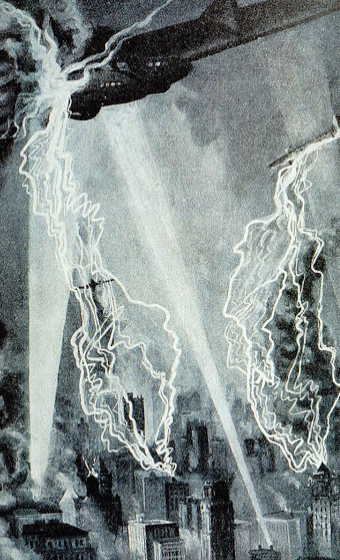
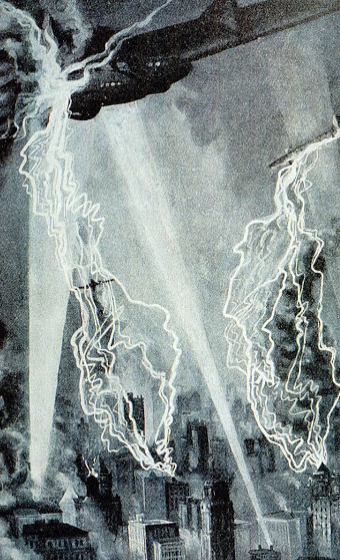
    Lubke IRCRAFT BOMBING

    I found another unexpected source for the initiation of nuclear energy—this one coming in Anton Lubke’s  1927 book, Technik und Mensch im Jahre 2000. The book is thick (372pp) and well-illustrated,  and has what seems to be a  mostly/somewhat progressive look into the future judging what I can cobble together….or from what I can tell, it was at least not terribly negative, though I haven’t been able to determine if the writer gets political, or not. Given the times Lubke (b. 1890) can’t but help to wonder what warfare might look like, and supplies us with one set of possibilities involving vast aircraft (pictured at left) attacking cities with poison gas and electricity. The idea of urban bombing was still pretty new in 1927, as was the idea of attacking cities that weren’t necessarily military targets. Both of the weapons used by Lubke’s aircraft seem as though they would be devastating, and indiscriminate. (Politicians would pull away from the idea of attacking civilian areas and sign treaties to that effect—that all went away with the invasion of China by Japan, and the attack upon cities by Nazi forces in WWII–the Allies followed suit almost immediately thereafter.) Lubke’s image (which appears in the section titled “Der Zukunftskrieg und die Technik”) must have seemed terrifying to his readers of 1927, though they are at least spared the image of the effects on the population in the imagery of the attack. (The Illustrated London News doesn’t hold back from its readers in an issue from 12 November 1932, which shares an exceptionally graphic artist’s interpretation of a poison gas attack on London, right on the front cover.) 

    This is only 16 years removed from what seems to be the first aerial bombing attack of a civilian population on 1 November 1911, when  Lt. Giulio Cavotti dropped the first bomb from a plane on oasis-encamped Libyan troops at Tripoli.  Of course things rapidly in the few years following that, so that by the end of WWI people got a good taste of what it meant to controlling pieces of property without actually occupying them, raining chaos and destruction from above.  20+ years later, in the early 1930’s bombing became more sophisticated, including a new arsenal of poison gas weapons.  The threat from this weapon was agonizing and palpable–the results of gas attacks upon armed combatants in WWI and  the gassing of civilians in the 1920’s and early 1930’s  made a hard strike into the social fabric, an enormous gaping new hole to be filled in the heart of fear.

    There were a number of interwar aerial bombings that took place that kept the issue of mass destruction alive and well.  For example,  Britain used its air arm  very convincingly in Iraq, bombing many places including Bagdhad  in 1923; the Spanish bombed civilians into submission in Morocco, near Tetuan, in 1925, and the French crippled and destroyed  their opponents–both military and civilian, it made no difference–in Damascus, Syria, also in 1925.

    Fiction also harnessed the possibilities of air war, not the least of which included Armageddon-like scenarios for the semi-End of Days through the use of poison gas and “atomic” weapons.  For example, deadly gas used in Anderson Graham’s The Collapse of Homo Sapiens (1923) and Neil Bell’s Valiant Clay (where the poison gas kills 1.5 billion) and Dalton’s Black Death (1934), while Reginald Glossop’s The Orphan of Space (1926) created an alien atomic spaceship which delivered holocaustal death to Soviets and Chinese and Communists in general.  There were many more stories like this, not the least of which were the non-fiction strategy works, like Giulio Douhet, author of Dominion of the Skies (1921), legitimizer of the “strategic” bombing of civilian populations (in spite of the Hague Conference of 1907*), and  JFC Fuller’s The Reformation of War (1923) which emphsized the new importance of air war and power and which also allocated the use of gas, justifying that morality  because it could cause less harm than a conventional attack.

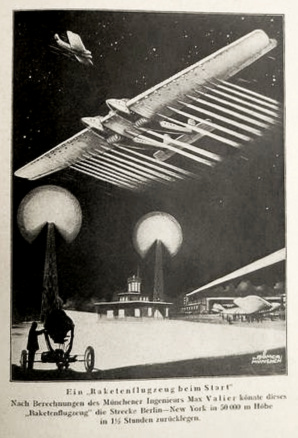
    Back to Lubke: it seems an interesting book, and from what I can see in a very light review there is space devoted to different energy sources than those of 1927: he wrote on solar, wind, tidal, and nuclear (“Atomzertrümmerung”) energy. He also addressed some sort of perpetual motion-something, electrical farming (“Düngung durch Elektrokultur”), and trips to the Moon with the “Mondrakete” (though this adventure into space was already being a well-established part of images of the future in the 1920’s).
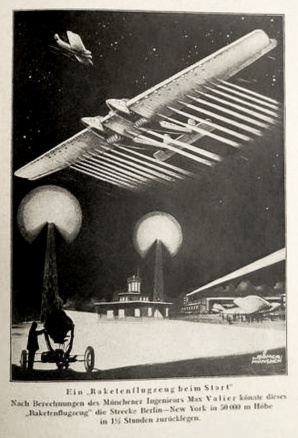
    Lubke aircraftThere’s also this terrific image of a vast rocket plane, the description of which mentions Max Valier, the rocket pioneer, Oberth-popularizer, and founder in 1927 of the (German) Society for Space Travel.  An aircraft/space vehicle like this it is noted could make the Berlin-NYC flight in about 1.5 hours. (Valier was also the first to lose his life in a failed experiment using liquid oxygen, establishing him in a very unfortunate category of “firsts”, becoming probably the first person to lose their lives in rocket flight; this is a similar category to Thomas Selfridge, who became the first person killed in an airplane crash, a 1908 test flight for the army with the pilot Orville Wright.)

    There’s not that much else I can drag out of the Lubke book given my references, though I have just ordered a copy. I’ll get back to this when I’ve had a better look at it. 

    [Image at left from bookseller Versandantiquariat Hans-Jürgen Lange, here:

    https://www.booklooker.de/B%C3%BCcher/Anton-L%C3%BCbke+Technik-und-Mensch-im-Jahre-2000-Erstausg/id/A028NHxY01ZZi]
  • Android Artists (1785 and 1903)

    JF Ptak Science Books  Post 2777

    Jacquet-Droz 1903This is a very short post on a much more involved issue, but for right now I just want to scribble out this note in the sand.

    While looking for the Wright Brothers not-appearing in the Scientific American in 1903 and 1904 and 1905 and 1906 and 1907 I found in the May 3, 1903 issue  “The Jacquet-Droz Androids”. It was seeing the word “androids” that was so unusual–usually when you see references to the great machines built by Pierre and Henri-Louis  Jacquet-Dros1 you nearly always seem the inventions as “automatons2” or “automata”. This time, it was “android”. 

    “Android3” as it turns out is pretty old as a word, though I do not know how common its usage was, though just weighing that against decades of reading it seems to my experience not to pop up very much at all before WWI.  

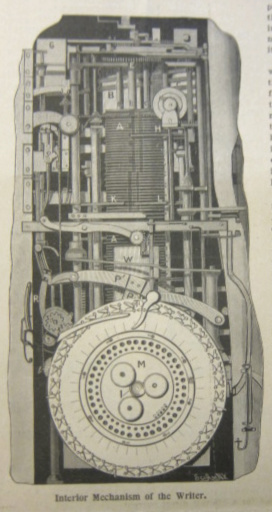
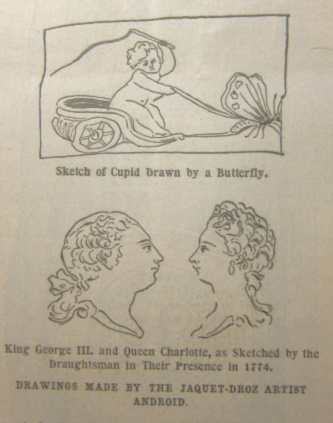
    This gets us to the truncated history part. The Jacquet-Droz machines were built during a relatively short period, 1768-1774 or so. One of the machines was called “The Draughtsman”, which had the capacity to render at least several different drawings. This would make them among the earliest machines to ever produce art. The “android”–which was about half-life size and quite human-like–sits at a small desk and renders its creations, looking like a mechanical artist. In fact the machine had a very sophisticated cam-based memory, which to some extent meant that the machine was “programmed”, and so becomes the first (?) computer-generated artworks4. 

    What distinguishes this article in Scientific American further is that it reproduces the artwork of “The Draughtsman”.  The question here then is when are these android drawings first reproduced? There were many exhibitions of the Jacquet-Droz creations over the years, and the popular portrayal so far as I can recall has been the machine itself and then a small reveal of the mechanism. Were the drawings reproduced in the 18th century? Right now, I just don’t know. I did do a search under “Jacquet-Droz” in Gallica over thousands of publications and at first blush there (1) seems to be not many hits and (2) none that I have seen have any illustrations. Also even though the machines of Jacuet-Droz and, say, Maillardet’s writing/drawing machine (le Jeune artiste”) were popular in the late 18th and early 19th c, they seem to not have been so afterwards. One source says that Maillardet falls completely off the RADAR in 1833 and resurfaces only in 1928.  

    Jacquet-Droz _2_

    This all makes for an intriguing question. Right now though all I can really say is that the end-date for the range of possible first-publication dates for Jacquet-Droz is 1903.

    Notes:

    1.  “Constructed between 1768 and 1774 by Pierre Jaquet-Droz, his son Henri-Louis (1752-1791), and Jean-Frédéric Leschot (1746-1824), the automata include The Writer (made of 6000 pieces), The Musician (2500 pieces), and The Draughtsman (2000 pieces). Pierre Jaquet-Droz (French: [ʒakɛ dʁo]; 1721–1790) was a watchmaker of the late eighteenth century. He lived in Paris, London, and Geneva, where he designed and built animated dolls, or automata, to help his firm sell watches and mechanical birds.”–Wikipedia

    2.  From the Oxford English Dictionary: “Automatons. A moving device having a concealed mechanism, so it appears to operate spontaneously. Frequently (and in earliest use) in figurative and similative contexts. Now chiefly hist.Originally denoting various functional instruments including clocks, watches, etc., as well as moving mechanical devices made in imitation of human beings; later (from the early 19th cent.) usually restricted to figures simulating the action of living beings and widely regarded as toys or curiosities, as clockwork statues or animals, images striking the hours on timepieces, etc.”

    • 1616   W. Cornwallis Essayes Certaine Paradoxes sig. G3   The soule doth quicken and giue life to the body, the body like an Automaton, doth moue and carry it selfe and the soule.
    • 1660   H. More Explan. Grand Myst. Godliness ii. iii. 37   God will not let the great Automaton of the Universe be so imperfect.
    • 1742   J. T. Desaguliers tr. M. Vaucauson (title)    An Account of the Mechanism of an Automaton or Image Playing on the German Flute.
    • 1784   P. Thicknesse Speaking Figure 5   That an Automaton can be made to move the Chessmen properly, as a sagacious player,..is..utterly impossible.
    • 1790   J. Imison School of Arts (ed. 2) 284   Those automata..do by little interstices, or strokes, measure out long portions of time.
    • 1815   Scott Guy Mannering I. xx. 315   Sprawling out his leg, and bending his back like an automaton.
    • 1821   New Monthly Mag. 1 443   Archytas’ flying dove..is another of the ancient automata… It was made of wood

    3.  Citations of “android” in the Oxford English Dictionary:

    • 1728   E. Chambers Cycl. (at cited word),   Albertus Magnus, is recorded as having made an Androides.
    • 1819   Pantologia (new ed.) (at cited word),   M. de Kempelen..constructed an androides capable of playing at chess.
    • 1847   J. Craig New Universal Dict.   Android
    • 1951   C. D. Simak Time & Again (1956) i. 1   Human gossip as well as android and robot gossip.
    • 1958   Spectator 19 Sept. 379/1   Today SF must be more than a blood-and-sex day~dream spattered with words like androids (robots made of flesh and bone).

    4.  Another long history is that of computer generated art. Suffice to say here that the very earliest period of this genre begins probably with Ben Laposky’s “Oscillons” in 1952 where he manipulated electronic waves in an oscilloscope to produce interesting and complex figures.