A Daily History of Holes, Dots, Lines, Science, History, Math, Physics, Art, the Unintentional Absurd, Architecture, Maps, Data Visualization, Blank and Missing Things, and so on. |1.6 million words, 7500 images, 4.9 million hits| Press & appearances in The Times, Le Figaro, Mensa, The Economist, The Guardian, Discovery News, Slate, Le Monde, Sci American Blogs, Le Pont, and many othr places… 5000+ total posts since 2008.

Category: Astronomy

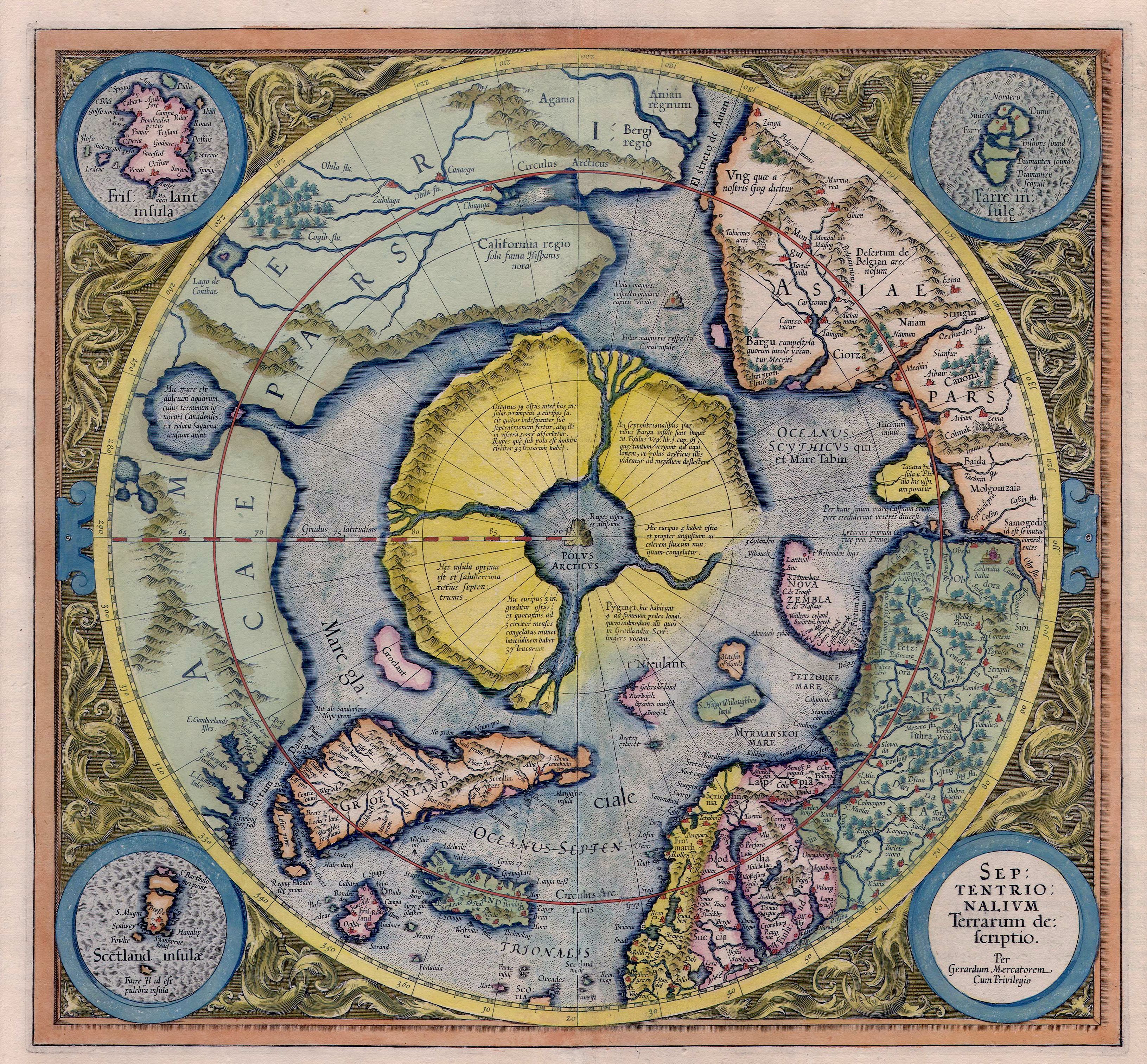
  • The Garden of Eden at the North Pole

    JF Ptak Science Books   Quick Post  Overall Post 5126

    Artic

    (Gerald Mercator, 1596)

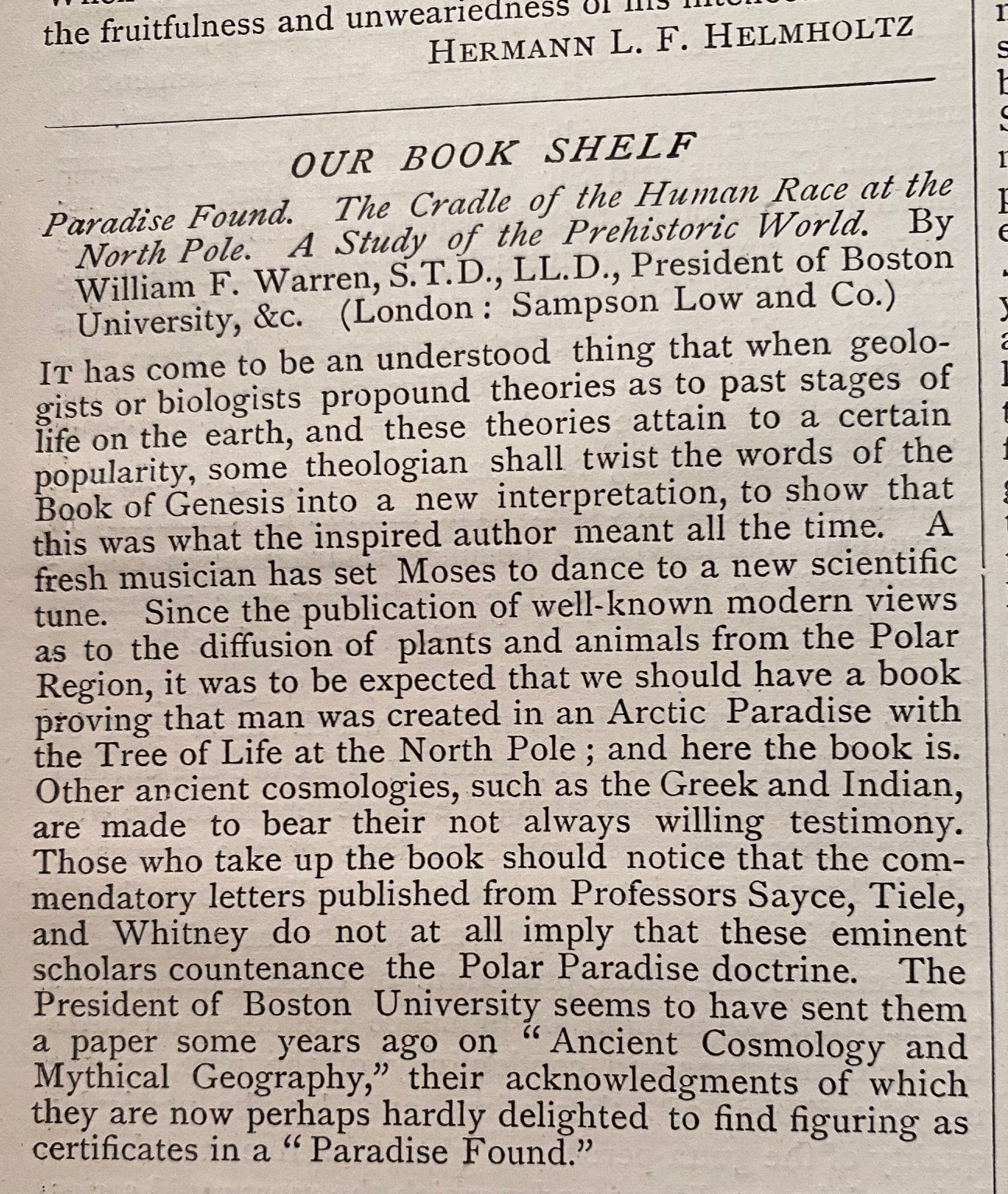
    IMG_5158This is a short, dismissive, stabbing review of a book by a theological and long-established scholar and administrator, William F. Warren (1833-1929). I remember his name from his interesting work on ancient cosmologies (1882), illustrated with examples of the history of all things according to various belief systems and religions. This quick-and-dead arrow of a review (which appeared in Nature on 14 May 1885 p, 28), was directed at his new work Paradise Found, the Cradle of the Human Race at the North Pole..., which as you can guess tries to establish the origin of humans at the North Pole, along with the Garden of Eden and the Tree of Life. And, for that matter, also establishes the Pole as the home of Mt. Maru, the Arthurian Avallon, and so on. There’s a lot that can be said but not by me—there is an attraction to hunting up other mythologies placing some part of great importance to the North Pole as the Navel of the Earth, but I just don’t have the time or inclination. As a matter of fact, I hadn’t known about this work by Warren, and I doubt I’ll know much more than what I am communicating right now—one thing the reviewer doesn’t mention is that the book runs about 500 pages, which is just too much of an investment for yours truly.

    ·Posted by :

    ·in:

    — — —

  • Chess, Dante, 4 Trillion kg Wheat, and a Bad Pun (1877)

    JF Ptak Science Books  Post 2903

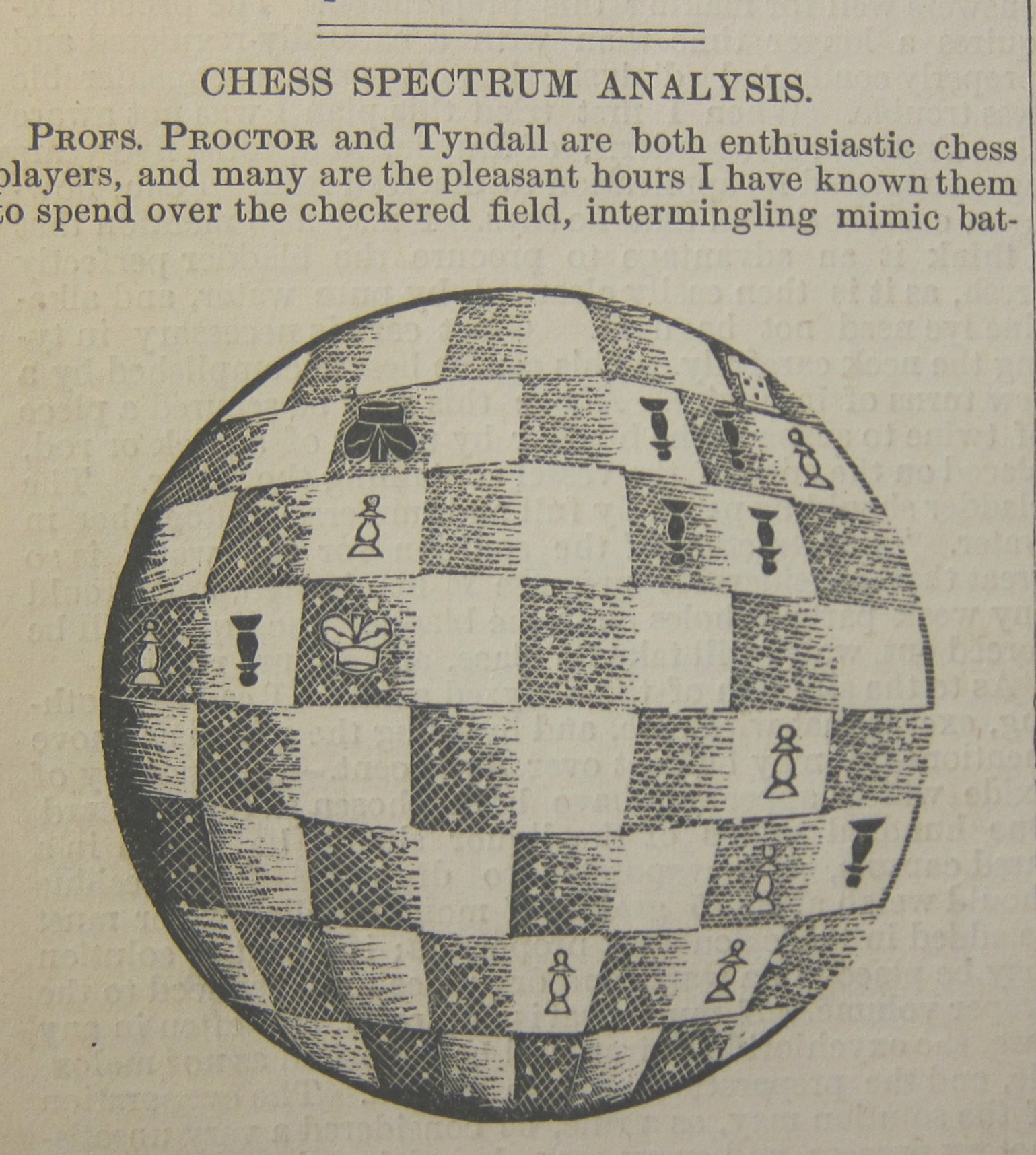
    Chess sphereAs is often the case in looking through the early-ish issue of Scientific American, I usually find much more than what I was originally looking for, finding a lot that I had no idea that I needed to find, mostly because I had never heard of them before. And so grazing though the 1877 volume of the Scientific American Supplement I found in the weekly chess review in the back of each issue an extraordinary image and title:

    I was tempted to add “Pre-Escherian” in the title to this post, but that would put the thing way over the top–but that is what came to mind first, a polished gazing ball with an interesting perspective. This was meant to illustrate an imaginary dialog between two astronomer-chess players (Richard A. Proctor and John Tyndall, though Tyndall’s interests were spread far and wide and deep and then not so much in astronomy), both of whom had made contributions to astronomical spectroscopy.  Further into the short article there was a little discussion of Dante and sunspots, which I was not aware of, though when I went looking for that reference I did find the following chess quote in Paradiso (Canto XXVIII) with our Poet in the ninth heaven:

    “So sparkled then those circles all and each And every spark did more and more abound, In fiery light and so their number grew, Beyond the chess board’s doubling problem’s bound”

    And another translation

    “And after she had finished with her speaking,  The circles all around began to sparkle,  Like red-hot iron shooting off bright sparks.  Each sparkle stayed within its fiery ring, So many that their number runs to more, Millions than the redoubling of the chessboard.”

    Moving on from the sunspots mentioned in the SA article, it has been pointed out by many that in the quote above that Dante may be referring to an earlier chess story, told at least by the 12th century, where the inventor of the game of chess agreed to give it over to the king if the king paid him in grains of wheat based upon the chess board, starting with one grain in the first square and then doubling the amount until the last square is reached. The big surprise for the king who agreed to this payment was a very fine lesson in the  quick-as-a-bunny doubling sequences: you’d move from 1 to 2 to 4 to 8 to 16 to 32 to 64  to 138 to 276 just in the first rank, 56 more squares of doubling to go, until you summed them all up on square 64 and find yourself with the number  18,446,744,073,709,551,615, which is a big number. Bigger still if you consider that this is in terms of wheat, and I figured the weight of that wheat to be about 4 trillion kg, 4 trillion being about the equivalent of stars in 40 Milky Way galaxies. 

    Even though the article was very heavy in the discussion of some real games, and light in the inclusion of our astronomers and their conversation, everything winds up and out in a whimsical fashion, with a discussion of Gutenberg and spell-check.  The author tells us:

    “It would take but little argument to show that a mere oversight of Guttenburg’s [sic] proof-reader made the world believe the moon was composed of cheese instead of chess”.

    And so it goes.  19th century astronomy/chess humor, as whacky as it gets.  

    ·Posted by :

    ·in:

    —

  • A Hole in the Ground vs. a Hole in the Sky

    JF Ptak Science Books  Quick Post

    Tunnel collage


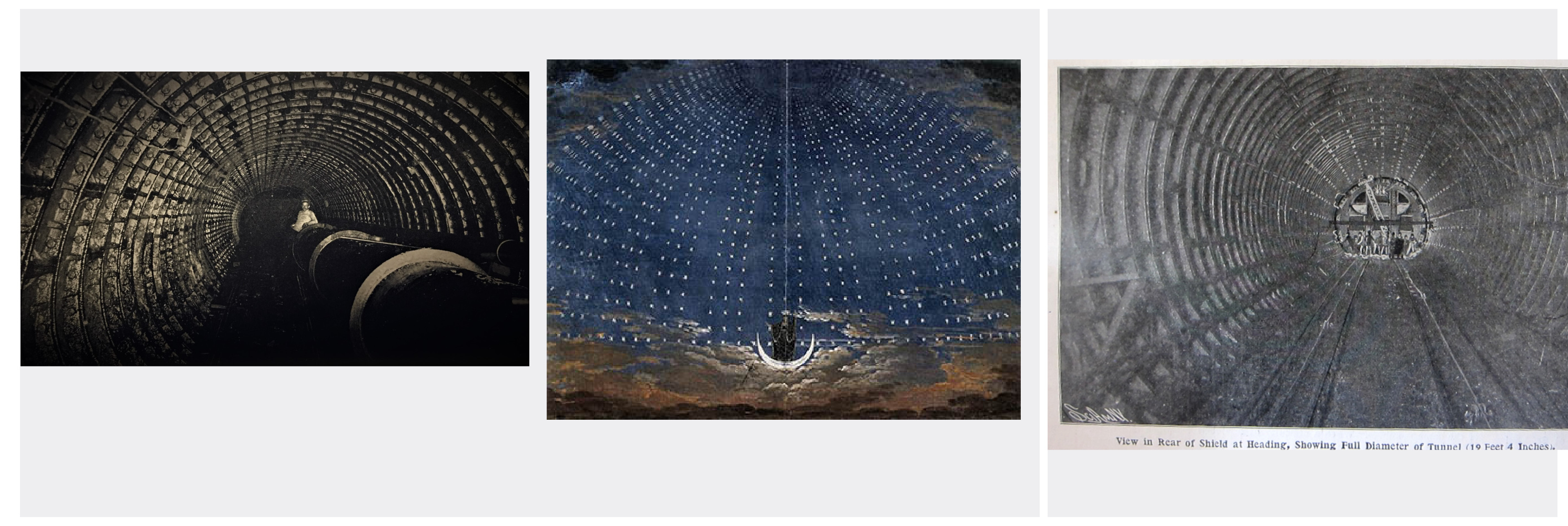
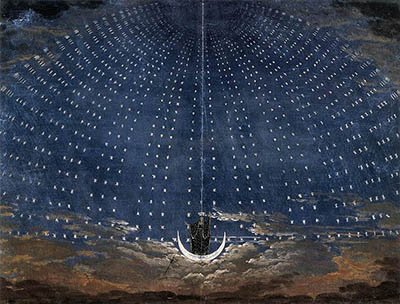
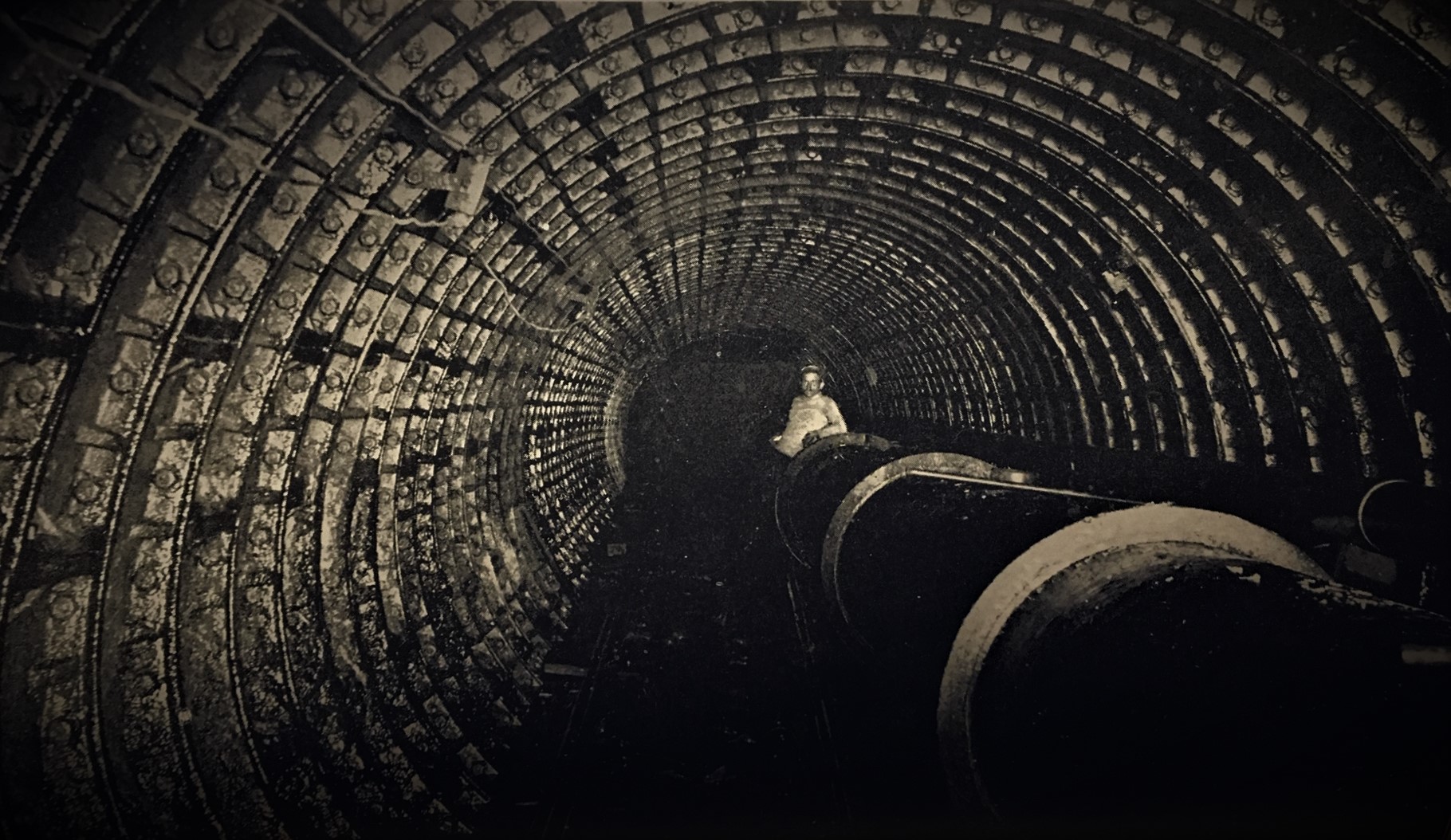
    Mozart tunnel _2_A while ago I wrote about a brief connection that I saw in a  photographic view of the 19′ tunnel section of the Hudson River tunnel with  the 1815 stage set by Karl Friedrich Schinkel (1781-1841) for Mozart’s Magic Flute1. Its just the initial reaction to the perspective pulled up the Schinkel more than anything else, except maybe for a non-existent underground image from Jan Vredeman de Vries’ book on perspective. That said, the set design I’m thinking of features the arrival of the Queen of the Night/Königin der Nacht, so perhaps this association isn’t too meshuga…excepting the ripped-to-shreds lust for revenge that the Queen of the Night sings about, which hasn’t much to do with digging a tunnel. 


    Perhaps this is an association that can be made for any tunnel being dug and illuminated in the 19th century, as I stumbled upon another example of this association, a photograph2 in another NYC tunnel–this one the tunnel under construction under the East River for the East River Gas Company, 1894. It is a little antithetical that these similarities are seen between an image of starry vault surrounding the Earth while the photos depict a lighted tube surrounded by Earth, a sort of alpha and omega of endless light…a contraction of environment filled with light compared to a contraction of the limitless night sky as seen as a theatrical set.  (I understand that there aren’t a long series of lights in the tunnels, just that it looks so because of the no-doubt heavy-duty light source and its reflections on the odd surfaces/bolts/etc. the metal tubing surfaces…and that is a riff in itself.)

    In any event, I like these images, and so I’ll share the newest of my finds here this morning.  

    Tunnel lights mozart


  • “Is The Sun One-Sided?” (1878)

    JF Ptak Science Books  Quick Post

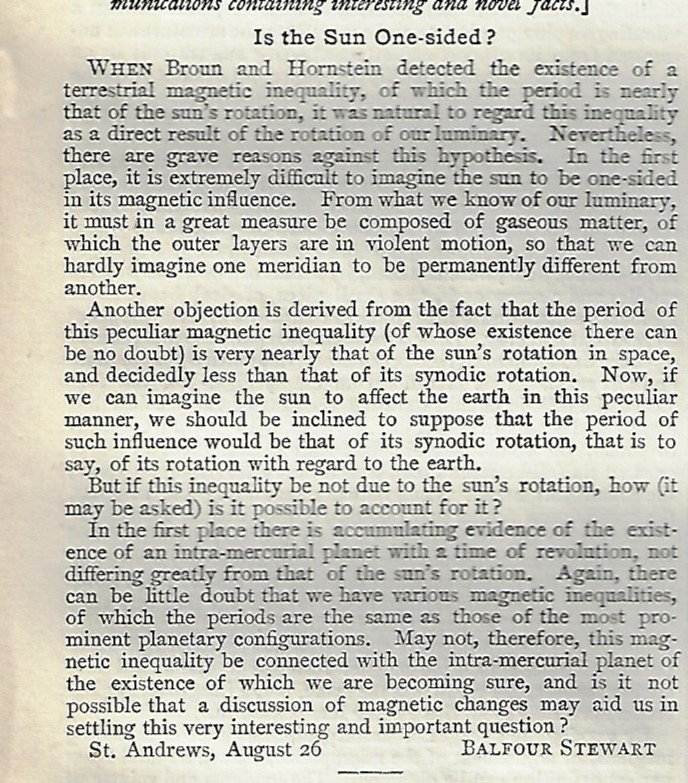
    There are a number of unexpected and interesting notes and articles in the September 5, 1878 of Nature as is usually the case with is excellent journal. The first to catch my eye was “Spontaneous Combustion of Wasps’ Nests” where some unusual behavior was observed in wasps’ nests in Venezuela–the correspondent was wondering if there was any corroborating evidence anywhere else in Nature’s world.  Then there was a short paper on the newly-invented telephone, the display of parental affection in Sparrows, “The Sea Serpent Explained”, the physics of photography, hypnotism (in animals), and a number of others. And then there was a letter to the editor which I think I’ve never heard before, and so I reproduce it in full:

    Nature 1878 sun ine sided


    ·Posted by :

    ·in:


  • The Early Use of a Telescope in Crime Detection (1900)

    JF Ptak Science Books  Quick Post

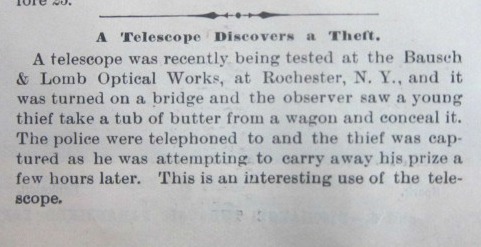
    Just a quick notice here of an interesting note found in Scientific American (vol 83, no. 4, pg 54) for 28 July 1900:

    Telescope discovers a theft

    I wonder if this observation violated the expected zone of privacy of an individual, meaning a violation of the fourth amendment? Now this activity described above in Rochester took place on a bridge, so perhaps there was no expectation of privacy on a public street , especially if you are out-and-about and committing a crime. A quick look at the history of the fourth amendment gets immediately complex to me, and so I’ll leave it alone–except to say that it is not a clear-cut issue as to whether the above use of a telescope would’ve been a search-and-seizure issue. On the other hand, when this issue is discussed the idea of what would be “normally” observable to the unaided eye comes up–but what sort of unaided eye are we talking about? If the eye needed correction, would using eyeglasses constitute a challenge to the fourth amendment?  I don’t know, as I’m not a law guy–but the question about the telescope and the fourth amendment seems mildly interesting. 

    ·Posted by :

    ·in:


  • J.P. Joule and God

    JF Ptak Science Books  Quick Post 

    (With thanks to David Wenner for the introduction to this paper by Joule.)

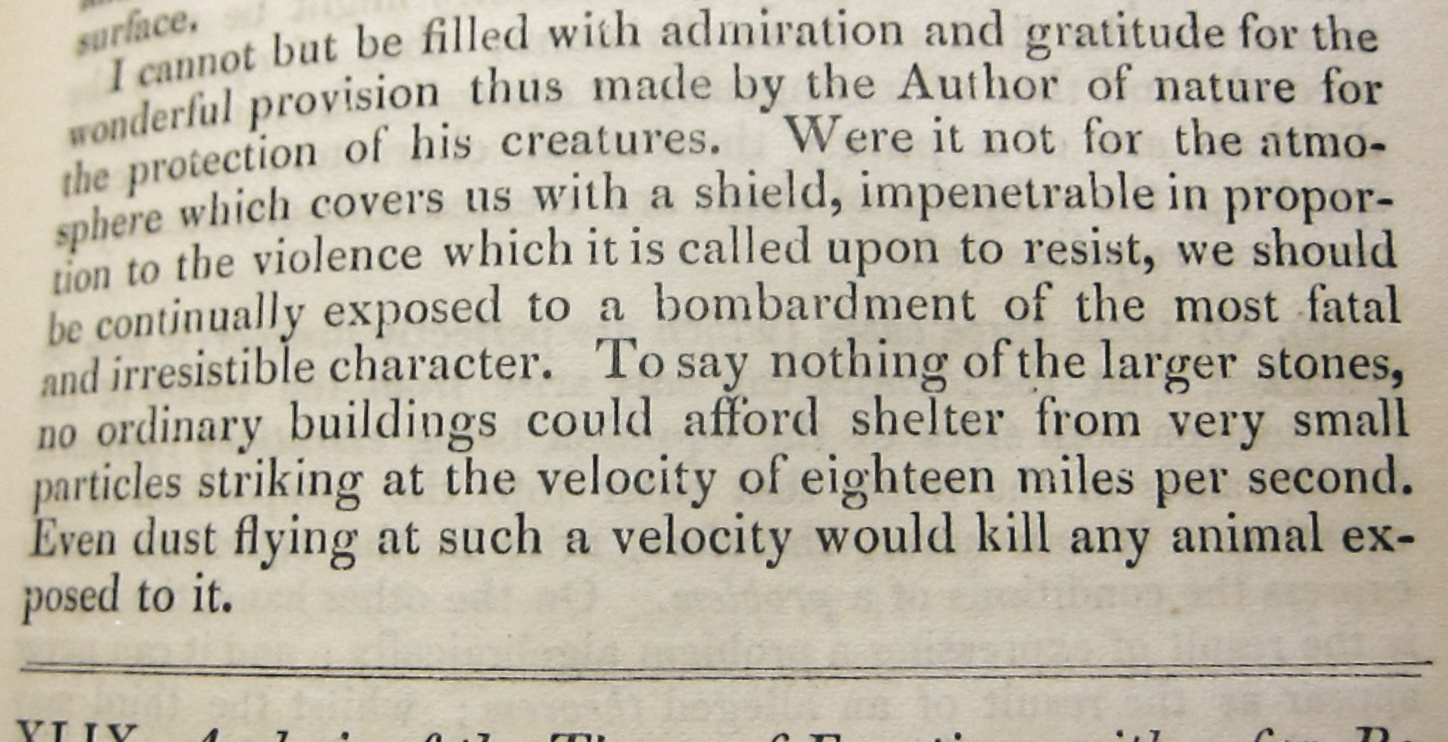
    There is a real work of unexpected beauty in the last paragraph in “On Shooting Stars” Philosophical Magazine vol 32, 1848, pp 349-351, by James Prescott Joule,  thanking the creator of the universe for including an atmosphere for the Earth.

    At the end of the day, the first law of thermodynamics is found in the law of the conservation of energy, which was found in the relationship of the nature of heat to mechanical work, which was found in the work of James Prescott Joule (“Wherever mechanical force is expended, an exact equivalent of heat is always obtained”.— J.P. Joule, 1818-1889, August, 1843.) The unit of energy called the “joule” (”used by the International Standard of Units (SI)…defined as the amount of work done on a body by a one Newton force that moves the body over a distance of one meter”–Universe Today/Astronomy ) is named for J.P. Joule.

    After addressing some issues of “shooting stars”, Joule writes his lovely closing sentiments, which to me can be easily arranged into a bit of “Found Poetry”–that is, it is the simple restructuring of the two paragraphs into a poetic format, and without changing any of the words. It is an interesting process, and I think Joule’s language easily transcends its sleepy place at the end of a mostly-forgotten work half-way through a scientific journal.

    Here it is: 

    I.

    I cannot but be filled with admiration and gratitude

    for the  wonderful provision thus made

    by the Author of nature

    for  the protection of his creatures.


    II.

    Were it not for the atmosphere which covers us with a shield,

    impenetrable in proportion to the violence

    which it is called upon to resist, we should 

    be continually exposed to a bombardment of the most fatal 

    and irresistible character [of shooting stars].

    To say nothing of the larger stones, 

    no ordinary buildings could afford shelter from very small  particles

    striking at the velocity

    of eighteen miles per second. 


    III.

    Even dust flying

    at such a velocity

    would kill any animal exposed to it.      


    This is the original bit of the poetry straightened-out, proper, and correct:

    Joule god _2_

    And the rest of the article:

    ·Posted by :

    ·in:


  • The Plurality of Worlds (1912)

    JF Ptak Science Books   Quick Post

    The following is section is from mathematician/logician Augustus DeMorgan’s (1806-1871) classic Budget of Paradoxes second edition of 1912). It is a short expository on the plurality of worlds and life on them beyond the Earth, looking back over the history of the idea from Lucian, Huygens, Swift, Kircher, and others.  DeMorgan’s footnotes are included at bottom (with a few added comments in italics). 

    “INHABITED PLANETS IN FICTION

    There is a class of hypothetical creations which do not belong to my subject, because they are acknowledged to be fictions, as those of Lucian,[177] Rabelais,[178] Swift, Francis Godwin,[179] Voltaire, etc. All who have more positive notions as to either the composition or organization of other worlds, than the reasonable conclusion that our Architect must be quite able to construct millions of other buildings on millions of other plans, ought to rank with the writers just mentioned, in all but self-knowledge. Of every one of their systems I say, as the Irish Bishop said of Gulliver’s book,—I don’t believe half of it. Huyghens had been preceded by Fontenelle,[180] who attracted more attention. Huyghens is very fanciful and very positive; but he gives a true account of his method. “But since there’s no hopes of a Mercury to carry us such a journey, we shall e’en be contented with what’s in our power: we shall suppose ourselves there….” And yet he says, “We have proved that they live in societies, have hands and feet….” Kircher[181] had gone to the stars before him, but would not find any life in them, either animal or vegetable.

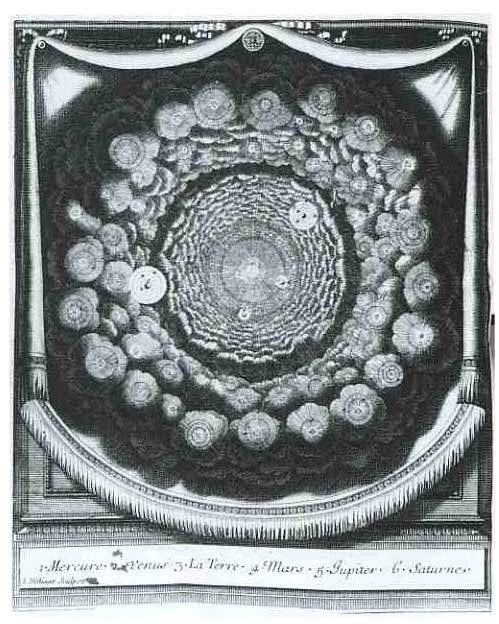
    Fontenelle

    • [This lovely image belongs to Entretiens sur la Pluralitie de Mondes (Conversations on the Plurality of Worlds), written by the great French philosophe Bernard le Bouvier de Fontenelle in 1686 (just a year before publication of perhaps the greatest work in the history of science, Newton’s Principia Mathematica). The Plurality was a best-seller by the best-selling Fontenelle. An excellent attempt by a rather restricted writer to engage the population-at-large, writing a high-pop book on what was basically the history of astronomy and cosmology of the preceding century. Copernicus was a major feature of his imaginary conversations with a muse as he wandered through a metaphorical garden of questions, with the observations of Galileo and Cassini also very prominently featured.]


  • A Particular Bit of Science In Wells’ “War of the Worlds” (1894)

    JF Ptak Science Books   Quick Post

    I haven’t read in Wells’ WOTW in a long time, and when I went to it just now (reading and listening) I was surprised at how quickly the Mayday Martians element evolved.  We get to it by the end of the very first paragraph:  

    • “At most terrestrial men fancied there might be other men upon Mars, perhaps inferior to themselves and ready to welcome a missionary enterprise. Yet across the gulf of space, minds that are to our minds as ours are to those of the beasts that perish, intellects vast and cool and unsympathetic, regarded this earth with envious eyes, and slowly and surely drew their plans against us. And early in the twentieth century came the great disillusionment.”

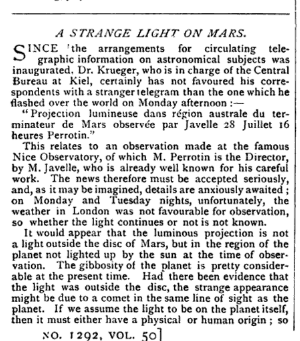
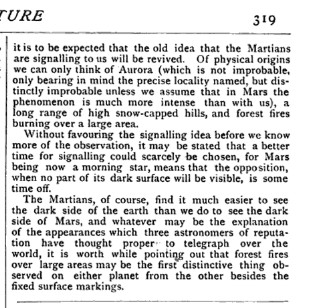
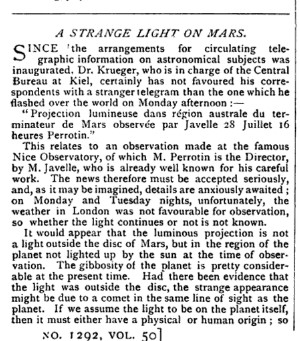
    I was also surprised by the appearance of some tech references, including a dated reference to an article in Nature magazine (2 August 1894).  The Nature article references a “strange light” which Wells uses to his own world-stabbing ends, and he gives his story some credibility by dragging in a real-life background to the possibilities of his imaginations.

    • “Had there been evidence that the light was outside the disc the strange appearance might be due to a comet in the same line of sight as the planet. If we assume the light to be on the planet itself then it must either have a physical or human origin…” (And by “human” here the editor no doubt means extra-terrestrial, or biological, or intelligent life form.)

    I’m not a big sci fi reader, but in my experience I’ve never seen a tale woven using the names of Perrotin and Schiaparelli, though I have no seen them used in the plot setup thickening agent in WOTW. (By the way Wells mentions the “palpitating” work of “Lavelle of Java” though he must have meant “Javelle”, who was Stephane Javelle, the assistant to Perrotin of the Nice Observatory.)

    On the “strange light”:
    War of the Worlds Mars in NAture _1_


    War of the Worlds Mars in NAture _1_


    Source: Nature, volume 50, August 2, 1894

    ·Posted by :

    ·in:

    —

  • Finding the Center, continued: the Center Sun and the Center of the Universe. 11th Anniversary Post

    JF Ptak Science Books   Post 2787

    In the long history of finding the Center of Things is the subset (or overset) of finding the center of the galaxy (which until the 1920’s was the universe) or of creation. The center changes over the dozens of centuries, not the least of which was the flower of creation blossoming outward from Jerusalem.  
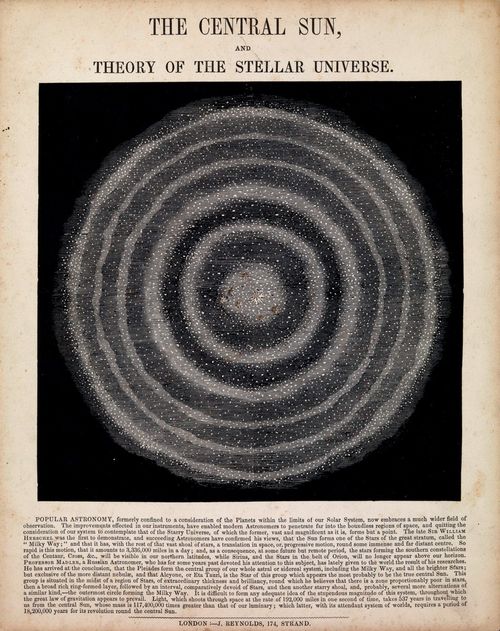
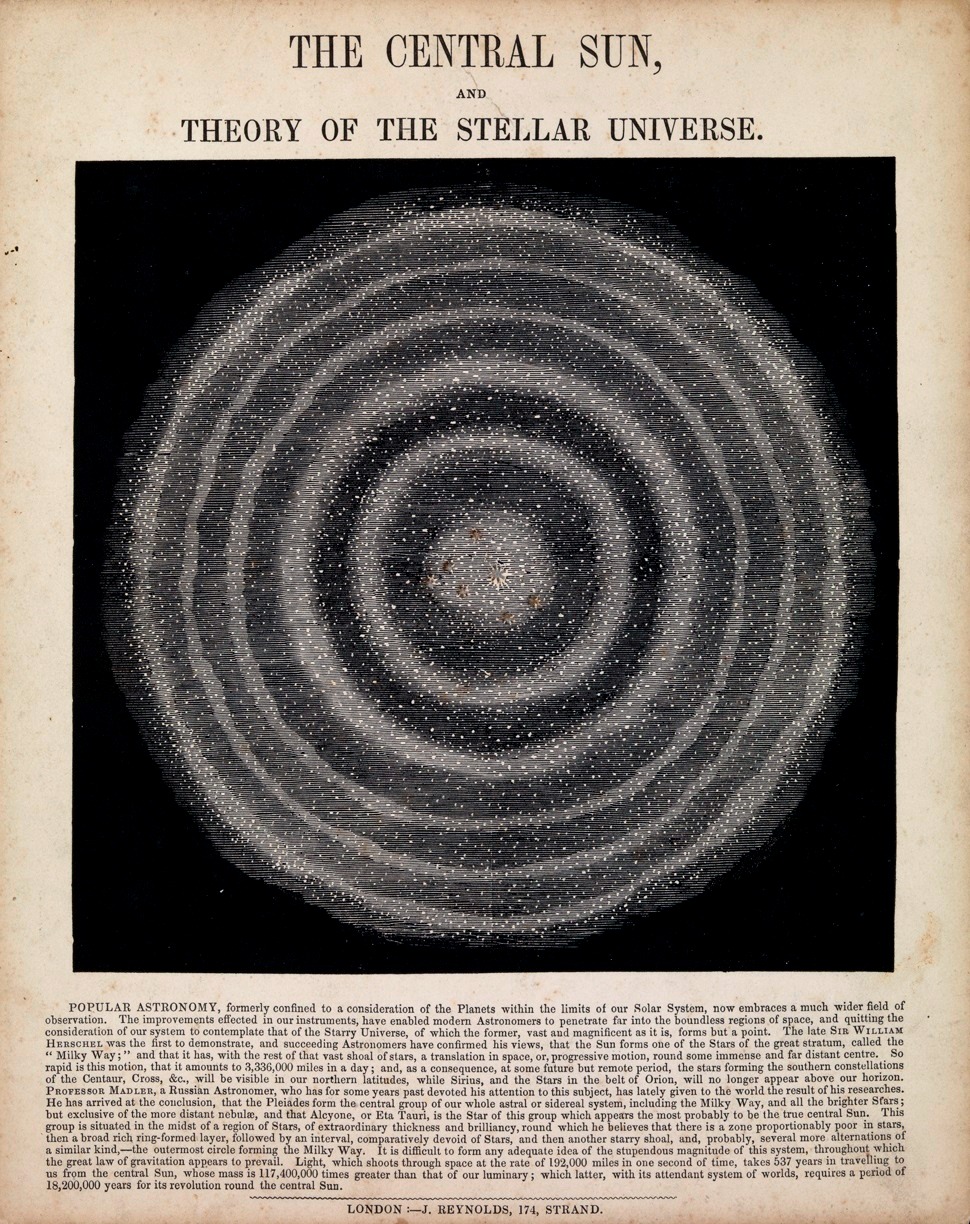
    Astronomy--central sun

    • Image source:  Greenwich Observatory29x23cm http://collections.rmg.co.uk/collections/objects/263846.html (This is a depiction of the center of the universe, the Central Sun, as hypothesized by William Herschel and  later by Johann Henirich von Maedler (1794-1874), who published his observational results in Die Central Sonne, Doprat, 1846.)  This legend to this image is very legible once expanded. 

    Where is the center?
    Where is the center of the Earth, of religion, of the United States, of the universe, of art, of consciousness, of seriousness, of complexity?
    The center of stuff throughout history has been an almost entirely shifting matrix, a collection of vortices coming from Jupiter’s strongbox–a three dimensional representation of the location of their shifting centers over time would make an interesting Fibonacci-like display, I think.\The question may seem meaningless at first, but people have long asked it of nearly everything within their experience, trying to find the center of their world and universe, of their selves, of their religion, of their country, of politics, of art and music, and on through the Encyclopedia of Things that Could Have a Center.

    Take for example the questions of where the center of the Earth, or solar system, or galaxy, or universe might be?  There have been answers to these question more often than not over time, though the answers have been shifting.  The center of the Earth has certainly stayed more-or-less constant over thousands of years, though the stuff in the center has been swarming with change, from being hollow, to being filled with magma, to being a solid magnetic core, to being occupied by Mole Men, to housing the seat of the Inferno, or to be simply located on the surface of the sphere at Jerusalem (as the old T-maps have shown for hundreds of years), and on and on.  Working backwards, the center of the universe has drastically changed over time–for thousands of years, it was assumed that the Earth was the center of all things, until it wasn’t (that beginning mostly with Copernicus, and then challenged with Galileo’s use of the telescope and his discovery of an order of magnitude more stars, etc.).  And then William Herschel beautifully represented the shape of the galaxy in 1782, placing our solar system in a far from central location.  The center of the universe’s fate changed along with that of the Earth, incredibly so beginning with the Big Bang and then with the possibilities of their being a universe without boundaries.  And then of course there’s multiple universe theories, and worm holes, and the space time continuum, which complicates things even further, making the discussion of a “center” pretty much nonsensical.

    Simpler things can be as complicated–where is the center of the United States?  If we measure the center for the lower 48 states, it will be different than if we included the two far-flung states, or protectorates like Puerto Rico. The geographical center is one thing; another might be where the population center might be–that has made a beautiful map published over time by the U.S. Census Bureau (Department of Commerce), showing the star of the center moving not-so-slowly westward into Ohio over the last 20 censuses or so.  And where is the heart of the country?  Where is the heart of the West?  Better yet, where is the center of the West (or North, or South, or Mid-West)?  To answer where the center of these places might be you’ve got to first locate where those geographical ideas begin and end, which for many is a tricky subject, making it a matter of opinion as to where the center of these places might be.  
                                        
    The center in art had been a findable thing for some time, though more recently people like the Impressionists and Kandinsky have shown that the center might not exist, and it might not exist along with anything that is recognizable as a form of nature, representation and the center falling away completely.  Perhaps this is like finding the center of a decade or year or month, or week or day or second.  The parameters keep getting both smaller and larger, the ability to measure halves of things or the center of a second growing almost incalculably small, small enough to reveal that in this Zeno-paradoxical way, that there is no center because there are no boundaries; getting half-way to something into infinity doesn’t actually get you there.  

    Now, getting back to today’s image: this lovely illustration shows what is supposed to be the center of the galaxy, which at the time also meant the center of the universe.  The model was based on the observations and hypothesis of William Herschel, and then later more firmly put forward by Johann Henirich von Maedler (1794-1874), who published his results in Die Central Sonne, Doprat, 1846. The Central Sun was supposed to be the star Alcyone in the constellation of the Pleiades. Alcyone (or Eta Tauri, “the Central One”), who in legend threw herself into the sea in deep grief after an encounter with the disguised Morpheus; the gods though took pity or exhibited compassion and changed her into a bird, the Kingfisher. The Kingfisher is a bird which lays its eggs around the time of the equinox in December, the gods showing more mercy by introducing a period of non-stormy weather for seven days, and so introducing the (H)alcyone Days of winter. (I just missed being able to post this during that period by about a week.)  The Pleiades, (“the Seven Sisters”), were the seven daughters of Atlas, who (long story fractured) were turned into stars to ease the worry of the father who was busy doing others things, saving them from their instant pursuers once their protector was otherwise engaged. Orion, however, still pursues them across the sky.

    Here’s the concept of the Central Sun, explained for the kids of 1872:

  • Found Poetry in the Table of Contents of an Astronomy Book, 1874

    JF Ptak Science Books  Post 2783

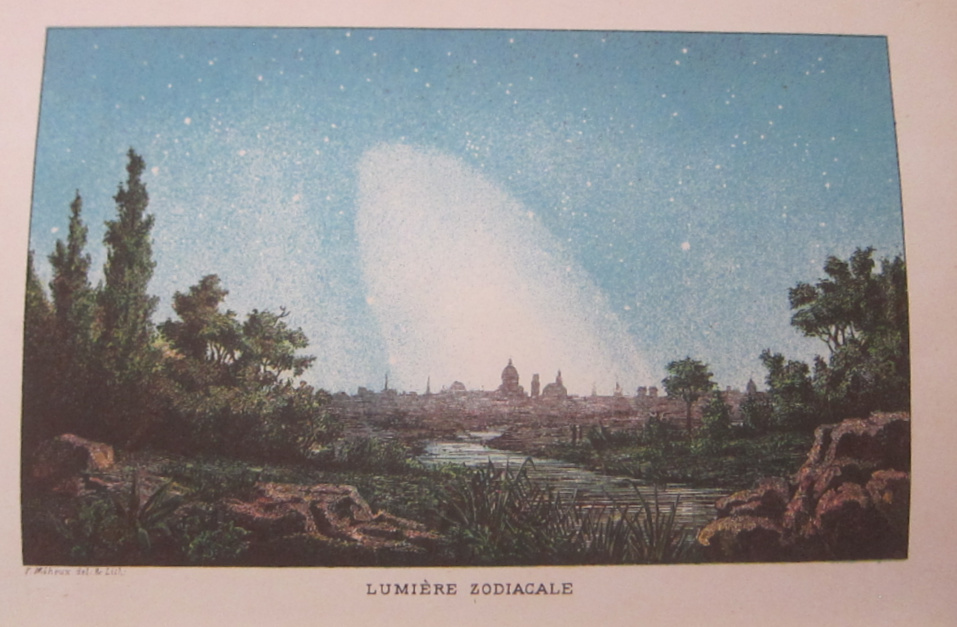
    Lumiere Zodiacale


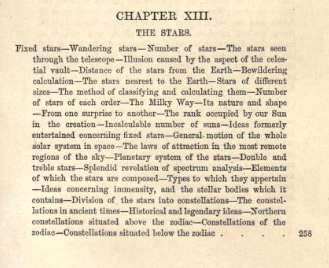
    Found poetry the starsI’ve written a number of posts on poetry found in unusual places: title pages of antiquarian books, technical manuals, unruly translations of commonplace literature, and so on. Here’s another, found in the table of contents for chapter 13 of a translation of Jean-Pierer’s Rambosson’s Histoire des Astres, Astronomie pour Tous. The edition I’m working from here is the illustrated edition of Paris, (1874) with its table of contents printed after the index at the rear of the text; the English translation’s table appears up front, and is pretty much the same as the French original (though the French sounds better).  I’ve got to say that there are some beautiful illustrations in this volume, not the least of which is a bright cross section of the Earth–it has exaggerated surface features out of scale to the rest of the planet to make a point in the text. (If this scale was correct then Vesuvius would be 500 miles in height.)

    So, the poetized chapter contents (and the original, at left):

    THE STARS. 
    
    Fixed stars, Wandering stars, Number of stars;
    The stars seen 
    through the telescope, Illusion,
    caused by the aspect of the celestial vault.
     
    Distance of the stars from the Earth,
    Bewildering calculation.
    The stars nearest to the Earth, Stars of different 
    sizes 
    The method of classifying and calculating them;
    Number of stars of each order.
    The Milky Way, Its nature and shape from one surprise to another. The rank occupied by our Sun in the creation Incalculable number of suns, Ideas formerly entertained concerning fixed stars, General-motion of the whole solar system in space.
    The laws of attraction in the most remote regions of the sky, Planetary system of the stars, Double and treble stars. Splendid revelation of spectrum analysis, Elements of which the stars are composed; Types to which they appertain Ideas concerning immensity, and the stellar bodies which it contains.
    Division of the stars into constellations the constellations in ancient times, Historical and legendary ideas Northern constellations situated above the zodiac Constellations of the zodiac, Constellations situated below the zodiac ....

    --Full text in English available from the Internet Archive: https://archive.org/stream/astronomy00rambiala/astronomy00rambiala_djvu.txt

    ·Posted by :

    ·in: