A Daily History of Holes, Dots, Lines, Science, History, Math, Physics, Art, the Unintentional Absurd, Architecture, Maps, Data Visualization, Blank and Missing Things, and so on. |1.6 million words, 7500 images, 4.9 million hits| Press & appearances in The Times, Le Figaro, Mensa, The Economist, The Guardian, Discovery News, Slate, Le Monde, Sci American Blogs, Le Pont, and many other places… 5000+ total posts since 2008.

Category: Absurdist, Unintentional

  • A Really, Really Greater New York–Filling in the East River, Redux.

    JF Ptak Science Books   Old Post 1470 expanded and updated.  

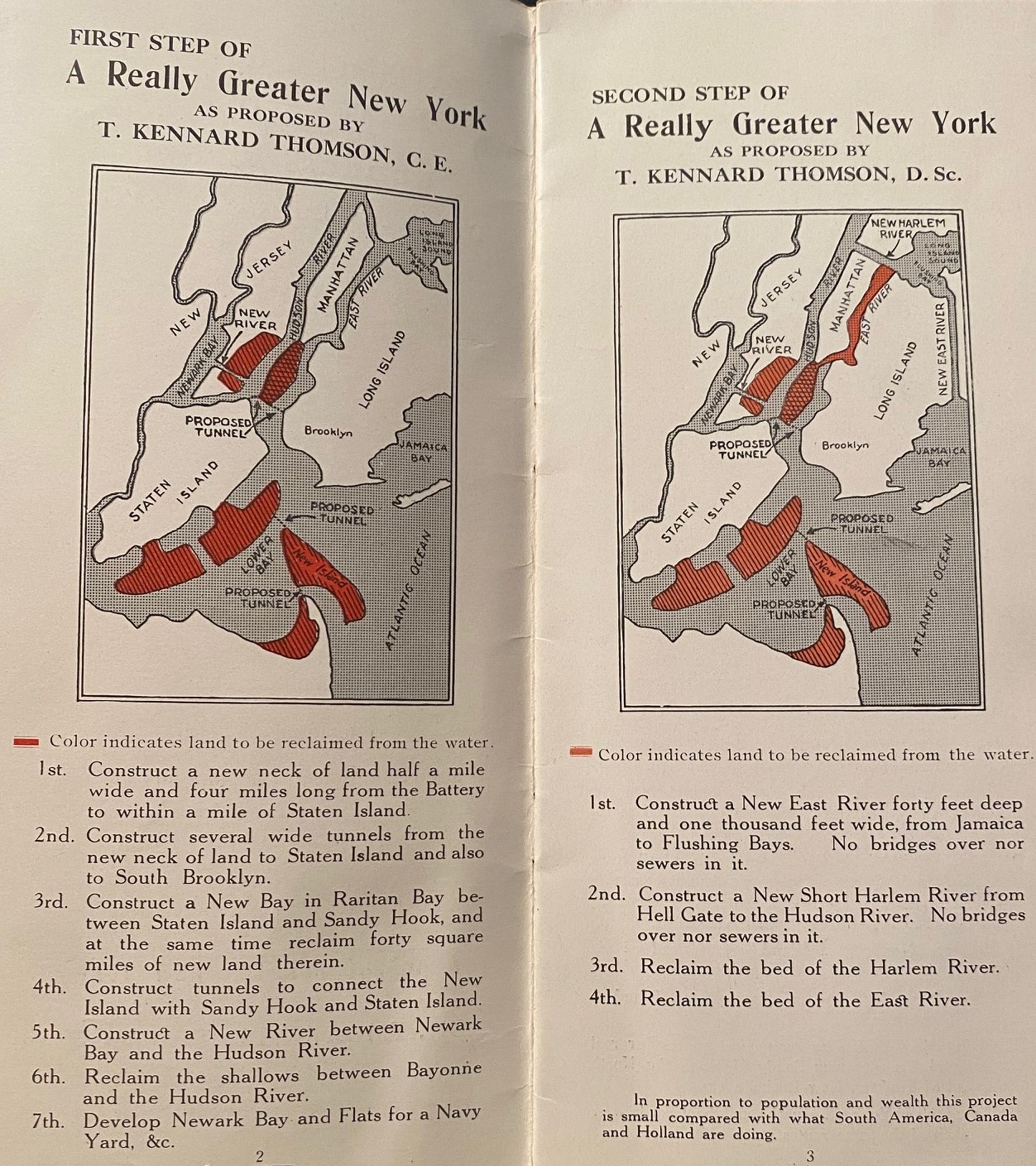
    Eleven years ago on this blog (May 2011) I wrote about the fantastical idea of Dr. T. Kennard Thomson for expanding NYC land and wharf area by reclaiming parts of the NYC harbor and filling in the East River, among many other things.  I came across another pamphlet by Thomson, though this one was almost entirely filled with favorable reviews for his spectacular sci-fi-ish speculations and aspirations.  The newer (1918) pamphlet did offer a part I and part II to the plan–that is listed below following the the first illustration:

    And the glorious side-by-side spectacular:
    IMG_8146

    Long ago on this blog I wrote a post on  Herman Soergel’s  plan for extending the landmass of the countries around the Mediterranean Sea by damming the straits of Gibraltar, lowering the sea and irrigating the Sahara–an original, interesting but not very good idea, filled with briney cultivation and racial politics. In the past on this blog I’ve written about other city plans–and in particular, for New York City–that have involved floating Manhattan into the harbor, or filling up large chunks of the Narrows, or floating the city on an enormous anti-gravity platform, and so on. Some of those plans were real, some science fiction, and some were plainly beyond both.  The plan presented above is another monster, but at least this one could work, if not for the doing of it, and the expense. And the will.
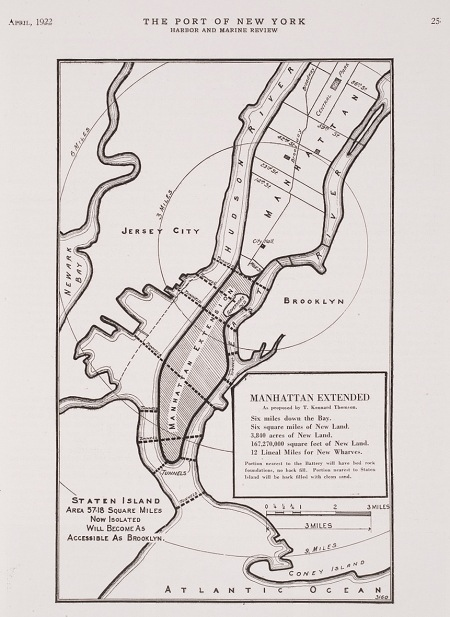
    NYC Really Big
    But the bottom line, according to the engineer doing the thinking on this project, Kennard Thomson, would supposedly net the city a cool billion dollars after everything was said and done, and that would be 1916 dollars–that was equal to about 5% of the American GDP (!) in 1916, which would be about $400 billion in terms of 2010 GDP.  I’m not sure how Thomson came up with this very big/very round number, though it must have been done for effect–I can just imagine him standing before a smokey room filled with civil engineers talking about his massive plan for enlarging NYC and throwing out the billion-dollar figure, watching the cigars glow red in exhaled disbelief.

    Thomson did know what he was talking about–he was a busy (and “leading” according to the NYT) Manhattan civil engineer of stature, working on the Canal Barge and being the principal engineer for the Municipal and Singer buildings, for example–and his project seems to be well within the scope of possibility.  Their sensical aspects however are, well, questionable. 

    Here’s the story–around 1911, while examining proposals to repair and extend New York’s wharves, Thomson came upon the idea–a magnificent, fabulous idea–of adding new wharves by adding new lands to the city.  In short, the overall plan was to fill in the East River (!!) and reclaim the new land for city living,  dam Hell Gate,  construct a New East River (from Flushing to Jamaica Bay),  extend the tip of Manhattan Island from the Battery to within a quarter-mile of Staten Island (!), create a new 40-square-mile island between Sandy Hook and Staten Island, extend the Jersey shoreline, add two new Manhattan-sized appendages to the east shore of Staten Island, and more.  All of this would be connected by various new bridges and roads and tunnels, as well as a 6-track elevated railway that would circumnavigate the city.  The purpose of all of this would be to add 100 miles of new docks, an enormous amount (“50 square miles of reclaimed land”) of new land and the capacity for NYC to house 20+ million people, all of which would be worth a billion dollars. 

    Thomson really meant “really” in the title for the proposal. There have been reclamation projects undertaken in New York Bay since then of course, and I think that virtually all of what Thomson talked about could be done.  I think it would be a very interesting project for a class of some sort to undertake an estimation of what such a thing would cost today (and I would guess to duplicate the idea in real terms now would take up a sizable chunk of the GDP).  Maybe all of this will make sense at some more future point. 

  • The Loneliness of Linoleum and the Psycho-Weaponization of Polygons (1924)

    JF Ptak Science Books   Quick Post   Overall Post 5137

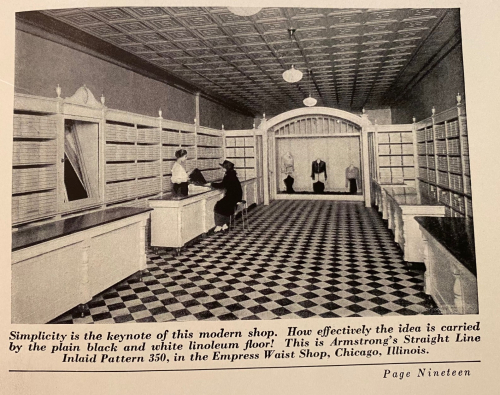
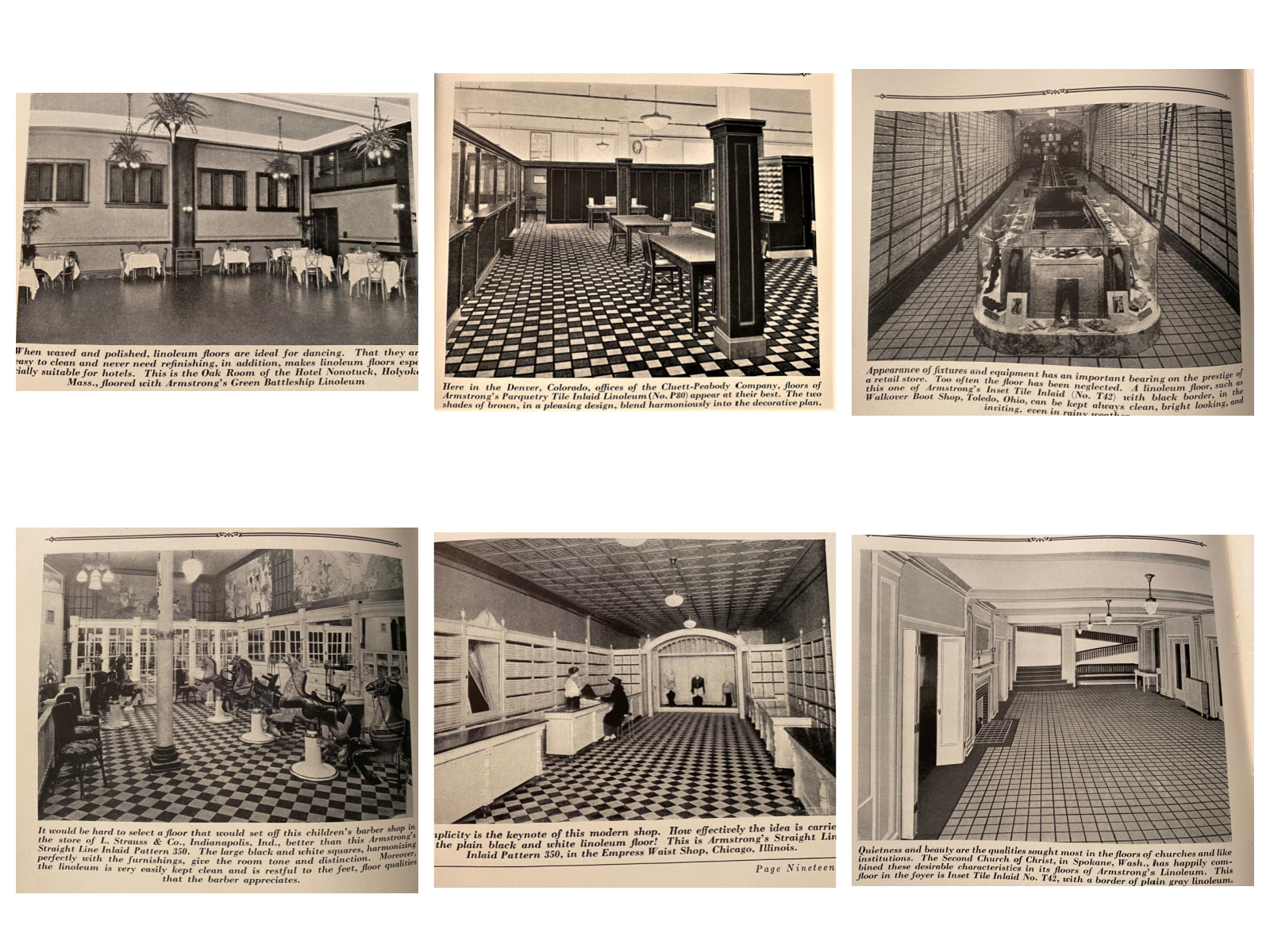
    This is a pretty unassuming pamphlet, judging from outward appearances (see below)1. It is an advertising promotional published in 1924 for Armstrong Cork Company of Lancaster (PA) pushing their extensive selection of linoleum flooring. (Linoleum, by the way, was created in the 1850s and was a constant source for durable and inexpensive floor covering for about 100 years…the first linoleum factory established in the U.S. was on Staten Island, NYC, with the company settled into a town they called Linoleumville, which was later renamed “Travis”. Anyway, I digress…)  I’m drawing attention to the publication because of the illustrations, which are no doubt standard for the time and made to be complimentary, though they look a lot different from their intentions looking at them today–at least to me.  There’s a LOT of distortion in the perspective, some of it from the camera angle and some of it, well, from the highly repetitious designs in the flooring, as you can see here:

    As you can see below in the montage (larger images follow) the rooms seem to be distant, cool/cold, removed, surgical.  Neat and clean, of course, but elegantly perfunctory.  And then there’s the polygons, the advancing retreating squares and rectangles that number in the hundreds and thousands, and are headache-invoking.  I can’t tell if these images would be more or less of what they are if the photos were in color.  (Keep in mind some of those colors were bright red, bright yellow, shout-out-loud blue…)                    Facebook ShopIMG_6065


  • Found Poetry in Use of the Infinite and Imaginary in the Service of the Finite ad Real (1885)

    JF Ptak Science Books   Quick Post  Overall Post 5127

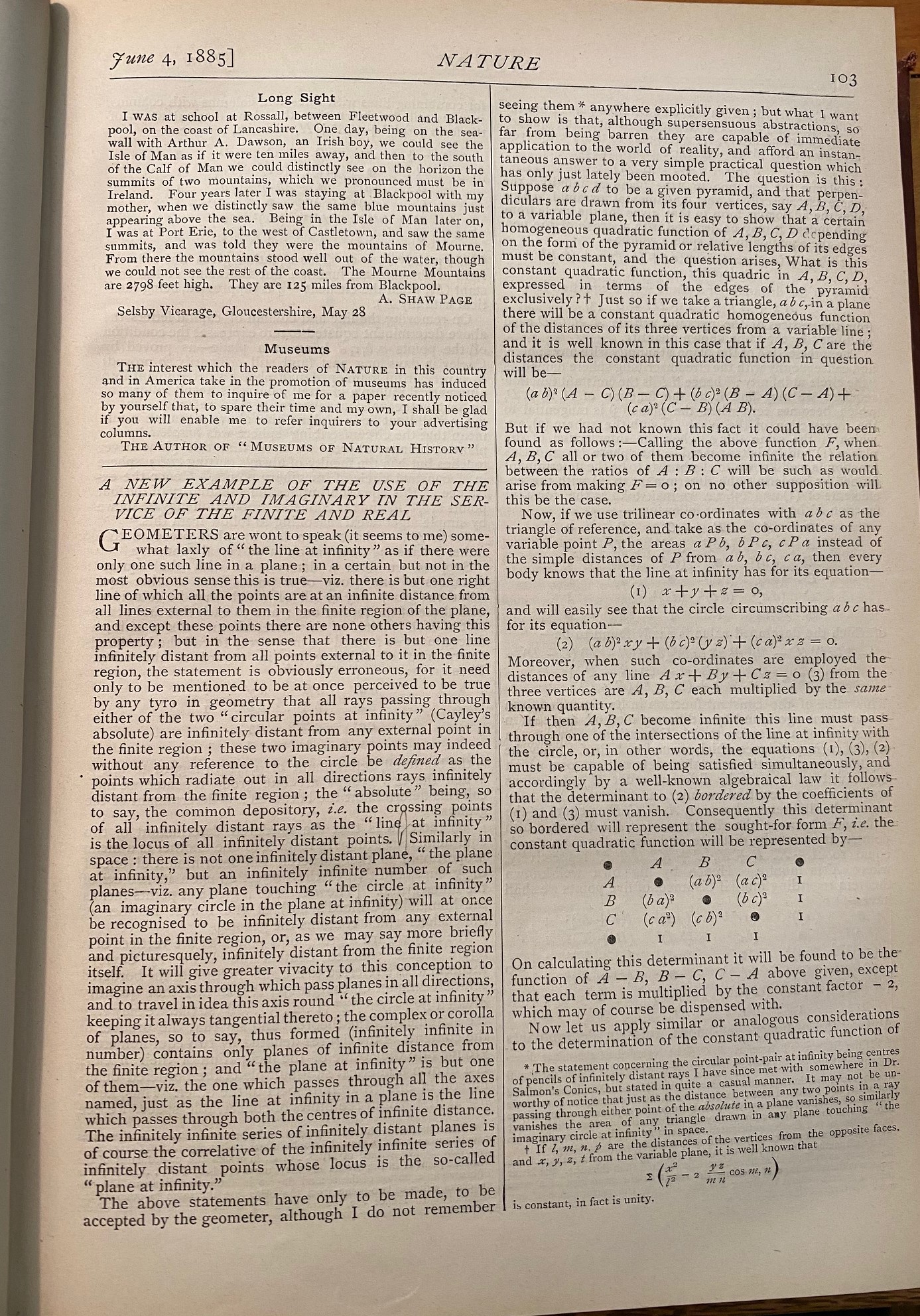
    IMG_5160Over on my blog I’ve made a number of posts on “Found Poetry”–phrases and constructions of interesting structural images that when removed from a narrative form and subjected to a different display find a sort of light art form in themselves. The phrases and sentence are in their original order—spacing and delineation have changed a bit to focus their attractiveness. There have been posts on “Found Poetry” in the (sometimes very extended) titles of Renaissance books, recipes and instructions on cooking dainty sardines, a disintegrating machine from 1877, descriptions of clouds from 1726, and well, you get the picture. “Found art is where you don’t find it”, as M. Duchamp didn’t say—sometimes the found poetry is pretty obvious, sometimes not. Today’s entry has a terrific title, though the text lets us down a little, but then closes up very strong in the last paragraph. And so, from NATURE, volume 32 number 814, 4 June 1885, by the great and prolific J.J. Sylvester,  “A New Example of the Use of the Infinite and Imaginary in the Service of the Finite ad Real”:


    “GEOMETERS are wont to speak 

    (it seems to me) somewhat laxly of ” the line at infinity ” 

    as if 

    there were only one such line in a plane; 

    in a certain but not in the most obvious sense 

    this is true —

           viz. there is but one right line of which all the points are at an infinite distance from all lines external to them in the finite region of the plan

                 and except these points there are none others having 

                        this property; but in the sense that there is but one line infinitely distant from all points external to it in the finite region, 

                               the statement is obviously erroneous, for it need only to be mentioned to be at once perceived to be true by any tyro in

                                      geometry that all rays passing through either of the two “circular points at infinity” (Cayley’s absolute) are infinitely

          distant from any external point in the finite region ; these two imaginary points may indeed without any reference

                 to the circle be defined as the points which radiate out in all directions rays infinitely distant from the finite  region…

    the “absolute” being, so to say, the common depository,

    i.e. the crossing points of all infinitely distant rays as the  “line at infinity”

    is the locus of all infinitely distant points.

    ·Posted by :

    ·in:


  • Found Graphic Novel Art in (of all places!) the Annalen der Physik (1885)

    JF Ptak Science Books  Quick Post  Overall Post 5135

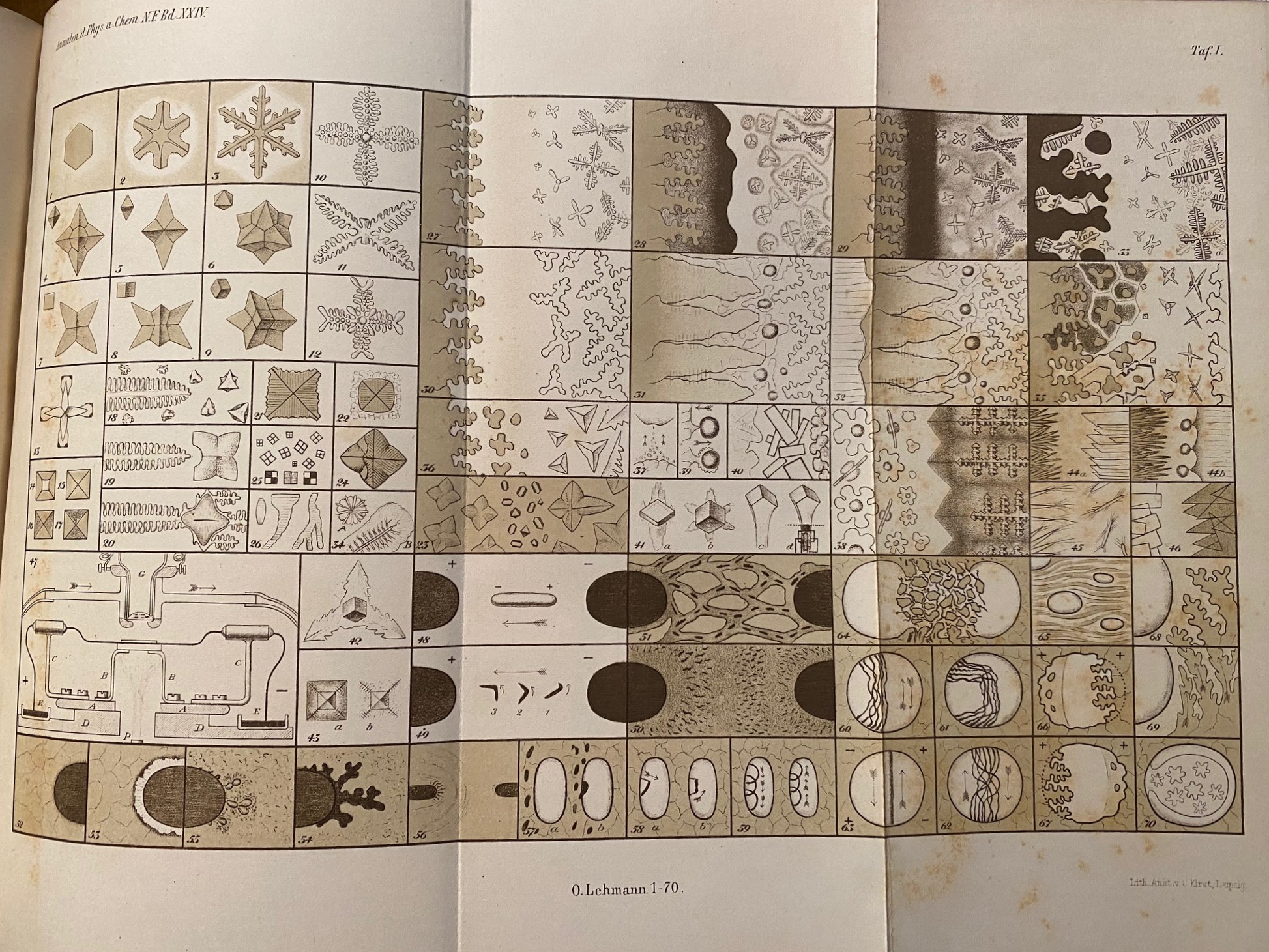
    There are some sub-categories on this 2-million (!?) word blog presented in the vernacular of FOUND items, like FOUND Poetry, or FOUND Science Art, or FOUND Outsider art, or TechnoNaive, and so on. The “Found” prefix simply notices that there is an appreciation of something beyond the use for which it was intended, being removed from context bringing on a new life/meaning for whatever it was that was “Found”. I guess that there are a few dozen of these posts, like “Found Poetry in Lost Plankton”(1872), “Euphonium: Found-Poetry of Recorded Soundwaves” (1897), and “Found-Poetry in a Technical Work on Bubbles” (1896), where by simply poetizing the structure of some of the text the piece can read like a bit of poetry…sometimes this is a bit strangled, but the point comes through.

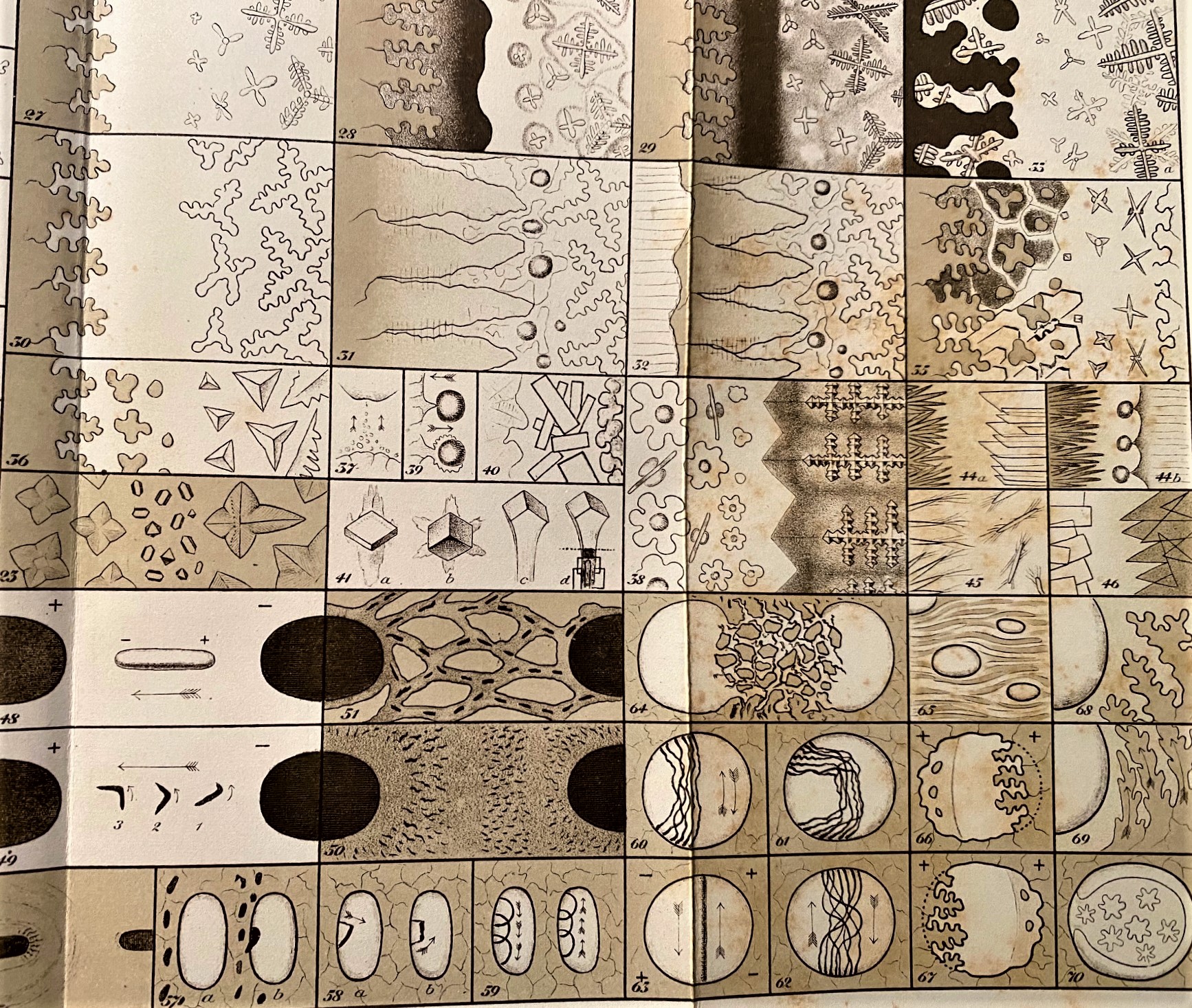
    Tonight’s Found bit is in the art field, and located in the great physics journal, the Annalen der Physik. There are some other instances of Found Art in the Annalen (these can be found by searching “Found” and “Annalen” in this blog’s Google box), but this is the first time I’ve ever found Found Graphic Novel Art—for all the world this looks to me like a very orderly story board for something like the brilliant Chris Ware’s work. It is a highly unusual de-abstraction abstract when removed from the original context, and I really do like it.

    Source: “Ueber den Schmelspunkt in contact befindlicher Korper und die Electrolyse des festen Jodsilbers” Annalen der Physik, series III, vol 24, 1885.

    IMG_5172

    IMG_5178


    ·Posted by :

    ·in:


  • “The Perfect Smoke Column”—the New Miracle of Electronics, 1952

    JF Ptak Science Books  Quick Post

    Electronic cigarettesLiggett & Myers, the producer of Chesterfield cigarettes, sounds the triumphal blast of “the greatest cigarette improvement in thirty years” in this LIFE magazine ad from 1953. It was all made possible by SCIENCE and the sacred mysteries of electronics, which helped create the “perfect-smoke-column-from-end-to-end”, which doesn’t sound all that appetizing though I guess it was if you were a lazy or distracted ciggie consumer. To prove the claim we see a model with perfect un-ciggied teeth with an inset of electronic machinery in the background, which made it look as though the stuff was being produced by the machine.

    The machine doing the great scientific deed was the AccuRay. It was a measure and control system produced by Industrial Nucleonics (beignning their industrial life in 1912 as a steam power supply systems company), which ensured that the cigarettes would be the same, million after million, each being the same length and with the same mount of tobacco. “Scientific miracles never cease”, said the Liggett & Myers people, and I guess the stained proof was in the smokey pudding.

    It may have been all about the burning, as a cigarette that doesn’t need to be drawn on to keep it lit means that it will burn itself out in the allotted time even if you just lighted the thing and kept it in the ashtray. Better burning meant more cigarettes consumed, and so on.

    And by the way Industrial Nucleonics was sold in 1987 to a perhaps more appropriately-named Cumbustion Engineering, at least so far as cigarettes were concerned.


  • Smell-orama without the Rama (1895)


    Smell


    JF Ptak Science Books  Quick Post

    “A true poet does not bother to be poetical. Nor does a nursery gardener scent his roses.” Jean Cocteau

    Maybe so and maybe no, and if not, maybe they should…especially for the poets.  But this come from the writer with only the memory of smell for an olfactory sense.  

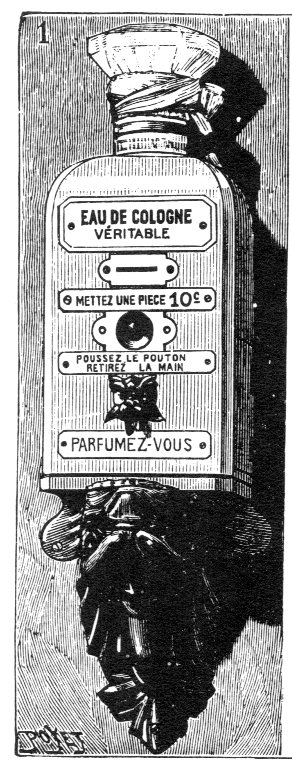
    I looked around without success in Walter Benjamin’s Arcades Project to find something relating to this image, which turns out to be a scent dispenser. These buggers were quite popular (at least in France) and used to be hung at entrances to popular venues where patrons could scent themselves with this-and-that for a few pennies. It seems positively Terry Gilliam-ish to me, but that’s what it was.  

    Source: Scientific American, 1895 (apologies for the skimpy date)


  • Things-out-of-Place Department: Old Maps in Space

    JF Ptak Science Books  Quick Post

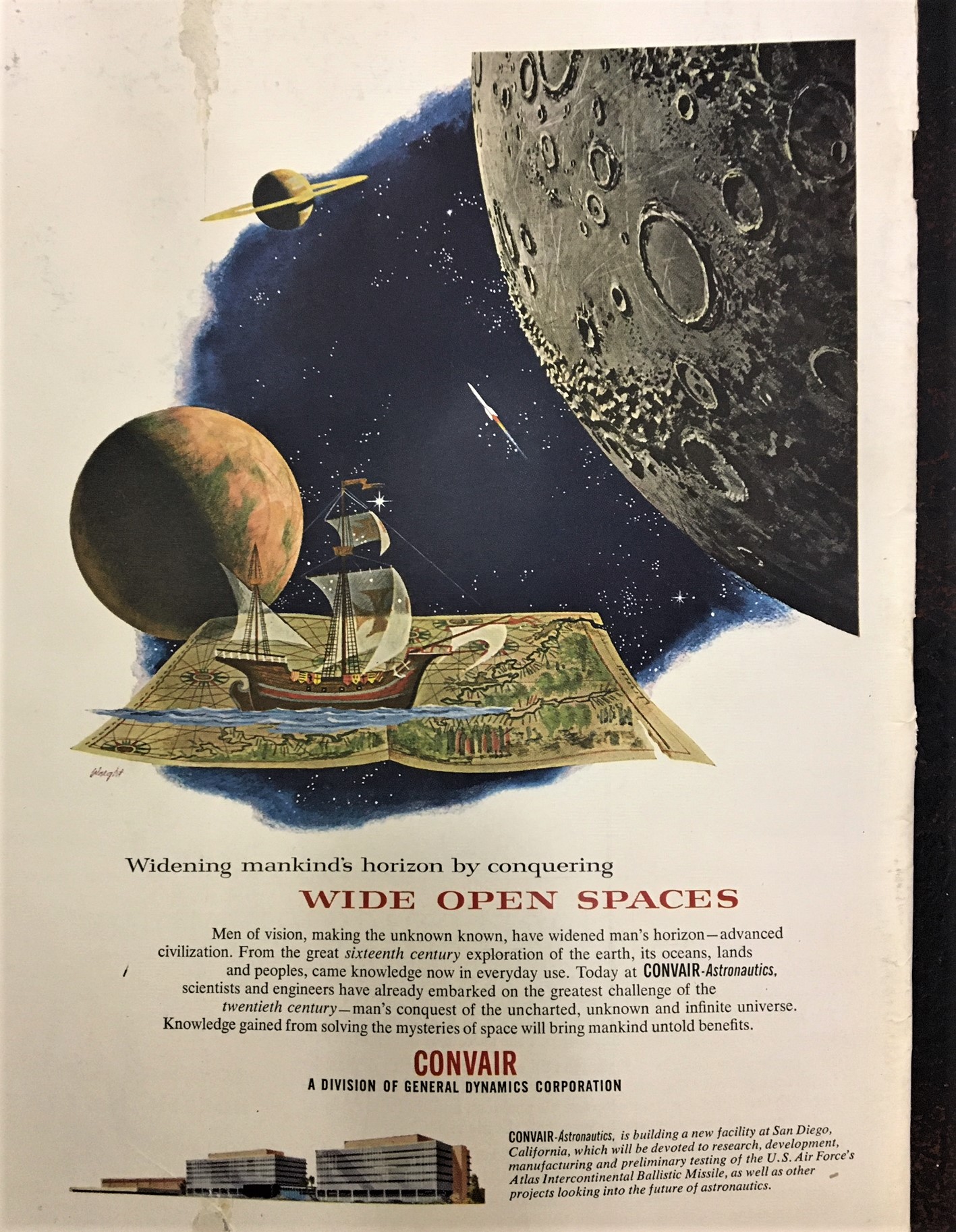
    IMG_2246This is just a short, funny little bit here–I can’t remember noticing an antiquarian map being used as part of the design or decoration based on extraterrestrial objects.  I guess that’s why this image struck me so quickly as being unusual…I just can’t recall another image like it. I mean, this isn’t exactly a towering visual achievement, and in many ways it is ordinary, except that (I think) it isn’t. Anyway, I share it with you now (the source being the Scientific American, July 1957):


  • Capitalism as the Destroyer of Youth

    JF Ptak Science Books  Quick Post

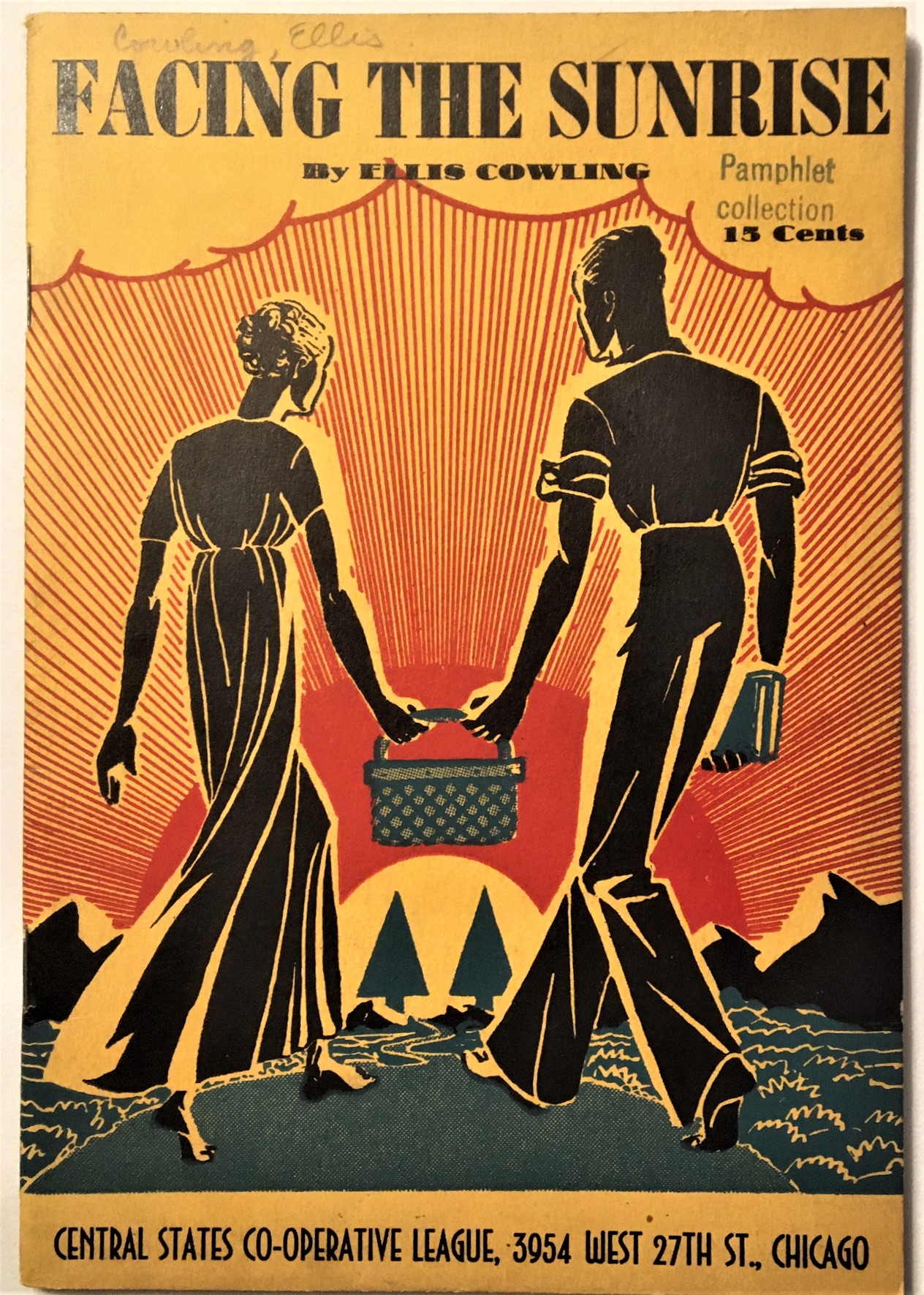
    I just couldn’t resist sharing the cover design for this 1937 pamphlet, as Dick and Jane walk into the purifying light of an atomic sunset.  Well, not quite that, as they were walking the other way into the Purity-of-Essence of a Communist/Cooperative deep red sunrise:

    IMG_2039

    The Cooperative Movement indicts Capitalism for the first half of the pamphlet:

    • Education: “capitalism is robbing youth both of its chances for education…”
    • Romance: “With other things it wrecks, Capitalism is wrecking marriage and home life”. 
    • Good Time: “Modern civilization is not  giving youth what it wants”. 
    • Art: “…increasing insecurity of our times simply means that youth’s chances of being artistically creative are growing less and less”.
    • “Profit system”: “Youth facing life under capitalism does not have a very cheerful outlook”.

    On the other end of the equation, the Cooperative movement promised abundance, increases employment, makes romance and good time possible, encourages creative effort, and advances practical Christianity.  It was 1937, and the Great Depression had its downs and ups but mostly down, deep into 1937/8/9, and people were looking for solutions everywhere. The New Deal may have been part of that, though by 1937 it was mostly being taken off-the-books, and there were plenty of conservative and more-rightist Republicans and Dixiecrats who thought of the FDR acronymic programs as just this side of Socialism–which is all fine and good, though those guys should also remember that FDR did more to save Capitalism than just about anyone in this country, ever. So: yin-yang.


  • A Hole in the Ground vs. a Hole in the Sky

    JF Ptak Science Books  Quick Post

    Tunnel collage


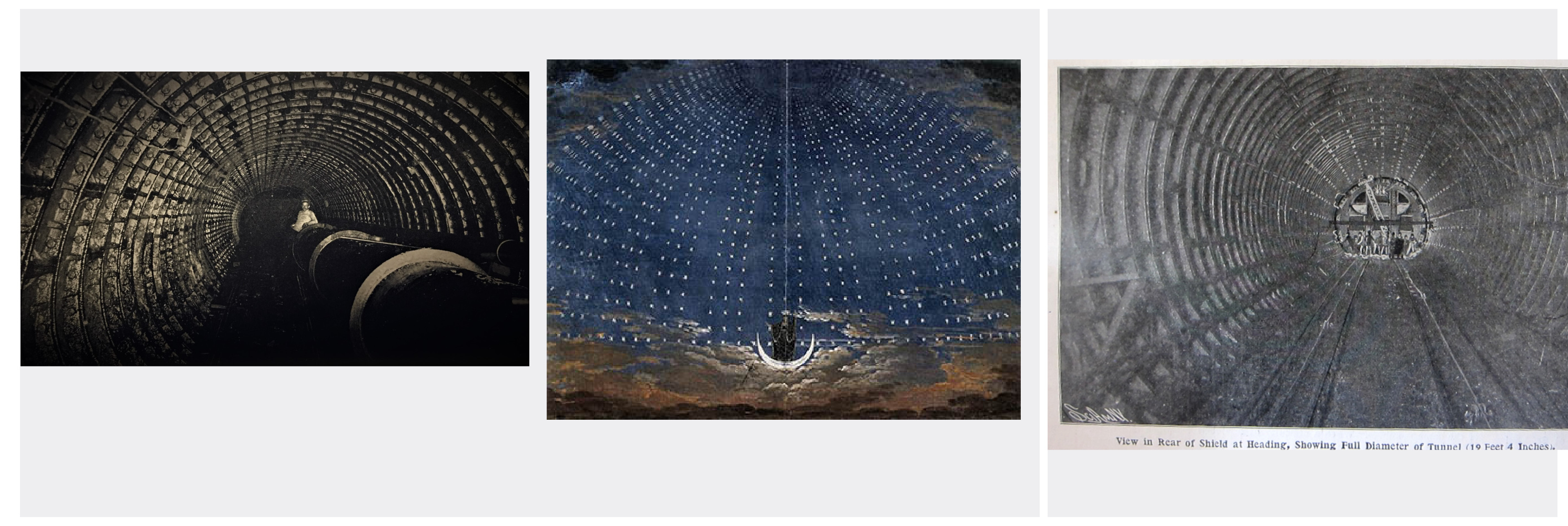
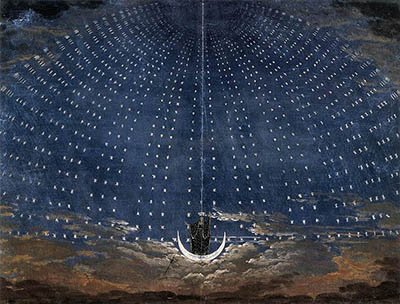
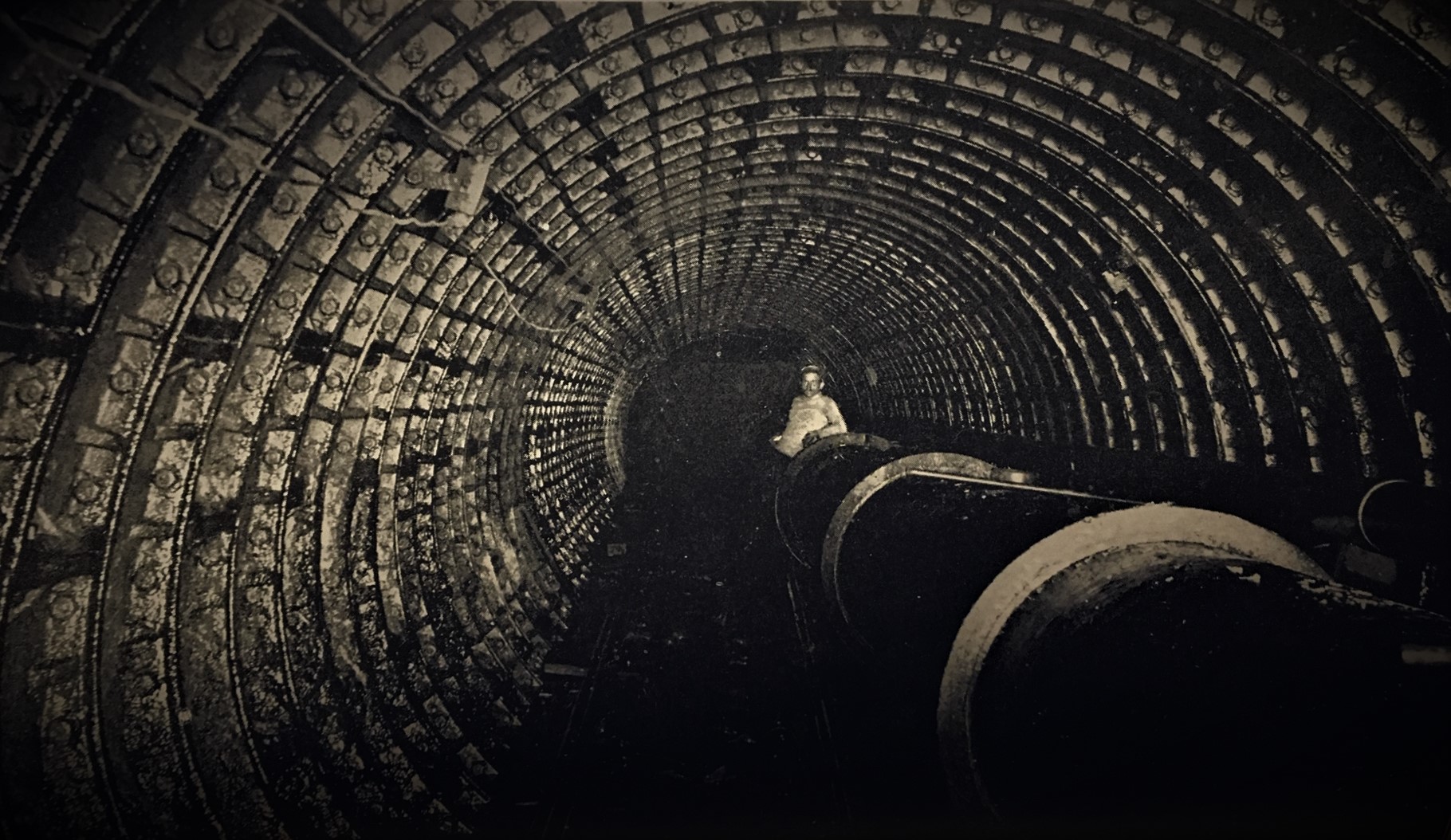
    Mozart tunnel _2_A while ago I wrote about a brief connection that I saw in a  photographic view of the 19′ tunnel section of the Hudson River tunnel with  the 1815 stage set by Karl Friedrich Schinkel (1781-1841) for Mozart’s Magic Flute1. Its just the initial reaction to the perspective pulled up the Schinkel more than anything else, except maybe for a non-existent underground image from Jan Vredeman de Vries’ book on perspective. That said, the set design I’m thinking of features the arrival of the Queen of the Night/Königin der Nacht, so perhaps this association isn’t too meshuga…excepting the ripped-to-shreds lust for revenge that the Queen of the Night sings about, which hasn’t much to do with digging a tunnel. 


    Perhaps this is an association that can be made for any tunnel being dug and illuminated in the 19th century, as I stumbled upon another example of this association, a photograph2 in another NYC tunnel–this one the tunnel under construction under the East River for the East River Gas Company, 1894. It is a little antithetical that these similarities are seen between an image of starry vault surrounding the Earth while the photos depict a lighted tube surrounded by Earth, a sort of alpha and omega of endless light…a contraction of environment filled with light compared to a contraction of the limitless night sky as seen as a theatrical set.  (I understand that there aren’t a long series of lights in the tunnels, just that it looks so because of the no-doubt heavy-duty light source and its reflections on the odd surfaces/bolts/etc. the metal tubing surfaces…and that is a riff in itself.)

    In any event, I like these images, and so I’ll share the newest of my finds here this morning.  

    Tunnel lights mozart


  • On the Souls of Toys (1892)

    JF Ptak Science Books  (Expanded earlier post)

    Fact:  toys have souls.  Or, if we can establish that in this case a “fact” can be so identified, then a “fact” this must be.

    Toys 6 det325
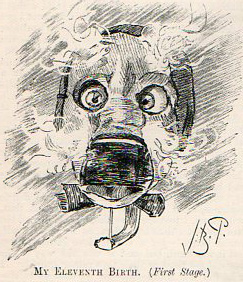
    I’ve stumbled onto a remarkable short story in Punch’s Almanack for 1892 (as part of Punch, or the London Charivari) called “The Evolution of a Toy Soul, or Nursery Karma”.  This piece establishes that toys have souls, that they have an inner, thinking, emotional existence which is capable of Karma and reincarnation, a life of their own–lives of their own. Cognizant, penetrative, analytical.  And a toy.

    The story is told partially in the first person, in the voice of a toy who recounts its long series of births and rebirths–eleven (so far) in all–and its (his or her’s) long experiences.  And this all more than a hundred years before Toy Story.  I don’t know this literature very well, not really, but so far I have not found other “toys have souls” stories, nor have I been able to find out anything about this particular toy story, with searches done in JSTOR and Google and a host of other repositories turning up nothing at all.  Its a puzzling thing, really, because it is a wonderful story.

    In a brief summary, our toy soul starts out it life (“my first birth”) as a rubber ball (“the body in which I first became conscious of my existence”).  The toy soul figures too that it must be its first body, because there is no lower entry point in toydom, except, as is noted, for a brick, which happens to be not-really-a-toy. 

    “My Second Birth” find the toy soul returned to the nursery as a Ninepin, a Ninepin King, who lives part of its life in the hands of a (“quite mad”) human child who dresses the Ninepin in dolls clothes and fabric.

    “My Third Birth”:  “the law of Karma has mysteries which are hid even from the initiated, and I am still at a loss to explain how it came about that I was next incorporated in an Organ Top”, which was basically a spinning top that produced a melody of some sort.

    “My Fourth Birth”:  “I was advanced at a bound” in Karmic hierarchy by being held in the form of a fur monkey with bead teeth and glass eyes.  Here our toy soul has a recollection of its earlier self as a musical top, as it leaves with the monkey a “chronic melancholy”, who takes care (as it were) of a sick girl for a long period of time, and then in the end is given over to a careless boy, and ends up burning in a fireplace.