A Daily History of Holes, Dots, Lines, Science, History, Math, Physics, Art, the Unintentional Absurd, Architecture, Maps, Data Visualization, Blank and Missing Things, and so on. |1.6 million words, 7500 images, 4.9 million hits| Press & appearances in The Times, Le Figaro, Mensa, The Economist, The Guardian, Discovery News, Slate, Le Monde, Sci American Blogs, Le Pont, and many other places… 5000+ total posts since 2008.

Category: History of Lines

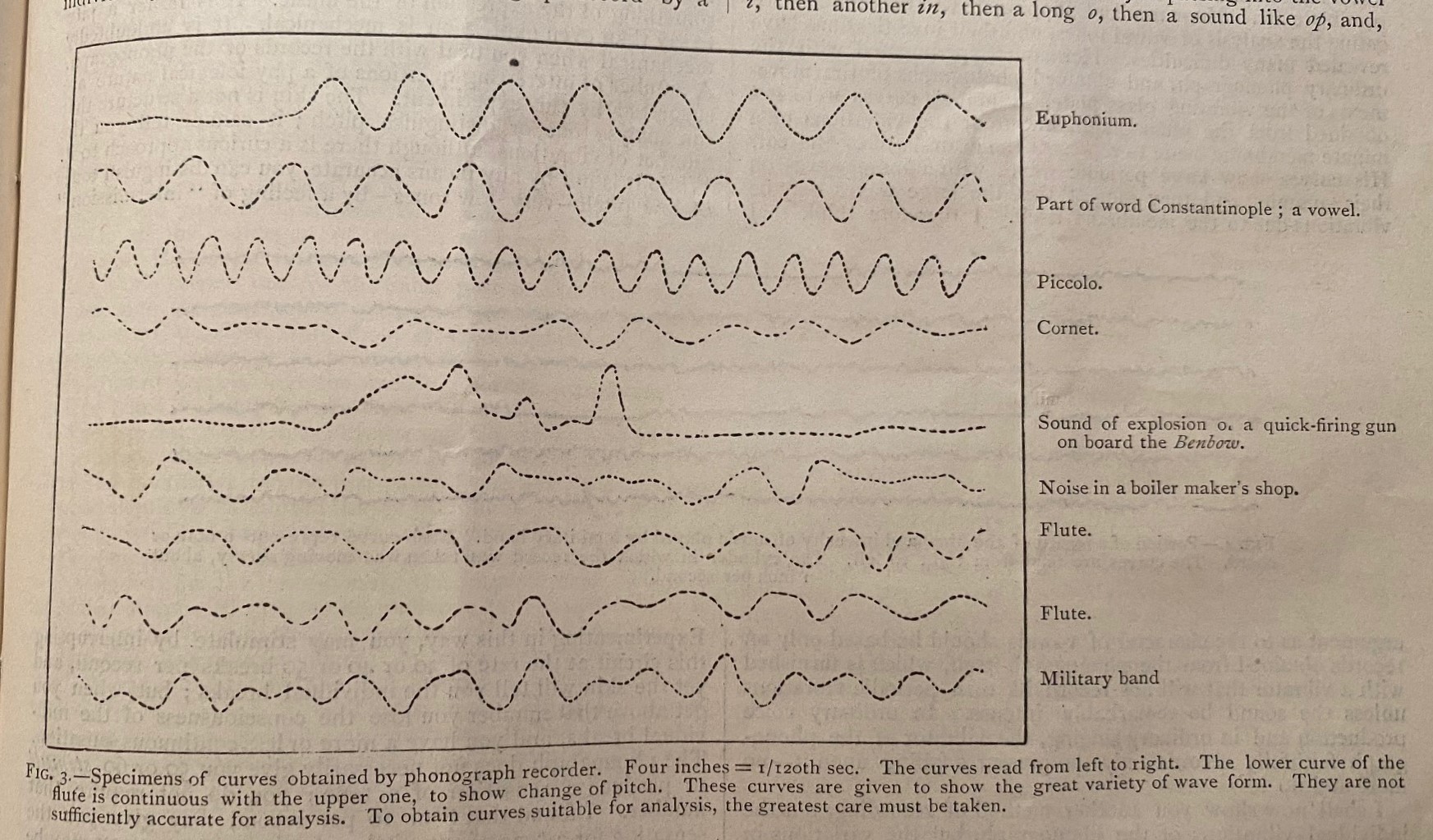
  • “Euphonium”: Found-Poetry of Recorded Soundwaves (1897)

    JF Ptak Science Books  Quick Post –Overall Post 5122 (Part of the History of Lines series)

    IMG_4854John McKendrick had a long scientific career, with a  lot of very widely-spaced interests on which he wrote well and often.  What caught my eye on this piece (“The Analysis of Phonograph Records”, in Nature, a Weekly Illustrated Journal of Science, volume 56 no. 1444, 1 July 1897, pp 209-213 in the issue of pp 193-216)–I mean, aside form its wonderful content–was a bit of found poetry in one of the paper’s illustrations.  McKendrick’s—professor of physiology at Glasgow—effort here is one of the early attempt studying graphic records of soundwaves specifically prepared on phonographic cylinders, looking for variations in the graphics of pitch and the meaning they convey. Fascinating results.  

    EUPHONIUM (1897)

    Euphonium,

    Part of a word Constantinople, a vowel,

    Piccolo

    Cornet

    Sound of explosion or a quick-firing onboard the Benbow.

    Noise in a boiler makers group.

    Flute.

    Flute.

    Military band.


  • “The Perfect Smoke Column”—the New Miracle of Electronics, 1952

    JF Ptak Science Books  Quick Post

    Electronic cigarettesLiggett & Myers, the producer of Chesterfield cigarettes, sounds the triumphal blast of “the greatest cigarette improvement in thirty years” in this LIFE magazine ad from 1953. It was all made possible by SCIENCE and the sacred mysteries of electronics, which helped create the “perfect-smoke-column-from-end-to-end”, which doesn’t sound all that appetizing though I guess it was if you were a lazy or distracted ciggie consumer. To prove the claim we see a model with perfect un-ciggied teeth with an inset of electronic machinery in the background, which made it look as though the stuff was being produced by the machine.

    The machine doing the great scientific deed was the AccuRay. It was a measure and control system produced by Industrial Nucleonics (beignning their industrial life in 1912 as a steam power supply systems company), which ensured that the cigarettes would be the same, million after million, each being the same length and with the same mount of tobacco. “Scientific miracles never cease”, said the Liggett & Myers people, and I guess the stained proof was in the smokey pudding.

    It may have been all about the burning, as a cigarette that doesn’t need to be drawn on to keep it lit means that it will burn itself out in the allotted time even if you just lighted the thing and kept it in the ashtray. Better burning meant more cigarettes consumed, and so on.

    And by the way Industrial Nucleonics was sold in 1987 to a perhaps more appropriately-named Cumbustion Engineering, at least so far as cigarettes were concerned.


  • Snow, Gloriosum Miracula (1692)

    JF Ptak Science Books  Quick Post

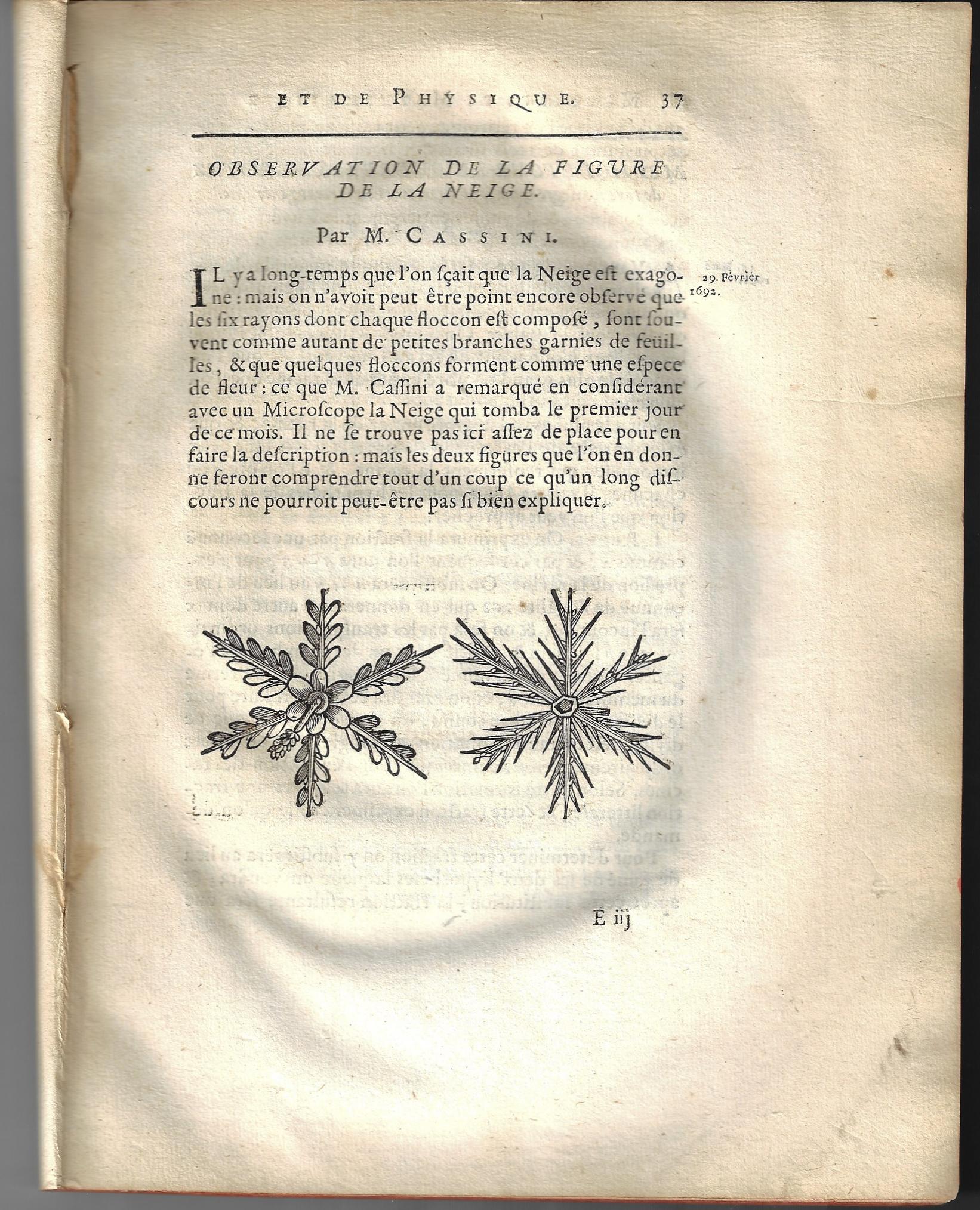
    This short notice by Cassini1 published in 1730 has a lot going for it–I just like the design, and the way it sits on the page, unrushed by another article beginning right underneath it, plenty of space, wide margins, and so on. Also the content is pretty interesting–the great astronomer went out and collected some new fallen snow and had a peep of it under a microscope (the instrument 100 years old or so at this point), and briefly reports his lovely findings. The editors state that there are “so many branches furnished with leaves that a few flakes form like a specie of flower. Cassini–a very busy man–states that he didn’t have the journal space nor his own time to write something about what he saw in the snowflakes, so simply presented the editor with an engraving of what he witnessed. The image of the snowflakes will “suddenly make one understand what a long speech might not be able to explain”.  (“Il ne fe trouve pas ici allez de place pour en faire la defeription : mais les deux figures que l’on en donne feront comprendre tout d’un coup ce qu’un long discours ne pourroit peut-être pas fi bien expliquer.”) I think you could say it is still fairly early to see these snowflake images, though I’m not sure yet when the first published micrographic images of snowflakes appeared. (Robert Hooke published micro images in his Micrographia in 1665, though I don’t know if his were the first. Earlier still were Kepler and his famous Charles Bridge observations of the six-cornered snowflake, though the images weren’t made via a microscope though they were the first scientific endeavors with the snowflake…)


    Cassini snow

    Notes:

    1.  Giovanni Cassini, 1625-1712. The note appears in Memoires de l’Academie Royale des Sciences, Depuis 1666 jusqua 1699, Paris, 1730, and was first published in 1692.  

    ·Posted by :

    ·in:


  • Another Segment in the History of Lines: Lining Up to the Fractionating Tower (1949)

    JF Ptak Science Books  Quick Post

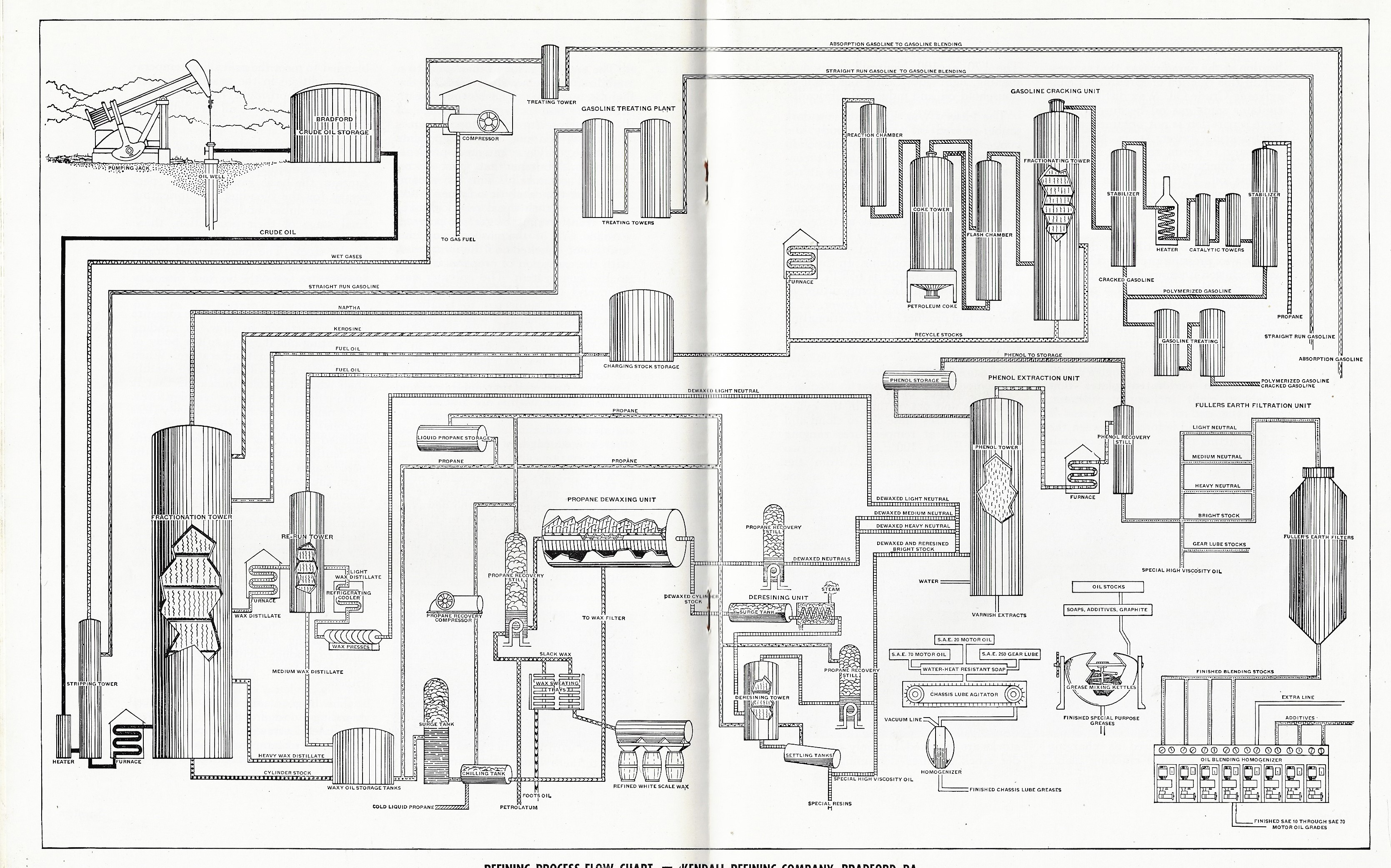
    At first glance this display of data looks a bit like a plate of straightened/geometrizied spaghetti, though it is actually a very good representation of the oil production process, from pump to purchase:

    Oil schematic

    Delivery, fractionating, and distillation process from A Refinery Process Bulletin, Kendall Refining Company, 1949.

    Also, here’s the attractive and nicely-designed front and back cover of the publication:


  • Cracks in the Road and What They Mean–a Short Diversion in the History of Lines (1943)

    JF Ptak Science Books  Quick Post   (Part of the History of Lines series) 

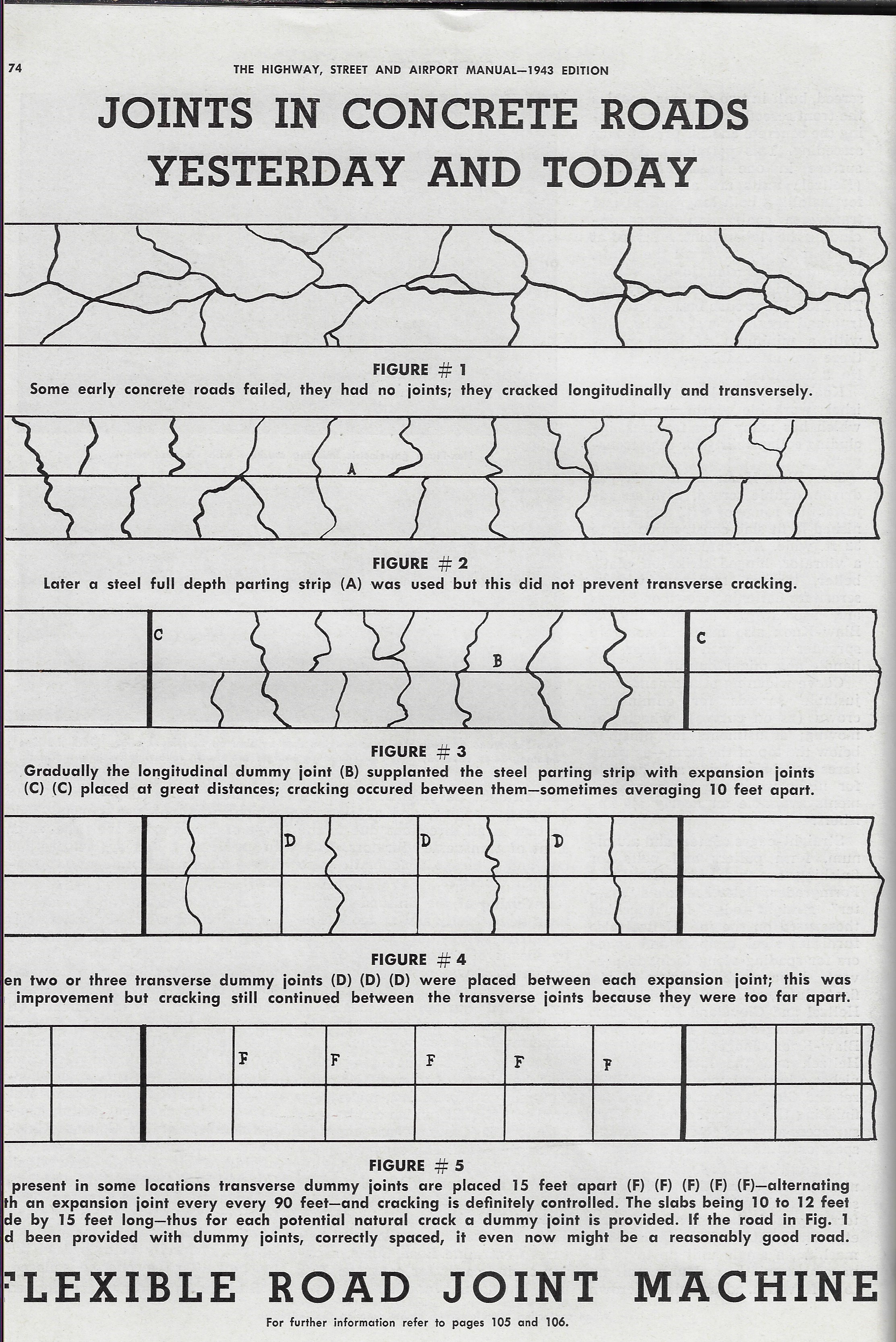
    This part of tonight’s entertainment comes from the unlikely source: The Highway, Street and Airport Manual, Equipment, Methods, Materials (1943), published by Public Works Magazine, and shares an ad that displays the results of various types of concrete road paving failure with the placement of joints. (And, yes, I’m sorry to say that I’m equating “lines” with “cracks”.) It is pretty interesting stuff in a similar vein of the history of painted road lines (longer and more complicated than expected), alpha-numeric utility pole designations, the design of manhole covers, the placement of cable and electrical lines on utility poles, and the like–very obvious and present things in the daily social life of organized public conveniences, but probably mostly overlooked for their constant presence.

    And so, cracks in the street:

    Road concrete failure _1_

    The full two pages of text:


  • Display of Information–a Brooklyn Bridge Contribution to the “History of Lines” Series

    JF Ptak Science Books   Quick Post 

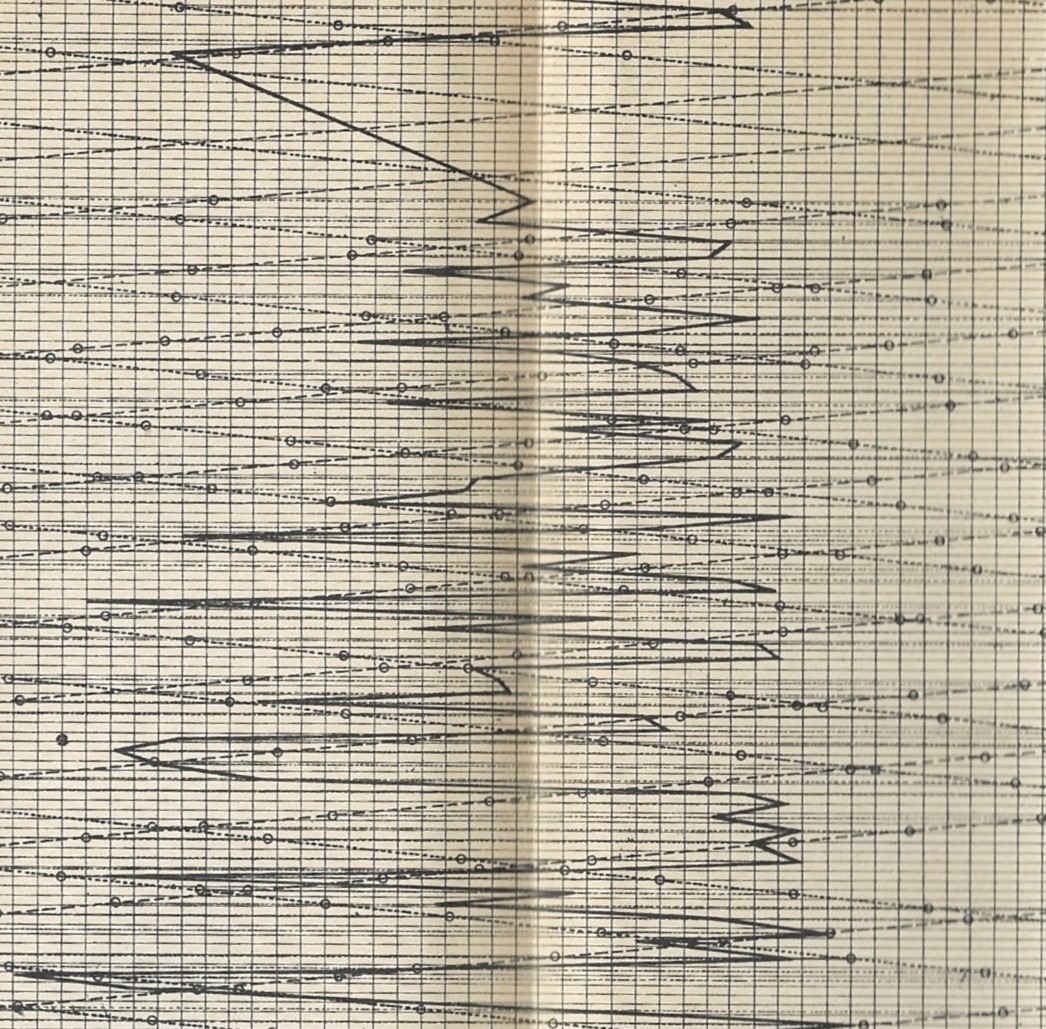
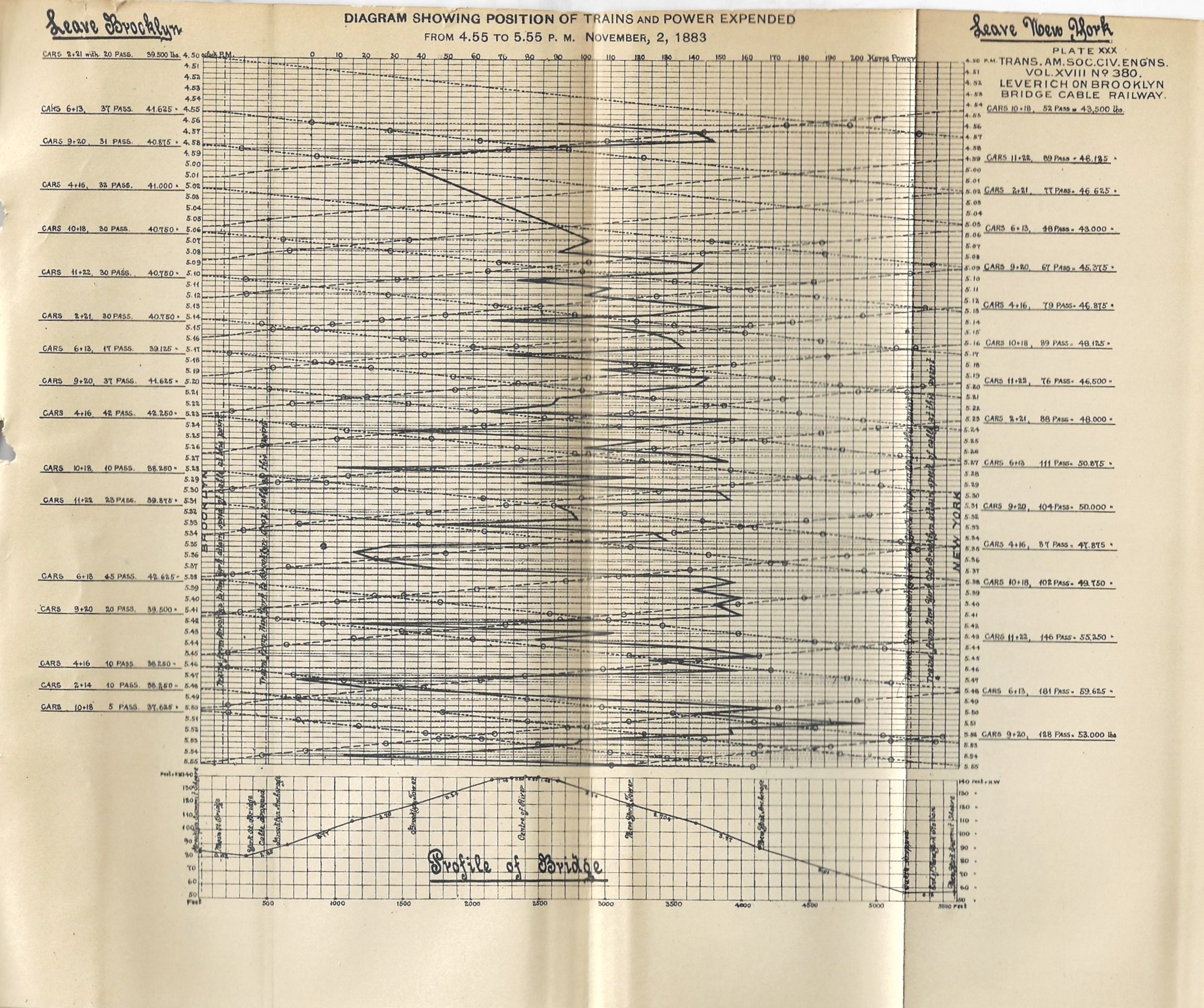
    It has been a while since I’ve added a post  to the History of Lines series, but today I’ve found a good one: a graphical display of the limited comings-and-goings of the cable tram on the Brooklyn Bridge in 1888.  The bridge–still not yet quite the “Brooklyn Bridge”, but the “New York and Brooklyn Bridge”–was open at this point for only five years, still relatively new. and this chart shows the power expense and general time table of the small train that ran pedestrians from one end of the bridge to the other.  It wasn’t a continuously moving cable train, and had regular departure times.  In any event I’m happy to display the complicated and not altogether clear display of the data associated with the train:

    Brooklyn Bridge 1888 cable railway detail

    And the full display, with legend and explanation:

    Brooklyn Bridge 1888 cable railway

    Source: G. Leverich, “The Cable Railway on the New York and Brooklyn Bridge”, from American Society of Civil Engineers, Transactions, vol XVIII, March  1888, #380, pp (67)-102, plates 4-30 (25 folding plates of various aspects of the power train and fittings, complete).  


  • A Very Early Quantitative Scale for Classifying Smoke (1899)

    JF Ptak Science Books   Quick Post

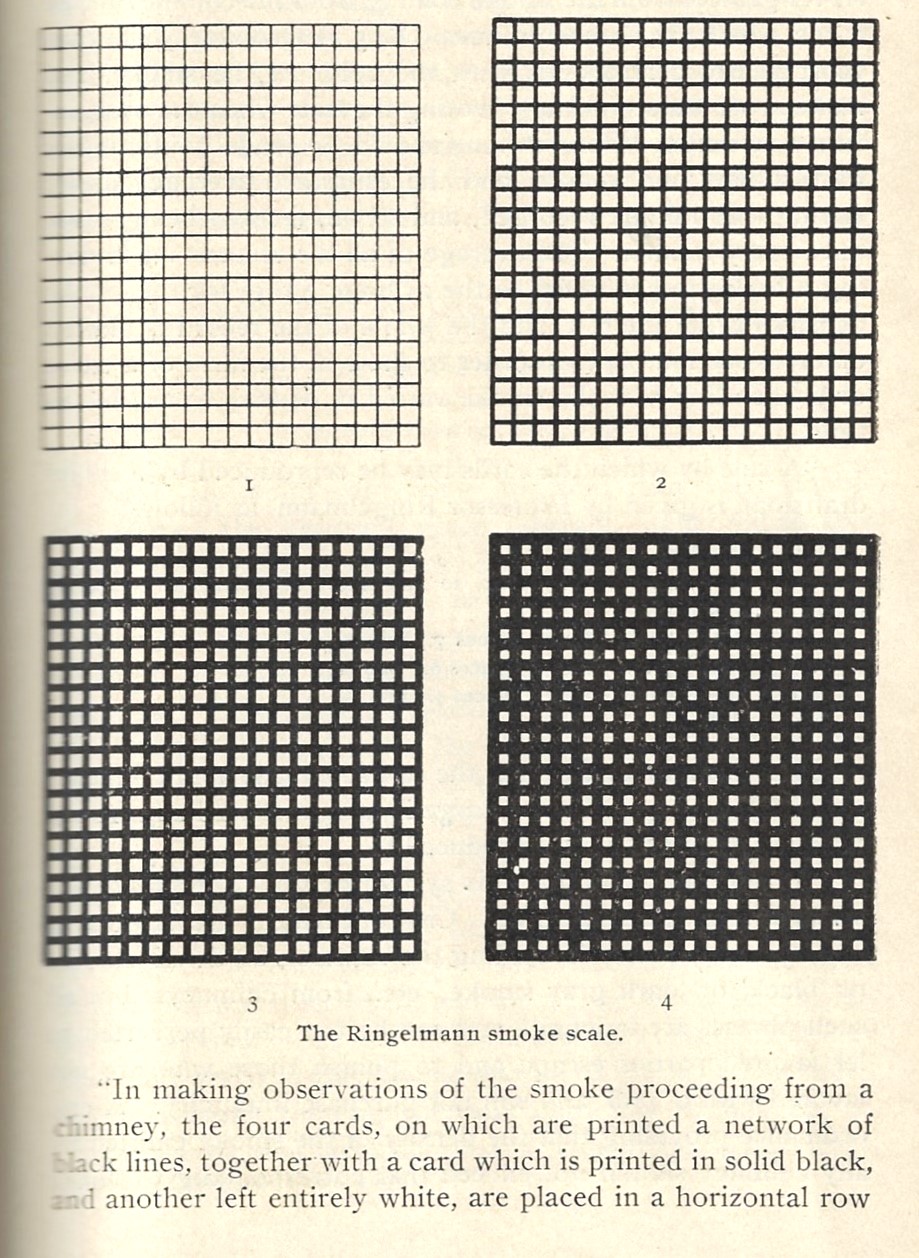
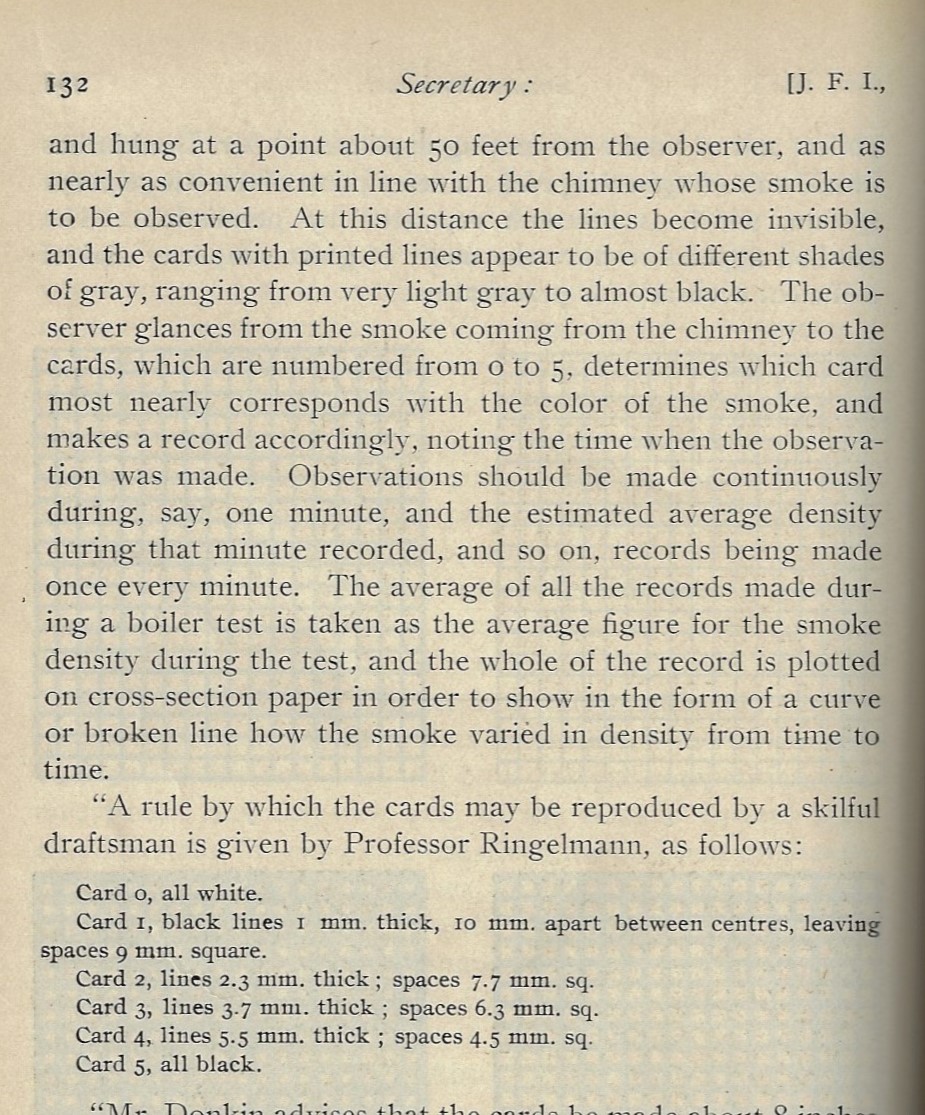
    This is one of those things that you’d probably not properly think about until you had to do so–a quantitative measuring device to classify smoke (or visible emissions). In a way it reminds me of Mr. Howard who was the first to classify clouds in a scientific way in 1803–surely you’d think that the great classifiers like Aristotle & Co. would have done this over the centuries, but evidently the moving floating mountains escaped scientific classification until relatively recently. Is the same true of the cloud’s distant cousin, smoke?  And what about classifying fog? I don’t have the answers to this tonight as its too late to figure it out right now, but I’ll return with the answers and correctly update this post. In the meantime, please find below the last part of a two-part article that appeared in the Journal of the Franklin Institute1 in which the organization and classification of smoke by Max Ringlemann is discussed and explained. It seems as though there is a slightly earlier publication of the scale in Engineering News in 1897, though I haven’t yet (again!) found the original article by Ringlemann himself.  (“In 1897 architectural engineer Maximilien Ringelmann developed smoke charts to allow observers to contextualize observable smoke into a scale of known gray. Lighter smoke indicated fewer particulates and more water, while the darkest of smoke was of grave concern. The charts were posted outside of factories, providing a very public method of environmental monitoring and awareness.”–Science History Institute, https://www.sciencehistory.org/ringelmann-smoke-charts.)

    It is interesting to note that a paper published by the Bureau of Mines of the U.S. Department of the Interior in 1967 employed the Ringlemann scale pretty much as we see it below.

    There is also an interesting article that addresses the use of the Ringlemann scale in regards to discussion of air pollution: 

    • “ Dark smoke – an introduction to air pollution control (smoke) regulations “(PDF). Hong Kong: Environment protection department, Hong Kong. Retrieved 31 August 2018.

    JFI 1899 Ringelmann smoke scale _2_


    JFI 1899 Ringelmann smoke scale _2_

    Notes:

    1. William H. Thorne, “The Smoke Nuisance and its Regulation…”, JFI, February 1898, vol 145, pp 401-442 and pp 17-59 (same volume, different number).  


  • One of the Earliest Reports of Dogs on the Newly-Invented Telephone (1877-1884)

    JF Ptak Science Books   Quick Post

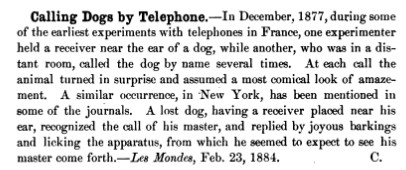
    Okay, so I really don’t have any idea of what might be the earliest use of a telephone with a dog–I mean, who does? However I do have some long experience in looking at very early reports on the development of the telephone and the first time I ever came across a reference mentioning dogs and the phone was today (oh sweet joy!) in the Journal of the Franklin Institute (volume 116, June 1884, p 460). This is nothing really but personal bias and judged on my own experience, but I have to say that I may be right in my guess…though I’m not going to set out and research what a better answer might be in pulling the timeline to make it taught.  In any event, it is an enjoyable report, and at this point the dogs probably reacted like most humans did hearing the telephone for the first time.  

    JFI 1884 Dogs on the phone

    ·Posted by :

    ·in:


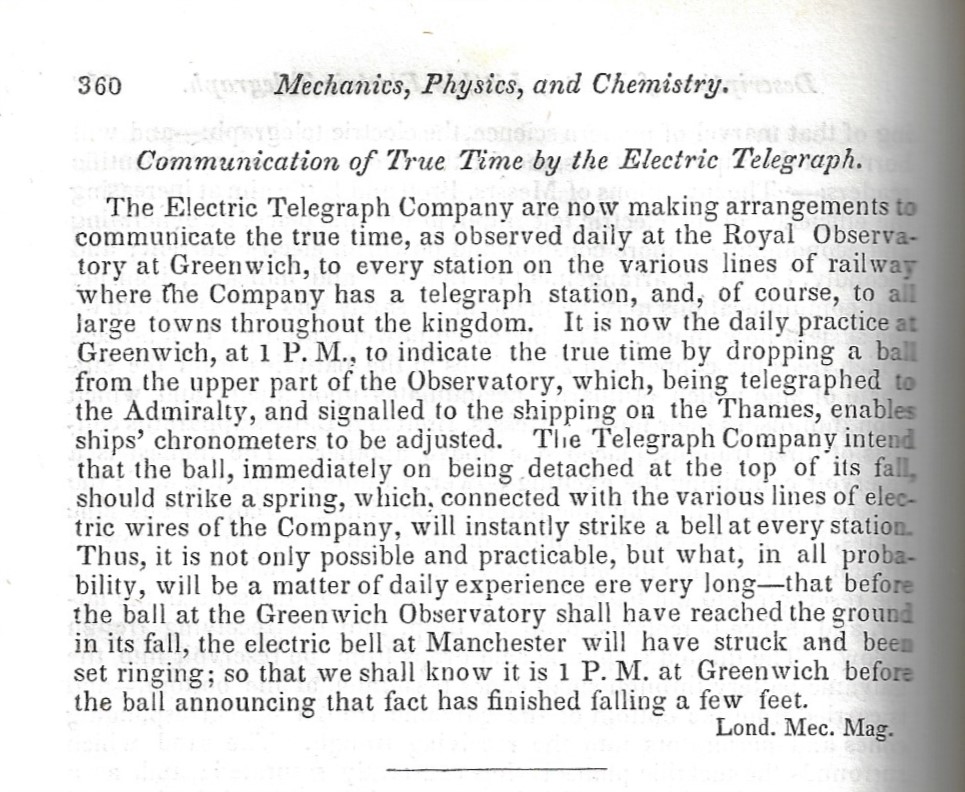
  • Electric Time (1847)

    JF Ptak Science Books  Quick Post

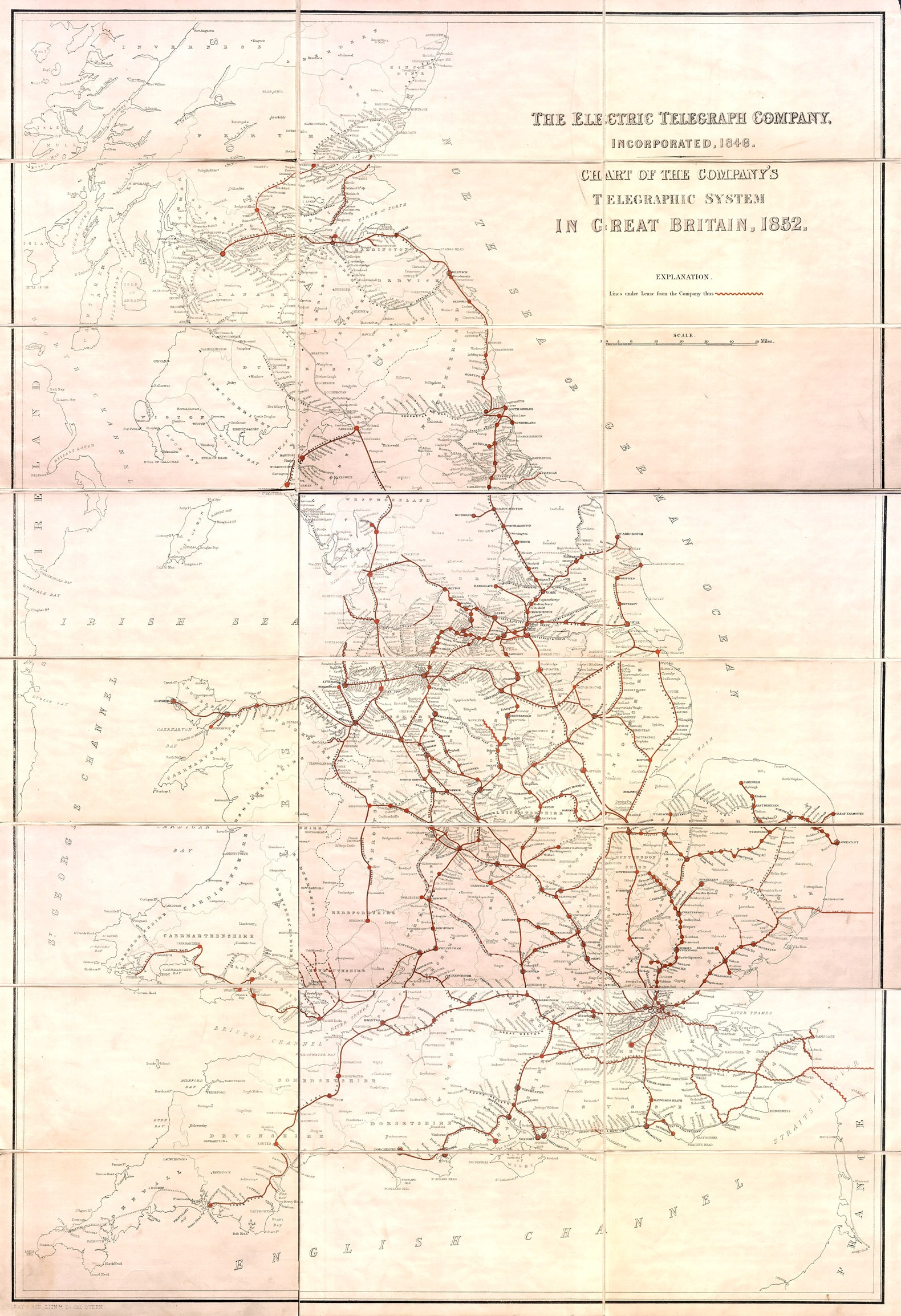
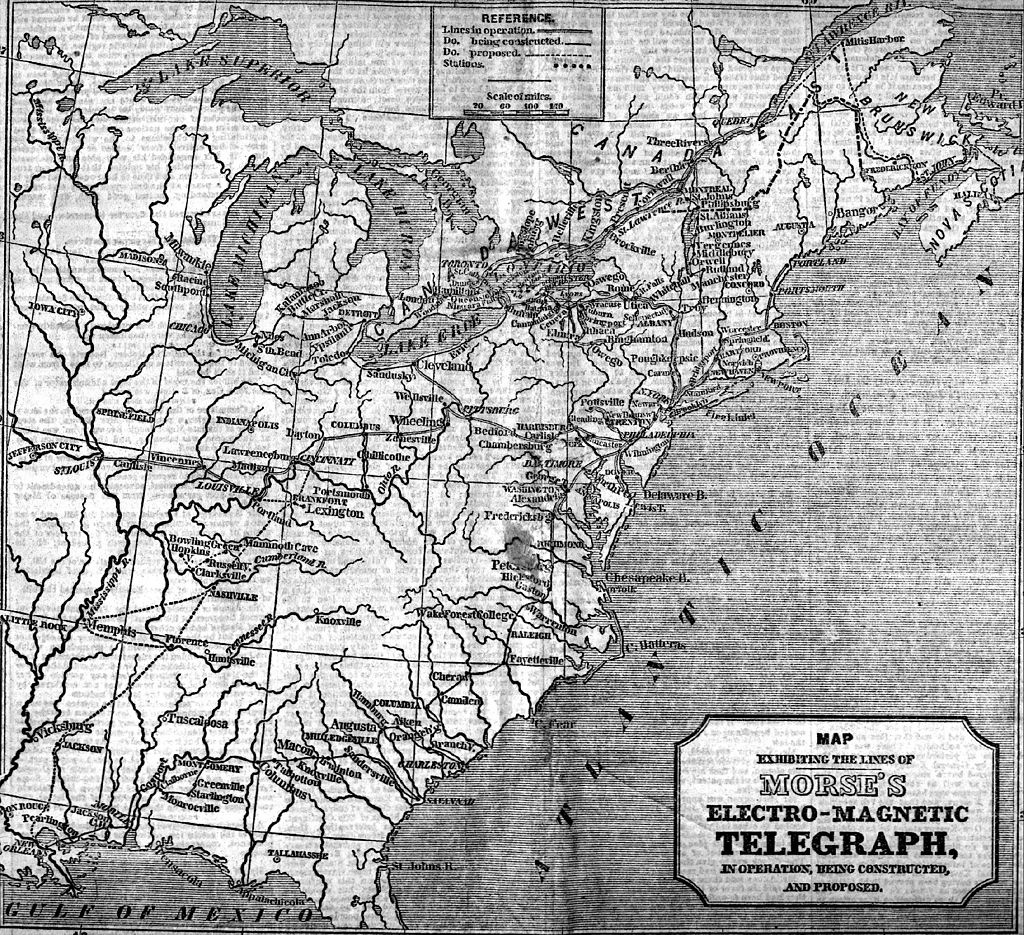
    There were some ways of getting around the problem of geography and communications over long distance–visual semaphores, smoke, drums, that sort. The issue of long-distance relatively instant communication wasn’t solved until the appearance of the telegraph, which for the most part outside of starts and fits and a complicated pre-history really wasn’t solved until Morse and Vail in about 1843. The first line was laid in the U.S. between D.C. and Baltimore in the next year, and then with the display of this success a network of electric communications exploded, as you can see in the map below showing telegraph lines in the U.S. in 1848, just five years after there was nothing at all. 

    Anyway this is what came to mind when I stumbled on the following short notice that appeared in the Journal of the Franklin Institute in December 1847–the fixing of a “constant” time communicated by electric telegraph, reporting the standard time from Greenwich, to be sent out to the furthest reaches of the telegraphic world, and which was an early attempt at the mass distribution of regulated synchronous time keeping over long distances. Pretty cool idea.  

    • “It is now the daily practice at Greenwich, at 1 P.M., to indicate the true time by dropping a ball from the upper part of the Observatory, which, being telegraphed to the Admiralty, and signaled to the shipping on the Thames, enables ships chronometers to be adjusted.”


    JFI 1847 telegraph time

    A map of the telegraph lines in Great Britain in 1852:


    Telegraph map GB 1852

    Source: distancewriting.co.uk 

    And the map of telegraph lines in the U.S.:

    Telegraph map wikipedia

    Source: wikicommons on “telegraph history”


  • The Found-Poetry in Erasing Straight Lines from Maps of Mars (1909)

    JF Ptak Science Books   Post 2759

    There was good strong debate on the issues of Martian “canals” and whether or not they were there by chance or by Percival Lowell’s (and others) intelligent design. The debate dates range from about 1886 to 1909 or so, though the real method in the intelligent life argument comes in at about 1895.  The “1909” part of the endgame is embodied in the interesting paper “Observations de la planete Mars, faites a l’Observatoire de Meudon”1 by Eugene Michel Antoniadi, which is also the holder of some superior and evocative vocabulary and imagery.

    Antoniadi made a series of painstakingly-executed photos of the planet with Europe’s largest telescope (the 33″ “Grande Lunette”) at Meudon. They revealed that the canals as hard geometric forms had indeed been a sort of optical illusion, and that the new and more-definitive photographs showed them in their true and far more complex existence, more as naturally-occurring objects than something that was designed by another life form.

    • (“During the planetary opposition in 1909, Antoniadi observed Mars at the celebrated 33-inch Meudon Observatory telescope, the largest in Europe. Although he observed for only nine nights during a month-long stay in Paris, he reported seeing Mars so clearly at times that the linear appearance of the canals dissolved into an intricate mess of smaller, irregular details, and he noted that ‘the geometrical “canal” network is an optical illusion; and in its place the great refractor shows myriads of marbled and chequered objective fields, which no artist could ever think of drawing’.)–“Mapping the Mars Canal Mania: Cartographic Projection and the Creation of a Popular Icon”, Imago Mundi, 58:2, 2006.

    The Antoniadi photos came only about five years after the true “first” photograph of what were thought to be canals was made by Percival Lowell’s assistant, Carl O. Lampland. (Antoniadi by the way spent nine years as a special assistant to Camille Flammarion at his personal observatory.)  In addition to the debate of how the “canals” came to be, there was another on whether the features identified as “canals” were there at all. It was Lampland’s work that seemed to settle at least that issue, establishing photographically that there was indeed something there. Lowell seized on this work as confirmation of his theories–that if the canals were proven to be there then it followed logically that his iterations of Martian intelligence would also be true. Here Lowell probably acted too rashly, as the photos showed that the canals also weren’t like the patterned and highly-geometrical structures shown in Lowell’s maps. (That said, the British Astronomical Society adopted the position in their 1906 annual meeting that the Lampland photos served as the confirmation that Lowell had been seeking…)

    The Lowell canals as constructed objects hypothesis lost steam after 1905, and met the large part of its end on the work by Antoniadi on what was evidently a perfect night of viewing on 30 September 1909, the primum mobili aspect removed in favor of natural causes.

    In the paper Antoniadi observed 50 canals and before he described them he defined them, the definition coming from one of the original namers of the canals as “canali” (or “channels”)–Schiaparelli–and not Lowell, who interpreted the “canali” as “canals”, with the armature that they were constructed by someone or something. Antoniadi writes with certainty in this paper: “a canal is a [banrle?] or greyish line of regions called the differences of brightness of neighboring points, which constitute the details of the image…”2  which leads us far away from the material intelligence argument.

    Antoniadi then sets down an 8-point descriptive list of canal characteristics, which is beautifully written and when presented in a certain way takes on a very poetic form. His original description reads: “(a) En ombres diffuses, plus ou moins îrréijulières, dont quelques-unes paraissent doubles d’une manière fugitive;  (b) en estompages noueux;  (c) en masses grises, informes et disjointes;  (d) en estompages irréguliers, minces dans le vcuMiiage d’une haie des mers martiennes, et s’élargissnnt en une ombre vaste et confuse plus loin, comme des neuves avec leurs tributaires, vus a une très grande distance; (e) en alignements d’un très petit nombre de lacs; (f) en lacs in-éguliers, simples et bien isoler-; (g) en bords de pâles demi-tons; (h) en lignes noires très courtes, sinueuses ou courbes.”

    Here’s the description, reformatted and translated:

    “Our observations lead us to divide the channels into several categories, namely:

    In diffuse shadows, more or less irregular, some of which appear

    double in a fleeting way;

    In gnarled blobs;

    In gray masses, shapeless and disjointed;

    In irregular, thin blurring, in the construction of a hedge of

    Martian seas, and widen into a vast and confused shadow further on, like

    new with their tributaries, seen at a great distance;

    In alignments of a very small number of lakes;

    In ‘simple lakes, simple and well insulated;

    In edges of pale semitones;

    In very short black lines, sinuous or curved.


    Antoniadi concludes (translated):

    “In this nomenclature, we have not understood the fugitive straight lines, often called channels, which are visible only during a fraction of second and which can be due to an illusion.. These first observations do not confirm the existence of a network of geometric straight lines, crisscrossing in all directions. Even, by very calm images, we have recognized, not in a fleeting way but for several consecutive seconds, a structure of continental regions quite different from the previous one. These regions are shown covered with a large amount of greyish mottling, irregular, complex and gnarled, which no artist can render.

    I was very surprised to find such a significant paper rendered in such a poetic manner.

    Notes:

    1. ANTONIADI, E.-M. “Observations de la planete Mars, faites a l’Observatoire de Meudon. In: Comptes Rendus, 15 November 1909, pp 836-838 in the weekly issue, WITH a lovely full-page map of Mars.

    2. Antoniadi remarks elsewhere that the lack of geometry on the planet “was conspicuous by its complete absence”.–McKim, R. J., “The life and times of E.M. Antoniadi, 1870-1944. Part II: The Meudon years”, Journal of the British Astronomical Association, vol.103, no.5, p.219-227, 1993. There is a long report with 100 illustrations by Antoniadi in the Memoirs of the British Astronomical Association (vol XX, part II) published in the second year of the War, 1915–on the cover of that report is a very strong but still measured statement by George Ellery Hale: “The total absence of straight lines…seems to me significant”. 

    McKim goes on to note the polite correspondence between Antoniado and Lowell, including the very generous suggestion to Lowell that the later’s observations were obscured and complicated by Martian cloud cover. 
    ·Posted by :

    ·in:

    — —