A Daily History of Holes, Dots, Lines, Science, History, Math, Physics, Art, the Unintentional Absurd, Architecture, Maps, Data Visualization, Blank and Missing Things, and so on. |1.6 million words, 7500 images, 4.9 million hits| Press & appearances in The Times, Le Figaro, Mensa, The Economist, The Guardian, Discovery News, Slate, Le Monde, Sci American Blogs, Le Pont, and many other places… 5000+ total posts since 2008.

Category: Naming Things

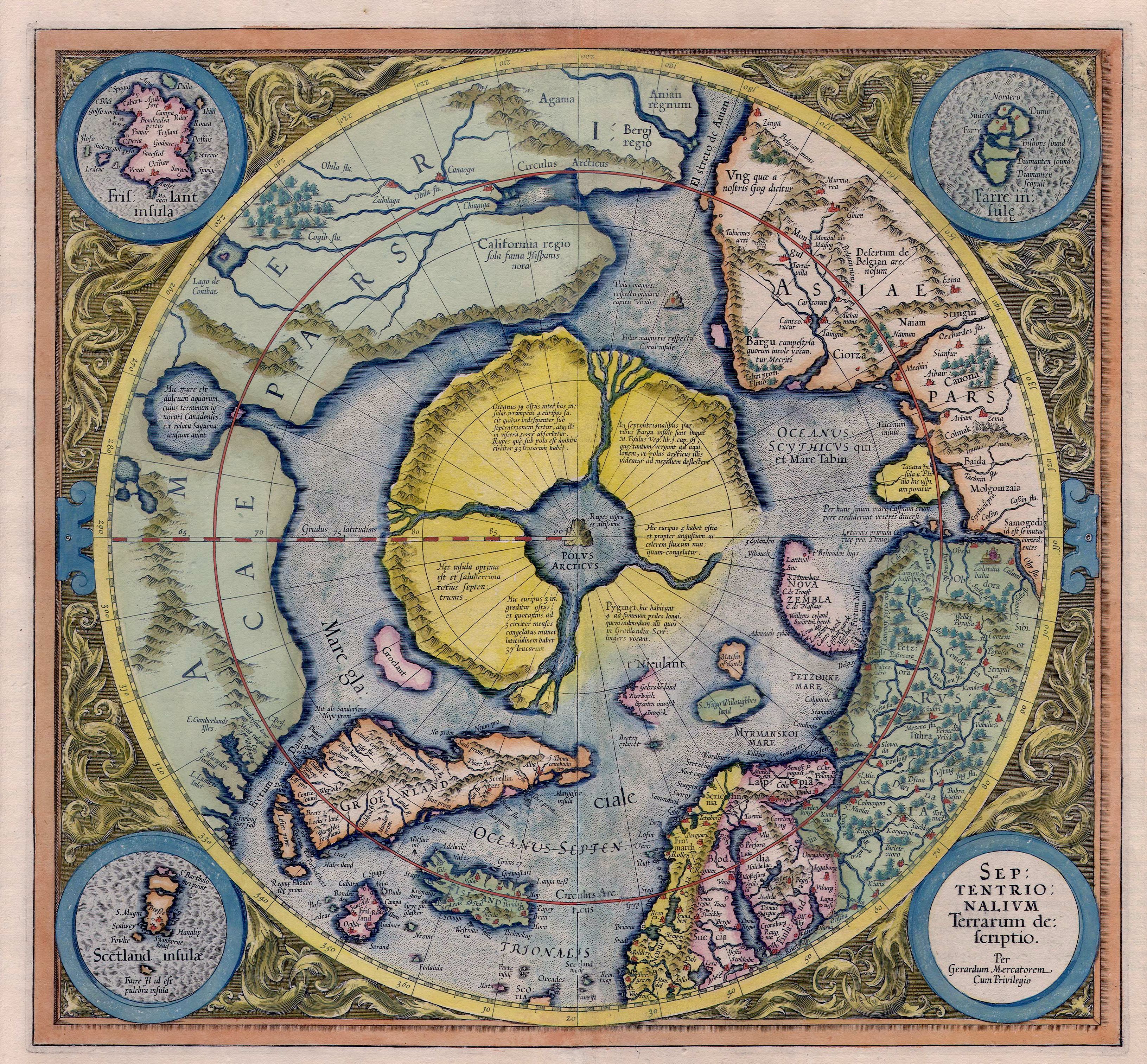
  • The Garden of Eden at the North Pole

    JF Ptak Science Books   Quick Post  Overall Post 5126

    Artic

    (Gerald Mercator, 1596)

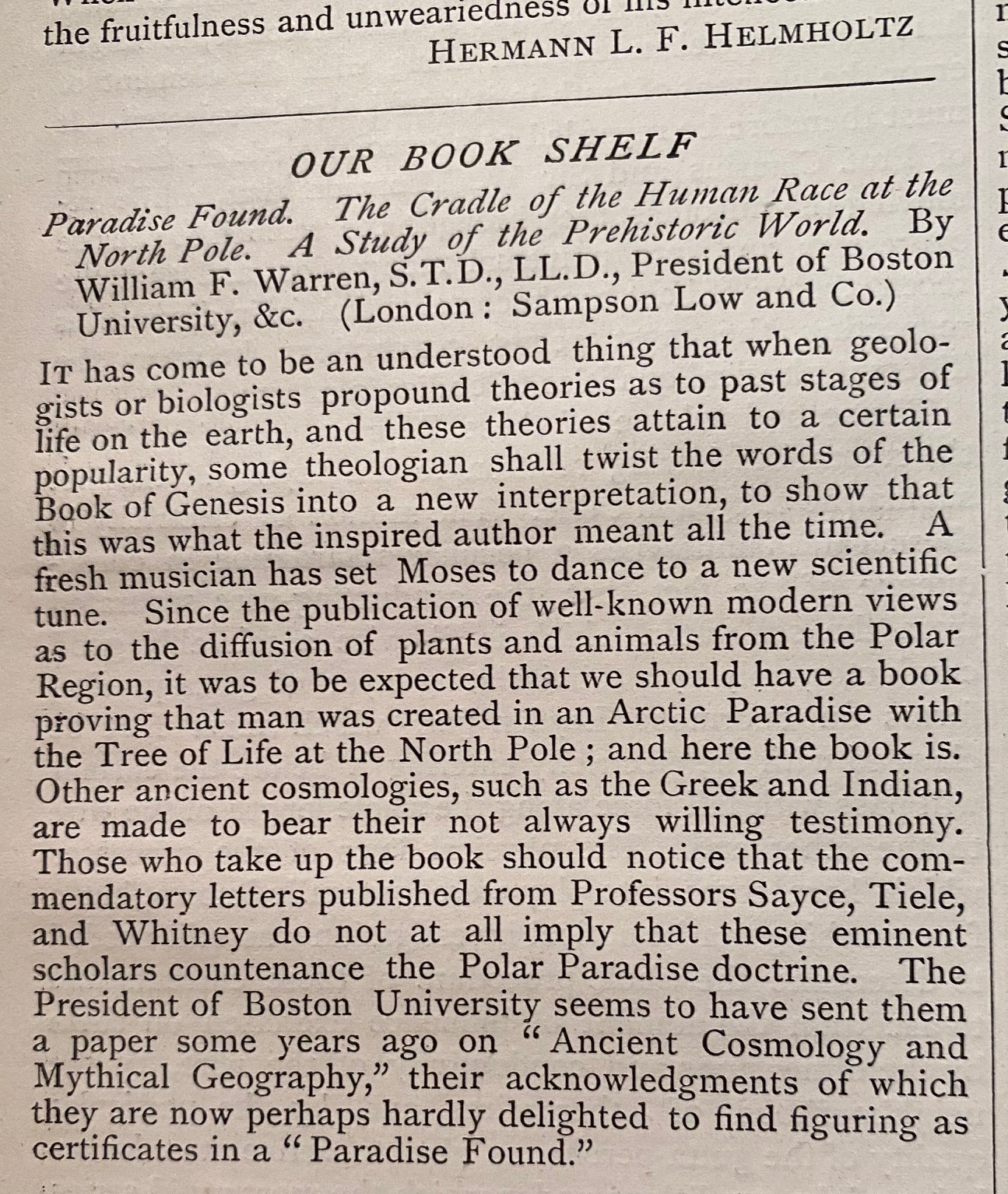
    IMG_5158This is a short, dismissive, stabbing review of a book by a theological and long-established scholar and administrator, William F. Warren (1833-1929). I remember his name from his interesting work on ancient cosmologies (1882), illustrated with examples of the history of all things according to various belief systems and religions. This quick-and-dead arrow of a review (which appeared in Nature on 14 May 1885 p, 28), was directed at his new work Paradise Found, the Cradle of the Human Race at the North Pole..., which as you can guess tries to establish the origin of humans at the North Pole, along with the Garden of Eden and the Tree of Life. And, for that matter, also establishes the Pole as the home of Mt. Maru, the Arthurian Avallon, and so on. There’s a lot that can be said but not by me—there is an attraction to hunting up other mythologies placing some part of great importance to the North Pole as the Navel of the Earth, but I just don’t have the time or inclination. As a matter of fact, I hadn’t known about this work by Warren, and I doubt I’ll know much more than what I am communicating right now—one thing the reviewer doesn’t mention is that the book runs about 500 pages, which is just too much of an investment for yours truly.

    ·Posted by :

    ·in:

    — — —

  • An Eviscerating Review of “The Last Attack on Darwinism” (1872)

    JF Ptak Science Books   Overall Post 5130

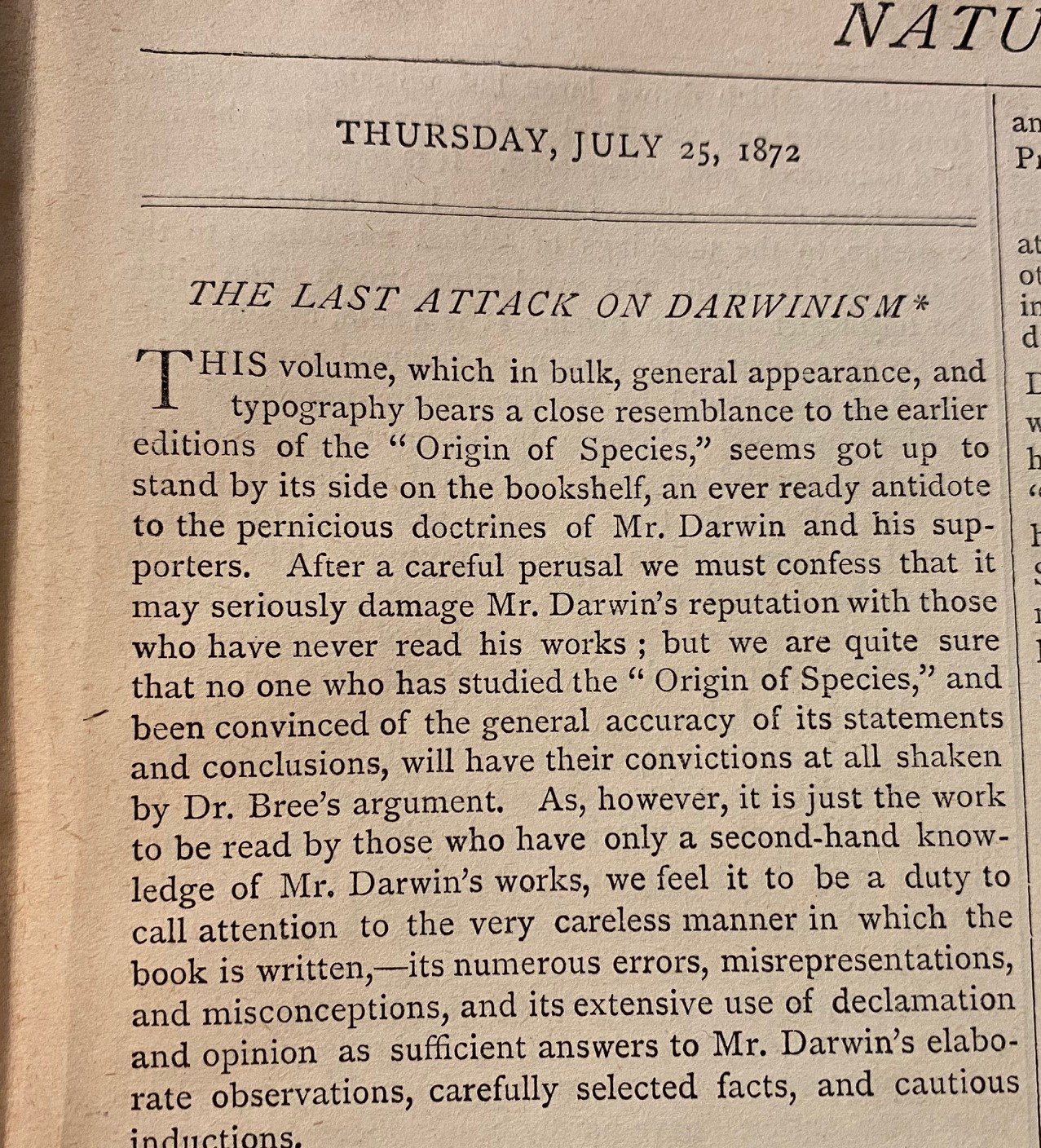
    There are many hopeful headings that appear in the fantastically-readable journal Nature (especially in the 19th century), and this one–“The Last Attack on Darwinism”–is certainly one of them. It was written for the 25 July 1872 issue by Alfred Russell Wallace in 1872 in response to Dr. Charles R. Bree’s1 An Exposition of Fallacies in the Hypothesis of Mr. Darwin, and it pretty much eviscerates Dr. Bree’s attack.  No doubt this title can be read two ways–one meaning the most recent attack on Darwinism, and the other meaning the final attack.  I suspect Wallace hoped that this would be the last such thing he’d have to read or review, but being a thinking man he probably felt that no mater what proof and evidence was established for evolution there would always be someone/group/society that would argue their belief over the science, and so on into the future the debate would go.  In any event, I’ve reproduced the first and last paragraphs of the Wallace review. Also there’s a further quotation on Bree from The Lancet as an example of the many scathing reviews Bree’s book received.  The reviews are surgical and denunciating, though from what I’ve read they do not reach the high/low level of book reviews by Poe, whose book reviews read as though he read the work with a sledge-scalpel. 


    IMG_4244

    And the last short paragraph from Wallace: “In conclusion, I must again repeat that the only reason for devoting so much space to a book so little worthy of its title or its author, is the wish to warn such as are not well acquainted with Mr. Darwin’s works from implicitly relying either on Dr. Bree’s facts and arguments, or on the accuracy of his representation of those of Mr. Darwin and his supporters.”

    Now a snippet from one of many such reviews that greeted Dr. Bree’s work, this from The Lancet (volume 2 1872):

    “This book is the production of an uncompromising opponent of the Darwinian hypothesis. Dr. Bree can see no good in it at all, but hews away at it root and branch…The position taken up by Dr. Bree would, it appears to put a stop to all investigation of nature, for he contends that it is beyond the limits of human reason to furnish any sound explanation of the modus operandi of God in creation.” And: “Upon the whole, we should scarcely expect to find Dr. Bree’s work exercise much influence in staying the progress of  the new opinions, or do more than satisfy those who have already made up their minds against them.” 

    Notes:

    1. Charles R. Bree (1811-1886). An Exposition of Fallacies in the Hypothesis of Mr. Darwin. London: Longmans, Green, and Co., 1872. 8vo., 418 pp. + 32 pp.(publisher’s list).


  • The Color of Clouds as a New Determinant (1880)

    JF Ptak Science Books   Quick Post   (Overall Post 5114)

    IMG_3388

     “Euery Cloud engenders not a Storme.”–Shakespeare, Henry VI, Pt. 3 (1623) v. iii. 10

     “Vapour, previously unseen, makes its appearance as cloud, or mist, or fog.”–T. H. Huxley Physiogr. (ed. 2) 40 

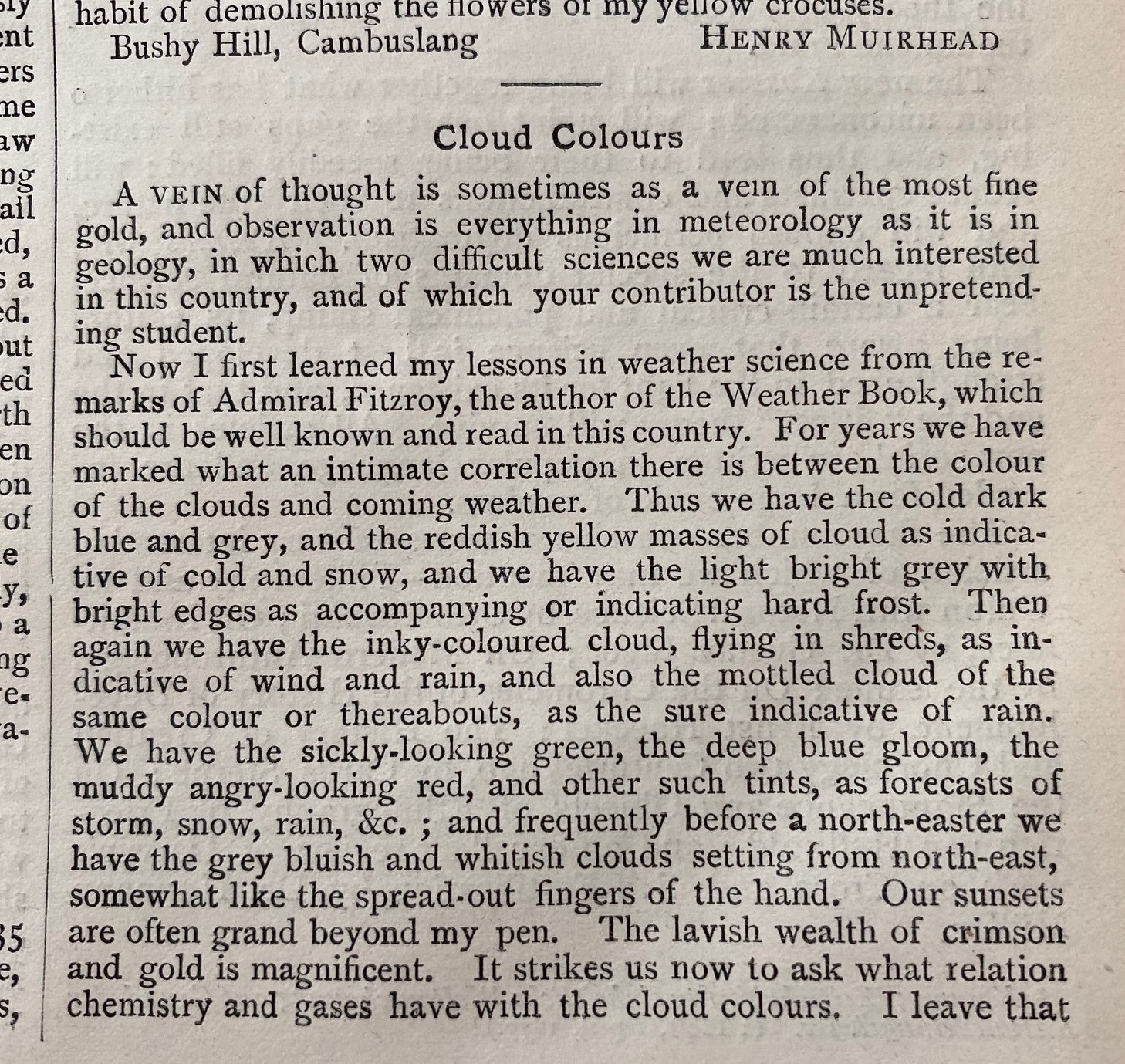
    “H.C” notes in the end that there is “vast importance in noting the colors of clouds. We depend very much in this country ([Canada] on the colour of clouds for weather prediction…”  And he says, H.C. says, that they are not the person for the job of standardizing the description of cloud color.  I imagine that that would be left to the keepers of weather stations (or data collectors), or lighthouse keepers, etc. after some sort of congress or collective determined what colors were what, and then issuing color cards or guidelines matching up clouds color to some standard color list. 

    It is not terribly surprising to see this beginning discussion of cloud color, as cloud shapes hadn’t come to be standardized, somehow, until the early 19th century. The great cloud pioneer Luke Howard (1772-1864) first published on his cloud classifications in his papers “On the Modifications of Clouds and on the Principles of their Production Suspension and Destruction being the Substance of an Essay read before the Askesian1 Society in the Session 1802-3″ in 1803, launching him from general normal obscurity into the ranks of the internationally known. He had done what Aristotle and many others down the years hadn’t–classified (his “Modifications” of the title of his 11k-word effort) the moving mountains in the sky, making him a Linnaeus/Godfather of clouds, his nomenclature quickly adopted worldwide.

    Color, though, was yet another story

    Here’s a bit from none other than Goethe (another great classifier, and color person–I wonder if clouds and color ever came up for him?): 

    “But Howard gives us with his clearer mind
    The gain of lessons new to all mankind;
    That which no hand can reach, no hand can clasp,
    He first has gain’d, first held with mental grasp.
    Defin’d the doubtful, fix’d its limit-line,
    And named it fitly.—Be the honour thine!
    As clouds ascend, are folded, scatter, fall,
    Let the world think of thee who taught it all.”–Goethe, “Howards Ehrengedächtnis”, 1821

    Source: “Cloud Colors”, by H.C., in Nature, volume 16, no. 394, 17 May 1877, pp 43-4.

    ·Posted by :

    ·in:


  • Mr. Burns, X-Rays, and the How to Answer a Telephone Call in 1877

    JF Ptak Science Books  Post 2906 (Overall post 5113)

    IMG_3383Mr. Burns, the terminally-alive money monster from The Simpsons, evidently gets it right when he answers his telephone with the phrase “ahoy ahoy”. It seems to me that was the established courtesy in the very earliest stages of telephonic communication. But how did you know the telephone was “ringing” to answer it in 1877 if there was no “ringer”?

    In 1877, Alex Graham Bell’s invention and demonstration of the telephone was only about a year old and was followed immediately by worldwide interest and experimentation. One aspect of the telephone that I hadn’t thought about before but stumbled upon last night1 is something seemingly simple—how did you know to answer a telephone call in 1877? Evidently, you did it with some difficulty, as there seems yet to have been a ringer/notification that a person was receiving a call.

    It seems that the first person to address this issue in a published paper was—unexpectedly–the discoverer of the x-ray, Wilhelm Rontgen.

    Rontgen (1845-1923) was still quite young and a lecturer at Strasbourg in 1877, publishing in the area of thermal conductivity of crystals (1870) and specific heats of gases; and he was still eighteen years away from his own epochal contribution to the history of science  (“Ueber eine neue Art von Strahlen”, “On a New Type of Ray” in 1895) and then for reasons presently unknown to me he was attracted to an issue with the new and magnificent invention of the telephone.
    He states the case pretty clearly in the opening paragraph of his 600-word article:

    “THE speaking of the telephone is admittedly so weak that it can only be caught by keeping the instrument in

    immediate contact with the ear. Hence there is transmitted through the telephone in its present

    form no sound which would be intense enough to announce to any one who was in a large room and who

    did not hold the telephone close to his ear, that a message was about to be sent from the transmitting station. 

    The consequence is that a warning apparatus must be attached to the telephone, so  that there may be no fear

    of missing a projected telephonic conversation.”

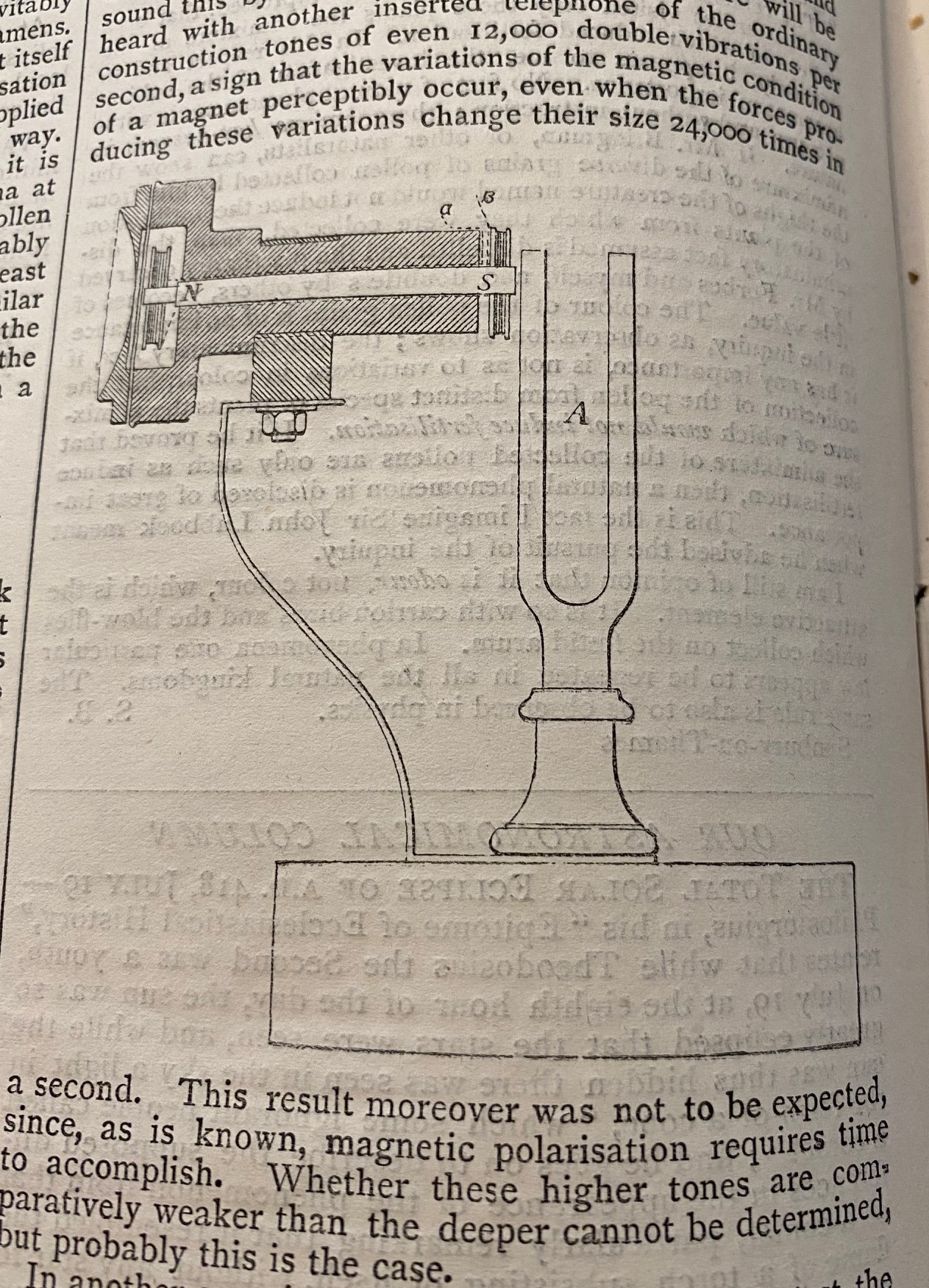
    Rontgen proceeds to experiment with an unused part of the telephone magnet attaching various tuning forks to the device which would become part of the circuit. He writes that:

    “the currents thereby induced in the coil are powerful enough to set the fork of the receiving station in such intense vibration that the sound may be distinctly heard in a large room; warned by this signal a person can in the usual way put the telephone to his ear and listen to the words of from the transmitting station. And so vice versa. “

    I’m not sure when a bell or warning device becomes part of the telephone experience after this, though I assume it comes quickly, once the issue had been identified. 

    Notes:

    Rontgen, W.C. “A Telephonic Alarum”, In NATURE, volume 17, no. 426, December 27, 1877, p165.


  • On the Vocabulary of the Holocaust in 1939

    JF Ptak Science Books  Post 2896

    IMG_2107

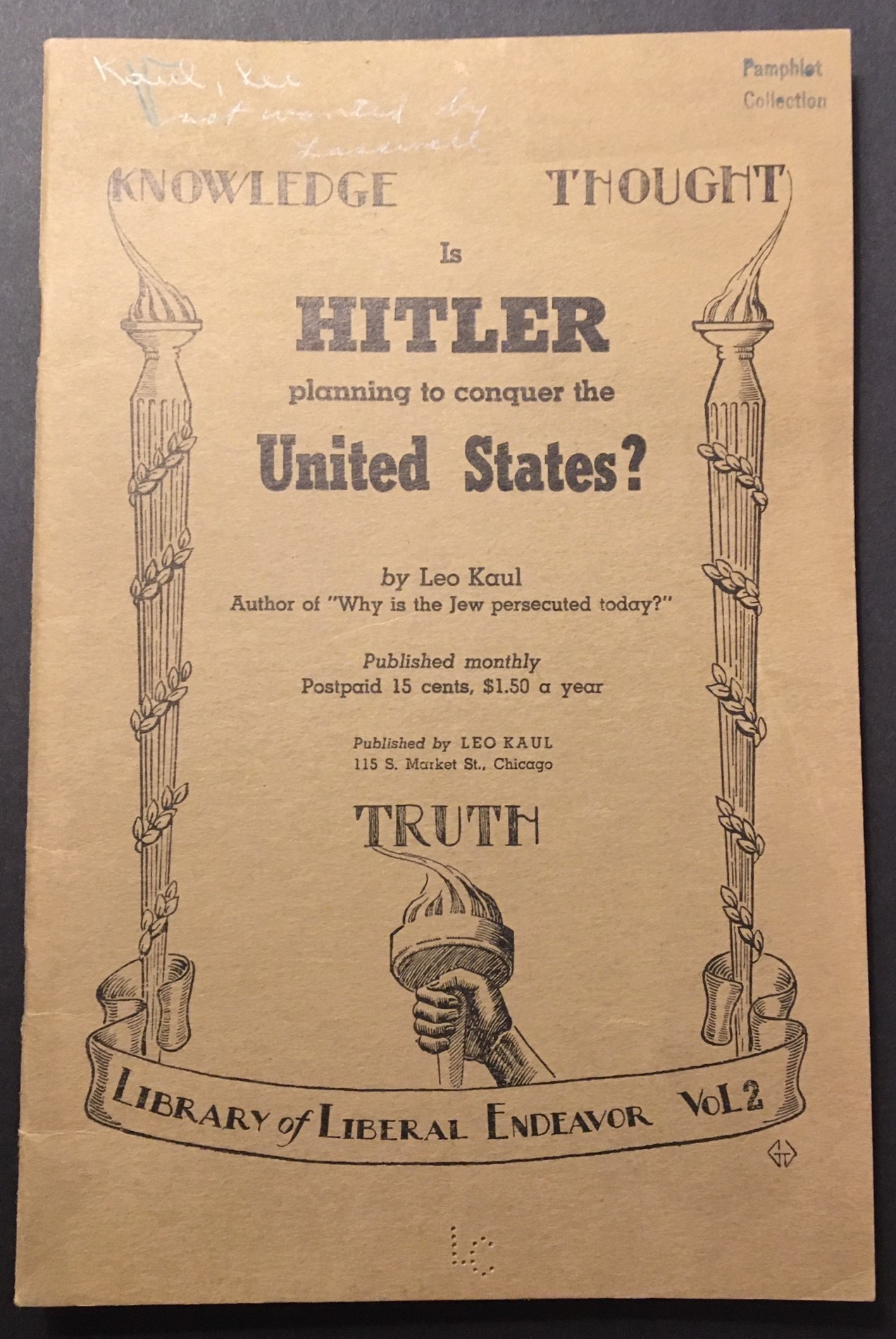
    I recently uncovered a scarce and unusual pamphlet printed in 1939 in Chicago that addressed Hitler’s threat to Europe, his designs on action in the United States, and his general threat to the world. The pamphlet under discussion here is Leo Kaul’s Is Hitler Planning to Conquer the United States?, which was published by the author in Chicago in 1939 as part of a planned monthly series of pamphlets called the “Library of Liberal Endeavor”.  This was volume two, following Why is the Jew Persecuted Today as volume one; there was a third volume planned called Hitler and Father Coughlin though it seems never to have been published. I think that Mr. Kaul–who was writing as early as 1912 and as late as 1950 and who had a business in Chicago manufacturing small bottles and porcelains–self-published these tracts hoping to establish a journal or monthly, though it appears that the existing works didn’t reach a wide audience and barely survive in libraries. 

    One part of this pamphlet that I’d like to mention here is a three-page discussion on “concentration camps” which I think is remarkable not for “exposing” them but for recording the remarks that (in 1938/9) “there have been many books written about life in concentration camps, about the liquidation of the Jewish people, and about the persecution of everyone not in sympathy with Hitler.” The German concentration camp system began with Dachau in 1933 and expanded to over 1000 (including the main and sub-camps) before the end in 1945 (this is exclusive of ghettos and other controlled environments), and there was certainly a good-sized literature on the camps–I am less certain though about the phrase “liquidation of the Jewish people” which does seem jarring to me for 1939.

    Most of the discussion of the concentration camps in this pamphlet are quotes from a work by Martha Dodd and William Dodd jr., Through Embassy Eyes, which was published in 1938.  I don’t have a copy of this though from what I could find this work is based on the collected experiences of the Dodd family, with William Dodd (sr.) being the U.S. ambassador to Germany from 1933-1937, and Martha and William being the children, each named for their parents. The daughter Marsha was later accused of being a Soviet spy, while the son William was destroyed by the Dies Commission and in spite of his accomplished past and connections was a sales clerk at a department store in San Francisco when he died in 1952. 

    I’ve reproduced the pages on the KL below:

    ·Posted by :

    ·in:

    —

  • A Killer Green…Literally. (1877)

    JF Ptak Science Books  Quick Post

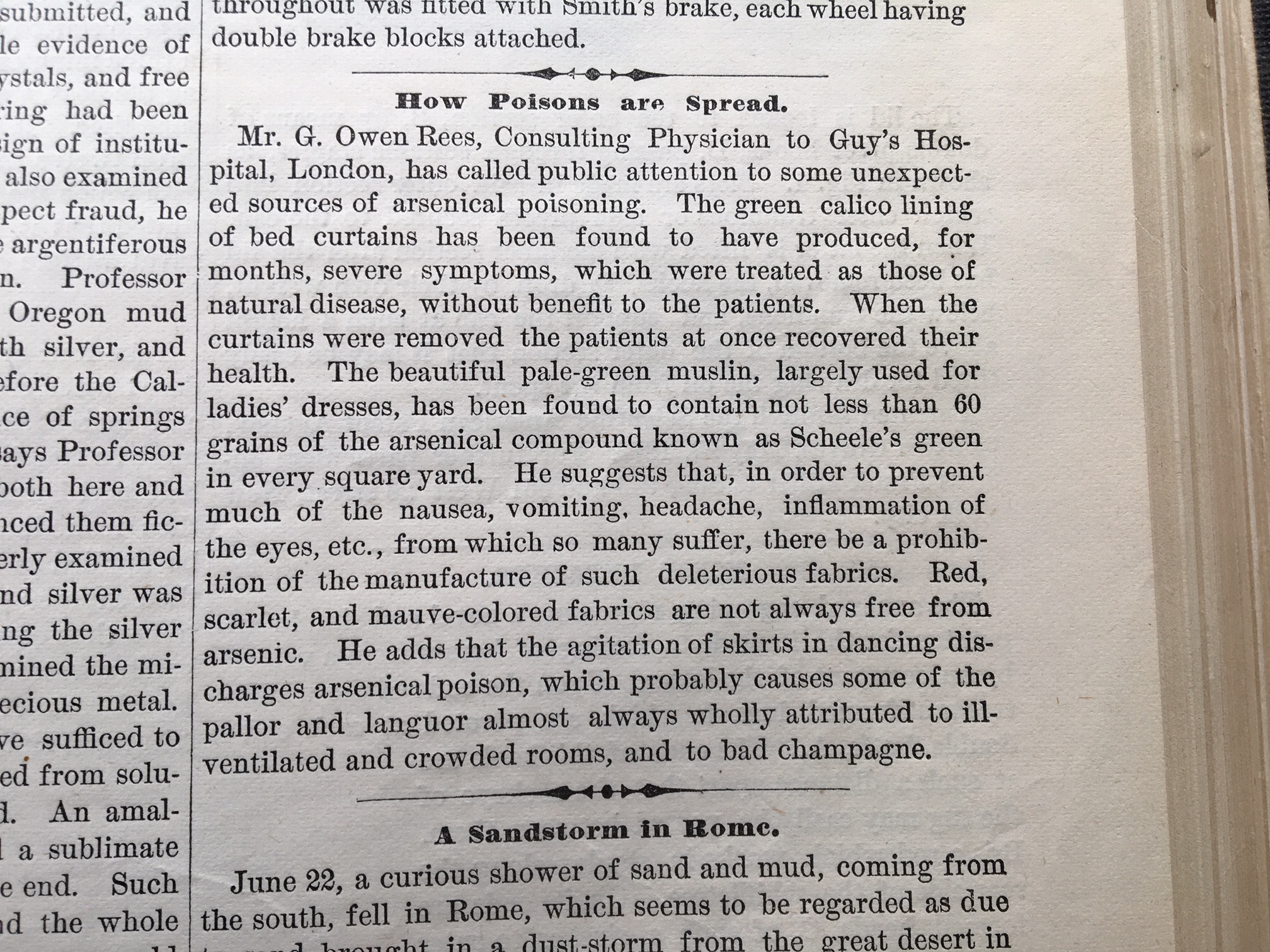
    IMG_2083This is a short Sherlockian episode found in the pages of the 1877 volume of Scientific American. It seems that people were becoming ill for unknown reasons (and not further specified in the short note) that soon was found to be: the color green. Green pigment. Green pigment in the fabric of the patients’ bedroom curtains.

    It was found that once the curtains were removed, the patients recovered.

    The green in this case was called Scheele’s Green, named for its inventor, the German/Swedish chemist Carl Wilhelm Scheele, who brought it into the world in 1775. Unfortunately it was found that this green was particularly toxic, as it employed a large quantity of arsenic, which proved to be unstable and became a noxious chemical pollutant.

    It was replaced in the late 19th century by other greens (such as cobalt green), though it did have a short rebirth in the 1930’s when it was used as an insecticide. This was in marked contrast to its earlier use as a food dye for candies.


  • A Too-Early Vision of the Post-WWII World (November 1939)

    JF Ptak  Science Books  Post 2890 
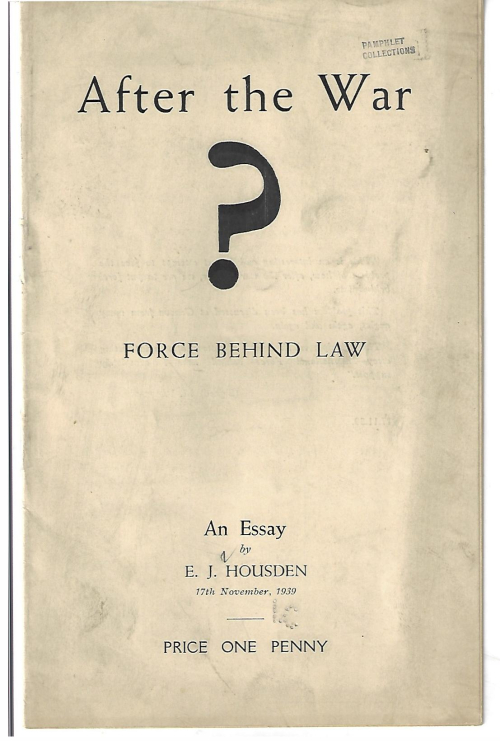
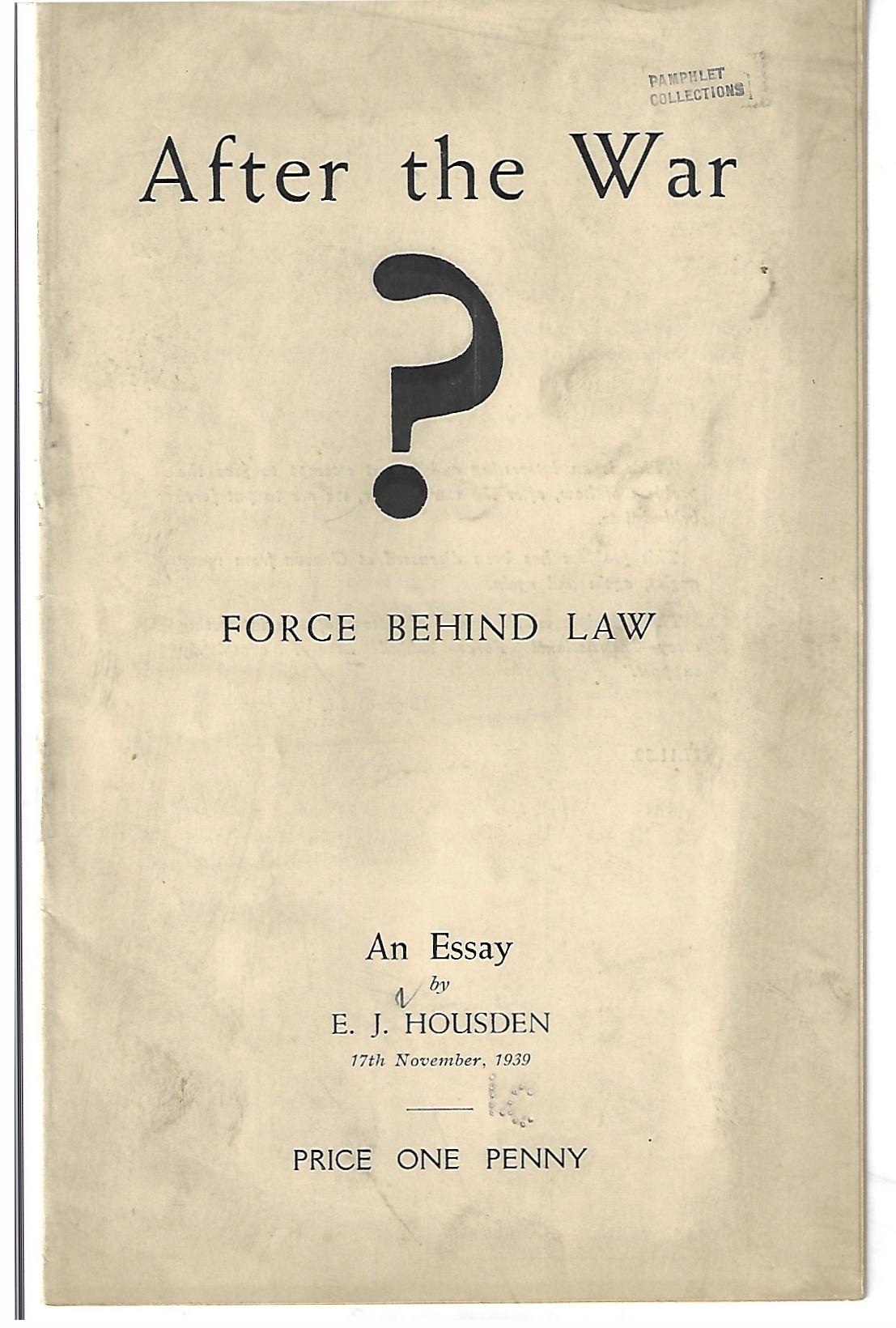
    1939 WarThis is an unusual work to my experience as the author was looking at the post-WWII scenario for the globe at such an early time in the war–November 1939–that the war as written here was known as the “1939 war”, a pre-“World War Two/II/etc designation.  World War I wasn’t really known as such until there was a World War II to differentiate it, and lo! they both came into existence at about the same time, in September, 1939. This publication is dated November 1939, though perhaps it was set into type too late in September to accommodate the new terminology. In any event, I thought it was worth making a note about.

    I don’t know much about E.J. Housden except that he may have published material in the nineteen-aughts, and that one of his pamphlets (Democracy is Fake) turns up in a census of George Orwell’s pamphlet collection. He writes about one world government, a New League of Nations, a universal army, the rollback of sovereignty, one-language, and that sort.  It was a pretty long vision for the end of the war, since there were still about 1,780 days of fighting yet to come, and that the USA, USSR, and Japan were not in it all of the way, yet.  Still. the effort is commendable, and someone needed to do thinking like this at least to establish some sort of dialog about the future.  

    While we’re at it, here’s a bit from the Oxford English Dictionary regarding the first appearances of  “World War” terminology:

    “World War I  n. (also World War One, World War No.1) = First World War n. at first adj., adv., and n.2 Special uses 2b. Abbreviated WWI.

    1939   Time 18 Sept. 10/2   Exports of arms, munitions and related materials in World War I amounted..to only 25% of total exports to the Allies.

    1947   Time & Tide 29 Nov. 1269/2   The despair and cynicism that followed what it has now become fashionable to call World War One.

    First World War  n. the war which began on 28 July 1914 with hostilities between Austria-Hungary and Serbia, and ultimately involved the majority of the nations of the world, suspended by armistice on 11 Nov. 1918.Earlier called the Great War.

    1889   R. B. Anderson tr. V. Rydberg Teutonic Mythol. 399   The giant-maids..took part in the first world-war on the side hostile to Odin.

    1914   E. Haeckel in Indianapolis Star 27 Sept. 37/1   There is no doubt that the course and character of the feared ‘European war’..will become the first world war in the full sense of the word.]

    World War II  n. (also World War Two; occasionally World War No. 2, World War Deuce) = Second World War n.

    1919   Manch. Guardian 18 Feb. 10/1 (heading)    World War No. 2.

    1939   Time 11 Sept. 38/1   Some of the diplomatic juggling which last week ended in World War II was old-fashioned international jockeying for power.

    Second World War  n. the war which began with the German invasion of Poland on 1 Sept. 1939 and ultimately involved the majority of the nations of the world; hostilities ceased in Europe on 7 May 1945 and in the Far East on 12 Sept. 1945. [1930   H. G. Wells Autocracy Mr. Parham 257 (heading)    Book the Fourth: The Second World War.]

    1942   Polit. Sci. Q. Sept. 321   The economic developments associated with the second World War have restored to American railroads a volume of traffic comparable to that which they handled before the great depression.

    World War III  n. (also World War Three, World War No. 3) = Third World War n. at third adj.and n. Special uses 2.

    1945   Duke of Bedford Let. 16 Apr. in B. Russell Autobiogr. (1969) III. i. 44   You will have to postpone your visit until the brief interlude between this war & world-war no 3.”
     

    ·Posted by :

    ·in:

    —

  • In Living Black & White: T.V., 1944

    JF Ptak Science Books   Post 2887

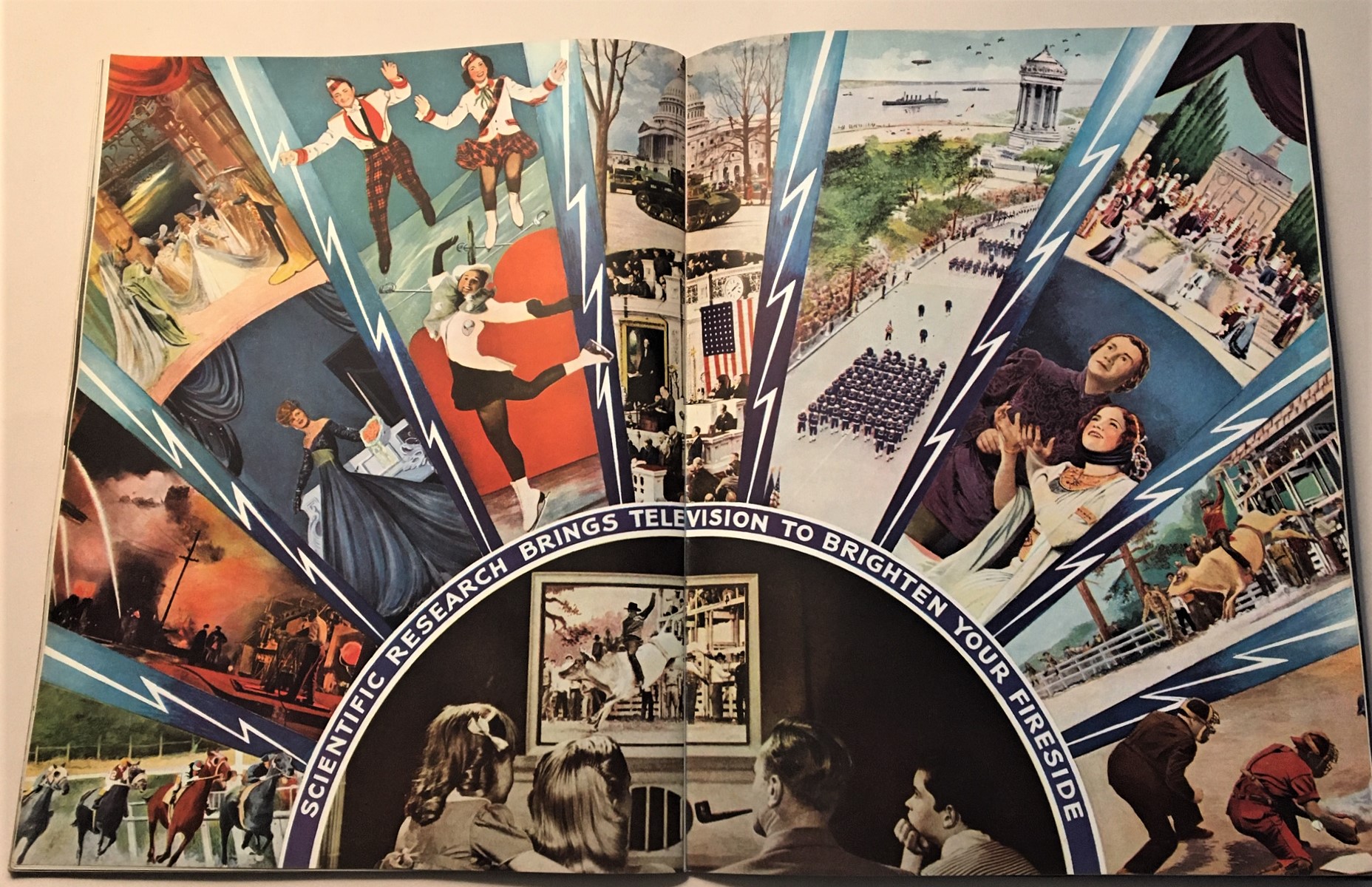
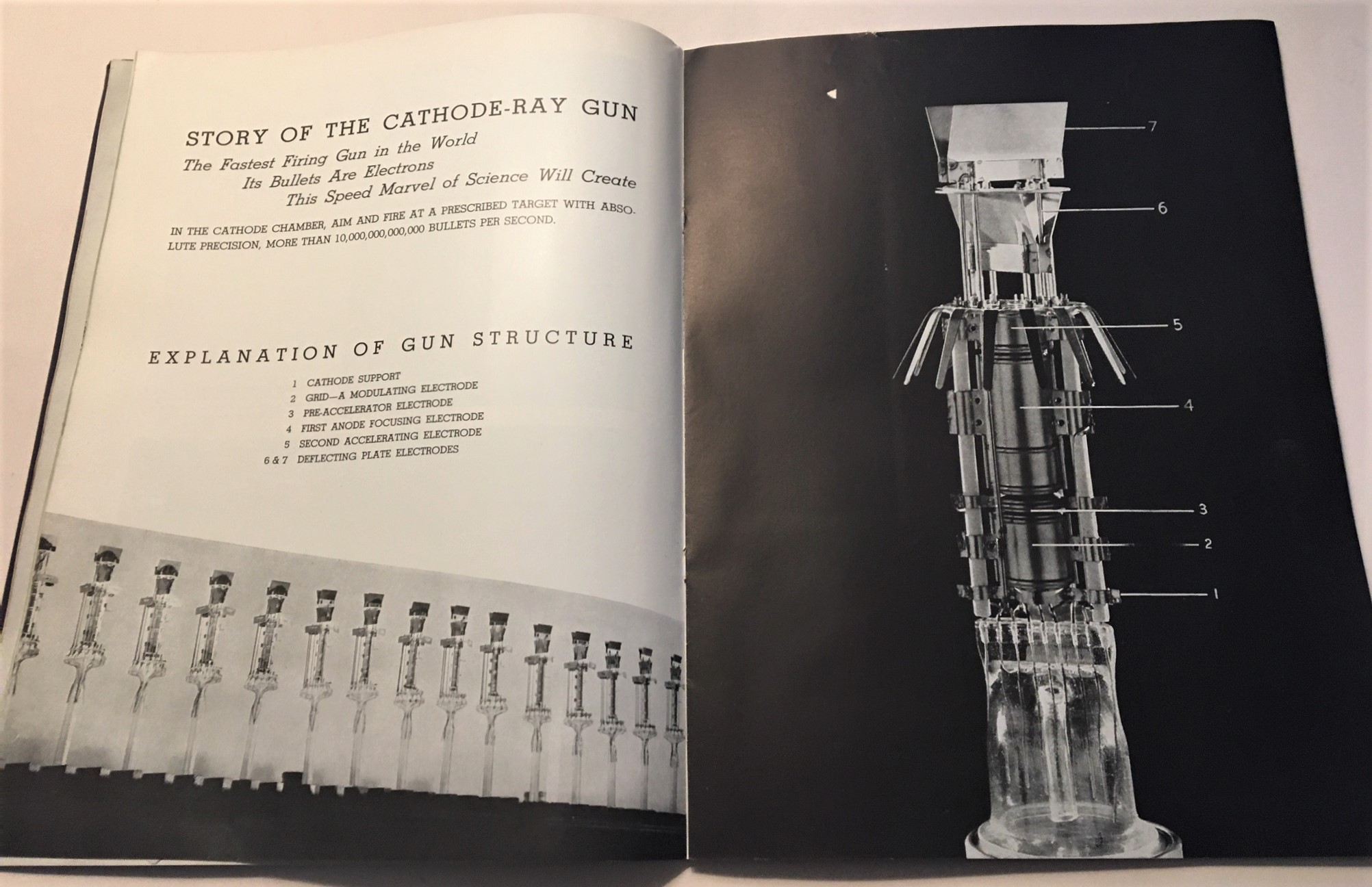
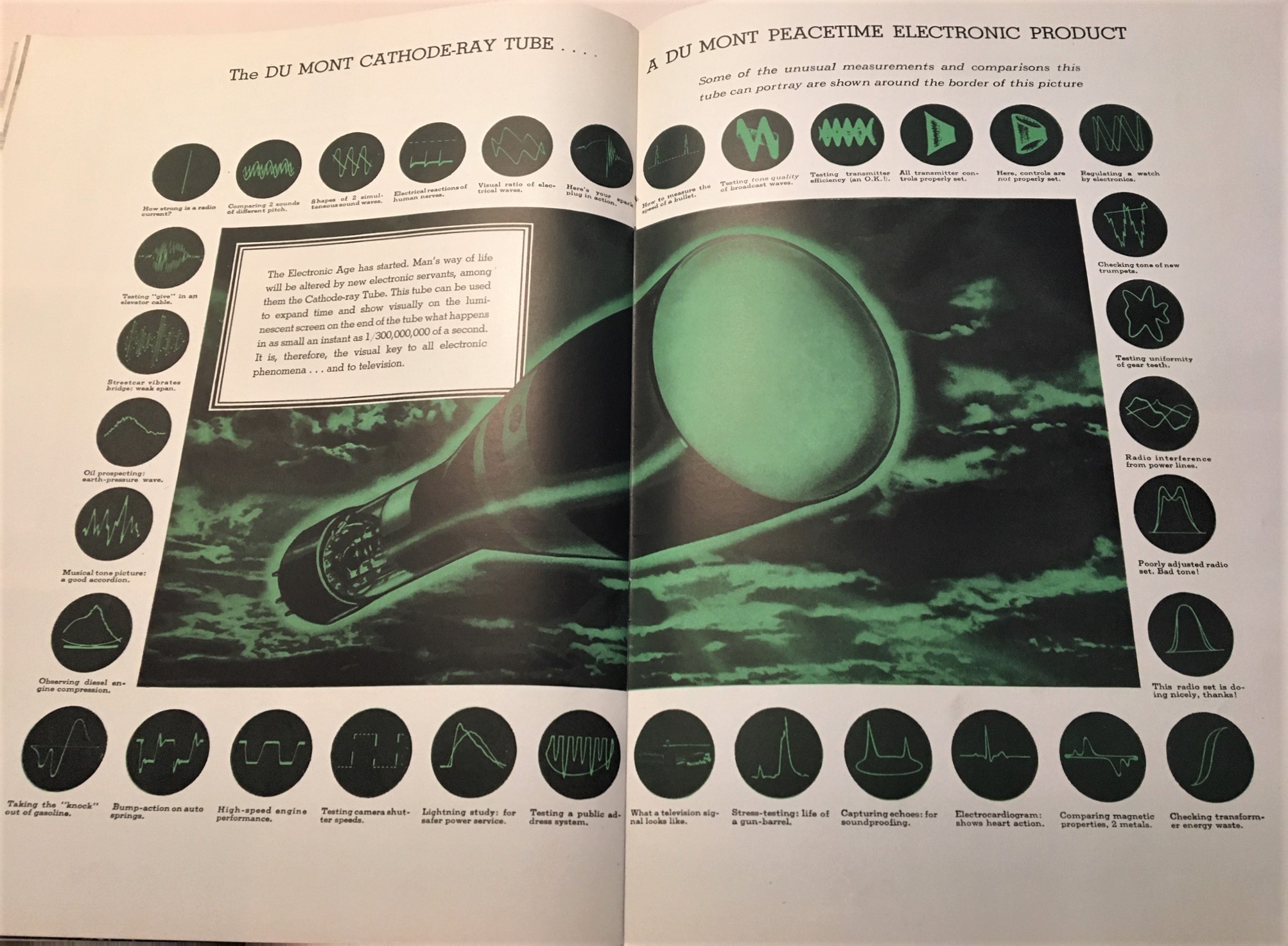
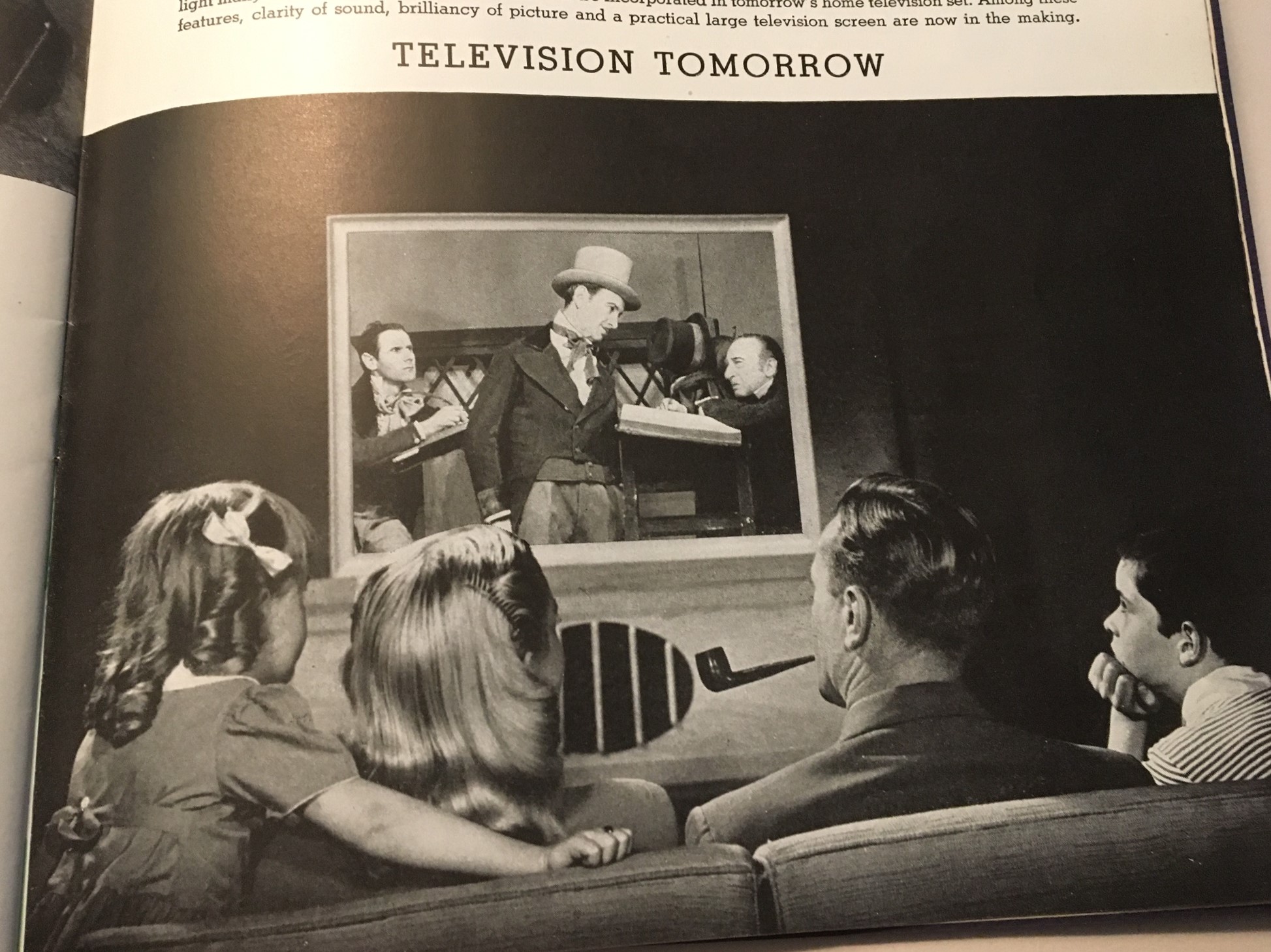
    I didn’t expect such a good photo-essay of the Du Mont labs and assembly facilities after the very odd first few pages of the manufacturer’s 1944 brochure. It started the history of the cathode ray tube at Genesis and then had a couple of pages of cartoonish timelines, but then settled into the turf and surf of their business. Well, nearly so, anyway–there were a few odd bits with the introduction of a sort of scary-looking “Alex Electron” showing how television images were made, otherwise this was an engaging assembly-line view of television manufacturing.  

    It did have this gloriously colorful display, including a look at the television of the future:

    Dumont _2_

    It did prompt me to check out the history of the word “television” for its first and early appearances in the OED,  and there I found the following:

    • 1900   Cent. Mag. June   Through television and telephone we shall see and hear one another as perfectly as though we were face to face.
    • 1900   Electrician 31 Sept. 822/2   At the afternoon sitting on Friday, M. C. Perskyi read a communication on ‘Television’, describing a number of apparatus based on the magnetic properties of selenium.

    Dumont _5_

    • 1926   Glasgow Herald 20 Dec. 11/8   Mr. John L. Baird, a native of Helensburgh,..recently invented an apparatus which makes television possible.

    • 1930   J. Buckingham Matter & Radiation 122   We have heard so much about Television lately that we are apt to forget that no portion of the apparatus used is novel to scientists.
      Dumont _4_

    • 1948   N. Wiener Cybernetics 10   Television was destined to be more useful to engineering by the introduction of such new techniques than as an independent industry.

    • 1957   Technology Mar. 9/2   The solution of the major problems in colour television, the public introduction of which is now more a question of economics than of technical difficulty.

    Dumont _3_


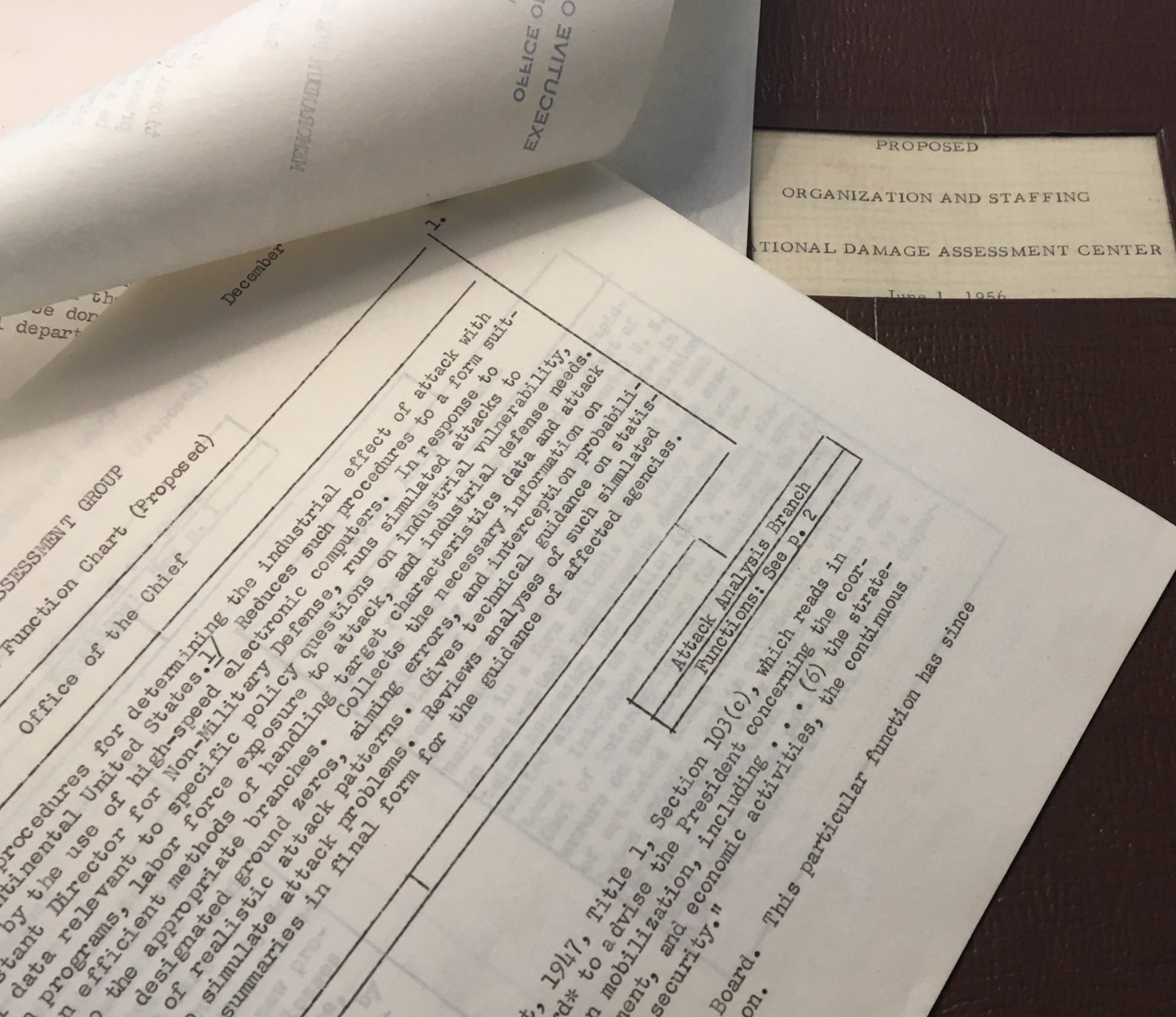
  • Internal Document Proposing an Organization to Establish Post-Nuclear Exchange Damage Assessment (1956)

    JF Ptak Science Books  Post 2885

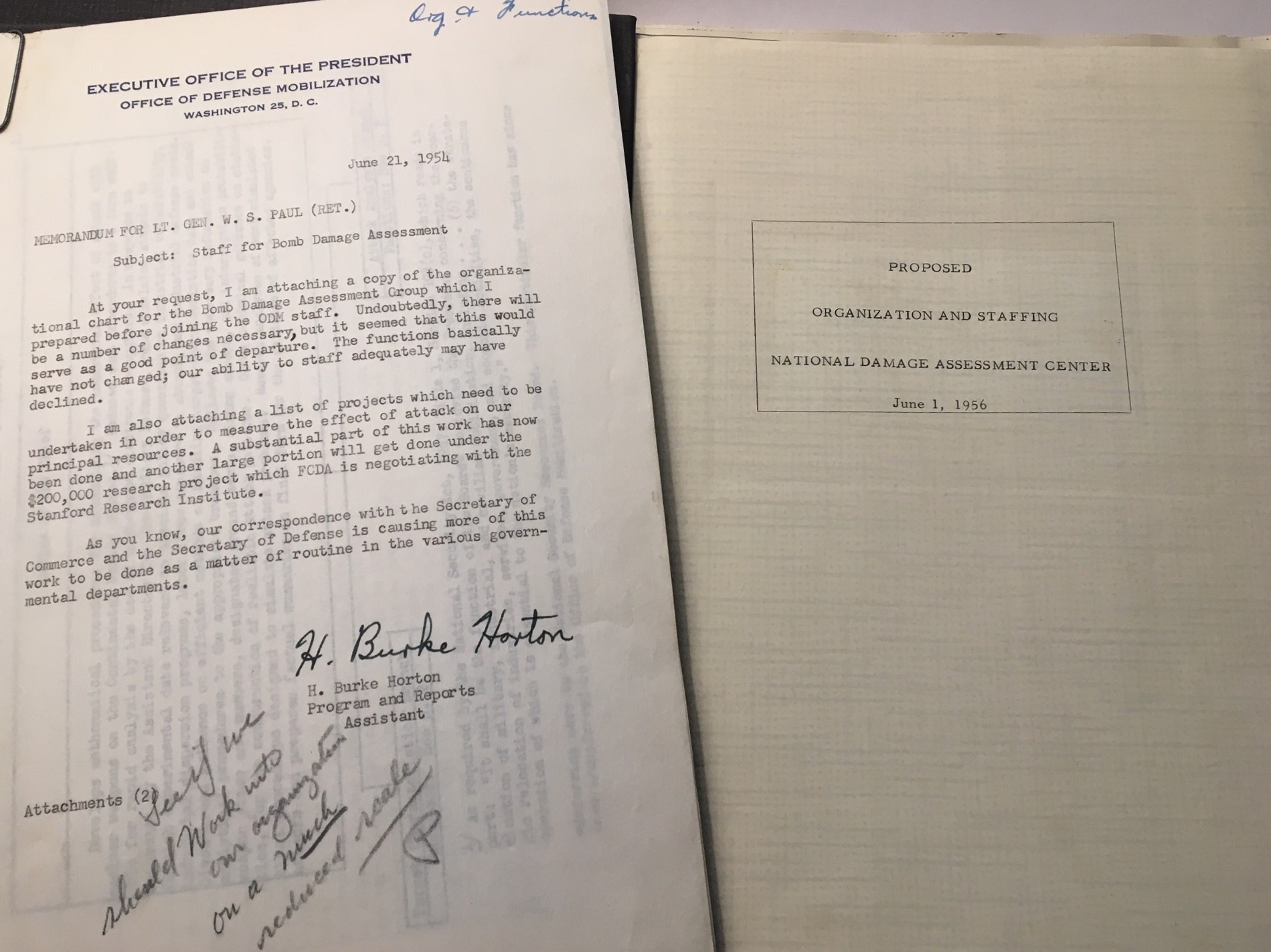
    Proposed organ _2_I’ve written many times on the technical and political end of the creation and deployment of the atomic bomb, along with some posts on the use and manipulation of language in controlling the sense impressions of nuclear war and survivability.  What I have found so extraordinary about this second part is the creation of ordinariness, or mechanization, or acceptance, of the aftermath of nuclear warfare–and what we’re talking about here is the
    “exchange” of not just a few 20 kiloton Hiroshima-type weapons, but thousands of megatons of explosives and massive amounts of radiation. But this is the function of familiarity, I guess–given the situation it was essential to plan for eventualities A-Z, and for that you need structure, and vocabulary. 

    All things being equal, such things as an Terrestrial Afterlife in the United States needed to be contemplated because that is what we do–we make the situation possible for end-of-the-world stuff to happen, and so we have to plan for building things up again with radioactive detritus once all of the keys get turned and buttons pushed, as  it is just a natural course of that historical river. That the bomb would be built was a given; that the Soviets would develop the a bomb and delivery capacities was just a matter of time, and that they would be our sworn death-enemies was also a fait accompli. To develop a way to somehow survive a nuclear war may have been a major deterrent to not launching an attack, especially when linked with a Mutually Assured Destruction (MAD) arms build up (where everyone and everything would be obliterated if there was a nuclear war, or at least so by 1965 (and probably earlier than that). All this insane stuff may have worked, and somehow we managed not to ignite the world, because (to paraphrase Frank Zappa) there would be no real estate left.

    Proposed organ _1_On the other hand, building all of these weapon systems and planning for attack and the post attack world could have pushed us into a final confrontation, making all of this sound “winable”, “doable” somehow, that once the bombs had all exploded and nothing worked anymore, that there would be enough to pull together of our civilization to declare that we had indeed “won’”. 

    And the only way to declare a winner was to have something to stand on besides pieces of green glass and Earth, and so  plans for communications and a military, police force, fire brigades, medical care, food distribution, banking, and all the rest–the pieces of a recognizable backbone of American society–would have to be undertaken.  All of this could very well accomplish the creation of an illusion in the mind of the adversary that you are capable of surviving a nuclear war, and so there would be no great gain in attacking; or it could send the message that by doing this preparation that you were preparing a first strike scenario, and so the adversary would attack while the odds were still not horribly out of balance.  And on and–it all looks like a lose-lose endgame to me, which is hardly a “game” at all when all players are losers.

    But still there was a need to staff the thousands of positions that went into the theoretical end of figuring out the non-weapon-end world after nuclear war, and the above “position description” is an example of that, a necessarily pro forma form, just another job in a ea of jobs.  This one’s job descriptions read like any other, except of course that the content was much different.  Form the same, sentence structure the same, vocabulary basically invariable. 

    One aspect of this planning for the Afterlife was the planning part itself, planning to plan, how to make sense of the answers and the questions, a form into which the parts of a process are poured before they become the process itself.


  • Public Humor Displayed: London Signboards (1866)

    JF Ptak Science Books   Post 2883

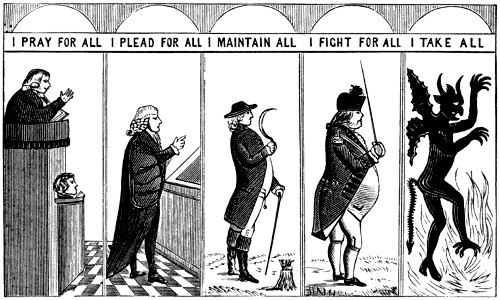
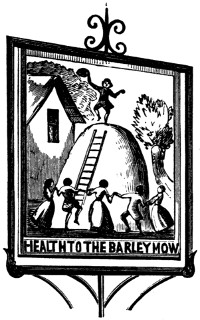
    What is the first stop for looking at—hold on to your seat!–socio-descriptive stationary public humor? I do not know, though I have found an example of the history of such a thing in a book written by the author of which I wrote about on this blog earlier (in post 2882) named John Camden Hotten, who contributed a fine effort in the history of cant and slang. All I’m really talking about here are intentionally funny signs, advertisements and store/shop/business signs that identify what goods/services are offered, or the name of an establishment, that sort, but in there is another story of humor and sarcasm in the display of the name—sometimes it is the name itself but it seems mostly that the funny part of it all are the parable-like qualities of the elements that visualize the name. Hotten’s contribution to this genre of humor is a wonderful catalog called The History of Signboards, from the Earliest Times to the Present Day (1866), which is, at it states, a history of advertising and shop signs, some of which are lovely, some are bizarre, many are funny,  all of which make this book an irresistible browse.

    Signboards 4

    Signboards _6_

    Here are a few examples of the legends of such signs:

    Barber:

    “I devote my razors to all faces,
    And defy the criticism of faithful mirrors.”

    Public Houses:

    “You gentlemen, and yeomen good,

    Come in and drink with Robin Hood.

    If Robin Hood be not at home,Come in and drink with Little John.”


    And:

    “Your head cool,Your feet warm,

    But a glass of good gin Would do you no harm.”

    An inn:

    “Stay, Traveller, a while and view

    One that has travelled more than you,

    Quite round the Globe in each Degree,

    Anson and I have plow’d the Sea;

    Torrid and Frigid Zones have pass’d,

    And safe ashore arriv’d at last.I

    n Ease and Dignity appear He—in the House of Lords, I—here.”

    Hotten has hundreds and hundreds of examples, and he tells the story in an odd manner, with a lilt of an 18th century antiquarian more so than a Victorian. Here’s the link for the full text with illustrations available at Project Gutenberg, and I do recommend even just a quick browse, as there is only so much I can do in a one-hour post like this. 

    ·Posted by :

    ·in:

    —