A Daily History of Holes, Dots, Lines, Science, History, Math, Physics, Art, the Unintentional Absurd, Architecture, Maps, Data Visualization, Blank and Missing Things, and so on. |1.6 million words, 7500 images, 4.9 million hits| Press & appearances in The Times, Le Figaro, Mensa, The Economist, The Guardian, Discovery News, Slate, Le Monde, Sci American Blogs, Le Pont, and many othr places… 5000+ total posts since 2008.

Category: Bad Ideas

  • A Monumental and Fantastically Bad Idea: Lowering the Mediterranean (1929)

    JF Ptak Science Books  (This is a slight expansion of an earlier post from 2011)

     “Simply the thing I am shall make me live.”–from Jorge Luis Borges, “Shakespeare’s Memory”
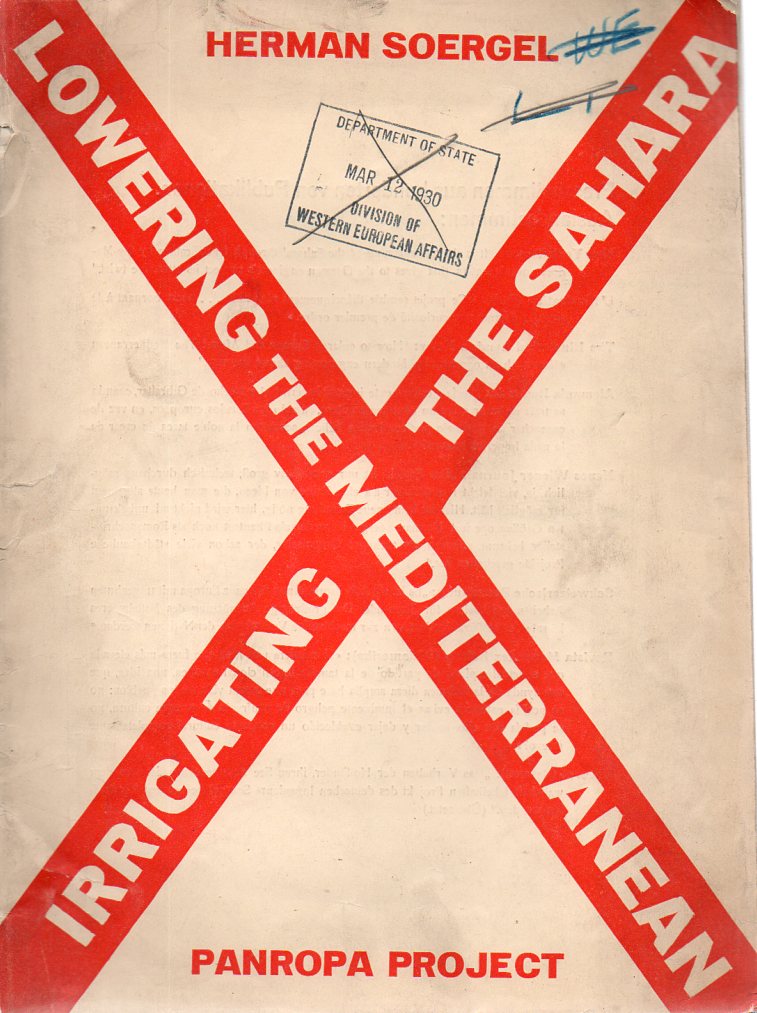
      Soergel403
    It would be a Purgatory, or worse, to suddenly wake up one morning with another person’s memory–worse yet than to have wished it, only to find that you didn’t want it at all.  This evidently works out with memories high and low, though it is tempting to want to wish to see what the inspiration looked like for one idea located in a particular memory.  Or maybe not.  But I am curious about when and here the author of the pamphlet above got his idea, and what it looked like to him–did he hear or see or smell something that prompted the inspiration for this reverse-monumental jolt, something that may well be one of the worst engineering ideas of the 20th century?

     It is interesting to pursue a loose thought like this to its not-necessarily logical end.  Such is the case with the self-styled Paneuropic ideas of Hermann Soergel (1885-1952), the author of the above. Soergel was a Bauhaus architect and author of a number of works on design and far more ethereal, floating-castle ideas. His most spectacular contribution—incubated in the mid-1920’s and still clinging by its fingertips as an idea among some current thinkers—was to put a dam across the straights of Gibraltar.  The dam would generate electricity of course, but most importantly to Soergel, it would also empty an enormous amount of water (lowering the sea by 200 meters)  from the Mediterranean leaving vast new expanses of land to be developed and colonized over generations into the future.  The water of course would have to go somewhere, and that somewhere was the Sahara Desert, somehow in its wake creating farmable and productive lands. Soergel was creating a certain, very wide, fantastical future of uncertain monumental prospects.
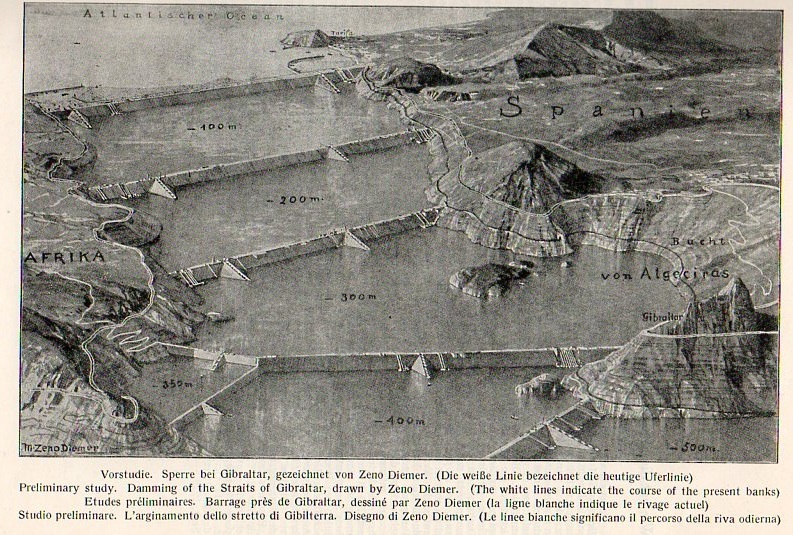
    Soergel405
    A “brief outline” of the idea was published in this four-language pamphlet, Lowering the Mediterranean Irrigating the Sahara (Panropa Project), which was published by J.M. Gebhardt in Leipzig in the very bumpy year of 1929. (The Weimar years in Germany were already into deep bumpiness; the rest of the world would follow suit in October of that year.)  To be fair, Soergel didn’t plan on emptying the entire Mediterranean, just a bunch of it–at least enough to be able to rename it.
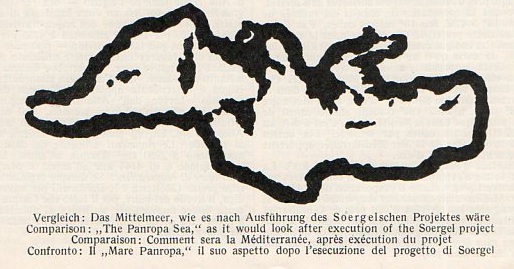
    Soergel404
    [Here’s a map of the new Mediterranean, or the Mediterranean that would be made to go away.  As you can see at this point Sicily and Italy become enormous, and the Greek Islands are combined to form one large land mass–this last bit alone is enough to form total and complete reisstance to this idea. Also at this stage perhaps 150 or so miles of new lands have been reclaimed from the sea all along its former borders–more so in Turkey.  There is no mention as yet of any new islands that are formed in the sea water’s wake.] 

    As it turns out Soergel thought that this plan would add at least 660,000 KM2 to the base of the surrounding countries of the Mediterranean, or roughly the equivalent of the combined land masses of Italy and Germany.  Having the sea pulled back from hundreds if not thousands of seaside towns and cities would no doubt be a “problem”, for them; but that doesn’t matter to Soergel, as they were inferior thoughts to the grand idea of emerging a new continent.  Great bog (and a good simulation with a powerful computing capacity) only know how the changes in the Mediterranean would affect the climate–well, that in combination with the thousands of new square miles of inland sea and canals in the previous Sahara desert.  There are of course many other problems. 

    The master plan at work was that the world would be divided into three economic spheres in the future, all beginning with the letter “A”:  American, Asia, and the new land to be created by Soergel, “Atlantropa”, which was the former Europe expanded into the new dry beds of the Mediterranean and North Africa.  And also of course Egypt, which would be covered with “thousands” of canals and become semi-submerged by the new borders of the meandering sea.  This would be the way for Europa t==Blog July 21==shakespeares memorieo compete with the rest of the world in the future. 

    [I should point out that the image above comes from the Illustrierte Zeitung (Leipzig) for August 1931, and is a drawing by an artist named “AS. Christ” depicting a cross section of one of the bridge/dams of Soergel’s Panropa’s ideas.]

    Perhaps it is actually three steps to get from the idea of damming up the straits of Gibraltar to the osmosis of Shakespeare’s memories into someone else’s brain—a squinting acquiescence of the middle touch being the brilliant Jorge Luis Borges.  You see it was in the Argentine master’s last published story, “Shakespeare’s Memory”, that we meet Herr Soergel (as Hermann Sorgel) again.  But so far as I can remember Soergel exists only as a fictional character, with no reference to his real-life self.  In this wonderful story, Soergel inherits the memories of William Shakespeare—these bits come to him slowly but surely, until they start to conflict with his own memory, and things get difficult.  The man with Shakespeare’s memories winds up phoning strangers on the telephone, giving them away at random, until Soergel is left with his own mind again.  Superior as Bill’s memories were, they still weren’t Hermann’s, who wanted his own life back in the end. 

    And so from the titanic, pan-europic technodream of Bauhausian Hermann Soergel to the dead brains and living memories of William Shakespeare, all through the fingers of the beautiful Jorge Luis Borges.  

    I’m sorry to report that at the end of it all, near the end of the pamphlet, Soergel releases his opinion on the political importance of his project.  And yes, his aim was to form an alliance between the new PanAmerica (of the “three Americas” with the new Pan-European African Union to thwart “the yellow peril” which “arises from the racial antipathy of India, China and Japan.  Soergel writes that “the fate of occidental civilization…will be settled on the Mediterranean”. 

    After it is all said and done, perhaps the best review of the work by Soergel is provided by the graphic designer who put the Big Red X on the cover of his work.  It fits. 


  • Hitler Youth Diary for Girls, 1937

    JF Ptak Science Books   Overall Post 5134

    Hilterjunge diary008There’s a bookcase in the house that has a top shelf for small books, most of which I haven’t written about, though there is a clutch of them that have gotten some exposure here on the blog, with most of them being unused diaries, and most of those being Nazi-oriented.  I’ve wondered about the people who would have sat down with those things blank-ish books, thinking about scheduling their time, or recording events, and then deciding not to. Maybe they didn’t want to be reminded of Nazi holidays and/or the birth of Hitler, or the right of duty and the proper way to respond to current events based on the policies of the NSDAP. The diaries are all pretty much like-new, and aren’t even all that old in the scheme of things, though their distance in time doesn’t match their distance in historical “space” (so to speak). 

    This diary was for German girls who were members of the Young Girls League (Jungmädelbund), which in the German stratification of Nazism was part of the League of German Girls (Bund Deutscher Mädel), which in turn operated under the broader gender-divided organization of Hitler Youth.

    It is difficult as a father of two daughters–one of whom is of the correct age to have been using this diary had circumstances been enormously different–and it is painful to imagine her looking through these pages, at the red-letter days and inspiration photographs, filling in the book and responding to these enormous and not necessarily subtle social pressures.

    “Wir folgen!” states the cover of the diary, and it meant it. “We follow”. 

    Hilterjunge diary009

    ·Posted by :

    ·in:

    —

  • Recovery to Normal Existence, 1960

    JF Ptak Science Books   (Expanding an earlier post  #2499 from July 2015)

    Nuclear Attack LIVE230
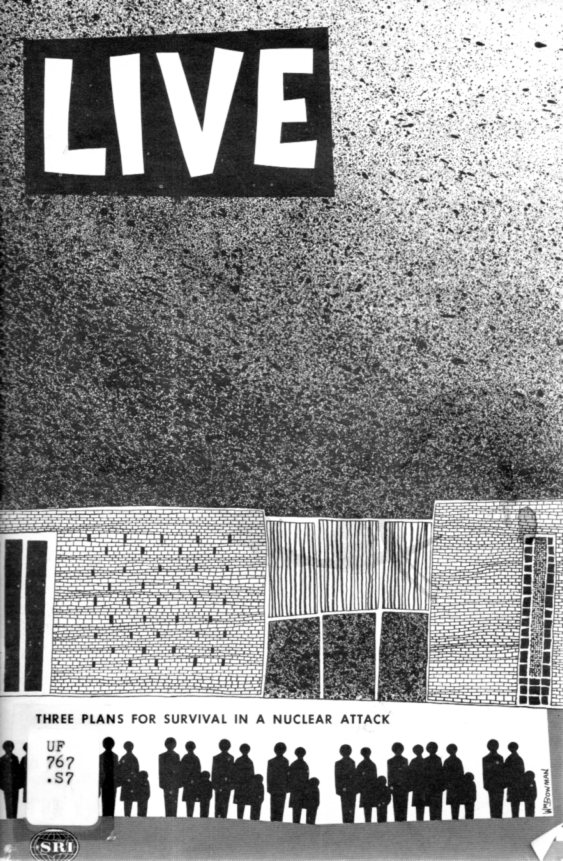
    In the not-modest stream of thin paperback  nuclear holocaust survival literature in the 1950’s and 1960’s appears this effort: LIVE, Three Plans for Survival in a Nuclear Attack. It was published by the Stanford Research Institute in 1960, and was part of nuclear health physics pioneer Lauriston Taylor’s donation to the National Council on Radiation Protection and Measurement, where I bought it some time ago when they were thinning out their stuff.  It is an unusual publication to me for its illustrations, some of which are odd, and a few of which are positively semi-surreal when view out of context.

    The pamphlet overall is fairly helpful, assuming that you had as much time to get yourself together in an impending attack, and that is a major assumption.  But I’m sharing this tonight for some of those images–and the cover, which is an unusual design in itself, not the least of which is the heavily-borrowed part from LIFE Magazine.

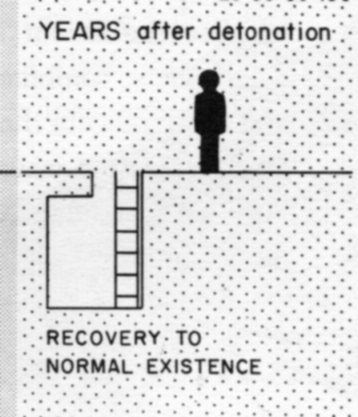
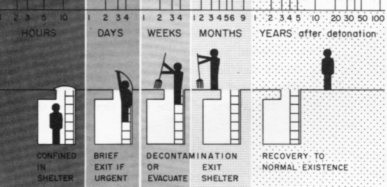
    So the first of the few that I’ll post here (above) is a detail from this illustrated graph, a march of the intellect and survival from being in a dark hole to a rather stiff return to normal existence:

    Nuclear Attack LIVE229

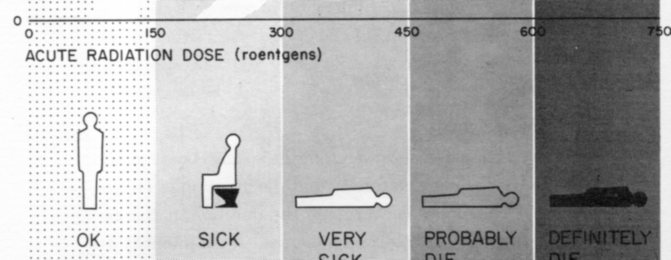
    Here’s another sobering bit, showing a progression of NOT-recovering to normal existence:

    Nuclear Attack LIVE231

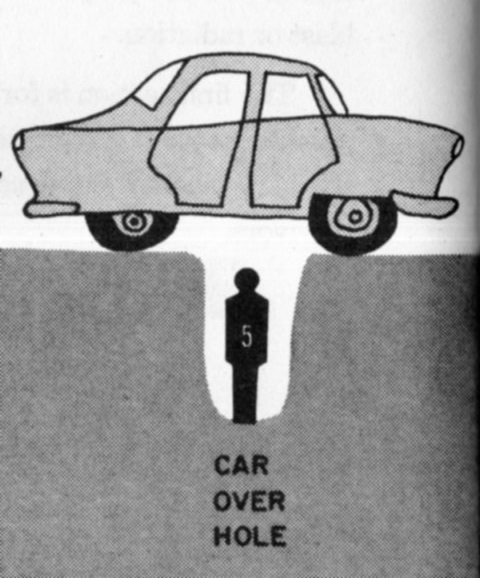
    And of course the hole:

    Nuclear Attack LIVE233

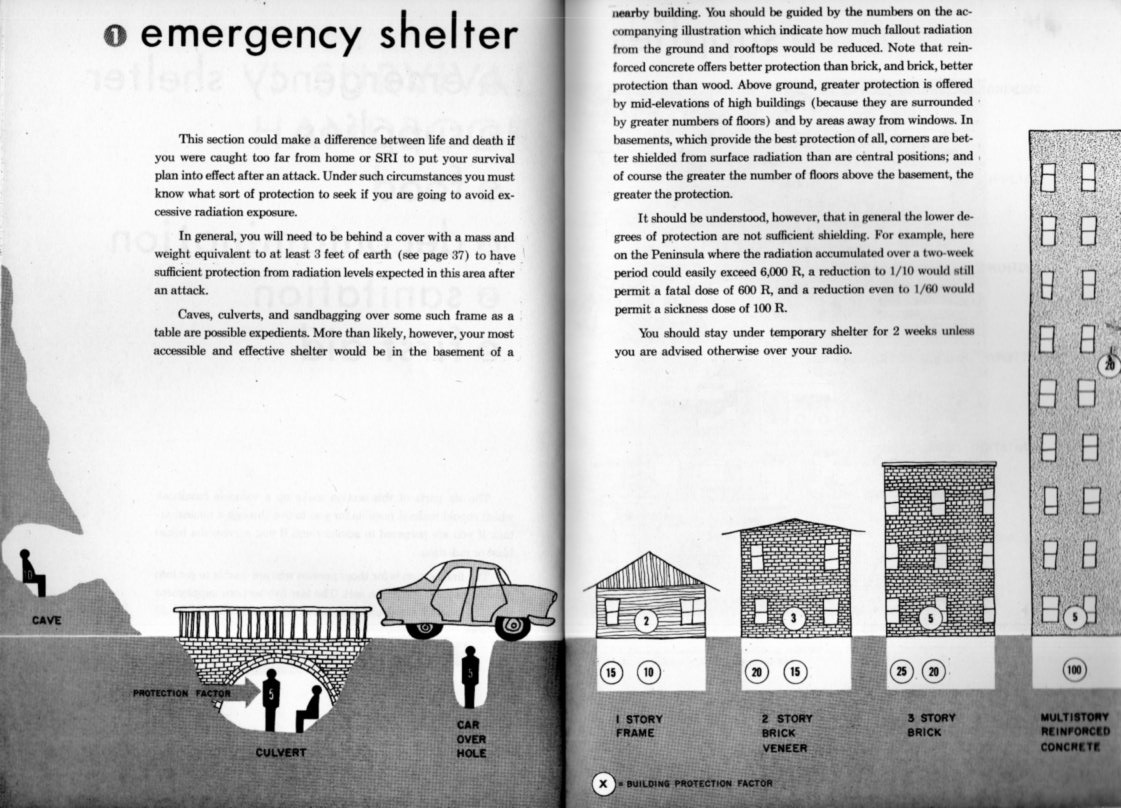
    Which is a detail from:

    Nuclear Attack LIVE232

    And the cover, which has some blotchy Ralph Steadman-y elements:


    Nuclear Attack LIVE228

    And so, there are some of the major themes.  I found the work unsettling in general for using mostly dark silhouettes for the people, that profile having been sort of established to represent dead folks. 


  • An Eviscerating Review of “The Last Attack on Darwinism” (1872)

    JF Ptak Science Books   Overall Post 5130

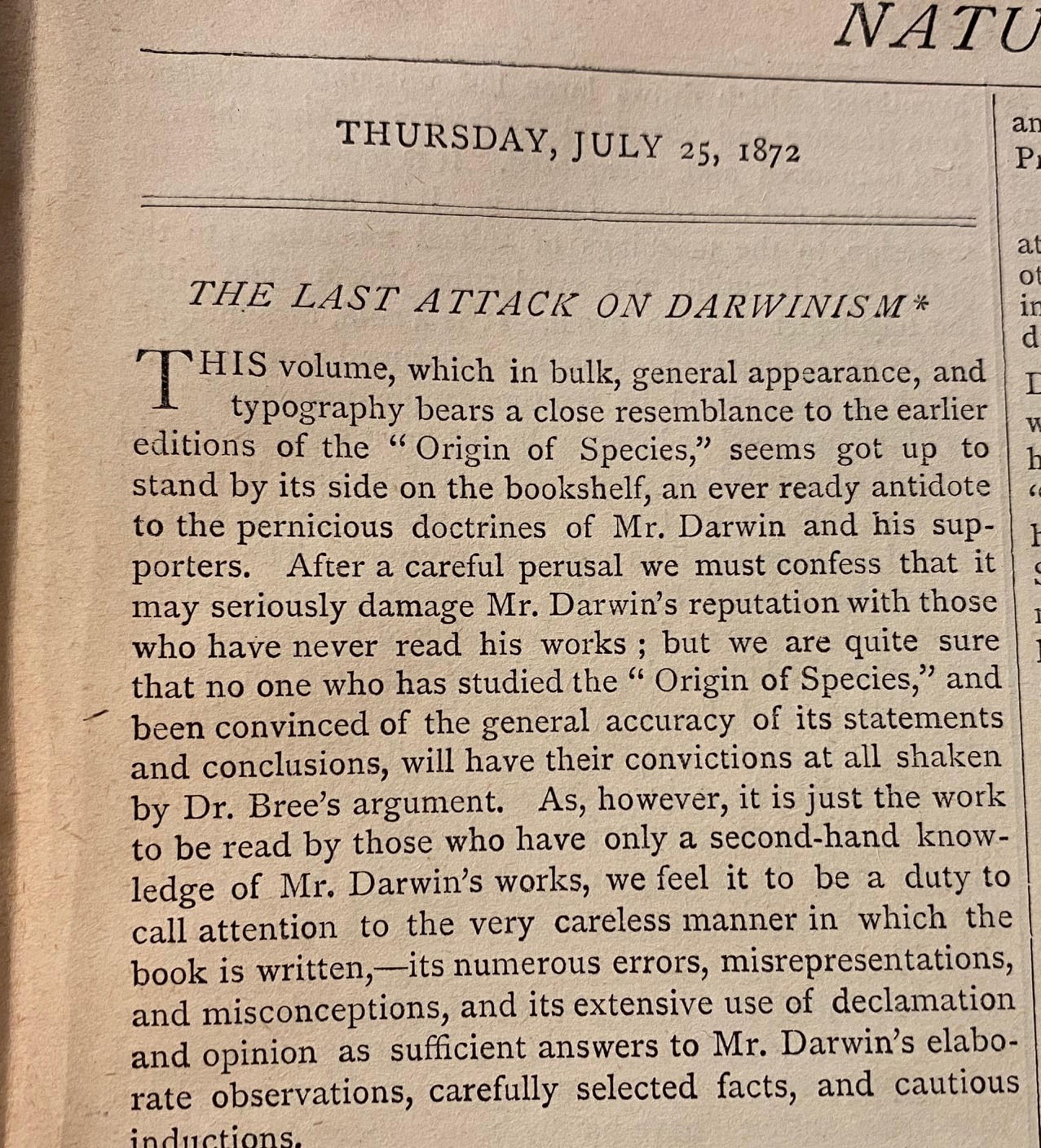
    There are many hopeful headings that appear in the fantastically-readable journal Nature (especially in the 19th century), and this one–“The Last Attack on Darwinism”–is certainly one of them. It was written for the 25 July 1872 issue by Alfred Russell Wallace in 1872 in response to Dr. Charles R. Bree’s1 An Exposition of Fallacies in the Hypothesis of Mr. Darwin, and it pretty much eviscerates Dr. Bree’s attack.  No doubt this title can be read two ways–one meaning the most recent attack on Darwinism, and the other meaning the final attack.  I suspect Wallace hoped that this would be the last such thing he’d have to read or review, but being a thinking man he probably felt that no mater what proof and evidence was established for evolution there would always be someone/group/society that would argue their belief over the science, and so on into the future the debate would go.  In any event, I’ve reproduced the first and last paragraphs of the Wallace review. Also there’s a further quotation on Bree from The Lancet as an example of the many scathing reviews Bree’s book received.  The reviews are surgical and denunciating, though from what I’ve read they do not reach the high/low level of book reviews by Poe, whose book reviews read as though he read the work with a sledge-scalpel. 


    IMG_4244

    And the last short paragraph from Wallace: “In conclusion, I must again repeat that the only reason for devoting so much space to a book so little worthy of its title or its author, is the wish to warn such as are not well acquainted with Mr. Darwin’s works from implicitly relying either on Dr. Bree’s facts and arguments, or on the accuracy of his representation of those of Mr. Darwin and his supporters.”

    Now a snippet from one of many such reviews that greeted Dr. Bree’s work, this from The Lancet (volume 2 1872):

    “This book is the production of an uncompromising opponent of the Darwinian hypothesis. Dr. Bree can see no good in it at all, but hews away at it root and branch…The position taken up by Dr. Bree would, it appears to put a stop to all investigation of nature, for he contends that it is beyond the limits of human reason to furnish any sound explanation of the modus operandi of God in creation.” And: “Upon the whole, we should scarcely expect to find Dr. Bree’s work exercise much influence in staying the progress of  the new opinions, or do more than satisfy those who have already made up their minds against them.” 

    Notes:

    1. Charles R. Bree (1811-1886). An Exposition of Fallacies in the Hypothesis of Mr. Darwin. London: Longmans, Green, and Co., 1872. 8vo., 418 pp. + 32 pp.(publisher’s list).


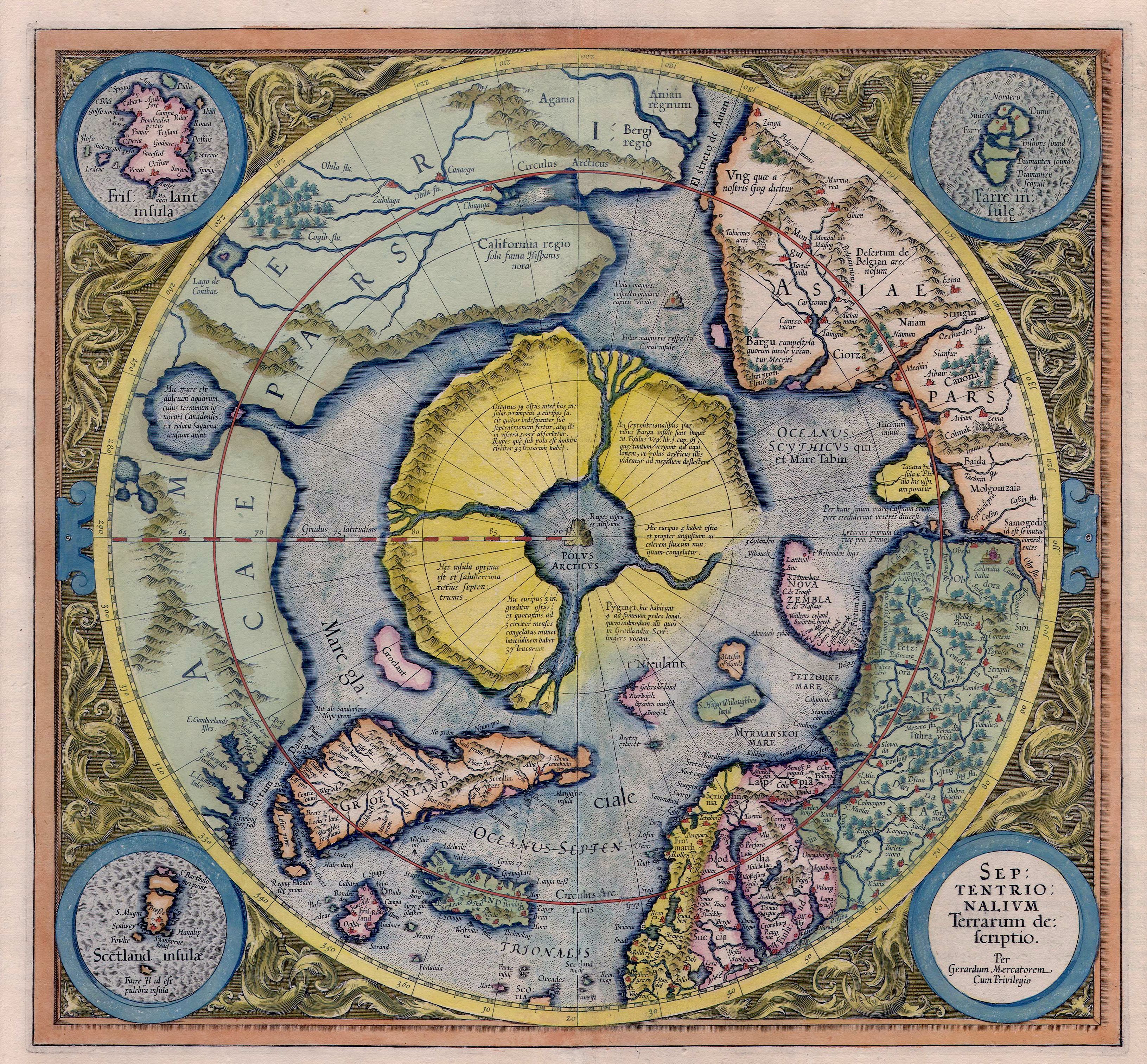
  • The Garden of Eden at the North Pole

    JF Ptak Science Books   Quick Post  Overall Post 5126

    Artic

    (Gerald Mercator, 1596)

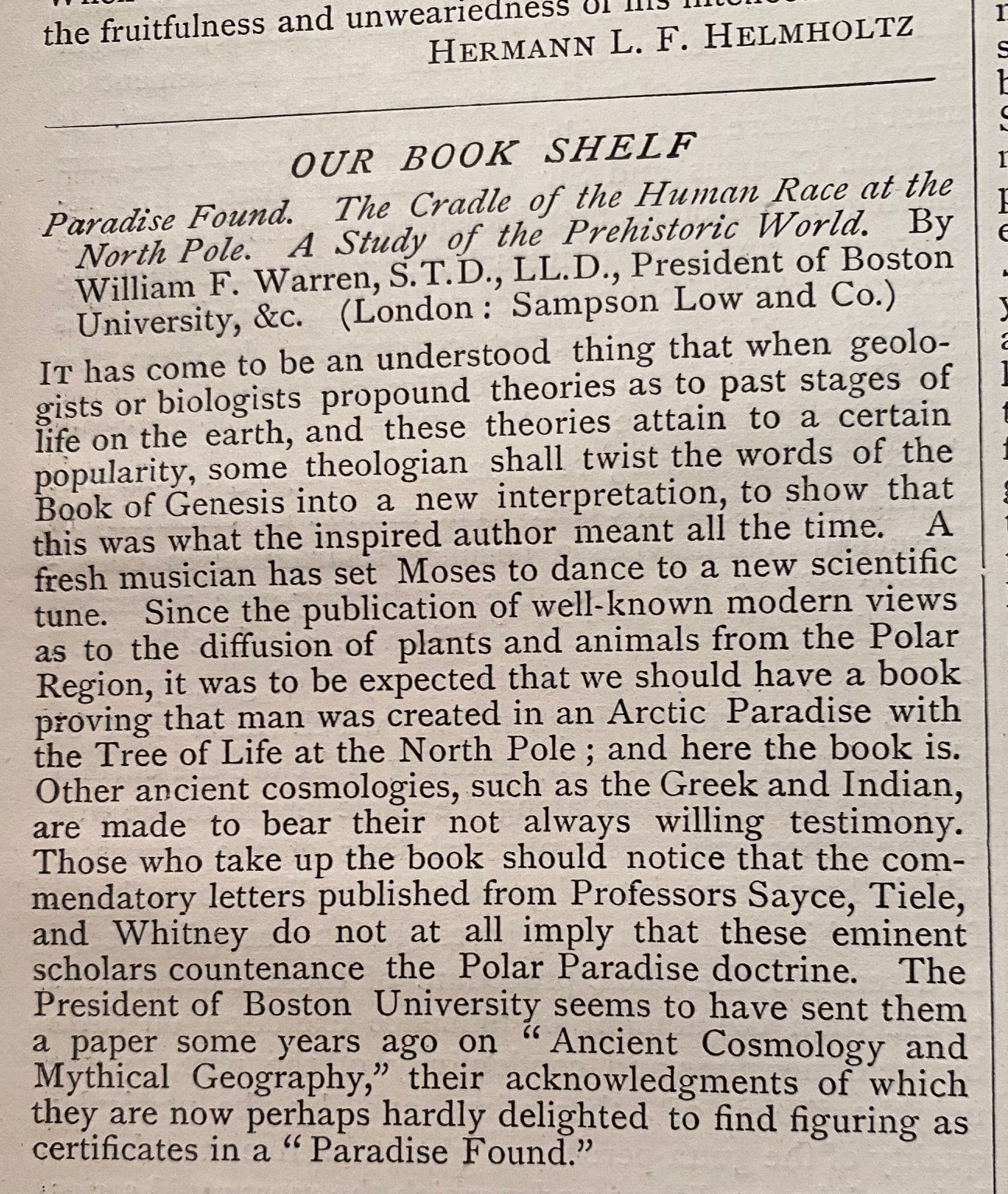
    IMG_5158This is a short, dismissive, stabbing review of a book by a theological and long-established scholar and administrator, William F. Warren (1833-1929). I remember his name from his interesting work on ancient cosmologies (1882), illustrated with examples of the history of all things according to various belief systems and religions. This quick-and-dead arrow of a review (which appeared in Nature on 14 May 1885 p, 28), was directed at his new work Paradise Found, the Cradle of the Human Race at the North Pole..., which as you can guess tries to establish the origin of humans at the North Pole, along with the Garden of Eden and the Tree of Life. And, for that matter, also establishes the Pole as the home of Mt. Maru, the Arthurian Avallon, and so on. There’s a lot that can be said but not by me—there is an attraction to hunting up other mythologies placing some part of great importance to the North Pole as the Navel of the Earth, but I just don’t have the time or inclination. As a matter of fact, I hadn’t known about this work by Warren, and I doubt I’ll know much more than what I am communicating right now—one thing the reviewer doesn’t mention is that the book runs about 500 pages, which is just too much of an investment for yours truly.

    ·Posted by :

    ·in:

    — — —

  • Presidential Yard Sale/Give (1913)

    JF Ptak Science Books  Quick Post

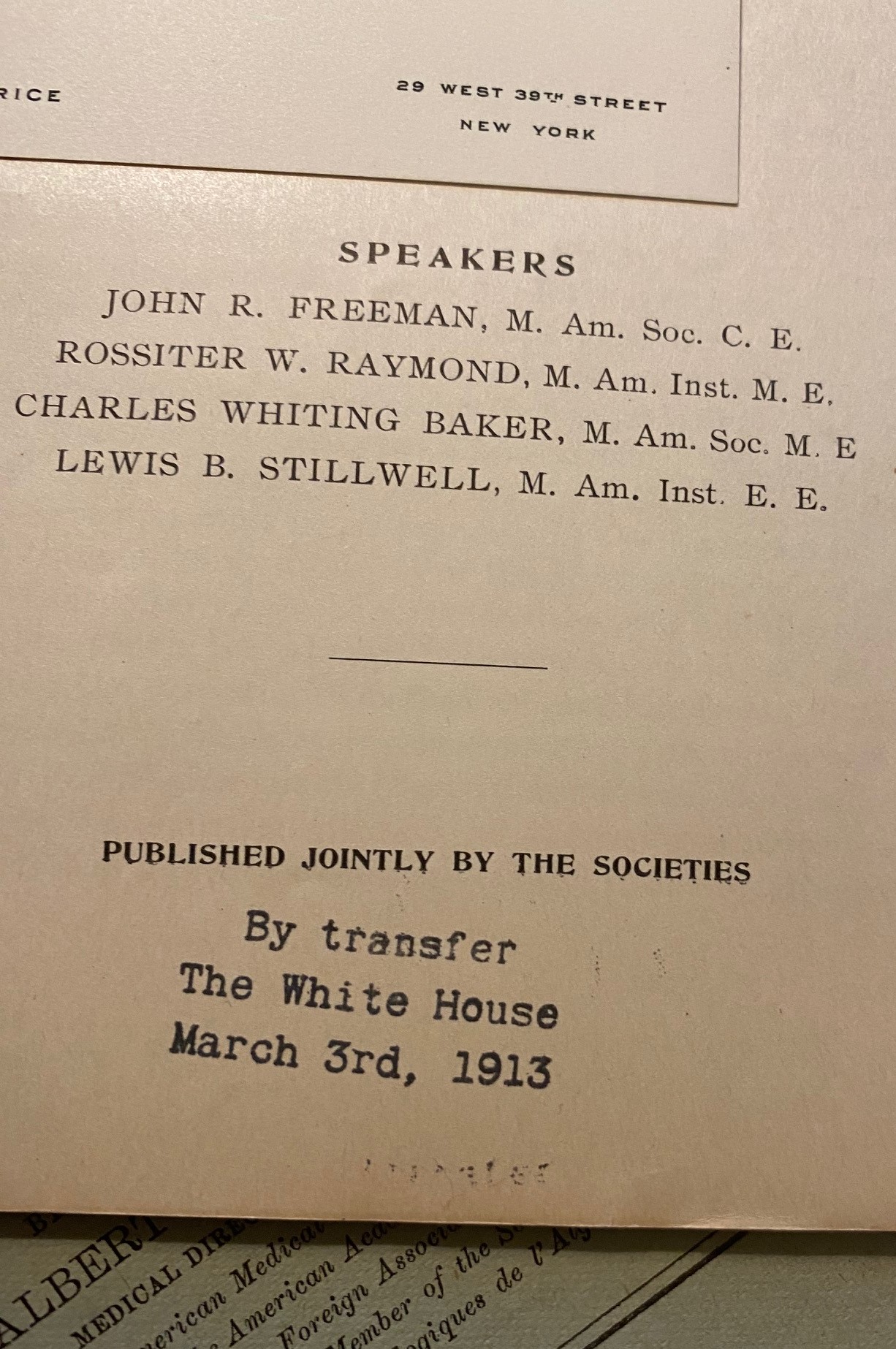
    IMG_2421 (1)This is just a small and short post about an unusual bit/bob from the White House. William Howard Taft to me was Mr. In-Between: he was the president between Roosevelt and Wilson, and he was in there about in between half the bad-ish and half the good-ish presidents, squarely in the middle, I think. He was also Chief Justice of the U.S. Supreme Court, where he was probably a better justice than he was a president, which would put him among the accomplished of his brethren. I remember him mostly for wanting to try to hang on to his chief justice role at least until Herbert Hoover was out of office–he found Hoover to be too liberal for his tastes, memorably referring to the not-Liberal president as “Bolsheviskii”, which has a certain “wow” factor to it. But what I’m drawing your attention to is the pamphlet Conservation of Natural resources–Meeting of Engineers, printed in 1909. The interesting part is that this was transferred out of the White House library on March 3, 1913, Taft’s last full day in office, which makes it sound as though there was a bit of shelf cleaning going on right to the bitter end before Wilson came in, making this a curious tiny bit of ephemera.

    ·Posted by :

    ·in:

    —

  • Getting Everything Wrong in 1937 (Gerald L.K. Smith)

    JF Ptak Science Books  Quick Post

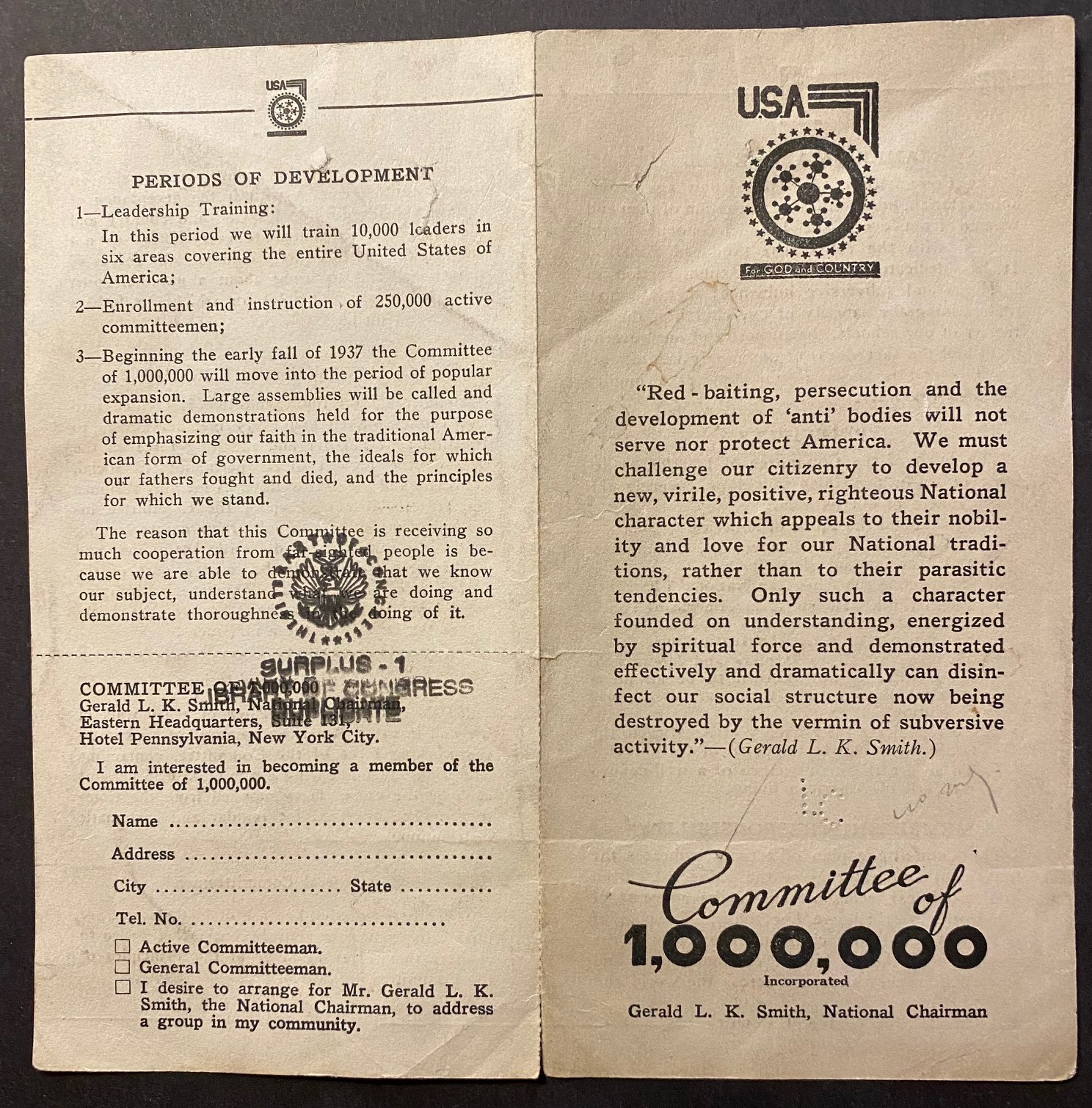
    This little pamphlet packed a lot of bitter bilious hope into its small-framed four pages. The  Committee of 1,000,000 was the work of the past-and-present pastor Gerald L.K.Smith, a rabid far-rightist who seemed to be present at the birth of most of the bad ideas of the 1930s and 1940s. He was a white supremist anti-Semite ultranationalsit pro-Nazi who started his major political life as a national organizer for Huey Long, an ally of Townsend and Coughlin, and the founder of the America First Party. He was a presidential candidate running in   against what he considered to be the Communist Franklin Roosevelt, was a member of William Pelley’s neo-Nazi Silver Shirts in 1942, advocated for the early release of Nazi war criminals at Nuremberg, denied the Holocaust saying that six million Jews weren’t murdered but emigrated to the U.S….and, well, you get the picture. The little leaflet was printed in 1937 and evidently was owned by H.L. Mencken (who kept his fingers on the pulse of such dangerous folks) though he gave it up to the Library of Congress after only a few months. The leaflet is printed on only one sheet of paper, and I reproduce it below. 

    IMG_2414 (1)

    ·Posted by :

    ·in:


  • “The Conflagration May Lead to a Good Result…” (1877)

    JF Ptak Science Books  Quick Post

    IMG_2227 (1)

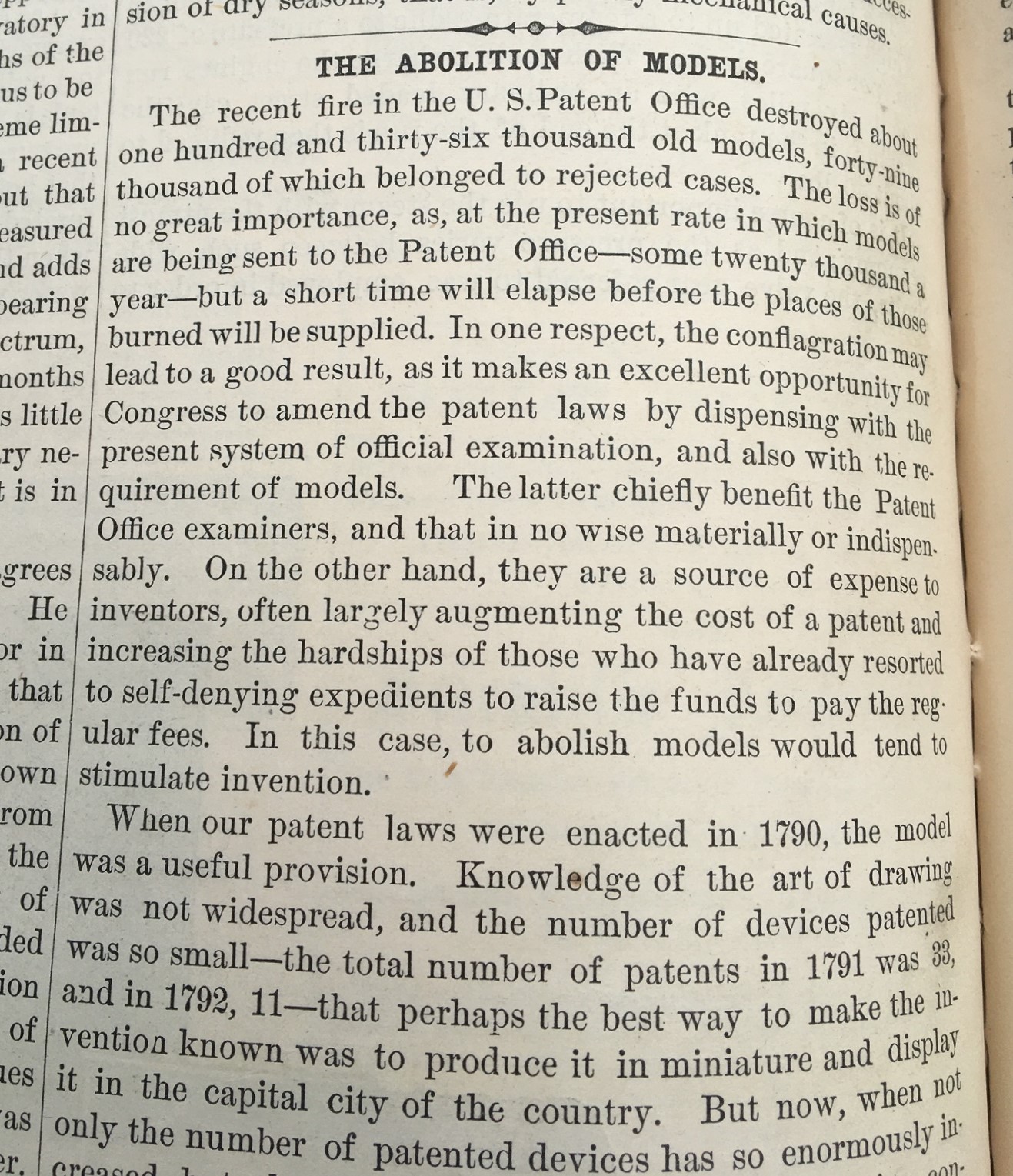
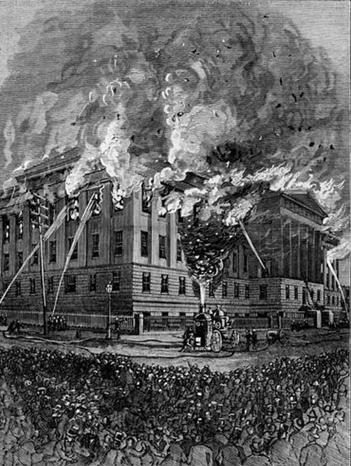
    There are sometimes positive results from fires, though I think not so in this case of the devastating fire that burned much of the U.S. Patent Office building on 24 September 1877 that is the subject fire of the header of this post. Perhaps the writer of the piece (appearing in Scientific American on 1 October 1877) was desperate to find some ray of goodness in the great fire that destroyed half of the USPO building along with 136,000 patent models…which in the old days to that present was a requirement in some areas to obtain a patent in the U.S. About the fire-consumed models the writer states that “the loss is of no great importance” which is a bizarre statement, and that their places on the shelves come along at 20,000 new patents per year, so the new space generated by their loss would be occupied in seven years. The case is then made for the silver lining, which would be to do away with the physical model requirement for a patent.  It was no doubt an appropriate conversation to have, but to try to establish the efficacy of doing away with the models by establishing that it hardly mattered whether the models existed or not is a tough go. 

    This was evidently the second great fire at the USPO (following the 1836 fire) and it consumed much of the building. It was designed by Robert Mills (architect, and designer of the Washington Monument, under construction 1848-1885) and was mostly fireproof, except for the roof and all of the stuff inside the building, so it was fireproof for all that was fireproof, and not for that that wasn’t. 

    Anyway, this was a strange article, well outside my standard experience with SciAm. 

    Patent_Office_1877_fire


  • A Good and Quirky Basis for a Holmesian Mystery–How to Kill Someone With Silk Thread (1877)

    JF Ptak Science Books  Quick Post

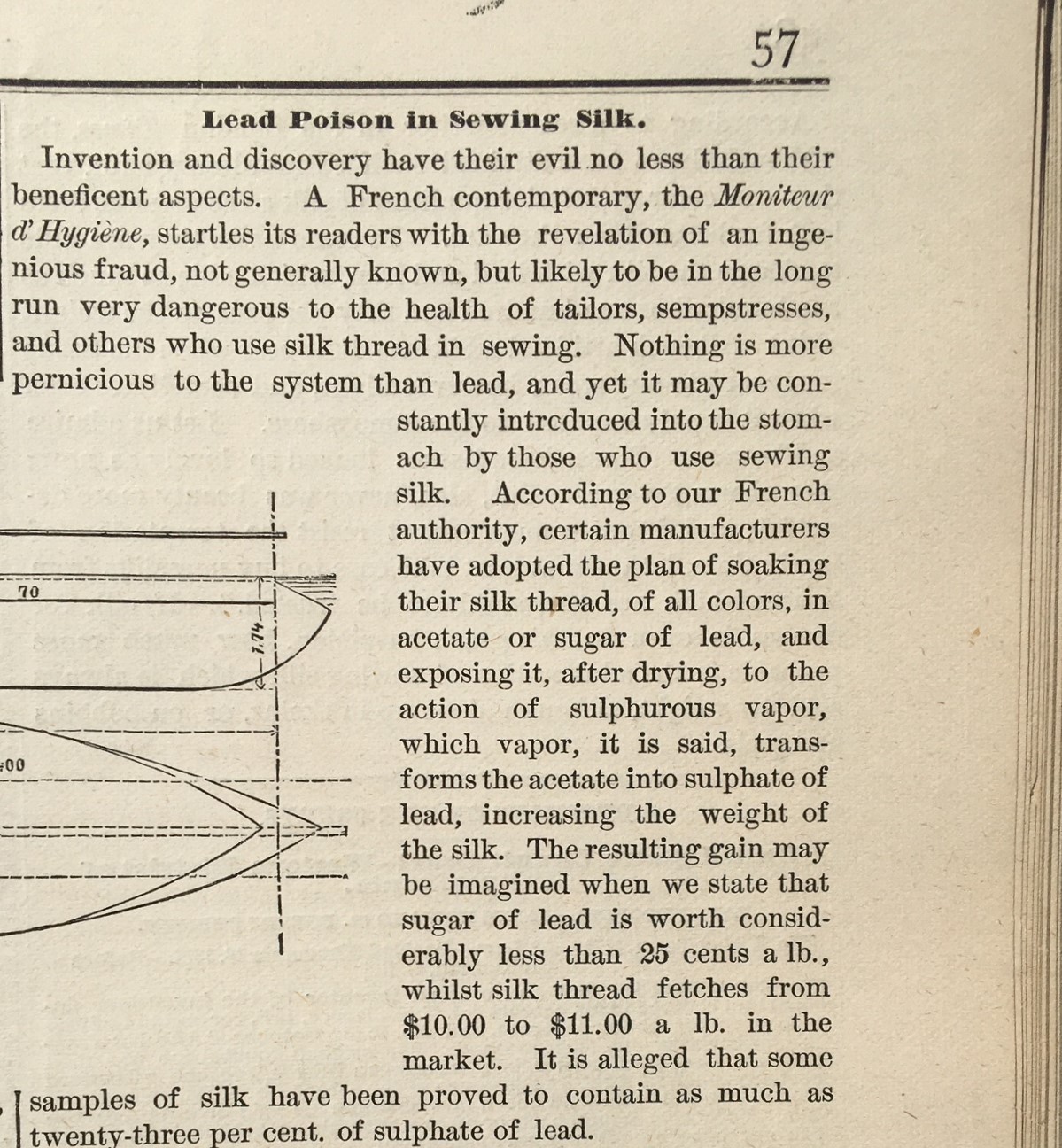
    And so it came to pass that a metal merchant was found drowned in the Thames, weighed down by his own wares, his jacket and greatcoat and pants–even his hat–filled with lead, his feet encased in lead, as were his hands.  The only reason the body was found was because of a severe summer drought which lowered the level of the river enough to reveal all manner of hidden nastiness, including the leaden mineral maven, Mr. Sockety. In and of itself this murder wasn’t all that interesting aside from it being bizarre…except over the following months there were a number of deaths of young women who had, as it turned out, a common touchstone–they all were seamtresses, and their specialty was silk thread. Then place here all of the interesting stuff that happens in mysteries >HERE<  until we get to the Eureka! moment that Holmes would know about halfway through==>they were looking for the tradesperson, Mr. Plump, who supplied the silk thread to these workers. Silk thread was expensive, so Mr. Plump committed fraud  and treated his silk thread with lead, multiplying the expensive thread’s value and which also made it lethal to its users.  Plump–seeing the damage that had been done and the people who had been killed as a result of his fraud–decides to kill Sockety to cover his tracks.  So on.

    This all came about as a result of seeing this interesting sidebar story in the 15 July 1877 issue of Scientific American:

    IMG_2179


    ·Posted by :

    ·in:


  • Defining What “Flying” Is, or Was (1894)

    JF Ptak Science Books  Post 2899    

    What does “flight” mean, anyway? How much do you have to be off the ground for something to be “flying”? If the answer is “two feet off the ground for 500 feet”, then Hiram Maxim did indeed succeed in being the first to construct a heavier-than-air aircraft that “flew”. Perhaps this definition might be a little broad, or narrow, though it does make falling sound like flying, too.

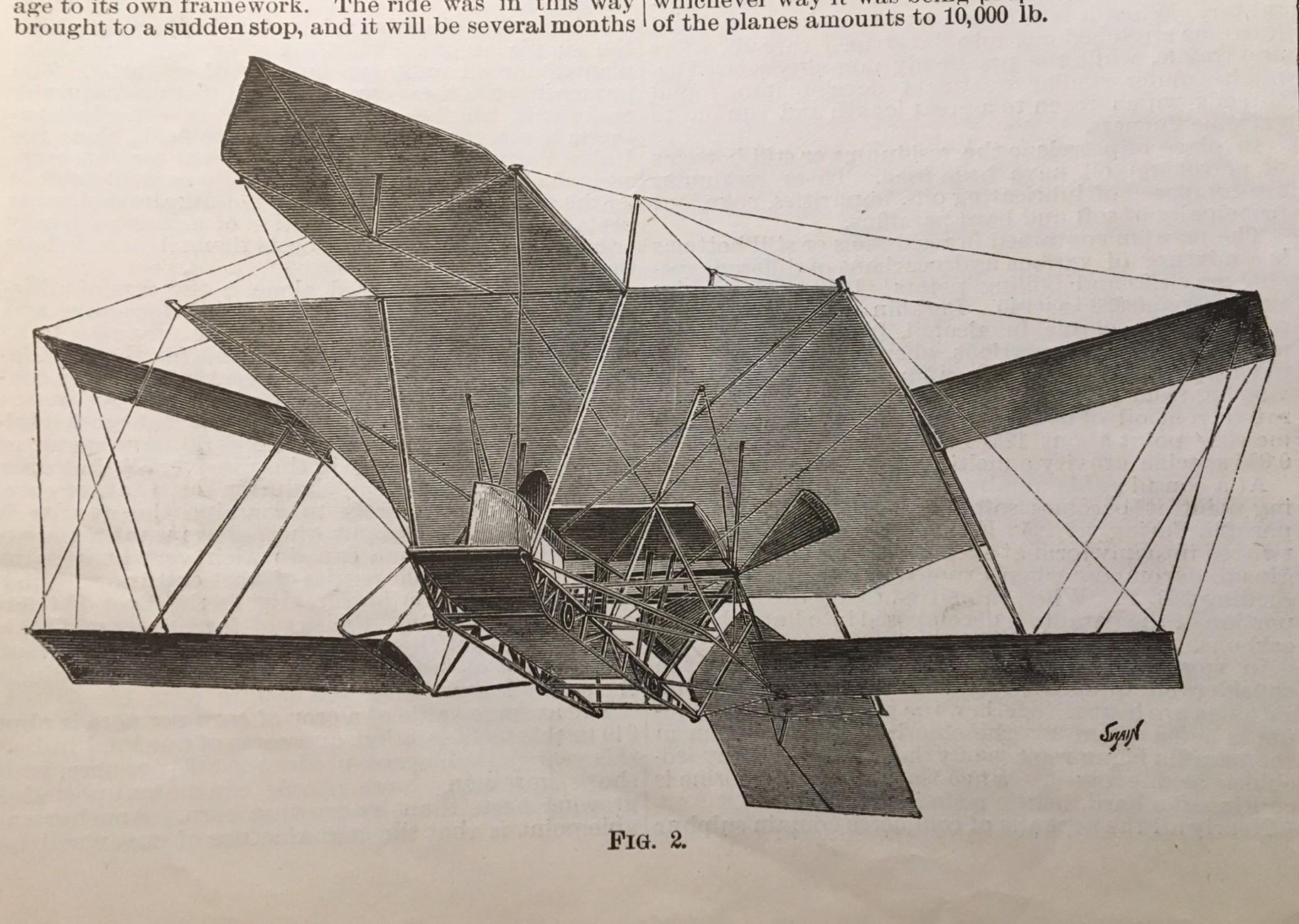
    IMG_2168In any event, that is what Mr. Maxim (1840-1916) did on 31 July 1894 with his enormous aeroplane as reported in the Scientific American of 15 September 1894 (“Maxim’s Flying Machine”).  He invested a good amount of money in the project funded by his tremendously successful “Hiram gun”, creating a number of aircraft before settling in on a great beast of a flying machine in 1894.

    The image of the aircraft is a perspective looking up at it, as though it were in flight. It wasn’t, though it was a semi-romantical thought and presentation. It had big numbers: 7000 pounds, 17.5′ diameter propellers, 2 steam-powered 180hp engines, 120′ long and 105′ wide, and 8” cylinders with a 5” stroke. Big numbers.

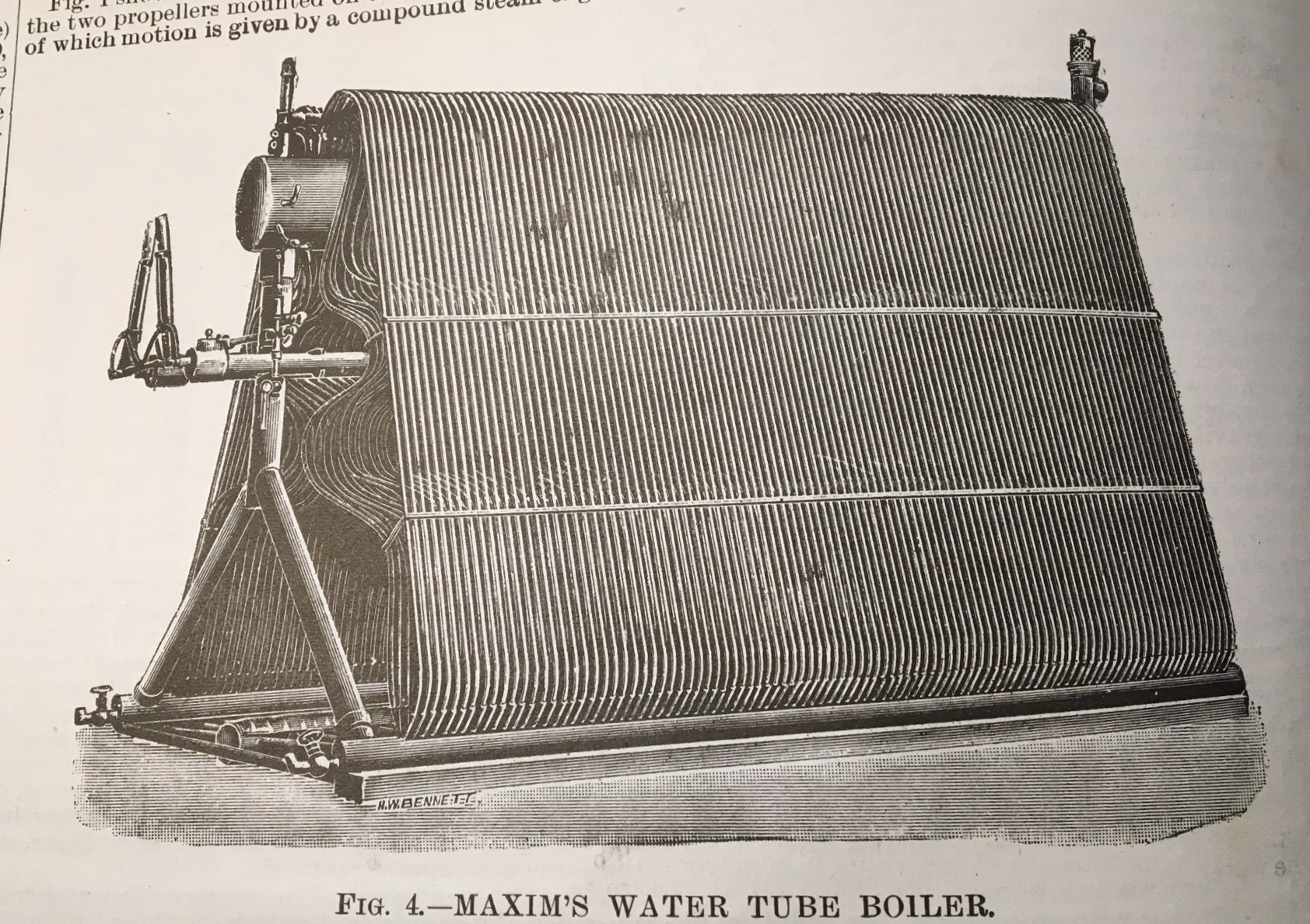
    One of the images that really struck me though was the steam chamber, which looks absolutely huge (though I can’t find dimensions for it), but you can make it out on the aircraft’s bow. For test runs 600 pounds of water were needed—2500 pound were needed to generate lift. IMG_2169

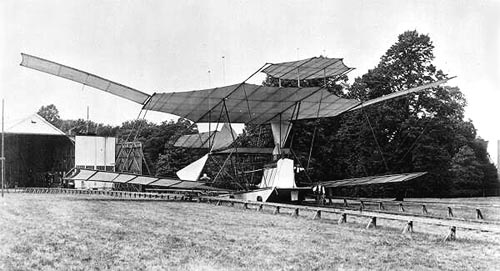
    So back to the “flight” issue; Mr. Maxim was on board the 3-person-crew aircraft on the day of the test. The aircraft was tethered to an 1800′ wooden rail to prevent it from actually taking off if it could…I think mainly because they were really just testing lift, as controlled flight was still yet another enormous issue. The aircraft did manage to achieve lift two feet above the rail, but the force was so great it ripped up the rail and crashed. (Mr. maxim found himself in a somewhat similar position to that of Frankenstein when overpowered by the monster which he himself had fabricated and endowed with life.”) No one was hurt, though the aircraft was decimated. As the writer in the Sci Am stated, “the ride in this way was brought to a sudden stop, and it will be several months before it can be renewed”. It isn’t anything like the Wright’s flight nine years later, though some do consider this Maxim experiment to constitute a “first flight”.

    One thing is certain: it was a lovely and impressive thing that Maxim built–it wasn’t elegant by any means, though it had a certain crushing charm to it.  

    Here’s a photo of the aircraft (with a person standing right there in front of it, for scale):

    Maxim aeroplane

    (Image source: ctie.monesh.edu.au/hargrave/maxim.html)