A Daily History of Holes, Dots, Lines, Science, History, Math, Physics, Art, the Unintentional Absurd, Architecture, Maps, Data Visualization, Blank and Missing Things, and so on. |1.6 million words, 7500 images, 4.9 million hits| Press & appearances in The Times, Le Figaro, Mensa, The Economist, The Guardian, Discovery News, Slate, Le Monde, Sci American Blogs, Le Pont, and many other places… 5000+ total posts since 2008.

Category: Atomic and Nuclear weapons

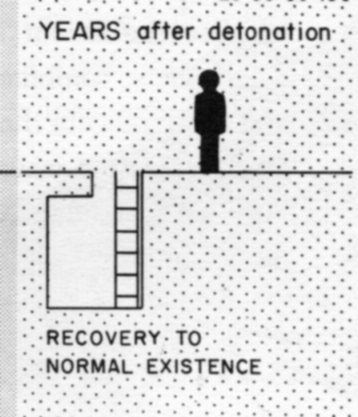
  • Recovery to Normal Existence, 1960

    JF Ptak Science Books   (Expanding an earlier post  #2499 from July 2015)

    Nuclear Attack LIVE230
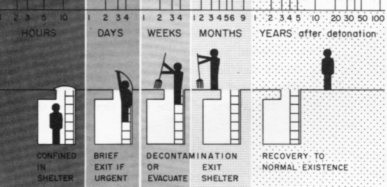
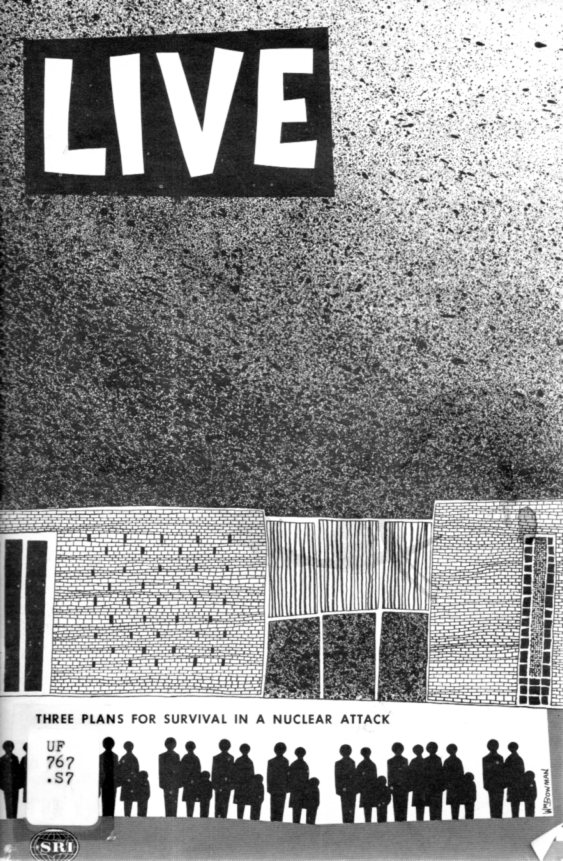
    In the not-modest stream of thin paperback  nuclear holocaust survival literature in the 1950’s and 1960’s appears this effort: LIVE, Three Plans for Survival in a Nuclear Attack. It was published by the Stanford Research Institute in 1960, and was part of nuclear health physics pioneer Lauriston Taylor’s donation to the National Council on Radiation Protection and Measurement, where I bought it some time ago when they were thinning out their stuff.  It is an unusual publication to me for its illustrations, some of which are odd, and a few of which are positively semi-surreal when view out of context.

    The pamphlet overall is fairly helpful, assuming that you had as much time to get yourself together in an impending attack, and that is a major assumption.  But I’m sharing this tonight for some of those images–and the cover, which is an unusual design in itself, not the least of which is the heavily-borrowed part from LIFE Magazine.

    So the first of the few that I’ll post here (above) is a detail from this illustrated graph, a march of the intellect and survival from being in a dark hole to a rather stiff return to normal existence:

    Nuclear Attack LIVE229

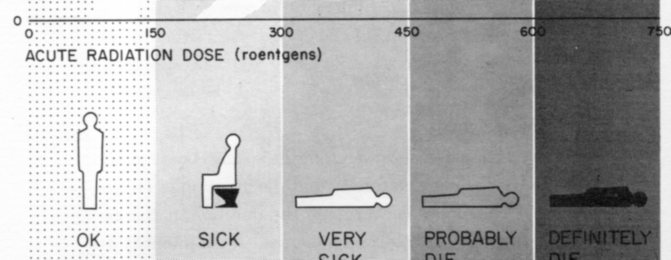
    Here’s another sobering bit, showing a progression of NOT-recovering to normal existence:

    Nuclear Attack LIVE231

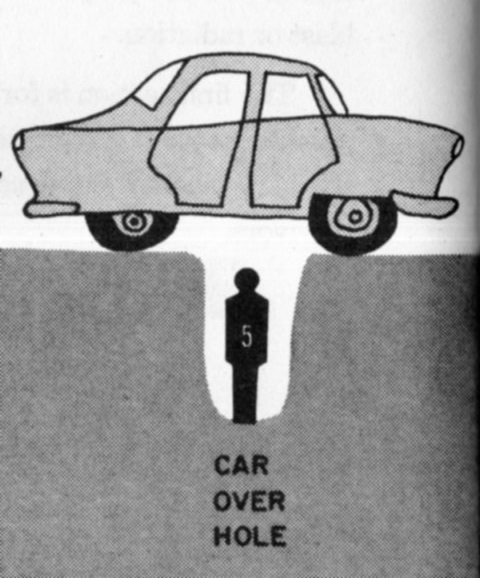
    And of course the hole:

    Nuclear Attack LIVE233

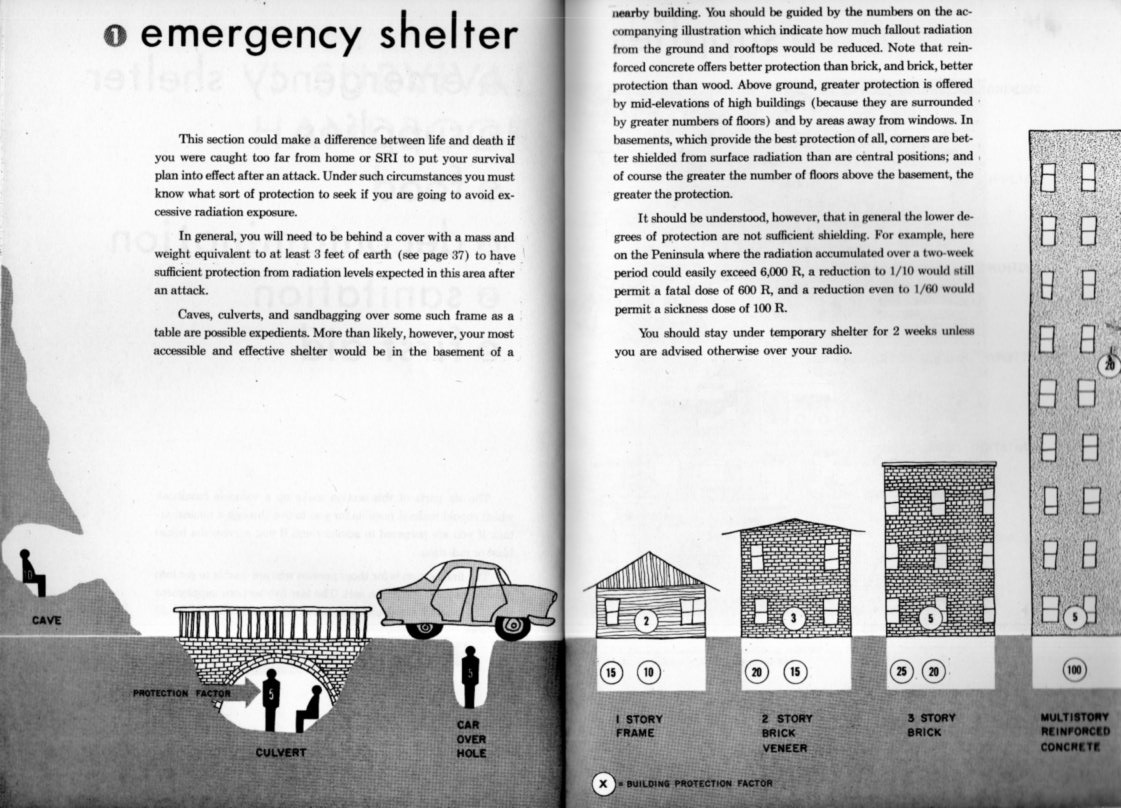
    Which is a detail from:

    Nuclear Attack LIVE232

    And the cover, which has some blotchy Ralph Steadman-y elements:


    Nuclear Attack LIVE228

    And so, there are some of the major themes.  I found the work unsettling in general for using mostly dark silhouettes for the people, that profile having been sort of established to represent dead folks. 


  • Planning for a Job Post-Nuclear Attack (1956)

    JF Ptak Science Books  Post 2895

    I’ve written many times on the technical and political end of the creation and deployment of the atomic bomb, along with some posts on the use and manipulation of language in controlling the sense impressions of nuclear war and survivability.  What I have found so extraordinary about this second part is the creation of ordinariness, or mechanization, or acceptance, of the aftermath of nuclear warfare–and what we’re talking about here is the
    “exchange” of not just a few 20 kiloton Hiroshima-type weapons, but thousands of megatons of explosives and massive amounts of radiation. But this is the function of familiarity, I guess–given the situation it was essential to plan for eventualities A-Z, and for that you need structure, and vocabulary. 

    All things being equal, such things as an Terrestrial Afterlife in the United States needed to be contemplated because that is what we do–we make the situation possible for end-of-the-world stuff to happen, and so we have to plan for building things up again with radioactive detritus once all of the keys get turned and buttons pushed, as  it is just a natural course of that historical river. That the bomb would be built was a given; that the Soviets would develop the a bomb and delivery capacities was just a matter of time, and that they would be our sworn death-enemies was also a fait accompli. To develop a way to somehow survive a nuclear war may have been a major deterrent to not launching an attack, especially when linked with a Mutually Assured Destruction (MAD) arms build up (where everyone and everything would be obliterated if there was a nuclear war, or at least so by 1965 (and probably earlier than that). All this insane stuff may have worked, and somehow we managed not to ignite the world, because (to paraphrase Frank Zappa) there would be no real estate left.

    On the other hand, building all of these weapon systems and planning for attack and the post attack world could have pushed us into a final confrontation, making all of this sound “winnable”, “doable” somehow, that once the bombs had all exploded and nothing worked anymore, that there would be enough to pull together of our civilization to declare that we had indeed “won’”. 

    And the only way to declare a winner was to have something to stand on besides pieces of green glass and Earth, and so  plans for communications and a military, police force, fire brigades, medical care, food distribution, banking, and all the rest–the pieces of a recognizable backbone of American society–would have to be undertaken.  All of this could very well accomplish the creation of an illusion in the mind of the adversary that you are capable of surviving a nuclear war, and so there would be no great gain in attacking; or it could send the message that by doing this preparation that you were preparing a first strike scenario, and so the adversary would attack while the odds were still not horribly out of balance.  And on and–it all looks like a lose-lose endgame to me, which is hardly a “game” at all when all players are losers.

    But still there was a need to staff the thousands of positions that went into the theoretical end of figuring out the non-weapon-end world after nuclear war, and the above “position description” is an example of that, a necessarily pro forma form, just another job in a ea of jobs.  This one’s job descriptions read like any other, except of course that the content was much different.  Form the same, sentence structure the same, vocabulary basically invariable. 

    One aspect of this planning for the Afterlife was the planning part itself, planning to plan, how to make sense of the answers and the questions, a form into which the parts of a process are poured before they become the process itself.

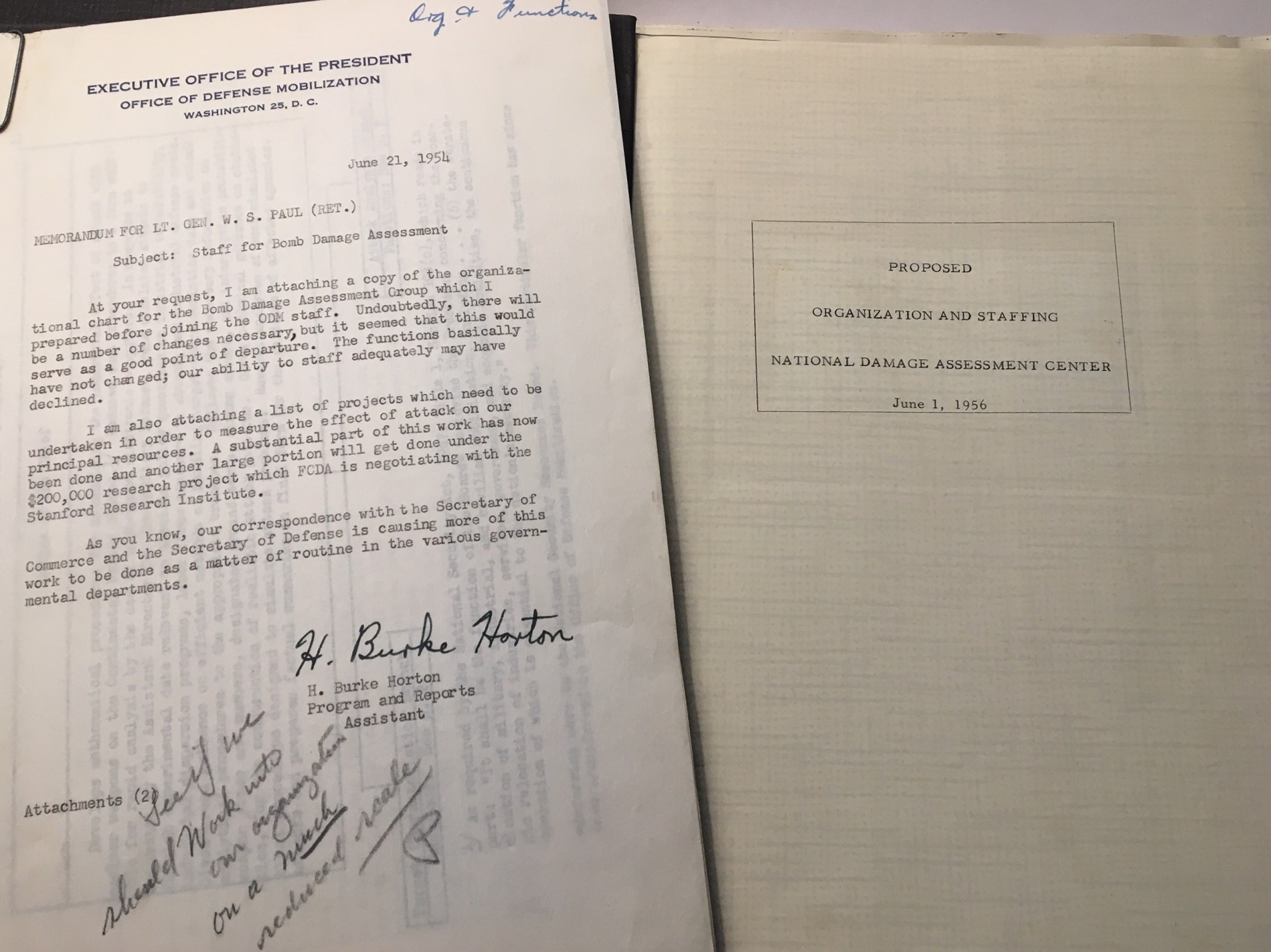
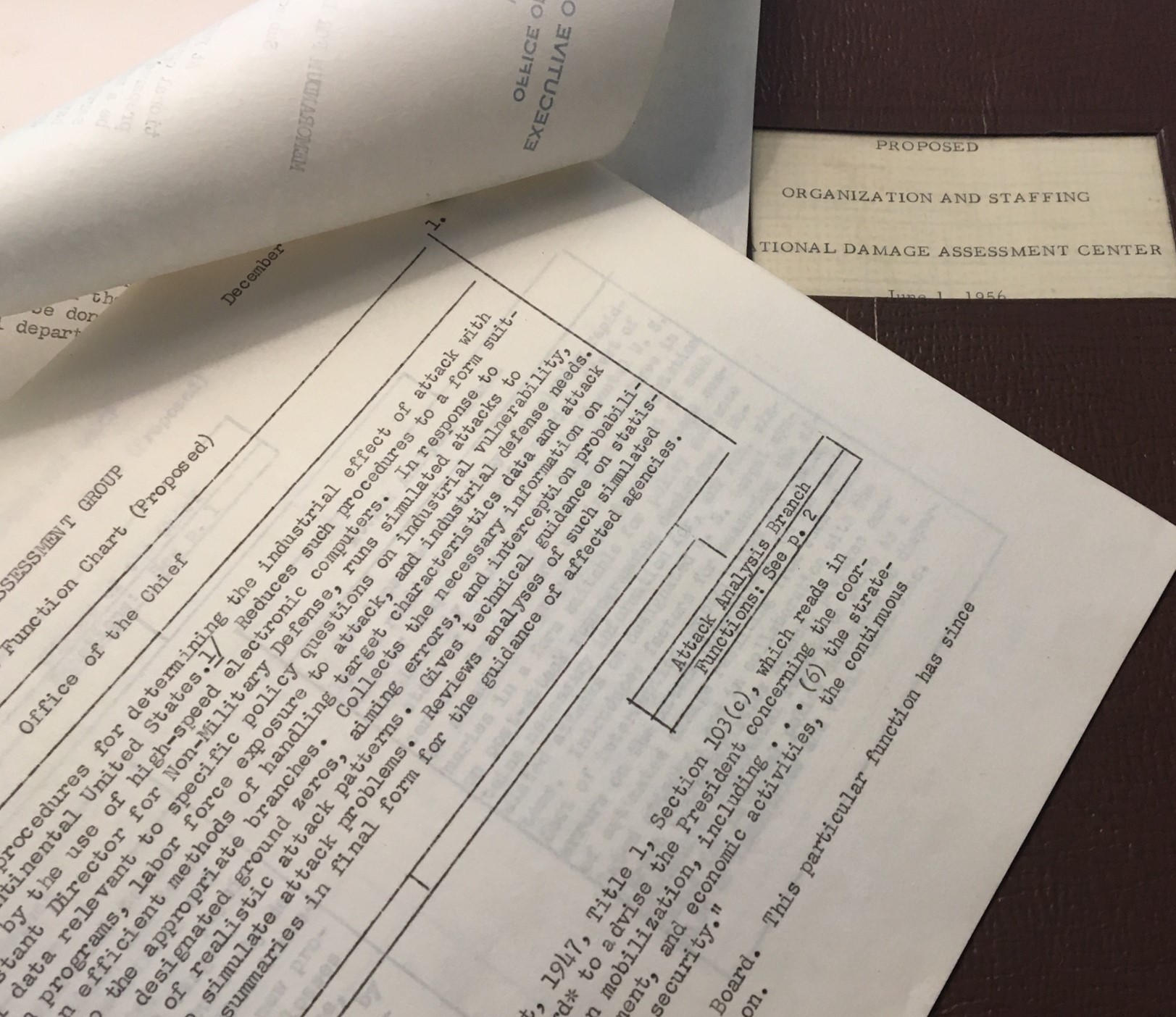
    This all came up this morning because of a document that surfaced here—it is a working proposal to establish one such agency/group studying post-nuclear war scenarios. Its title is Proposed Organization and Staffing, National Damage Assessment Center, 1 June 1956 , and comes from the estate of Dr. Joseph Coker, who helped form this center and who did become an assistant director when it became engaged.

    This position description was for “Chief, Damage Assessment Division”, was was the part of the Office of Emergency Preparedness (which operated under the auspices of the Executive Office of the President, and then under the Office of Defense Mobilization (ODM), and then under the Production Area, and then, finally, the Damage Assessment Division DMA).  The job of the DMA was to identify what would happen to the essential production facilities that would keep the country going–industrial, technical, medical, biological, and so on–how they would be targeted, and how they might survive an attack.  This also applied to the people who would be required to be in charge of all of this.  Damage assessment.

    It was also the job of this person to coordinate the estimation of damage and assessment business post-attack.
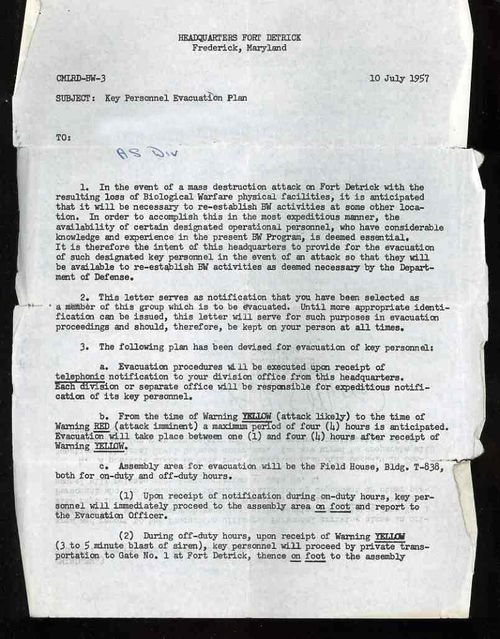
    0--blog---dec 1 hell162So, one “perk” of this job was that they would be expected to survive a nuclear attack, which means that the added benefits to this employment would be a special trip to a safe place to wait out the destruction of the world.  I assume that this person would have a leverage like the one I wrote about  in my Get-Out-of-Hell-Free Card post (pictured just here, and clickable to 250%).

    The position description clearly makes distinctions between pre- and post-attack responsibilities of the Chief of the Damage Assessment Division:  under “Nature of Purpose of Work”,  part 1, section A (1) it reads “a pre-attack capability for translating likely patterns of attacks into losses of manpower, industrial capacity, and weapon systems output’.  In Section A (2) we see”a post-attack capability for assessing actual losses, for alternating alternate levels of output consistent with surviving resources and for testing feasibility of proposed new mobilization programs”.  Or in other words, sifting the rubble to see who and what was left and to see where they could be actually plugged into whatever scenarios had already been planned, and alter as necessary.  And also on page two, part (3) “development and maintenance of capabilities for both rapid and deliberate damage assessments in event of actual attack…”

    Continuing on page two, the Damage Assessment Division would create damage estimates, “disseminate …estimates of indirect effects including effects…on government, financial and credit systems, and production…” which of course is, well, everything.  Except overall assessments of total numbers of people killed, which isn’t a necessary statistic for most of the stuff we’re talking about here.

    There was much else in this job description, which is five pages long.  It is quite fascinating, seeing all of this spelled out so clearly, written on the end pages of our national book of life.

    On the other hand, I’m not exactly sure what else everybody else could’ve done, all other things being equal.

    The rest of the document:
    ·Posted by :

    ·in:


  • Internal Document Proposing an Organization to Establish Post-Nuclear Exchange Damage Assessment (1956)

    JF Ptak Science Books  Post 2885

    Proposed organ _2_I’ve written many times on the technical and political end of the creation and deployment of the atomic bomb, along with some posts on the use and manipulation of language in controlling the sense impressions of nuclear war and survivability.  What I have found so extraordinary about this second part is the creation of ordinariness, or mechanization, or acceptance, of the aftermath of nuclear warfare–and what we’re talking about here is the
    “exchange” of not just a few 20 kiloton Hiroshima-type weapons, but thousands of megatons of explosives and massive amounts of radiation. But this is the function of familiarity, I guess–given the situation it was essential to plan for eventualities A-Z, and for that you need structure, and vocabulary. 

    All things being equal, such things as an Terrestrial Afterlife in the United States needed to be contemplated because that is what we do–we make the situation possible for end-of-the-world stuff to happen, and so we have to plan for building things up again with radioactive detritus once all of the keys get turned and buttons pushed, as  it is just a natural course of that historical river. That the bomb would be built was a given; that the Soviets would develop the a bomb and delivery capacities was just a matter of time, and that they would be our sworn death-enemies was also a fait accompli. To develop a way to somehow survive a nuclear war may have been a major deterrent to not launching an attack, especially when linked with a Mutually Assured Destruction (MAD) arms build up (where everyone and everything would be obliterated if there was a nuclear war, or at least so by 1965 (and probably earlier than that). All this insane stuff may have worked, and somehow we managed not to ignite the world, because (to paraphrase Frank Zappa) there would be no real estate left.

    Proposed organ _1_On the other hand, building all of these weapon systems and planning for attack and the post attack world could have pushed us into a final confrontation, making all of this sound “winable”, “doable” somehow, that once the bombs had all exploded and nothing worked anymore, that there would be enough to pull together of our civilization to declare that we had indeed “won’”. 

    And the only way to declare a winner was to have something to stand on besides pieces of green glass and Earth, and so  plans for communications and a military, police force, fire brigades, medical care, food distribution, banking, and all the rest–the pieces of a recognizable backbone of American society–would have to be undertaken.  All of this could very well accomplish the creation of an illusion in the mind of the adversary that you are capable of surviving a nuclear war, and so there would be no great gain in attacking; or it could send the message that by doing this preparation that you were preparing a first strike scenario, and so the adversary would attack while the odds were still not horribly out of balance.  And on and–it all looks like a lose-lose endgame to me, which is hardly a “game” at all when all players are losers.

    But still there was a need to staff the thousands of positions that went into the theoretical end of figuring out the non-weapon-end world after nuclear war, and the above “position description” is an example of that, a necessarily pro forma form, just another job in a ea of jobs.  This one’s job descriptions read like any other, except of course that the content was much different.  Form the same, sentence structure the same, vocabulary basically invariable. 

    One aspect of this planning for the Afterlife was the planning part itself, planning to plan, how to make sense of the answers and the questions, a form into which the parts of a process are poured before they become the process itself.


  • Louis Turner’s Classic History and Bibliography on Nuclear Fission, 1940

    JF Ptak Science Books

    I’ve found this article by physicist Louis A. Turner to be very helpful over the years.  He was an I-was-there guy (and actually an I-am-here guy) who wrote a stuccato article on the history of nuclear fission which was top heavy in references, and did so in 1940, just before the clamp came down on publication on the topic.  Certainly there are other more modern efforts in this area that are far more detailed, but few have managed to do so good a job in as limited space as Turner. 

    Louis Turner. “Nuclear Fission.”  Lancaster:  American Physical Society,  1940. An article in the  Reviews of Modern Physics, vol 12/1, January 1940, pp 1-30  of an issue of 85pp   Original orange wrappers.  Fine condition.  (The issue also contains articles by Seaborg and Zwicky.)His references list is quite useful:

    • E. Fermi, Nature 133, 898 1934.
    • E. Amaldi, O. D’Agostino, F. Rassetti and E. Segrè, Proc. Roy. Soc. A146, 483 1934.
    • I. Noddack, Zeits. f. angew. Chimie. 37, 653 1934.
    • O. D’Agostino and E. Segrè, Gaz. Chim. Ital. 65, 1088 1935.
    • I. Curie, H. von Halban and P. Preiswerk, J. de phys. [7] 6, 361 1935; C.R. 200, 1841 1935; 200, 2079 1935.
    • A. von Grosse and M. S. Agruss, J. Am. Chem. Soc. 57, 438 1935.
    • O. Hahn and L. Meitner, Naturwiss. 23, 320 1935 [CAS].
    • O. Hahn and L. Meitner, Naturwiss. 23, 37, and 230 1935.

    ·Posted by :

    ·in:


  • General Groves on The Possibility of Blowing Up the World and What Comes Next (1945)

    JF Ptak Science Books   Quick Post

    Yesterday I wrote a post about Robert Oppenheimer’s 1945 Congressional testimony on the economics of using atomic bombs over conventional bombs. In an earlier section of the same volume1 publishing the Oppenheimer statements there are also testimonies of some other Los Alamos and atomic bomb figures, including Harold Urey, Irving Langmuir, and Vannevar Bush. And Leslie Groves. General Groves of course was the military chief of the Manhattan Project and ran it with some interpersonal difficulties but with great success with Robert Oppenheimer, who was in charge of the scientific cadre.  They were an odd pair but worked well enough together to push through an enormous project of absolutely fantastic complexities and depths. In questions from six Senators Groves addressed a number of wide-ranging issues about the bomb, though what particularly appealed to me today was his observations on the possibilities of the U.S. precipitating some sort of event with atomic weapons that would bring an end to the world. The question came from  Senator Richard Russell (Ga.) who (with some difficulty) asked after this possibility. Groves responded with brusqueness and a sort of common authority, which I reprint below. 

    “Senator Russell: General, the papers tell us that some of the scientists are of the opinion that if a large number of these [atomic bombs] were exploded over the world that it would reach out into the elements in the atmosphere and instead of being a world we would just be a new star, and all life on the planet would be extinguished almost automatically. Do you have any theory on that to give us?

    General Groves: My only theory is that I don’t worry about it because if it happens it will be all over and we won’t have that to worry about. We won’t have to explain that one but the theory is not concerned with getting a number of these bombs but with getting one that is big enough to do that. No one knows what that size is. It is all highly theoretical…It is more or less the kind of thing that they [physicists] will discuss as a possibility when they are just sitting around talking theoretically they may be able to prove that such a thing is possible but the best advice I have and I certainly don t hold any personal views or knowledge on the subject but the best advisers tell me that they are not a bit worried, and I personally am not worried. I feel it will be beyond my lifetime and then I will let the next generation worry as to whether they are going to blow themselves up or not.”

    And there you have it. 

    Notes:

    1. HEARINGS BEFORE THE SPECIAL COMMITTEE ON ATOMIC ENERGY UNITED STATES SENATE SEVENTY NINTH CONGRESS FIRST SESSION PURSUANT TO S Res 179 4.  A RESOLUTION CREATING A SPECIAL COMMITTEE TO INVESTIGATE PROBLEMS RELATING TO THE DEVELOPMENT USE AND CONTROL OF ATOMIC ENERGY.  USGPO, 1945.

    ·Posted by :

    ·in:


  • An Atomic Trinket for a Nuclear Whimsey: The Bomb in 1940 (?)

     JF Ptak Science Books  Post 2770

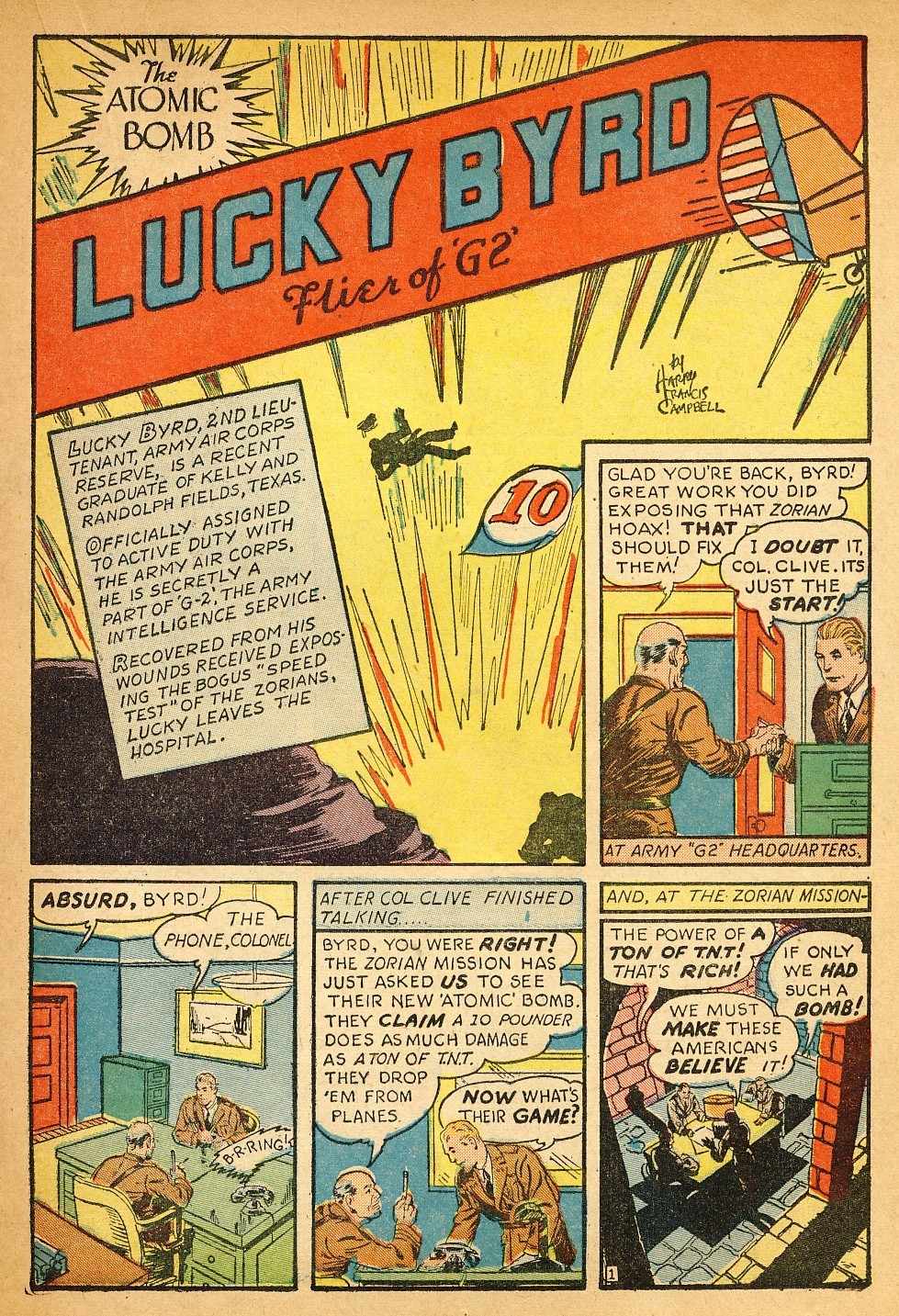
    Comic book atomic bomb cover _1_There are some early suggestions for the atomic bomb that occur earlier than when it was first tested on July 16, 1945: there was H.G. Wells who famously wrote about it in 1914 (in The World Set Free), which came a few years after a very obscure mention by the semi-polymath Gustave Le Bon who wrote about its scientific possibility in 1905 in the Revue Scientifique. That said I was surprised to see the atomic bomb referenced in a comic in 1940 (book five years before the Trinity test): “The Atomic Bomb, Lucky Bird, Flier of G2”1 definitely suggests a bomb of high power, which so far as I can determine from my non-existent comic book expertise seems to be the earliest of its kind. The very intriguing aspect of the story is that it shares an interesting coincidence with the Real Thing.

    The story–only seven pages long–revolves around the Zorians (from where I don’t know) who make it known that they have a smallish shell (a “ten pounder”) that has the yield of 2,000 pounds of t.n.t. We are informed that the Zorians actually don’t have this weapon, this “atomic bomb”, but they intended to “fake it” and convince the world they had it and confound the U.S. They weren’t planning to use their non-existent bomb though they did plan to demonstrate it,  that  bombing 10 labeled secret sites to display its effectiveness. The fakery part was that the Zorians hid 2,000 pounds of t.n.t. beneath each labeled targets that would be ignited by the 10-pounder and thus make that shell look like a lot more than what it was. The hero of the story, Lt. Lucky Bird of “G2” figures out that the test would actually be a fraud and sets out to prove to the world that the Zorrians do not have such a devastating weapon, and thus go on to save the U.S. from having to react to a fraud atomic bomb. 

    Spoiler alert: Lt. Byrd succeeds, the Zorians are exposed, and they of course blow themselves to kingdom come in the end.

    The big real-life coincidence? The Zorians were going to demonstrate the weapon in the “Shiprock Desert”, north of  Gallup, New Mexico, which means I guess they planned to use the thing on land in the Navajo Nation. It so happens that the Trinity Site (of the plutonium implosion explosion) is only 100 miles or east of the Gallup area and the beautiful Shiprock. 

    There’s plenty of desert in the U.S. to experiment with a weapon like this, so choosing a location so close to the one that was used for an actual atomic explosion is pretty interesting. It doesn’t mean anything, of course, but it does have a certain amusement value. 

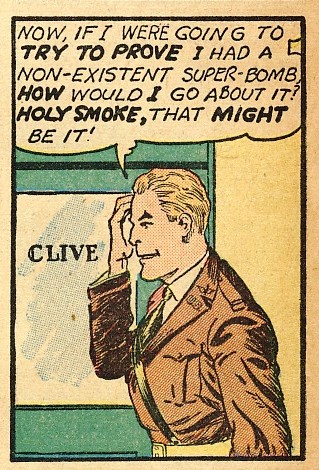
    And then there’s some fabulousness, like this:

    Comic book atomic bomb _2_

    [Source: Both images from Comic Books + http://comicbookplus.com/?dlid=17561]

    The newspaper Daily Tab announces with a flourish Lt. Byrd’s success with the the sub-header: “Bogus Bomb’s Big Blast of Bunk”. 

    Here’s one more thing: the 10 pounder of the Zorians was supposed to deliver the equivalent explosion of 2000 pounds of t.n.t.  The real thing, the Fat Man bomb, weighed 10,000 pounds and delivered 20,000 tons of t.n.t. For the Zorian weapon to have that sort of yield it would need to be about ten times the weight of Fat Man. 

    Notes:

    1. Target Comics, published by the Novelty Press, December 1940, with ink and color by Harry Francis Campbell. 

    ·Posted by :

    ·in:


  • Pre-History of the A-Bomb: Arming Nukes with Your Teeth, 1914.

    JF Ptak Science Books   Post 2741

    “Atomic Bomb” appeared in print for the first time thirty years before there was one. It appeared in H.G. Wells’ The World Set Free, written in 1913 and published in 1914, evidently before the appearance of the guns of August later in that year. The “set free” part of the world in Wells’ hands doesn’t come without an atomic struggle, though, much of the novel being a stage-up for the last bit in which people realize that atomic-bombing everything everywhere is not the way to go.

    There are other atomic-conjoined terms in this book besides “bomb”, and they are somewhat telling of the period. Wells does make a good strike with “atomic bomb”, “atomic ammunition”, and “atomic power”, and then goes on to describe the other bits that could benefit from this atomicity, including “atomic aeroplanes”, “atomic hay lorries”, “atomic traction engines”, “atomic riveters” (riveting at twice the pace of a human), and “atomic smelters”. So there are some weak spots here and there in his 57 mentions of “atomic-something”, and that’s okay—he did some pretty good sightseeing into the future with the bomb.

    And he was definitely the first to use “atomic bomb”, according to many sources and not the least of which is the OED (which also provides another interesting example of the word in use, quoting the Yale Review in 1917 “When you can drop just one atomic bomb and wipe out Paris or Berlin, war will have become monstrous and impossible”.) “Atomic-bombed”, “atomic bombing”, and “Atomic bomber” do not make their appearance in the English language until after August 6 in 1945.

    The first view of the atomic bomb in Wells finds that there not one but three of them, all contained in a “coffin-shaped box”, and even with a 2′ diameter were small enough to be stored under a person’s legs. The “essential element” in its construction was a substance named “Carolinum1”, which thus far had been “tested only in almost infinitesimal quantities within steel chambers embedded in lead”.


  • Consequences of Ingestion by Man of Real and Simulated Fallout (1963)

    JF Ptak Science Books   Quick Post

    This is one of those titles that most people will read twice: 

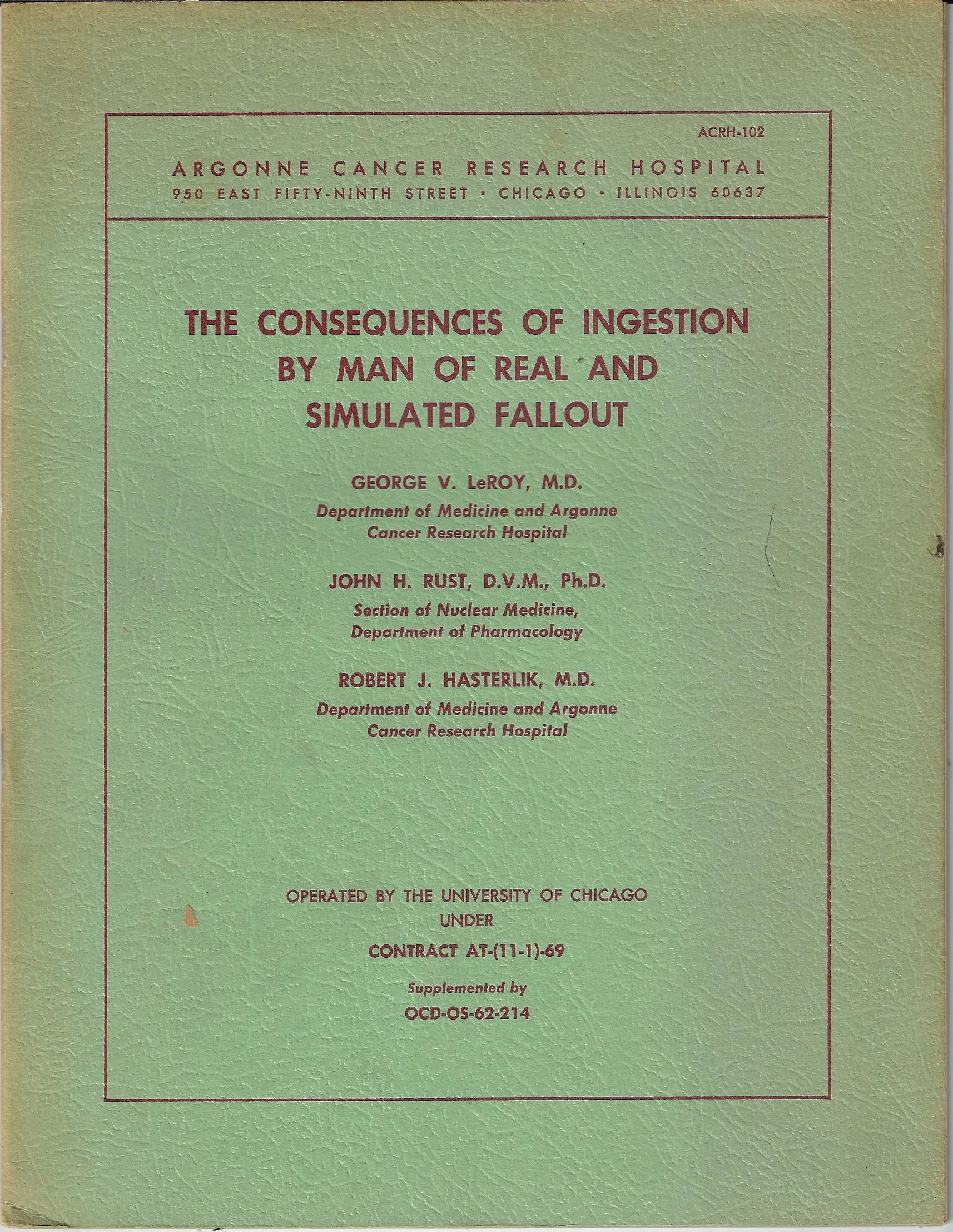
    The Consequences of Ingestion by Man of Real and Simulated Fallout.

    Atomic consequences ingestion(By LeRoy, George V. ; Rust, John H. ; Hasterlik, Robert J. Operated by the University of Chicago under Contract AT-(11-1)-69, Argonne Cancer Research Hospital, Chicago, 1963. 11×8″, 32pp. )

    I understand the need for the data and the research, but, still, it is a tough go, and no doubt a lot of unusual bits could be forced from the title. 

    From the paper: “Abstract-Real and simulated particulate fallout and solutions of Sr85CL2 and Cs134Cl2 were fed to 102 healthy volunteers. Absorption and retention of ingested radioactivity was measured by whole-body counting using the gamma-ray spectrometer at the Argonne Cancer Research Hospital. An average of 3 per cent of the radioactivity of week-old local fallout W~S absorbed: the range was 0-9 per cent. Strontium and cesium leached or dissolved from simulated fallout behaved in the same way, metabolically, after absorption as they did when the tracer was swallowed in a solution or injected intravenously. The large number of subjects studied provided additional information on the range of variation of intestinal motility, biological availability of strontium, cesium and barium following ingestion of fallout, and retention of the radionuclides of these elements.”

    [Sr85=Strontium Cs134=Caesium]

    Interesting set of descriptors used by the Defense Technical Information Center:

    • “Descriptors :   (*RADIATION EFFECTS, FALLOUT), (*METABOLISM, FISSION PRODUCTS), (*FISSION PRODUCTS, ABSORPTION), GASTROINTESTINAL SYSTEM, EXCRETION, NUCLEAR PARTICLES, RADIOACTIVE ISOTOPES, LABELED SUBSTANCES, TRACER STUDIES, ORAL, INJECTION (MEDICINE), DOSAGE, NUCLEAR RADIATION SPECTROMETERS, SOLUBILITY, CESIUM, BARIUM, STRONTIUM, SIMULATION, HUMANS.”

    ·Posted by :

    ·in:


  • The Car That Makes the Threat of Atomic Attack “Lose Some of its Menace” (1953)

    JF Ptak Science Books   Post 2687

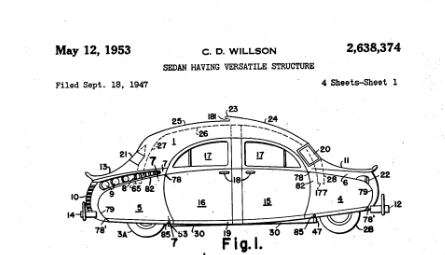
    Patent Atomic bomb car `953When i was a kid I watched a marionette-action show called Supercar–it had a high creep factor to it what with the marionette eyes and mouths and all, but I watched it anyway, I guess, because that was probably the only cartoon being broadcast at that hour. (It was filmed in “Supermarionation”, which utilized electric moving parts in the marionettes in addition to string controls. It was the brainchild of Gerry Anderson, who also brought you Fireball XL5 for which I can still sing the theme song.) And that is what struck me seeing the reasoning for this “atomic bomb car”–it really is just a car with a high creep factor that is outfitted for camping, but it is being sold in the patent as a ways for urban dwellers to survive the coming nuclear holocaust (” our greater areas of human congestion have slowly begun to face the threat of eventual atomic destruction”). Since we find the cost of reallocating everyone and all business everywhere in the US so that there is no real profile for nuclear attack because everything is spread out (or underground), it means that people in targetable cities are more or less doomed because they won’t be able to get out of town when the bombs come.

    [Image source: Google Patents, https://patents.google.com/patent/US2638374A/en]

    The author writes: “It is commonly acknowledged that the physical structures of congested areas are doomed once atomically attacked, The real problem is: how sensibly to save the lives of the inhabitants of cities thus marked for destruction and temporarily house them so that” the business of resistance may go. on in spite of the chaos engendered?”  And since U.S. citizens at the time owned 30 million cars, there was a potential to have 30 million bomb shelters (or  whatever) on wheels. (This is also the first time I have seen the phrase “atomically attacked”.)

    And then this, in classic patentese:  “The primary object of this invention is a practical means of implementing and temporarily maintaining mass diffusion from congested areas threatened with atomic attack, and in a manner related to proved public preferences, to mass production techniques and to prevailing trends”.

    “Yet, once some practical: i. e., simple and economically possible, means is found for making the average car quickly convertible to housekeeping use, then the threat of the atom bomb to our cities loses some of its menace. Once swift mass diffusion is properly implemented, it becomes susceptible to military organization. The city might be bombed, but its population could be saved.

    Anyway, the car is basically a camper, though it is still just a car. I’ve got to give the guy his credit because there are some interesting ways in which seats fold and are made into beds and tables and such.

    There’s enough in this patent to suggest that what we are dealing with is more than a simple salve me fons pietatis, that it is more than just a car with convertible beds that is renamed something like “High Speed Survival Encapsulator and Escape Vehicle”. And the vast dependent clause for the utility of this vehicle to save U.S. civilization is for (1) millions of people to evacuate a high-density location in an orderly fashion and given the time to do that in, and (2) there was no “2”. So, once you get fair warning and make your way out of the city in your bubblecar to the fresh countryside, loaded down with family and water and food and toilet paper for a few weeks and 10 cartons of cigges per person, you’d be on your way to surviving in Tomorrowland.  

    It is a Supercar–it just doesn’t fly, or doing anything particularly special. Probably though you couldn’t fit much else in there because it is already filled to the brim with audacity and hope, and a certain stink. 


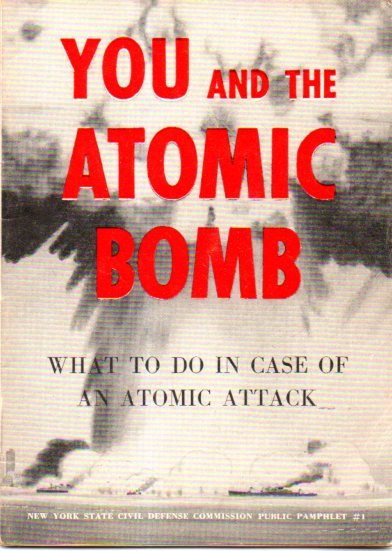
  • YOU and the Atomic Bomb (Again)

    JF Ptak Science Books  Quick Post

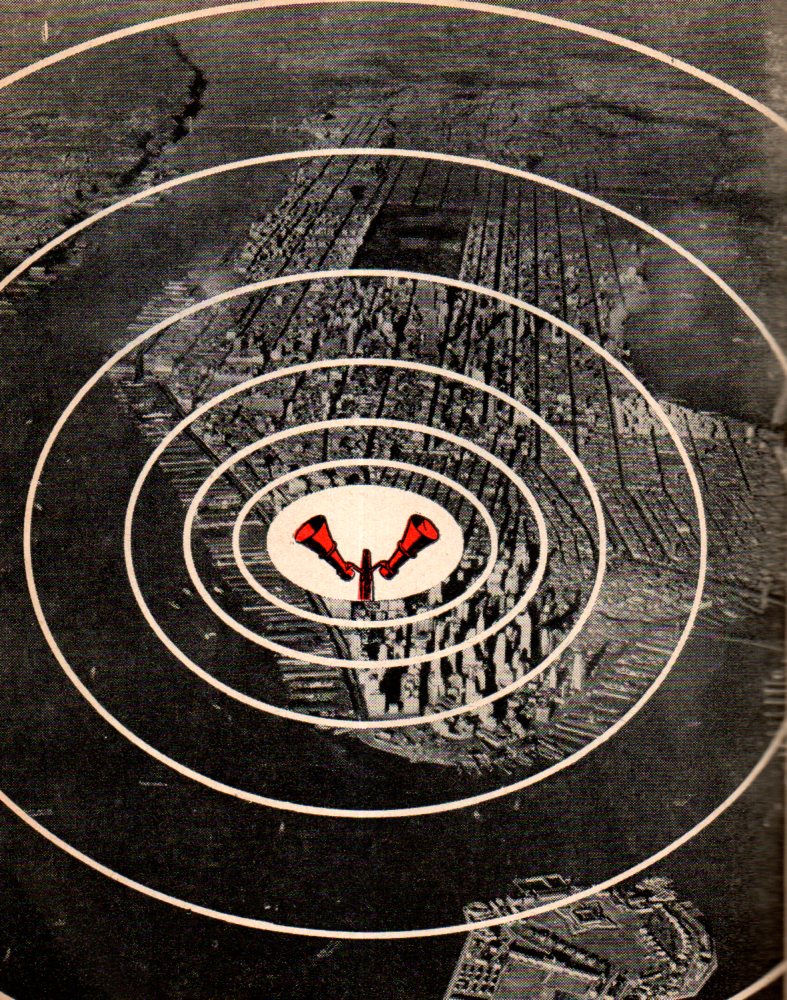
    No doubt there is some serious and useful information in this little undated (ca. 1945/6) pamphlet–mostly I guess its purpose was fulfilled in its attempt at softening the dread of nuclear holocaust in that there was actually something that could be “done” in the event of an attack.  It addresses the standard fears, and perhaps the standard fears of hope, though the pamphlet does paint a profile of possibility for a post-attack scenario that is, shall we say, a little optimistic.  In any event, I share this now for the graphics, and the Manhattan Destroyed map.  

    Atom bomb you and the737


    Of course there must be a map, but instead of the usual map of rings of destruction, this bird’s eye view was meant only to depict the effective range of an air raid siren–and it is not lost on me that the central red graphic is placed very near to the WTC site. (The first published map of the rings of destruction of an atomic bomb on any city of so far as I can tell appeared in the great PM newspaper the day after Hiroshima, showing what sort of effects the bomb would have on a profile not of Hiroshima, but of Manhattan.  As a matter of fact the entire issue of the ad-free newspaper was devoted to the bombing, Hiroshima receiving more (and better) coverage than in any newspaper reporting I have seen in the first week after the bomb was dropped.  I really have no idea how the paper was able to put together dozens of bright and informed pages of coverage in 24/36 hours after the event–except of course that those were some very smart people.)  

    Atom bomb you and the NYC map738