A Daily History of Holes, Dots, Lines, Science, History, Math, Physics, Art, the Unintentional Absurd, Architecture, Maps, Data Visualization, Blank and Missing Things, and so on. |1.6 million words, 7500 images, 4.9 million hits| Press & appearances in The Times, Le Figaro, Mensa, The Economist, The Guardian, Discovery News, Slate, Le Monde, Sci American Blogs, Le Pont, and many other places… 5000+ total posts since 2008.

Category: Atomic and Nuclear weapons

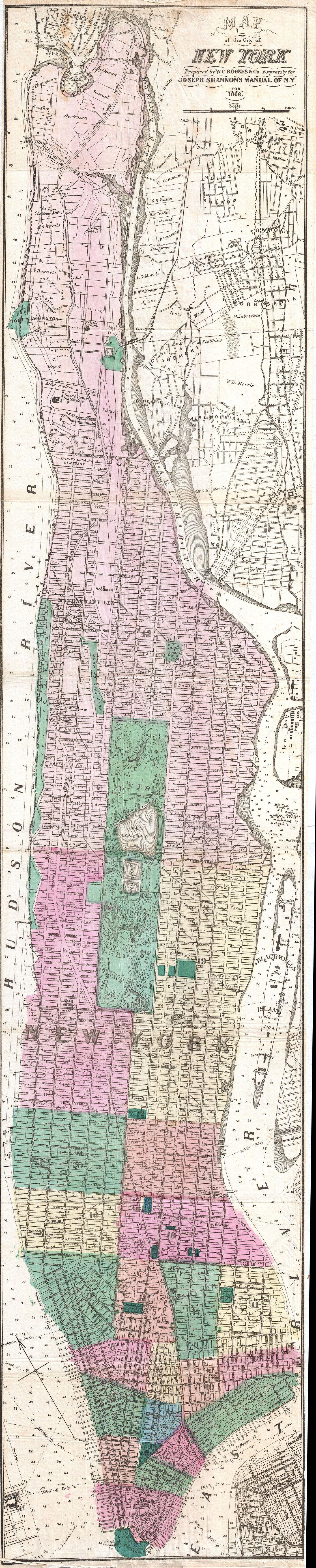
  • Tinian, the Manhattan Project, and Manhattan (1944/5)

    JF Ptak Science Books   Quick Post 

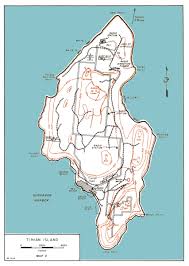
    As we all know Tinian Island was of a vast strategic importance to Allied War effort against Japan.  It sits just a few miles away from Saipan, and is situated close enough to Japan (1500 miles) to make the place an integral part of the advance on Japan as an airstrip.  The battle fought to control the island–in August 1944–resulted in it being taken by U.S. forces, the Japanese losing all but 300 or so of a garrisoned force there of 8500. Tinian became home to (among others) the 509th Composite Group, which was the home base for the bombing of Hiroshima and Nagasaki. It was the penultimate step of the fulfillment of the Manhattan Project–the last being the dropping of the bombs–and it struck me only very recently that after all of this time, it seems to me that Tinian bears a resemblance to Manhattan Island, which  makes for a peculiar irony. 

    Now that I have for the first time looked at a map of Tinian with street names, I see that this irony was deeply incised into the very earth of the place by Seabees, because when the plan of the city was laid out in the fall of 1944, the place received a gridwork of streets similar to Manhattan–and as a matter of fact, a number of the streets were named with Manhattan in mind: Broadway, Riverside Drive, Canal Street, 42nd Street, Wall Street, Canal were there and named, and even for the north end of the island, the major road leading out was named Saw Mill River Parkway, which is what I would drive leaving the city for Great Barrington, Ma. I don’t know why I am so very late to this party, but I am.  If you’ve not noticed this before, join the club, and enjoy.  (See here for a clearer map of the Tinian street names: http://www.pacificwrecks.com/provinces/marianas/maps/tinian.html#axzz4HjqvMu1w )

    Tinian Tnian manhattan


  • Computers, Nuclear War, and Afterwards (Full text document, 1964)

    JF Ptak Science Books   Post 2628

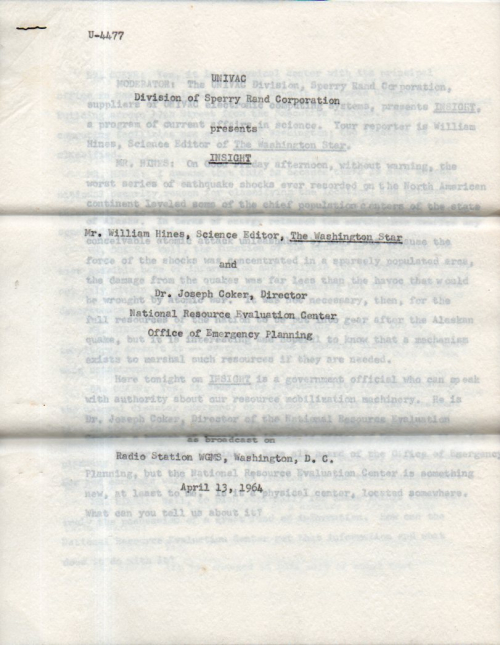
    This title may sound overly dramatic, but it really isn’t. As part of the Mutually Assured Destruction game plan there was an absolute necessity for calculating the leftovers from a nuclear exchange in order to convince the aggressor nation (which of course in 1964 would be the Soviet Union) that in spite of massive destruction the U.S. would be situated to carry out acting as a government/society/military in the post-war world. Part of figuring all of that out would entail a massive amount of bean counting for personnel, materiel, natural resources, and so on in a nearly endless list of stuff that runs the U.S., and then figuring out where it all was, and how it would/could be affected by a nuclear strike at XX locations, and that with different yields, and weather patterns, and so on, on into the night, of how a nuclear attack of x-capacity would affect the tactical and strategic and social base of the U.S.  So you’d have to gather all of that data, and then lay it all on in XX scenarios that would all be played out in computer simulations.  

    And that is what this interview is all about–explained on the radio to a general listening audience by Joseph Coker, who was at the time chief of the NREC (the National Resource Evaluation Center). All of this made its own crazy sense, and all of it had to be done, running both towards and away from the black hole that did and didn’t exist.  

    UNIVAC Coker544


  • Artwork for Detecting Nuclear Explosions in Outer Space (1960)

    JF Ptak Science Books   Quick Post

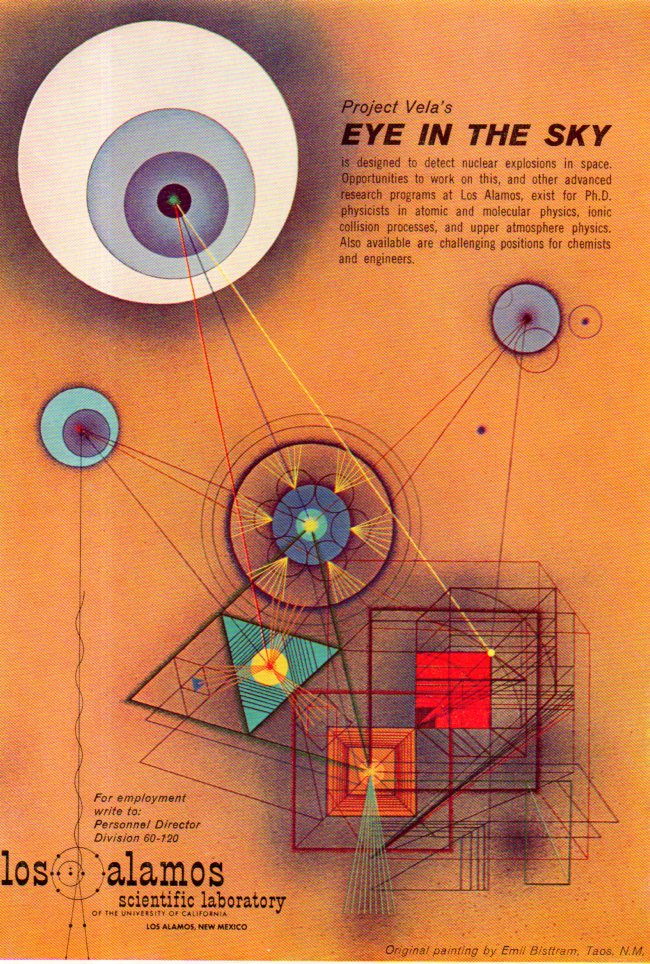
    I do not have the source for this though I believe it is from Science Magazine from 1960.  The ad was placed LANL looking for new hires, and employed the artwork of Emil Bisttram (Taos, New Mexico), representing the new ARPA (pre-DARPA) work for the detection of nuclear explosion tests conducted in outer space, Project VELA.  (“In a continuation of presidentially directed programs, Eisenhower assigned ARPA in the summer of 1959 the task of developing the technologies necessary for the detection of nuclear tests, what would become Project VELA (Vela means watchman in Spanish). This program would examine technologies for detection space and atmospheric tests by satellites (VELA , undertaken by the High Altitude Detection panel (the Panofsky panel) of PSAC, which recommended that a satellite system be employed to detect atmospheric or space nuclear tests as part of a verification system for a possible nuclear test ban treaty.”–“DARPA Space History”, here: http://qnet.me/legal/DARPA%20-%20Background.pdf

    Ads  VELA371


  • What Happens After a 1,667 Megaton Nuclear Attack (1962). Happily, The Board of the Federal Reserve Survives!

    JF Ptak Science Books  

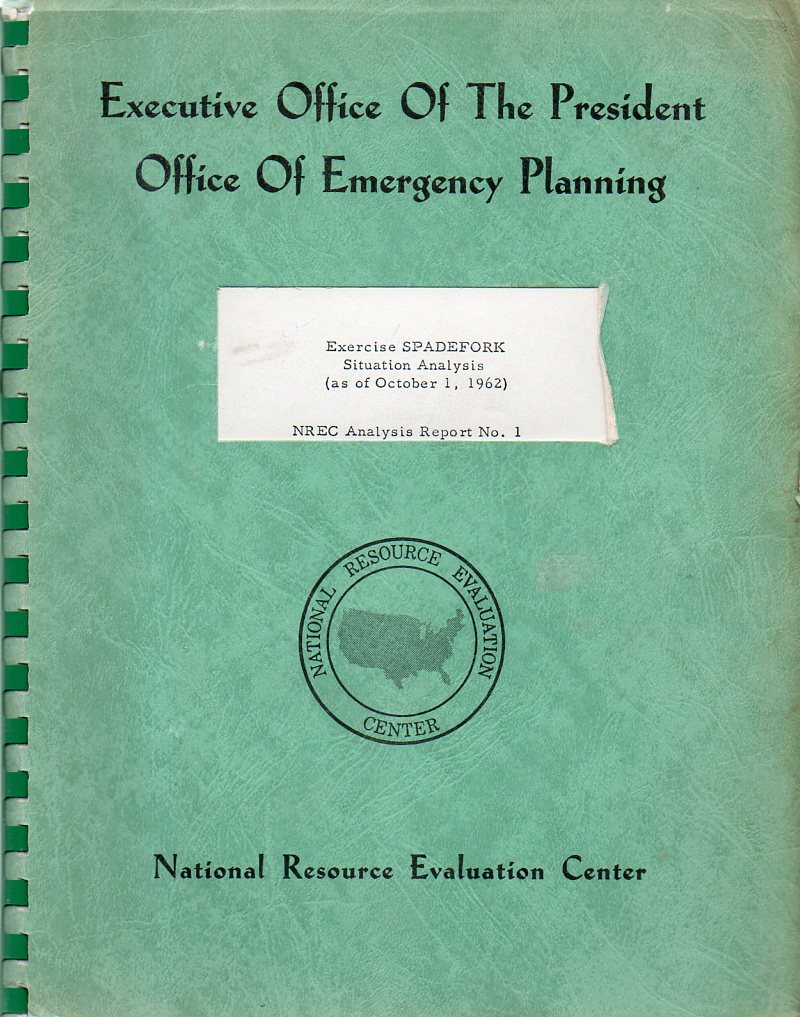
    This report on Exercise Spadefork was issued at the very beginning of the Cuban Missile Crisis on October 1,1962. Undertaken by the National Resource Evaluation Center (NREC) and other agencies it was supposed to give a good indication of what happens after a very large nuclear attack on the United States, “Measuring the Capability of Survival”, evaluating what remains of the country and its sovereignty.


    Spadefork797The theoretical attack began at 3pm, Friday 21 September 1962. 221 nuclear missiles were exploded in/over the U.S. In the first hour, with a total of 355 in the first 48 hours. [I’m not sure that the Soviet Union had 221 intercontinental ballistic missiles at this time, nowhere near that, unless of course they were able to get their 700-missile medium-range ballistic missiles closer to the U.S.]

    A total of 1, 779 megatons were exploded almost equally between ground and air bursts.

    20 were 1 megaton; 15 were 10 megaton, and 320 were 5 megaton.

    • The Hiroshima weapon was about 20 kilotons, so in the roughest sense each one of the 5 megaton weapons carried about 250 Hiroshima weapons; the total 1,779 megaton delivery would (grossly) be equal to about 178,000 Hiroshima weapons.

    Most of the attack was delivered against military sites, “population and industrial centers appeared to be secondary targets, with only about 50 major centers receiving signifcant amount of blast damage”. Somehow “no major sections of the country were isolated due to fallout contamination”.

    How we make out:

    Military & “Sovereignty”: not so bad. Air Force and Navy take major hits (something approaching 50% casualties) but the Army does better, not being targeted so heavily, with 20% losses.

    “While our sovereignty is preserved, there are some troublesome areas” (page 10), the very first notice being that “over ½ of the federal civilian personnel are available to work but with only ¼ of the actual floor space in about half of the offices normally functioning”.

    And by the way “our normal Federal headquarters at Washington, D.C. Is severely damaged and completely out of operation”. The “headquarters” being, basically, downtown D.C.

    Federal workers out in the country away from D.C. fared better.

    Communications: in this report 80% of pre-attack telephones and 95% of pre-attack central stations…[would] be in service and have access to toll routes”.(pg 15) though “no route [would be] intact for transcontinental or through north-south traffic”.

    Radio does better at night: “it is evident that heavy damage to radio stations will leave some areas with little or no daytime coverage, but night time coverage should still be good”.

    Finance: “sufficient banking capacity has survived to support the surviving productive capability…the Federal Reserve System, though badly damaged, is in a position to support surviving banking institutions”.

    One third of the $18 billion held by the Fed has been destroyed…though there will be enough currency in circulation “for a reduced level of economic activity, although there may be some local shortages…”

    One-half to two-thirds of the commercial banking system survives.

    The board of the Federal Reserve also survives.

    Population: 21 million die either immediately or shortly after the attack from blast effects, with 13 million dying from fallout, making the total 34 million. 17 million are injured and expected to recover. 135 million do not have a significant injury. 51 million total. Most of these are in big cities, though we see that the states of MA, WA, VT, TN, Wva, OR suffer 42%-49% casualties, CT, MO, IL, MI, DE, NY, CA, OK, TX, LA, KS, NM, OH all suffer 30%-38% casualties. D.C. Leads away with 88% casualties.

    Medical: a big topic dispensed with in two sentences (and to be read while whistling a happy tune), and which seems to make little sense at all when discussing injury rates in the 2 million range and their treatment. In shorter than the shortened story, all inventories of medical supplies “could priovide for needs for the first 25 days. Deficiencies would occur on many items…”

    No mention of medical personnel or facilities survivability is made.

    Somehow though 70%-95% pf drug and pharmaceutical companies survive and operate, though the manpower is down 25%. How this occurs when so many of these places are located near large cities that have been decimated, I do not know.

    Food: the report assumes that food stocked “in the home, the retail store, and the small wholesaler would be sufficient to meet local needs for 30 days…” I think everyone has seen what happens to food and toilet paper when a snow storm threatens. Also grain mill products, sugar factories, production of fats and oils, meat/dairy/bakery services would be 40% available after 30 days.

    About 50% of “lands in farms and 46% of crops harvested” would be available immediately. By D+30 88% would be available.

    Leading the way for operations under “non-emergency conditions” is tobacco, 91.6% of farms being available after 30 days. Fruit and nut and vegetable production is last at 75% after 30 days. 

    Housing: it is calculated that on a nationwide basis that “housing will not constitute a major problem from the standpoint of requirements for materials and manpower”. Most of this evidently is accomplished by doubling-up occupancy “from pre-attack levels of .65 persons per room to 1.26”.

    “Early decisions as to investment in physical plant will great effect subsequent GNP”.

    21% of steel and 34% of all industry (?) is available immediately after attack, the numbers jumping to 55% and 52% with emergency effort after 90 days, with the balance “denied w/o major repair or decontamination”.  

    Part of the report concentrated on how dependable the data are, and how reliable the interpretation was .  In summary it seems to my reading that the exercise showed fairly accurate information, and given the massive attack that the sovereignty (measured in terms of governance and military capacity) and the capability to survive (meaning financial structure, production, industry, population) remains basically intact even given large amounts of destruction. The bottom line is that the country survives and gets on with life. The report has nothing to do with the U.S. response, or the outcome of the war.

    The Nuts & Bolts: 

    Exercise SPADEFORK Situation Analysis, printed by the Executive Office of the President, Office of Emergency Planning.  1962.  11×8″. This report on Exercise Spadefork was issued at the very beginning of the Cuban Missile Crisis on October 1,1962. Undertaken by the National Resource Evaluation Center (NREC) and other agencies it was supposed to give a good indication of what happens after a very large nuclear attack on the United States, “Measuring the Capability of Survival”, evaluating what remains of the country and its sovereignty.   It is odd that even though this document received a small circulation there is only one copy (at the U.S. Army Heritage Center library) located in the massive database, WorldCat/OCLC.  You can own this report for  $750
    ·Posted by :

    ·in:


  • In the Comics: NYC Destroyed in “Atomic War”, 1952/3

    JF Ptak Science Books  Post 2580

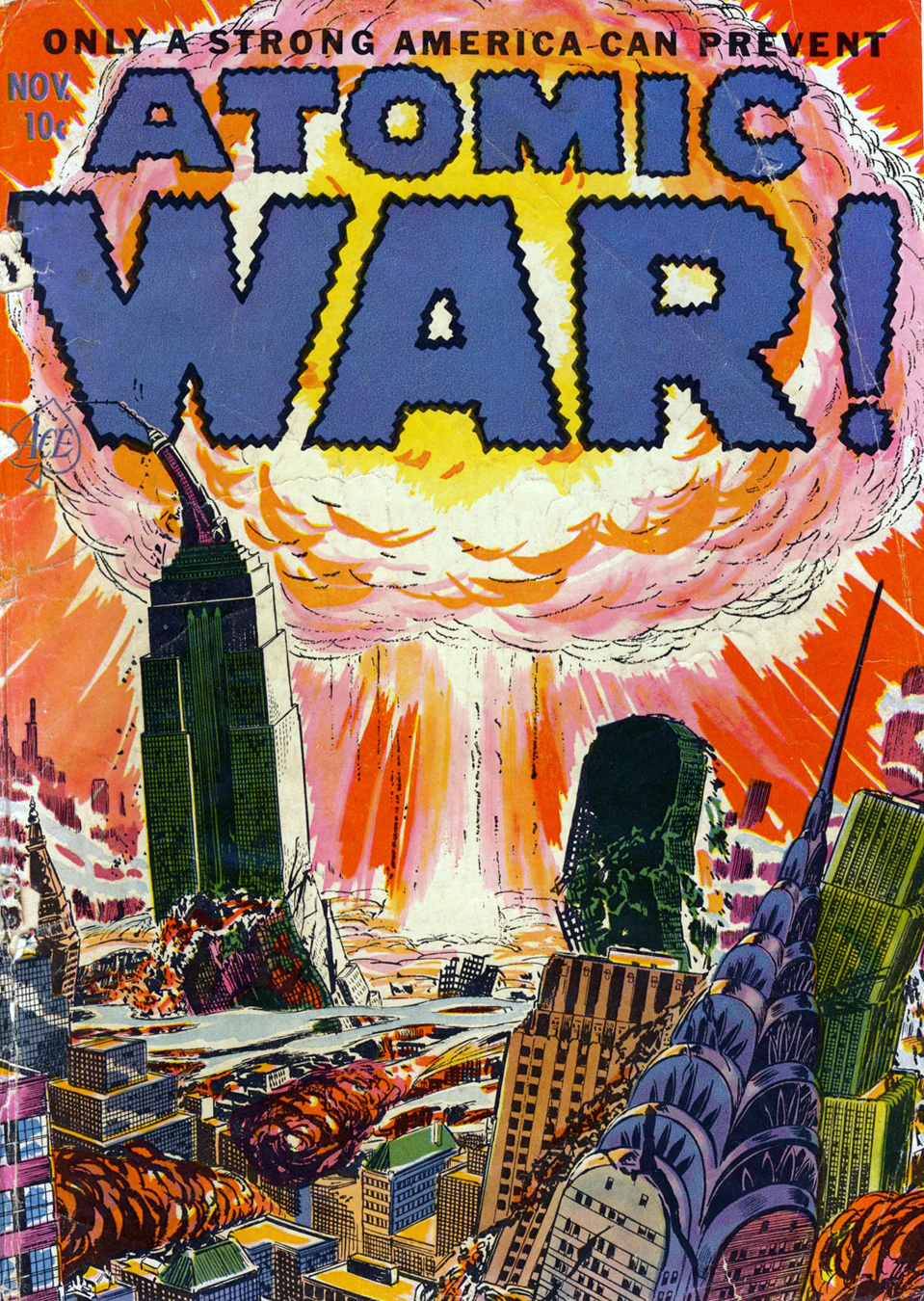
    I have been collecting images of destroyed Manhattan since this blog was started, and at this point there must be two dozen pre-1965 images. Mostly they are located in the Atomic/Nuclear Weapons series, as well as A History of Blank, Empty, and Missing Things, and lastly in the History of Holes series, all of which are browsable in the right-hand “categories” column.

    Today I’ll add two very strong Cold War images that leave no bit of interpretation to chance.  The first is a cover story for a four-issue short-lived comic called Atomic War, which was published in 1952 to 1953.  There is an enormous amount of red-baiting–no surprise given the period–and we find the Soviets initiating several varieties of preemptive strikes, including one in West Berlin in 1945 (the Soviets didn’t get the bomb until 1949). In any event it is a very strong push to patriotism and Red-hatred aimed of course at kids. No doubt an 11-year-old seeing this cover at Christmas time 1952 would remember it.  

    Atomic war nyc

    [Source: http://falloutshelternyc.blogspot.com/2011_02_01_archive.html. Another image source with some history:  Wiki  http://en.wikisource.org/wiki/Atomic_War!]

    The second piece is another example of indelible impression possibilities. a very disturbing cover showing the effects of a nuclear attack on Manhattan, which turns pretty much all of midtown into a hole–a hole that was starting to fill up with the Hudson River:

    Atomic weirdness NYC nuked[Cover by Al Feldstein, January 1952. Source: http://atomik67.altervista.org/COMICS-EDITORI/EDIZIONI_001/WEIRD_FANTASY-DOCUMENTI/Fantasy_Crono.htm]

    ·Posted by :

    ·in:


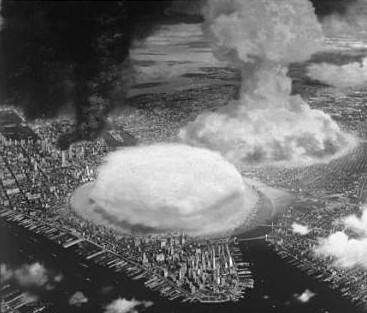
  • Mushroom over Manhattan: A-bomb Strike Images of NYC, Chicago, Seattle…1945-1958

    JF Ptak Science Books  Quick Post

    I’ve written perhaps 100 posts for the History of Fission and Nuclear Weapons series on this blog, and in that I’ve collected a number of (pre-1960) images showing a nuclear explosion over specific, recognizable U.S. cities. Some of these came as a result of Cold War propaganda, others were used to show the effects of the bomb on a familiar profile.  I’ve not put them together in one post before, so I thought to do it now.  (The very first image of any sort of nuclear weapon published in the popular press showing its effects on a U.S. city appears in PM newspaper, 7 August 1945–as I’ve said before, I have no idea how these folks put together such a comprehensive issue in the day+ after the Hiroshima bombing, but they did).

    Here are the U.S. cities I’ve collected so far–the majority of them are New York City, mainly because it has the most recognizable features making it easier for a broad spectrum of readers to understand the destructive force of the bomb(s).

    Manhattan, Collier’s Magazine, 1948

    Atomic bomb US cities Manhattan


    Seattle, 1955:

    Civil Defense Manual front cover, circa 1955:

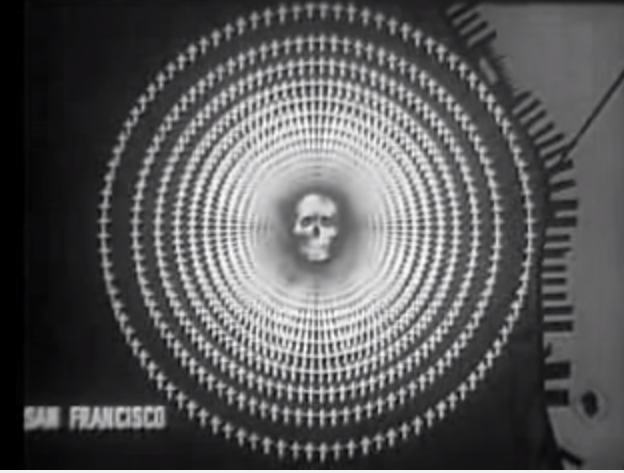
    Not a mushroom cloud, but the only thing I have for San Francisco:

    Atomic bomb cities sfMovie still from “One World or None”, 1946.   https://youtu.be/u6ORe_tHYXU
      

    ·Posted by :

    ·in:


  • Atomic Jello and Henry Darger

    JF Ptak Science Books  Post 2566

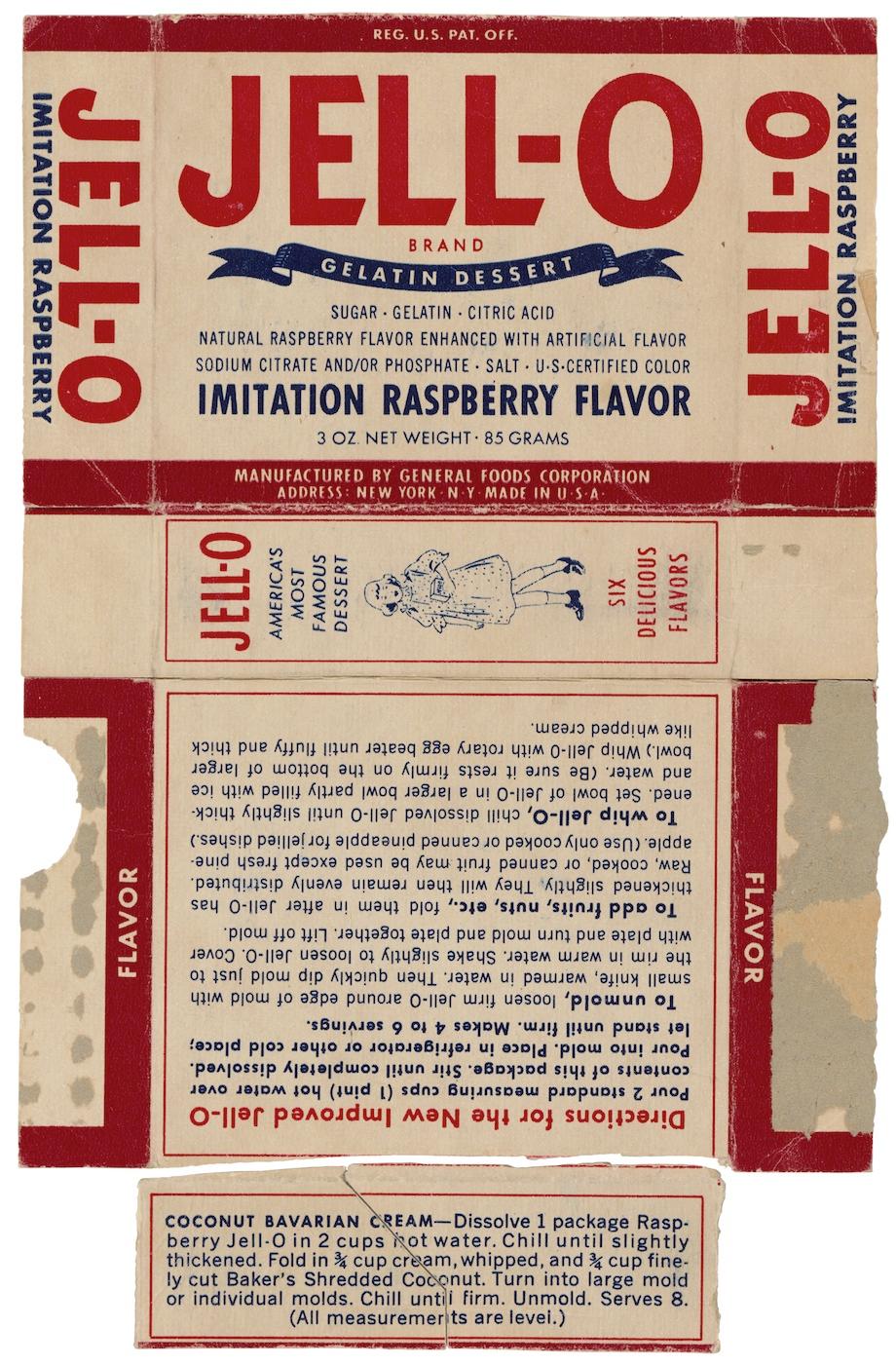
    Atomic Jello two point oneJello is a powdered gelatin formed of collagen, a cocktail of peptides and proteins from pig skin and cow bones, and “ready to eat”. 

    It is also basically what glue is.

    It is the “glue” part of this thing that brings us together here, to tell a story of atomic bomb secrets given to the Soviets and the U.S. traitors who made it happen.  

    The story of Harry Gold, David Greenglass, Ethel and Julius Rosenberg has been told countless times, and in some of them the hook for the story was this box of Jello. The Jello box was cut in half, and used as an innocuous way for Gold and Greenglass–who each possessed one half of the box–to match up, signifying that each man was communicating with his proper counterpart.  Why they thought it was innocuous to be walking around with Jello box parts in their wallets is not known, but they used it successfully, and under this cover of establishing their identities, they carried on their work.

    As I said, it is an old story. Back in the mid 1980’s when I thought I wanted to be a journalist one of the stories I dredged up was this one, and I tracked down the Rosenberg kids and interviewed them, and the janitor who cleaned up after the Rosenberg’s deaths in their execution in Ossining, and even to the Rabbi who was probably the last person to see them alive.  The story for them gets pretty weepy, and convoluted, but not so much anymore after you read the Venona transcripts regarding them.  And that pretty much tells the story, I think.

    Anyway, their stories are best told by others elsewhere.  

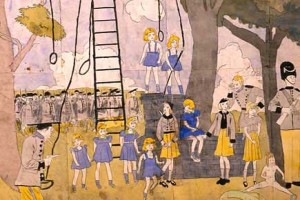
    All I wanted to do here was make the passing note that the girl on the Jello box has some resemblance to the girls populating the artwork of Henry Darger, the bleak, fabulous, impossibly-driven Outsider with what was probably a complicated and terribly unsavory fascination with young girls.   

    I don’t know if this is the exact type of Jello used by the conspirators, though this is what was entered into evidence at the trials of these people, a “replica” of what was believed to be the box, but it is good enough:

    Atomic Jello two[Source: National Archives, here: http://blogs.archives.gov/prologue/?p=4655]

    Here’s is an example of the (clothed) Darger Vivian girls. I know, I know, he is perhaps one of the great three/four great icons of Outsider art in the 20th century, but all I take away from him is a sense of very very complex creepiness:

    Darger girls

    [Source: http://www.chicagostagereview.com/the-most-conceptually-encompassing-production-of-2008-%E2%80%93-as-told-by-the-vivian-girls/]

    • See an earlier post of mine on Henry Darger and the Campbell Soup Playhouse Schoolroom for Kids, here:  https://historyofideasblog.com/thesciencebookstore/2012/09/henry-darger-and-campbell-soups-kids-playitme-schoolroom-1955.html

  • On Bombing Everything in Japan with Atomic Bombs, 1945

    JF Ptak Science Books  

    Atom bomb 720
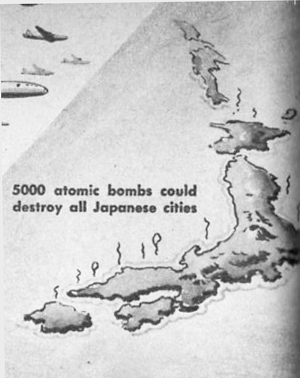
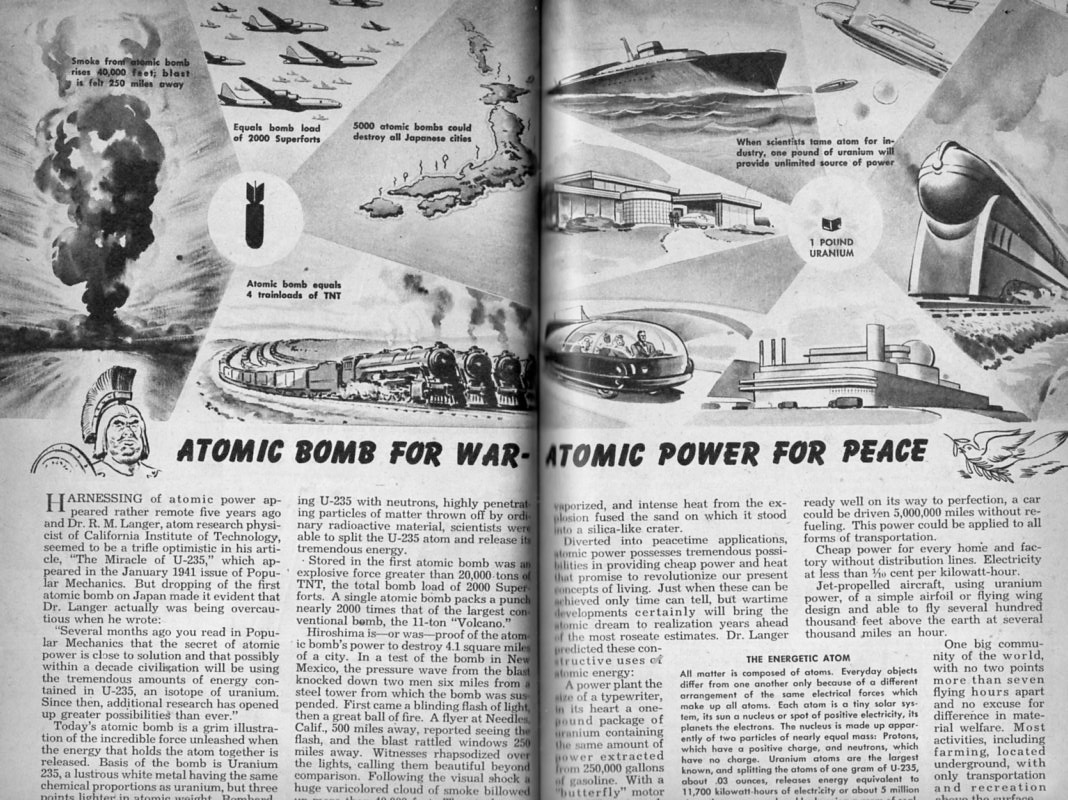
    The October 1945 issue of Popular Mechanics carried a story “Atomic Bomb for War / Atomic Bomb for Peace” as a reminder to its readers that the vast destructive power of the atomic bomb was just one example of what nuclear power might be–and that there could be incredible and wide-reaching benefits of the process for peaceful uses. This work came about eight weeks after the bombings of Hiroshima and Nagasaki, and seems to be only the second post-use story on the weapon in this magazine. The article does mention a prescient piece (“The Miracle of U-235”) published in January 1941 in Popular Mechanics by physicist R.M. Langer1 (CalTech) which extolled the future possibilities of the energy/power potential of nuclear energy, which is really what the present article is all about.  Except of course for the 5,000 a-bomb total destruction of Japan analogy, which is an odd thing.

    Atom bomb 719
    Half of the article’s illustration is dedicated to military applications of atomic energy, and the other to the peaceful; and in the upper-middle of the military side we are told that if necessary that every city in Japan could be completely destroyed with “5,000 atomic bombs”.  The truth of the matter is that a great percentage of the major  (and minor-major and major-minor) cities had already been pretty much decommissioned. (Just weeks before the bomb came the massive firebombing of Tokyo–334 of  General Curtis LeMay B-29’s were loaded to utmost capacity with the newly-conceived M-69s bomb, an incendiary so vicious  that the fires it produced were all but inextinguishable.  The B29’s bombed Tokyo for hours, killing 100,000+ people and making over a million homeless.)  And so I’m not sure what the message was, here, except to establish that the complete destruction of a city with weapons dropped from planes was now a possibility.  It was probably right at about this point that this idea became a real possibility–and so to for its extension, that given enough of these weapons, that the entire world could be bombed out of existence.

    Notes

    1. Langer wrote an earlier piece in 1940 for Colliers which was a more sugary version of the Popular Mechanics Article. In this one he hypothesized that uranium would basically fuel life–it would be a fuel source so cheap to produce that it wouldn’t make economic sense to charge for it (?). It was the seed of peace that would lead to Utopia and eliminate wars.  This was Langer’s popular side–he did in fact work and publish through the 1930’s on the fission issue; his vision of the future though were a little overly-optimistic.  

    ·Posted by :

    ·in:


  • The Preliminary Tower at Trinity, 1945

    JF Ptak Science Books   Quick Post     Part of the series on Atomic and Nuclear Weapons

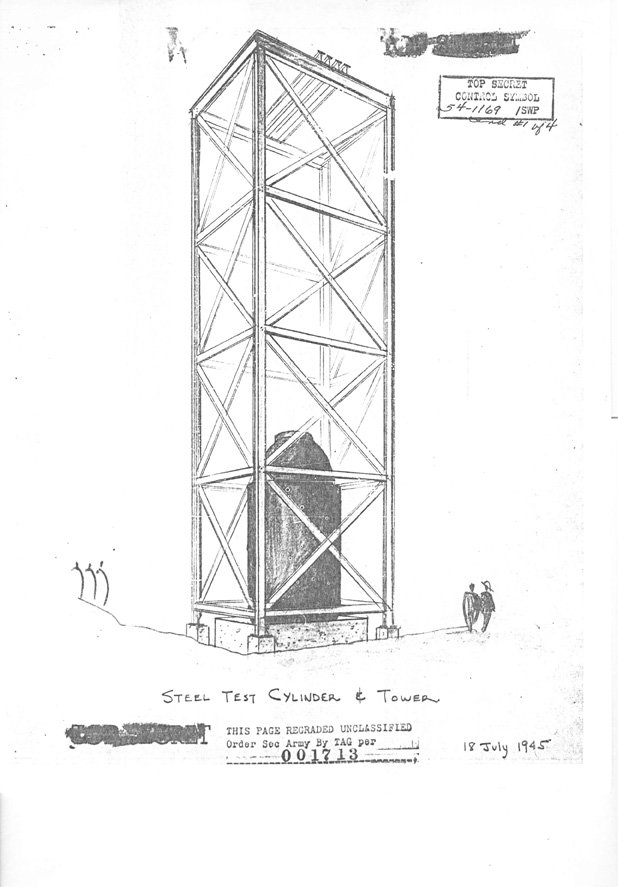
    Here’s an interesting formerly Top Secret document from the Lee Groves collection of the George C. Marshall Foundation:

    Atomic bomb tower Groves archive

    The document is dated two days after the Trinity test of 16 July–I presently do not know why this is so.  

    “The sketch is of a test cylinder procured and installed at a time when we were uncertain as to the explosive power of the bomb. If, at the time of the test, we anticipated that the force might be relatively small or even that there might be no nuclear explosion, we were going to place the bomb in the cylinder so that it would be possible to recover the plutonium.”–Marshall Foundation, below. 

    The cylinder/container for the bomb was called “Jumbo”, and was 25’x10′ and 214 tons–a big thing.  It was decided at some near point that “Jumbo” would not be necessary as it became evident to many that the bomb would indeed “work”.  “Jumbo” and the tower were constructed and ready but abandoned for their intended purpose–it was left to stand, about 800 yards from the point of explosion; afterwards, “Jumbo” remained intact but its steel tower was completely destroyed. 

    Source: the George C. Marshall Foundation: http://marshallfoundation.org/library/documents/steel-test-cylinder-tower-july-18-1945/#sthash.ccG8PSRb.dpuf

    Thanks to Gene Dannen at www.dannen.com for the lead on this.  

    ·Posted by :

    ·in:


  • When Having Hope in Hopefulness is Helpless: Nuclear Protection, 1960

    JF Ptak Science Books     Post 2517  

    I’ve written on this blog earlier on the creation of Atomurbia–the dissemination of U.S. industry and population centers more-or-less evenly, and remotely, throughout the country to decrease targeting liability, “employing distance as defense”. There were different flavors of this plan, from the gargantuan to less-so, but no matter how this is idea is presented, on virtually any level, it was. of course, a Big Plan. It was so very big that it was even hard to talk about–the thing seemed just too big, and impossible, for discussion beyond generalities.  

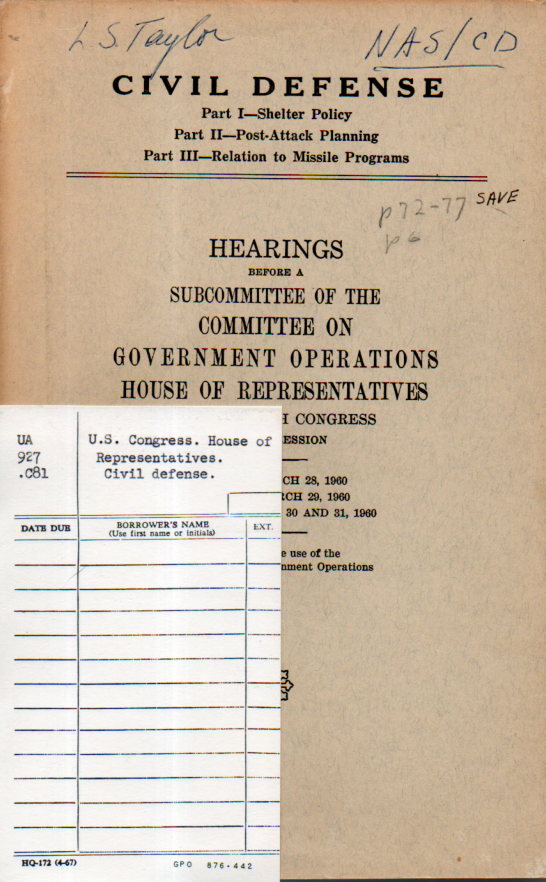
    Atomic  Taylor Atomurbia112I found some language in a Congressional hearing on civil defense for 1960 that addresses and undresses the issue of “dispersal”. In “Part II–Post Attack Planning” of these hearings1 there is a discussion of “dispersion”, and what it is and is supposed to do, but there is ultimately a monumental shrug about this Enormous Situation, and a recognition that “there is no active program of dispersion” (pg 102).  This in the face, evidently, of at least part of the dispersal plan being the Federal Government’s “responsibility of carrying out out the national policy of dispersal in locating new or major expansions of essential facilities in accordance with defense mobilization order I-19”.  

    I’ve wondered how such a plan would come into being–I mean the impossible move everyone everywhere plan–but did not know about this I-19 plan that actually made the dispersal of new national-interest industries a governmental responsibility.

    The hopelessness of implementation of such a nightmare is spelled out pretty well in this bit, on the same page 102: “The objective of industrial dispersal can only be achieved when industrial and economic factors contribute to this purpose”.   A statement like this is so large and bland and intractable that it really says nothing, except that if the effort and the money was there, then the dispersal plan could possibly be achieved.

    The report continues, “It indicates a desirable goal but there is no program here”. 

    Leo A. Hoegh (former governor of Iowa and speaking to the CD issues as the first director of the Office of Civilian and Defense Mobilization) makes the case that there is dispersal going on, but as a natural element of industries looking to “get out of the marketplace”, and brings up the growth of new industry in Iowa as an example, which was really pretty ingenuous, and he is held accountable to that thinking by Congressman Chet Hollifield (Ca.) who basically says, “Oh, come on….”

    Mr. Hoegh responds: “The thing is, we are interested in dispersal and we are urging it”.

    Mr. Holifield: “There has been no dispersal”, he said, there has just been growth. “None of your industrial centers…have decreased”. 

    Mr. Hoegh: “We are still desirous to have dispersal”. 

    According to the borrower’s card in the pocket at the rear of the book, it was never borrowed. That doesn’t mean that it wasn’t read–just that it wasn’t overnight reading.

    Notes:

    [For those keeping track of such things the “L.S. Taylor” on the front cover of this hearing was Lauriston S. Taylor,  (1902-2004), pioneer in radiation measurement, radiation protection, and health physics.)

    1. Hearings before a Subcommittee on the Committeee on Government Operations, House of Representatives, Civil Defense (Parts I-III); March 28-31, 1960, 573pp.