A Daily History of Holes, Dots, Lines, Science, History, Math, Physics, Art, the Unintentional Absurd, Architecture, Maps, Data Visualization, Blank and Missing Things, and so on. |1.6 million words, 7500 images, 4.9 million hits| Press & appearances in The Times, Le Figaro, Mensa, The Economist, The Guardian, Discovery News, Slate, Le Monde, Sci American Blogs, Le Pont, and many other places… 5000+ total posts since 2008.

Category: Art History

  • A Note on Explaining Impressionism as a Result of Astigmatism (1872)

    JF Ptak Science Books  Post 2907  (Overall Post 5116)

    Years ago I wrote short post here on the influence of eyesight and modern art, something along the lines of Impressionism owing itself to artists with poor/uncorrected vision. It was along the lines of alien outer space space aliens determining that for the USA the most revered object in society was what we called “automobiles”–we feed them, wash them, take them out for exercise, work long hours to afford them, get them regular checkups plus occasional doctor visits, etc.–and so in this light Impressionism is born of astigmatism by an artist who thought that their color symphony was what everyone was seeing, and not just a product of their poor eyesight, and lo! a revolution in imagination is created.

    After this bit the subject really never came up…until last night, when I happened on a story by Richard Liebreich in several 18721 articles in the early years of publication of the great science journal, Nature. Between an article on the new Yellowstone Park and another on adaptive coloration of mollusks is “Leibreich on Turner and Mulready”, and on the face of it there’s not much in the title to excite an interest, unless you knew that the first name was that of a celebrated ophthalmology person, suggesting something-or-other in the science/art realm. This appearance is a report on Liebreich’s lecture to the Royal Institution on 8 March 1872 “On the effects of certain faults of vision on painting, with special reference to Turner and Mulready”, the title here getting straightaway to the point, which was basically explaining the creation of Impressionism due to abnormalities in artistic vision.

    Liebreich (1830-1917) was a fine anatomist, an artist and sculptor, an assistant to one of the 19th century’s greatest minds in von Helmholtz, creator of his own ophthalmoscope, and creator of the first atlas of ophthalmology, and so had the chops to look deeply into the possible physiological aspects of vision. He applied this talen to the pre-Impressionist JMW Turner, and evidently found that was people find to be genius in Turner was to Liebreich the possible result of astigmatism. He writes:

    • “It was particularly important to ascertain if the anomaly of the whole picture could be deduced from a regularly recurring fault in its details. This fault is a vertical streakiness, which is caused by every illuminated point having been changed into a vertical line. The elongation is, generally speaking, in exact proportion to the bright- ness of the light; that is to say, the more intense the light which diffuses itself from the illuminated point in nature, the longer becomes the line which represents it on the picture.”

    Giving Liebreich the benefit of the doubt here, it should be noted that when he was working this out in 1871/2 Impressionism was still a very young idea, and Turner (1775-1851) was already dead for 21 years. His access to other examples of Impressionist works was no doubt extremely limited, as the first exhibition of Impressionist painters was still two years away in 1874. (This show displayed works by Degas, Monet, Pissarro, Renoir, Cezanne, Sisley, Morisot and others, and resulted in sales of only 1000 francs for Monet, 200 francs for Renoir and Cezanne, 130 francs for Pissarro, with Degas and Morisot selling nothing. The second exhibition—two years later in 1874—would do a little better.) Anyway my guess is that there wasn’t much for Liebreich to compare Turner to, and so relied on his interpretation of physiological evidence to explain Turner’s revolutionary depiction of light and form. I’ve wondered what people tried to make of Turner in the 1830s—now I know a little of that story, from a little later on. Liebreich writes:

    • “Everything that is abnormal in the shape of objects, in the drawing, and even in the colouring of the pictures of this period, can be explained by this vertical diffusion of light. Till the year 1830 all is normal [re Turner]. In I831 a change in the colouring becomes for the first time perceptible, which gives to the works of Turner a peculiar character not found in any other master. During the last years of Turner’s life this peculiarity became so extreme that his pictures can hardly be understood at all.”

    He does defend Turner from folks who simply see his work as “deranged”–it isn’t, as the “derangement” is just the result of the artist rendering exactly what it was he saw, which was a twisted version of what everyone else was viewing, though it was beyond his control.

    " It is a generally received opinion that Turner adopted
    a peculiar manner, that he exaggerated it more and more,
    and that his last works are the result of a deranged intel-
    lect. I am convinced of the incorrectness, I might almost
    say of the injustice, of this opinion. According to my
    idea, Turner's manner is exclusively the result of a change
    in his eyes, which developed itself during the last twenty
    years of his life. In consequence of it the aspect of nature
    gradually changed for him, while he continued in an un-
    conscious, I might almost say in a naive manner, to re-
    produce what he saw. And he reproduced it so faithfully
    and accurately, that he enables us distinctly to recognise
    the nature of the disease of his eyes, to follow its develop-
    ment step by step, and to prove by an optical contrivance
    the correctness of our diagnosis."

    Liebreich ends another version (appearing in the first volume of Popular Science Monthly, NYC) two months later in June 1872:

    • “It would be more important to correct the abnormal vision of the artist, than to make a normal eye see as the artist saw when his sight had suffered. This, unfortunately, can only be done to a certain extent.”

    This is a complicated story and I’m just making a note of it here. Liebreich overall—I think—makes a defense for understanding and even defending Turner as a fine artist who does not have control over his painting field because of a visual impairment, rather than a revolutionary artist introducing a new way of representing the world.

    A few weeks later a response by W. Mattieu Williams2 appears in Nature in which he conducts some of his own experiments, and finds that some of the Turner imagery were results of deformation in the crystalline lens and of prolonged exposure to the Sun and viewing a scene through excessive tears.

    • “The other phenomena represented by Turner are, I think, simply a faithful copying of the effects of glare and suffusion produced by painful sun-gazing and the looking at a landscape where the shadows are, so to speak, nowhere, or all behind one’s-back.”

    Liebreich lived to 1917, which means that he was able to see the full development of Impressionism and then of non-Representational painting. I wonder how his opinions changed when when seeing Braque and Kandinsky and all he rest…

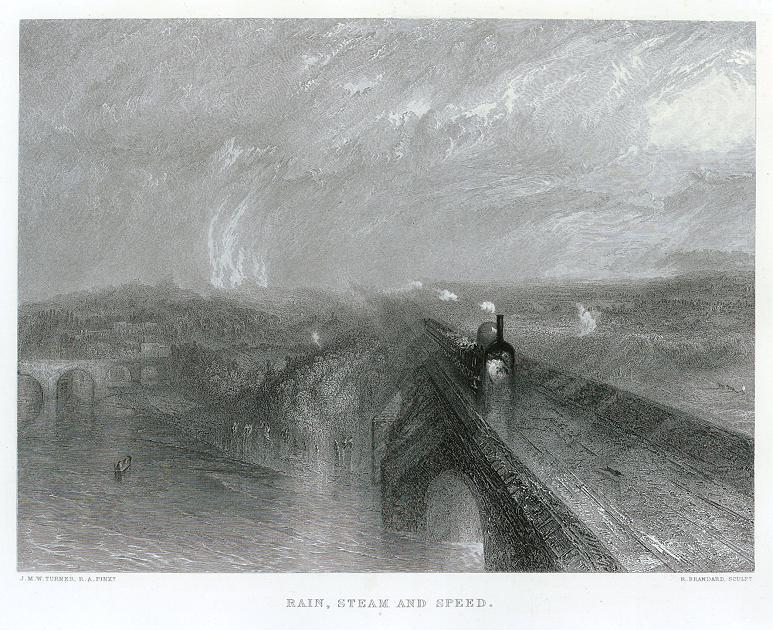
    And as an aside, Turner does get “cleaned up” in a way, when his artwork appears as engravings. There is of course much more definition given the scene as the engraver puts in hard lines on the soft non-edges of the original. For example, here we have “Rain, Steam, and Speed”:

    Before:
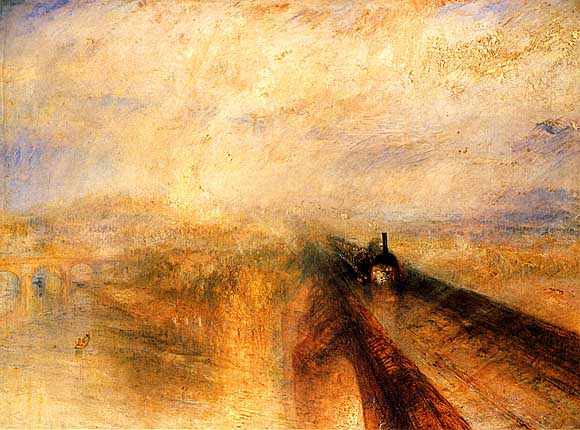
    Rain_Steam_and_Speed_The_Great_Western_Railway_1844

    After:

    Rain_Steam_and_Speed_The_Great_Western_Railway_1844

    The “after” version here is actually much more representative of the original than generally found in Turner engravings. 

    Anyway there’s nothing that quite takes the “impression” out of “Impressionism” than cutting a hard line of it in a steel plate.  

    (Again, this is just some outside thinking on the topic, limited to about the timeline of three cups of coffee.  Maybe four.)

    Notes:

    1. “Dr. Liebreich on Turner and Mulready”, Nature, March 21, 1872

    2. Williams, W. Mattieu. “Turner’s Vision”, Nature, 25 April 1872, p 500.

  • From Children’s Games to the Lake of Fire: Fun and Hell by Mr. Bruegel (Alpha & Omega, Part II)

    JF Ptak Science Books  Post 2834b

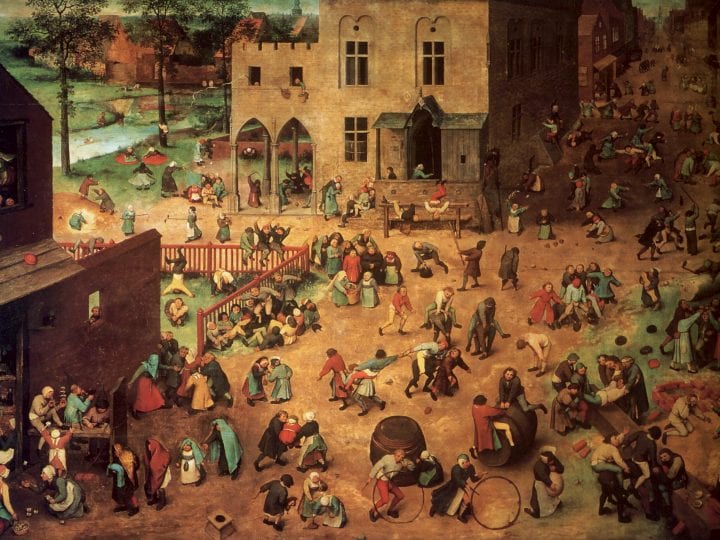
    Being quite filled up with Bruegel’s orderly disaster of death’s chaos control, I went to the other end of his work, to the Alpha of his death Omega: Children’s Games (1560). It is the opposite of The Triumph of Death painting (the preceding post), showing some 200 kids at play, involved in at least 80 different games—it is a visual dictionary of fun and hope. The viewer goes from one game or kid cluster to the next, experiencing a fun slow climb to the mountaintop—and in the other, with death being death and all that, it leads the other way along a road of broken glass.

    Bruegel children

    for a good and expandable view of the painting, see: https://artsandculture.google.com/asset/children%E2%80%99s-games-pieter-bruegel-the-elder/CQEeZWQPOI2Yjg?hl=en

    I’m sure these kids at play were thinking “ars longa, vita brevis” as they lost themselves in the easy complexity of whatever it was they were doing—well, no, they didn’t think that because they didn’t need to, as they were alive in it.

    The game clusters seem to be distributed evenly, and in spite of all of the divergent action, everything seems to be orderly in spite of the sweaty irregularities of the kids. The composition reminds me of the ultra careful construction of engraved illustrations in 18th and 19th century encyclopedias—like those of Abraham Rees Cyclopedia… and J.G. Heck’s Iconographic Encyclopedia—where the pages are filled to the edges with related and unrelated objects though by their arrangement there seems to be plenty of unused space.

    I can only recognize a game here and there—there are a number of experts who have gone through the painting and identified every aspect of every game, as the painting really is a social geology as much as it is anything else.

    For interesting reading see:

    In closing this short share I’d like to mention another fantastic Renaissance work featuring children’s games: the games played by Gargantua in Rabelais’ 1534 work Gargantua and Pantagruel, as there are at least 145 of them (217 in the revised edition), and they appear in a list! Again, there’s only a few here that I recognize straightaway, though they all can be found and explained.

    From the text (being nearly all of chapter 22):

    “Then blockishly mumbling with a set on countenance a piece of scurvy grace, he washed his hands in fresh wine, picked his teeth with the foot of a hog,
    and talked jovially with his attendants. Then the carpet being spread, they brought plenty of cards, many dice, with great store and abundance of
    chequers and chessboards…”

    “There he played.
    At flush.

    At love.
    At primero.

    At the chess.
    At the beast.

    At Reynard the fox.
    At the rifle.

    ·Posted by :

    ·in:

    —

  • From Children’s Games to the Lake of Fire: Fun and Hell by Mr. Bruegel (Alpha & Omega, Part I)

    JF Ptak Science Books  Post 2834a

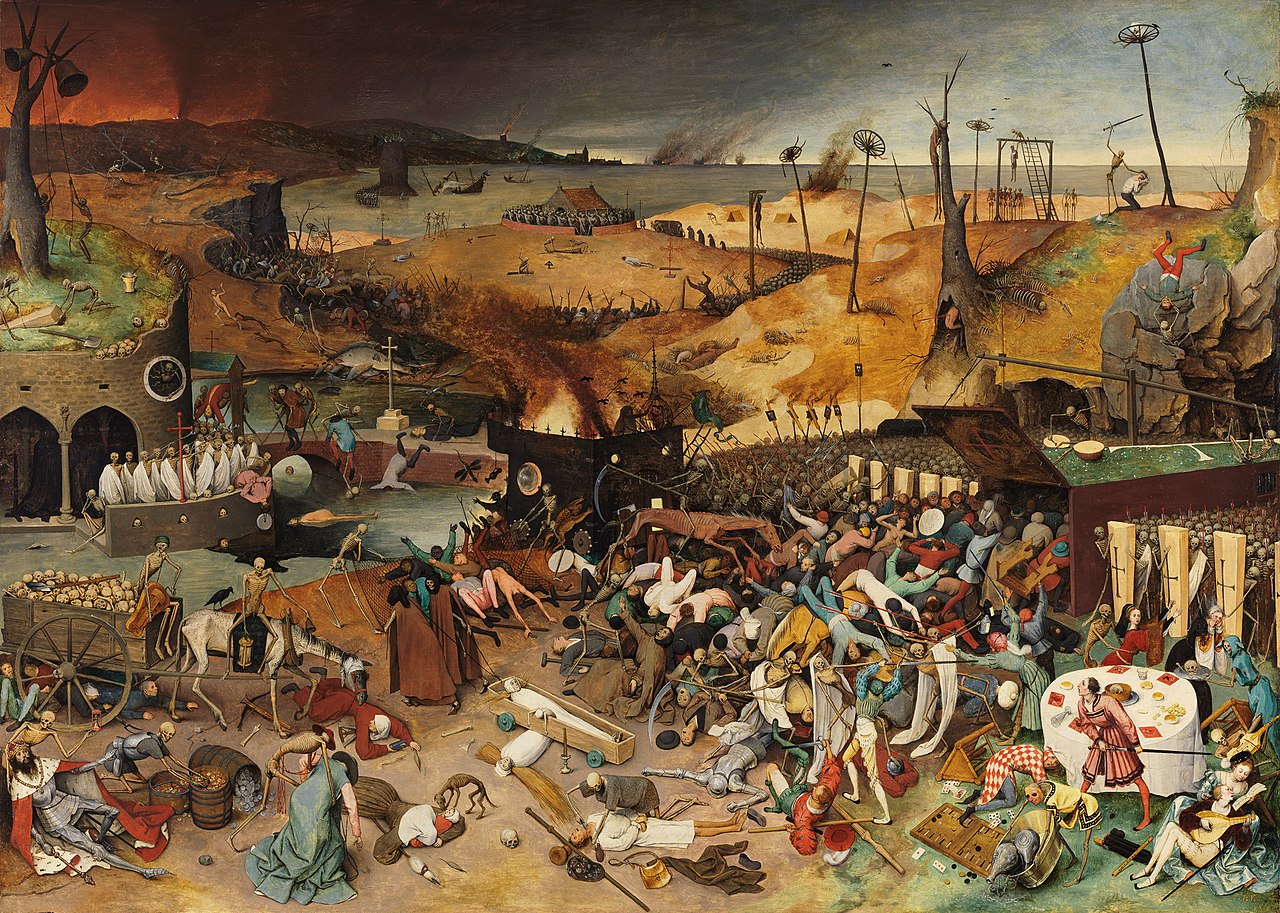
    Somehow I was drawn to take a close look at Pieter Bruegel (the elder’s) massively complex painting, The Triumph of Death (painted ca 1562), in which people were skeletonized by skeletons, killed in fantastic grotesqueries. No doubt I found my way there thinking about COVID-19, and the 1918 Influenza Pandemic, and naturally to the time of the London plague and then the Black Death, winding up on Bruegel’s bitterblack doorstep. In the painting’s many nooks and crannies and its deep minutiae, there is no regard for hope to be found, no possibility of god’s grace to comfort and possibly save the doomed, nothing by the delivery of myster-horrories leading to the lake of fire.

    Bruegel triumph of death

    There is just so much going on in this painting, so many scenes that you’d expect to see an overall narrative, except that there is none, just hundreds of people being taken by Death and its skeleton minions, led off to the gate of Hell. There are dozens of individual passions being crushed and morals observances being made, but they all seem to stand apart and clear.

    I did a quick survey to see if there was an overall census of this apocalypse, but I didn’t find one, surprisingly, which probably means I didn’t look hard enough. That said I thought it would be quicker to make my own scan of what is going on in the painting, starting in the near-center, where we see the spiked opening of the cave of Hell, surrounded by the armies of the dead. In the foreground is a very bad litany of very bad things, people being hanged and burned and drowned and stabbed and knifed and strangled broken on the wheel, those looking out to a deeper field of burning houses and a burning armada, everything burning or set to burn—everything was on fire, leading to the place where the fire was on fire.

    Continuing the survey in the image’s far left-bottom, we see a king in his finery being shown an empty hour glass; to his left a skeleton in armor poking around in bags of gold and silver coins, while just nearby is a cardinal being led to eternity by a skeleton wearing a cardinal’s hat. Further on we see a very strong denial of the absence of mercy, in this case a starving dog nibbling on the face of a dead baby still in its dead mother’s arms, and this right next to someone being overpowered and having his throat slit.

    Behind the king there is a skeleton crew operating a wagon full of the dead—one of the skeletons plays a hurdy gurdy while the other sits daintily astride the starving horse pulling the dead crate. Nearby people are being gathered in a net—like, well, people being led of to hell in a net—which seems a better end than what is going on around them, a diatribe of death by hackings and assorted other nastiness.

    On the opposite side of the painting from the king, on the far right corner, is a pair of, what, friends or something singing and playing, completely oblivious to the larger scene and even to the lute-playing skeleton leering and hovering over them. To their left is particularly disturbing figure—a skeleton wearing a human face with no eyes is tipping over a brazer filled with flasks, this taking place next to an upset backgammon board and a fallen deck of cards.

    Rounding it all out, in the center of the painting, we finally see Death itself, riding a red horse, horse of war, the symbol of fire, of blood, and one of the four horses of the apocalypse. Death charges on, and in this horrible commotion leads his hundreds of skeletons into what was probably a generic scene of generic people doing generic things appropriate to their generic-icity, the great an overwhelming triumph over mortals seeming abandoned by their god.

    So, there it is—I just ran out of steam in thinking of a census of what was happening in the painting, settling for a summary. Its just a little too nasty for right now.

    The cure for this painting is to have a look at Bruegel’s superb painting of children’s games, which comes up next.

    ·Posted by :

    ·in:

    — —

  • Robot-Art of the Future and Far-Sighted Art of the Past

    JF Ptak Science Books   Post 2813

    Eyeglasses-detail[Johannes Reuchlin, Augenspiegel...1511]

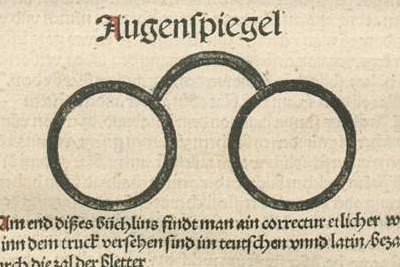
    What happened to art in the period before Impressionism that was made by people who needed glasses and didn’t or couldn’t wear them?  The answer is obvious because, I think, nothing quite like that exists in galleries or public collections:  people who painted but had poor vision were probably/simply told that they couldn’t paint.  If a far-sighted person without corrective specs attempted to paint a sunset over a forest, and painted it exactly  as they saw it, and were doing this in 1787, there work undoubtedly would have been rejected as utterly failing in realism.  On the other hand, the result of their work may have been beautiful collections of forms and colors capturing the essence of the forest and the sunset, but they would have been 50 years shy of the JMW Turner time, and 70 years or whatever shy of the Impressionists.  

    A person with poor or disturbed vision who tried to paint during this time would have been roundly scooted out of the palace of correct painting, though they could have been inspirations to generations of Barnett Newmans and Jasper Johns and Clyfford Stills and Wassily Kandinskys.

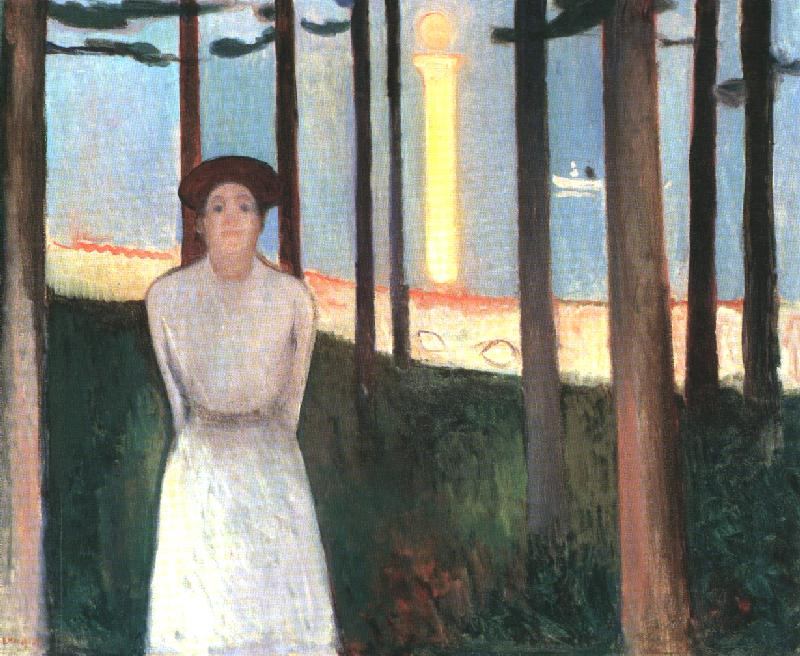
    All this said, does something like Edvard Munch’s The Voice (1893) start to look a little “different” if you imagine a far-sighted artist at work without their glasses?

    Munch--the-voice-1893

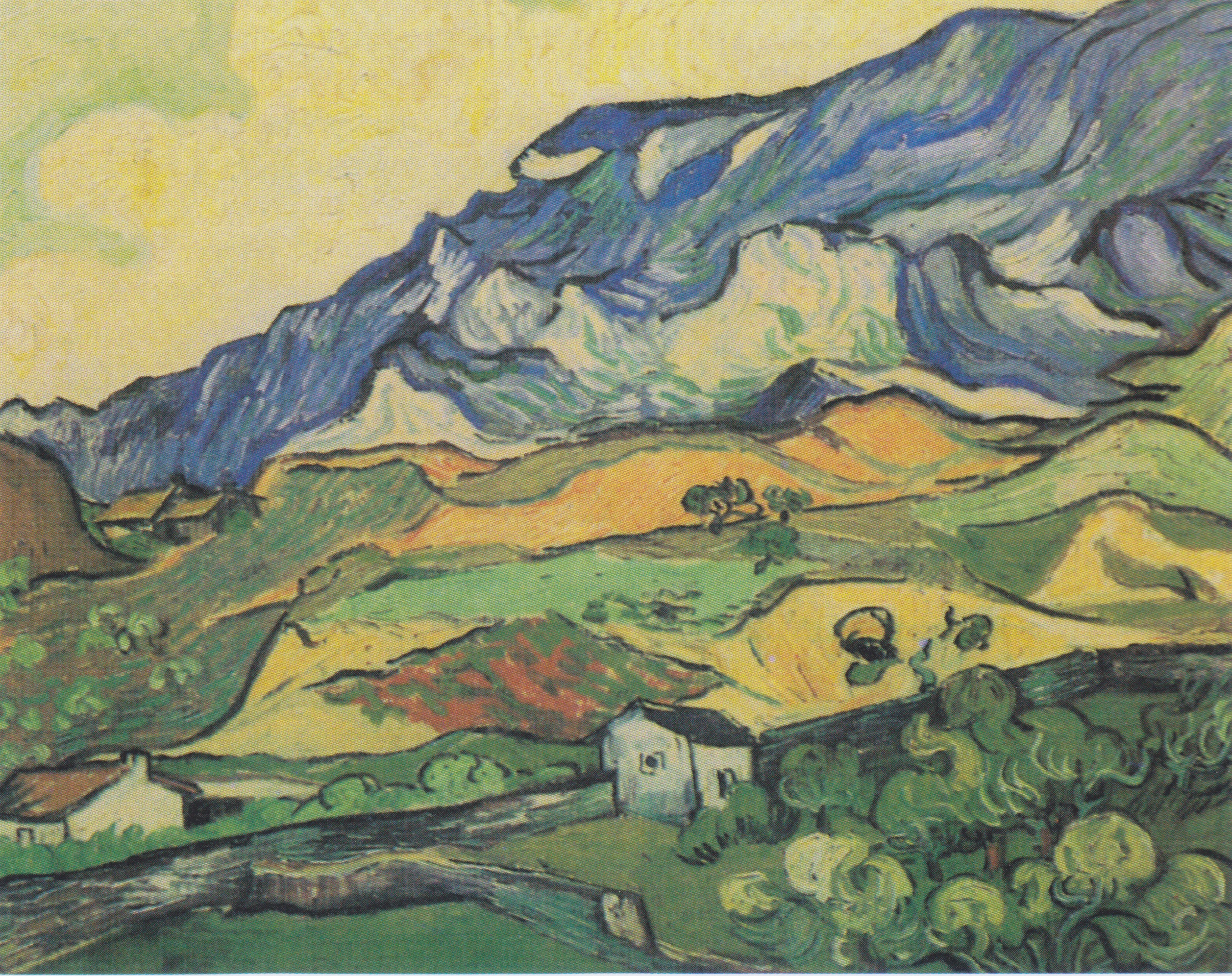
    Or a vision-impaired person producing Les Alpilles (1890) instead of a visionary Van Gogh?

    Van_Gogh_-_'Les_Alpilles',_Berglandschaft_bei_Saint-Rémy

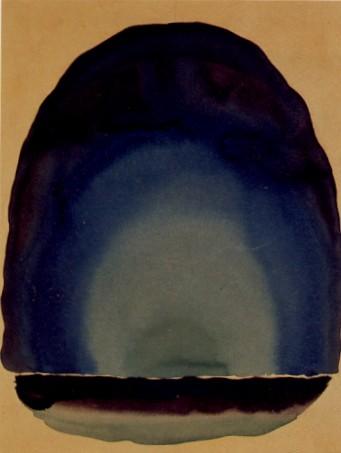
    Or a macular degenerating issue producing a painting like Georgia Okeefe’s Light Coming on the Plains III (1917)?

      Okeeffe_light_coming_up_on_the_plains_iii

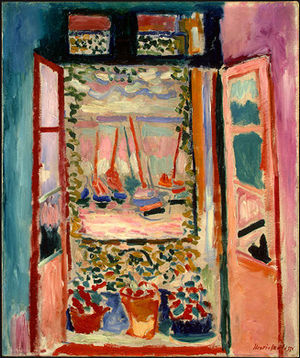
    Or a half-blind artist painting Matisse’s The Open Window, Collioure (1905), simply painting exactly what they saw?  

    Matisse
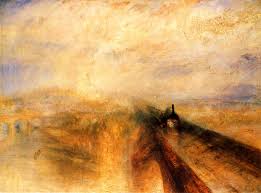
    I don’t think of revolutionary artworks in terms of their common ophthalmologic varieties–I just wanted to make a point about what happened to all of that artwork that was no doubt produced by people with impaired vision before the Impressionists and Fauves and non-representational artists came into being.  I wonder if those who received J.M.W. Turner (as with, say, Rain, Steam, Speed–the Great Western Railway, 1844) so badly so early on in his career and so early in the History of Disappearing Details wondered whether he had a visual issue, or not?  Turner rain steam speed

    And in a way, similar to the probably non-existent vision-challenged art of the past is the Robot art of the future–or at least the robot art of what was described by P.K. Hoenich in his article “Robot-Art, the Hopeful Monster” that appeared in two part in the unlikely journal Cybernetica in 1963 and 1964.  It was with high hopes that I started reading this article wanting the author to address robots-making-art in the future.  After all, my friend George Widener, who is a fabulously gifted artist,  directs some of his fantastically involved calculating/numerical artworks to the interests of his robot-collectors of the future–given this case, why (if the robots are collecting) wouldn’t they also produce art themselves?  And why, if given the legions and multitudes of robots of the future couldn’t they produce every recorded piece of art that has ever existed and then insinuate development and trends and institution and all of the other gifts of the singularity and produce all of the works of art that will ever be produced?

    Well, Hoenich turns out to be describing “robots” of a very different sort, whether he uses the term “monster” in his title or not.  He was broadly addressing a style of art that is produced by externally-controlled structures (mostly), and his particular brand was a mobile-like device with art bits whose movement was powered by the wind…and also used found spectra and sunlight.  It was not what I was hoping for, the vision of robots-at-the-easels/keyboard/whatever remaining unfulfilled. 

    Still it was an interesting read, mostly in laying Hoenich in a continuum of similar artists whose “robots” were the wind (as for example with a Calder) or Nicolas Schoeffer (with spectacular luminodynamics) or Mohly-Nagy (with a combo of light and movement) or Arp (with chance painting) and maybe even Pollock. I guess even Duchamp could be included in a category like this if you considered his work to be governed by selective, found chance, a sort of choice-chance, for his Readymades. 

    So in a way these artworks were made by “robots” insofar as they were produced by not-exactly the artist but with external assistance.

    “Squinting with Art” perhaps could have been the title of this post–squinting at your landscape to see it with semi-non-representational vision, and squinting at the titles of other works to make their possibility more appealing to what you ‘d like to see. 


  • A Note on an Often-Cited Quote of Vincent van Gogh

    JF Ptak Science Books   Quick Post

    • Also see: Found Poetry in the Words in Last Lines from Vincent van Gogh, 1889-1890  https://historyofideasblog.com/thesciencebookstore/2014/03/the-words-in-last-lines-from-vincent-van-gogh-1889-1890.html#more

    Van Gogh grave opposite

    [Source: Google Maps. This image captured on a virtual walking Google tour of Auvers. This is the view exactly behind the van Gogh brothers’ graves, on the other side of the cemetery wall, looking away.  See: “There are no Van Goghs in Arles (?)”  https://historyofideasblog.com/thesciencebookstore/2014/12/there-are-no-van-goghs-in-arles.html]

    So there’s a van Gogh quote is making the rounds on social media, and to me it sounds not quite right, like some of the odd Einstein and Newton “quotes” that are never attributed or annotated or properly referenced and just don’t exist in the history of the person. I can find a lot of sites using this quote but after looking at a bunch of them no one provides a source reference—some reference another site that simply is carrying the quote though they don’t give a source, either.

    Anyway, the quote: “I put my heart and my soul into my work, and have lost my mind in the process”. I’m not a van Gogh scholar, and I’m not even an historian of art. The only bit of van Gogh experience that I have is that I have read all of the published letter in his archive, as well as some incidental reading–this a scholar does not make, though it does give at least a little background to ask a half-decent question.

    After checking many of the places using this quote and finding no reference to its origin I went to one of the great van Gogh resources: his correspondence.  There are about 903 surviving letters, with ca. 820 written by van Gogh and the balance being letters he received. The great majority of them (about 650) were Vincent writing to his brother, Theo. When I searched the letters for a simple reference of “heart”, “soul”, and “work” I was surprised to find that there were over 800 hits. When I narrowed the search a little,  searching for “heart and soul”, the results were drastically changed–there were only 8 hits, none of which were a fit for the elusive quote. There following were among the eight, and to me could be read as quite the opposite of the meanings of the searched-for quote:

    “What helped me recover my balance more than anything else was reading practical books on physical and moral diseases. I got a deeper insight into my own heart and also into that of others. Gradually I began to love my fellow men again, myself included, and more and more my heart and soul – which for a time had been withered, blighted and stricken through all kinds of great misery – revived.”–12 November, 1881, to Theo. 

    And:

    “I also don’t think that it would be a hindrance if my health let me down on occasion. As far as I can make out, it isn’t the worst painters who can’t work for a week or a fortnight now and then. Sometimes the reason for this is that they’re the very ones who ‘put their heart and soul into it’, as Millet says. That doesn’t matter, and in my view one shouldn’t spare oneself when it comes to the point. One may be exhausted for a while, but one recovers, and the advantage is that one has gathered in one’s studies, just like the farmer does his corn or hay.”–Letter 257 (14 August 1882, to Theo)

    And:

    “You will understand my intention better than Pa if I were to try to explain such a thing to him. In my view I’m often very rich, not in money, but rich (although not every day exactly) because I’ve found my work — have something which I live for heart and soul and which gives inspiration and meaning to life.” 

    “My mood varies, of course, but nonetheless I have a certain average serenity. I have a certain faith in art, a certain trust that it’s a powerful current that drives a person — although he has to cooperate — to a haven, and in any case I consider it such a great happiness if a person has found his work that I don’t count myself among the unfortunate.”

    “I have a certain average serenity”!–Letter 327 (11 March 1883, to Theo)

    There were no hits in the van Gogh letter archives for the phrases “lost my mind” or “heart and my soul into my work”.  It certainly seems as though that the source of the quote is not in the correspondence.

    If you know the source for the much-quoted quote, I’d be very keen to know of it. 

    Notes:

    Sources for the van Gogh letters:


    ·Posted by :

    ·in:


  • A First Alphabet of Missing “Firsts” in Art

    JF Ptak Science Books   Quick Post

    Keeping track of the first time something appears in a reproduced form is an interesting and perhaps useful exercise…well, it is at least diverting and occasionally helpful in connecting a few other disparate bits. I’ve wondered about some of this throughout the course of the blog, like the first time the Sun appears with a smiling face, and the first appearance in print of the spectrum of a star other than the Sun, or the first appearance of a portrait of Einstein (or Newton, or Goedel, or Feynman, or FDR), and so on.

    Sitting in the airport parting lot and waiting on the arrival of a plane (and after seeing a very unexpected flyby of a number of Sikorsky Super Stallions) I thought about what might be unusual objects and when it was that they first appeared in art, and organized them alphabetically. For example, when did an Adding machine of any sort make an appearance in a work of art? A Barking dog? A Crutch or cane, and then a broken crutch or cane?  A Dinosaur? (Or dead horse?)  An Eclipse? A Fork? (Also the representation of human Frailty?) A Girl, a House on Fire, an Incision, a Jail?  When does a Kitchen appear (though this may be one of the easiest to answer)? Where do we find the first Library depicted in art, or the first Microscope? When does the first Nighttime scene appear? How about the first image in art displaying the law of Octaves, or Pi, or a Quagmire, or a Ripple in a stream? And when does the first Stirrup show up, and the first Signature of an artist, or the first Toothless Smile? And what about leafless Trees, and Underwater scenes? When do we see the first Visions or dreams enter the artistic landscape, or the first Wire, or Yawn, or the number Zero? 

    So there you have it. If you have any answers to these questions, please do share, as I don’t have the answers (though I have some guesses, or approximations of a time period).  Probably there are some quickish responses for the first signed artwork, and the first appearances of the fork, and stirrup, and microscope. We’ll see. 


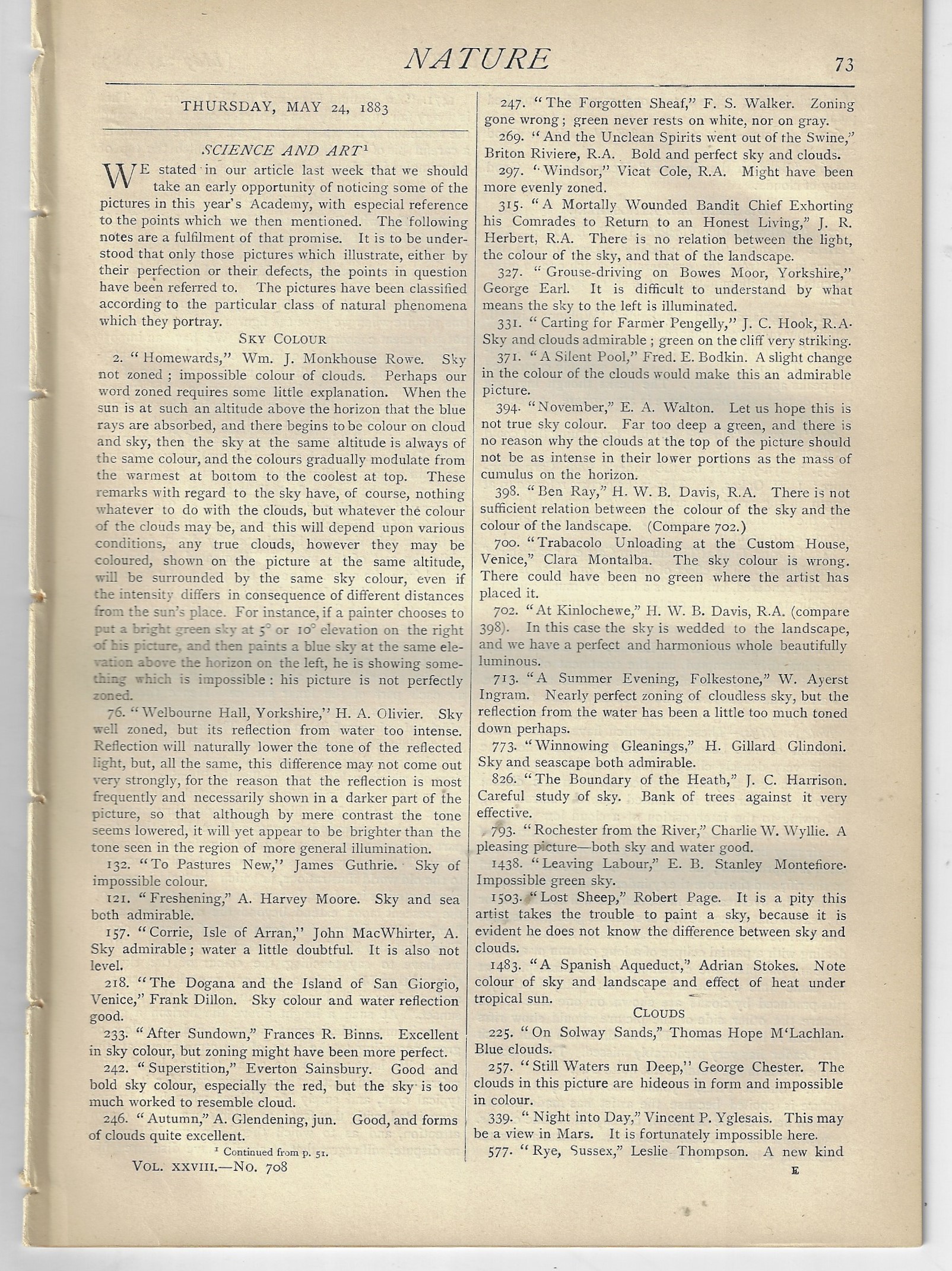
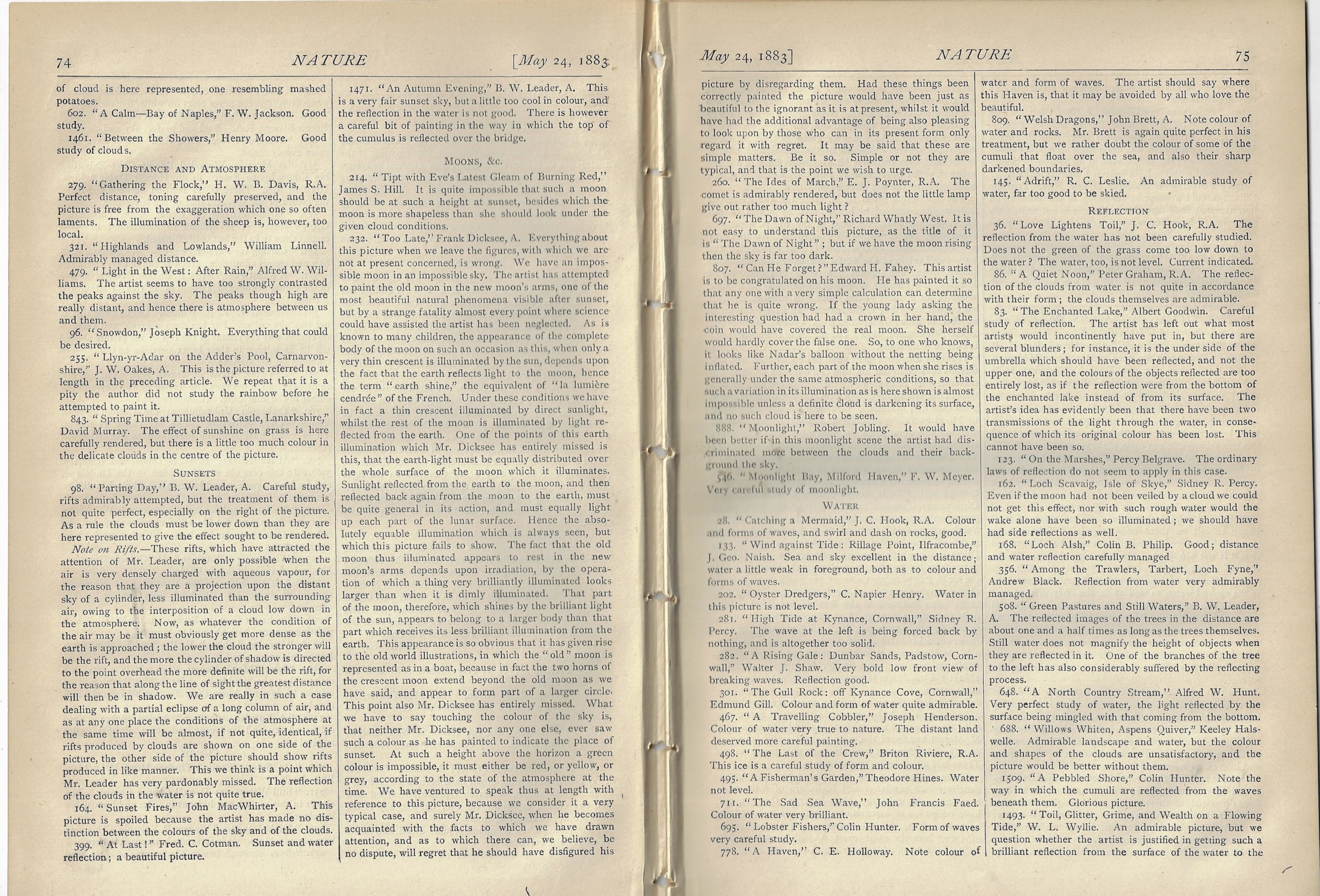
  • Science-in-Art Art Reviews in “Nature”, 1883

    JF Ptak Science Books  Quick Post

    I haven’t seen too much in the venerable journal Nature (begun in 1869), though I did not the following two papers written1 in 1883.

    In the second paper there is a discussion of various aspects of some of the paintings including “Sky Colour”, “Clouds”, “Distance and Atmosphere”, “Sunsets”, “Moons &c.”, “Water”, “reflection”, and “Snowstorms”. The reviewer liked some, and others—from the “science” end of things, not so much. For example there is a long and involved and devastating review of Frank Dickee’s (a successful and highly-Victorian (almost Victorian-velveteen)) piece, concentrating on the Moon, which presented many problems to the sci-observer, with the assault on the Moon of Dickee occupying about 20% of the entire article. He really didn’t like it.

    You can read the review below:

    Notes:

    1. [“Science and Art” in Nature, vol 28, no 707, May 17, 1883, pp 50-51; with “Science an Art” same volume, no. 708, May 24, pp 73-76.]

      Nature 1883 Sci Art _2_

    NAture 1883 sci art _3_

    ·Posted by :

    ·in:


  • What Happened to Good Artists with Bad Vision Before Spectacles Were in General Use?

    JF Ptak Science Books   Post 2728

    Eyeglasses-detail[Johannes Reuchlin, Augenspiegel...1511]

    What happened to art in the period before Impressionism that was made by people who needed glasses and didn’t or couldn’t wear them?  The answer is obvious because, I think, nothing quite like that exists in galleries or public collections:  people who painted but had poor vision were probably/simply told that they couldn’t paint.  If a far-sighted person without corrective specs attempted to paint a sunset over a forest, and painted it exactly  as they saw it, and were doing this in 1787, there work undoubtedly would have been rejected as utterly failing in realism.  On the other hand, the result of their work may have been beautiful collections of forms and colors capturing the essence of the forest and the sunset, but they would have been 50 years shy of the JMW Turner time, and 70 years or whatever shy of the Impressionists.  

    A person with poor or disturbed vision who tried to paint during this time would have been roundly scooted out of the palace of correct painting, though they could have been inspirations to generations of Barnett Newmans and Jasper Johns and Clyfford Stills and Wassily Kandinskys.

    All this said, does something like Edvard Munch’s The Voice (1893) start to look a little “different” if you imagine a far-sighted artist at work without their glasses?

    Munch--the-voice-1893

    [Image source: https://www.britannica.com/topic/The-Voice-painting-by-Munch]

    Or a vision-impaired person producing Les Alpilles (1890) instead of a visionary Van Gogh?

    Van gogh les apilles

    [Image source: https://www.vangoghmuseum.nl/en/collection/s0417M1990]

    Or a macular degenerating issue producing a painting like Georgia Okeefe’s Light Coming on the Plains III (1917)?

      Okeeffe_light_coming_up_on_the_plains_iii

    [Image source: www.alpheus.org/unfolding-the-art-of-georgia-okeeffe/]

    Or a half-blind artist painting Matisse’s The Open Window, Collioure (1905), simply painting exactly what they saw?  

    Matisse

    [Image source: https://en.wikipedia.org/wiki/The_Open_Window_(Matisse)]

    I don’t think of revolutionary artworks in terms of their common ophthalmologic varieties–I just wanted to make a point about what happened to all of that artwork that was no doubt produced by people with impaired vision before the Impressionists and Fauves and non-representational artists came into being.  I wonder if those who received J.M.W. Turner (as with, say, Rain, Steam, Speed–the Great Western Railway, 1844) so badly so early on in his career and so early in the History of Disappearing Details wondered whether he had a visual issue, or not?  Turner rain steam speed

    [Image source: https://www.wga.hu/html_m/t/turner/2/205turne.html]

    And in a way, similar to the probably non-existent vision-challenged art of the past is the Robot art of the future–or at least the robot art of what was described by P.K. Hoenich in his article “Robot-Art, the Hopeful Monster” that appeared in two part in the journal Cybernetica in 1963 and 1964.  It was with high hopes that I started reading this article wanting the author to address robots-making-art in the future.  After all, my friend George Widener, who is a fabulously gifted artist,  directs some of his fantastically involved calculating/numerical artworks to the interests of his robot-collectors of the future–given this case, why (if the robots are collecting) wouldn’t they also produce art themselves?  And why, if given the legions and multitudes of robots of the future couldn’t they produce every recorded piece of art that has ever existed and then insinuate development and trends and institution and all of the other gifts of the singularity and produce all of the works of art that will ever be produced?

    Well, Hoenich turns out to be describing “robots” of  mostly a very different sort, whether he uses the term “monster” in his title or not.  He was broadly addressing a style of art that is produced by externally-controlled structures (mostly), and his particular brand was a mobile-like device with art bits whose movement was powered by the wind…and also used found spectra and sunlight.  It was not what I was hoping for, the vision of robots-at-the-easels/keyboard/whatever remaining unfulfilled. 

    Still it was an interesting read, mostly in laying Hoenich in a continuum of similar artists whose “robots” were the wind (as for example with a Calder) or Nicolas Schoeffer (with spectacular luminodynamics) or Mohly-Nagy (with a combo of light and movement) or Arp (with chance painting) and maybe even Pollock. I guess even Duchamp could be included in a category like this if you considered his work to be governed by selective, found chance, a sort of choice-chance, for his Readymades. 

    So in a way these artworks were made by “robots” insofar as they were produced by not-exactly the artist but with external assistance.

    “Squinting with Art” perhaps could have been the title of this post–squinting at your landscape to see it with semi-non-representational vision, and squinting at the titles of other works to make their possibility more appealing to what you ‘d like to see. 

    ·Posted by :

    ·in:

    —

  • Missing the Fog for the Mist–Where was Fog in Renaissance Painting?

    JF Ptak Science Books   Post 2713

    If there is one thing that you can say about Renaissance art is that it was determined to represent nature–in form, color, perspective–as truthfully as possible.  Except–so far as I can tell–in some cases, like, say, fog.  And mist. I’m not sure why this is so, but once I started looking for examples of major and then minor cases showing fog in painting in the 1400-1550 period…and then later.  Much later.  Fog–and mist–seem to pop up regularly in the  mid-19th century, along with the new genre of Impressionism, which seems to be when people became more more comfortable with nothingness and the suggestion of things that may or may not be present or in existence. 

    There are examples of suggested forms in the Renaissance where the outlines of forms come to life without their detail, as with the great Paolo Uccello (and the solids in the horses in the Battle of San Romano, ca. 1450s), but for the most part, where detail was supposed to be, there was detail. 

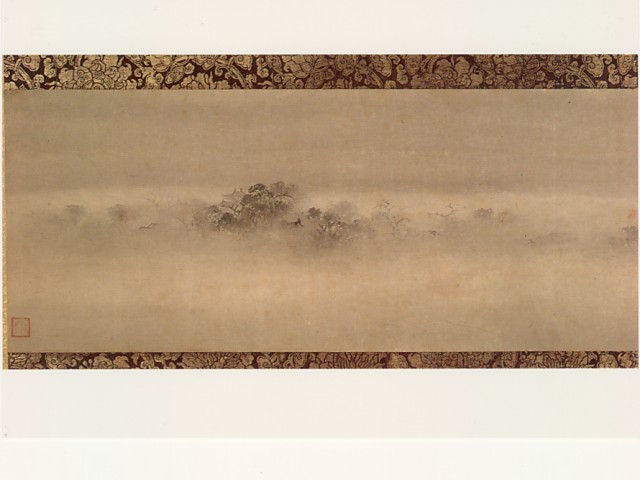
    Fog _2_ evening bellLeaving elements of an artwork open to interpretation was not a problem with other cultures at this time, as in China and Japan, where fog and mist and rain and obscurity were very comfortable elements in artwork, and for centuries earlier than the Western Renaissance. The classic rendering say of a swath of fog obscuring everything but the top of a mountain was a “comfortable” mode of expression that can be seen in a number of landscapes that are listed as national treasures of Japan. For example, the “evening Bell from Mist-Shrouded Temple” and one of the Eight Views of Xiaoxiang is attributed to to Muqi Fachang (or Muxi Fachang) and was painted in the mid-13th century. 

    Another interesting example of countless others (and which like the Muqi Fachang is counted as a Japanese National Treasure) is that by  Sesshū Tōy, in a landscape with broken ink/splashed ink (“hatsubokun, evolving an abstract simplification of forms and freedom of brushwork”–Wiki), and created ca. 1495. The dreamy landscape and the sparse and (somewhat aggressive) brushwork of the “broken ink” seem more a creation of Zen and meditation than anything else.

    Like the rarity of the full-toothed, open-lipped smile, the image of fog and mist and the difficulty in representing what it is that they are mostly-hiding seems to be a not-at-all popular genre in Western art for hundreds of years. This is of course all conjecture on my part and is based mostly upon a little research and a lot of what is probably faulty memory, but it does at least seem to be an observation worth a little thought.  After all, clouds had their many champions for long periods of time, though they served mostly to frame and accentuate the subject of the painting rather than being subjects in themselves (or at least so until the 18th century).  Fog couldn’t even exist in the West as a major part of paintings even as clouds-on-the-ground until the 19th century, when painting was catching up to work done by the Chinese and Japanese in the 13th century.

    I suspect I’ve gotten a lot wrong in this speculation, and I’d like to hear about it as a form of conversation. 

     Image: https://en.wikipedia.org/wiki/List_of_National_Treasures_of_Japan_(paintings)


    ·Posted by :

    ·in:

    —

  • The Fate of the Future & the Ironies of Artistic “Futurism”

     JF Ptak Science Books

    “The oldest of us is thirty: so we have at least a decade for finishing our work. When we are forty, other younger and stronger men will probably throw us in the wastebasket like useless manuscripts—we want it to happen! They will come against us, our successors, will come from far away, from every quarter, dancing to the winged cadence of their first songs, flexing the hooked claws of predators, sniffing doglike at the academy doors the strong odor of our decaying minds, which will have already been promised to the literary catacombs.”–from the “Futurist Manifesto”, by F.T. Marinetti, 1909

    They came for Mr. Marinetti (1876-1944) a little earlier than that, and continued to come, though whoever it was that came couldn’t quite reach the founder of Futurism, who seemed to be one invisible step ahead of oblivion.  Or perhaps it was behind?  I’m not sure.

    But futurism as a movement was more in the past than in the future, barely lasting long enough to have anything but a past.

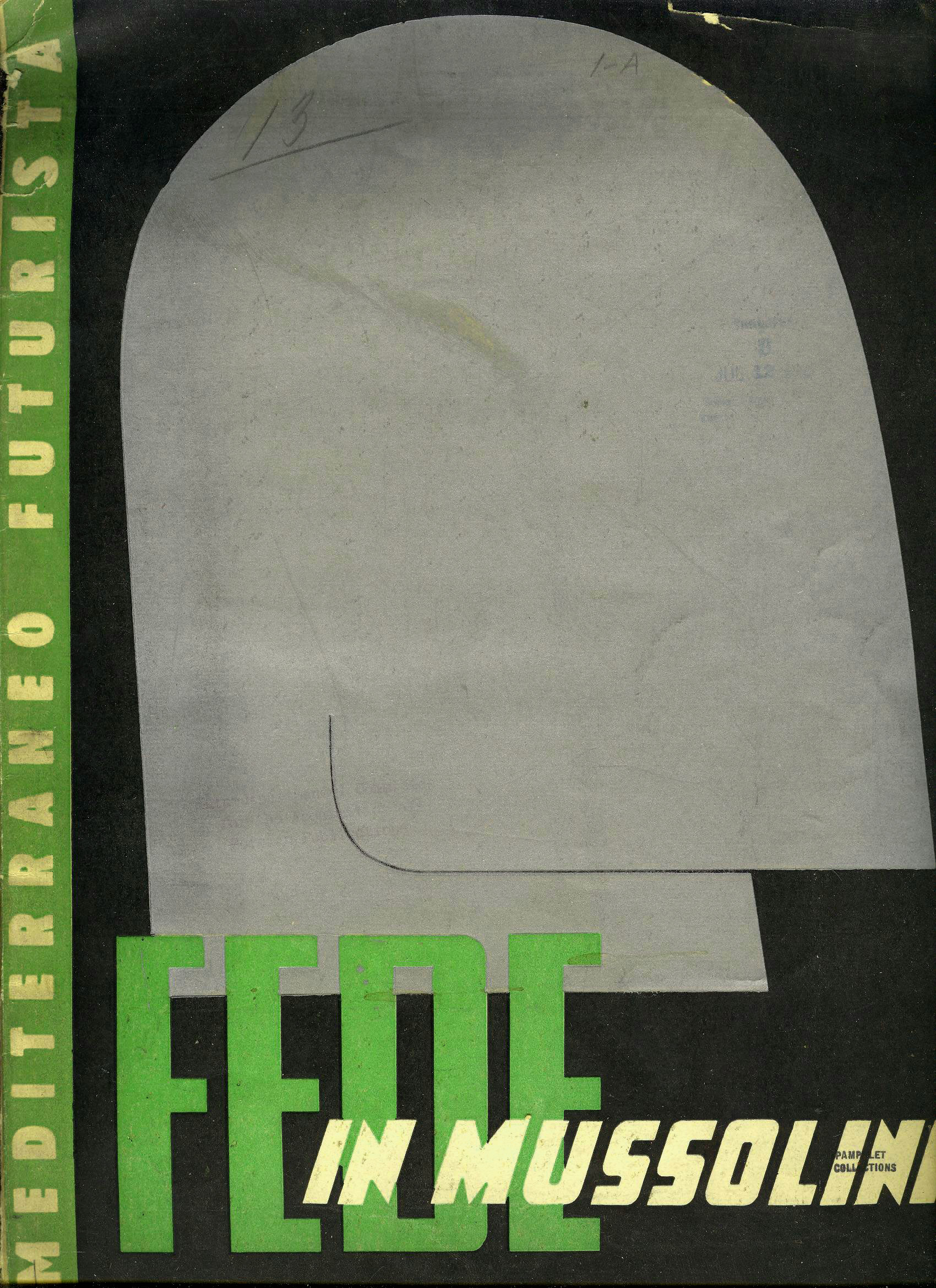
    Mussolini

    • This is the cover of a magazine edited by Marinetti and others, a hagiographic-porn hommage to the leader of the Italian fascist government, Benito Mussolini, featuring a very striking portrait of the leader on the cover. (I’ve seen a note elsewhere stating that the image on the cover is by (Mari Biazzi (1880-1965)) though I could not find any other references for that. Also I’m not sure about the journal, as it comprises the names of two Futurism journals, Mediterraneo Futurista and Fede in Mussolini (“Faith in Mussolini”).Apologies for this incompleteness. Mostly I just wanted to share the image given its particularly brutal Brutalist aspects.)

    Not that the movement wasn’t important–it was, obviously–its importance branched out into other areas and movements, morphing into necessary branches, leaving behind a shell of the original tended by the originator.  (It can be argued that this movement helped create the environment for Dadaism and Cubism [or at least Cubist-futurism as in the Russian sense of that art].)  Marinetti had some unsavory and some just downright weird political and social ideas, having a long and vested interest in fascism.1  And not only the earliest part of Italian fascism –founded in 1919 with an interest in expanding the democratic process–but the later, Mussolini-controlled Italian fascism as well.  Marinetti sought the protection of Il Duce,2 and even so during the war, when he sought to protect his movement’s art from being designated as “degenerate ” and therefore unacceptable and existence-deniable by Adolf Hitler.

    And so the unlikely prolonged existence of futurism–a movement transformed far beyond itself in a matter of years, held together by pieces of fluff and dust, supported in its old age on the hopes of a noxious political system which was itself doomed to rapid failure.

    “At last they’ll find us—one winter’s night—in open country, beneath a sad roof drummed by a monotonous rain. They’ll see us crouched beside our trembling aeroplanes in the act of warming our hands at the poor little blaze that our books of today will give out when they take fire from the flight of our images.”  –F.T. Marinetti, from his “Futurist Manifesto”, 1909

    Notes

    1. Marinetti’s goal was to establish futurism as the official art movement of the government–something he specifically wrote against in earlier incarnations of himself.  He would come to loggerheads with much of his earlier social opinions, abandoning his beliefs in his never-ending quest to promote his movement.  I must say though that Marinetti did publicly speak against anti-Semitism.

    2. Marinetti sought to have the Nazi traveling exhibition of degenerate art–which included works by futurists–banned from Italy.  So even though the Nazi fascists established futurism as degenerate, Marinetti was able to enlist the aid of Mussolini to shield Italians from what the Nazis thought of the art.  But the futurist manifesto seemed comfortable with the while idea right from the start, as we can see in proposition #9 of its self-proclamation: “We will glorify war – the world’s only hygiene – militarism, the destructive gesture of freedom-bringers, beautiful ideas worth dying for and scorn of woman…”