A Daily History of Holes, Dots, Lines, Science, History, Math, Physics, Art, the Unintentional Absurd, Architecture, Maps, Data Visualization, Blank and Missing Things, and so on. |1.6 million words, 7500 images, 4.9 million hits| Press & appearances in The Times, Le Figaro, Mensa, The Economist, The Guardian, Discovery News, Slate, Le Monde, Sci American Blogs, Le Pont, and many other places… 5000+ total posts since 2008.

Category: History of Nothing

  • A Monumental and Fantastically Bad Idea: Lowering the Mediterranean (1929)

    JF Ptak Science Books  (This is a slight expansion of an earlier post from 2011)

     “Simply the thing I am shall make me live.”–from Jorge Luis Borges, “Shakespeare’s Memory”
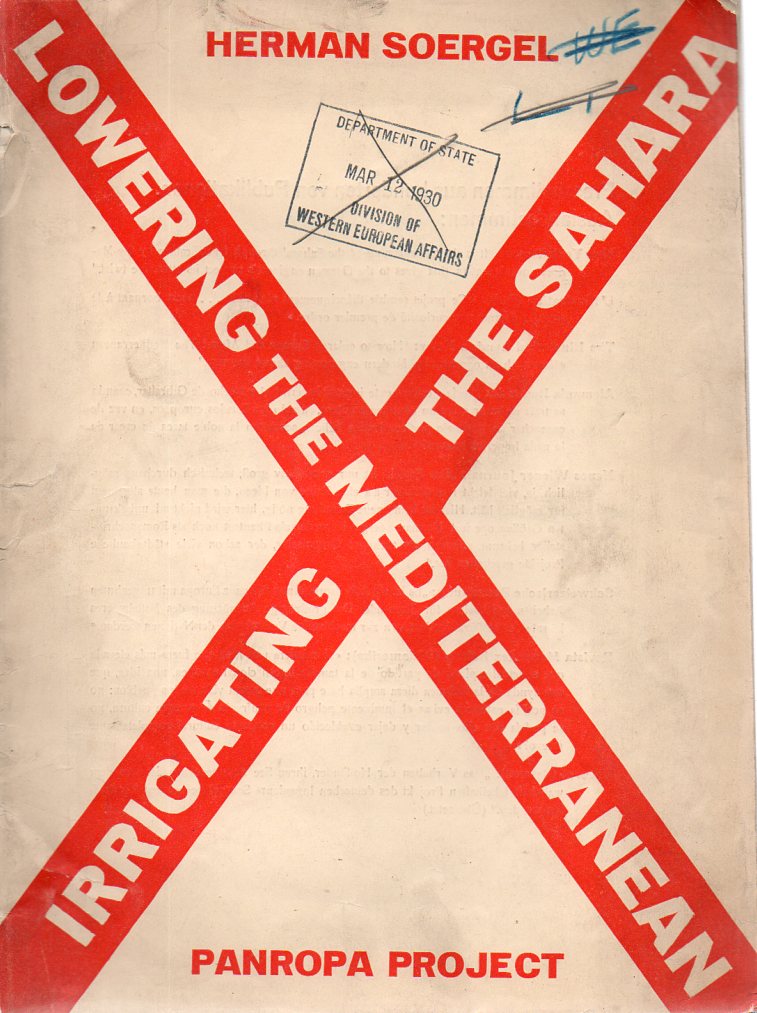
      Soergel403
    It would be a Purgatory, or worse, to suddenly wake up one morning with another person’s memory–worse yet than to have wished it, only to find that you didn’t want it at all.  This evidently works out with memories high and low, though it is tempting to want to wish to see what the inspiration looked like for one idea located in a particular memory.  Or maybe not.  But I am curious about when and here the author of the pamphlet above got his idea, and what it looked like to him–did he hear or see or smell something that prompted the inspiration for this reverse-monumental jolt, something that may well be one of the worst engineering ideas of the 20th century?

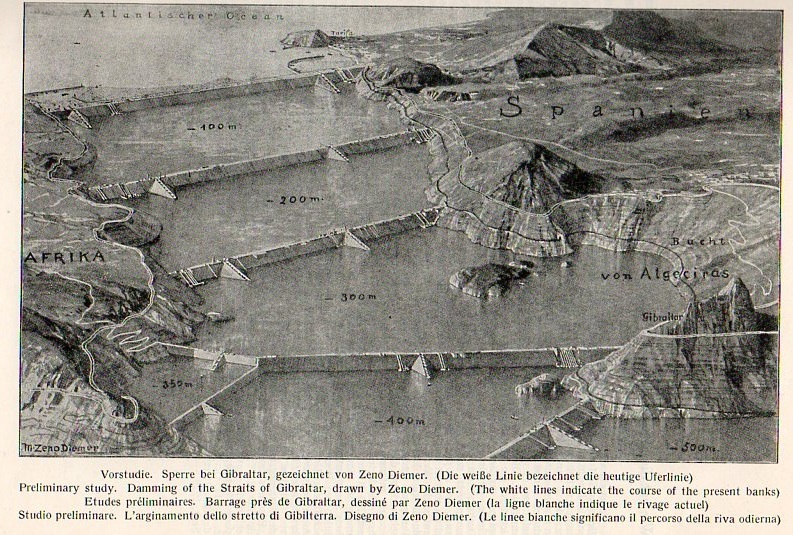
     It is interesting to pursue a loose thought like this to its not-necessarily logical end.  Such is the case with the self-styled Paneuropic ideas of Hermann Soergel (1885-1952), the author of the above. Soergel was a Bauhaus architect and author of a number of works on design and far more ethereal, floating-castle ideas. His most spectacular contribution—incubated in the mid-1920’s and still clinging by its fingertips as an idea among some current thinkers—was to put a dam across the straights of Gibraltar.  The dam would generate electricity of course, but most importantly to Soergel, it would also empty an enormous amount of water (lowering the sea by 200 meters)  from the Mediterranean leaving vast new expanses of land to be developed and colonized over generations into the future.  The water of course would have to go somewhere, and that somewhere was the Sahara Desert, somehow in its wake creating farmable and productive lands. Soergel was creating a certain, very wide, fantastical future of uncertain monumental prospects.
    Soergel405
    A “brief outline” of the idea was published in this four-language pamphlet, Lowering the Mediterranean Irrigating the Sahara (Panropa Project), which was published by J.M. Gebhardt in Leipzig in the very bumpy year of 1929. (The Weimar years in Germany were already into deep bumpiness; the rest of the world would follow suit in October of that year.)  To be fair, Soergel didn’t plan on emptying the entire Mediterranean, just a bunch of it–at least enough to be able to rename it.
    Soergel404
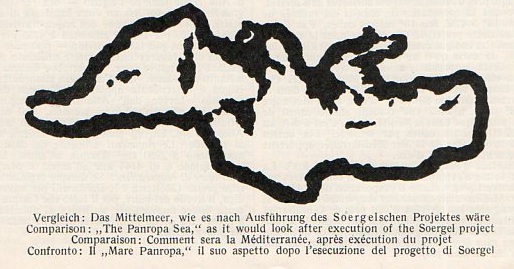
    [Here’s a map of the new Mediterranean, or the Mediterranean that would be made to go away.  As you can see at this point Sicily and Italy become enormous, and the Greek Islands are combined to form one large land mass–this last bit alone is enough to form total and complete reisstance to this idea. Also at this stage perhaps 150 or so miles of new lands have been reclaimed from the sea all along its former borders–more so in Turkey.  There is no mention as yet of any new islands that are formed in the sea water’s wake.] 

    As it turns out Soergel thought that this plan would add at least 660,000 KM2 to the base of the surrounding countries of the Mediterranean, or roughly the equivalent of the combined land masses of Italy and Germany.  Having the sea pulled back from hundreds if not thousands of seaside towns and cities would no doubt be a “problem”, for them; but that doesn’t matter to Soergel, as they were inferior thoughts to the grand idea of emerging a new continent.  Great bog (and a good simulation with a powerful computing capacity) only know how the changes in the Mediterranean would affect the climate–well, that in combination with the thousands of new square miles of inland sea and canals in the previous Sahara desert.  There are of course many other problems. 

    The master plan at work was that the world would be divided into three economic spheres in the future, all beginning with the letter “A”:  American, Asia, and the new land to be created by Soergel, “Atlantropa”, which was the former Europe expanded into the new dry beds of the Mediterranean and North Africa.  And also of course Egypt, which would be covered with “thousands” of canals and become semi-submerged by the new borders of the meandering sea.  This would be the way for Europa t==Blog July 21==shakespeares memorieo compete with the rest of the world in the future. 

    [I should point out that the image above comes from the Illustrierte Zeitung (Leipzig) for August 1931, and is a drawing by an artist named “AS. Christ” depicting a cross section of one of the bridge/dams of Soergel’s Panropa’s ideas.]

    Perhaps it is actually three steps to get from the idea of damming up the straits of Gibraltar to the osmosis of Shakespeare’s memories into someone else’s brain—a squinting acquiescence of the middle touch being the brilliant Jorge Luis Borges.  You see it was in the Argentine master’s last published story, “Shakespeare’s Memory”, that we meet Herr Soergel (as Hermann Sorgel) again.  But so far as I can remember Soergel exists only as a fictional character, with no reference to his real-life self.  In this wonderful story, Soergel inherits the memories of William Shakespeare—these bits come to him slowly but surely, until they start to conflict with his own memory, and things get difficult.  The man with Shakespeare’s memories winds up phoning strangers on the telephone, giving them away at random, until Soergel is left with his own mind again.  Superior as Bill’s memories were, they still weren’t Hermann’s, who wanted his own life back in the end. 

    And so from the titanic, pan-europic technodream of Bauhausian Hermann Soergel to the dead brains and living memories of William Shakespeare, all through the fingers of the beautiful Jorge Luis Borges.  

    I’m sorry to report that at the end of it all, near the end of the pamphlet, Soergel releases his opinion on the political importance of his project.  And yes, his aim was to form an alliance between the new PanAmerica (of the “three Americas” with the new Pan-European African Union to thwart “the yellow peril” which “arises from the racial antipathy of India, China and Japan.  Soergel writes that “the fate of occidental civilization…will be settled on the Mediterranean”. 

    After it is all said and done, perhaps the best review of the work by Soergel is provided by the graphic designer who put the Big Red X on the cover of his work.  It fits. 

  • A Note on Explaining Impressionism as a Result of Astigmatism (1872)

    JF Ptak Science Books  Post 2907  (Overall Post 5116)

    Years ago I wrote short post here on the influence of eyesight and modern art, something along the lines of Impressionism owing itself to artists with poor/uncorrected vision. It was along the lines of alien outer space space aliens determining that for the USA the most revered object in society was what we called “automobiles”–we feed them, wash them, take them out for exercise, work long hours to afford them, get them regular checkups plus occasional doctor visits, etc.–and so in this light Impressionism is born of astigmatism by an artist who thought that their color symphony was what everyone was seeing, and not just a product of their poor eyesight, and lo! a revolution in imagination is created.

    After this bit the subject really never came up…until last night, when I happened on a story by Richard Liebreich in several 18721 articles in the early years of publication of the great science journal, Nature. Between an article on the new Yellowstone Park and another on adaptive coloration of mollusks is “Leibreich on Turner and Mulready”, and on the face of it there’s not much in the title to excite an interest, unless you knew that the first name was that of a celebrated ophthalmology person, suggesting something-or-other in the science/art realm. This appearance is a report on Liebreich’s lecture to the Royal Institution on 8 March 1872 “On the effects of certain faults of vision on painting, with special reference to Turner and Mulready”, the title here getting straightaway to the point, which was basically explaining the creation of Impressionism due to abnormalities in artistic vision.

    Liebreich (1830-1917) was a fine anatomist, an artist and sculptor, an assistant to one of the 19th century’s greatest minds in von Helmholtz, creator of his own ophthalmoscope, and creator of the first atlas of ophthalmology, and so had the chops to look deeply into the possible physiological aspects of vision. He applied this talen to the pre-Impressionist JMW Turner, and evidently found that was people find to be genius in Turner was to Liebreich the possible result of astigmatism. He writes:

    • “It was particularly important to ascertain if the anomaly of the whole picture could be deduced from a regularly recurring fault in its details. This fault is a vertical streakiness, which is caused by every illuminated point having been changed into a vertical line. The elongation is, generally speaking, in exact proportion to the bright- ness of the light; that is to say, the more intense the light which diffuses itself from the illuminated point in nature, the longer becomes the line which represents it on the picture.”

    Giving Liebreich the benefit of the doubt here, it should be noted that when he was working this out in 1871/2 Impressionism was still a very young idea, and Turner (1775-1851) was already dead for 21 years. His access to other examples of Impressionist works was no doubt extremely limited, as the first exhibition of Impressionist painters was still two years away in 1874. (This show displayed works by Degas, Monet, Pissarro, Renoir, Cezanne, Sisley, Morisot and others, and resulted in sales of only 1000 francs for Monet, 200 francs for Renoir and Cezanne, 130 francs for Pissarro, with Degas and Morisot selling nothing. The second exhibition—two years later in 1874—would do a little better.) Anyway my guess is that there wasn’t much for Liebreich to compare Turner to, and so relied on his interpretation of physiological evidence to explain Turner’s revolutionary depiction of light and form. I’ve wondered what people tried to make of Turner in the 1830s—now I know a little of that story, from a little later on. Liebreich writes:

    • “Everything that is abnormal in the shape of objects, in the drawing, and even in the colouring of the pictures of this period, can be explained by this vertical diffusion of light. Till the year 1830 all is normal [re Turner]. In I831 a change in the colouring becomes for the first time perceptible, which gives to the works of Turner a peculiar character not found in any other master. During the last years of Turner’s life this peculiarity became so extreme that his pictures can hardly be understood at all.”

    He does defend Turner from folks who simply see his work as “deranged”–it isn’t, as the “derangement” is just the result of the artist rendering exactly what it was he saw, which was a twisted version of what everyone else was viewing, though it was beyond his control.

    " It is a generally received opinion that Turner adopted
    a peculiar manner, that he exaggerated it more and more,
    and that his last works are the result of a deranged intel-
    lect. I am convinced of the incorrectness, I might almost
    say of the injustice, of this opinion. According to my
    idea, Turner's manner is exclusively the result of a change
    in his eyes, which developed itself during the last twenty
    years of his life. In consequence of it the aspect of nature
    gradually changed for him, while he continued in an un-
    conscious, I might almost say in a naive manner, to re-
    produce what he saw. And he reproduced it so faithfully
    and accurately, that he enables us distinctly to recognise
    the nature of the disease of his eyes, to follow its develop-
    ment step by step, and to prove by an optical contrivance
    the correctness of our diagnosis."

    Liebreich ends another version (appearing in the first volume of Popular Science Monthly, NYC) two months later in June 1872:

    • “It would be more important to correct the abnormal vision of the artist, than to make a normal eye see as the artist saw when his sight had suffered. This, unfortunately, can only be done to a certain extent.”

    This is a complicated story and I’m just making a note of it here. Liebreich overall—I think—makes a defense for understanding and even defending Turner as a fine artist who does not have control over his painting field because of a visual impairment, rather than a revolutionary artist introducing a new way of representing the world.

    A few weeks later a response by W. Mattieu Williams2 appears in Nature in which he conducts some of his own experiments, and finds that some of the Turner imagery were results of deformation in the crystalline lens and of prolonged exposure to the Sun and viewing a scene through excessive tears.

    • “The other phenomena represented by Turner are, I think, simply a faithful copying of the effects of glare and suffusion produced by painful sun-gazing and the looking at a landscape where the shadows are, so to speak, nowhere, or all behind one’s-back.”

    Liebreich lived to 1917, which means that he was able to see the full development of Impressionism and then of non-Representational painting. I wonder how his opinions changed when when seeing Braque and Kandinsky and all he rest…

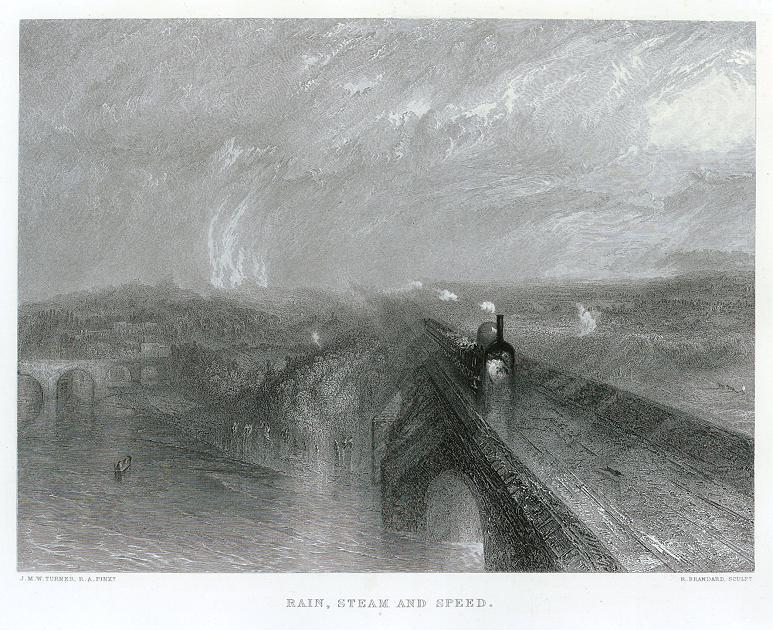
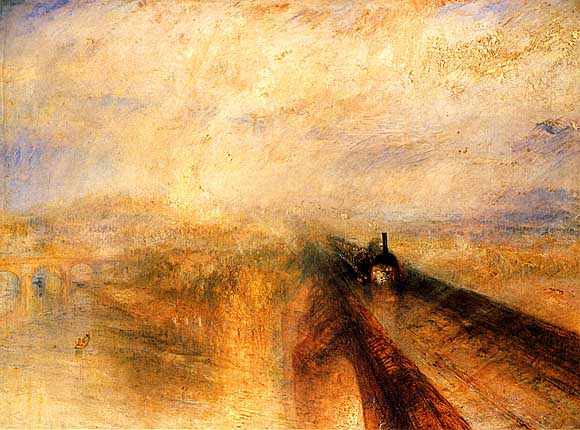
    And as an aside, Turner does get “cleaned up” in a way, when his artwork appears as engravings. There is of course much more definition given the scene as the engraver puts in hard lines on the soft non-edges of the original. For example, here we have “Rain, Steam, and Speed”:

    Before:

    Rain_Steam_and_Speed_The_Great_Western_Railway_1844

    After:

    Rain_Steam_and_Speed_The_Great_Western_Railway_1844

    The “after” version here is actually much more representative of the original than generally found in Turner engravings. 

    Anyway there’s nothing that quite takes the “impression” out of “Impressionism” than cutting a hard line of it in a steel plate.  

    (Again, this is just some outside thinking on the topic, limited to about the timeline of three cups of coffee.  Maybe four.)

    Notes:

    1. “Dr. Liebreich on Turner and Mulready”, Nature, March 21, 1872

    2. Williams, W. Mattieu. “Turner’s Vision”, Nature, 25 April 1872, p 500.


  • The Big Bang Monkey and “Gasoline Alley”

    JF Ptak Science Books  Overall Post 5111   Part of the series A History of Blank, Empty and Missing Things 

    Concevons qu’on ait dressé un million de singes à frapper au hasard sur les touches d’une machine à écrire … [translation: Let us imagine a million monkeys typing haphazardly on typewriters …”1

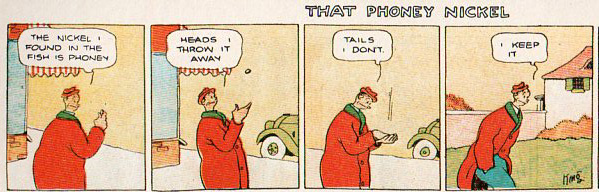
    Gasoline alley723[Gasoline Alley, 1931]

    There are some ideas that leave me with a powerful sense of nothing.

    To me, “nothing” can be very important–especially in writing and speaking and action, doing or saying nothing has been the important and the correct thing to do.  “Nothing” isn’t necessarily an ending, and, just a period or a coma, can just be a placeholder for something that is developing.  There can be long nothings and short one, forever- and micro-nothings, and nothing that is nothing for almost nothing.  Nothing can be implied, insinuated, broadcast and defined, though self-defined extended nothingnesses (like John Cage’s  4’33”) is a tricky thing to make happen with success. 

    The ideas that leave me with a sense of nothing are interesting things.  And there are a lot of them. When I can remember them they are in my nothing file, waiting for nothing–or something–to happen.

    This is the sense I had when (years ago) I was trying to explain randomness to our 10-year-old daughter and her 11-year-old cousin, sitting out in a park, looking at stuff.  Somehow I reached into the past and pulled up the infinite monkey theorem, and tried to make that interesting, but just couldn’t do it. Maybe it was the difficulty of super-large numbers, or the fascinating but incomprehensible thought-threats of Borges and his infinite library, but I was left with nothing.

    It is Borges who writes a lovely piece on the history of producing everything from nothing, appearing in his “The Total Library” in 1939 (and then again in “The Library of Babel” in 19412), reviewing machines and such of spectacular randomization that could produce the whole of what we recognize as what we know. 

    Emile Borel wrote on it in 1913, finding the possibility of one million monkeys pounding away at one million typewriters.  In his wonderful work, The Math Book3, Cliff Pickover looks at 250 big ideas in the history of mathematics and gives each of them one page only for presentation and explanation.  He approaches the infinite monkey theorem by looking at one monkey wailing away at one typewriter, striking the keys, and analyzing how long it might take for the one monkey to produce one line from one book.  The line is “In the beginning…” at the beginning of one great nothingness, from the Old Testament, a 56-object sentence (including punctuation and spaces) and, Pickover reasons, that if there is a 93-character keyboard, then this monkey will have a 1/9356 possibility times 10100 of getting it right, and that if it worked for 24 hours a day striking one key every second then it will have used all of the time in the present universe–the Big Bang Monkey.

    All I got back were big stares, and a big sense of nothing in my gut.  It reminded me of the cartoon featured above, a toss-off sub-cartoon in a panel of the Gasoline Alley series.  Did he actually look at the coin?  Did he just decide to keep it?  And why keep a phony nickel? And who counterfeits nickels, even during the Depression?  What is the outcome of the panels–just some guy walking down the street with a nickel in his pocket.  Something may have happened, but it was a lot of nothing. 

    I know that I should have a bigger sense of what Felix Edouard Justin Emile Borel and Jorge Francisco Isidoro Luis Borges were writing about and in many ways I do, but in the end I know that I am left with nothing.  But I have it in my pocket.  

    Notes

    1. Émile Borel (1913). “Mécanique Statistique et Irréversibilité”) J. Phys. 5e série 3: 189–196.

    2.  Jorge Borges,  “La biblioteca total” (The Total Library), Sur No. 59, August 1939. Translated by Eliot Weinberger, in Selected Non-Fictions (Penguin: 1999)

    3.  Clifford Pickover, The Math Book, (2009), Sterling, page 328.


  • Worse than “Science Jokes”: Songs of Biology (1945)

    JF Ptak Science Books   Quick Post 

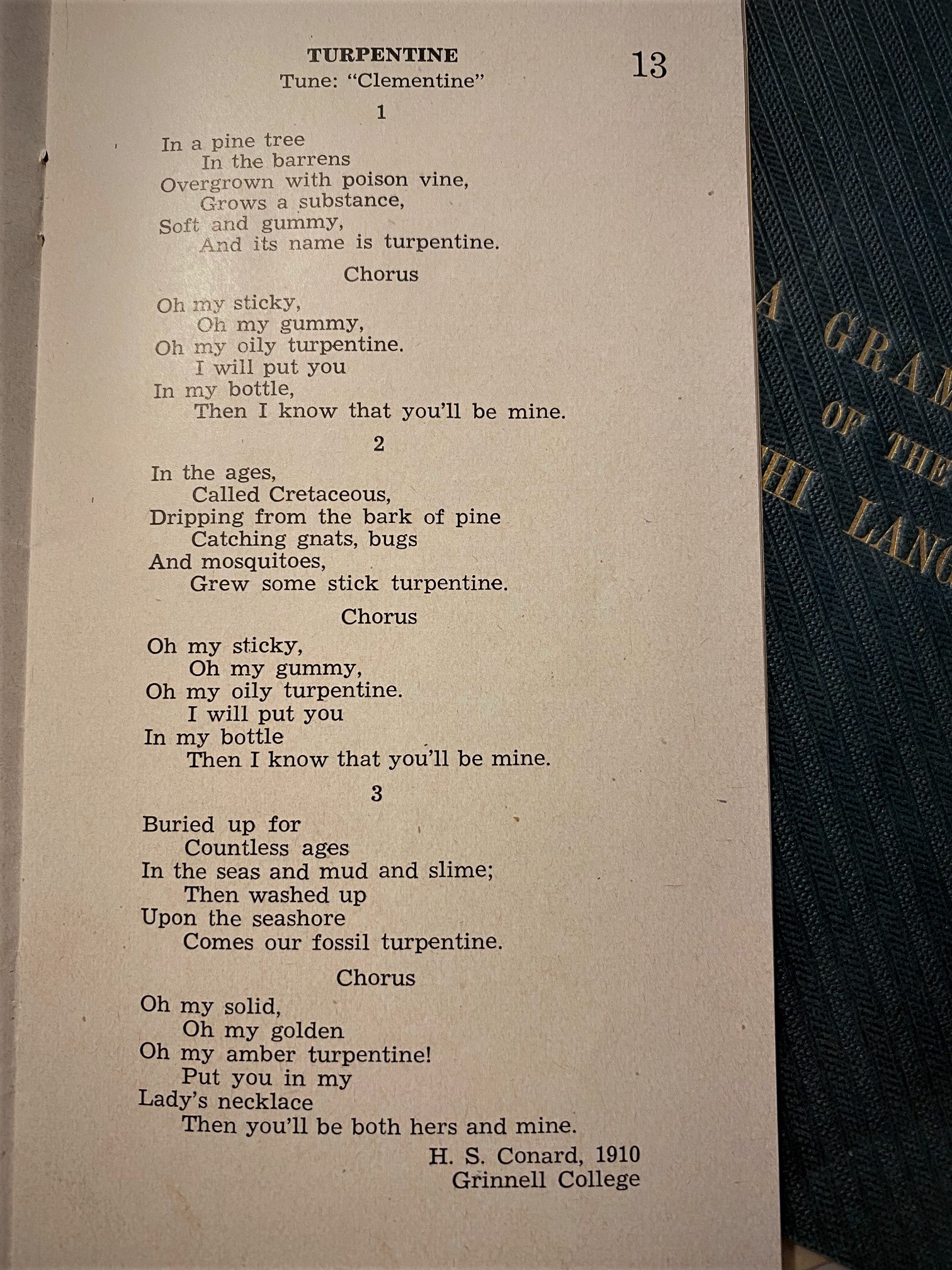
    IMG_2973 (1)Tonight I found a wonderful little biology pamphlet sandwich between two other very thin pamphlets—Free Our Political Prisoners, by the League for the Amnesty of Political Prisoners, ca. 1920, and A Grammar of the Marathi Language, 1868—the three of them together not weighing four ounces. The bio pamphlet is a very non-droll and forced-funny publication out out by the Beta Beta Betans of Mt. Vernon, Iowa, at the end of the War in 1945, and is called Songs of Biology. None of them are any good, though they’re not quite bad enough to land in the safety zone of so-terribly-bad-that-it-is-good. The only simultaneity that occurs here is the level of badness living down to its expectation.

    I do have to commend them on at least some of the song subject and titles, several of which were very unexpected. For example, I doubt that many other songs have been written about turpentine. A few of the others that are more enjoyable to imagine the lyrics than to read them are “The Sad Fate of a Youthful Sponge”, “Objective Tests”, “Parasites on Parade”, “The Germ-Laden Bucket”, “The Simple Arthopod”, and :”ode to Drosophila”. They’d be better with no music and no lyrics.

    Anyway, I present the glory of turpentine…


    ·Posted by :

    ·in:


  • The Encouragement of Insanity (1877)

    JF Ptak Science Books  Quick Post

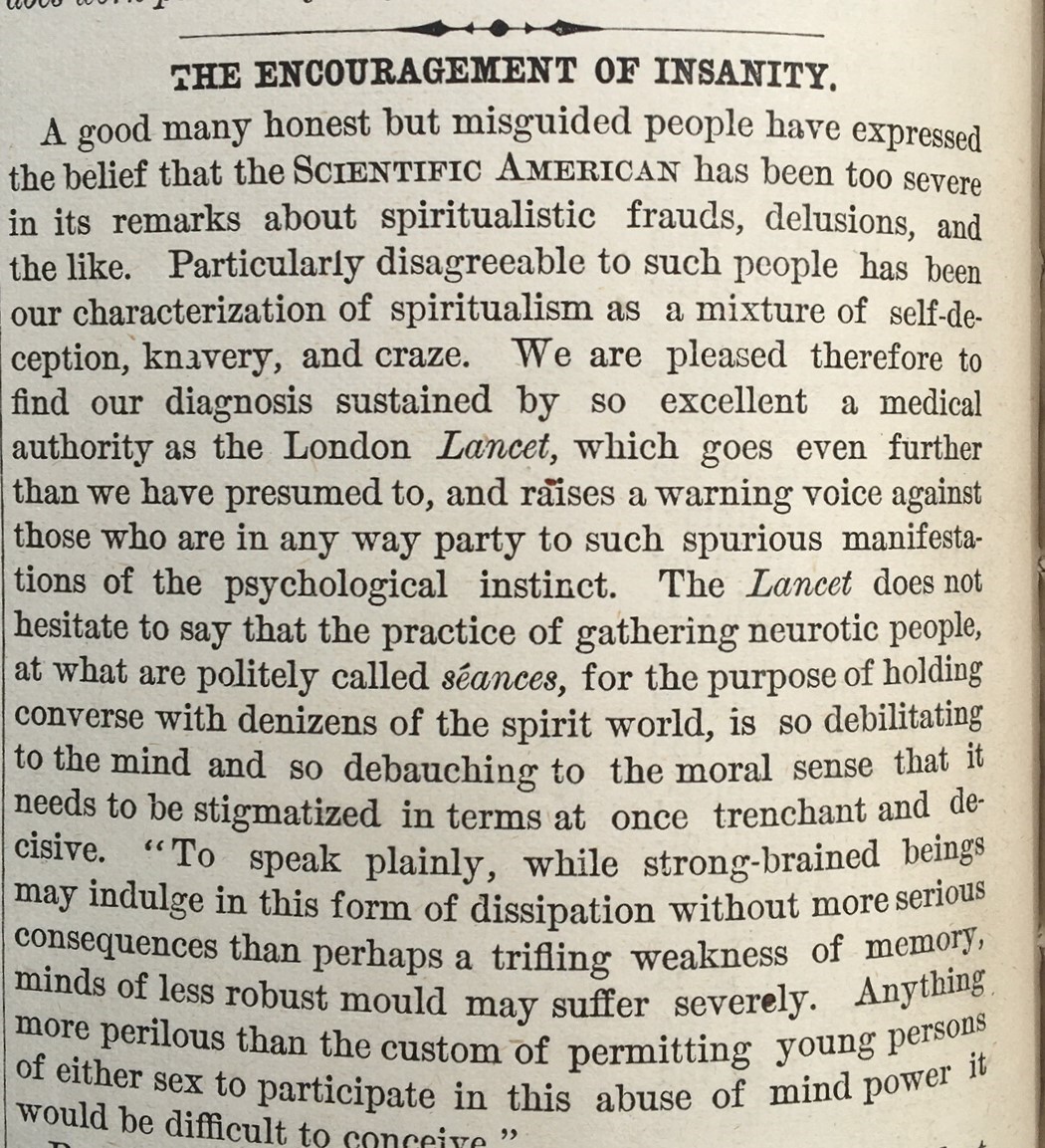
    IMG_2195Well. The Scientific American (1913) delivered quite a blow against the current “craze” of spiritualisms and seances, which they characterize as a mixture of “self-deception and knavery”.  They had no room for it whatsoever, and let their readers know it. These practices were “symptoms of mental degradation that will cast adrift principles…and elect to run riot in vain imaginings and idle conceits”. The editor also brought The Lancet on board in the condemnation of the Spiritualism racket, quoting the great medical journal saying that the talking-to-the-dead racket was “debilitating to the mind and so debauching to moral sense it needs to be stigmatized in terms at once trenchant and decisive”.  An Edgar A. Poe vicious book review this is not, though they do communicate their displeasure with the whole racket in very forceful words.


  • An Educated Fly–Scientific American, 1898

    JF Ptak Science Books  Quick Post

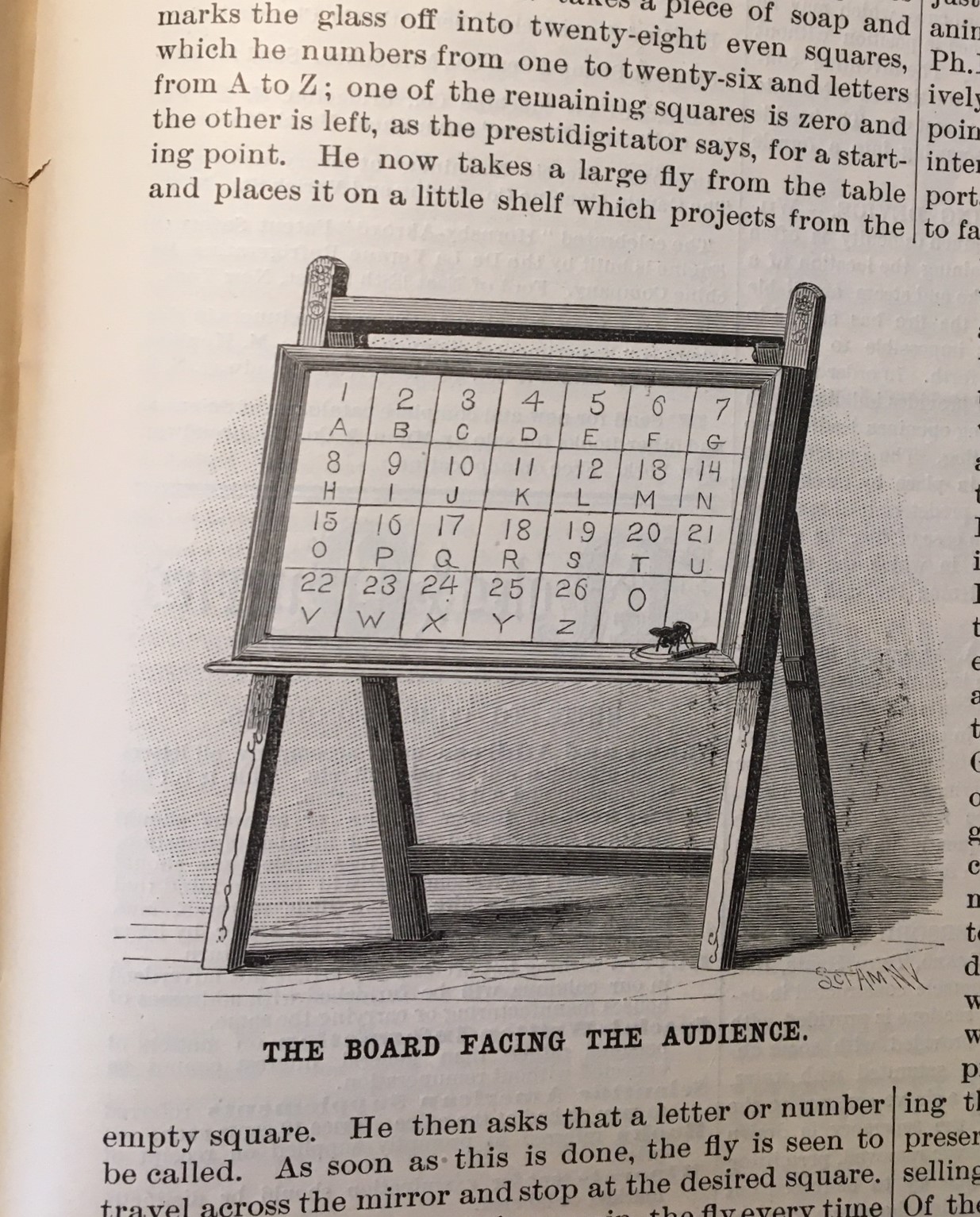
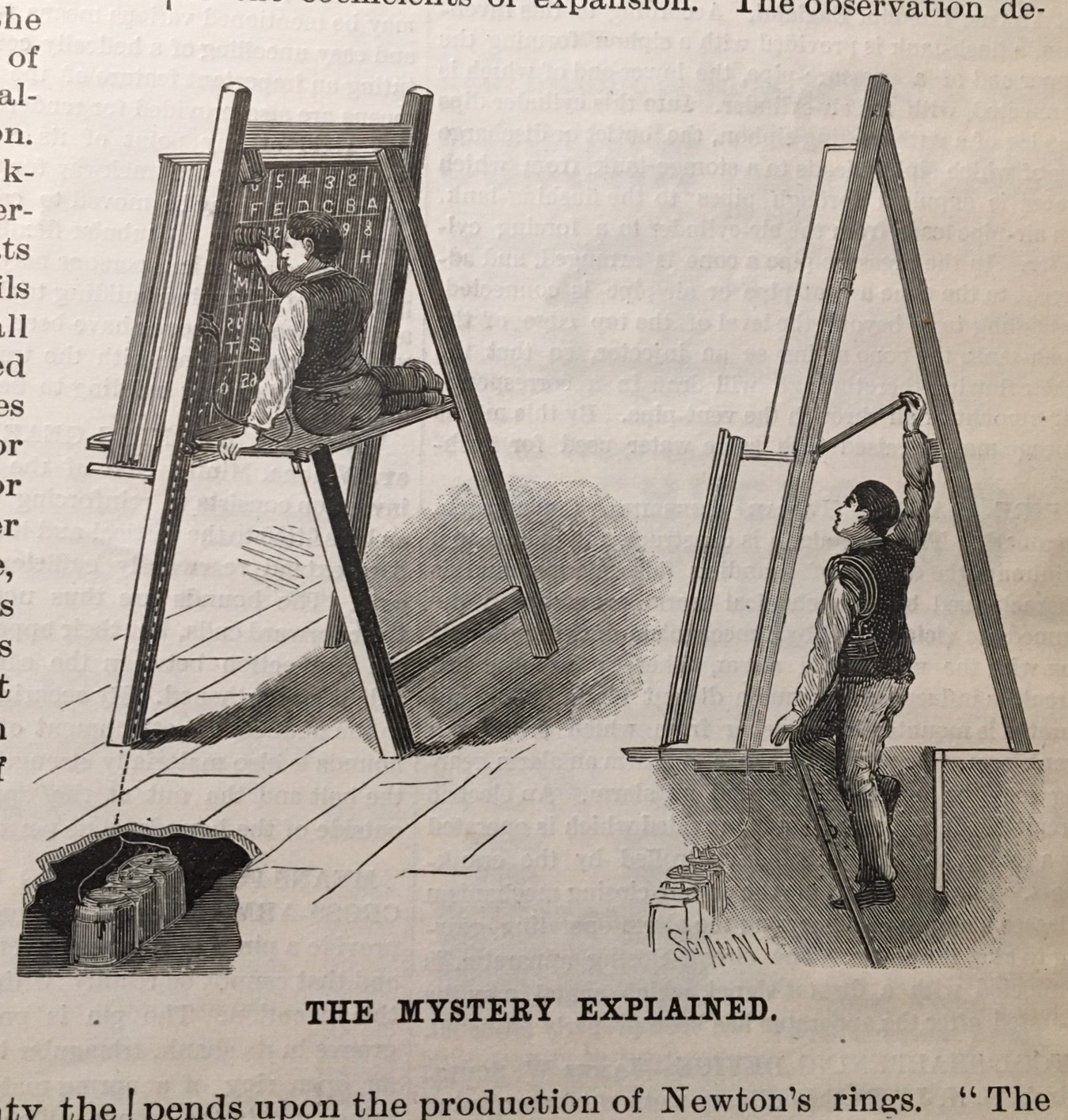
    Sci Am 1898 fly _2_How could you see an article heading of “An Educated Fly” and not share the secret?  I don’t know, and so I am performing a bit of due diligence, sharing the story from Scientific American from 3 September 1898. There really isn’t that much to tell, and the title is probably better than the story: the large tablet is placed on a stage in front of an audience, with a pitchman telling some sort of warm-up story to create interest among the crowd; a fly of some sort (whether a model or a real fly pinned or tied to something, I don’t know) and placed on a little shelf beneath the board. The ringmaster would ask a question, and the fly move around and alight or somehow make it known as to its selection of the numbers/letters on the grid. The trick is revealed in the image below–after the blackboard on its pedestal is shown to the audience front-and-back, it is positioned over a trap door on the stage, where a confederate would rise up and position themselves inside the pedestal and operate the device holding the live/inanimate fly. That’s it. After the tricks were performed, the inside man would escape through the trap door, the pedestal would be wheeled out to display that it was empty, and that was that. Old trick, new fly. 

    Sci Am 1898 fly _1_


  • Magritte, Bruegel, and Mid-western Streetlights (1908)

    JF Ptak Science Books  Quick Post

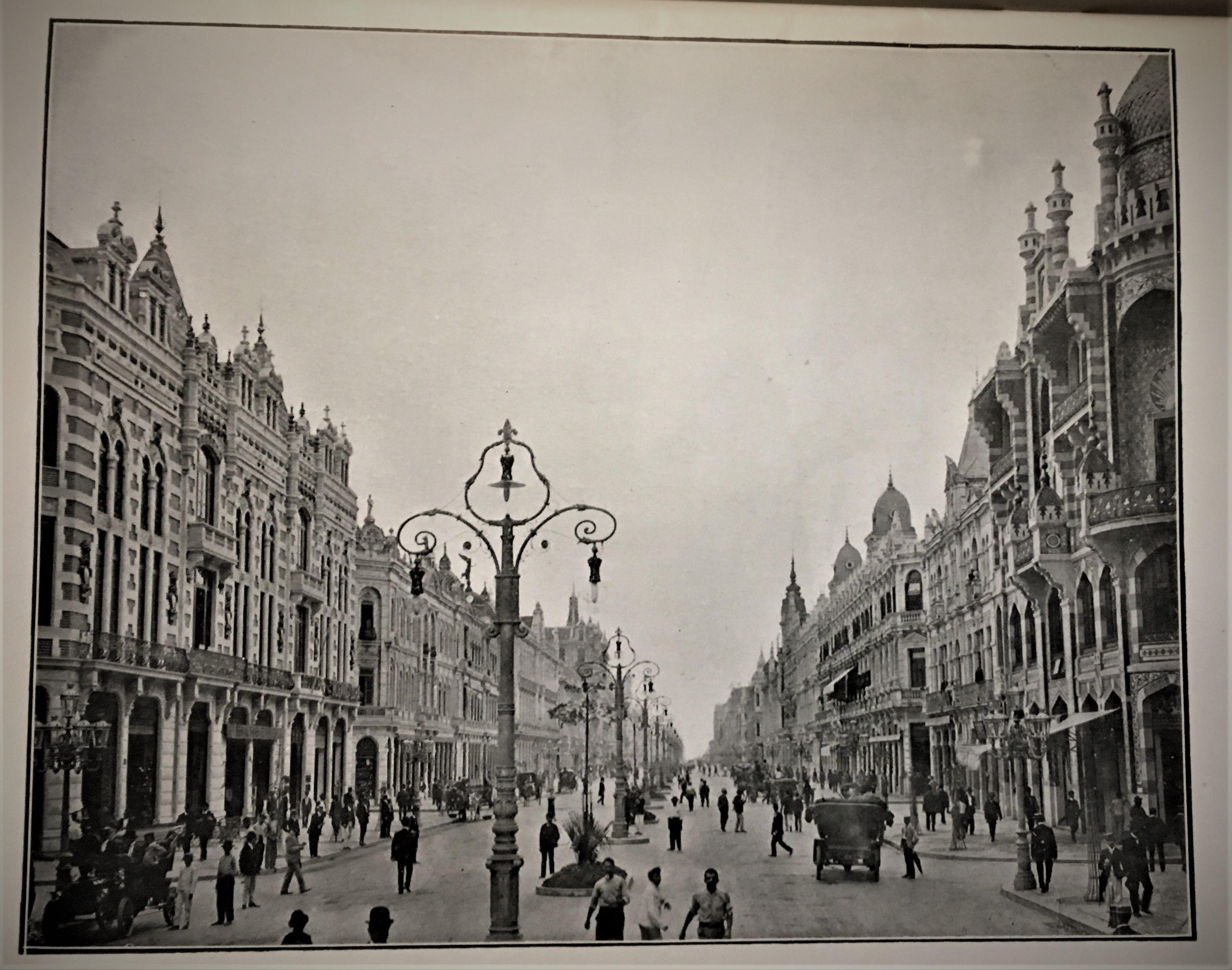
    IMG_1851 (1)I am somewhere between the 16th and 20th centuries with this image–I see a bit of Pieter Bruegel (d. 1569) in this, one of his involved  and diverse human landscapes set into a complex physical environment. In spite of its great and inquisitive artfulness, this photo was made to illustrate the streetlights of Central Avenue in Rio de Janiero for a speculative publication called Public Lighting for St, Louis, which was printed in 1908 and published to solicit opinion on the style of street lighting that was to take place in the city.  Fairly mundane stuff, except that several of the photos used in that slim pamphlet are quiet little sub-masterworks of nothing. I think too that the perspective here of the horizon disappearing down the avenue and the sky being about the same color as the street lend a certain arrogance to the realism of the thing.

    I also see the possibility of Rene Magritte (d. 1967) at work here as well–or a Dada-reconstruction of his Golconda, if you applied a heavier gravity a bit and placed all of those raining bodies from his painting  carefully onto the streets of Rio.   Or it is a combination of the two…in any event it is an evocative photo, buried up to its eyeballs in total obscurity in this 1908 pamphlet, and which probably has not seen the light of day in a hundred years. 

    ·Posted by :

    ·in:


  • Aether Ennui (1927)

    JF Ptak Science Books  Quick Post

    IMG_1822 (1) (2)IMG_1822 (1) (4)

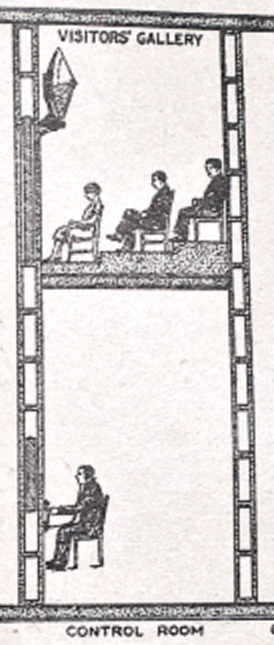
    This story on the new Roxy theater appeared in Radio World in 1927, and it caught my attention with its peculiar empty space and loneliness in elements of the article’s image. 

    Even though we are reading about a new state-of-the-art performance and broadcast facility, a story filled with hope and possibility of another brand new stage opening, the imagery has that certain varnish of vague ennui.

    There is also a lot of space, open space,  over-strong areas of nothing, flat, forbidding, and perhaps even a little cold and frightening. It does fit rather nicely into my collection of images and idea in the History of Blank, Empty and Missing Things series on this blog.   

    I’ve included the full illustration below.  


  • Humpty Dumpty on Words (History of Nothing series)

    JF Ptak Science Books  Quick Post (History of Nothing series)

    Watching the performances of the U.S. president for these thousand+ days—particularly exemplified in the wind/”wind mill” address–seeing him teetering and as always ready for a fall that never happens, put me in mind of an old character, Humpty Dumpty. This doesn’t apply for what happened to Humpty Dumpty in the old rhymes, but for what he said in Mr. Carroll’s book:

    “When I use a word,” Humpty Dumpty said, in rather a scornful tone, “it means just what I choose it to mean—neither more nor less.”

    “The question is,” said Alice, “whether you can make words mean so many different things.”

    “The question is,” said Humpty Dumpty, “which is to be master—that’s all.”

    –Lewis Carroll,  Alice Through the Looking Glass, (1871), Lewis Carroll’s sequel to Alice’s Adventures in Wonderland (1865).  This one isn’t doesn’t have such a cushioned fall through the rabbit hole, and has very sharp edges all the way around. Carroll introduces us to the reverse in this world, having Alice step through a mirror into a realm that is a reflection of sorts of what her world once was, including the example of logic above that so fits the U.S. situation at the top of the turtle stack.  Or bottom–das macht nichts.  

    Communication when the speaker uses a private truth table is difficult (for the listener). 

    And then I wondered about whether or not Wittgenstein had ever read Carroll, which is way more of a question that I can answer in one of these quick posts with the one-hour time limit imposed—suffice to say that it is something interesting to pursue.

    For now, a good quote from the early W:

    “Roughly speaking, to say of two things that they are identical is nonsense, and to say of one thing that it is identical with itself is to say nothing at all.”–Ludwig Wittgenstein, Tractatus… 5.5303.)

    For an interesting read not quite on the point of whether W read C, see: George Pitcher, “Wittgenstein, Nonsense, and Lewis Carroll”, The Massachusetts Review, Vol. 6, No. 3 (Spring-Summer, 1965), pp. 591-611

    ·Posted by :

    ·in:


  • A Lovely and Lonely Plainness, by Margaret Bourke-White

    JF Ptak Science Books  Post 2814

    I happened upon some photographs by the great Margaret Bourke-White yesterday in a most unexpected place–an upper-end oversize pamphlet advertising the perfume and oils business of Fritzsche Brothers of NYC. No disrespect to Fritzsche–which was in its 65th year of business–but it was a surprise to see the work of a pioneering and iconic photographer like Bourke-White in such a relatively common setting. Of course photographers need to pay the bills, too, and I’m sure that Bourke-White was well paid for her ultra-competent and accomplished business and industrial assignments. She was probably very well paid considering that she already had a national audience, being the first photographer for the new Fortune magazine, with her photo essays appearing there beginning in 1930. 

    The Fritzsche pamphlet was published in 1937, just a year or so before she made her first LIFE magazine cover.  She had a tremendous run between 1935-1950, and seemed to be everywhere, seeing everything. She was the first U.S. war photo-correspondent covering WWII and Korea; she was at concentration camps in 1945 and with Stalin in 1944 and Gandhi in 1949, and was a superb documentarian of the human experience during the Great Depression–even her first assignment at Fortune found her making photographs of the bank vault at the First National Bank of Boston coincidentally on the evening of Black Tuesday, 1929. 

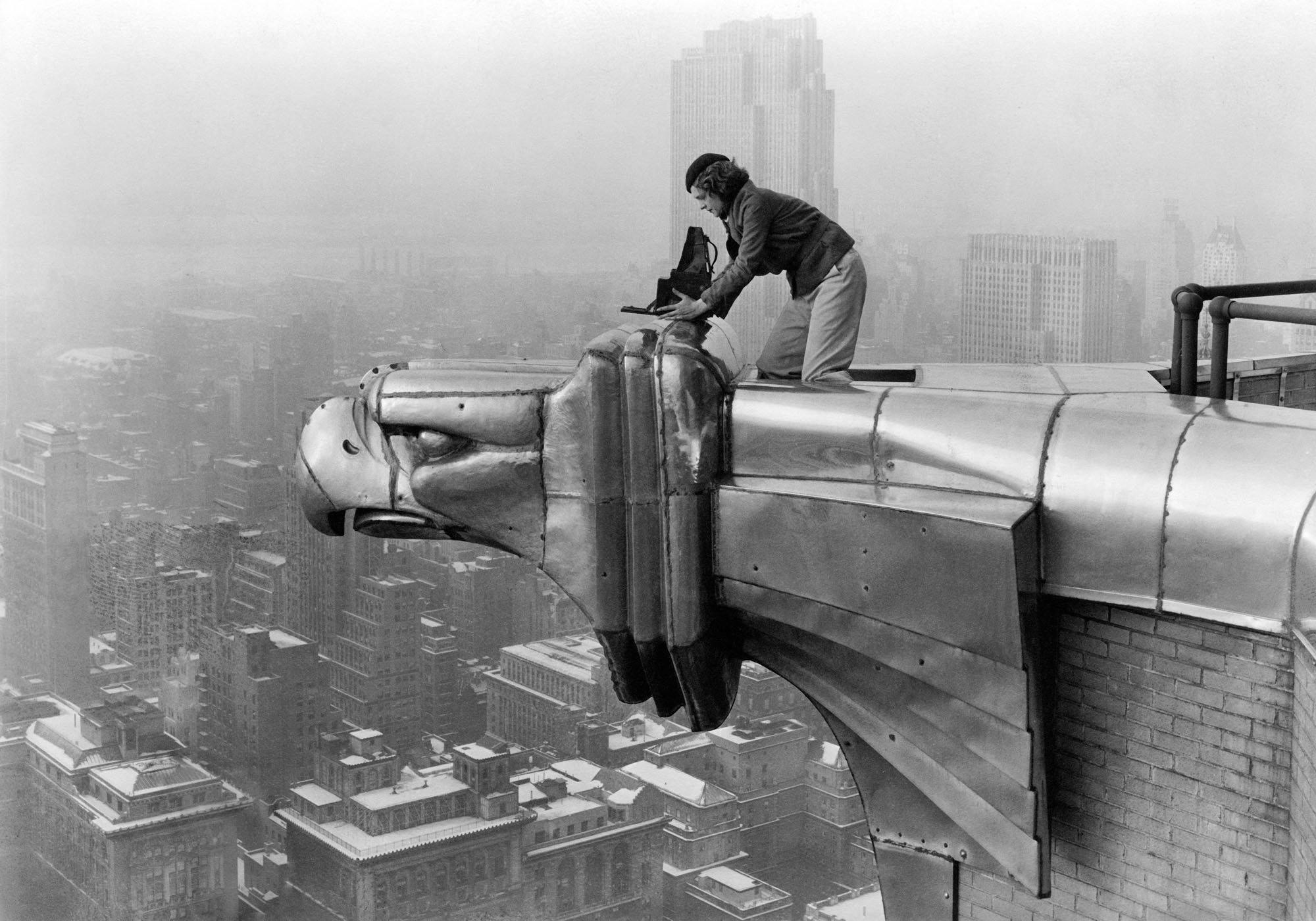
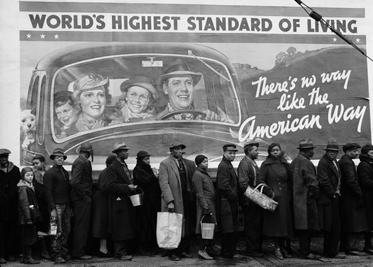
    Here’s a photo of Bourke-White at work (from her first-photographer-at-Fortune-magazine days). and one of her most recognizable works made during the Great Depression:

    Bourke-white _1_ atlantic

    Bourke-White _2_ Kentucky flood wikicommons


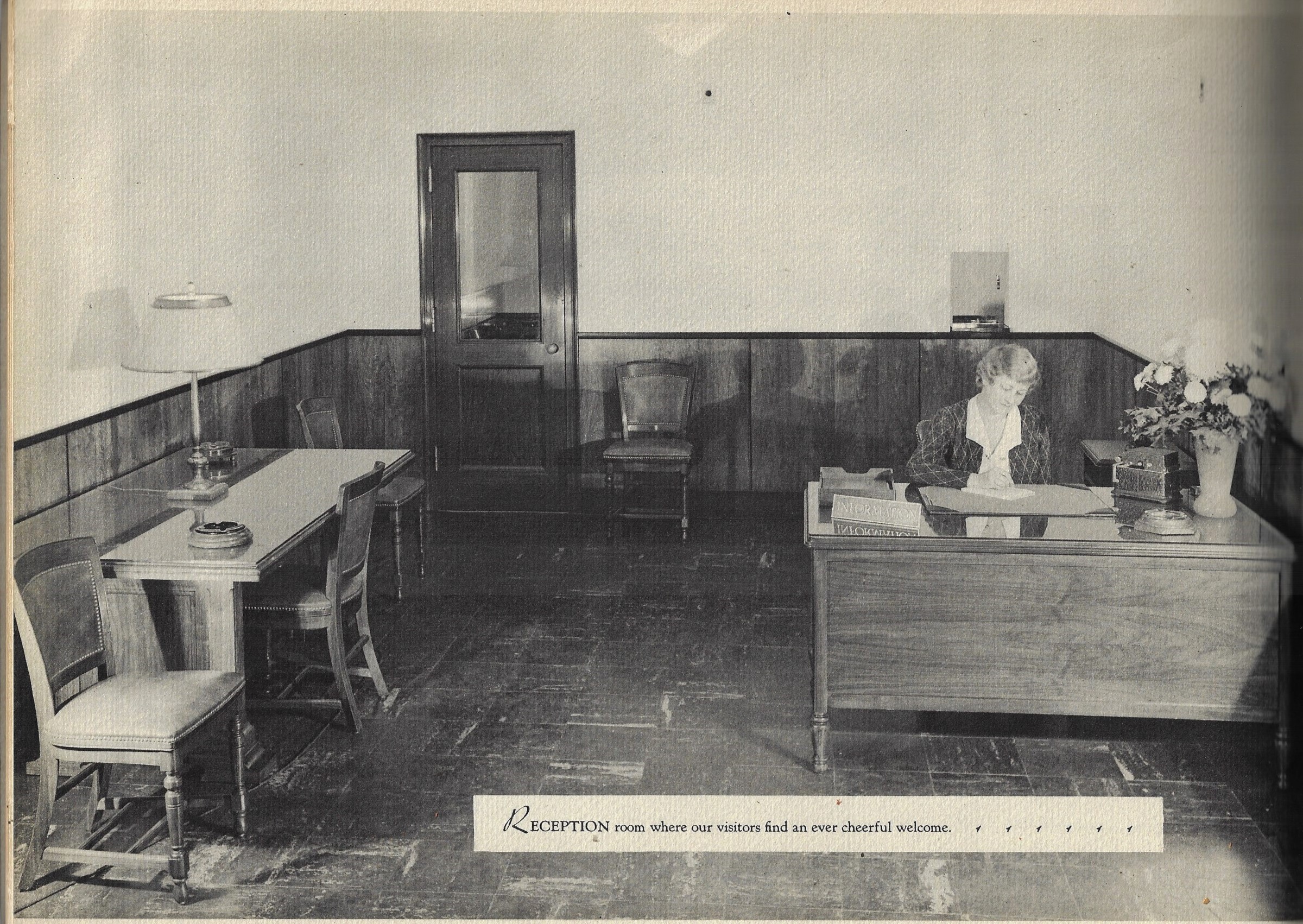
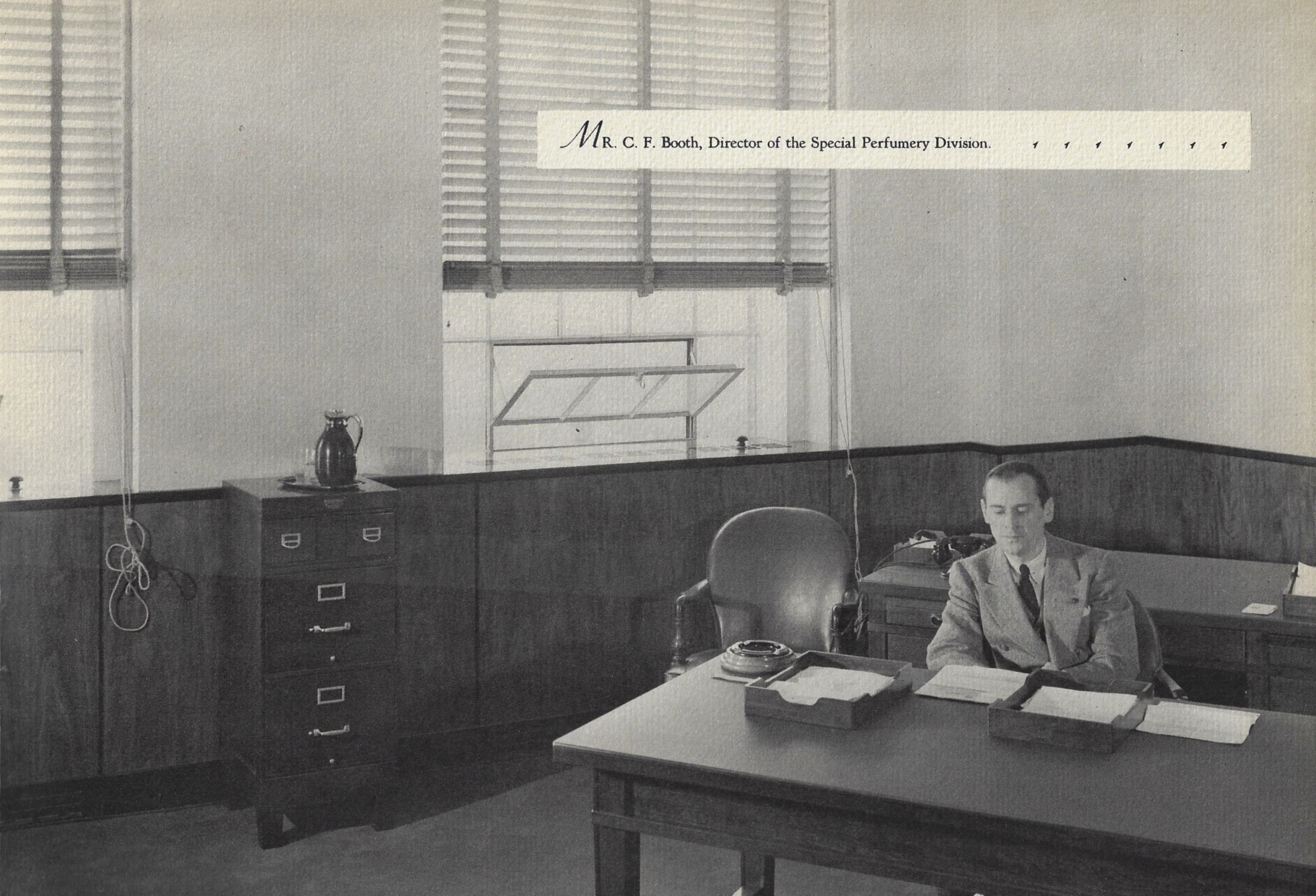
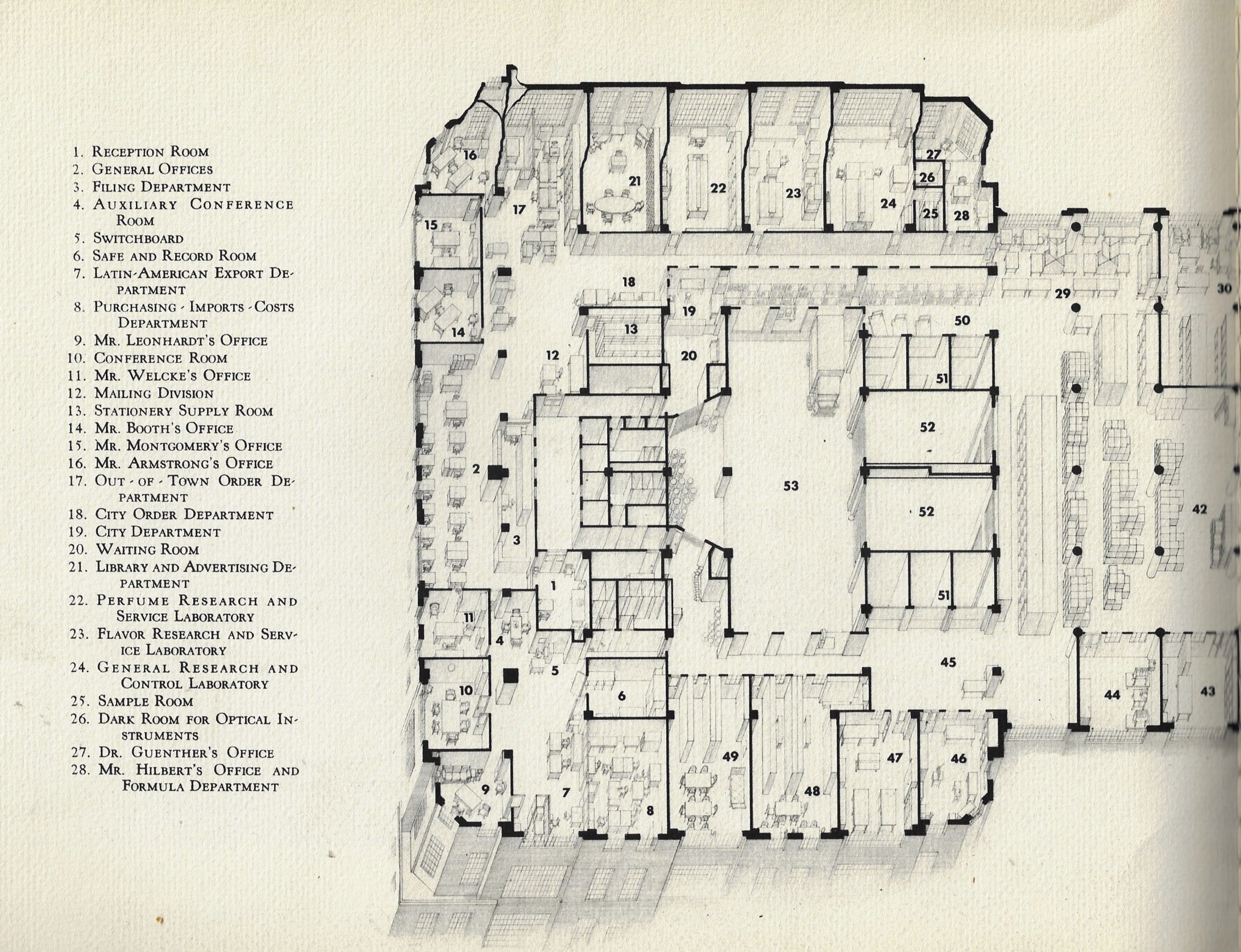
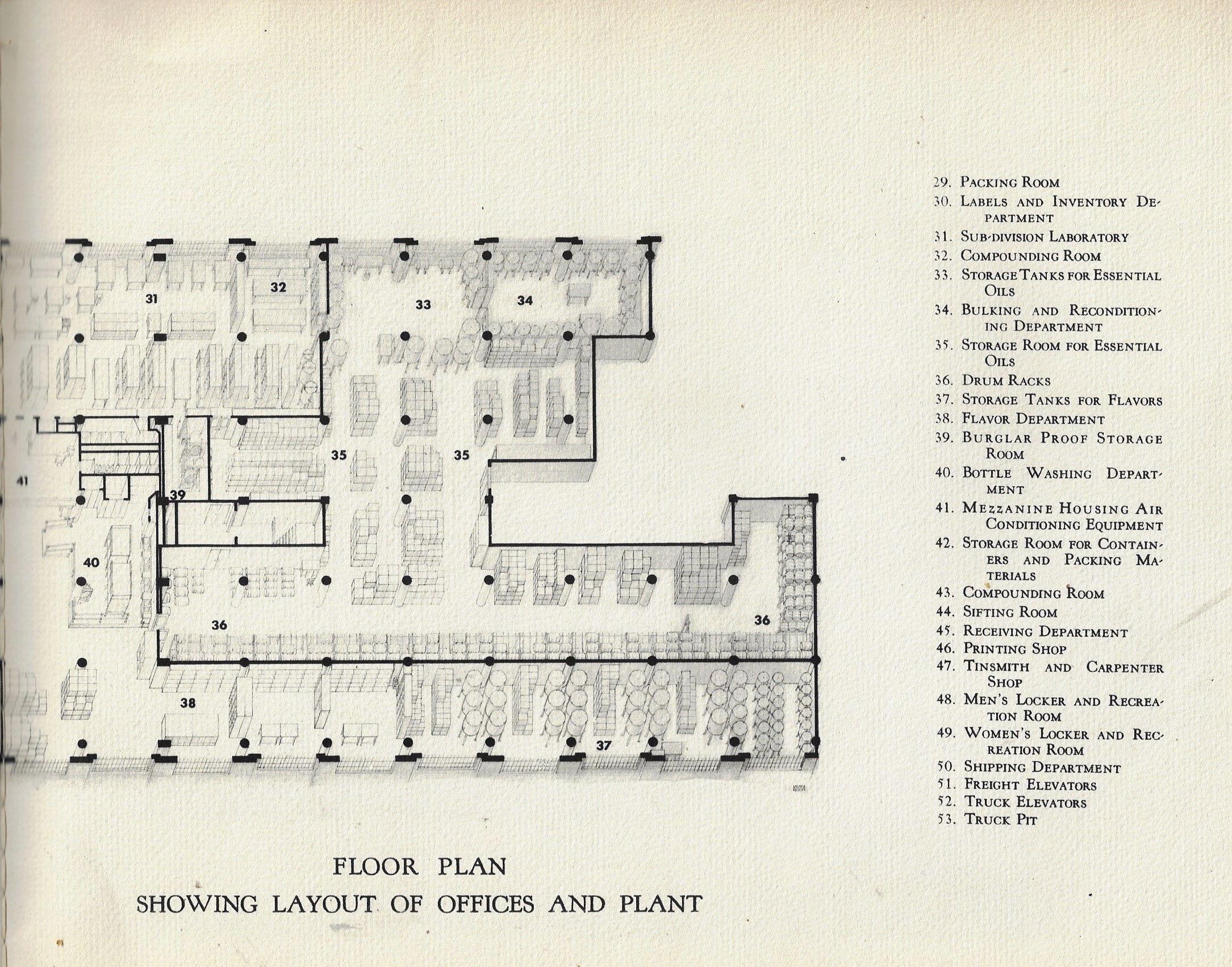
    And then here she was in the relatively bland pages of the Fritzsche promo, making images of reception areas, loading docs, labs, a library, some VP studiously at work at a small desks…however when you look closely at the rooms she was working in you can appreciate that it was a difficult assignment, and that lighting was a problem, though it was one that she solved.  The odd thing is that everything in these photos is sort of the same, that a general blankness/blandness has taken over, all of the people with similar expressions, and then something else…that in this very large collection of offices there’s absolutely noting on the walls except for an occasional clock here and there. Other than that exception, there are no wall decorations. Given that the company is chemically decorating the air around people, it strikes me as a little odd that the physical surroundings was such a collection of nothing.  Here’s the reception area as an example of the environment’s assertive blandness:

    Fritzsche _3_

    There are 22 such photos of hollow spartanness, well-lighted. And very tidy.

    Here’s another:

    Fritzsche _4_

    The blank walls become even more oppressive when you consider the number of walls in the place: 

    Fritzsche _2_

    Fritzsche brothers _1_


    I guess Bourke-White did as well as could be done with what there was…