A Daily History of Holes, Dots, Lines, Science, History, Math, Physics, Art, the Unintentional Absurd, Architecture, Maps, Data Visualization, Blank and Missing Things, and so on. |1.6 million words, 7500 images, 4.9 million hits| Press & appearances in The Times, Le Figaro, Mensa, The Economist, The Guardian, Discovery News, Slate, Le Monde, Sci American Blogs, Le Pont, and many other places… 5000+ total posts since 2008.

Category: History of Nothing

  • Courageous “Degenerate” Art, 1937

    JF Ptak Science Books    Post 1731

    I came upon this pamphlet out in the warehouse, and I was reminded again of the greatness and courage of some of the anti-NSDAP/Hitler artists in Germany in the early period of Nazism, 1933-1936.   There were many who were overtly anti-Nazi–like George Grosz and John Heartfield–in the political messages that were their artwork; then there were those  (like Felixmueller, Wollein, Otto Dix, Max Pechstein) who became enemies of the Nazi state because they chose to depcit the horrors of war or poverty or other social ills
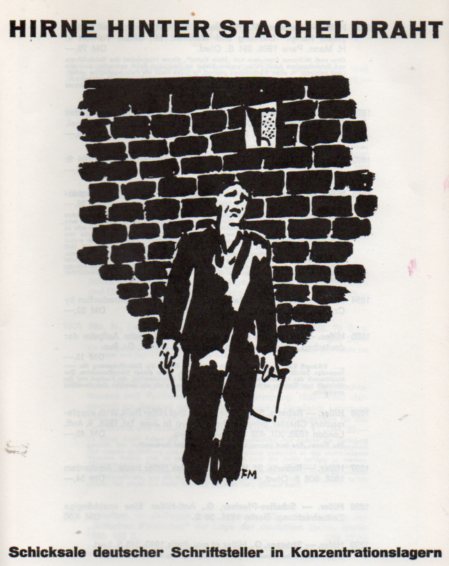
    Degenerate art257[“Brains Behind Barbed Wire”, with a woodcut by Frans Masereel.]

    John Heartfield, Blood and Iron, 1934

    And then, as the Nazis consolidated power they erected an enormous edifice of propaganda and thought control, codified in law and absorbed into societal practice, where artists and writers and their artwork and books and ideas were banned, being “deliberate sabotage of national defense”.   The books were burned, the art removed or sold or destroyed or hidden, the writers and artists threatened with extinction as well:  deported, thrown away, controlled, imprisoned, sent to concentration camps, murdered. 
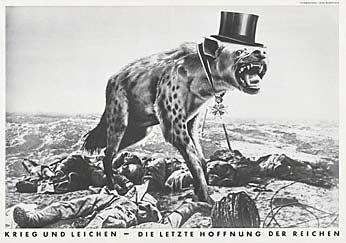
    Photomontage by John Heartfield, 1932

    [War and Corpses, by John Hearfield, 1932.]

    One way of another, they were mostly gotten rid of–the paintings and other works of those who were abroad or dead or otherwise not-reachable; and the art as well as the artists who were still in Germany, and whose presence could be controlled.
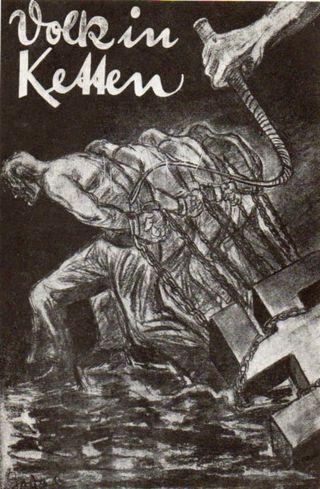
    Klinger258[“Max Klinger”, Volk in Ketten. Deutschalnds Weg ins Chaos, 1934]

    Some of the artists who were not able to escape, or who were Jewish and who did no tget sent to concentration camps, were murdered via the infamous Aktion 4 or T4 program–the mass murder of the physically disabled, the sick, the weak, the “moral degenerate”, and those too incapacitated to take care of themselves.  The name comes from the address of the organization responsible for it, at Tiergartenstrasse 4 in Berlin–the  Gemeinnützige Stiftung für Heil- und Anstaltspflege, [or Charitable Foundation for Curative and Institutional Care] which was run from (at least ) 1939 to 1945 under the direction of Recihsleiter Philipp Bouhler (who unfortunately escaped life by suicide after being captured by the Americans in May 1945). 

    [From Wiki: “This poster (from around 1938) reads: “60,000 Reichsmarks is what this person suffering from a hereditary defect costs the People’s community during his lifetime. Fellow citizen, that is your money too. Read ‘[A] New People‘, the monthly magazine of the Bureau for Race Politics of the NSDAP.”]

    To make things easier on the German mind, the NSDAP selected artists and entire art movements that were to be banned as “degenerate”, and displayed them in an infamous 1937 show called Entartete Kunst (“Degenerate Art”).  

    The people who committed their beliefs about the great Evil Thing that was National Socialism, those who committed their thoughts in art or literature, and did so in the 1933-1937 period, were brave people.  Hitler and Goebbels and the rest of the Nazi machine deeply appreciated the influence of visual images, being great practioners in the idea themselves, only though with vastly different content.

    The great social commentator/satirist/cartoonist for Harper’s Weekly magazine, Thomas Nast, also knew the great influence of the single visual image, and magisterially used his insight and art to great effect in helping to effect social change.  One of the evils he brought down–Boss Tweed of Tammany Hall–said that he didn’t fear anything that was written about him in the newspaper because his constituency “couldn’t read”.  But what he didn’t get, and what he never did understand, that the thing that brought him down were cartoons, and those were the things that people didn’t need to be able to read words in because they could already “read” the images. And it got him in the end.

    The manufacturers of the NSDAP recognized this factor and saw how much it could play against them, and so sought to remove “it”.  They went after the art, the artists, and the ideas, and came away from it all with safe and sanitized and partially meaningless culture. 

    The artists condemned in the 1937 Degenerate Art exhibition necessarily reads like a who’s-who of modern and 20th century art:  the show included Ernst Barlach, Willi Baumeister, Max Beckmann, Max Ernst, Wassily Kandinsky, Emil Nolde, Max Pechstein, Paul Klee, Ernst Krircherm Lyonel Feiniger, Oskar Schlemmer,  Franz Marc, El Lissitzky, Oscar Kokoschka, George Grosz, Marc Chagall, and Kurt Schwittersto name a few.  (A full list can be seen below.) Entire artistic movements were also to be eliminated in order to save the morality and conscience of the German people, including Bauhaus, Surrealism, Impressionism, Fauvism, Expressionism, Cubism and Dada. Basically, it was almost all of modern art.

    [Hitler visiting the Degenerate Art Show, 1937.)

    A fuller list of those exhibited at the 1937 Degenerate Art show.

    These artist were abandoned/exiled/killed in favor of a more morally-robust and Aryan flavor, a genetic correctness, like the work here by Ernst Liebermann, moribund in its deadly color, greasy, tumescent hyper-non-sexuality:
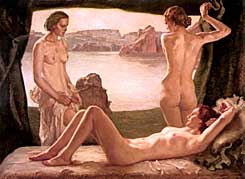
    By the Water - Oil painting by Nazi artist, Ernst Liebermann

    which is picture postcard bad, like Franklin Mint artists gone to Nazism and shining/lustrous nudes.

    The “degenerate” label didn’t last very long in Germany, at least not in years–measured in lives, however, it is a completely different story.
  • On Infinite Blankness in the Infinite Library

    JF Ptak Science Books  Post 1664 

    (Part of a series of on the History of Blank, Empty and Missing Things and the History of Nothing .)

    Nothing017

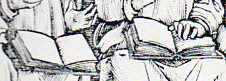
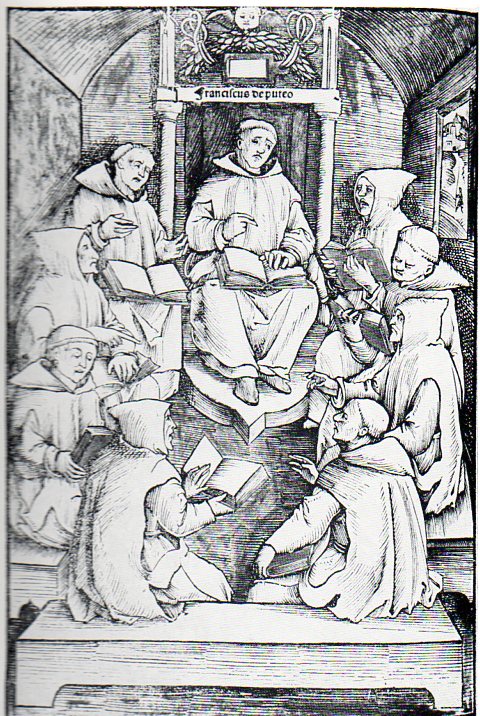
    I have a notion that when we enter the infinite library of Jorge Borges that what we find somewhere in there, in the middle (where every place is the middle) we find that the books being read are just like the volumes from this illustration. It may only make sense that in a place where everything that could be written had been written, and that in the place where there was a finite amount of the infinite and vice versa, that the whole mechanism would go spinning fractally out of control once the Primum Mobile got the chance to introduce the notion of the Blank Book.  Reproducing nothing infinitely may be a lot more cumbersome than reproducing everything than can be written.  At least the written aspect has some sense of order to its infinity, and that–like when approaching the speed of light–that when you get near “the end” that everything gets a little, well, funny. When confronted with infinitely reproducible nothingness, there’s nothing that quite reproduces to the end of pi like the blank book.  It’s nothing all the way down.  And all the way up, too, for that matter.

    Nothing016
    [Image source:  Statuta ordinis cartussiensis a domno Guigone priore cartusie edita, printed in Basel by J. Amerbach, 1510.  Illustrated with woodcuts by Urs Graf. This is a beautiful and important work, a great effort by an early and important press, and this image happens to show study timne in a Monastic setting. Their books of course weren’t blank.]


  • The Most Beautiful Blank Map in the World–the Bellman’s Fit from the Hunting of the Snark

    JF Ptak Science Books   Post 1644  [Part of the Series on the History of Blank, Empty and Missing Things.]

    “Other maps are such shapes, with their islands and capes!
    But we’ve got our brave Captain to thank”
    (So the crew would protest) “that he’s bought us the best-
    A perfect and absolute blank!”–
    Lewis Carroll, The Hunting of the Snark.

    Peutinger
    [This post fits perfectly in our History of Blank, Empty and Missing Things.  Ditto for the series on The History of Lines–making this a great confluence for a History of Blank and Missing Lines (in the History of Nothing series).]

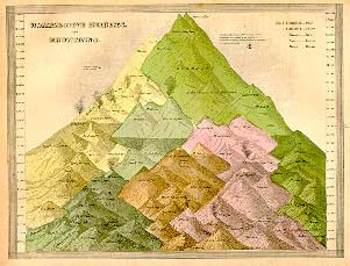
    For all of the brilliance of all of the cartographers and map makers who have drawn a line in the sand or strung a strand of quipi or drawn a celestial rendering on a cave wall or imagined the Americas in 1504 or ventured out and away from the Medieval T-maps or drew maps of other worlds or fashioned spiraling maps of Hell, I think the maps I most like are maps of imagined places.  Of course I enjoy the extremely rigorous and steadfast maps (like those of the German Stieler Company of Gotha who for a hundred years routinely drew the most detailed maps in a particular scale than any other mapmakers in creation—you know, the big maps of the U.S. that would locate minute places like Truman Capote’s “out there” town of Holcomb, Kansas) and of course maps of the solar system and galaxy and universe (as knowledge expanded and collapsed and expanded again).  And of course there are the representational maps showing the comparative heights

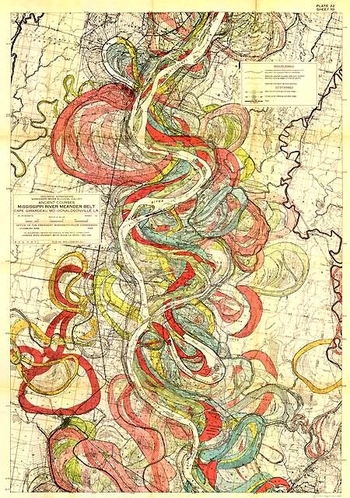
    Mountain of mountains and lengths of rivers, or the grouping of all the world’s lakes, or the divorce rate map of the United States at Centennial, or the heights at which different sorts of trees are found, or geological speculations on the thrust of the Appalachian chain, or the wanderings of the course of the Mississippi River (below), and other hosts of things.
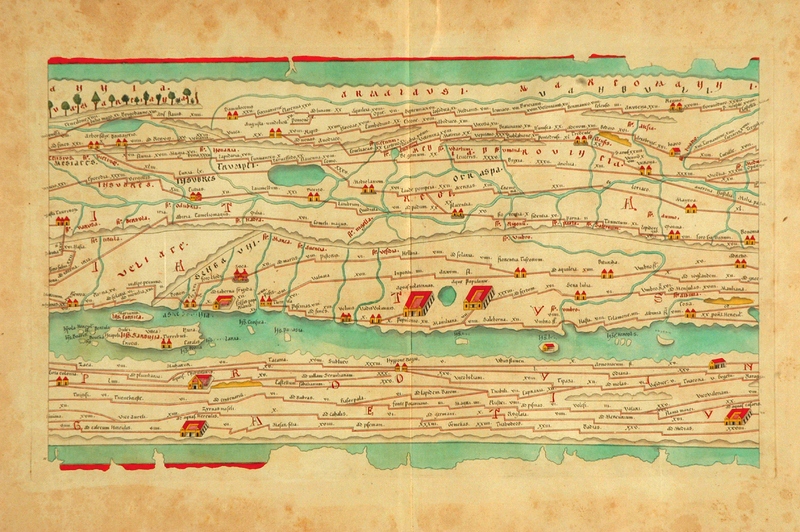
    As much as detail is attractive to me—complex, staggering information correctly displayed—there is also the opposite:  the quick, thoughtful, spare map.  The Tabula Peutingeriana is sort of like that—this is a 17th century reproduction of an ancient Roman map that was, basically, a road map of the world (or the Roman World) that was linear and included all manner of detail of the roads themselves, with little else.  It is a spectacular thing—one version I had once was 14 inches high and 16 feet long, just a skinny map of how to get around in the world from 2000 years ago.  There was of course nothing “quick” about how the map was made, coming at the expense of countless hours of careful observation, keen observation, and lots of general human tragedy.

    Mississipi

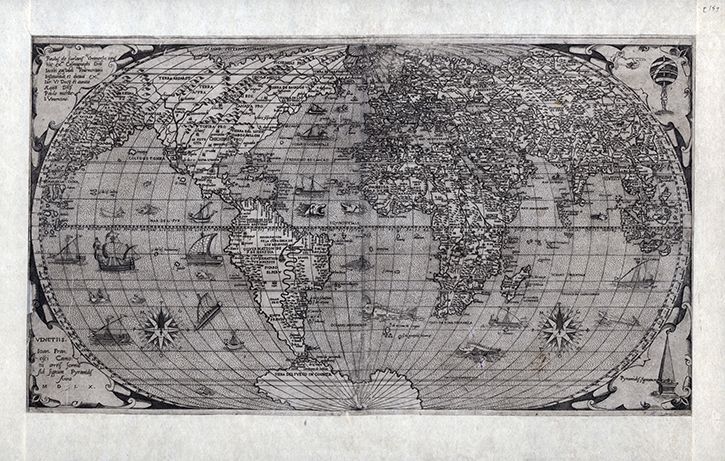
    Folrani’s world map of (ca.) 1575 (which appeared in Antoine Lafrery’s (1512–1577) Geografia tavole moderne di geographia) is a glorious thing and a fantastic accomplishment for its time (and also being the first map to use the name “Canada”).  It has a sumptuous artistry to it in addition to including (and excluding) certain of the newly known discoveries.  In this version of the map he chose to not use the newly-incorporated Straits of Ainan

    Folrani maps

     [I’m sorry to say that I’ve misplaced the original source for this map–I will try and supply. My apologies.]

    In another edition of the m-which appeared a few years later–North America is still attached to Asia, but now there is added another bit, a gigantic land mass to the south, Terra Incognita.  This was basically put together by some sightings in the southern seas that located different land masses, and Forlani took it upon himself to connect all of those pieces of information and draw them into one continuous land mass, greatly expanding his own version of Antarctica from a few years earlier.  It is a wonderful example of leaving something(big)  out and making something else (even bigger) up.

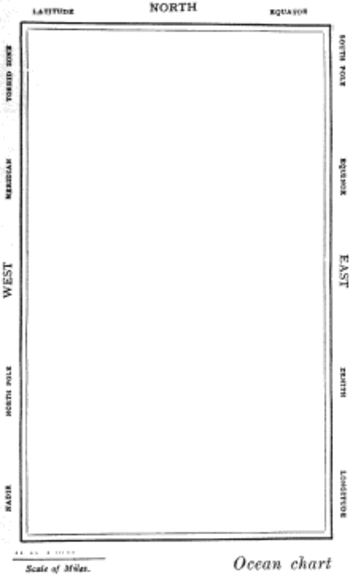
    But the map that I think I love the most illustrates Lewis Carroll’s The Hunting of the Snark, an Agony in Eight Fits, and occurs in the Bellman’s tale, starting the second fit. It begins:

    The Bellman himself they all praised to the skies-
    Such a carriage, such ease and such grace!
    Such solemnity too! One could see he was wise,
    The moment one look in his face!

    He had bought a large map representing the sea,
    Without the least vestige of land:
    And the crew were much pleased when the found it to be
    A map they could all understand.

    “What’s the good of Mercator’s North Poles and Equators,
    Tropics, Zones, and Meridian Lines?”
    So the Bellman would cry: and the crew would reply,
    “They are merely conventional signs!

    “Other maps are such shapes, with their islands and capes!
    But we’ve got our brave Captain to thank”
    (So the crew would protest) “that he’s bought us the best-
    A perfect and absolute blank!”

    Snarkmap

    Sometimes there is nothing so fine as something that beautifully illustrates the nothing that isn’t there, and this lovely map, unencumbered of all of the elements and details that define the mapness of something,  perfectly explains the origin of its need.

    For a lovely work on the complexities and simplicities and just sheer  beauty of what things like maps are check out former Ashevillean Peter Turchi’s Maps of the Imagination, the Writer as Cartographer.


  • The History of Blank, Empty & Missing Things–When Everything was Missing

    JF Ptak Science Books   Post 1624   (Part of the series on the History of Blank, Empty and Missing Things.)

    Koberger bw884

    Perhaps “everything” wasn’t missing, but almost everything was.  Certainly the ancients and even the more-moderns, even the scientists of the 16th and into the 17th centuries (until von Guericke in 1672), could not abide the idea of the existence of nothing.  The vacuum, a space in which there was nothing at all, was seen to be an anathema to the creations of the great creator, that the vacuum was antithetical to what was understood to be the nature of nature. (I wrote a post here earlier on when nothing was almost something.)

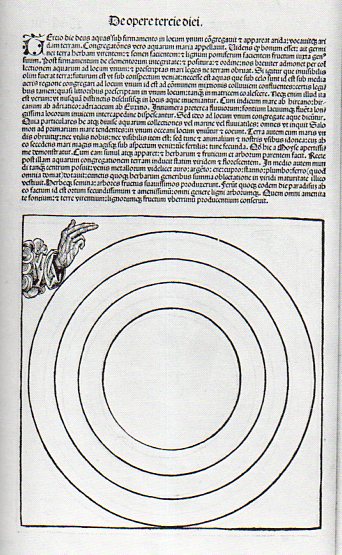
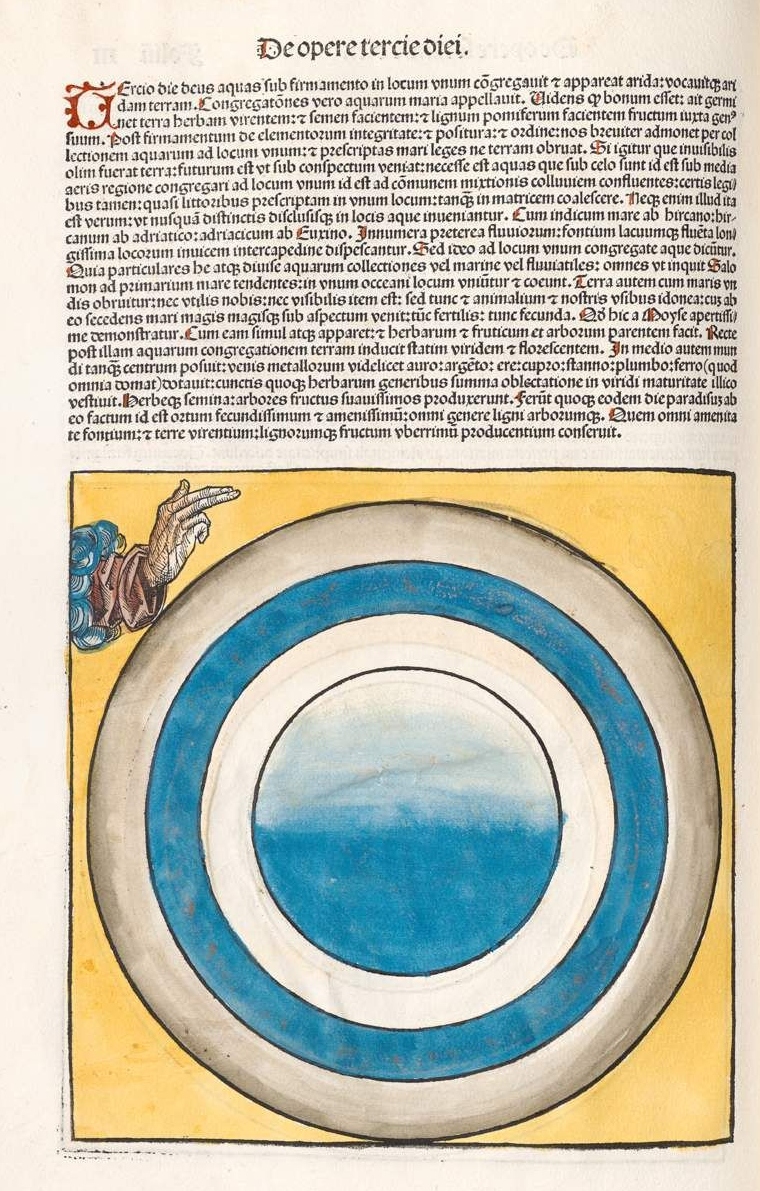
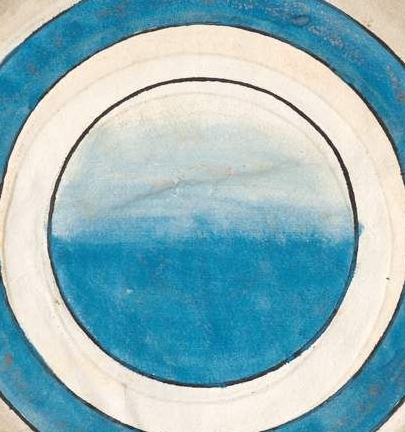
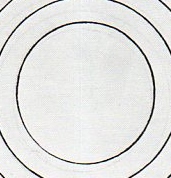
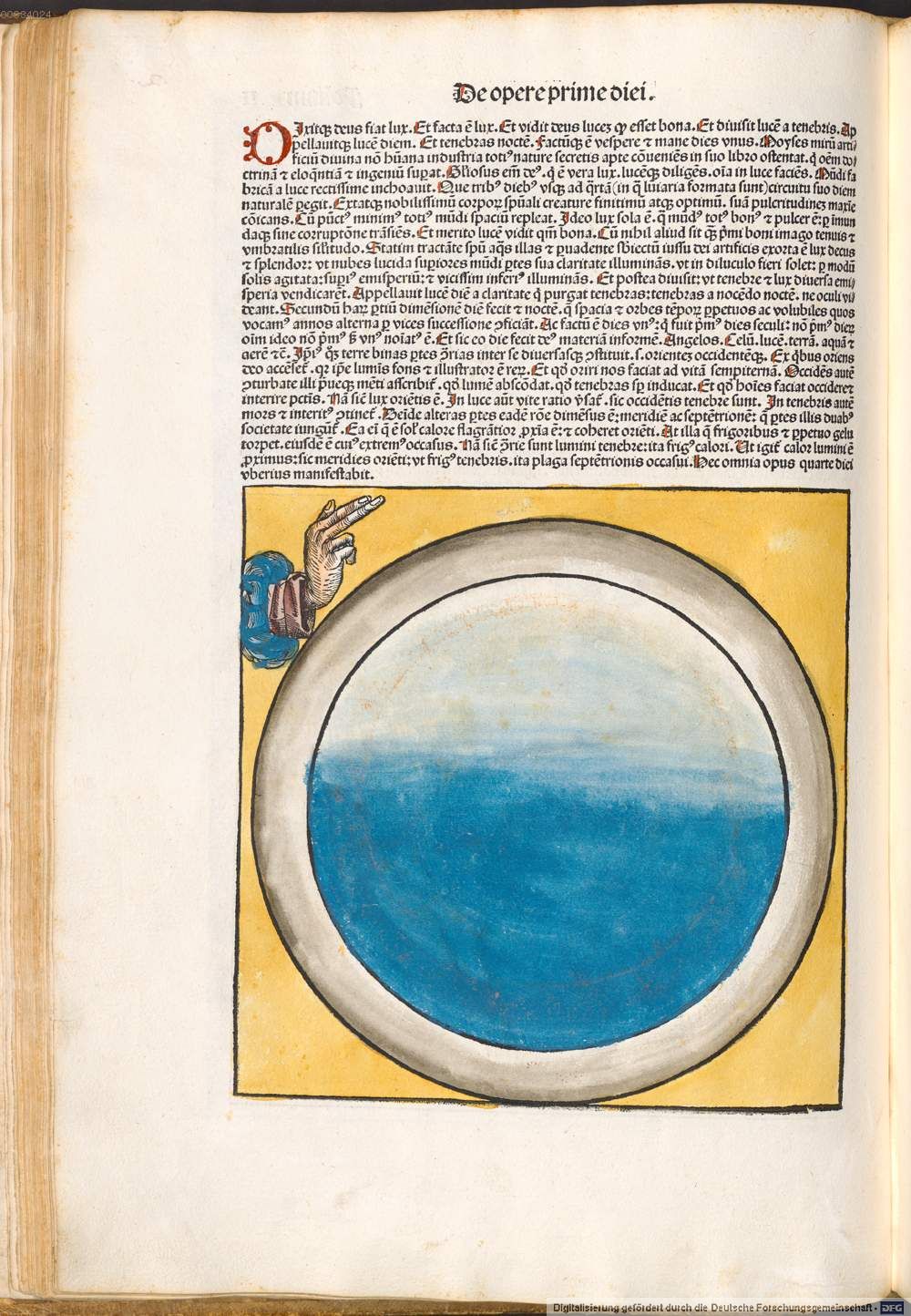
    But what we see here, above, is the third day of creation as presented in one of the most significant books printed in the 15th century, and it is somewhat problematic, because it depicts almost-northing.  That, or almost-everything. 

    The book was written in Latin by Hartmann Schedel (1444-1514, with the German translation by Georg Alt) , with the illustrations under the control of Michael Wohlgemut (1434-1519) and his stepson Wilhelm Pleydenwurff (c. 1450-1494), .and was published in Nuremberg in 1493 by Anton Koberger as Liber Chronicarum–known best to English-pseaking readers as the Nuremberg Chronicles (and to Germans as Die Schedelsche Weltchronik).  It is perhaps one of the greatest illustrated works in the first half-century of movable type printing, using more than 1800 woodcuts to tell the story of the world–according to the Bible, mostly.  (The book deals with the history of world in its seven ages–the first five of which deal with cumuulative history to the birth of Jesus Christ, while the sixth ages handles the history from Christ to the present day, and teh seventh carries along the future history of the world to the Last Judgment.  Not much then is devoted to the 1500 years preceding the publication of Koberger’s book. The author, Schedel, was a very religious man, and considered the work of teh Bible to come from the hand of god and therefore was infallible; on the other hand (so to speak), everything written outside of the Bible was that of humans, and so fallible, and therefore open to interpretation.)

    Here is a colored version of the third day in the creation cycle mythology, which opens itself to much more visual congruence. (“On the third day God gathered together unto one place the waters under the firmament; and the dry land appeared. And God called the dry land Earth; and the gathering together of the waters he called Seas; and God saw that it was good, and said, Let the earth bring forth the green grass, the herb yielding seed, and the fruit trees yielding fruit after their kind.[Genesis 1:9-13.]”)

    Koberger color

    Koberger color b

    And the uncolored version, third day:

    Koberger bw det

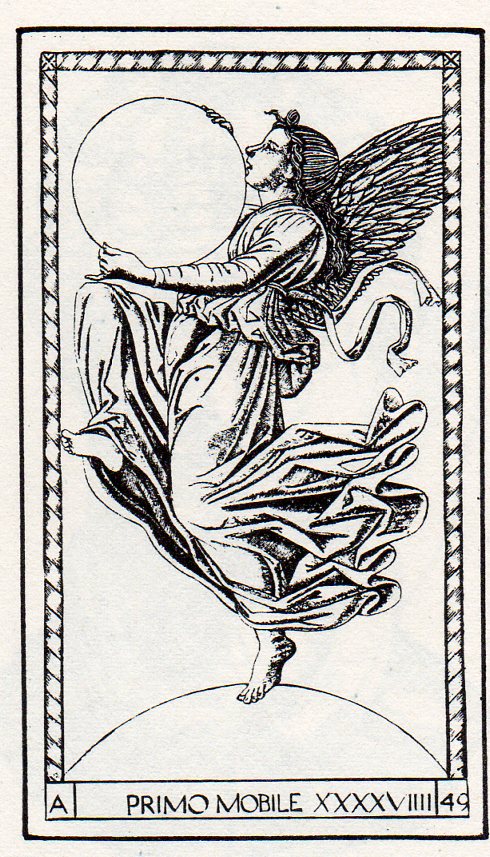
    This sort of “nothingness” is not unique, as we can see in this example from the Mantegna Tarocchi, showing the creator as Primum Mobile, the First Mover, holding what may well be our universe in its hands (and standing on another sphere of nothing, god knows what that might be):


    https://historyofideasblog.com/a/6a00d83542d51e69e20133f47ca205970b-piPerhaps I’m missing the larger picture, and that the circles/spheres are the things created, and that they are contained in the square surrounding them; and that the boundaries marked by the circular lines are not necessarily empty, and that it is the suggested of the circles that is the stuff created, placeholders, contained within the square of the creator’s domain.  Or maybe not. Perhaps the circles are signifiers for the elements–earth at the center, surrounded by water/air/fire. Perhaps the woodcut was just waiting for some color. 

    Notes:

    The English translation of the Nuremberg chronicle used here is from Beloit College (here) which also has a very lovely scholarly treatment of their copy of the Nuremberg Chronicle (here).

    Here’s the rest of the cycle, in color:

    “For he spoke and they were made: He commanded and they were created”  (Psalm 33)., so says the legend (IPSE DIXIT ET FACTA SUNT; IPSE MANDAVIT ET CREATA SUNT Psalm 32) which floats above god enthroned–but it is difficult to see the progress in the un-colored version of day three.  

    http://www.beloit.edu/nuremberg/graphics/Layout%20and%20Design-Full%20Page_lg.jpg

    The first day:

    Korberger 1st day real


  • A Paris Made to be Destroyed–Sham Paris, 1917/18

    JF Ptak Science Books   Post 1613  (Post 656–expanded) 
    Follow Me on Pinterest


    Now this was a case in which you were given the result and had to find everything else for yourself.  — Sherlock Holmes in A Study in Scarlet

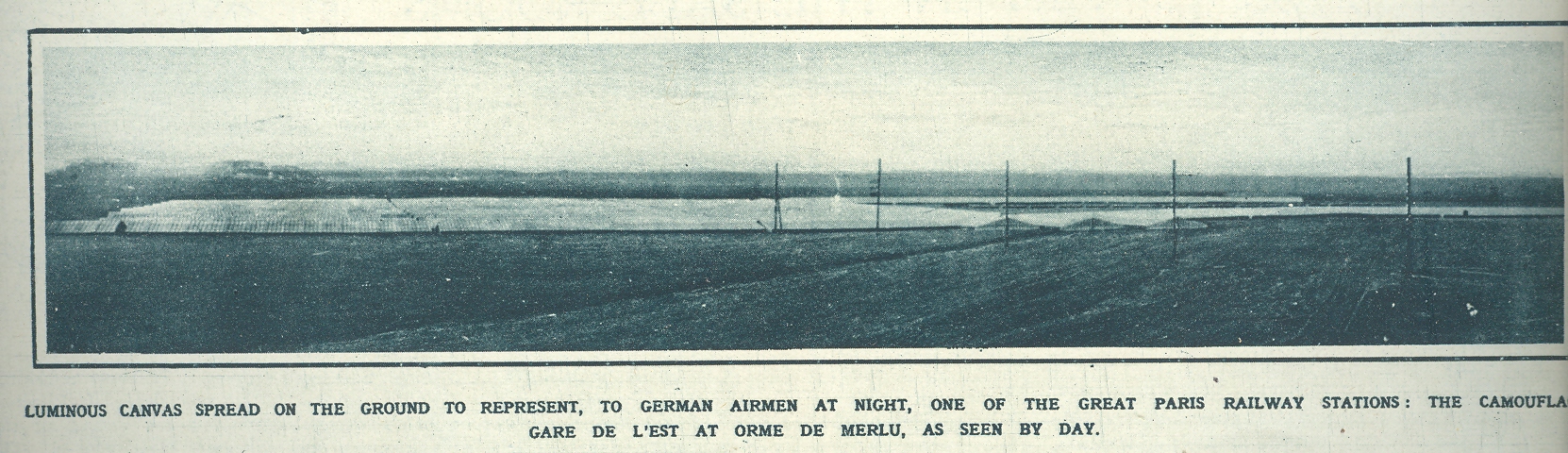
    There is no doubt a history that could be written on shadow cities, cities that were built to resemble other cities, cities constructed to serve as a deterrent or double, cities set to deceive, cities constructed to be experimented upon. Some were built ot be destroyed.  Like Paris–or “Sham Paris”. 

    Paris sham detail sham

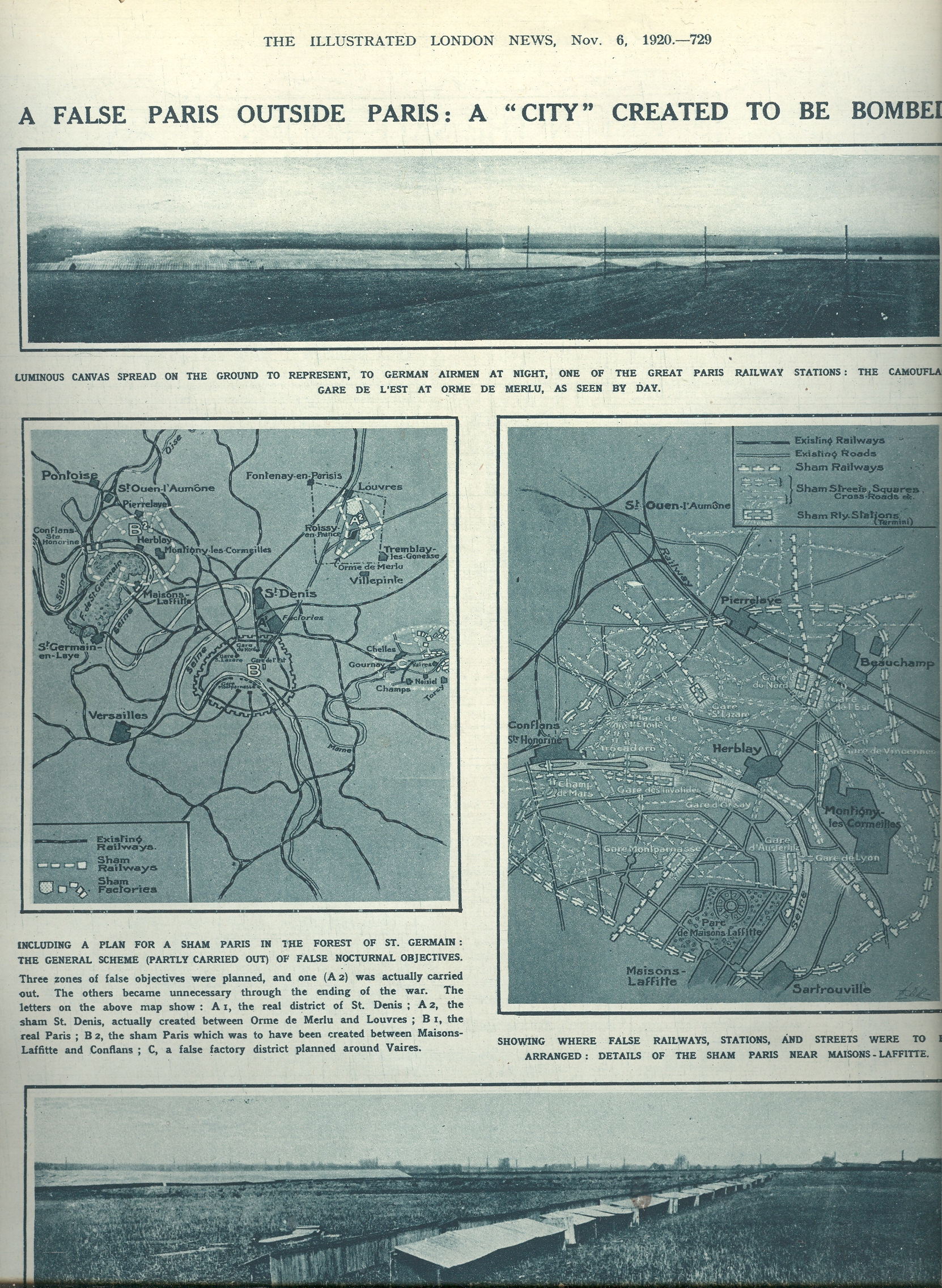
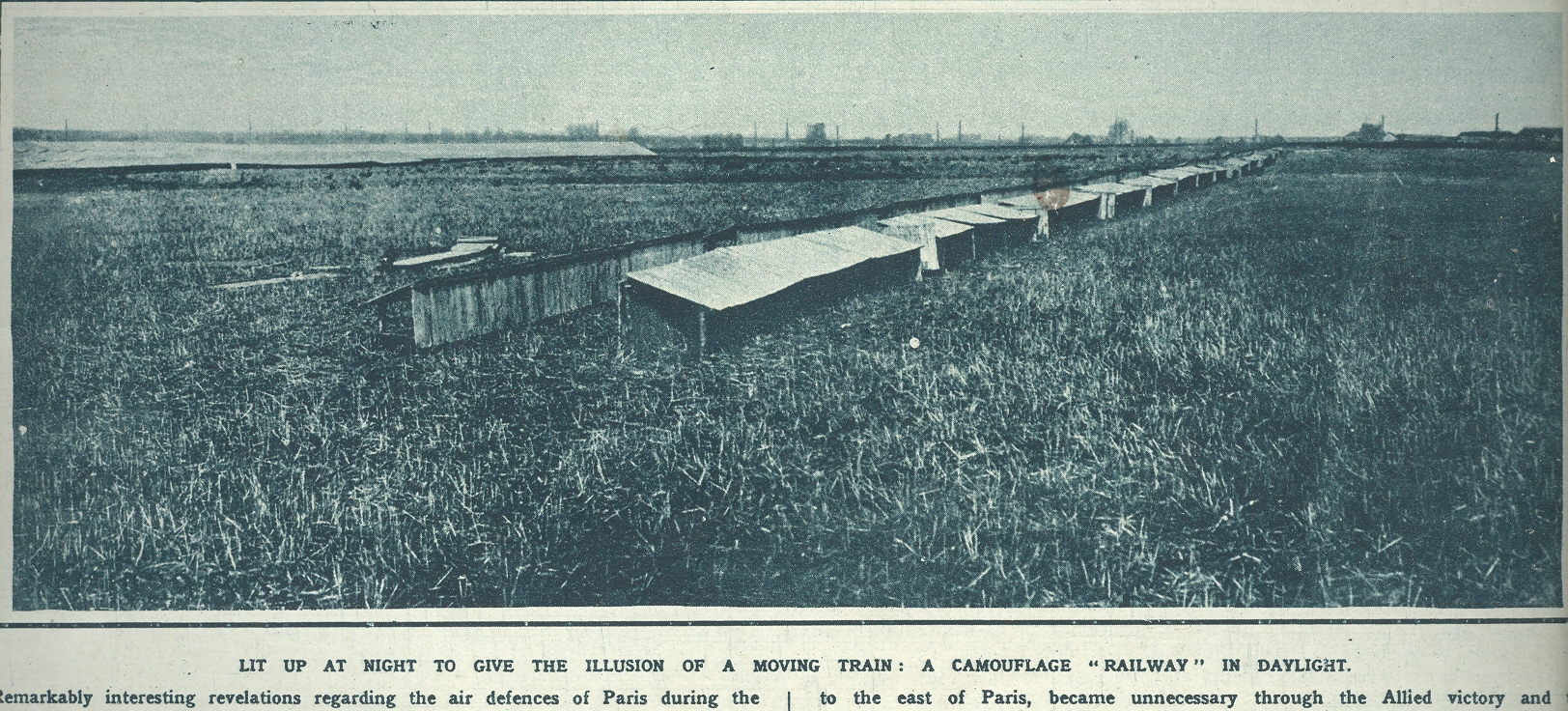
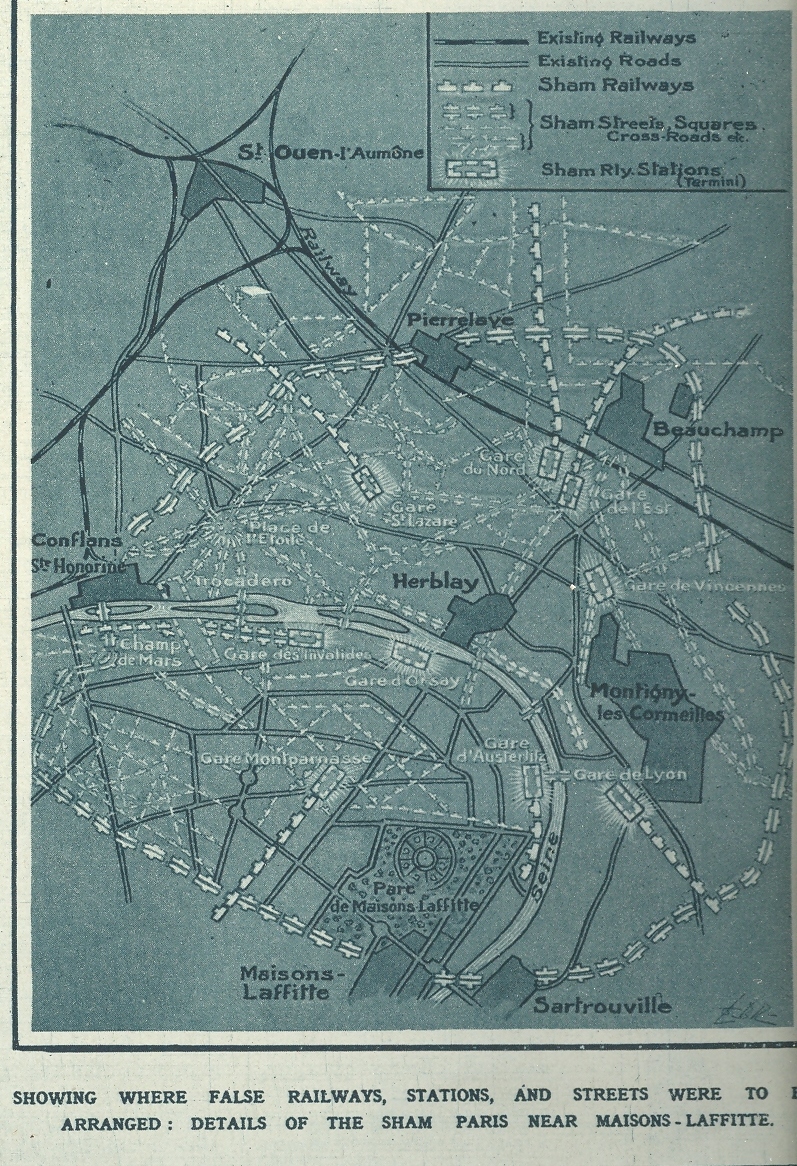
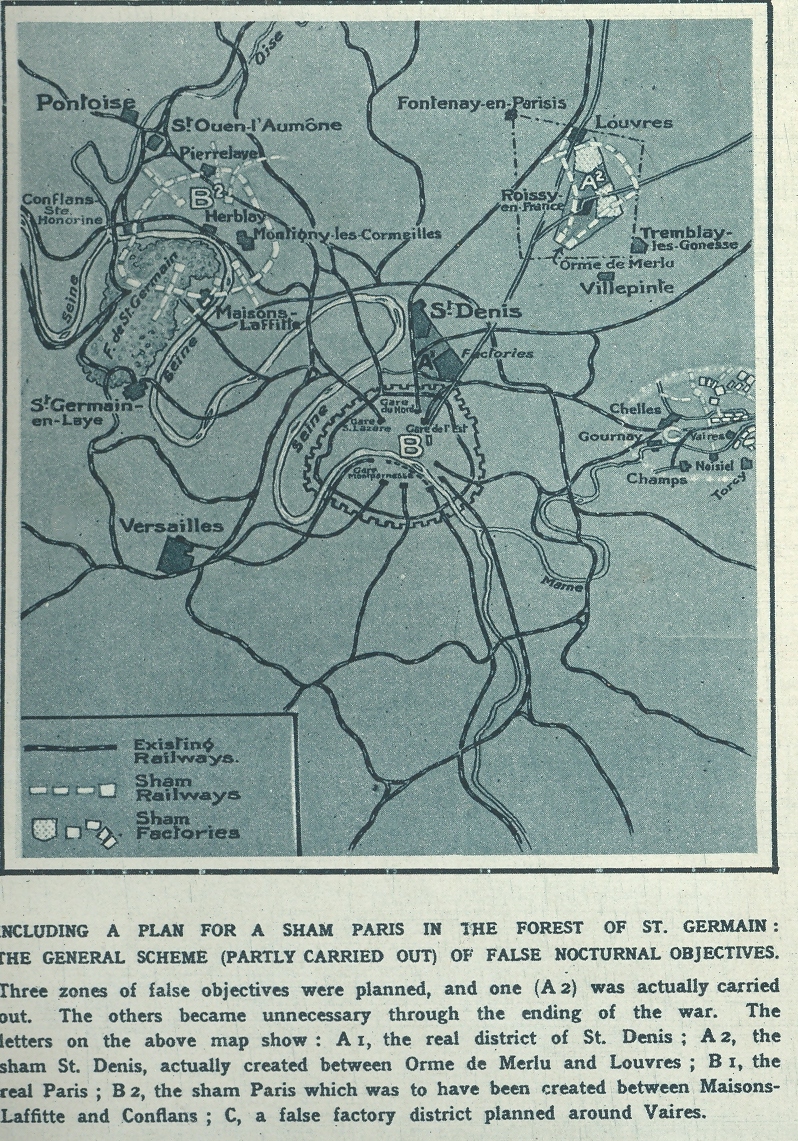
    Augustine cleaved two cities from one, the good and the doomed, in The City of God.   The powers that were in Paris at the end of World War I tried to do exactly that—to create a Sham Paris located on the outskirts of the real city—it was to be doomed, offered with confusing lights and displays that would disorient German aviators into bombing and destroying it rather than the real city. 

     Blo--june 18--paris overview

    Of course these were also the days of pre-RADAR, and of aviators simply holding a bomb by its fins and letting go once a target was in sight, so the possibility of causing this sort of dissonance was at least palpable. The planes held the pilot and a lot of fuel, and not much flight weight was devoted to bombs, so the bombing runs were necessarily quick and comparatively light (by standards of just a decade later).  So the idea of a Sham Paris might’ve, could’ve sort’ve worked, maybe; but not really.  It had a very strong, fatal, feculent (thank you for this word, Mr. Depp) air about it, like that misty doomsday smell that lifted the Maginot Line out of the earth and dumped it in the dim and stinking past. 


    Blo--june 18--paris long2

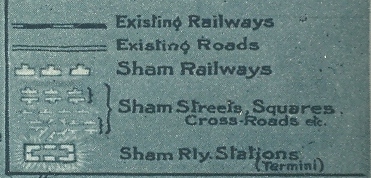
    The story of Sham Paris may have been “broken” in The Illustrated London News of 6 November 1920 in a remarkably titled photo essay, “A False Paris Outside Paris—a ‘City’ Created to be Bombed”.  There were to be sham streets lined with electric lights, sham rail stations, sham industry, open to a sham population waiting to be bombed by real Germans.  It is a perverse city, filled with the waiting-to-be-murdered in a civilian target.  Sham Paris seems to me like a reverse city.  And a reverse city in the manner of the cities created by the guilty Cain and Romulus—these two were murders who created cities; Sham Paris is a city of created murders to save the innocent.

    Paris sham detail
    Sham Paris was only partially constructed before war’s end in November 1918.  

    Paris sham 3

    (All images here are clickable and can be enlarged.)

    Blo--june 18--paris long


    Its important to distinguish Sham Cities from hidden cities, like Project Iceworm (the underground city built in Greenland) or Mt. Weather (the not-so-very-secret secure and safe bunker for the governing class in Bluemont, Virginia) and so on.  Sham Cities were definitely constructed for deception and/or destruction.  The next city we’ll take a look at:  Survival Town, Nevada.


  • The Future of War (1888)

    JF Ptak Sciene Books    Quick Post   (Part of the History of the Future series)

      Future Punch Dissolving Views detail
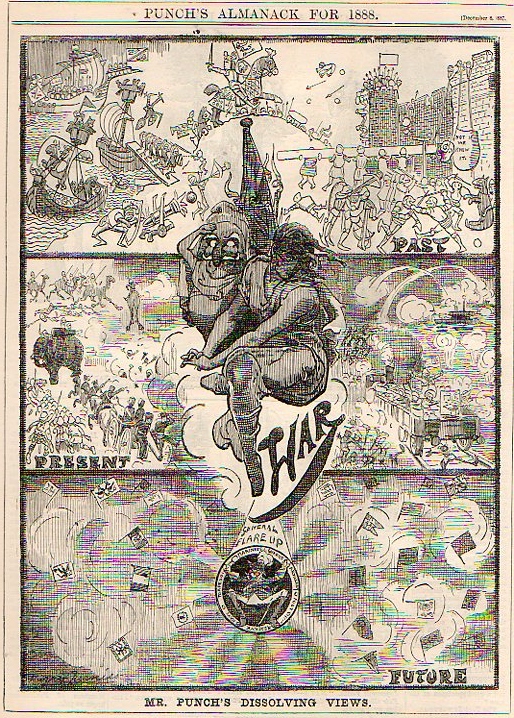
    People really started to understand the future of war at the end of the 19th century.  It was a time during which there was a high altar to high technology, and the industrial/tech/electrical revolutions were well on their way; it was a time in which people felt the enormous weight of advancing technology.

    This image appeared in the 8 December 1888  issue of the London Punch magazine, and foresaw the complications of global conflict in terms of global conflagration. 

    Future war punch845
    This was before the epochal events of 1895 and the X-Ray and the before the understanding of atomic structure (in the work of Thomson and then Rutherford and Curie and Soddy and Planck and Millikan, all of which would take place between 1897 and 1909) that would eventually lead to the unleashing of enormous energy in the form of atomic weapons.  Here, in 1888, we’re till dealing with conventional weapons and their near-future, and the Punch artist, the great Harry Furniss, still saw an exploding world for the next global conflict.  (In 1914 H.G. Wells (in his The World Set Free)  released “atomic bombs” on the world, but his weapons were still measured in terms of conventional explosive, except that they would explode for days on end.)  Furniss’ world-at-war would be a world war, and it wouldn’t take too much time to see that such an insight was correct.


  • A Note on Tricycles in the History of Nothing

    JF Ptak Science Books   Post 1576

    Lbikes--tryke645
    This image–from the Scientific American Supplement for 25 September 1895–triggered an immediate reaction, though not for the electrification of what looks like a child’s toy. Charles H. Barrows of Willimantic, Connecticut patented this bike, which turns out to be a considerable object–it has a two hp engine which is powered by a hundred-pound battery that is “stored in the two cabinets” (measuring 24x8x8) on either side of the hub, making the wheel I guess somewhere around 34-36″ in diameter. After everything was said and done, the trike was a big, heavy, thing, in spite of a fairly spartan design in the rest of the bike.

    What the woodcut remind me of was William Eggleston’s quiet, odd, iconic and enigmatic portrait of a tricycle, which  I think launched a new photographic experience for the suburbs–a kind of Robert Frank for people doing “okay”.

    Tricycle

    Eggleston’s work, including this s image above (Untitled, Tricycle and Memphis, 1970), was a subject at a MoMA show in 1976, William Eggleston’s Guide.  It was received with long glances down long noses–seen as a banal exercise in the portrayal of everyday stuff in everyday settings, critics saw the semi-nothingness in the photos as simple all-nothingness, with one critic asking “a guide to what?”  But the Eggleston show was far more than that, showing the bits–in color–of American cultural life in middle class seclusion, a splendor of small Americana. 

    Bill Owens, working at about the same time as Eggleston, also shared his vision on the restricted glory of the suburbs in his Suburbia, spreading his discoveries of new-found cultural diversity.

    http://adventurepatches.files.wordpress.com/2010/05/suburbia-boy-with-gun.jpg

    The critics saw basically nothing in these works when they were first shown, though they had a lot more going on for them than the electrified tricycle, which was far too big and heavy to have done any good for anyone (though the design of the sprocket/wheel was pretty interesting).  The only nothingness that are in the photos of Eggleston and Ownes was the nothing that the critics chose to see.  Sometimes new, different ways of looking at things as in the cases of these two photogrpaher makes it seem as though it is a newness of nothing, but only for a short time, until everybody else showed up.