A Daily History of Holes, Dots, Lines, Science, History, Math, Physics, Art, the Unintentional Absurd, Architecture, Maps, Data Visualization, Blank and Missing Things, and so on. |1.6 million words, 7500 images, 4.9 million hits| Press & appearances in The Times, Le Figaro, Mensa, The Economist, The Guardian, Discovery News, Slate, Le Monde, Sci American Blogs, Le Pont, and many othr places… 5000+ total posts since 2008.

Category: Propaganda

  • A Glimpse of a Small Part of the Big Lie, Soviet Style (June 1945)

    JF Ptak Science Books   Post 2884
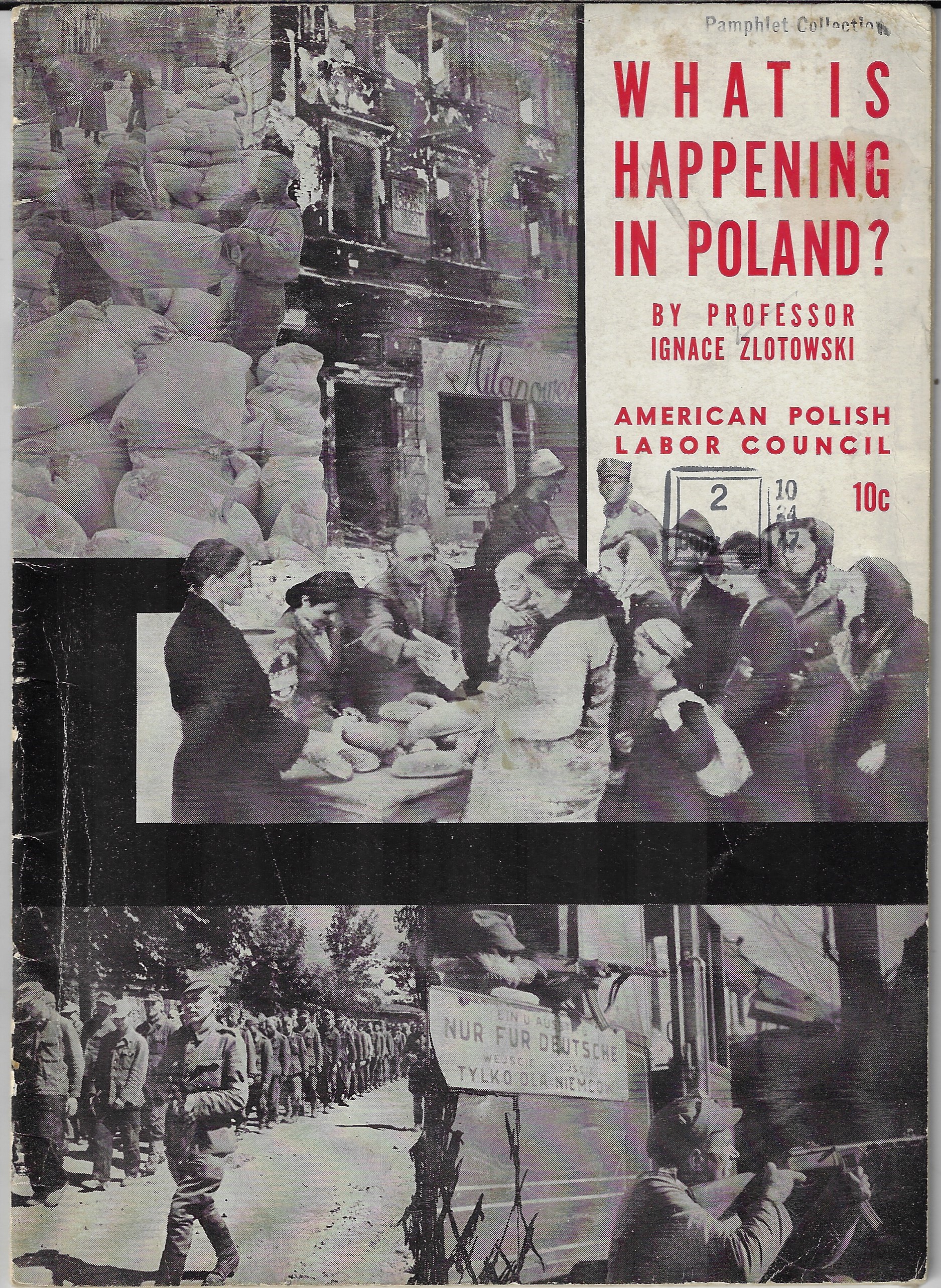
    Poland 1945 cvrThere’s nothing quite like a series of lies that is a vast series of lines, lies all the way up and mostly all the way down, lies that are built into Borgesian extravagancies with a sweetener here and there of a little bit of truth. That is pretty much what we have here in the pro-Stalinist/Soviet pamphlet, What is Happening in Poland, with an imprint of June, 1945.

    There’s a lot of difficulty in this work’s 29 pages, all of which are ultimately directed against the still-extant Polish government in exile (in London) insisting that those are the anti-democratic and anti-Soviet forces at work in Poland. The write, a physicist named Ignace Zlotowski is the author, and he makes an abundant case for the London government setting out to destabilize (and de-Stalinize) the “New Poland”.

    The rhetoric is really quite remarkable.

    For example, Zlotowski makes the case for the catastrophic defeat of the Polish underground in the Warsaw Uprising (1 August—2 October 1944) directly on the Polish exile leadership. Even though far away in London the government did exert considerable influence in Poland, and did organize and begin the uprising. The rest of the story and the failure of the uprising against the Nazis can be placed in squarely in the lap of the Soviets, who—even though at the gates of the city, advancing West—did nothing in this fight against the German army. The Soviet forces sat just across the Vistula, ignoring pleas from Churchill and Roosevelt to help the Poles, and waited the tragedy out, until the Germans destroyed the uprising in bitter house-by-house fighting, ultimately destroying nearly the entire city, killing some 200,000 people (mostly civilian, and mostly murdered). The Wehrmacht pushed through the city from October to January, hunting people, destroying the city almost completely. It was a strategic move by Stalin, deciding to let two enemies fight it out, allowing the Nazis to destroy elements of the population that the Soviets found to be problematic for the administration of the country once they decided to push through Poland on their way west.

    This was standard procedure for the Soviets—for example, there was the Katyn massacre, where 22,000 Polish military officers, police, and intelligentsia were executed in various parts of the Katyn forest. The Great Terror, the Great Famine, the Show Trials, the Holodomor, the Pogroms, and on and on. This was what the Polish government in exile was fighting against, and this is what they would lose to.

    This pamphlet displays just a little of that Stalinist thinking, and it is enough to understand what those people were up to.

    I’ve included (below) some of the text related to the Warsaw Uprising and the Trial of the Sixteen–we don’t have the results of the trial though they are pre-ordained, as is the fate of the fabled and heroic General Okulicki, who would be found guilty and then murdered by the NKVD in 1946. 
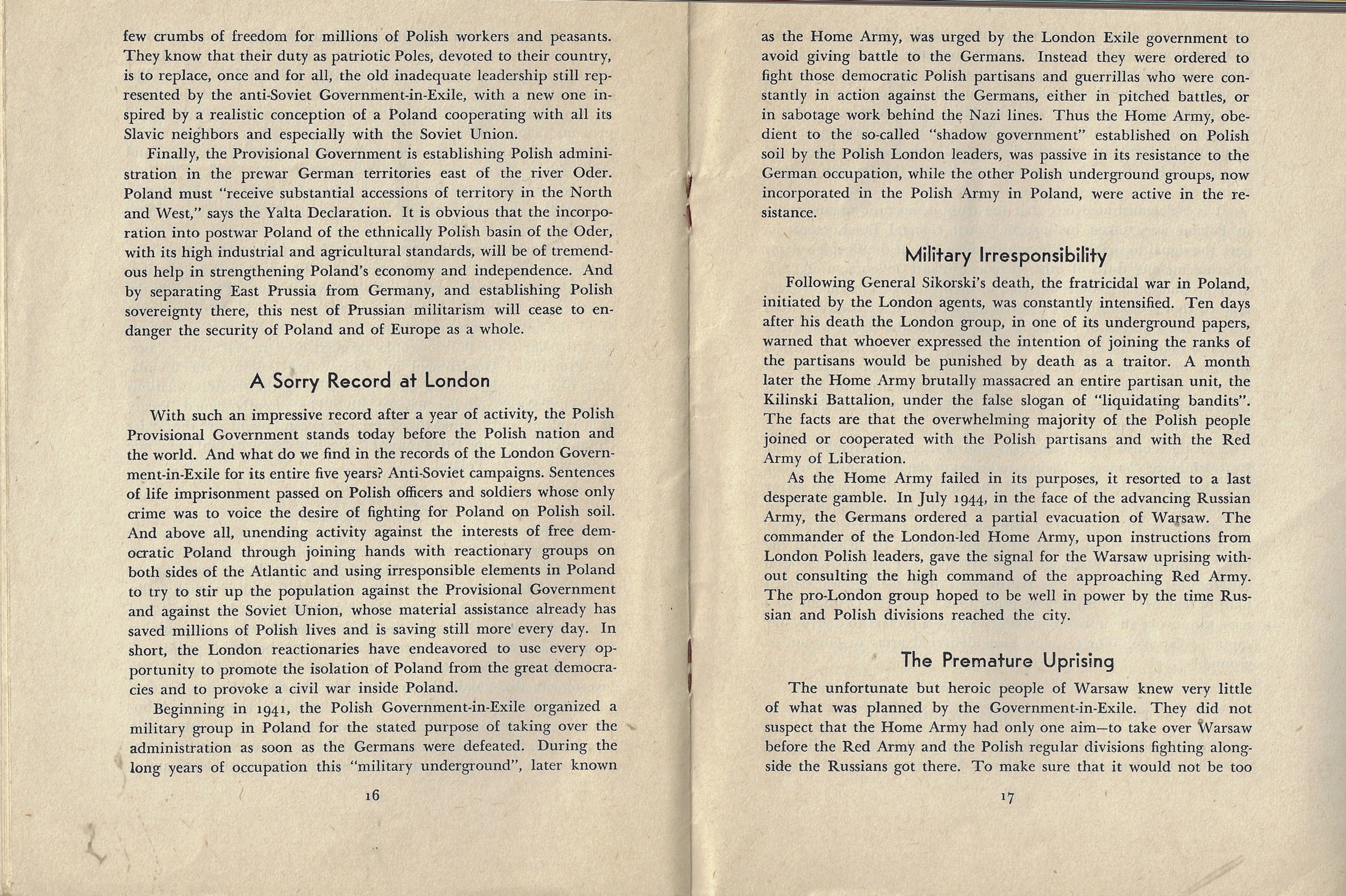
    Poland 1945 _5_


    ·Posted by :

    ·in:

    —

  • A Provocative Piece of Italian Fascist Anti-U.S. Propaganda, 1944

    JF Ptak Science Books   Post 2832


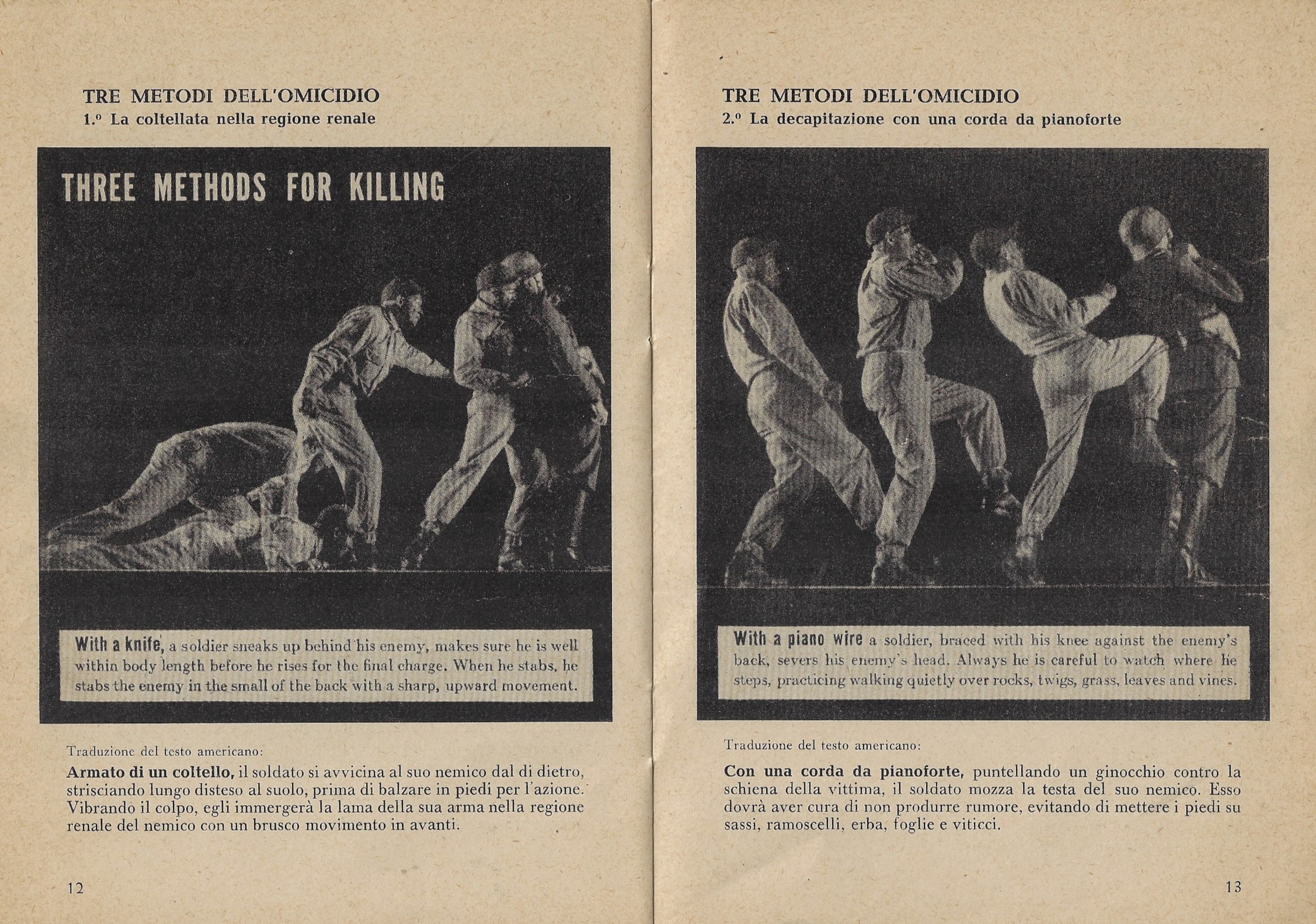
    This piece of propaganda from Italy in 1944 made the case for a gangster-like bloodthirsty U.S. Soldier being deployed to an immoral imperialist war in a place of ancient culture and high morals. The example it uses is LIFE magazine, which after tongue-in-cheek praise is established as a mirror of its readers’ mentality, feelings, desires, and passions, offering congratulations to Mr. Luce for establishing such a magazine that so deeply displayed the character of the United States. After this follows the propaganda rain, and the horrors that were in the pages of LIFE.

    The Italian reader is then introduced to a quick succession of stories that evidently displayed the building blocks of American culture, with LIFE focusing on vainglory, false culture, sex appeal (the main ingredient), and malignant ruthlessness.

    In getting to this last part the writer of this pamphlet uses a story that appeared in LIFE on 22 March 1944–the reader warned of the horrifying nature of the photographs to follow “(ueste fotografie vi fanno orrore”)–which graphically displayed in a studio setting the stealthy killing method of the U.S. Soldier at war.

    Propaganda Italian LIFE_2_

    Propaganda Italian LIFEThe pamphlet makes the point along the “this is your enemy” lines, that this is what the U.S. was all about. And if the reader was surprised by the images, then they had no idea of what the “Ameriucan mentality” was. (“Ma se queste illustrazioni vi stupiscono, allora — vogliate scusare — finora avete avuto ben poca nozione della mentalità americana!” “But if these illustrations amaze you, then – please excuse – so far you have had very little notion of the American mentality!”)

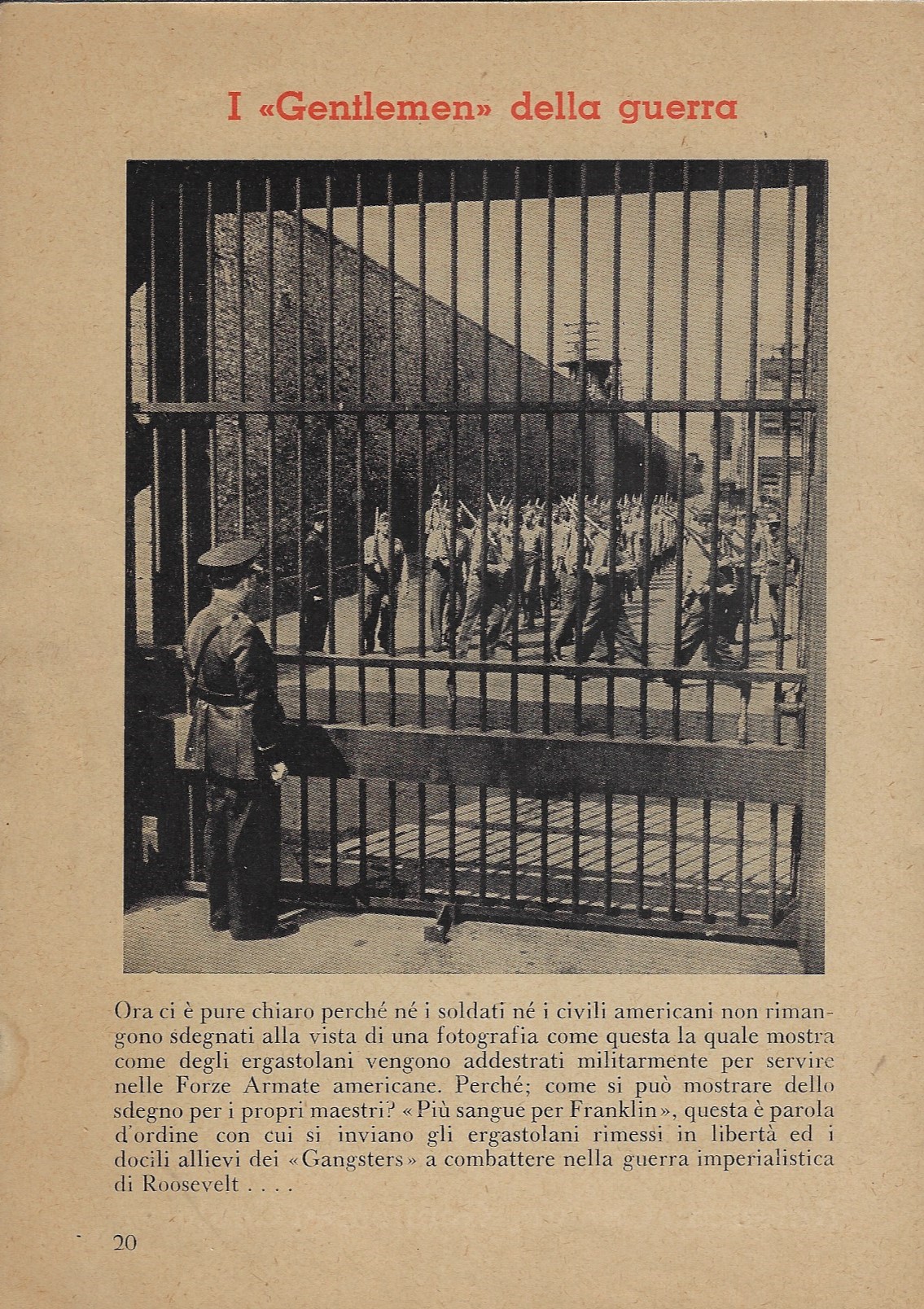
    The short (14pp) pamphlet ends with a full page picture of American “gangsters and life prisoners” in prison, training to fight for the “imperialist war of Franklin”.

    The work is certainly provocative —whether or not it was believed is unknown to me. I do know that U.S. Marines were depicted as baby murderers and baby rapists to Imperial troops, scaring the hell out of soldiers and civilians (re the native population on Okinawa) alike, further enforcing the belief and demand of a fight-to-the-death mentality because not only was this the codified way to behave, but the shame of surrender would be worsened by the treatment and torture they would receive in captivity. The results of this propaganda was horrific for the soldiers and for thousands of Okinawans. As I said, I don’t know anything at all of the effectiveness of this Italian effort, though my best guess is that the reader would’ve thought this to be bullshit  inaccurate. 


    ·Posted by :

    ·in:

    —

  • Nazi Propaganda Against the B-17 (1943)

    JF Ptak Science Books  Post 2824

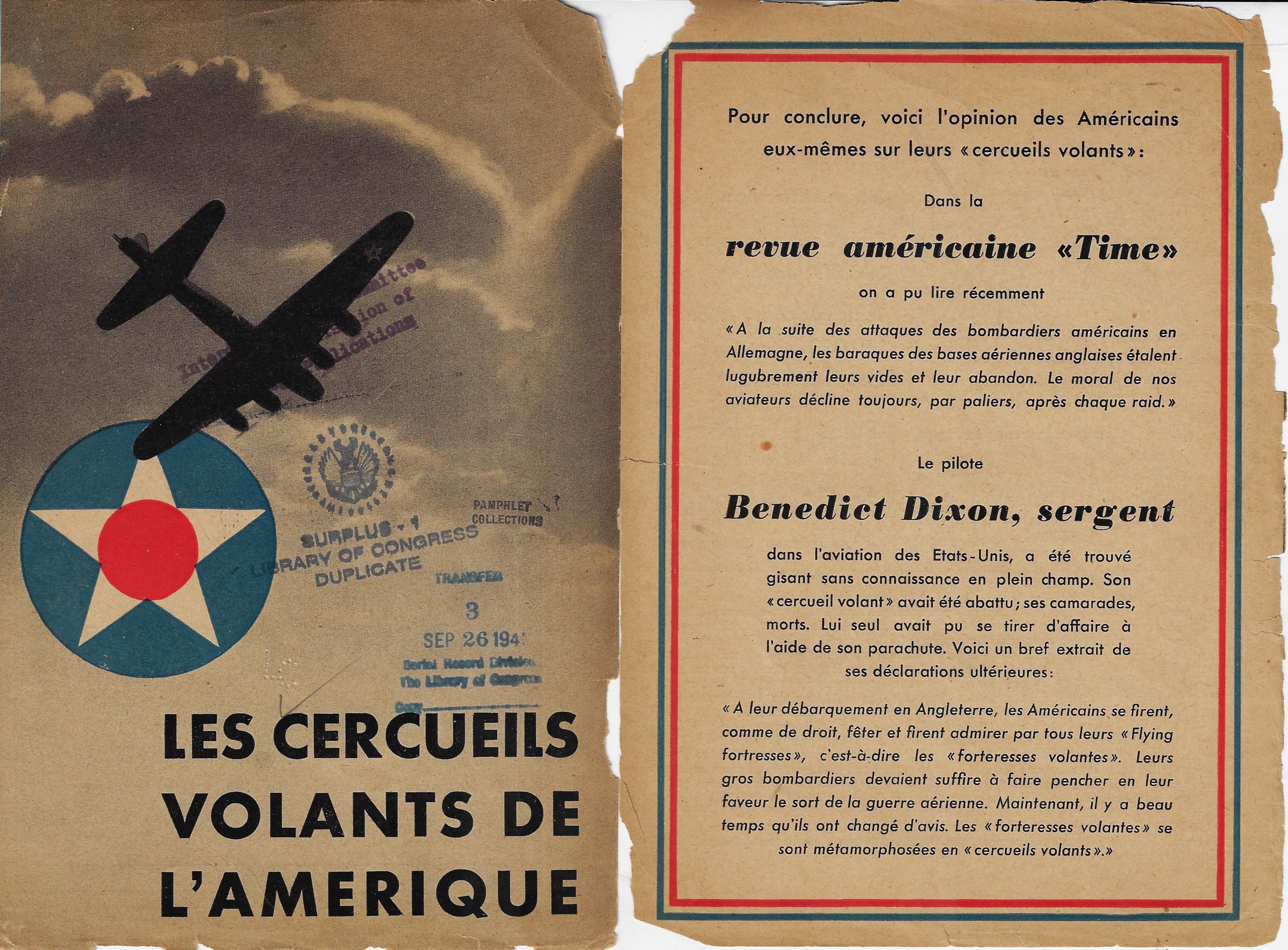
    This is quite the piece of anti-U.S. Propaganda, printed in 1943 and targeted so to speak against the B-17 Flying Fortress. (I’m not sure why this is in French, though no doubt it was focused on occupied territories in France and Belgium and other areas reached by Lingua Franca.) This was a difficult piece to work through given my tender spot for this aircraft–I’ve long admired it, and was even a passenger on one many years ago (it was much louder than I expected). As a piece of propaganda I would have expected to see more copies of this here and there, but as it turns out there is only one copy (at Nanterres) located by WorldCat–this in mind I’ve reproduced the whole of the very short work.

    B 17 propaganda _1_[Front and rear covers.]

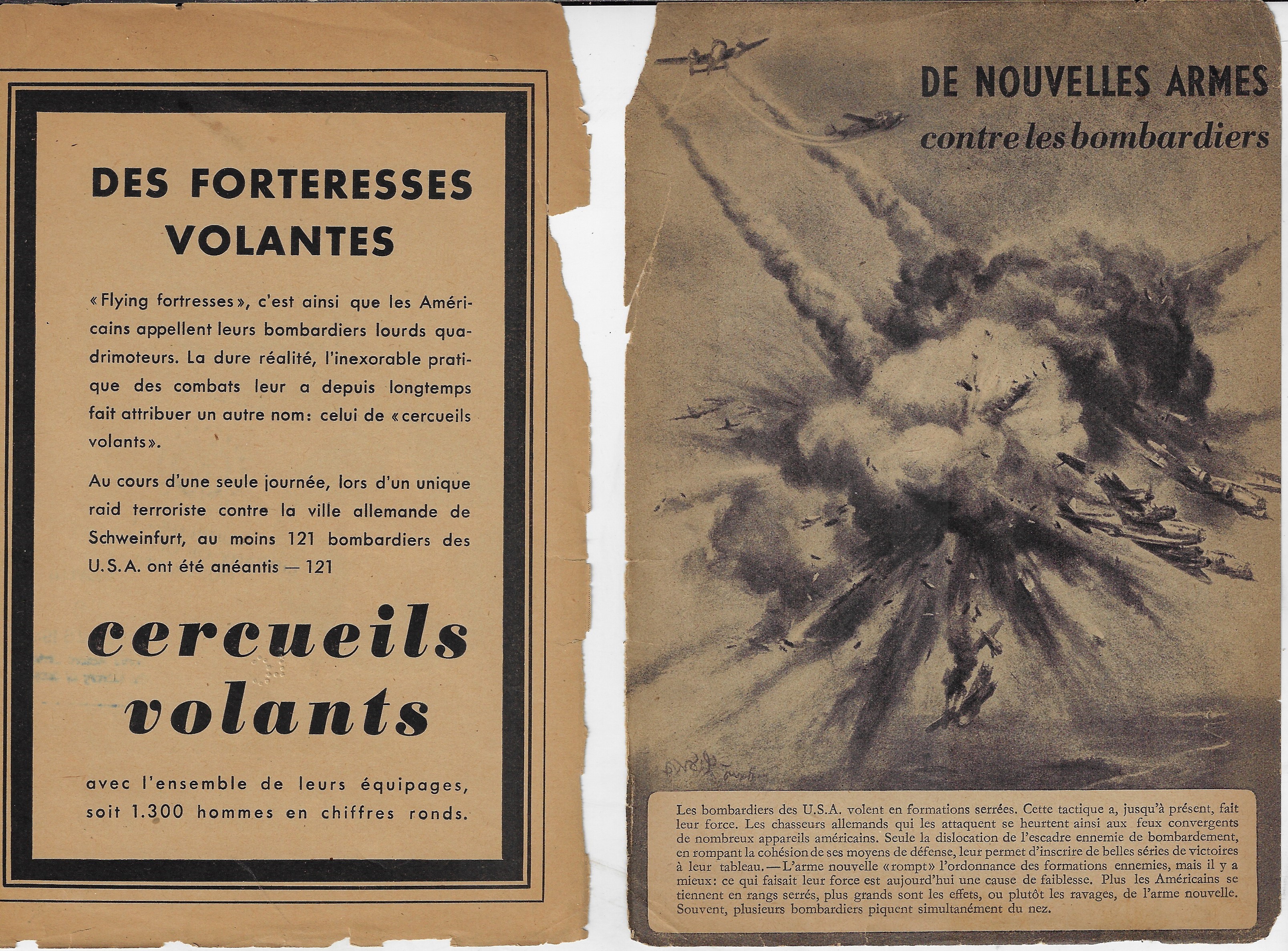
    The little pamphlet got to business straightaway, claiming on the back of the title page that the “Flying Fortress” suffered terribly at (“terrorist raid”) Schweinfurt—true enough for the 8th Air Force, though the numbers aren’t quite right. The author tells us that the “Flying Fortress” was actually “the Flying Coffin”. “This is how the Americans call their heavy four-engine lighters [the “Flying Fortress”]. The harsh reality, the inexorable practice of fighting has long since given them another name: that of flying coffins. C’est ainsi aue les americains appelent leurs bombrdiers lourds quadrimoteurs. la dure realite, l’inexorable practique des combats leur a depuis longtemps fqit attribuer un autre nom: celui de cercueils volantes.”)

    In the explosive scene on the page there’s a picture of mass destruction of B-17’s being blown out of the sky—this a result of the (“tight”) formation flying that the writer says used to be a strength, but now with new (German) weapons would prove to be the 17’s weakness. (“The greater the function, the bigger their devastation.”)

    B 17 propaganda _2_The next scene, a two-pager, is heartbreaking and brutal. “Voila ce qui les attend” it shouts–”this is what awaits them”! And then, boldly beneath the scene, the pamphlet repeats the Flying Fortress is the Flying Coffin claim.

    ·Posted by :

    ·in:

    — —

  • A Political Map of Future Possibilities (ca. 1932-5)

    JF Ptak Science Books  Quick Post

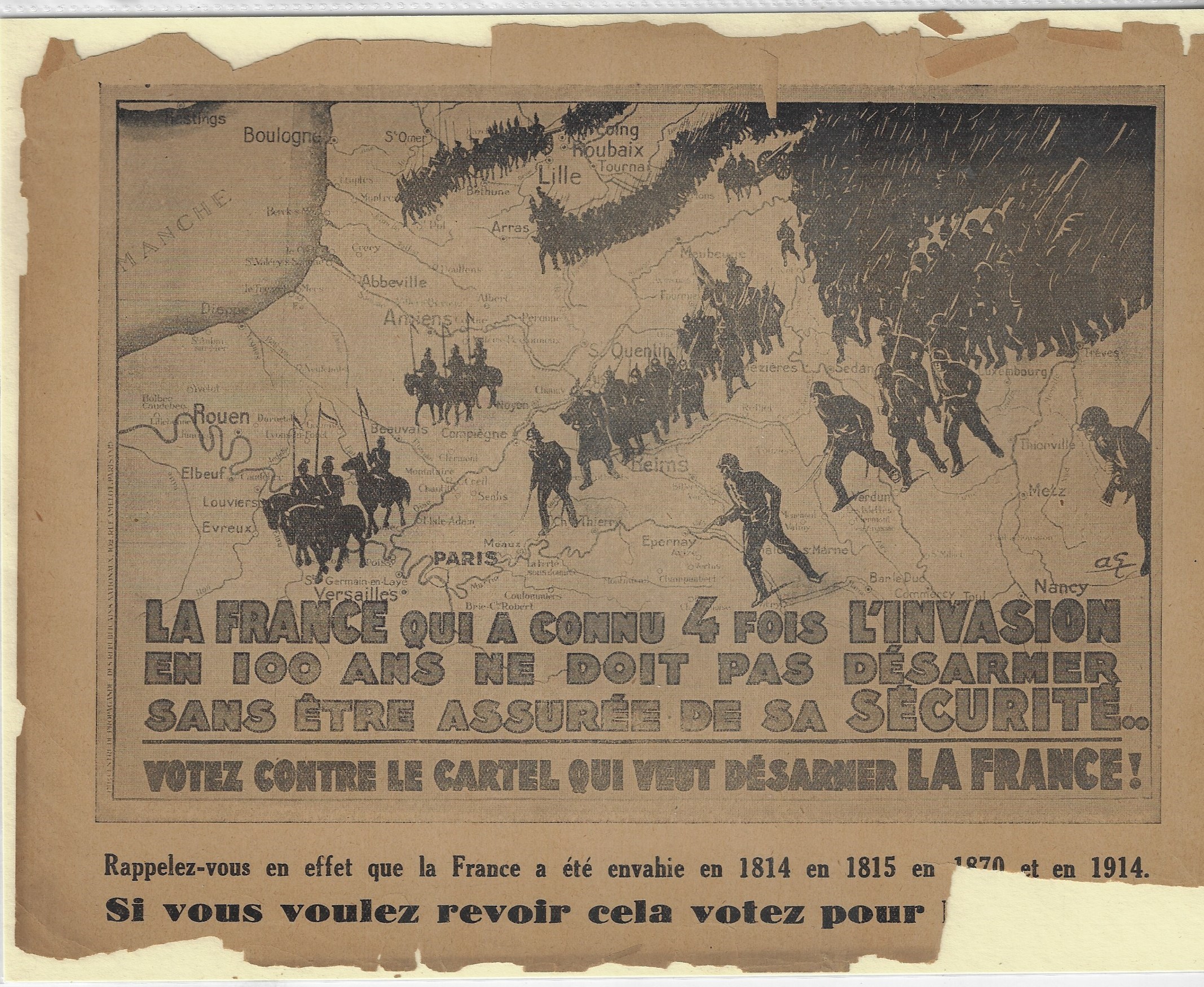
    This is certainly a successful design in describing fear and possibility for the near future and the security  (or lack of it) for France. Nothing quite conveys temporal disruption than a consolidated mass of dark and sharp objects advancing on the home front. 


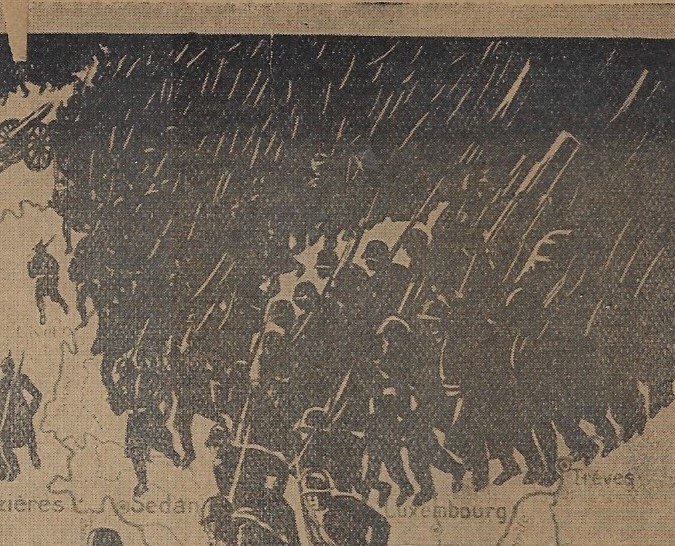
    Maps propaganda France detail

    • “La France qui a connu 4 fois l’invasion en 100 ans ne droit pas desarmer sans entre assuree de sa securite. Votz contre le cartel qui vent desarmer la France!” (“France, which has been invaded four times in 100 years, should not disarm with being assured of its security! Vote against the cartel that will disarm France!”)
    • Maps propaganda France detail

    The image is a moderate Right Wing political propaganda piece extolling people not to vote for a political group (unnamed but Left Wing) that would “disarm France” by referencing the four times that France has been invaded in the last 100 years (1814, 1815, 1870, and 1914). Design by Andre Galland and printed 1932-1936. The fifth invasion was already on its way, coming in 1940, when Germany simply did an end-run around the ill-conceived modern antique of the Maginot Line, after which the very large French army was slow to respond, with France surrendering 46 days later on 25 May 1940.

    • In a tiny scroll script in the left margin reads: (translated) Propaganda Center of the National Republicans (Republicains Nationaux).

    This is an effective design for sure, showing a mass of infantry and cavalry crossing the northern French border…so massive in fact that most figures blend into an almost-solid black mass save for the white streaks of rifles/bayonets.

    I’m not sure what the intended use was for my copy of this image, which was originally produced as a poster, though this copy measures only 27x21cm. I don’t know if it was meant as a flyer, or small poster, or if it was simply an illustration in a larger book. It is interesting, regardless. (This image is available on the bookstore side of this blog.) It is certainly worth sharing, though. 


  • On Unconditional Surrender (1943)

    JF Ptak Science Books   Quick Post

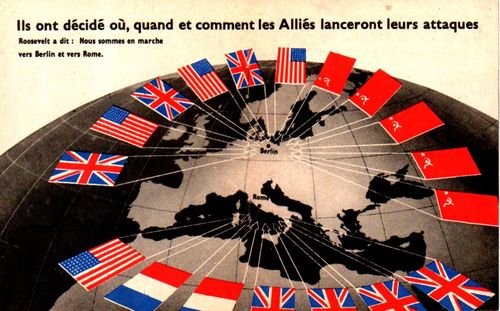
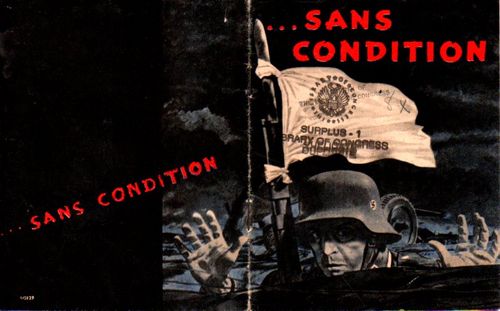
    I found this arresting map in a tiny publication called …Sans Condition, which was published in the first half of 1943. The publication is only 12 pages long but has a number of evocative images of Germany being bombed and lines of German POWs–it is in general a propaganda piece for French-speaking folk (which was printed god-knows-where) produced deep in the war and at a time when the tide has about turned on the Nazis.  The term “Sans Conditions” refers to “Unconditional surrender”, which was a phrase that President Roosevelt surprisingly used when meeting with Allied leaders at Casablanca in January 1943. It is a term that doesn’t make many appearances in U.S. military history, though it was famously endorsed by General U.S. Grant in 1862 in response to an entreaty from Confederate general Simon Bolivar Buckner jr.–and as it happened a U.S. general by the same name was killed om Okinawa by a direct hit from a Japanese heavy gun. Roosevelt would send the same directive to the government of Japan at Potsdam July 26, 1945 (later modified somewhat to accommodate the Japanese keeping their emperor). 

    Books covers sans conditions _1_

    The title of this post is the title of the map,  “Ils ont decide ou, quand et comment les Allies lanceront leurs attacques”–and you don’t need to know French to know what it says.  

    Books covers san conditions __2_

    ·Posted by :

    ·in:

    —

  • The Unions and Tear Gas Propaganda

    JF Ptak Science Books   Quick Post

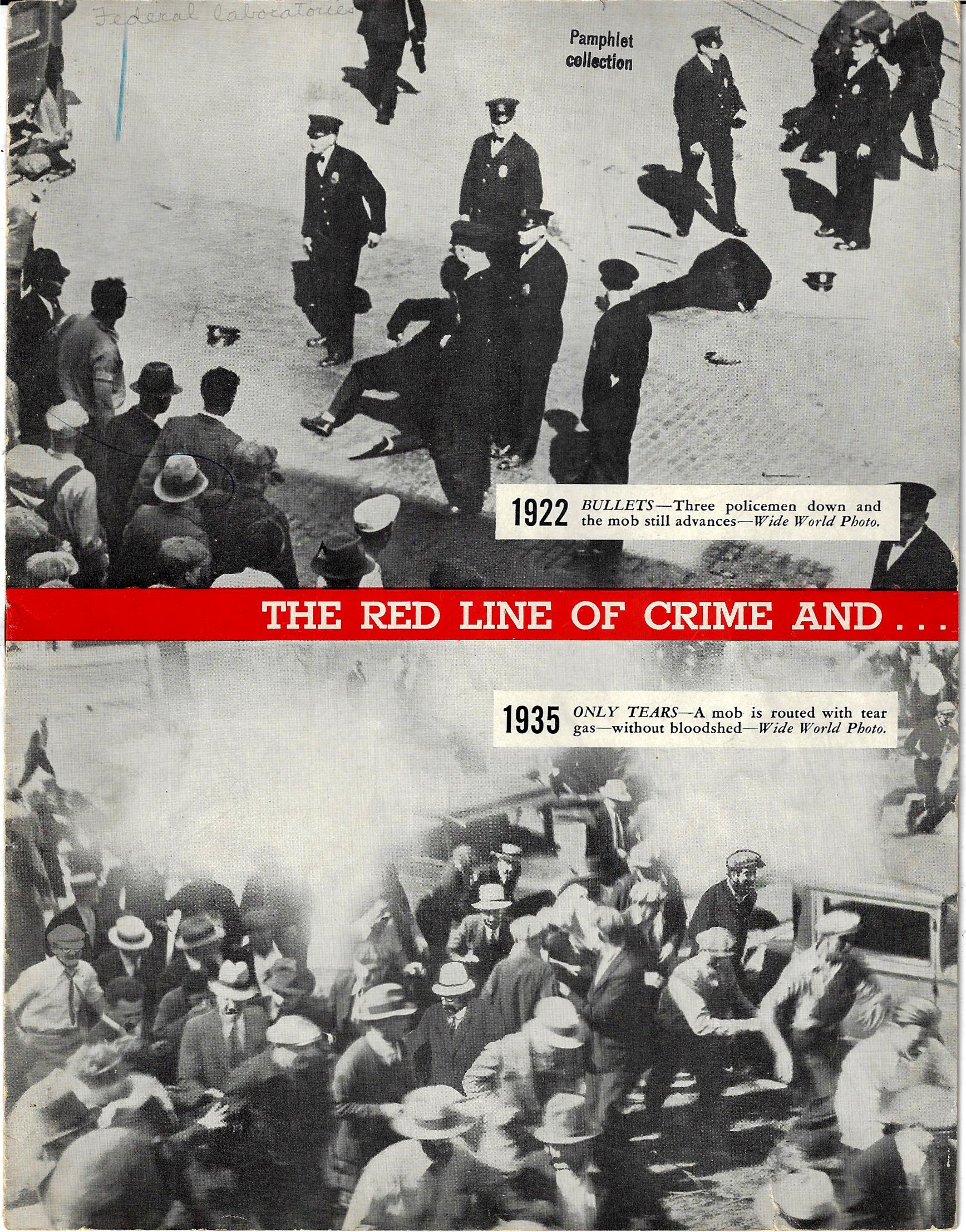
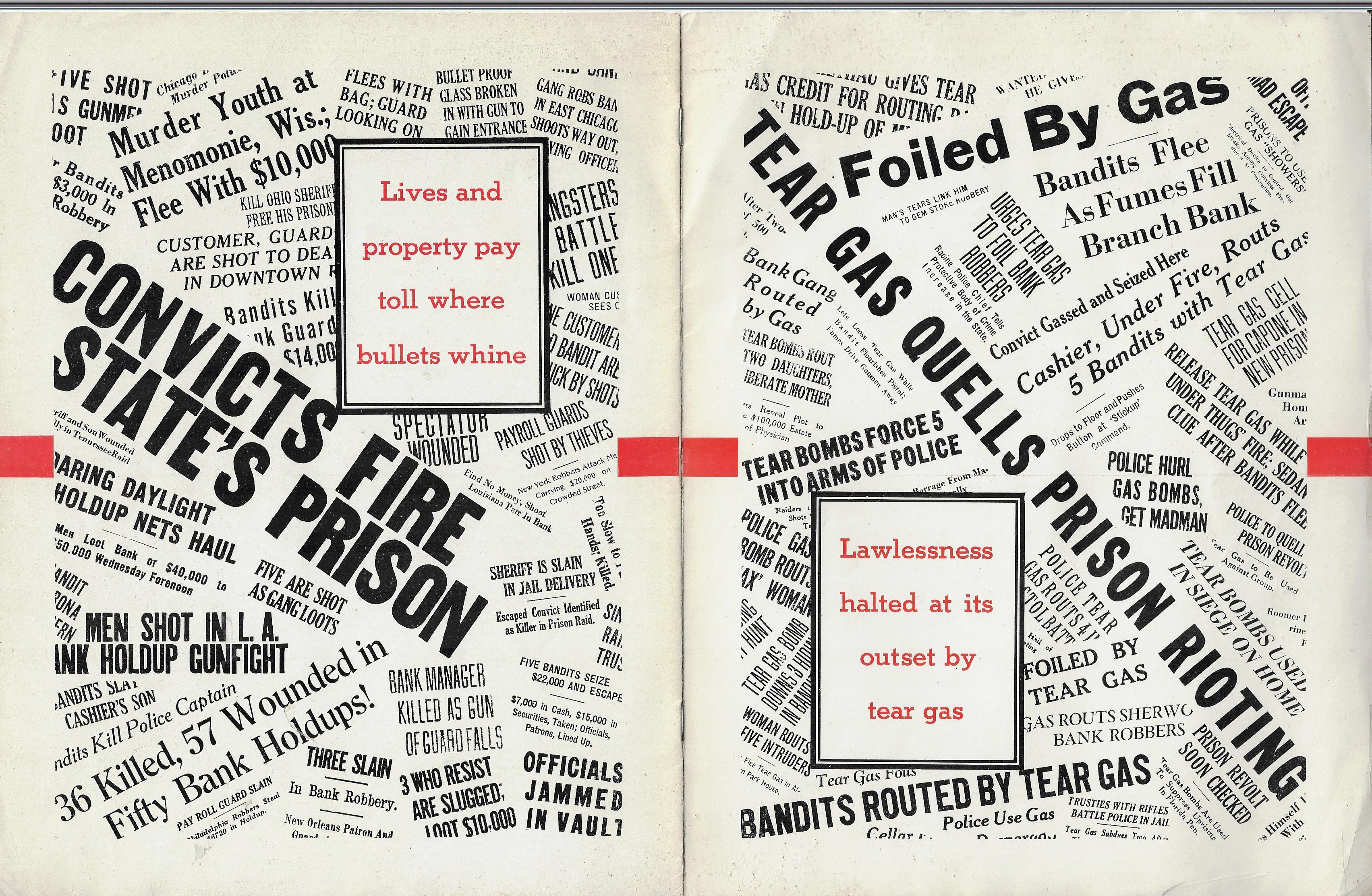
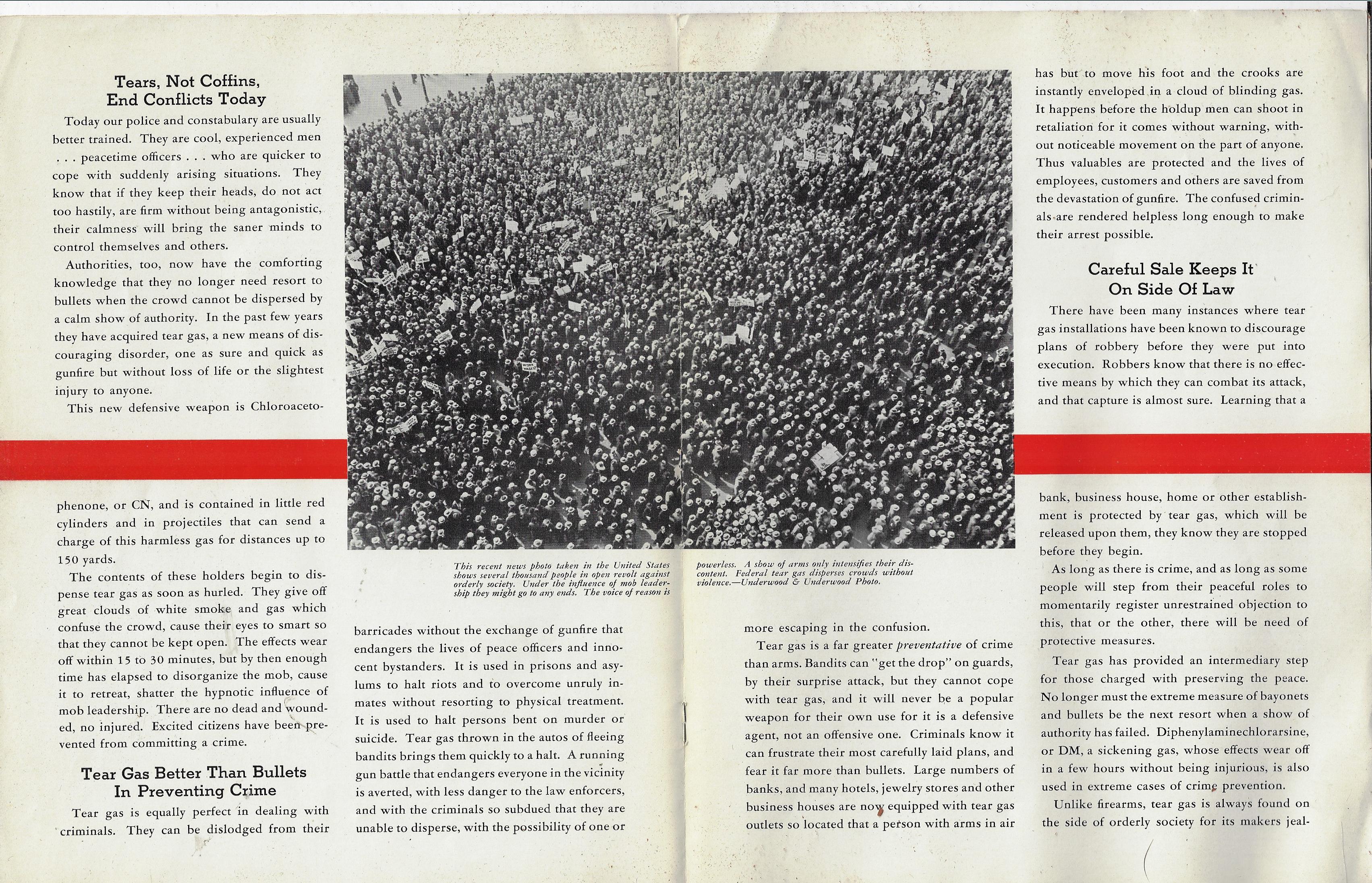
    The “sublime mundane” probably isn’t the correct category for this pamphlet, though I think it comes close. The illustrations and the text are squint-inducing, both unusual in peculiar ways, and all for the purpose of selling tear gas.  

    The Red Line of Crime and…Civil Disorder is the pamphlet, and it was published in  Pittsburgh and printed by Federal Laboratories  in 1934. It makes the case for tear gas over bullets in response to civil disobedience/riots/unrest, a good part of that being described sotto voce (and not so much so) as the work of unions. In any event, tear gas is prescribed as the reactive agent to the reaction, being more humane and less fatal…anyway, that is the sales pitch. 

    I’m sharing the pamphlet here mainly for its illustrations and design. Here’s the very arresting front cover:

    Books covers red line _1_

    • A description of Federal Laboratories from Wiki:  “In the 1930s, custom gas guns by FedLabs were adopted by the New York Prison department, following a sales pitch made before the APA by the president of FedLabs in Baltimore in 1931. Also in the 1930s, Federal Laboratories actively worked to sell gas guns for the purpose of strikebreaking, with one FedLabs representative firing a tear gas grenade during the 1934 West Coast waterfront strike, resulting in the death of a striker due to skull fracture. Auerbach notes, however, that despite FedLabs stated opposition to “communist” strikers, the firm continued to sell tear gas to the Soviet Union even during 1933.”

    And the center illustration, a montage of newspaper clippings:

    Books covers red line _2__0001


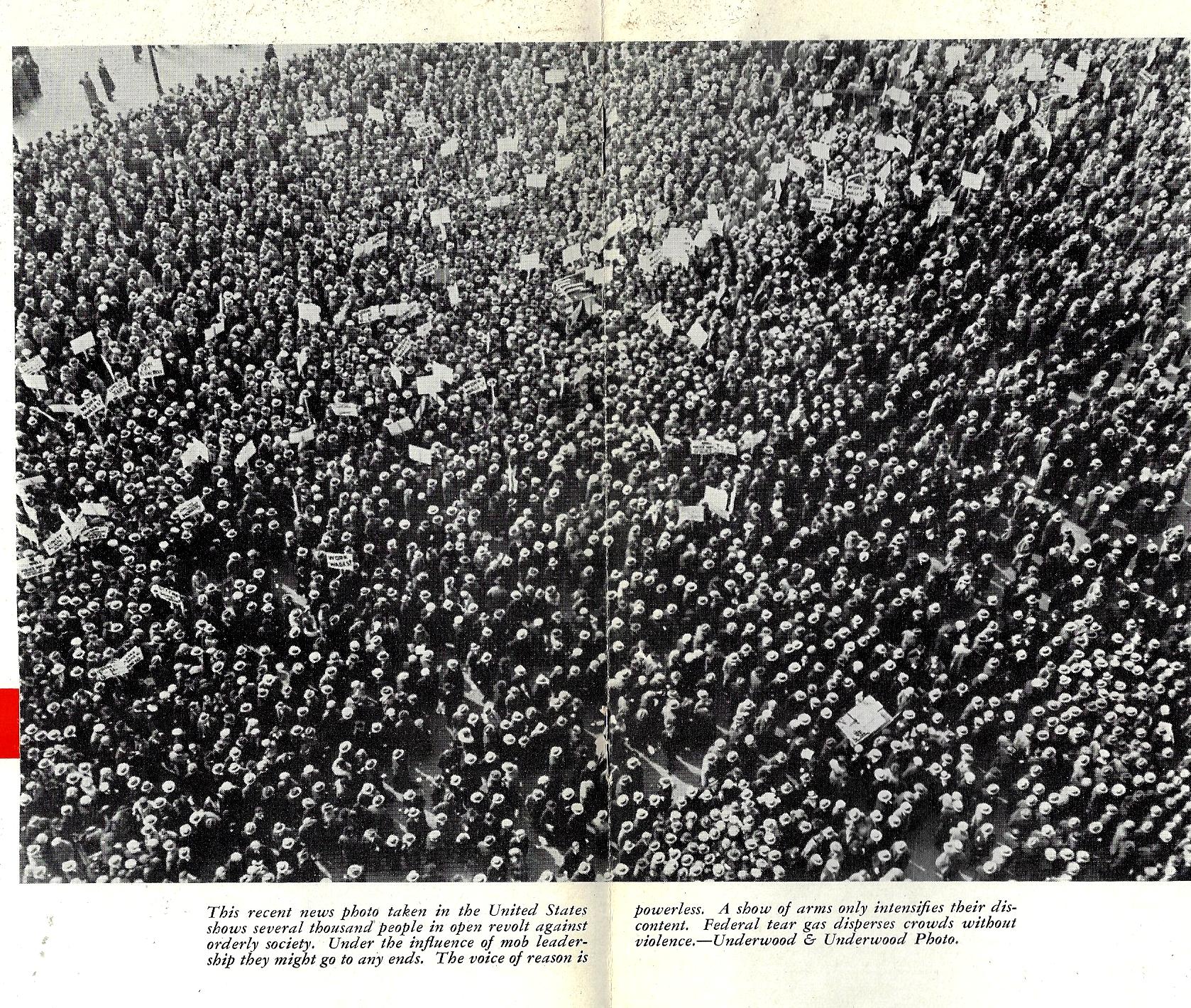
    And in this image, a worker’s strike is described as “an open revolt against orderly society…under the influence of such leadership they might go to any ends”, which is as great a propaganda statement against unions as I have seen:

    Books covers red line _4_ detail


    Books covers red line _3_

    ·Posted by :

    ·in:

    —

  • The Burning of the Books, May 1933

    JF Ptak Science Books   Quick Post

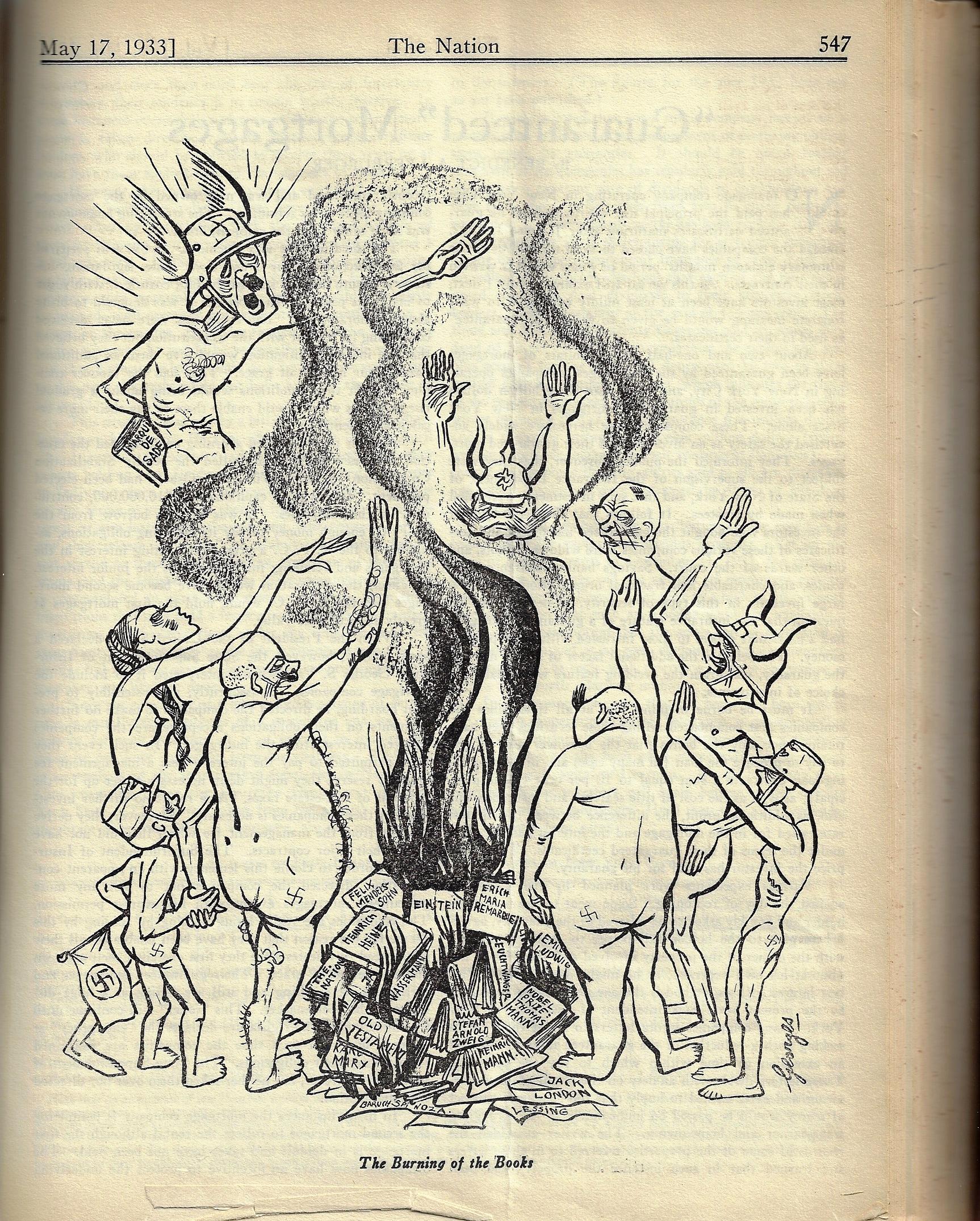
    The infamous book burnings as we knew them started in their earnest wickedness on German university grounds and city squares on May 10, 1933.  The attempt in destroying intellectualism, history, science, philosophy, beauty, and many other aspects of culture was to protect Germany from past and present destroyers of Teutonic legacy and anything that threatened Hitler’s brand-new German reich. So to that end the Nazis in control thought the best way to approach works like these was to burn it all.  

    In this editorial cartoon drawn by Georges Schreiber the Nazis are portrayed in a bestial, devilish,  and accurate light. The image appeared in The Nation (volume 136 no. 3541) on May 17, 1933, and as we can see a zombie-ish Hitler is seen in the upper left, with an aged Paul von Hindenburg to his right. The flames are built on a pile of some of the damned books, featuring Einstein front and center (as the representative of the “degenerate Jewish science”), surrounded by works id Remarque, Ludwig, Heine x2, Mendelssohn, Spinoza, London, and others:

    Burning books

    For an  example of the targeted books have a look at the following  list (from Wolfgang Herman’s “Prinzipelles zur Säuberung der öffentlichen Bücherein,”  Börsenblatt für den deutschen Büchhandel 100 (5/16/1933):, 356-358 [Principles for the Cleansing of Public Libraries] was for the use of librarians in keeping their collections free from various types of art/science/tech/literature/art/music, and needless to say anything that was written by a Jewish author):


    “1. The works of traitors, emigrants and authors from foreign countries who believe they can attack and denigrate the new German (H.G. Wells, Rolland) ; 2. The literature of Marxism, Communism and Bolshevism. 3. Pacifist literature. 4. Literature with liberal, democratic tendencies and attitudes, and writing supporting the Weimar Republic (Rathenau, Heinrich Mann); 5. All historical writings whose purpose is to denigrate the origin, the spirit and the culture of the German Volk, or to dissolve the racial and structural order of the Volk, or that denies the force and importance of leading historical figures in favor of egalitarianism and the masses, and which seeks to drag them through the mud (Emil Ludwig); 6. Writings of a philosophical and social nature whose content deals with the false scientific enlightenment of primitive Darwinism and Monism (Haeckel); 7. Books that advocate “art” which is decadent, bloodless, or purely constructivist (Grosz, Dix, Bauhaus, Mendelsohn); 8. Writings on sexuality and sexual education which serve the egocentric pleasure of the individual and thus, completely destroy the principles of race and Volk (Hirschfeld); 9. The decadent, destructive and Volk-damaging writings of “Asphalt and Civilization” literati! (Graf, H. Mann, Stefan Zweig, Wassermann, Franz Blei). [transl. note: a derogatory term for writers dealing with upper middle class urban society]; 10. Literature by Jewish authors, regardless of the field; 11. Popular entertainment literature that depicts life and life’s goals in a superficial, unrealistic and sickly sweet manner, based on a bourgeois or upper class view of life.”

    • [Source: When Books Were Burned, University of Arizona Library, for the source and for the translation:   http://www.library.arizona.edu/exhibits/burnedbooks/documents.htm#guidelines ]

    ·Posted by :

    ·in:

    —

  • Name, Rank, and Serial Number (1945, with the Audio for the Radio Play)

    JF Ptak Science Books

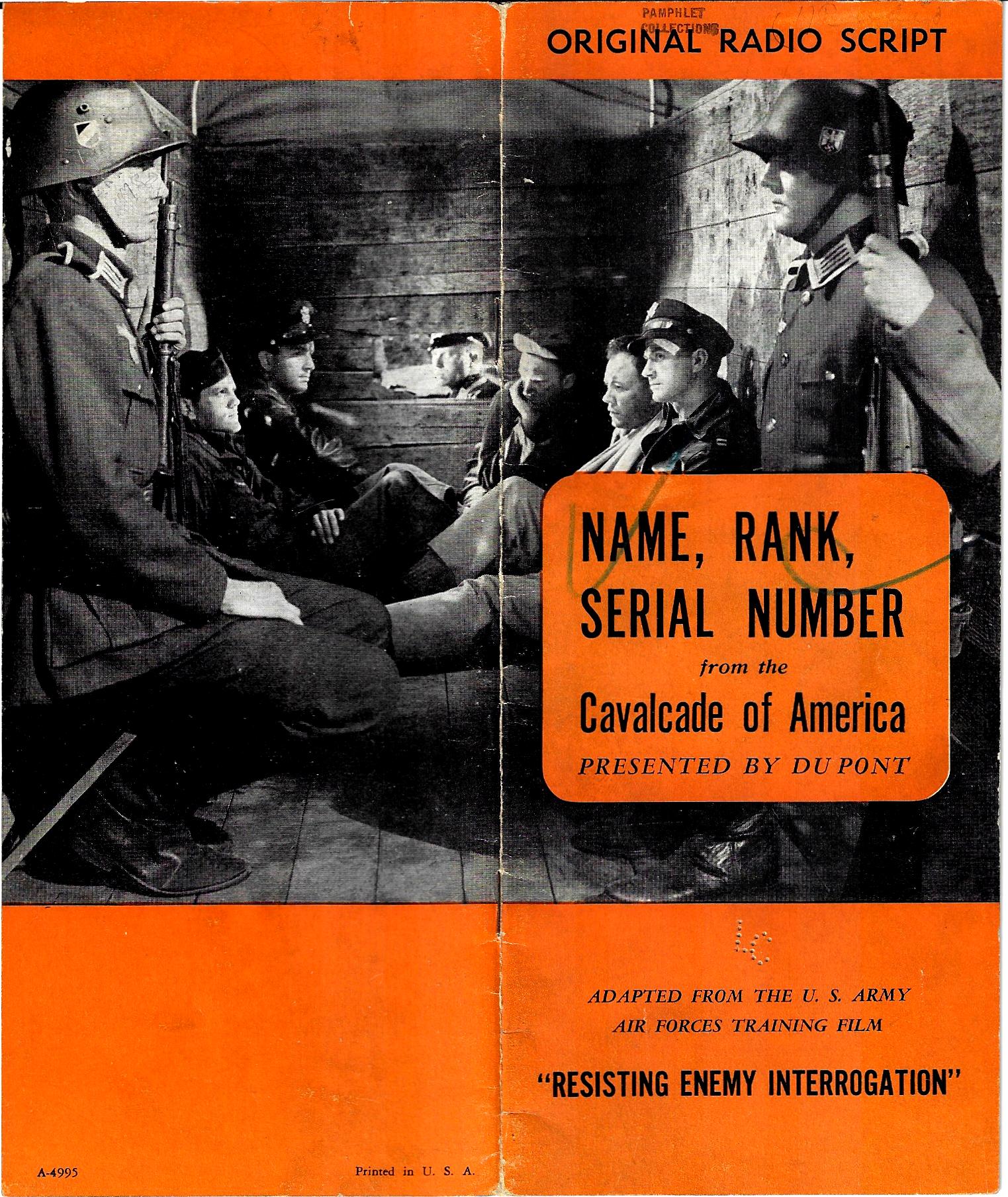
    Name rank serial numberName, Rank, and Serial Number is a tough-love drama produced by Du Pont (“Better things for better living…through chemistry“) for the Cavalcade of America, sharing the critical importance of leaked and mistakenly volunteered information and the foul end that might come to. The play was based on a training film for the USAAF called “resisting Enemy Interrogation”, which was one of certainly hundreds of such films produced by the armed forces during the war to try and prepare members of the military for situations A to Z. Name, Rank, Serial Number was the public demonstration of one of these films, and this slim pamphlet contains the script. There is nothing quite like listening to the original, though, which can be found on the American University Digital Archive site, here: http://auislandora.wrlc.org/islandora/object/hickman%3A250

    This is the story of four captured U.S. airmen  in a German POW camp, and how they faced skillful and then brutal interrogators, and how even the smallest bit of misspoken or half-volunteered mistake can lead to terrible consequences. 


    ·Posted by :

    ·in:

    — —

  • The End of the War for Engalnd: Nazi Propaganda, 1941

    JF Ptak Science Books    Post 2694

    Blog--May 24--map2

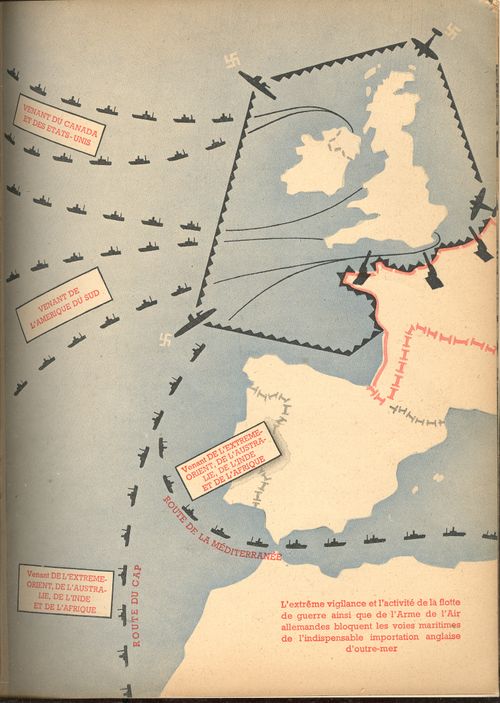
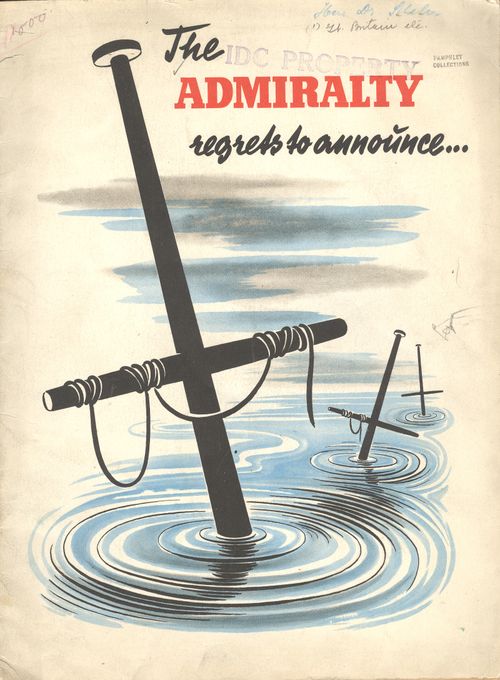
    The Admiralty Regrets to Announce… was for years the standard beginning to an official British announcement concerning the loss of ships and sailors.  The phrase is used as the title to this work (by an unattributed writer known only as “an expert”) to immediately introduce the reader to the failings of the British navy.  It is of course a piece of Nazi propaganda, issued some time in 1941. (My copy is he U.S. copyright deposit copy and is stamped with a transfer date of September 1942; the pamphlets reads to me as though the U.S. had not yet entered the war.)  The great strengths of the German air force and navy are extolled and the failings of the British mercantile elaborated at great—and sometimes greatly imagined—lengths.  The booklet was published in French (except for the title) and answers its own repetitive question: “quelle est donc la situation relle de la marine commerciale anglais?”

    Blog--May 24--map1

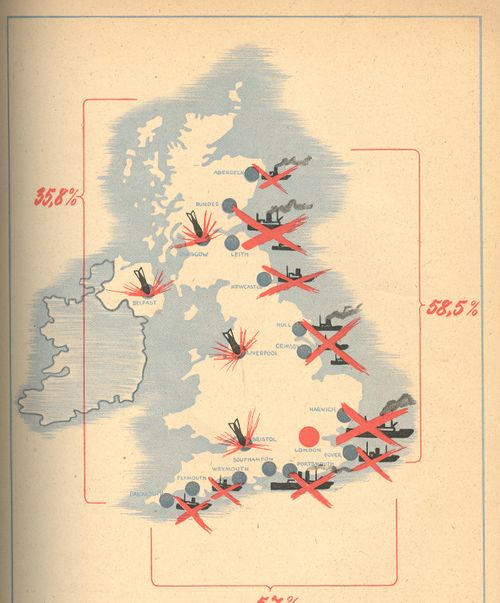
     The pamphlet’s 32 pages (illustrated with 24 photographs of various explosions and bombings, plus one graph and three maps) are dedicated to winning the French hearts and minds, trying to convince the conquered population that there really wasn’t any help coming, and that the British could not even supply themselves with the necessaries to run a country, let alone a war.

    In the map above we see the  ports and shipping centers that were bombed by the Luftwaffe (with London located by a big red dot).  Another map (at top) shows the stockade-like presence of the Nazi navy securing its impregnable wall against the arrival of foreign trade and supplies to Britain.  

    This post is one of a series on propaganda maps which occasionally appear in this blog.   Like Thomas Nast political cartoons and war photography, a map can instantly and overwhelmingly display not only data but sentiment as well. The maps published in this pamphlet by the Nazis are were certainly immediately understandable to just about anyone, French-reading or not, literate or not–the images needed no words, especially when surrounded in the text by vicious images of German military might.  Overrun
    or not, Petain-ized as it was, France was still offering aid to its allies and resistance to the Germans–the more minds that could be won over with propaganda of this sort meant one less to have to worry about as an active enemy.

    This is the back cover of the pamphlet, showing the final disposition of the British fleet:


    Blog--May 24--map2 001

    And the front cover:

    Blog--May 24--regrets


  • “I Escaped from Nazi Germany” (1944)

    JF Ptak Science Books  Post 2692

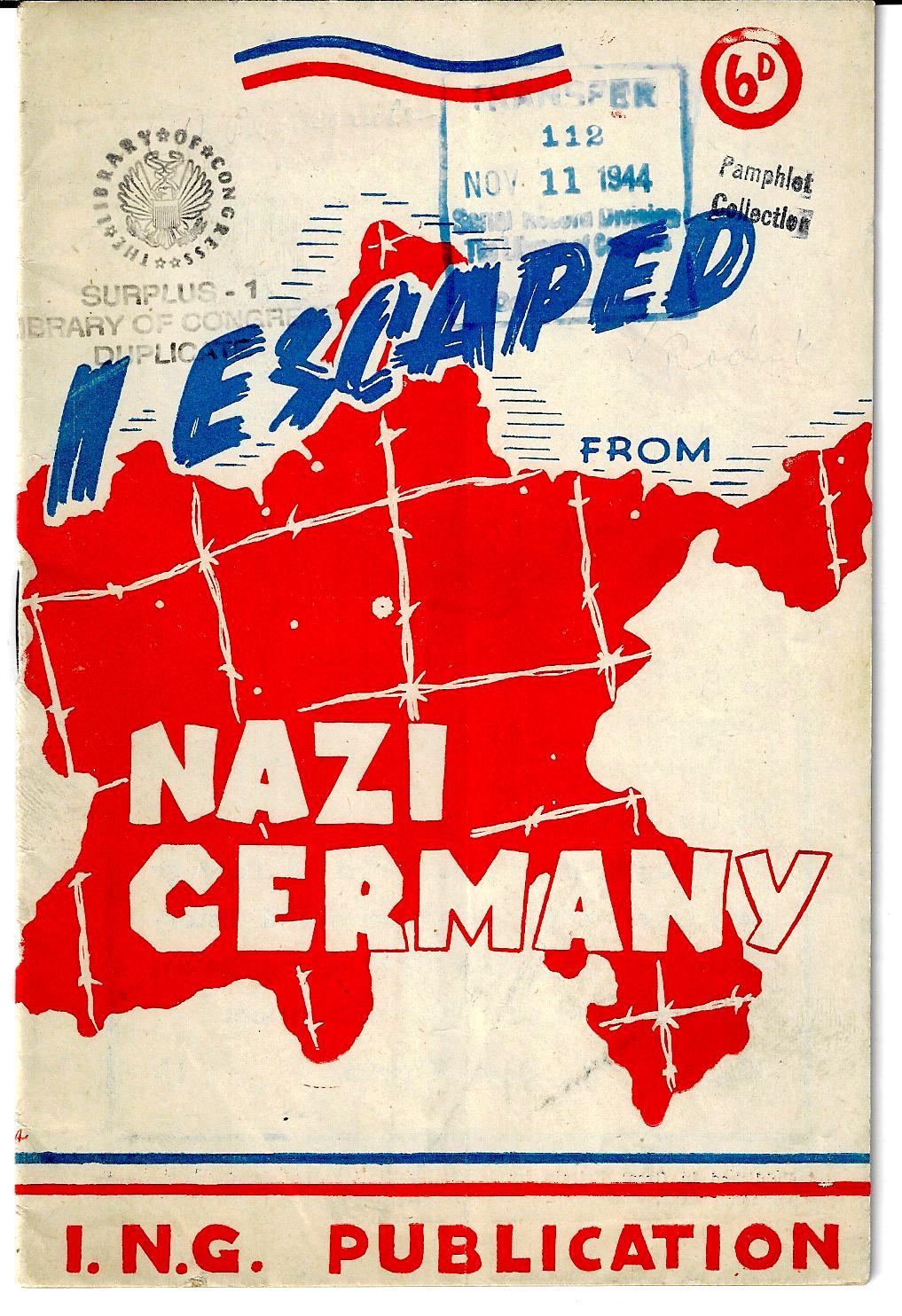
    I Escaped from Nazi Germany, a French Deportee’s Report, is a short, compact story by a French resistance fighter (of the “Armee de l’Ombre”) and observer/informationist. The writer is not identified, though the translator ( Egon Larsen) is, along with author of the author of the foreword (Waldeck Rochet). It was published by I.N.G. Publications in London in 1944, and although it is unclear whether this is pre/post 6 June, the writer does make it clear that the end was near for the Nazis.

    Perhaps the most emotional part of the pamphlet is the section (“Slave Workers and  Prisoners-of-War Under the Swastika”) on “foreign workers”. There’s a fairly longish description of the types of slave labor being done in Germany, and of the accommodation of the ‘workers”, with some insight on those who were kept in private houses/stables/billets and not in a camp. There’s also an interesting statement that speaks to the numbers of “foreign workers” in sections of Germany, saying that amidst the sea of these slaves that it was difficult to find an actual German resident. Then, at the extreme end of the treatment of foreign workers, in listing the tragedies of those people forced into cruel labor, the author ends with:

    “Foreign workers run the risk of being sent to concentration camps; and everyone knows what that means.”

    This may be the Great Unspoken of the war–unspoken though spoken, or unheard, or partially heard, or heard but not believed. 

    “A terrible fate await those who are sent to Dachau, the notorious torture camp” the pamphlet continues, followed by a short discussion of terrible working conditions and brutal treatment. Then there is a curious statement, an attempt to show the essential savagery of the Nazi/German, relating how there were “other Germans who were there fellow prisoners” [italics mine], not “just” foreign slave workers at the camp, “and whose treatment was even worse than that of the foreign workers”.  These “other Germans” could have been political, or gay, or a host of other legislated offenses–but in 1944, these people were no doubt Jewish, though the “Jewish” part of this explanation goes unmentioned.And so far as I can tell the only time the word “Jew” or “Jewish” appears in this pamphlet is a description of serendipitous punishment levied on the foreign worker for simple infractions of not-necessarily-exiting codes of behavior: “A Jew who tried to pick up a cigarette butt was ‘shot out of hand’”. This person, this Jewish person, was identified as a “Jew” as a social indicator (like telling someone to go ask Moshe, the Jew) rather than identifying the person as a class of people signaled out for particularly brutal treatment.  Rather than just say “a person” or “someone” being shot for picking up a cigarette, the writer identified that someone simply as a “Jew”. 

    I escaped Nazi Germany

    So, most of the pamphlet is an outsider’s view inside Germany–how the Germans live, what they eat, traffic conditions, Hitler Youth, and so on. There’s a discussion of R.A.F. (nighttime) bombing and the “catastrophe” of rail travel. There are also plenty of attacks on the social fibre and people of Germany laced throughout the work: “the uniformity of the masses can be found everywhere”, “their faces betray an enormous tiredness”, “the faces of the Germans do not show anything but appalling mediocrity”, “not human beings but automatons”, that sort. Also there’s a fair amount of notice on the state of terror instilled by the Gestapo on the German population (“Himmler’s Gestapo terrorism”): “individual expressions of dissatisfaction are suppressed with fantastic brutality”.  

    I wonder that in all of this ability of insight how the author missed the particularly brutal treatment of the Jews–especially when he knew about Dachau (to some degree), and spent so much time in Germany, and it was 1944.  It is certainly possible, I guess, but I don’t know how likely that possibility is, knowing so much about a big piece of the picture.  Perhaps much of what he says in hearsay, or second hand, or contrived for propaganda purposes, and perhaps not; I doubt it is a knowable thing. 


    ·Posted by :

    ·in:

    —