A Daily History of Holes, Dots, Lines, Science, History, Math, Physics, Art, the Unintentional Absurd, Architecture, Maps, Data Visualization, Blank and Missing Things, and so on. |1.6 million words, 7500 images, 4.9 million hits| Press & appearances in The Times, Le Figaro, Mensa, The Economist, The Guardian, Discovery News, Slate, Le Monde, Sci American Blogs, Le Pont, and many other places… 5000+ total posts since 2008.

Category: Psychology

  • Music, Color, Shape, and Synesthesia (1890)

    JF Ptak Science Books  Quick Post

    • “A studious blind man, who had mightily beat his head about visible objects, and made use of the explication of his books and friends, to understand those names of light and colours which often came in his way, bragged one day, That he now understood what scarlet signified. Upon which, his friend demanding what scarlet was? The blind man answered, It was like the sound of a trumpet.”— John Locke, An Essay Concerning Human Understanding.

    This is a big subject for a quick post, the subject of synesthesia having an origin enfogged in mist and with ill-defined boundaries, or at least that is until we get to the 19th century. If we leave aside the earlier thinking (by folks like the quoted Mr. Locke, above) we can speed ahead to Gutav Fechner (the father of psychophysics) with his empirical study of a group of synesthetes in 1871. He was quickly followed by Francis Galton (in 1881, a paper that I write about elsewhere on this blog), though neither Fechner nor Galton’s work in this area achieved very much recognition beyond pale acknowledgment. Things speed up somewhat in the early 20thc when the empirical work is taken more seriously.

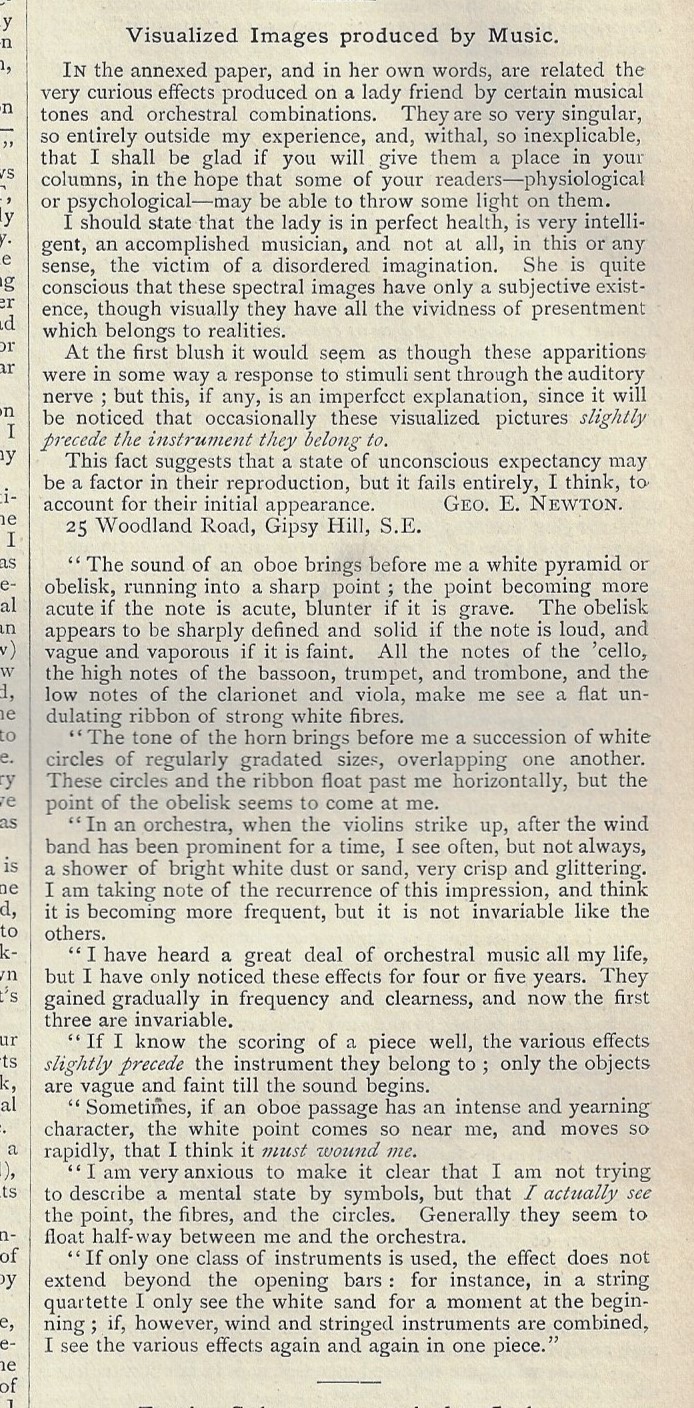
    But stepping back for a moment, I’d just like to share this unusual and interesting 1890 paper from Nature. I never bumped into it before nor could I find more than a couple of bare references to it. So I’m wondering if anyone out there knows anything about it—this is done in the spirit of the original author of the paper, George Newton, who posted his story (“Visualized Images Produced by Music”, March 6, 1890) to see if anyone else in nature-world recognized anything like the situation he describes.

    The opening paragraph of the paper:

    “IN the annexed paper, and in her own words, are related the very curious effects produced on a lady friend by certain musical tones and orchestral combinations. They are so very singular, entirely outside my experience, and, withal, so inexplicable, that I shall be glad if you will give them a place in your columns, in the hope that some of your readers-physiological or psychological-may be able to throw some light on them.”

    Nature 1890 Newton synesthesia

    ·Posted by :

    ·in:

    — —

  • Cancer and the Psychology of Buying Stuff

    JF Ptak Science Books  Post 2713

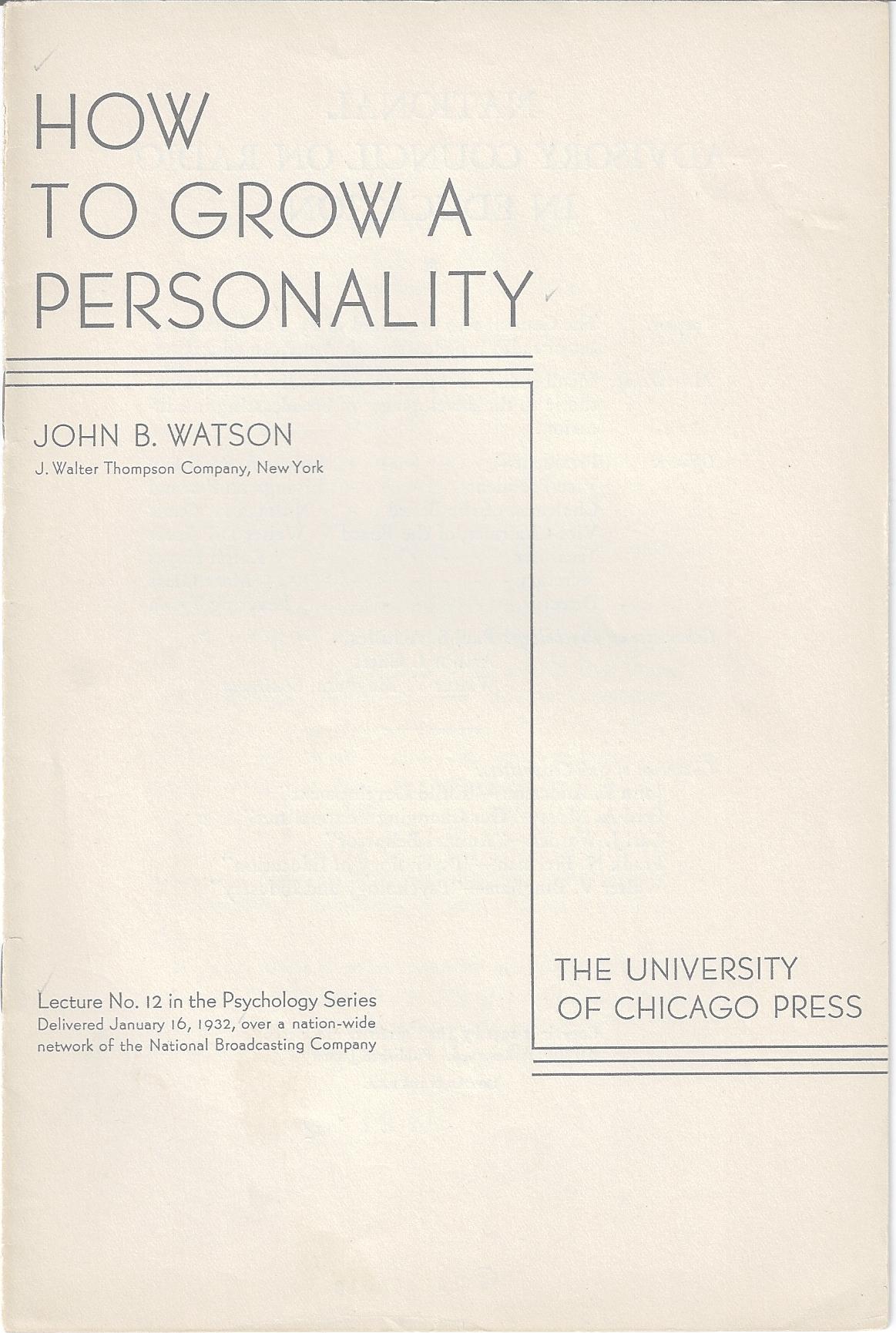
    WatsonWhen John Watson began his radio talk on NBC on January 12, 1932, on “How to Grow a Personality”, he meant it…literally and figuratively. Watson (1878-1958) is considered to be one of the founders of psychological school of behaviorism, which stated simply is the theory that all of human and animal behavior is derived or implied or controlled by “conditioning” or the stuff that happens to/in-and-around the being, and that emotions and thinking (such as they are) have little or nothing to do with forming the response to a stimulus. He claimed that he could train 12 infants to become 12 different sorts of people–lawyer, doctor, engineer, thief, etc.–if given access to training the infants/children–he never got too terribly close to doing that, though he did with a human experiment with the infamous case of “Little Albert”, which is a sodden story of questionable ethics. 

    In the case of personality, Watson defines it so: “Your personality at any age is just a cross-section of the things you can do at that age. There is nothing mysterious about it–it is just a steady growth coming out of your past.” And evidently that means that you can grow your personality by growing the things that you can do, thus training yourself by the stuff you can get done.  Sounds a little circuitous and has a strong scent of a napping carny in a big sweaty revival tent, but it did pass great psychological barriers, as Watson is held in very high regard in the history of 20th century American psychology.

    This is no doubt a rude and crude assessment, but so it goes. 

    One thing is without doubt–he did figure out how to create a “demand” for something. After he was fired from his post at Johns Hopkins (for having an affair that resulted in an enormously popularized divorce trial) Watson took himself and his intellectual toolkit and began work at the J. Walter Thompson advertising agency. He put his two decades of experimental research to hard use, and “discovered” that he could make something desirable by making it familiar and memorable, selling more a positive memory of (or surrounding) a particular thing more so than teh need or use for the thing itself. One example of the use of his behavioral talents was in selling cigarettes.  Billions of them. In keeping with his idea, he created a tremendously repeated slogan for a cigarette, and found that he could basically sell the thing wrapped in its memory/slogan layers. The product was Camel ciggies, and the slogan was “I’d walk a mile for a Camel”.  The slogan could’ve been for Cigarette X, or a rope, or a hammer, or sugar, or whatever–the object didn’t matter; only the environment and landscape created for it did.

    So there’s that.


  • Name, Rank, and Serial Number (1945, with the Audio for the Radio Play)

    JF Ptak Science Books

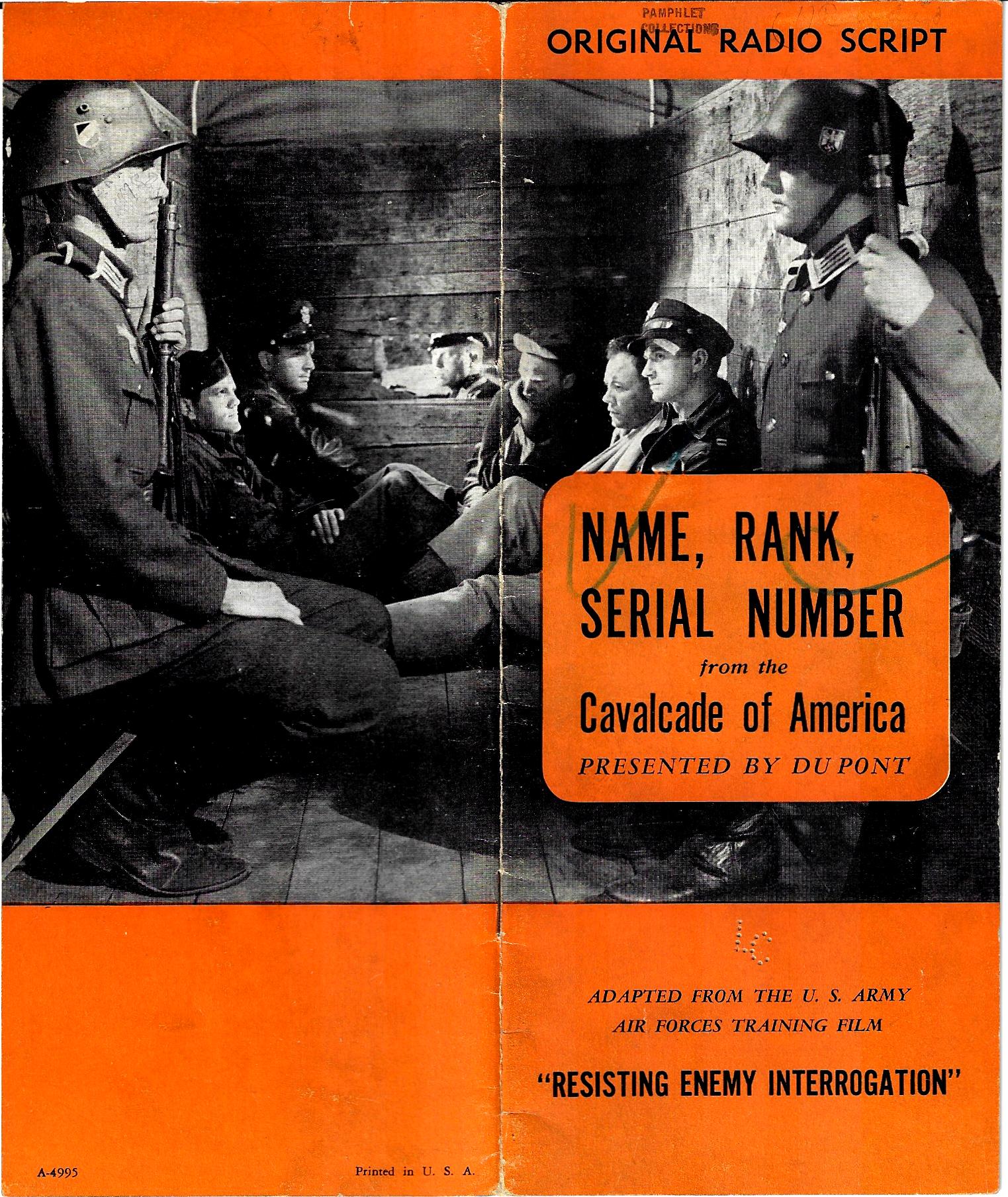
    Name rank serial numberName, Rank, and Serial Number is a tough-love drama produced by Du Pont (“Better things for better living…through chemistry“) for the Cavalcade of America, sharing the critical importance of leaked and mistakenly volunteered information and the foul end that might come to. The play was based on a training film for the USAAF called “resisting Enemy Interrogation”, which was one of certainly hundreds of such films produced by the armed forces during the war to try and prepare members of the military for situations A to Z. Name, Rank, Serial Number was the public demonstration of one of these films, and this slim pamphlet contains the script. There is nothing quite like listening to the original, though, which can be found on the American University Digital Archive site, here: http://auislandora.wrlc.org/islandora/object/hickman%3A250

    This is the story of four captured U.S. airmen  in a German POW camp, and how they faced skillful and then brutal interrogators, and how even the smallest bit of misspoken or half-volunteered mistake can lead to terrible consequences. 


    ·Posted by :

    ·in:

    — —

  • TV and the Nazis, Redux (1944)

    JF Ptak Science Books  (Expanding an earlier Quick Post)

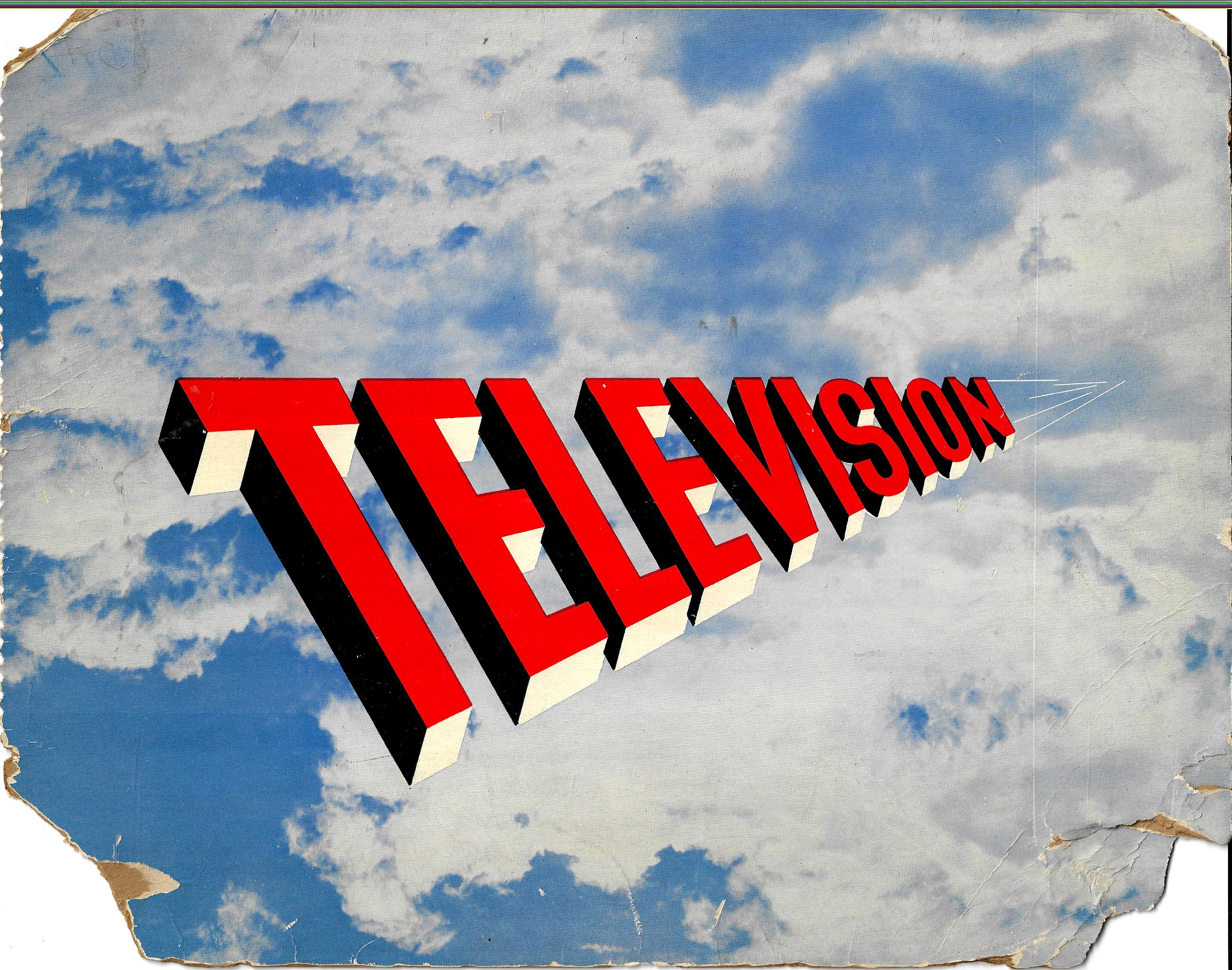
    Television 1939

    Nazi tv770

    In all my exposure to the history of WWII  I am pretty sure that the only reference to Nazi television has been along the lines of the Berlin Olympics or Carl Sagan’s Contact–that and some dim memory about Hermann Goering somehow in the great bowels of the labyrinthine Nazi bureaucracy being in control of the fledgling German television broadcasting. The International Future of Television, an address by Paul Railbourn before the American Television Society in NY in January 1944, discusses the possibility of television in the Post WWII era–and in that, stresses in no uncertain terms that the to-be-defeated Nazis should not have access to the new medium. Railbourne (who would later become a VP at Paramount Pictures) talks about how Hitler utilized and dominated the radio, and how after the war re-education of Germany was necessary along with free enterprise undertaking of newspapers, radio, television, and motion pictures. (He does make a good point, especially with the Nazi domination of radio–not only did they control development, sale, and distribution of radios but also the overwhelming majority of the content of broadcasts. The Nazi control of popular broadcast and live performance culture was virtually complete. 

    He notes that “The Nazis are well aware of the importance of television…destroy the Luftwaffe and the Krupps Armament works, but leave television in their hands, and we shall be leaving them with the most powerful weapon of all…”

    To that end the author discusses post-war control of radio and television in German. He also talks about establishing television networks throughout the U,.S. as quickly as possibly to “capture world leadership in television programming” and “carry the gosphel of the Four Freedoms to all mankind”.  “…Television will play a vital role, for good or ill as it is intelligently or evilly directed, in the establishment and maintenance of an enduring peace, once the present war comes to an end.”

    Railbourne made good sense, and had I think a pretty good idea of the coming possible influence of the new medium.

    A recent book does a fantastic job in investigating and telling the history of the Nazis and sound: Carolyn Birdsall’s Nazi Soundscapes: Sound, Technology and Urban Space in Germany, 1933‑…(published in 2012)

    (“In Nazi Soundscapes, Carolyn Birdsall offers an in-depth analysis of the cultural significance of sound and new technologies like radio and loudspeaker systems during the rise of the National Socialist party in the 1920s to the end of World War II. Focusing specifically on the urban soundscape of Düsseldorf, this study examines both the production and reception of sound-based propaganda in the public and private spheres. Birdsall provides a vivid account of sound as a key instrument of social control, exclusion, and violence during Nazi Germany, and she makes a persuasive case for the power of sound within modern urban history.”–Goodreads. I highly recommend this book. )


  • Perhaps the Earliest Psychological Report on Adolf Hitler, 1941/2

    JF Ptak Science Books   Quick Post

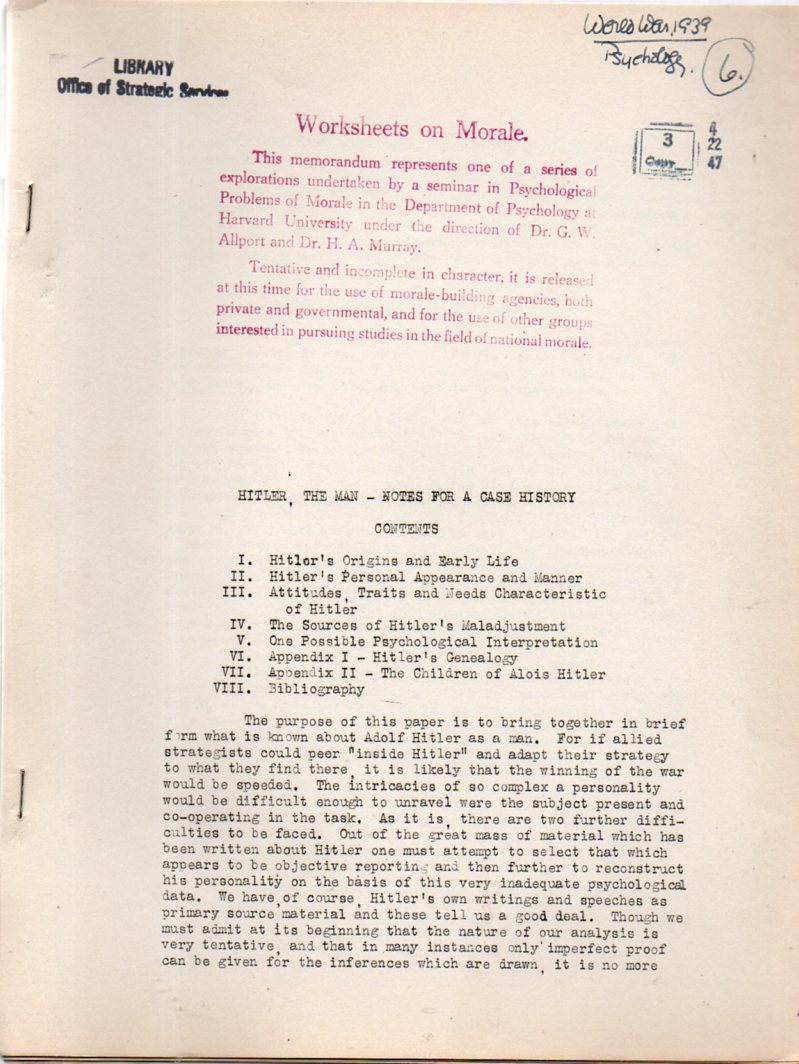
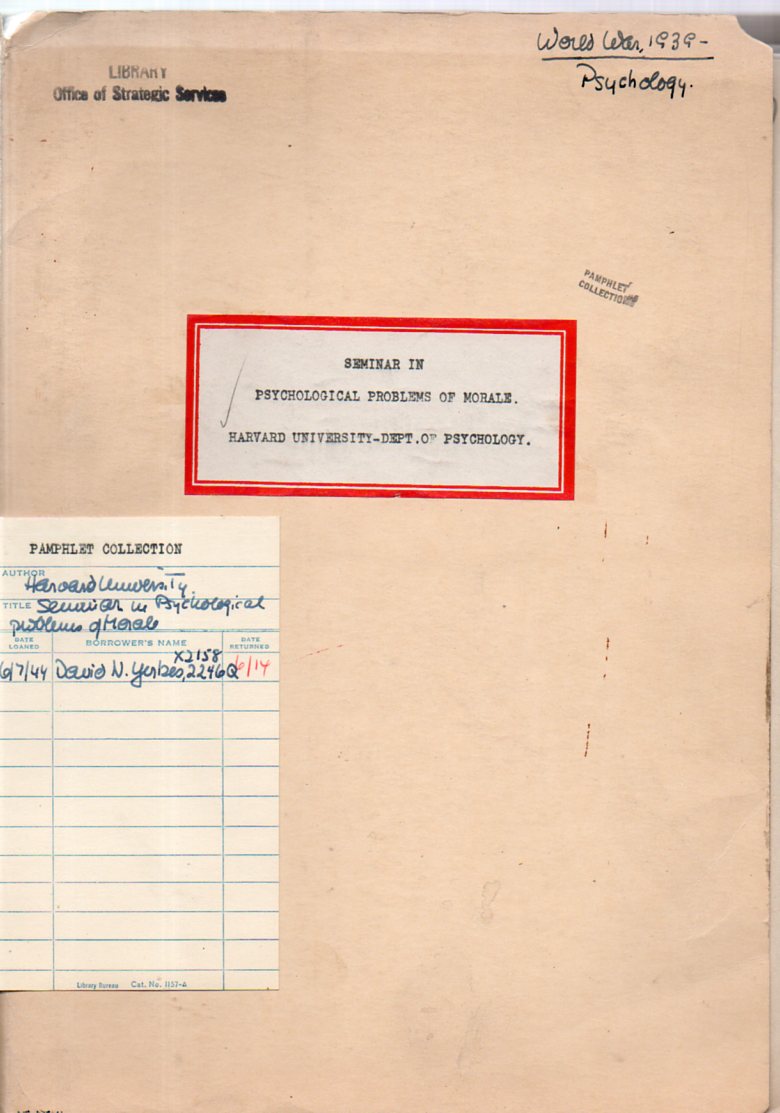
    I wanted to take a moment and post something from the bookselling section of this blog, something that’s pretty interesting and scarce in its own right.  It is a work produced at the Harvard University Department of Psychology by Henry A. Murray (1893-1988), the Worksheets on Morale. Seminar in Psychological Problems of Morale which was published in 1942 and contains a section which turns out to be the first psychological profile of Adolf Hitler–this copy was formerly in the library of the Office of Strategic Services, the precursor and incubator of the CIA.

    Allport696

    Allport697

    See more below:

    • This item may be purchased from the blog’s bookstore, here.

    ·Posted by :

    ·in:

    —

  • A Note on the History of Bad Beds (Bedlamia 2): the Utica “Crib” and Putting the Insane to Sleep, 1880.

    JF Ptak Science Books  Post 1349

    Following an earlier post that I made here on the History of Bad Chairs (including a contrivance made by Declaration-signer Dr. Benjamin Rush that immobilized the body, dulled the senses and kept the feet of its mental-patient-occupant in cold water for “treatment”) I’d like to start a short series on bad beds.  This part was excited by another historic psychological/shrinkological tool from the arsenal of doctors who treated the insane: an instrument of torturous treatment called the “Utica crib”. 

    It was a device used, obviously, to constrain the person placed in it–so that they could be controlled during the day if drugged and still not controllable, and to be used at night if the patient wouldn’t stay under their covers.  It looks pretty terrible, a squashed baby bed with a prison door for a top.  It comes as one in a long line of bad beds, including psychiatric hospital”tumbling beds”. centrifugal beds, and of course spiked beds of the inquisition, stretching beds form the same, Aushwitz  “beds”, and on and on, devices of torture made from places of rest.

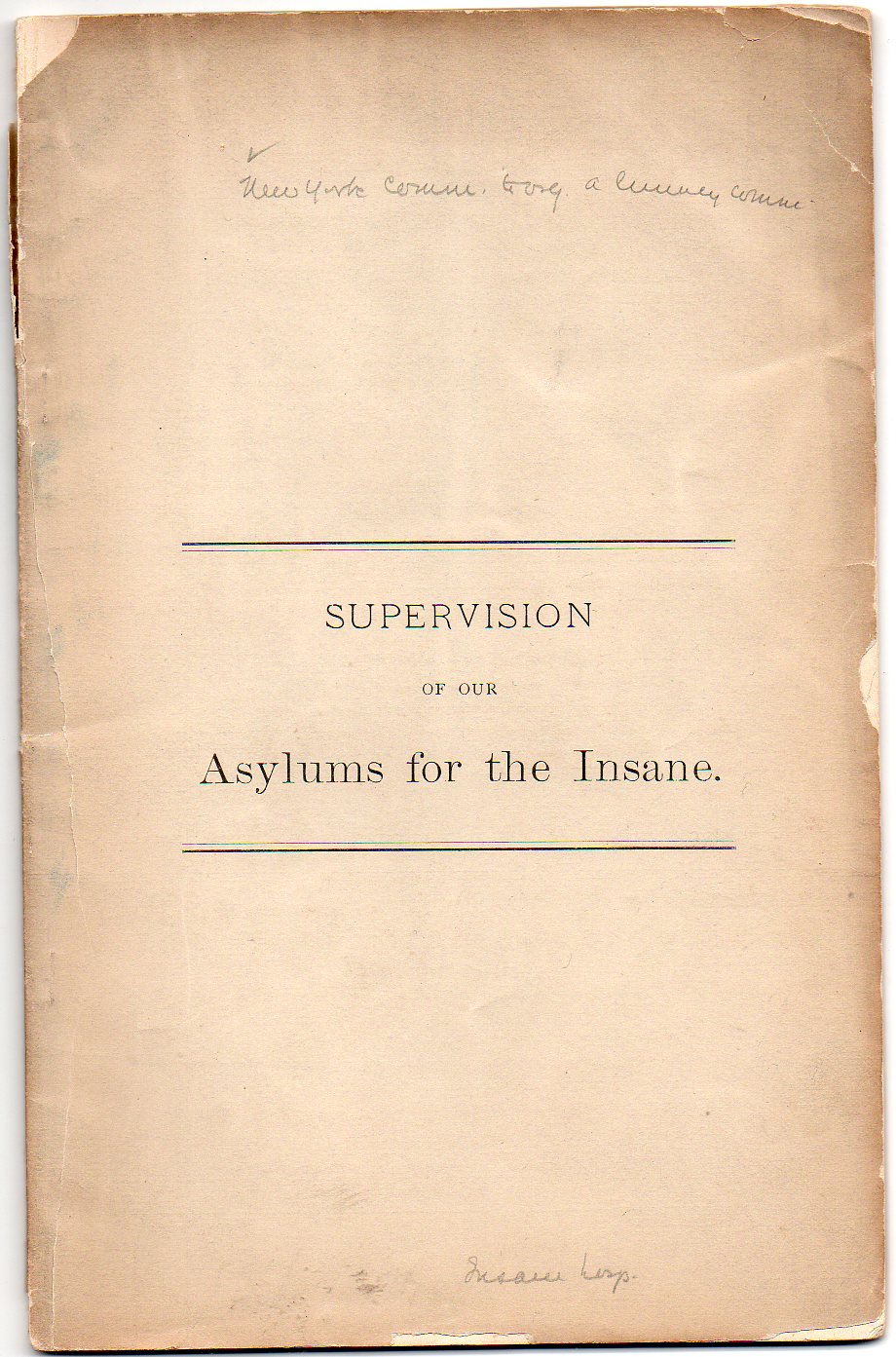
    Insane supervision453 The Utica Bed of the New York State Lunatic Asylum at Utica–if not actually constructed in Utica it was popularized  there–was put into use at about the same time that the facility was opened in 1843.  According to the numerous reports of New York State asylums directors in Supervision of our Asylums for the Insane1, it was about time (in 1880) that folks in control of the state institutions start to deal with their charges in a medical, treatable, fashion; to try and remedy the effects of mental illness rather than just use the asylums to warehouse societal outcasts.  And it was in this paper that the Utica Crib (and other retraining devices) came under very severe criticism. (The original pamphlet is available at our blog bookstore.)

    Edward C. Spitzka makes the point that the institutional that use devices like the Utica Crib–which was supposed to prevent patients from injuring themselves–actually had far more incidences of  patient injurious than those institutions which–with a similar clientelle–didn’t use them at all.  Spitzka made a very compelling case the the Utica Crib and other devices were archaic remnants of an earlier and darker time in the treatment of cases outside mental health, and they they were far more injurious to patients than not having them at all.  They also, he said, demoralized the staff of the hospital and depressed the medical supervision, making a mockery of treatment. All in all, Spitzka’s insights were accurate and prescient. 

    Notes:

    1.  Report of the Proceedings for Establishing a Board of Commissioners in Lunacy for the State of New York, published by Sherwood & Co., NYC, in 1880.  55pp.


  • Newspapers and Music in Bedlamia, 1850’s.

    JF Ptak Science Books   Post 1348

    Two short tales of attending the needs of the mentally ill in the 19th century:  asylum journals and treatment of mania via music.

    In the world of the treatment of the mentally ill, or of the possibly “deranged”, or the poor confused, or the old and demented, or the depressed of all ages, there have been some uncommon instances of creativity and rehabilitation in the constrained early days of warehousing patients, or inmates.  One example of this was the newspaper/journal called The Opal, which was published–extraordinarily–for ten years (1851-1860, in ten volumes and 3,000 pages) by the inhabitants of the State Lunatic Asylum of the State of New York at Utica.  This illustration–which is so far as I is (unfortunately!) the only image in the journal and is repeated month-to-month–depicts, I guess, the editor of the journal, in a cell, and with a terrified or manic or at least sharp-eyed thousand-yard gaze.  It is an unusual statement by the artist, perhaps, that the stone wall behind the editor’s bars look somewhat like the books bound with raised bands that are on the inside of his cell.  I’m uncertain as to whether this was a message, or whether this picture is just a picture.  But it is certainly odd to draw such a portrait of the editor of The Opal–greasy hair, sunken eyes, mouth ajar, crazy-gaze, and hardly very sympathetic.

    And the title page of the journal:

    Given the time, it is remarkable that such an enterprise occurred and lasted as long as it did.  It must have been an extraordinary aid to the people in Utica, allowed an avenue to express themselves, allow for creativity, allow for some independence of expressive thought  It was put loud and clear in the volume for 1854, on page one, in a bit called “A Message to Our Patrons”: “Forty-eight months [that’s four years since the beginning of the journal] have vibrated their moments on the engagements and extensions of the Opalians. The divine art of printing has conveyed through numerous and constant agencies the heraldry of Asylumian intellect, and in the varied developments of society, our paper hath been insinuated by the gentleness of humanity, and reciprocated in a fourfold state the harbingers of progression in kindness by exchanges, whose opening leaves hath borne refreshment from the wines on the lees of humanity, well refined by the studied graces of purity, sense, discretion and knowledge, to the great comfort of this retirement, hallowed by the superintendence of wisdom and virtue1.”

    The italicized “our paper” appears int he original. 

    And this example of trying to step somewhat beyond the modicum of dispensing agents for settling a “maniac”–a person it seems suffering from a manic stage.  Doctors and attendants tried to treat the patient with an assortment of narcotics, but they didn’t work; very liberal applications of btrandy occurred, which caused some sleepiness, but after two days the man woul dbe getting sleepy, anyway.  And then came the desperate measure (so to speak):  music.  It was certainly nothing new, really, the calming effets o fmusic having been know deep into antiquity.  Why it was not mor eliberally applied in mental institutions, I don’t know.  The case and description are found in the American Journal of Insanity (later the American Journal of Psychiatry) for 185 8:

    “The symptoms indicated, as it seemed, the prompt use of narcotics. Morphine was therefore given in doses gradually increased, till at the end of 48 hours, 3 gr. at a time, with strong laudanum injections, had been administered. This treatment seeming to have little or no effect, was abandoned and other means, such as baths, counter irritants, stimulants, djc &lc, resorted to, with but slight amelioration of the alarming symptoms. The patient had now continued in this state three days and nights, without sleep, and with little or no food. Pulse much of the time 120. Countenance anxious and sunken, presenting every appearance in fact, of approaching final prostration. Of the means above mentioned, the administration of brandy, in often repeated and large doses, seemed to act most favorably and effectually. Under its use the pulse came down to about 100. The patient also became more quiet* and manifested a slight disposition to sleep.

    “At this time, it was suggested by the father, that his son had always manifested a remarkable fondness for music, and that when a child, sleep had often been produced by it. A violin player was accordingly sent for, and the effect of his art tested upon the patient, with the most remarkable and immediate favorable effects. The nervous excitement began to abate at the sound of the fiddle, and in a very short time, the patient was in a sound sleep, from which he awoke in an hour or two much refreshed and nearly rational. By continuing the brandy, and when nervous excitement began to manifest itself, an occasional quietus from the fiddle, this singular state of mental excitement was, in a few days, entirely and permanently subdued.”

    In general, the 1850s were not a good time to be in a mental institution in the United States–or anywhere else for that matter.  There were 3700 people or so institutionalized in America at the time of the two stories (above).  It was really just about at this time that a national effort began to be organized to treat the institutionalized people more as patients than as inmates. 


    ____

    Notes:

    1. “In the diffusion of thought by the arts, its curiosity and character are enhanced by the manner in which it is communicated; and the respectful interchange of sympathy, and of emotions incident to nature that assimilate and affiliate the multiform interests and conditions of the human kind are so promoted by interchanges as to excite a brotherly regard for the correspondences, and a desire to advance their intelligences anew, when apprehended as the instrumentality of reasonable reliances.”

    Also this:

    Asylum Life; Or, The Advantages Of A Disadvantage, from The Opal


    Page 1:

     
    1  

    I have no care for copper or coin,
    I have no fear of any one’s frown;
    I’m fed by the hand that feedeth the best,
    And seldom molested is my sweet rest.

     
    2  

    I have walks to take, and news to read,
    With chit-chat and work the hours to speed;
    Good company, age, as good as the great
    Who have the charge of the “Empire State.”

     
    3  

    When ill, we have nurses; kind they be,
    And doctors too, without extra fee;
    When well, we can leave for homes far and near,
    While the Word of Life may be conned with care.

     
    4  

    Though sad, we may wait till brighter we grow,
    And health and good humor our faces make glow;
    When merry music may lend us her thrall,
    And consoling each other be less sad withall.

     
    5  

    And Love may abide, defended by prayer,
    And our hearts and our hopes be brightened elsewhere;
    We may write to our homes, and see our dear friends,
    And contented and blessed our destiny ends

    ·Posted by :

    ·in:

    — — —

  • Why Kindle is No Good for Kids

    JF Ptak Science Books  Post 1277

    Dick Words without Books–Kindle et al as a Dim Shadow in the History of Reading to Children The Kindle and its relatives may be a poor choice for reading to children–it’s a book and not a book, a collection of words without a wrapping, a constant reminder for what it isn’t, a cold remedy for warm memories.

    There have been a number of books “written” now that have no words.  Elbert Hubbard charmingly put one together in 1898 (called Essay on Silence).  More recently, there was The Nothing Book (1970), which was precisely that, and which found its way into the NYTimes book review section (“we have nothing to add”). Elsewhere in the arts John Cage produced a four and a half minute piece on nothing, while Samuel Beckett takes far less time to produce his ode to nothing in his play Breathing–all fine examples of nothing.

    There are more-lesser examples of nothing in literature, with books produced using nothing but the letter “I”, or commas, or periods/dots, or plus/minus signs.  They soberly add a little something to nothing and somehow come up with less than “something” and more than “nothing”, floating in a briney failed no-man’s-land of not-nothingness. Others have taken a different route around nothingness by simply dropping the use of a single letter in the formation of their novel–the lipogram isn’t even a stutter to nothingness, just a hollow something. 

    And that’s where the Kindle comes in, in the hollow somethingness. 

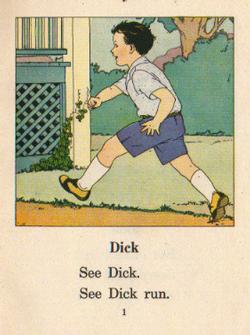
    Dick and Jane are something.  Or at least the physicality of reading them to children is something. The stories aren’t important, really–the handling of the book, the feel of the pages, the jumbling of position, the steadying of the text, the turning of the pages, trying to navigate the swirl of motions, the feel of the whole thing as a voice deciphers the tracks along the pages.  

    It’s the act of reading that might be the most mportant thing in getting children to appreciate the whole idea of reading. 

    Reading from a Kindle just won’t do, it can’t accommodate the range of differences, the cascade of varying stimuli, that comes from holding a book.  Books are always the same size inside a Kindle–I know t hat my own children love some books because of their shape, or they just like feeling something different in their own hands as they skip from title to title.  

    You also can’t give your kids the book that you had when you were little, seeing the way your name changes in your books as you grew older.  You won’t have a Kindle with your kid-scrawl on the flyleaf identifying the child-you in 1962.  The kindle has no personality of its own–which may be fine for people already reading, but not so for people just starting out.  

    You also can’t press a much-loved, hard-read copy of a favorite Kindle into your kid’s hands and expect some sort of response to it. There’s just too much missing from the reading experience with a not-a-book–you just don’t want to institute a sameness when what is needed is difference


  • The First American Race Riot: Harlem, 1935

    JF Ptak Scence Books  Post 1255–expanded

    “The Harlem riot of 1935, now the subject of a comprehensive report, demonstrated that ‘the Negro is not merely the man who shouldn’t be forgotten; he is the man who cannot safely be ignored’.” Alain Locke,  Survey Graphic, 1936.*


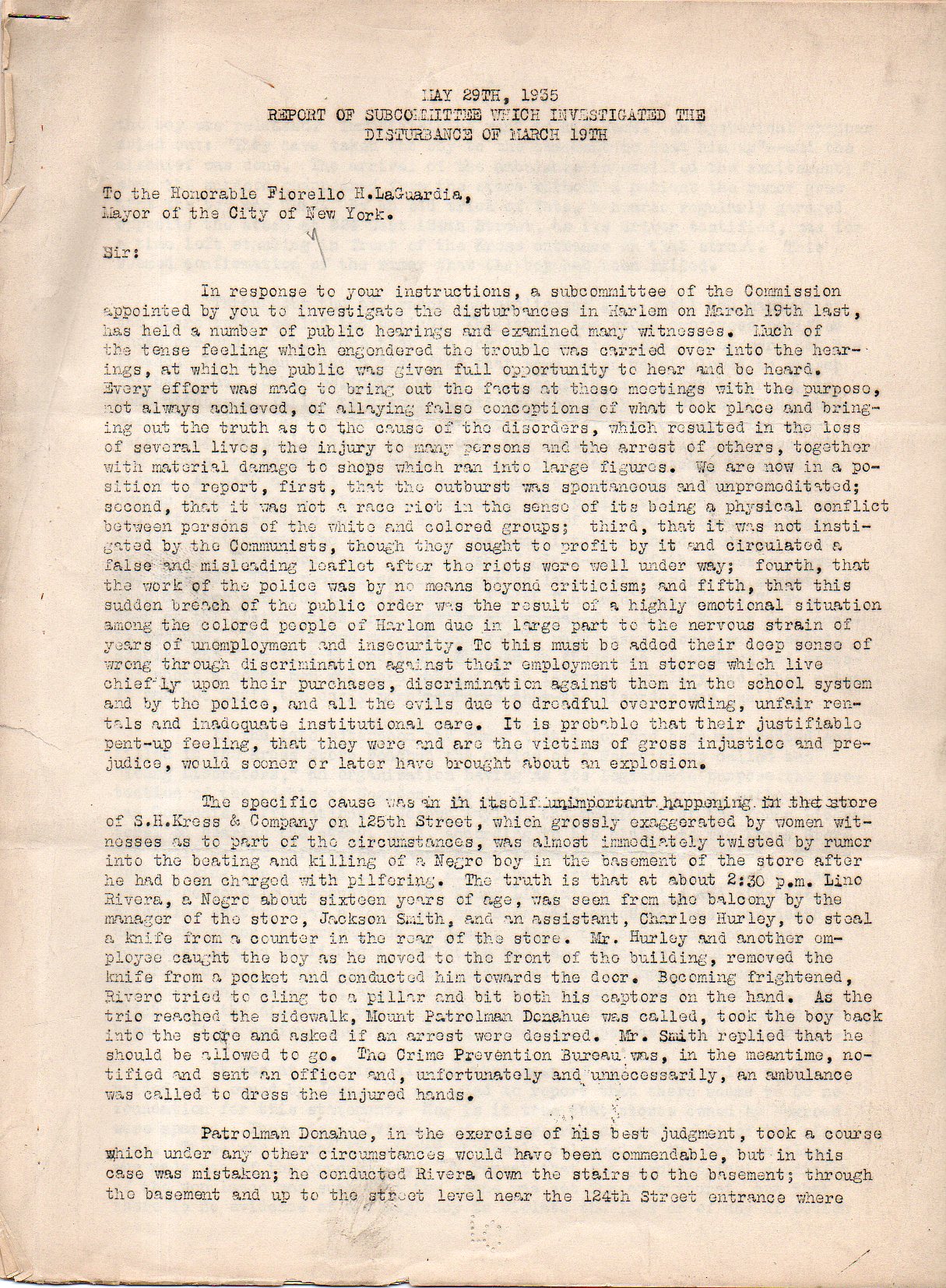
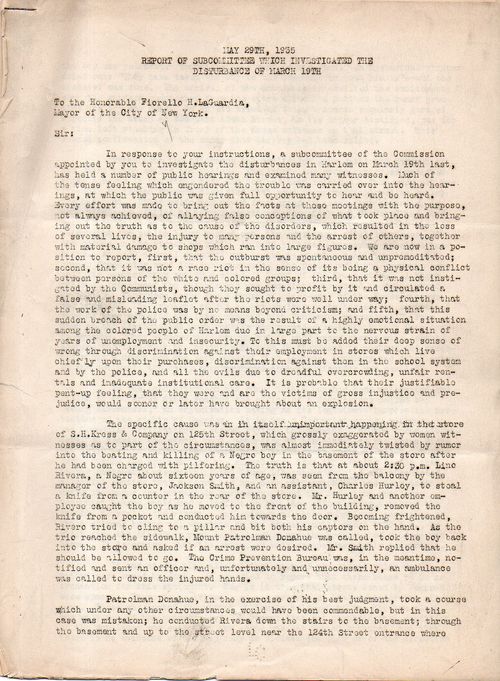
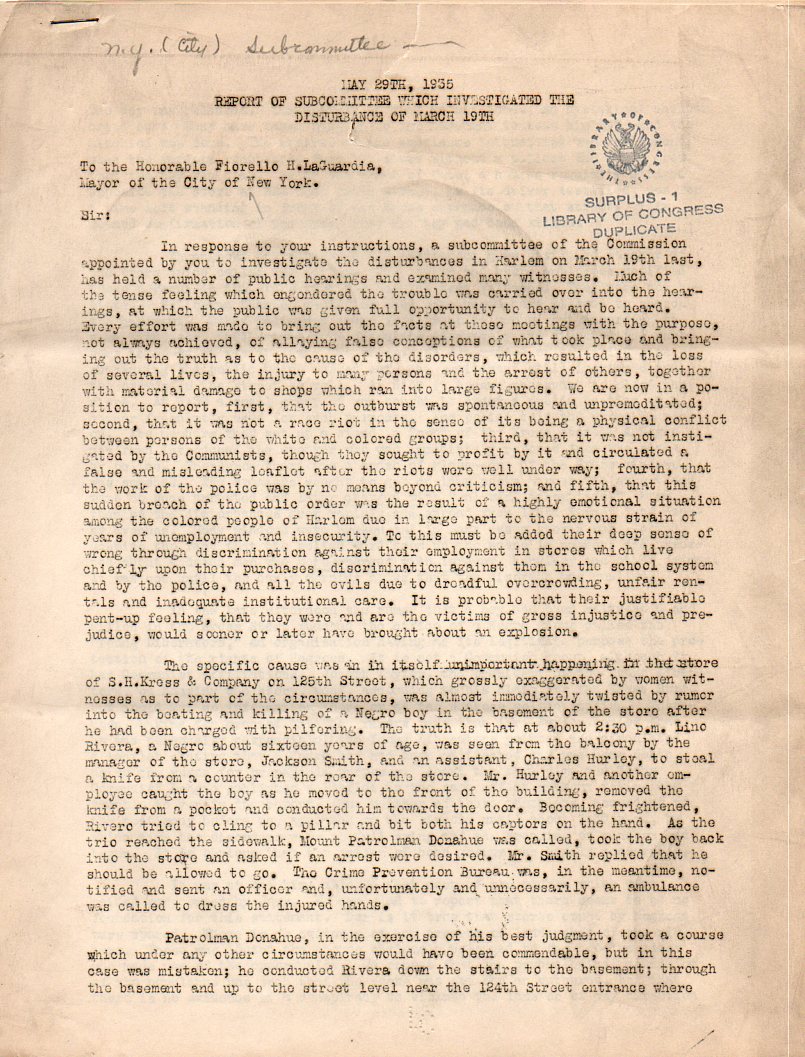
    This is a report to Mayor Fiorello LaGuardia (mayor of NYC from 1934-1945, a liberal Republican who was exactly what was needed in the city at exactly the right time) on what has come to be recognized as America’s first race riot.1 The damage was widespread, with hundreds of people injured, three killed, and $2 million 1935 dollars lost in during the Harlem event.   The action started at the S.H. Kress dime store on 256 W. 125th St. (just across from the Apollo Theater)   in Harlem, where a 16-year-old boy named Lino (described int his report as a “young Negro” though he was Puerto Rican) was detained by authorities in the store for shoplifting.  He was taken to the store’s basement and released to the backstreet unharmed, but a rumor spread violently and quickly that a young child had been taken to the basement of the store and beaten (or killed) for stealing a piece of candy.  Complications arose when the police arrived and when civic leaders’ questions went unanswered.  An odd and unfortunate twist of faith placed a hearse in front of the store during this build-up (from the business across the street from the store), inspiring outrage and “proof:” that the boy had been killed.2
    Race riot259

    In addition to the missing boy, the hearse, the police, and bad communications, were handbills distributed in the neighborhood printed by the Young Communist League and the black semi-militant Young Liberators, all helping to fan the flames of the crowds by the Kress store, which had swelled to several thousand people after just two hours–the riot came soon thereafter.

    The Report of Subcommittee Which Investigated the Disturbances of March 19th3 (and issued before August 15, 1935), was chaired by Arthur Garfield Hayes,analyzed the event in a surprisingly sympathetic way, recognizing that there was no organized response to the event, and finding that the response was understood to be a reaction to the long history of abuse of African Americans and poor governmental/police relations–and this all in eight quick pages.   LaGuardia said “We cannot be expected to correct in a day the mistakes and omissions of the past fifty years. But we are going places and carrying out a definite program. While the critics have been throwing stones, I have been laying bricks.”  It was surprising top me that the report was bi-racial, and that there was some real attempt to understand the problem and “do” something about it, rather than just chalk the whole thing up as something that could be simply solved with pure force.  [The original report is available for purchase from our blog bookstore.]

    As Locke wrote (below) the Riot of 1935 was the end of the Harlem Renaissance, and that a new era had begun.  For his part, LaGuardia at least opened a way to communicate about how to address the causes of such vast and repellent circumstances that eventually turned into the riot.

    Notes:

    * Locke continues: “Eleven brief years ago Harlem was full of the thrill and ferment of sudden progress and prosperity; and Survey Graphic sounded the tocsin of the emergence of a “new Negro” and the onset of a “Negro renaissance.” Today, with that same Harlem prostrate in the grip of the depression and throes of social unrest, we confront the sobering facts of a serious relapse and premature setback; indeed, find it hard to believe that the rosy enthusiasms and hopes of 1925 were more than bright illusions or a cruelly deceptive mirage. Yet after all there was a renaissance, with its poetic spurt of cultural and spiritual advance, vital with significant but uneven accomplishments; what we face in Harlem today is the first scene of the next act—the prosy ordeal of the reformation with its stubborn tasks of economic reconstruction and social and civic reform…” 

    1. Sociologist Allen D. Grimshaw called the Harlem Riot of 1935 “the first manifestation of a ‘modern’ form of racial rioting,” citing three criteria: “violence directed almost entirely against property”;  “the absence of clashes between racial groups”, and “struggles between the lower-class Negro population and the police forces”. “Harlem Renaissance”. Online Newshour Forum. PBS. February 20, 1998. http://www.pbs.org/newshour/forum/february98/harlem5.html.

    Another commission set to investigate the riot was headed by E. Franklin Frazier which produced a report, “The Negro in Harlem: A Report on Social and Economic Conditions Responsible for the Outbreak of March 19, 1935,” which found that the riot was not a controlled event and had happened spontaneously as a result of prolonged “injustices of discrimination in employment, the aggressions of the police, and the racial segregation”.

    2. Locke continues his observation on the Riot: “Curtain-raiser to the reformation was the Harlem riot of March 19 and 20, 1935; variously diagnosed as a depression spasm, a Ghetto mutiny, a radical plot and dress rehearsal of proletarian revolution. Whichever it was, like a revealing flash of lightning it etched on the public mind another Harlem than the bright surface Harlem of the night clubs, cabaret tours and arty magazines, a Harlem that the social worker knew all along but had not been able to dramatize—a Harlem, too, that the radical press and street-corner orator had been pointing out but in all too incredible exaggerations and none too convincing shouts.”

    3.  The commission was headed by Arthur Garfield Hayes and Charles H. Roberts, and was a bi-racial affair. “IMMEDIATELY after the March riot, Mayor La Guardia appointed a representative bi-racial Commission of Investigation, headed by an esteemed Negro citizen, Dr. Charles H. Roberts. After 21 public and 4 closed hearings conducted with strategic liberality by Arthur Garfield Hays…”

    4. Recommendations from the report:

    Increased hospital and health clinic facilities to combat disproportionate disease in the densely populated Negro areas.

    Recommended reorganization of Harlem hospitals and wider admission of Negro physicians to staff appointments, internee’ posts and educational facilities at all other municipal hospitals.

    New health center for Central Harlem District similar to East Harlem Center and a Negro supervisory health officer [the latter already agreed to by Commissioner Rice].

    Additional school buildings and extra educational facilities for vocational guidance, visiting teachers, and playgrounds. [The comparative absence of racial discrimination in the school system is one of the bright features of the report.]

    Housing legislation and additional low cost housing projects in line with recommendations of the report. Additional PWA and federal grants must be sought for such projects.

    Relaxing of the present tension in public opinion about the policy and attitude of the police in Harlem. The report recommends a Citizens’ Public Safety Committee not only to cooperate with the Police Commissioner as an advisory body but as a board of complaint in cases of suspected police brutality or reputed violations of citizens’ rights.
  • Looking Inside Out–Ernst Mach’s pre-Escher Image

    JF Ptak Science Books   Post 1243

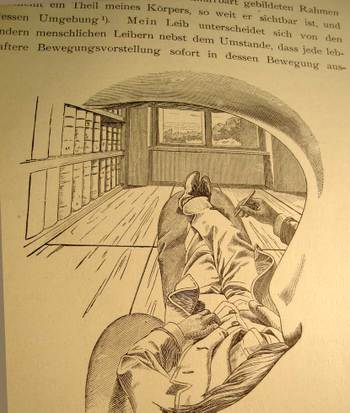
    MachbookI cannot think of another illustration by a scientist or philosopher who attempts to explain their own–literal, interior,physical–view of the world and then offer what this looks like to the reader from inside his own head, looking out through his own eye.  That’s exactly what Ernst Mach is doing right here on page 15 of his influential book Die Analyse der Empfindungen, the fourth German edition (“The Analysis of Sensations and the Relation of the Physical to the Psychical”)  (Jena, 1903)
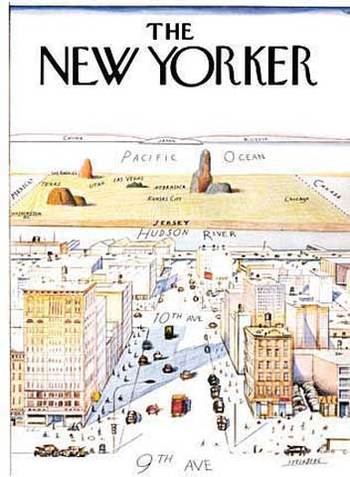
    There is nothing in this world for Mach that is not admissible to the human brain that is not empirically verifiable–that is, the world is nothing but awash in sensation and that sensation itself forms part of the experience of, well, experience. I’ve actually never been interested in the philosophy of science, and this is one of the reasons why.  Nevertheless I boldly break through my own prejudices to enjoy this phenomenally original image, drawn from the inside of Mach’s working mind, looking out through his eye socket, over his mustache, under his eyebrow, around his nose, out across his body and then leaping into the rest of the world.  I think he does make his point about the essentialSteinberg_352 nature of the observer. And much like the classic Steinberg New Yorker cartoon of the world view of the New Yorker (of course this includes only Manhattan), I know some number of people who have transposed their bodies much like Herr Mach into the Steinberg map–except that their worldview ends basically at the Hudson River (Mach’s feet) with the rest of the world being the sliver out there beyond the river (Mach’s window) until you go 359 degrees around the world to get back to the East River (and back inside Mach’s noggin).  It is an unusual world view to have, but someone has to have it so that we can at least identify it so. 
    I just like the picture.