A Daily History of Holes, Dots, Lines, Science, History, Math, Physics, Art, the Unintentional Absurd, Architecture, Maps, Data Visualization, Blank and Missing Things, and so on. |1.6 million words, 7500 images, 4.9 million hits| Press & appearances in The Times, Le Figaro, Mensa, The Economist, The Guardian, Discovery News, Slate, Le Monde, Sci American Blogs, Le Pont, and many other places… 5000+ total posts since 2008.

Category: Music

  • Music, Color, Shape, and Synesthesia (1890)

    JF Ptak Science Books  Quick Post

    • “A studious blind man, who had mightily beat his head about visible objects, and made use of the explication of his books and friends, to understand those names of light and colours which often came in his way, bragged one day, That he now understood what scarlet signified. Upon which, his friend demanding what scarlet was? The blind man answered, It was like the sound of a trumpet.”— John Locke, An Essay Concerning Human Understanding.

    This is a big subject for a quick post, the subject of synesthesia having an origin enfogged in mist and with ill-defined boundaries, or at least that is until we get to the 19th century. If we leave aside the earlier thinking (by folks like the quoted Mr. Locke, above) we can speed ahead to Gutav Fechner (the father of psychophysics) with his empirical study of a group of synesthetes in 1871. He was quickly followed by Francis Galton (in 1881, a paper that I write about elsewhere on this blog), though neither Fechner nor Galton’s work in this area achieved very much recognition beyond pale acknowledgment. Things speed up somewhat in the early 20thc when the empirical work is taken more seriously.

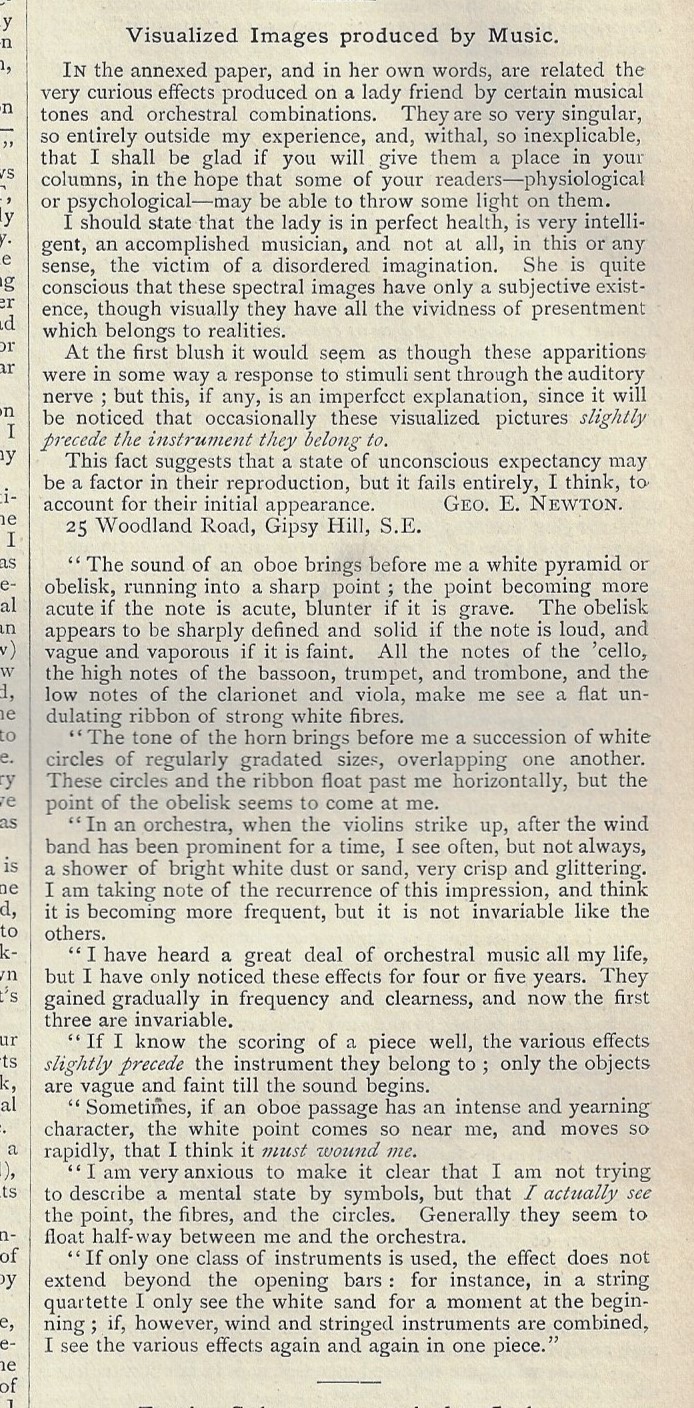
    But stepping back for a moment, I’d just like to share this unusual and interesting 1890 paper from Nature. I never bumped into it before nor could I find more than a couple of bare references to it. So I’m wondering if anyone out there knows anything about it—this is done in the spirit of the original author of the paper, George Newton, who posted his story (“Visualized Images Produced by Music”, March 6, 1890) to see if anyone else in nature-world recognized anything like the situation he describes.

    The opening paragraph of the paper:

    “IN the annexed paper, and in her own words, are related the very curious effects produced on a lady friend by certain musical tones and orchestral combinations. They are so very singular, entirely outside my experience, and, withal, so inexplicable, that I shall be glad if you will give them a place in your columns, in the hope that some of your readers-physiological or psychological-may be able to throw some light on them.”

    Nature 1890 Newton synesthesia

    ·Posted by :

    ·in:

    — —

  • Music as an Oil of the Industrial Machine (Muzak, 1941)

    JF Ptak Science Books   Quick Post 

    Reading cubaEntertaining works for a happier labor force has certainly been a “thing” for quite some time–I don’t know the history very much1 but I know it extends back into the 19th c to some probably very small degree, and I do recall a Lewis Hine photo of a Lectore in Havana reading to cigar rollers (in 1909).  It makes sense to make your workers comfortable and to work to end intellectual monotony, though few employers proceeded that way. 

    And thus to Muzak, the improbable source of injecting music into the cooperation equation of industrial control of workers.  [Source: via the Library of Congress]

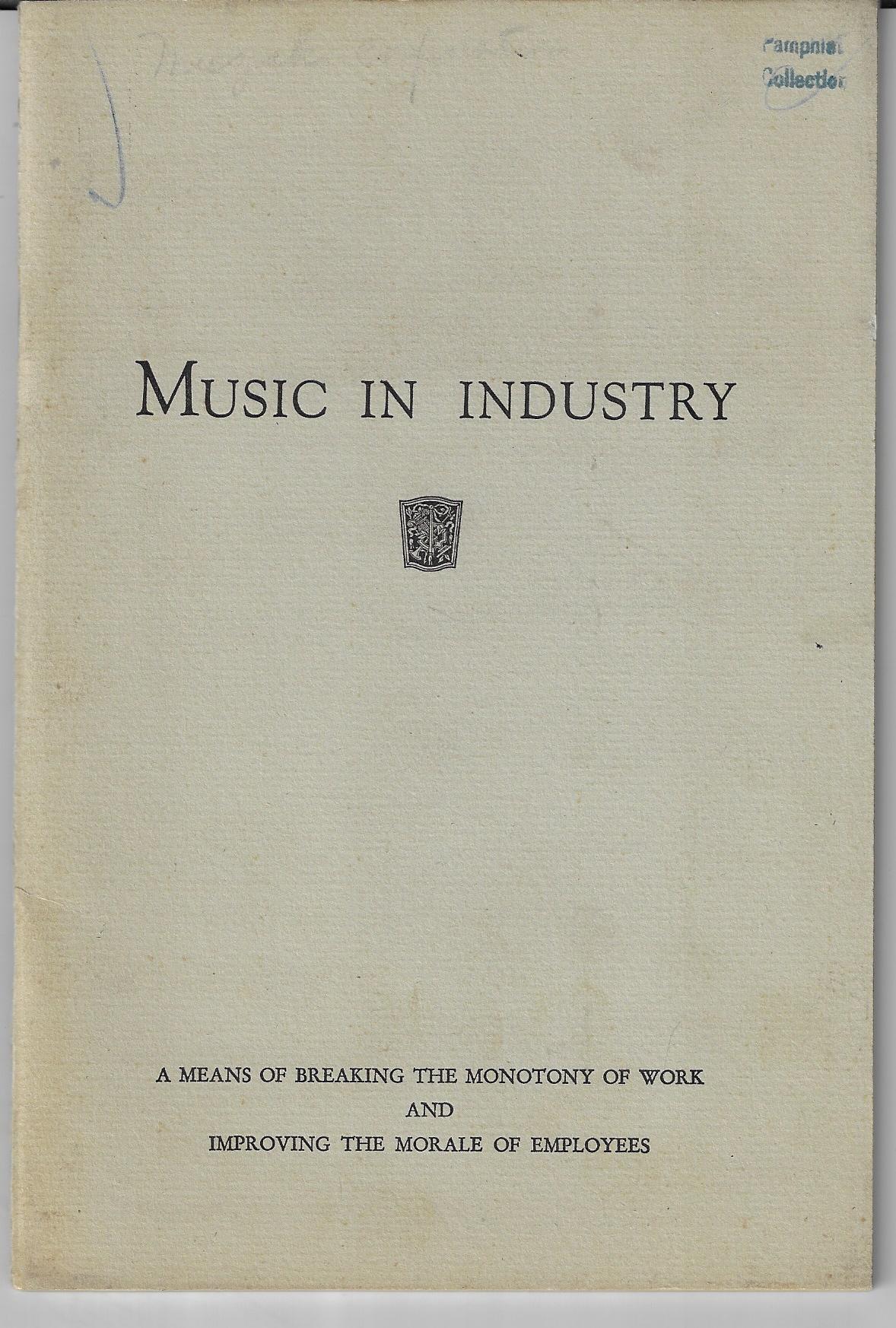
    MuzakI came to this quick realization–late to me–after finding a pamphlet in the warehouse, Music in Industry as a Means of Breaking the Monotony of Work and Improving the Morale of Workers. It was published in 1941–which is earlier than I expected for the Muzak Corporation–which adds to the surprise of the scope of the company’s long-lived impact, its history stretching back to the early 1930’s. It seems as though Muzak, which has a somewhat complex ownership and control history over its first 15 years or so, was a significant contributor to the sound landscape in the United States. It provided four  different broadcasting “networks” of selected musical patterns from the early days of wireless broadcast (at about a dollar a day per month) that provided a certain sort of architecture/design of a sound wall, though the music at this point was coming over telephone lines. In any event, Muzak started providing massive amounts of music into public and private spaces for some time, and their position was accelerated after the company’s war effort during WWII, and then becoming involved in U.S. post-war propaganda programs, and then into the Muzak that we think of today…all of which was happening a few decades before I thought it did. The fact is though that Muzak was filling silence in a controlling way in work and public places for a very long time. I imagine that one could think of this as a sort of early robotization of the human workforce–that is extreme, of course, but the thought worked its way through my head and came out here. 

    Notes:

    1. I don’t think I’ve ever mentioned this in the 4500-odd posts I’ve made to this blog in the last nine years, but the one rule I try to abide in writing one of these posts is that they take no more than an hour, start-to-finish. 
    • For an interesting read, see  Elevator Music: A Surreal History of Muzak, Easy-Listening, and Other, by Joseph Lanza.
    • There are no copies of this work found in WorldCat/OCLC, in spite of this being the second printing of the pamphlet. There are several other works by this title–generally being journal articles) and even a music in industry bibliography published in 1943, but no listings for the Muzak title. 

    ·Posted by :

    ·in:

    —

  • A Superior Musical Review Hidden inside a Superior and Obscure Journal, 1923

    JF Ptak  Science Books  Post 2630

    Manuscripts (MSS), edited by Paul Rosenfeld in New  York, 1922-23, was a Small Magazine, a wonderful Dadaist publication with contributions from the leading artisitc/intellectual community including Georgia O’Keefe, Alfred Stieglitz, Paul Strand, John Marin, Charles Demuth, and many others. What I’m writing about right now is issue #5–appearing in March 1923–of the six (total) issues that were printed of this short-lived and very highly spirited magazine–the issue shockingly emerged from a box in the studio last night. The striking cover was designed by Georgia O’Keefe, and underneath the cover for issue #5 “one of the most remarkable issues” (according to the Dada Once and For All catalog by Ex Libris in 1983), was the work of the critic and Stieglitz-supporter Herbert Seligmann. 

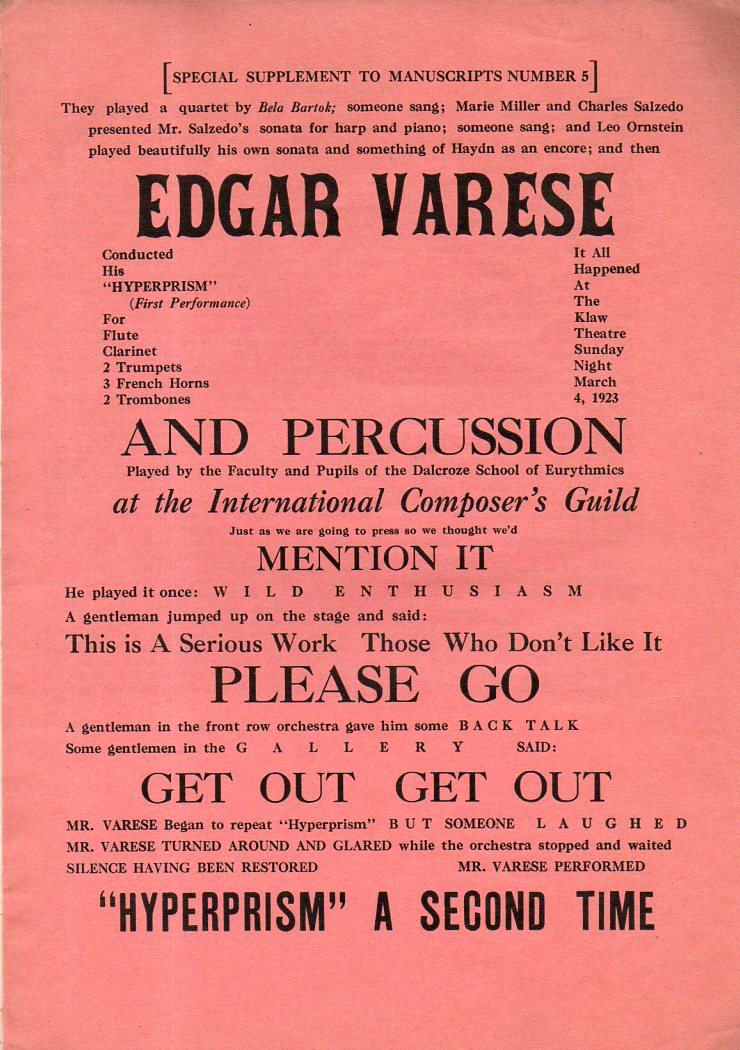
    All this aside, what really struck me was the broadside “review” tucked into the twelve-page publication–a very segmented, highly typefaced and fonted (sorry!), very creative look at the composer Edgard Varese’s Hyperprism, a very adventurous work for wind, brass, and percussion instruments was completed in 1922 and revised in 1923, and then obviously reviewed by Seligmann in this issue of MSS in 1923.  Varese (1887-1965) was a very-modern modernist whose reference to his music as “sound-mass” (among many other things of course) that was in a way similar to the process of crystallization/chemical crystallography gives an insight into the name of the piece to be performed. The review admonished “This is a Serious Work, Those Who Don’t Like It PLEASE GO” among other such tidy phraselets.  I reproduce this fantastic little gem below:

    Varese615

    Also if you’d like to listen to it:


    By the way Music and Modern Art by James Leggio  reproduces (on page 141) the Varese review as a full-page illustration. 

    See also Herbert  Seligmann, Alfred Stieglitz Talking: Notes on Some of his Conversation, 1925- 1931, New Haven: Yale University Library 1966, for more on MSS. 

    For more on MSS:


    • All six issues reproduced at Monoskop, here: https://monoskop.org/MSS
    • Full text of the MSS Number 5 https://monoskop.org/images/3/3d/MSS_5_Mar_1923.pdf

    And this from issue #5 on the previous issue of the magazine:  “MSS. Number One contained writings by Sherwood Anderson, Kenneth Burke, Waldo Frank, Paul Rosenfeld, Herbert J. Seligmann, William Carlos Williams. MSS. Number 2 contained writings by John Marin, Alfred Stieglitz, Paul Strand, Charles Duncan. MSS. Number 3 was entitled “What Is True Art?” by J. B. Kerfoot and W. Rhea Moreau. MSS. Number 4 was entitled “Can A Photograph Have The Significance Of Art?” by Sherwood Anderson, Thomas H. Benton, Ernest Bloch, Oscar Bluemner, Stephan Bourgeois, Gilbert Cannan, Charles Chaplin, Thomas J. Craven, Elizabeth Davidson, Charles Demuth, Marius De Zayas, Arthur G. Dove, Marcel Duchamp, Alfeo Faggi, Waldo Frank, Hutchins Hapgood, J. B. Kerfoot, Gaston Lachaise, Walter Lippmann, John Marin, Kenneth Hayes Miller, George F. Of, Georgia O’Keeffe, Leo Ornstein, Joseph Pennell, Carl Sandburg, Evelyn Scott, Charles Sheeler, Leo Stein, S. Macdonald Wright, Carl Zigrosser, Bibliography. The price of MSS. Number 5 is 15 cents. Subscription to 10 numbers one dollar. The entire cost of this MSS. Number 5 is the printing bill of $130.00 for the present edition of 1,000 copies, presented by Clarence S. Nathan, Inc., and paid by the Tin Whistle Fund. Each author is solely responsible for what appears over his signature. Complaints should be sent to individual authors. Subscriptions will be received by Herbert J. Seligmann, 129 East 10th Street, New York City. Donations of money will be received with thanks by the same. For the cover design: apologies to “Dada” (American), Marcel Duchamp, Man Ray, and acknowledgment to “Anonymous.” Copyright, 1923, by Herbert J. Seligmann.”–from page 2 of MSS Number 5. 


  • Table of the Compass of Voices and Instruments (1814)

    JF Ptak Science Books   Quick Post 

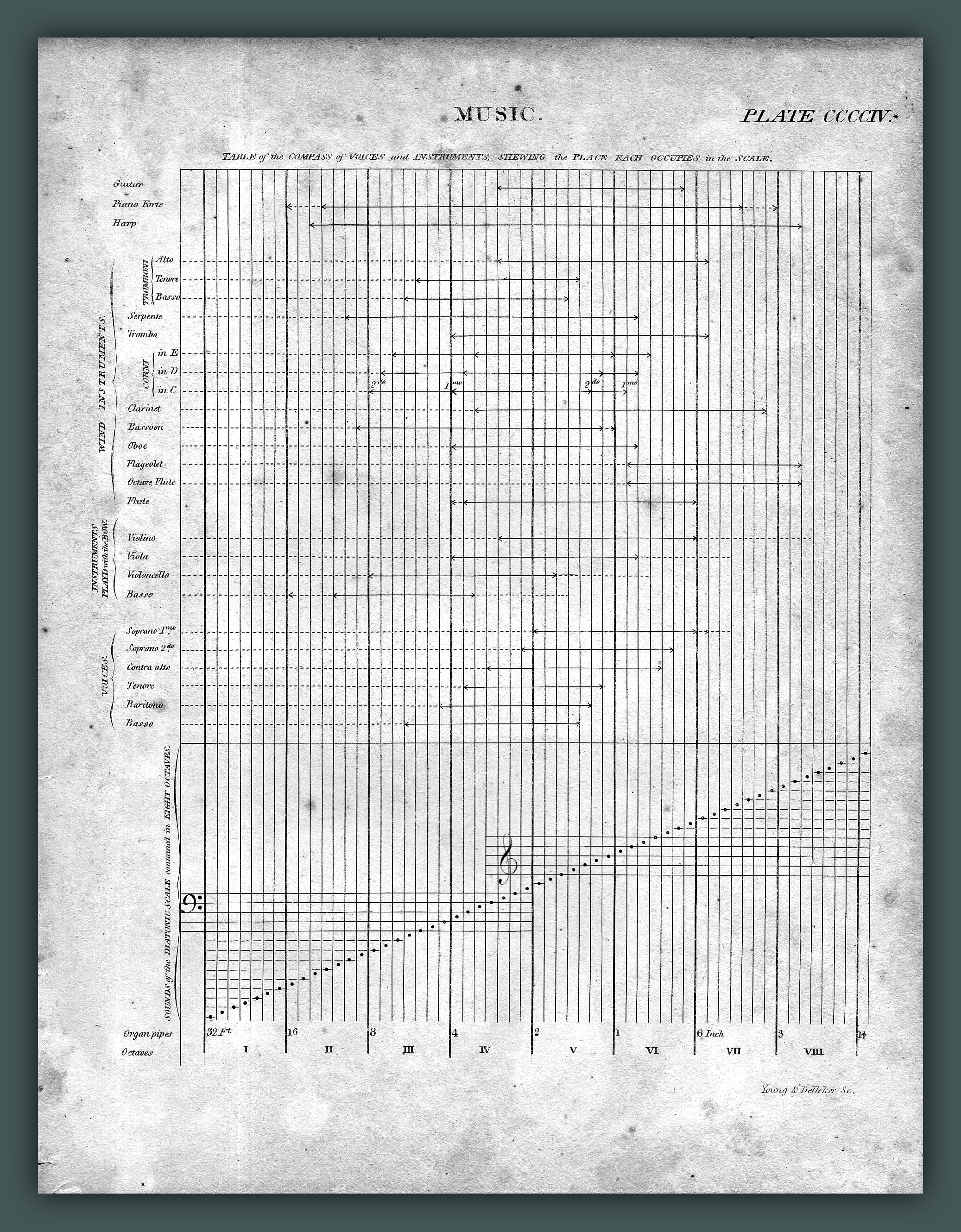
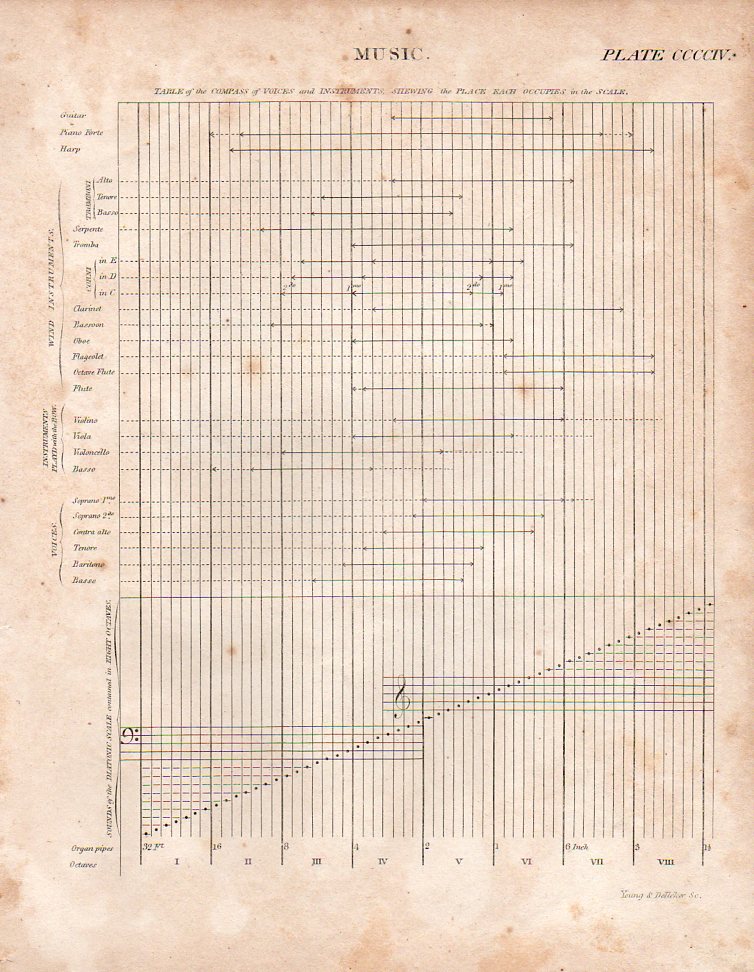
    This engraved plate from Abraham Rees’  Cyclopedia… is the wonderful invention of Alexandre Choron (1771-1834), and appeared (perhaps for the first time in an English press) in London in 1814.  It is a concise and interesting display of the comparisons of the reach of instruments along the eight octaves, and is a very strong example of clear and useful graphical display of quantitative data.  Choron graph056

     Here’s another version of the chart, expanded somewhat, and published using the bones of this earlier work, in the eighth edition (1858) of the  Encyclopedia Britannica:

    [Sopurce: the article on “Music”, Encyclopedia Britannica, via Google Books]

    The full subtitle:  “Table of the Compass of Voices and Instruments, Shewing the Place Each Occupies in the Scale”.  (The original print is also available for purchase through our blog bookstore.)

    From Grove Music Online:

    Choron, Alexandre(-Etienne)

    (b Caen, 21 Oct 1771: d Paris, 29 June 1834). French writer on music, instructor, publisher and composer. While still a boy, he taught himself Hebrew and German and acquired a permanent interest in scientific experiment and a fascination for music theory and the techniques of composition. Although he reached the age of 16 before taking music lessons, he had already attained elementary skill on keyboard and other instruments. He greatly valued a friendship with Grétry which began in his 20th year and which suggests that he moved to Paris after his father’s death.

    Choron’s earliest publications, the three-volume Principes d’accompagnement des écoles d’Italie (1804) and Principes de composition des écoles d’Italie (whose publication was announced for 1806 even though it did not appear until the end of 1808 or early 1809 – the preface is dated 9 December 1808), include courses in thoroughbass together with instruction in counterpoint and fugue, implemented by exercises from Sala, Martini, Marpurg and Fux. In February 1806 he undertook the editing for August Leduc of the scores of Haydn’s symphonies. He began his activities as a music publisher in partnership with Leduc in November of that year, in order to exploit a licence for lithographic printing bought from Frédéric André in 1807. His partnership with Leduc ended in late 1811. Choron published works by Josquin, Goudimel, Palestrina and Carissimi, as well as Italian and German music up to the time of Bach. In 1827 his daughter Alexandrine (d 1835) took over the running of her business, which after her marriage in 1832 to the composer and teacher Stéphano Nicou took the company name of the Société Nicou-Choron. There followed the two-volumeDictionnaire des musiciens (1810–11) in which Fayolle was his collaborator. Choron was too idealistic to be financially successful, and his attention to business was limited by his scholarly and scientific pursuits. What might have been his magnum opus, Introduction à l’étude générale et raisonnée de la musique, remained unfinished. He was forced to teach music and accept public appointments.

    In 1811 he was appointed a corresponding member of the Beaux-Arts class of the Institut de France in succession to Framery. From 1812 until Napoleon’s downfall he was Directeur de la Musique des Fêtes Publiques. His essays on plainsong and church music led to his nomination for the task of reorganizing music in French cathedrals and in the royal chapel after the restoration of the Bourbon monarchy. In January 1816 Louis XVIII made him régisseur général of the Académie Royale de Musique. According to Fétis he turned the Opéra ‘into a trial theatre’, and his dismissal after little more than a year enabled him to devote his energy to the founding of his Institution Royale de Musique Classique et Religieuse. He secured public grants for it between 1826 and the Revolution of 1830, but Charles X’s attempt to revive absolutism led the new government under Louis Philippe to discontinue expenditure associated with royal privilege.

    The reduced budget not only proved disastrous for Choron but incurred disappointment for music lovers in general, as Choron’s students associated with other schools to give choral festivals in Notre Dame, St Sulpice and provincial cathedrals. The programmes included unaccompanied works of the Renaissance, together with Baroque oratorios with orchestra and music of later periods. After years of decline his school was revived by Niedermeyer and renamed Ecole de Musique Religieuse Classique. It remains the most substantial testimony to the work of an influential idealist during a time when French musical life badly needed ideals.

    Although a few Conservatoire pupils sought Choron’s instruction, his school produced no outstanding composers until the Niedermeyer régime after 1836; yet Choron had a widespread influence on teachers, organists, choralists and those who were awakening to the importance of music history. His inexpensive editions of polyphonic and choral music were invaluable, despite the later issue of most of the works in better format by Proske and the Regensburg scholars and by English and German publishers; nor were his labours towards the revival of plainsong in vain, though the work of the Benedictine monks of Solesmes superseded them. His interest in the Baroque masters was more a revival than a novelty, and contributed indirectly to the demand for scholarly editions. The Manuel complet de musique vocale et instrumentale, published after his death by his collaborator, La Fage, was uniquely valuable in its day. In a country whose musical tradition was almost entirely unscholarly, and focussed on the capital, Choron stimulated interest that made his own publications impermanent.

    He composed chiefly sacred music, including a Messe brève, a Magnificat, a Stabat mater and numerous motets, both a cappella and with organ accompaniment. His opera, Nadir et Salyha, was produced in Kassel in 1811. He also wrote a number of songs, of which La sentinelle (1810) was popular in his lifetime.


  • The History of Blank, Empty and Missing Things–the Voice of Beethoven

    JF Ptak Science Books   Post 1540   (Part of a long series on The History of Blank, Empty and Missing Things.)

    So, in the history of very creative people saying things, I wonder if Ludwig van Beethoven said the most of the least interesting things? I’m referring to his correspondence and other written works, and not his music of course—and given the music nothing else really matters. But given the amount of surviving letters and conversation books, and of course his staggering genius (which makes him one of the most important men of the century) it is kind of remarkable that there isn’t more attractive, inventive, interesting content in his communications—which at the very least makes reading the stuff somewhat disappointing, and, at the very most, pretty much the same.
    Beethovenconversation2

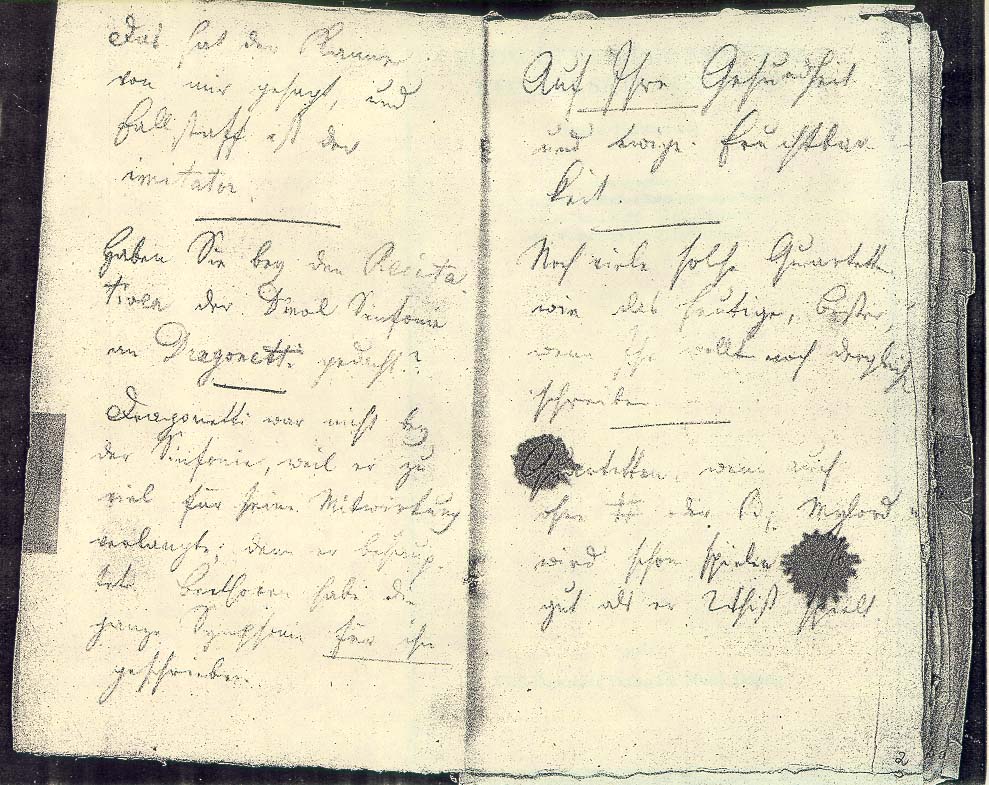
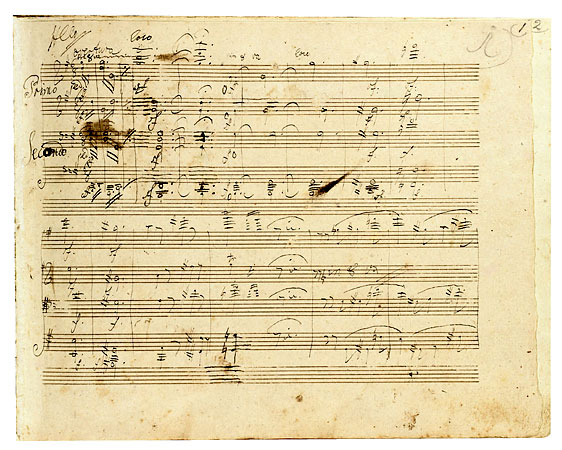
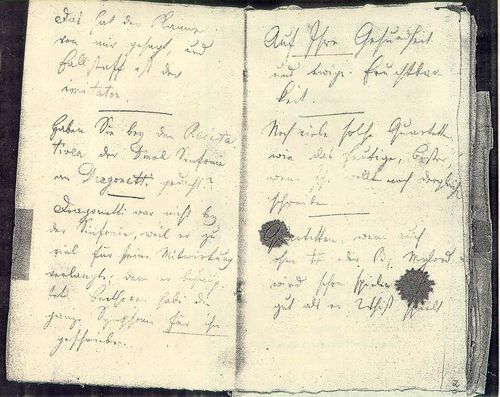
    When Beethoven (who died at age 57 on 26 March 1827, a year younger in death than Dickens and five years old than Shakespeare—a remarkable thing to consider how much these people accomplished in a very short period of time) began his experience in being deaf he resorted to using largish, quarto-sized blank chap books for his visitors to write their questions and answers to him. These books, Konversationshefte, the Conversation Books, were precisely that—they recorded the conversations with Beethoven over a number of years. Unfortunately, they reveal some very basic, daily, non-sequitur sorts of stuff, and contain almost nothing of what Beethoven actually said.

    Sometimes—according to scholars—it is possible to intuit what Beethoven sort of said by looking at series of questions and answers from his guests. But by and large the notebooks offer few clues to what the voice of Beethoven was actually saying. This is particularly grueling given the extent of the notebooks—136 of these books remain, covering the periods from about 1819 to 1827. (Actually, at Beethoven’s death there were more than 400 of the things, but his biographer, Anton Schindler, the man who inherited much from Beethoven including the notebooks, managed to purposely destroy at least 160 of the books. Evidently he found them impolitic, among other things, and tried to protect Beethoven’s reputation by making the evidences of the supposed impertinences disappear.)

    The conversations cover all manner of small, daily bits of life, including numerous one-sided conversations with/to the Maestro on how to take his enemas. (It is extraordinary that such evidence remains in the face of how much other –and probably more interesting—material didn’t.

    The letters of Beethoven, too, as voluminous as they are, are a terror to read, mainly because—at least to a general reader—there’s so little of interest in them. I have no doubt that for scholars they are vast repositories for things like Lost Punctuation and the sort, but the letters as intellectual documents, as things that give and insight into the mind of Beethoven, or what he thought about his work, or the works of contemporaries, and so on, well, the content just doesn’t seem to be there. (There are some occasional bright spots, like his continued reference to how extraordinary Handel was and that he, the great Beethoven, still learns from the man, even on his deathbed, but there’s really very little like this, relative to the great weight of the sheer number of words in the letters.)

    A number of writers have quoted W.H. Auden saying that there was only one memorable sentence in the whole of the Beethoven correspondence.  I can’t yet find what this was to Auden–my first guess is that it is in the “Immortal Beloved” writing, where we do get a big, deep cut into Beethoven’s mind.

    The letters do reveal all sorts of other things, most of which makes me sad, particularly when the sick room of Beethoven is described in not-pretty terms as an outreach and indicator of his possible poverty, and how much the ill Beethoven had to worry about securing a little money to pull him through his illness and into the next half-year or so of life if he survived  himself. 

    Even making my way though the Thayer biography of Beethoven and looking for his voice is a chore. I tried to content myself constructing found poetry in the questions of the visitors to Beethoven in the notebooks, but that was fairly well a failure.

    It is in these cases that the authentic voice of Beethoven  seems to be almost entirely missing–a blank, empty and missing sound from the man who made some of the most beautiful music ever created.

    The other end of this part of blank, empty and missing things history, and sound, and Beethoven, would obviously be his deafness, or perhaps his depression (in the 1815-1820 period, when he was plagued by, well, something).  For years Beethoven heard very little; and then for years after that, he heard almost nothing at all.  But he was sensitive to vibration, so he was able to experience music, though in a different sense form what we think of as auditory.  Missing music–though I wouldn’t call it “Empty” or “blank.”


  • Found Sound: Kircher, Pythagoras, Blacksmiths & Earbones

    JF Ptak Science Books  Post 1358

    [Above:  a gorgeous display of ear bones of humans and animals: reading across the top:  man, cow, hors,e dog, leopard, cat, rat, pig and sheep, coming from Athanasius Kircher’s book on sound and acoustics, and about the first of its kind:  Musurgia Universalis, printed in Rome in 1650.  Image from Special Collections of the University of Glasgow library, and which is the bottom half of the engraving reproduced int he “notes” section1.]

    It seems that almost all of human history’s hearing has been impressionistic–a collection of aural landscapes that would disappear as soon as they were ended, unless of course someone was there to write down what was heard on papyrus or sand or mud or clay or paper.  Finding the sound was important because, well, it was a single-shot phenomenon, unless it was repeated by the presenter, or someone else copied the presentation, or wrote it down so that it could be read and interpreted later.  It was a phenomenal invention of Mr. Edison’s that brought the possibility capturing sound so that it could be played over and over again, the experience becoming a simple piece of technology available to anyone who could afford it.

     The odd thing now is that virtually everything is findable, recordable, archivable.  We can also hear just about anything from just about anywhere.  Before the telephone–invented by Mr. Bell only 135 years ago–in order to hear something from a distance beyond the normal auditory range, a person would’ve needed the assistance of objects such as these “propagation horns” from Kempsten’s Phonurgia nova (of 1673, pictured at left).  Sir Samuel Morland, a fantastic English polymath (1625-1695) also produced an instrument similar to this in his stentoro-phonica, constructed in the 1660’s  It is in a way similar to the giant listening devices devised and constructed by the Imperial Japanese Army in the earliest days of WWII, prior to their use of radar.   Or, if one was a monarch or other highly placed aristocratic or ruling class person, one could have used something like Kircher’s listening device, found again in his Musurgia Universalis of 1650 so that a little eavesdropping might go on from one far-placed room to the next. 


    Wheel-mounted acoustic locators for detecting enemy aircraft over Japan in the 1930s
    [Kircher’s device, below.]
    If one were to construct a monument to “found sound” certainly an important element of it would have to involve Pythagoras, who by virtue of walking past a group of blacksmiths heard something in their pounding that struck him deeply, exciting his foundational ideas about pitch.
    We see him featured prominently in the frontispiece to the Kircher work mentioned above–well, that and a lot of other symbolism as well.

    The blacksmiths are seen at middle bottom, and the man to their left is Pythagoras, pointing to them with a staff, seeming to lean on a marble pillar, but what that really is is a manuscript of his theorem regarding pitch.  reigning over all is a sun representing the Holy Trinity, its rays anointing the earth in the forms of light and angels, the world scene in the center, surrounded by the zodiac and hosting the seated Musica, all representing the ealier beliefs of mathematical/artistic/musical relational proportions, the music of the spheres. [There are other interesting appearances:  musical instruments at the feet of Pythagoras, Pegasus (perhaps?) at the top of the stairs at middle-right, mermaids in the distance, and of course the figure at right, surrounded by all sorts of musical instruments as well as a golden owl.  Of lesser importance but of high interest is the figure just to the right of Pythagoras’ elbow, a figure who seems to be singing, or yelling, or attempting to hear an echo,]
    Perhaps the most significant manufactured found sound–in the tradition of Swift and later that of Burroughs and Gysin–was Kircher’s absolutely fabulous  music-making machine, the arca musarythmica.  It was with a device such as this that any person of any (in)sensibility could compose a slightly pre-arrnaged piece of music, combining previously tranbscribed scores together at random to produce a wholly new musical composition. As described  on the Glasgow Library site, the instrument functioned so: 


    The arca musarythmica is a device by which a non-musician could compose a piece of four-part music using prearranged musical fragments inscribed in wands arranged in columns inside the box. Each type of wand corresponded to a particular metrical unit e.g. 4, 5, or 6 syllables, and on each wand there were examples of florid counterpoint on one side and more simple note-against-note settings on the other. Once the phrase to be set had been analyzed into its fundamental syllabic units, each of these could be set to an example taken from a wand of the appropriate type

    I don’t reckon that I’d like the music much (have there been any recordings of anything ever “composed” in this way?) but I sure would like the object. 
    Notes:

    1.

  • The Compass of Music

    JF Ptak Science Books  Post 1252

    This engraved plate from Abraham Rees’  Cyclopedia… is the wonderful invention of Alexandre Choron (1771-1834), and appeared (perhaps for the first time in an English press) in London in 1814.  It is a concise and interesting display of the comparisons of the reach of instruments along the eight octaves, and is a very strong example of clear and useful graphical display of quantitative data. 

    Music compass a949
    The full subtitle:  “Table of the Compass of Voices and Instruments, Shewing the Place Each Occupies in the Scale”.  (The original print is also available for purchase through our blog bookstore.)

    From Grove Music Online:

    Choron, Alexandre(-Etienne)

    (b Caen, 21 Oct 1771: d Paris, 29 June 1834). French writer on music, instructor, publisher and composer. While still a boy, he taught himself Hebrew and German and acquired a permanent interest in scientific experiment and a fascination for music theory and the techniques of composition. Although he reached the age of 16 before taking music lessons, he had already attained elementary skill on keyboard and other instruments. He greatly valued a friendship with Grétry which began in his 20th year and which suggests that he moved to Paris after his father’s death.


  • TV and Liquor, the Modern Colossuses–Visualizing the New SuperSize for the Masses

    JF Ptak Science Books  1150

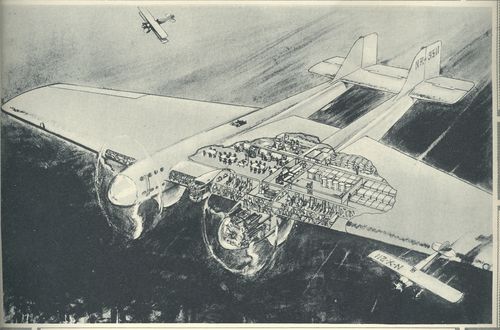
    Rabelais’ Gargantua and Pantagruel, Hobbes’ Leviathan, the Buddha at Yungang (Shanxi) and Melville’s whale were all pushed to their competitive monsterous edges in the 1950’s, when you were more likely to think of The Bomb and creeping Communism before thinking back to any of these great representations.  And it is also my general impression, having been paging through Life magazine for the 1950’s, that there are some other major, lesser heralds of gigantism, especially if you paid attention only to the advertisements. There were 1950’s colossal characters who were pale imitators of their earlier counterparts–the Amazing Colossal Man and Colossal Woman being two minor mirrors of older ideas–but they hardly contained the colossal ideas that were resident in the earlier creations. (Perhaps part of that is due to having just witnessed the demise of two enoromities in Hitler  Stalin.)

    Monumental television theatre446

    The new Pantegruels seem to have been television (completely victimizing
    and nearly eradicating radio in its day), giant cars, liquor,
    cigarettes, breasts, and, television, followed by television.  There was
    also the movies, with films filmed in super-spectro-pano-fabulism; and
    of course there were the computers (the 1943 machine at Bletchley Park
    was actually called the “Colossus” with Mark 1 and Mark 2 varieties,
    which were actually less colossal than the other period  colossi such as
    the Harvard Mark I/IBM ASCC and ENIAC), which just now turning the
    corner on “big” and getting faster/smaller/more powerful, and also
    fulfilling the “Giant Brains” dream.

    Monumental television flying445
    I’m not sure, but it feels right to say that there is a direct correlation to things getting both bigger and smaller as things got faster.
    Monumental cigs the king444

    Anyway the new Colossuses/Colossi  were hardly as attractive and had
    virtually no literary value compared with their earlier Rabelaisical
    counterparts or the giant 4th century BCE statue bearing that name in
    the harbor at Rhodes.  It is certainly true that the big things that
    were imagined in the 20th century were beyond any conception of “big” in
    the Western Canon of Big.  (There are certainly great big things in
    other cultures, say, in India for examples, where there are entities and
    numbers so vast that there was nothing to compare them with in the
    West.  But that’s another story.)

    Monumental whisky world442

    Monumentalism--airplane
    Monumentalism--car

    Monumental world tophat447

    Monumental world tire440 

    And of course joining the gigantic cultures of guns and booze:
    Monumental gun farm441

    ·Posted by :

    ·in:

    — —

  • Sesame Street: Ray Charles, Johnny Cash, Stevie Wonder, Los Lobos

    JF Ptak Science Books LLC   Post 605

    Just a fun post tonight, having bumped into these wonderful pieces of music performed by the High and Mighty on Seasame Street. Below are Yo Yo Ma (who winds up very bluesy), Ray Charles, Stevie Wonder (doing an almost seven minute long version of Superstition), Tito Puente, Los Lobos, Randy Travis, and Johnny Cash.  Enjoy!  Stevie.


    ·Posted by :

    ·in:


  • Getting the Future Wrong: Missing Beethoven and the Grosse Fugue

    JF Ptak Science Books LLC  Post 557

    Beethoven
    Dark is the present that denies change, or misunderstands it,
    or ignores it. I was thinking
    about this last night watching Ed Harris in an odd movie about Ludwig van
    Beethoven (“Copying Beethoven”, made I think in 2006)—more precisely it was
    about Beethoven’s time from 1824 to his death in 1827.   The movie introduced a woman who was sent as
    his score copyist as the Maestro worked the final days of the 9th
    symphony. (There were copyists of course but not women; I couldn’t imagine a
    woman filling that role for Beethoven, and I’m not sure what was added to the
    general knowledge of the man by supplying a fictional character in a general
    grand biopic.  Seems to me that we would
    have all been better served if the movie was told from B’s point of view and
    that the copyist was a creation in his own mind, a fragmentary muse.)  It was an offhandedly annoying film, except
    when it touched on the Grosse Fugue, which I don’t think I’ve ever seen
    mentioned in any movie that I’ve ever seen. 

    The Grosse Fugue was supposed to be the last movement in his
    String Quartet No. 13 (opus 130), but it was so difficult to perform, and it
    was so incredibly unlike anything else and so completely insistent in its
    originality that he was persuaded to replace the movement with another work,
    allowing the Grosse Fugue to survive in its own (opus 133) as a titanic single
    movement composition. The music was very
    hard and demanding—in the movie, the completely-deaf Beethoven sat facing the
    musicians at the front of the audience, and slowly but steadily as the piece
    was played the audience left, until at the end almost no one remained.  Ed Harris’ Beethoven was overjoyed that the
    musicians played the piece successfully, and then was shocked to see that there
    was almost no one left who had been listening—no one “got it.”  It was seen as a beastly piece of music from
    a beautiful beast who had lost touch—it remained so for a long time, too.  (The great Louis Spohr, along with almost
    everyone else in the 19th century, found it “an uncorrected
    horror.”)  Anyway I liked the idea of
    tossing the Fugue into this mix—surprised, really, to see someone deal with the
    thing.Urania

    But as with many visionaries, their insight into the future
    can be largely solitary—Beethoven’s visions lasted longer than most.

    Johannes Kepler, in the midst of finally overthrowing the Aristotilean
    concept of the universe in his Harmonies
    of the World
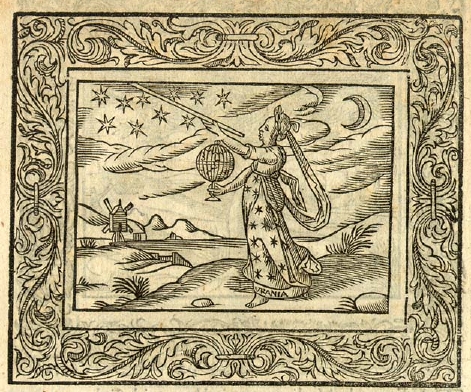
    , writes to Urania, one of the nine Muses, the Muse of
    Astronomy (and also the favorite of John Milton in Paradise Lost):

    “But now, Urania, there is need for a louder sound while I
    climb along the harmonic scale of the celestial movements to higher things
    where the true archetype of the fabric of the world is kept hidden. Follow after, ye modern musicians, and judge
    the thing according to your arts, which were unknown to antiquity. Nature, which is never not lavish of herself,
    after a lying-in of two thousand years, has finally brought you forth in these
    last generations, the finest true images of the universe. By means of your
    concord of various voices, and through your ears, she has whispered to the
    human mind, the favorite daughter of God the Creator, how she exists in her
    immortal bosom.”  It seems as though he
    could’ve been writing about a lot of things, not the least of which could’ve
    been our immortal Ludwig van. 

    Beethoven’s Fugue, like some of the other late quartets would
    have to wait, unappreciated, not understood, for a hundred years, a little
    piece of the future swathed in black. A
    Dickensian-black, a Victorian mourning-black, when black in mourning (for
    women, anyway) was deeply black. Bombazine black (a lusterless, lightless black material that ensured
    nothing but black). Arnold Sommerfeld’s
    B-1 bomber black. 

    And then somewhere in the earlyish 20th century
    it wasn’t a figment of bad imagination anymore; the Fugue was recognized as a
    piece of modern music written hundred years too early. To top it all of Igor
    Stravinsky said that the Fugue was a piece of contemporary music that would always
    be contemporary.  Except of course when
    it was written as a piece of the future in a dim past.

    ·Posted by :

    ·in:

    —