A Daily History of Holes, Dots, Lines, Science, History, Math, Physics, Art, the Unintentional Absurd, Architecture, Maps, Data Visualization, Blank and Missing Things, and so on. |1.6 million words, 7500 images, 4.9 million hits| Press & appearances in The Times, Le Figaro, Mensa, The Economist, The Guardian, Discovery News, Slate, Le Monde, Sci American Blogs, Le Pont, and many other places… 5000+ total posts since 2008.

Category: Technology, History of

  • The Goubet Submarine, 1886

    JF Science Books  Quick Post  Overall Post #5152

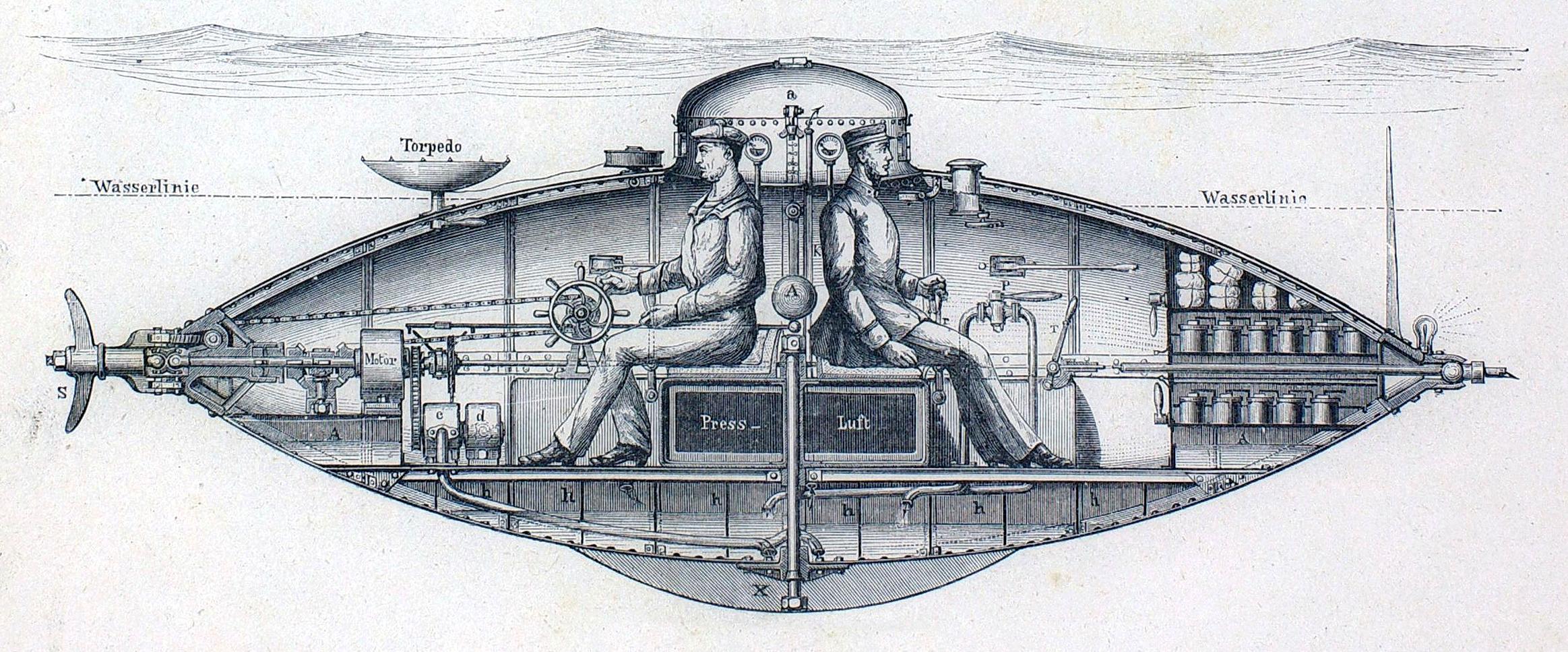
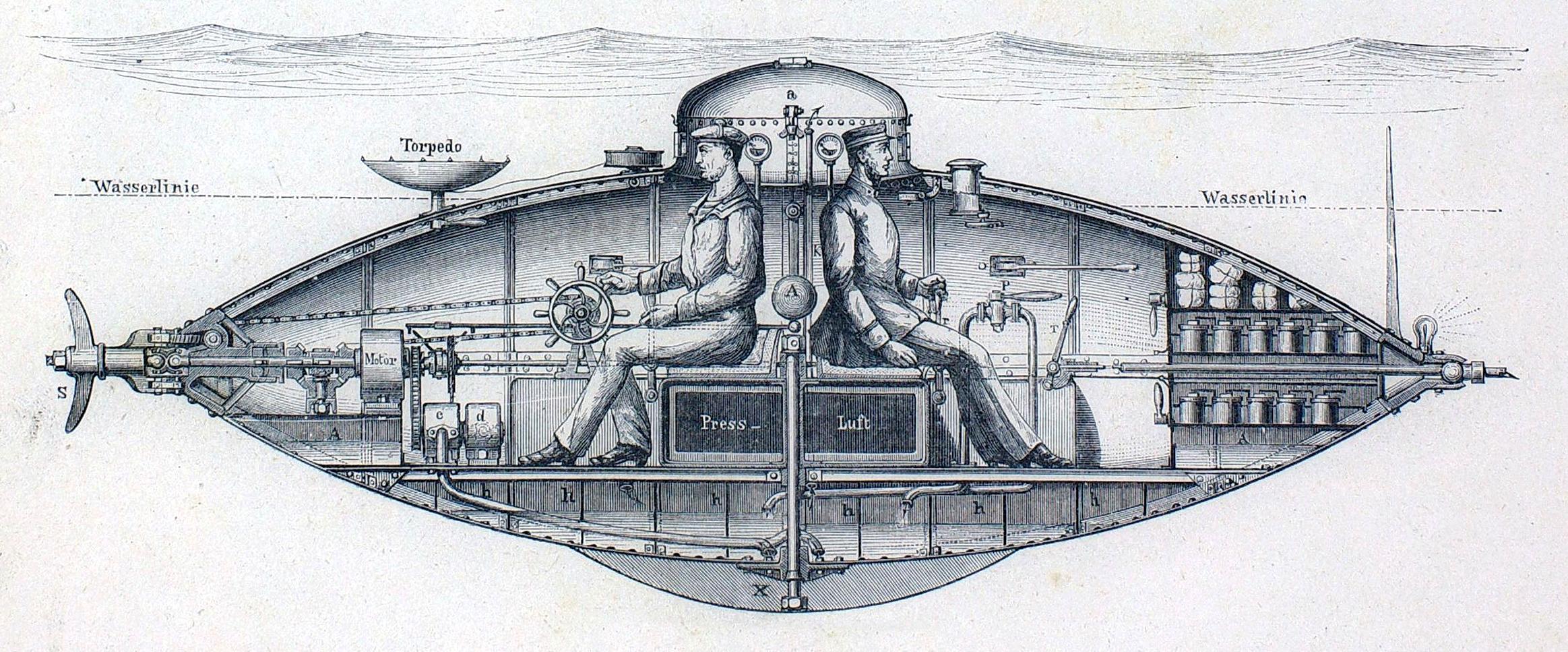
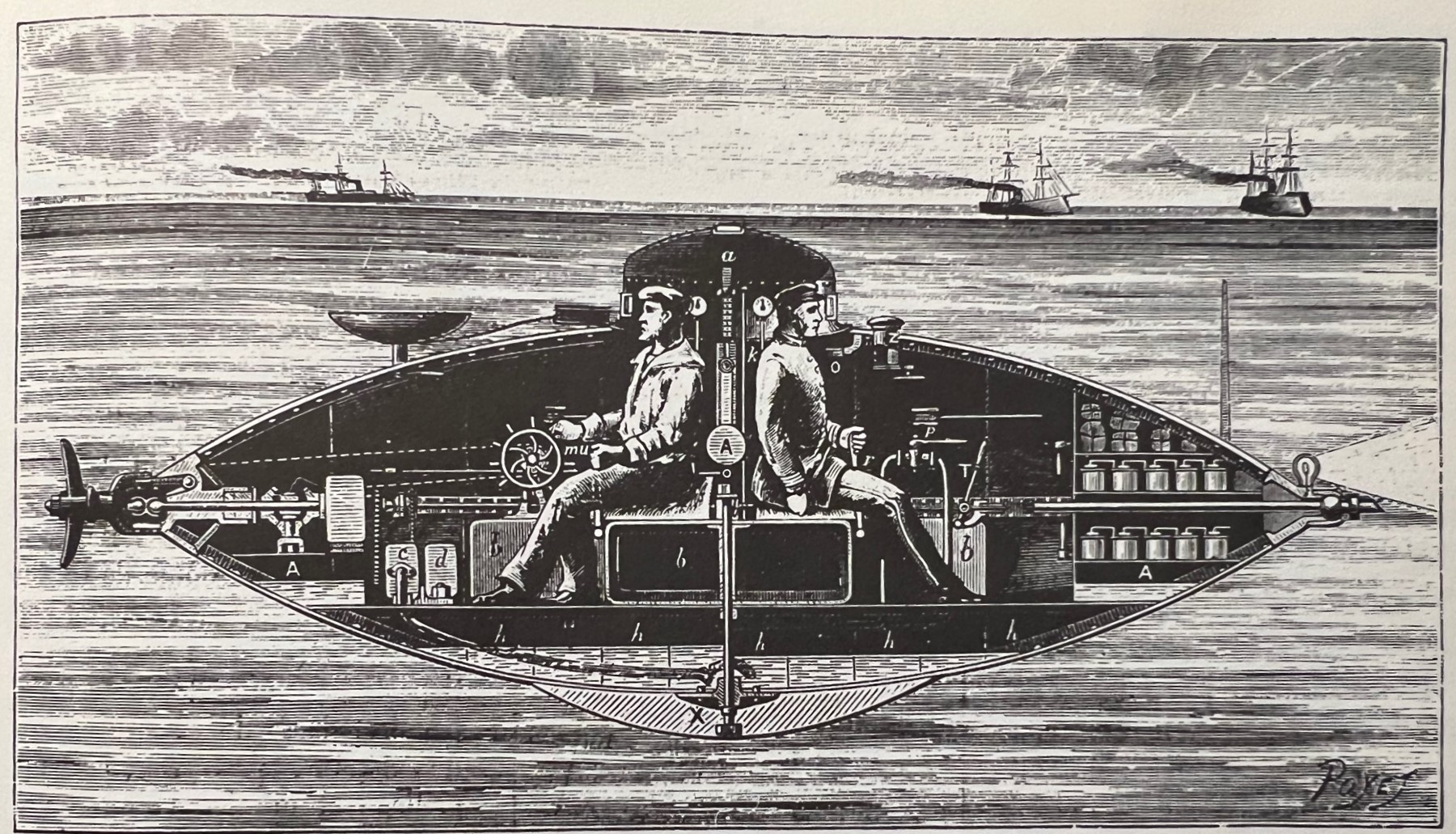
    Charles Goubet designed an interesting and technically advanced submersible boat, an electrically-powered submarine, which was the first of its kind to be powered in this way. The image below appeared in La Nature in 1886–the boat was about 16′ x 6′ x 3′, much deeper than wide, and was powered by a Siemens motor being driven by batteries, and the whole of it unsuccessfully rudderlessly steered by a highly moveable screw propeller. The electric power applied in this design was the innovation, while the navigating end of the operation of the boat seems to have been, well, not a success.

    IMG_1294

    “Das Unterseeboot von C. Goubet” [following] is an alternative, slightly cleaner and with less peripheral imagery view of the submarine as found in Die Gartenlaube (1886) page 146. 

    Goubet sub German version

    Goubet sub German version

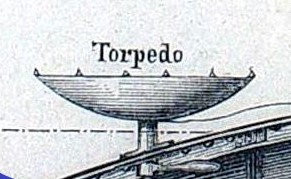
    The “torpedo”-labeled section on the plan view is exactly that—the explosive was fixed to the outside of the sub, and seems to have worked more like a mine than what we would consider to be a torpedo in the present. The sub would work its way under an enemy ship where it would release the weapon, which would attached itself to the ship; the sub would then withdraw trailing an explosive/detonating wire when, after reaching a safe distance, the torpedo would be detonated via the wire. Evidently the design overall was a failure—the major complaint being the sub was very difficult to navigate underwater and the attaching/detonation part of the torpedo was problematic. (It seems as though those “teeth” were supposed to attach the torpedo to the bottom of the target ship…and they seemed not to do so very well.)  That said, there were design elements and tech bits that carried forward to more substantial submarine attempts.


  • Bridges Never Built: the Hudson River Bridge (Midtown) 1896

    JF Ptak Science Books   Quick Post  (Overall post 5151)

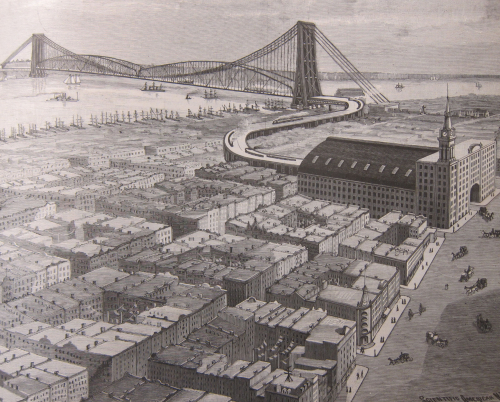
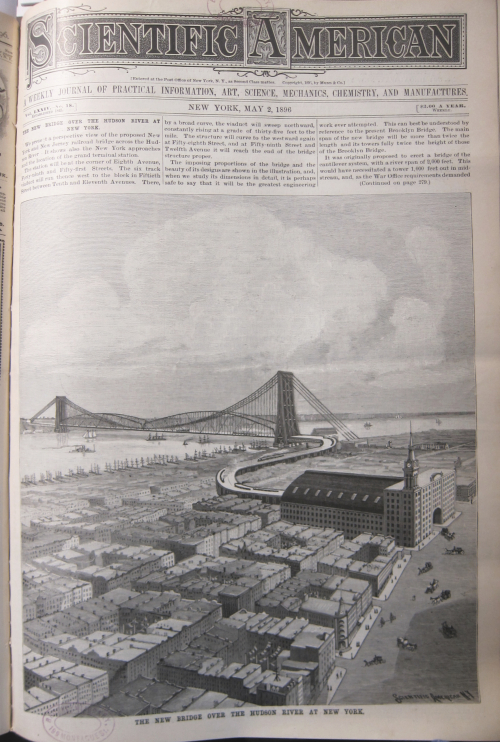
    This beauty appears in the pages of Scientific American for 1896, and discusses a proposal for a bridge to connect Manhattan to Jersey, and to do so spectacularly. The plan was for the bridge to be twice as tall and twice as long as the Brooklyn Bridge, making it “one of the greatest feats of engineering” ever.  The terminal and approaches would’ve been an issue in a few decades later had it been built, as they occupied a fair piece of land from about 59th/11th & 12th and 51st/8th, plus the ramping for six-rails-wide railway access.  The time would come for a bridge in 1929 when the work on the existing Hudson River Bridge (now known as the George Washington Bridge) would be built further north in Washington heights. In any event, this 1896 bridge was quite lovely.  

    Unbuilt bridge 1
    Unbuilt bridge 1


  • A Really, Really Greater New York–Filling in the East River, Redux.

    JF Ptak Science Books   Old Post 1470 expanded and updated.  

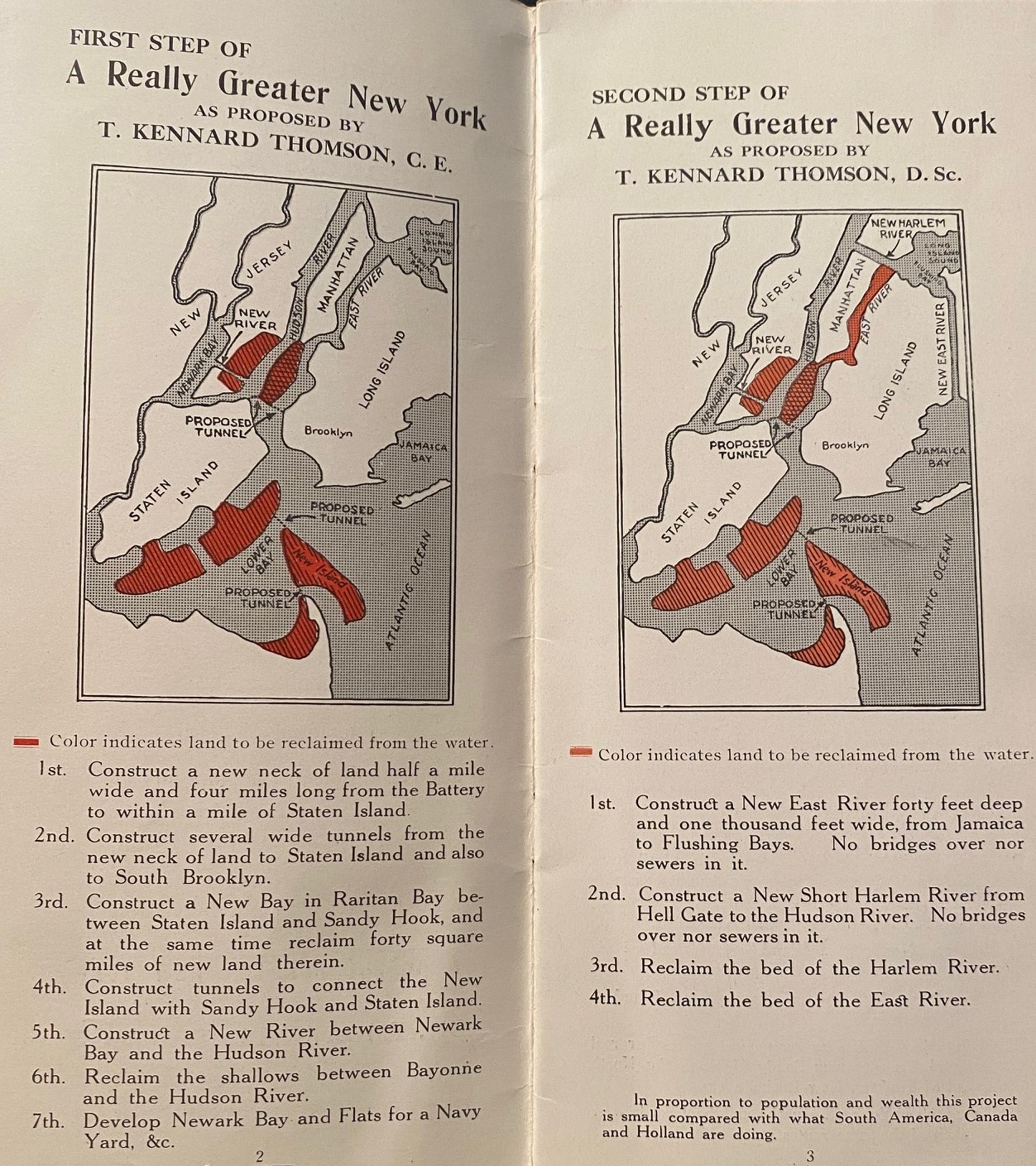
    Eleven years ago on this blog (May 2011) I wrote about the fantastical idea of Dr. T. Kennard Thomson for expanding NYC land and wharf area by reclaiming parts of the NYC harbor and filling in the East River, among many other things.  I came across another pamphlet by Thomson, though this one was almost entirely filled with favorable reviews for his spectacular sci-fi-ish speculations and aspirations.  The newer (1918) pamphlet did offer a part I and part II to the plan–that is listed below following the the first illustration:

    And the glorious side-by-side spectacular:
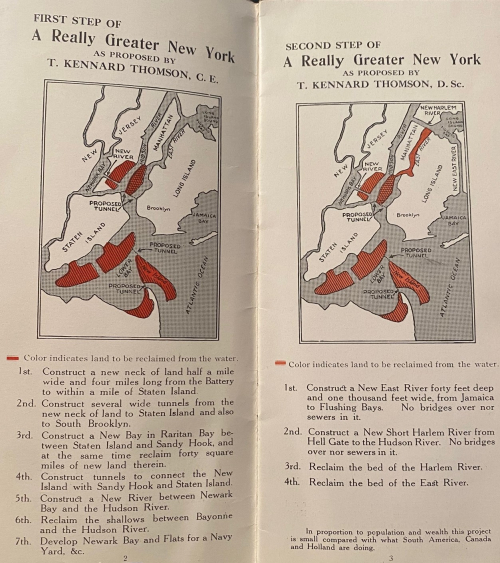
    IMG_8146

    Long ago on this blog I wrote a post on  Herman Soergel’s  plan for extending the landmass of the countries around the Mediterranean Sea by damming the straits of Gibraltar, lowering the sea and irrigating the Sahara–an original, interesting but not very good idea, filled with briney cultivation and racial politics. In the past on this blog I’ve written about other city plans–and in particular, for New York City–that have involved floating Manhattan into the harbor, or filling up large chunks of the Narrows, or floating the city on an enormous anti-gravity platform, and so on. Some of those plans were real, some science fiction, and some were plainly beyond both.  The plan presented above is another monster, but at least this one could work, if not for the doing of it, and the expense. And the will.
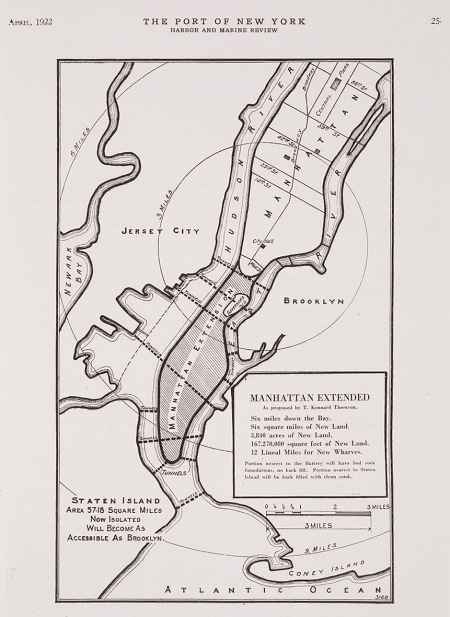
    NYC Really Big
    But the bottom line, according to the engineer doing the thinking on this project, Kennard Thomson, would supposedly net the city a cool billion dollars after everything was said and done, and that would be 1916 dollars–that was equal to about 5% of the American GDP (!) in 1916, which would be about $400 billion in terms of 2010 GDP.  I’m not sure how Thomson came up with this very big/very round number, though it must have been done for effect–I can just imagine him standing before a smokey room filled with civil engineers talking about his massive plan for enlarging NYC and throwing out the billion-dollar figure, watching the cigars glow red in exhaled disbelief.

    Thomson did know what he was talking about–he was a busy (and “leading” according to the NYT) Manhattan civil engineer of stature, working on the Canal Barge and being the principal engineer for the Municipal and Singer buildings, for example–and his project seems to be well within the scope of possibility.  Their sensical aspects however are, well, questionable. 

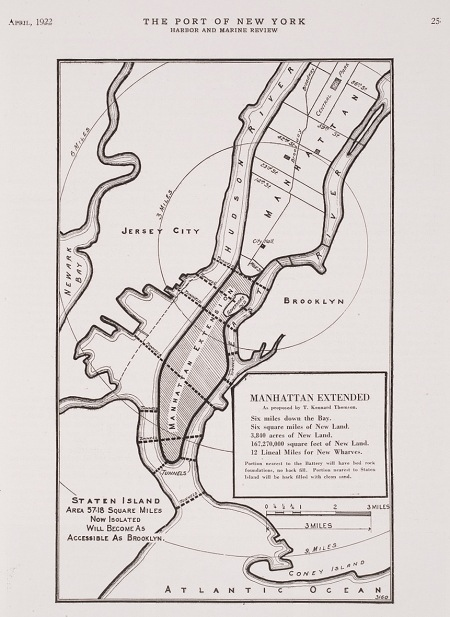
    Here’s the story–around 1911, while examining proposals to repair and extend New York’s wharves, Thomson came upon the idea–a magnificent, fabulous idea–of adding new wharves by adding new lands to the city.  In short, the overall plan was to fill in the East River (!!) and reclaim the new land for city living,  dam Hell Gate,  construct a New East River (from Flushing to Jamaica Bay),  extend the tip of Manhattan Island from the Battery to within a quarter-mile of Staten Island (!), create a new 40-square-mile island between Sandy Hook and Staten Island, extend the Jersey shoreline, add two new Manhattan-sized appendages to the east shore of Staten Island, and more.  All of this would be connected by various new bridges and roads and tunnels, as well as a 6-track elevated railway that would circumnavigate the city.  The purpose of all of this would be to add 100 miles of new docks, an enormous amount (“50 square miles of reclaimed land”) of new land and the capacity for NYC to house 20+ million people, all of which would be worth a billion dollars. 

    Thomson really meant “really” in the title for the proposal. There have been reclamation projects undertaken in New York Bay since then of course, and I think that virtually all of what Thomson talked about could be done.  I think it would be a very interesting project for a class of some sort to undertake an estimation of what such a thing would cost today (and I would guess to duplicate the idea in real terms now would take up a sizable chunk of the GDP).  Maybe all of this will make sense at some more future point. 

  • The Costs of Television Sets, 1946

    JF Ptak Science Books   Quick Post  Overall Post 5144

    • Q: “What kinds of programs will there be on television?
    • A:  “All kinds” (“The commercials will be unlike radio.”)

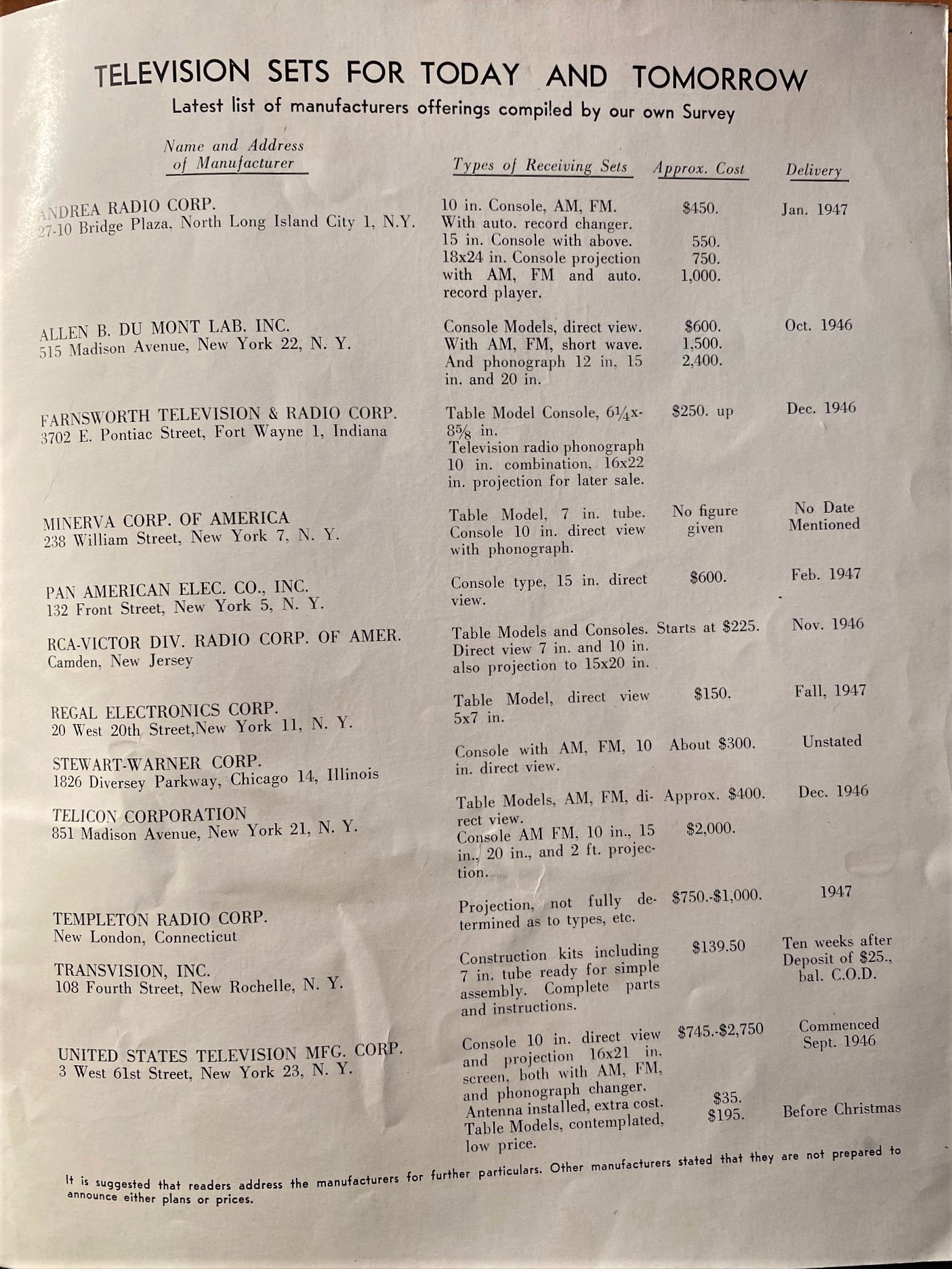
    IMG_7485I was initially attracted to this oversized pamphlet for its A-Bomb cover–using this sort of imagery was a thing in advertising in the Cold War years…pervasive, even. It was not uncommon to see this sort of image used to sell bubble gum, kids’ toys, motel rooms, laundry cleaners, and just about everything else (plus, of course, firecrackers).  This pamphlet though was a bit different from the others, as I expected that given its contents it would’ve been published around 1950. Wrong!  This work hit the streets in 1946, about a year after Hiroshima and Nagasaki, and very early on in the history of public television. Television (and facsimile transmission) exited around the edges of public awareness for a few decades, but television as a relatively common form of amusement with not-terrible accessibility was very new in 1946.  So I wanted to share a few of the useful bits that I found in this short (24pp) and oversized pamphlet, the primary one being a survey of costs of television sets listed by manufacturer.


    IMG_7483As you can see, the tv was not a purchase to be taken lightly by the average US citizen in 1946.  There’s only a couple of sets listed here under $200,  with the average cost (not including the relatively substantial fee for the aerial and aerial placement) coming in at more than 10% of the average yearly income. (The average income in 1946 was about $2600, or about $39k adjusted for inflation using the Bureau of Labor Statistics inflation calculator as a base.) The average salary in 2020 was about $56,000, or about $7k in 1946 dollars. That isn’t as rosy as it might seem, given that the average person could expect to spend about double their income on a house–a standard that does not carry forward to today. Toss in healthcare and education, and that 7k comes rambling down. Hm. Another way of looking at this relative costliness of a tv set in 1946 is that it was about 10% of the cost of the average new car–given that the new car cost today in 2021 has jumped over the $50,000 mark (?!), 10% of that would buy a boatload of television sets.  

    And there you have it–a little peep into the history of the future of television. (I should mention one interesting paragraph in which David Sarnoff reveals the remote-controlled bomber, outfitted with “television eyes” that would only be used in not-peacetime.)


  • The U-Boat Captain’s First-Person Account of Sinking the RMS Lusitania (1915)

    JF Ptak Science Books  Overall Post 5318

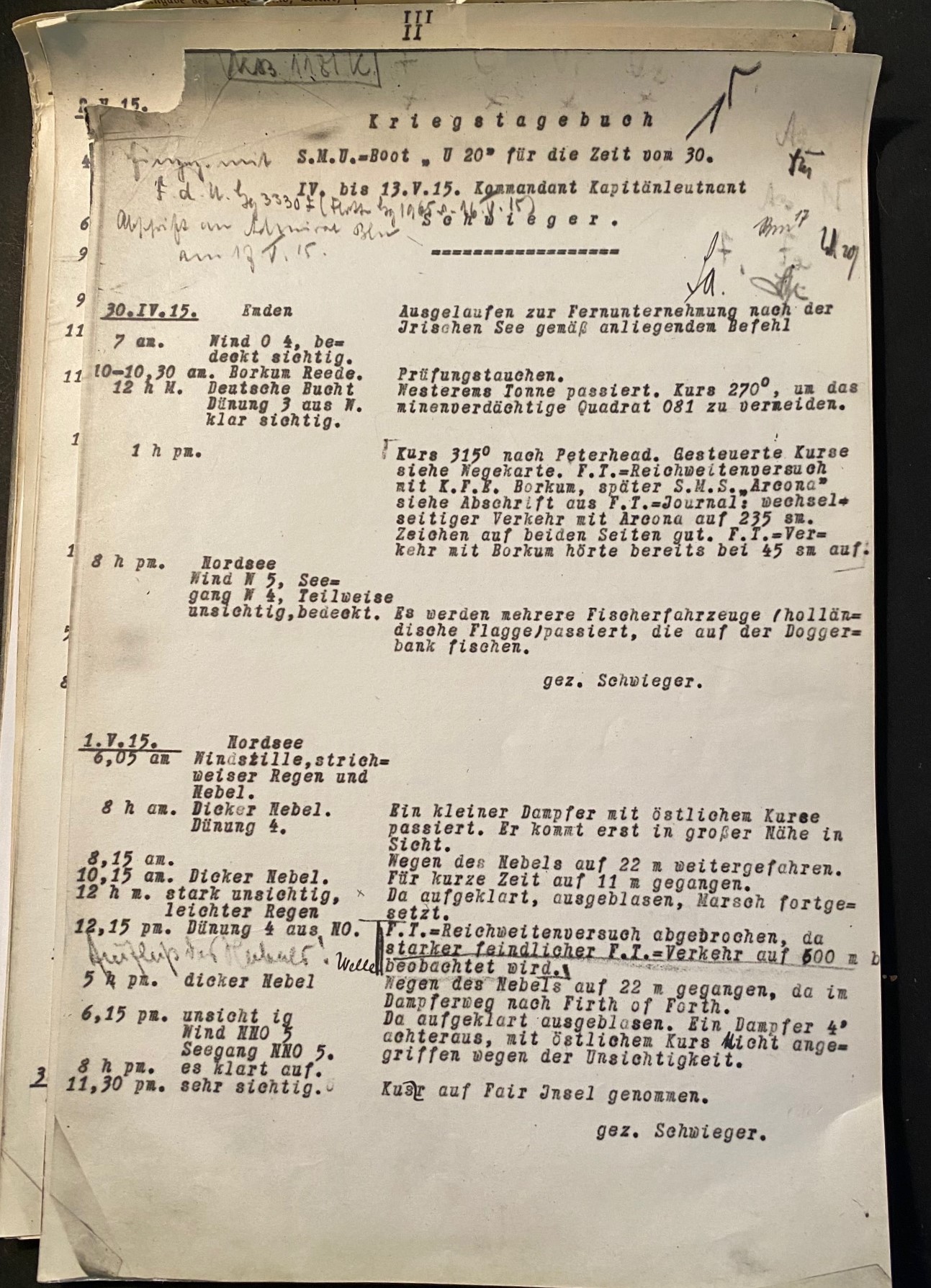
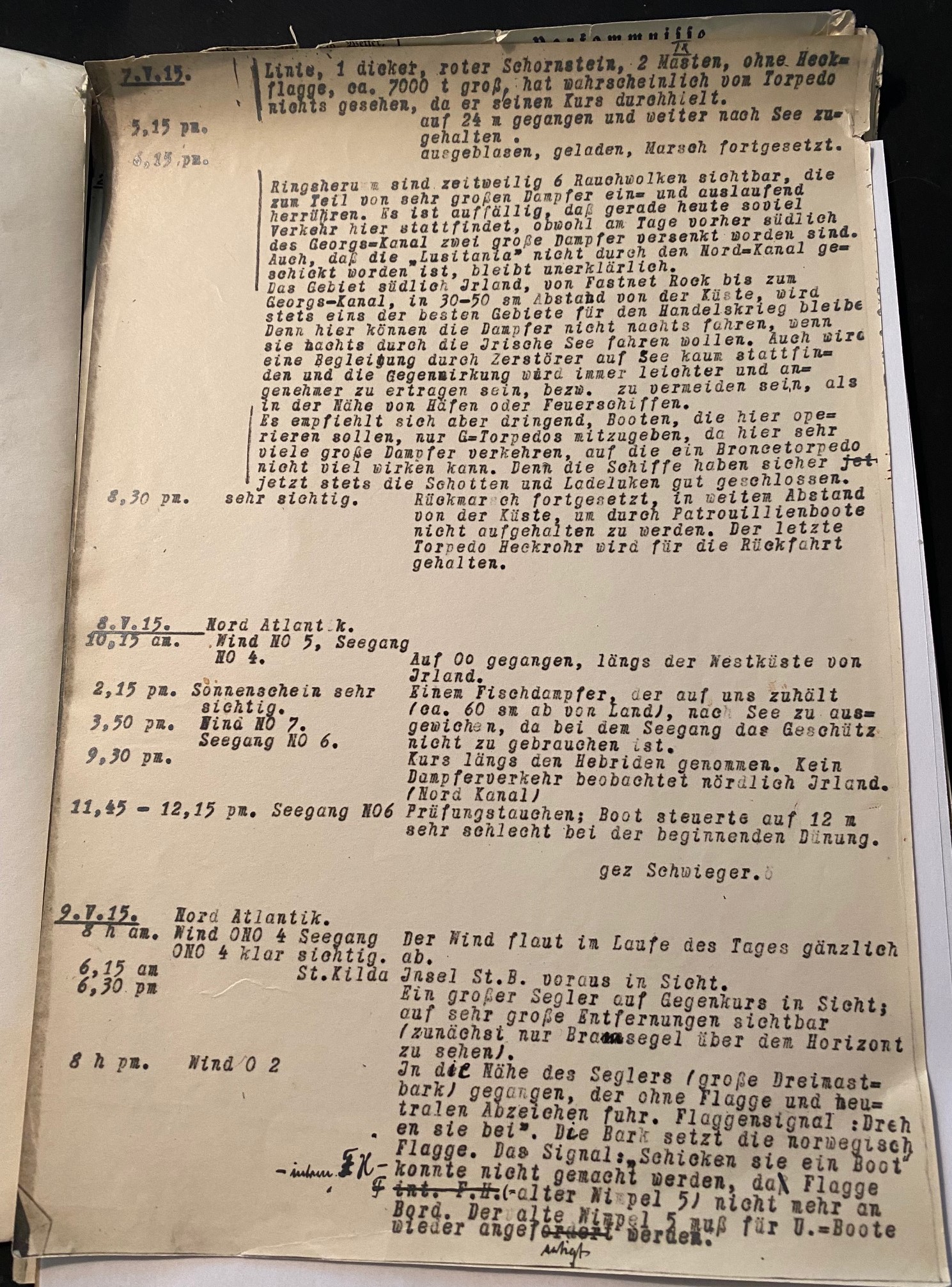
    IMG_5874The sheets presented here1 are very early photographs of the original war diaries of Captain Walter Schwieger, the captain of the German submarine SM U-20 who sank the RMS Lusitania in 1915.

    The period of coverage for these leaves extends from 30 April 1915 to 13 May 1915, the attack on the Lusitania coming on 7 May (which receives 1.5 leaves of coverage), and delineates the action by the hour. The periods before and after the Lusitania attack are highly documentary, well written, and descriptive. The story of the Lusitania itself is forensic but not without some reserved excitement, including the decision of not launching a second torpedo for the sake of not sending through many hundreds of survivors already in the water.

    A summary of the attack day—7 May—details that at 2:20p.m. Schwieger reports on tracking a possible target and then sees “four funnels” (“Schornsteine”), identifying the target as a large passenger steamer. Schwieger positions his boat and fires one torpedo “in the side close behind the bridge” followed by an “extraordinarily” large detonation, stopping the ship immediately and causing a severe listing. Schwieger then states that he sees “Lusitania” written in gold on the side of the ship.

    And then, at the end of the description of the attack on the Lusitania, when the ship was foundering, Schwieger writes that he could’ve sent a second torpedo to absolutely finish the ship, but didn’t because he didn’t want to shoot through a sea with survivors. “I would not have been able to shoot a second torpedo in this crowd of people who were saving themselves.” (“Auch hätte ich einen zweiten Torpedo dies Gedränge von sich rettenden Menschen nicht schiessen können.” pg viii 3:25 pm.)

    The Lusitania sunk in 18 minutes, with a loss of 1198 of the 1995 on board.

    The U-20 was launched 1912 and grounded in November 1916 when her crew attempted to destroy her. Their efforts were not complete, and I assume that Schwieger’s war diary was retrieved by the Royal Navy at that time. Schwieger commanded another boat—he met his fate against a mine, the boat sunk and the crew killed in 1917.

    The interpretation of the sinking of the Lusitania has been studied for a hundred years and the story is well known—it really isn’t necessary to repeat it here.

    I do not know who made the annotations—they appear on the documents that were photographed and not the photos themselves. Perhaps this will be useful for someone.

    Notes:

    1. (LUSITANIA) Schwieger, Walter, Kommandant Kapitanlieutenant (1885-1917), U-20. Kriegstagebuch S.M.U.-Boot “U-20” fur die Zeit vom 30.IV bis 13.V.15. 9 leaves, image on one side only, early photographs of the diary pages (ca. 1920’s-1030’s?). A copy of photographic sheets of Schwieger’s diary appeared in a traveling show of “Eyewitness, American Originals from the National Archives”, and also appears in a catalog for the show.

    IMG_5876

    ·Posted by :

    ·in:

    —

  • “Talking Photographs” (1878)

    JF Ptak Science Books  Overall Post 5135 (Updating and revising an earlier post from 2011)

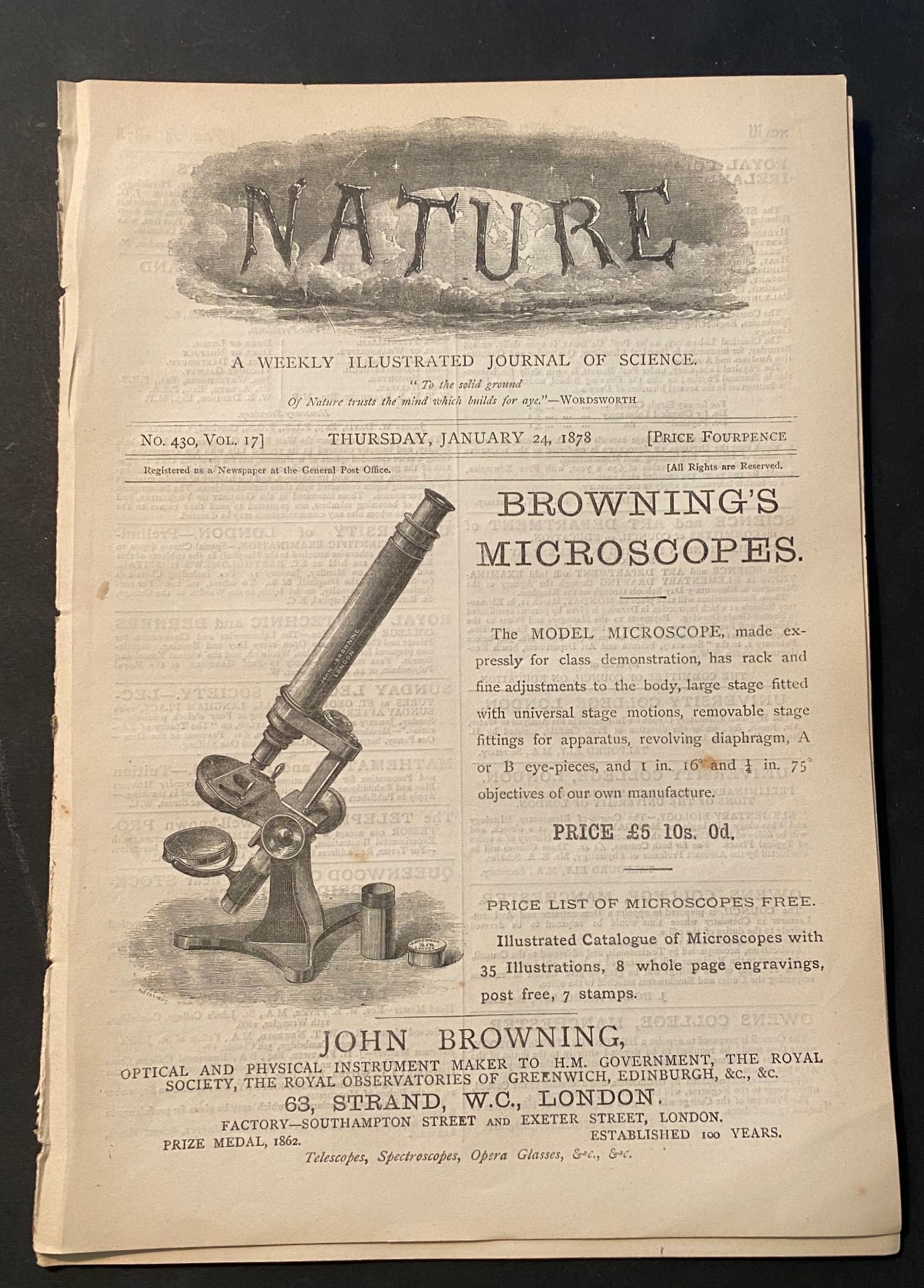
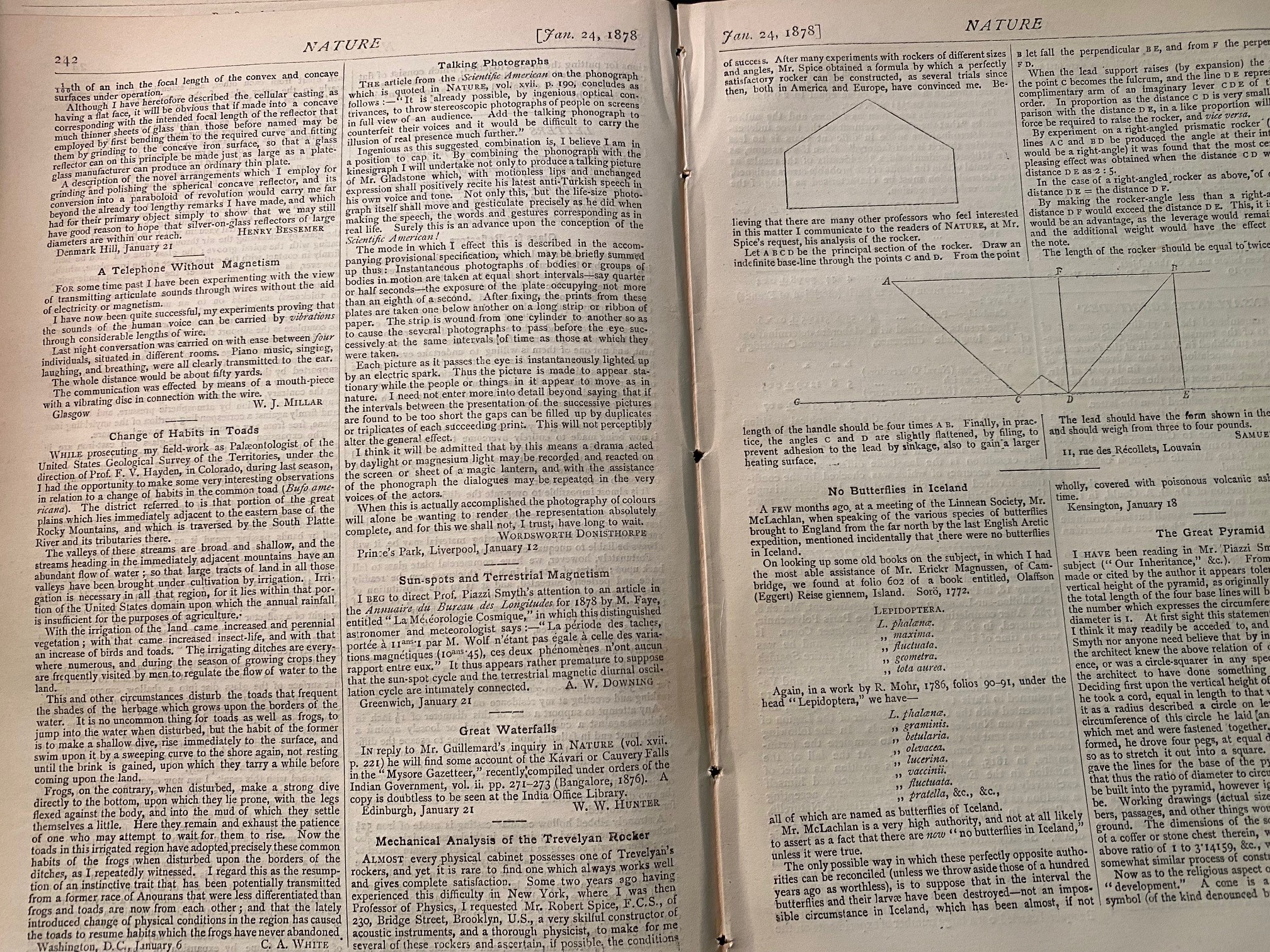
    IMG_6041There appeared in the wonderful pages of Nature (for 24 January 1878) a short but interesting technical communication from the probably/improbably-named Wordsworth Donisthorpe (1847-1914): “Talking Photographs”.1  It is a letter to the editor, really, about an invention that is deeply related to the earliest stages of motion pictures–it was among the first papers that coupled sound with the moving images, appearing eleven years before the first successful demonstration of a motion picture (1889).  

    “…Donisthorpe was an English individualist anarchist and inventor, pioneer of cinematography and chess enthusiast…” (Photography News). He invented a language (“Uropa”), was an ardent Darwinist, maths wrangler Trinity 1882, non-practicing Barrister, political fringe-elementist, and helped to found the British Chess Association, among much else. 

    With his device called the “Kinesigraph” (patented with his cousin William Crofts who whose sister was married to Darwin’s son Francis) which was based somewhat on the wool-combing machines that their fathers helped to invent and improve, the pair stepped into the instant future of the motion picture.

    IMG_6042

    As I said, Donisthorpe introduces a lot in this very short letter. He states:

    “By combining the phonograph with the kinesigraph I will undertake not only to produce a talking picture of [Prime Minister] Mr. Gladstone which, with motionless lips and unchanged expression shall positively recite his latest anti-Turkish speech in his own voice and tone. Not only this, but the life-size photograph itself shall move and gesticulate precisely as he did when making the speech, the words and gestures corresponding as in real life.” He states further: “It is already possible, by ingenious optical contrivances, to throw stereoscopic photographs of people on screens in full view of an audience.” And then, taking advantage of the newly invented Edison phonograph, continues: “Add the talking phonograph2 to counterfeit their voices and it would be difficult to carry the illusion of real presence much further.”

    *Lastly, I’ve included this in the “history of Memory” category because of the vast amount of memory that these inventions were able to store. Up to this point, before the introduction of the means to record sound and motion, people depended on static portrayals of these memories that were also subject to change and interpretation. With the phonograph and motion picture cameras continuous motion and audio sources are saved for as long as the media survives.  

    Notes:

    1. DONISTHORP, Woodsworth. “Talking Photographs”, in Nature, volume 17, no. 13. 24 January 1878, page 243 in the complete weekly issue of pp 237-256.
    2. What Mr. Donisthorpe is talking about in the pages of the Scientific American is really the back-door entry to an even bigger topic: the first announcement of Thomas Edison’s phonograph as it appeared on the back of the first  page in the last issue for the year, 29 December 1877.  “A Wonderful Invention–Speech Capable of Indefinite Repetition from Automatic records” was the article by Edward Johnson on the introduction of Thomas Edison’s phonograph. It is one and a half columns long, but contains a very compact 1500 words.  

  • Charles Babbage Obituary in “Nature”, November 1871.

    JF Ptak Science Books   Quick Post  Overall Post 5124

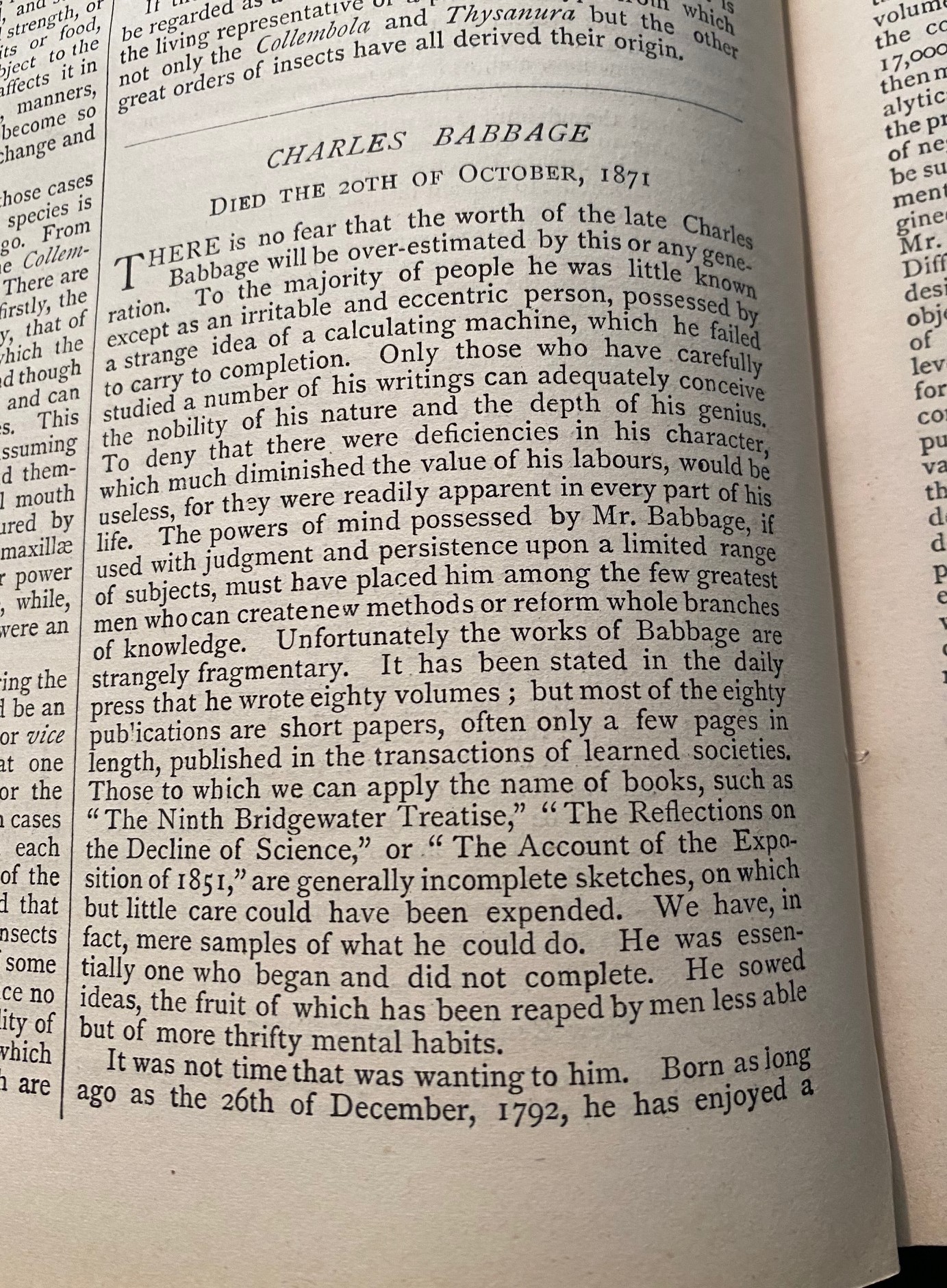
    This is a fine and understanding obituary of Charles Babbage--it appeared in Nature on 9 November 1871, just two weeks after 
    the death of the Great Man on 20 October, and I include the article in full below. You'll see that a lot of attention is paid to the
    Difference and Analytical Engines, and how much attention they received from Babbage and how much money the
    government spent on it. It was a failure as a working/practical/applicable enterprise, the writer states (which was true) , but the
    thinking that went into the machines were not. That Babbage didn't see the completion of the computer projects wasn't necessarily
    his fault, and to me seems to say that time will out. The obit writer (Lockyer, the founding editor of the journal?) was positively
    convinced of the clarity and precision of Babbage's thinking and writing, and convinced of his genius.

    "THERE is no fear that the worth of the late Charles Babbage will be over-estimated by this or any generation. To the majority of
    people he was little known except as an irritable and eccentric person, possessed by a strange idea of a calculating machine, which
    he failed to carry to completion. Only those who have carefully studied a number of his writings can adequately conceive
    the nobility of his nature and the depth of his genius."IMG_4897
    "Mr. Babbage, relinquishing all notions of completing the Difference machine, bestowed all his energies upon the designs of the
    wonderful Analytical Engine. This great object of his aspirations was to be little less than the mind of a mathematician embodied
    in metallic wheels and levers...Nothing but a careful study of the published accounts can give an adequate notion of the vast
    mechanical ingenuity lavished by Mr. Babbage upon this fascinating design. Although we are often without detailed explanations
    of the means, there can be little doubt that everything which Mr. Babbage asserted to be possible would have been theoretically
    possible."

    IMG_4899
    "The engine was to possess a kind of power of prevision, and was to be so constructed that intentional disturbance of all the loose
    parts would give no error in the final result."
    "Although for many years Mr. Babbage entertained the intention of constructing this machine, and made many preparations, we
    can hardly suppose it capable of practical realisation. Before 1851 he appears to have despaired of Its completion, but his
    workshops were never wholly closed. It was his pleasure to lead any friend or visitor though these rooms and explain their contents.
    No more strange or melancholy sight could well be seen. Around these rooms in Dorset Street were the ruins of a life time of the
    most severe and ingenious mental labours perhaps ever exerted by man. The drawings of the machine were alone a wonderful result
    of skill and industry; cabinets full of tools, pieces of mechanism, and various contrivances for facilitating exact workmanship,
    were on
    every side, now lying useless."

    Read the rest of the obituary:

  • “Euphonium”: Found-Poetry of Recorded Soundwaves (1897)

    JF Ptak Science Books  Quick Post –Overall Post 5122 (Part of the History of Lines series)

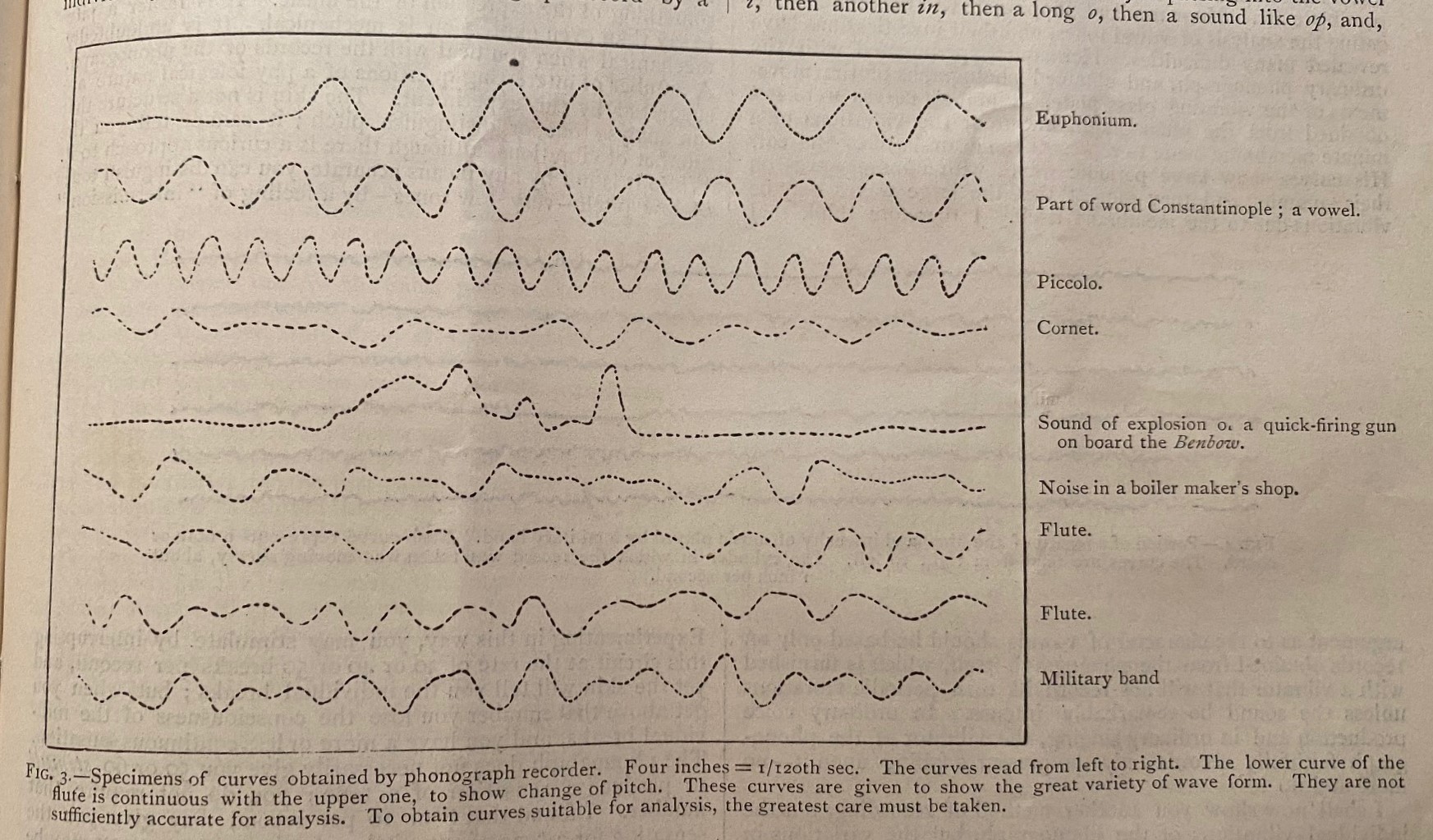
    IMG_4854John McKendrick had a long scientific career, with a  lot of very widely-spaced interests on which he wrote well and often.  What caught my eye on this piece (“The Analysis of Phonograph Records”, in Nature, a Weekly Illustrated Journal of Science, volume 56 no. 1444, 1 July 1897, pp 209-213 in the issue of pp 193-216)–I mean, aside form its wonderful content–was a bit of found poetry in one of the paper’s illustrations.  McKendrick’s—professor of physiology at Glasgow—effort here is one of the early attempt studying graphic records of soundwaves specifically prepared on phonographic cylinders, looking for variations in the graphics of pitch and the meaning they convey. Fascinating results.  

    EUPHONIUM (1897)

    Euphonium,

    Part of a word Constantinople, a vowel,

    Piccolo

    Cornet

    Sound of explosion or a quick-firing onboard the Benbow.

    Noise in a boiler makers group.

    Flute.

    Flute.

    Military band.


  • The New Speed of Information, 1846

    JF Ptak Science Books  Quick Post   Overall Post 5121

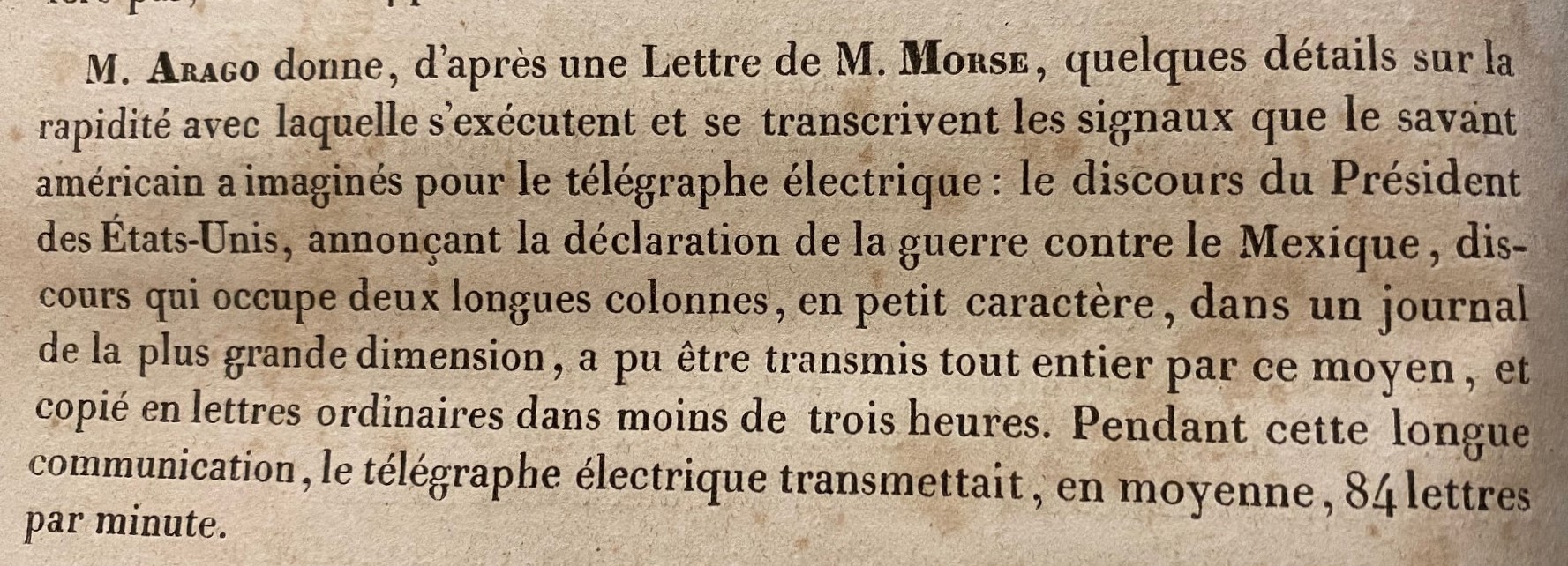
    Here’s probably an obscure bit on the coming of a very large change in journalism and the dispersion of information: a short announcement of the use of the electric telegraph in the rapid reporting of war news. The notice appeared in the Compte Rendu des Seances de l’Academie des Sciences 15 June 1846 (volume 22 no. 24, p 1004), and it is communicated to the Academie by Francois Arago, and runs for only about 100 words. Arago mentions how quick the operation of the electric telegraph was (citing our Mr. Morse), basically drawing attention to this new mode of data dispersal. He uses the example of the speech of the U.S. President (James Polk) on the new Mexican-American War, which was begun 25 April 1846, just weeks earlier than this report was published. Arago doesn’t mention the very dramatic spread of telegraphy lines and far-reaching nodes that blossomed in the U.S. Earlier in 1846…maybe he didn’t know of them, yet. What he does talk about is the astonishing bit of the Polk’s war address being disseminated so quickly—evidently the whole thing was transcribed and telegraphed in three hours. That seems today to be quite glacial, but this was done at a time when news was coming by packet steamer, Pony Express, and the U.S. Post by horse and wagon. To be suddenly able to disseminate news from Washington DC to Richmond and Albany and NYC and Boston all in a matter of hours from Morse to text was really quite astonishing.

    CR graze  15 June 1846 arago morse


  • The Not-Unbearable Extra-sub-Heaviness of Light (1876)

    JF Ptak Science Books  Quick Post (Overall post 5119)

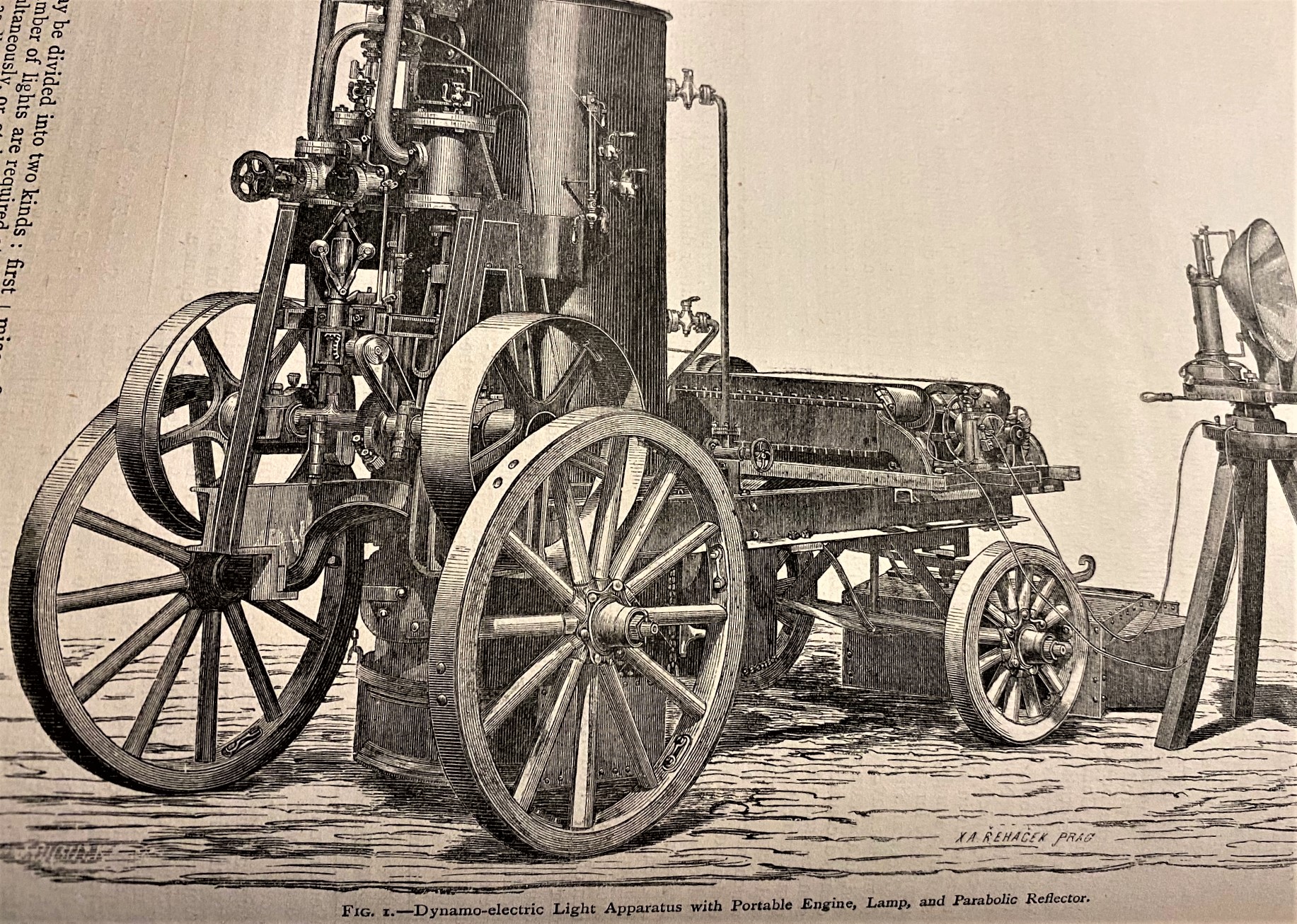
    I thought it would be interesting to share this engraving of a portable electric light apparatus. This does come very early in the modern (post 1850) sense of “electric light”, but, still, even knowing of how early this is in this fiel dit is still a little shocking to see the weight of the engineering and ingenuity in providing mobile electric light.  

    • “THE comparatively infrequent employment of electric light, considering the great success achieved in its production, would at first sight appear to be due to something in the application of the electricity itself. It has been repeatedly and satisfactorily proved that a continuous and powerful light can be produced by electricity, and the question naturally arises, Why is it not more frequently employed for practical purposes?”
    • “For transportation of the Dynamo-electric Light Apparatus is mounted on a wagon, with steam engine, the whole weighing 4,960 lbs. The combination has proved very serviceable on account of its lightness and compactness.”– Siemens’ Electric Light Apparatus. Nature 14, 133–136 (1876).

    IMG_3381