A Daily History of Holes, Dots, Lines, Science, History, Math, Physics, Art, the Unintentional Absurd, Architecture, Maps, Data Visualization, Blank and Missing Things, and so on. |1.6 million words, 7500 images, 4.9 million hits| Press & appearances in The Times, Le Figaro, Mensa, The Economist, The Guardian, Discovery News, Slate, Le Monde, Sci American Blogs, Le Pont, and many othr places… 5000+ total posts since 2008. Contact johnfptak at gmail dot com

Category: How Fast Stuff Is.

  • The New Speed of Information, 1846

    JF Ptak Science Books  Quick Post   Overall Post 5121

    Here’s probably an obscure bit on the coming of a very large change in journalism and the dispersion of information: a short announcement of the use of the electric telegraph in the rapid reporting of war news. The notice appeared in the Compte Rendu des Seances de l’Academie des Sciences 15 June 1846 (volume 22 no. 24, p 1004), and it is communicated to the Academie by Francois Arago, and runs for only about 100 words. Arago mentions how quick the operation of the electric telegraph was (citing our Mr. Morse), basically drawing attention to this new mode of data dispersal. He uses the example of the speech of the U.S. President (James Polk) on the new Mexican-American War, which was begun 25 April 1846, just weeks earlier than this report was published. Arago doesn’t mention the very dramatic spread of telegraphy lines and far-reaching nodes that blossomed in the U.S. Earlier in 1846…maybe he didn’t know of them, yet. What he does talk about is the astonishing bit of the Polk’s war address being disseminated so quickly—evidently the whole thing was transcribed and telegraphed in three hours. That seems today to be quite glacial, but this was done at a time when news was coming by packet steamer, Pony Express, and the U.S. Post by horse and wagon. To be suddenly able to disseminate news from Washington DC to Richmond and Albany and NYC and Boston all in a matter of hours from Morse to text was really quite astonishing.
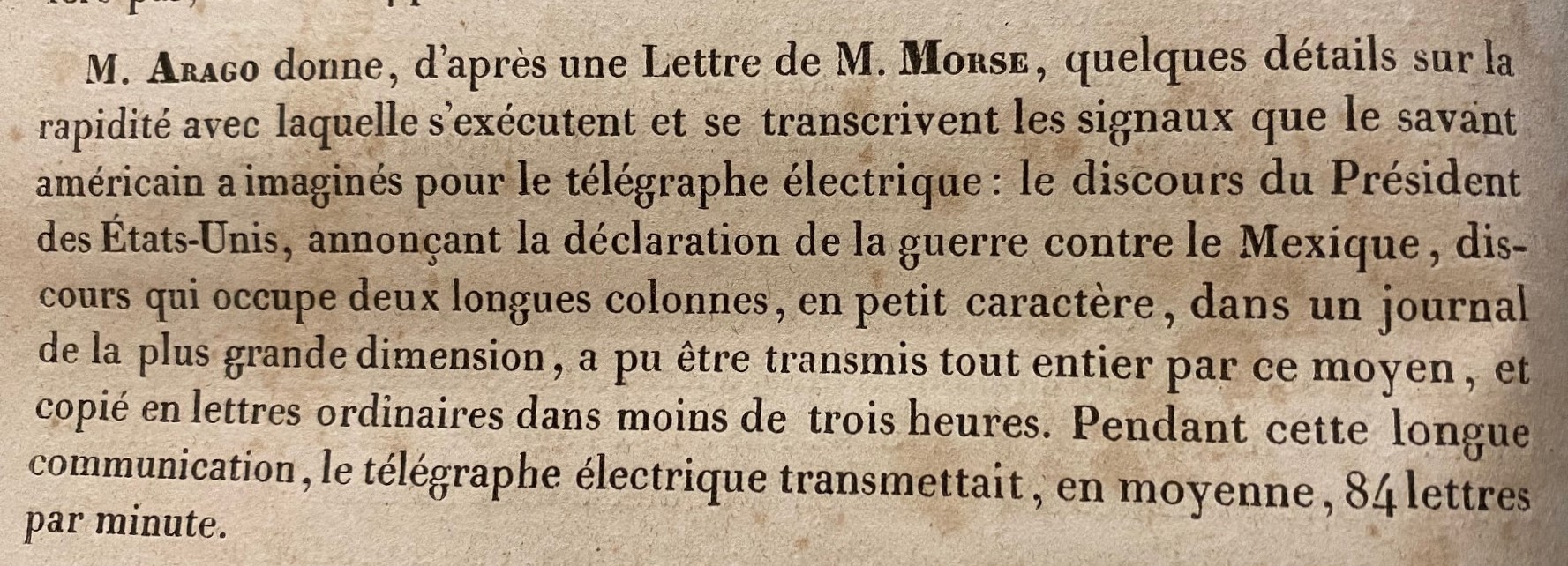
    CR graze  15 June 1846 arago morse


  • The Speed of Thought (1850)

    JF Ptak Science Books  Quick Post 

    Here’s another happy and unexpected find, this coming from one of my very-early-on scientific heroes, Hermann von Helmholtz. The two papers1 in question (French translations that appeared in 1850 and 1851 about a year after the results were published in German) form an interesting chapter in the history of infinity—in this case, closing the boundaries of speed of the neural impulses. As with the speed of light (thought to be infinite or thereabouts into the 17th century) the speed of “thought’ or “pre-thought” was thought to be infinite until this paper by the polymathic von Helmholtz. Von H worked in many different fields and made major contributions across numerous disciplines—he was a very very impressive guy, and evidently a good teacher, and also of fine character (as seen in the 2nd law business with Mayer). In this paper he was able to determine the speed of the nerve impulse in a frog, using its sciatic nerve and the calf it was connected to, and elegantly finding a speed of between 24-38 metres/sec., and presented in these two papers for the first time in French. The experiment was fairly simple and just remarkable, and presented the speed of the neural impulse at very much not light speed. And so, the infinity of the speed of thought—thought perhaps so because of religious demands—definitely had a bookend.

    Notes.

    1. Hermann von Helmholtz. “Note sur la vitesse de propagation de l’agent nerveux dans les nerfs rachidiens.” Published in Comptes Rendus vol 30, 25 February 1850, pp. 204-6;  and “Deuxieme Note surla vitesse de propagation de l’agentnerveux”, again in .Comptes Rendus, vol 33, 1851 in pp. 262-5. 

    ·Posted by :

    ·in:


  • How Fast Stuff Is: Thought (1870)

    JF Ptak Science Books   Quick Post

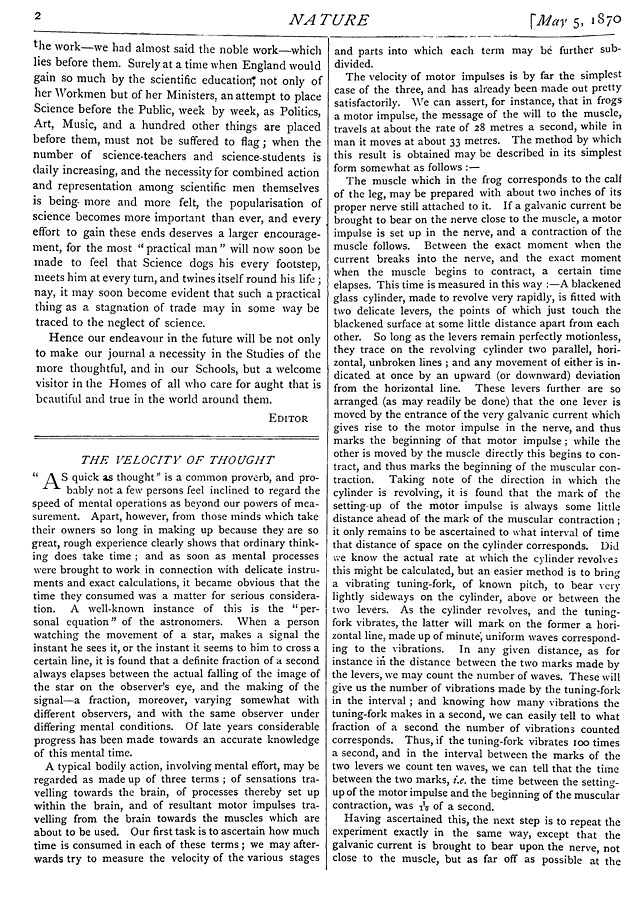
    There is probably a more elegant way of asking this question and still be catchy/popular, like “Speed of Stuff” or “On the Speed of Stuff” or some such–fact is though I should have begun a series by this (sort of) name years ago. It is a nice catch-all for mostly unrelated stuff, except for the “speed” part, which would be a nice thread.  In any event, I came upon this article today while looking for the beautifully-named Fleeming Jenkin article on a very unusual telegraph. It appeared in the May 5, 1870 issue of Nature, which is actually the first series in volume II of the then brand-new journal, and this was just issue #27. But right up front in this issue was a great-looking paper by a “M. Foster” called “The Velocity of Thought”. (This was not by a wonderful Mr. Foster from high school who warned us kinds in 1970 that we will one day be fighting in Afghanistan, “you mark my words,boys”–a bold position given that we still had a few years to go in Vietnam at that point.) I think that this “M. Foster” is Professor Michael Foster, who in time would add (if he hadn’t already) an M.D. and then a F.R.S. to his surname.  In any event I append the entire article below, which I found online at the University of Wisconsin.

    Thought velocity of by Foster

    (I should add that there is a nice book review by the great W. Stanley Jevons in this issue as well–anyone interested in purchasing the original issue cane write me at the addy found in the “About” section of this blog.)

    [Article image source:  http://digicoll.library.wisc.edu/cgi-bin/HistSciTech/HistSciTech-idx?type=turn&entity=HistSciTech.Nature18700505.p0004&id=HistSciTech.Nature18700505&isize=M]