A Daily History of Holes, Dots, Lines, Science, History, Math, Physics, Art, the Unintentional Absurd, Architecture, Maps, Data Visualization, Blank and Missing Things, and so on. |1.6 million words, 7500 images, 4.9 million hits| Press & appearances in The Times, Le Figaro, Mensa, The Economist, The Guardian, Discovery News, Slate, Le Monde, Sci American Blogs, Le Pont, and many othr places… 5000+ total posts since 2008. Contact johnfptak at gmail dot com

  • Some Current Catalogs: WWII, the Soviet Union, Nuclear Weapons, WWI Photographs, and of course Large Color Lithographs of San Marco

    CONTACT:   jfptak AT thesciencebookstore DOT com    johnfptak AT gmail DOT com

    Weimar pamphlet 8 schicksale336

    Weimar-Era to 1944 German Social, Political, and Military Pamphlets  

    Download Weimar-era to 1944 German pamphlets 

    (44pp, 5 meg. heavily illustrated)


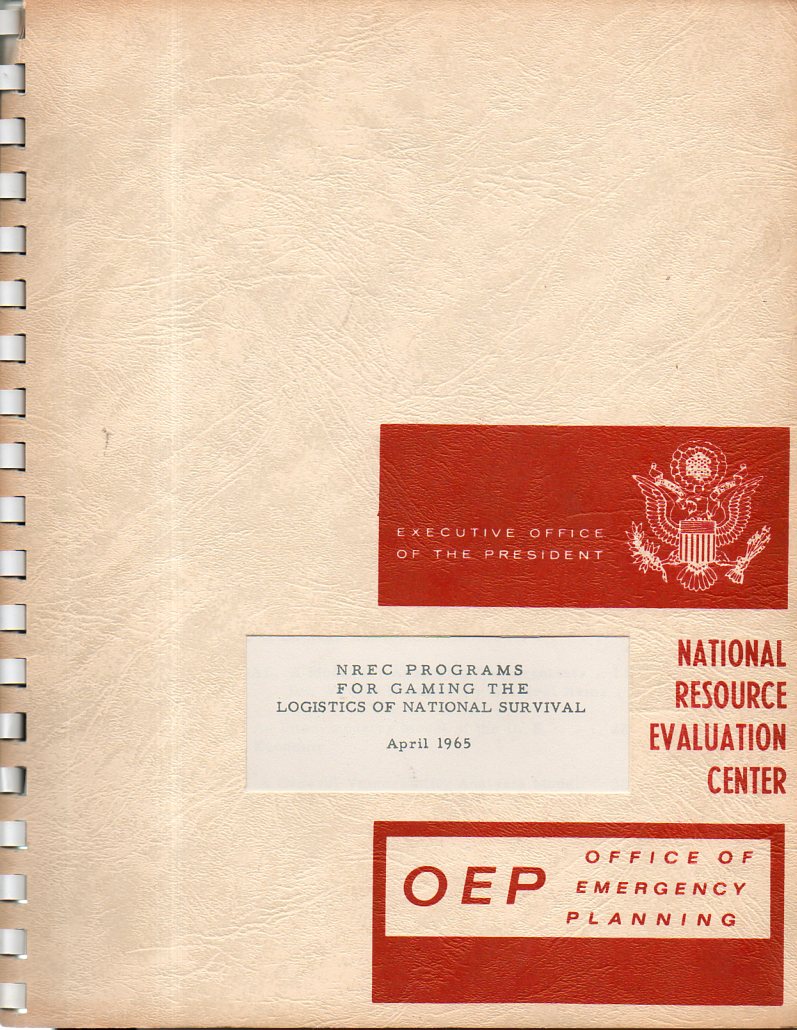
    Nukes hoover NREC237

    Nuclear Weapons and Planning the Post-Apocalypse Society

      Download Nuclear Weapons for PDF 

    (66pp,  8 meg, heavily illustrated)


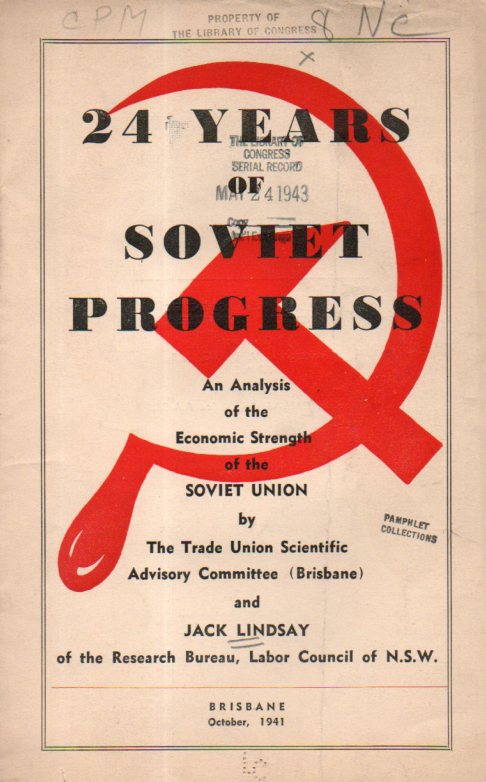
    Russian a131

    The Soviet Union and Communism (1920’s-1945)


    Download Soviet Union and Communism

     (20pp, 496k) 


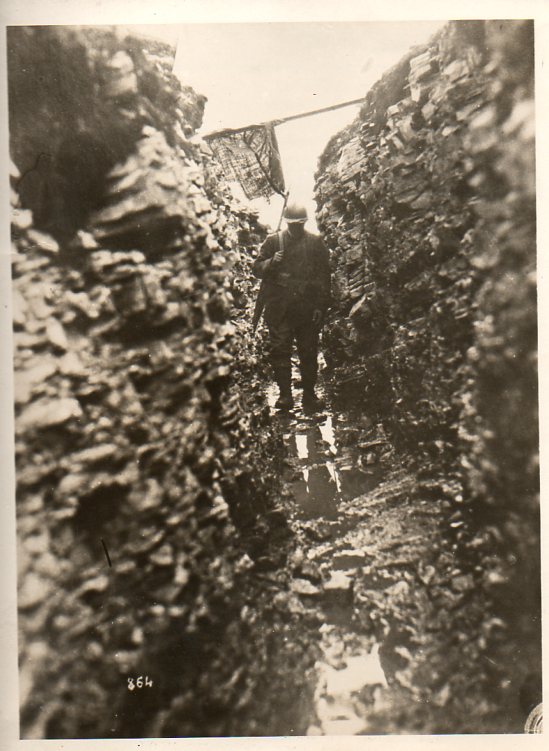
    WWI News Photo Service Archive, 1918 WWI cold ditch

    Download WWI News Photo Service Archive (41pp, 67 megs) 


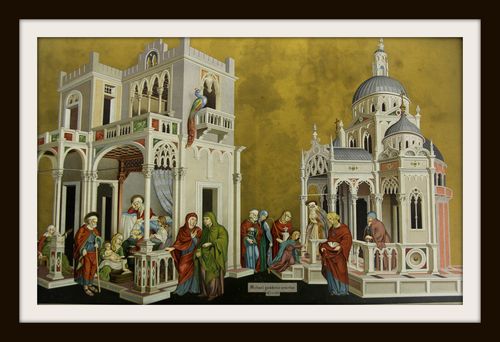
    San Marco _1_

    Lavish Architectural Chromolithographs, 1886

    Download Catalog San Marco 

    23pp 4 meg pdf

    ·Posted by :

    ·in:

    — —
  • The General Theory of Relativity, 1916

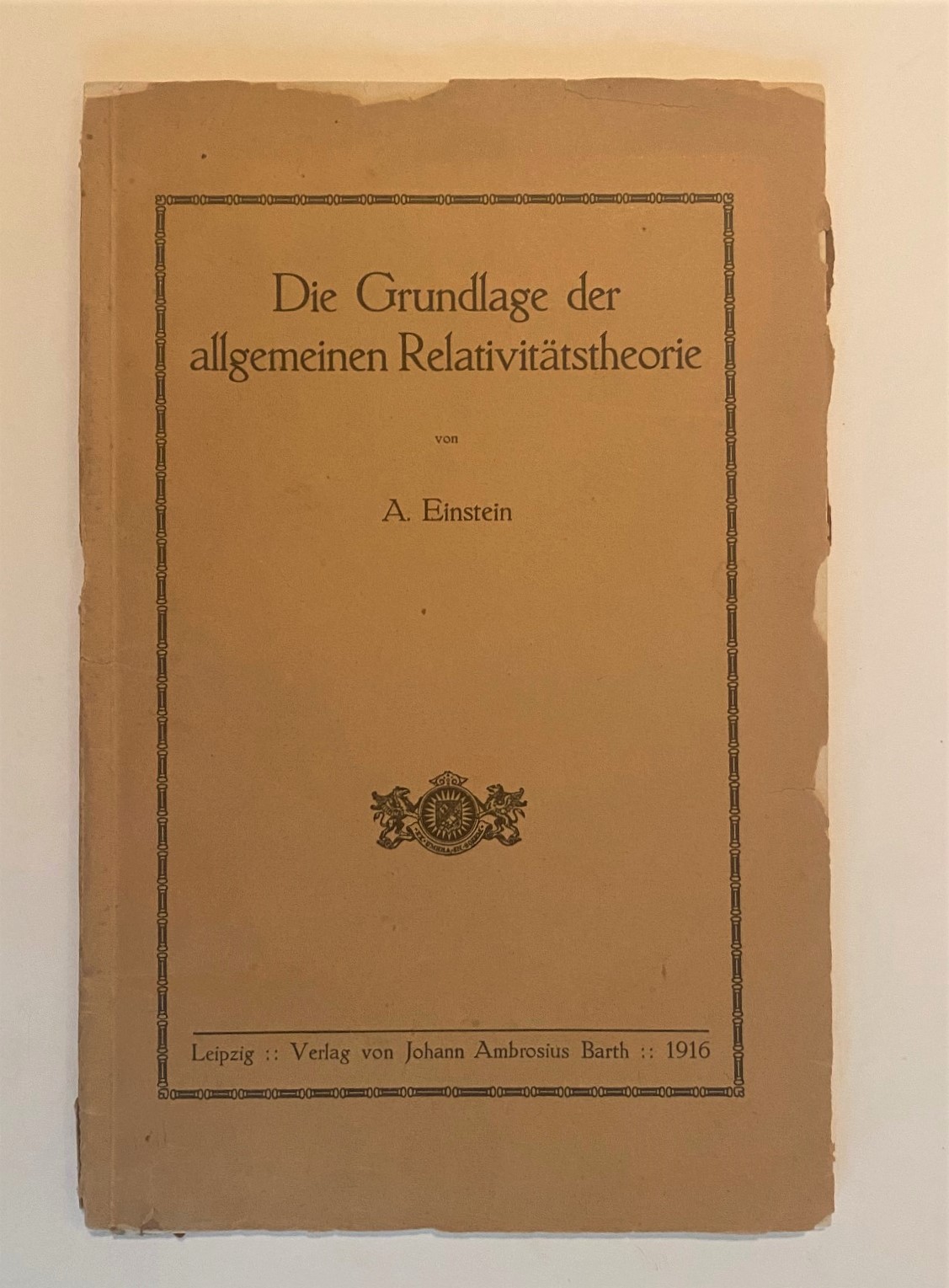
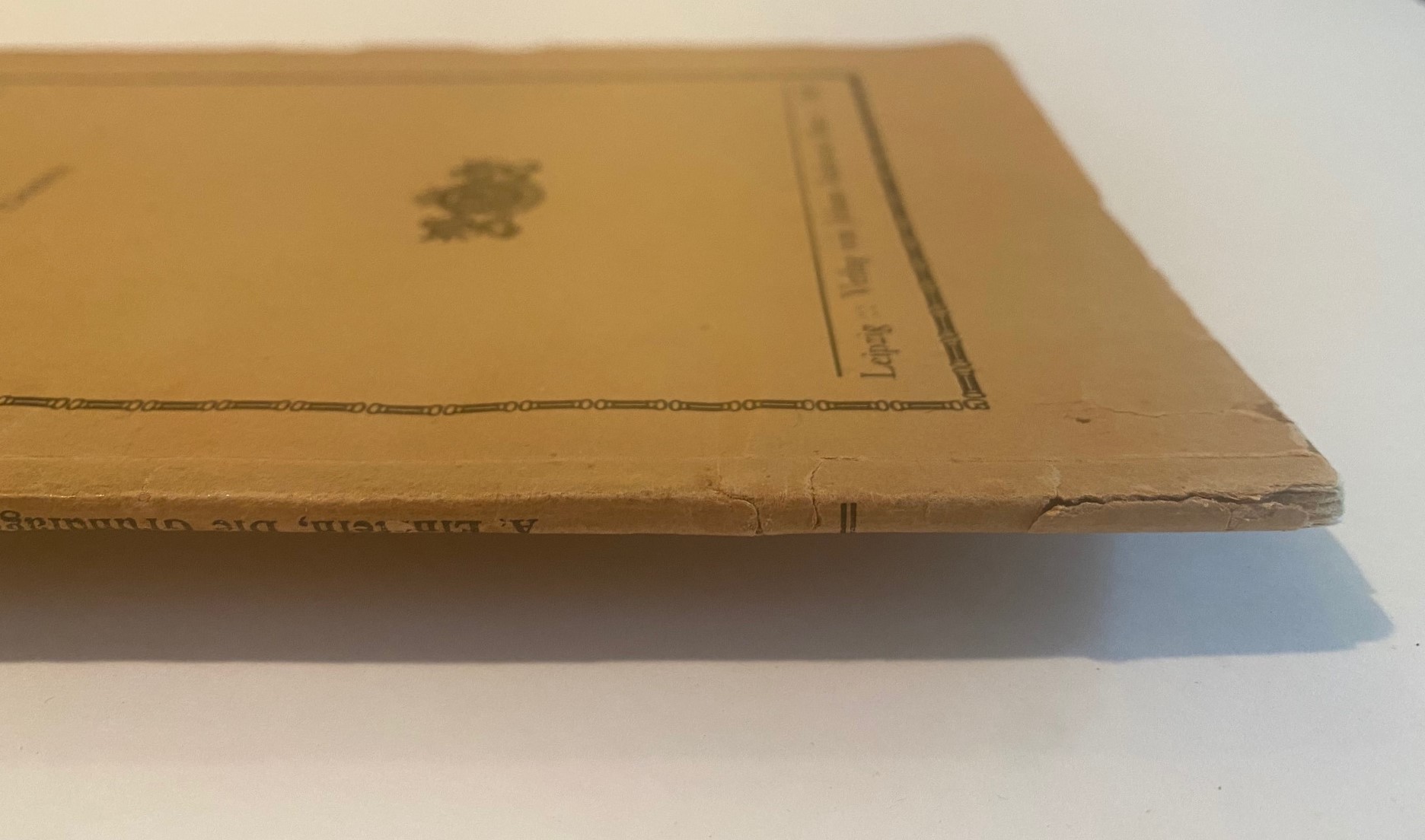
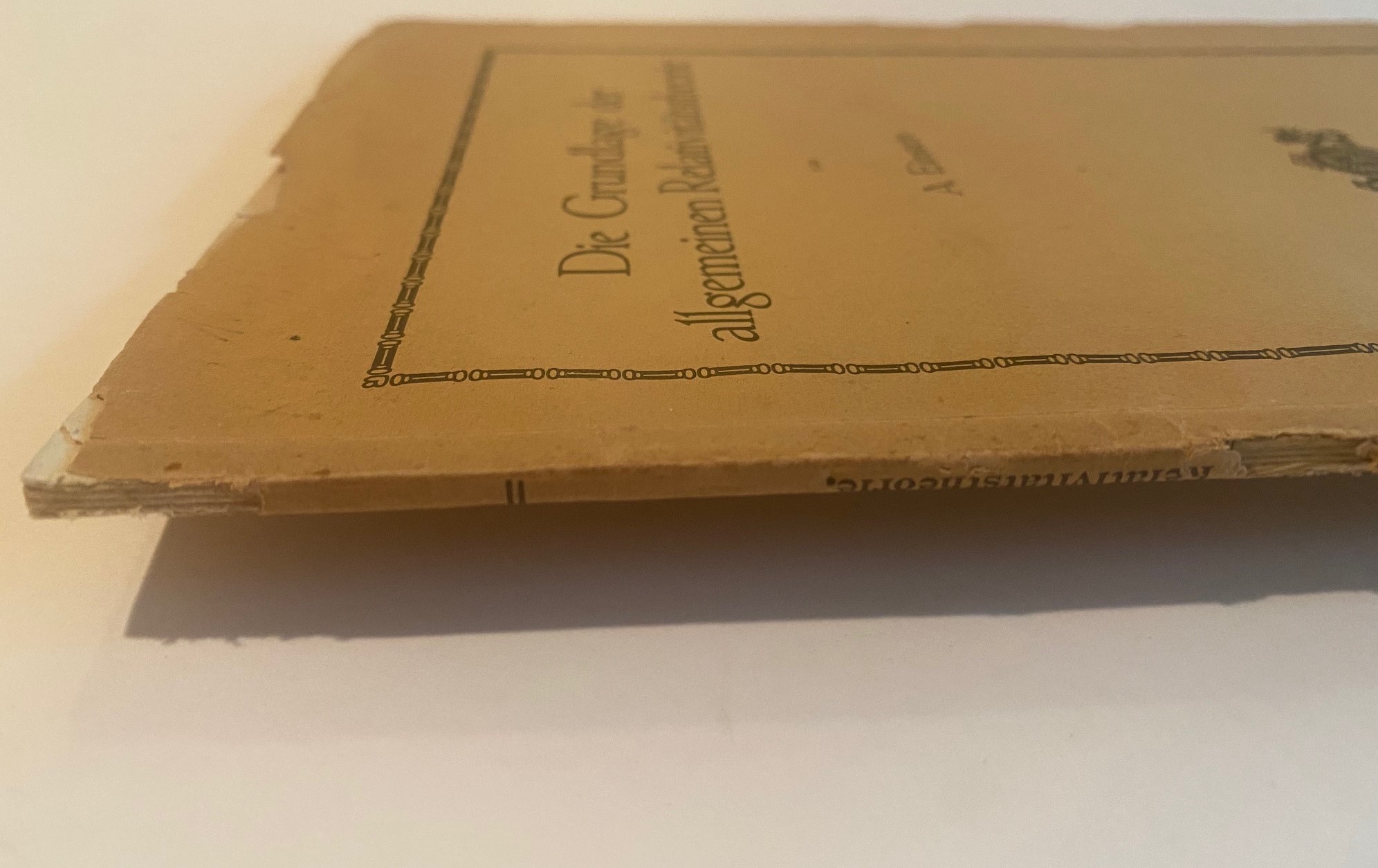
    IMG_7019EINSTEIN, Albert. “Die Grundlagen der Allgemeinen Relativitatstheorie,” Sonderdruck aus den Annalen Der Physik, 1916, series IV, volume 49, 1916. First edition, first issue of the monograph issue, of Einstein’s “Grundlagen…”, the “greatly expanded and detailed memoir…which, so to speak, became the Authorized Version” of the general theory of relativity–(Complete DSB online) Original wrappers. 9″x6″, 64pp. Condition: the wrappers have little chips out here and there (see photos) along the cover edges. There are also three small chips along the paper spine, two being about a half-inch and the third (at bottom) being ¾”. Owner’s name appears at top right title page, dated 1921. Overall, a solid copy. VG. Weil 80a, PMM 408, Grolier/Horblit 26c, Boni 78.1, Schilpp-Schields 86. $3750

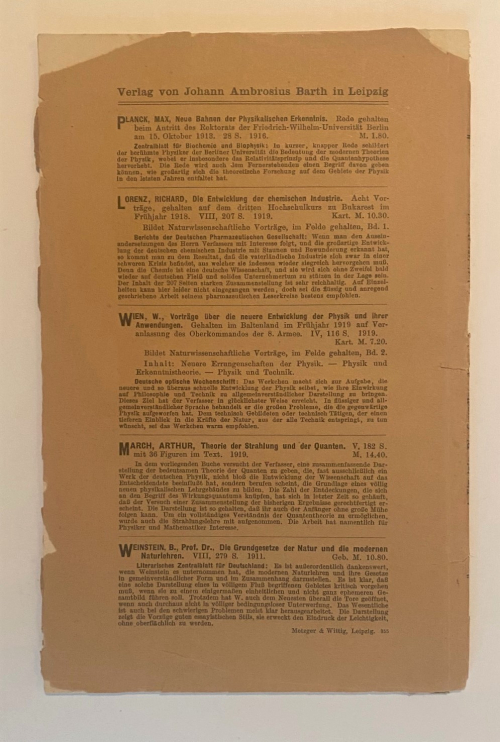
    The printer’s imprint identifying this as the first issue reads “Druck von Metzger & Wittig in Leipzig” on the verso of the title page; it also has the other first issue point, “Metzger & Wittig, Leipzig” printed on the rear cover. (The 2nd issue is mostly identical except that it has “Omnitypie-Ges.” imprinted on verso of title and was actually printed in 1919 even though the title page and cover dates the puiblication as 1916.) It is noted that the monograph issue is not an offprint from the Annalen–it is the first separate edition of this paper, Einstein’s general theory of relativity. It also contains additional material not in the offprint from the Annalen—namely a table of contents (“Inhalt”, pp 3-5) as well as an introduction (“Einleitung” pp 5-6).

    IMG_7020

    What can I say about this paper that hasn’t been said thousands of times before? I can go on and on about it, repeating everything, but the reader already knows all of it. But one does need to say/quote something, one or two things, at least, and so I will simply say that this work is one of the greatest feats of scientific thinking for a period of several hundred years. “The theory of relativity has transformed astrophysics, and indeed the whole scientific outlook,” which is a basic and core statement made about this work, this one being found its description in PMM 408. Perhaps a more richly textured statement on this Einstein was made on the front page of the 7 November 1919 issue of the London Times reporting the announcement at the joint meeting of the Royal Society and Royal Astronomical Society of 6 November of the 29 May eclipse expedition of Eddington/Dyson/Davidson eclipse/bent light experiment that verified general relativity, the headline loudly declaring : “Revolution in Science. New Theory of the Universe. Newtonian Ideas Overthrown,” which I think was very bubbly and excitable for the Brits, given all of it…

    IMG_7023
    IMG_7023

    ·Posted by :

    ·in:

    —
  • Serbian Depredations in Macedonia (1933)

    TATARTCHEFF, Marthe Thibault. Appel des Femmes Macedoniennes aux peuples libres et la conscience internationale. Geneva, Imprimerie Commerciale, 1933. 9″x5.5″, 8pp (though 6 pp of text). (“An Appeal of the Women of Macedonia to Free People of the World and the International Conscience.”) Provenance: Carnegie Institute of Washington, and the Library of Congress, with three stamps for these institutions. VG condition. RARE. WorldCat locates only two copies of this work (University College London and Nanterre) and two copies of the English translation (Harvard and Harvard Law). $250

    This is a harrowing tale. The author spent years trying to escape from what is today North Macedonia, trying to return to her native Switzerland. She tells a story of vast repression, destruction, and death. Tatartcheff writes (“After eight years of uninterrupted suffering…”) on the “…misfortune of Macedonia under Serbian domination” and “addressing the present appeal to the free peoples and to the international conscience, so that they come to help, in the name of humanity, as in the name of threatened peace in the Balkans and in Europe, to a population subjected to an incredible regime of physical and moral terror on the part of the government and the Yugoslav dictatorship”.

    “The general policy pursued by the Serbian government, now known as Yugoslavia, in Macedonia since, 1912/13 and in the former provinces of the Austro-Hungarian Empire from 1918/19, can be characterized in two words: serbization by violence moral and physical.”

    After describing her own imprisonment and the condition of the country in general, the author makes a final appeal, and raises the possibility of extermination: “These methods constitute a permanent threat to the peace of the Balkans and Europe and they are a real disgrace for our century. Unfortunately, with the growing danger of the collapse of Yugoslavia, these methods are only getting worse and more cruel. In the name of human solidarity and peace, in the name of a population threatened with extermination, I address an ardent appeal to all humanitarian organizations in the world, to all international organizations working for the establishment of peace and to all upright consciences to raise their hearing voices for an end to the incredible terror of Serbian tyranny in Macedonia and Yugoslavia.”

    Keywords: North Macedonia, Serbia, Yugoslavia, Bulgaria, Greece.

    ·Posted by :

    ·in:

    —
  • Henry Ford, the Dearborn Independent, and anti-Semitism (1927)

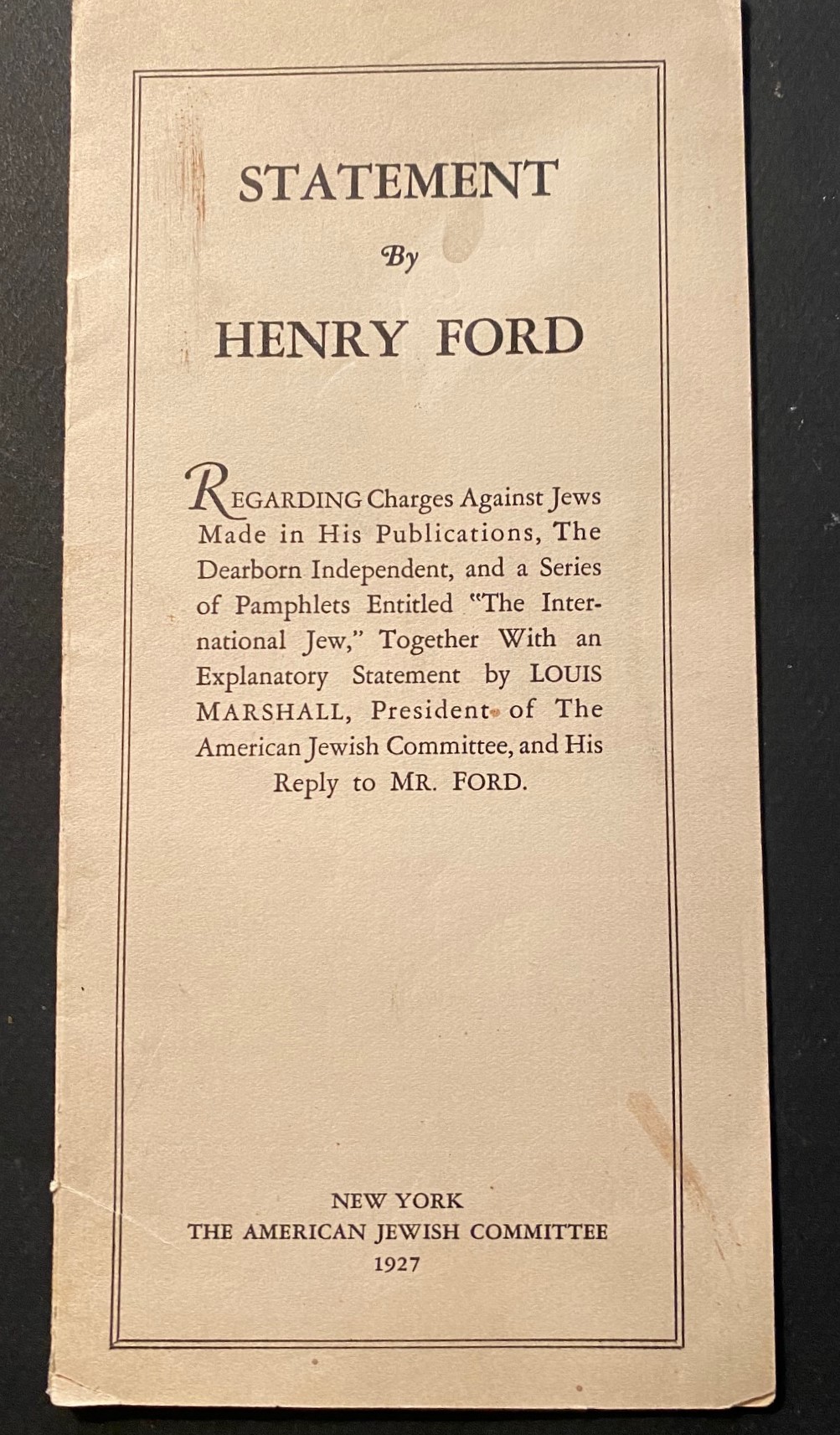
    IMG_5467(FORD, Henry) “Statement by Henry Ford Regarding Charges Against Jews Made in his Publications, The Dearborn Independent, and a Series of Pamphlets Entitled “The International Jew”, together with an Explanatory Statement by Louis Marshall, President of the American Jewish Committee and his Reply to Mr. Ford. Published by the American Jewish Committee, 1927. WorldCat locates ONE print copy, University of Michigan. (There are 5 other copies located, all overseas, Australia, NZ,2 UK, Canada) though they all seem to be only online copies.)  SOLD

    So, the Dearborn Independent was owned and published by Ford beginning in 1920 and rose to 900,000 copies/day, the second-leading circulation in the country. It was partially put over the hill via incentive quotas in every Ford dealership. There were many anti-Semitic articles appearing in the newspaper, which also published “The International Jew”. It was bad stuff. Anyway, boycotts against the Ford company were lodged and a lawsuit appeared in 1927. Ford finally responded to the accusations in June 1927 saying that he had no idea that the paper had published this sort of garbage since 1920, and that he was shocked by it, and repelled. He recanted, though it seems from historical sources that the letter wasn’t written or signed by Ford. The response by Louis Marshall, president of the American Jewish Congress, was reserved, and hoped that the paper no longer published the anti-Semitic filth. Ford closed the paper by the end of 1927. In 1938, Ford accepted the Nazi award of the Grand Cross of the German Eagle, the highest medal offered by the Nazis to a foreign. Hitler had been in power for five years by this point, and his war against the Jews was years old.
    So: actions and words…

    ·Posted by :

    ·in:

  • A.A. Michelson Papers on the Velocity of Light, 1878-1885

    MICHELSON, Albert A. Four papers on Michelson’s famous experiments determining the speed of light (the established velocity standing for 40 years). This includes the paper (#3) in which his outstanding result is established and reported.

    (1) MICHELSON, A.A. “Velocity of Light”, in Nature, volume 18, #451, June 20, 1878, page 195. This is the preliminary announcement of Michelson’s great speed of light experiment.  Very nice copy, removed from a larger bound copy.

    The Michelson bibliography in the Biographical Memoirs of the National Academy of Sciences (page 142) states the publication on the big paper as so: “(a) “On a Method of Measuring the Velocity of Light,” Am. J. Sci. (3) 394-95 (1878) ; (b) “Velocity of Light (Preliminary Announcement),” Nature 18, 195 (1878), differs from (a) in the addition of a paragraph.

    Offered with: (2) MICHELSON, A.A.  “Experimental Determination of the Velocity of Light” [Part I], in Nature, volume 21 no. 526, November 27, 1879, pp 94-96, in the issue of pp 77-100, with six figures in text, including two optics plans, two instrument profiles, and another two instrument plans. Offered in the original wrappers

    With: (3) MICHELSON, A.A. “Experimental Determination of the Velocity of Light, II”, in Nature, vol 21 no. 527, December 4, 1879, pp 120-122, with two schematics, in the issue of pp 101-124. With the original front wrapper. Removed from a larger bound volume. Clean and tidy issue.

    NOTE: In the interest of fullness I should say that there is a short addendum/corrigeda to these two papers “Velocity of Light” that appeared in Nature 21, 226-226 (08 January 1880) that I do NOT offer. It seems that the full text is limited to: “IF you can spare the space please state that the corrected result for the velocity of light (NATURE, vol. xxi. p. 94) is— 299944 ± 50 kilometres, or 186380 ± 33 miles per second.” It IS however a very significant publication correcting his great standard.

    (4) Michelson, A.A. “On M. Wolf’s Modification of Foucault’s Apparatus for the Measurement of the Velocity of Light”, in Nature, vol 32 no. 810, 7 May 1885, pp 6-7 in the issue of pp 1-24. This issue offered without the outer wrappers. Removed from a larger bound volume. VG copy, crisp.

    The four papers: $950.00

    ·Posted by :

    ·in:

  • Equal Rights for Women, League of Nations, 1936

    [Women, Equal Rights for. ] “Annual Meeting of Women’s Consultative Committee of the League of Nations.” Information Bulletin from Committee of Representatives of Women’s International Organizations, created in accordance with a resolution of the Council of the League of Nations, Hotel de Russie, Geneva, September 29, 1936.

    • Four leaves, 13″x 8.5″. Mimeographed (?) Printed on cheap newsprint. Paper browned and brittle, and heavily chipped at top. Fair condition. 10 or so short tears are repaired on reverse with archival Japanese tissue paper. NO copies located in WorldCat. Rare. Provenance: Library of Congress, with their rubber stamp on the back of leaf 4. $500

    This is a resolution presented to the League of Nations in September 29, 1936 (addressed to the president of the Seventeenth Session of the Assembly of the League of Nations, Saavedra Lamas [Argentina, 187801959]) on the subject of adopting equal rights for women in the League’s covenants. This was a combined meeting of the International Council of Women, Louise C.A. Van Eeghan (Holland) and Renee Girod (Switzerland); Women’s International League for Peace and Freedom, Madeleine G. Doty with Lola Maverick Lloyd, (USA); Inter American Commission of Women, Abby Scott Baker and Alice Paul (USA), with Leonor Cespedes (Columbia). Also: Equal Rights International, Juanita Frances (England), Helene Granitsch (Austria), Linda P. Littlejohn (Australia), Lilian von Matsch (Austria); and the All Asian Conference of Women, Rosa Welt Straus (Palestine).

  • One of the Earliest Efforts on Global Warming (1785)

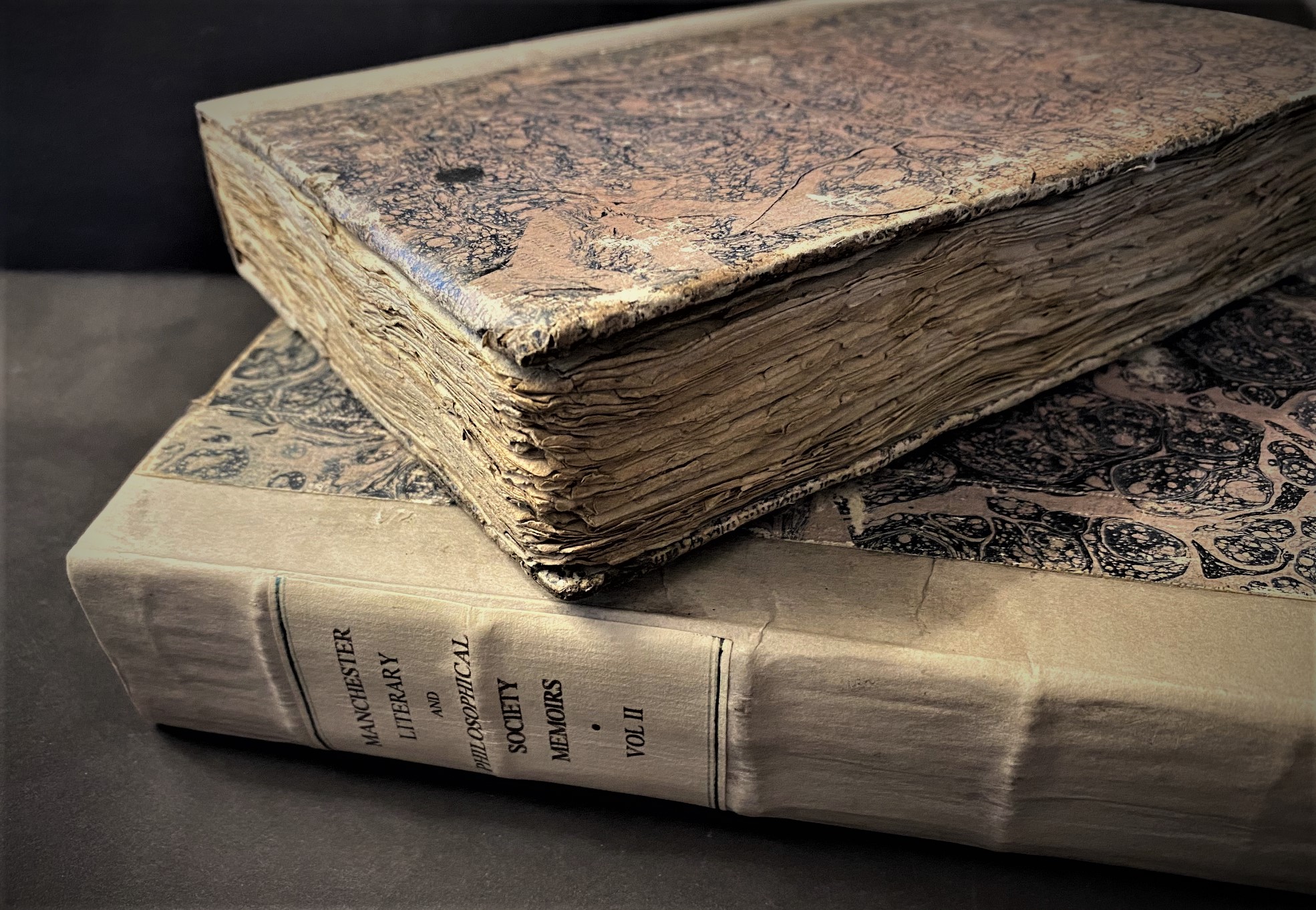
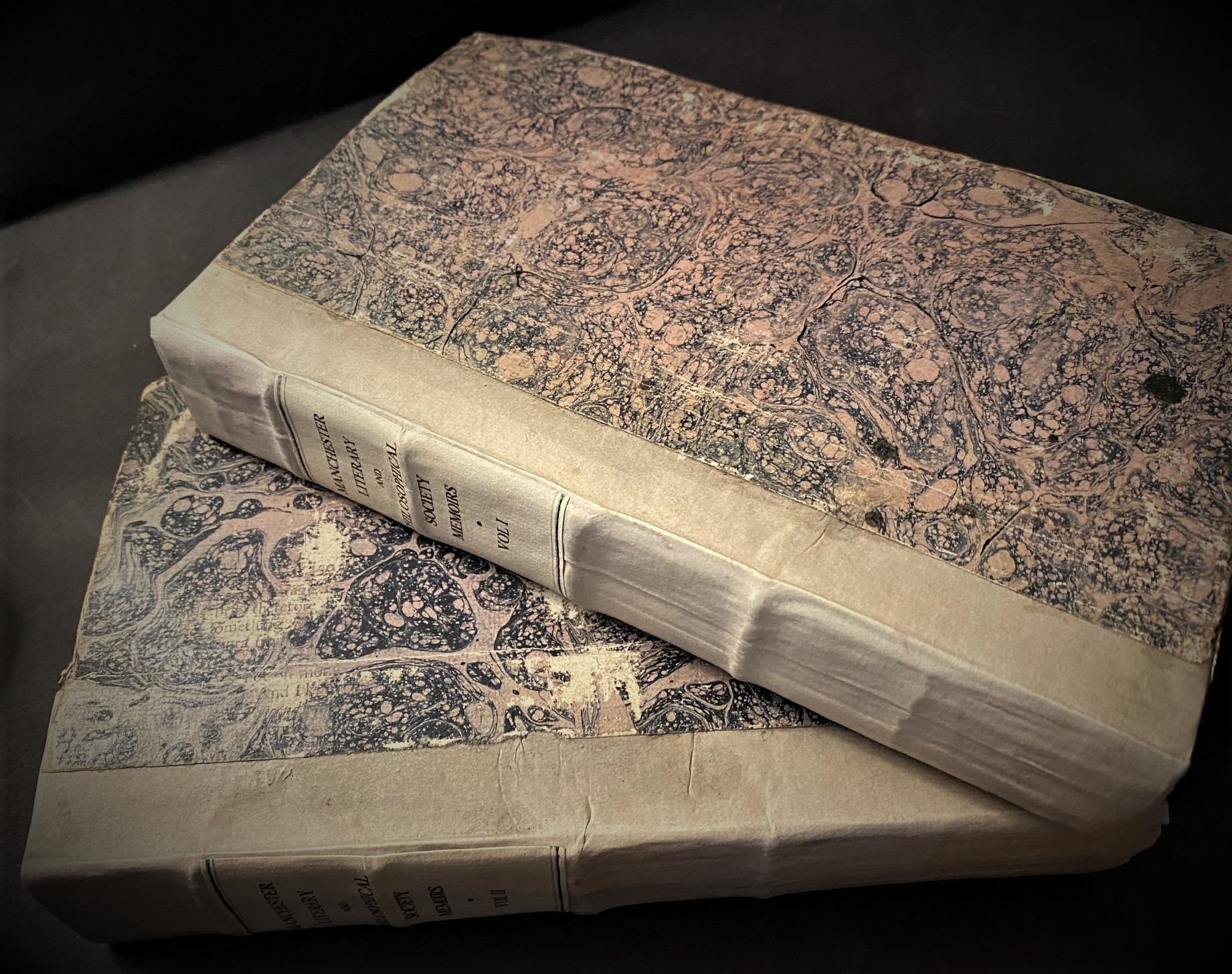
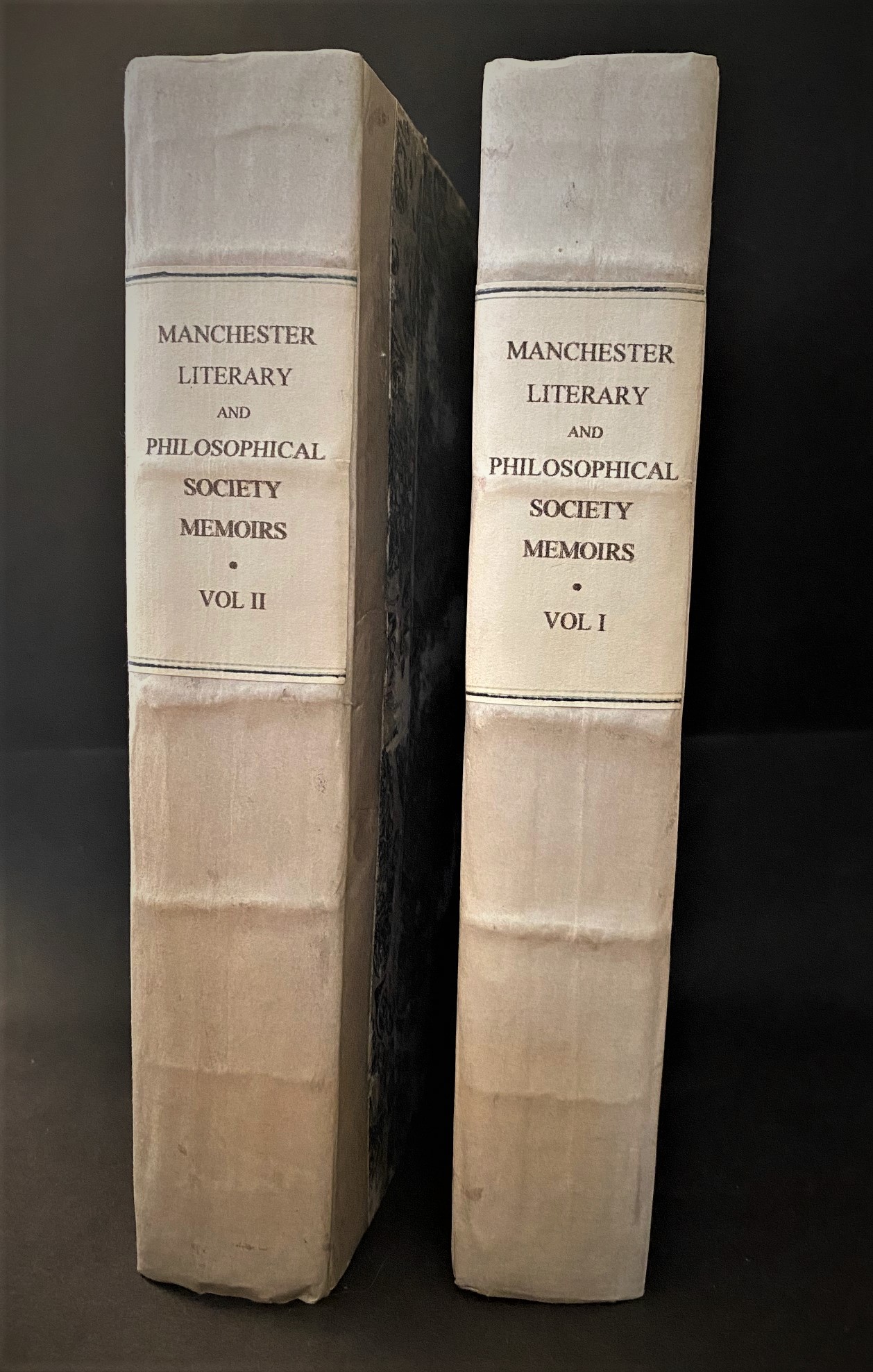
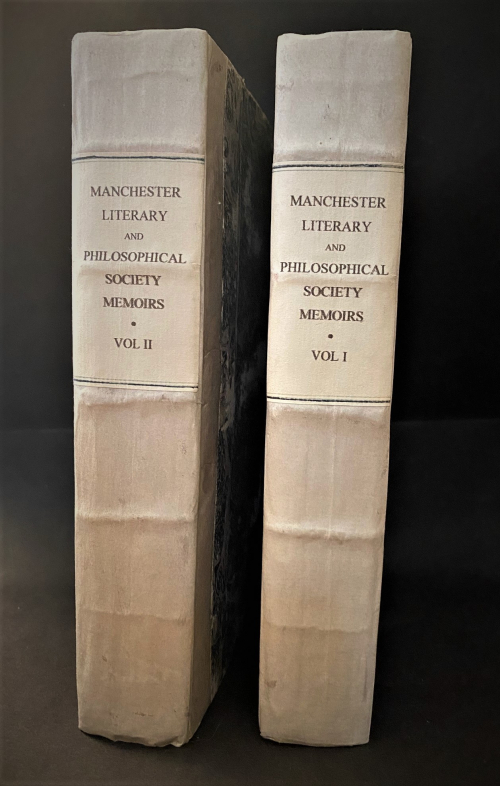
    FRANKLIN, Benjamin. “Meteorological Imaginations and Conjectures” in Memoirs of the Literary and Philosophical Society of Manchester, Warrington, printed by W. Eyres for T. Cadel in London, 1785. xxiii, (I), 473, (12)pp plus 3 engraved plates (two folding); viii,514,(12), plus 2 folding plates. Vellum-like spine, marbled boards; paper spine labels professionally replaced; text edges untrimmed. Original (or 18th c) owner’s name written in ink on title page of each volume. Lovely copies of this scarce title. VG condition. SOLD
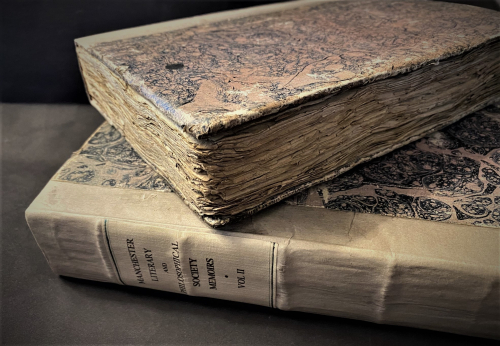
    IMG_4139The Franklin contribution occupies 357-361.

    Franklin also contributes the following: “On the Different Quantities of Rain which Fall, at Different Heights, over the same spot of ground, with a letter from Benjamin Franklin…by Thomas Percival”, pp 106-113, with the extract from the Franklin letter on pp 110-113.

    According to the American Institute of Physics website pages on the “Discovery of Global Warming”, this is the earliest paper in the field. (It is the first listed in their chronological bibliography, and is the only 18th century notation, and is also only one of seven papers listed printed before 1850.)

    “The “dry fog” that blanketed much of Europe during the summer of 1783 had occasioned much scientific speculation, but its cause was as yet unknown. In this paper, written nearly a year after the fog first appeared, Franklin was less concerned with its cause (though he did propose a theory that would turn out to be correct) than with its effect, proposing a connection between the summer’s fog and the exceptionally cold winter that followed.–” National Archives Founders online
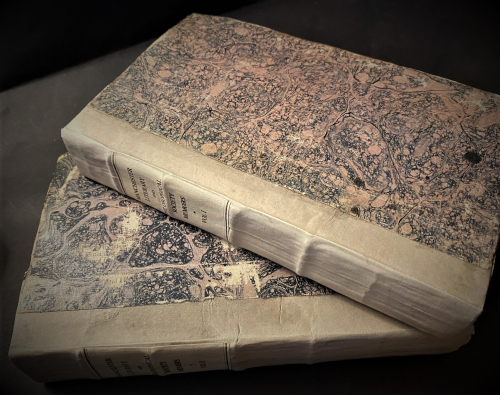
    IMG_4141

    “In 1783 a volcanic fissure in Iceland erupted with enormous force, pouring out cubic kilometers of lava. Layers of poisonous ash snowed down upon the island. The grass died, and three-quarters of the livestock starved to death, followed by a quarter of the people. A peculiar haze shadowed western Europe for months. Benjamin Franklin, visiting France, noticed the unusual cold that summer and speculated that it might have been caused by the volcanic ‘fog’ that visibly dimmed the sunlight” American Institute of Physics online

    “During several of the summer months of the year 1783, when the effect of the sun’s rays to heat the earth in these northern regions should have been greatest, there existed a constant fog over all Europe, and great part of North America.” He observed the effect the fog had on the sun’s rays: “They were indeed rendered so faint in passing through it, that when collected in the focus of a burning glass, they would scarce kindle brown paper. Of course, their summer effect in heating the earth was exceedingly diminished.”

    “He drew some important conclusions: ‘Hence the surface was early frozen. Hence the first snows remained on it unmelted, and received continual additions. Hence the air was more chilled, and the winds more severely cold. Hence perhaps the winter of 1783-4 was more severe, than any that had happened for many years.’ Franklin was arguably the first American scientist to recognize the sensitivity of climate to changes in radiative forcing, and to propose that the Earth can respond in a way that reinforces the change (now known as ice-albedo feedback).
    IMG_4140

    “Franklin’s logic is clear. Changes in the atmosphere’s radiative properties can affect weather and climate. The response of the Earth can amplify those changes. This can lead to problems, even if the details of the causes are uncertain. Resources should be spent on research to understand and predict changes to anticipate and avoid negative consequences to the extent we are able. –Mark Boslough, Contributor, HuffPost, “Ben Franklin, Climate Science, and National Security”, 2017

    Many other papers of interest can be found in these volumes as well.

    ·Posted by :

    ·in:

    —
  • “What Shall We Do With Them?” (Dustbowl & Great Depression, 1938)

    Taylor, Paul S. “What Shall We Do With Them?” Address before the Commonwealth Club of California, San Francisco, April 15, 1938. 11″x 8″, 7 lvs, single-spaced typewritten sheets, mimeographed. $450

    Paul S. Taylor is the Paul S. Taylor as in Mr. Dorothea Lange, partner to the great photographer and co-author of one of the greatest illustrated works of the 20th century, The American Exodus, a Record of Human Erosion. Taylor provided a lyrical and insightful text and Lange contributed her incredible photographs, producing one of the leading documents of life in the Great Depression era of the USA. This was one of the great documentarian centerpieces of the 1930’s, and it was published in the same year as The Grapes of Wrath and the release of the Wizard of Oz. (Two years later—1941–came the superb James Agee (text) and Walker Evans (photographs) finally saw their long-developing Let Us Now Praise Famous Men come to life.)

    The document offered here is an interesting and well-written appraisal of the great American exodus of the 1930s. The “Them” in the title refers being the Dust Bowler, the migrant workers, the dispossessed, people eaten away by the weather, and banks, and ill wind.  Paul Taylor was at this time three years into his marriage with Lange—he was a progressive thinker and a FSA operative who helped Lange land her job and was a part of an extraordinary team of very expansive ability that documented a pivotal period in American life. He was also co-creator with Lange of their great

    In this pamphlet Taylor gave testimony on migrant workers and nearly the height of the Depression—he was an expert, having traveled and lived among them and written academic papers on what he found. He outlined possible answers to the question, which had mainly to do with stability, which of course was the primary concern for the many of thousands of individuals and families who were once-stable but now very mobile, not having place to live or places to go. Taylor thought that opening dams and supplying irrigation and affordable government-owned houses would be the first of many steps to take to relieve the widespread suffering.  In all of the alphabet-soup programs undertaken by the Roosevelt administration, none were nearly as “successful” in ending the national social erosion as the events that were to unfold less than a year later.

    This document is an interesting read, particularly when you consider what he and Lange published just a year later.

  • Carbon Copy of a Classic Paper


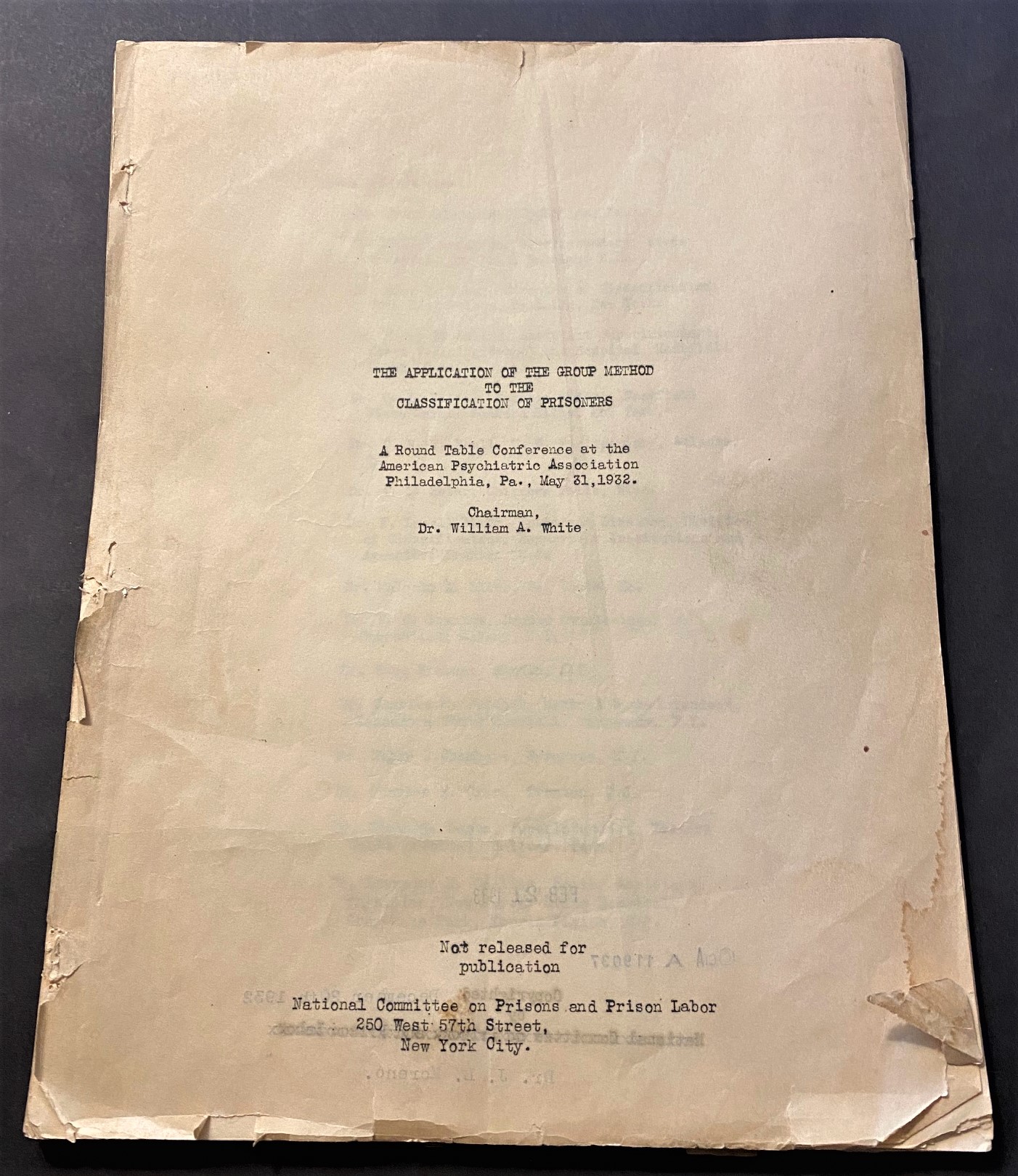
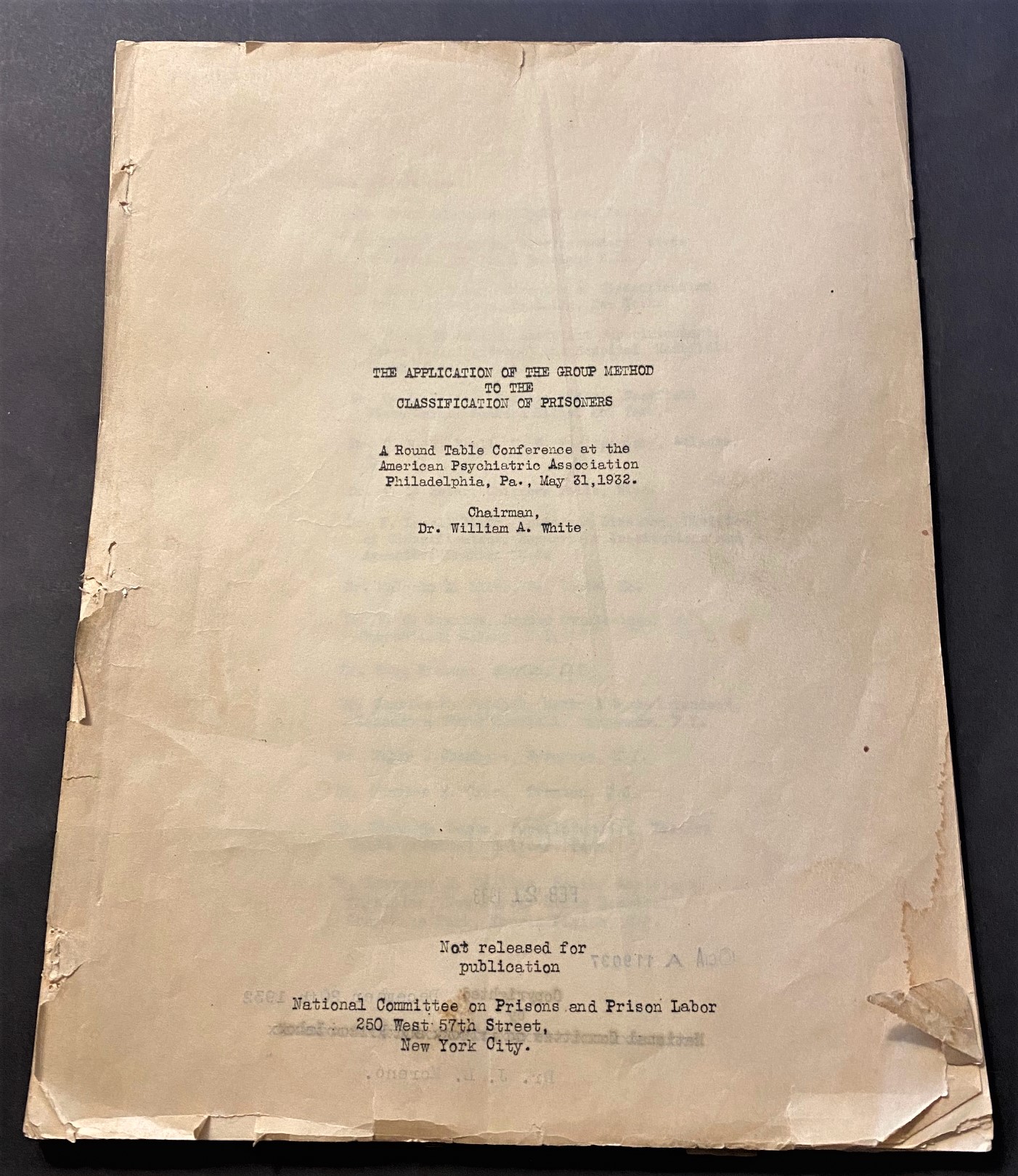
    IMG_4068MORENO, Jacob Levy. (b. 1889) The Application of the Group Method to the Classification of Prisoners. A Round Table Conference at the American Psychiatric Association, Philadelphia, Pa., May 31 1932. Printed by the National Committee on Prisons and Prison labor, NYC. “Not released fir/publication.” Copyrighted by Dr. J.L. Moreno, December 20th, 1932. 11″x 8.5″, 39 leaves. I believe that his is a Carbon Copy.

    Pp 1-7 includes a list of participants and a short introduction.

    Condition: this is, so far as I can tell, a carbon copy of the typed committee/meeting reports, on thin (but not onion) paper. There are chips and minor tears on the first few and last few pages, and the whole had been previously “bound” with three staples, though now those are gone and the report is unbound. Provenance: from the Library of Congress “Pamphlet Collection”, though it is not stamped so.

    Rare. No copies of this work are located in WorldCat.

    Moreno was a pioneer in psychotherapy and psychodrama, and this seems to be a very early application of the Moreno theory.

    (This paper was published a dozen years later as “The Application of the Group Method to the Classification of Prisoners.” in Moreno’s Sociometry volume 8, no. 3/4 (1945) 15-39, and also as a 308-page book in the same year. From J.L. Henderson’s review of “Group Therapy, a Symposium: Edited by J. L. Moreno, M.D.” (New York: Beacon House, Inc., 1945): “This book contains the proceedings of two round table conferences on group psychotherapy. The title of the first, held in 1932, was The Application of the Group Method to the Classification of Prisoners. It was sponsored by Dr. William A. White, who had read Dr. Moreno’s monograph and had talked with him, and was interested in the possible importance of the group approach to treatment. Although much of the discussion centered about the treatment of prisoners, the broader implications and possibilities of the group method were discussed. The talks were largely exploratory. Dr. Moreno concluded the discussion with what seemed to be a defensive explanation of his theory.”–Psychoanalytic Quarterly, (1947), vol 16:420-422

    “In 1925, Moreno moved to New York City, where he worked as a psychiatrist and continued experimenting with psychodramatics. He introduced group therapy into schools and prisons, such as Sing Sing, and he compiled the results of his research there into a book titled Who Shall Survive?: Foundations of Sociometry, Group Psychotherapy, and Sociodrama, published in 1934. He established the Beacon Hill Sanitarium, renamed the Moreno Sanitarium and later, the Moreno Institute, where he was the physician in charge between 1936 and 1968. Moreno started several journals, including Impromptu, Sociometry, Group Psychotherapy, and the International Journal of Sociometry and Sociatry. He was an adjunct professor of sociology at New York University from 1952–1966, and a guest lecturer at a number of universities, including the New School for Social Research, from 1937–1938, and Columbia University, from 1939–1940. Moreno also founded the Impromptu Theatre at Carnegie Hall and the Psychodramatic Institute in Beacon. He was directly responsible for the American Psychiatric Association’s recognition of group psychotherapy as a credible and viable form of treatment.” AND “While in school, Moreno began to develop his own theories for therapeutic practice that were distinctly different from those of Sigmund Freud’s. Rather than analyzing clients’ pasts, Moreno preferred to focus on the present and future through the use of interpersonal relations. Moreno’s interest in theater led him to develop his psychodrama technique. A psychodrama session focuses primarily on one person, called the protagonist. Techniques such as mirroring the behavior of the protagonist and role reversal are used to help participants better understand their own behavior and feelings, as well as the behavior and feelings of others.”–Amar, Nadine. (2005). Jacob L. Moreno. International Dictionary of Psychoanalysis. Also see: Moreno, Jacob L. (n.d.). American National Biography Online.

    ·Posted by :

    ·in:

  • A Seminal Game Theory Theoretical Concept and “the basis for evolutionary game theory.”–British Library blog

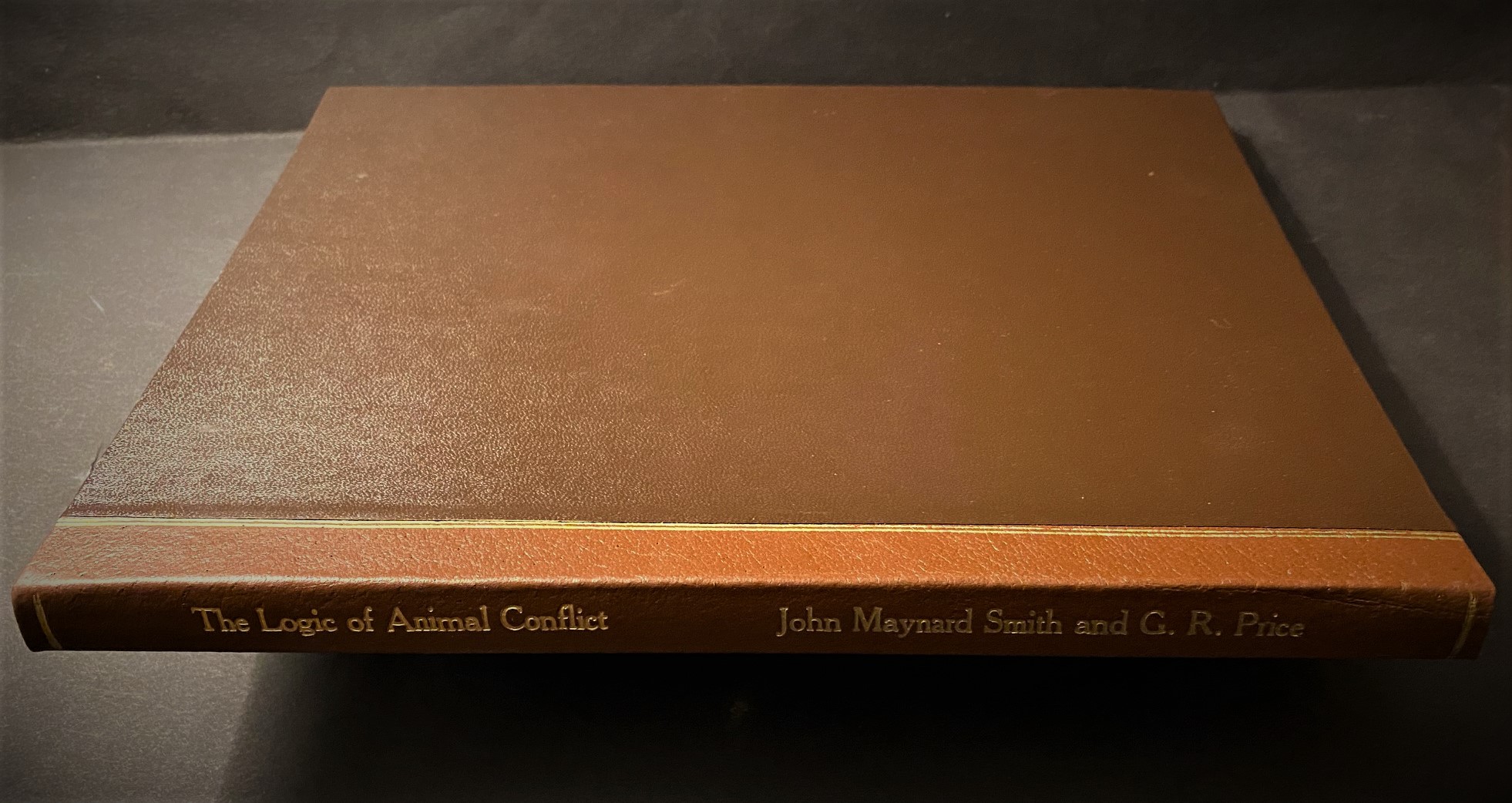
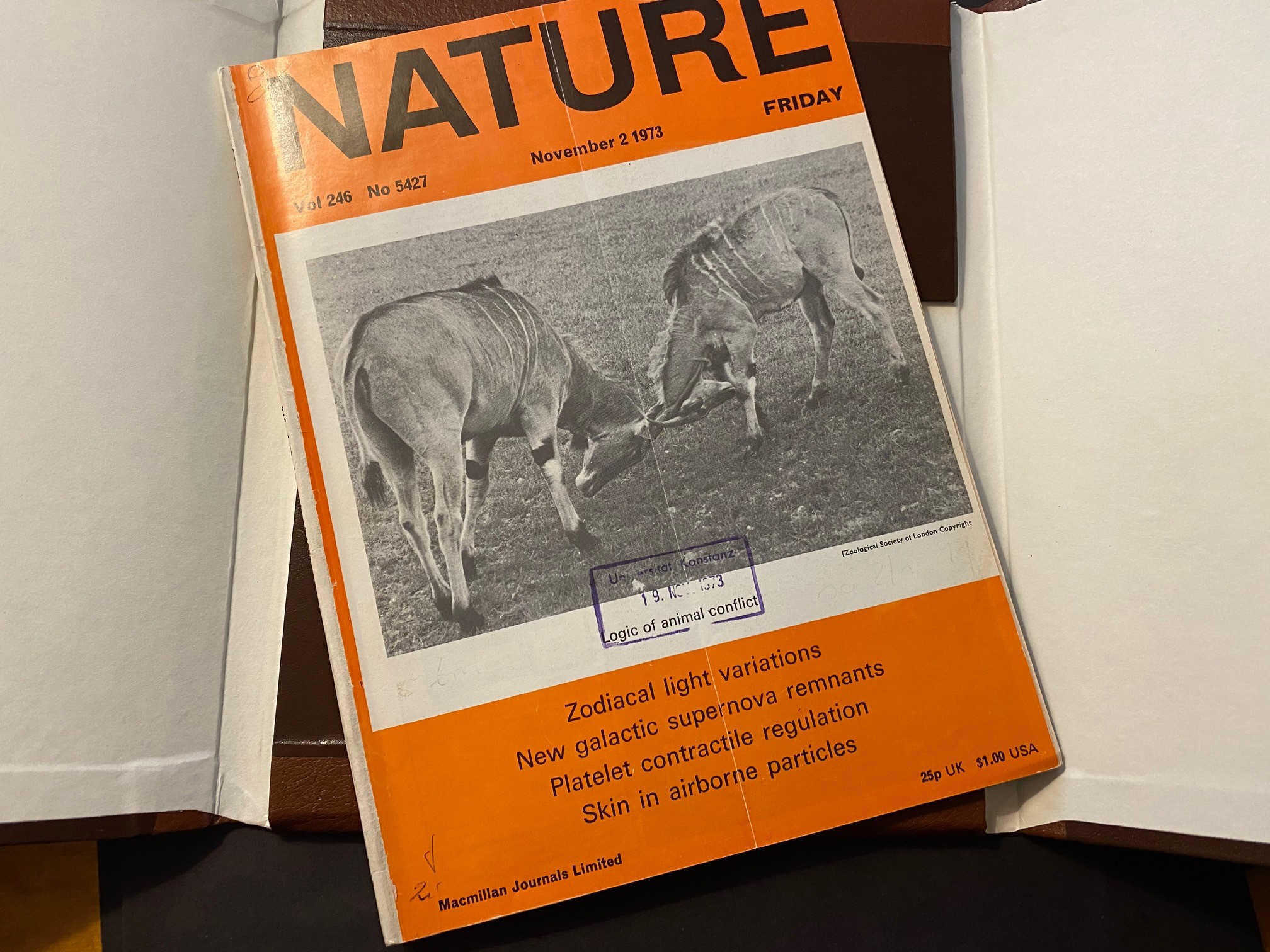
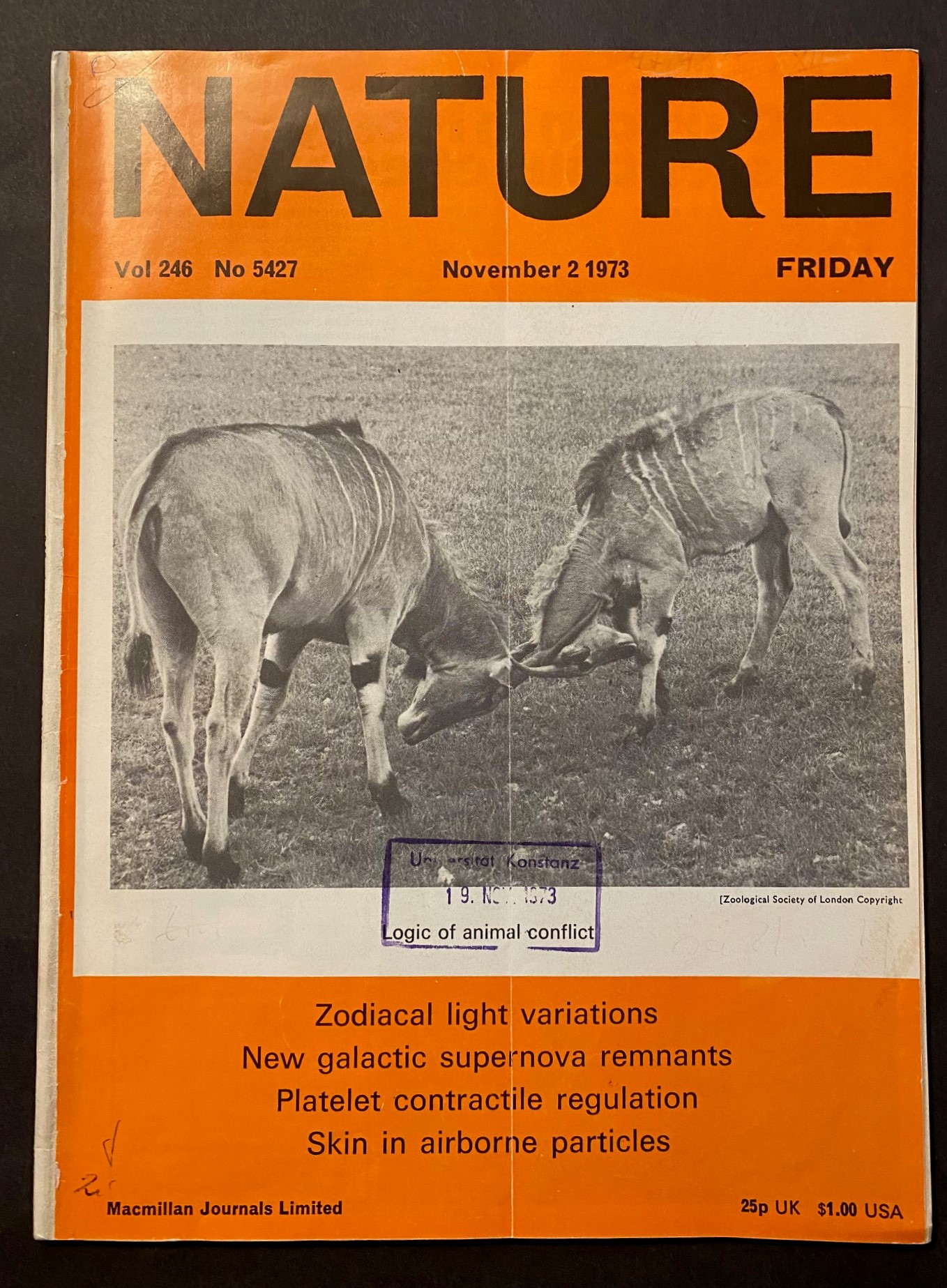
    John Maynard Smith and G. R. Price. “The Logic of Animal Conflict” in Nature vol 246  No. 5427, pp. 15-18, in the issue for November 2 1973). In the original front wrapper, with a blank rear wrapper expertly added. There is one old vertical fold that runs through the issue, and one rubber stamp on the front cover. Other than these notes, a VG copy. Housed in a lovely leather-backed pamphlet case (in Very Fine condition). $500

    This is the influential (6,000+ citations) paper about the “hawk-dove game,”  the introduction of the concept of “Evolutionarily stable strategies.”

    IMG_4108
    “Evolutionary game theory (EGT) is the application of game theory to evolving populations in biology. It defines a framework of contests, strategies, and analytics into which Darwinian competition can be modeled. It originated in 1973 with John Maynard Smith and George R. Price’s formalisation of contests, analysed as strategies, and the mathematical criteria that can be used to predict the results of competing strategies [the paper offered]. The first game that Maynard Smith analysed is the classic hawk dove[a] game. It was conceived to analyse Lorenz and Tinbergen’s problem, a contest over a shareable resource. The contestants can be either a hawk or a dove. These are two subtypes or morphs of one species with different strategies. The hawk first displays aggression, then escalates into a fight until it either wins or is injured (loses). The dove first displays aggression, but if faced with major escalation runs for safety. If not faced with such escalation, the dove attempts to share the resource.”

    IMG_4106
    IMG_4106

    “…John Maynard Smith brought about the realization of the fallacy of the good of the species idea. This brought back the focus to individual selection and forced biologists to re-think evolutionary explanations for many apparently altruistic behaviours seen in animals. Maynard Smith took up the challenge of providing an explanation for animal conflicts from the individual rather than the species point of view. Along with George R Price he used game theory, originally developed by economists, to formulate the concept of Evolutionarily Stable Strategies (ESS). ESS is a strategy that is evolutionarily stable because it is unbeatable by any other strategy. Game Theory and the concept of ESS have since been applied with success to a variety of situations including foraging, cooperation, communication, sex ratios, parent-offspring conflict, predator-prey interactions and so on.” –Indian Academy of Science, Resonance, November 2005

    Richard Dawkins, in his The Selfish Gene, credits Maynard Smith’s work as a ‘major stimulus that led me to […] write the whole book.’  “It is in chapter 5, ‘Aggression: stability and the selfish machine’ where you can read Dawkins’ description of evolutionary game theory – without any of the maths that was in the original paper of Maynard Smith and Price.”–Encyclopedia Britannica

    ·Posted by :

    ·in:

  • Grant’s Massive Calculating Engine, 1874.

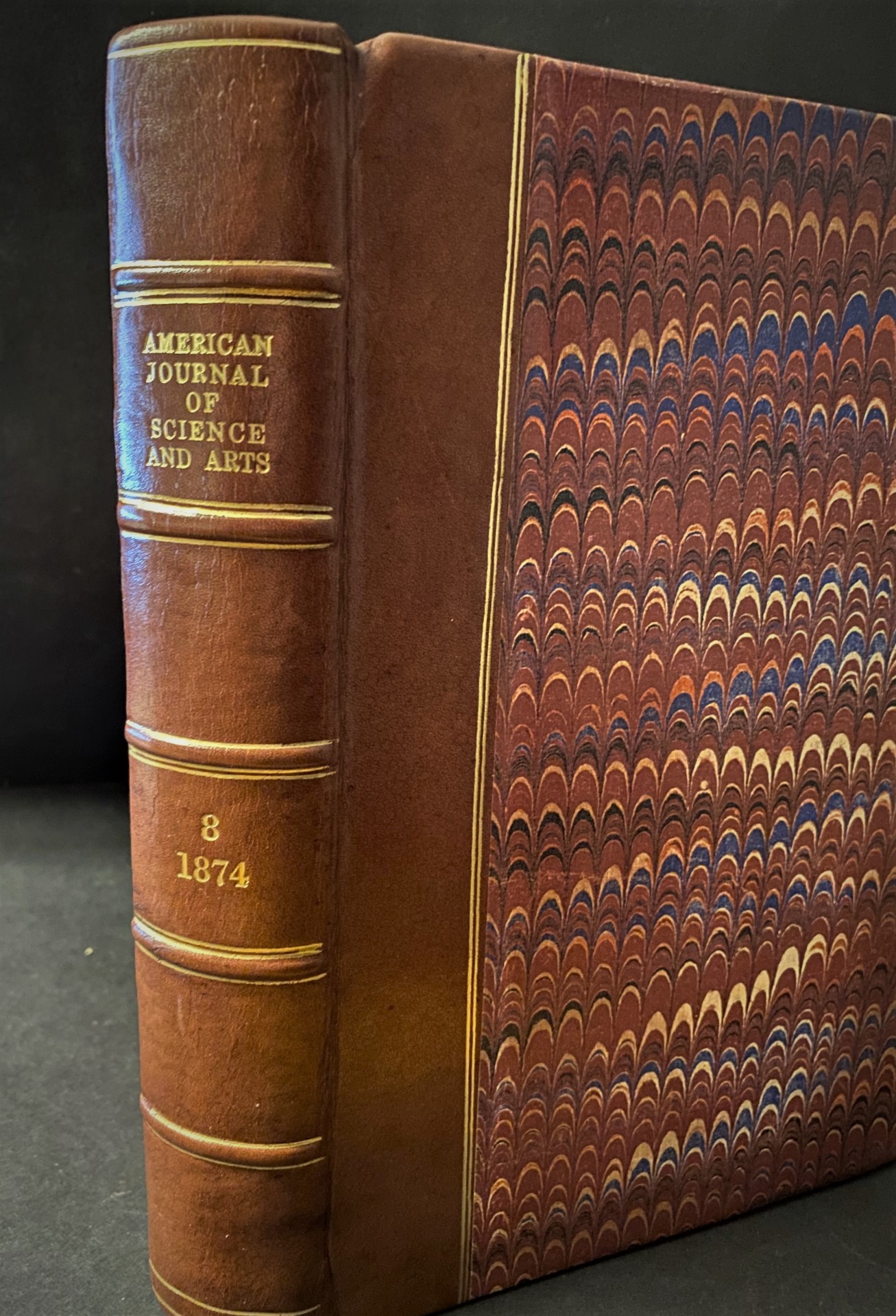
    IMG_4072GRANT, George (1849-1917) Computer Pioneer. “A New Calculating Machine”, pp 277-284, in American Journal of Science and Arts, edited by James Dana and Benjamin Silliman, third series, vol VIII (whole number 108) nos. 43-48, July-December 1874. New Haven, 1874. viii, 484pp, 7 plates. Beautifully rebound in half-leather with marbled boards, with raised bands stamped on their horizontals. VG copy. The first three pages are a review of the history of calculating machines while the last four are a description of how Grant’s machine functions. $600

    Condition—there are a few old bumps in the text at the Grant article, otherwise this volume is in excellent condition.

    “While a student at Harvard, Grant worked on the problem of inventing a mechanical calculator. With the encouragement of his professor, Oliver Wolcott Gibbs, he set about improving on the work of Babbage and Per Georg Scheutz. He published this work in the American Journal of Science and Arts (see below), and was awarded two patents as a student. Shortly after college, Grant designed and built two calculating machines that were displayed at the Centennial Exposition held in Philadelphia in 1876. One of them, known as a difference engine, was eight feet long and five feet high, and weighed 2,000 pounds. It may have been the largest calculator ever built (pictured below). The other, known as the “Centennial Model”, is among the Smithsonian collection of Grant’s inventions. The Smithsonian Institution has nine of Grant’s inventions in its collection in Washington, D.C. Grant’s calculating machine business was known as “Grant Calculating Machine Company of Lexington, Mass”.

    Although Grant’s sales of calculating machines were modest (125 of the “Rack and Pinion Model” were sold commercially), his machines were considered sturdy and reliable. Grant’s calculators won a number of awards: the Centennial Medal, the Scott Medal of The Franklin Institute, and the Gold Medal of the Massachusetts Mechanics Association.”–Wikipedia

    “Grant is reported to have invented this machine (so called Centennial Model) while a student at the Lawrence Scientific School of Harvard University (between 1870 and 1872). This machine was reported to be intended for us in counting houses, insurance offices, etc., and was described as a smaller instrument for common operations in multiplication, division, etc. It is a foot in length by half as much in height and width, weighs twenty pounds, and contains less than 400 pieces, less than 75 of which are working parts. It takes numbers up to nine decimal places. According to an exhibition report, this machine, or arithmometer, successfully rivals the well-known one of Colmar.” History Computer site/the History of Computers.

    “The American engineer and entrepreneur George Barnard Grant (1849-1917) is a notable figure in the world of mechanical calculator. He was the creator of several all-purpose calculators, but also of a magnificent Difference Engine. As a whole, Grant devised four different calculating machines: three all-purpose calculators, and a sophisticated machine for computing tables. While in Lawrence Scientific School of Harvard University, in 1869, George Grant got interested in calculating machines while he was computing a table for excavations and embankments, but he soon became discouraged with his initial efforts when he realized the subject was more difficult than he had anticipated. Thus between 1870 and 1872 he devised firstly a simple calculator, and later continued with several more complex calculating machines. All his devices were well designed and workable machines, and although none of them achieved market success, they fully deserve our attention.” Computer Timeline online

    ·Posted by :

    ·in:

Recent Posts

Archives

Categories