A Daily History of Holes, Dots, Lines, Science, History, Math, Physics, Art, the Unintentional Absurd, Architecture, Maps, Data Visualization, Blank and Missing Things, and so on. |1.6 million words, 7500 images, 4.9 million hits| Press & appearances in The Times, Le Figaro, Mensa, The Economist, The Guardian, Discovery News, Slate, Le Monde, Sci American Blogs, Le Pont, and many other places… 5000+ total posts since 2008.

Book Category: Chemistry

  • One of the Earliest Efforts on Global Warming (1785)

    FRANKLIN, Benjamin. “Meteorological Imaginations and Conjectures” in Memoirs of the Literary and Philosophical Society of Manchester, Warrington, printed by W. Eyres for T. Cadel in London, 1785. xxiii, (I), 473, (12)pp plus 3 engraved plates (two folding); viii,514,(12), plus 2 folding plates. Vellum-like spine, marbled boards; paper spine labels professionally replaced; text edges untrimmed. Original (or 18th c) owner’s name written in ink on title page of each volume. Lovely copies of this scarce title. VG condition. SOLD
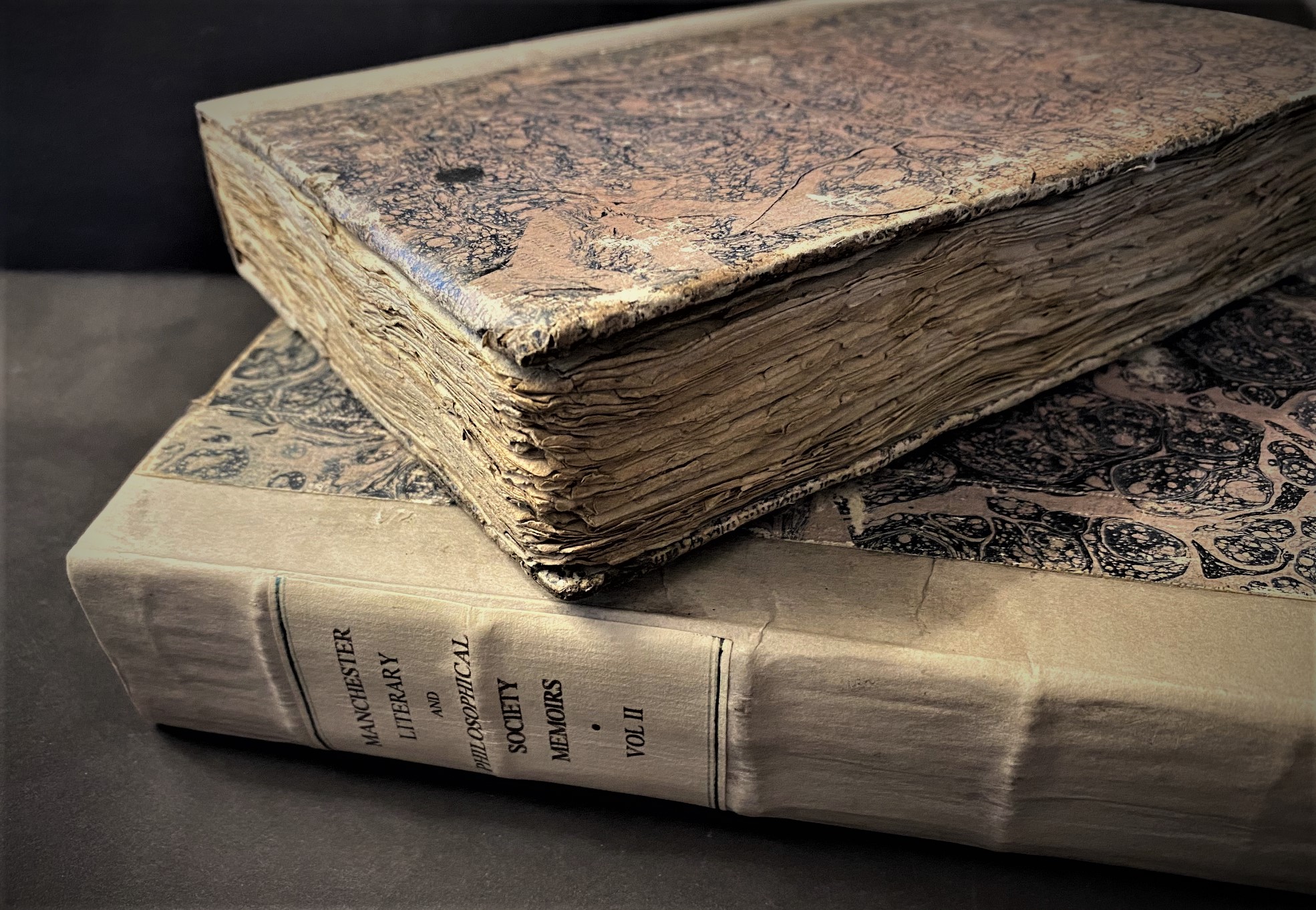
    IMG_4139The Franklin contribution occupies 357-361.

    Franklin also contributes the following: “On the Different Quantities of Rain which Fall, at Different Heights, over the same spot of ground, with a letter from Benjamin Franklin…by Thomas Percival”, pp 106-113, with the extract from the Franklin letter on pp 110-113.

    According to the American Institute of Physics website pages on the “Discovery of Global Warming”, this is the earliest paper in the field. (It is the first listed in their chronological bibliography, and is the only 18th century notation, and is also only one of seven papers listed printed before 1850.)

    “The “dry fog” that blanketed much of Europe during the summer of 1783 had occasioned much scientific speculation, but its cause was as yet unknown. In this paper, written nearly a year after the fog first appeared, Franklin was less concerned with its cause (though he did propose a theory that would turn out to be correct) than with its effect, proposing a connection between the summer’s fog and the exceptionally cold winter that followed.–” National Archives Founders online
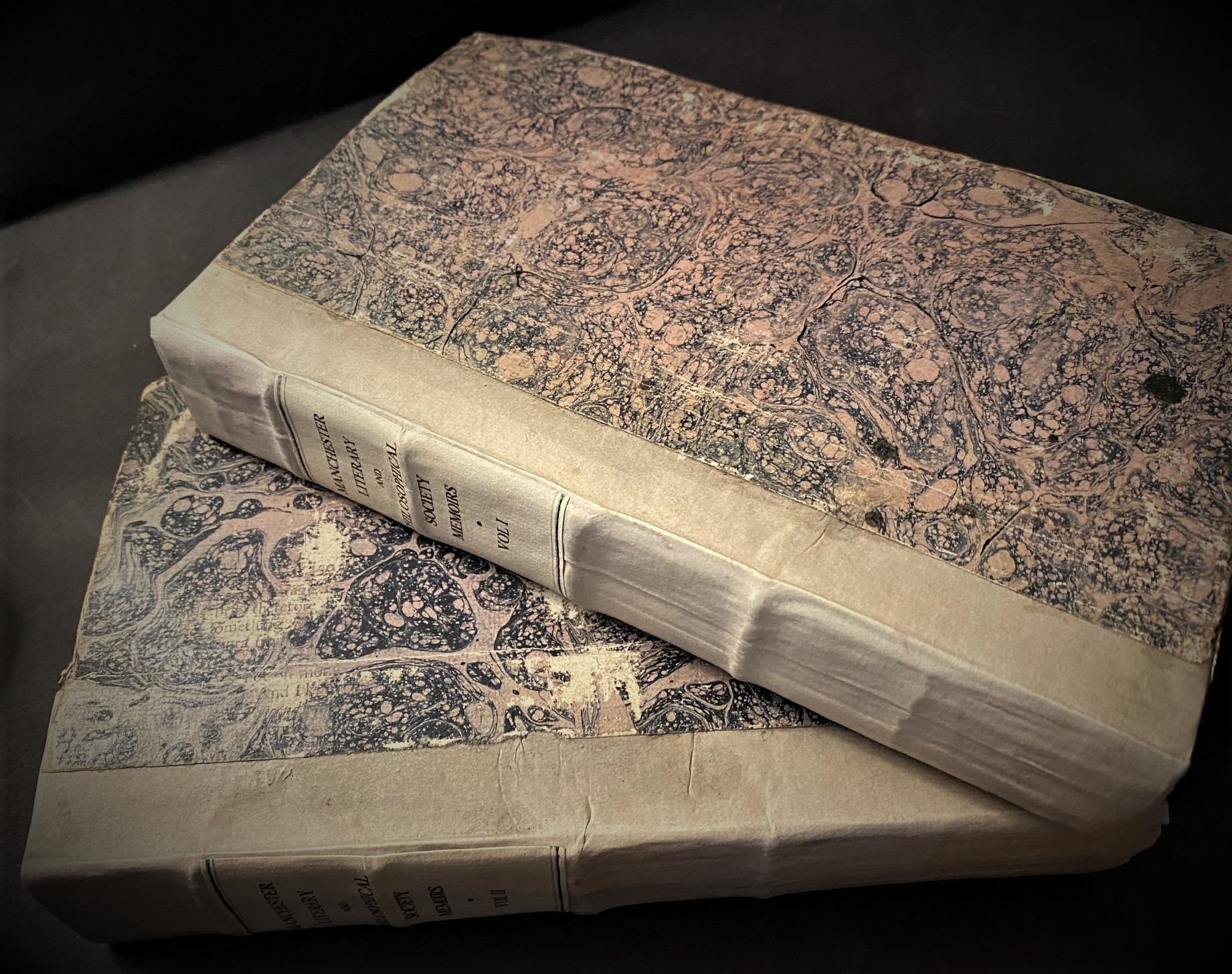
    IMG_4141

    “In 1783 a volcanic fissure in Iceland erupted with enormous force, pouring out cubic kilometers of lava. Layers of poisonous ash snowed down upon the island. The grass died, and three-quarters of the livestock starved to death, followed by a quarter of the people. A peculiar haze shadowed western Europe for months. Benjamin Franklin, visiting France, noticed the unusual cold that summer and speculated that it might have been caused by the volcanic ‘fog’ that visibly dimmed the sunlight” American Institute of Physics online

    “During several of the summer months of the year 1783, when the effect of the sun’s rays to heat the earth in these northern regions should have been greatest, there existed a constant fog over all Europe, and great part of North America.” He observed the effect the fog had on the sun’s rays: “They were indeed rendered so faint in passing through it, that when collected in the focus of a burning glass, they would scarce kindle brown paper. Of course, their summer effect in heating the earth was exceedingly diminished.”

    “He drew some important conclusions: ‘Hence the surface was early frozen. Hence the first snows remained on it unmelted, and received continual additions. Hence the air was more chilled, and the winds more severely cold. Hence perhaps the winter of 1783-4 was more severe, than any that had happened for many years.’ Franklin was arguably the first American scientist to recognize the sensitivity of climate to changes in radiative forcing, and to propose that the Earth can respond in a way that reinforces the change (now known as ice-albedo feedback).
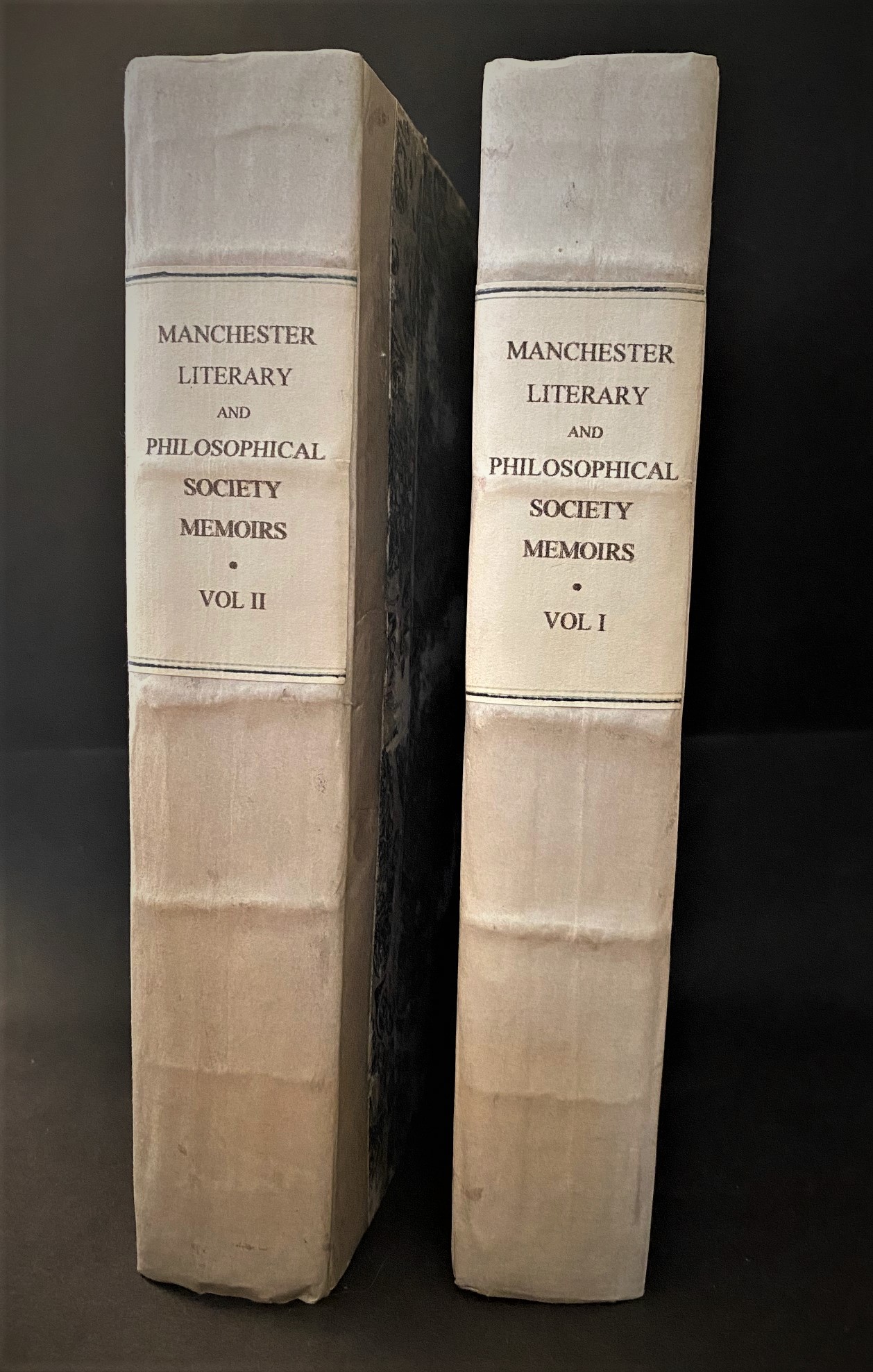
    IMG_4140

    “Franklin’s logic is clear. Changes in the atmosphere’s radiative properties can affect weather and climate. The response of the Earth can amplify those changes. This can lead to problems, even if the details of the causes are uncertain. Resources should be spent on research to understand and predict changes to anticipate and avoid negative consequences to the extent we are able. –Mark Boslough, Contributor, HuffPost, “Ben Franklin, Climate Science, and National Security”, 2017

    Many other papers of interest can be found in these volumes as well.
    ·Posted by :

    ·in:


  • On Naming Clouds: Luke Howard, 1815

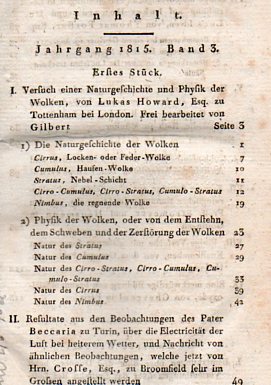
    HowardHOWARD, Luke. Versuch einer Naturegeschichte und Physik der Wolken, von Lukas Howard…in Annalen der Physik, series I/51, band 3- (vi), 442pp, 6 plates. The Howard article appears on pp 1-42. Also included in the volume: Eine Probe von Lukas Howard’s meteorologischen Monatsberichten”, pp 66-72

    And with:Thomas Forster, pp 73-78 “Einigemrteorlogische Beobachtungen in Beziehung auf Lukas Howard’s und De Luc’s ideen.

    Provenance: (a) Provinzial Gewebbschele zu Aachen, then (b) Deutsche Akademie der Luftfahrtforschung, and then (c) Wright Field Library (Dayton, Ohio), and finally (d) the Library of Congress. There are ownership rubber stamps on text block page edge at top and bottom, a stamped gilt title on the bottom of the spine, and two scant stamps on the contents page, and that’s it. Very nice, tight, fresh copy.  $350

    It is interesting to note that this very important work wasn’t really discussed in the German language for another dozen years, appearing in the Annalen der Physik (series I volume 51) in 1815.  It is also interesting to see that–unlike the English original–there are no illustrations, which in some sense provide a scent of defeat in trying to display these groundbreaking classification ideas. The paper does present the names and descriptions of clouds (as you can see in the attached pic of the table of contents).

    Also contains works by H. Davy (Ueber die Ursaxhe der Farben) and another dozen or so contributors.

    ·Posted by :

    ·in:


  • Dalton John Four Papers 1 Versuche ÜBer WäRme KäLte Die Bei Mechanischer Verdichtung Und VerdüNnung Der Luft Entste

    DALTON, John. Four papers: (1) Versuche über Wärme Kälte, die bei mechanischer Verdichtung und Verdünnung der Luft entstehen. (2) Ueber die Kraft der Flüssigkeiten, Wärme zu leiten, in Beziehung auf des Grafen von Rumford siebenten Essay. (3) Ueber den absoluten Nullpunkt der Wärme und verwandte Betrachtungen. (4) Versuche über die Ausdehnung des Wasser’s durch Wärme. All in Annalen der Physik, Series I, vol 14, (viii), 512pp, 5 plates (the last of which is provided in facsimile). Halle, Rengerschen Buchhandlung, 1803. The volume is bound in black half-cloth and very dark green/black marbled boards.

    Provenance exlibris (a) Provinzial Gewebbschele zu Aachen, then (b) Deutsche Akademie der Luftfahrtforschung, and then (c) Wright Field Library (Dayton, Ohio), and finally (d) the Library of Congress. There are ownership rubber stamps on text block page edge at top and bottom, a stamped gilt title on the bottom of the spine, and two scant stamps on the contents page, and that’s it. Very nice, tight, fresh copy. 

    Each section (stuck 5-8) is offered with their original wrappers bound in (save section 8 which lacks the rear wrapper). The original wrappers for the AdP are uncommon. $750

    Four early and significant papers by Dalton (their first appearance in German) occupying pp 101-11, then pp 184-198, then pp 287-292, an then lastly pp 293-96.

    “Three papers that Dalton read to the Manchester Literary and Philosophical Society in 1799 and 1800 (in which year he became the Society’s secretary) show how much the question of water vapor continued to exercise him. In the first paper he discusses the balance in nature between rain, dew, river-water runoff, and evaporation. In the course of this discussion, he provided the earliest definition of the dew point. Then followed two competent, but more pedestrian, papers on heat, in which his firm belief in a fluid of heat is well-displayed and his complete acceptance of the particular caloric theory of William Irvine an Adair Crawford is apparent.  The really dramatic development came in the summer of 1801. By 14 September, Dalton was confident enough in his ideas to write to William Nicholson’s recently established monthly Journal of Natural Philosophy, Chemistry and the Arts. It showed no hesitation in publishing his “New Theory of the Constitution of Mixed Aeriform Fluids, and Particularly of the Atmosphere.”–Dictionary of Scientific Biography online.

    ·Posted by :

    ·in:


  • Mendeleev on the Discovery of Gallium (1876)

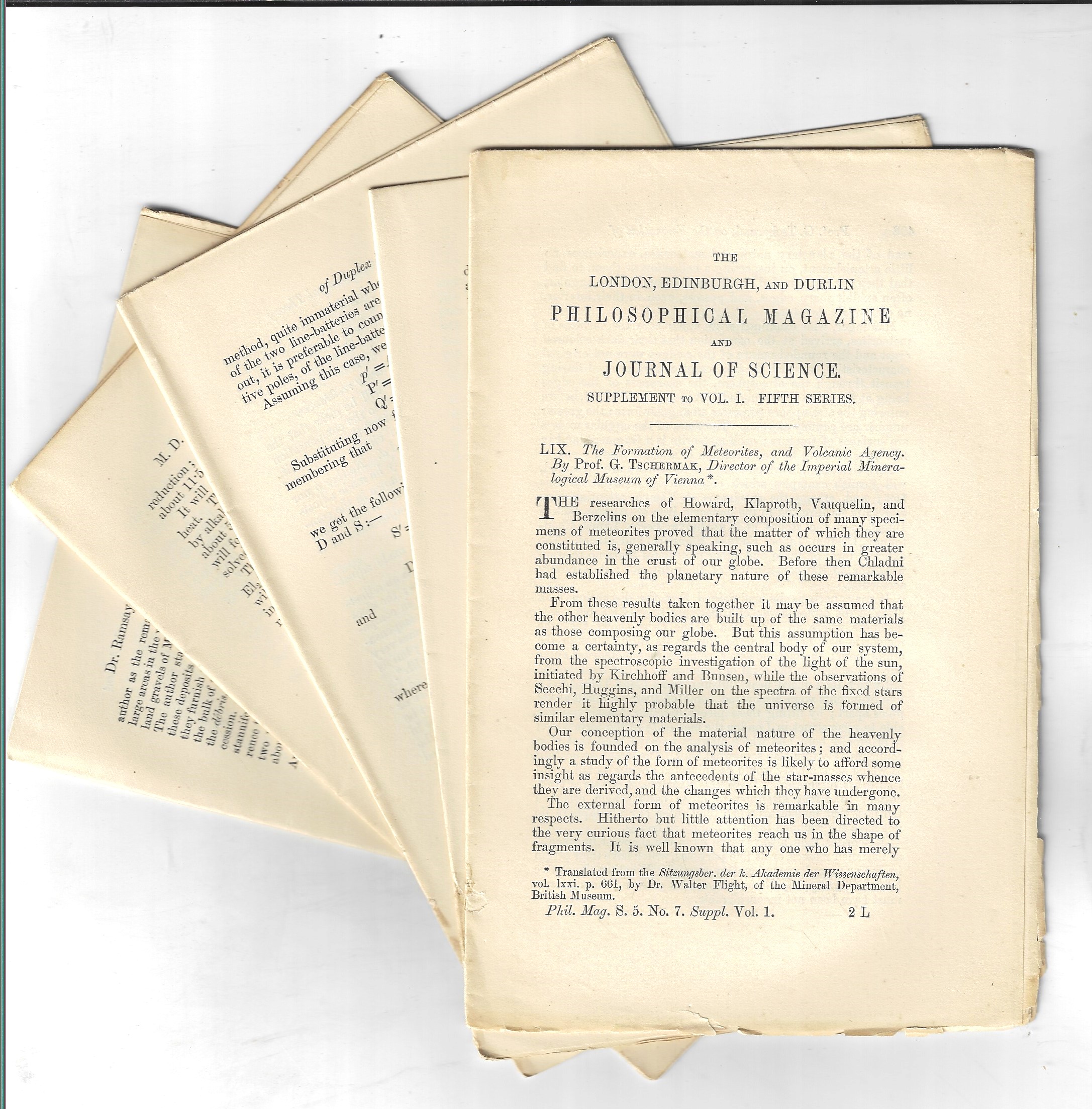
    MENDELEEV (MENDELEJEFF), Dmitri. "Remarks on the Discovery of Gallium" in The London, Edinburgh, and 
    Dublin Philosophical Magazine and Journal of Science,
    London, 1876. Supplement to vol I, fifth series, 1876,
    pp 542-546.
    Offered in the original unbound parts, pp (497)-576, in the five original quires, plus a sixth being the table of contents
    for the entire 576pp volume. Very unusual to my experience. Unopened and uncut. Fine condition. $450
    This is the first appearance in English of this work, translated from the French by Pattison Muir from “Remarques
    a propos de la devouverte du gallium; par M.D. Mendeleeff” and published in the
    Comptes Rendus. de l'Academie
    des Sciences,
    22 Novembre 1875.

    Mendeleev Gallium
    “The discovery of gallium has great significance to Mendeleev’s development of the periodic table as it was the first new element discovered since Mendeleev’s 1869 table. In 1871 Mendeleyev had prepared a table of known elements leaving gaps for those “elements yet to be discovered”, one of these being eka-aluminium. Four years later, a Frenchman Paul Emile François Lecoq de Boisbaudran discovered this element spectroscopically (two violet lines) during an examination of a zinc blende from the Pyrenees. Lecoq’s newly discovered element was found to have an atomic weight of 69 and appeared to have the properties that Mendeleev had predicted for eka-aluminium…gallium’s most important modern day use is in electronic devices. Semiconductor use is now almost the entire world market for gallium. However, new uses in alloys and fuel cells continue to be discovered…”–Luke McGuiness, Royal Australian Chemical Institute, “Gallium”.

    Mendeleev writes on the prediction of “gallium” and the verification of the periodic table:
    “In 1869 I announced the following periodic law:  "The  properties of the simple bodies, as also the properties and 
    constitution of their combinations, are periodic functions of the atomic weights of the elements....Among the
    different applications of that law I shall cite only the following :
    “1. This law constitutes the basis of a complete systematic classification of the elements...It ought to be remarked
    that, previous to the discovery of the periodic law, it was not possible to predict the existence or to foretell the
    properties of undiscovered elements...”
    “M. Lecoq de Boisbaudran has discovered, by means of spectral analysis, the existence of a new element in the
    blende of Pierrefitte (Pyrenees) ; to this element he has given the name of gallium. The manner of its discovery,
    the process for its separation (precipitation by sulphuretted hydrogen before zinc), and certain of its properties
    (precipitation by barium carbonate, solubility of the hydrate in ammonia, degree of volatility, &c), make it
    probable that the new metal is no other than eka alu-minium...If subsequent researches confirm the identity
    of the pro- perties of gallium with those which I have pointed out as belonging to eka aluminium, the discovery
    of this element will furnish an interesting example of the utility of the periodic law. Let us hope that the
    discovery of eka silicium, Es = 72, Es0 2 , the probable properties of which I have detailed in Liebig's
    Annalen, vol. viii. (Suppl.) p. 171, will not be long delayed.”--from this paper.

    “The discovery of gallium has great significance to Mendeleev’s development of the periodic table as it was the first new element discovered since Mendeleev’s 1869 table. In 1871 Mendeleyev had prepared a table of known elements leaving gaps for those “elements yet to be discovered”, one of these being eka-aluminium. Four years later, a Frenchman Paul Emile François Lecoq de Boisbaudran discovered this element spectroscopically (two violet lines) during an examination of a zinc blende from the Pyrenees. Lecoq’s newly discovered element was found to have an atomic weight of 69 and appeared to have the properties that Mendeleev had predicted for eka-aluminium…gallium’s most important modern day use is in electronic devices. Semiconductor use is now almost the entire world market for gallium. However, new uses in alloys and fuel cells continue to be discovered…”–Luke McGuiness, Royal Australian Chemical Institute, “Gallium”.

    See also: Early Responses to the Periodic System, edited by Masanori Kaji, Helge Kragh, Gabor Pallo.

    ·Posted by :

    ·in:


  • Tyndall’s Experiments with Greenhouse Gases (1861-2)

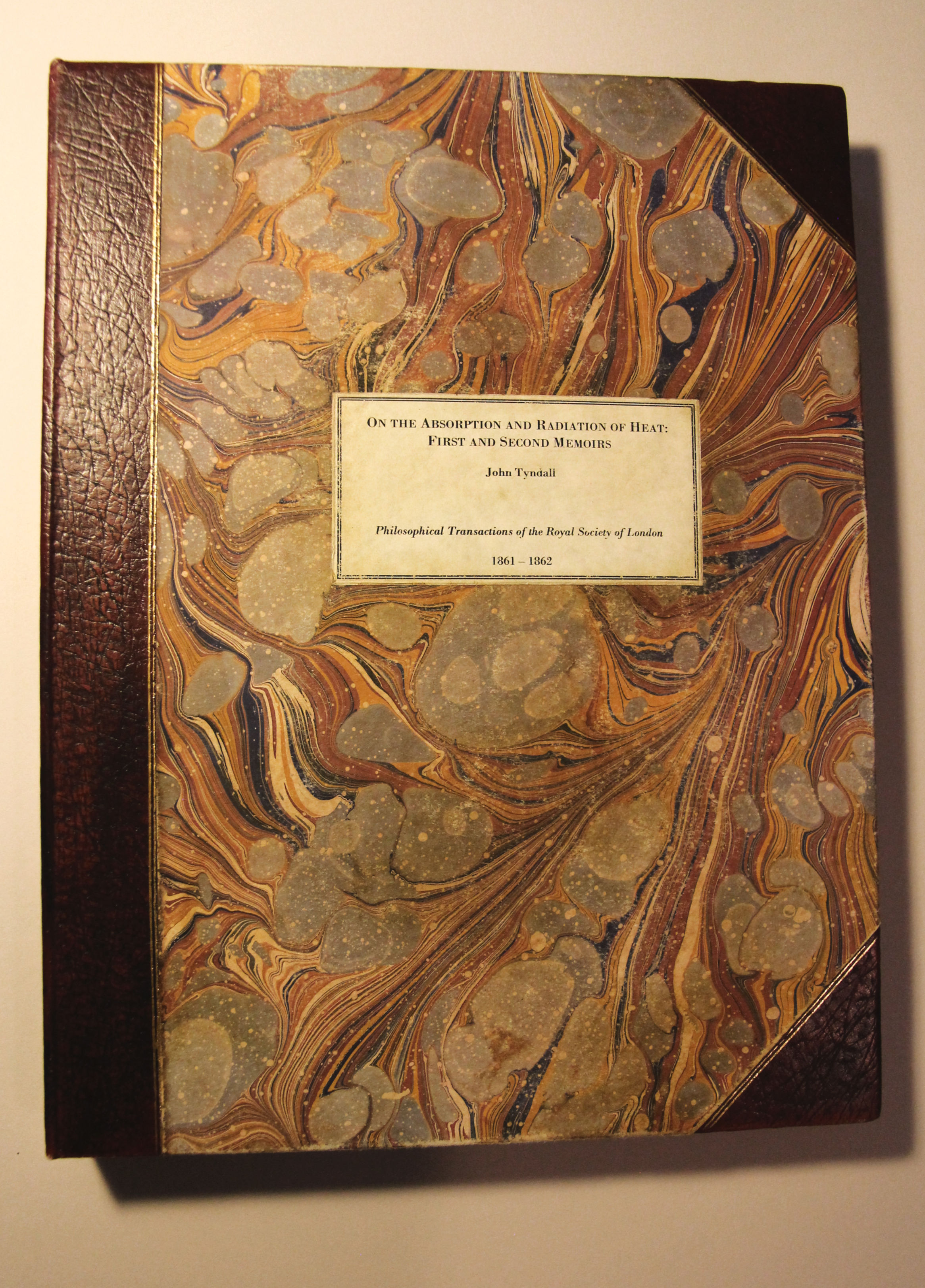
    John Tyndall. Two papers, as follows:

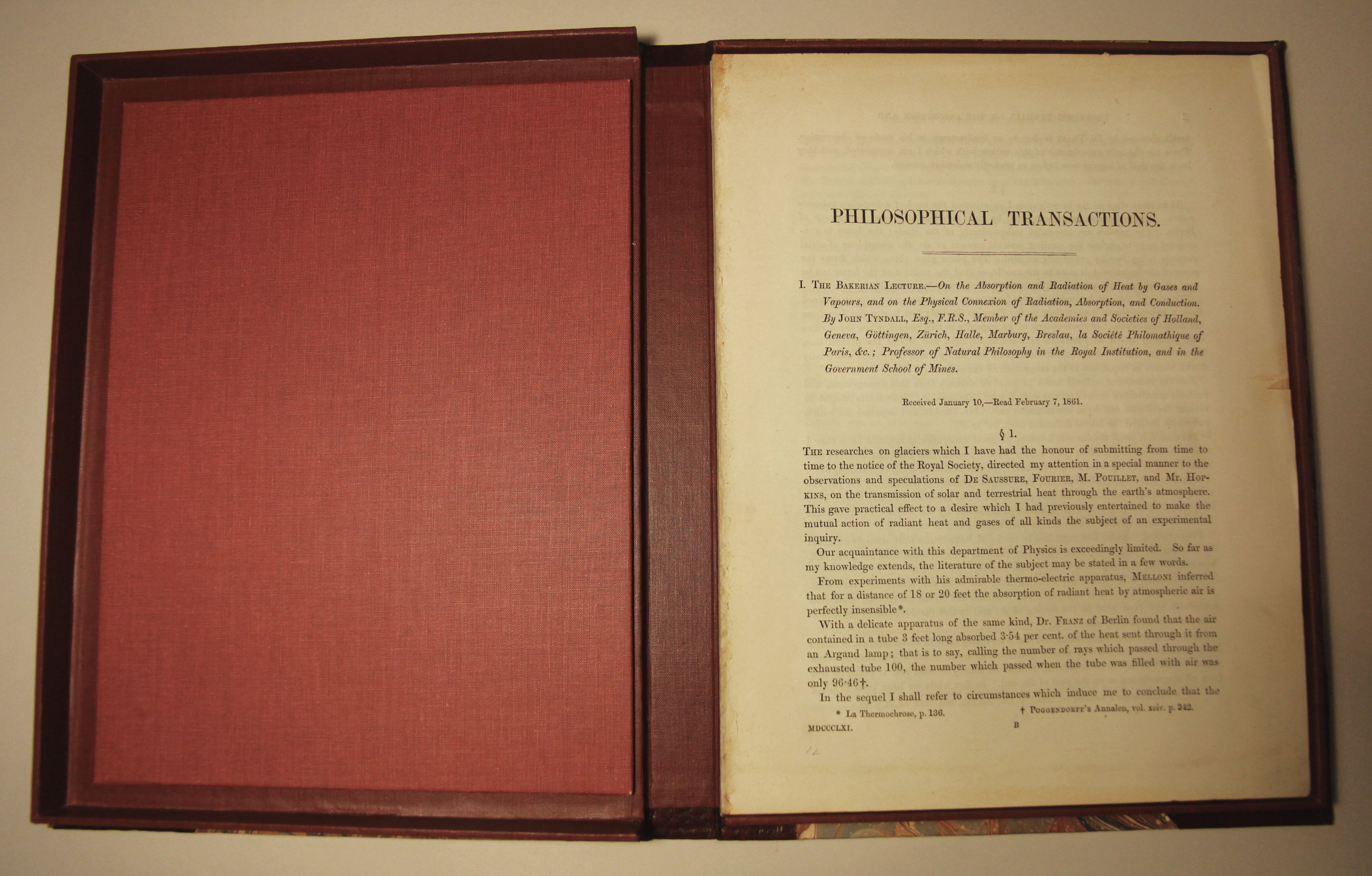
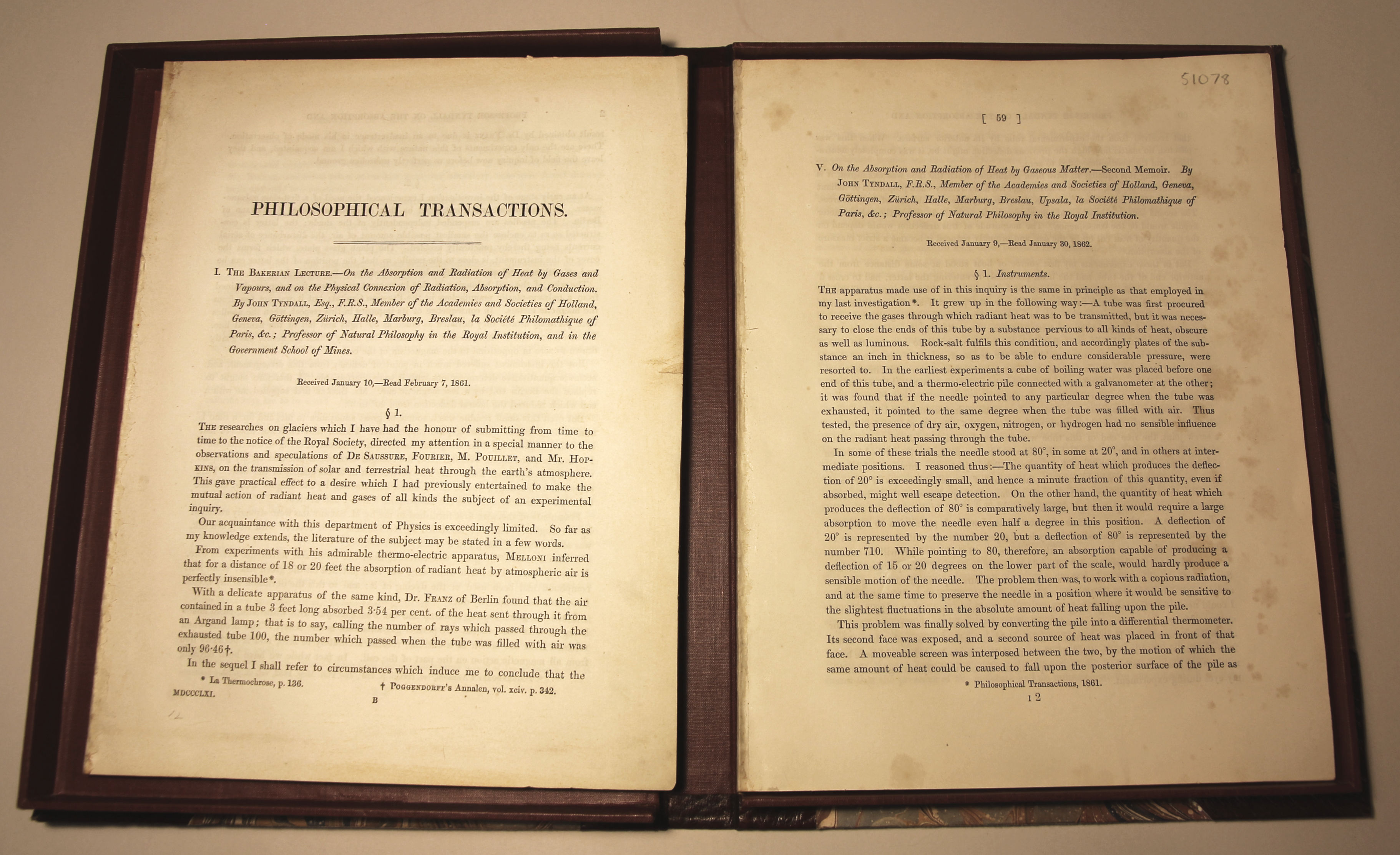
    “The Bakerian Lecture: On the Absorption and Radiation of Heat by Gases and Vapours, and on the Physical Connexion of Radiation, Absorption and Conduction” , in Philosophical Transactions of the Royal Society 151, pp 1-36, 1861.

    • And with:

    “On the Absorption and Radiation of Heat by Gases and Vapours—Second Memoir”, Philosophical Transactions of the Royal Society of London 152 pp. 59-97, 1862.

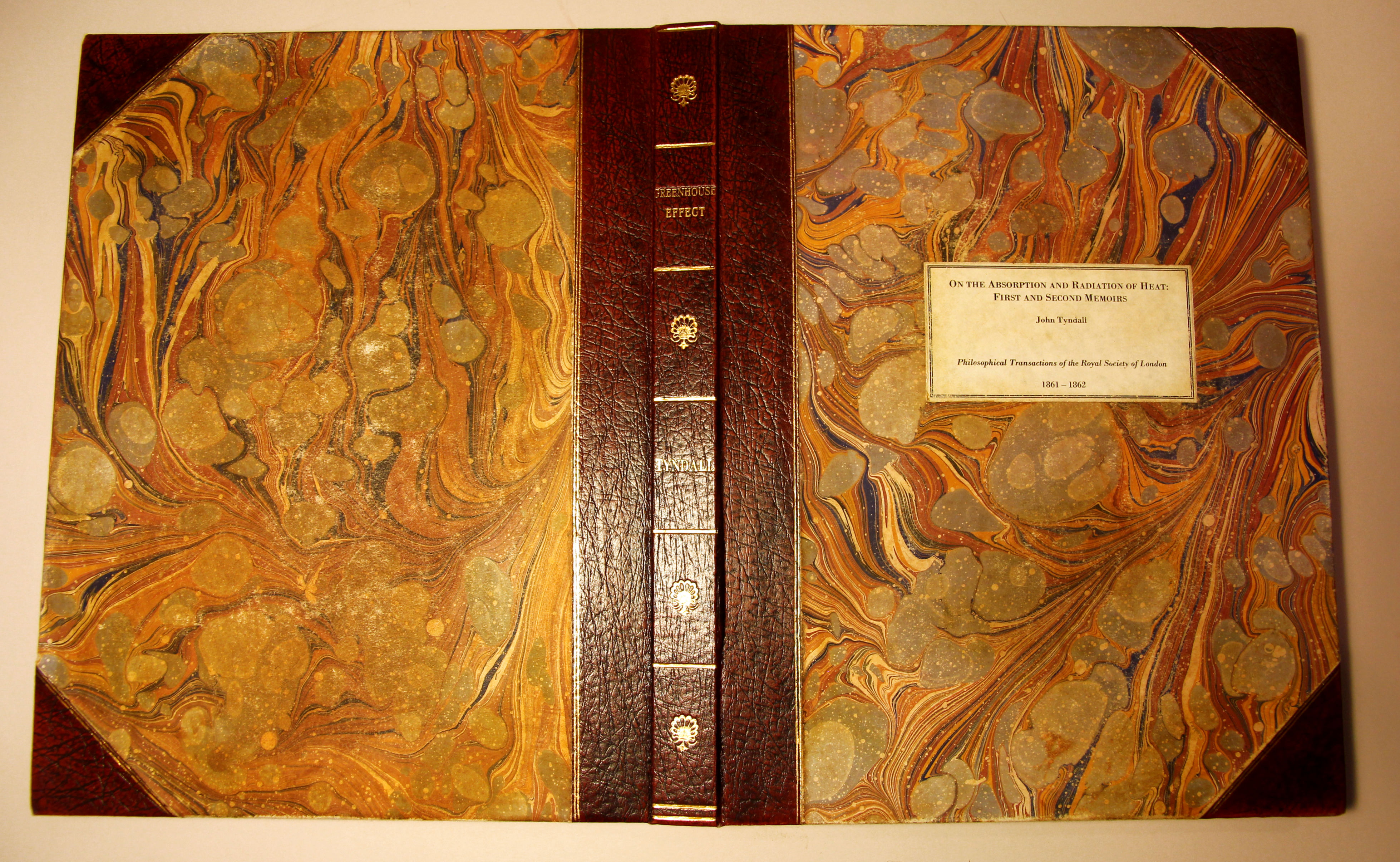
    Both papers, extracted from the bound volume, and housed in a luxurious clamshell box, bound in calf-backed paper covered boards, leather corners. Lovely, and in Very Fine condition. $1100


    Tyndall greenhouse _2_

    “Tyndall described the most important findings and conclusions from his greenhouse gas experiments in [these two] papers…John Tyndall was an English physicist best known for his study of thermal radiation. In 1852, Tyndall developed the first “ratio spectrophotometer” and used it to test the heat absorption of gases. He found that only a few gases, water vapor and a few trace gases (CO2 and hydrocarbon vapors like methane and ozone), absorb infrared radiation to any measurable degree. He also found that these gases also re-emit this heat, creating the reflection/absorption/re-reflection cycle that causes the greenhouse effect.”–David Wenner, History of Physics Collection

    Tyndall greenhouse _2_

    “The enormous range of Tyndall’s inquiries reflected many different intellectual influences. An explicit discussion of these influences in their context has yet to be undertaken. We lack any comprehensive review of Tyndall’s work on optical and crystalline structure; on magnetism, radiation, and mountaineering; and on the relationship between his several research programs. Tyndall is remembered chiefly for his efforts to verify the high absorptive and radiative power of aqueous vapor; to measure the absorption and transmission of heat by many different gases and liquids; to explain the selective influence of the atmosphere on different sounds; and to establish the principle of “discontinuous heating”–Complete Dictionary of Scientific Biography, online

    Tyndall greenhouse _2_

    “His work suggested the possibility that by altering concentrations of these gases in the atmosphere, human activities could alter the temperature regulation of the planet. Tyndall could forsee such a possibility already in 1861. Changes in the amount of any of the radiatively active constituents of the atmosphere may have produced all the mutations of climate which the researches of geologists reveal (Tyndall, 1861), although he was a long way from developing a coherent account of how human actions could induce significant changes in climate on much shorter timescales.”–Mike Hulme, “On the origin of ‘the greenhouse effect’: John Tyndall’s 1859 interrogation of nature”, in Royal Meteorological Society, 27 April 2009.

    Tyndall greenhouse _2_

    ·Posted by :

    ·in:


  • Typed Letter by Glenn Seaborg (1970)

    Glenn Seaborg.

    Typed/printed letter, signed (“Glenn”), dated March 20, 1970. 3pp, with cover letter from the recipient acknowledging Seaborg’s letter.

    Glenn Seaborg (1912-1999), Nobel Prize recipient in Chemistry (1951 with Ed McMillan) and at the time of signing this document, chair of the USAEC. TLs signed by Seaborg to Carly Haskins (president of the Carnegie Institution at the time). This is a 3pp review of the AEC Annual Report to Congress for 1969.  Fine copy.  $200

    ·Posted by :

    ·in:


  • Humphrey Davy and Thomas Malthus (1811)

    Edinburgh Review, or Critical Journal for June 1826…September 1826, Edinburgh, printed by D. Willison for Archibald Constable, iv, 530pp, volume 18, nos. 35+36, 1811.  8.25×5.5”. Rebound in modern cloth. Very tidy, in FINE condition. The Edinburgh Reivew was a sort of TLS and NYTBR for its day, with very long and penetrating articles reviewing books and reports on a very wide range of topics. It was also one of the most popular journals for the 1800-1830 period. $250

    For example, for this volume we have:

    DAVY, Sir Humphrey. “The Bakerian Lecture—On some of the Combinations of Oxymuriatic Gas and Oxygene, and on the Chemical Relations of these Principles to inflammable Bodies. “ And “On a Combination of Oxymuriatic Gas and Oxygen Gas….from the Philosophical Transactions, 1811, Part I”. Pp 471-480.  The new gas that Davy names in this paper is “chlorine or chlorine gas” which appears on p. 475.  (In the August, 1811 issue, No. 36.) 

    “Gay-Lussac and Thenard had simultaneously been experimenting on this subject and had concluded that it would be possible to argue for the elementary nature of oxymuriatic acid; but they resisted Davy’s arguments when he put them forward. He declared that oxygen was never produced in reactions in which oxymuriatic acid was concerned unless water was present, and concluded that no substance had a better claim to be regarded as undecomposed. Applying Lavoisier’s criterion more rigidly than Lavoisier, he placed oxymuriatic acid among the elements as an analog of oxygen and gave it the theory-free name “chlorine.” With the demolition of the scaffolding of the oxygen theory of acids, the view that all exothermic reactions were oxidations, and the caloric theory, Lavoisier’s revolution was complete; and Davy’s chemical career, to all intents and purposes, was over.”–DSB online

    With:

     (Malthus, Thomas Robert, though written anonymously.) “Review of the Controversy respecting the High Price of Bullion; A short Investigation of the alleged superfluous Issue of Bank Notes, and the unſavourable State of Foreign Exchanges, London, 1811; The Theory of Money; or a Practical Inquiry into the present State of the Circulating Medium; Deſence of Abstract Currencies, in Reply to the Bullion Report, and Mr Huskisson;  A Plain Statement of the Bullion Question, b Davis Giddy, Esq. M. P.;  The Expediency and Practicability of the Resumption of Cash Payments by the Bank of England, by J. L. Tavers.”All reviewed on pp 448-470.

    And with: Abraham Gottlob Werner, “New Theory of the Formation of Veins”; “Memoires sur le Grand Mastodonte…”;

    Robert Wilson, “Brief Remarks on the Character and Composition of the Russian Army, and a Sketch of the Campaigns in Poland” (30pp);

    “Essays on the Superstitions of the Highlanders of Scotland” (30pp).

    ·Posted by :

    ·in:


  • Saving the Lives of Miners Everywhere (1816)

    Davy, Sir Humphry, “On the Fire-Damp of Coal Mines, containing an Account of an Invention for Lighting the Mines, and consuming the Fire-Damp, without danger to the Miner” In: Edinburgh Review, or Critical Journal for June 1826…September 1816, Vol 26 No. Li, Edinburgh, printed by the Heirs of D Williams,1816; iv, 510pp, 8.25×5.5”. Rebound in modern cloth. Very tidy, in FINE condition. $250

    The Edinburgh Reivew was a sort of TLS and NYTBR for its day, with very long and penetrating articles reviewing books and reports on a very wide range of topics, as well as being one of the most popular journals in Great Britain for half a century.

    “On the Fire-Damp of Coal Mines, containing an Account of an Invention for Lighting the Mines, and consuming the Fire-Damp, without danger to the Miner” was published February 1816, was a review of the important discovery reported by Davy just weeks before in the Philosophical Transactions. Davy (1778-1829, knighted in 1812) already the most famous chemist in Great Britain, in 1815 attacked the subject of safety lighting in mines—this in response to ongoing problems and disasters in mine lighting igniting “fire-damp”. (“Fire-damp” or “damps”, perhaps deriving from the German “dampf” for “vapor”, correlates to a number of explosive gases found especially in bituminous coal mines, and particularly in reference to methane.)

    Following the catastrophic explosions at the Felling Colliery (May 25, 1812) in which 92 men and boys were killed there was a very general rush to concern all levels of society to find a solution to this dreadful problem. 

    The present (6pp) article appears in the Edinburgh immediately following Davy’s technical publication in the Phil Trans, for which, oddly enough, there is no reference, even though there are bits here and there in the ER that seem to me directly lifted from the PT paper.  In any event this must be about the earliest ‘popular” appearance announcing Davy’s very significant find. 

    The ER article is a fine summary of Davy’s experimental work—much deeper than I expected. It ends with a great series of compliments to Davy:

    “The result is as wonderful as it is important. An invisible and impalpable barrier made effectual against a force the most violent and irresistible in its operations—and a power that, in its tremendous effects, seemed to emulate the lightning and the earthquake—confined within a narrow space, and shut up in a net of the most slender texture—are facts which must excite a degree of wonder and astonishment, from which, neither ignorance nor wisdom can defend the beholder.”
    “When to this we add the beneficial consequences, and the saving of the lives of men, and consider that the effects are to remain as long as coal continues to be dug from the bowels of the earth, it may fairly be said, that there is hardly, in the whole compass of Art or Science, a single invention, of which one would rather wish to be the author. It is little that the highest praise, and that even the voice of national gratitude, when most strongly expressed, can add to the happiness of one who is conscious of having done such a service to his fellow men. We hope, however, that some distinguished mark of such gratitude will not be wanting, to a person, who, by disarming one of the most powerful agents of destruction, has so well merited a Civic Crown. In this, indeed, the honour of the giver is more interested than that of the receiver: The latter may not admit
    of much increase; but it nevertheless becomes those, who administer the affairs of a free People, to show themselves grateful for benefits conferred even on the humblesland most obscure of their fellow citizens.”

    Here’s the reference for Davy in the Philosophical Transactions, “On the fire-damp of coal mines, and on methods of lighting the mines so as to prevent its explosion. Read November 9, 1815. (And) An account of an invention for giving light in explosive mixtures of fire-damp in coal mines, by consuming the fire-damp.”

    ·Posted by :

    ·in:


  • Histoire de l’ Academie Royale des Sciences, 1728

    Histoire de l’ Academie Royale des Sciences. Annee M. DCCXXVIII Avec le memoires de mathematique & de physique, pour la meme annee. Tires des registres de cette academie. Printed in Amsterdam by Pierre Moerier, 1732. volumes 1 and 2, complete. The two volume work is 6.5”x3.5” and is in two sections with three working title pages: Histoire de l’Academie Royale des Sciences… (164pp) followed by Memoires de Mathematique et de Physique tirez des registres de l’Academie Royale des Sciences…(197pp and 5 folding plates) in volume 1; volume II is Suite des Memoires de Mathematique et de Phyqiue tirez des registres de l’Academie Royale des Sciences (pp 201-605 and 17 folding plates).

    Very Good condition—lovely copies, really. $500/two volumes.

    Many interesting articles, reprinted here in 1732, and including such contributions as:

    “Sur le Mouvement de Saturne”, pp 94-100;

    “Sur la Foce des Corps des mouvement”, pp 100-134;

    C.E.L. Camus, “Du Mouvement Accelere par des Ressorts et des Forces qui resident dans les Corps en Mouvement”, pp 230-283 (A significant paper, especially influential to Lagrange—see Isaac Todhunter, “A History of the Theory of Elasticity and of the Strength of Materials”.)

    Jean-Jacques d’Ortous de Mairan (1678 – 1771, French geophysicist, astronomer and most notably, chronobiologist), “Dissertation sur l’Estimation et la mesure des forces motrices des corps”, pp 17-81.

    Giovanni Cassini (d. 1712, first observation of the moons of Saturn), “Du Mouvement de Saturne”, pp 95-124;

    Jean-Jacques Dortous de Mairan (1678-1771,”was a mathematician and an enthusiastic experimenter whose major works were on the formation of ice and on the aurora borealis. However, he was also interested in all the important topics addressed the scientific community in the eighteenth century, among them, the shape of Earth, light, colors, sound, the composition of matter, and vis viva (the debate around the force of moving bodies and the conservation of matter).”–DSB . “Eclaireissement sur le Memoire de la Cause generale du Froid en Hiver at de la Chaleur en Ete, pp 10-23.

    René Antoine Ferchault de Réaumur  (1683-1757, French entomologist and writer who contributed to many different fields, especially the study of insects), “Histoire des Teignes, ou des Insects qui Ronguet les Laines et les Pelleteries”, premiere part, pp 201-282 and parte seconde pp 439-476.

    Abbe de Molieres, “Loix Genrales du Mouvement dans le Tourbillon Spherique”, pp 349-380;

    Petit, “Observation sur la Rupture Incomplette du Tendon d’Achille”, pp 331-380;

    Geoffroy le Cadet. “Suite d’ Observations fur les Huiles ejfentielles , leur altération & la manière de reâifer celles de certains fruits , avec un examen  des changemens i]ui arrivent à l’Huile d’Anis.”M. 

    De Maupertuis, “Sur toutes les Développées qu’mie Courbe peut avoir à l’Infini”;

    Du Hamel, “Recherches sur les causes de la multiplication des Especes de Fruits”, 477-499;

    Du Fay, “ “Observations sur qualques Experiences de l’Aimant”, pp 500-520;

    Pitot, “Remarque sur les Rapports des surfaces des grands et des petits corps”, pp 521-530

    Bourdelin, “Memoire sur la Formation des sels Lixiviels”, pp 541-567;

    ·Posted by :

    ·in:


  • A Very Early Photography-Related Publication (1837)

    Draper, John William. “Experiments on Solar Light”, in Journal of the Franklin Institute, Philadelphia, vols 19 and 20, 1837 (full year). Half calf and marbled boards. 9.5×6”, 490pp (8 plates), 442pp (2 plates). Condition: Scuffing and wear to spines though the gilt stamped titles are quite legible—the volumes seem to have received some use over the years. Ex-library, with stamps on the title page. The textblock is crisp and strong. Good copies. $500

    Draper articles appear in four parts and comprising 36pp with 3 plates: vol 19, June, pp 469-479, plate; vol 20, July, August, October , pp 38-46, 114-125, 250-253 (two plates).

    Also in volume 20: a significant report:

    (Samuel Morse.) “Electro-Magnetic Telegraph”, pp 323-325. Here the editor relates a successful experiment by Morse transmitting the message “Successful experiment with Telegraph”, with his one-wire (conductor) recording telegraph. (This is pre-Morse code, so the words were transmitted via numerals found in a telegraphic dictionary.)

    There is also a report on the first Russian railroad, as well as the book review of the first American edition of Lyell’s Principles of Geology.

    This is the pioneer Draper’s first paper containing sections relating to the photographic arts, though it seems to have been not much noticed or referenced, the best early ref to it coming from Draper himself. The paper appeared in four parts over two volumes of the Journal of the Franklin Institute in 1837, parts of it being published three years later in 1840 in the Philosophical Magazine, where Draper’s ideas seem to have been more widely recognized. Draper wrote in the PM:

    • “Most of these have been published in the Journal of the Franklin Institute of Philadelphia; but as they do not appear to have been noticed in England, I will ask the favour of a page or two of your excellent Magazine, to give my testimony on a subject, which now appears to excite so much interest.”

    On the 1837 appearance and the work in general, The Complete Dictionary of Scientific Biography contributes:

    • “As early as 1837, while still in Virginia, [Draper] had followed the example of Wedgwood and Davy in making temporary copies of objects by the action of light in sensitized surfaces. When the details of Daguerre’s process for fixing camera images were published in various New York newspapers on 20 September 1839, Draper was ready for the greatest remaining challenge, to take a photographic portrait. A New York mechanic, Alexander S. Wolcott, apparently won the race by 7 October. But if Draper knew of this, he persisted in his own experiments and succeeded in taking a portrait not later than December 1839. His communication to the Philosophical Magazine, dated 31 March 1840, was the first report received in Europe of any photographer’s success in portraiture. The superb likeness of his sister Dorothy Catharine, taken not later than July 1840, with an exposure of sixty-five seconds, seems to be the oldest surviving photographic portrait. In the busy winter of 1839–1840, Draper also took the first photograph of the moon and launched, in a very modest way, the age of astronomical photography.”


    ·Posted by :

    ·in: