A Daily History of Holes, Dots, Lines, Science, History, Math, Physics, Art, the Unintentional Absurd, Architecture, Maps, Data Visualization, Blank and Missing Things, and so on. |1.6 million words, 7500 images, 4.9 million hits| Press & appearances in The Times, Le Figaro, Mensa, The Economist, The Guardian, Discovery News, Slate, Le Monde, Sci American Blogs, Le Pont, and many othr places… 5000+ total posts since 2008.

Author: JF Ptak

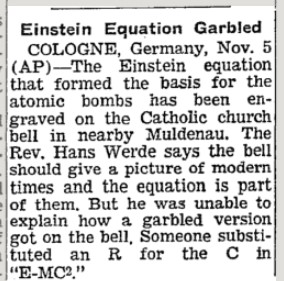
  • On Getting “E=mc^2” Wrong, Twice in 1.5 Square Inches

    JF Ptak Science Books  Quick Post

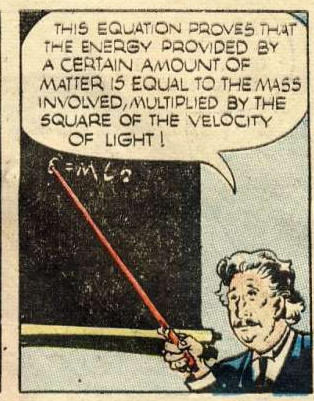
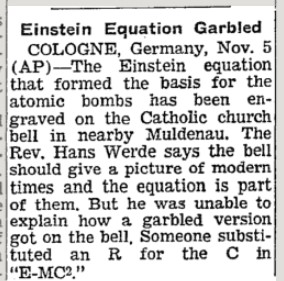
    E=mc^2 mistakeI think that this is the first time I’ve seen E=mc^2 incorrectly written in the same journal article. It occurs in a filler article in a 1950 slug filler piece in the New York Times (sorry I do not have the exact date/page) reporting on a church near Cologne incising its bell with the world’s most famous equation but getting it wrong. The NYT reports that the equation was written as E=mr^2 instead of E-mc^2 [sic with the minus sign]. And there you have it. Highly unusual—this also comes just about two years after the first appearance of the equation that most kids know appeared in a published article by Einstein himself (in Science Illustrated, April 1946). Extraordinarily there is almost an earlier appearance of the equation in its most-known form in a kids’ comic book called Science Comics (January 1946) where it is written on a blackboard in the background as Einstein lectures to an odd assortment of scientists. I’ve wondered where the writer/artist/ink/etc. got the equation from…perhaps the Smyth Report of 1945 (page 2)? I really don’t know, though the equation is evidently first seen in a published paper by H.A. Lorentz in 1913. Maybe the comic books folks didn’t have great access to that info back there in 1946. Anyway I just wanted to share this unlikely pair of misprints from 1950.

    E=mc2 comic

    ·Posted by :

    ·in:


  • Colossus in the Colosseum

    JF Ptak Science Books   Quick Post

    Wimshurst machine205

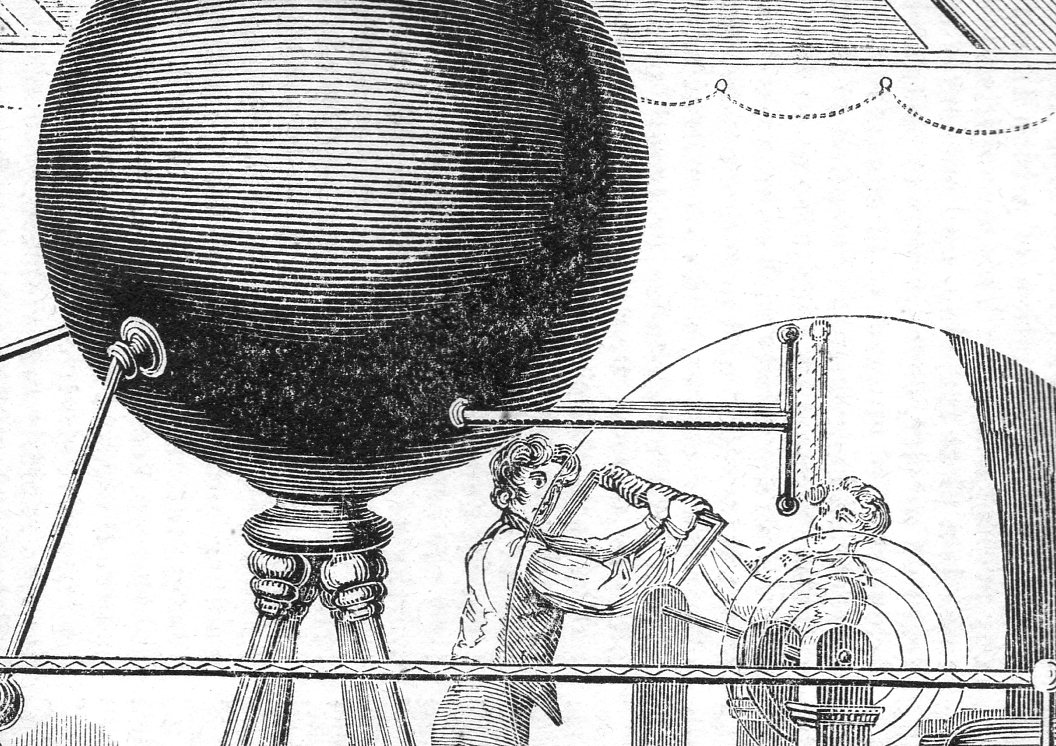
    Here’s an interesting combination of sweat and electricity–an enormous electrical device that was on display in an exhibit of “natural magic” at the Colosseum in Regent’s Park in 1839.  The large disk that the two guys are turning is actually larger in real life, being 7′ in diameter, the conductor being varnished copper, and the conducting balls being gilded–it must have been a very shiny experience, especially when they generated their electric spark.  In 1839 this was the largest electrical generating device in the world.  (I have a tiny version of that device here, something made out of old records coated with copper and found ball glasses acting as Leyden jars, all painted and varnished, the work of an 8 year old in 1925 who went on to a career in astronomy and became the most celebrated eclipse follower in the mid 20th century.)

    This monster is made just 39 years after Volta’s first battery was made,  and not long after Oersted generated the first magnetic field from an electric current in 1820, the same year as Ampere’s solenoid. There were many quick and brilliant development from then to 1839 (also the year in which Daguerre perfected his collaborative work with Niepce to produce the photographic camera), not the least of which was the  Davidson’s creation of the first electric motor car/land locomotive, again in that same full year of 1839:

    ·Posted by :

    ·in:

    —

  • Birds and Human Flight

    JF Ptak Science Books    Overall Post 5154
    Blogflightleonardo_2 For thousands of years the most popular fuel of the common idea for humans to achieve flight was through the application of bird flight mechanics.  (The other common vehicle employed balloons of one sort or another—I’ll look at that later.)

    Before the age of the actual application of these principles there were long sustained bird-like semi-humanoid-godlike-birdforms throughout mythology.

    Kings and overarching rulers living and imagined were seen to perform bird-supported and flighted adventures; the Old Testament is populated by winged seraphim and cherubin; Egyptian gods and goddesses were depicted with long, graceful vulture-like wings; in ca. 160 ACE Lucian of Samosata wrote one of the earliest accounts of space flight with Icaromenippus, who reached ultra-great heights with a device employing eagle and vulture wings, using them in an attack upon Heaven;  a Chinese emperor of the Han dynasty reputedly kept an eye on his empire from a flying chariot; the famous Bellerophon took flight on Pagasus (the horse with bird-like wings, and confusing my point some) to spear the Chimera.  Closer to the point is the flight of Daedalus and his waxy birdwings, as well as Thidireks (from a Germanic myth) who uses a suit of artificial feathers to fly; but much closer to the point of this post was the Persian king Keykavus–he oversaw his lands from the comfort of his throne, which was transported by four apparently very muscular eagles.

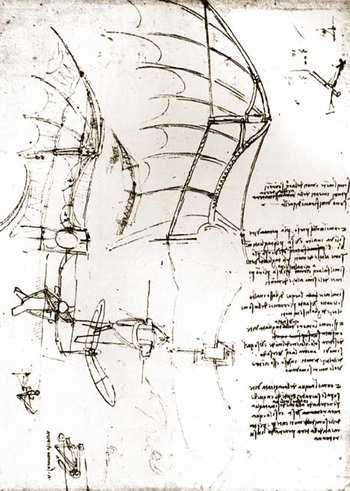
    Among the many things that Leonardo was working on as he was semi-creating the Renaissance was a system of solo flight for man.  His earliest system was based on a large winged device in which a person would be prone, flapping flexible wings via the use of a pulley system, looking quite birdlike.  Later on Leonardo would develop multi-winged systems, some of which would be quite large and requiring the operator to be upright, making the whole look more like a helicopter than a man-filled bird.
    Blogflight_bird_064

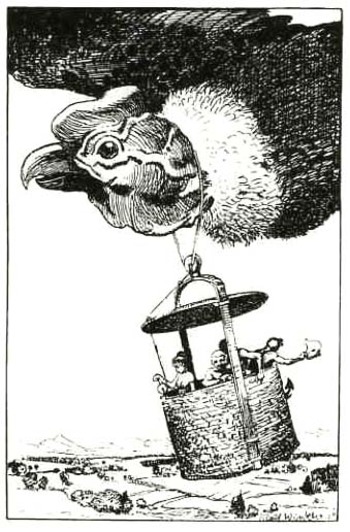
    Perhaps the greatest visionary of techno-anthropormorphic human flight was Cyrano de Bergaerac.  Before he was the object of Edmund Rostand’s 1897 play, de Bergerac was a massively creative author, producing, among other things, the book Histoire des Etats et Empires de la Lune (History of the States and Empires of the Moon, published posthumously in 1657), followed by Histoire des Etats et Empires du Soleil (History of the States and Empires of the Sun, again, published further and deeper into his life’s surrender, 1662), both eventually collected as L’Autre Monde (Other Worlds).  Bergerac introduces us, the humble reader, to one of the most important concepts in the history of literature–namely that we humans were not only not alone in the universe, but that we were not even the dominant culture, and indeed we were actually hated by some of the other more advanced species.

    In a very complicated series of adventures the protagonists are brought to the moon and to the other side of the sun and such by being flown in a basket attached to the neck of a giant bird.  (In one part of the escapade, Cyrano takes us to the moon, which is a paradise, where the adventurer is captured and imprisoned by the intelligent indigenous folks, and from which he escapes by clinging to a soul being removed by the devil. (!))
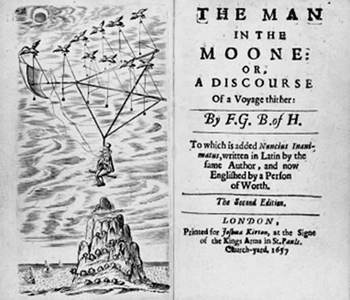
    Blogflightgodwin

    Another spectacular visionary was Francis Godwin, who brought us about the first book on interplanetary space travel with his The Man in the Moone; or, A Discourse of a Voyage Thither; by F.G., B. of H.; to which is added Nuncius inanimatus, written in Latin by the same author, and now Englished by a person of worth (London, 1657).  Here we encounter the tales of y Domingo Gonsales, who Godwin gets to teh moon on a device powered by captured birds, becoming also one of the earliest literary proponents of the plurality of world’s thesis.

    A quick look at the chronology of imaginary flight shows that there are lots of other attempts at flight—but none that I can identify quickly that use birds to lift and carry its cargo to the sun.

    Fast forward to the 19th century though and we come into the veritable heyday of anthropomorphic flight attempts.  Here we find very notable attempts by George Cayley—who was probably the first person to truly understand the dynamics and physics of flight  creates his first aerial device—a model helicopter with contra-rotating propellers reminiscent of the Leonardo device.
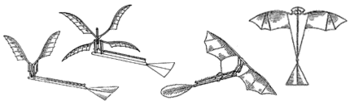
    Blogflighttatin
    Victor Tatin’s ornithopter of 1875 actually was a much more sound “read” than it looked.  He had a very advanced idea of the mechanics of flight, understanding the conditions, and physics, and the resistance of the air, and so on, but just couldn’t translate this understanding into a realistic design.  This is especially true when he hit upon one of the key ingredients to the Wright success—a good, powerful but very lightweight engine.  This was pretty big news, though Tatin would up a suicide.

    And speaking of deadly ideas, the exceptional Otto Lilienthal would wind up a victim of his thinking, too, though his end came in practical applications (or impracticable, I guess) rather than unrealized theoretical understanding.  Lilienthal was one of the most important figures in the development of flight in the nineteenth century, making the first heavier than air gliding flights in what looked quite a bit like bird wings.  (Wilbur Wright said of him; “Of all the men who attacked the flying problem in the 19th century, Otto Lilienthal was easily the most important. … It is true that attempts at gliding had been made hundreds of years before him, and that in the nineteenth century, Cayley, Spencer, Wenham, Mouillard, and many others were reported to have made feeble attempts to glide, but their failures were so complete that nothing of value resulted” as found in  The Aero Club of America Bulletin, Sept. 1912 and also in the article on Lilenthal in WIki.)  He would die in 1896 in a gliding accident, falling to a crumpled death.
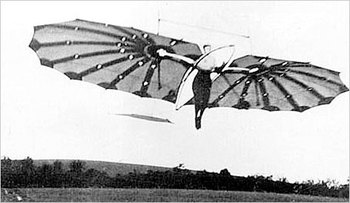
    Blogflightpilcher
    This was also the fate of Percy Pilcher, a great English aviator, who was also quite close to developing a powered heavier than aircraft, but was killed in 1899 before having a chance to test the craft.

    Note:  The title of this post comes from the World War II (late 1942) patriotic song, with words by Harold Adamson and music by Jimmy McHugh. It tells the tale of a plane struggling home after a bombing raid:

    Comin’ in on a wing and a prayer
    What a show, what a fight
    Boys, we really hit our target for tonight
    How we sing as we limp through the air
    Look below, there’s our field over there
    Though there’s one motor gone
    We can still carry on
    Comin’ in on a wing and a prayer.

  • Cross-Section of an Arctic-Exploring Balloon, 1890

    JF Ptak Science Books  Quick Post  Overall Post 5153

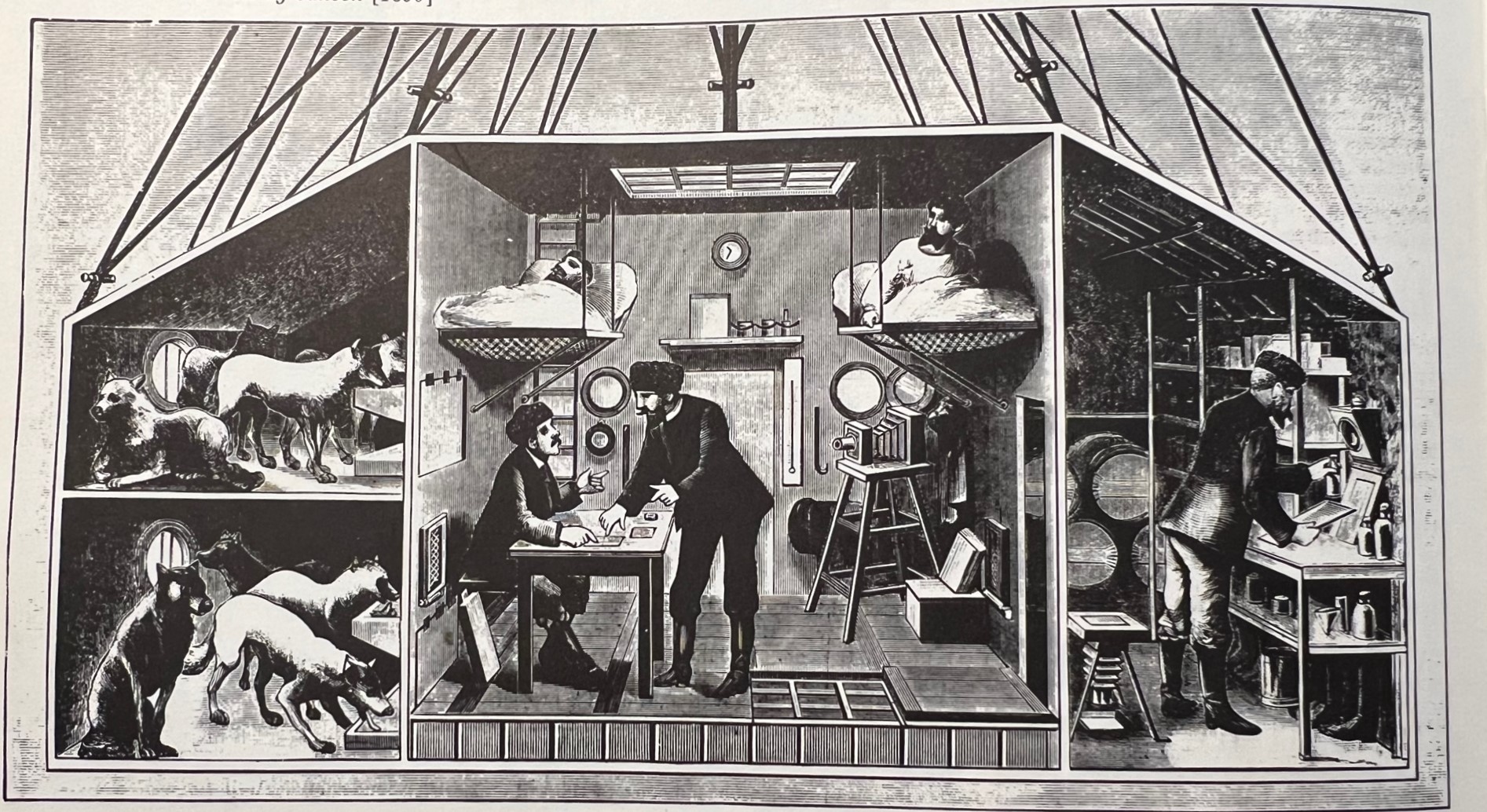
    Answering the great North Call, to reach the North Pole, has been a quest for hundreds of explorers reaching back hundreds of years The image here depicts one iteration from 1890 of an attempt utilizing a 100′ diameter balloon. The pilot adventurers here were Georges Besancon (1866-1934) Gustav Hermite (1863-1914), whose aims were to pilot the 17.5 ton aircraft (complete with a darkroom) to the Pole—and as you can see in the cutaway view of the balloon car, their’s was an ambitious project. But their attempt to fly over the Pole was not to be, as they couldn’t raise the funds to put it all together. They did however concentrate on atmospheric research using balloons and became leaders in that brand-new field, and were successful in establishing the use of balloon in this area. (The attainment of the North Pole came probably in 1909, generally regarding Robert Peary (b. 1852) reaching it in 1909…though Frederick Cook may have done so in 1908. And perhaps it was Matthew Henson, who may have stood at the coordinates before Peary. And so on. Two things seem to be certain in the uncertain list of “firsts” and the North Pole: the first over the Pole was probably Roald Amundsen in 1926, though Richard Byrd flew over the Pole in a Fokker-tri-motor at about the same time. It is a definite thing though that the first under the Pole was the USS Nautilus in 1958.

    IMG_1303

    • [Source: Scientific American, volume 91, 1890.]


  • The Goubet Submarine, 1886

    JF Science Books  Quick Post  Overall Post #5152

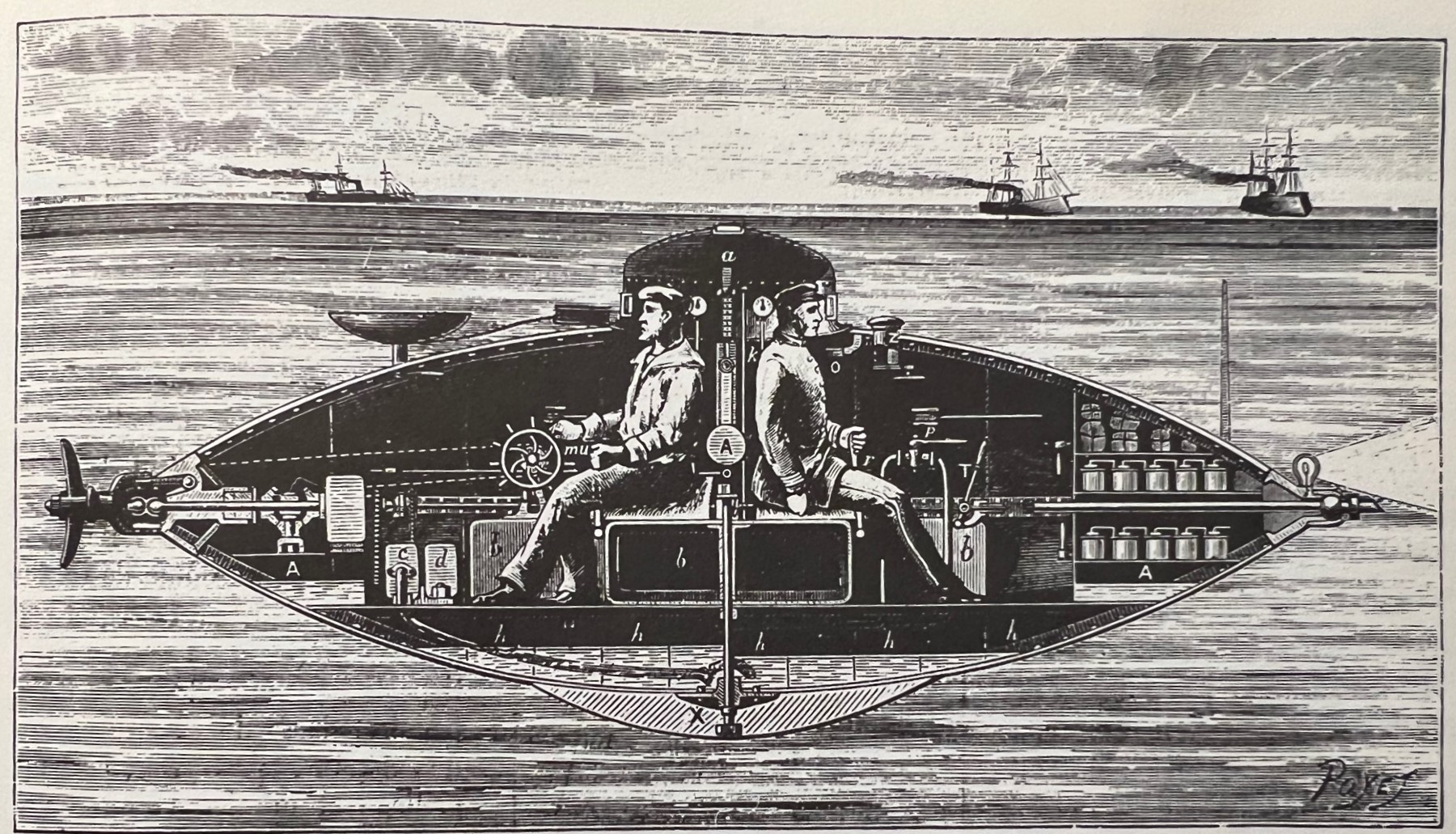
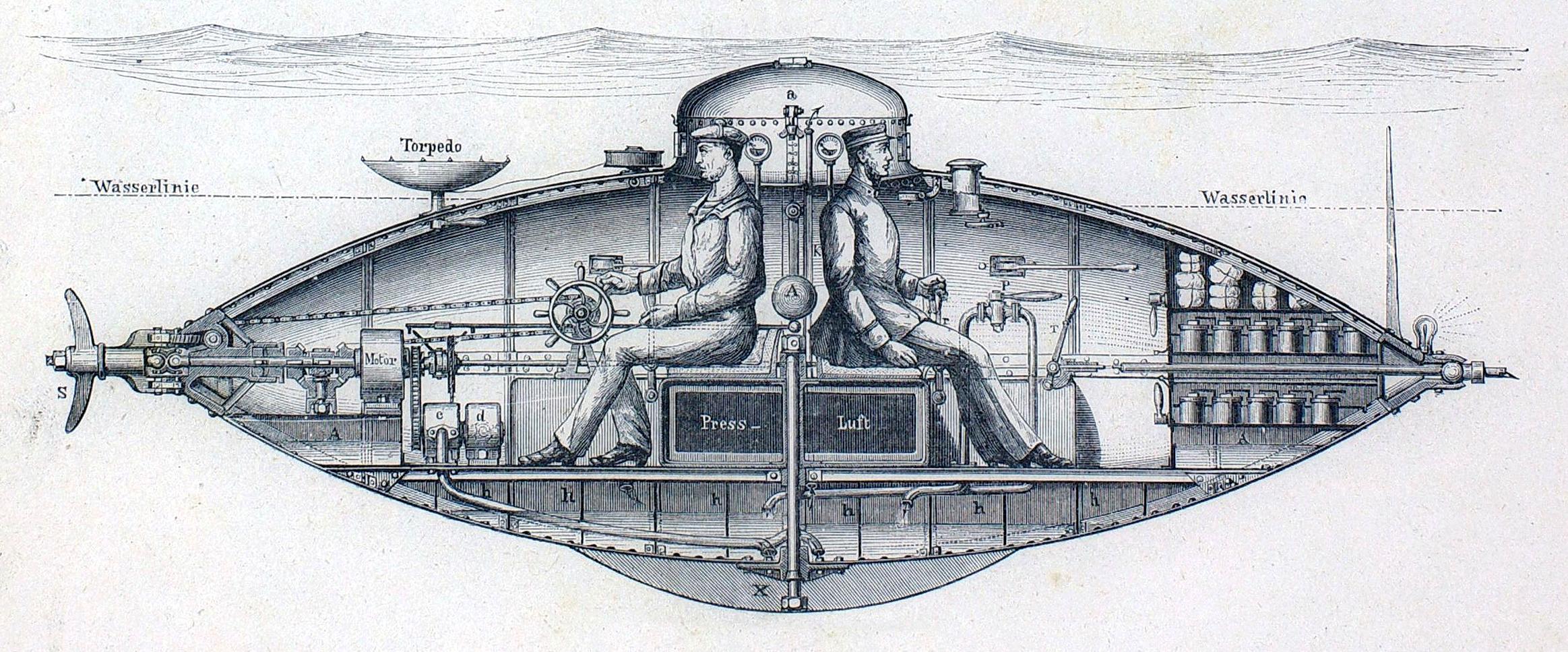
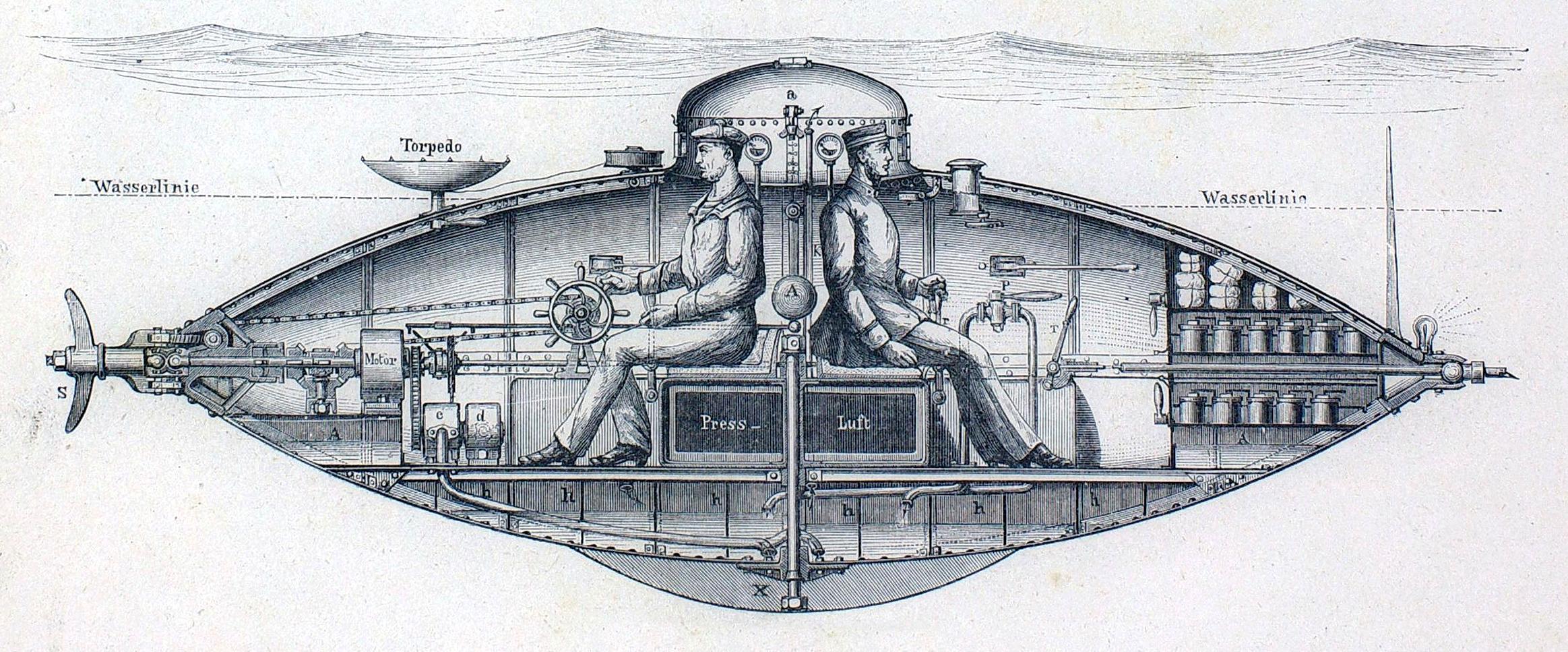
    Charles Goubet designed an interesting and technically advanced submersible boat, an electrically-powered submarine, which was the first of its kind to be powered in this way. The image below appeared in La Nature in 1886–the boat was about 16′ x 6′ x 3′, much deeper than wide, and was powered by a Siemens motor being driven by batteries, and the whole of it unsuccessfully rudderlessly steered by a highly moveable screw propeller. The electric power applied in this design was the innovation, while the navigating end of the operation of the boat seems to have been, well, not a success.

    IMG_1294

    “Das Unterseeboot von C. Goubet” [following] is an alternative, slightly cleaner and with less peripheral imagery view of the submarine as found in Die Gartenlaube (1886) page 146. 

    Goubet sub German version

    Goubet sub German version

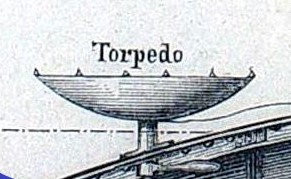
    The “torpedo”-labeled section on the plan view is exactly that—the explosive was fixed to the outside of the sub, and seems to have worked more like a mine than what we would consider to be a torpedo in the present. The sub would work its way under an enemy ship where it would release the weapon, which would attached itself to the ship; the sub would then withdraw trailing an explosive/detonating wire when, after reaching a safe distance, the torpedo would be detonated via the wire. Evidently the design overall was a failure—the major complaint being the sub was very difficult to navigate underwater and the attaching/detonation part of the torpedo was problematic. (It seems as though those “teeth” were supposed to attach the torpedo to the bottom of the target ship…and they seemed not to do so very well.)  That said, there were design elements and tech bits that carried forward to more substantial submarine attempts.


  • A Monumental and Fantastically Bad Idea: Lowering the Mediterranean (1929)

    JF Ptak Science Books  (This is a slight expansion of an earlier post from 2011)

     “Simply the thing I am shall make me live.”–from Jorge Luis Borges, “Shakespeare’s Memory”

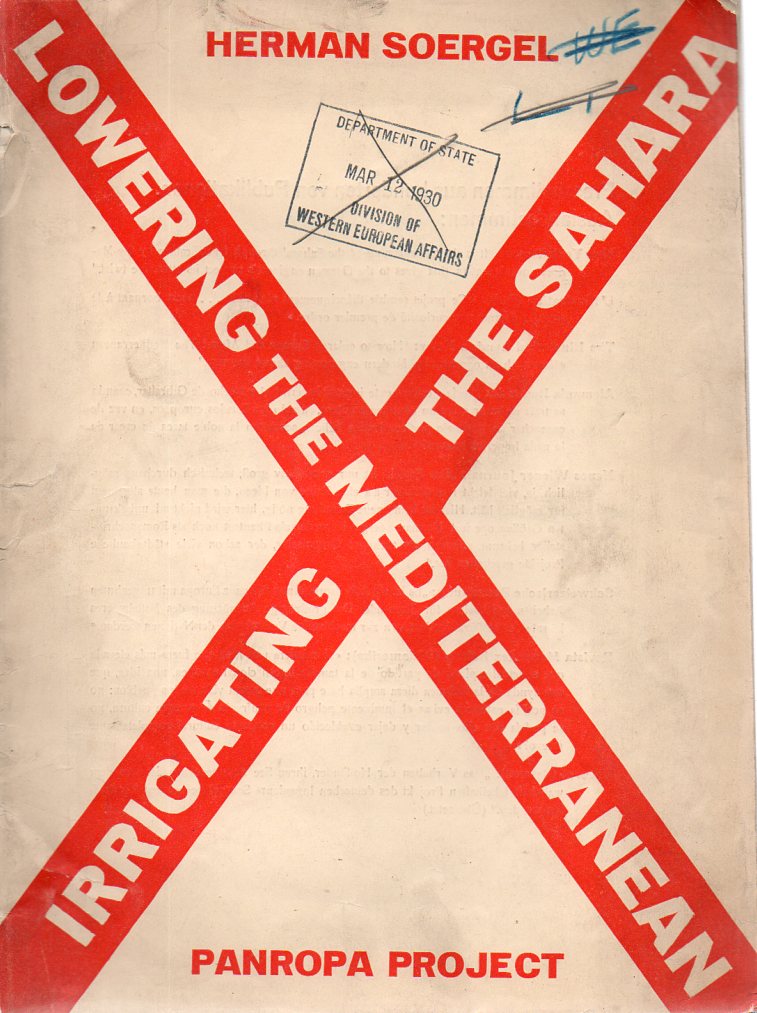
      Soergel403
    It would be a Purgatory, or worse, to suddenly wake up one morning with another person’s memory–worse yet than to have wished it, only to find that you didn’t want it at all.  This evidently works out with memories high and low, though it is tempting to want to wish to see what the inspiration looked like for one idea located in a particular memory.  Or maybe not.  But I am curious about when and here the author of the pamphlet above got his idea, and what it looked like to him–did he hear or see or smell something that prompted the inspiration for this reverse-monumental jolt, something that may well be one of the worst engineering ideas of the 20th century?

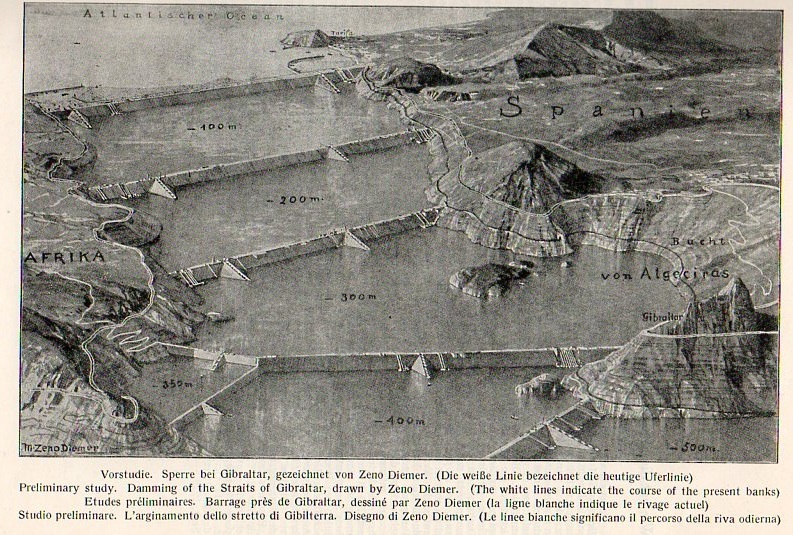
     It is interesting to pursue a loose thought like this to its not-necessarily logical end.  Such is the case with the self-styled Paneuropic ideas of Hermann Soergel (1885-1952), the author of the above. Soergel was a Bauhaus architect and author of a number of works on design and far more ethereal, floating-castle ideas. His most spectacular contribution—incubated in the mid-1920’s and still clinging by its fingertips as an idea among some current thinkers—was to put a dam across the straights of Gibraltar.  The dam would generate electricity of course, but most importantly to Soergel, it would also empty an enormous amount of water (lowering the sea by 200 meters)  from the Mediterranean leaving vast new expanses of land to be developed and colonized over generations into the future.  The water of course would have to go somewhere, and that somewhere was the Sahara Desert, somehow in its wake creating farmable and productive lands. Soergel was creating a certain, very wide, fantastical future of uncertain monumental prospects.

    Soergel405
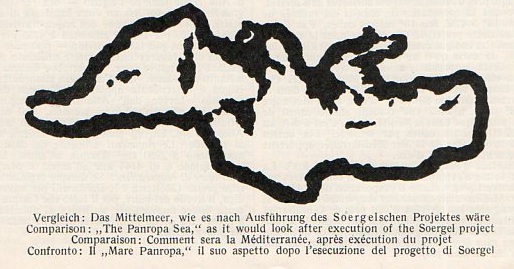
    A “brief outline” of the idea was published in this four-language pamphlet, Lowering the Mediterranean Irrigating the Sahara (Panropa Project), which was published by J.M. Gebhardt in Leipzig in the very bumpy year of 1929. (The Weimar years in Germany were already into deep bumpiness; the rest of the world would follow suit in October of that year.)  To be fair, Soergel didn’t plan on emptying the entire Mediterranean, just a bunch of it–at least enough to be able to rename it.

    Soergel404
    [Here’s a map of the new Mediterranean, or the Mediterranean that would be made to go away.  As you can see at this point Sicily and Italy become enormous, and the Greek Islands are combined to form one large land mass–this last bit alone is enough to form total and complete reisstance to this idea. Also at this stage perhaps 150 or so miles of new lands have been reclaimed from the sea all along its former borders–more so in Turkey.  There is no mention as yet of any new islands that are formed in the sea water’s wake.] 

    As it turns out Soergel thought that this plan would add at least 660,000 KM2 to the base of the surrounding countries of the Mediterranean, or roughly the equivalent of the combined land masses of Italy and Germany.  Having the sea pulled back from hundreds if not thousands of seaside towns and cities would no doubt be a “problem”, for them; but that doesn’t matter to Soergel, as they were inferior thoughts to the grand idea of emerging a new continent.  Great bog (and a good simulation with a powerful computing capacity) only know how the changes in the Mediterranean would affect the climate–well, that in combination with the thousands of new square miles of inland sea and canals in the previous Sahara desert.  There are of course many other problems. 

    The master plan at work was that the world would be divided into three economic spheres in the future, all beginning with the letter “A”:  American, Asia, and the new land to be created by Soergel, “Atlantropa”, which was the former Europe expanded into the new dry beds of the Mediterranean and North Africa.  And also of course Egypt, which would be covered with “thousands” of canals and become semi-submerged by the new borders of the meandering sea.  This would be the way for Europa t==Blog July 21==shakespeares memorieo compete with the rest of the world in the future. 

    [I should point out that the image above comes from the Illustrierte Zeitung (Leipzig) for August 1931, and is a drawing by an artist named “AS. Christ” depicting a cross section of one of the bridge/dams of Soergel’s Panropa’s ideas.]

    Perhaps it is actually three steps to get from the idea of damming up the straits of Gibraltar to the osmosis of Shakespeare’s memories into someone else’s brain—a squinting acquiescence of the middle touch being the brilliant Jorge Luis Borges.  You see it was in the Argentine master’s last published story, “Shakespeare’s Memory”, that we meet Herr Soergel (as Hermann Sorgel) again.  But so far as I can remember Soergel exists only as a fictional character, with no reference to his real-life self.  In this wonderful story, Soergel inherits the memories of William Shakespeare—these bits come to him slowly but surely, until they start to conflict with his own memory, and things get difficult.  The man with Shakespeare’s memories winds up phoning strangers on the telephone, giving them away at random, until Soergel is left with his own mind again.  Superior as Bill’s memories were, they still weren’t Hermann’s, who wanted his own life back in the end. 

    And so from the titanic, pan-europic technodream of Bauhausian Hermann Soergel to the dead brains and living memories of William Shakespeare, all through the fingers of the beautiful Jorge Luis Borges.  

    I’m sorry to report that at the end of it all, near the end of the pamphlet, Soergel releases his opinion on the political importance of his project.  And yes, his aim was to form an alliance between the new PanAmerica (of the “three Americas” with the new Pan-European African Union to thwart “the yellow peril” which “arises from the racial antipathy of India, China and Japan.  Soergel writes that “the fate of occidental civilization…will be settled on the Mediterranean”. 

    After it is all said and done, perhaps the best review of the work by Soergel is provided by the graphic designer who put the Big Red X on the cover of his work.  It fits. 


  • Two Uncommon Crowd Scenes, 1932 and 1945.

    JF Ptak Science Books   Quick Post  (Overall Post 5152)

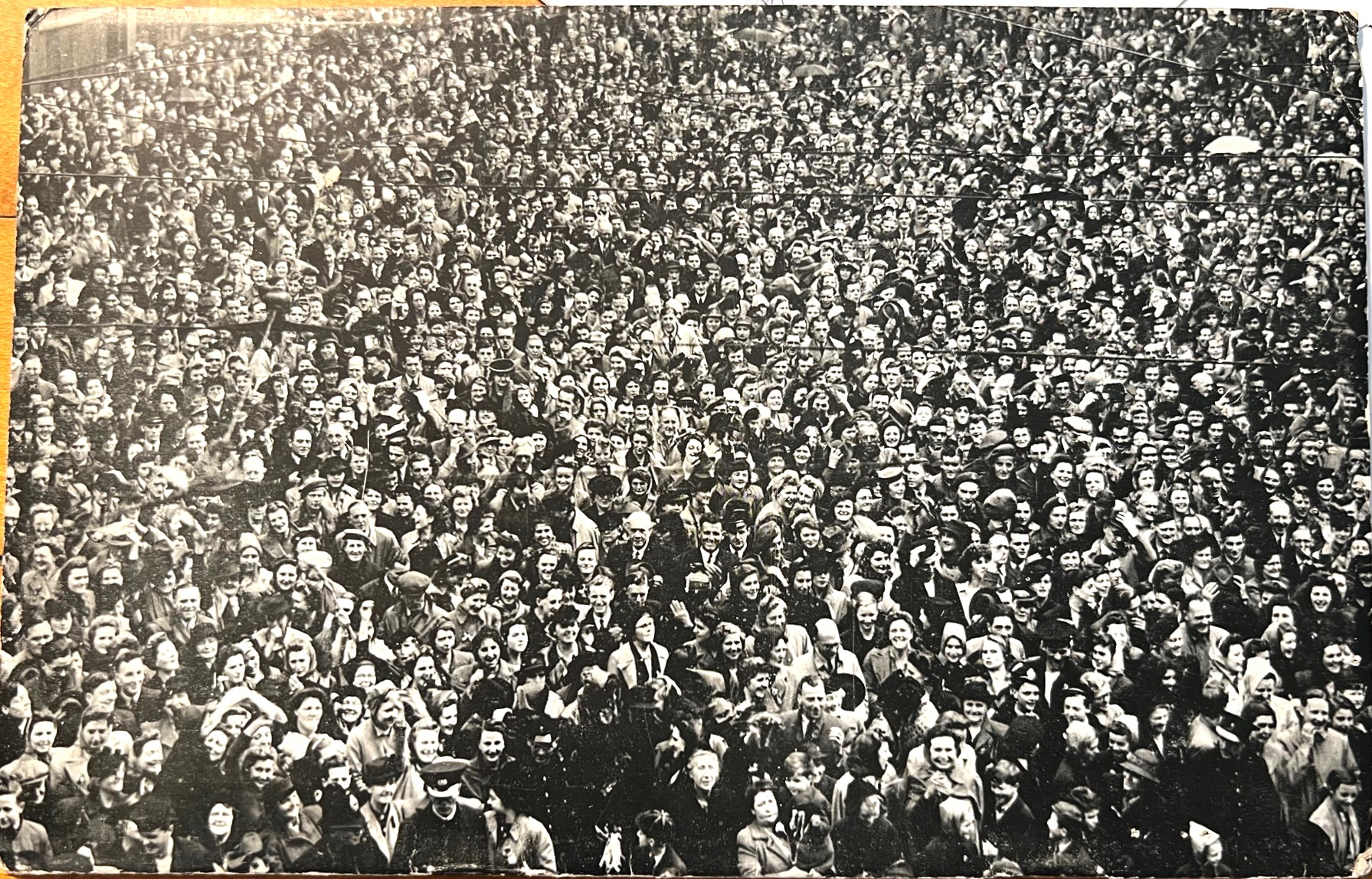
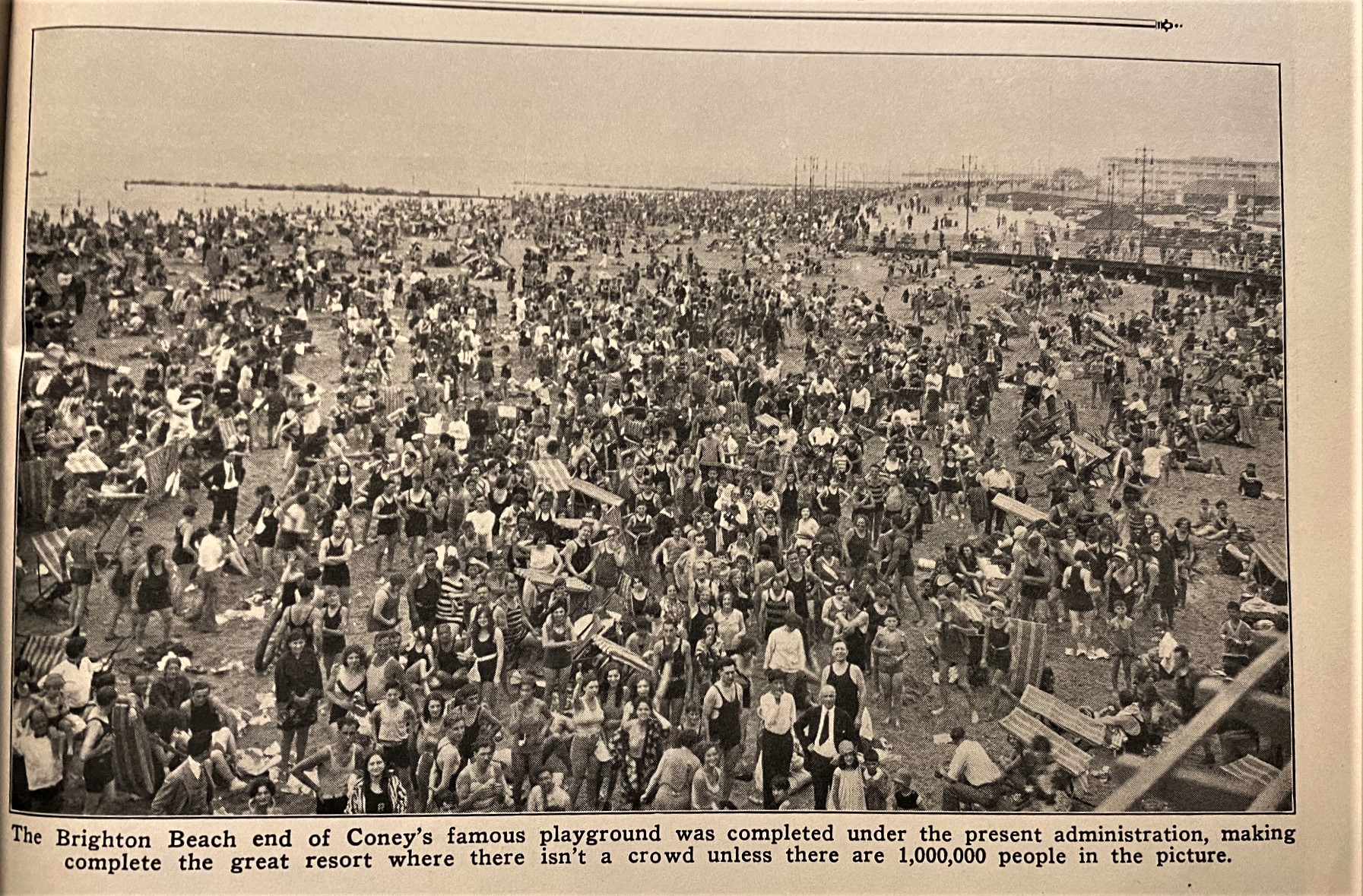
    It seems to me that these two photos may be of some interest to folks given how utterly jammed the scenes are with people and that their sources are pretty obscure.  The photographer for each is not identified, which is a shame.  

    IMG_0974[Source:  Your City, a Handbook of the Citizens of Liverpool, October 1945.]

    And also  this pre-Weegee  scene  of  Coney  Island, the caption stating that there were one million people on the beach.

    IMG_0793 (1)[Source:  New York, the Wonder City, 1932.]

    ·Posted by :

    ·in:

    —

  • Mathematical Exercises and Found Art

    JF Ptak Science Books

    In my science bookstore business one of my principle interests is antique manuscript notebooks in the sciences.  It is a pleasure to see someone working through a problem, or finding what the writer thought to be the most interesting point in a lecture on a particular subject, and to read the occasional doodles and see the timely gloss every now and then.  I’ve had notebooks from an advanced and very careful student for a course given by the great Robert Bunsen that was filled with hundreds of pages of what the master was trying to communicate to his pupils.

    ++00++ 9.16 math

    There’s also a  series of notebooks from the spectacular period of Cornell physics history (1948-1949), including 6 notebooks of classes with Richard Feynman, including several hundred pages from his 1948/9 course in advanced quantum mechanics, which included (a very early) use of the Feynman diagrams.  The thing that makes these observant, advanced notes taken during Feynman’s classes have more than a pedagogical interest (which is substantial and enough on its own)—they have a capacity to show the logic behind the man’s thinking and how he presented his ideas over a period of some months.  Also, and curiously, notebooks like these seem to have not survived. 

    Then there’s the notebooks taken by the team of Charlotte and Fritz John when they were pursing doctoral degrees at Goettingen (1929-1933), until forced to leave with the enforcement of the Nazi laws against non-Aryans.  Goettingen happened (and happens) to be the seat of a long, great mathematical heritage, home of Felix Klein, Emmy Noether, David Hilbert and Bernhard Riemann (among many others).  The notebooks—some two linear feet of them—represented four years of advanced interactions with some of the finest mathematical minds in Germany.  I was told by Mrs. John that they were required to take such full notes—but let me tell you, these notebooks were typed transcriptions of the daily handwritten notes, compiled over the course of a class, and then bound.  They are beautiful, and go far beyond my concept of “required”.  Mrs. John told me the story of the class notes that she and Dr. John took while taking a course with the great Hermann Weyl (who had taken his doctorate under the iconic David Hilbert, and who was also forced to flee Goettingen because his wife was Jewish):  everyone of course was required to take extensive notes during the day and work on them during the night, turning them in the following day for appraisal.  She told me that she still vividly remember placing their notes on a long wooden table at the front of the class, and then picking that set of note up the next day.  After a month of this, she, said, they became convinced that Weyl was not looking at the notes at all, as everything seemed always to be in the spot that they left it in.  One week they decided to see if the notes were being moved, and placed a hair carefully on the interior page, reasoning that if the notes were reviewed, the hair would be gone.  For a week, the hairs stayed in place.  “And so, what did that mean to you?” 

    ++00++ 9.16 math block

    Mrs. John replied that it really didn’t mean anything, and that they continued to do the notes as they would, and leave them on the long wooden table.  They never slacked off (which I can fully imagine).  She said that they did it for themselves, of course, but also they did it for Dr. Weyl, fully expecting that the day that they missed handing in their notes would be the day that they were looked for by Dr. Weyl.  Plus they were studying with a famous and fabulous thinker, and did not want to disappoint themselves or their instructor. 

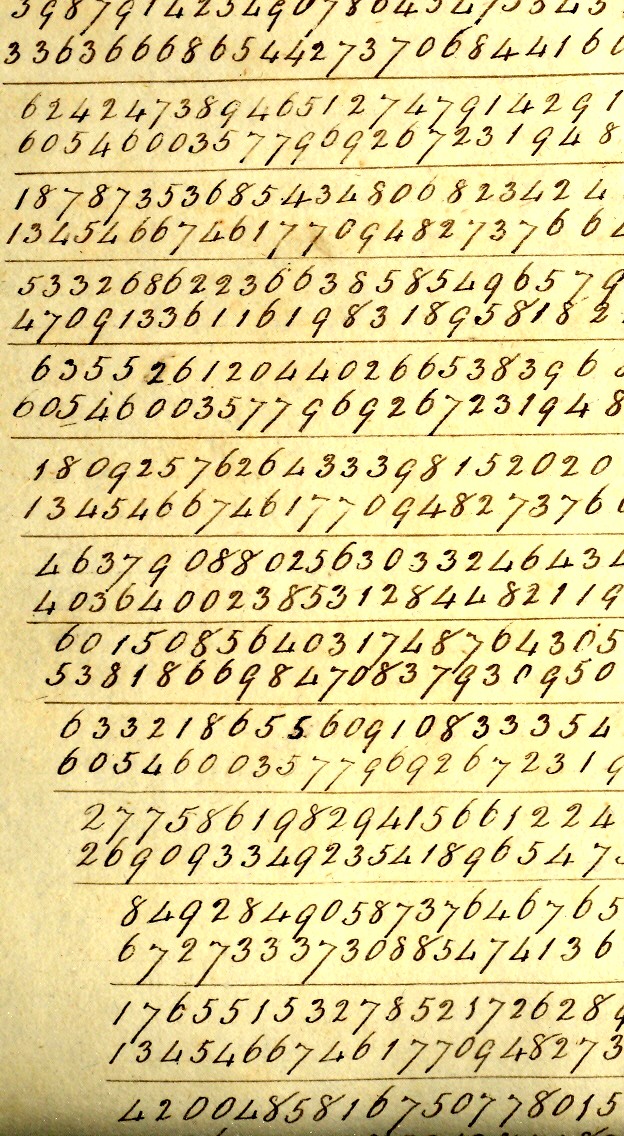
    I do enjoy the historic or significant material like this, but I also quite the naïve, homegrown, elementary manuscript attempts by children at doing math or understanding physics.  Cipher books have always been a little hard to find in my field, wit many of them (I think) winding up in the genealogy area), and they just don’t seem to be very much on the findable side of things anymore. 

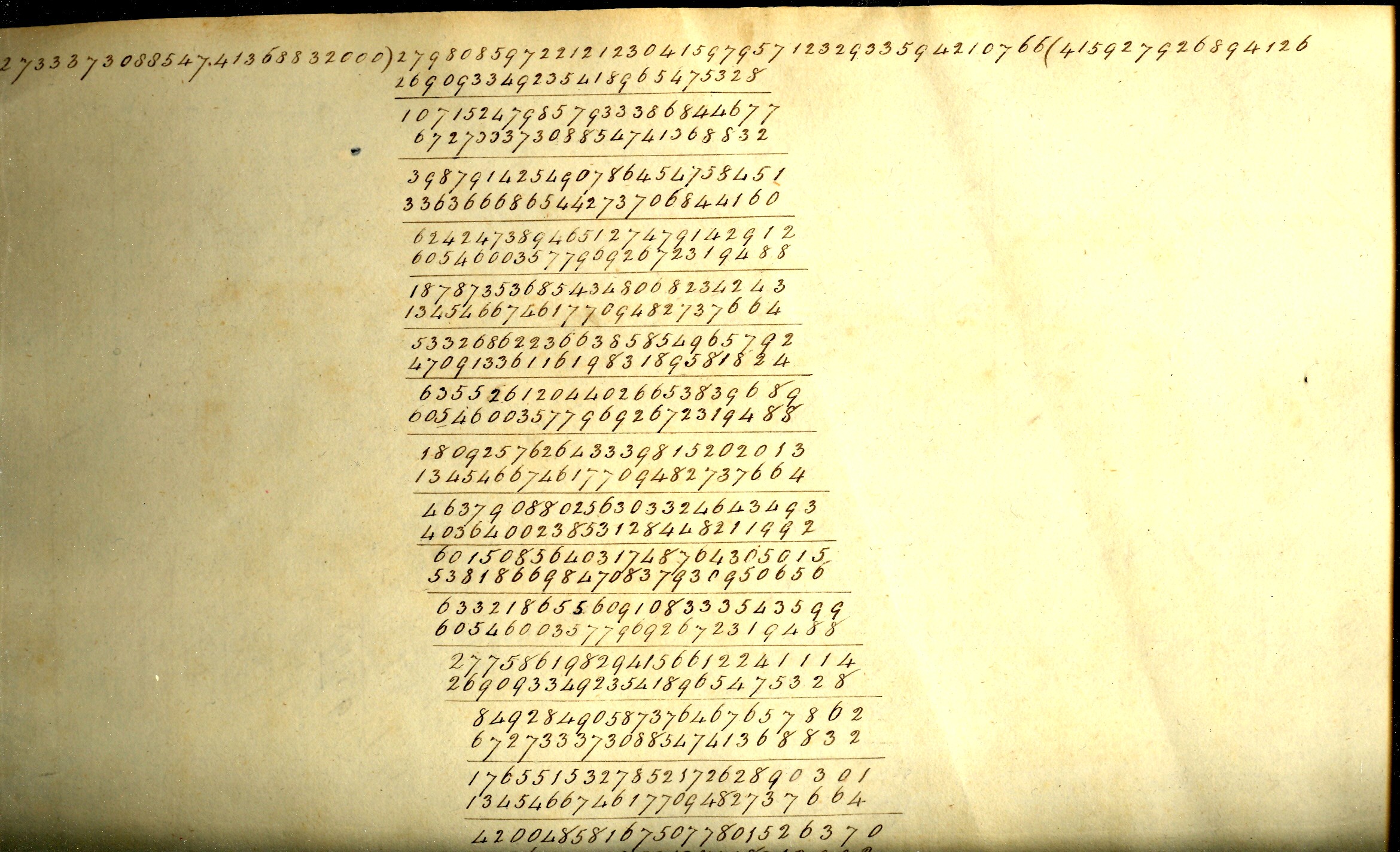
    The example I’ve reproduced here are from an anonymous (but dated 1818) work on different elementary areas of mathematics.  What makes this special to me is the precision of the penmanship and the extreme effort that is being used for a simple display of division.  It would certainly convey the message if the author had used two five-figure numbers to display division rather than these enormous, never-to-be-encountered numbers. 

    ++00++ 9.16 math string

    Surely there were pages and pages of scrap used to get to this point as the operator machined his numbers down, showing us the result rather than the real process.  But what is left to us in this effort is a thing of considerable beauty—the found art of practicing elementary math. 

    ·Posted by :

    ·in:


  • Bridges Never Built: the Hudson River Bridge (Midtown) 1896

    JF Ptak Science Books   Quick Post  (Overall post 5151)

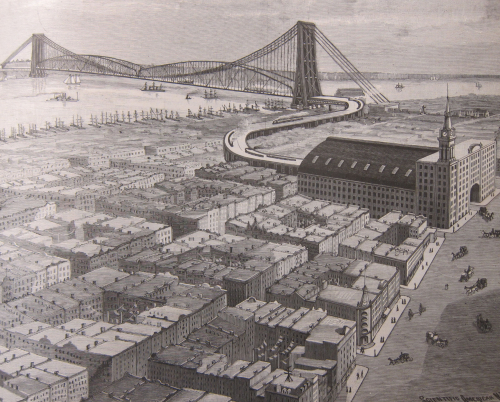
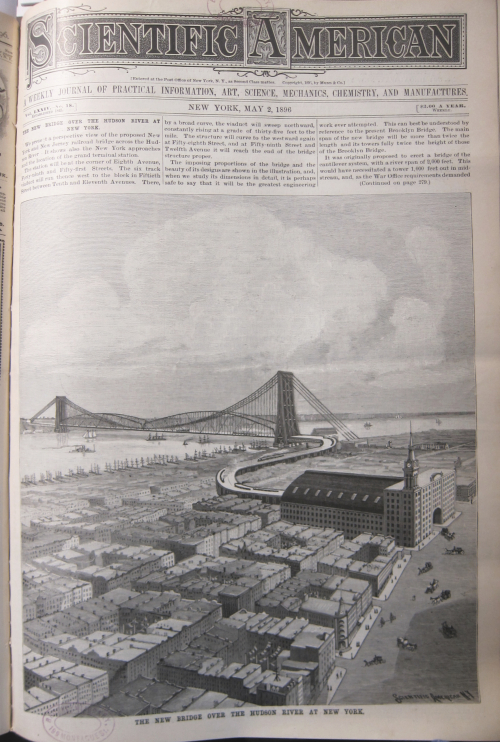
    This beauty appears in the pages of Scientific American for 1896, and discusses a proposal for a bridge to connect Manhattan to Jersey, and to do so spectacularly. The plan was for the bridge to be twice as tall and twice as long as the Brooklyn Bridge, making it “one of the greatest feats of engineering” ever.  The terminal and approaches would’ve been an issue in a few decades later had it been built, as they occupied a fair piece of land from about 59th/11th & 12th and 51st/8th, plus the ramping for six-rails-wide railway access.  The time would come for a bridge in 1929 when the work on the existing Hudson River Bridge (now known as the George Washington Bridge) would be built further north in Washington heights. In any event, this 1896 bridge was quite lovely.  

    Unbuilt bridge 1
    Unbuilt bridge 1


  • An Episode in Antiquarian Depiction of Upside Down Things (1506)

    JF Ptak Science Books   Overall Post 5150

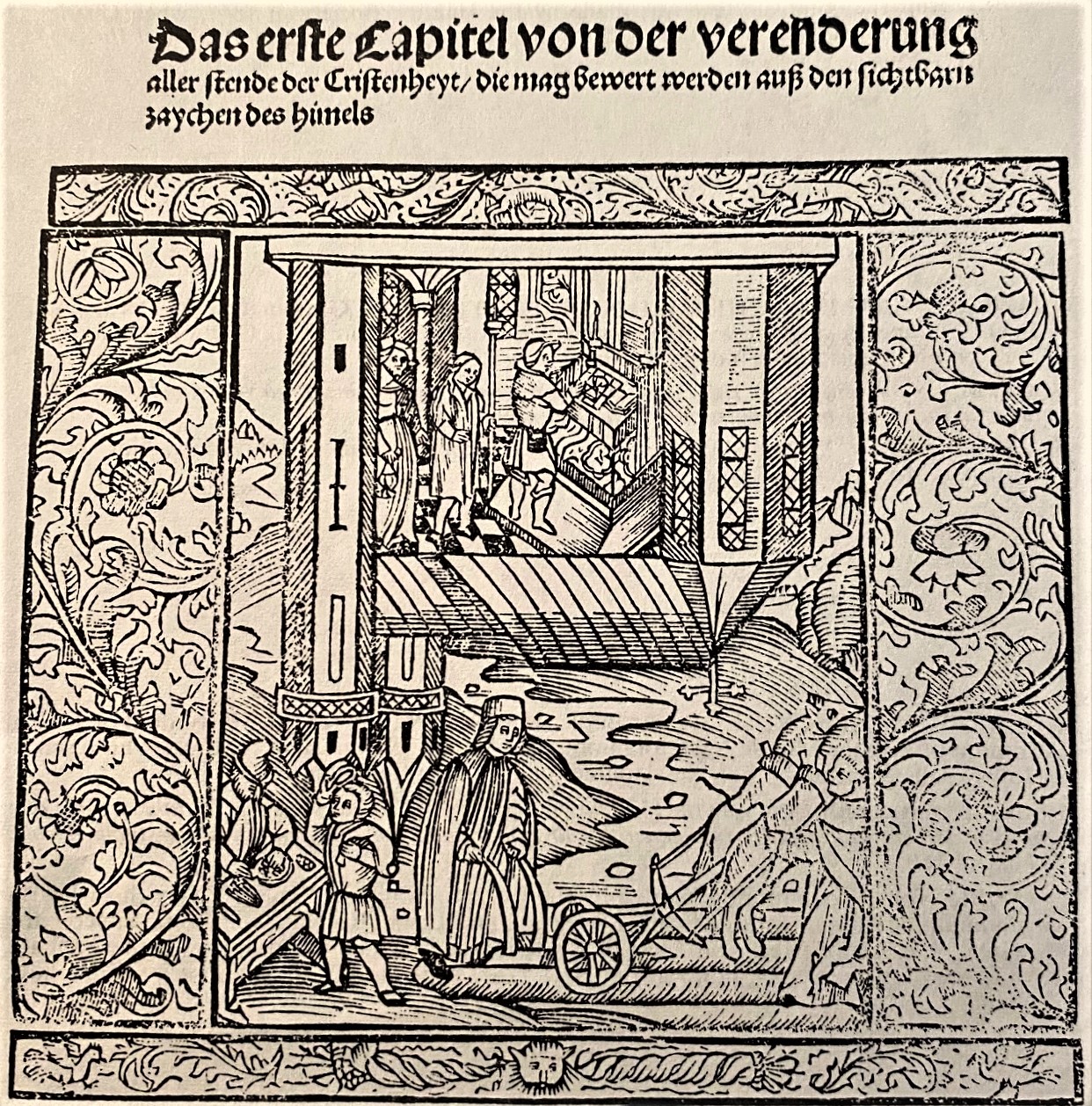
    The subject of this woodcut is well out of my range, even on a better-than-beyond-my-means day, but the imagery 
    is very sharp, and contrasting, and very unusual. I'd say that of the 5000+ posts on this blog that fewer than a
    dozen might be in the established but underused category, The Department of Upside Down Things.
    This image would be one of its stars, as the upside down part isn't immediately obvious to my eye given the
    somewhat complex construction of the woodcut.
    IMG_9895But then, there it is: the upside down cathedral.
    The illustration is from a work by Joseph Grunpeck (1476-ca.1530+), a man with range in religion/theology and
    medicine, and author of one of the earliest works on "the French disease", syphilis. In this work he is writing,
    I think, from a humanist standpoint on a coming change in Christianity, and in the image depicts the changing
    world, showing clerics in the field while in the upside down cathedral we see the farmer and the peasant...the classes
    have changed sides, or perspectives, or are equal, or some such. As I said, this is a very weak area for me, but
    thought that I would at least share this interesting illustration, even if my interpretation is wrong--it is or it isn't.
    [The legend reads: "Veränderung aller Stände der Christenheit , die mag bewährt werden aus den sichtbaren
    Zeichen des Himmels".]

    ·Posted by :

    ·in: