A Daily History of Holes, Dots, Lines, Science, History, Math, Physics, Art, the Unintentional Absurd, Architecture, Maps, Data Visualization, Blank and Missing Things, and so on. |1.6 million words, 7500 images, 4.9 million hits| Press & appearances in The Times, Le Figaro, Mensa, The Economist, The Guardian, Discovery News, Slate, Le Monde, Sci American Blogs, Le Pont, and many other places… 5000+ total posts since 2008.

Category: Physics

  • On Getting “E=mc^2” Wrong, Twice in 1.5 Square Inches

    JF Ptak Science Books  Quick Post

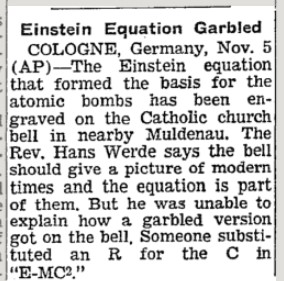
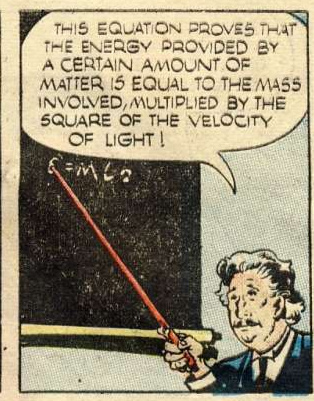
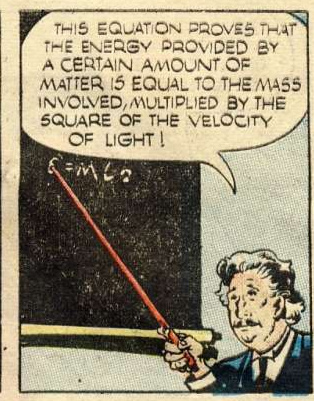
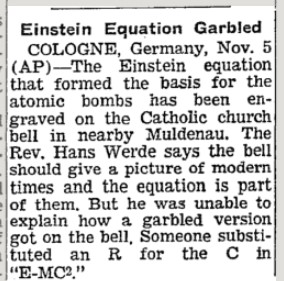
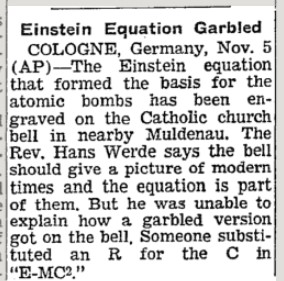
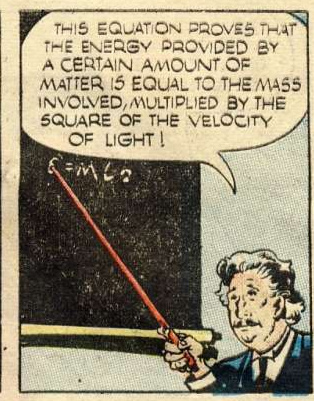
    E=mc^2 mistakeI think that this is the first time I’ve seen E=mc^2 incorrectly written in the same journal article. It occurs in a filler article in a 1950 slug filler piece in the New York Times (sorry I do not have the exact date/page) reporting on a church near Cologne incising its bell with the world’s most famous equation but getting it wrong. The NYT reports that the equation was written as E=mr^2 instead of E-mc^2 [sic with the minus sign]. And there you have it. Highly unusual—this also comes just about two years after the first appearance of the equation that most kids know appeared in a published article by Einstein himself (in Science Illustrated, April 1946). Extraordinarily there is almost an earlier appearance of the equation in its most-known form in a kids’ comic book called Science Comics (January 1946) where it is written on a blackboard in the background as Einstein lectures to an odd assortment of scientists. I’ve wondered where the writer/artist/ink/etc. got the equation from…perhaps the Smyth Report of 1945 (page 2)? I really don’t know, though the equation is evidently first seen in a published paper by H.A. Lorentz in 1913. Maybe the comic books folks didn’t have great access to that info back there in 1946. Anyway I just wanted to share this unlikely pair of misprints from 1950.

    E=mc2 comic

    ·Posted by :

    ·in:


  • Statements by the Editor of Nature on Equality in the Sciences (1910).

    JF Ptak Science Books  Overall Post 5143

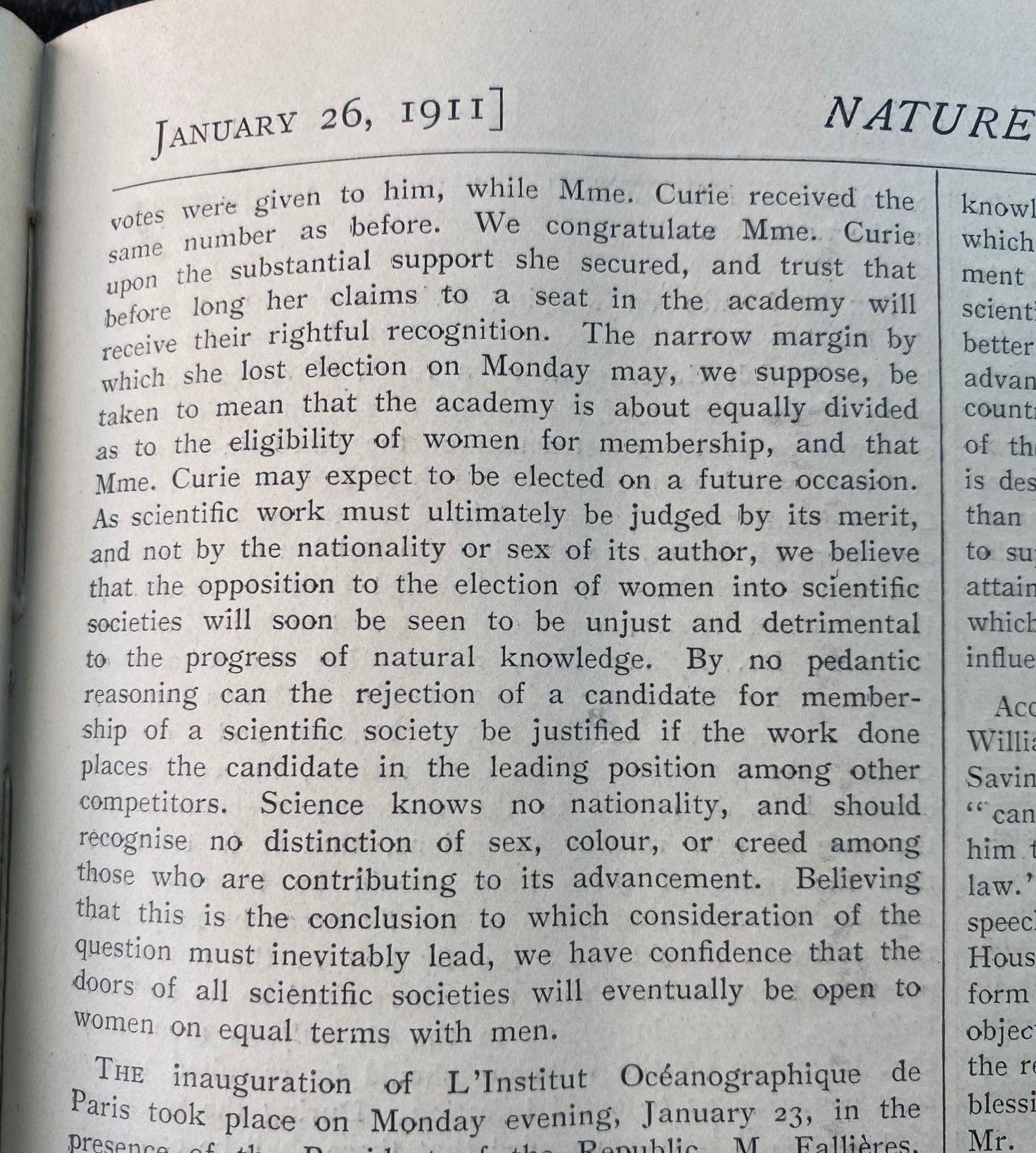
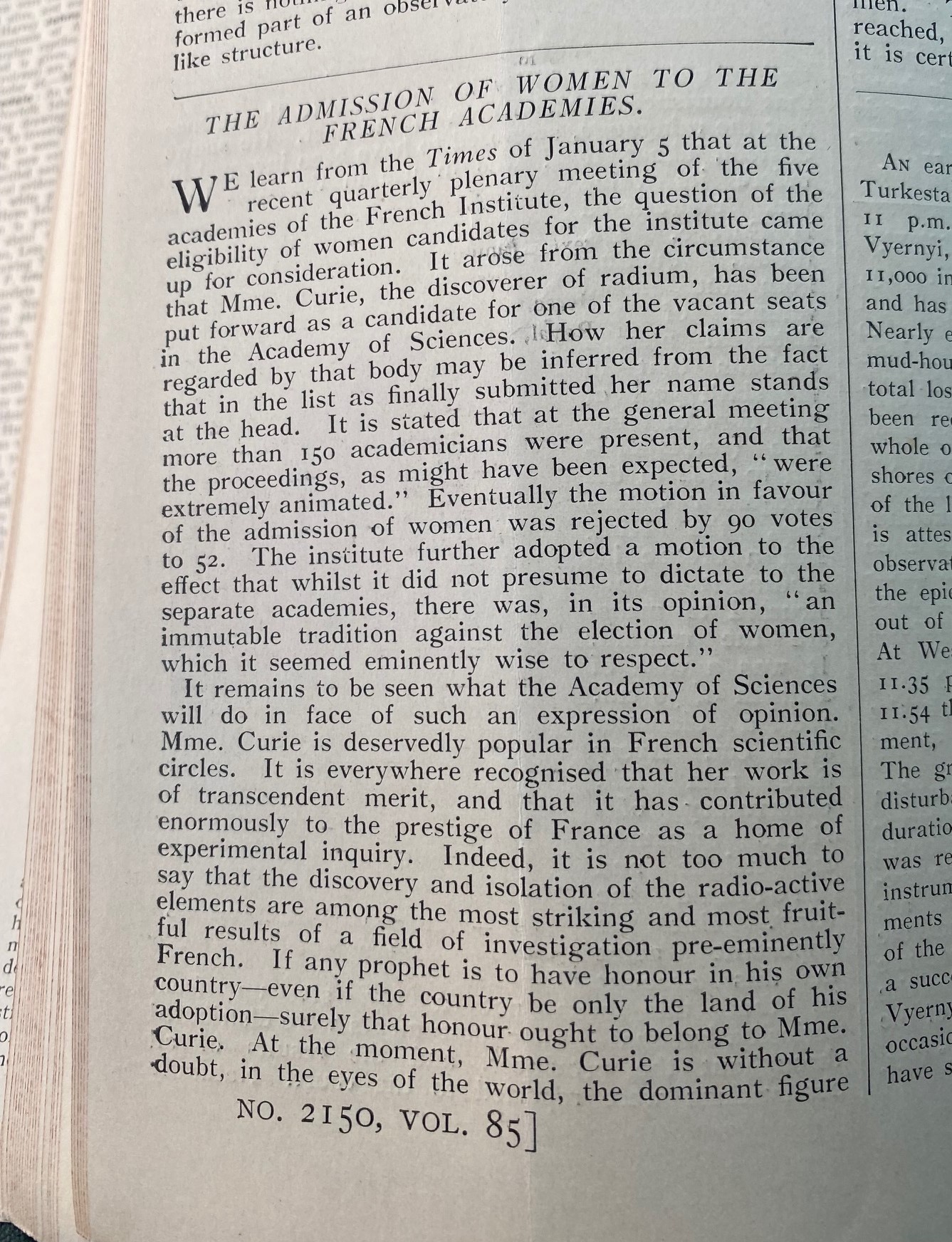
    IMG_7448This is a short note on an interesting series of reports in the venerable journal Nature (1911) regarding the status of women in the sciences.  These are three short articles (about 1750 words total) on the recent elections to a seat at the French Academy of Sciences in which Mme. Curie–one of two candidates–was not elected, her candidacy lost by vote to Edouard Branly. (Branly is an important figure in the history of wireless communications and inventor of the Branly coherer, but Curie was, well, far advanced of that.) The editorial staff of Nature took exception, reporting on the issue and the vote’s unfortunate outcome. Being fairly familiar and having worked in Nature (for the 1869-1950 period) I was a little surprised by the summation of this short note in the 26 January issue. It is a strong message, at least so far as scientific and other intellectual endeavors are concerned. (Women will not get the full vote in G.B. Until 1928, achieving partial victory in 1918, though the vote was limited then to women 30+ with adequate property.) Still, I take this as a significant statement from Nature, even if it is limited to a short article in the “Notes” section of the weekly. I cannot recall other early pro-equality stances like this outside of a few articles here and there in support of women being able to attend classes at major universities, though not being able to receive academic credit for them. All caveats included, I find the Nature article to be a remarkable statement for the time. Perhaps someone out there with experience in this field will be able say whether these statements are actually as early as I think they are.  

    Here’s the conclusion of the 26 January article:

    “As scientific work must ultimately be judged by its merit,

    and not by the nationality or sex of its author, we believe
    that the opposition to the election of women into scientific
    societies will soon be seen to be unjust and detrimental
    to the progress of natural knowledge. By no pedantic
    reasoning can the rejection of a candidate for member-
    ship of a scientific society be justified if the work done
    places the candidate in the leading position among other
    competitors. Science knows no nationality, and should
    recognise no distinction of sex, colour, or creed among
    those who are contributing to its advancement. Believing
    that this is the conclusion to which consideration of the
    question must inevitably lead, we have confidence that the
    doors of all scientific societies will eventually be open to
    Women on equal terms with men.”

    By the way, Curie was never elected to the French Academy of Science, though she did receive membership to the Academie Nationale de Medicine…in 1922. She had already received the Nobel Prize in physics in 1903, and would be awarded the prize again in chemistry a few months after she lost this 1911 vote to the Academy. (Perhaps the “creed” part of the “sex. colour, or creed” pronouncement above referenced certain elements circulating the story that Curie was Jewish?)

    IMG_7450

    Notes:

    Three issues of  Nature, London, Macmillan & Co., 1910, volume 85.  Including: “The Admission of Women to the French Academies”, pg 342 (full column, about 800 words), 12 January, in the issue #2150, pp 329-362. WITH: “The Admission of Women to the Paris Academy of Sciences”, in 19 January, pp 372-373 pp 363-396, issue 2151. AND WITH: [Women’s Rights], a 400-word contribution to the “Notes” section of 26 January issue no. 2152 pg 412-413 in the issue of pp 397-430. It is in the third contribution, the “Notes” section, that contains the strongest statement by the editor of Nature on the equality (at least in the sciences and intellectual pursuit) of sex, race, and religion. 

    ·Posted by :

    ·in:

    —

  • Cutaway View of the Cockpits of the Hawker Hurricaine and Messerschmidt (1942)

    JF Ptak Science Books  Quick Post (Overall post 5101)

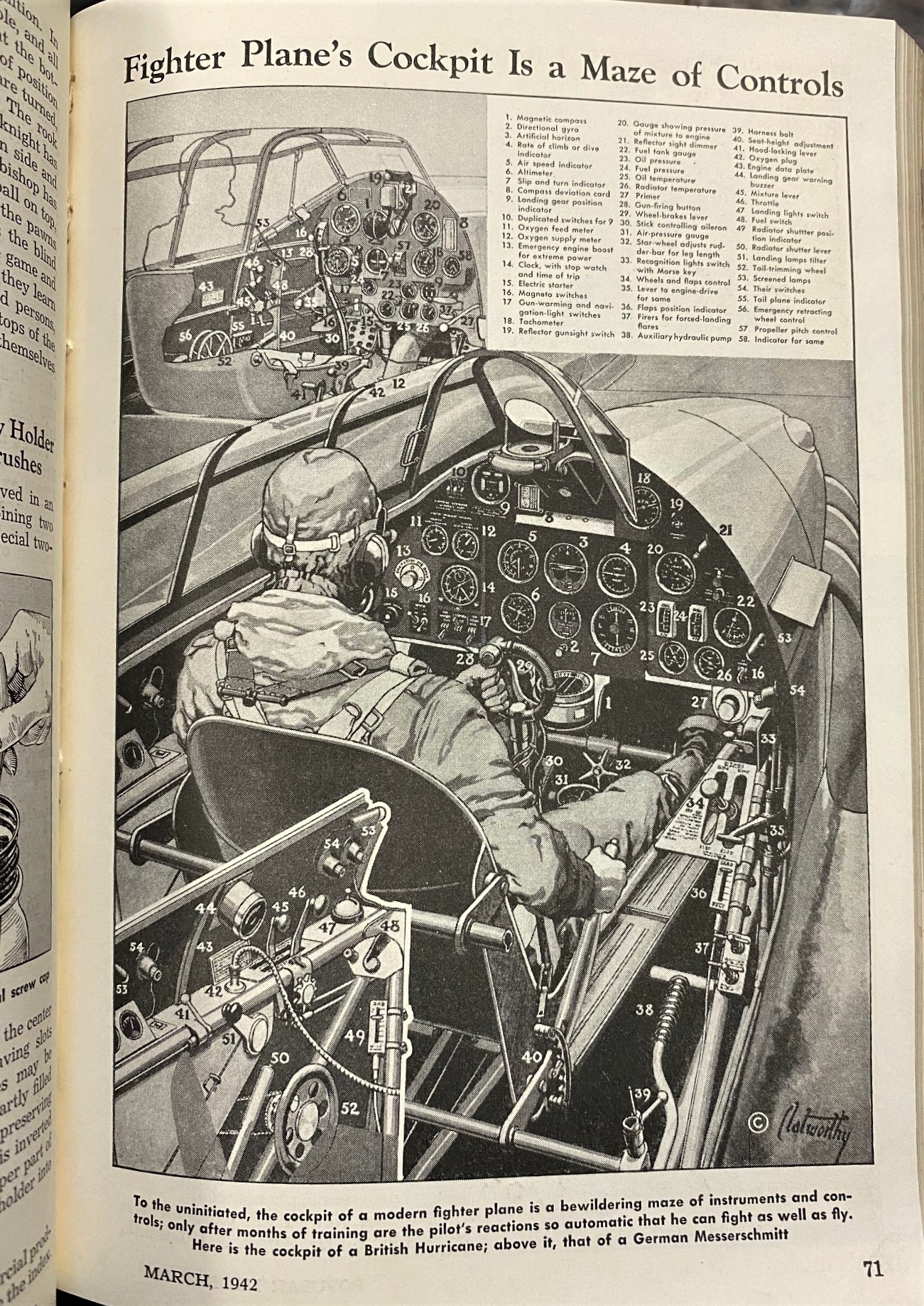
    I think that there are several dozen aircraft cutaway and cross section aviation schematics on this website, and tonight’s main entry is for the British (Hawker) Hurricane (predominantly by Hawker Aircraft Ltd.) followed by a small inset of an (unnamed though I’d guess the 109) Messerschmidt of the Luftwaffe. The image is found in the August 1942 issue of Popular Mechanics, which has hosted a number of these sorts of displays of information.  

     IMG_2472

    ·Posted by :

    ·in:

    —

  • Albert Messiah in Berchtesgaden (1945)

    JF Ptak Science Books   Post 2881

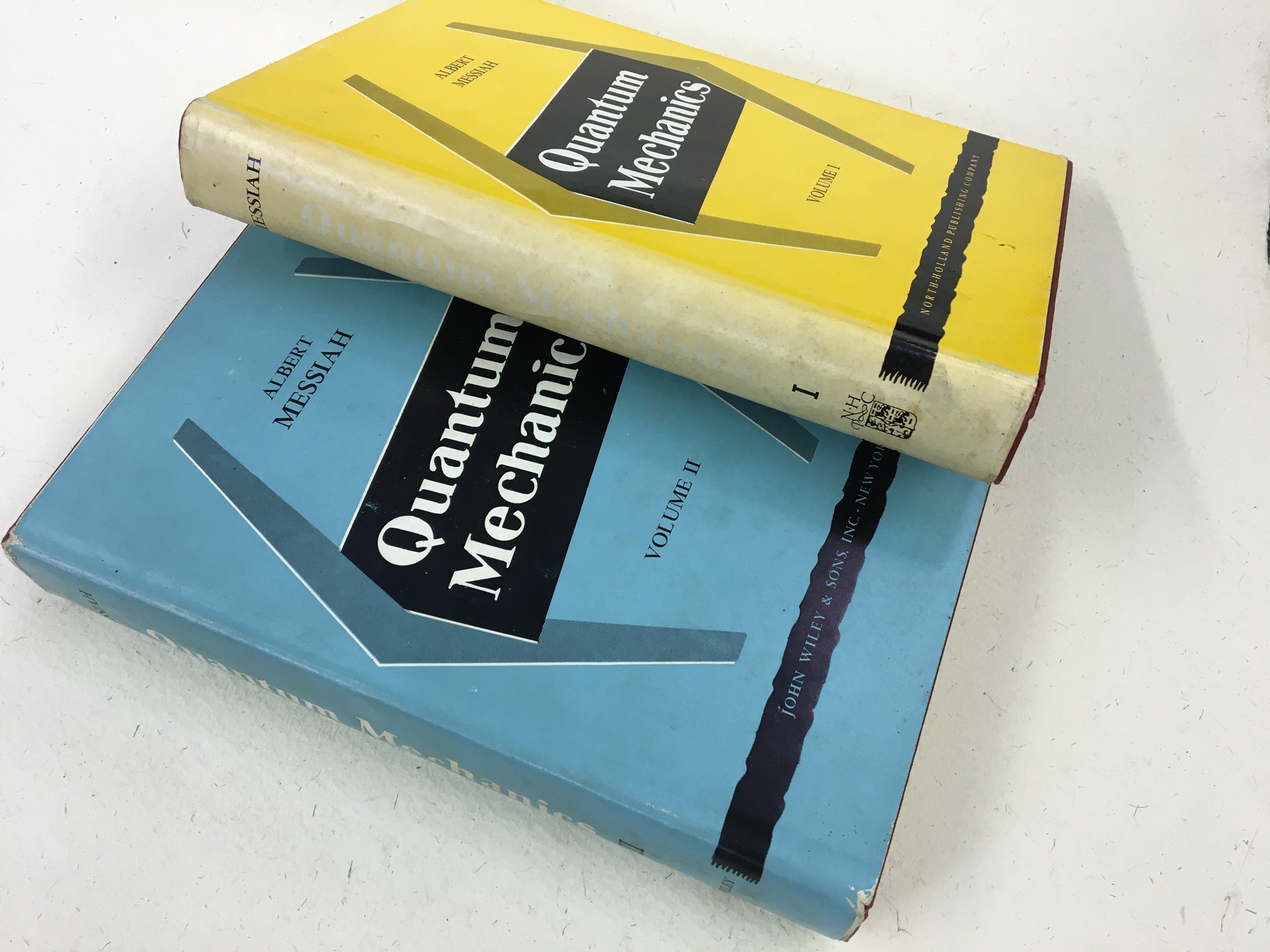
    I recently unboxed (after a long and deep in-box slumber) the classic two-volume work Quantum Mechanics by Albert Messiah. It was published in French in 1959 and soon found its way into English in 1961 (and 1962), and was a staple in the studies of two generations of physicists.

    I had no idea of Messiah’s background, which is extraordinary. I learned that he was accept to the IAS (Princeton) with only a high school education—this was due to Messiah (1921-2013) having spent his formative years from 1940 to 1945 fighting and killing Nazis. He heard Petain on the radio announcing that the gentlemanly thing to do for much-fallen-France in 1940 was to lay down arms, which to Messiah was the clarion call to resistance. He also refers to Petain as an imbecile. He recalls Petain intoning a vainglorious “…entre soldats et dans l’honneur, il fallait cesser le combat, etc. etc.” , and that he does not recall this “stupidity” being much shared at the time (“…cette stupidité n’était pas tellement partagé à l’époque.”)  This was indeed his path, as he joined the Resistance and fought for five years.

    IMG_1417 (1)

    Here are a few interesting responses to questions put to Messiah at the Ecole Polytechnique in January 2009 regarding his time during WWII:

    On a question of the lack of use of armor in 1940, Messiah says it simply was that French command sucked. (“Tout simplement parce que le commandement militaire français était un peu nul, c’est tout.”) Mediocrity was the ruler by which things were measured, and in general is very well spread. (“La médiocrité est une chose qui finalement est relativement répandue.”)

    The people who won the war, and the reason why the Resistance was successful, were those who could think and stand out from the crowd. (“Parce que l’histoire justement est faite par les gens qui se démarquent de ça, des gens qui réfléchissent et qui éventuellement prennent des risques, c’est ce qui a donné la Résistance d’ailleurs, des gens qui prennent des risques mais qui ne vont pas dans le sens de l’histoire.”)

    At the end of the interview Messiah relates being among the first to occupy Hitler’s residence/seat of government in Berchtesgaden in May, 1945. He found it very amusing and ironic that Hitler’s place would in the end by occupied by a Jew. (“…le malheureux Hitler a eu la malchance de voir son repaire occupé par un Juif.”) 

    And a Jew named “Messiah” at that.

    ·Posted by :

    ·in:

    —

  • “The vulcano’s, or, Burning and fire-vomiting mountains…” The Luxurious Language of Science, 1669

    JF Ptak Science Books  Post 2833

    I came to be working in the great and problematic Athanasia Kircher’s glorious Mundus Subterraneus..., printed in 1665, which is a compendium of most things scientific though with the heavy flavor of application to the world underground. Figuring out what was going on in places that could not be seen or investigated or for the most part quantified didn’t stop Kircher from extreme hypothesizing on the nature of the Earth, and so he came into possession of a hermetic-philosophico-alchemical-religio-scientific panspermic theory of the origin of all things. Of course there’s a lot of good thinking that goes along with the Grand Theory, and some very innovative scientific thinking, and the expanse of the knowledge of this one man is extremely impressive—there is a LOT in this book.

    In 1669, four years after the publication of the Mundus, came the English publication of a somewhat-beautifully and certainly surprisingly-titled book summarizing and cajoling the Mundus, called:

    The vulcano’s, or, Burning and fire-vomiting mountains, famous in the world, with their remarkables collected for the most part out of Kircher’s Subterraneous world, and exposed to more general view in English : upon the relation of the late wonderful and prodigious eruptions of Ætna, thereby to occasion greater admirations of the wonders of nature (and of the God of nature) in the mighty element of fire. (London : Printed by J. Darby, for John Allen, and are to be sold by him …, and by Benjamin Billingsly …, 1669.)

    How lovely is that? (By the way I cannot find any other book with “fire-vomiting” in its title1.)

    It is a stripped-down 82-page summary of some of the principle ideas of the massive two-volume Mundus, and appears with only one illustration2, while the full work was magisterially published with fantastic illustrations and folding plates throughout.

    There are many pleasurable turns of phrase and off-brand uses of common words, and unexpected and conjoined vocabulary throughout the work—at least so far as I have seen from the bits that I have read in it. For example, just in the first few pages of browsing I have come across “treasuries of Fire”, “forges in the profoundest Bowels of Nature”, “entrails of the Earth”, “nor as the Vulgar perswade themselves”, “sulphrous unctious matters”, “fire engendering all concocting Nature”, “ever-flowing flames”, are among the notables from the first pages.

    Here’s one paragraph from page three:

    “The Prodigious Vulcano’s therefore and Fire-vomitting Moun∣tains visible in the external surface of the Earth, do sufficiently de∣monstrate it full of invisible and under-ground fires. For where∣ever there’s a Vulcan, there also is a Conservatory, or Store-house under, as certain, as where there is a Chimney or smoke, there is fire; And argue deeper treasuries and storehouses of fire, in the very heart and inward bowels of the Earth. In so much that from hence the Holy Father’s have not incongruously placed the greatest of all the * Fire-conservative Abysses in the Centre of the Earth, for an eternal Jakes and Prison, destin’d for the punishment of the Damned; and some others for Purgatory (according to the received belief of Papists.)”

    Sources:

    Early English Books online  https://quod.lib.umich.edu/e/eebo/A65153.0001.001/1:11.2?rgn=div2;view=fulltext

    Wellcome Library: https://wellcomecollection.org/works/ygm2etrh/items?canvas=9&langCode=eng&sierraId=b1028090x

    Notes:

    1.  “Vomiting” in the title, however, is not horribly uncommon. For example, here’s a long title for a broadside publication that including snake vomiting, as in vomiting up snakes: A warning for all such as desire to sleep upon the grass : By the example of Mary Dudson maid-servant to Mr. Phillips a gardener … being a most strange, but true relation how she was found in a dead-sleep in the garden, that no ordinary noise could awake her. As also how an adder entered into her body, the manner of her long sickness, with a brief discovery of the cause at length by her strange and most miraculous vomiting up of about fourteen young adders, and one old adder … the maid is yet living. The like to this hath not been known in this age. The tune is, In summer time.–London, printed for Charles Tyus, 1664.

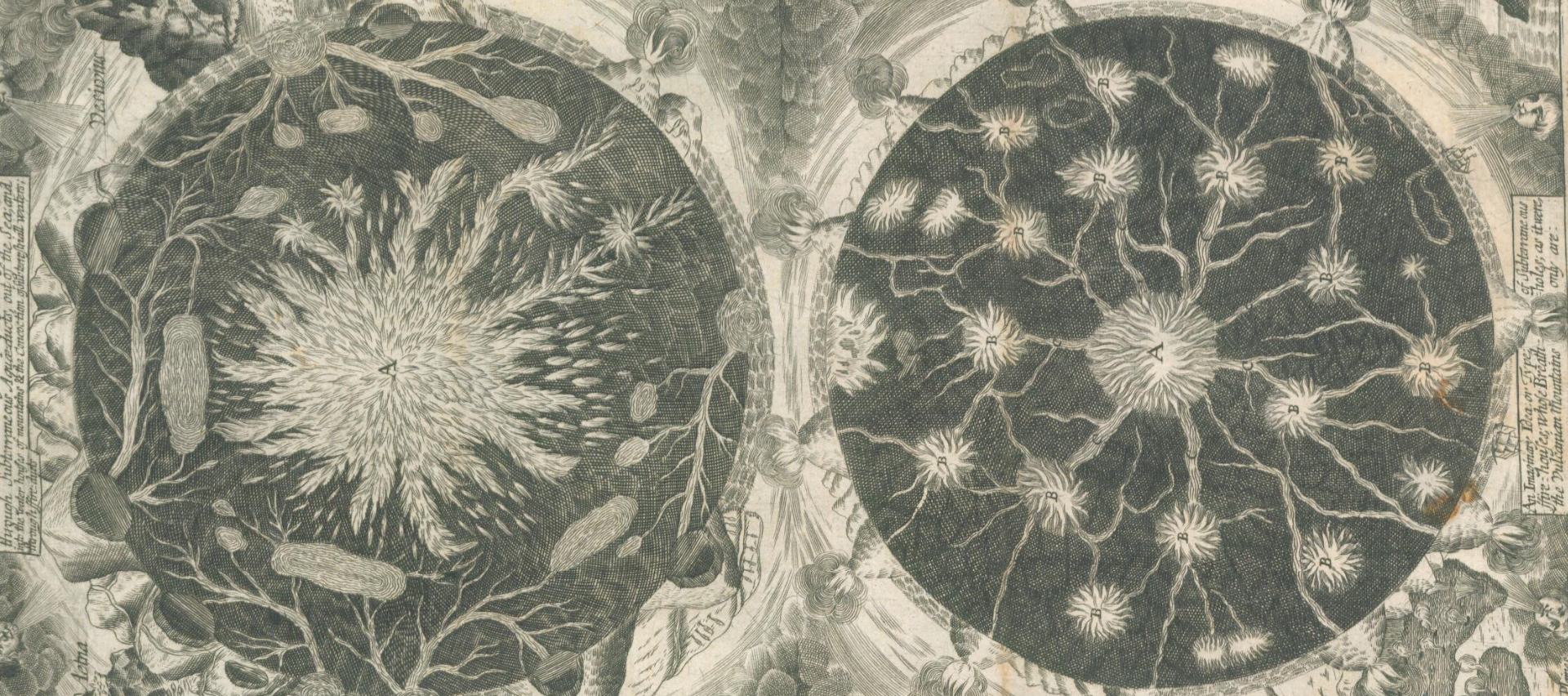
    2. Though there is only the one illustration (a folding frontispiece) in the English summary, it is pretty remarkable:

    Download


    ·Posted by :

    ·in:

    —

  • Measuring Civilization by Height (1919)

    JF Ptak Science Books  Quick Post

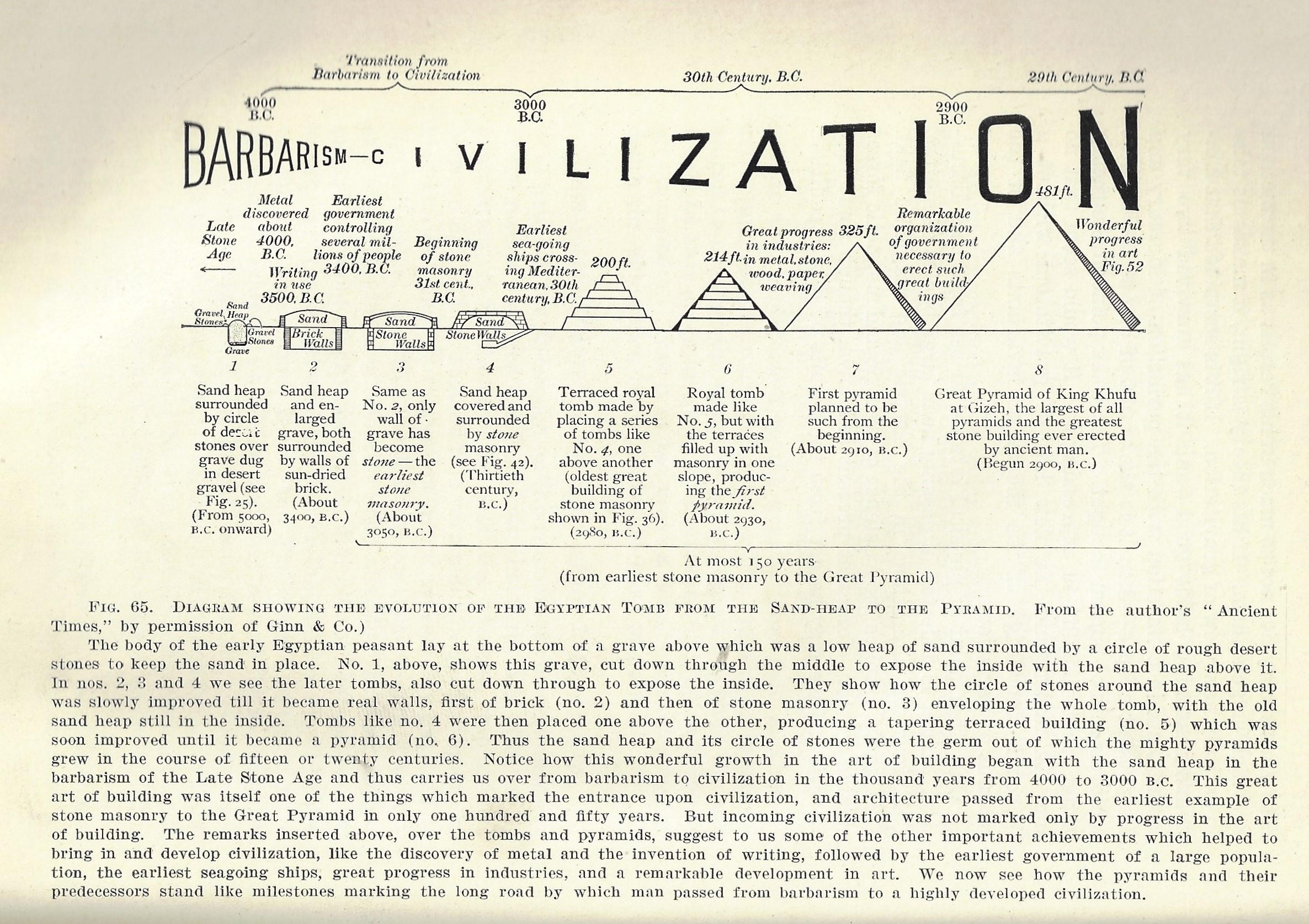
    Sharing space in the January 1920 issue of The Scientific Monthly with two significant papers is an unusual data visualization in James Breasted’s article “The Origins of Civilization”.  Leading the issue off is the wonderfully-presented and important paper (“Defects Found in Drafted Men”) by C.B. Davenport and A.G. Love, which is a remarkable display of an enormous amount of data on the health of young men in the U.S. presented in a graphical display, the results of medical examinations of millions entering military service during WWI. Following this is a report by Sir Joseph Thompson (“The Deflection of Light by Gravitation and the Einstein Theory of Relativity”) on the gravity/eclipse/relativity experiment in May 1919, which he referred to as  “the greatest achievement in the history of human thought”. And then comes the Barbarism/Civilization dataviz of the Breasted article.  I’m having a bit of fun with this at Breasted’s expense, as it looks as though he is measuring the progress of Barbarism to Civilization and the subsequent increases in culture to the depths/heights of monuments for the dead, from sand pit to pyramid, 4000-2800 BCE:

    Dataviz civilization

    [The text here becomes clearer when expanded.]

    It is an arresting image, to be sure, but the direction it takes seems a little suspect to me. In any event, I reproduce it here for general enjoyment.


  • The Earliest Appearance of “Einstein” in the “Physical Review”?

    JF Ptak Science Books   Quick Post 

    I set out to see when the first mention of “Einstein” occurs in the Physical Review to vaguely see how he was presented in what was even then in its first few decades of existence the premier U.S. physics journal. It is well known that he doesn’t publish a paper in the journal until 1931, and then publishes “only” two more papers there (the EPR paper in 1935 and then the Einstein-Rosen bridge (the wormhole) paper in 1937). There was one other small contribution as a letter to the editor in 1952, but that was it. (There have been many papers written on his anti-interest in publishing in the Physical Review so I won’t go into that right now.) I had just discussed the first appearance of a relativity paper in the Physical Review, found in the bibliography by Maurice Lecat (1929), which spots 1908 as the first effort published in the journal, though of course this doesn’t necessarily answer the first “Einstein” appearance. According to my searches on the American Physical Society Physical Review site, the first time Einstein’s name is mentioned in the PR is in the May 1, 1914 issue, and then only 11 more times to 1919.  Unfortunately the 1914 record is definitely not the first time E is mentioned, as just about the fist paper on relativity published in the PR does mention him by name in January 1909. (This is an abstract of a paper given by G. Lewis and R. Tolman in vol 28 1909 p 150.) So I’m not all that sure what this means, except that it seems unlikely that this sort of word search is an accurate (or definitive) tool–and I’m pretty sure that I can’t access hoped-for easy answers answers to these questions.

    In any event, Einstein doesn’t have much of an existence in the Physical Review until his big year of 19161, and then again another uptick following the verification experiment of the eclipse of May 28, 1919. It seems though that the major amount of fame and acknowledgment comes in the popular press, where Einstein becomes EINSTEN after the eclipse proofs. As a side note Einstein had no notice whatsoever in the New York Times until June 1919, at which time the massive coverage of him as the New & Improved Newton begins. 

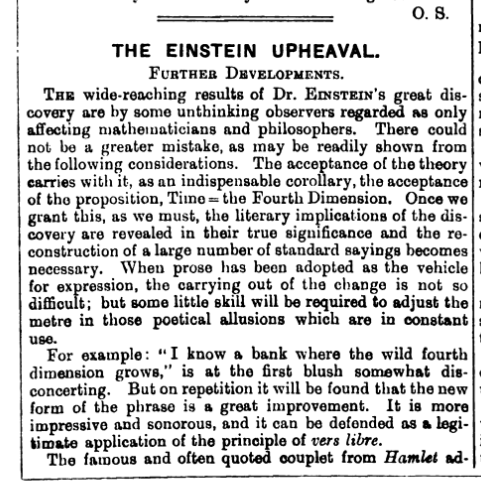
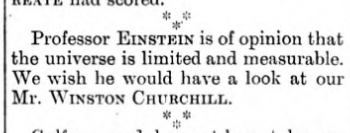
    I don’t have much of anywhere to go with this post, but I thought I’d at least share what I found, faulty as it probably is.  As a limp distraction from my inconclusive searches, here below are a couple of examples of early humorous treatments of Einstein, found in the pages of Punch, or the London Chiaravari, 1919-1921; the full results aren’t in yet, but it seems as though Einstein has more mentions in the 1920s in this satirical/entertainment magazine than he does in the Physical Review. I haven’t done supplementary searches in the databases of other journals/magazines/newspapers yet, though I will if this question of the earliest Einstein appearance in the Physical Review hasn’t left me. 


    Einstein Punch March 2 1921

    ·Posted by :

    ·in:


  • Scarce Collection of Portraits of Physicists, 1908

    JF Ptak Science Books  Quick Post

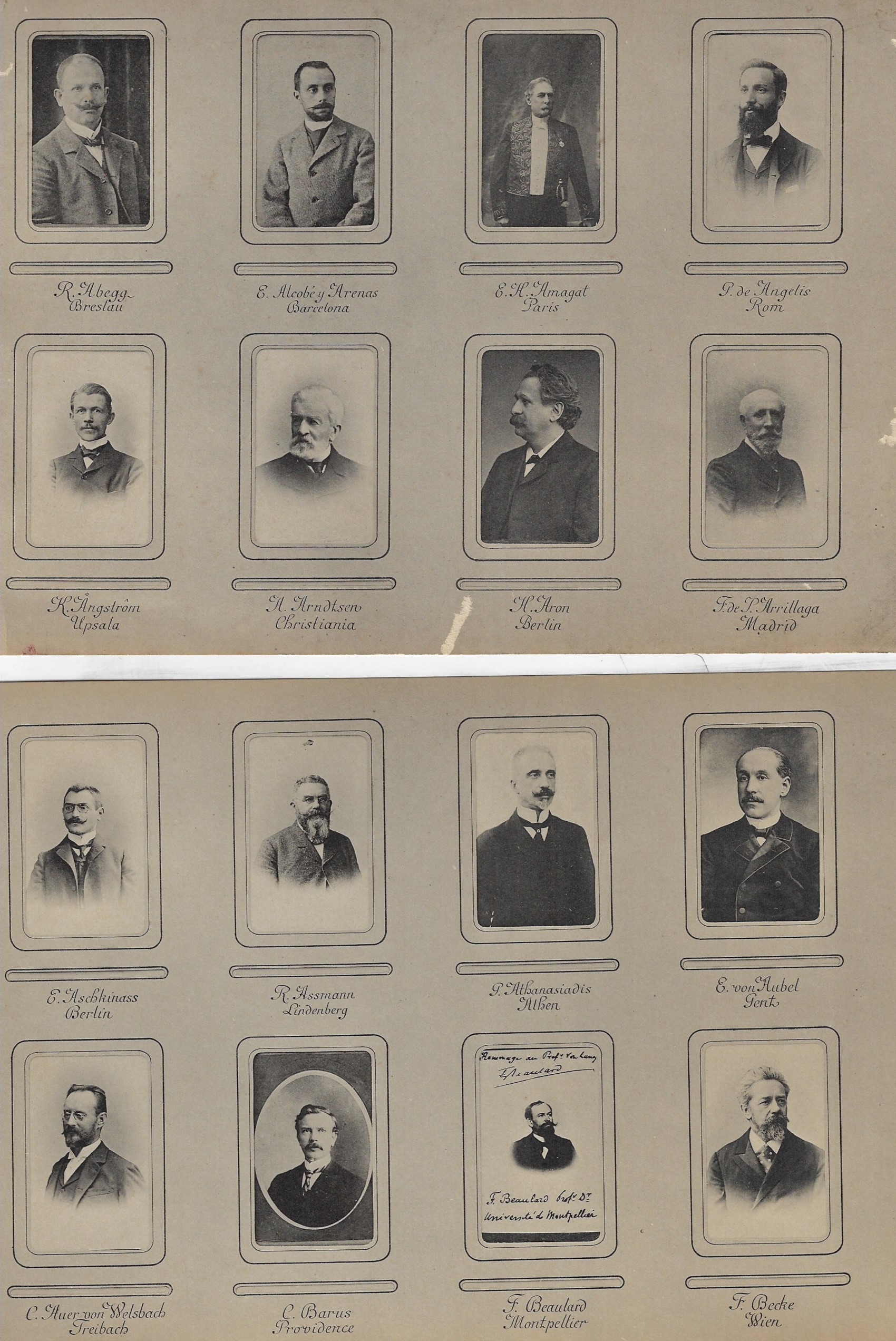
    This scarce publication–Bildnisse zeitgennossischer Physiker–is a collection of about 320 portraits of leading physicists, collected together as an homage to Viktor von Lang on the occasion of his 70th birthday.  The book was made to look like a family portrait album, resembling stiff cardboard pages that would have open places in the pages for a collection of cartes des visites to be slid into place via at slot at the bottom of the window. The physicist are from Germany, France, the UK, Spain, the U.S., Russia, Czechoslovakia, Poland, Italy, Hungary, Japan, and a few other countries.  Interesting to note here are the three portraits of women physicists: Margaret Maltby (Barnard, and first woman to receive a doctorate from a German university); A. Serdobinskaja (St. Petersburg); and O. Steindler (Vienna).

    Lang (1838-1921, one of the founders of crystal physics and from 1865 to 1909 (!) the director of the Physikalisches Kabinett in Vienna) is listed in some references as the author though I’m pretty certain that the work was edited by someone else and presented to Lang as an appreciation for his long contribution to science. There is also no mention of a place of publication.

    There are only four copies of this book found in WorldCat, and I only found a handful of the published photos online, so I thought to reproduce the book in its entirety Each section is expandable; the images were scanned at 200dpi so I think they will stand up nicely for individual reproduction. 

    Physics portraits _1_

    ·Posted by :

    ·in:


  • The First Imagery of Einstein with “E=mc^2” Appears in…a Comic Book?

    JF Ptak Science Books  Post 2782
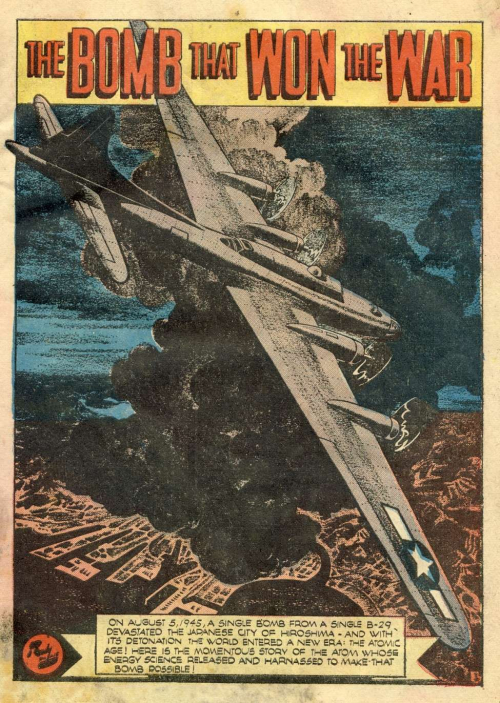
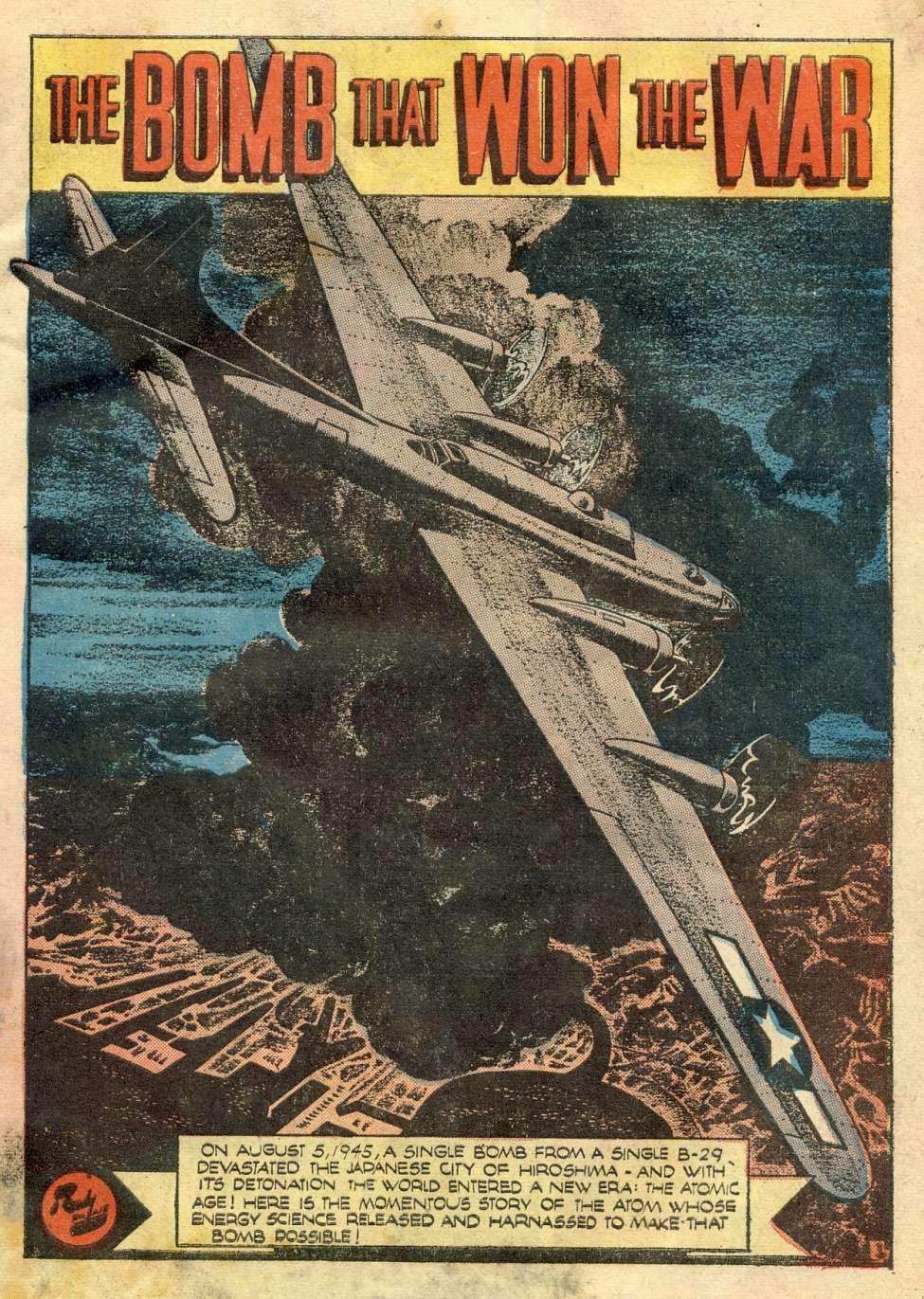
    Comic book hiroshima 1946After years of interest in the development of the atomic bomb and the half+-century of physics and chemistry that went into it, the question was put to me as to when the bomb’s use at Hiroshima and Nagasaki first appeared in a comic book. (It was potentially interesting to see how long it took  to see the effects of the bomb depicted to the very popular youth culture.) That led to an unexpectedly long and not very satisfying search for what turned out to be not a trivial answer. I’m not telling that story here now because the middle parts of the search are still a little unsorted–there was however another curious and provoking bit that popped up in the latest installment of the question,  found in what I think is the issue of this “first” comic book appearance of the use of the atomic bomb.

    Tucked inside this comic was an odd though not terribly wrong description of some of the background physics to the bomb. Amidst some fawning (?) and for no obvious reason highly caricatured images of physicists there appeared a crudely-rendered Einstein, and in his second panel, with his second blackboard, we see the The Equation, or almost so, appearing perhaps as   “E=mc2” or “E=mc2” [sic]. What seems to me to be the fact of the matter is that the equation that every schoolchild knows was not a very famous face to the great idea for nearly half a century, and nearly 25 years after Einstein received his Nobel (though that was not for relativity), because it just doesn’t show up. Long story short with a new subset, it seems to me that the very first time that Einstein publishes using this equation is not until the first issue of Science Illustrated,  in his article “E=mc2 the Most Urgent Problem of Our Time”, in April 1946.

    [Image sources above and below: Science Comics, vol 1/1, January 1946, from the wonderful website Comic Books Plus http://comicbookplus.com/?dlid=15937.  Also it is worth noting that the Enola Gay isn’t drawn very well, with extraneous stuff on the fuselage, and is also flying the wrong direction over Hiroshima and is too low…that’s all done for the sake of art, but, still, it ain’t right.]
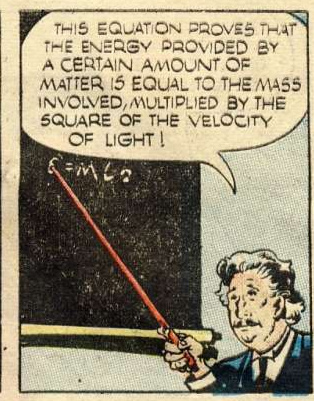
    E=MC2 comic book 1946

    It didn’t seem possible that it took so long for the equation to be published under Einstein’s name, but it appears that this is the case. The theory appears with much else in Einstein’s miracle year of 1905 (where it was written as a sentence and not as a formula), and there are numerous other representation of the idea of mass-energy equivalence, but so far as Einstein writing it in its most recognizable notation, publishing it under his name, it looks like the first appearance comes years later.

    The equation seems not quite right here in the comic book, and of course it is a comic book characterization of Einstein who is writing it and not Einstein himself, so it seems that this is a curiosity and little else…except when you wonder where the comic book writer/inkman/artist was exposed to the equation so that he might include it in the story?  This must be a shadow of something else, obviously, though not a shadow thrown directly by Einstein. (Another twist came in July 1946 when Time magazine used an image of Einstein and a mushroom cloud on their cover, with E=mc2 written onto the mushrooming cloud. This is “close” but then again, not really–also it appears after the publication of our comic book and Science Illustrated.)

    Just a year earlier there was an appearance of “E=mc2 in Henry DeWolf Smyth’s Atomic Energy for Military Purposes: The Official Report on the Development of the Atomic Bomb Under the Auspices of the United States Government, 1940-1945, right there on page 2, in the introduction. (It was published months earlier in several formats by the U.S. government, though the Princeton 1945 edition reached more readers.)

    This part of the story also has to wait to be told because I haven’t quite got the timeline down for the E=mc2 equation exactly as it appears and not written/published by Einstein, the earliest example that I have found thus far is 1929 (below). Today’s entry on this matter is more thinking-out-loud than anything else. 

    I guess the bigger question is: does it matter that E=mc2 doesn’t appear until much later, or that Einstein didn’t use it much?  Probably not. Other equations–like m=E/c2 and E0=m–were used in lecture and in other papers. It is simply curious to me why the equation has such a misty history given its supra-iconic status. 

    • I’m a little hesitant about posting this on the equation because it seems that the answer is obvious, which makes my question seem a little kooky–so far though the answer seems not trivial. 

    Notes:

    The first appearance in print in general of the equation is a much knottier question, with the “usual suspects” of possibilities exhausted without a satisfactory answer.  I must commend Eric Sacharow (an independent scholar in Milford, Connecticut) for instantaneously suggesting several possibilities during a phone call, all of which were very good and very close to the mark, but not quite there–thus far the best of the possibilities offered.

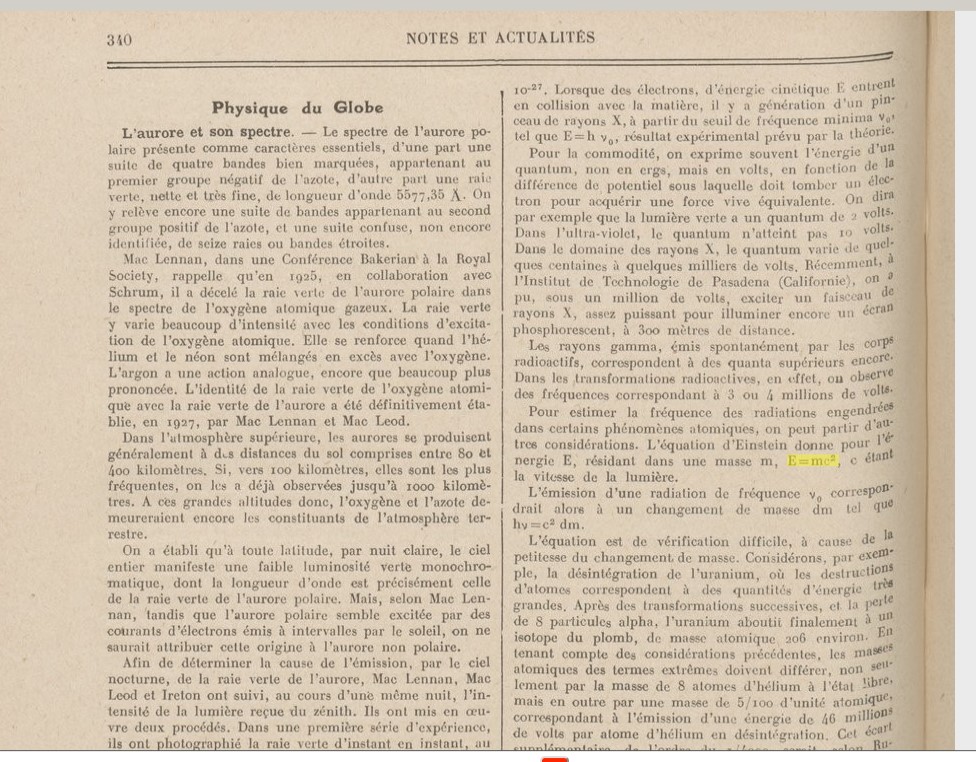
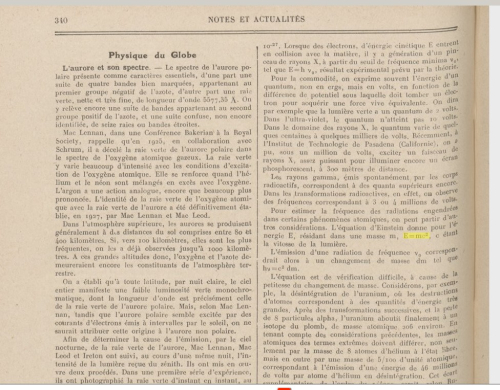
    Here’s an early appearance of E=mc2, in Revue Scientifique (Rose), 1929, in a review of physics for the previous weeks, a condensed review, signed only “S.V.”:
    E=mc2 1929 Revue

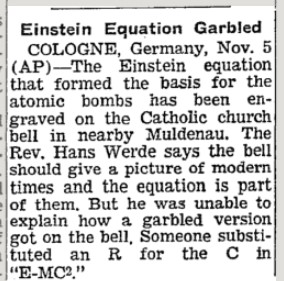
    And in this note from the New York Times (1950, sorry no further data yet) reporting on a “garbled” notation of E=mc2 that sounds as though it was engraved on a church bell as E=mr2 itself garbles the equation as “E-mc2“:
                                     E=MC 1950 NYT

    ·Posted by :

    ·in:

    —

  • A New-to-Me Find: the History of Nobel Prize Nominations

    JF Ptak Science Books   Quick Post

    Yesterday I found a fine resource that lives within another fine resource—somehow I missed it, entirely, and for years I suspect of using the one without noticing the other.

    The new-to-me find is the history of nomination process for the Nobel Prize on the Nobel Prize site. What this searchable database holds are all those nominated for the prize in all of the Academy’s fields, who nominated whom, what year, and for what area, with biographical links for all involved, an then cross-referenced so you can search by year and name.

    • Nobel Prize Nomination Archive:  https://www.nobelprize.org/nomination/redirector/?redir=archive
    • Nobel Prize site: https://www.nobelprize.org/

    I came upon the site looking to see the proof of nomination of Gustave Le Bon for the Physics Award in 1903–and indeed, he was there.  I’m not very sure about what Le Bon had done to achieve this level of recognition as he seems in his polymathic way to be around the peripheries of a lot of interesting things in a number of different fields without being at the core (?)–but there he was. One nomination for that year and then for all time. He didn’t stand a chance for the prize for that year, with Becquerel and Poincare receiving it for 1903.

    I didn’t check to see how many others received one and only one nomination, though I did find who received the most nominations and never receive the award–that distinction belongs to the great Arnold Sommerfeld, who was one of the last of those people who “knew everything”, and who over the years received 184 nominations. (#2 by the way was microbiologist Gaston Ramon with 155.)

    Just for the fun of it I looked up Richard Feynman and found that he was nominated 48 times, receiving multiple votes in 1956, 1957, 1960, 1962, 1963, 1954, and finally 1965 when we was awarded the prize. Einstein received 62 nominations between 1922 and 1922, receiving them in every year but 1911 and 1915–he was finally awarded the prize (for 1921) in 1922. 

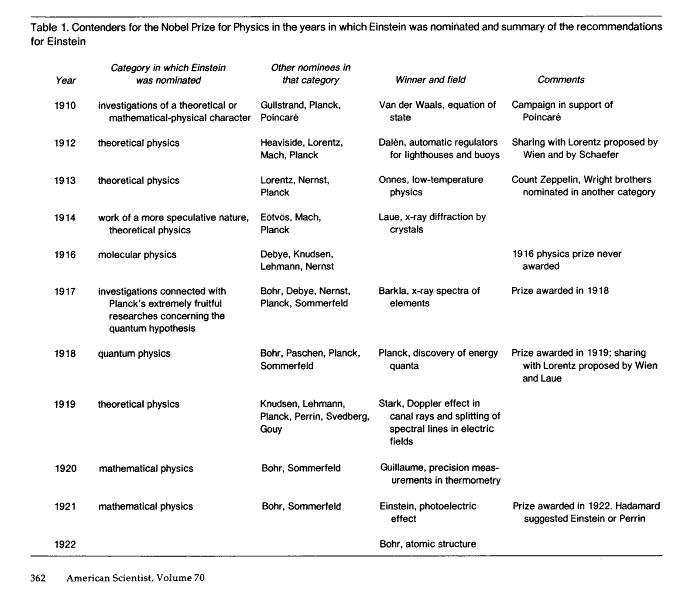
    The story of Einstein’s Nobel (that, is, the getting-it and not-getting-it part) is a bit complex, but is fabulously told by Abraham Pais in his paper “How Einstein Got the Nobel Prize: Why did the Nobel Committee for Physics wait so long before giving Einstein the Prize, and why did they not award it for relativity?” found in  American Scientist, Vol. 70, No. 4 (July-August 1982), pp. 358-365 (and also in a section of his book Einstein Lived Here).  Suffice to say here that the seemingly very long time for him not to receive the award (that he ultimately was given in 1922 for the photoelectric effect and not for relativity) is a “story which has neither heroes nor culprits” according to Pais, but rather seems one where the delayed recognition was due to very conservative appreciation for the proofs of the work. 

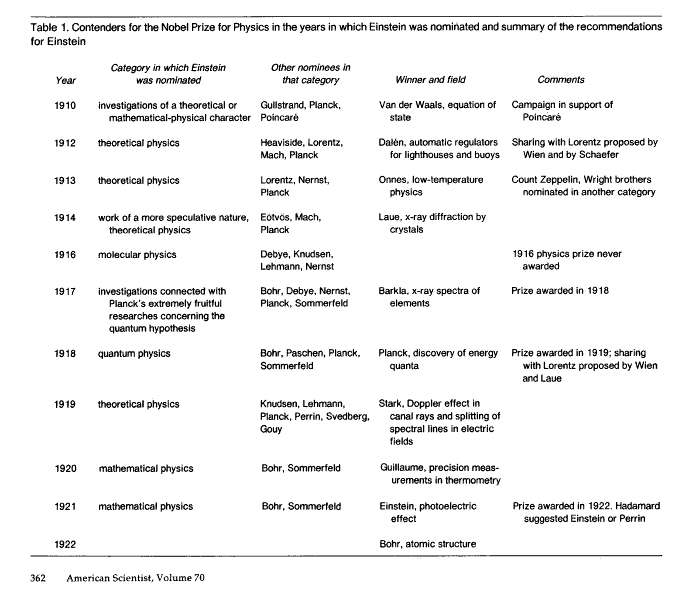
    Here’s a table from the Pais paper outlining the history of the Einstein nominations:

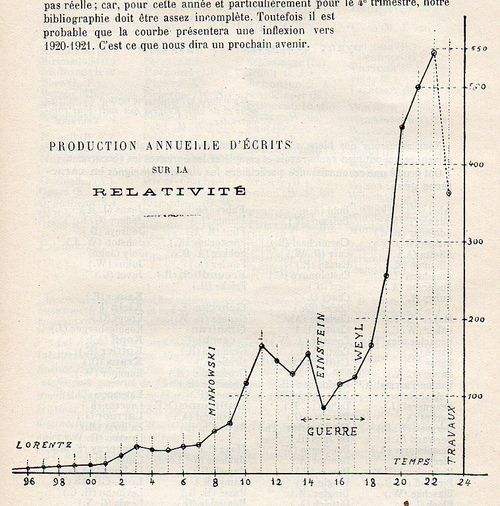
    Einstein nobel historyAgain, Pais points out that the Academy warded Einstein the prize for the photoelectric effect, and not for relativity. We can see in the graph below from the Lecat bibliography of relativity (published 1925) that there was an enormous increase in publications on the theory beginning at the end of WWI. Then came the experimental verification in 1919 that made Einstein into Einstein. Of course this is just a quantitative display of the numbers of papers published on the subject for that year–the members of the Academy certainly had some reservation on the theory of relativity even into 1920, citing what Pais refers to as not-unreasonable hesitations on the interpretation of the eclipse data. 


    Einstein relativituy lecat graph

    In any event, it was a very interesting and somewhat shocking experience to find the nomination archive. I recommend a tour. 

    ·Posted by :

    ·in:

    —