A Daily History of Holes, Dots, Lines, Science, History, Math, Physics, Art, the Unintentional Absurd, Architecture, Maps, Data Visualization, Blank and Missing Things, and so on. |1.6 million words, 7500 images, 4.9 million hits| Press & appearances in The Times, Le Figaro, Mensa, The Economist, The Guardian, Discovery News, Slate, Le Monde, Sci American Blogs, Le Pont, and many othr places… 5000+ total posts since 2008. Contact johnfptak at gmail dot com

Category: Reference Tools

  • “Relativity” and “Quantum” in the Titles and Abstracts of “Physical Review” Papers, 1911-2007

    JF Ptak Science Books  Quick Post 

    Here’s a simple list I made using a search tool on the American Physical Society site showing the frequency of the appearances of the words “relativity” and “quantum” in the titles and abstracts of papers that appeared in the Physical Review from 1911-2007. (I made this in 2008 so that’s why the count stops there.) This may be interested to graph out, though the info might not really tell you anything beyond he obvious.  Interestingly, RC Tolman seems to have the first article in PR on relativity (1910) and the second on quantum mechanics (1917).  Or so it seems at this point…

    PR articles with the word “relativity” in the title or abstract:

    2007 (1,012)
    2006 (971)
    2005 (968)
    2002 (846)

    ·Posted by :

    ·in:


  • History of the Past and History of the Future: Communications and Electronics in the Year 2012 (from 1962)

    JF Ptak Science Books    Post 2803 (Reference Tools Post) 

    Now HERE’S a wonderful and referenced and deep look at the history and future of electronics, and one that I believe is very overlooked. The article has the slightly opaque title of “Proceedings of the IRE Fiftieth Anniversary, 1912-1962” , which is the entire May issue for the journal, a double-brick of a book, weighing in at 6 pounds and running over 900 pages. It is a vast and compelling survey of the history and present state and future of electronics in general, boasting an authorship of leading lights across many different fields and encompassing 250 articles. (Some of the big names include: Terman, H.A. Wheeler, H. Olson, Gordon Teal, Presper Eckert, Zworykin, Simon Ramo, JR Pierce, Watson-Watt, Jerome Wiesner, Leo Beranek, Belevitch, Colin Cherry, Lee Lusted, Ronald “THE Antenna”) King, and many others. There’s fantastic reporting on the present-day state of things, as well as dozens of provocative and very prescient overview of what the future may/will bring…and take.

    I obviously can’t reproduce the volume, and no one seems to have the whole thing online, but I can provide a mostly-cleaned-up OCR (please pardon some of the typos) of the three very packed pages of the table of contents of the issue—many of those individual articles can be found online. (If anyone wants the original of this work, I have it for sale in my bookstore.) Perhaps now that you know such articles exist and hadn’t before, you may be able to put this list to some use.

    Some interesting articles include: There Will Be No Electronics Industry in 2012 A.D., J. M. Bridges; Communications Throughout the Solar System, W. H. Pickering; The Information Science anti Industry Fifty Years Hence, Robert M. Bowie; Machines with Imagination, G. A. Morton; The Integration of Man and Machine, J. Presper Eckert, Jr; Man-Machine Coupling-2012 A.D., R. M. Page…well, you get the idea.  

    COMMUNICATIONS AND ELECTRONICS-2012 A.D

    World Travel and Space Communication-2012 A.D., A Realistic Fantasy, Ernst Weber

    • Space-2012, Lloyd V. Berknei
    • Space Exploration, J. H. Dellinger
    • Education in 2012 for Communication and Electronics, Frederick E. Terman
    • Engineering Education-Circa 2012 A.D., W. L. Everitt
    • A Day in the Life of a Student in the Year 2012 A.D., Maurice J. Ponte
    • Fifty Years of Teaching Machines, Harold A. Zahl
    • The Tools of the Engineer 2012 A.D., R. Bennett
    • The Automatic Handbook, Nathaniel Rochester
    • There Will Be No Electronics Industry in 2012 A.D., J. M. Bridges
    • Radio Communication in 2012-An Obsolete Art, Dorman D. Israel
    • Electromagnetics and Communications, Harold A. Wheeler
    • Communication Spectra by the Wholesale-2012 A.D., Estill I. Green
    • A Short History of Electromagnetic Communications, John W. Coltman
    • The Spectrum Problem-Looking Back From 2012 A.D., E. A. Sack
    • The Full Use of Wide-Band Communications, Sir Noel Ashbridge
    • Wide-Band Communication into the Home, W. D. Lewis
    • Communication and Navigation, Henri Busignies
    • Communications and Electronics-2012 A.D., Peter C. Goldmark.
    • Communications Throughout the Solar System, W. H. Pickering.
    • Human Factors in Communications, Albert G. Hill
    • Multilingual Communication, Yasujiro Niwa
    • Language, Words and Symbols, Harold A. Wheeler
    • Processing of Sound, Harry F. Olson

  • Life Expectancy–a Useful Collection of Numbers

    JF Ptak Science Books  Quick Post/Reference Post

    I was having an interesting conversation with my friend, Andy Moursund, who asked if we are better off now or 50/60 years ago. That was the basic premise from which MANY qualifications were made, including who “we” are, where that “we” is, what they do, and so on, and then followed by defining “better” in a number of different ways, and then creating relative measures and measurements, and etc. It is a very complicated question–Andy says it is his favorite question for a long car ride with someone, and I like it. Anyway, in checking out one point I needed to consult numbers for human life expectancy, and since it took a little poking around, I thought I’d collect a useful selection of them and share it here. 

    (One definition by Encyclopedia Britannica: https://www.britannica.com/science/life-expectancy)

    Life Expectancy (current) by Country (wikipedia)

    Life Expectancy 1850-2015

    • https://www.infoplease.com/us/mortality/life-expectancy-age-1850-2011

    Life Expectnacy, Worldwide, 1850-2015

    • https://ourworldindata.org/life-expectancy

    Life Expectancy U.S., 1900-2000 (including by race)

    • https://www.seniorliving.org/history/1900-2000-changes-life-expectancy-united-states/

    Life Expectancy at Various Ages, 1800-1920, Great Britain

    Life Expectancy 1950-2050

    • https://en.wikipedia.org/wiki/Life_expectancy

    Actuarial Tables

    Also:

    Net Worth by Age and Percentile Calculator

    • https://dqydj.com/net-worth-by-age-calculator-united-states/

    ·Posted by :

    ·in:


  • A New-to-Me Find: the History of Nobel Prize Nominations

    JF Ptak Science Books   Quick Post

    Yesterday I found a fine resource that lives within another fine resource—somehow I missed it, entirely, and for years I suspect of using the one without noticing the other.

    The new-to-me find is the history of nomination process for the Nobel Prize on the Nobel Prize site. What this searchable database holds are all those nominated for the prize in all of the Academy’s fields, who nominated whom, what year, and for what area, with biographical links for all involved, an then cross-referenced so you can search by year and name.

    • Nobel Prize Nomination Archive:  https://www.nobelprize.org/nomination/redirector/?redir=archive
    • Nobel Prize site: https://www.nobelprize.org/

    I came upon the site looking to see the proof of nomination of Gustave Le Bon for the Physics Award in 1903–and indeed, he was there.  I’m not very sure about what Le Bon had done to achieve this level of recognition as he seems in his polymathic way to be around the peripheries of a lot of interesting things in a number of different fields without being at the core (?)–but there he was. One nomination for that year and then for all time. He didn’t stand a chance for the prize for that year, with Becquerel and Poincare receiving it for 1903.

    I didn’t check to see how many others received one and only one nomination, though I did find who received the most nominations and never receive the award–that distinction belongs to the great Arnold Sommerfeld, who was one of the last of those people who “knew everything”, and who over the years received 184 nominations. (#2 by the way was microbiologist Gaston Ramon with 155.)

    Just for the fun of it I looked up Richard Feynman and found that he was nominated 48 times, receiving multiple votes in 1956, 1957, 1960, 1962, 1963, 1954, and finally 1965 when we was awarded the prize. Einstein received 62 nominations between 1922 and 1922, receiving them in every year but 1911 and 1915–he was finally awarded the prize (for 1921) in 1922. 

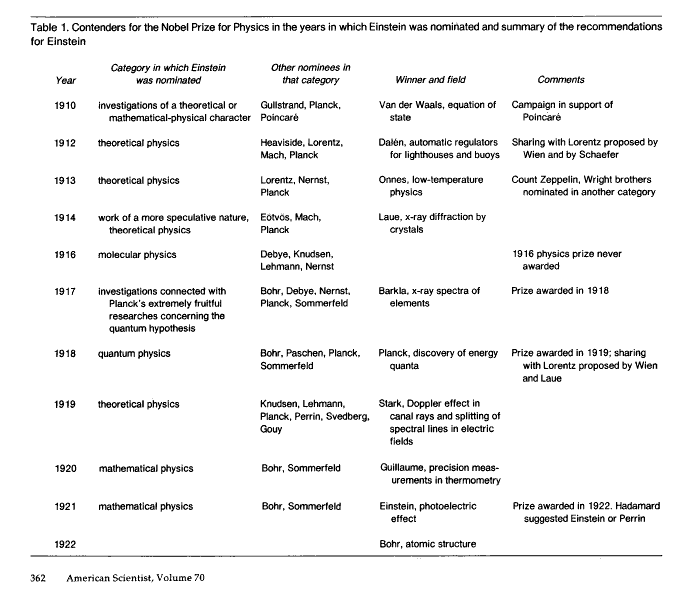
    The story of Einstein’s Nobel (that, is, the getting-it and not-getting-it part) is a bit complex, but is fabulously told by Abraham Pais in his paper “How Einstein Got the Nobel Prize: Why did the Nobel Committee for Physics wait so long before giving Einstein the Prize, and why did they not award it for relativity?” found in  American Scientist, Vol. 70, No. 4 (July-August 1982), pp. 358-365 (and also in a section of his book Einstein Lived Here).  Suffice to say here that the seemingly very long time for him not to receive the award (that he ultimately was given in 1922 for the photoelectric effect and not for relativity) is a “story which has neither heroes nor culprits” according to Pais, but rather seems one where the delayed recognition was due to very conservative appreciation for the proofs of the work. 

    Here’s a table from the Pais paper outlining the history of the Einstein nominations:
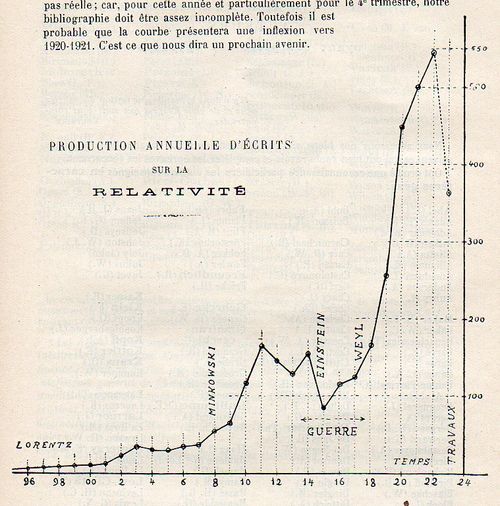
    Einstein nobel historyAgain, Pais points out that the Academy warded Einstein the prize for the photoelectric effect, and not for relativity. We can see in the graph below from the Lecat bibliography of relativity (published 1925) that there was an enormous increase in publications on the theory beginning at the end of WWI. Then came the experimental verification in 1919 that made Einstein into Einstein. Of course this is just a quantitative display of the numbers of papers published on the subject for that year–the members of the Academy certainly had some reservation on the theory of relativity even into 1920, citing what Pais refers to as not-unreasonable hesitations on the interpretation of the eclipse data. 
     

    Einstein relativituy lecat graph

    In any event, it was a very interesting and somewhat shocking experience to find the nomination archive. I recommend a tour. 
    ·Posted by :

    ·in:

    —

  • Quantum Mechanics Bibliographic Timeline–the El’yashevich List

    This is a handy and interesting timeline of QM placed in chronological order from the article by M A El’yashevich  ( “From the origin of quantum concepts to the establishment of quantum mechanics”, by M A El’yashevich, in Soviet Physics USPEKHI, 1977, 20 (8), 656–682.). I did not compose this nor did I add to it in any way—this is the sole effort of Prof. El’yashevich. I did make some slight compositional changes to make the list a little more accessible and usable to people like me, and condensed the list to only 1950 (whereas in the original the entries extend into the 1970’s), and made so that each entry is limited to a line or two;  but that’s it.

    I guess it would be easy to start the list with Planck if you wanted to give it a firm footing somewhere, though the history of quantum mechanics goes into development stages long before the 1900 Planck paper.  Be that as it may, this is just a quick exercise, and if an idea was formed or a lost memory found via a quick look at this list, then it is good enough for me.

    • M. Planck, Über irreversible Strahlungsvorgänge, Annalen der Physik, 1 (1900), 60–122,
    • Lord Rayleigh, Remarks upon the Law of Complete Radiation, Philosophical Magazine, 49 (1900), 539–540
    • M. Planck, Entropie und Temperatur strahlender Wärme, Annalen der Physik, 1 (1900), 719–737,
    • M. Planck, Über eine Verbesserung der Wienschen Spekralgleichung, Verb. Deutsch. Phys. Ges., 2 (1900), 202–204,

    • M. Planck, Zur Theorie des Gesetzes der Energieverteilung im Normalspektrum ibid., 1900, 237–245, 251–257)
    • M. Planck, Über des Gesetz der Energieverteilung im Nor malspektrum, Annalen der Physik, 4 (1901), 553–563,
    • M. Planck, “Über irreversible Strahlungsvorgänge (Nachtrag)”, ibid., 6 (1901), 818–831,
    • H. A. Lorentz, On the Emission and Absorption by Metals of Rays of Heat of Great Wave-Lengths, Proc. Amsterdam Acad., 5 (1903), 666–685
    • J. H. Jeans, On the Partition of Energy between Matter and Aether, Philosophical Magazine, 10 (1905), 91–98
    • A. Einstein, Über einen die Erzeugung und Verwandlung des Lichtes betreffenden heuristischen Gesichtspunkt, Annalen der Physik, 17 (1905), 132–148;
    • M. Planck, Vorlesungen Über die Theorie der Wännestrahlung, (Leipzig, Barth), 1906; (Leipzig, Barth, (2 Aufl.), 1913; (Leipzig, Barth, 3. Anfl.), 1919; (Leipzig, Barth, 4 Aufl.), 1921; 5 Aufl. (Leipzig, Barth), 1923;
    • P. Ehrenfest, Zur Planckschen Strahlungstheorie, Physikalische Zeitschrift, 7 (1906), 528–532,
    • A. Einstein, Die Plancksche Theorie der Strahlung und die Theorie der spezifischen Wärme, Annalen der Physik, 22 (1907), 180–190;
    • A. Einstein, Zum gegenwärtigen Stand des Strahlungsproblems, Physikalische Zeitschrift, 10 (1909), 185–193;
    • A. Einstein, “Über die Entwicklung unserer Anschauengen Über des Wesen und die Konstitution der Strahlung”, ibid., (1909), 817–825;
    • A. E. Haas, Über die elektrodynamische Bedeutung des Planckschen Strahlungsgesetz und Über eine neue Bestimmung des elektrischen Elementarquantums und der Dimensionen des Wasserstoffatoms, Sitzungber. Akad. Wiss. Wien, 2a, 119 (1910), 119–144
    • P. Debye, Der Warscheinlickeitsbegriff in der Theorie der Strahlung, Annalen der Physik, 33 (1910), 1427–1434
    • W. Nernst, Zur Theorie der spezifischen Wärme und Über die Anwendung der Lehre von den Energiequanten auf physikalisch-chemische Fragen überhaupt, Zs. Elektrochem., 17 (1911), 265–275
    • W. Nernst and F. Lindemann, “Spezifische Wärme und Quantentheorie”, ibid., 8 (1911), 17–827
    • M. Planck, Eine neue Strahlungshypothese, Verb. Deutsch. Phys. Ges., 13 (1911), 138–148
    • P. Ehrenfest, Welche Züge der Lichtquantenhypothese spielen in der Theorie der Wärme Strahlung eine wesentliche Rolle?, Annalen der Physik, 36 (1911), 91–118,
    • M. Planck, Die Gesetze der Wärmestrahlung und die Hypothese der elementaren Wirkungsquanten. Vortrag gehalten auf dem Solway-Kongress, Brüssel, 1911, 282–310)
    • A. Einstein, Zum gegenwärtigen Stand, des Problems der Spezifischen Wärme. Vortrag, gehlaten auf dem Solway-Kongress, Brüssel,
    • A. Einstein, Thermodynamische Bergründung des photochemisches Äquivalentgesetzes, Annalen der Physik, 37 (1912), 832–838;
    • Niels Bjerrum, Über die ultraroten Absorptionspektren der Gase, in: W. Nernst Festchrift, Halle, (1912), S. 90–98
    • W. Nicholson, The Constitution of the Solar Corona, II, Mon. Not. Roy. Astron. Soc., 72 (1912), 677–692
    • P. Debye, Zür Theorie der spezifischen Wännen, Annalen der Physik, 39 (1912), 789–839
    • M. Born and T. von Kármán, ÜberSchwingungen in Raungittern, Physikalische Zeitschrift, 13 (1912), 297–309
    • M. Born and T. von Kármán, “Zur Theorie der spezifischen Wärme”, ibid., 14 (1913), 15–19
    • N. Bohr, On the Constitution of Atoms and Molecules, Philosophical Magazine, 26:part D, 1–25, 476–502, (part II), 856–875 (part III) (1913);
    • P. Ehrenfest, Bemerkung betreffs der spezifischen Wärme zweiatomiger Gase, Deutsche Physikalische Gesellschaft, 15 (1913), 451–457
    • P. Ehrenfest, A. Mechanical Theorem of Baltzmann and Its Relation to the Theory of Energy Quanta, Proc. Amsterdam Acad., 16 (1914), 591–497,
    • N. Bohr, Om brintspektret, Fysisk Tidsskraft, 12 (1914), 97–114, (N. Bohr, Trudy 152–167)
    • M. Planck, Eine veränderte Formulierung der Quantenhypo-these, (Sitzungber. Akad. Wiss. Berl.), 1914, 918–923 ;
    • P. Ehrenfest, On Adiabatic Changes of a System in Connec tion with the Quantum Theory, Proc. Amsterdam Acad., 19 (1916), 576–597
    • A. Einstein, Strahlungs-Emission und-Absorption nach der Quantentheorie, Deutsche Physikalische Gesellschaft, 18 (1916), 318–323;
    • A. Einstein, Zur Quantentheorie der Strahlung, Mitt. d. Phys. Ges. Zürich, Nr., 18 (1916), 47–62;
    • N. Bohr, On the Quantum Theory of Line-Spectra, Kgl. dansk. vid. selskab. skr. IV, 1918–1922, 1–36, part D, 37–100 (part II) 101–118 (Part III); German translation in Über die Quantentheorie der Linienspektren, (Braunschweig), 1923
    • A. Sommerfeld, Atombau and Spektrallinien, 2. Aufl. (Braunschweig, Viewig), 1921, 1919; 3. Aufl., (1922); 4. Aufl., (1924);
    • N. Bohr, “Über die Serienspektra der Elemente”, Zeitschrift fur Physik, 2 (1920), 423–469; Über die Serienspektra der Elemente, I,
    • A. H. Compton, Secondary Radiations Produced by X-rays, Bull. Nat. Res. Council (pt. 2), 4:No. 20 (1922)
    • N. Bohr, Über die Anwendung der Quantentheorie auf den Atombau. I. Grundypostulate der Quantentheorie, Zeitschrift fur Physik, 13 (1923), 117–165;
    • A. H. Compton, A Quantum Theory of the Scattering of X-Rays by Light Elements, Physical Review, 21 (1923), 483–502
    • P. Debye, Zerstreuung von Röntgenstrahlen und Quanten theorie, Physikalische Zeitschrift, 24 (1923), 161–166
    • P. Ehrenfest, Adiabatische Transformationen in der Quanten theorie und ihre Behandlung durch Niels Bohr, Naturwissen-schaften, 11 (1923), 543–550;
    • L. de Brogue, Ondes et quanta, Comptes Rendus…de l’Academies des Sciences, 177 (1923), 507–510;
    • L. de Broglie, “Quanta de lumière, diffraction et interférence”, ibid., (1923), 548–550; (Usp. Fiz. Nauk, 93 (1967), 182–183
    • L. de Brogue, “Les quanta, la théorie cinétique des gaz et le principe de Fernat”, ibid., (1923), 630–632;
    • L. de Broglie, A Tentative Theory of Light Quanta, Philosophical Magazine, 47 (1924), 446–458; translation in this issue, 562)
    • S. N. Bose, Plancks Gesetz und Lichtquantenhypothese, Zeitschrift fur Physik, 26 (1924), 178–181 
    • A. Einstein, Quantentheorie des einatonigen idealen Gases, (Sitzungher. Preuss. Akad. Wiss.), 1924, 261–267 ;
    • L. de Brogue, Recherches sur la théorie de quanta. Thèse de doctoral, (Paris, Masson et Cie), 1924; (also in: Ann. de Phys., 3 (1925), 22–128,
    • A. Einstein, Quantentheorie des einatonigen idealen Gases, (Zweite Abbandbung, Sitzungber. Preuss. Akad. Wiss.), 1925, 3–14 ;
    • W. Pauli, Über den Zusammenhang des Abschlusses der Elektronengruppen im Atom mit der Komplexstruktur der Spektren, Zeitschrift fur Physik, 31 (1925), 765–783; Trudy, I, 645–660)
    • N. Bohr, “Über die Wirkung von Atomen bei Stössen”, ibid., 34 (1925), 142–157
    • M. Born, Vorlesungen über Atommechanik, (Bd. 1, Springer, Berlin), 1925, 1934;
    • G. Uhlenbeck and S. Goudsmit, Ersetzung der Hypothese von unmechanischen Zwang durch eine Forderung bezügluch des inneren Verhaltens jedes ienzelnen Elektrons, Naturwissenschaften, 13 (1925), 953–954
    • G. Uhlenbeck and S. Goudsmit, Spinning Electrons and the Structure of Spectra, Nature, 117 (1926), 264–265
    • E. Schrödinger, Zur Einsteinsche Gastheorie, Physikalische Zeitschrift, 27 (1926), 95–101; “
    • E. Fermi, Zur Quantelung des idealen einatomigen Gases, Zeitschrift fur Physik, 36 (1926), 902–912;
    • W. Pauli, “Quantentheorie”, Handbuch der Physik, Bd. 23, (Berlin, Springer), 1926, S. 1–278 ;
    • W. Heisenberg, Über quantentheoretische Umdeutung kinematischer und mechanischer Beziehungen, Zeitschrift fur Physik, 33 ([July 29] 1925), 879–893;
    • M. Born and P. Jordan, “Zur Quantenmechanik”, ibid., 34 (1925), 858–888, 27 Sep.;
    • P. A. M. Dirac, The Fundamental Equations of Quantum Mechanics, Proc. Roy. Soc. (London), 109 (1925 [Nov. 7]), 642–653,
    • M. Born, W. Heisenberg, and P. Jordan, Zur Quanten mechanik. II, Zeitschrift fur Physik, 35 (1926), 557–615; [Nov., 16 (1925)
    • H. A. Kramers, Eenige opmerkingen over de quantuummechanica van Heisenberg, Physica, 5 (1925 [November]), 369–377
    • W. Heisenburg, Über quantentheoretische Kinematik und Mechanik, Math. Ann., 95 (1926 [Dec. 21, 1925]), 683–705
    • K. Lanczos, Über eine feldmässige Darstellung der neuen Quantenmechanik, Zeitschrift fur Physik, 35 (1926 [Dec. 22, 1925]), 812–830
    • M. Born and N. Wiener, “Eine neue Formulierung der Quantengesetze für periodische und nichtperiodische Vorgänge”, ibid., 36 (1926 [Jan. 5]), 174–187
    • W. Pauli, “Über das Wasserstoffspektrum vom Standpunkt der neuen Quantenmechanik”, ibid., (1926 [Jan. 17]), 336–363
    • P. A. M. Dirac, Quantum Mechanics and a Preliminary In vestigation of the Hydrogen Atom, Proc. Roy. Soc. (London), 110 (1926 [Jan. 22]), 561–579
    • E. Schrödinger, Quantisierung als Eigenwertproblem (Erste Mitteilung), Annalen der Physik, 79 (1926), 361–376; [Jan. 27] (E. Schrödinger, Trudy;, 9–20; Usp. Fiz. Nauk, 122, 621)
    • L. Brillouin, Les spectres de rotation, dans la nouvelle mechanique des quanta, avec le calcule des matrices, Comptes Rendus…de l’Academies des Sciences, 182 (1926 [Feb. 8]), 374–376
    • E. Schrödinger, “Quantisierung als Eigenwertproblem (Zweite Mitteilung)”, Annalen der Physik, 79 (1926), 489–527, [Feb. 23]
    • K. Lanczos, Variationsprinzip und Quantenbedingungen in der neuen Quantenmechanik, Zeitschrift fur Physik, 36 (1926 [Mar. 1]), 401–409
    • W. Heisenberg and P. Jordan, “Anwendung der Quantenmechanik auf das Problem der anomalen Zeemaneffekte”, ibid., 37 (1926 [Mar. 16]), 263–277
    • G. Beck, “Comptoneffekt und Quantenmechanik”, ibid., 38 (1926 [Mar. 16]), 144–148
    • F. London, “Energiesatz und Rydbergprinzip in der Quanten mechanik”, ibid., 36 (1926 [Mar. 17]), 775–777
    • E. Schrööinger, “Über das Verhältnis der Heisenberg-Born–Jordanschen Quantenmechanik zu der meinen”, Annalen der Physik, 79 (1926), 734–756, [Mar. 18]
    • P. A. M. Dirac, The Elimination of the Nodes in Quantum Mechanics, Proc. Roy. Soc. (London), 111 (1926 [Mar. 27]), 281–305
    • G. Wnetzel, Die mehrfach peridoschen. Systems in der Quan tenmechanik, Zeitschrift fur Physik, 37 (1926 [Mar. 27]), 80–94
    • Lucy Mensing, “Die Rotations-Schwingungshanden nach der Quantenmechanik”, ibid., 36 (1926 [Mar. 29]), 814–823
    • I. Tamm, “Zur Quantenmechanik des Rotators”, ibid., 37 (1926 [Apr. 27), 685–696
    • P. Jordan, “Uber kanonische Transformationen in der Quanten mechanik”, ibid., (1926 [Apr. 27]), 383–386
    • D. Dennison, The Rotation of Molecules, Physical Review, 28 (1926 [Apr. 27]), 318–333
    • E. Fues, Das Eigenschwingungspektrum zweiatomiger Moleküle in der Undulationsmechanik, Annalen der Physik, 80 (1926 [Apr. 27]), 367–396
    • K. Lanczos, Uber die komplexe Beschaffenheit der quantenmechanischen Matrizen. Zeitschrift fur Physik, 37 (1926 [Apr. 28]), 405–413
    • O. Klein, “Quantentheorie und fünfdimensionale Relativitäts–theorie”, ibid., (1926 [Apr. 28]), 895–902
    • P. A. M. Dirac, Relativity Quantum Mechanics with an Appli cation to the Compton Scattering, Proc. Roy. Soc. (London), 111 (1926 [Apr. 29]), 405–423
    • E. Schrödinger, Dr stetige Übergang von der Mikro-zur Makromechanik, Naturwissenschaften, 14 ([May] 1926), 664–666; Handbuch der Physik,
    • E. Schrödinger, Quantisierung als Eigenwertproblem (Dritte Mitteilung), Annalen der Physik, 80 ([May 10] 1926), 437–490; Handbuch der Physik,
    • F. London, Uber die Jacobischen Transformationen in der Quantenmechanik, Zeitschrift fur Physik, 37 (1926 [May 22]), 915–925
    • C. Eckart, The Solution of the Problem of the Simple Os cillator by a Combination of the Schroedinger and the Lanczos Theories, Proc. Nat. Ac. Sci., 12 (1926 [May 31]), 473–47
    • C. Eckart, Operator Caclulus and the Solution of the Equa tions of Quantum Dynamics, Physical Review, 28 (1926 [June 7]), 711–726
    • W. Heisenberg, Mehrkörperprobleme und Resonanz in der Quantenmechani, Zeitschrift fur Physik, 38 (1926 [11 June]), 411–426
    • V. Fock, “Zur Schrödingerschen Wellenmechanik”, ibid., (1926 [June 11]), 242–250
    • G. Wentzel, “Eine Verallgemeinerung der Quantenbedingungen für die Zwecke der Quantenmechanik”, ibid., (1926 [June 18]), 518–529
    • E. Schrödinger, QuantentisieSung als Eigenwertproblem (Vierte Mitteilung), Annalen der Physik, 81 ([June 21] 1926), 109–139; Handbuch der Physik,
    • J. Waller, Der Starkeffekt zweiter Ordnung bei Wasserstoff und die Rydbergkorrektion der Spektra von He and Lĭ, Zeitschrift fur Physik, 38 (1926 [June 21]), 635–646
    • M. Born, “Zur Quantenmechanik der Stossvorgänge (vorlüufige Mitteilung)”, ibid., 37 (1926 [June 25]), 863–867
    • L. Mensing and W. Pauli, Uber Dielektrizitätskonstante von Dipolgasen nach der Quantenmechanik, Physikalische Zeitschrift, 27 (1926 [June 25]), 509–512
    • R. Kronig, The Dielectric Constant of Diatomic Dipole-Gases on the New Quantum Mechanics, Proc. Nat. Ac. Sci., 12 (1926 [July 3]), 488–493
    • L. Brillouin, “La méchanique ondulatoire de Schrödinger; une methode général de résolution par approximations successives”, Comptes Rendus…de l’Academies des Sciences, 183 (1926 [July 5]), 24–26
    • T. De Donder and H. van den Dungen, “La quantification dédnite de lagraphique einsteinienne”, ibid., (1926 [July 5), 22–24
    • P. Jordan, Uber kanonische Transformationen in der Quantenmechanik. II, Zeitschrift fur Physik, 38 (1926 [July 9]), 513–517
    • E. Fues, Zur Intensität der Bandenlinien und des Affinitätsspektrums zweiatomiger Moleküle, Annalen der Physik, 81 (1926 [July 9]), 281–313
    • C. Eckart, The Hydrogen Spectrum in the New Quantum Theory, Physical Review, 28 (1926 [July 17]), 927–935
    • M. Born, Quantemechanik der Stossvorgänge, Zeitschrift fur Physik, 38 ([July 21] 1926), 803–827; Russ. translation Handbuch der Physik, (Usp. Fiz. Nauk), 122, p. 632)
    • N. von Raschevsky, “Einige Bemerkungen zur Heisenbergschen Quantenmechanik”, ibid., 39 (1926 [July 21]), 153–158
    • W. Heisenberg, “Über die Spektra von Atomsystemen mit zwei Elektronen.”, ibid., (1926 [July 24]), 499–518
    • L. Brillouin, Sur un type général des problèmes, permettant la séparation dans la mechanique ondulatiore de Schrödinger, Comptes Rendus…de l’Academies des Sciences, 183 (1926 [July 26]), 270–272
    • L. de Broglie, “Remarques sur la nouvelle Méchanique ondulatoire”, ibid., (1926 [July 26]), 272–274
    • P. A. M. Dirac, On Quantum Algebra, Proc. Cambr. Phil. Soc., 23 (1926 [July 26]), 412–418
    • P. S. Epstein, The Stark Effect from the Point of View of Schroedinger’s Quantum Theory, Physical Review, 28 (1926 [July 29]), 695–710
    • V. Fock, Über die invariante Form der Wellen-und Bewegungsgleichungen für einen gelendenen Massenpunkt, Zeitschrift fur Physik, 39 (1926 [July 30]), 226–232
    • L. de Broglie, Les principes de la nouvella méchanique ondulatoire, J. de Phys., 7 (1926 [Aug. 5), 321–327
    • F. London, Die Zahl der Dispersionselektronen in der Un dulationsmechanik, Zeitschrift fur Physik, 39 (1926 [Aug. 19]), 322–326
    • P. A. M. Dirac, On the Theory of Quantum Mechanics, Proc. Roy. Soc. (London), 112 (1926 [Aug. 26]), 661–677 
    • F. Reiche, Die Quantelung des symmetrischen Kreisels mach Schrödingers Undulationsmechanik, Zeitschrift fur Physik, 39 (1926 [Aug. 26]), 444–494
    • Jane Dewey, Intensities in the Stark Effect of Helium, Physical Review, 28 (1926 [Aug. 28]), 1108–1125
    • J. Kudar, Zur vierdimensionalen Formulierung der undulatorischen Mechanik, Ann. d Phys., 81 (1926 [Aug. 30]), 632–636
    • H. A. Kramers, Wellenmechanik und halbzahlige Quantisie rung, Zeitschrift fur Physik, 39 (1926 [Sep. 9]), 828–840
    • R. Kronig, The Dielectric Constant of Symmetrical Poly atomic Dipole-Gases in the New Quantum Mechanics, Proc. Nat. Ac. Sci., 12 (1926 [Sep. 13]), 608–612
    • P. Ehrenfast and G. Uhlenbeck, Graphische Veranschaulichung der de Broglieschen Phasenwellen in der fünfdimensionalen Welt von O. Klein, Zeitschrift fur Physik, 39 (1926 [Sep. 16]), 495–498
    • G. Gamow and D. Ivanenko, “Zur Wellentheorie der Materie”, ibid., (1926 [Sep. 19]), 865–868
    • F. London, “Winkelvariable und kanonische Transformationen in der Undulationsmechanik”, ibid., 40 (1926 [Sep. 19]), 193–210
    • W. Gordon, “Der Comptoneffekt nach der Schrödingerschen Theorie”, ibid., 117 (1926 [Sep. 29]), 133
    • P. S. Epstein, The New Quantum Mechanics and the Zeeman Effect, Proc. Nat. Ac. Sci., 12 (1926 [Oct. 7]), 634–638
    • D. Iwanenko and L. Landau, Zur Ableitung der Klein-Fock-schen Gleichung, Zeitschrift fur Physik, 40 (1926 [Oct. 8]), 161–162
    • M. Born, “Das Adiabatenprinzip in der Quantenmechanik”, ibid., 167-192, (1926 [Oct. 16])
    • E. Fermi, “Zur Wellenmechanik des Stossvorganges”, ibid., (1926 [Oct. 23]), 399–401; Handbuch der Physik, I,
    • E. Madelung, “Quantentheorie in hydrodynamischer Form”, ibid., (1926 [Oct. 25]), 322–326
    • L. Pauling, “Die Abschirmungskonstanten der relativistischen oder magnetischen Röntgenstrahlendubletts”, ibid., (1926 [Oct. 27]), 344–350
    • J. R. Oppenheimer, Quantum Theory and Intensity Distribu tion in Continuous Spectra, Nature, 118 ([Oct. 30] 1926), 771
    • R. H. Fowler, General Forms of Statistical Mechanics with Special Reference to the Requirements of the New Quantum Mechanics, Proc. Roy. Soc. (London), 118 (1927 [3 Nov.]), 432–449
    • R. Kronig and I. I. Rabi, The Symmetrical Top in the Undulatory Mechanics, Physical Review, 29 (1927 [Nov. 4]), 252–269
    • W. Heisenberg, Schwankungserscheinungen und Quantenmechanik, Zeitschrift fur Physik, 40 (1926 [Nov. 6]), 501–506
    • E. Fermi and E. Persico, “Il principio delle adiabatiche e la nozione di forza viva nelle nuova meccanica ondulatoria”, Rend. Lincei, 4 (1926), 452–457, [Nov. 7]
    • E. Wigner, Über nicht kombinierende Terme in die neuen Quantentheorie (Erster Teil), Zeitschrift fur Physik, 40 (1926 [Nov. 12]), 492–500
    • L. Landau, “Zur Theorie der Spektren der zweiatomiger Moleküle”, ibid., (1926 [Nov. 13]), 621–627; Handbuch der Physik, I,
    • E. Fermi, Quantum Mechanics and the Magnetic Moment of Atoms, Nature, 118 (1926 [Nov. 14]), 876;
    • J. H. Van Vleck, The Dielectric Constant and Diamagnetism of Hydrogen and Helium in the New Quantum Mechanics, Proc. Nat. Ac. Sci., 12 (1926 [Nov. 15]), 662–670\
    • C. Eckert, “Note on the Correspondence Principle in the New Quantum Mechanics”, ibid., (1926 [Nov. 16), 684–687
    • G. Wentzel, Zur Theorie des photoelektrischen Effekts, Zeitschrift fur Physik, 40 (1926 [Nov. 19), 574–589
    • F. Hund, “Zur Deutung der Molekelspektren. I”, ibid., (1927 [Nov. 19]), 742–764
    • Burrau, “Berechnung des Eigenwerts des Wasserstoff-molekel Ions (H+ 2)”, Normalzustand. Naturwissenschaften, 15 (1927 [Nov. 22, 1926]), 16–17
    • P. Jordan, Über quantenmechanische Darstellung von Quantensprüngen, Zeitschrift fur Physik, 40 (1927 [25 Nov, 1926]), 661–666
    • E. Wigner, “Über nicht kombinierende Terme in der neuen Quantenmechanik (Zweiter Teil)”, ibid., (1927 [Nov. 26, 1926]), 883–892
    • J. S. Slater, Radiation and Absorption on Schroedinger’s Theory, Proc. Nat. Ac. Sci., 13 (1927 [Nov. 26, 1926]), 7–12
    • H. Radamacher and F. Reiche, Die Quantelung des symmetrischen Kreisels nach Schrödingerschen Undulationsmechanik. II. Intensitätsfragen, Zeitschrift fur Physik, 41 (1927 [Nov. 29, 1926]), 453–492
    • E. Schrödinger, Über den Comptoneffekt, Annalen der Physik, 82 (1927), 257–264, [Nov. 30, 1926]
    • P. A. M. Dirac, The Physical Interpretation of the Quantum Dynamics, Proc. Roy. Soc. (London), 113 (1927 [Dec. 2, 1926]), 621–641
    • O. Klein, Elektrodynamik und Wellenmechanik von Stand-punkt der Korrespondenzprinzip, Zeitschrift fur Physik, 41 (1927 [Dec. 6, 1926]), 407–442
    • E. Schrödinger, “Der Energieimpulssatz der Materien-wellen”, Annalen der Physik, 82 (1927), 265–272, [Dec. 10, 1926] (E. Schrödinger, Trudy, 145–150)
    • P. Ehrenfest, and G. Uhlenbeck, Die wellenmechanische Interpretation der Boltzmannschen, Statistik nehen der der neuen Statistiken, Zeitschrift fur Physik, 41 (1927), 24–26, [Dec. 15, 1926] (P. Ehrenfest, Stat’i, 79–81)
    • W. Pauli, “Über Gasentartung und Paramagnetismus”, ibid., (1927 [Dec. 16, 1926]), 81–102
    • P. Debye, Wellenmechanik und Korrespondenzprinzip, Physikalische Zeitschrift, 28 (1927 [Dec. 16, 1926), 170–174
    • L. Brillouin, Les moments de rotation et le magnetisme dans la méchanique ondulatoire, J. de Phys., 8 (1927 [Dec. 17, 1926]), 74–84
    • P. Jordan, Über eine neue Bergrüdung der Quantenmechanik, Zeitschrift fur Physik, 40 (1927 [Dec. 18, 1926]), 809–838
    • A. Unsöld, Beitrage zer Quantenmechanik der Atome, Annalen der Physik, 82 (1927 [Dec. 22, 1926]), 355–393
    • W. Heisenberg, Mehrkörperprobleme und Resonanz in der Quantenmechanik. II, Zeitschrift fur Physik, 41 (1927 [Dec. 22, 1926]), 239–267
    • L. de Broglie, L’univers a cinq dimensions et la méchanique ondulatoire, J. de Phys., 8 (1927 [Dec. 23, 1926]), 65–73
    • F. Slack, Die Intensitätsdissymmetrie beim Wasserstoff-Starkeffekt, Annalen der Physik, 82 (1927 [Dec. 24, 1926]), 576–584
    • J. R. Oppenheimer, Zur Quantentheorie kontinuirlicher Spektren, Zeitschrift fur Physik, 41 (1927 [Dec. 24, 1926]), 268–293
    • G. Beck, “Zur Theorie des Photoeffekts”, ibid., (1927 [Dec. 27, 1926]), 443–452
    • M. Sugiura, Sur le nombre des electrons de dispersion pur pour les spectres continues et pour les spectres de séries de l’hydrogene, J. de Phys., 8 (1927 [Dec. 30, 1926), 113–124
    • E. E. Witmer, The Quantization of the Rotational Motion of the Polyatomic Molecule by the New Quantum Mechanics, Proc. Nat. Ac. Sci., 13 (1927 [Jan. 15]), 60–65
    • P. Ehrenfest nd G. Uhlenbeck, Zum Einsteinschen “Mischungsparadoxon” Zeitschrift fur Physik, 41 (1927 [Jan. 25]), 576–582
    • J. C. Slater, Action of Radiation and Perturbations on Atoms, Proc. Nat. Ac. Sci., 13 (1927 [Jan. 29]), 104–111
    • L. de Broglie, La structure atomique de la matière et du rayonement et la Mèchanique ondulatoire, Comptes Rendus…de l’Academies des Sciences, 184 (1927 [Jan. 31]), 273–274
    • P. A. M. Dirac, The Quantum Theory of the Emission and Absorption of Radiation, Proc. Roy. Soc. (London), 114 (1927 [Feb. 2]), 243–265
    • F. Hund, Zur Deutung der Molekelspektren. II, Zeitschrift fur Physik, 42 (1927 [Feb. 7]), 93–120
    • D. Iwanenko and L. Landau, “Bemerkung Über Quantenstatistik.”, ibid., (1927 [Feb. 12]), 562–564
    • P. Jordan, “Anmerkungen zur statistischen Deutung der Quan tenmechanik”, ibid., 41 (1927 [Feb. 17), 797–810
    • F. London, “Quantenmechanische Deutung der Theorie von Weyl”, ibid., 42 (1927 [Feb. 25]), 375–389
    • J. H. Van Velck, On Dielectric Constants and Magnetic Sus ceptibilities in the New Quantum Mechanics, Part I. A Gen eral Proof of the Langevin-Deybe Formula, Physical Review, 29 (1927 [Feb. 28]), 727–744
    • G. Beck, Über die Strahlungreibung in der Quantenmechanik, Zeitschrift fur Physik, 42 (1927 [Mar. 8]), 86–88
    • J. Oppenheimer, “Zur Quantenmechanik der Richtungsentartung”, ibid., 43 (1927 [Mar. 8]), 27–46
    • A. Landé, “Spontane Quantenübergänge”, ibid., 42 (1927 [Mar. 17]), 835–38
    • A. Markoff, “Über eine Minimaleigenschaft der Schrödinger Wellengruppen”, ibid., (1927 [Mar. 18), 637–640
    • E. C. Condon, Coupling of Electronic and Nuclear Motion in Diatomic Molecules, Proc. Nat. Ac. Sci., 13 (1927 [Mar. 19]), 462–466
    • W. Heisenberg, Über den anschaulichen Inhalt der quanten-theoretischen Kinematik and Mechanik, Zeitschrift fur Physik, 43 (1927 [Mar. 23]), 172–198; Russ. translation Usp. Fiz. Nauk, 122, 651)
    • H. Bateman, A Modification of Gordon’s Equation, Physical Review, 30 (1927 [Mar. 30]), 55–60
    • L. de Broglie, La méchanique ondulatoire et la structure atomique de la matiè re et du rayonnement, J. de Phys., 8 (1927 [Apr. 1]), 225–241
    • N. Wiener and D. Struik, Quantum Theory and Gravitational Relativity, Nature, 119 (1927 [Apr. 2]), 853–854
    • G. Wentzel, Zur Theorie des Comptoneffekts, Zeitschrift fur Physik, 43 (1927 [Apr. 3]), 1–8
    • P. A. M. Dirac, The Quantum Theory of Dispersion, Proc. Roy. Soc. (London), 114 (1927 [Apr. 4]), 710–728
    • D. Hubert, J. von Neumann, and L. Nordheim, Über die Grundlagen der Quantenmechanik, Math. Ann., 98 (1927 [Apr. 6]), 1–30
    • E. U. Condon, Wave Mechanics and the Normal State of the Hydrogen Molecule, Proc. Nat. Ac. Sci., 13 (1927 [Apr. 18]), 466–470
    • P. S. Epstein, “The Dielectric Constant of Atomic Hydrogen in Undulatory Mechanics”, ibid., (1927 [Apr. 20]), 432–43
    • J. C. Slater, “The Structure of the Helium Atom. I”, ibid., (1927 [Apr. 26]), 423–430
    • E. Fermi, Sul meccanismo dell’emissione nella meccanica ondulatoria, Rend. Lincei, 5 (1927 [May 1]), 795–800; Handbuch der Physik, I, (E. Fermi, Trudy), 271–277
    • W. Pauli, Zur Quantenmechanik des magnetischen Elektrons, Zeitschrift fur Physik, 43 (1927 [May 3]), 601–623
    • G. Beck, “Über einige Folgerungen aus dem Satz von der Analogie zwischen Lichtquant und Elektron.”, ibid., (1927 [May 3]), 658–674
    • E. Wigner, “Einige Folgerungen aus der Schrödingerschen Theorie für die Termstrukturen”, ibid., (1927 [May 5]), 624–652
    • J. H. Van Vleck, On Dielectric Constants and Magnetic Sus ceptibilities in the New Quantum Mechanics, Part II. Appli cation to Dielectric Constants, Physical Review, 30 (1927 [May 5]), 31–54
    • C. Richter, The Hydrogen Atom with a Spinning Electron in Wave Mechanics, Proc. Nat. Ac. Sci., 13, 476–479, [May 9]
    • A. Unsold, Quantentheorie der Wasserstoffmolekülions und die Born-Landéschen Abstossungskräfte, Zeitschrift fur Physik, 43 (1927 [May 10]), 563–574
    • G. Wentzel, “Über Strahlungslose Quantensprünge”, ibid., (1927 [May 11]), 524–530
    • E. Fues, “Lebensdauer und Resonanzerscheinungen”, ibid., (1927 [May 11]), 726–740
    • W. Heitler, “Freie Weglänge und Quantelung der Molekültranslation”, ibid., 44 (1927 [May 20]), 161–169
    • J. von Neumann, “Mathematische Begründung der Quanten mechanik”, Gött. Nachr., (1927 [May 20]), 1–57
    • L. Sugiura, “Über die numerische Bestimmung der Mittel-werte zwischen Ortho-und Paratermen von He and Li+“, Zeitschrift fur Physik, 44 (1927 [May 23]), 190–206
    • G. Wentzel, “Zur Theorie des Comptoneffekts. II”, ibid., 43 (1927 [May 26]), 779–787
    • F. Hund, “Symmetriecharactere der Termen bei Systemen mit gleichen Partikeln in der Quantenmechanik”, ibid., (1927 [May 27]), 788–804
    • F. Hund, Zur Deutung der Molekelspektren., III (1927 [May 28]), 805–826
    • G. Kellner, “Die Ionisierungsspannung des Heliums nach der Schrödingersche Theorie”, ibid., 44 (1927 [June 1]), 91–109
    • P. Jordan, Über eine neue Begrüdung der Quantenmechanik, II:ibid. (1927 [June 3]), 1–25
    • D. M. Dennison, A Note on the SpecificHeat of the Hydro gen Molecule, Proc. Roy. Soc. (London), 115 (1927 [June 3]), 483–493
    • E. Schrödinger, Energieaustausch nach der Wellenmechanik, Annalen der Physik, 83 (1927 [June 10]), 956–968; Handbuch der Physik,
    • P. Jordan, Über die Polarisation der Lichtquanten, Zeitschrift fur Physik, 44 (1927 [June 16), 292–300
    • G. Kellner, “Der Grundterm des einfach ionisierten Lithiums nach der Schrödingersche Theorie”, ibid., (1927 [June 17]), 110–112
    • L. Rosenfeld, L’électron magnétique ondulatoire, Comptes Rendus…de l’Academies des Sciences, 184 (1927 [June 20]), 1540–1541
    • P. A. M. Dirac, Über die Quantenmechanik der Stossvorgänge, Zeitschrift fur Physik, 44 (1927 [June 28), 585–595
    • W. Heitler and F. London, “Wechselwirkung neutraler Atome und homöpolare-Bindung mach der Quantenmechanik”, ibid., (1927 [June 30]), 455–472
    • P. Jordan, “Zur Quantentheorie der Gasentartung”, ibid., (1927 [July 7]), 473–480
    • E. H. Kennard, “Zur Quantenmechanik einfacher Bewegungsty pon”, ibid., (1927 [July 17]), 326–352
    • L. Landau, “Das Dämpfungsproblem in der Wellenmechanik”, ibid., 45 (1927), 430–441; [July 27]
    • A. Landé, “Zur Wellenmechanik der Kontinua und Elektrodynamik”, ibid., 44 (1927 [July 28]), 766–772
    • C. G. Darwin, The Electron as a Vector Wave, Proc. Roy. Soc. (London), 116 (1972 [July 30]), 227–253
    • Jane Dewey, Intensities in the Stark Effect of Helium. II, Physical Review, 30 (1927 [July]), 770–780
    • H. Faxen and J. Holtsmark, Beitrag zur Theorie des Durchganges langsamer Elektronen durch Gase, Zeitschrift fur Physik, 45 (1927 [Aug. 6]), 307–324
    • E. U. Condon, Zeeman Effect of the Symmetrical Top Ac cording to the Wave Mechanics, Physical Review, 30 (1927 [Aug. 8]), 781–784
    • W. Elsasser, Zur Theorie der Stossprozesse bei Wasserstoff, Zeitschrift fur Physik, 45 (1927 [Aug. 26]), 522–538
    • M. Born and R. Oppenheimer, Zur Quantentheorie der Molekeln, Annalen der Physik, 84 (1927 [Aug. 28]), 457–484
    • L. Sugiura, Über die Eigenschaften des Wasserstoffmole-küls im Grundzustand, Zeitschrift fur Physik, 45 (1927 [Aug. 30]), 484–492
    • J. R. Oppenheimer, Three Notes on the Quantum Theory of Aperiodic Effects, Physical Review, 31 (1927 [August]), 66–81
    • P. Ehrenfest, Bemerkung Über die angenäherte Gültigkeit der klassischen Mechanik innerhalb der Quantenmechanik, Zeitschrift fur Physik, 45 (1927), 455–457, [Sep. 5] (P. Ehrenfest stat’i, 82–84)
    • Lucy Mensing, “Zur Theorie des Zusammenstosses von Atomen mit langsamen Elektronen”, ibid., (1927 [Sep. 13]), 603–609
    • P. Jordan and O. Klein, Zum Mehrkörperproblem der Quan tentheorie, Zeitschrift fur Physik, 45 (1927 [Oct. 4]), 751–765
    • P. Jordan, “Über Wellen und Korpuskeln in der Quanten mechanik”, ibid., (1927 [Oct. 11]), 766–775
    • W. Heitler, “Störugsenergie und Austausch beim Mekrkör-perproblem”, ibid., 46 (1927 [Oct. 12]), 47–7
    • H. Weyl, “Quantenmechanik und Gruppentheorie”, ibid., (1927 [Oct. 13]), 1–46
    • C. C. Darwin, Free Motion in the Wave Mechanics, Proc. Roy. Soc. (London), 117 (1927 [Oct. 25]), 258–293
    • J. R. Oppenheimer, On the Quantum Theory of the Polarization of Impact Radiation, Proc. Nat. Ac. Sci., 13 (1927 [Oct. 26]), 800–805
    • S. C. Wang, “The Diamagnetic Susceptibility of Hydrogen Molecule and of Helium in the New Quantum Mechanics”, ibid., (1927 [Nov. 7]), 798–800
    • E. Hulthén, Über nicht kombinierende Teilsysteme in den Bandonspektren. Zeitschrift fur Physik, 46 (1928), 349–353; [Nov., 9 (1927)
    • J. von Neumann, “Warscheinlichkeittheorietischen Aufbau der Quantenmechanik”, Gött. Nachr., (1927 [Nov. 11]), 245–272
    • J. von Neumann, “Thermodynamik quantenmechanischer Gesamtheiten”, ibid., (1927 [Nov. 11]), 273–291
    • A. Ruark, The Zeeman and Stark Effects of Hydrogen in Wave Mechanics. The Force Equation and the Virial Theorem in Wave Mechanics, Physical Review, 31 ([Dec. 4, 1927), 533–538
    • P. Jordan and W. Pauli, Zur Quantenelektrodynamik ladungs-freier Felder, Zeitschrift fur Physik, 47 (1928 [Dec. 7, 1927]), 151–173
    • R. Kronig, “Zur Deutung der Bandespektren”, ibid., 46 (1928 [Dec. 8, 1927]), 814–825
    • F. London, “Zur Quantentheorie der homöopolaren Valenz-zahlem”, ibid., (1928 [Dec. 9, 1927]), 455–477
    • L. Nordhe in, “Zur Theorie der thermischen Emission und der Reflexion von Elektronen an Metallen”, ibid., (1928 [Dec. 11, 1927]), 833–855
    • L. Mandelstam and M. Leontovich, “Zur Theorie der Schrödingerschen Gleichung”, ibid., 47 (1928), 131–136, [Dec. 15, 1927]
    • A. Sommerfeld, “Zur Elektronentheorie der Metalle auf Grund der Fermischen Statistik. I, II”, ibid., (1928 [Dec. 17, 1927]), 1–32, 43–60
    • A. H. Wilson, The Ionized Hydrogen Molecule, Proc. Roy. Soc. (London), 118 (1928 [Dec. 19, 1927]), 635–647
    • F. Slack, Intensities in the Hydrogen Spectral Series, Physical Review, 31 (1928 [Dec. 20, 1927]), 526–532
    • J. von Neumann and E. Wigner, Zur Erklärung einiger Eigenschaften der Spektren aus der Quantenmechanik des Drehelektrons, Zeitschrift fur Physik, 47 (1928 [Dec. 28, 1927]), 203–220
    • E. H. Kennard, Note on Heisenberg’s Indetermination Prin ciple, Physical Review, 31 (1928 [Dec. 29, 1927), 344–348
    • J. C. Slater, “Central Fields and Rydberg Formulas in Wave Mechanics”, ibid., (1928 [December 1927]), 333–343
    • J. R. Oppenheimer, “On the Quantum Theory of the Capture of Electrons”, ibid., (1928 [December 1927]), 348–358
    • P. A. M. Dirac, The Quantum Theory of the Electron, Roy. Soc. (London), 117 (1928 [Jan. 2), 610–624
    • V. Fock, Bemerkung zur Quantelung des harmonischen Oszillators im Magnetfeld, Zeitschrift fur Physik, 47 (1928 [Jan. 12]), 446–448
    • J. H. Van Velck, The Correspondence Principle in the Sta tistical Interpretation of Quantum Mechanics, Proc. Nat. Ac. Sci., 14 (1928 [Jan. 16]), 178–188
    • K. Niesson, Über die annäharenden komplexen Lösungen der Schrödingerschen Differentialglelchung für den harmonischen Oszillator, Annalen der Physik, 85 (1928 [Jan. 21), 497–514
    • P. Jordan and E. Wigner, Über das Paulische ÄAquivalenzverbot, Zeitschrift fur Physik, 47 (1928 [Jan. 26]), 631–651
    • W. Heitler, “Zur Gruppentheorie der homöopolaren chemischen Rindung”, ibid., (1928 [Jan. 26]), 835–858
    • J. H. Van Vleck, On Dielectric Constants and Magnetic Sus ceptibilities in the New Quantum Mechanics, Part III. Appli cation to Dia-and Paramagnetism, Physical Review, 31 (1928 [Feb. 1]), 587–613
    • P. A. M. Dirac, The Quantum Theory of the Electron (part II), Proc. Roy. Soc. (London), 118 (1928 [Feb. 2]), 351–361
    • J. Frenkel, Zur Wellenmechanischen Theorie des rotierenden Elektrons, Zeitschrift fur Physik, 47 (1928 [Feb. 3]), 786–803
    • J. Frenkel, “Zur Wellenmechanischen Theorie der metallischen Leitfähigkeit”, ibid., (1928 [Feb. 7]), 819–834
    • E. H. Kennard, On the Quantum Mechanics of a System of Particles, Physical Review, 31 (1928 [Feb. 10]), 876–890
    • W. Gordon, Die Energieniveaus des Wasserstoffatoms nach der Diracschen Quantentheorie des Elektrons. Zeitschrift fur Physik, 48 (1928 [Feb. 23]), 11–14
    • J. Holtsmark, “Zur Theorie der Streuung langsamer Elektronen”, ibid., (1928 [Feb. 27]), 231–243
    • C. G. Darwin, The Wave Equation of the Electron, Proc. Roy. Soc. (London), 118 (1928 [Mar. 6]), 654–680
    • L. Pauling, The Shared-Electron Chemical Bond, Proc. Nat. Ac. Sci., 14 (1928 [Mar. 7]), 359–362
    • D. Iwanenko and L. Landau, Zur Theorie des magnetischen Elektrons. I, Zeitschrift fur Physik, 48 (1928 [Mar. 8]), 340–348
    • A. Ruark, The Limits of Accuracy of Physical Measurements, Proc. Nat. Ac. Sci., 14 (1928 [Mar. 8]), 322–328
    • A. Ruark, “A Critical Experiment on the Statistical Interpre tation of Quantum Mechanics”, ibid., (1928 [Mar. 9]), 328–330
    • R. Kronlg and H. A. Kramers, Zur Theorie der Absorption und Dispersion in den Röntgengebiet, Zeitschrift fur Physik, 48 (1928 [Mar. 10]), 174–179
    • J. von Neumann, “Einige Bemerkungen zur Diracschen Theorie des relativistischen Drehelektrons”, ibid., (1928 [Mar. 15]), 868–881
    • C. Eckert, “Die Korrespondenzmässige Beziehung zwischen den Matrizen und den Formierkoeffizienten des Wasserstoff-problems”, ibid., (1928 [Mar. 16]), 295–301
    • E. Hylleraas, “Über den Grundzustand des Heliumatoms”, ibid., (1928 [Mar. 16]), 469–494
    • A. Landé, “Zu Diracs Theorie des Kreiselektron.”, ibid., (1928 [Mar. 24), 601–606
    • F. Sexl, “Bemerkung zur Quantelung des harmonischen Oscilators im Magnetfeld”, ibid., (1928 [Mar. 28]), 611–613
    • J. Frenkel, “Elementare Theorie magnetischer und elektrischer Eigenschaften der Metalle beim absoluten Nullpunkt der Temperatur”, ibid., 49 (1928), 31–45, [Mar. 30]
    • N. Bohr, Atomic Theory and Mechanics, Nature, 116 (1925), 845–852;
    • W. Heisenberg, Quantenmechanik, Naturwissenschaften, 14 (1926), 989–994 ;
    • E. Schrödinger, An Undulatory Theory of the Mechanics of Atoms and Molecules, Physical Review, 28 (1927), 1049–1070;
    • E. Schrödinger, Abhandlungen zur Wellenmechanik, 2 Aufl. (Leipzig, Barth), 1928, 192
    • M. Born, Quantenmechanik und Statistik, Naturwissenschaf ten, 15 (1927), 238–242;
    • Louis de Brogue, La mechanique ondulatoire, (Paris, Gautier-Villard), 1928
    • Louis de Broglie and Leon Brillouin, Selected Papers on Wave Mechanics, (Glasgow, Blackie and Son), 1928
    • H. Weyl, Gruppentheorie and Quantenmechanik, (Leipzig, Hirzel), 1928; 2. Aufl., (1931)
    • N. Bohr, Atom, (Encyclopedia Brittanica, 14th ed., v. II, London), 1929
    • A. Sommerfeld, Atombau und Spektrallinien. Wellenmechanischer Ergän-zungsband, (Braunschweig, Vievig), 1929, 1933;
    • J. Frenkel, Einführung in die Wellenmechanik, (Berlin, Springer), 1929
    • W. Heisenberg, Die physikalischen Prinzipien der Quanten theorie, (Leipzig, Hirzel), 1930, 1932;
    • P. Dirac, The Principles of Quantum Mechanics, (Clarendon Press, Oxford), 1930; 2 Ed. 1935
    • M. Born and P. Jordan, Elementare Quantenmechanik, (Berlin, Springer), 193
    • Louis de Broglie, Introduction a l’etude de la mécanique on dulatoire, (Paris, Hermann), 1930, 1934;
    • E. Wigner, Gruppentheorie und ihre Anwendung auf die Quan tenmechanik der Atmospektren, (Braunschweig, Viewig), 1931
    • J. von Neumann, Mathematische Grundlagen der Quanten mechanik, (Berlin, Springer), 1932, 1964; translated from the German Mathematical Foundations of Quantum Mechanics,
    • B. L. Van der Waerden, Die gruppentheoretische Methode in der Quantenmechanik, (Berlin, Springer), 1932, 1938;
    • W. Pauli, Die allgemeinen Prinzipien der Wellenmechanik in: Handbuch der Physik, (Bd. 24, Teil 1, Berlin, Springer), 1933, 1947;
    • L. de Broglie, L’electron magnétique (Théorie de Dirac), (Paris, Hermann), 1934, 1936;
    • E. Rutherford, “Forty Years of Physics. II. The Develop ment of the Theory of Atomic Structure”, Background to Modern Science, Cambridge, II, (E. Rutherford, Trudy), 1940, 47–74 479–492
    • A. Sommerfeld, Zwanzig Jahre spektroskopischer Theorie in München, Scientia, 72 (1942), 123–130; 
    • M. Planck, Zur Geschichte der Auffindung des physikali-schen Wirkungsquantums, Naturwissenschaften, 31 (1943), 153–159; 
    • A. Sommerfeld, Some Reminescences of My Teaching Career, Am. J. Phys., 17 (1949), 315–317;

    ·Posted by :

    ·in:


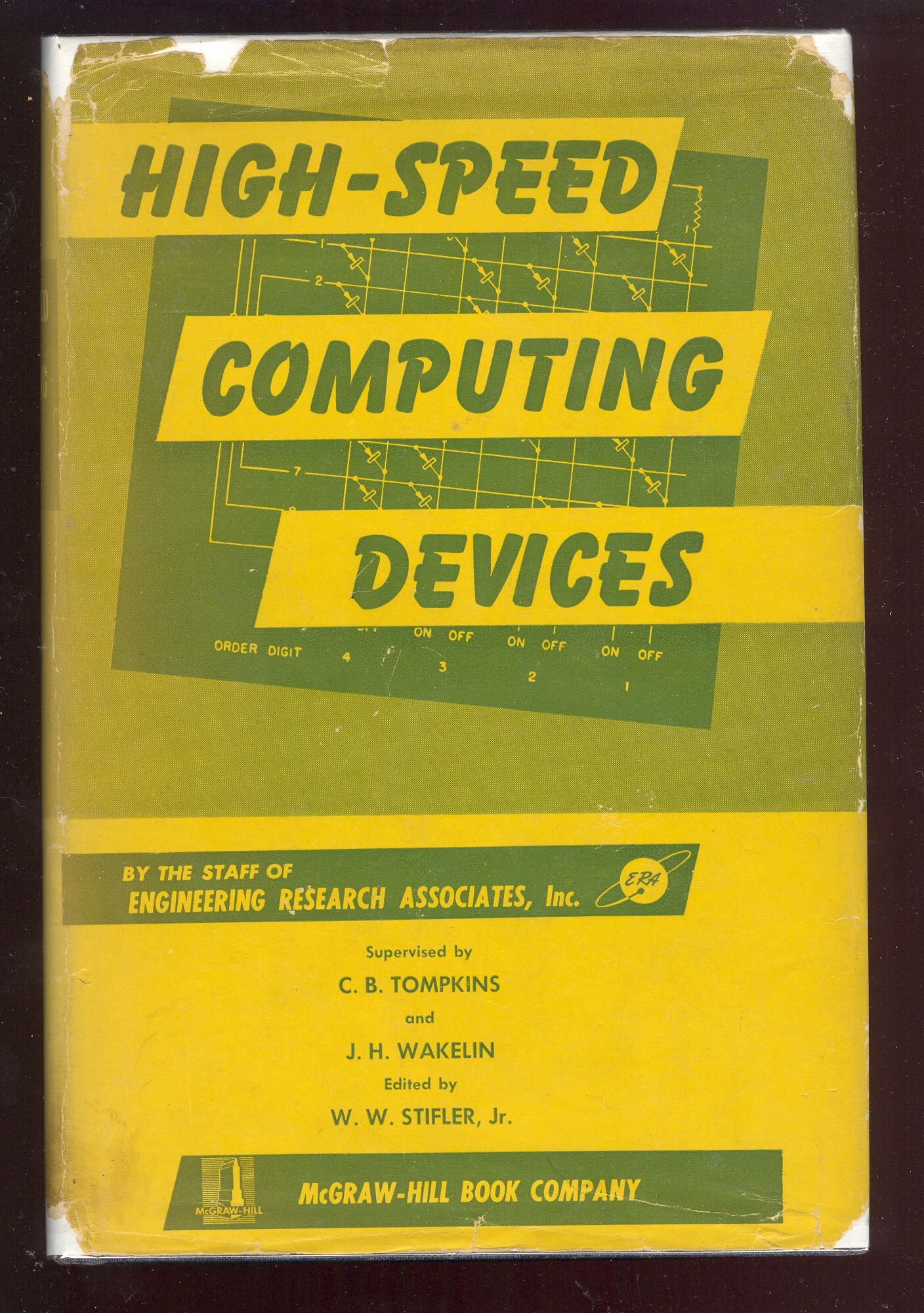
  • A Great Classic–the First True Textbook on Computing Bibliography!

    JF Ptak Science Books   Post 2529    Reference Tools series

     C.B. Tompkins’  High-Speed Computing Devices (New York,  McGraw Hill, 1950) is probably the best of the pre-1960 textbooks on the computer, complete with stout bibliographies and lots of bits to trail  from the golden age of computers. This classic work is enhanced by a (very) unusually complete series of chapter-ending references and bibliographies. Among much else of interest we find a treatment of the Harvard Mark I and II on pp 183-187 in the chapter on “Large-Scale Digital Computing Systems” on pp 182-222 with bibliography occupying pp 218-222. Also, the “Punched-Card Computing Systems” chapter pp 146-181 has a very nice bibliography on pp 166-181. 

    Books--era


    Even though I’ve used this book quite a bit I’ve never collected the chapter-ending references in one document until today. Tompkins now appears in the glorious Internet Archive, and I’ve taken the 16 pieces of bibliography and gathered them all below in a document that is about 40 pages long.  Have a look, and enjoy–thanks to the Internet Archive!

    • This is considered to be the first textbook on digital computers, the first compendium in English on digital computer technology, and a pioneering work that influenced many computer designers during the 1950s. It provides an unsurpassed picture of the state of the art during the late 1940s, and is further enhanced by the inclusion of several excellent bibliographies. — Sarrazin F2.
    • “The book is a careful analysis of the electronic field as of 1950 and was in very large measure written by the late Professor C. B. Tompkins..” – Goldstine 315.
    • (This book) was written to satisfy “a perceived need, following the end of WW II, for compendium of technologies applicable to the emerging field of electronic digital computers…Because published technical information was scarce in the U.S., there can be little question that the book was an important contribution to computer literature…with its state of the art picture of the period 1947 through 1949, establishes a well-documented baseline fro tracking and evaluating subsequent technological progress.”– Arnold Cohen, from the Introduction to the 1983 Charles Babbage Institute Reprint Series Edition of the ERA Report, published by Tomash Publshing. ERA


     High-Speed Computing Devices, by C.B. Tompkins: bibliographies

    Source: Internet Archive  https://archive.org/stream/highspeedcomputi00era/highspeedcomputi00era_djvu.txt

    Chapter 1. Introduction 
    Chapter 2. Preliminary Considerations 
    Chapter 3. Counters as Elementary Components 
    Chapter 4. Switches and Gates
    Chapter 5. A Functional Approach to Machine Design 
    Chapter 6. Arithmetic Systems
    Chapter 7. Numerical Analysis 
    Chapter 8. Desk Calculators 
    Chapter 9. Punched-card Computing Systems 
    Chapter 10. Large-scale Digital Computing Systems
    Chapter 11. Analog Computing Systems 
    Chapter 12. The Form of a Digital Computer  
    Chapter 13. Arithmetic Elements  
    Chapter 14. Transfer Mediums  
    Chapter 15. Data-conversion Equipment 
    Chapter 16. Special Techniques and Equipment 


  • Stephens Bibliography on Nuclear Fission (1948)

    JF Ptak Science Books    Reference Tools series

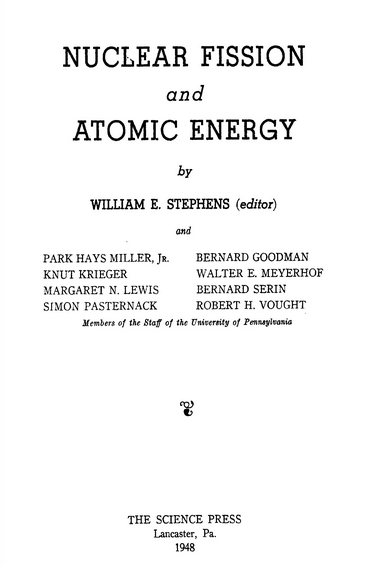
    Stephens nuclearHere’s a very useful tool for the early days of nuclear fission and atomic energy–the bibliography from William Stephen’s Nuclear Fission and Atomic Energy (published by the Science Press in 1948). The OCR is a little unsteady but the info is there even if it isn’t as clear as it might be.  

    The full text for the work is found at the Internet Archive, here:  https://archive.org/details/nuclearfissionan030064mnb

    Also see the excellent Louis Turner bibliography for nuclear fission, 1934-1940 (133 items) in an earlier post on this blog, here:  https://historyofideasblog.com/thesciencebookstore/2013/08/turners-bibliographic-review-of-nuclear-fission-1934-1940.html

    Partial Bibliography on Nuclear Fission and Transuranic Elements


  • A Very Early Bibliography on the Theory of Special Relativity (1910)

    JF Ptak Science Books    Reference Tool series

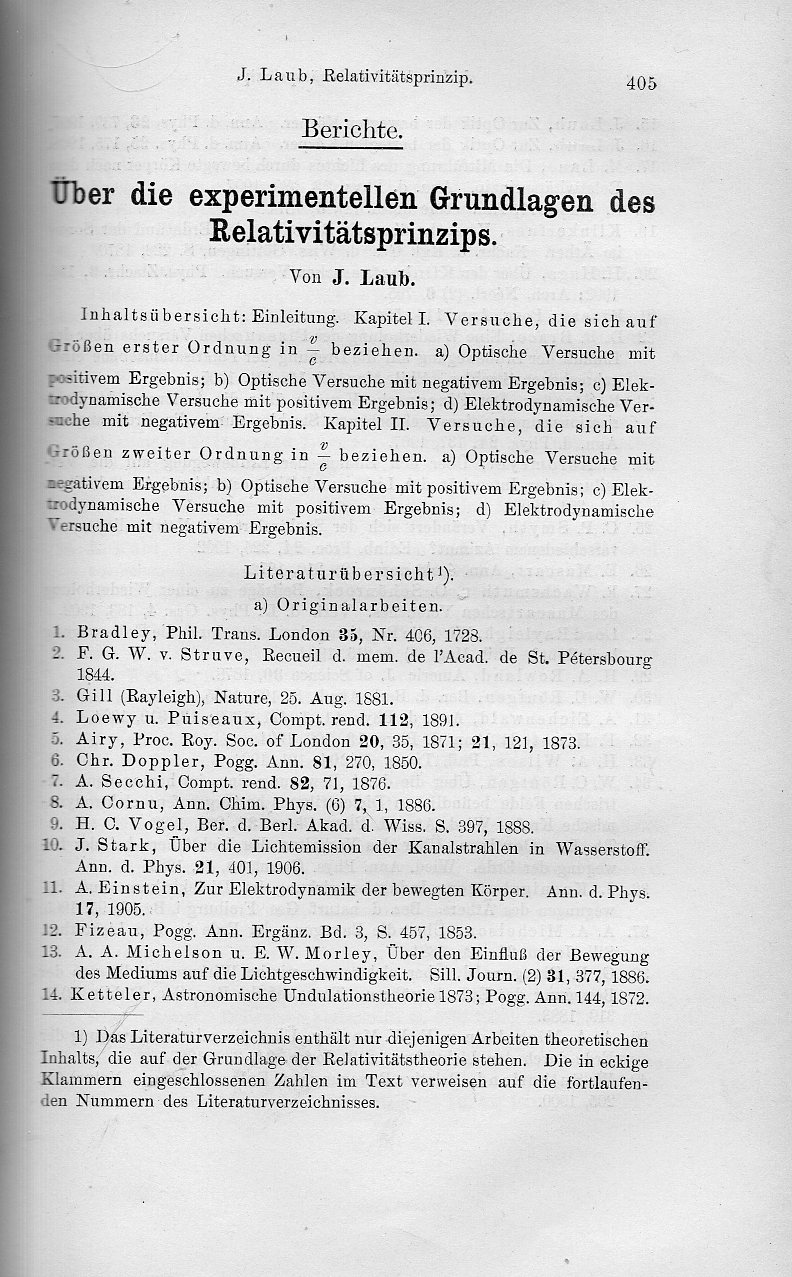
    Jakob Laub–the first collaborator of Albert Einstein–wrote one of the earliest histories/retrospectives of relativity theory for the Jahrbuch der Radioaktivitat und Electronik in volume 7 for 1910: “Uber die experimentellen Grundlagen des Relativitatsprinzips”, pp 405-463. (It seems that I don’t often see/notice references on this level citing the first German edition of an integral work in another language, which Laub does here for example in two articles by Fizeau that he found in Annalen when their original publication took place in the Comptes Rendus.)  (See the reference for Laub in Physics Before and After Einstein  edited by M. Mamone Cap; also The Scientist as Philosopher: Philosophical Consequences of Great Scientific ...by F. Weinert. 

    This paper also contains a 127-item bibliography, which I cannot find online and which I reproduce below.

    On Laub, from the Dictionary of Scientific Biography, volume 17:

    “Laub attended gymnasium in Rzeszόw. In 1902, after studying briefly at the universities of Cracow and Vienna, he entered the University of Göttingen as a student of mathematics and physics. There, taking courses and seminars with David Hilbert and Hermann Minkowski, he became interested in the electron theory. He turned to experiment, and in 1905 he decided to work with Wilhelm Wien at Würzburg. Laub’s doctoral dissertation (1907) concerned secondary cathode-ray emission. At his oral defense (1906), he introduced Einstein’s special theory of relativity, which Wien had recommended to him in September 1905. For the next several years Laub remained at Würzburg and concentrated on extending Einstein’s ideas.”

    “Although by early 1908 Einstein was attracting notice from distinguished physicists, he had not yet received a university appointment. It was an unusual step, then, when in February 1908 Laub wrote to Einstein to ask if he could visit Bern to study relativity with him. Laub became Einstein’s first scientific collaborator. Together they published articles criticizing Minkowski’s notion of electromagnetic force and suggesting an experiment to decide between Einstein’s special relativity and Hendrik Lorentz’s electron theory.”

    Laub764

    ·Posted by :

    ·in:

    —

  • Quick List of Alan Turing Publications

    JF Ptak Science Books   Reference Series

    Alan Mathison Turing. 1912-1954

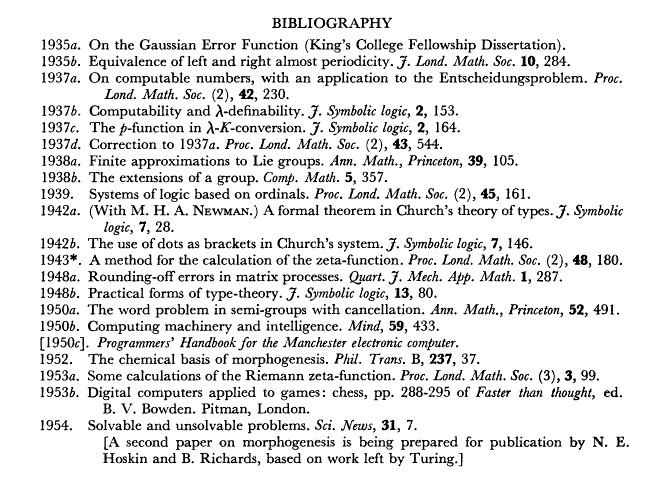
    Bibliography of his works by M. H. A. Newman from Biographical Memoirs of Fellows of the Royal Society, volume 1, November 1955, pp 253-263 (with the bibliography of page 263). 

    (I’m posting this simply because I thought some readers here could use it.)

    Bibliography Turing Roy Soc


  • Abstracts of Einstein’s 1905, 1907, & 1916 Papers

    JF Ptak Science Books  Quick Post

    I’ve nibbled away at a set of the Science Abstracts (Physics) and pulled away several reviews of Albert Einstein’s great papers of 1905, 1907, and 1916.  
    =>Einstein’s three monumental papers of 1905, as they appeared in Science Abstracts, Section A.–Physics, 1905, volume VIII, 1906, printed in London, E. & F.N. Spon, 


    ·Posted by :

    ·in:

    —