A Daily History of Holes, Dots, Lines, Science, History, Math, Physics, Art, the Unintentional Absurd, Architecture, Maps, Data Visualization, Blank and Missing Things, and so on. |1.6 million words, 7500 images, 4.9 million hits| Press & appearances in The Times, Le Figaro, Mensa, The Economist, The Guardian, Discovery News, Slate, Le Monde, Sci American Blogs, Le Pont, and many othr places… 5000+ total posts since 2008.

Category: Computer Tech/History

  • The Beauty of a Hexadecimal Tonal System (1863)

    JF Ptak Science Books  Overall Post 5145

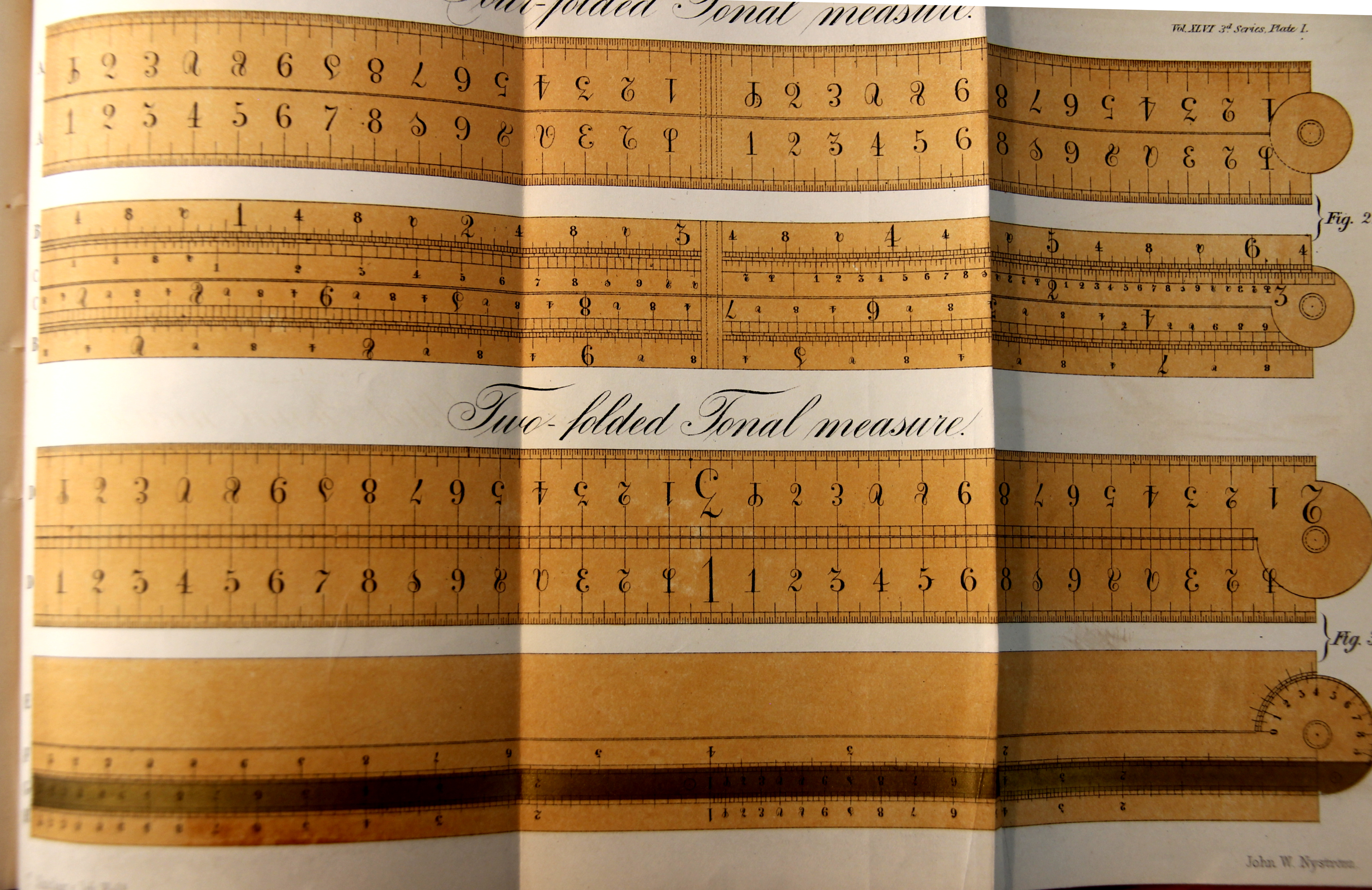
    John Nystrom’s  “A New System of Arithmetic and Metrology, called the Tonal System”1 (1863) is a very early entry in the history of the application of the hexadecimal system.  Nystrom’s plan included converting to a hex arithmetical system, and then expanded the idea to the calendar, musical notation, geography, time—an overall shift in metrology. His idea did not extend to calculators, and his name does not seem to be referenced by any of the modern compsci folks (with the major exception of Donald Knuth). Probably base-16 was not employed in programming until, I guess, around the early 1960’s. All that said, this is still a remarkable paper. ALSO: the paper is illustrated with a beautiful color-highlighted folding plate of divider-like instruments that translated hex to denary.

    Nystrom 1863 _3_


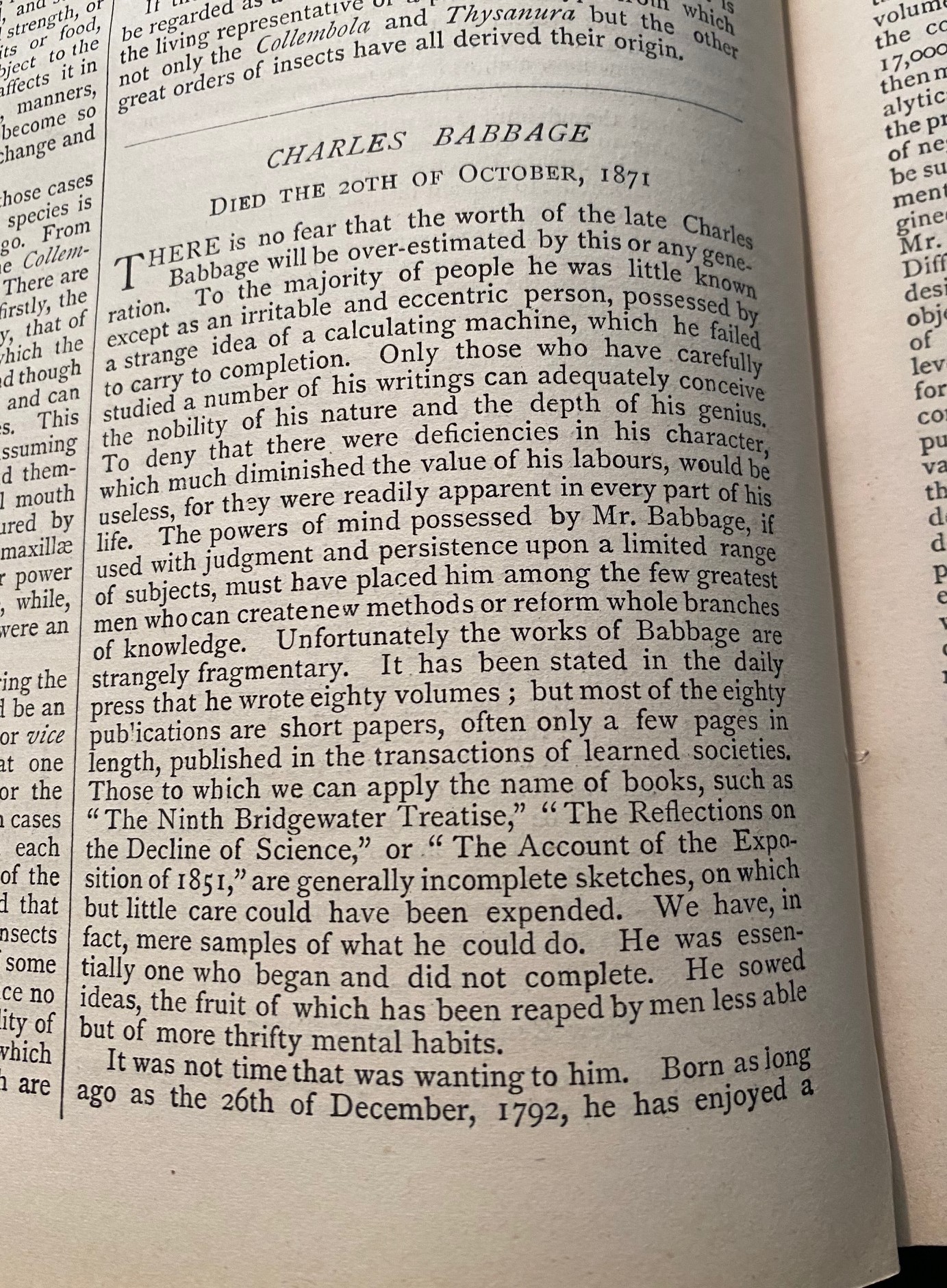
  • Charles Babbage Obituary in “Nature”, November 1871.

    JF Ptak Science Books   Quick Post  Overall Post 5124

    This is a fine and understanding obituary of Charles Babbage--it appeared in Nature on 9 November 1871, just two weeks after 
    the death of the Great Man on 20 October, and I include the article in full below. You'll see that a lot of attention is paid to the
    Difference and Analytical Engines, and how much attention they received from Babbage and how much money the
    government spent on it. It was a failure as a working/practical/applicable enterprise, the writer states (which was true) , but the
    thinking that went into the machines were not. That Babbage didn't see the completion of the computer projects wasn't necessarily
    his fault, and to me seems to say that time will out. The obit writer (Lockyer, the founding editor of the journal?) was positively
    convinced of the clarity and precision of Babbage's thinking and writing, and convinced of his genius.

    "THERE is no fear that the worth of the late Charles Babbage will be over-estimated by this or any generation. To the majority of
    people he was little known except as an irritable and eccentric person, possessed by a strange idea of a calculating machine, which
    he failed to carry to completion. Only those who have carefully studied a number of his writings can adequately conceive
    the nobility of his nature and the depth of his genius."IMG_4897
    "Mr. Babbage, relinquishing all notions of completing the Difference machine, bestowed all his energies upon the designs of the
    wonderful Analytical Engine. This great object of his aspirations was to be little less than the mind of a mathematician embodied
    in metallic wheels and levers...Nothing but a careful study of the published accounts can give an adequate notion of the vast
    mechanical ingenuity lavished by Mr. Babbage upon this fascinating design. Although we are often without detailed explanations
    of the means, there can be little doubt that everything which Mr. Babbage asserted to be possible would have been theoretically
    possible."

    IMG_4899
    "The engine was to possess a kind of power of prevision, and was to be so constructed that intentional disturbance of all the loose
    parts would give no error in the final result."
    "Although for many years Mr. Babbage entertained the intention of constructing this machine, and made many preparations, we
    can hardly suppose it capable of practical realisation. Before 1851 he appears to have despaired of Its completion, but his
    workshops were never wholly closed. It was his pleasure to lead any friend or visitor though these rooms and explain their contents.
    No more strange or melancholy sight could well be seen. Around these rooms in Dorset Street were the ruins of a life time of the
    most severe and ingenious mental labours perhaps ever exerted by man. The drawings of the machine were alone a wonderful result
    of skill and industry; cabinets full of tools, pieces of mechanism, and various contrivances for facilitating exact workmanship,
    were on
    every side, now lying useless."

    Read the rest of the obituary:

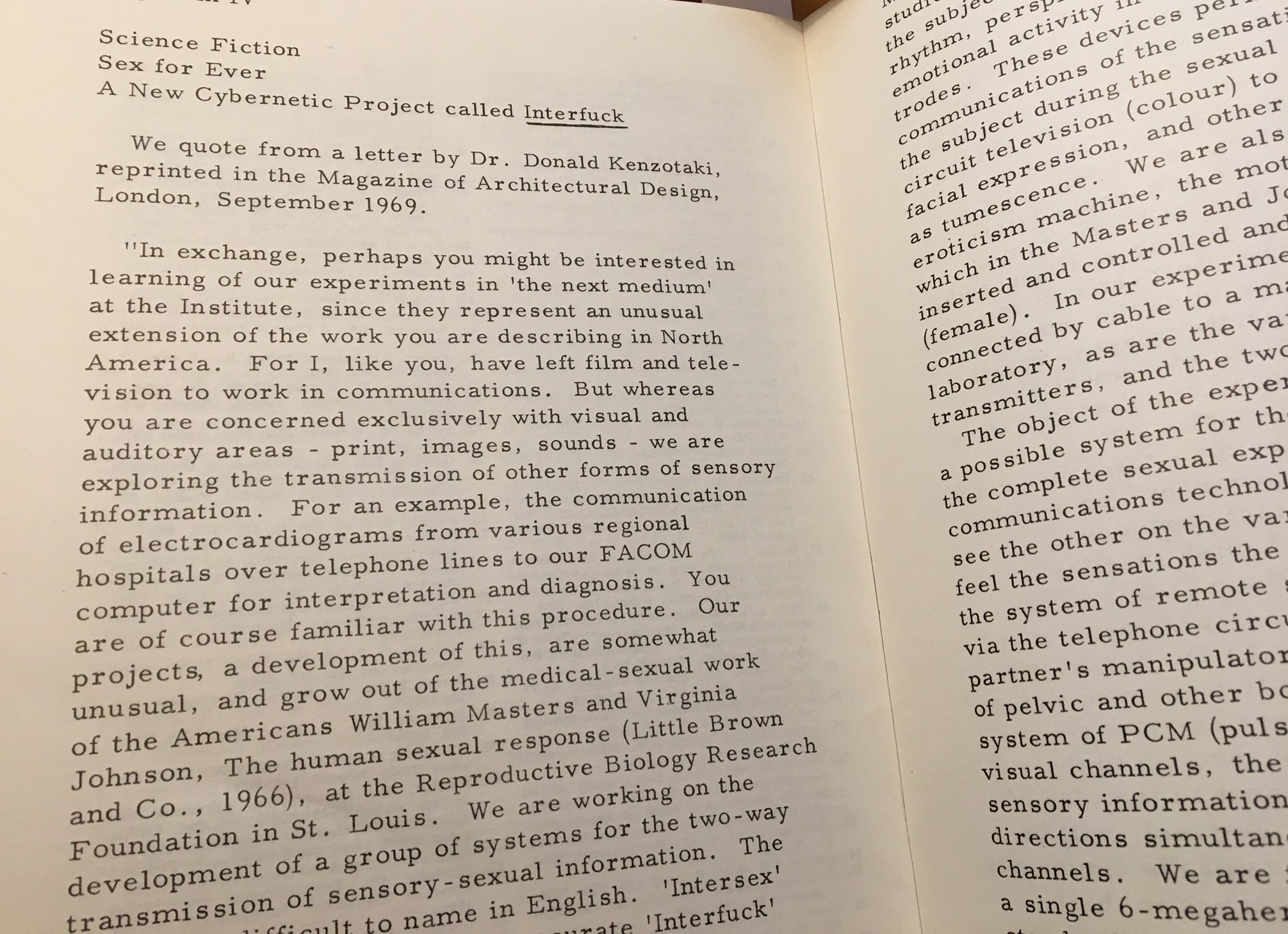
  • Is This the First Mention of the Word “Cybersex”? Â

    JF Ptak Science Books  Post 2888

    At first it appeared that this was indeed the first appearance of “cybersex” (in 1970), and that it pre-dated the established conception of its first appearance by twenty years. But, well: no. After much ado, and after some very subdued and annoyed half-bored/boring interest, it turns out that this is a reprint of an article that appeared in 1967, three years previously.

    “Science Fiction—Sex for Ever—a New Cybernetic Project Called Interfuck” is the in-your-face uncertain “title” of the article under consideration here, and it seems to be bouncing its little four-page self around without attribution. Its weirdness caught my eye, and I quickly zeroed-in on the unexpected word, “cybersex”. Now, there’s a LOT of speculation going on in this short article about how all of that person-to-person-to-machine loop happens, and I have no interest in going through it—you can certainly read it for yourself, though, as I’ve scanned the thing and attached it below.

    IMG_1869 (1)

    The article appears in a badly-titled booklet by O.D. Wells, How Could You be So Naive!, published by Artorga and distributed by Modern Books Limited, Berkshire. There are six other papers/articles in this issue in addition to the Wells, including mostly serious stuff: H. Maturan, “Neurophysiology of Cognition”; David Redman “Processing Information with Light”; Roland Fischer, “The Perception-Hallucination Continuum”; J.L. Synge (?!) “A Plea for Chronometry”’ A. Battersby, How to Bury and Idea”; and the our problem, “Science Fiction—Sex for Ever—a New Cybernetic Project Called Interfuck [sic]”…plus a foreword by F.H. George.

    The course of the article wasn’t so obvious because it seemed that this was a bit of a sci-fi story wrapped around a parody and tied up with short anxieties, and the references in the article weren’t accurate, and perhaps not real. Also the publisher, Artorga, is enigmatic, and sometimes to me seems to not take itself seriously even though there are some very serious contributors. There weren’t that many places to turn to check this piece out after the first obvious choices proved to go nowhere.

    It is difficult to find out anything about Artorga (“Artificial Organism”), though the “Paragram” of this work cites heavy hitters Gordon Pask, Ehinz von Foerster, W. Ross Ashby, and Stafford Beer as being “the Committee of Artorga” establishing it in 1958.

    Anyway, “cybersex” as a word hunt was enough for me, and the earliest uses of the word were given as 1991 (Oxford English Dictionary), 1990 (Merriam-Webster), and then a myriad of other minor notes (almost all unreferenced) for the period 1985-1990. This example of course has them all beat, and by a wide margin.

    It also predates just about all of the other “cyber-” created words prefixed to a wide variety of nouns, including a number of words that are slightly more removed than “cybersex”. There’s “cyber-porn” from 1989; -romance, 1992; -smut, 1993; -friend, 1986; and -affair, 1994, for example. The only references I can find for earlier “cyber” prefixes are “cyberkid” which I’ve never encountered (1966); “cyberman”, which evidently has something to do with Dr. Who and also from 1966; and “cybertron”, as a sort of computer hardware reference, from 1961. All of this flows from the first introduction of “cyber” in its creation by Norbert Wiener (a very smart guy who also happened to control greatly to the US war effort in WWII with fire-control in AA weapons derived from his famous “Yellow Peril” book) in his work Cybernetics (1948). Oh yes–”cyberneticist” and “cybernetician” appear in 1948 and 1950.


  • Electric/Electronic Brains, Part X (1948)

    JF Ptak Science Books   Quick Post

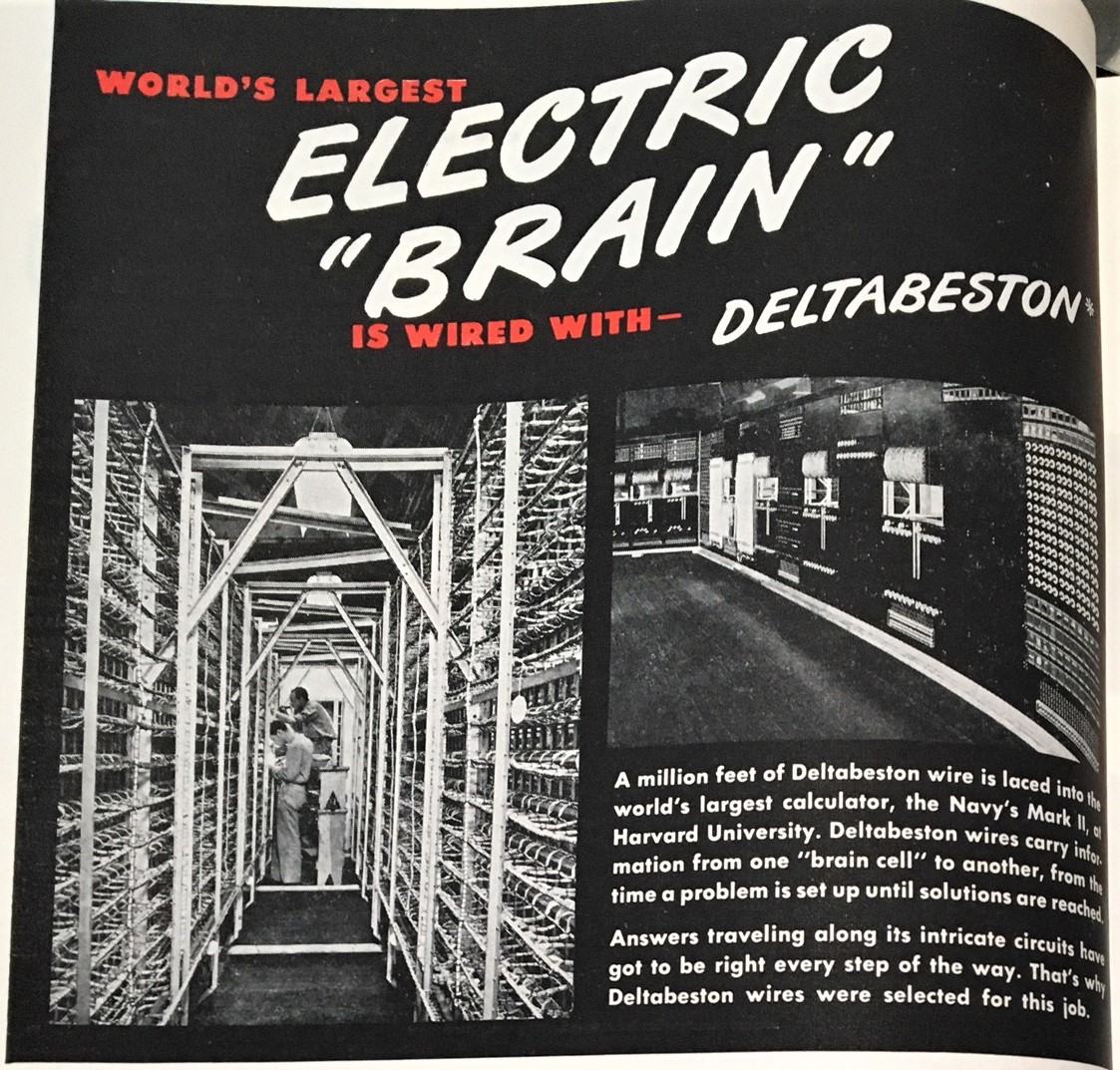
    Here we have a lovely full-page ad from Electrical Engineering, February 1948, extolling the use of Deltabeston power cables and wiring…over a million feet (5,200 miles) of it. It was produced by GE and was covered (and layered?) with asbestos. In any event I’ve paid attention to electronic/electric/analog/digital/electrical/mechanical description of the human brain, either described so or pictured with gears and tubes and such. This image from 1948 is relatively late for the early period of this sort of imagery.

    This is the Mark II at Harvard, also known as the Aiken Relay Calculator, and was programmed by Aiken and Grace Hopper at the beginning of operations in 1947. It followed the Mark I, the famous wartime machine (the IBM ASCC, operational 1944), and preceded the Mark III (the ADEC, operational in 1951) and Mark IV (1952). 

    Mark II computer

    ·Posted by :

    ·in:


  • On Building Mr. Babbage’s Engines (1878)

    JF Ptak Science Books  Quick Post

    Here’s a very interesting report from an 1878 issue of Nature (volume 18 pp 460) considering the construction and its consequences of the yet-built Babbage computer (analytical machine). Charles Babbage died in Marylebone in 1871 and bequeathed his working archive to his youngest son Henry (1824-1918)  who expected to carry his father’s work into the future. This is one attempt to construct a working machine from the Babbage plans. I’ve reproduced most of the Nature article below, with a few inconsequential edits. Enjoy. 

    REPORTS Report of the Committee, consisting of Prof. Cayley, Dr. Farr, Mr. J. W. L. Glaisher, Dr. Pole, Prof. Fuller, Prof. A. B. W. Kennedy, Prof. Clifford, and Mr. C. W. Merrifield, appointed to consider the Advisability and to estimate the Expense of constructing Mr. Babbage’s Analytical Machine, and of printing Tables by its means. Drawn up by Mr. Merrifield. We desire in the first place to record our obligations to General Henry Babbage for the frank and liberal manner in which he has assisted the Committee, not only by placing at their disposal all the information within his reach, but by exhibiting and explaining to them, at no small loss of time and sacrifice of personal convenience, the machinery and papers left by his father, the late Mr. Babbage. Without the valuable aid thus kindly rendered to them by General Babbage it would have been simply impossible for the Committee to have come to any definite conclusions, or to present any useful report.

    We refer to the chapter in Mr. Babbage’s “Passages from the Life of a Philosopher,”and to General Menabrea’s paper, translated and annotated by Lady Lovelace, in the third volume of “Taylor’s Scientific Memoirs,”for a general description of the analytical engine.

    The Report then, in Section I., contains an account of the general principles of calculating engines, and proceeds:

    Section II. Special Characteristics of Mr. Babbage’s Analytical Engine.

    ·Posted by :

    ·in:


  • The Jevons Logic Machine (1870)

    JF Ptak Science Books  (This is a null post, carried over from the bookstore section of this blog–I’m sharing it in the bookseller format to simply share the info on this fascinating machine.)

    Jevons logical _4_W. Stanley Jevons, On the Mechanical Performance of Logical Inference, in Philosophical Transactions of the Royal Society, 1870, pp 497–518. This is an extract from the volume, containing the entire article, plus its three engraved plates showing the works and interior of the machine. This is very tastefully bound in paper covered boards with a paper spine label. This is the first description of the one the preeminent. 

    Jevons was a polymath and one of my favorite thinkers of the 19th century. He worked across many fields but seems to be remembered today mostly and unfortunately for his theory of the relationship between sunspots and economics cycles. He is not so well known as the inventor of one of the earliest pre-modern computers and particularly for it being the fastest machine of its kind ever invented.

    “In 1870 a British scholar, W.S. Jevons, built the first computer designed to solve logical problems. Inspired by Boole and Babbage, Jevons built a mechanical device implementing automated deduction…”–Paul Amblard, “A Finite State Description of the Earliest Logical Computer: The Jevons’ Machine”, in the Springer International Series in Engineering and Computer Science book series (SECS, volume 434)

    “The creation of analog computing devices is both relevant and significant to the development of modern computers, but was there no early pure mechanical digital apparatus, given the advent of Boolean logic and Venn diagrams in the 19th century? One individual in particular began a small, but significant movement that transformed digital theory into mechanical devices that, while lacking the sophistication and power of later electronic digital computers, did, nevertheless, function in a digital mode. The person responsible was the Englishman W. Stanley Jevons (1836–1882).”–George Buck and Stephen Hunka, “W. Stanley Jevons, Allan Marquand, and the Origins of Digital Computing” in IEEE Annals of the History of Computing, Vol. 21, No. 4, 1999.


  • Leonardoesque Robot Brains, the Harvard Mark I, and a Peek into the Future of Computing (1944)

    JF Ptak Science Books   (Expanding an earlier post from 2008)

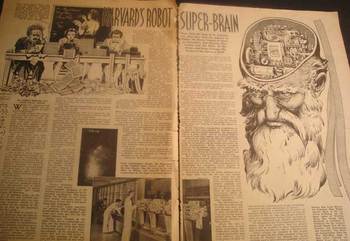
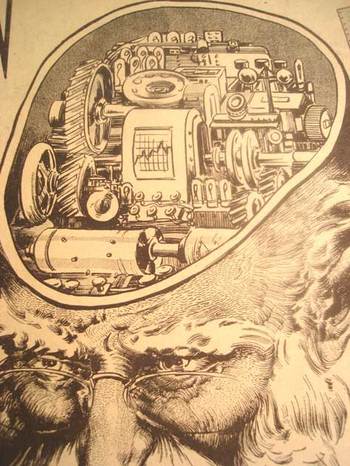
    Blogharvardbrain This may well be the first popularly-written and popularly-published report on the Harvard Automatic Sequence Controlled Calculator (ASCC) (appearing in the American Weekly, 15 October 1944), which was the first automatic, general-purpose, digital calculator.  Known as the MARK I, it was the brainchild of Howard Aiken (1900-1973), a graduate student at Harvard, who started it all in 1937 by proposing a series of coordinated Monroe calculators to function as a unified whole  that would cross the threshold of the physically-impossible calculation (though theoretically possible) to the eminently doable.  The project was immeasurably aided by the input of Harvard astronomer Harlow Shapley (who had earlier dealt with the enormously problematic aspects of the scale of the universe) who put Aiken in the hands of IBM at Endicott (NY).  From there the building of the computer came under the supervision of Clair D. Lake, with the engineering and theoretical team of Francis Hamilton, Ben Durfee and Howard Aiken. 
    Blogharvardbraindetail
    The machine was basically completed in 1943 and tested in Endicott for the better part of the year before it was shipped of to Harvard in February 1944, where it was put almost instantly to work on ballistic calculations (like its cousin ENIAC at the Moore School at U Penn), as well as naval engineering and design issues. 

    The author of this article, Gordind Bhari Lal (“noted science analyst”), actually does a pretty decent job describing the machine and its (1940’s) possibilities, noting at the end that “it may even unleash for Man’s Use the long-dreamed-of energy of the atom”.  This part did come true, especially post-war, when the machine was put to fair use by the US Atomic Energy Commission. 

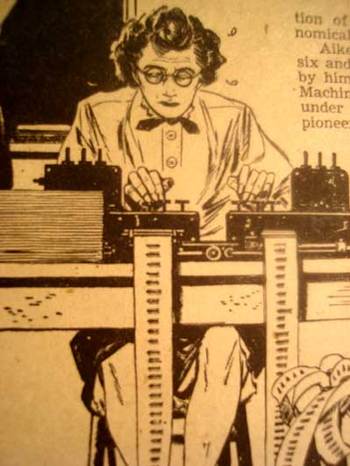
    The part I really don’t understand in this article is comparing the speed and function of the ASCC to two women working on calculators and Albert Einstein, working with a pencil, paper and pipe, none of whom look comfortable or happy.   Lal does make a decent comparative point (of uncertain veracity) about four generations of humans (the three above-mentioned calculators?) doing calculations that the ASCC could do in seconds.  Right or wrong, it gave the crowds in 1944 a real something to think about.
    Blogharvardbraingirl


  • Charles Babbage, Poet: on Chess and Miracles.

    JF Ptak Science Books  Post 2797 (extended)

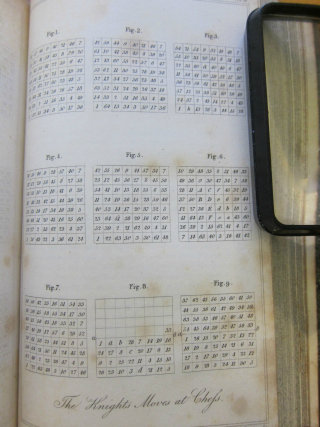
    When reading through a volume of the Royal Society’s quarterly publication on the stuff of science (for the year 1817) I came across an article on the Knight’s Tour puzzle: “An Account of Euler’s Method of Solving a Problem, relative to the Move of the Knight at the Game of Chess, from a  Correspondent”, and which was published in Babbage chess The Quarterly Journal of Science, Literature, and the Arts, edited at the Royal Institution of Great Britain, published by John Murray for the Royal Institution, London, 1817-1818. After a little digging to find the authorship, I found that the “Correspondent” here is Mr. Charles Babbage himself, with the authorship established at least by the time of his Passages from the Life of a Philosopher if not before. The Knight’s Tour puzzle–in which a  knight is moved around a chessboard (8×8 grid, though smaller and much larger have been used) so that every square is touched only once–is ancient, with the host of the famous 18th century mathematical revelers3 positioning the problem in the dim past, with Lucas in 1882 and then Kraitchik in 19272 fixing it more resolutely in India over 2000 years ago.
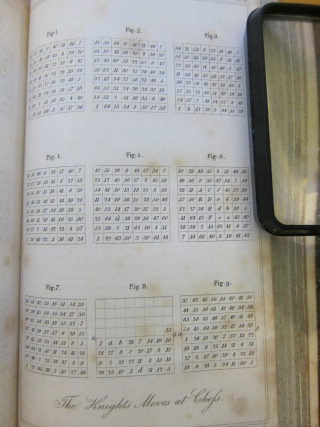
    Babbage identifies the paper as his own in the section of his own “contributions to human knowledge” in his retrospective, Passages in the Life of a Philosopher, published in 1864. I’ve never read this book though I’ve used bits and pieces for research, and last night and today I’ve read in it quite a bit. Apart from the sheer enjoyment of the power of this guy’s mind, I’m finding the book to be unexpectedly amusing. The man is actually funny, plus witty, and an entertaining writer–why this is so surprising, I don’t know; perhaps it is because he is associated in a personal sense in my mind with General Winfield Scott, as they resemble one another, both looking Very Highly Contentious and gassy. In any event, I can safely say that this is a Good Read. 

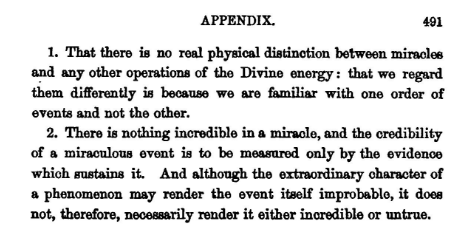
    Now to the Found Poetry part in this bit, the text of which is found in the appendix of the article, in the section called “On Miracles”. The text is as found, though the spacing/structure has been “poematized”to exhibit the great and hidden logical poetry of Mr. Babbage:

    On Miracles

    "1. That there is no real physical distinction between miracles 
    and any other operations of the Divine energy: 
    that we regard them differently 
    is because we are familiar 
    with one order of events 
    and not the other. 
    
    2. There is nothing incredible in a miracle, 
    and the credibility 
    of a miraculous event 
    is to be measured only by the evidence 
    which sustains it. 
    
    And although the extraordinary character 
    of a phenomenon may render the event itself improbable, 
    it does  not, therefore, necessarily 
    render it either 
    incredible or untrue."

    And the original:
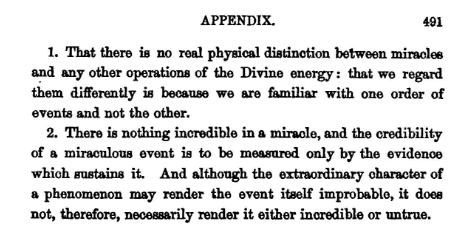
    Babbage miracles

    There’s a few pages of reasoning before we get to his enumerated “prepositions”, but this should do nicely.  The guy was a very very good thinker. 

    Full text of the article is found here: https://archive.org/stream/passagesfromlif01babbgoog#page/n510/mode/2up

    Notes

    1. See the “collected works” section in Babbage’s Passages from the Life of a Philosopher (1864) where he outs himself as the author.  https://archive.org/stream/passagesfromlif01babbgoog/passagesfromlif01babbgoog_djvu.txt

    2. “Chronology of Knight’s Tours”, compiled by George Jelliss, http://www.mayhematics.com/t/1g.htm

    3. Just as a sample the folks working on this puzzle in the 18th c included d’Alembert and Diderot in theEncyclopedie; Jacques Ozanam  in Recreations Mathematiques et Physiques; d’Ortous de Mairan, Abraham de Moivre, Pierre Rémond de Montmort; Jean Etienne Montucla,, Leonhard Euler, and many others.

    The “Euler” in the title refers to Leonhard Euler “Solution d’une Question Curieuse qui ne Paroit Soumise a Aucune Analyse”, Mémoires de l’Academie Royale des Sciences et Belles Lettres, Année 1759, volume 15, pp.310-337, which was the first mathematical paper on knight’s tours.
     

    ·Posted by :

    ·in:


  • History of the Past and History of the Future: Communications and Electronics in the Year 2012 (from 1962)

    JF Ptak Science Books    Post 2803 (Reference Tools Post) 

    Now HERE’S a wonderful and referenced and deep look at the history and future of electronics, and one that I believe is very overlooked. The article has the slightly opaque title of “Proceedings of the IRE Fiftieth Anniversary, 1912-1962” , which is the entire May issue for the journal, a double-brick of a book, weighing in at 6 pounds and running over 900 pages. It is a vast and compelling survey of the history and present state and future of electronics in general, boasting an authorship of leading lights across many different fields and encompassing 250 articles. (Some of the big names include: Terman, H.A. Wheeler, H. Olson, Gordon Teal, Presper Eckert, Zworykin, Simon Ramo, JR Pierce, Watson-Watt, Jerome Wiesner, Leo Beranek, Belevitch, Colin Cherry, Lee Lusted, Ronald “THE Antenna”) King, and many others. There’s fantastic reporting on the present-day state of things, as well as dozens of provocative and very prescient overview of what the future may/will bring…and take.

    I obviously can’t reproduce the volume, and no one seems to have the whole thing online, but I can provide a mostly-cleaned-up OCR (please pardon some of the typos) of the three very packed pages of the table of contents of the issue—many of those individual articles can be found online. (If anyone wants the original of this work, I have it for sale in my bookstore.) Perhaps now that you know such articles exist and hadn’t before, you may be able to put this list to some use.

    Some interesting articles include: There Will Be No Electronics Industry in 2012 A.D., J. M. Bridges; Communications Throughout the Solar System, W. H. Pickering; The Information Science anti Industry Fifty Years Hence, Robert M. Bowie; Machines with Imagination, G. A. Morton; The Integration of Man and Machine, J. Presper Eckert, Jr; Man-Machine Coupling-2012 A.D., R. M. Page…well, you get the idea.  

    COMMUNICATIONS AND ELECTRONICS-2012 A.D

    World Travel and Space Communication-2012 A.D., A Realistic Fantasy, Ernst Weber

    • Space-2012, Lloyd V. Berknei
    • Space Exploration, J. H. Dellinger
    • Education in 2012 for Communication and Electronics, Frederick E. Terman
    • Engineering Education-Circa 2012 A.D., W. L. Everitt
    • A Day in the Life of a Student in the Year 2012 A.D., Maurice J. Ponte
    • Fifty Years of Teaching Machines, Harold A. Zahl
    • The Tools of the Engineer 2012 A.D., R. Bennett
    • The Automatic Handbook, Nathaniel Rochester
    • There Will Be No Electronics Industry in 2012 A.D., J. M. Bridges
    • Radio Communication in 2012-An Obsolete Art, Dorman D. Israel
    • Electromagnetics and Communications, Harold A. Wheeler
    • Communication Spectra by the Wholesale-2012 A.D., Estill I. Green
    • A Short History of Electromagnetic Communications, John W. Coltman
    • The Spectrum Problem-Looking Back From 2012 A.D., E. A. Sack
    • The Full Use of Wide-Band Communications, Sir Noel Ashbridge
    • Wide-Band Communication into the Home, W. D. Lewis
    • Communication and Navigation, Henri Busignies
    • Communications and Electronics-2012 A.D., Peter C. Goldmark.
    • Communications Throughout the Solar System, W. H. Pickering.
    • Human Factors in Communications, Albert G. Hill
    • Multilingual Communication, Yasujiro Niwa
    • Language, Words and Symbols, Harold A. Wheeler
    • Processing of Sound, Harry F. Olson

  • Illustrations from Two Rare Computer Pamphlets (1945 and 1948)

    JF Ptak Science Books   Quick Post

    This is a repost from my books-for-sale pages, basically catalog entries (minus the sales stuff) for two very seldom seen works on early (and famous) IBM machines, the ASSC (1945) and the SSEC 

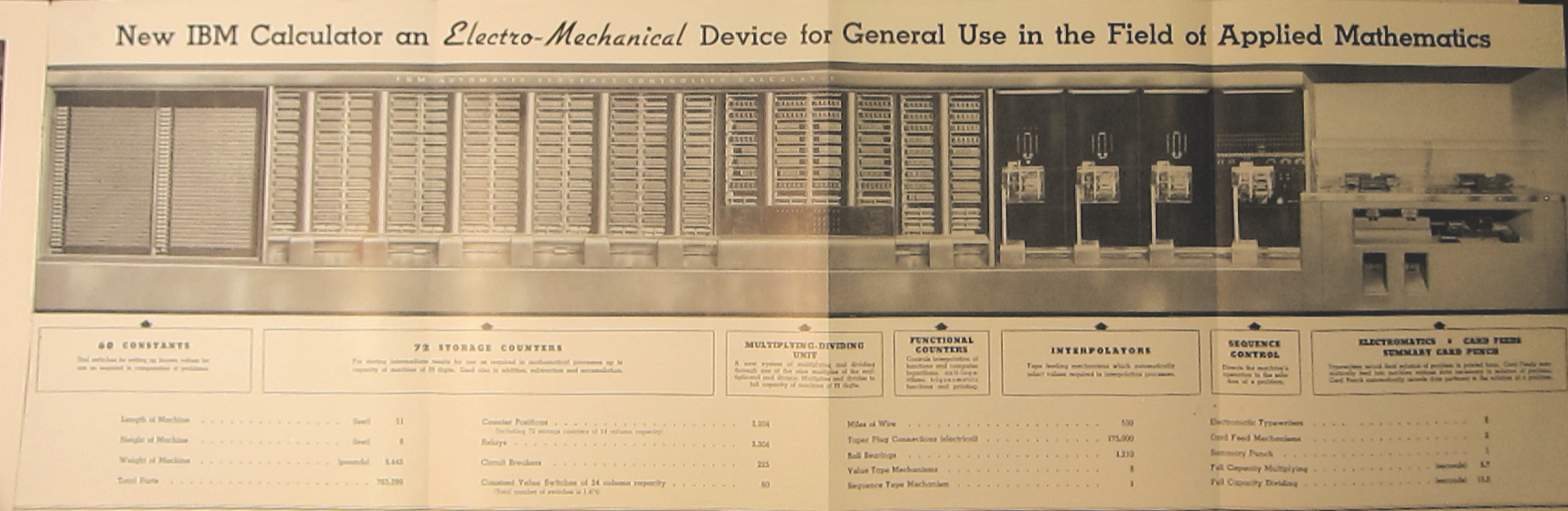
    With a Giant Fold-out Photo Illustration of the Mark I (the ASSC) Computer, 1945

    IBM Automatic Sequence Controlled Calculator. Published by International Business Machines Corporation, 1945. 11”x 8.5”, 6pp. Illustrated with a massive (30” x 11”) folding photographic plate of the computer which seems to be the first image of the full length of the machine. (An earlier but less inclusive report appears in Popular Mechanics in 1944 (in an unusually-titled article, “Robot Solves Problems”) and though it does have a photo of the computer only shows a small piece of it. This photo is just fantastic, and it would seem to be the first full frontal image of the great computer. It is also one of the most impressive computer photos I’ve ever seen of any of the early machines. 

    AI 4 ASEC _long pic pt 2_

    This pamphlet tells the story of the ASCC starting with the establishment of the Columbia University Statistics Bureau in 1928 (for adapting IBM machines for Columbia’s computing requirements. Proceeding from there the outline develops around the 1934 establishment of a separate lab in the astronomy dept at Columbia, and then up to the efforts of H.A. Aiken, Harlow Shapley, T.H. Brown, and W.J. Eckert. Following this I s n extended review of Aiken’s speech at the dedication of the calculator in 1944, including 10 of the significant inventions “of the many basic units of the calculator, invented or developed by IBM”. Here appears on pp 5-6a general description of the calculator. Appearing at the end of the pamphlet is the magnificent folding photo showing the entire face of the 51′-long computer, while in the photo legend are a number of nuts-and-bolts facts about the composition of the machine (including “530 miles of wire”).

    ·Posted by :

    ·in: