A Daily History of Holes, Dots, Lines, Science, History, Math, Physics, Art, the Unintentional Absurd, Architecture, Maps, Data Visualization, Blank and Missing Things, and so on. |1.6 million words, 7500 images, 4.9 million hits| Press & appearances in The Times, Le Figaro, Mensa, The Economist, The Guardian, Discovery News, Slate, Le Monde, Sci American Blogs, Le Pont, and many other places… 5000+ total posts since 2008.

Category: Computer Tech/History

  • The Data Mine: the French Census of 1911 and Storing Numbers on Paper

    JF Ptak Science Books  Post 835 

    Today’s post on the tabulating office of the French 1911 Census seems quite natural following yesterday’s of the reading-and-writing (French) fireproof man…
     ++ blog ++ nov 16 french census 3 001

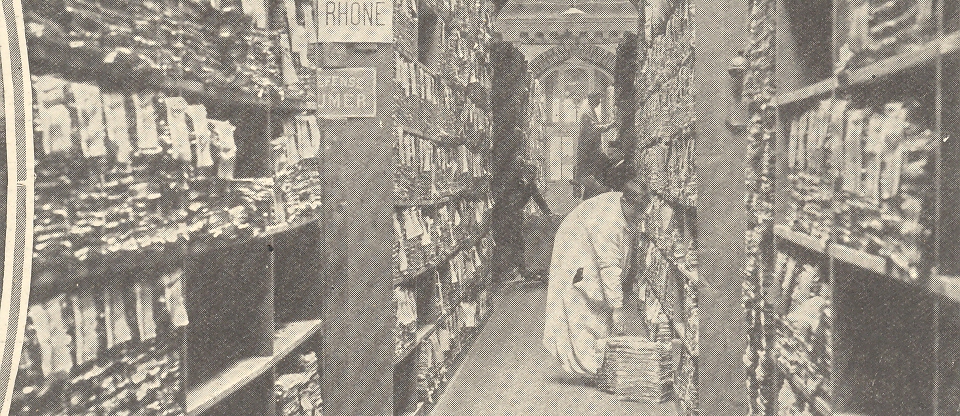
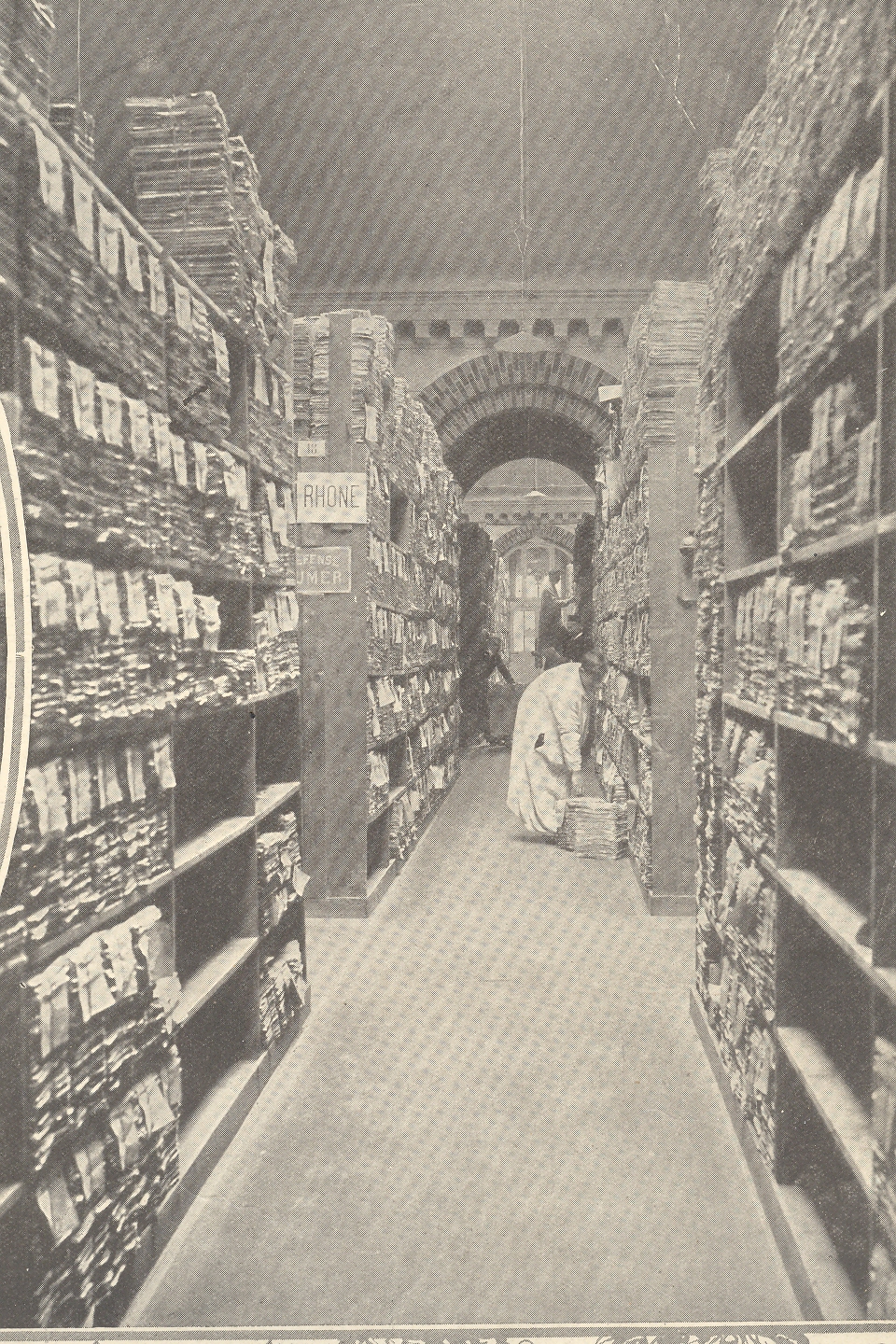
    Like many other countries, the French were certainly not playing to the technological audience in conducting their census of 1911, the physical, tabulating part of it looking much as it did in the 1880’s.  Granted, the United States was dragged somewhat into the new high-tech age of tabulating for its 1890 census, but it was absolutely and clearly shown that the Herman Hollerith machines and methods were vastly superior to those previous used, giving the government extraordinary new insights into the way in which the country functioned—a Hubble Telescope-like impact for those interested in more and more-manipulable data.   

    ++ blog ++ nov 16 french census 3

    What interests me in these photos are the endless stacks of paper, and what I imagine was the quiet of the job of the paper-stack-classifier, all of whom seem to be heavily dressed…I guess that you couldn’t keep a dry heat around exposed paper like that for fear of (a) well, possible fire and (b) drying the documents out and making them fragile and unusable.   

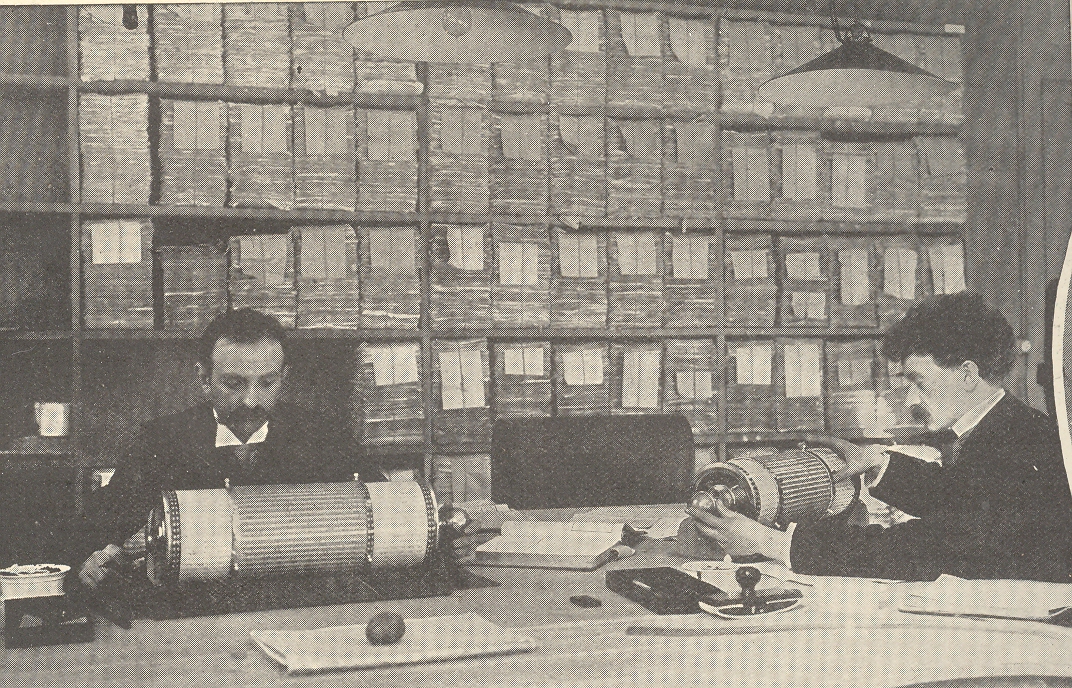
    The image below shows two men using the Thacher Calculating Instrument, a large, cylindrical slide rule1.     
    ++ blog ++ nov 16 french census 1


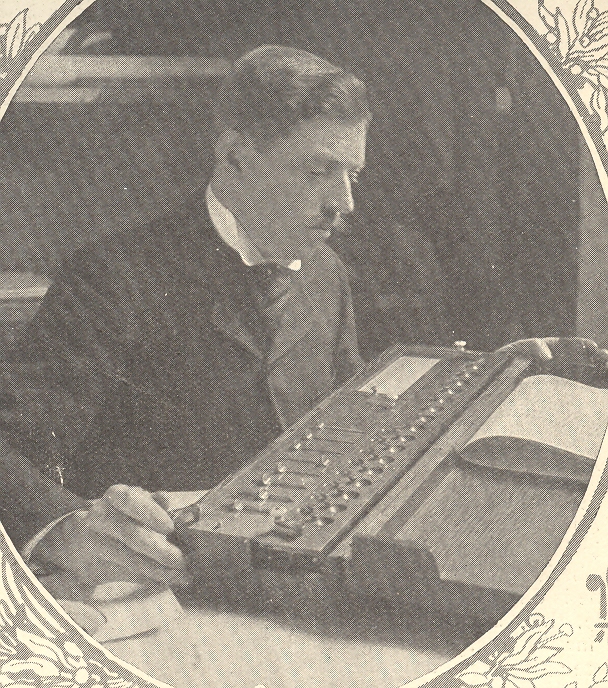
    This man is using an arithmometer, invented  by Charles Xavier Thomas de Colmar in 1820.  It was employed, as we can clearly see, well into the 20th century even though it had been far superseded.   
    ++ blog ++ nov 16 french census 4


    The U.S. government, on the other hand, wasn’t so much taken by the astronomical range of new statistics that flowed from the Hollerith machines as it was the astronomical bill for their use.  The 1880 census had cost about $6 million and took 9 years to tabulate; the 1890 census using the Hollerith machines cost $10 million and took seven years.  The main focus of many in government was the cost differential—not the incredible amounts of new controllable information.  The rent of the Hollerith machines was only $750,000 for the conduct of the entire census, so the differential must’ve been in the extra utility costs (for electricity, for example, which was used for the first time to run the tabulators) and for the small army of statisticians and data entry people.  Be that as it may, the government was not amused, particularly when Hollerith figured that he had actually saved the government $5 million.    The two parties left each other grumbling, though the roar of the trickle down from the Hollerith success drowned it out.  The tabulating system was quickly exported, and large private concerns in the U.S. saw a savior in the system that would soon rescue them from the sea of paper in which they were beginning to drown.   The Hollerith company did very, very well for itself, and soon merged with three other companies (in 1911) to ease the burden of success.  The resulting company was called the Computing-Tabulating-Research Company (CTR), which after a short while became the International Business Machine Corporation (IBM).  

    ++ blog ++ nov 16 french census 2

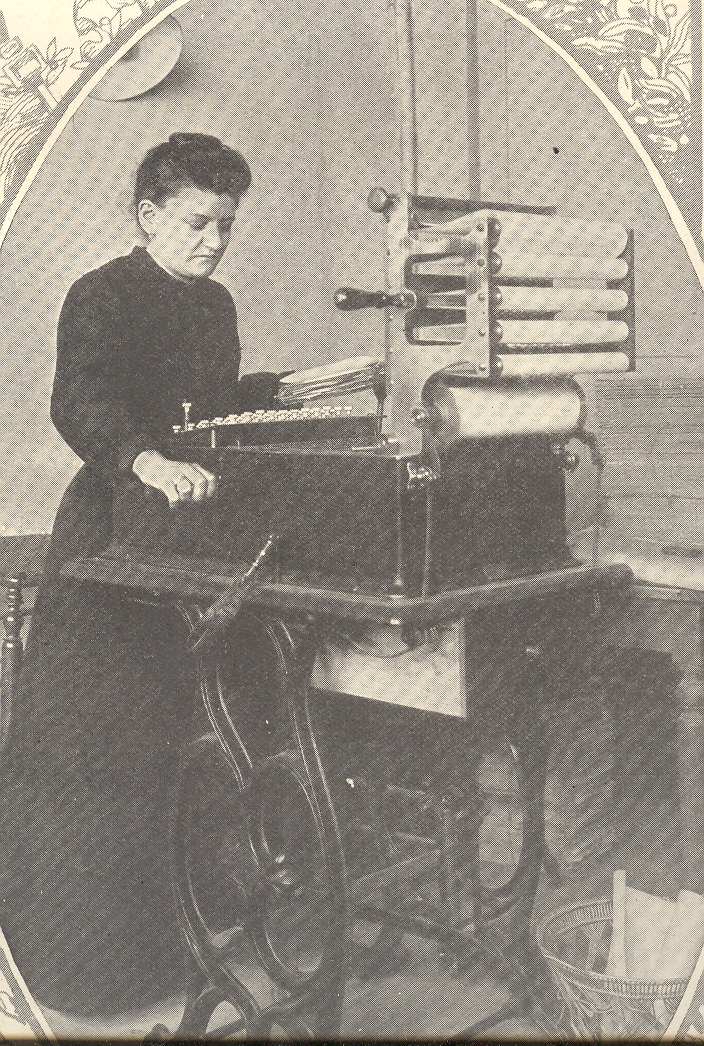
    Image source:  The Illustrated London News, 11 March 1911.  

     Notes:

    1.The following description is from the wonderful SlideRuleMuseumsite;

    “Thacher’s Calculating Instrument – Patented in 1881 by Edwin Thacher. Originally made by W.F. Stanley, in London, but, by 1897, Keuffel & Esser had taken over production. an 1884 instruction book notes, “The original rule in use is 12 inches long, with radii of II and 5 1/2 inches, the divisions of which are cut by hand, copying from a machine divided plate. In the present instrument the radii are 60 and 30 feet, the divisions of which are printed directly from machine divided plates. Those plates contain over 33,000 divisions, calculated to seven places of decimals from Babbage’s tables by using a common multiplier, every line being subjected to correction for error of screw and temperature variations, so that possibly every line center is within .0001 inch of its true place.” The instrument consists of a cylindrical slide, which admits of both rotary and longitudinal movement within an open metallic framework of 20 equidistant triangular bars. The bars are connected to rings at their ends which admit rotation within standards attached to the base. Upon the slide are wrapped two complete logarithmic scales, each of which is divided into 40 parts of length equal to half that of the slide. The parts follow each other in regular order around the cylinder, and the figures and divisions which constitute any part of the right are repeated on the left, one line in advance. By the rotary and longitudinal movement of the slide any of its divisions may be brought opposite to or in contact with any division on the fixed scales. The divisions on the upper lines are transferred to the slide by means of a pointer fitting over the bars, which is also convenient for retaining the position of any division on either line while the slide is being revolved into the required position. Near the commencement of each scale on the slide is a heavy black mark designed to catch the eye.”
    ·Posted by :

    ·in:

    —

  • Microcards and the Paper Internet

    JF Ptak Science Books LLC  Post 729  Blog Bookstore
    ===blog==aug 24==micro 2  

    For several decades, say in the 1930’s-1970’s, microforms, microfiche, microfilm
    and their related compatriots certainly looked as though they were next the
    direct and epochal inheritors of printing traditions that was limited to
    papyrus, paper, Gutenberg, and, well, micro-whatevers.  They weren’t too terribly wrong, and were
    actually getting a  little close to Vannevar
    Bush’s (1890-1974) Memex idea, as these processes of reproduction could reduce
    bookcases worth of bound material into a pile of cards a few inches high. It
    really was a sensational idea, and a major advancement in the distribution of
    knowledge.

    ===blog==aug 24==micro 3

    Out of all the important advancements in the history of printing, though,
    the mico- division of accomplishments lasted the shortest amount of time, being
    phenomenally replaced by the first real man-machine symbiosis (at least called
    so by the originator, JCR Licklider), the internet.

    (It is interesting to point out that at about the same time as the Memex
    concept was published in 1945, another man, Murray Leinster, whose dates are
    very similar to that of Bush (1890-1975) published a short story in Astounding Science Fiction magazine
    called ”A Logic Named  Joe”. The first sentence of the story reads: “It was on the third day of August that Joe come off the assembly line,
    and on the fifth Laurine come into town, an’ that afternoon I saved
    civilization.” Indeedy! Read the whole thing here.)

    ===blog==aug 24==micro 4

    Leinster foretold a future in which computers would be in every household and connected
    by an electrical grid.  The “logic” was
    the home node, or terminal; “Joe” was a logic that had developed a little past
    the machine stage,  gaining some human
    capacity.  It was an astonishing attempt,
    and actually perhaps a little more prescient than the genius technoid Bush’s
    idea. 


    ===blog==aug 24==micro 5


  • The Most Important Menu in the History of Computing–the NORC, John von Neumann, & the Weather

    JF Ptak Science Books LLC  Post 576

    “There is no mystery about these machines[computers]. The mystery is how the human brain has been able to develop them. These devices are merely small tools which men have devised to help them do a better job.”–Thomas J. Watson, chairman of the board of IBM, 1954

    [I need to thank my friend P.J. Mode for pointing this connection out to me years ago!]

    Norc--von n group
    Here is something that one doesn’t get to say very often:  this is perhaps the most important memory in the history of computing. 

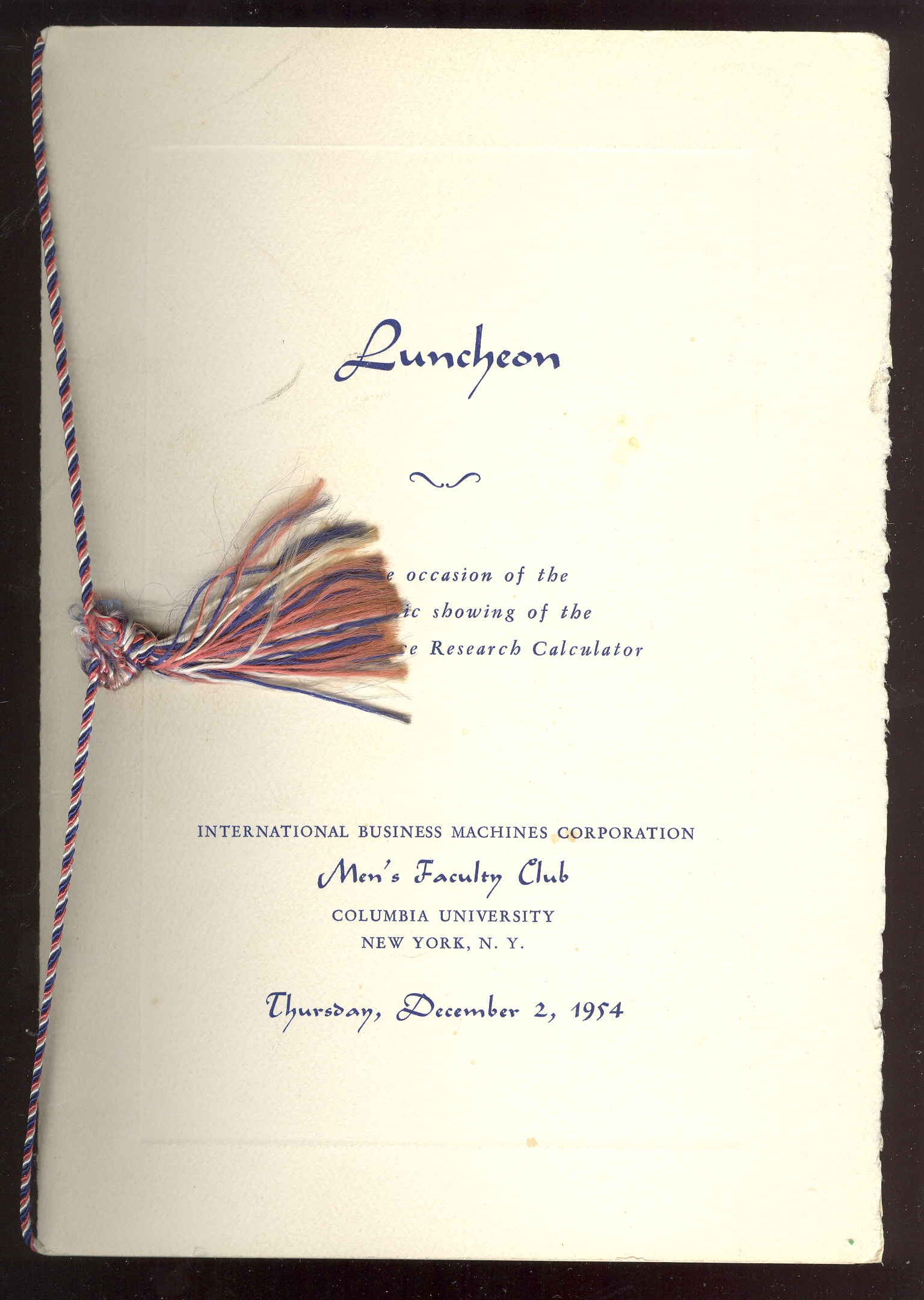
    This is the luncheon menu for the dedication of the NORC “Calculator” (the Naval Ordnance Research Calculator) a computer which was constructed principally with IBM parts and built at the Watson Scientific Computing Laboratory at Columbia.  The NORC was the world’s first supercomputer, and the most powerful computer on the planet for about ten years (from 1954 to 1963, until it was surpassed by Seymour Cray’s CDC 6600 in 1964). 

    The NORC was an astonishing accomplishment, difficult to summarize simply, really, though a very good example is that provided by Dr. Paul Herget, the director of the Cincinnati Observatory.  Dr,. Herget used the NORC in 1956 to make precise calculations of the earths orbit for the 1920-2000 period.  Dr. Herget said: “We used nine hours of running time and completed more computations than had ever before been done at one time in the history of astronomy.’”

    Outside of celebrating the accomplishment of the NORC, the luncheon was also  important for the remarks of the principal speaker, John von Neumann.  Von Neumann of course was perhaps the most expansive mind of the century–a thinker of phenomenal proportions and the father of the modern computer.  His brain was impossibly big.  Impossible. 

    During the luncheon von Neumann made prescient and extraordinarily wide remarks on the future utility of the computer.  Some of the highlights (from the entire address, included below):

    –it is now “practical and feasible” to forecast, with the NORC, the weather for an entire hemisphere thirty or sixty days ahead

    –calculation of the tidal motions of all the oceans, the marginal movements near the continents as well as the main motions of the oceans

    –the hydrodynamics of the earth’s fluid core

    –“In the statistical field, dealing with matters which are not wholly mechanical, such as troop operations and logistic operations which involve purely accidental factors like the prevailing weather during the operation, command decisions which have not yet been officially made can be stipulated and various solutions for various alternatives calculated. This has been done before on a minor scale but it takes too long to do on a large scale. “In this field the importance of NORC is enormous…”

    –in the first four hours of operations the NORC  performed more work than any calculator of ten years ago has performed in its entire lifetime. He termed this performance “completely fantastic; I doubt if it has ever been done before.”
    Norc--von n group menu

    The last section of von Neumann’s comments:

    “The last thing, which is very important, is said in fewer words, but I think that it is none the less important. And it is this: In planning new computing machines, in fact, in planning anything new, in trying to enlarge the domain of parameters with which one can work, it is of course customary and very proper that one should consider what the demand is, what the price is, whether it will be more profitable to do it in a bold way than in a cautious way, and so on. This type of consideration is necessary — the world would very quickly go to pieces if these rules were not observed in 99 cases out of a hundred.

    “It is terribly important that there should however be one piece in a hundred where it is done differently.

    “And that one uses the definition which Dr. Haven (?) pointed out 20 minutes ago, namely to occasionally do what the U. S. Navy did in this case and what IBM accepted in this case: to write a specification essentially to build the most powerful machine that is possible in this day with the present state of the art. I just hope that this will be repeated very soon and will never be forgotten.    http://ftp.arl.mil/~mike/comphist/54nord/

    It may be the last statement that is the most important–pressing those of the present and future to perform

    Norcd

    The NORC group caption from the IBM Archive website:
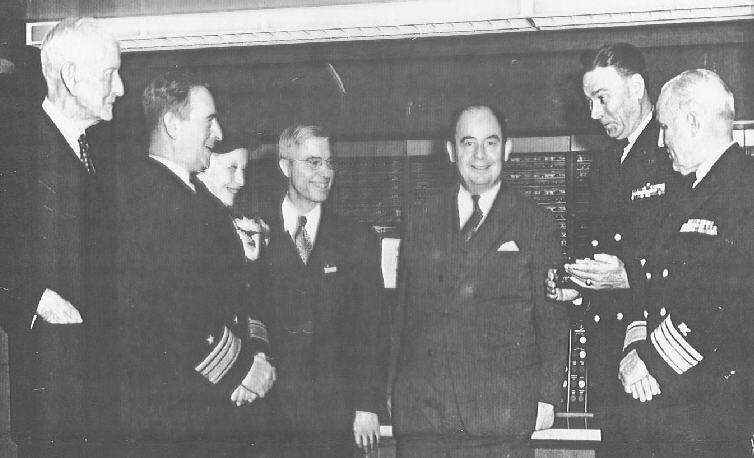
    “At the NORC dedication in Watson Lab, 2 December 1954: IBM Chairman Thomas J. Watson, Rear Admiral E.A. Solomons (Executive Office, Secretary of the Navy), Jeannette Watson (Mrs. Watson Senior), Columbia Professor Wallace Eckert, John von Neumann, Captain C.K. Bergin (Director, R&D, Bureau of Ordnance, Dept of the Navy), Rear Admiral C.G. Warfield (Executive Office, Secretary of the Navy).”  The Navy is happy here because they wound up with the computer at Dahlgren.  Von Neumann was happy because he got to play von Neumann his whole life long. 

    The IBM press release for the NORC included the following summary of the event and the von Neumann address:

    NORC Press release//The following is the text of a December 2, 1954 IBM press release regarding the first public demonstration of NORC and its official “delivery” to the U.S. Navy.

    The first public demonstration of NORC (Naval Ordnance Research Calculator), fastest and largest capacity electronic calculator in existence, which has been built by International Business Machines Corporation for the Bureau of Ordnance, U.S. Navy, was conducted today at the Watson Scientific Computing Laboratory at Columbia University in the presence of approximately 150 representatives of the U.S. Navy and other Government departments, education and scientific research institutions and industrial companies. The machine was accepted on behalf of the Bureau of Ordnance by Captain C. K. Bergin, USN, Assistant Chief of research and development of the Bureau, from Thomas J. Watson, Jr., president of IBM.

    At a luncheon following the demonstration, Professor John Von Neumann, of the Institute for Advanced Study, Princeton University, and an appointee to the Atomic Energy Commission, discussed possible uses for the NORC other than for the immediate problems of the Bureau of Ordnance, instancing the field of geophysics as having great possibilities.

    It is now “practical and feasible” to forecast, with the NORC, the weather for an entire hemisphere thirty or sixty days ahead, by calculations occupying perhaps 24 hours, with results about as good as those obtained by an experienced subjective weather forecaster, “which are very good.” Calculations similar to those now made, forecasting weather over the area of the United States for 24 hours in advance, could be made on the NORC in perhaps half a minute, he stated.

    Complete calculation of the tidal motions of all the oceans, the marginal movements near the continents as well as the main motions of the oceans, is now, with the NORC, a matter of days and therefore feasible. He also declared that calculation of the hydrodynamics of the earth’s fluid core, the movements of which are responsible for the main phenomena of terrestrial magnetism, “becomes probably accessible for the first time.”

    In the statistical field, dealing with matters which are not wholly mechanical, such as troop operations and logistic operations which involve purely accidental factors like the prevailing weather during the operation, command decisions which have not yet been officially made can be stipulated and various solutions for various alternatives calculated. This has been done before on a minor scale but it takes too long to do on a large scale. “In this field the importance of NORC is enormous,” Dr. Von Neumann said.

    He concluded by pointing out that the NORC was assembled less than two months ago and put on test less than two weeks ago, yet in a test yesterday (Wednesday. Dec. 1) it ran for four hours without an error, doing in this period more work than any calculator of ten years ago has performed in its entire lifetime. He termed this performance “completely fantastic; I doubt if it has ever been done before.”

    Dr. Grayson L. Kirk, president of Columbia University, stated that during the test period the NORC will be available to the University for important research projects, particularly in the field of nuclear physics, before it is shipped to the Naval Proving Ground, Dahlgren, Va. to be installed in the Computation Laboratory already established there.


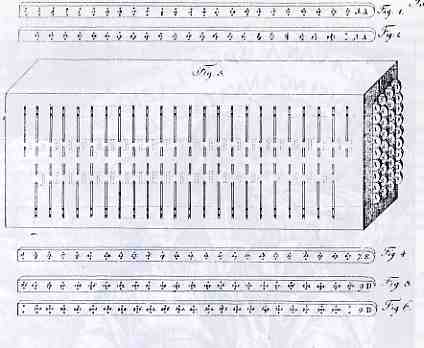
  • The First Electric Calculator–Seiferheid’s Invention of 1818

    JF Ptak Science Books LLC  Post 539

    0 blog march 9 computer659
    One of the most unexpected monuments–to me at least–in the history of modern computation is the fantastic electrical calculating machine that shows up in the vast, dense, and bibliographically complicated work by Georg Heinrich Seiferheid (1757-1818), Sammulung Electrischer Spielwerke fur junge..., published over the years 1791 to 1817.  Mr. Seiferheid was an experimenter, innovator, inventor and writer, and wrapped up in one complicated ball, publishing his major and minor bits under the heading of this one large work over a period of least 16 years.  And don’t let the title fool you:  in the vein of Chandrasekhar’s Newton’s Principia for the Common Reader, there wasn’t all that much in these volumes by Seiferheid for kids, just like in the Chandrasekhar book, which redefined the phrase “Common Reader” way, way up.  Even taking into account the level at which children were educated in the applied and natural sciences/philosophy, which demanded more from the 18th and 19th century kids than out grade school do now, Seiferheid’s work is obvious far removed from that.  Perhaps it was because he had a large number of gadgety trinkets that hung through the work like plumb lines that the word junge was included–I really don’t know.  The vastness of his reach though into all manner of mechanical and electrical objects is very impressive–Seiferheid evidently constructed electrically powered guns, clocks, and of course this fantastic calculating device. The calculator was much similar to the machine invented (although no
    version of it survived) by Wilhelm Schickard (1592-1635)  in 1623, followed by that in 1643 of the
    overwhelming Blaise Pascal (with the “Pascaline”) and then again in 1675 of
    Gottfried Leibniz (1646-1716) who produced the “Stepped Reckoner”—the Seiferheid
    machine was more complex, and of course, electric, a true and terrific innovation, creating for its maker the sobriquet of “grandfather” of the modern computer.  

    * I have found very little biographical data on this man; even the very reliable Poggendorff has only about 15 lines on him:  he was born in Wurtemberg, was a professor of physics at the Gymnasium at Schwabisch Hall, and that’s about it for the personal data.  He did write four other books in addition to this ten-volume magnum opus. 

    I am unsure of why this man is so little known to general readers.

    ·Posted by :

    ·in:


  • The Glory of theTechnicolor Electronic Future Arrives: 1942 Electronics

    JF Ptak Science Books LLC   Post 253

    Blog1sept_9527

    I’m sorry to report that the publisher and beneficiary of this
    brilliant 1940’s advertising art–General Electric–swallowed up the
    identity of their artist.  Nowhere in the 1942 publication with the
    Huxleyesque title of Electronics, a New Science for a New World is
    there any mention of the poor artist who gave vision to this retread
    idea…or retread if you don’t consider the “electronics” part.  Yes,
    the art is a little removed and slightly, spatially, naive; and the
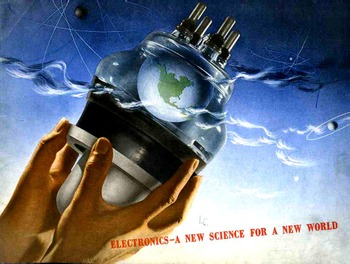
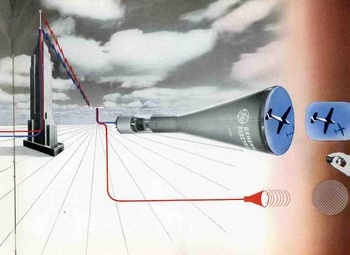
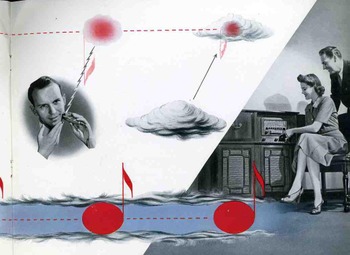
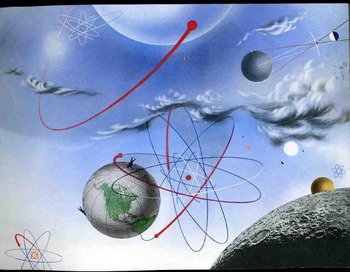
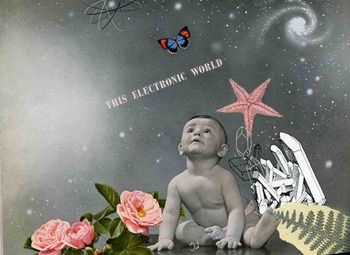
    colors are too much and the symbolism too big (there’s allot of host of hosts stuff, offerings up to the big sky),and the images are a little ridiculous,  but they are jolting (for good or for ill) and it really does speak for its time.  And in 1942 electronics was just about to come to the rescue and save World War II:  from tracking aircraft for anti-aircraft weapons to RADAR to the development of computers to the Enigma to the development of the atomic bomb, and on and on, “electronics” did ride in on a white horse to save the day.  I can understand perfectly well the sentiments exhibited in these fabulously bombastic illustrations: the extraordinary power of radio and the beginning of television, the beautifully rendered hands on the front cover (the shadows on the fingernails are done very well) holding the electronic chalice, the baby and the butterfly (and all of that other weird stuff strewn about); all are getting ready for the bigger world that was coming as the beneficiary of this electronic revolution.  And, as a matter of fact, no one really had a clue as to what was coming–that baby would be retiring now, and the changes that occurred during its lifetime are so supremely removed and incalculable from 1942 that it makes even the vast hope exhibited in these electronic icons seem mild.  It also makes me wonder about what brave oceanic beliefs and expectations of the future that we have today will look common and sugary (or saccharin, or whatever) in the year 2074.

    Blog1sept_9e531

    Blog1sept_9d530

    Blog1sept_9b528

    Blog1sept_9c529


  • The Birth of the “Internet” at the End of WWII: Vannevar Bush & the MEMEX, July 1945

    JF Ptak Science Books LLC  Post 190

    Dsc00022 In the midst of running the American scientific war effort (As Director
    of the Office of Scientific Research in charge of some 6000 scientists)
    and in the middle of trying to figure out the best way of dealing with
    the coming proliferation of atomic weapons, Vannevar Bush somehow found
    the time to write what many consider to be the first scientific paper
    on what would become the internet. The paper,   “As We May Think”;  was
    published in the Atlantic Monthly in July 1945.

    (It might be odd to look at it this way, but if you were a Nazi time traveler able to assassinate three people in the U.S. that would change the direction of the American effort in WWII, one would certainly be Roosevelt (who rose to the tasks of the Depression and the War  with Lincolnian sustainability), and I’m not unconvinced that one f the other two might very well be Bush–he kept the scientific agenda on course, direct, and to the point, saving time, effort and lives.  Its an interesting bit to think about….)

    Bush was doing A LOT of thinking on the organization of thought in that year.  I suspect that in trying to deal with the problems of the coming atomic arms race (beginning in the year before Trinity) and in trying to figure out how to distribute the knowledge-base that lead to the building of the bomb, that the idea of the MEMEX may very well have been the future consequence formed by his immediate concerns.

    The MEMEX (Mechanical Aid to Memory) was Bush’s breathtaking idea for a design for the organization of associative thought and memory.  It was a mechanical “aid” to memory, building “trails” of associations of ideas.  The MEMEX was another in the long line of art-of-memory attempts, from the ancients to the memory palaces and theaters of Raymond Lull and Francis Bacon and Athanasius Kircher and Giulio Camillo. What made this so appealing to the next generation of thinker on the distribution of information in the computer age was its ideas on making massive amounts of information obtainable; it was more about *thinking* about order and ability and access to information (in quantities unthinkable and by means unknowable) in 1945. 

    Looking at the future square in the face, Bush writes (on page eight of his short paper) with extraordinary perception: 

    “Wholly new forms of encyclopedias will appear, ready-made with a
    mesh of associative trails running through them, ready to be dropped
    into the memex and there amplified. The lawyer has at his touch the
    associated opinions and decisions of his whole experience, and of the
    experience of friends and authorities. The patent attorney has on call
    the millions of issued patents, with familiar trails to every point of
    his client’s interest. The physician, puzzled by its patient’s
    reactions, strikes the trail established in studying an earlier similar
    case, and runs rapidly through analogous case histories, with side
    references to the classics for the pertinent anatomy and histology. The
    chemist, struggling with the synthesis of an organic compound, has all
    the chemical literature before him in his laboratory, with trails
    following the analogies of compounds, and side trails to their physical
    and chemical behavior.

    “The historian, with a vast chronological account of a people,
    parallels it with a skip trail which stops only at the salient items,
    and can follow at any time contemporary trails which lead him all over
    civilization at a particular epoch. There is a new profession of trail
    blazers, those who find delight in the task of establishing useful
    trails through the enormous mass of the common record. The inheritance
    from the master becomes, not only his additions to the world’s record,
    but for his disciples the entire scaffolding by which they were erected.”

    Sounds pretty familiar, yes? 

    Some of the great internet developers who have recognized the
    importance of this paper by Bush include Doug Englebart, (who would
    write to Bush acknowledging the influence Bush’s article had had on his
    own work. (Zachary, 267).);  J.C.R. Liklider  (Waldrop, 2000): and Ted
    Nelson (Internet pioneer and coiner of the term hypertext and know as
    “one of the most influential contrarians in the history of the
    information age.” (Edwards, 1997)).  And of course many, many others. 

    The full text of the paper “As We May Think” is below.


  • Pre-histories of Great Ideas: Mandelbrot and the Fractal, 1967-1975

    JF Ptak Science Books LLC  Post 143
    Blogmandelbrot217_2
    This is the first of a few short essays of the idea of
    pre-historic appearances of important ideas. I use the word “pre-historic” in its literal sense—that is, these papers
    were published before the concepts that they discussed were recognized and published,
    later, in more complete form and of course to greater fame. One will certainly be Gregor Mendl’s paper (Versuche
    über Plflanzenhybriden
    ) published in the obscure Verhandlungen des
    naturforschenden Vereines in Brünn, (Brno),
    and to be resurrected at the hands of Gregory Bateson thirty-odd years
    later. Another example is Vannevar Bush’s
    “As We May Think”, published in The Atlantic Monthly in June 1945, and which
    was a definite intellectual precursor to the construction of the Internet. A third

    Right now, though, I’d like to look at the pre-birth of
    fractals in Benoit Mandelbrot’s precursor (1967) paper (and in a weird,
    probably not-correct way, scooping himself) to his more famous effort of 1975,
    in which he coins the term and fully describes fractals, showing the
    measurement of the coastlines behave like a fractal over a range of measurement
    scales.

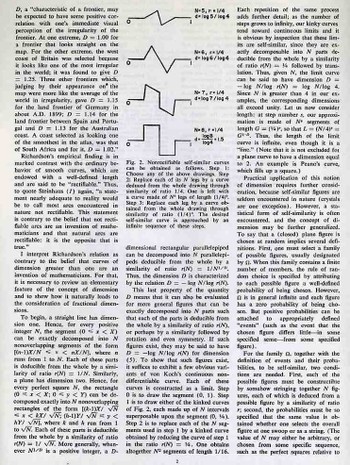
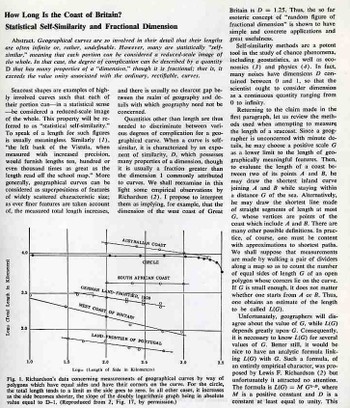
    The seminal paper, How Long Is the Coast of Britain? Statistical Self-Similarity and Fractional Dimension, published in Science
    magazine in 1967, is an introduction to the concept of fractals (which
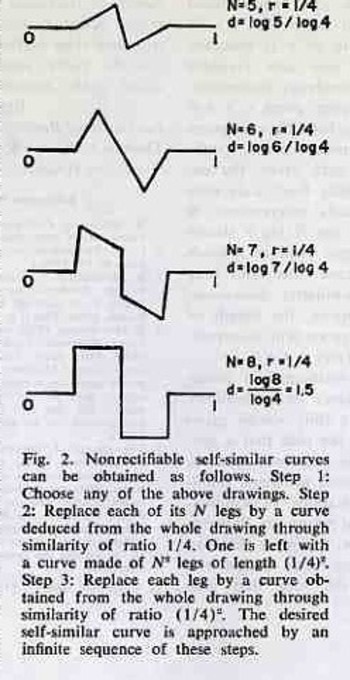
    Mandelbrot would name in later in1975), The kernel of it all is found in the Lewis Fry Richardson graphs and
    more so in the small illustration on page three of the paper—the peek into the future
    world of fractals, seeing a fractal before it was named so.

    Blogmandelbrot2218

    Blogmandelbrot217_3

    Richardson (a kind of Jevons, Marey-like American figure on the history of 20th century
    science) did some very good thinking about the elusive nature of naming such a
    thing as the lengths of coastlines and other natural constructions: namely he determined that their measured
    length was dependent upon the scale of measurement. That is to say the measured length, L(G), is
    ruled the scale of G, approximating the function as L(G)=M(G)1-0 

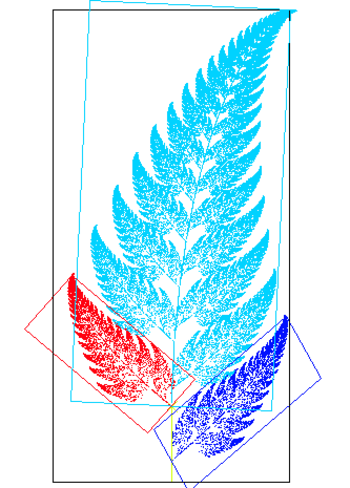
    Mandelbrot moves on to discuss the coastline in terms of it
    being a self-similar object, which is something that is nearly exactly similar
    to a part of itself, or the whole having the same shape of one or more than one
    of its parts, and regresses.

    Mandelbrotfern


    The Mandelbrot Fern (courtesy of http://en.wikipedia.org/wiki/Image:Fractal_fern_explained.png) displaying self-similar properties. 

    ·Posted by :

    ·in:


  • Advancing Modernity, 1965: the Enormous Footprint of the UNIVAC 490 Computer

    JF Ptak Science Books LLC  Post 6

    The State of the Art in Advanced Computing, 1965

    Six-Foot-Long Blueprint for the Installation of an UNIVAC 490 at the UNIVAC Headquarters in Herkimer, NY

    UnivacThis is a rare blueprint for the layout of the new
    UNIVAC 490 computer for installation at
    the UNIVAC Utica (NY) headquarters. What
    makes this blueprint particularly interesting is that it gives an overview for
    the placement of the entire 490 system. The central attractive feature of this blueprint is the church-like feel
    of the placement of the components, with the “control console” being roughly in
    the center of the plan. The operator
    would sit at the central console facing about 25 feet worth of Uniservos, with
    the 490 itself located 18 feet away on the left; various drums (about 20 feet
    worth) were located behind the CC as were various processors and the 1004
    (card) punch. The whole plan seems to
    incorporate something like an 18×40 foot space, *plus* five exterior rooms
    (manager, confernece, tape storage, tab room, and (my favorite, service and
    repair).

    This fills me with memories of Victorian steam whistle
    designs (lovely, ornate) and water-driven mills in
    Lowell (long and narrow, utilizing river bank and available sunlight). It is a document that speaks of its time,
    elegantly portraying the size and scope of one of the leading computers of the
    day and its placement at one of its
    maker’s principal headquarters. 


  • Alonzo Church’s Great Mathematical Logic

    JF Ptak Science Books LLC  Post 2

    Church’s Mathematical Logic is offered here in a rarely seen format–namely, the one that was produced, printed and distributed by the members of the class.  At the end of the description is an insightful story told by Albert Tucker about the mechanics of producing such a work. 

    Church,  Alonzo:  Mathematical Logic, Lectures
    by
    Alonzo Church,
    PrincetonUniversity,
    October 1935-January 1936;
      Princeton:
    ,  1936.  1st edition.    124 leaves  4to.
    Original printed wrappers.  Very good condition.     $2,000.00

    This is the Library of Congress’ copy, with the original
    mimeographed LC callcard laid in. +++Lecture notes of Church’s class taken by
    six of his graduate students (Ficken, Landau, Ruja, Singleton, Steenrod, Sweer,
    Weyl) in the fall term of 1935 at the Institute for Advanced Studies at
    Princeton.

    The following is an interview between William Aspray and
    Albert Tucker on the publication (so-called) of this work, taken from the Princeton University website on the Princeton mathematics community in the 1930’s. Needless to say, Church was an enormous
    influence, changing the entire face of mathematical logic. (It should be noted
    to that A.M. Turing came to study with Church at Princeton and particualry in
    this course in the fall of 1935.)