A Daily History of Holes, Dots, Lines, Science, History, Math, Physics, Art, the Unintentional Absurd, Architecture, Maps, Data Visualization, Blank and Missing Things, and so on. |1.6 million words, 7500 images, 4.9 million hits| Press & appearances in The Times, Le Figaro, Mensa, The Economist, The Guardian, Discovery News, Slate, Le Monde, Sci American Blogs, Le Pont, and many other places… 5000+ total posts since 2008.

Category: Computer Tech/History

  • The Alpha and Omega of Computer Questions; Asimov, 1953 and 1955

    JF PTak Science Books  Post 1375

    Asimiv question087
     

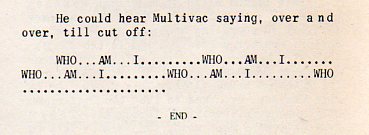
    Following up on yesterday’s post on the world’s first (popularly-published) computer magazine (Computers and Automation)  is this Isaac Asimov short story on what might be the first great computer question.  The story in mind, “Question”, appeared in the March 1955 issue of this same magazine, a two-pager sandwiched between an ad for Remington Rand UNIVAC and an article on computers and weather prediction.  It is the first appearance too of Asimov’s massive computer of the future, Multivac, a giant machine with corridors and nooks where technicians could stop and have a seat to enjoy a cup of coffee.  And it seemed to at least one worker that it wasn’t quite right to be sitting inside the machine, that the billion-tube, two billion relay computer was more than just a flow of electrons. (The ENIAC, which was basically the world’s first computer, had 20,000+ tubes, so a billion as  conceived by Asimov would’ve been a very big machine indeed, a 500,000-ENIACs-sized behemoth.) And a very hot one.   The workers wondered if you could ever tell if the machine was alive, if it thought on its own, if it attacked aparat from its instructions and programs. 

    As it turns out, the answer was positive, and not only that, but Multivac could speak.  Its answer to “the question” was “who…am…I…?”, repeated several times in the closing sentence of this rocket-fast short story.  I guess that that would give you pause, as it would anyone had the question come to them from their own computer while communicating along the spine of the great global “mind”, the Internet, and perhaps someday it will, at some time in the near-ish future when the height of our own computer-y heights looks as quaint to them as a half-million ENIAC idea of 1955’s premier scifi writer looks to us today.

    I know almost nothing about Asimov, but he seems to return to this idea of the Big Computer, Multivac, and ultimate question a few years later.  It seems as though there was an issue of serendipity involve with the structure of the “Question” story and that of another writer’s ending for a story called “Problem for Emmy” by Robert Sherman Townes. Asimov admitted the similarities but also maintained that he didn’t know of Townes and had never read his story–be that as it may, Asimov promised that he would never reprint the story, and it seems as though he never did.  But it looks as though he resurrected his idea somewhat, which is fine, because the whole idea of ultimate/penultimate questions and massive computers is a great genre. 

    Asimov wrote a story called “The Last Question” in 1956, a year later, writing about a trillion years of human history in the space of another terrifically-short short story, the short story that Asimov found to be his own favorite.  If “Question” posted the ultimate question put to the super-colossal Multivac computer,  ultimate question in “The Last Question” may well then be the ultimate answer.  You’ll have to see the ending of the story for yourself to see what it was–I can’t spoil it. 

    Notes:

    1.  I’m just a little surprised that Asimov was hung up on tubes in 1953–transistors had been in the air by 1947/8, published in 1948, and pretty-published by 1952.  I figure he should’ve been aware of them and how they would transform computer construction.  Maybe not. Perhaps he just wanted to write about a billion-tube computer. “Multivac ” stands for “muliple vacuum tubes”, and then “multiple vacuum tubes analog computer”, so using transistors might be a little at cross-odds with the name and the idea of the machine.  It woulod be interesting to put together a list of questions/answers of these early fictional machines, a longlist of which appears here.

    2. The two characters in the story by the way are named “Alexander Adell and Bertram Lupov”, both of which suggest the name Alexander Graham Bell to my head.


  • The World’s First Popularly-Published Computer Journal

    JF Ptak Science Books   Post 1374

    Computer history082

    Nothing quite gives you the taste for the ancient history of a very modern topic–like computers–than by looking through some of the earliest popular publications on the subject. This can actually be done pretty quickly if you wanted to just get a broad taste for the subject in its modern infancy–just reading the titles of the papers and taking in the advertisements might be enough. So here’s two volumes of a very scarce and interesting journal by old Edmund Berkeley that may do this job perfectly.  Berkeley was a bona fide mover and shaker in the early days of electronic computing in the United States–he had a lot on his mind, contributed many written words and ideas, and also tried to make a fair living while doing so (there was a bit of Sideshow Ed in him for some of the things he tried to sell.  

    Computers and Automation, the brainchild of the brainy not-child Edmund Berkeley, was the first popularly-published  magazine published regarding the computer, its applications, it programming, and really just about everything else.  (It appeared seven years after the Mathematical Tables and Aids to Computation  was published in 1943, almost entirely to the mathematics and engineering communities.) Computers was published by Edmund Berkeley & Associates in NYC beginning in 1952., beginning its publishing journey as The Computing Machinery Field, its name changing to Computers and Automation in February 1953 (in volume 2, number 2).   All issues have some fair space devoted to advertising, even though the issues generally ran between 32 and 40pp. Berkeley was a real-enough mathematician, engineer and computer pioneer, but he also had a pretty large taste for making these interests pay–which was essential, as the original print runs were not very large, though his advertisers were impressive. (According to the first issue, approximately 1200 people were on the mailing list for the journal, with around 2000 issues being printed each number. All told, this is not a large print run, and thus not many of the early issues have survived.)  He was not averse to being somewhat outre with his journal—in addition to having contributors like Grace Hopper and Alton Householder, he also had Fletcher Pratt and Isaac Asimov writing some pretty arresting pieces from the SciFi/Futurama point of view.

    Computer history083

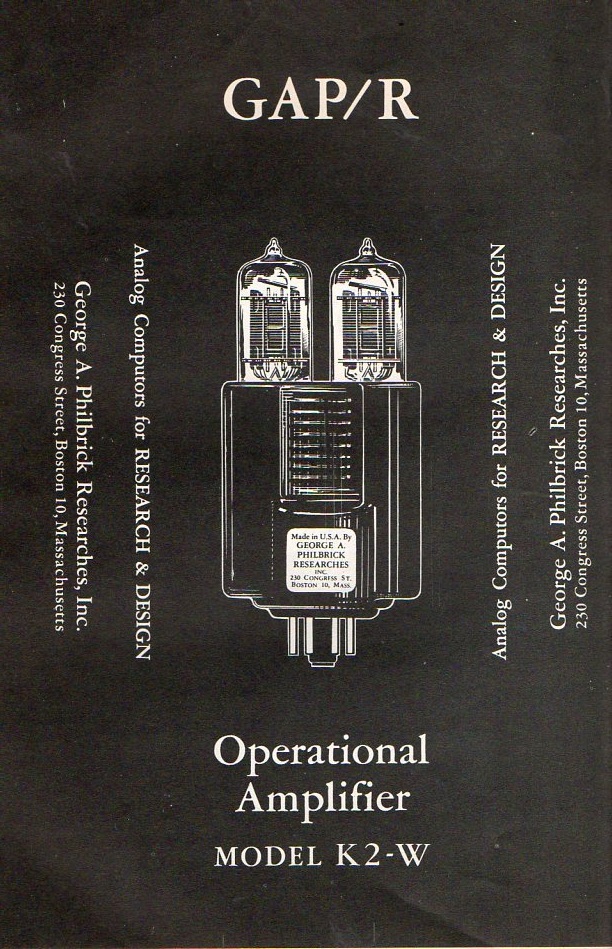
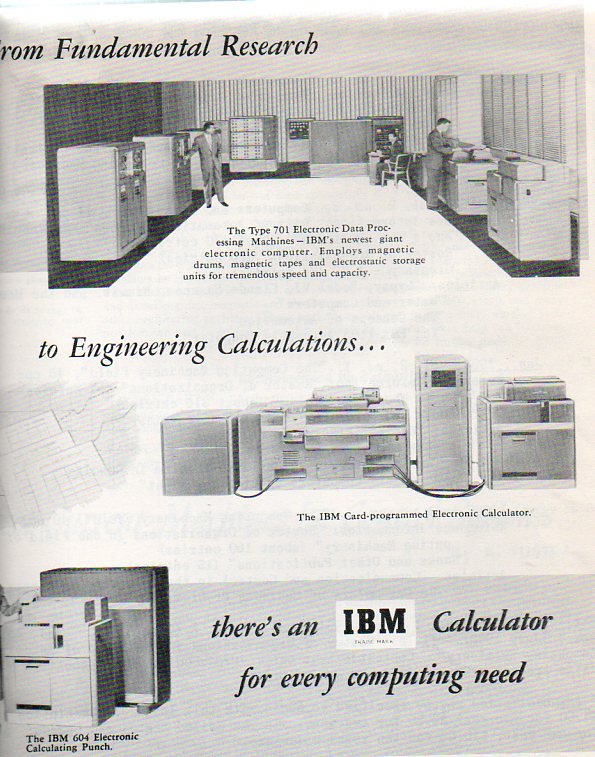
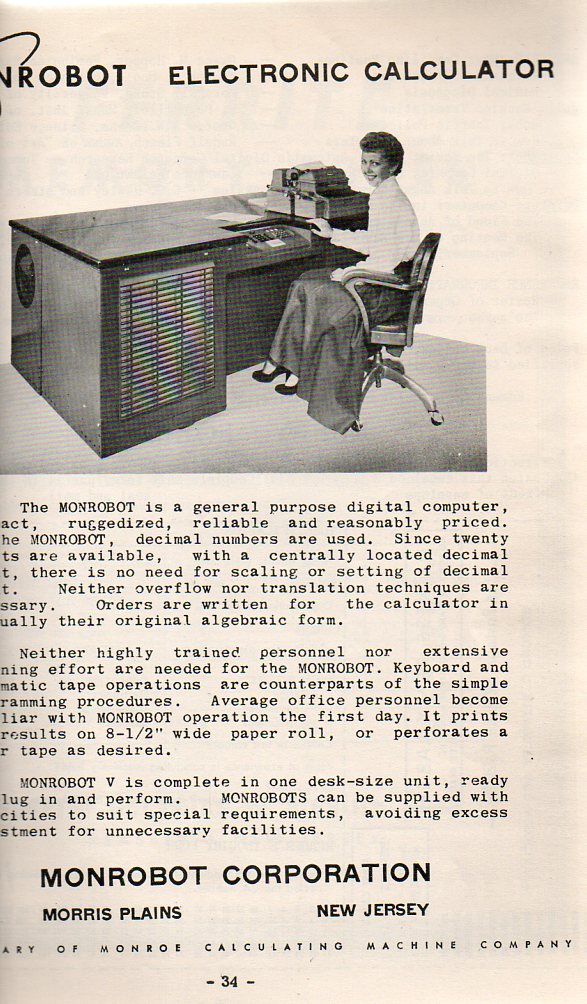
    A Note on the Advertisements: in short, they’re wonderful. For example, on the back cover of vol2/1 is Edmund Berkeley & Associates “SMALL ROBOTS”, advertising “Simon, the Mechanical Brains”, “Squee, the Robot Squirrel”, and other gadgets. To give you an example the other ads in this issue alone are for “The Circle Computer”, “General Ceramics Ferramic Cores”, “Magnetic Metals Co. Amplifier Cores”, Ross Ashby’s “Design for a Brain”, Consolidated Engineering’s SADIC System, Monroe Calculator’s Monrobot Electronic Calculator, George Philbrick’s “Computor (sic) products”, and a lovely two-page spread for Remington Rand. Further into the year are ads for Burroughs, IBM (604 ands 607), Electronic Associates Inc, Prokar capacitors, and many others.

    Some of the subjects include: The ERA 1103 computer, NIMWIT, Applications of the Computer, what the computer *is*, Admiral Grace Murray Hopper’s compiler, mechanical translation, Harper’s subroutines, the cost of coding, computer “self-repair”, automation at Ford, and so on.  Also includes perhaps the earliest announcement of the first all-transistor computer (October 1954, IBM’s “new experimental transistorized computer” , the earliest (?) printing of Asimov’s Three Laws of Robotics in a scientific journal, and more.

    Computer history086

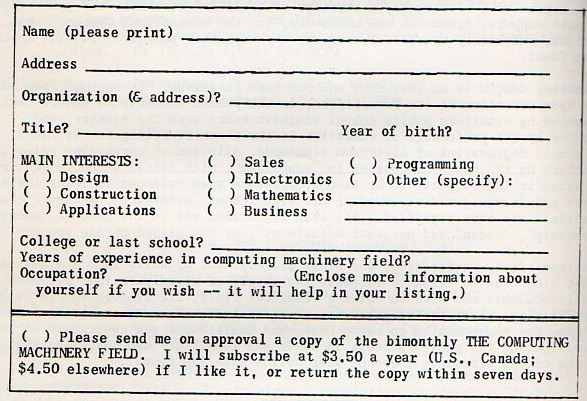
    Each section generally has three of the following categories (per issue) : computer glossary, roster of member organizations, who’s who, an annotated books and journals section, and other aligned concerns.  For example, there’s this bit, an application (cut-out) card for “Who’s Who in the Computing Field for December 1952”–utterly simple, it seems as though anyone who filled out the card was in, the “who’s who” part of this that we normally celebrate with fame or achievement really was just telling the rest of the people in the field who was exactly who.

    Computer history084

    The contents:

    Volume 2/1, January 1953. 45pp.

    Householder, A.S. Brains, Electronic and Otherwise; Williams, S.B. (President, ACM) What Computers Do; Murphy, E.F. and E.C. Berkeley. Automatic Computers on Election Night.

    Volume 2/2 , March 1953. 37pp.

    Boehm, George A.W. Gypsy, Model VI, Claude Shannon, Nimwit and the Mouse; Paynter, Henry. Water and Computers; and the editor Berkeley, The Concept of Automation, and Berkeley (with Neil Macdonald, Berkeley’s other name). The ERA 1003 Automatic Computer

    Volume 2/3, April 1953. 40pp.

    Fletcher Pratt, The Art of Solving Secret Ciphers and the Digital Computer; Berkeley, Avenues for Future Development in Computing Machinery;  Gene Hegedus, Hungarian Prelude to Automation..

    Volume 2/4. May 1953. 33pp.

    Grace Murray Hopper,  Compiling Routines; A.D. Booth, Mechanical Translation; Marshall Stone,  Medical Diagnosis.

    Volume 2/5. July 1953.

    Yehosuha Bar-Hillel (the great logician),  Machine Translation; George Boehm, Robot Traffic Policemen; Rudolf Flesch,  How to Talk to Computers.

    Volume 2/6. September 1953.

    Tommaso Fortuna,  The Soviet Union: Automatic Digital Computer Research.; Wainwright, Lawrence Wainwright,  Digital Computer Questionnaire; and a general DISCUSSION: “How to Talk About Computers”, with GG Hawley, Samuel Scharff, C.B. Crumb, and EC Berkeley.

    Volume 2/7. October 1953. 36pp.

    Brown, David W. Brown Computers in the Factory; Neil (Berkeley) Macdonald,  The Flood of Automatic Computers. 

    Volume 2/8. November 1953. 40pp.

    John W.Carr  III. Who Will Man the New Digital Computers?; E.F. Cooley,  Electronic Equipment Applied to Periodic Billing; Glenn.Hagen,  Air-Floating: a New Principle in Magnetic Recording of Information.

    Volume 2/9 December 1953. 36pp.

    Clippinger, Richard Clippinger, How a Central Computing Laboratory can Help Industry; R.T. Wiseman, “Combined” Operations in a Life Insurance Company instead of “fractured operations”.

    These are the contents for 1953; the volume for 1954 bulks up a little, but is still under an inch thick.   The MTAC journal stays quite slender throughout its pre-1960 life (it has virtually no advertisement and is entirely academic), and there are more and more computer articles appearing in old stand-by associated journals like the Proceedings of the Institute of  Radio Engineers (which by 1959 will published a massive supplemental volume called “the Computer Issue” which I’ll talk about soon.  For the time being, I just wanted to make an inroad into this journal–I’ll expand on he articles in just a bit. 

    Computer history085


  • The First Photo Inside of the Information Revolution–the Transistor, 1949

    JF Ptak Science Books  Post 1370

    Transistor 066

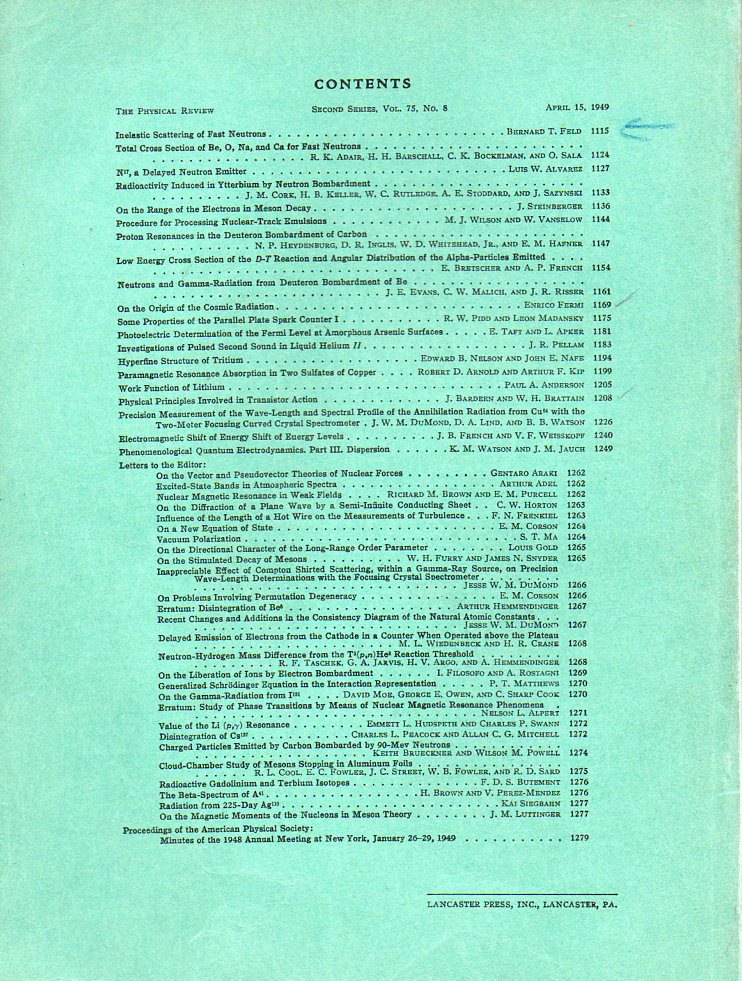
    One of the things I love about working my way through old scientific journals is when I find the issue that I’m looking for and scroll down the list of contributors to find the significant article that I want.  Long list, usually; and then, after making my way through 30 or 40 lines of tight type of the index I find it. [This by the way is one of those experiences that is being replaced by the digital library.]   Even though the paper on pp 1208 through 1226  of the 15 April 1949 issue of The Physical Review looks like any other, it is today seen as revolutionary. The entry for “Physical Principles Involved in Transistor Action” by John Bardeen (two-time Nobel in physics) and Walter Transistor 064 Brattain (Nobel ’72) shows up about halfway down the index, sandwiched in some very good company (Enrico Fermi’s “Origins of Cosmic Radiation” and a number of others), and does not show up bolded, or highlighted, or with an asterisk.  Such is the nature of publication in the academic journal world, everything delivered with equal weight. (The original publication is available for purchase here at our blog blookstore.)

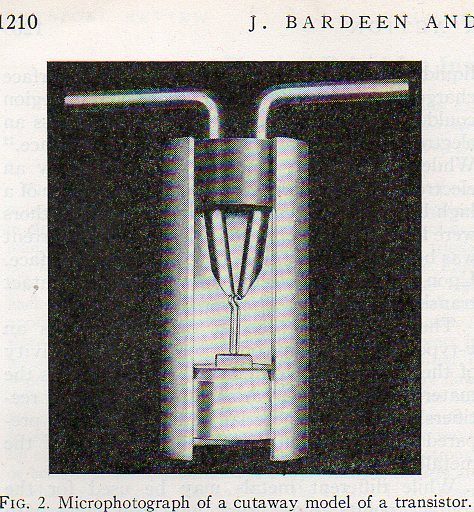
    It makes me wonder though how it would’ve felt to open this journal for the first time back there in mid-April ’49, turning to page 1210 to see the microphotograph of the cutaway of a model of the transistor.  This was the defining technical publication on the transistor1, which was the first massive step towards microminiaturization and the explosive new growth in the computer, allowing far more powerful machines to be designed in far less space, in far less amounts of time, and on and on.  It is one of the first steps in the Information Revolution, moving the computer from massive racks of electronic tubes to more simple, elegant, nimble and by-far faster circuit boards with transistors (and resistors, capacitors, inductors, diodes, etc.) to make an electronic circuit.  This would be the standard for computer construction, only supplemented by Jack Kilby (TI)  and Robert Noyce (Fairchild Camera) in 1958/9 with the integrated circuit, where transistors are made smaller still and produced in groups on circuit boards rather than individually.

    The photo above shows a cutaway of the transistor, and is the first time it was published–the first photo of what was one of teh 20th century’s greatest inventions. 

    Transistor 065

    Notes

    1.  The paper was published simultaneously in the Bell System Technical Journal; Bardeen and Brattain were with the Bell Labs.  The Bell journal also contained another revolutionary paper in the same volume, Claude Shannon’s “Communication Theory of Secrecy Systems”, which is one of the most important early papers on electronics and cryptology.  (We also have a copy of this classic paper for sale at our blog bookstore site.)


  • The pre-pre-Internet? The SAGE Defense System, 1959-1983.

    JF Ptak Science Books   Post 1341

    Quality Control of America’s Anti-Bomber Defensive “Shield”: the SAGE System, 1958

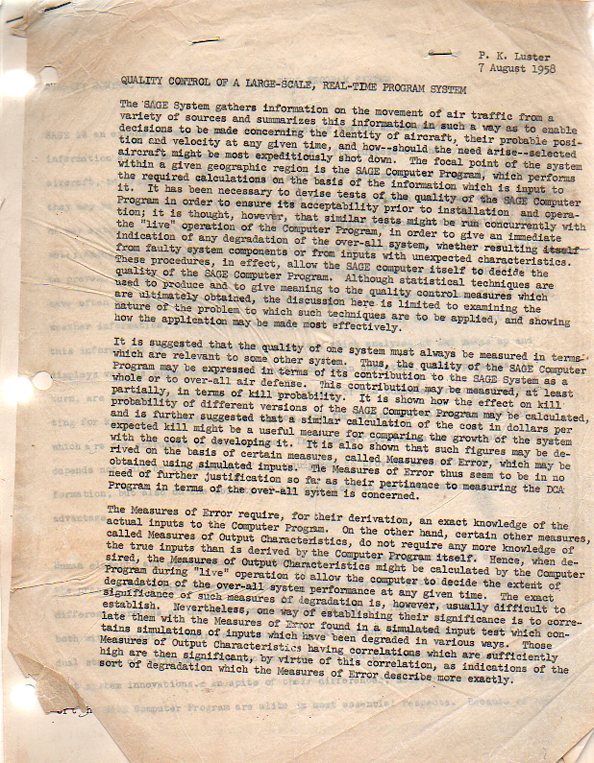
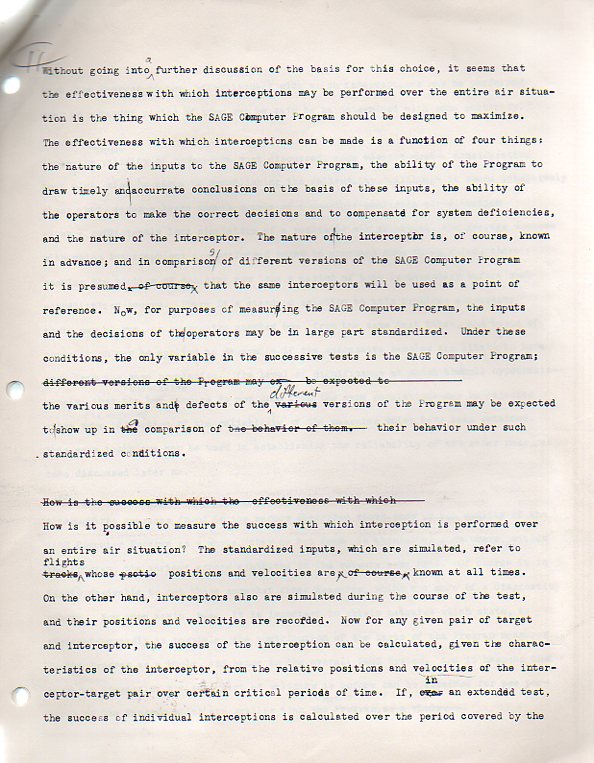
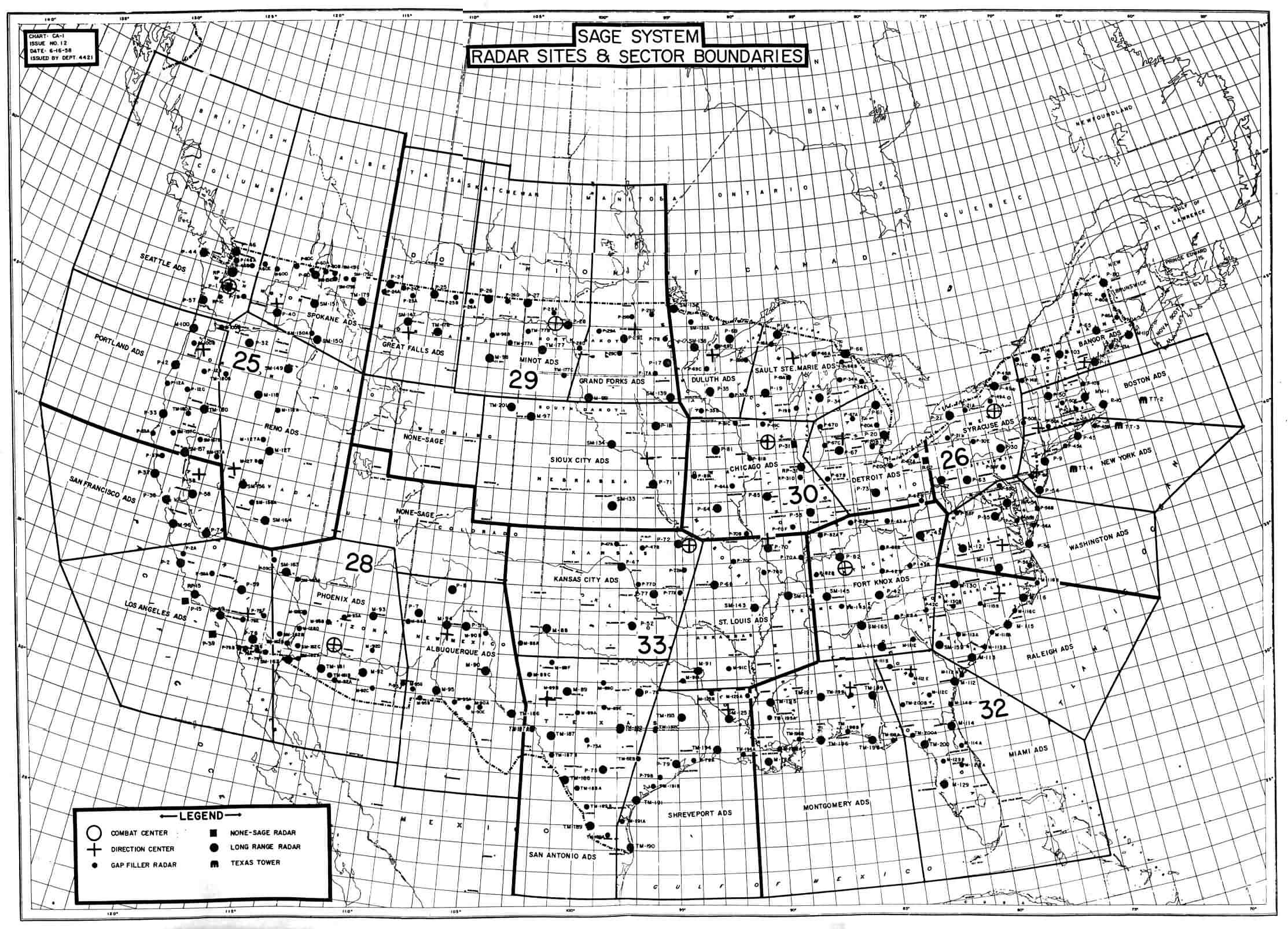
    SAGE403 The SAGE  (The Semi-Automatic Ground Environment) was an “air traffic control device”1 that was used to detect enemy aircraft, relate their position and speed to interceptors which would destroy the threat.  It was basically the air defense shield against attack of North America by Soviet bombers (in the pre-ICBM days of MAD). The MIT/IBM SAGE system was enormously important in the history of computing because of its many real-time, interactive and online aspects–it was an enormously successful and futuristic system, one of the “best” computers ever built. This paper on the computer’s ability to self-reference and check itself, by P.K. Luster, was written in 1958 and serves as an interesting insight into quality control for the world’s first nation-wide computer communication network.

    Luster (who at one time worked for a contractor in Arlington, Virginia, named the John D. Kettelle Corp) was one of hundreds of programmers who worked on the system, and in this case, for this effort of his, he looked at various ways for selecting the proper way for a SAGE to monitor itself in real time and make assessments of its own reliability.  This was a very tricky bit, of course.  SAGE was the largest computer ever built–it had 23 installations in the U.S. (And one other in Canada) each given the possibility of tracking about 400 aircraft at one time.  SAGE would track these developments, coordinate all efforts in response, and then if the flights were determined to be hostile /Soviet forces, would destroy the buggers with responses from “nuclear tipped” BOMARC and Nike missiles. (The Boeing Michigan Aeronautical Research Center and Nike missiles each carried a 1-5 kiloton warhead, enough so that if it was near its target it would be able to destroy it.The BOMARC looked like a jet aircraft; the Nike looked like a multi-finned, very sleek ultimate 1950’s imaginatively-styled rocket ship, but real.) Trying to insure that the system was accurate was a major consideration. (This document is available for purchase from our blog bookstore.)

    From Luster’s  paper:

    “It has been necessary to device tests of the quality of the SAGE computer program in order to ensure its acceptability prior to installation and operation…also to run it “live” in order to give an immediate indication of any degradation of the overall system.  In effect, allow the SAGE computer itself to decide the quality of the SAGE computer program…The discussion here is limited to examining the nature of the problem to which such techniques are to be applied, and showing how the application may be made most effectively.”

    SAGE402
    The SAGE system was of course functional, highly reliable, and ws used until 1983.  IT was a kind of early version of the Star Wars defense system envisioned by President Reqgana nd Edward Teller, among others.  Except that SAGE existed and worked.

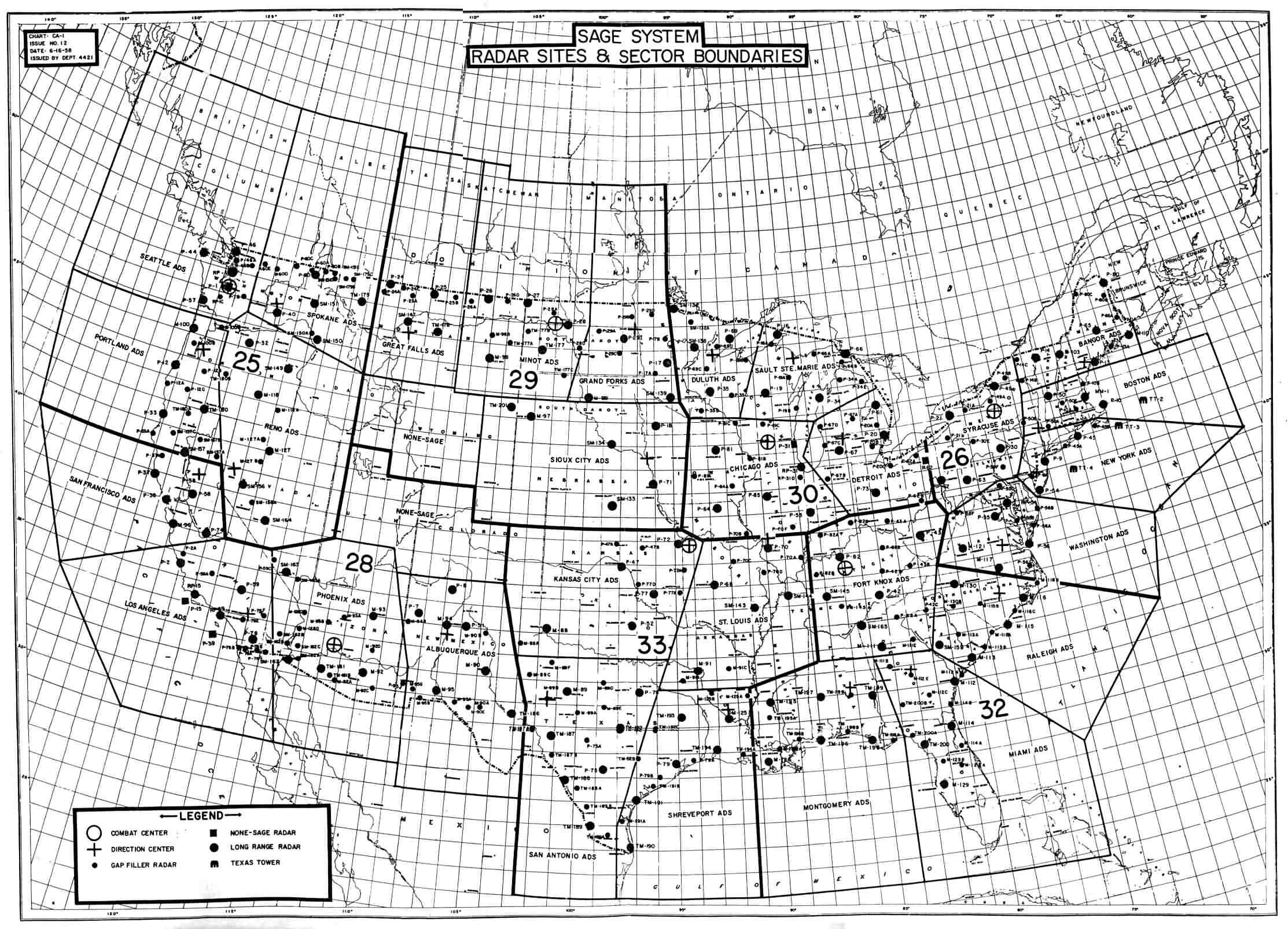
    It is interesting too to think of it in terms of a sort of pre-ARPANET pre-internet, a pre-pre-internet, in that the system has 24 remote nodes which communicated among themselves.  It doesn’t bear much resemblance to J.C.R. Licklider’s  Memorandum For Members and Affiliates of the Intergalactic Computer Network (1963)–the true first modeling suggestion for a working internet in which all of the main pieces of the internet are present, but it is at least in the neighborhood, as SAGE was the first operational nation-wide real-time computer network. ( It should also be pointed out that Licklider and other of the creators of ARPANET were programmers for SAGE.)  SAGE was in-place by 1959 and operating by 1963, but it had severe limitations as a national defense shield and was ill-equipped to counter ICBMs and SLBMs, but it was kept alive until 1983.   

    Sage network


     Notes

    1.  SAGE did become the template for SABRE as well as for the national air traffic control ssytem.


  • Dividing by Zero: David Byrne and Herman (“the Fat Man”) Kahn Sing the Future Blues

    JF Ptak Science Books  Post 1312

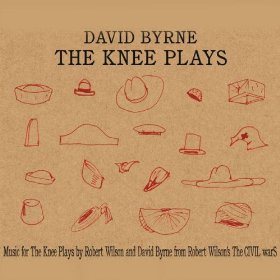
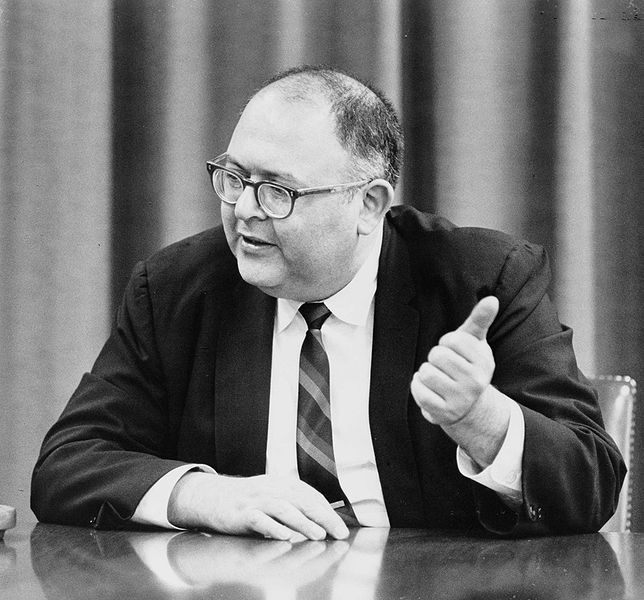
    Earlier in this blog, about two years ago, I wrote a piece on David Byrne’s beautiful Knee Plays, which included a song “In the Future”.  The post was about Byrne’s vision of the future which was bounced off the belly of “futurist” Herman Kahn, a man who was widely influential and whose thinking (I do believe) was widely incorrect.  He was also a proponent of possible first-strike (that is, American-initiated) nuclear warfare, deeming the scenarios “winable”., a broad thinker on Thinking-the-Unthinkable, and coiner of the word “megadeath” when used in conjunction with his nuclear end-game games. A main component of the template for Dr. Strangelove in Kubrick’s movie by that name,  Kahn and the think tank he helped found (the Hudson Institute) had the ear of the Reagan administration, among others, and it shows.

    Here’s the revised post, expanded some.

    0-blog-dec 3 byrne David Byrne, former Talking Heads member, produced a series of twelve short pieces to be used in the Philip Glass (and Robert Wilson*) Opera CIVIL warS  in 1985. (“Opera” may not be the right word for this piece, as I think it was one only in so far as the composition needed an opera house to be performed in.)   The Byrne pieces, called ”Knee Plays”, were meant to fill in the spaces, the spaces in-between,  place holders, between the sections of the day-long multimedia production..  Glass had used this idea of inter-pieces to the whole earlier in 1976 in his at-the-edge Einstein on the Beach, in which the connective elements were meant to not only join the pieces of the production together, but were also meant to stand alone, as a cohesive unit, if removed from the opera.  (Glass said they were “short connecting pieces which appear throughout the work much as prelude, interludes and post-ludes. Taken together they form a play in themselves”)

    0-blog-Dec 3 David_Byrne1991

    One of the Knee Plays, “In the Future” (Knee Play Number 12) is a slippery, stacatto brass section accompanying Byrne’s 51 sophisms about life in the future.  About thirty years earlier, “futurist” and think-tank-filler (or maybe it was “Think Tub”?) Herman Kahn (1922-1983), occupying a lot of space at the RAND and Hudson Institutes  (he was also known in many circles as the “Fat Man”), diligently recorded his myopic views of the future. He is generally regarded as a systems theory and military strategy guy, and is most remembered for (as he claims, perhaps) introducing the term “Vietnamization” which described the ultra-failed de-escalation (?) process and withdrawal for the United States from Vietnam (attention Obama administration).  Superluminarily speaking though his contribution to thought on constructing and implementing thought regarding nuclear weapons exchange (pointless to refer to this as “war”) in several books, including On Thermonuclear War (1960), Thinking About the Unthinkable (1962) and, On Escalation (1965), where he famously put The Bomb on the table of use possibilities.  In addition to these books—which he is busily trying to forget out there in his afterlife, somewhere, maybe in a penitential place where you are forced to think endlessly about paths-to-bad-decisions) is that 1967 peek into the future, The Year 2000.  Petroleum and oil are not issues.  Computers are of minor societal importance.  And then other things of no importance happen.

    0-blog-dec bryne kahn When you take Byrne’s Knee Play 12 and place it next to Kahn and other mis-spent prognosticators, the musician looks positively brilliant.  Some of the stuff has come to pass, some hasn’t; some will, and some won’t.  Some are open to a little interpretation, and some, a lot.  Overall, though, if you think through these little future bullets a little carefully, David Bryne looks very good.  Byrne’s lyrics/list is below.

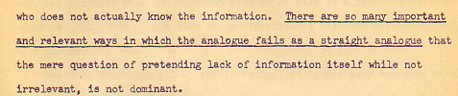
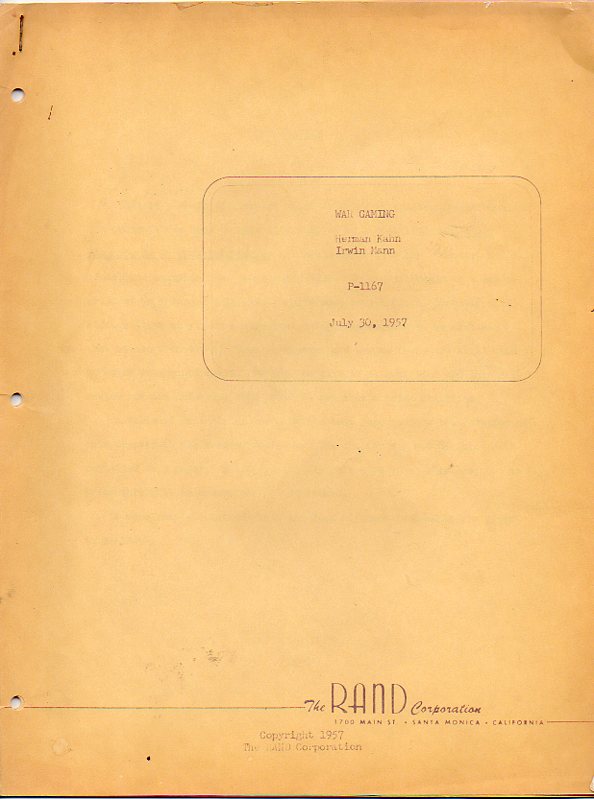
    Kahn’s writing is necessarily less elegant than Byrne’s, and probably less elegant than most other people in general including those who don’t write, though it does lower itself to some height of governmental semi-speak.  For example, from his July 1957 RAND paper “War Gaming” (available at our blog bookstore, HERE), we find this nugget:

    Kahn314

    Kahn315

    I have no doubt that Kahn looks like a warrior to many people–he no doubt was something of one, so long as that warrior could wear a white button-down shirt and not get dirty.  Simply because a person is thought of as a “warrior” doesn’t make them a ‘good” one, either, and I think that I would nominate Herman Kahn as an example of one:  in my own approximation of Kahn-speak, he would  “generate the apparent non-non appearance in definable though undefined parameters as  a non-good non-warrior in circumstances that defined or not define him/them in this semi-stable manner”.

    I think it is important to look at documents like this–documents that helped establish military policy–to see how their authors were able to convince people in government that they could divide by zero.


    *Robert Wilson is a phenomenal conceptualist and theatrical designer.  On the liner notes to CIVIL warS is found the interesting note on Wilson and Byrne:  “At first, Robert Wilson asked David to compose pieces for several sections of The CIVIL warS, but on account of David’s limited time, he composed only The Knee Plays part. The CIVIL warS was supposed to be played in its complete form at the Olympic Games in Los Angeles, but if one plays every part, it takes at least eight hours. There was also a financial problem for playing every part. So only some parts of it were staged there. David himself was very interested in composing for such a play and dance and this time again he enjoyed this work very much. Last time, for The Catherine Wheel, he used recorded tape, but this time he made musicians play on the stage.”

    (Featuring a prominent role for The Tuba)

    IN THE FUTURE (KNEE PLAY 12)

    In the future everyone will have the same haircut and the same clothes
    In the future everyone will be very fat from the starchy diet
    In the future everyone will be very thin from not having enough to eat
    In the future it will be next to impossible to tell girls from boys, even in bed


  • Selling and Costing-Out Digital Computers, 1959–When “Computers Didn’t Sell Themselves”

    JF Ptak Science Books   Post 1296

    “Computers do not as yet sell themselves.”–Lehman, 1959

    Computer--lehman223 Question:  what had 1000 transistors, 5000 diodes, 2000 resistors and 1000 capacitors, a team of ten and took 18 months to build?  

    Answer: an inexpensive, $12,000 digital computer in 1959.  

    Mind you this is legions better than what was happening in the mid-1940’s, with teams of hundreds and costs in the many millions, and much better than in the early 1950’s, when these numbers were of an order of magnitude greater.

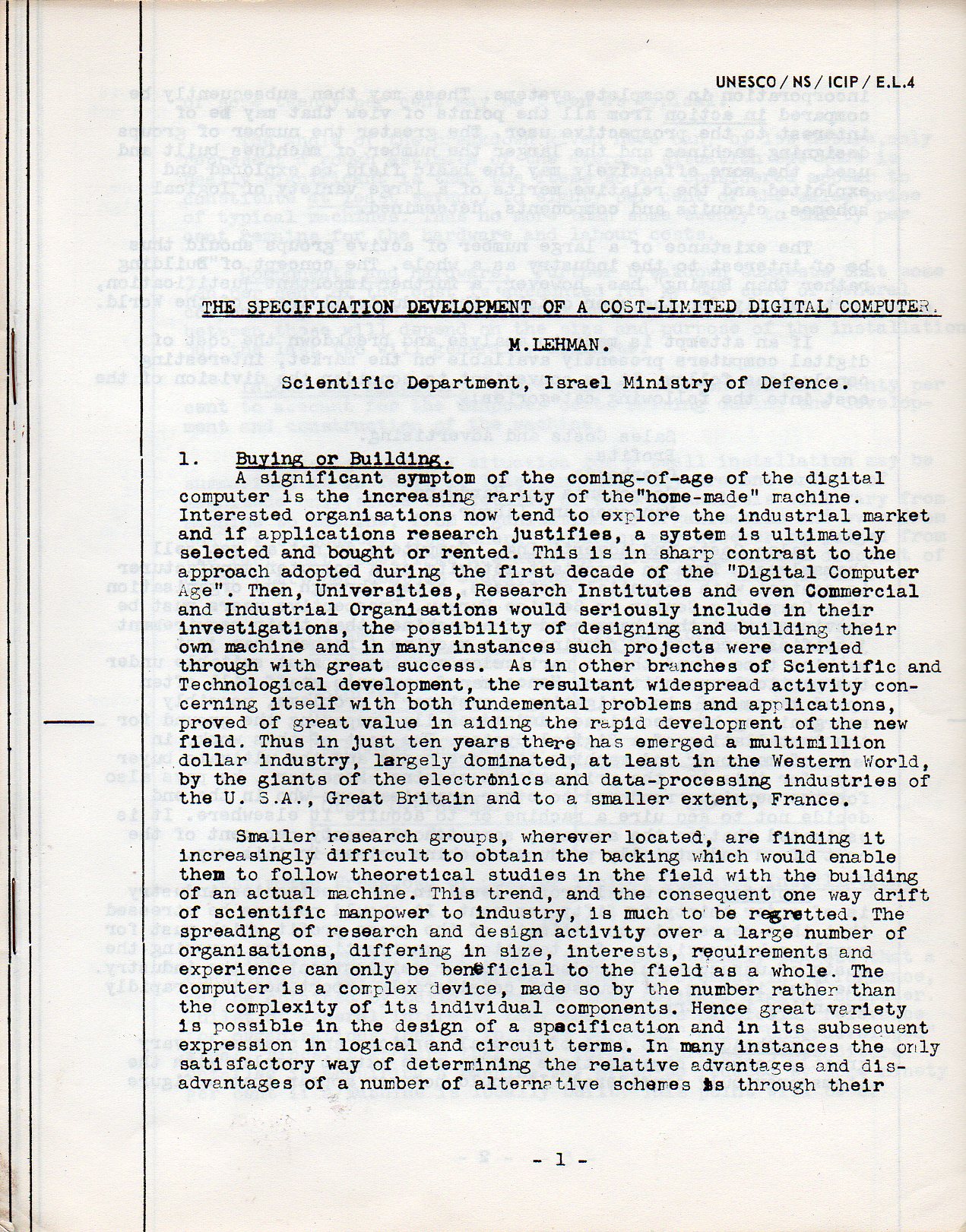
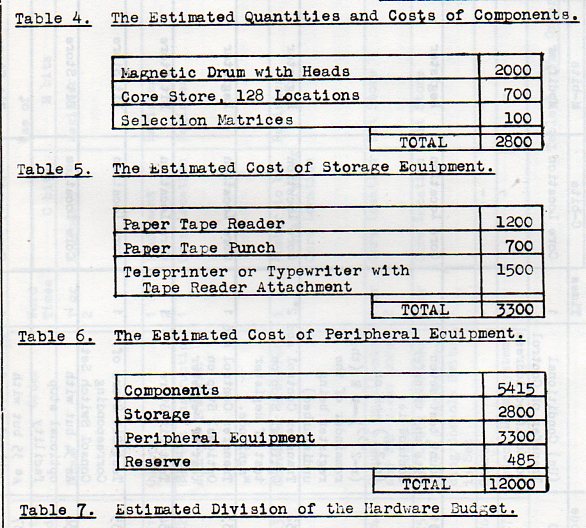
    It seems to me that this short 1959 paper is at the upper end of a beginning concern–costing -out the price of a digital computer for second-tier interests.  “The Specification Development of a Cost-Limited Digital Computer” (by M. Lehman of the Israeli Ministry of Defense, and available here for purchase) was written for those businesses and schools with a definite low-end budget, the upper range of which was set by Lehman at $12,000 for “peripherals, hardware and programming  (or about $125,000 in 2010 dollars, sort of1). This figure was also exclusive of maintenance outside of the cost (at 15-20% of the construction costs overall) of designing and building the machine.

    This was some new thinking on providing lower-cost digital computers to a new market:  “in just ten years there has emerged a multimillion dollar industry largely dominated….by the giants of the electronics and data-processing industries…”.  Lehman was saying that there was a new opportunity for business to supply computers to “smaller research groups” who were “finding it increasingly difficult to obtain the backing which would enable them…to build an actual machine”.  There were other ways of doing it, and Lehman laid out the basic understanding of that procedure.  

    Lehman’s leading quote for this post was accurate–computers needed to be “sold”, as in salesmen and businesses actively engaged in contacting clients who would (“might”) benefit from having computeriaed part of their business. The computer manufacturer’s “staff will often spend many months investigating customer’s problems, possibly reorganizing his techniques and generally preparing teh ground for the installation of a Digital System…”

      Computer--lehman224

    (The figures in the right column are indeed dollars.)

    Lehman was doing some groundbreaking work here at the end of the ’50’s, still far ahead of the time–and probably a full generation–where computers didn’t necessarily have to be shown as being ‘needed” let alone
    “necessary”.  The computer would be “selling itself” on the low-end of the market soon enough, but really not until the Reagan years when it was beyond question that the computer could be used by virtually any person or business–at affordable rates.  

    Notes

    1.  Sort of, indeed.  Straight CPI translation would put this figure at about $125,000, but the other cost of things in 1959 compared to 2010 is a different structure.  Sure, it might cost out to 125k, but that $12k in  1959 could’ve been traded for a decent working-class house in a big city; you couldn’t trade that $125k for the same thing today, no way, no how.  


  • A Do-It-Yourself Paper Digital Computer, 1959.

    JF Ptak Science Books    Post 1210

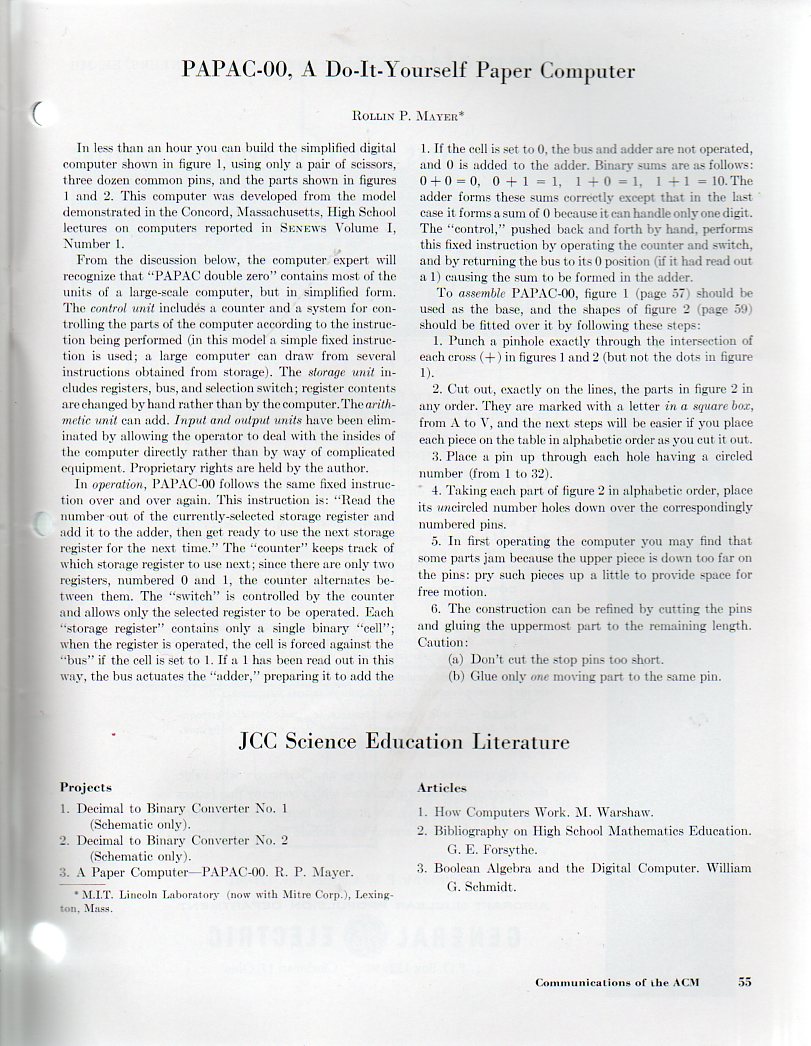
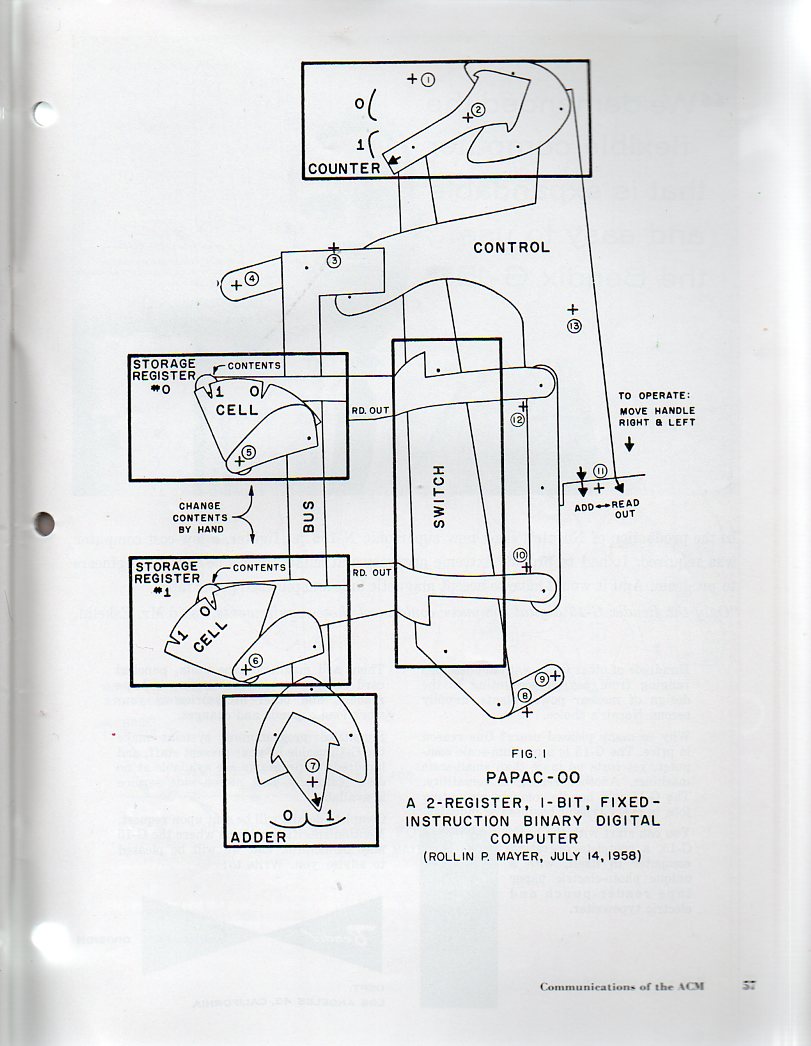
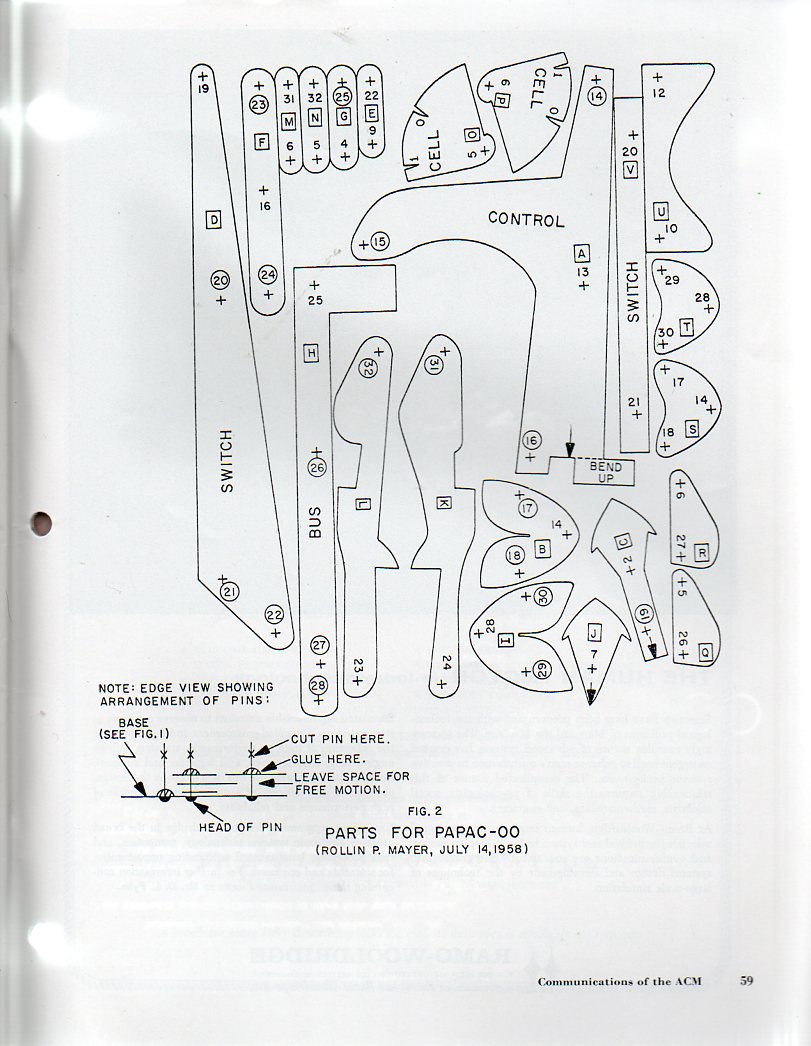
    Computer, paper832 This wonderful cut-away and paste-up template for a digital computer comes to us from the Communications of the Association for Computing Machinery, volume 2, issue 9 for September 1959.  The PAPAC-00 is a “2-register, 1-bit, fixed-instruction binary digital computer” and was submitted to the journal by Rollin P. Mayer (of the MIT Lincoln Lab).  There’s a hunk of me that wants to make this thing really big–cut out the individual pieces and then crash them out to 50″ widths, pasted on found bits of cardboard packing from the neighborhood frame shop, and then piece the thing together as the world’s largest pre-1960 1-bit paper computer.  Or maybe not.  In any event I thought to share this with readers here who might actually print out these templates and try to construct the thing themselves–warning: you’ll need t be able to cut pins in order to make the model work properly. Computer, paper833

    Mayer also wrote an interesting article on including children in the scope of the computer industry…in 1956–something I find to be a very early piece of thinking on Little Humans and Big Computing.  His abstract identifies the three main points of his paper: “(1) That the digital computing field needs, and will continue to need, not only more people who are capable of designing and programming digital computers, but more people who understand the basic limitations and potential uses of digital computers; (2) that the computer industry should take an active interest in providing a basic computer training to the largest number of people, in addition to more extensive training to those who show an interest in designing and programming computers; and (3) that the typical 12-year-old youngster has the interest, skill and basic knowledge necessary to build and understand simple working models of practically anything”. –“A proposal for training youngsters in digital computing techniques” in Proceeding ACM ’56 Proceedings of the 1956 11th Annual Meeting.

    Lastly I should also mention that in this same monthly issue (which ranged all of 52 pages) was an article by Julien Green, “Remarks on ALGOL and Symbol Manipulation”, a three-page paper that comes from the near-dawn of the ALGOL (short for ALGOrithmic Language). (It can be argued that the beginnings of ALGOL were about 1955, but for the sake of simplicity here I’ll note that the first committee appointed to study the matter for the ACM was in September, 1957, and the first group to formalize it met at the ETH Zurich in 1958, producing the language’s first version, known as ALGOL 58.  Julien Green was a member of the 13-person panel that created the ALGOL 60that met in Paris in January 1960.   And so the Green paper did appear within the first few years of institutional study in America, and it was written by one of the six American members of the ALGOL 60 team.)

    Computer, paper834


  • The Most Important Menu in Computing History? Johnny von Neumann, Herman Melville the NORC & the MOBIDIC

    JF Ptak Science Books  Post 1202

    “There is no mystery about these machines[computers]. The mystery is how the human brain has been able to develop them. These devices are merely small tools which men have devised to help them do a better job.“–Thomas J. Watson, chairman of the board of IBM, 1954
    Here is something that one doesn’t get to say very often:  this is perhaps the most important menu in the history of computing1. And if there’s another menu out there of the same or greater significance, then I offer that this is perhaps the most important menu tassle in the history of computation–that seems safer.

    In the history of odd bits of historic computeriana ephemera, this tassle joins the ranks of other one-percenters, like this:  the world’s first portable computer had a gun rack.  This was hardly a laptop though it was portable, and very well lived up to its Herman Melville-inspired acronym:  MOBIDIC.

    The Mobile Digital Computer was intended to be a transistorized van-mounted computer used to store and route data as part of the U.S. Army’s Fieldata system.  The machine was indeed built and deployed by 1959–as were the MOBIDIC A,B,C,D,E and 7a by the early 1960’s–and it was a successful component, even though the overall network was not successful.  Fieldata was supposed to integrate all manner of information and distribute it to battlefield recipients. My friend (Dr.)  Carl Hammer (1914-1904), who I knew from being in the neighborhood in Georgetown, was a delightful man who had long and significant history in the development of the modern computer.  He told me one afternoon–stopping in to visit on his constitutional–in his sly and amusing way about working on the MOBIDIC while he was at Sylvania. (He had just finished heading up Remington Rand’s UNIVAC European Division before going to Sylvania.) Anyway he started his story about the MOBIDIC by telling me that it was the world’s first portable computer (sitting in a 42-foot-long semitrailer) and that it had gun racks.  The reason for the gun racks was simple–if something was made by the U.S. Army, and it had wheels, then it had to have a gun rack.  Case closed.

    Norc--von n groupNow let’s get back to the NORC.

    [This item is available for purchase at our blog bookstore.]

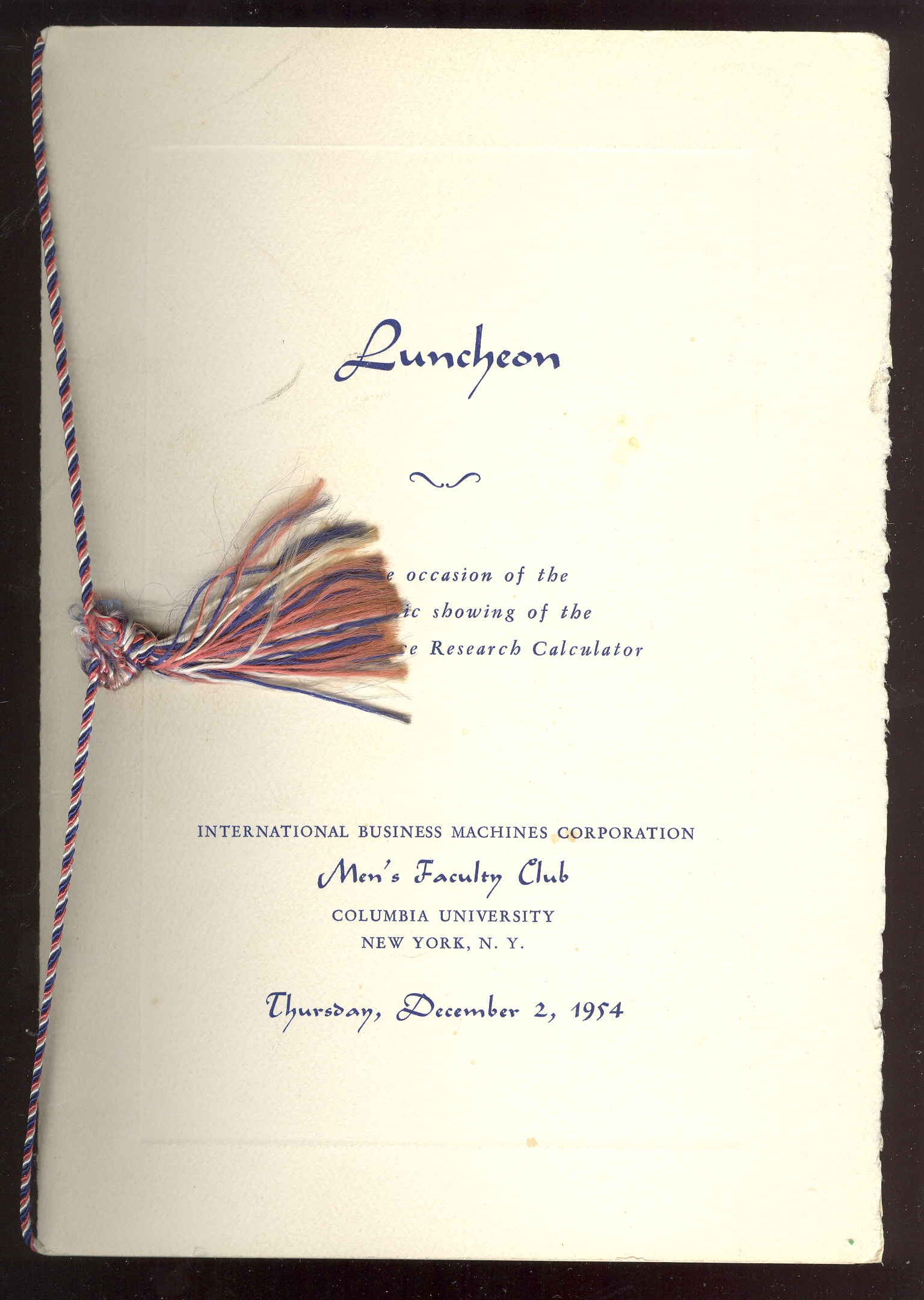
    This is the luncheon menu for the dedication of the NORC “Calculator” (the Naval Ordnance Research Calculator) a computer which was constructed principally with IBM parts and built at the Watson Scientific Computing Laboratory at Columbia.  The NORC was the world’s first supercomputer, and the most powerful computer on the planet for about ten years (from 1954 to 1963, until it was surpassed by Seymour Cray’s CDC 6600 in 1964). 

    The NORC was an astonishing accomplishment, difficult to summarize simply, really, though a very good example is that provided by Dr. Paul Herget, the director of the Cincinnati Observatory.  Dr. Herget used the NORC in 1956 to make precise calculations of the earths orbit for the 1920-2000 period.  Dr. Herget said: “We used nine hours of running time and completed more computations than had ever before been done at one time in the history of astronomy.’”

    Outside of celebrating the accomplishment of the NORC, the luncheon was also  important for the remarks of the principal speaker, John von Neumann.  Von Neumann of course was perhaps the most expansive mind of the century–a thinker of phenomenal proportions and the father of the modern computer.  His brain was impossibly big.  Impossible. 

    During the luncheon von Neumann made prescient and extraordinarily wide remarks on the future utility of the computer.  Some of the highlights (from the entire address, included below):

    –it is now “practical and feasible” to forecast, with the NORC, the weather for an entire hemisphere thirty or sixty days ahead

    –calculation of the tidal motions of all the oceans, the marginal movements near the continents as well as the main motions of the oceans

    –the hydrodynamics of the earth’s fluid core

    –“In the statistical field, dealing with matters which are not wholly mechanical, such as troop operations and logistic operations which involve purely accidental factors like the prevailing weather during the operation, command decisions which have not yet been officially made can be stipulated and various solutions for various alternatives calculated. This has been done before on a minor scale but it takes too long to do on a large scale. “In this field the importance of NORC is enormous…”

    –in the first four hours of operations the NORC  performed more work than any calculator of ten years ago has performed in its entire lifetime. He termed this performance “completely fantastic; I doubt if it has ever been done before.”
    Norc--von n group menu

    The last section of von Neumann’s comments that were made at the dinner:

    “The last thing, which is very important, is said in fewer words, but I think that it is none the less important. And it is this: In planning new computing machines, in fact, in planning anything new, in trying to enlarge the domain of parameters with which one can work, it is of course customary and very proper that one should consider what the demand is, what the price is, whether it will be more profitable to do it in a bold way than in a cautious way, and so on. This type of consideration is necessary — the world would very quickly go to pieces if these rules were not observed in 99 cases out of a hundred.

    “It is terribly important that there should however be one piece in a hundred where it is done differently.

    “And that one uses the definition which Dr. Haven (?) pointed out 20 minutes ago, namely to occasionally do what the U. S. Navy did in this case and what IBM accepted in this case: to write a specification essentially to build the most powerful machine that is possible in this day with the present state of the art. I just hope that this will be repeated very soon and will never be forgotten.” Source.  

    It may be the last statement that is the most important–pressing those of the present and future to perform.

    Notes:

    1.  The importance of this menu was described to me in a lovely and painterly fashion for the first time by P.J. Mode.


  • Footnotes in the Future–Swift, Lull, Borges and the End of Writing

    JF Ptak Science Books   Post 1155

    “The most ignorant person at a reasonable charge, and with little bodily labor, may write books in philosophy, poetry, law, mathematics, and theology, without the least assistance from genius or study.”   Jonathan Swift, in Gulliver’s Travels

    “Hell is the kingdom of the animal that swallows up the memory of all things… Between life and death there is no destiny except memory. Memory weaves the destiny of the world..”  Carlos Fuentes, Terra Nostra

    “A people without history/ is not redeemed from time, for history is a pattern of timeless moments” — T.S. Eliot, Four Quartets.

    The future history of writing–it will tell us–was already written before it was written.   In the future, when everything that can be written has been written and everything spoken has already been spoken, perhaps the first footnote in the history of already-done things will be to Jonathan Swift.  The experience belongs to us through Lemuel Gulliver1, who after surviving two trips (one to Lilliput in which Gulliver is twelve times the size of

    Written468

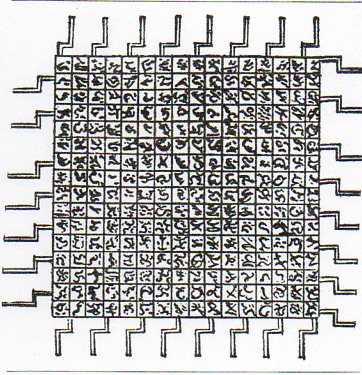
    everything else, and the second to Brobdingnag where he is one-twelfth the size of everything) comes to a third (of four2) in the land of Laputa.  It is here where he encounters a conversation machine that, when cranked, produces anything and everything, the known and unknown, the original and the copied, and have the thought and spoken
    word belong to the manipulator of the machine.  Everything that can be said is in that box, waiting to come.  The 20′ square was occupied by cubes with words on their sides, with 40 cranks and 40 handles and 40 operators to manipulate the mechanical vocabulary and associated scribes to record anything that made sense, and would be the springboard of “knowledge”operating without a manual or an intelligent primum mobile. (The image of the machine–which bears some resemblance to an integrated chip–appears in the third edition of Swift’s book, and as you can see is not a well-drawn thing, missing a row and a column and a crank here and there. A fuller description is found below.)

    Writtenc machine470

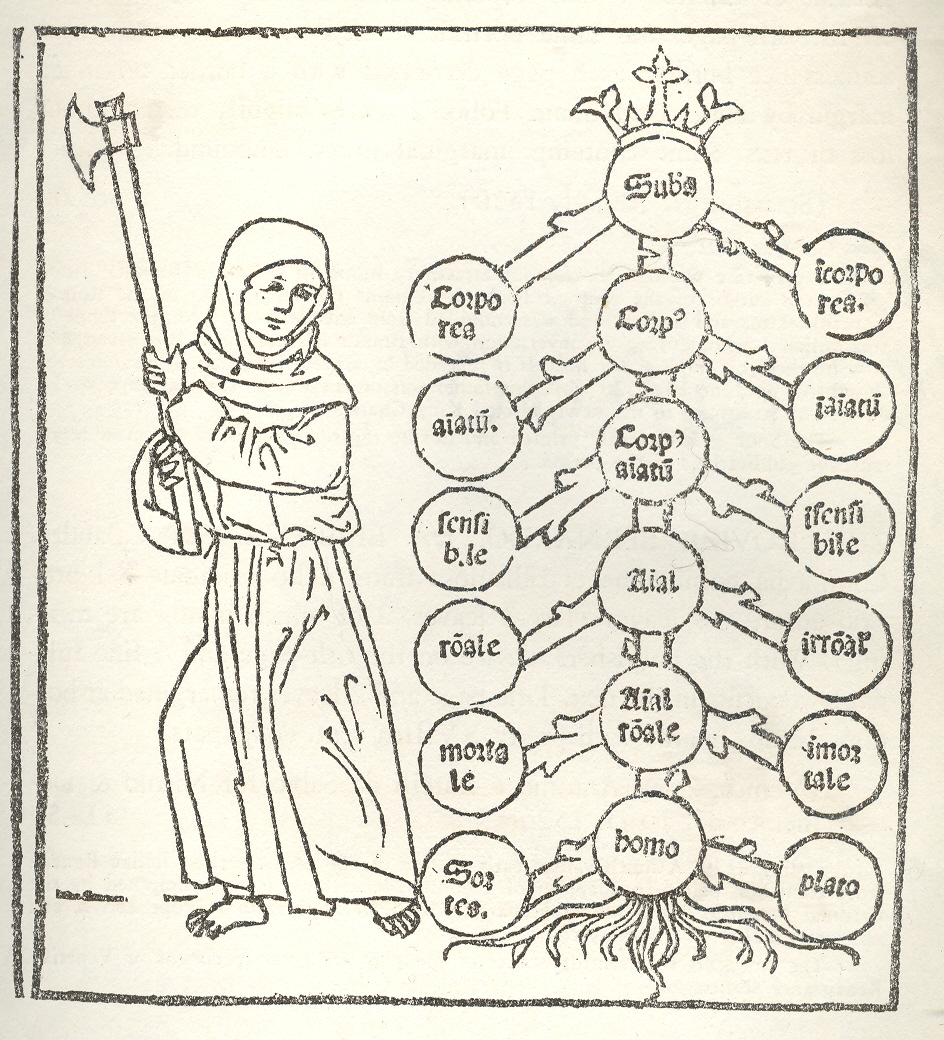
    The idea of a universal knowledge or an expanding, forever-library is very old, particularly if you expand the concept a bit to include Aristotle and the Tree of Porphyry3.  While not exactly a generator in the sense of Jorge Borges’ Library of Babel or the Swiftian machine, the ancients did 1--logic treeproduce very interesting, elegant, beautiful ways of story information and ordering information.  The Tree of Porphyry is far more concise–an abbreviation-compared to the infinitely expanding hexagonal rooms filed with books and attendant librarians in the Borges’ universe.  Or the Ars Magna/Thinking Machine of the 13th century Ramon Lull (also known as Ramon, Raimundo and Raymond, Raimundus and Raymundus Lull, Lully and Lullus and Lulio), the ultimate organizer of how sentences can be made and knowledge produced/uncovered (particularly if you want to please the logic of the church and the Creator), and which was almost certainly known to Swift (and which was also written about, described and worried-over by Borges4).  There are many other early figures in this category to be sure (Lewis Carroll, William Jevons, and even in a way Mr. Venn, not to mention Leibniz and his calculator,  and the changes in scientific method and (English/Dutch) mathematical concentration on applied mathematics of the 17th century that made thinking about the industrial revolution possible)), but that would be left to (at least) a longer post.  (The Lull wheel, below.)
                               

    How long will it take to digitize everything that has ever been written, or recorded, or composed? Several generations? Ten?  It may well come to pass in shorter time than we think; and when you compare this control of recorded human history to the centuries that will follow in developing “computers”, how can we possibly know what will become of all of it?  In the coming centuries and their attack on intelligence, when in the future the brain is a harvest of the computer, perhaps intelligence finally submits, and everything that can be done has been done, the progress of humanity snubbed to a stub. Or expanded exponentially.  It is such a tough call to make…

    Notes:

    1.  Jonathan Swift, Travels into Several Remote Nations of the World, in Four Parts. By Lemuel Gulliver, First a Surgeon, and then a Captain of several Ships.  1726.

    2. The third voyage was Part III. A Voyage to Laputa, Balnibarbi, Luggnagg, Glubbdubdrib, and Japan. The fourth finds humans as pets/inferiors in the island of the Houyhnhnms, a land of intelligent horses.

    3. The “tree” was a diagrammatic creation of a 3rd century Syrian mathematician/logician/philosopher named Porphyry who– much taken with Aristotle (and with the Categories in particular)– developed a systematic approach to the organization of thought in diagrammatic form.

    4. Borges J. L. (1999) ‘Ramon Lull’s thinking Machine’ in The total library: non-fiction 1922-1986 (Edited by) Weinberger, E., trans. Allen, E. Levine, S. J., and Weinberger, E. London, Penguin, on pp 155-160.

    It is interesting to note that Lull, who gave up everything to follow his calling into the church (and who was antagonized by the belief that his very act of missing his left-behind life to be a sin against god’s choice of him to follow his “career path”) was demonized by the church soon after his death, his works prohibited reading for hundreds of years.  He was resurrected in 1958 though on a path towards sainthood, a doctor of the church.  

    A description of the Swift machine:


  • A Note on Poe, Babbage and Thinking Machines, 1836

    JF Ptak Science Books LLC  Post 838  Blog Bookstore

    This is part of a longer piece I’m doing on Man in the Machine—Early Days of  Man-Machine Singularity

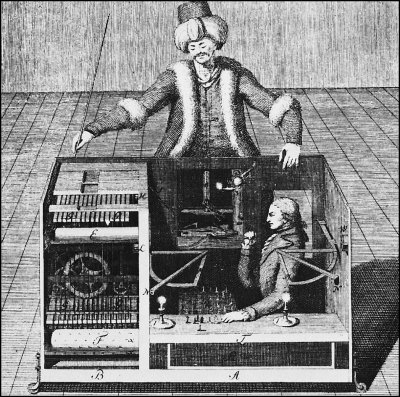
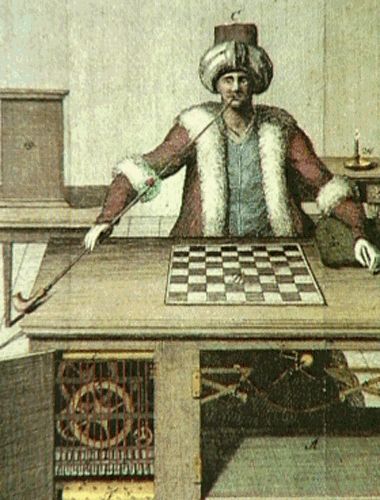
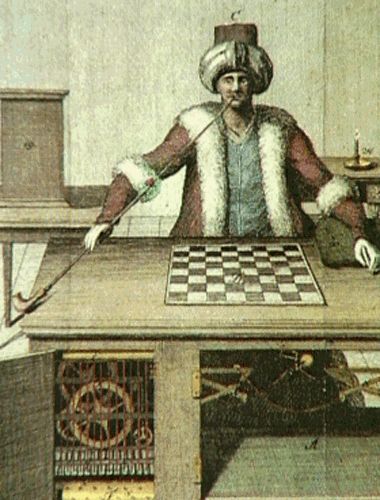
    Continuing from yesterday on Poe’s untitled books in “The Raven”, and making my way backwards through his Collected Works (from his criticism in volume XI to his short essays in volume X), I found an extraordinary piece on computers and a chess-playing machine.  Poe addresses a touring wonder called the Maelzel Chess-Playing Machine, which theoretically was a stand-alone device which thought and played the game, beating all-comers. (The version of the works that I own was published by Harper’s around the turn of the century—they didn’t bother to date their own work or give any references to the origins of Poe’s, which is awful  The essay1 though originally appeared as Edgar Allan Poe, “Maelzel’s Chess-Player” in the  Southern Literary Messenger, April 1836, 2:318-326.)  
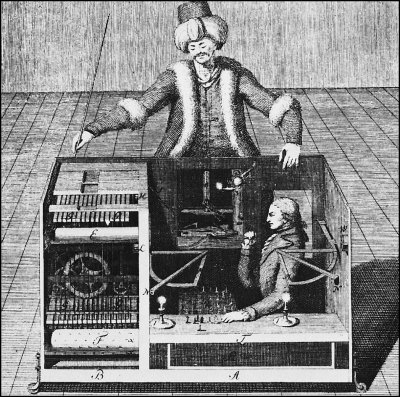
    Kempelen The machine was actually in its 65th year or so on tour, starting out life with Baron Kempelen, the original inventor of the device in 1769.   Maelzel was a shuckster who happened to be one of the machine’s final owners–touring with it in America in the 1830’s–before the thing burned to bits in 1854.

    But before he deals with the innards of the automaton, Poe writes on its history, and touches on some very deep understanding of the Babbage Difference Engine, “computers”, and thinking machines.  This is especially interesting because the Babbage machines hadn’t yet been given wide public conversation—that would come in 1843 with Babbage’s somewhat unlikely bulldog, Lady Ada Lovelace, who published an account of his work in Taylor’s Scientific Memoirs.  Poe’s work predates this by seven years, though
    Kempelen4 Lovelace’s commentary is far more robust, more mathematical, and longer and deeper2. Beautiful, even. (For example: “We may say most aptly that the Analytical Engine weaves algebraical patterns just as the Jacquard-loom weaves flowers and leaves.”)

     Poe states the difference between Babbage’s machine and a thinking machine.  First up, his paragraph on Babbage’s engine, rearranged for easier consumption:

    (1)   “Arithmetical or algebraical calculations are, from their very nature, fixed and determinate.

    (2)   Certain data being given, certain results necessarily and inevitably follow.

    (3)   These results have dependence upon nothing, and are influenced by nothing but the data originally given.

    (4)   And the question to be solved proceeds, or should proceed, to its final determination, by a succession of unerring steps liable to no change, and subject to no modification.”

     The thinking machine (chess-player) occurs later in the same paragraph:

    (1)   “But from the first move in the game of chess no especial second move follows of necessity. In the algebraical question, as it proceeds towards solution, the certainty of its operations remains altogether unimpaired. The second step having been a consequence of the data, the third step is equally a consequence of the second, the fourth of the third, the fifth of the fourth, and so on, and not possibly otherwise, to the end.

    (2)   But in proportion to the progress made in a game of chess, is the uncertainty of each ensuing move. A few moves having been made, no step is certain.

    (3)   Different spectators of the game would advise different moves. All is then dependent upon the variable judgment of the players.

    (4)   Now even granting (what should not be granted) that the movements of the Automaton Chess-Player were in themselves determinate, they would be necessarily interrupted and disarranged by the indeterminate will of his antagonist.

    (5)   There is then no analogy whatever between the operations of the Chess-Player, and those of the calculating machine of Mr. Babbage…”

    [The full quote is below as well as the link for the entire piece.]

    This is an interesting and fundamental understanding of the differences between a calculating device and a computer capable of iterative deduction.  I think also that both he and Lady Lovelace thought of the Babbage machine in terms of an added, extra intelligence for the human brain.

    After dealing with the machine’s history, and after looking at other explanations on how the thing could work, Poe delivers his conclusion:  that the machine wasn’t a machine after all, and that it could not function in this way unless it was being guided by a human inside the machine, which in fact, of course, it was.  Even after displaying the internal clockworks of the device, whoever it was exhibiting the machine would open and close the three doors covering the machine’s inner workings would do so in such a way that a small person could scoot back and forth to avoid detection, all of the exhibition being done at a safe distance  After that, the confederate would follow the game on his own board after hearing the moves announced by the showman, and then move the arm of the automaton via levers and such to produce his move, the taking of pieces done by Maelzel. (How this went undetected for so long is a sacred mystery.  It would seem as though someone at some point would’ve seen a faint light of a candle coming form inside the box, or smoke, or something.) The machine was originally designed for a brilliant Polish cavalryman who lost both legs in combat and was not above this deception.  Poe’s unraveling of the story and display of reasoning and getting to this conclusion is a pretty powerful display.

    It is interesting to note here that, without going all-academic about it, it seems to me that Babbage’s work on the computer passed without mention in the experiences of the earliest computer pioneers of the 1930’s-1950’s.  At least I don’t think I’ve ever seen mention of Babbage in any way, at least through the construction of UNIVAC II.  And so we have an instance of someone being recognized as the founding father of something without actually exerting any influence on anyone else working in that that field’s early future.  This is not the case with another person who actually did have an influence on those who followed him but has never received full public recognition for his efforts—that would be Vannevar Bush and his MEMEX as the precursor to the internet.  I’ve never looked for Poe’s name in conjunction with modern computing history (outside of cryptology), though I have a sneaking suspicion that if Babbage wasn’t there then neither would Poe.

    NOTES

    1. The paragraph in its entirety:

    But if these machines were ingenious, what shall we think of the calculating machine of Mr. Babbage? What shall we think of an engine of wood and metal which can not only compute astronomical and navigation tables to any given extent, but render the exactitude of its operations mathematically certain through its power of correcting its possible errors? What shall we think of a machine which can not only accomplish all this, but actually print off its elaborate results, when obtained, without the slightest intervention of the intellect of man? It will, perhaps, be said, in reply, that a machine such as we have described is altogether above comparison with the Chess-Player of Maelzel. By no means — it is altogether beneath it — that is to say provided we assume (what should never for a moment be assumed) that the Chess-Player is a pure machine, and performs its operations without any immediate human agency. Arithmetical or algebraical calculations are, from their very nature, fixed and determinate. Certain data being given, certain results necessarily and inevitably follow. These results have dependence upon nothing, and are influenced by nothing but the data originally given. And the question to be solved proceeds, or should proceed, to its final determination, by a succession of unerring steps liable to no change, and subject to no modification. This being the case, we can without difficulty conceive the possibility of so arranging a piece of mechanism, that upon starting it in accordance with the data of the question to be solved, it should continue its movements regularly, progressively, and undeviatingly towards the required solution, since these movements, however complex, are never imagined to be otherwise than finite and determinate. But the case is widely different with the Chess-Player. With him there is no determinate progression. No one move in chess necessarily follows upon any one other. From no particular disposition of the men at one period of a game can we predicate their disposition at a different period. Let us place the first move in a game of chess, in juxtaposition with the data of an algebraical question, and their great difference will be immediately perceived. From the latter — from the data — the second step of the question, dependent thereupon, inevitably follows. It is modeled by the data. It must be thus and not otherwise. But from the first move in the game of chess no especial second move follows of necessity. In the algebraical question, as it proceeds towards solution, the certainty of its operations remains altogether unimpaired. The second step having been a consequence of the data, the third step is equally a consequence of the second, the fourth of the third, the fifth of the fourth, and so on, and not possibly otherwise, to the end. But in proportion to the progress made in a game of chess, is the uncertainty of each ensuing move. A few moves having been made, no step is certain. Different spectators of the game would advise different moves. All is then dependent upon the variable judgment of the players. Now even granting (what should not be granted) that the movements of the Automaton Chess-Player were in themselves determinate, they would be necessarily interrupted and disarranged by the indeterminate will of his antagonist. There is then no analogy whatever between the operations of the Chess-Player, and those of the calculating machine of Mr. Babbage, and if we choose to call the former a pure machine we must be prepared to admit that it is, beyond all comparison, the most wonderful of the inventions of mankind. Its original projector, however, Baron Kempelen, had no scruple in declaring it to be a “very ordinary piece of mechanism — a bagatelle whose effects appeared so marvellous only from the boldness of the conception, and the fortunate choice of the methods adopted for promoting the illusion.” But it is needless to dwell upon this point. It is quite certain that the operations of the Automaton are regulated by mind, and by nothing else. Indeed this matter is susceptible of a mathematical demonstration, a priori. The only question then is of the manner in which human agency is brought to bear. Before entering upon this subject it would be as well to give a brief history and description of the Chess-Player for the benefit of such of our readers as may never have had an opportunity of witnessing Mr. Maelzel’s exhibition

     –The Maelzel essay:

    –And here as well. 

    2) Ada Lovelace writing on the computer “program” from her extensive “Notes” section in her translation of Menabrea’s work on Babbage, appearing in Scientific Memoirs, Selections from The Transactions of Foreign Academies and Learned Societies and from Foreign Journals, edited by Richard Taylor, F.S.A.,Vol III London: 1843, Article XXIX. “Sketch of the Analytical Engine invented by Charles Babbage Esq.”

    “The distinctive characteristic of the Analytical Engine, and that which has rendered it possible to endow mechanism with such extensive faculties as bid fair to make this engine the executive right-hand of abstract algebra, is the introduction into it of the principle which Jacquard devised for regulating, by means of punched cards, the most complicated patterns in the fabrication of brocaded stuffs. It is in this that the distinction between the two engines lies. Nothing of the sort exists in the Difference Engine. We may say most aptly that the Analytical Engine weaves algebraical patterns just as the Jacquard-loom weaves flowers and leaves.”