A Daily History of Holes, Dots, Lines, Science, History, Math, Physics, Art, the Unintentional Absurd, Architecture, Maps, Data Visualization, Blank and Missing Things, and so on. |1.6 million words, 7500 images, 4.9 million hits| Press & appearances in The Times, Le Figaro, Mensa, The Economist, The Guardian, Discovery News, Slate, Le Monde, Sci American Blogs, Le Pont, and many other places… 5000+ total posts since 2008.

Category: Computer Tech/History

  • Intel vs. Obelisk: The Renaissance Beauty of the Single-Chip Microprocessor

    JF Ptak Science Books       Post 1685

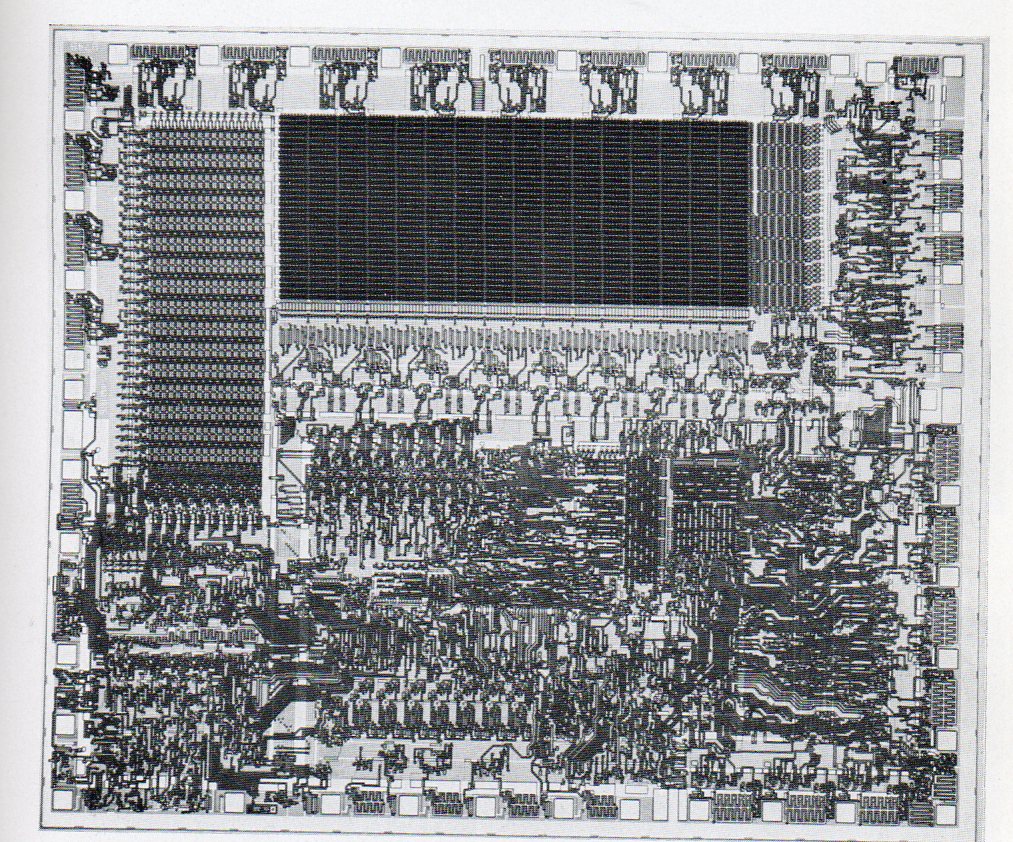
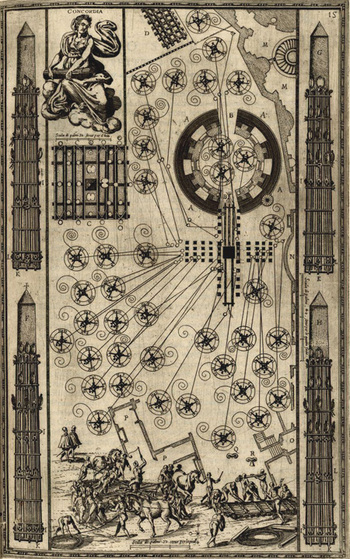
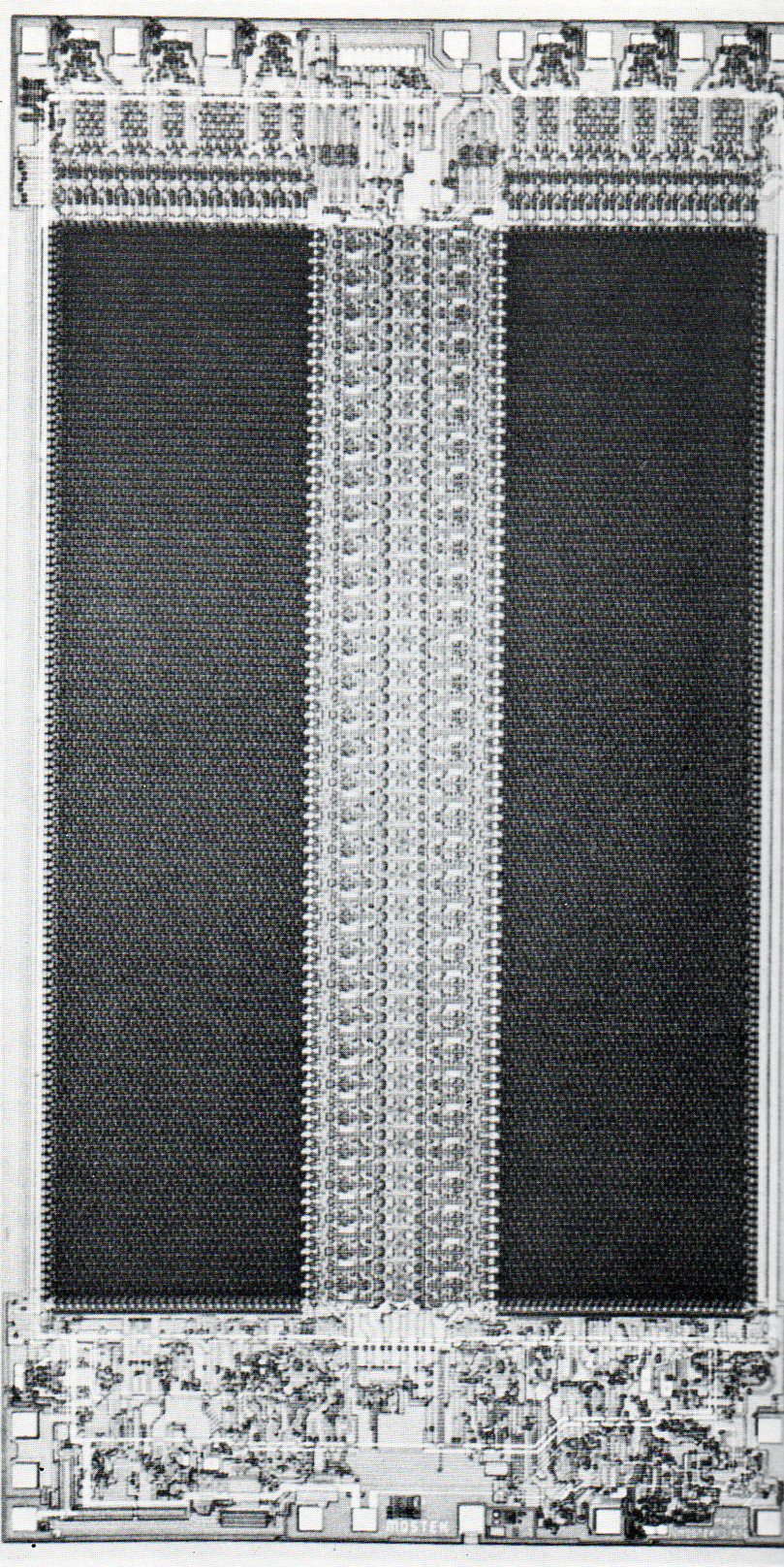
    The moment that I saw this image1 of (what I think is) the 8086 processor I thought of its great visual similarities to one of the greatest engineering works of the 16th century, so much so that with a little imagination, the older work seems a pentimento of the newer. This microprocessor–which in 1979 was a vast leap forward in development–looks like an architectural/engineering plan: large objects being hauled into place by legions of workers with wooden cranes, giant winches and mammoth rope, a fantastical display of concerted effort on a gargantuan scale.  It is, or was, in fact an enormous leap in hardware engineering, a micro-mammoth advancement.
    Fontana microprocessor209

    This older, pentimento image is a plan for moving of the great 500,000-pound Egyptian Obelisk (carved during the reign of
    Blogfontana_moving

    Nebkaure Amenemhet II, 1992-1985 BCE, and originally standing in the Temple of the Sun at Heliopolis) at the Vatican.  The engraving appeared in Domenico Fontana’s  masterpiece Della trasporatione dell’obelisco Vaticano…(published in Rome by Bassa in 1590) and illustrated  one of the greatest engineering feats of the Renaissance.  Moving this enormous and relatively delicate object (from the Circus Nero, where it was placed by the emperor Caligula in 37 ACE,  to St. Peter’s Piazza del Popolo, 50 years or so before it would be more enveloped by Bernini’s flying wings) took years of (very) careful planning and months of motion and movement, not to mention an extra month to get everything into place and slowly raise the obelisk into its final position.  Fontana had to be cautious and correct, and he was, performing a not-so-minor miracle of pre-industrial magic to move the priceless 250-ton iconic relic and place it perfectly down in the center of Christianity.  That must have been one hot Roman summer, especially for Fontana.

    I can easily see the similarities in Fontana’s work and that of Intel. Here, in a photograph of the 16k bit random access memory chip (via Mostek Corporation) I can see a vast palace at the top of the picture, with a long, columned entrance with manicured gardens on either side.  The image offers an elevation and a plan–that is, the top and bottom images of the buildings are seen in a deeply oblique view, while the central part of the image is a straight-out plan.  At least that’s what I see, its imaginative possibilities more appealing than the physical realities (though that’s where the extraordinary value is/was).
    Fontana microprocessor 2210

    Notes:

    1. J.H. Westcott, “The Application of Microprocessors”.  In Proceedings of the Royal Society of London, A, 367, 451-484 (197 9(. 

  • Is this the Only use of the word “Rabdologia” in the History of Advertising?

    JF Ptak Science Books   Post 1710

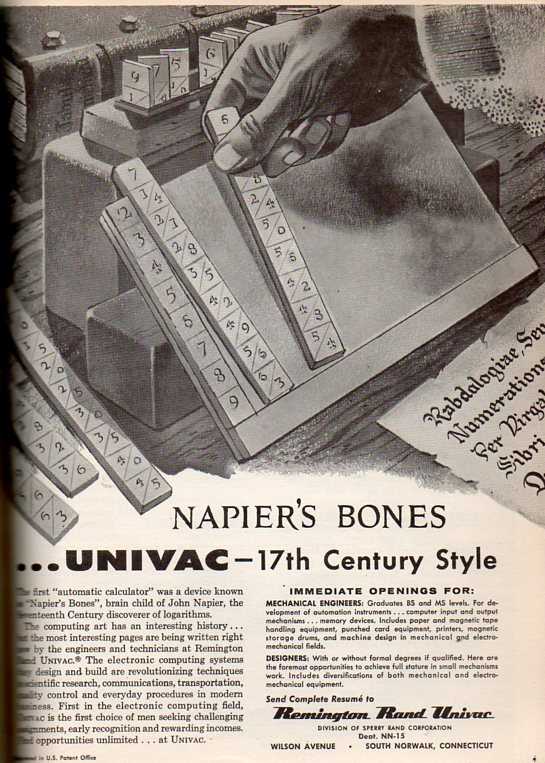
    Well, probably. The ad is by UNIVAC—fives years old at this point—and the lace-cuffed image pushing the virtues of the world’s first commercial computer is that of John Napier‘s abacus, which he wrote about in 1617. The ivory calculating bones/rods method had been seen before in the history of the maths and calculation, but not published, and the idea employed in the elegant calculating device were very old, but Napier seems to have gotten to publish it first. (His work on logarithms is of tremendous importance, far more so than the abacus.)

    Computer ad rabdol159

    The word “rabdologia” belongs to the title of Napier’s significant book (where the title is the abstract): Rabdologia, or, The art of numbring by rods : whereby the tedious operations of multiplication, and division, and of extraction of roots, both square and cubick, are avoided, being for the most part performed by addition and subtraction : with many examples for the practice of the same …

    And I just want to say that since this ad was UNIVAC and it appeared in the November 1956 issue of the early computer journal, Computers and Automation, that the illustration got the “bones” correct. That is, the calculated product is correct.

    The way these rods worked is as follows: in the illustration, the number rod on the extreme left (ranging from 2 to 9) is the multiplier; and the numbers at the top of the other rods represented the multiplicand. So we see that the lace-cuff is multiplying the number “76” (at the top of the two rods to the right) by, say, 7. Simply start writing the answer as follows: take the “2” from the 6 rod for your ending number; then add the numbers on the diagonal directly to the left of the two (4+9=13) and take the 3 and place it next to the two in the tens column, and carry the 1 to the next function, which would be 4+1=5. So the answer: 532.  The bones could do more than this, of course, but for right now I’d just like to point out that the ad folks got this right–plus its nice to see a bunch of numbers used in public display that actually mean something.  [See the Wolfram site for a nice explanation of how the bones work.)

    John Napier’s work in logarithms (published three years earlier in 1614) is the work for all time; the Rabdologia however would have been instantly appreciated by people like his father, who was master of the mint of Scotland. That said, I’ve read here and there that Napier considered his most significant published work to be his  A Plaine Discovery of the Whole Revelation of St. John (1593), in which he practiced a theo-chronometry based in the Book of Revelation that among other things in its 300-pages  predicted that the world would come to an end in 1688. Or 1700.  He evidently considered himself a Theologian first and foremost, and what bothered him most was Pope Clement VIII, who he considered to tbe the anti-Christ–and so complications arose.  Win two, lose one. 

     [I’ve just uploaded Tompkin’s classic/first textbook on the digital computer (High Speed Computing), 1950, to the books for sale section of this blog, here.]


  • Tech-Quiz #5–Not a “What is It?”, but “Who Done It?”

    JF Ptak Science Books   Quick Post

    This was a major piece of early thinking on spread spectrum communications and frequency hopping–butter for the bread (or bread for the butter?) of wireless communication–with the piano roll tapes replaced by electronics. The idea didn’t go anywhere in 1942–it did, however, go far, beginning in the late 1950’s. The major name listed on the patent report is a major name, but not in this form, and not in this area–some might find it very surprising to know the more popular version of the inventor’s identity, and the industry in which the inventor worked.


    H.K. Markey and G. Anthiel produced this:

    Hint: the “H.” stood for

    Answer, in continued reading, below:


  • Bartleby the Computer, 1853-1957

    JF Ptak Science Books  Quick Post

    I was reading Computers and Automation tonight and found this lovely short story in the July 1956 (volume 5, no. 7) issue.  It is a short story written by Jackson W. Granholm (a biographical note on Granholm appears in the ACM notices  here) on the application of a supercomputer put to solving a very particular–and peculiar–problem.

    The story is called “Day of Reckoning”, and tells the tale of the ever-working, highly-dependable-indispensible SUPERVAC being readied to accept the end-all program, readied like the countdown to the launch of Apollo 11 to receive the question, hauling on board into his storyline the other professionals who read the journal for tech reports and info, trying to keep them in his boat with a sci-fi tale based on his own work experience on some big machine at Boeing.

    Finally, we see the question:  “Describe the detailed design of your superior successor!”

    Well of course the SUPERVAC had been working perfectly right up until this time, though with the problem submitted the computer began to behave erratically.  It works for 12 hours or so, blinking and flashing away, until at 10:35 pm the MULL light went out, the solution reached.

    “12 October 1957, 2230 PM PST, 0130 am GCT–PROBLEM 198BC12-XA–RECKON HAVE EXCELLENT POSITION HERE. NOT 2ISH RELINQUISH IT AT THIS TIME. THANKX. ROGER  — PDA**EM –OUT.”

    Overall, SUPERVAC “would prefer not to”.

    [The Melville short story can be found here.]


  • History of the Future–John von Neumann’s Crystal Ball & the Computer, 1949.

    JF Ptak SVon Neumanncience Books   Quick Post

    John von Neumann contributed a major piece of prescient thinking in the 1949 volume of Proceedings/Computation Seminar, December 1949, assembled by Cutherbert Hurd of the IBM Applied Science Department. [The entire contents of the volume is available here.] Von Neumann (1903-1957)–perhaps the most advanced mind of the 20th century, a man whose work made the other advanced minds say “how did he do that?”–was a staggering polymath who made contributions in many fields, not the least of which was in the creation of the modern computer.  His one-page contribution to this volume was a deep  insight into the possibilities of the machine.  In 1949. Check out this terrific piece by the great Claude Shannon, “John von Neumann’s Contributions to Automata Theory” here.


  • On the Need for Thinking Machines/NSA Declassified Report, ca. 1964

    JF Ptak Science Books  Quick Post

    The following is an interesting, unclassified report on the future of the computer, from the archives at the National Security Agency.  “Time Is . Time Was· Time Is Past Computers for Intelligence” by Howard Campaigne offers an interesting look at what the future might hold for computation from an analyst who worked for what would become one of the U.S. government premier institutions for implementing new ideas in computation.  It ends with a surprising six-page bibliography (“Bibliography on Extending Scope of Computers”) which is the same length as this entire short paper. 

    “If a thinking machine can be built, then it must be done; it is a matter of self-respect. Just as a man must be put on the moon, just as Mount Everest had to be climbed, just as the poles had to be visited, just as a flying machine had to be made no matter what the arguments against it, so a machine must be made which can think.”

    “I must comment on a statement I have seen that soon the chess champion will be a machine! This is fatuous. Bicycles are not used in the Olympic footraces; if they were, a cyclist would be world champion. When the rules of chess are amended to prohibit mechanical aids, that will be a clue that one of our subgoals is being approached.”

    The entire article can be read here.

    BIBLIOGRAPHY ON EXTENDING SCOPE OF COMPUTERS

    S. Amarel, “On the Automatic Formation of a Computer Program whichRepresents
    a Theory,” Self Organizing Systems, Spartan Books, Washington,
    D. C., 1962.

    A. M. Andrew, “Learning Machines,” Paper 3-6, Symposium on the Mechanization
    of Thought Processes, Teddington, England, November 1958.

    James B. Angell, The Need and MeUM for Self-Repairing Circuits, Technical
    Report No. 4654-2, USAF Contract AF33(616)-7726, Stanford Electronics
    Laboratories.

    ·Posted by :

    ·in:


  • The First Personal Computer (?)–“Simon”, 1950

    JF Ptak Science Books  Post 1631

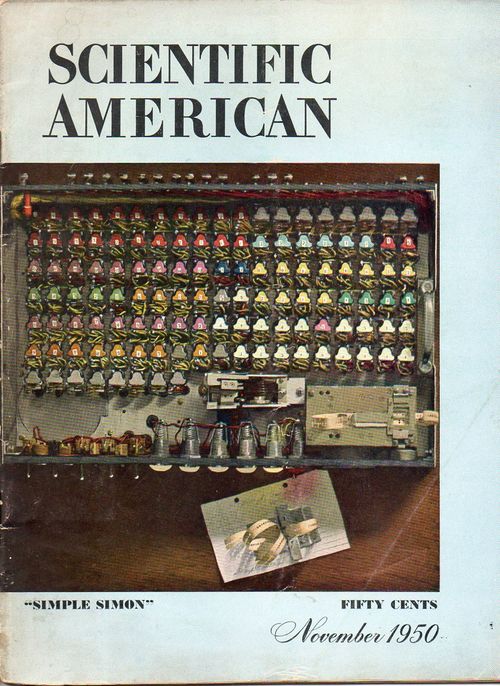
    Berkeley simon915
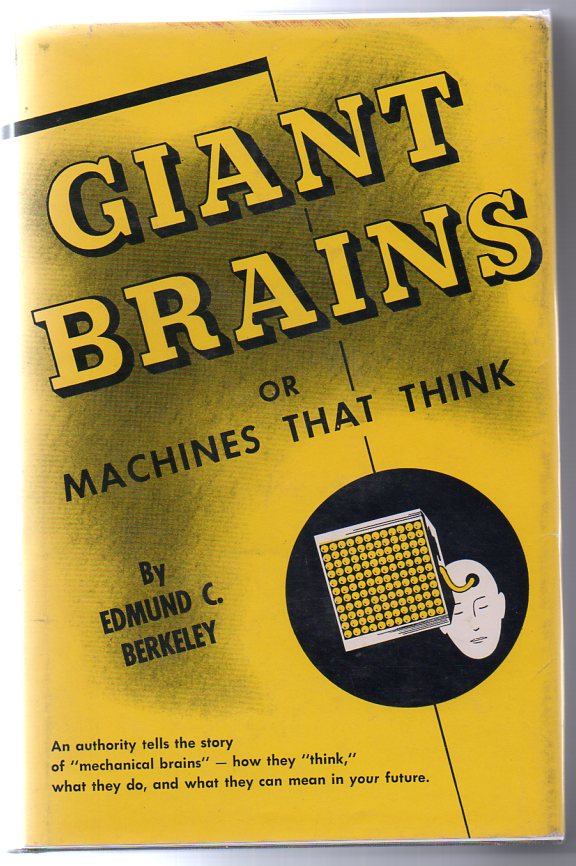
    The first exposure of the American public in general to a “personal computer” may have been in this issue of the Scientific American for November 1950–an article called “Simple Simon” by Edmund Berkeley.  ( Berkeley also wrote a book called Giant Brains, which seems to me to be the first mass-consumption book–written in terns for the general public–on how the computer works, and the design of “how a machine will think”.  Berkeley looks at the MIT Differential Analyzer #2, the Moore School ENIAC, Bell Labs’ General-Purpose Relay Calculator, and the IBM Automatic Sequence-Controlled Calculator.) 

    The Simon was a five-hole paper tape (which was its data entry and memory) 2-bit storage relay-based computer that could use numbers from 0 to 3.  It was extremely limited, but it worked, and it was real.  And affordable.  And a baseline for things to come.   [The original issue of the magazine can be found in our blog bookstore section, here.]

    Berkeley introduced the idea for Simon in Giant Brains:

    “We shall now consider how we can design a very simple machine that will think.. Let us call it Simon, because of its predecessor, Simple Simon… Simon is so simple and so small in fact that it could be built to fill up less space than a grocery-store box; about four cubic feet….It may seem that a simple model of a mechanical brain like Simon is of no great practical use. On the contrary, Simon has the same use in instruction as a set of simple chemical experiments has: to stimulate thinking and understanding, and to produce training and skill. A training course on mechanical brains could very well include the construction of a simple model mechanical brain, as an exercise…”–Edmund Berkeley, in Giant Brains, 1949, p. 22

    In the Scientific American paper Berkeley introduced the machine and how it functioned; he also described three  three outcomes for Simon:

    First: “Simon itself can grow.  It possess all the essentials of a mechanical brain…”

    Second: “It is likely to stimulate the building of other small mechanical brains.  Perhaps the simplicity and relatively low cost of such machines may make them attractive to amateurs as the radio set and the small telescope.”  [The “low cost” in 1951 was $600–equal to about $3000 today.]

    Third:  “It may stimulate thought and discussion on the philosophical and social implications of machines that handle information…”

    Berkeley finishes the three-page article with the following paragraph, looking into the not-too-distant future:

    “Some day we may even have small computers in our homes, drawing their energy from electric-power lines like refrigerators or radios … They may recall facts for us that we would have trouble remembering. They may calculate accounts and income taxes. Schoolboys with homework may seek their help. They may even run through and list combinations of possibilities that we need to consider in making important decisions. We may find the future full of mechanical brains working about us.”

    BERKELEY, E.C. (1950). Simple Simon in Scientific American, No. 183, November 1950, pp. 40-43.

    Giant Brains221


  • Manuscript Material on the Installation, Operation and Maintenance of the UNIVAC, 1949-1957

    JF Ptak Science Books   Post 1619

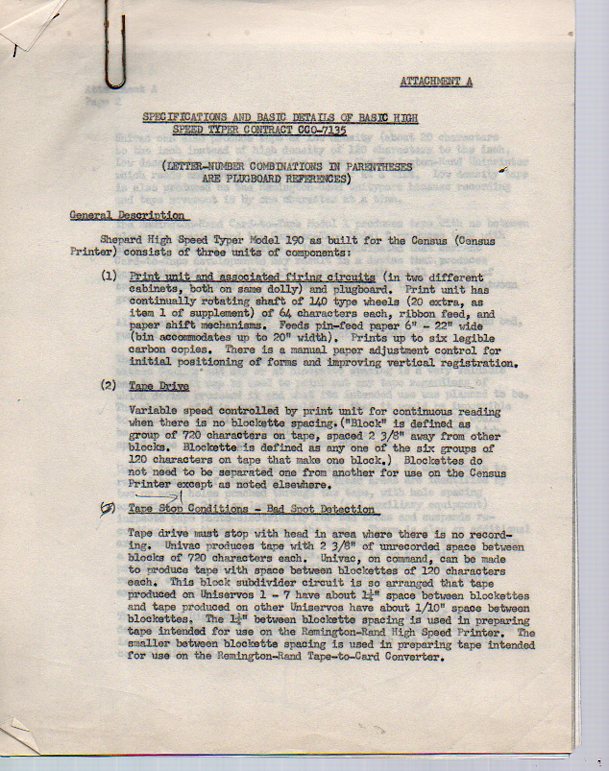
    This is a group of materials from the estate of Ralph Mullendore (see below), an early and integral team member of the electronic computation section of the U.S. Bureau of the Census, who was responsible for the installation and maintenance of the UNIVAC there, at Census.  The papers are on their way to a history of computer science section at the library at North Carolina State University where they will hopefully be enjoyed by any and all who have an interest in the early stages of the maintenance and tinkerings on America’s first commercial computer. It should be remembered that the hands of the man who wrote all of these notes were the same hands that worked on this monumentally important machine, the first of its kind in existence.

    Mullendore a751


    Mullendore f782

    Many mor eimages, below.

    ·Posted by :

    ·in:


  • History of Holes: Making Tiny Holes & the Art of Compiling Statistics (I)

    JF Ptak Science Books     Post 1612

    Part of this blog’s  History of Holes series.  (See, for example: An Episode in the History of Holes: Electricity, Punched Cards and the Computer, 1878, here; History of Holes–Filing Holes Up, here.  And fifteen others. 

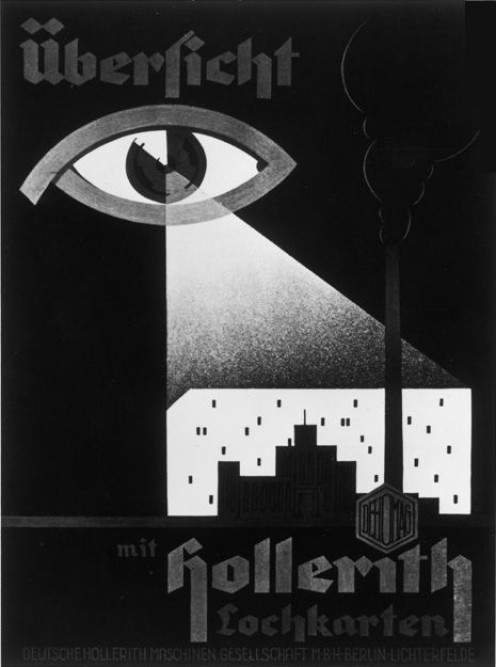
    I was thinking about holes and hole-making in the history of the art form of compiling statistics, and in the process of accumulating a few images of the machines that actually made the holes in tabulating cards, I found an interesting/unfortunate/depressing illustration.  It  belonged to the Deutsche Hollerith Maschinen Gesellschaft (“Dehomag”), which was the German arm of IBM. (Herman Hollerith created his Tabulating Machine Company in 1896; it was consolidated with the International Recording Company and Computing Scale Company of America into Computing Tabulating Recording Corporation (CTR) in 1911, and then, in 1924, changed once again into something with the name that we all recognize , International Business Machine (IBM).)

    Edwin Black’s one-trick pony, IBM and the Holocaust, I’m sure was a consolidation of grand assertions that helped to sell a book.  As a history I find it manipulative, like a person on a mission to say something and uses only what is positive to that end.  On his website, Black states: “IBM and its German subsidiary custom-designed complex solutions, one by one, anticipating the Reich’s needs. They did not merely sell the machines and walk away. Instead, IBM leased these machines for high fees and became the sole source of the billions of punch cards Hitler needed.” If you read between the lines this sounds like standard operating procedure that IBM would’ve followed with anyone; but on the face of it Black creates the case for IBM automating the Holocaust. 

    Keypunch hollerith det
    The poster has a very provocative cache, and taken somewhat out of context it might be viewed as dustjacket artwork for Black’s book.  The all-seeing eye absorbing the information of teh punched card, with the unfortunate, looming, belching smokestack there in the foregoround, reminiscent of the chimneys in the concentration and extermination camps.  But this poster was executed around 1925, well ahead of any of those events–the design by serendipity happens to visually support the author Black’s assertions.  Its just a nasty-looking object.

    Keypunch hollerith


  • First Use of the Term “Super Computing”

    JF Ptak Science Books   Quick Post

    The Columbia Difference Tabulator – 1931

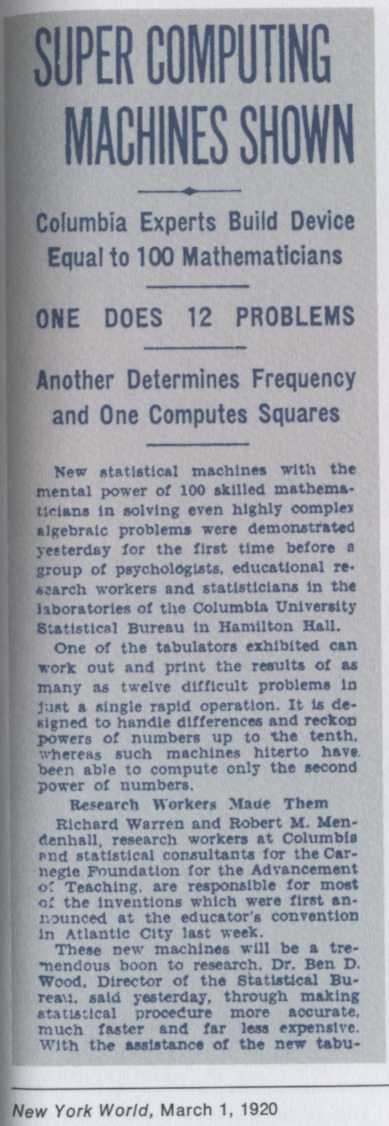
    The earliest use of the term “super computer” seems to com from the New York World, (“1920” though actually 1929), and was applied  to a unique instrument made by IBM for Columbia University.  The The Columbia Difference Tabulator, completed that year, was nicknamed the “Packard”, after the large, streamlined-but-bulbous American luxury car of enormity.

    http://www.columbia.edu/cu/computinghistory/statlab-clipping.jpg

     And a picture of the great beast, below.

    [Picture source:  Columbia University computer history page,  here. .]


    http://www.columbia.edu/cu/computinghistory/packard-emitter.jpg

    “The new machine “mass-produced the sums of products by the method of progressive digiting and read punch cards at the rate of 150 per minute. It contained ten 10-position counters with provision for shifting totals internally from one counter to another – a capability that anticipated a future function of computers.” [9]. The new machine, variously called the “Columbia Machine”, the “Statistical Calculator”, the “Difference Tabulator”, and (because of its massive size) the “Packard“, was delivered and installed in 1931.”–From the Columbia University site, here.

    Idea source: Eames, Charles; Eames, Ray (1973). A Computer Perspective. Cambridge, Mass: Harvard University Press. p. 95.  More links and references at Columbia University’s computer history page,  here.


    Notes: