A Daily History of Holes, Dots, Lines, Science, History, Math, Physics, Art, the Unintentional Absurd, Architecture, Maps, Data Visualization, Blank and Missing Things, and so on. |1.6 million words, 7500 images, 4.9 million hits| Press & appearances in The Times, Le Figaro, Mensa, The Economist, The Guardian, Discovery News, Slate, Le Monde, Sci American Blogs, Le Pont, and many other places… 5000+ total posts since 2008.

Category: Patents

  • Questionable Quidity: the Fire Escape Head Parachute, 1879

    JF Ptak Science Books   Quick Post

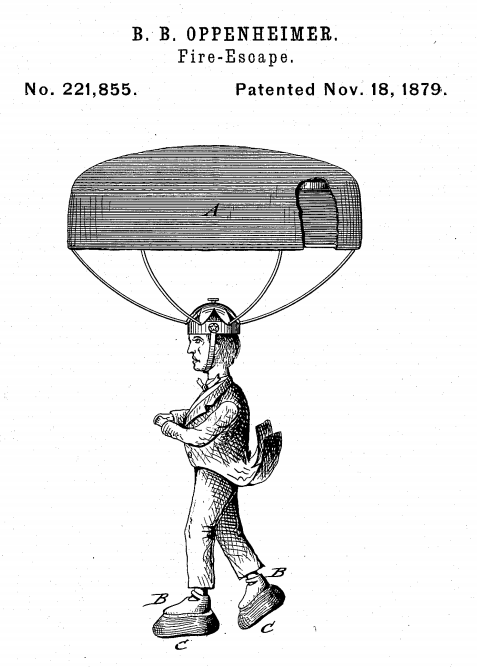
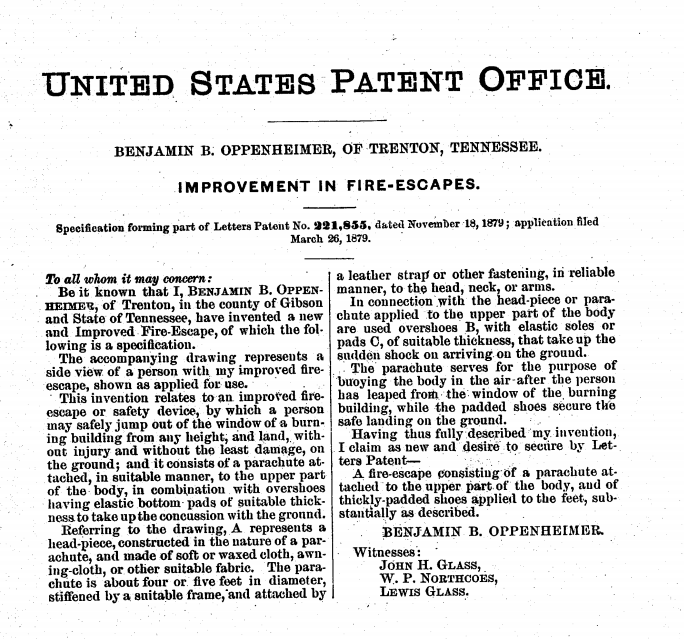
    When I first saw this image I thought, naturally, that it was an unreal real patent; it turns out that Mr. Oppenheimer was a real person and that this patent was a real patent. I doubt that someone would have their necks broken by this device when deployed thinking that it would just pop off–then again, if fastened very securely, it becomes a very cringeworthy thing to think about. The shoes don’t help much.  

    Patent parachute fire escpae _2_

    And the report:

    Patent parachute fires escape

    ·Posted by :

    ·in:

    — —

  • The Slim Ubiquity of Smiles in Patent Reports, 1850-1925

    JF Ptak Science Books   Post 2623

    “Better is the last smile, than the first laughter.”–J. Heywood Dialogue Prouerbes Eng. Tongue, 1550. 

    Young communist league detail


    I haven’t written very often on the word “smile” on this blog–less than ten times in 4000 posts, I think. (“Did Teeth Exist in the Renaissance?”, “The Mystery of the Sun’s Missing Smile”, “Is the Mona Lisa’s Smile Nothing?”, that sort of thing, all searchable in the Google search box.)  This came up this morning because I had an idea for morning coffee to check out “smile” in a patent search for 1850-1925 to see what sort of smile-somethings existed in the Patent Office records.  It turns out that even though “smile” appears in two dozen patents for this period, none of them are about the smile of smiling; rather they’re all anthropomorphized for varied and unrelated purposes–except that the thing it is they refer to looks like a “smile”. I thought I’d find something for an artificial smile, or smile-maker (whatever that would be), or something along those lines, but no.

    The differences in the patents in which the word “smile” was used is pretty impressive, and can almost approach a found-poetry status, but not quite–the word appears describing elements of patents for: chuck for bowspirits (1908), production of fertilizer (1918), window cleaner (1909), antifriction cage for roller-bearing rollers (1910), mechanism for a milking apparatus (1919), self-closing funnel (1913), life vest (1912), guide for a molding apparatus (1909), car-coupling for railroad cars (1876); bridle bit (1909); convertible freight car (1914), design for a horse shoe calk (1897), design for a stool (1885)…there are some others, but I think the point is made. Even though the word “smile” is used in many different ways to describe divergent pieces of machinery, they don’t really have anything in common from one patent to the next, save for the anthropormorphized shape of the object, which I find amusing. 

    The slightly odd thing that I have found in this adventure is that “smile” doesn’t seem to makes its way into English until 1550 (?), at least according to the OED, which sources the opening quote above from J. Heywood as the first appearance. Perhaps my post on “Did Teeth Exist in the Renaissance?” which is really about the smile in art shoud have asked that question more directly about the word “smile”…

    ·Posted by :

    ·in:

    — —

  • When the Catcher’s Mitt Was a Cage (1904)

    JF Ptak Science Books  Quick Post

    PAtent catcher cage detail


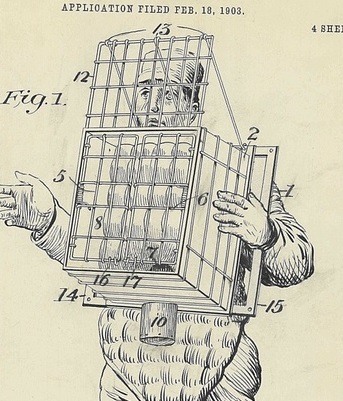
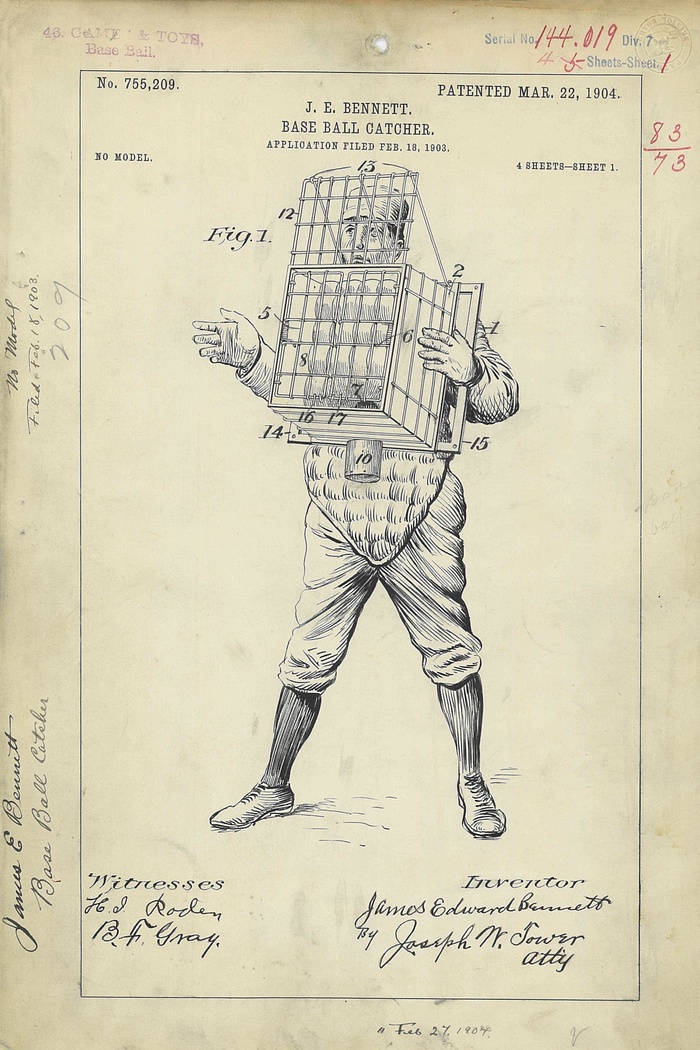
    In the history of baseball gloves–better still, in the history of the catcher’s mitt–there are few ideas that are as singular as the glove/mitt that isn’t a glove, or a mitt.  This was the patent report of the invention of J.E. Bennett in 1904, which proposed to replace the mitt with a cage.  The cage offered a receiving area easily double the size of a catcher’s mitt, with padding at the back of the cage to cushion the capture of the pitched ball, after which the ball would somehow be collected and deposited via that pipe.  I’m not sure what the catcher would do with pitched balls that were low, or high, but the cage certainly did not have any real versatility, particularly when comparing it to a real glove. It seems as though this idea didn’t go far, and that was a good thing. 

    http://www.theguardian.com/technology/gallery/2015/may/14/imagining-the-future-turn-of-the-century-us-patents-in-pictures

    Patent catcher cage


    ·Posted by :

    ·in:

    — —

  • The Eloquence of Baseball (Games), 1904

    JF Ptak Science Books  Quick Post

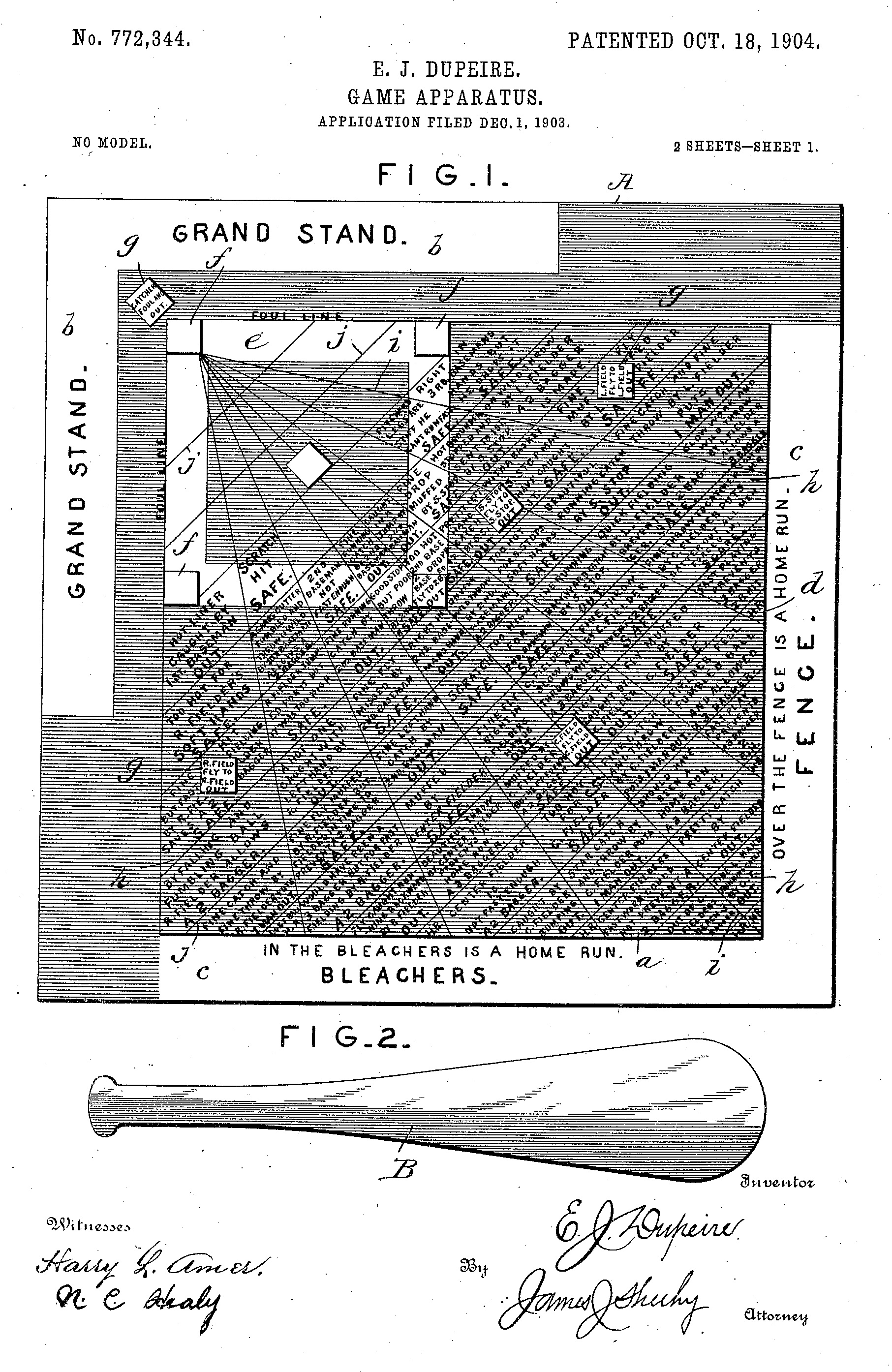
    Baseball season is either here or almost here, so picking around in old patents on baseball games in December is perfectly allowable.  This game (found at Google Patents) probably has more text on it than just about any game of any sort I’ve ever seen (and that may actually include Scrabble), and its lazy-staccato descriptions of the “play” are really quite lovely for a board game1. For example: 

    • “too hot for the right fielder’s hands”
    • “a hot one caught” 
    • “2nd baseman not fast enough”
    • “fine running catch” and “beautiful running catch” and “pretty left hand catch”
    • “good stop, poor throw”
    • “would have been a 3-bagger but for the fast fielding by the right fielder”
    • “slow work and wild throw”
    • “fly muffed”

    Patent baseball game lots of script

    [Source: https://www.google.com/patents/US772344?dq=catcher+baseball&hl=en&sa=X&ved=0ahUKEwiz0–e5L7JAhXK7CYKHWt_CPwQ6wEIVjAI]

    Notes:

    1.  I haven’t read many books on sports in my reading history, but from what I have seen over the years is that baseball literature is good enough to have its own genre. If you’re going to read only one or two baseball books in your life, consider one of these: Roger Kahn, The Boys of Summer (1972);  Eliot Asinof, Eight Men Out: The Black Sox and the 1919 World Series (1965); Jimmy Breslin, Can’t Anybody Here Play This Game? (1963);   Robert Creamer, Babe: The Legend Comes to Life (1974); Arnold Hano, A Day in the Bleachers (1955);  Donald Honig, Baseball When the Grass Was Real: Baseball from the Twenties to the Forties, Told by the Men Who Played It (1975); Bernard Malamud, The Natural, (1952).


    ·Posted by :

    ·in:

    —

  • The .50-Caliber Better Mousetrap

    JF Ptak Science Books   Quick Post    Daily Dose from Dr. Odd

    Patent better mouse trap

      [Source:  Google Patents, https://www.google.com/patents/US269766?dq=patent:269766&hl=en&sa=X&ved=0ahUKEwiyw_r6277JAhUGSiYKHV_eCdkQ6wEILDAC]

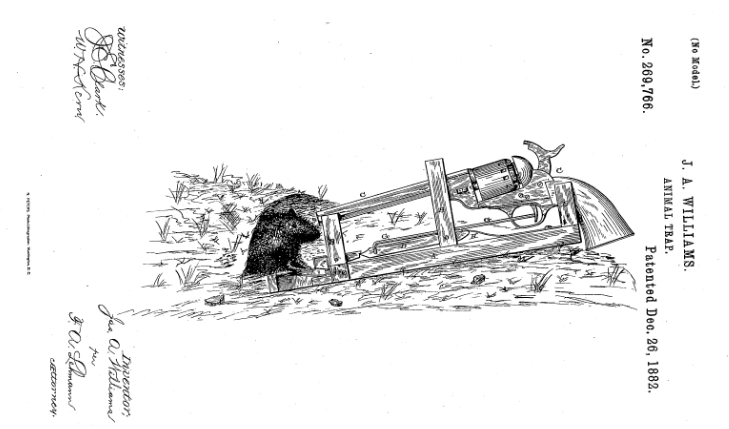
    Well, there’s not much that one can say about this that the reader is not already thinking.  

    The idea was that of J.E. Bennett of Fredonia, Texas, who patented the “trap” in 1882.  He reports that this apparatus has been used before, as a house “alarm”. He states in the patent that  “I am aware that burglar-alarms of various kinds have been used, and which have been connected to windows and doors in such a manner that the opening of the window or door causes a pressure upon a lever which discharges a tire-arm; but in no case have the parts been arranged and combined as here shown and described.”  Indeed.  I think that this sort of “alarm” was declared illegal decades ago because its use employed depraved indifference.  Poor little critter.  

    ·Posted by :

    ·in:

    — —

  • Balloons I Know But Do Not Love–Deaths from Above in Ads and Bombs (Revisited)

    JF Ptak Science Books   Post 1771 (b) (from 2012)

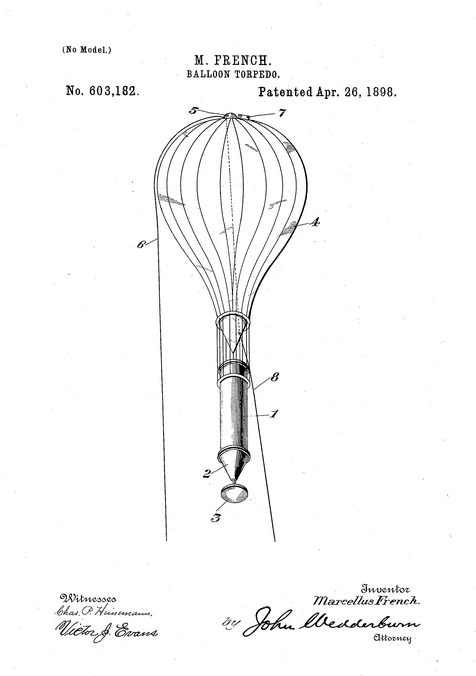
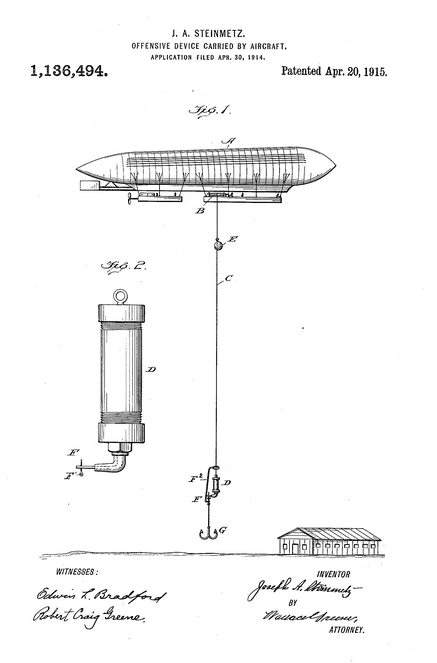
    In the early days of aviation aerial assault must have seemed incredible–and an abomination.  Hurling stones and other offensive weapons by trebuchet and catapult is one thing, and  launching balls and shot from cannons and mortars is quite another–but actually having your weapon flown over an enemy’s position and dropped, remotely or via cable, must have been ab excruciating achievement, militarily speaking.  To be able to direct an explosive charge over a position not reachable by an infantry (say in 1915) must’ve been a short-lived comfort on the offensive end, though the user of such a technology would also have to contend with the contrary, as the enemy would be able to do the same thing themselves. 

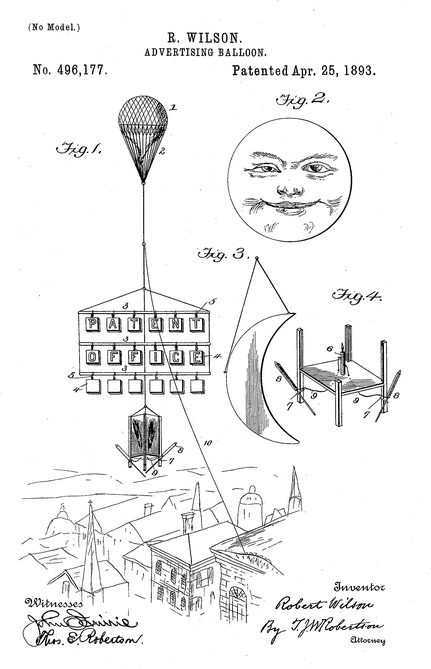
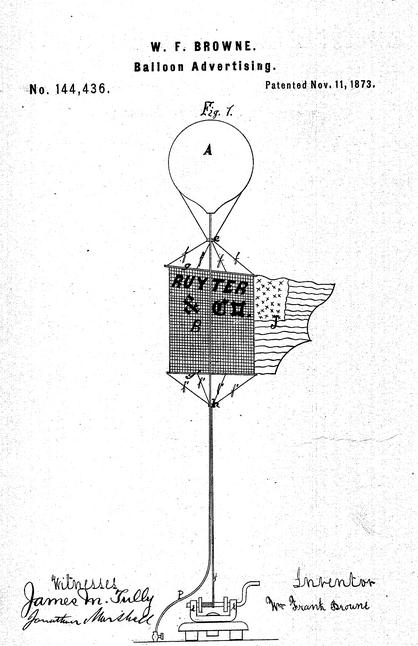
    This idea was not limited to just military purposes.  Companies could now wage an advertising war war against competitors  in a thee-sky’s-the-limit campaign, hoisting their ads on balloons anchored over a city, making it possible for the first time to have your message so universally read, a pre-intertubes version of smoke signals. 
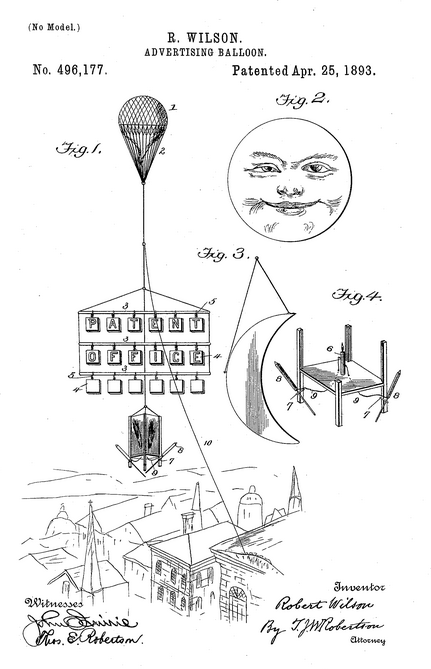
    Patent balloon advertising 1893[Source:  Google patents, http://www.google.com/patents/US496177?dq=balloon]
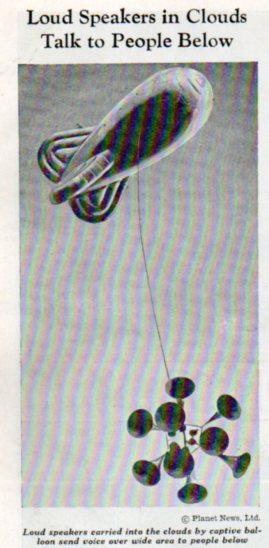
    Sky speakers413

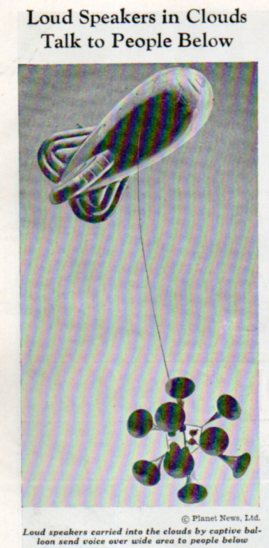
    And this, seeming more on the Orwellian/1984 side, or perhaps more contemporary as an instrument of the Dear Leader in North Korea (left, from Popular Mechanics, July, 1939).


    Here’s an interesting, pre-airplane, airship-delivered explosive device: floated over an enemy’s position, the chord would be pulled at the desired time to create a tear in the balloon’s top, sending the craft down, with the bomb exploding on impact:
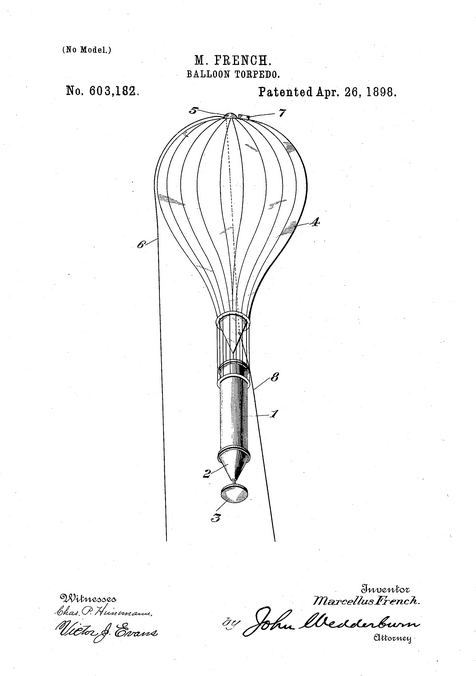
    Patent balloon torpedo[Source: Google patents, http://www.google.com/patents/US603182?dq=balloon]

     Another sort of slow death from above advertising scheme:
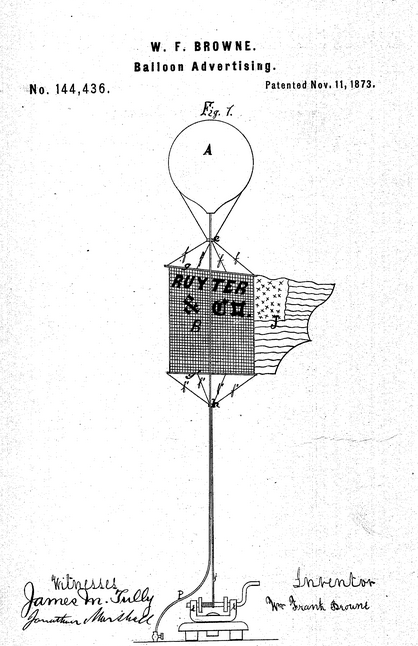
    Patent balloon 1873

    [Google patent:  http://www.google.com/patents/US144436?dq=balloon]

    In this device patented by Steinmetz the explosive device is still actually attached to the aircraft when exploded–not a very common way of delivering your weapon.  The airship would advance on the enemy, with the bomb  attached to a cable just above an anchor at bottom; the anchor would grapple the target, and the bomb detonated from the  gondola of the airship:
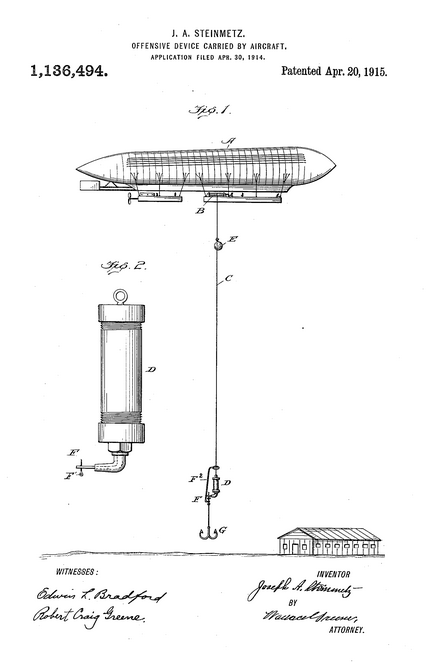
    Patent Balloon gondola


  • The Expandable Waistcoat & Blank Book Patents of A. Einstein & S. Clemens

    JF Ptak Science Books   Quick Post  
    Follow Me on Pinterest 

    Albert Einstein was many things–including a designer of clothing, and a patented one at that. He applied for and was granted a patent in 1936 (not an unbusy period in which he must’ve been noodling this thought around in his head, that blouse thing along with gravitational lensing, that pesky quantum mechanics, and the EPR paradox and all that) for an expanding waistcoat. 

    Well.  Einstein had his hand in other patents, including a rather famous one regarding a refrigerator with no moving parts (along with the great Leo Szilard, the “Einstein-Szilard electromagnetic pump), as well as part interest in gyroscompasses and a hearing aid, and better yet a “light intensity self-adjusting camera” with an “electric eye”.  And the “ornamental blouse”. I suspect that it was all in fun, except that once the thinking had been done, it was thought to take it to the next logical step. 

    ·Posted by :

    ·in:

    —

  • DIY Pocket Baseball Game, 1876

    JF Ptak Science Books   Quick Post  Follow Me on Pinterest

    Following up on a post from yesterday on a make-it-yourself baseball history calcul-computer is this glorious spinning arrow pocket game board from 1876.  An enthusiast could easily cut and paste their way to their very own baseball game for lost moments on the train or in line at the Piggly Wiggly.  Enjoy.


    ·Posted by :

    ·in:

    —

  • Inventing Aged Tone in New Violins, 1903

    JF Ptak Sciecne Books  Quick Post

    First page clipping of GB 190303723 (A)

    Patent
    #190303723  issued in Great Britain to R.H. Payne and T. Broadbent,
    February 17, 1903. It really doesn’t have anything to do with creating
    patina/lustre in the tone of a new violin via artificial means, but it
    does have that scent to it, and sometimes that all anything needs to do,
    provide the aroma of an interesting idea.

    ·Posted by :

    ·in:

    —

  • Circular Calculators: 19th Century Patent Diagrams

    JF Ptak Science Books   Quick Post 

    Follow Me on Pinterest


    ·Posted by :

    ·in:

    —