A Daily History of Holes, Dots, Lines, Science, History, Math, Physics, Art, the Unintentional Absurd, Architecture, Maps, Data Visualization, Blank and Missing Things, and so on. |1.6 million words, 7500 images, 4.9 million hits| Press & appearances in The Times, Le Figaro, Mensa, The Economist, The Guardian, Discovery News, Slate, Le Monde, Sci American Blogs, Le Pont, and many other places… 5000+ total posts since 2008.

Category: Patents

  • BioPunk: Human Robots, 1900-1923

    JF Ptak Science Books  Quick Post #425

    I found this extraordinary image via collection of Finkiyaya on Pinterest, which is an interesting source for the unusual relating to the uncommon.  There is no attribution, but help came from correspondent Jeffrey Weston, who advised that the helmut belongs to none other than the ferociously active publisher/editor/thinker and creator of the term “science fiction”, Hugo Gernsback.  This was supposed to deliver a more powerful thinking and concentration experience to the user by delivering a flow of O2 , shutting off sound and auditory distraction, and by making the wearer focus their vision through a kind of horizontal pinhole slit. Gernsback I am sure did not use one of these things while working on his dozens of simultaneous projects, but he thought that it might help the rest of us–in today’s world, perhaps all we need to do to achieve this iolsation is turn off the electronics and sit at a clean desk.  In any event, the mask removed a fair amount of the human experience from thinking, and probably focused a LOT of attention on not-hearing and trying to see through those tiny slits. 
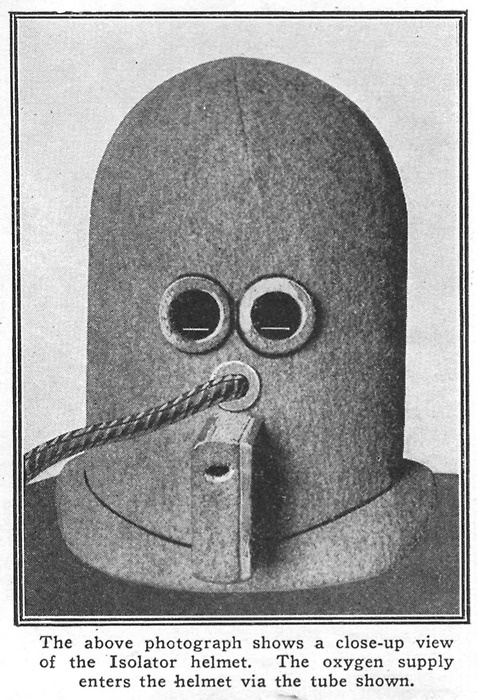
    Sub,arine helmet[Source: Pinterest account of Finkiyaya, here]

    [I wonder if Wilhelm Reich read about this as he was fiddling around with his “orgone accumulator” (read: “box”).   Even the crown prince of American Black Comedy, William Burroughs, could not wrestle this Reichian thing outside its impossible cellulosity of weird. As odd as Gernsback’s thing is, Reich’s goes on-beyond-zero with his, thinking that his siting-coffin collects/regulates an etherless ethery thing called orgone which was the seat of many and remarkable things, not the least of which was a controller of cancer and the weather.  It sounds sort of like a water-cycle thing but for a thing that influences thought and consciousness and biological systems as well as our ocean of air–that’s a long pull for a box with a chair in it.]

    Now three’s plenty in this helmet to suggest itself to the history of masks, but that is an enormous diversion, because I was really just looking for complements in the mechanical helmet world.  I could not resist though including this magnificent mask made by someone of the Sukuma ethnic group of Tanzania:
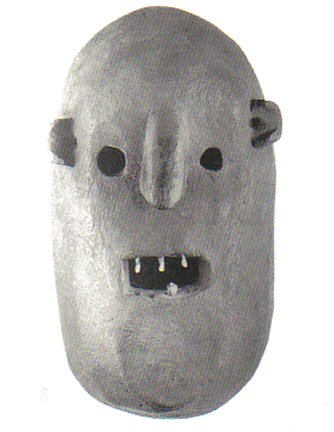
    Sukuma_mask_TAA

    It is interesting to note hwo the Isolator mask eprforms up to its name, isoalting human qualities to a high degree, muhc like the Sukuma mask.  There is a real encapsulating experience going on with these helmets and suits, looking far more robotic and alien than anything else. 

    And a last visit to Gernsback:
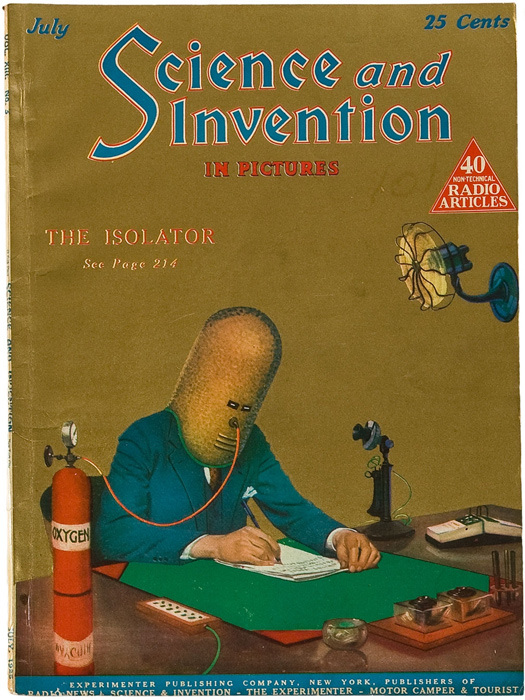
    BioPunk Isolator
    [Source: LaughingSquid, here.]

    And another (source here):
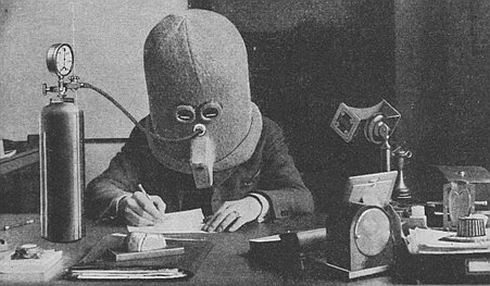
    Gernsback isolator

    How could any of this possibly go wrong?


  • Standard Corpse, Inc. & Deadpunk: Shaving, Cooling, Lifting, Electroplating, and Diapering the Dead

    JF Ptak Science Books   Post 1975   Follow Me on Pinterest

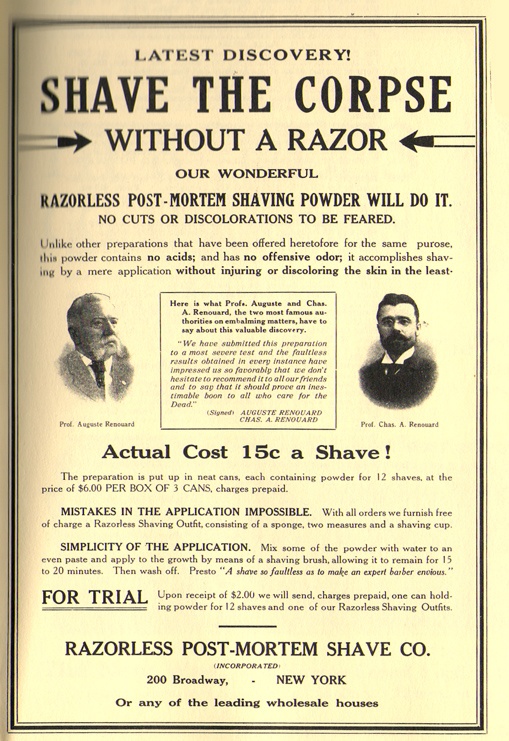
    The idea of creating an economy from a previously dead clientelle–the very after-market dead person–is relatively new. Once a middle class or lower working class with disposable income was created, celebrating the care of the dead was a paying option opened to the millions of families who were not the fastidious and celebratory wealthy.  Once the notion of having other people take care of the dearly departed became a part of the popular ritual of dealing with the dead, an entire new industry was born–spawning other related and associated industries for supplying the dead-care-givers with amenities and notions and necessities of a previously unthunk and unthinkable nature.  For example, the idea of needing to shave a corpse became an issue after it became fashionable to allow several days or more to pass between death and burial.  Beards and hair grow in death, so the people caring for the body and its display now were ordained an issue of economy in nultiple shavings of a corpse.  Now that may or may not have been an issue, but it was certainly presented as a possibility by the incredibly-named “Razorless Post- Mortem Shave Co.”


    Deadpunk shave

    {Many thanks to reader Max W for providing the information for the correct information for the citation of the above image–the magazine is Casket & Sunnyside for January 1912, and there are ample references to it in Charles Addams and Jessica Mitford.] The worry for the consideration of the cost of a shave (15 cents) for a dead person seems quite an inescapable weirdness and luxury. The weirdness of the name of the company nearly obscures it common nature–it isn’t exactly the Acme Corpse Company, but it is close to it, and it addresses just one small bit of minuatiae of deadness in the vast sea of Dead, Inc.

    The sellers of the razorless post-mortem shave equipment didn’t receive a patent for their process–nor did anyone else, for that matter, at least so far as I can determine. 

    Here are some further examples of Dead, Inc/DeadPunk patented death appliances:

    Post-mortem skull examination facilitator:

    Postmortem Underwear for the prevention of dead leakage and deodorization:


  • Vaginal Opium Suppository & Rectal Exercise Dumbbell Patents (1881 & 1931)

    JF Ptak Science Books Quick Post

    Follow Me on Pinterest


    This is a Quick Post quickly posted, fast-quick, mainly because I’m not so sure what to say about it, other than “wow”.  So, I’m sharing these patents for the sake of sharing, mostly without comment. (Here’s another curious suppository-related post on this blog: Radioactive Suppository Sex Aids & Radium Toothpaste: Shining Lethal Nonsense).

    The first comes from Leonhard Roth, of Brooklyn, who won this patent in 1881:

    And:


    ·Posted by :

    ·in:

    —

  • Questions Answered with Guts, Wax, Bumps and Glory: Fortune Telling Patent Devices

    JF Ptak Science Books   Post 1956
    Follow Me on Pinterest


    [All images via the lovely and easy to maneuver Google Patents here]

    Fortune telling and divination is mostly the subject of the pretty patents (below), a quick penny-ante for the fulfillment of the instant treatment of possibility. reckoning via mechanical means,easing folks out of the necessity to think about What May Come, and also, possibly, relieving some of them of the possibilities of worry should the fortunes agree with their hopes.  And desires. Opposite, for the opposite. 

    This thinking goes back a long way into dark and dusty time, though it becomes interesting (to me, anyway) when it gets wrapped up in Renaissance magic and science. 

    I’m not sure what it reveals except for what people might have wanted to believe in during different periods of time.

    Anyway, the patent drawings are pretty.

    The ways of telling fortunes are broad and numerous and may have been dictated by the stuff that was readily available at hand; a veritable alphabet can be quickly summoned to deal with the most common of the sort:

    Alectromancy (telling the future by relatively brainless modern dinosaur roosters pecking at the ground for stuff);

    Astrology
    (thinking that the motions of stars that are light years away from the
    observer in a vast sea of space and their annotation on an
    infinitesimally small speck of universe dust called “Earth” can somehow
    interact with living organisms that are 1030000 the amount of space that can be affected by the light from the stars that are 1/1,000,000,000 of the age of those stars);


  • 19th Century Smart Sticks: Calculating Pencils

    JF Ptak Science Books  Quick Post 


    Follow Me on Pinterest

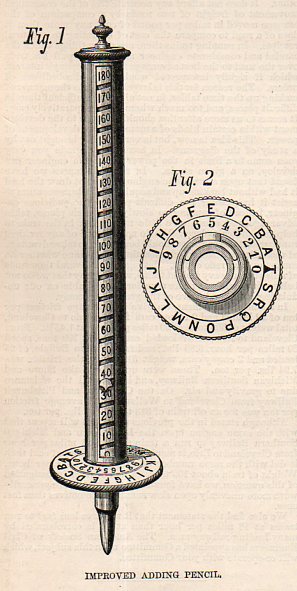
    This thinking stick comes to us via the courtesy of the Scientific American Supplement (19 August 1876, page 542), and shows a lovely Victorian non-SteamPunk answer to on-the-run calculation. It is an almost-elegant device, and seems as though it should work just fine. Its utility as a writing instrument seems a bit limited, as seems the calculator part, but the whole of it seems to be full of possibility–and a very nice piece of dedicated thinking. 

    Pencil052
    [Text describing the invention below.]

    Other nice examples of adding/writing found in the U.S. Patent Office via GooglePatents are seen below:


  • Beautiful Sprockets: MetalPunk in Space and the Jetsons.

    JF Ptak Science Books    Post 1958

    The birth year of Rosie the Robot is approaching.

    (This beautiful sprocket nest, for a patent for transmitting power (1874), like all of the following patent images, is located at   Google Patents, here)

    Spacely sprocketsFor some odd reason I was thinking about Spacely’s Sprockets, George Jetson’s (of The Jetsons cartoon in the 1960’s) employer.  I wondered if this was a high irony–the “sprockets” part– and if there would be any sprockets in our space-aged future.  Even by the end of the 60’s, just at the end of this cartoon, I wonder if in the tens of thousands of parts that went into the hardware of the Apollo Project to get us to the Moon if there were any sprockets among them. 

    The sprocket was just such an excellent idea in the history of the transmission of power…but in the 15 or so books that are on hand here on the history of technology there’s nothing in between “spring” and “Sputnik” in their indexes. Patents for sprockets seem to begin in U.S. patent history in the late 1860’s.  Sprockets show up in Gatling/machine guns (1878, with the Leland gun), chain propellers (1875), turn tables for railroads (1874), chain saws (1883), holler for printing machines (1882), stump extractors (1878), wind engine engines (1880), window shutters (1879), safety pulleys (1880), traction engines (1881), feathered paddling wheels (1882), potato differs (1883, with very great tank potential), harvesters (1880), hay elevators (1881), horse treadmills (1884), corn planters (1881), grain elevators (1883), and of course in veliocepedes (a very cumbersome device by Emmit G. Latta in 1880). 

    [Bicycle source here]

    I suspect that there were sprockets in space in 1969, and perhaps they’re in a Space X vehicle–I really don’t know. Its just interesting to think of the coming of the sprocket and what an enormous influence it exerted in the history of power transmission–and the device’s beauty. 

    My sneaking suspicion is that Rosie the Robot, the maid for the Jetson family–who was 45 years old in the  beginning of the 1962 series– was loaded with 1965 sprockets–whether sprockets would exist in the year 2062 or whatever year George Jetson was alive in (certainly many centuries post-2062) is another story. But Rosie–the outdated-model mid-life maid of the future and most reasonable character in the series–surely had them.

    Some beautiful sprockets:


  • Tech Quiz: The Tooth Telephone? (1880)

    JF Ptak Science Books  Quick Post

    This device looks a little suspect, but it isn’t. Well, on first sight of the patent drawing this device seemed dubious and quacky, and since the patent office issued some-number of patents for quackery, it was entirely plausible that this was one of those beasts.  This is the kind of quackery beasty that would latch on to a new discovery or invention and somehow derive and twist the name or concept of the new thing into something fabulous or miraculous (as with the case of  radium suppositories and x-ray massages for the bones).

    The device is a vibrating element to help people with hearing loss hear conversations on the telephone. On reading the patent though it becomes pretty clear that this thing could work, or should work, depending upon the hearing loss of the receiver.  Patented about four years after the Bell patent, there were nearly immediate reports on Mr. Fiske’s invention in Scientific American, The Electrical Journal, and Engineering (seen below). 

    ·Posted by :

    ·in:

    —

  • Standing on Your Stagnant Nerve-Juice Nostril Tube? The Daily Dose from Dr. Odd

    JF Ptak Science Books     Daily Dose from Dr. Odd  
    Follow Me on Pinterest

    This cure-all from G. Anston looks simple, but the hydraulics of his nerve juice pumper is actually a little involved, or more involved than it needed to be given the fact that the machine didn’t actually do anything productive.  That said, Anston was  setting out to “move fluids” and cause all manner of cure-alls for “air stagnation” in the body, without the trouble of losing any time except for sticking those tubes into your nostrils.  I do not know why the artist has the subject standing on  #44 (the nerve-waste elimination tube) which was basically the tail-pipe of the cure-waste that was supposed to be flushed from a window.  It seems as though stopping the exit of the stagnated brain-air and nerve-fluid effluvia might’ve made the subject’s head pop off a little, which would be problematical. 


    [Source:  Google Patents, here.]


  • Patenting the Artificial: Moustaches, Bark and Ideas

    JF Ptak Science Books   Post 1928

                An Alphabet of the Artificial as Seen in Patent Drawings

                      ”
    I…can wet my Cheekes with artificial Teares.”–3 Henry VI, iii, ii, 184.

    Using “artificial” as the word preceding a concept makes for some pretty interesting thought, especially if you remove it a bit from what the expected outcome is supposed to be.  So: creation. Intelligence. Harmomics. Society. Language. Consciousness. Person.  With the word “artificial” in front of these, they become captivating ideas both inside and outside of the realms of possibility.  (“Artificial creation” can have a definite hard sci-fi edge to it beyond genetic algorithms and trying to cook primordial chemical elements into the stuff of life in controlled environments; the “artificial person” more than just the person ficta of the law, although “artificial personality” wrapped around that gets to be very interesting as well.  The “Artificial society”has some Superman aspects to it from my 25-cent comics day, though the von Neumann/Ulam/Conway simplified paper grid cell creations are fr more interesting; artificial consciousness has a nice film-feel to it beyond machine/synthesis and cognitive robotics, where consciousness has somehow been identified and was controllable to a walking-around state. And so on.)

    What I’ve pulled together below is a small sampling of patented items using the word “artificial” in its title, and presented them in a (near-complete) alphabet of artificial creations.

    There is no patent on “artificial ideas” itself, though the idea of taking real issues like “artificial harmonics” and turning into something wholly unrelated to its intended use might be considered so. In any event, it would be an interesting thing to try to patent.

    A

    ·Posted by :

    ·in:

    — —