A Daily History of Holes, Dots, Lines, Science, History, Math, Physics, Art, the Unintentional Absurd, Architecture, Maps, Data Visualization, Blank and Missing Things, and so on. |1.6 million words, 7500 images, 4.9 million hits| Press & appearances in The Times, Le Figaro, Mensa, The Economist, The Guardian, Discovery News, Slate, Le Monde, Sci American Blogs, Le Pont, and many other places… 5000+ total posts since 2008.

Category: Patents

  • Tech-Quiz #4–the Sublime Mundane

    JF Ptak Science Books  Quick Post

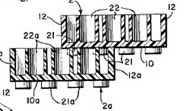
    This forms the absolute end of something, the “tip” of it, one of two, at the either end of slender cord. Even for this there must be a patent–and there were, evidently, many of them.  This is just one, from 1922

    Answer in the continued reading section, below:

    ·Posted by :

    ·in:

    — —

  • The Department of “What is It?” (#7): What are the Ultra Famous Holes that this Hole Puncher Punched?

    JF Ptak Science Books Quick Post

    This is one of the most important hole punchers in the history of holes, and also in the history of counting and figuring out what to do with counted things.  Do you know who filed this drawing as part of their patent report, and what famous contribution this thing made? 

    What is Itt ollerith hole puncher detail


  • TechQuiz 2: What Monster-Mega Thing Did This Become?

    JF Ptak Science Books   Quick Post

    The original patent for this tube-and-rod design was made at the Danish Patent and Trademark Office in Copenhagen on 28 Jaunary 1958 at 1:58 p.m.  The design could be for an associated cooling system for a steam turbine; or for a high-pressure/reactive clutch of passes and cylinders for a water turbine hydroelectric facility; or perhaps it was for a modern prison system utilizing water-filled bars for prison cells that could indicate a possible jail break if any leaking water was discovered, making tampering with the bars an impossibility.

    Patent lego detail

    What’s your best guess? (Answer below.)

    ·Posted by :

    ·in:

    — —

  • Tech-Quiz What is It? Can You Identify What Made this Patent Mega-Famous?

    JF Ptak Science Books    Quick Post

    I would not have made the intuitive leap to what this “game apparatus” would become from the simple reading of the opening two paragraphs of the patent description for it by its creator, J. Brunot:

    “This invention relates to apparatus for playing board games and more particularly to apparatus designed to facilitate scoring procedures in connection with the playing of such games. In many board games playing pieces are placed on certain contiguous or successive areas marked out on the board and the placing of the playing piece on certain predetermined areas results in an adjustment of the score of a player either by adding a bonus to the score or subtracting a penalty therefrom.”

    “Usually the predetermined areas which result in adjustment of the score are marked in a characteristic way in order to show how the score is to be adjusted.  However when a playing piece is placed on one of the predetermined areas it covers this marking and it has been found that frequently the playing piece has subsequently to be lifted in order to discover how the score should be adjusted. The object of the present invention is to provide board game apparatus in which the occasions for such subsequent lifting of a playing piece are eliminated or substantially reduced…”

    [Patent 2,752,158 GAME APPARATUS James Brunet and Helen Brunot Newtown Conn Application October 28 1954 Serial No 465,222 priority application Great Britain June 11 H54 5 Claims Cl 273 135]

    The patent drawing offers a much better visual clue, but it still really doesn’t bear a great witness to what the apparatus would become:


    And the story on the answer to what this is can be found at the SCRABBLE Association history section.


  • Child Straigtener & Other Edwardian Cyborg Bits: Patent Reports

    JF Ptak Science Books   Post 1549

    (The following images are taken from the U.K. Intellectual Property Office Espacenet patent search page, here. The quotations following the illustrations for the patents are from that page.)

    Close Straightening Encounters for Children of the Reading Kind

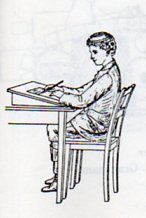
    Here’s an interesting implement that no doubt brought secondary thoughts about reading to any child made to wear this thing–the unhappy child is at left, and the skull-cap, at right.

     
    Yborg578

    First page clipping of GB 190421618 (A)

    Abstract of  GB 190421618  (A)

    “Lorenz, H.. For indicating when wearer deviates from an upright position; caps.-A cap I is made in the form of an inverted bottomless saucer with holes 3 in the side for lightness and ventilation. It is intended to be worn by school children to prevent stooping, inasmuch as it only remains on the head so long as the wearer remains in an erect posture…”


    Hand Guard for Cutting Things


    First page clipping of GB 190402703 (A)

    Francis John Crell: GB190402703 (a) “A Hand Guard for use in Cutting Bread and for Other Like Purposes”.  I’m not sure how this works as a glove-protective unit  given the spaces in-between the springy fingers–mostly it seemed to increase the cutter’s grip rather than protect them for accidental cutting.


     Walking and Running Anti-Deformation Appliance

    Patent Brit walking running machine

    Abstract of  GB 190414477  (A)

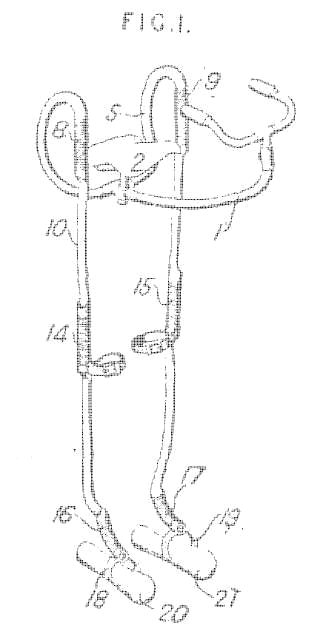
    “Skorzewski, Comte V. Walking and running, appliances for aiding.-A n appliance for aiding walking and running is adapted to store up, and to give up at the required moment, the energy resulting from the alteration in height of the centre of gravity of the body. The user sits on a saddle 2 adjustably attached to a tube 1 provided with handle – bars. The tube 1 branches into two tubes 5, which are connected by joints 8, 9, 14, 15, 16, 17 to other tubes of narrower crosssection, conforming in shape to the legs of the wearer, who is strapped to the appliance. The joints 16, 17 are connected by means of stirrups 18, 19 to soles 20, 21, or to straps by means of which soles may be attached to the appliance. The tubes are filled with compressed air through a suitable cock or valve. The joints are preferably formed of armoured rubber tubes, coated or not with para rubber.”


  • FearNaughtia Coffins: Life Detectors, Escape Ladders, Breathin’ Pipes and Premature Burial

    JF Ptak Science Books   Post 1526

    I’ve written here before on the wonderful book by Jan Bondeson, Buried Alive, the Terrifying History of our Most Primal Fear 1(Norton, 2001) and on the difficulties of determining death in the 19th century, and the various ways that people sought to deal with and sidestep the possibilities of premature burial.  In continuing those posts I’d like to add the following  drawings from hopeful reports of the U.S. Patent Office, some of which really didn’t make that much applicable sense, but, well, you can patent just about anything if it hasn’t already been patented. 

    These coffins were constructed to allow their occupants to ring or telephone or telegraph or signal with smoke or light and so on should the dead respond to their lost life while buried.  As I point ou tin the earlier (linked) post, determining death was a difficult task in the 19th century, so there wsa a legitimate fear-of-being-buried-alive concern.  OF course, the best way yo determine death would be to allow the supposed-dead to lay out for three days at the end of which the body became a corpse and putrefy–the decay part was the true determiner of death. WHy people had to bury the dead into a coffin and be placed underground faster than the three days is a mystery, particularly if there were so many people who lived in fear of waking up in an underground coffin. 

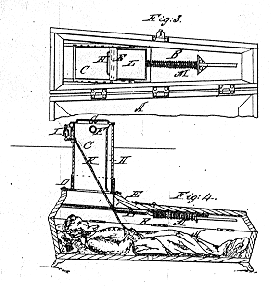
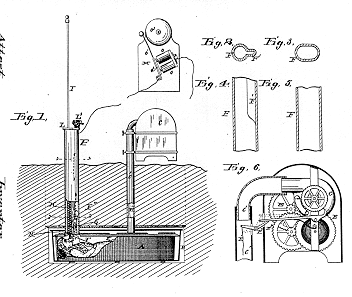
    And so to the solutions, the first of which was brought to the world by Franz Vester of beautiful Newark, New Jersey.  Well, Newark was probably beautiful when this patent was granted in 1868, and maybe this idea seemed so, too.  Here’s what would happen if a dead body awoke in Vester’s safety coffin:  their hands were attached to a rope that would be connected to a top-side bell, and the not-deceased would tug on it for all they were worth.  After that, a sliding door above the face would be moved, and the coffin’s occupant was then supposed to pull themselves up to a short laddered tunnel that was connecting the living world from the sleep-of-worms-world.  Were there problems?  Yes, of course, but so far as it has been recorded no person ever saved themselves suing this coffin, in spite of Vester’s very strenuous exercises to promote his invention.
    http://www.americanartifacts.com/smma/life/g13.gif

    [Image source:  American Artifacts, via VanVleck]

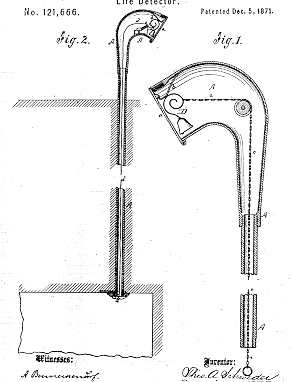
    A few years later from just downthe road in Hoboken, Theodore Schroeder and Hermann Wuest were granted a patent for another rope-activated sounding device.  The 1871 patent revealed what was pretty much a common thread to come–rope, hands, bell.  Theoretically, if the dead awoke they would tear away at the bell until the prefect or whomever arrived to dig them out.  The pair from Hoboken added a few tweaks here and there–one that allowed a release of fresh air into the coffin, and another which used an electromagnetic deice to replace the hand engine.  I’m not sure how long someone can last in a coffin underground, but it can’t be very long at all.  Why someone would think that adding an air vent to a coffin where the dead have been underground for a few days already doesn’t seem to make much sense, except to the coffin manufacturers. 
    http://www.americanartifacts.com/smma/life/g1.gif


    The next example comes from the beautifully-named Albert Fearnaught, who although not from mid-Jersey patented a device again using a rope around the wrist of the dead, this time though the rope was attached to a spring-loaded device that would release a flag when activated from below. 

    This next (1885) patent has a slight variant on the rope-hand solution:  the string-finger. Well, there was also some electromagnetic stuff involved, but basically the string on the finger of a moving not-dead-corpse would activate an electric bell and yadda yadda yadda people would come to help and release.  The added extra here, the clear-coat undercoating, is a device that would allow the folks topside to peer down and see the face of the interred, and whether or not it was animated, I guess. 
    http://www.americanartifacts.com/smma/life/g4.gif

    Hubert Deveau evidently had grown tired of all of these hand/finger-operated back- from-the-dead resurrection devices, and constructed (in his patent of 1894) a relatively simple groundskeeper-alerting-breathing-device combo–a pipe that could be moved up by the head of the person int he coffin which would in turn activate a spring-something that would keep the pipe poking-up above the ground.  It would deliver fresh air to the buried, and would evidently be a warning sign to the cemetery man that something was afoot, underfoot.

    Funny thing her is that most of the systems I looked at for this post involved a single device to release the prematurely-buried–it seems to me that there should have been at least one back-up system in case the main apparatus failed.  I mean, if you’re going to become intensely psychotic, why would you then depend on one thing to get you out of your buried coffin?  And that one thing is, basically, a rope.  What if the thing failed?  I’m just saying that I expected to see a little more comfort juice applied to these solutions than I saw. 

     And why current radio talk show fearmongers like Glenn Beck isn’t all over these things, I don’t know–they Fearnaughts for just about everything else…

    Notes:

    1. A fine article on patent remedies for premature burial can be found here: “Signals from the Grave, Early Patents for Detecting Life in Buried Persons”, by Richard Van Vleck, in American Artifacts, issue 45, July 1999. 


  • Incontestable Oddness: Inflatable Puffy Shirts for the Dead & Coffins with Retractable Legs

    JF Ptak Science Books   Quick Post

    Some things that seem perfectly odd seem to take on another life, an extra life, when you put moveable things on it.  For example, coffins that have anything “retractable” seems a little much. As corpse receptacles, coffins as a box seem, I guess, an odd thing–scooping out a body’s innards and replacing them with packing, toxic preservative, gums, paint, glue, plastic, rubber, wire, pins, needles and such seem to be a little on the extreme side, especially when you are going to put that body into a hole in the ground and cover it with dirt.  What better thing than to enclose the corpse in a container so that the horrible idea will be further kept from deterioration?  Then there’s the container for the coffin, and the slumber vault cement liner, and so on. 

    This weirdness turns professional (to paraphrase the Good Doctor) when movable/retractable bits are added to the coffin.  In a long “is this really necessary?” list, one of the last/first would concern retractable legs on a coffin, or perhaps the retractable flower vases, or the inflatable puffy shirt.  There’s a strange sociological history going on in the thousands of death/corpse/funeral-related reports from the U.S. Patent Office, which will make it much easier for the anthropologists of the future to understand our present concerns with death, or life. 

    [Most of the following patent reports are entirely understandable by their titles.  The first in the list though needs a little explanatory help–this is a garment was made with numerous openings to accommodate different forms of corpse body shapers, including inflatable balloons, putty, clay and other material that would help the dead body look a little more not-dead.]

    [And then of course the explanation of the thing, which has a distinct federal-ese flavoring.]

    [I like this one because of the name association with the Norden bomb sight, a once-top secret improvement in delivering bombs dropped from planes, and which helped put many people into a coffin, if only figuratively.] />/>/>

    />/>


  • Facial Fat and Breast Support

    JF Ptak Science Books   Quick Posts

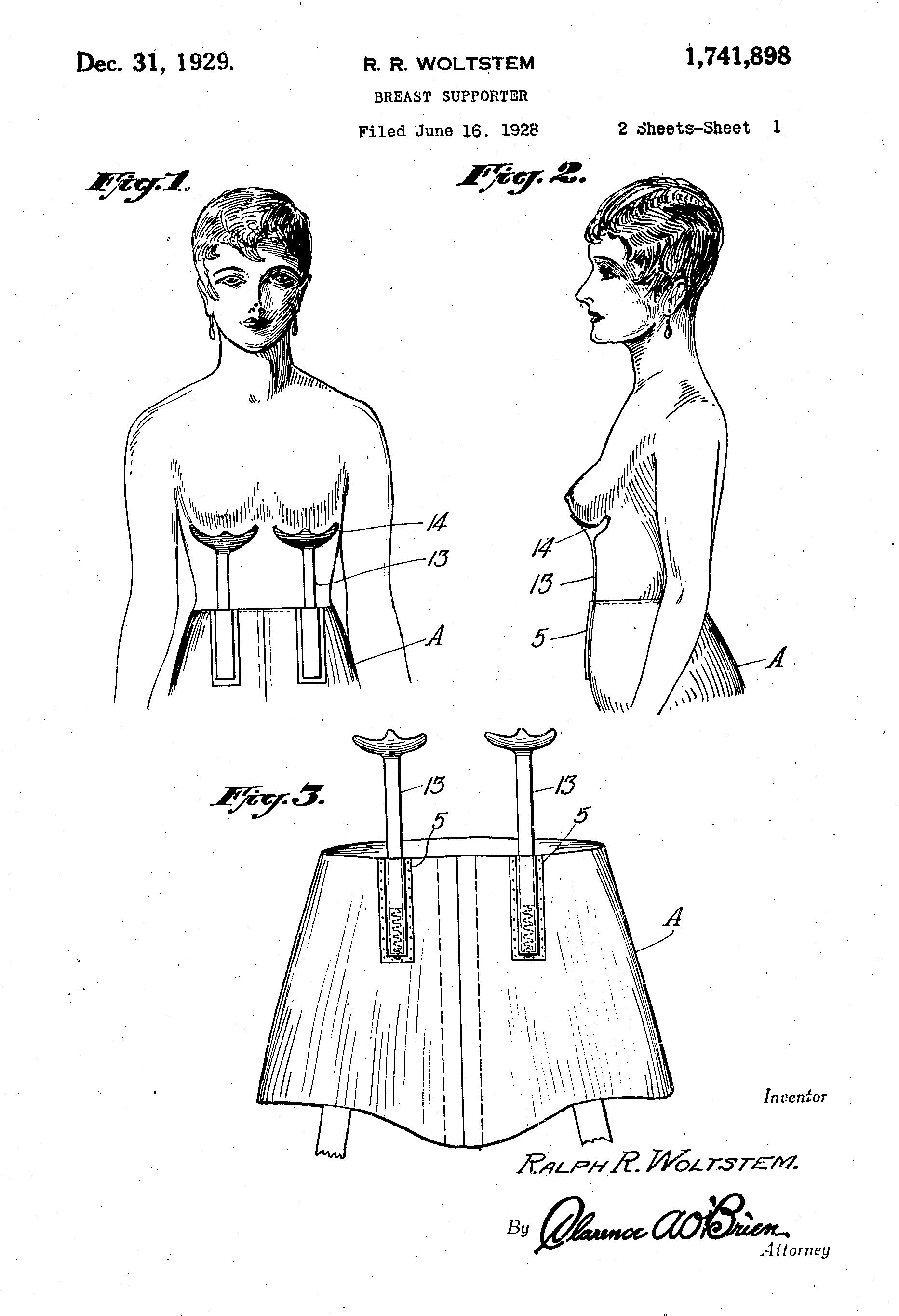
    I didn’t quite know what to do with this bugger, but it seems so special in and of itself that I thought it deserved to stand alone.  I have seen other things like this, as in the post  made two days ago on the history of enormous bras, that used stone-age implements in the patent (see below).

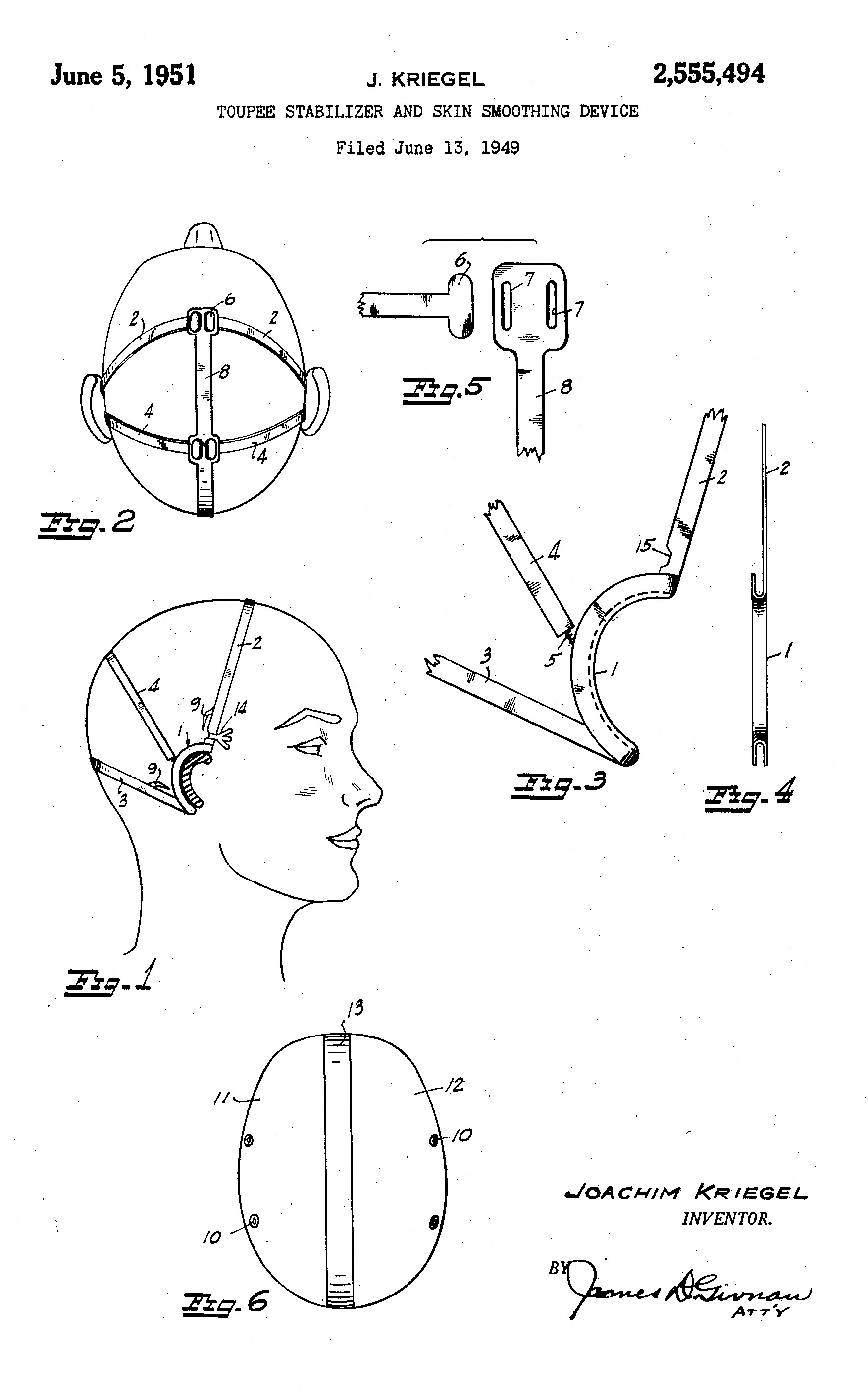
    This toupee adherer, the thing to which a toupee would be attached, also served as a facial splint–a splint for face fat, the device described as being capable of pulling back the looseness of age.  


    Patent--head bra title full

    It seems as though waking up in the morning au natural might be a bit of a shock. 


    Here’s another prehistoric bit, this on breast support:

    Patent bra


  • Electro-LUXurious 3: Anti-erection “Body Wear” 1889

    JF Ptak Science Books  Quick Post

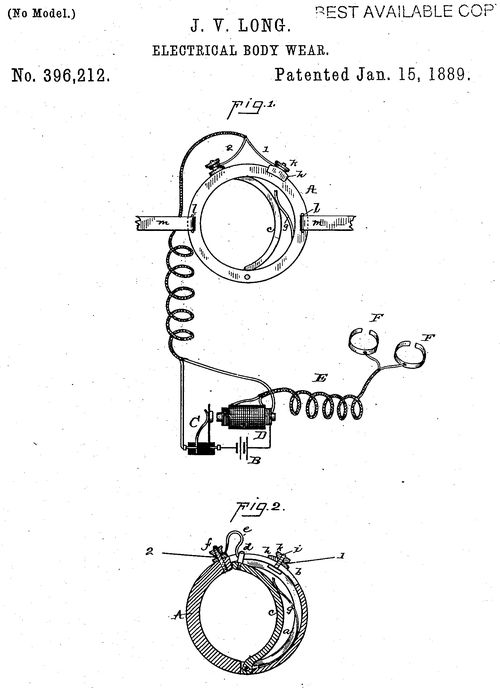
    Electrical Anti-Erection “Body Wear”  1889

    This is the third in a new series of posts on interesting, early applications of electricity, most of which are taken from the archives of the U.S. Patent Office.  Unlike the general post in this blog, many of the Electro-LUXurious post images and documentation can be presented without commentary. 

    Patent anti erection


    [Source: Google Patents, http://www.google.com/patents/US396212]