A Daily History of Holes, Dots, Lines, Science, History, Math, Physics, Art, the Unintentional Absurd, Architecture, Maps, Data Visualization, Blank and Missing Things, and so on. |1.6 million words, 7500 images, 4.9 million hits| Press & appearances in The Times, Le Figaro, Mensa, The Economist, The Guardian, Discovery News, Slate, Le Monde, Sci American Blogs, Le Pont, and many other places… 5000+ total posts since 2008.

Category: Patents

  • Antique Board Games for Astronomy

    JF Ptak Science Books  Quick Post

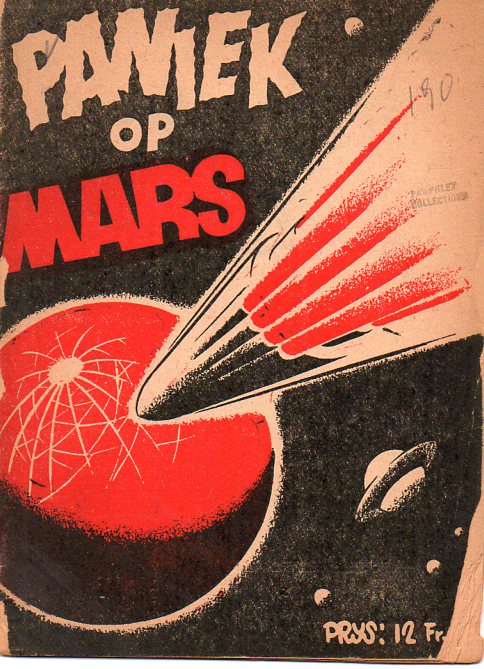
    This slender 1946 Dutch publication proved a little irresistible–the cover looked very loud, very red, and very accelerating-y, and was the only thing about the booklet that I could understand, though I really don’t understand that, either. 

    Mars panic457
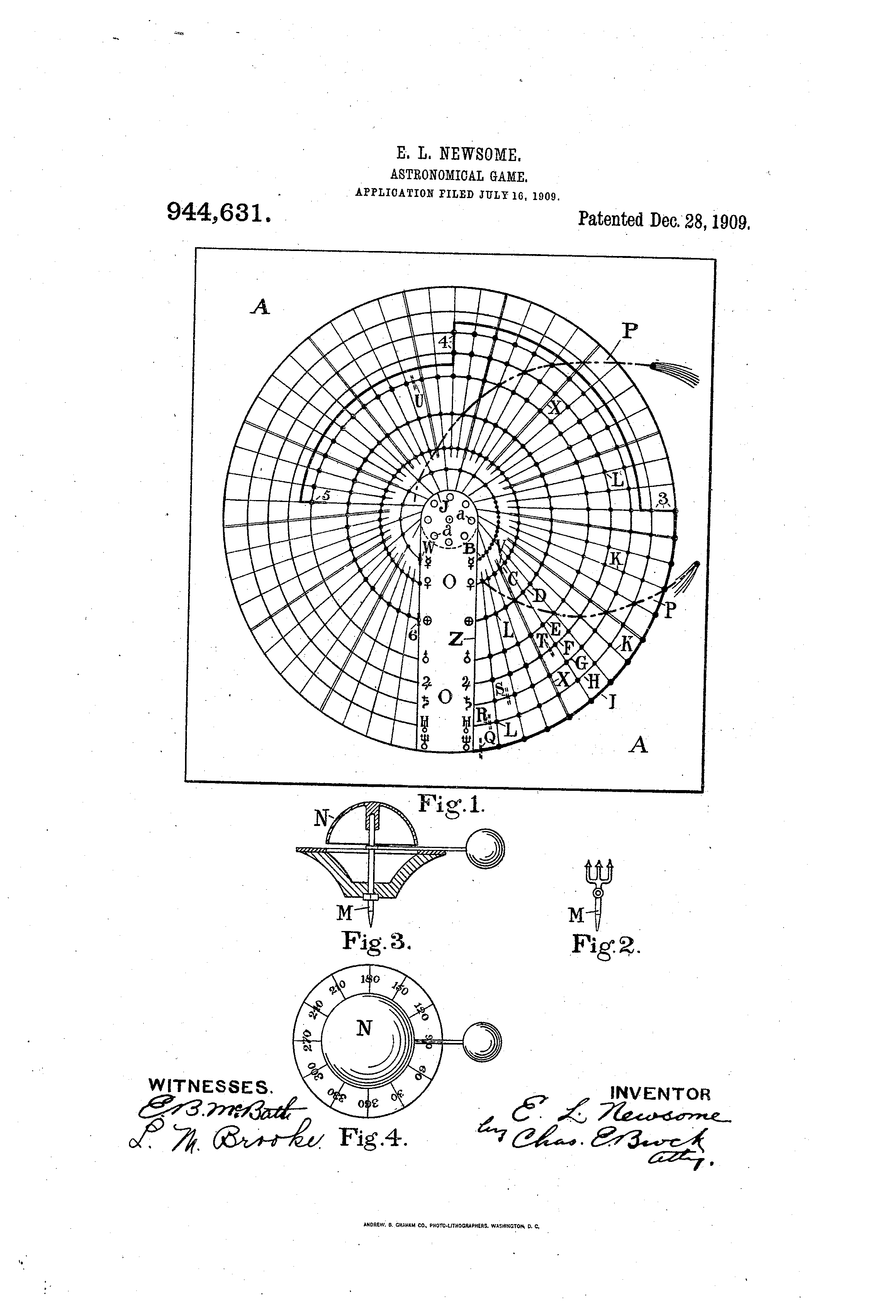
    I went over to Google Patents to see what a “Mars” search might unveil, and it lead me not necessarily logically to the following patent, which seems to me to be quite a playable astronomy game, with all of the necessaries found in the text of the document.  I’m not so sure that the game would be “fun” per se, but, well, it could be played.  And perhaps someone might learn something from it.  [Source:  U.S. Patent and Trademark Office, here.]

    Games astronomical patent office

    ·Posted by :

    ·in:

    —

  • A Series of Fortuante and Unfortunate Events

    JF Ptak Science Books   Quick Post  Part of the series on the History of Blank, Empty and Missing Things.

     V. Klobassa produced a very pleasing design for this Centennial game, though it seems to me from a  reading of the patent for the board that the details of the empty years were left, well, empty.  I guess it was left to the players to add the details to the blank years, that way adding to the memorization part of the game experience.  It is unusual I think that Klobassa used white and dark stars to differentiate “good” from “bad” events, just to make sure that there was no doubt which was which. 


  • Calendrical Patents, Lumpy and Lean, 1864-1897

    JF Ptak Science Books   Quick Post

    I found these patents for calendars and calendar/clock improvements to be very interesting–particularly so for the simple, wooden examples with the hundreds of blocky, placeable elements (as seen in the first image):


    ·Posted by :

    ·in:

    —

  • Aviation Games, 1913-1917

    JF Ptak Science Books   Quick Post

    I was wondering how early aerial warfare was used as the basis for a child’s structured entertainment, and so passed a little time in the U.S. patent archives for a quick overview of patented games.  I was more interested in games than simple toys

    The first is an ingenious military game that included playing chits for “aerial mines”, which in 1913/1915 was a forward-thinking defensive device, though not much tested.  (The the full text and explanation of the game is  here.)

    Next is a magnetic game–which again was patented during WWI–in which aircraft were supposed to seek out and destroy forts, naval ships, and other tools of war.


  • History of Dropping Things: Electro-Punk Machine for Waking/Smothering People

    JF Ptak Science Books    Quick Post

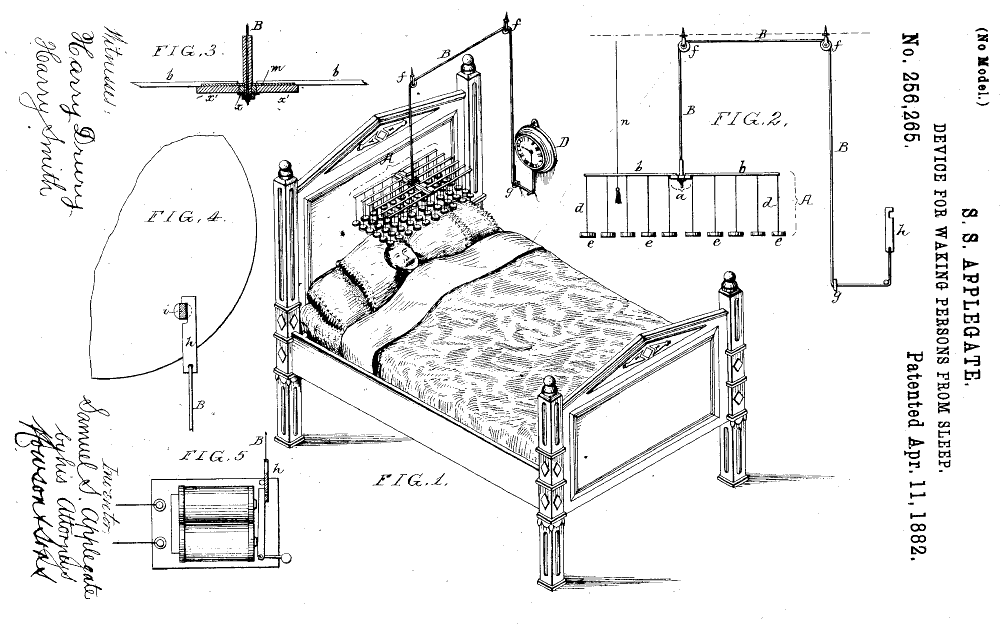
    Here’s an ambitious alarm clock that I stumbled across–something designed so as to not be ignored, something for the people who regularly sleep through simple alarm clocks.  This device, patented by Samuel S. Applegate in 1882, woke the sleeping client by dropping that cage-resembling apparatus on the sleeper’s head.  Evidently the ends of the suspension were soft, but hard enough to cause the sleeper to get straight-away back into the waking world. There’s probably nothing quite so like being slapped awake every morning.


    Patent waking people up
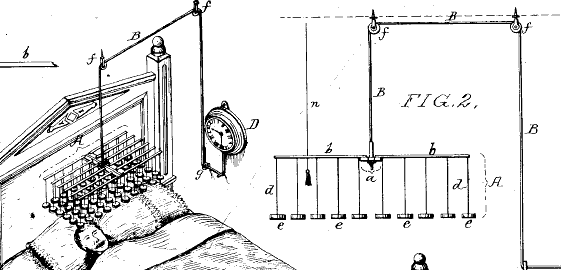
    The apparatus is seen better here–it is an unusual contrivance:

    Patent waking people up_edited-1

    Such a pretty picture of the sleeper, though I must admit the perspective would’ve been a bit of a challenge especially to a challenged  artist. 


    Okay, this one is walking people using water dropped on the sleeper’s neck:

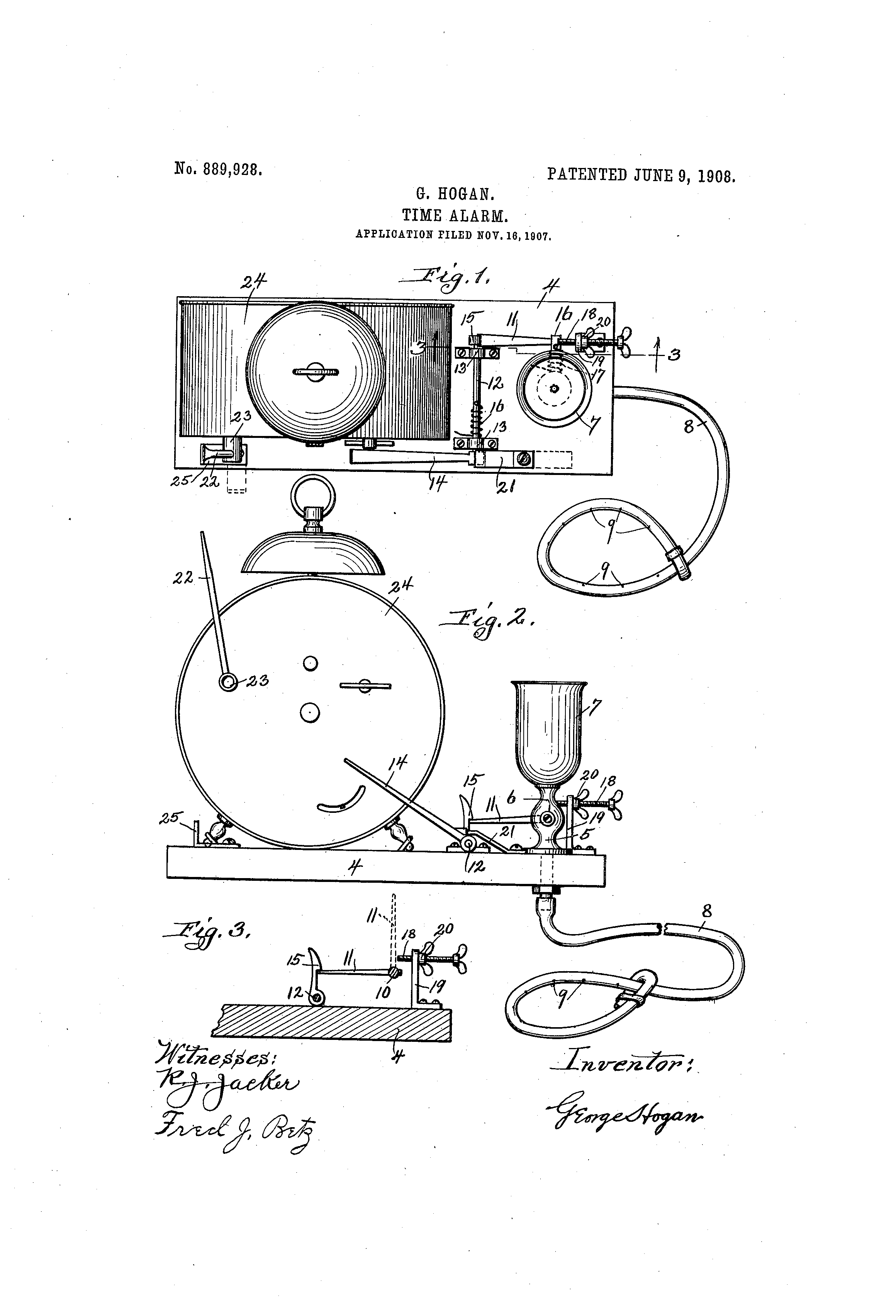
    Patent--time alarm


  • Balloons I Know But Do Not Love–Deaths from Above, Ads and Bombs

    JF Ptak Science Books   Post 1771

    In the early days of aviation aerial assault must have seemed incredible–and an abomination.  Hurling stones and other offensive weapons by trebuchet and catapult is one thing, and  launching balls and shot from cannons and mortars is quite another–but actually having your weapon flown over an enemy’s position and dropped, remotely or via cable, must have been ab excruciating achievement, militarily speaking.  To be able to direct an explosive charge over a position not reachable by an infantry (say in 1915) must’ve been a short-lived comfort on the offensive end, though the user of such a technology would also have to contend with the contrary, as the enemy would be able to do the same thing themselves. 

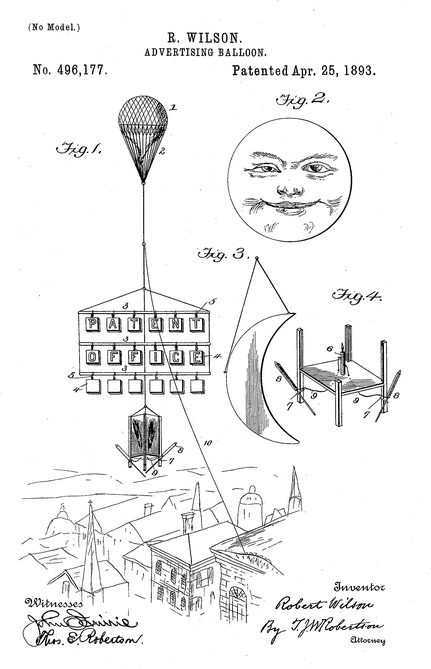
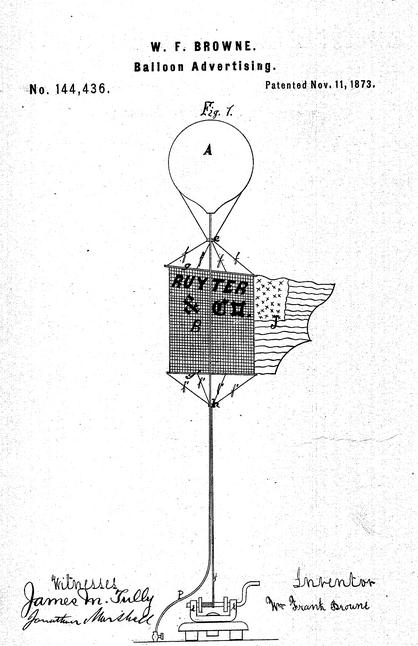
    This idea was not limited to just military purposes.  Companies could now wage an advertising war war against competitors  in a thee-sky’s-the-limit campaign, hoisting their ads on balloons anchored over a city, making it possible for the first time to have your message so universally read, a pre-intertubes version of smoke signals. 
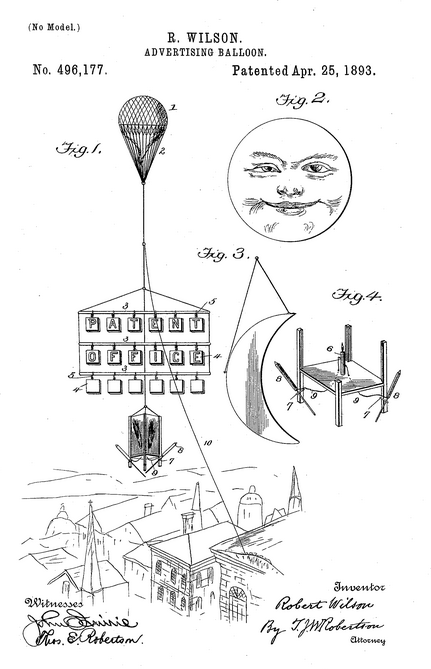
    Patent balloon advertising 1893[Source:  Google patents, http://www.google.com/patents/US496177?dq=balloon]
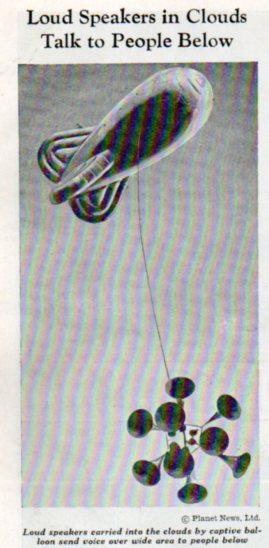
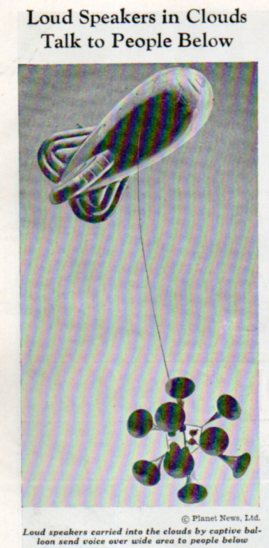
    Sky speakers413

    And this, seeming more on the Orwellian/1984 side, or perhaps more contemporary as an instrument of the Dear Leader in North Korea (left, from Popular Mechanics, July, 1939).


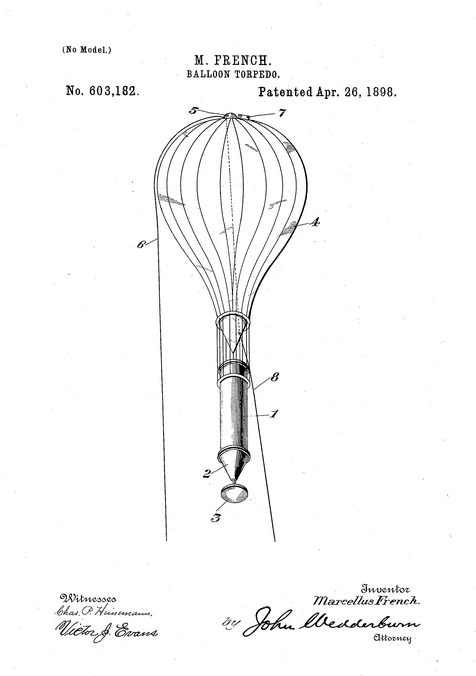
    Here’s an interesting, pre-airplane, airship-delivered explosive device: floated over an enemy’s position, the chord would be pulled at the desired time to create a tear in the balloon’s top, sending the craft down, with the bomb exploding on impact:
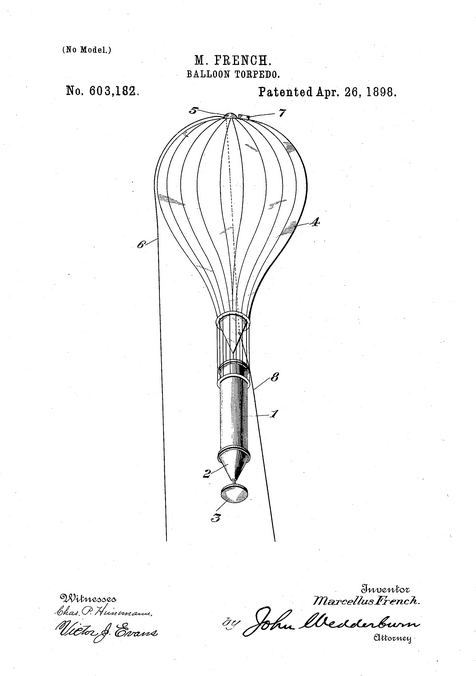
    Patent balloon torpedo[Source: Google patents, http://www.google.com/patents/US603182?dq=balloon]

     Another sort of slow death from above advertising scheme:
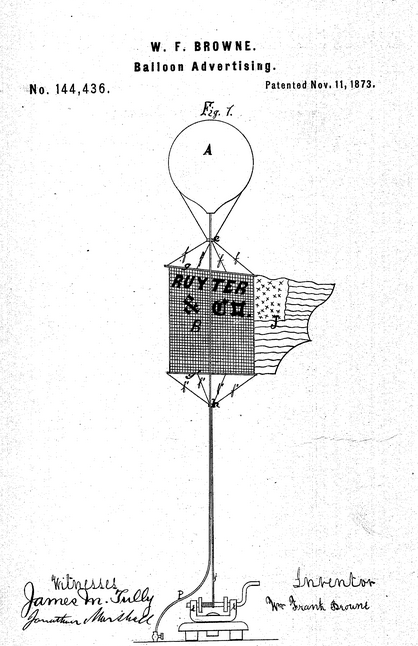
    Patent balloon 1873

    [Google patent:  http://www.google.com/patents/US144436?dq=balloon]

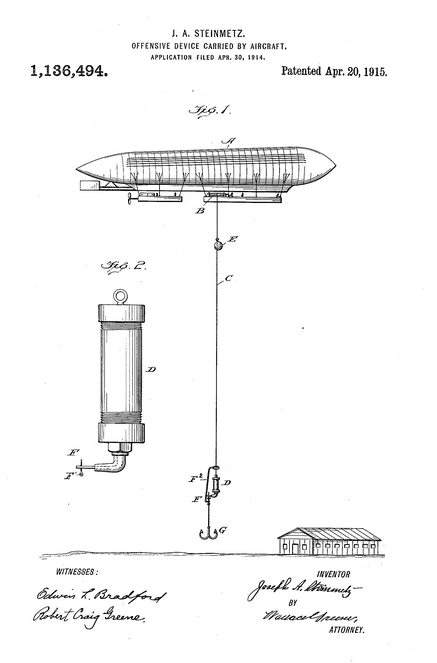
    In this device patented by Steinmetz the explosive device is still actually attached to the aircraft when exploded–not a very common way of delivering your weapon.  The airship would advance on the enemy, with the bomb  attached to a cable just above an anchor at bottom; the anchor would grapple the target, and the bomb detonated from the  gondola of the airship:
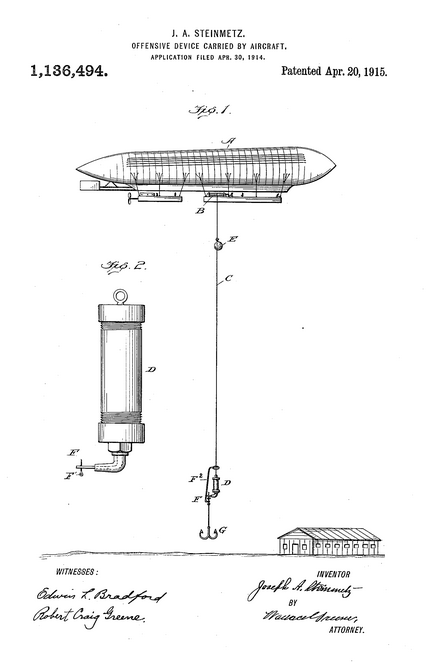
    Patent Balloon gondola


  • An Early–and Patented–“Flying Saucer”, 1898

    JF Ptak Science Books   Quick Post

    This magnificent flying thing was perhaps among the earliest of its kind, at least according to shape, which as we can see really wasn’t quite a flying saucer,, though it was a flying disk.  And a big one, at that.  From the ladder that led to the major axle we can infer that the aircraft was at least 60 feet high, which made its disk apparatus a very ferris-wheel-like 40′ or 50′ in diameter.  If nothing else, the patent drawings are quite pretty.


  • A Few Examples of “Heavy Stuff”: Patent Drawings for Flying Machines, 1877-1900

    JF Ptak Science Books  Quick Post

    This is as beautiful as it is heavy; and it is in its way very beautiful, so I guess that also means that is is very heavy…

    And speaking of heavy, this balloon doesn’t seem large enough to lift the very heavy ship-like carriage:

    Another flying boat:  I don’t see a power source to drive the “fans”/propellers on this one, though there is a tail for its “kite” body:


  • Drop-Dead Gorgeous Flying Man/Ornithopter Patent Drawings, 1889

    JF Ptak Science Books    Post 1746

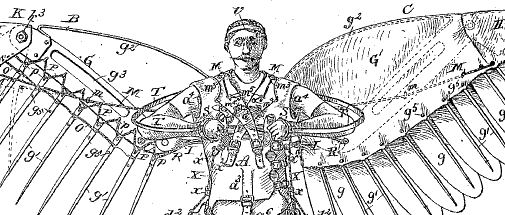
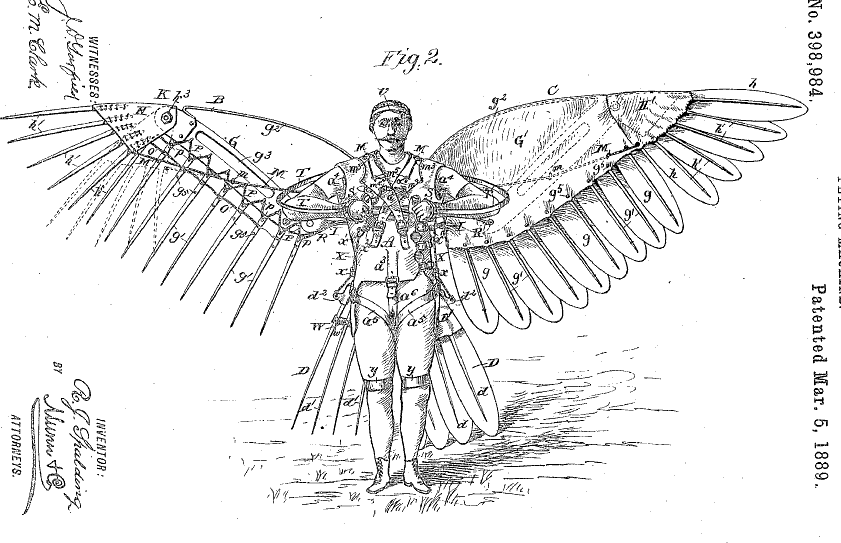
    This is one of the most appealing sets of “flying” or manned aerostation patent drawings that I have seen in the USPTO collection for the 19th century. The machine is a human-powered ornithopter, applying the structure of a human against that of a bird, and outfitting the flyer accordingly to combat their human weaknesses as adapted to bird flight.  Needless to say, and in spite of the beauty of the thought, this arrangement was destined to deep failure.  (The patentee, Reuben Jasper Spaulding, of Rosita (“Little Rose”), Colorado (south of Pueblo), may have been the same Reuben J Spaulding who made the first gold strike on the Blue River on Colorado’s Western Slope in 1859.)  Spaulding’s design is interesting also for the balloon device for getting the aero pioneer off the ground. 

    [Source:  Google Patents (and also for the extensive annotations for the images).]  I note that there was a model constructed for this patent–I’d love to see that.

    Patents--spalding flying_edited-1

    Patents--spalding flying

    And along this same vein of ornithopter-y thought is this, another American solution to the man-bird-mechanical-flight continuum, produced a dozen years earlier–it is similar, though not nearly as glorious (at least in presentation) as the later Spaulding effort: 


    The work really ins’t quite as awesome as Spalding’s beautiful Lazarusian resurrection, and not as detailed, but still quite interesting:


  • Bad Ideas of Great Timelessness: Basball Bat, 1890

    JF Ptak Sciene Books   Quick Post

    Some ideas are bad enough to stay that way, possibly forever. Impervious to the future, nothing anywhere ever catches up to them to make them unbad.  The design for this baseball bat fits snuggily into that category. Not only is this a bad idea, it is an ugly one, too.  I have to say that there is an intrinsic beauty to a baseball bat–its angularity, its diameter-to-length ratio, its color (for the most part), its patina, and even the applied non-Brettian pine tar–that just should not be trampled. (I’m sorry, but baseball bats really need to be the original color of the ash wood–not brown, or black.  I’m of course not talking about metal bats which are also in and of themselves a bad idea, “wrong”, somewhat like monster golf drivers,  not to mention that they can be made in a variety of colors, which simply deepens their wrongness.)

    Caveat–none of what I’ve just said applies if any of these bats are being used by children. Any kid with any bat at any time is perfectly fine.  And natural.) 

    I’m happy that no one felt any particular need to need Mr. Kinst’s (patented) bat.

    A nice history of bats can be found here.

    Mr. Kinst as he appeared in 1924.  The image is found in the American Memory Project of the Library of Congress, and the caption to the photo is as follws: “SUMMARY: Head and shoulders portrait of Emile Kinst, inventor of a baseball bat, looking toward the camera, sitting in front of a light-colored backdrop in a room in Chicago, Illinois.”

    ·Posted by :

    ·in:

    —