A Daily History of Holes, Dots, Lines, Science, History, Math, Physics, Art, the Unintentional Absurd, Architecture, Maps, Data Visualization, Blank and Missing Things, and so on. |1.6 million words, 7500 images, 4.9 million hits| Press & appearances in The Times, Le Figaro, Mensa, The Economist, The Guardian, Discovery News, Slate, Le Monde, Sci American Blogs, Le Pont, and many other places… 5000+ total posts since 2008.

Category: Patents

  • Mall-Mortuary Faces on Robot Patent Drawings, 1936-1976

    JF Ptak Science Books   Post 1927

    There is something that I’ve found in my time grazing through U.S.patent drawings–for the most part, if the device has a face, or is being worn/employed by some human with a face, chances are that this face will indeed have some high invasion of “Creep Factor” elements.  It is just so.  I’ve encountered this many times, and I think that it is possible that in these hundreds of samples that I have come across that these inventors (a) could not draw, (b) could not draw well, or (c) chose not to (a) and/or (b). It is too much to expect that these creepy faces are an expression of humor–that would be too much of a conspiratorial element for anyone to absorb.  It is just remarkable that these faces are time after time just so off, and soft-creepy, like a puffed-up rougey death mask found in a mall mortuateria.


    1936

    1938

    1938


  • Patent Drawings for Voting Machines, 1873-1971

    JF Ptak Science Books    Quick Post, Election Day

    I’ve just simply collected a representation of  sixteen patent drawings for voting machines for the decades from 1873 to a very early electronic voting apparatus in 1971. Today I simply filled out a paper ballot with a pencil, which was in turn read by the real voting tabulator.

    I  found very few examples for “ballot boxes” or “ballot ____”  or “vote ___” anything prior to 1850; most of  the patent actions seem to take place after 1875 (perhaps ignited by the very problematical “stolen” election of 1876. 

    I don’t know if it is ironic/prophetic/problematic that the first example is by an inventor named “Doolittle”.

    1873


    1875


  • Imago Frammeni: Boulle, the Dogon, Jouffret, the Simple and the Complex

    JF Ptak Science Books  Post 1914

    Changing the Mind’s View of Simple and Complex Ideas via Different Image Perspectives

    I’m always very interested in curious things, or standard, “average” things pictured in non-standard ways, as theDsc04588
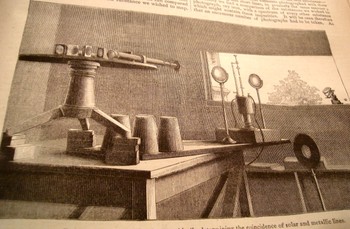
    change in perspective can lead to entirely new observations and discovery.  Seeing this illustration in an article by J. Norman Lockyer (Nature 1881) I was shocked by its clarity and usefulness—Lockyer was simply showing the arrangement of his apparatus for his solar spectrum experiments but the angle of observation (being at such an oblique angle as is normally found) was just, so, well, “correct”.  The image I thought was perfect for the reader—not only that, it was designed artistically and with grace, and one can see exactly what Lockyer was up to.  Diagrams would’ve worked almost as well, but there is just something so extraordinary here that you could just about work from the image if there was no description. 
    Dsc04579_2

    Looking at things differently is hard work—that’s why I think it is always good to refresh the neuronal sap and look at great examples of unusual , insightful imagery.

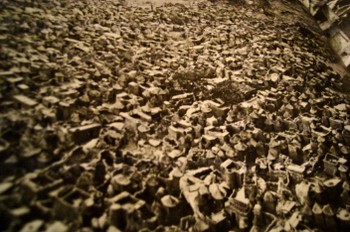
    Sometimes it works to read the description of what the image is before actually viewing it to see the differences of the image that you form in your brain before seeing the thing itself.  For example, when reading about the Dogon, a cliff-dwelling people of the plateau of Bandiagara, south of Tombouctou, and how they would make houses and then towns out of the rocks fallen from cliffs, you get what is probably a pretty benign image.  When you see photographs of these structures it seems as though the brain just simply isn’t ready for their impossible nature, though you quickly, instantly, recover (once you convince yourself the photo is real) and—voila—your mind has been expanded.  (This photo is from an expansive work by Bernard Rudofsky, Architectures without Architects, Doubleday, 1964.) 

    The (internally) spectacular Etienne Boullee can greet us in the same way with some of his eye-popping architecturalBoulle1
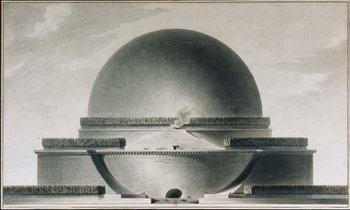
    creations (unbuilt architecture by an architect, in this case, compared to the built architecture of the non-architects above).  Boullee’s “Plan du Cenotaphe de Newton”, a gigantic memorial to Newton  that was dancing with necessary privacy in Boullee’s brain during the French Revolution (and also during a particularly un-Newtonesque time in on-your-knees-to-Cartesian-principles France)  is another superior example.  Reading the description of the structure just doesn’t quite do, and it seems whatever grand comes of that is tarnished and stripped away  by the obesely florid sentiment of none other than Ledoux’s poetic sentiments “…O Newton!  Sublime Mind!  Vast and profound genius!  I conceived the idea of surrounding thee withBoulle2
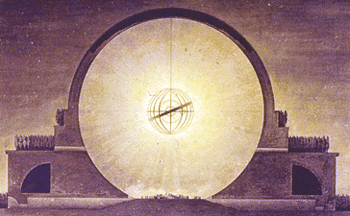
    thy discovery…”.  Oy.   Boulle adds to this inspirational atrocity by saying of the sphere:  “…we must speak of a grace that owes its being to an outline that is as soft and flowing as it is  possible to imagine…”   And once the demand of “oh  dear god just please show me the picture” is met, we are left with a turned-around brain and another heavenly exaltation, or profanity.  The Cenotaph is just Grand-Canyon-Spectacular. 

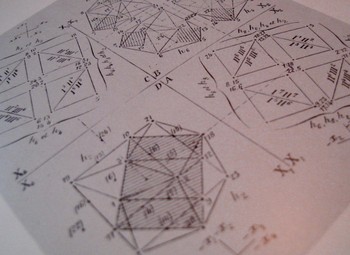
    Complex can turn on the simple in this way, where we can have those “a-ha” moments from, say, early efforts at picturing the fourth dimension or non-Euclidean geometry to a new perspective of looking at Roman ruins.  The arrival on the non-Euclidean geometries  in the 19th century posed new issues, not the least of which was representing the ideas.  Our saintly Hermann von Helmholtz believed –contrary to most elevated opinions—that the human mind could indeed intuit complex space and figures of these geometries.  (The difficulty not only from the obvious intellectual hardships in picturing the concepts but also because the geometry of Lobachevsky http://www-groups.dcs.st-and.ac.uk/~history/Mathematicians/Lobachevsky.html was called somewhat into doubt when some of its results were cast in doubt by contemporary astronomical observations.—and this even though so far as the great Gauss was concerned there was no deviation in Euclidean values.)   Helmholtz did this by employing the three-dimensional pseudosphere model of Beltrami.  (Reluctance to these ideas would end soon enough, for, as Linda Dalrymple Henderson points out with such sotto voce, “the convenience of Euclidean geometry would prove inadequate once Einstein” hit in 1905.)
    Dsc04585
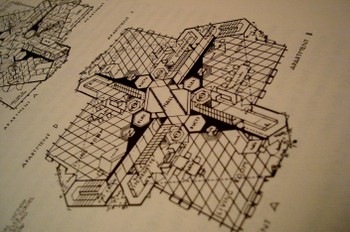
    The work of Beltrami  and H.P. Manning  (Geometry of Four Dimensions, 1914), and Jouffret  (Traite elementaire de geometrie a quarte dimensions, Paris 1903) in illustrating these complex ideas (the titles of which were in themselves daungting as with Jouffret’s “plane projections of the sixteen fundamental octahedrons of an ikosatettrhroid”) would in themselves prove to be entirely irresistible to the world of the arts.  Charles Howard and Maurice Princet I think had as much to do with  the creation of cubism and abstract art and the imaging of time than anyone, including the painter (I shudder to say his name) of Les Demoiselles (1907) or the lovely Georges Braque (Houses at Estaque, 1908) or Jean Metzinger or even the sublime comedian Duchamp’s Nude DescendingDsc04584
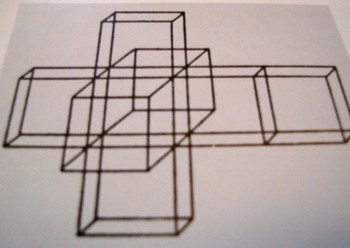
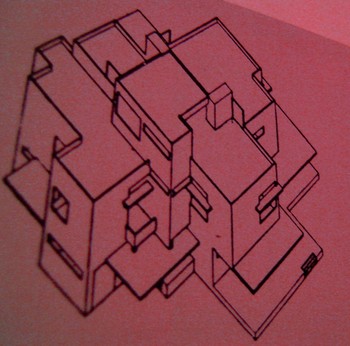
    (1914).  The hypercube starts to show up a lot in some Bauhaus genres and even into the palette of Frank Lloyd (“Stinky”) Wright (with his St. Mark’s Tower plan, NYC, 1929).Dsc04589 I can only imagine the shock to the brains of these creative geniuses in seeing the display of such a novel idea.  (For the ultimate treatise on this see Linda Dalrymple Henderson’s The Fourth Dimension and Non Euclidean Geometry in Modern Art, Princeton  1983).  And no the art didn’t come first. 
    Dsc04578

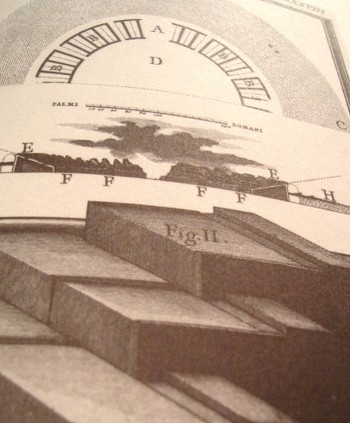
    But coming back to the simple, and in the same frame as the first example that we mentioned in Lockyer, we have the unlikely find of Giovanni Piranesi.  In my opinion his most spectacular work is found in his frammeni (the diverse bits and pieces of architectural and sculptural bric-a-brac found objects that are collected together on one stage) and in his archaeological detail.   His attention to new perspective in showing the crucial aspects of structure and building in Rome is tremendous andDsc04590
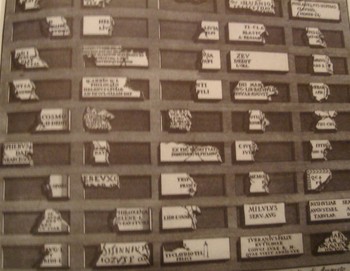
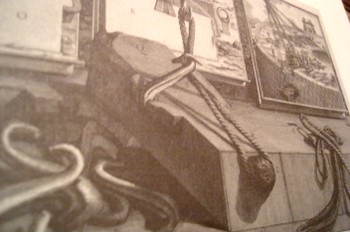
    unexpected—as an example we see here the child’s-eye-height view of three steps of the reconstruction of the theatre of Pompey.  I must say that I’ve seen a lot of architectural images in my time but nothing quite comes to me so surprisingly as this step-level view of the reconstruction of a Roman theatre,  This happens throughout the lesser-known Piranesi, with great details of tools, and cross sections of the very deep Dsc04591
    footings of bridges, and so on.  It is really refreshing, lovely, unexpected work. 

    We’ll return to this subject from time to time as I have hundreds of interesting examples to draw from—for example, the remarkable Emily Vanderpoel’s Colour Problems (which has surfaced in this blog from time to time) which is ostensibly an undecipherable attempt to quantify color arrangement in art but through the lovely examples displaying this attempt pre-date the modern re-invention of non-representational art by at least a dozen years.  Stay tuned! Dsc04592

  • Inventing (1) Old Tone in New Violins & (2) New Tone in Old Violins. Patent Models.

    JF Ptak Science Books  Quick Post

    Finding old tone in the 19th was attempted in the following way, an interesting if not myopic attempt to put some play-time in a brand-new violin:

    First page clipping of GB 190303723 (A)

    Abstract of  GB 190303723  (A)

      Payne, R. H., and Broadbent, T. Feb. 17, 1903.

    In an instrument for reproducing sound, a resonating-chamber is used instead of a diaphragm and a trumpet. In the construction shown, the resonating-chamber consists of a violin body C mounted on an arm D extending from the instrument A. Fig. 2 shows means which may be employed for the mounting. The pin E passes through a hole in the neck C’, which is clamped by the nut E’. The pin E is mounted in the wooden block F journalled in the fork H on the swivelling-pin. Washers G, G<1> prevent the communication of vibrations to the arm D. The hole in the neck may be dispensed with, a screw or spring clamp being employed in place of the pin E. The reproducer K, Fig. 3, is cemented to the violin belly. The style K<1> is clamped in it by the screw K<2>. The violin has the usual sound post and f-holes in the belly and also holes C<2> in the back. Strings may be stretched across the resonator. When a violin body is used, the strings are stretched by the usual pegs in the neck. 

    This is not the most elegant invention for producing a more-interesting music from a stationary, non-human-played violin. 

    On the other hand, this is:

    The work is by Henry Konrad Sandell, and the patent was for a magnificent machine that produced 64 notes on the violin, and was accompanied by a 44-note piano, both played at the same time. It is a very impressive accomplishment, with several thousand of them produced over two dozen years by the Mills Novelty Company.

    Source, here. Mills Novelty, here  Henry Konrad Sandell,  and a photo of a restored and lovely Violinola, here with a sample of the music it produced (!)

    ·Posted by :

    ·in:

    —

  • Happy Anniversary! Unsliced Bread–the Best Thing Since Sliced Bread.

    JF Ptak Science Books   Post 1855     Almost on this Day in 1932…

    Bread3

    Thanks to Emma Digh Ptak who gave me a book on the history of bread for Father’s Day!  Thanks, Buddy! 

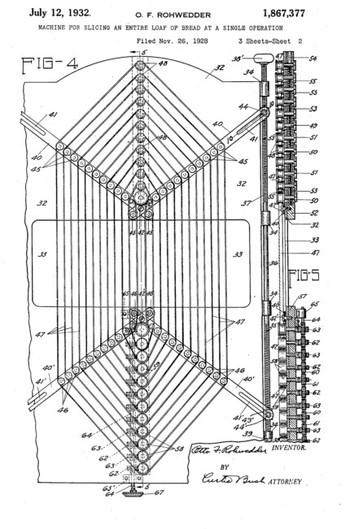
    This expression has a bit of a scent of death, of corporate sameness, about it. Its tale is one of innovation, deceit, deception; of ridding independence and quality, of providing a gross replacement for quality in the name of mechanized progress. The progress came in the form of a continuous loop delivering exactly the same loaf of bread, endlessly, to be cut and bagged and delivered to consumers–brought to us at t he expense of 97% of all of the bakeries that have ever existed in this country.

    The replacement of the small bakery began slowly, around 1850, proceeded with caution to the turn of the century, and was basically completed by 1940. In 1900 the small bakery outnumbered the corporate producers by 80:1. By 1939 the large company absorbed the practice of 95% of all dollars spent on baked goods. It was the continuous-belt bread baker that started of the replacement process in 1850 and 1866, sending the breadBread_patent_2 through long ovens on the endless feed. This was the start–it was in the high speed mixers that made the domination possible, thoroughly dispersing the yeast throughout the dough, making it possible to produce almost the exact same loaf of bread time and time again. It was then that the bread cutters–which had been around for some time but more or less perfected in 1928–could really do their job and finish production. The cutters would work exceptionally well so long as the stuff that they were cutting was the same–this done, multiple loaves could be cut every second, hundreds of times a minute, thanks to the mixer. Efficiency had reached high speed, and the cutters performed their revolutionary task.

    By 1942 the show was over for the small bakery–their non-uniform, hand made, thickish, irregular products replaced by bread clones: white, spongy and terrifically porous, and something that, once squeezed, would return to its original shape.

    Bread2

    The masterwork on the coming of mechanization is by S. Gideon, and is called Mechanization Takes Command, published by Oxford, (New  York), in 1948.  It is a work of great beauty and insight.  


  • Mathematical Sticks & Unmagic

    JF Ptak Science Books  Quick Post

    Just a quick post here on patented mathematical tools using long wooden planks in a sliding frenzy to find displayable answers for 19th century schoolchildren and their addition problems.  I know a good set of Napier’s bone could come in very handy (appearing much earlier on than these instruments), but I’m just not sure what kids could learn from using these tools–like any other calculating device, early or late, they have a questionable quidity so far as appreciating the essence of numbers is concerned.   That said, the drawing for the Meyers’ machine is beautiful, and could no doubt lead to a number of short, noir-y stories.

    Source:  Google Patents, here.


  • The First Sightings of Great Things: the Telephone, March, 1876

    JF Ptak Science Books   Post 1845

    Bell patent close
    Besides it being the Centennial year, 1876 saw a number of major games in the history of human thinking. Sometimes the announcements or earliest public appearances of these breakthroughs didn’t get all that much attention.  As one of the major means of transferring technical and applied science info to teh general public, it is interesting to see how Scientific American reacted to such innovations.  For the thick, heavy volume for 1876, amid

    Bell patent
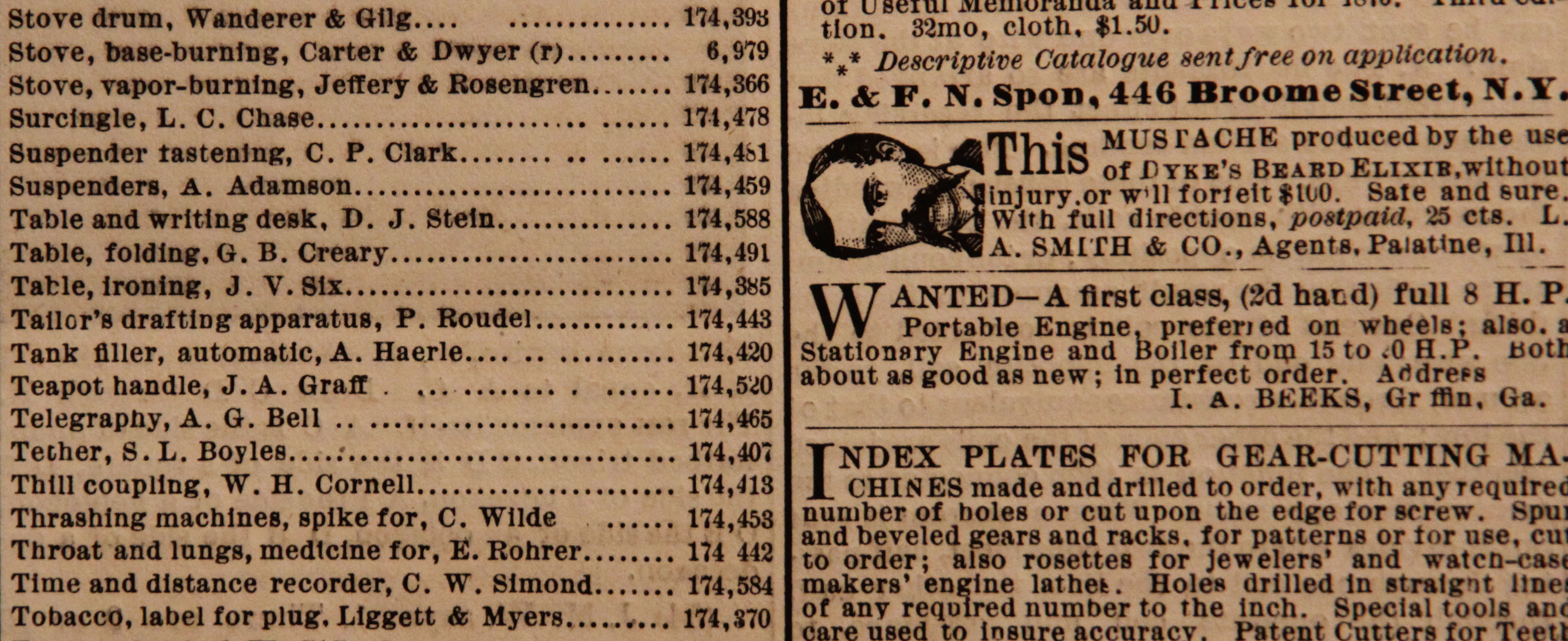
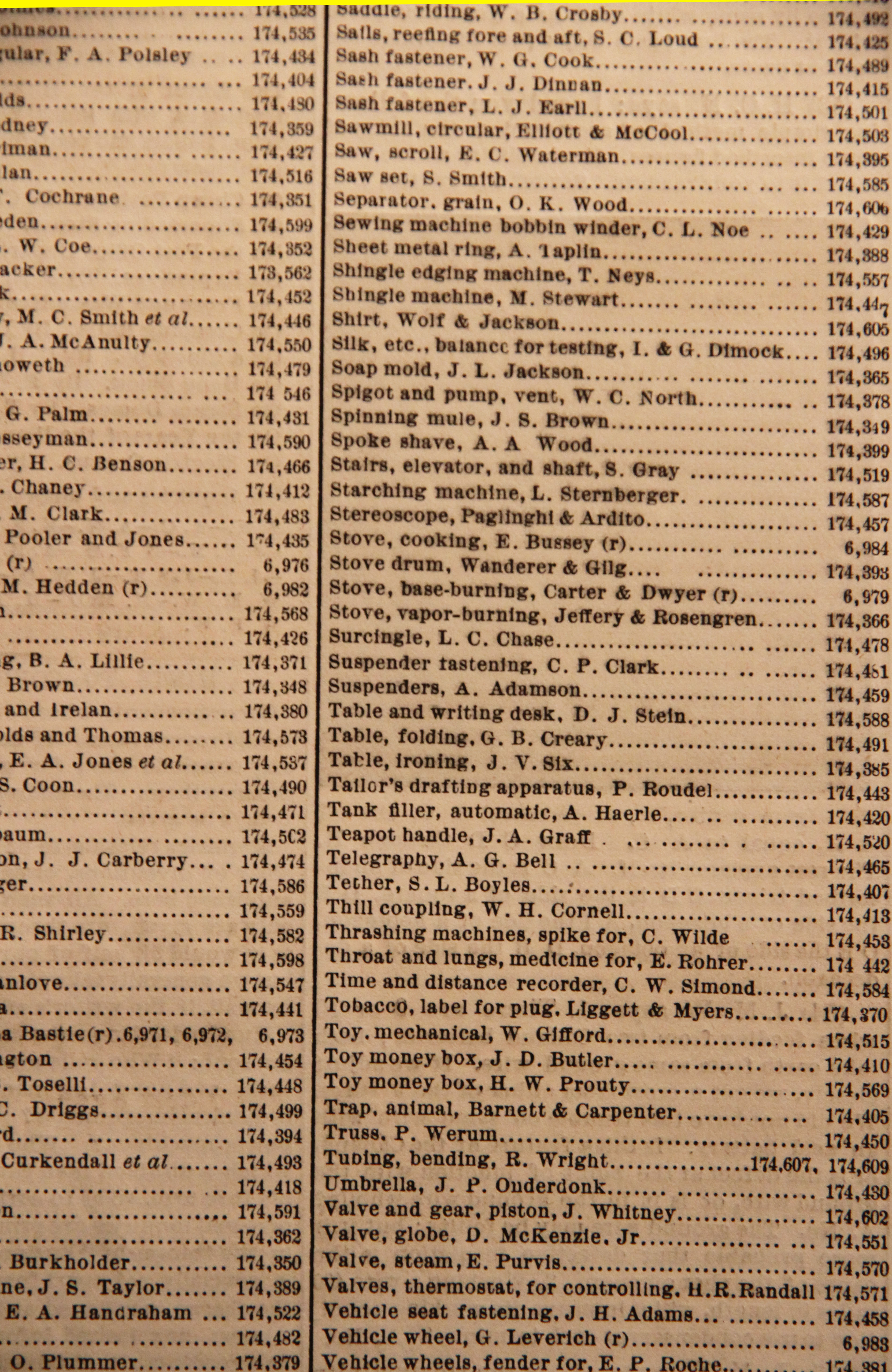
    patent announcements and articles on telegraphic fire alarms, electro-harmonic multiplex telegraphs, recording telegraphs, electro-magnetic telegraph railroad car signals, signal box telegraphs, underground telegraphs, telegraph keys and armature, acoustic telegraphs and the l;ike (though there weren’t that many reported, not really, just on the order of dozens), we find one of the most important of them all, patent # 174,465, by Alexander Graham Bell, appearing 8 April 1876.  It would be a rude resumption of being here in the future of this event to call the coverage short-sighted

     In an earlier article in the 4 March 1876 issue of SA, there appeared “The Invention of the Telephone”, by P.H. Vander Weyde, in which there is yet any mention of Mr. Bell.  There is an illustration of one of his precursors in the field, the Reuss telephone, with ample description. (This was actually Philipp Reiss, and his telephone really wouldn’t work to transmit the human voice, though did so work for music to some degree.)  Bell’s patent  would be at the Patent Office in March, and would appear as a one-line notice (among a hundred others), the patent stating it was “the method of, and apparatus for, transmitting vocal or other sounds telegraphically … by causing electrical undulations, similar in form to the vibrations of the air accompanying the said vocal or other sound”.  (The first image above is a detail; the second image a longer version, which is really only less than half of what the real-life version looks like in the tall listing.)

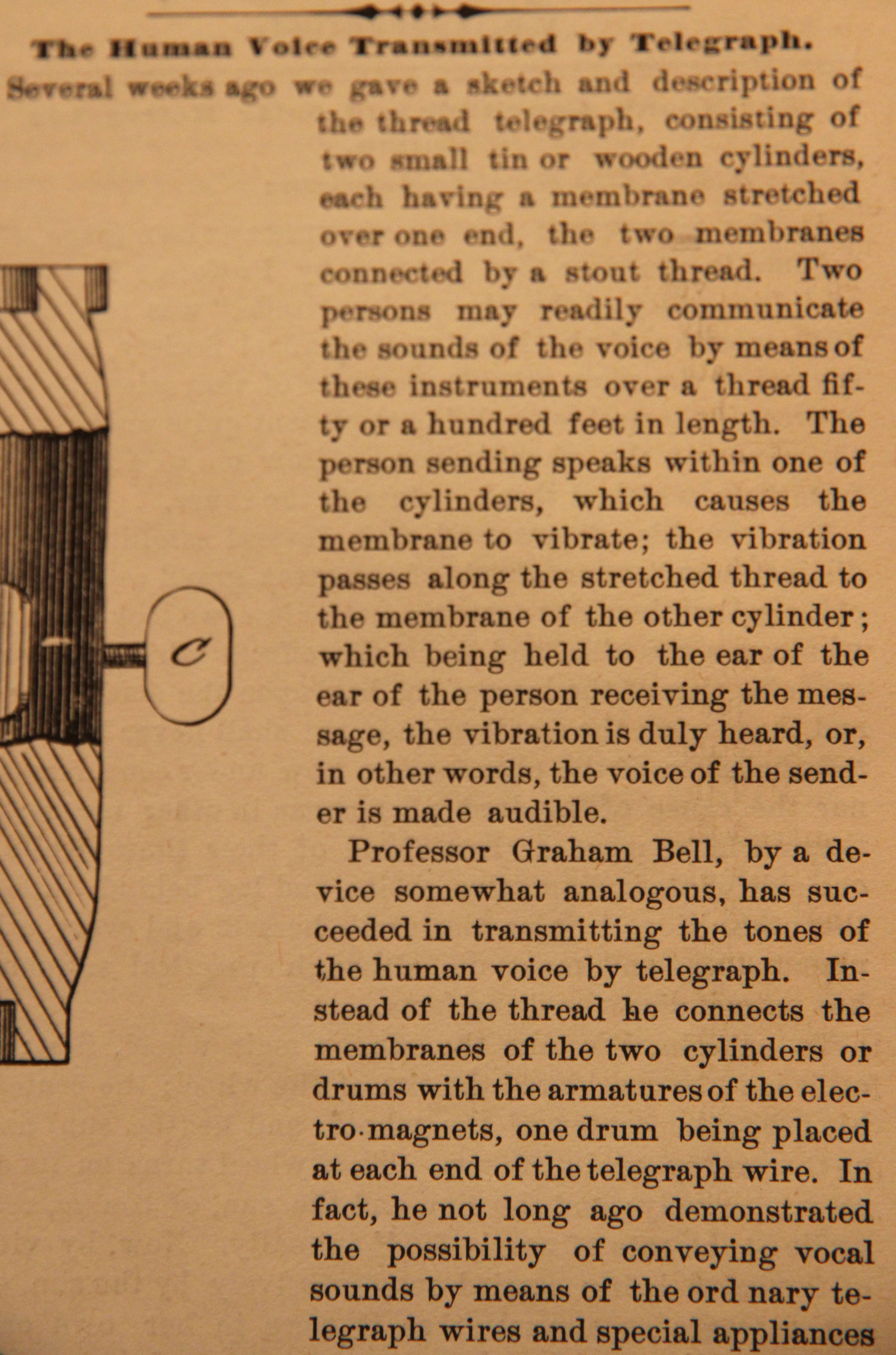
    Weeks later, Elisha Gray‘s (on 13 May) telegraphic telephone patent (175071) appears in the Scientific American, and later, on 9 September, on page 163, there is the article “The Human Voice Transmitted by Telegraph”, on the successful transmission by Graham Bell. 

    Bell human voice

    Admittedly there were a number of developments in the production of the speaking telephone at this time, though in general there seems to have been no great attention paid them in the pages of the Scientific American than pipe cutting machine improvements or improved gravel separators.  Obviously the great impact of the invention was yet to be appreciated, even in any sort of fictional way.

    The original volume of these reports is available for purchase via our blog bookstore, here.

    Some of the earliest speaking telegraph patent illsutrations follow:

    ·Posted by :

    ·in:

    —

  • Daily Dose of Dr. Odd: Blackboard Technology, 1850-1900

    JF Ptak Science Books  Quick Post

    Einstein chalkboard
    What is there not to like in a blackboard?  Doing work on a blackboard is a definite commitment, thinking done out-loud, brain squeezings that you had to stand next to and own, creativity done on the fly with plenty of room for annotations.  And so how would you accommodate an expansion of the display of thought or instruction in the 19th century?  There were evidently plenty of ways around just having a big piece of slate on a  wall, as these U.S. Patent Office application/grant drawings will show. 


  • Found Surrealist Parabolic Art, 1905

    JF Ptak Science Books    Quick Post

    A continuation–of sorts–of “Earths Inside the Earth“, which is part of the History of Blank, Empty and Missing Things series.

    This wonderful bit of Found Surrealist artwork is part of a series of patent drawings by Sir Hiram Maxim, inventor of many things (including the Maxim Gun, which was the first portable fully automatic machine gun, but not the electric light bulb as he claimed, and many many other things) for a hollow spherical structure made to deceive, thrill and confuse the people inside the structure with parabolic mirrors. An amusement.  This is not out-of-keeping for Maxim, as he also designed a “Captive Device Flying Machine” for amusement parks that every kid today would recognize. 

    But I do like this drawing, the third of four for the patent application, and I guess it gives a pretty good approximation of what folks might see inside his amusement palace of combined optics and sensory confusion. 

    Here’s the cross-section of the structure:


    Which is a detail from the set of patent drawings for


  • Zodiacal-Sexual-Social Indicator: Astrological Prediction Tool, 1919

    JF Ptak Science Books   Quick Post

    As these things go, this mechanical device is awfully pretty in an Outsider-y kind of way, and I have no doubt that I’d want to own one if for nothing else than for its explicit implied-complexity (whatever that is).  [Source: US Patent and Trademark Office.]