JF Ptak Science Books Post 1855 Almost on this Day in 1932…

Thanks to Emma Digh Ptak who gave me a book on the history of bread for Father’s Day! Thanks, Buddy!
This expression has a bit of a scent of death, of corporate sameness, about it. Its tale is one of innovation, deceit, deception; of ridding independence and quality, of providing a gross replacement for quality in the name of mechanized progress. The progress came in the form of a continuous loop delivering exactly the same loaf of bread, endlessly, to be cut and bagged and delivered to consumers–brought to us at t he expense of 97% of all of the bakeries that have ever existed in this country.
The replacement of the small bakery began slowly, around 1850, proceeded with caution to the turn of the century, and was basically completed by 1940. In 1900 the small bakery outnumbered the corporate producers by 80:1. By 1939 the large company absorbed the practice of 95% of all dollars spent on baked goods. It was the continuous-belt bread baker that started of the replacement process in 1850 and 1866, sending the bread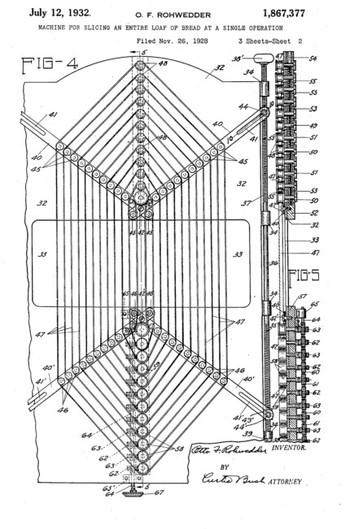 through long ovens on the endless feed. This was the start–it was in the high speed mixers that made the domination possible, thoroughly dispersing the yeast throughout the dough, making it possible to produce almost the exact same loaf of bread time and time again. It was then that the bread cutters–which had been around for some time but more or less perfected in 1928–could really do their job and finish production. The cutters would work exceptionally well so long as the stuff that they were cutting was the same–this done, multiple loaves could be cut every second, hundreds of times a minute, thanks to the mixer. Efficiency had reached high speed, and the cutters performed their revolutionary task.
By 1942 the show was over for the small bakery–their non-uniform, hand made, thickish, irregular products replaced by bread clones: white, spongy and terrifically porous, and something that, once squeezed, would return to its original shape.

The masterwork on the coming of mechanization is by S. Gideon, and is called Mechanization Takes Command, published by Oxford, (New York), in 1948. It is a work of great beauty and insight.