JF Ptak Science Books Post 1894
“…stars…Numerous, and every star perhaps a world Of destined habitations”–Milton, Paradise Lost (1668)
In spite of a fairly long (if not light) and ancient history, it seems as though Christian Huygens might have thought more to the shaping of extraterrestrial life than any writer to his time. [The idea of extraterrestrial life is very old, stretching far back into Hindu cosmology, and even deep into the (eighteen worlds) of the Talmud. Thales, Anaximander, Democritus, Aristole, Ptolemy all thought about and agreed on the possibilities of life being lived on places other than the Earth–infintely more life, in the case of Epicurus. Bruno, Copernicus, Fontenelle, Henry More, and Cyrano de Bergerac.] In a way, in a Asimovian way of rules, Huygens may have laid out the first real template for describing what life-not-on-Earth might look like. And in the long run, he finds that the possibilities for life Elsewhere are enormously high (and not in doubt in any way), and that it should in no way be any lesser life-formed than what we know here on Earth–and that includes “life” in all of its great complexities.
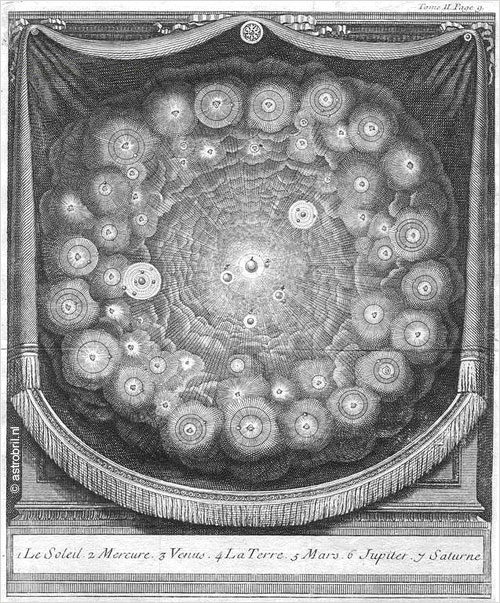
[One of the few images made during this time or earlier on the possibilities of world systems outside our own appeared in Bernard le Bovier de Fontenelle–who almost but not quite gets there in his 1682 book Entretriens sur la pluralite des mondes, as follows, though it really has not much at all to do directly with Huygens:]

Huygens (1629-1695) worked across many fields, including astronomy, biology, math and physics, and was extraordinarily productive, making numerous contributions in the physical and theoretical areas, as well as being a prolific author and correspondant. But towards the end of his relatively short life (he died at age 56) Huygens embarked down the science fiction road in pre-science fiction days, writing a wonderful and provocative book entitled Cosmotheoros, The Celestial World Discover’d: or, Conjectures Concerning the Inhabitants, Plants and Productions of the Worlds in the Planets (available online in English here) where he establishes the groundwork of this extraterretrial life. (The book was nearly published during Huygens’ lifetime, but it didn’t quit ework out; left to his brother to published, he, too died before the book was finally in print in 1698. Shortly after the Latin edition of the Cosmotheoro was published by the The Hague publisher Adriaan Moetjens, translations appeared in English (1698) and in Dutch (1699). In the following years, translations also appeared in French (1702), German (1703), Russian (1717) and in Swedish (1774).)
Hugens set out his description by arguing that extraterrestrial existence of life is perfectly in keeping with the Bible, and that his”conjectures are not useless” or “overcurious”, and that are justified in and of themselves as a useful pursuit because of the display of logic in his arguments. He states that the inherent sinfulness and “villany” of man on Earth does not perclude life elsewhere, and these lifeforms coul dbe everywhere else, and no different from our own, with no differences in ability to reason and explore. Lifeforms exist much like us, with at least five senses (and here Huygens makes an interesting play for more-than-give senses, though he doesn’t understand what they might be), and are capable of all of the supporting capacities for enjoying astronomy, and logic, mathematics, physik, arithmatic, and all of the rest, including all possible skills that could be called upon in the production of instruments of science necessary to pursue any endeavor, and all enjoyed in a society as expectently rich as any on Earth, enjoying all of their plants and animal lifeforms, all of their own creations and the rest of the creations of Nature, all while listening to a universe-wide application of music (“everywhere immutably the same”, which Huygens states beautifully here:)
“It’s the same with Musick as with Geometry, it’s every where immutably the same, and always will be so. For all Harmony consists in Concord, and Concord is all the World over fixt according to the same invariable measure and proportion. So that in all Nations the difference and distance of Notes is the same, whether they be in a continued gradual progression, or the voice makes skips over one to the next. Nay very credible Authors report, that there’s a sort of Bird in America, that can plainly sing in order six musical Notes: whence it follows that the Laws of Musick are unchangeably fix’d by Nature, and therefore the same Reason holds valid for their Musick, as we even now proposed for their Geometry”–(page 86)
Cosmotheoros’ pages are filled with such reasoned arguments–remarkably so for the end of the 17th century, barely 90 years after the great publication of Galileo and 40 aftre the work of Hooke (in exploring infinities at the other end of the optic scale).
I’ve included some interesting parts from Book One of the Cosmotheoros; the subject/section headings are in red, and the page number (which usually appears mid-sentence) is related as [23]. Huygens occasionally referes to the other non-Earth life forms as “Planetarians”. Here’s a sample: