JF Ptak Science Books Quick Post
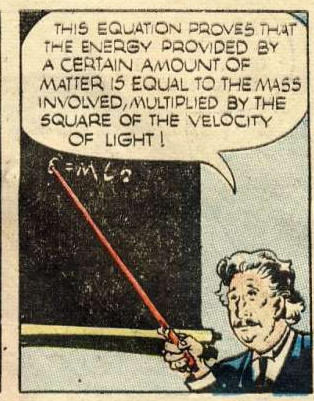
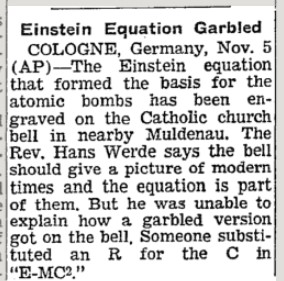
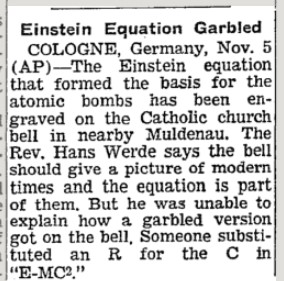 I think that this is the first time I’ve seen E=mc^2 incorrectly written in the same journal article. It occurs in a filler article in a 1950 slug filler piece in the New York Times (sorry I do not have the exact date/page) reporting on a church near Cologne incising its bell with the world’s most famous equation but getting it wrong. The NYT reports that the equation was written as E=mr^2 instead of E-mc^2 [sic with the minus sign]. And there you have it. Highly unusual—this also comes just about two years after the first appearance of the equation that most kids know appeared in a published article by Einstein himself (in Science Illustrated, April 1946). Extraordinarily there is almost an earlier appearance of the equation in its most-known form in a kids’ comic book called Science Comics (January 1946) where it is written on a blackboard in the background as Einstein lectures to an odd assortment of scientists. I’ve wondered where the writer/artist/ink/etc. got the equation from…perhaps the Smyth Report of 1945 (page 2)? I really don’t know, though the equation is evidently first seen in a published paper by H.A. Lorentz in 1913. Maybe the comic books folks didn’t have great access to that info back there in 1946. Anyway I just wanted to share this unlikely pair of misprints from 1950.