A Daily History of Holes, Dots, Lines, Science, History, Math, Physics, Art, the Unintentional Absurd, Architecture, Maps, Data Visualization, Blank and Missing Things, and so on. |1.6 million words, 7500 images, 4.9 million hits| Press & appearances in The Times, Le Figaro, Mensa, The Economist, The Guardian, Discovery News, Slate, Le Monde, Sci American Blogs, Le Pont, and many other places… 5000+ total posts since 2008.

Category: World War I

  • New York City in Danger of Attack (1917)

    JF Ptak Science Books   Overall post 5149
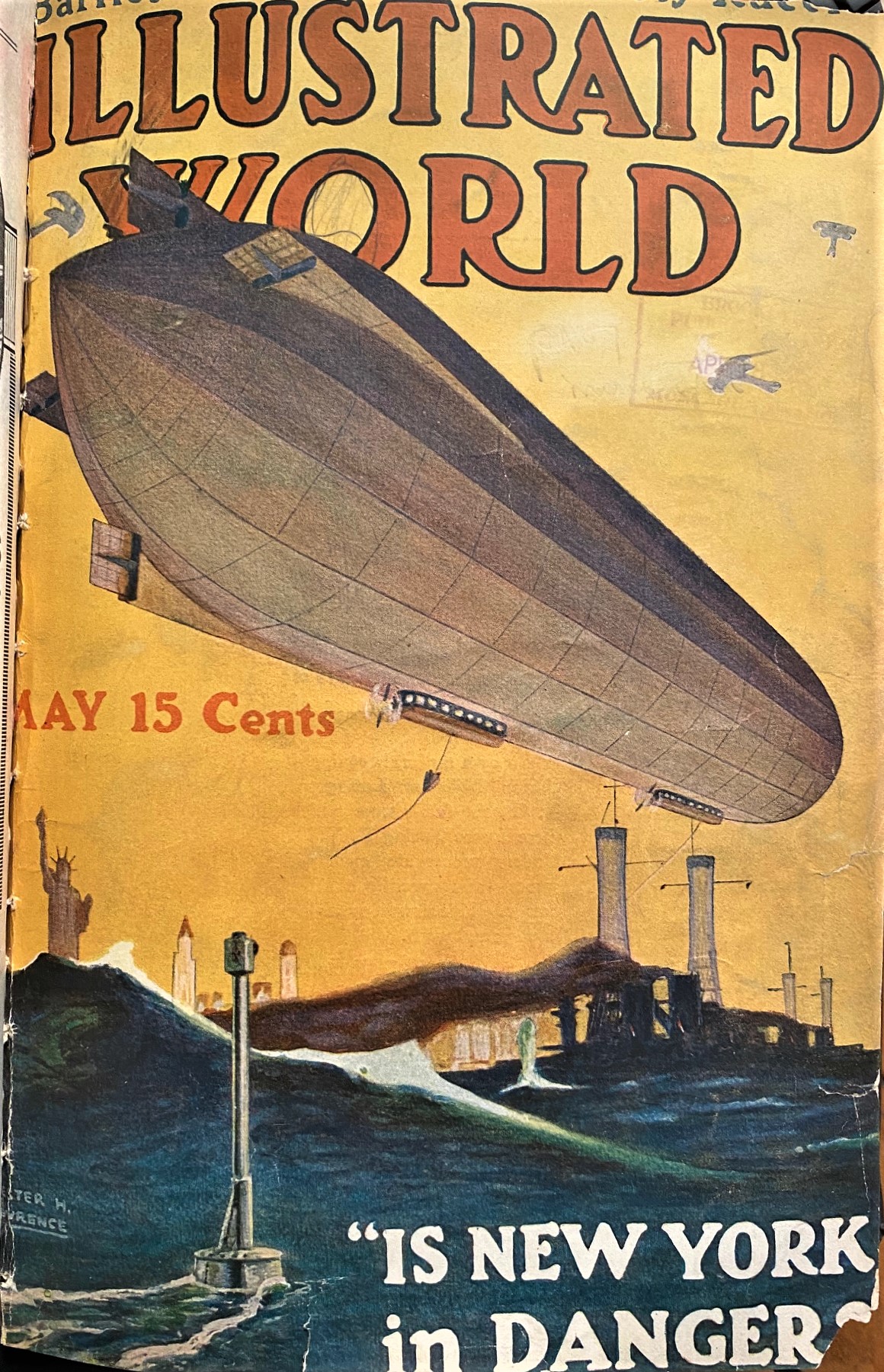
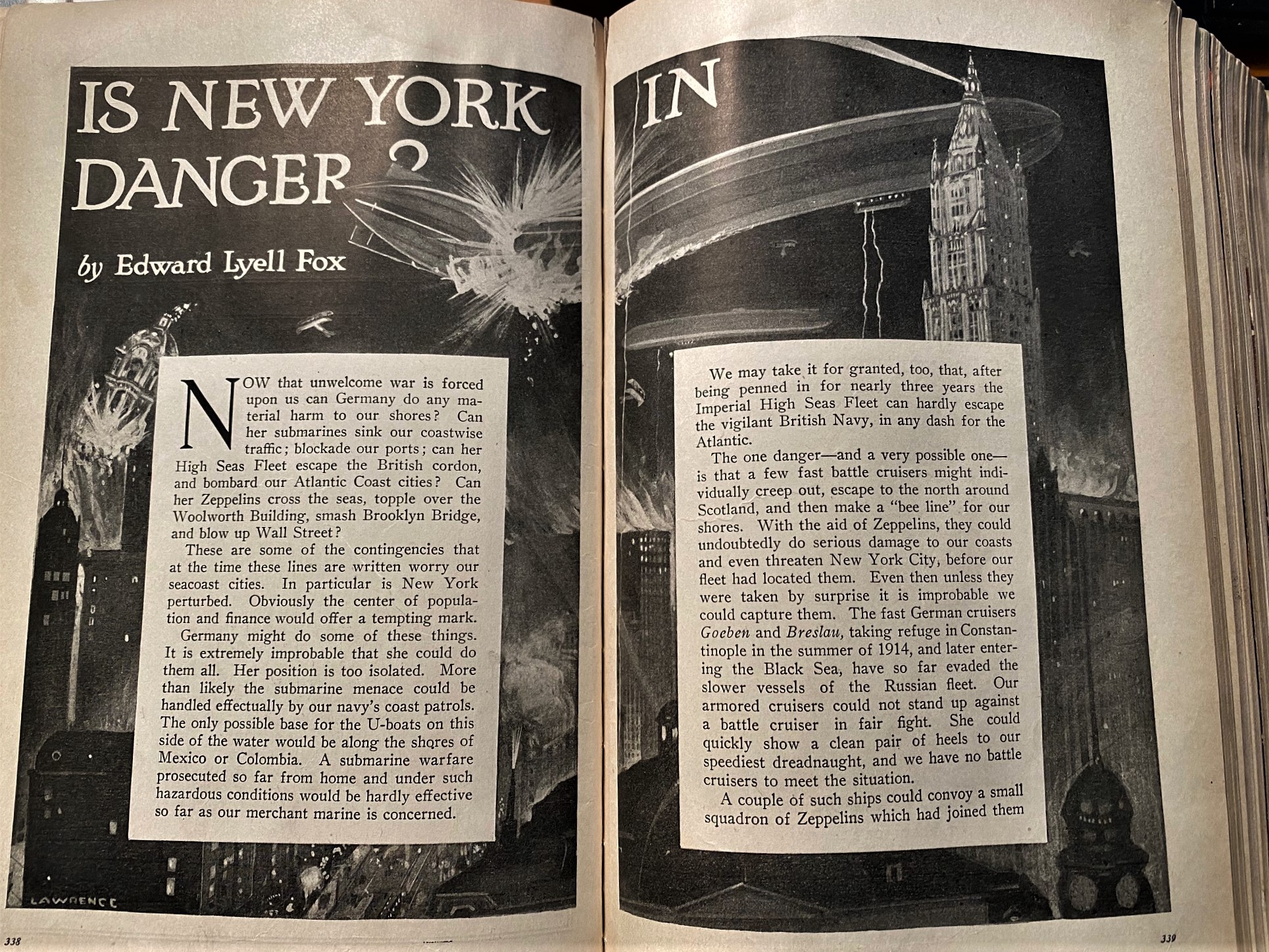
    IMG_8774The New York City harbor looks pretty rough in this picture, tall whitecaps with surprising little reflected in what should be pretty choppy water, meaning that light should be reflecting everywhere, a difficult collection of reflected reflections. 

    [Image source:  May 1917 issue of the uncommon magazine, Illustrated World. The entire article is reproduced below.]

     The submarine, battleship  and zeppelin menaces were real, at least in Europe or in the Atlantic–the aeroplanes far less so.  But the applications of these fears directly to American shores were still very distant things, particularly when it came to an attack on New York City–except of course that the U.S. had just declared war against Germany, finally, just a few weeks before this issue was published.

    The war began for real in Europe in August, 1914, so the fighting had been going on there in fratricidal earnestness for two and half years, costing millions and millions their lives and limbs.  America had been isolationist and non-interventionist up until this point, remaining sweatily on the sidelines, until the capture of the infamous Zimmerman telegram, which was a coded message sent from Germany (the German Empire) to Mexico (and taken by the Brits as it was sent, the crypto-folks of Room 40 breaking the thing) suggesting that Mexico join in a war against the U.S.  It hit the American press on 1 March, and the story exploded–literally. This is what the beginning of war looks like, sometimes.
    IMG_8776

    So perhaps there was some amount of yellow journalism involved here, and some inflationary propaganda as well, and some good-old profit-taking on a half-sci-fi story–on the other hand, the German Empire did just sink 800,000 gross tons of shipping during the 30 days of April (1917), so sub fears were in general real and palpable.  The issue of them sighting the Staten Island Ferry though was quite another matter. 

    The first American soldiers would arrive for fighting in June.  The whole thing would be over in 17 months, which is well less than half of the time that the U.S. spent in WWII. 

    The United States would suffer 116,000 military deaths during its part of the war–a small fraction of the overall military deaths (9 million) and a smaller part still of overall deaths including civilians (totaling 16 million).  There would be 205,000 American wounded in this conflict, a little less than 1% of all war military casualties. 

    It would be interesting to see the coverage in England of the American invasion fears.

    [Article continues below]

  • Uncommon Photo of the Surrender of the German Fleet, 1918

    JF Ptak Science Books   Overall Post 5148

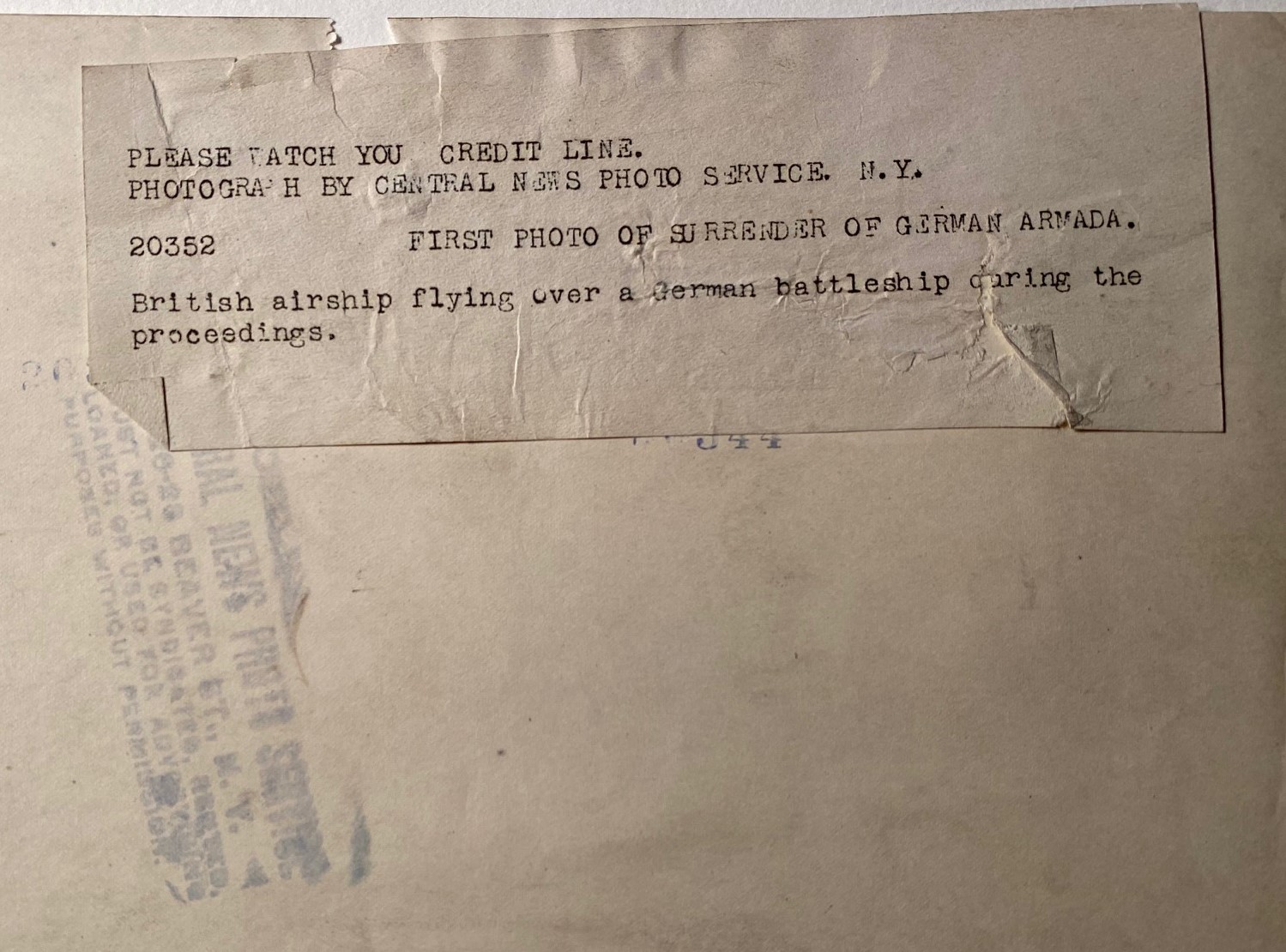
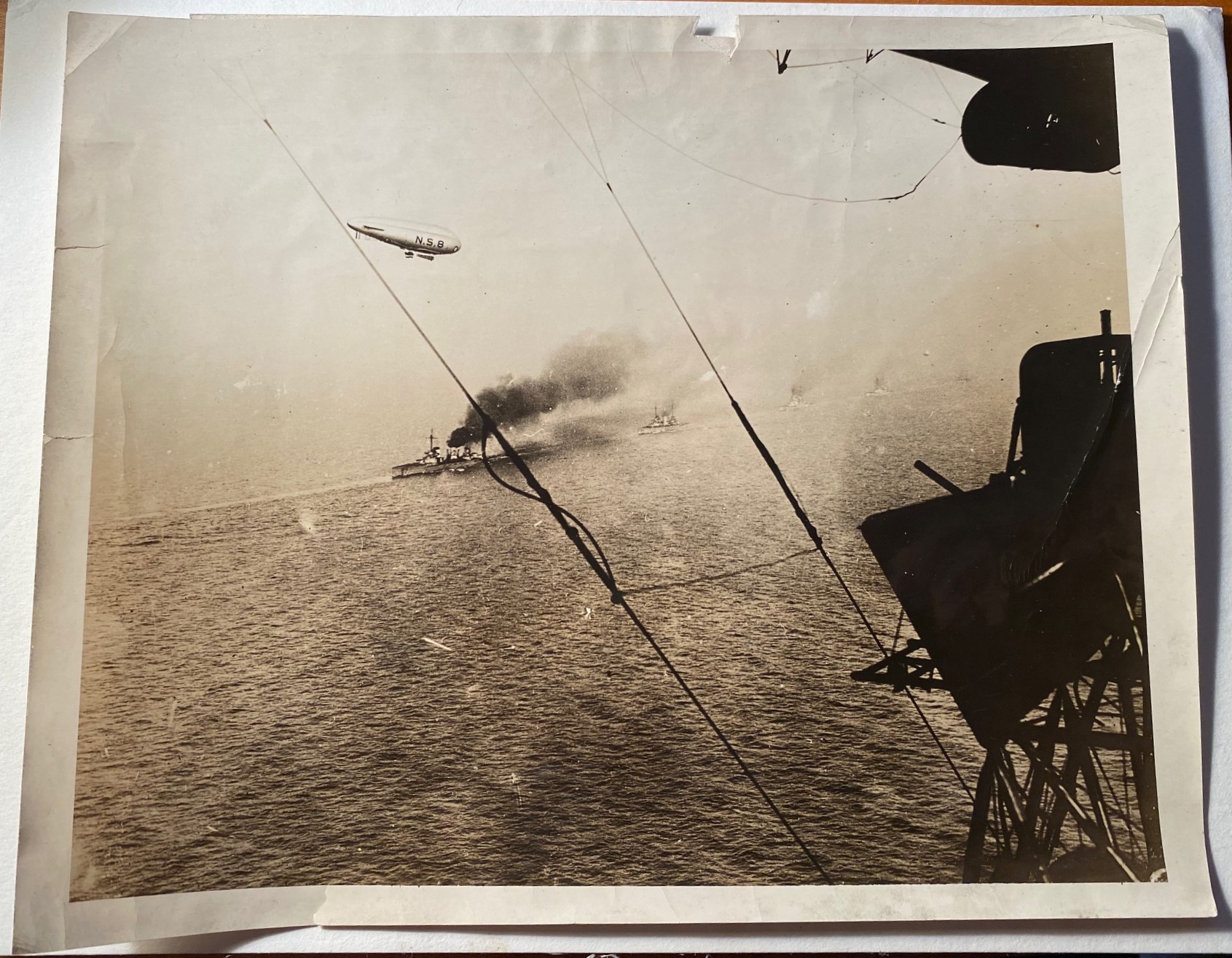
    This is a photograph of the surrender of the German high seas fleet at the Firth of Forth (Scotland), 21 November 1918. The image was undoubtedly made from an airship, and centers on the German battleship “Seyditz” with the British non-rigid airship “N.S. 8” (that’s “North Sea” #8) observing overhead. On that day Germany surrendered 4 battleships, 3 battleship cruisers, 3 light cruisers, and 50+ destroyers. I can find only one reproduction of this image online, and that in Spencer Tucker’s WWI: the Definitive Encyclopedia..., p. 961 (identifying that German battleship as the “Seyditz”), so I thought I’d share this fuller version. 

    IMG_7543

    IMG_7544The photo (measuring 8″x10″) has a pasted bit of paper on the back identifying the scene: “First Photo of Surrender of German Armada” and “British airship flying over a German battleship during the proceedings” with the maker/distributor identified as “Photograph by Central News Photo Service, N.Y.”  [ A note on WWI imagery from photo news services: WWI photographs were made by pools of photographers working for several different photographic news agencies. The content of the images were generally secured and approved by the Committee for Public Information (CPI), which came into existence by executive order under President Woodrow Wilson on April 13, 1917, and which was charged with the task of wining the hearts and minds of the people of the U.S., to gain public support for the war and for American participation. The way that many newspapers obtained the war images that they published in their papers was via a semi-centralized pool of war images.  The newspaper would request, say, a photo of German prisoners, and would contact one of these photographic agencies—for example, say, the Central News Photo Service of 26-28 Beaver Street, NYC—and purchase the rights for republication, and then print it in the newspaper along with the story.  In almost every case the photo would be accompanied by a caption mimeographed onto an attached piece of cheap paper, or have the information stamped on the reverse.] 

    ·Posted by :

    ·in:


  • Patriotic Snow Parade, 1917/1918

    JF Ptak Science Books    Overall Post 5147

    WWI--great imagessnow parade059


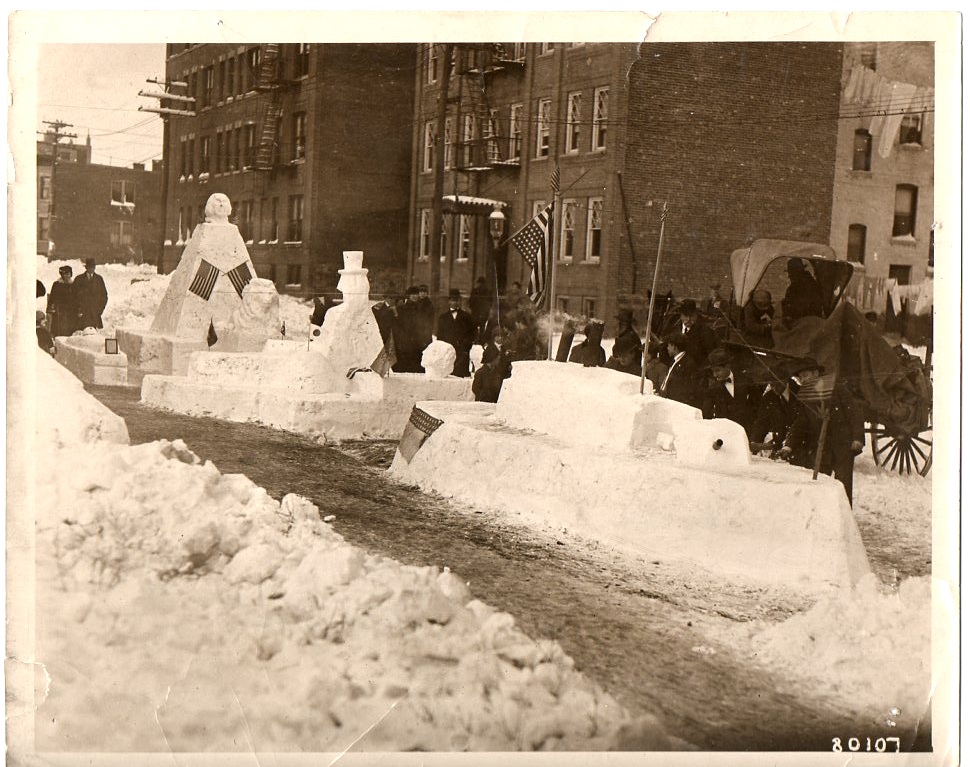
    This news photo service image–stamped “Hearst-Pathe News Agency” on the back–is from the winter of 1917/1918 and shows a patriotic snow parade somewhere in the United States.  The snow looks prodigious, judging from the piles in the foreground and also the accumulated snow on the windowsills, and I imagine that all of the snow floats were sculpted mainly out of exiting snow in the street.  It is a delightful scene, to me, and hosts a variety of smaller, lovely images in vignette. For example:

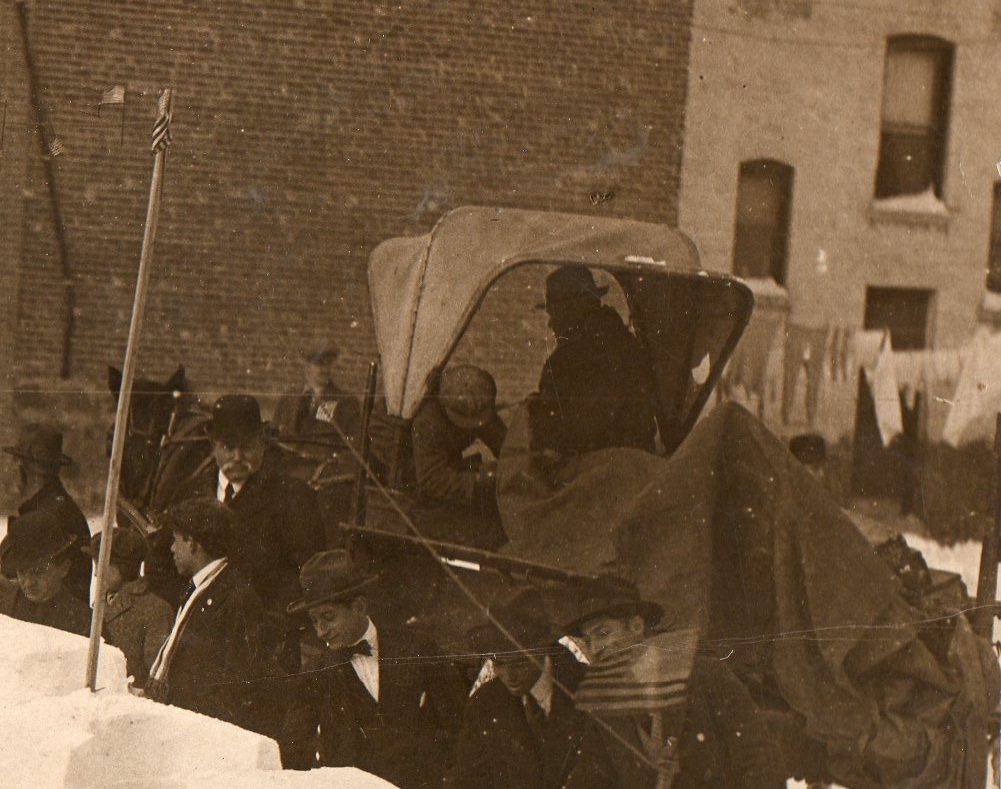
    WWI--great imagessnow parade060

    The man in shadow and sleeping/relaxed figure (boy) in the buggy complement the white-mustachioed bowler-wearing man to the left; the men looking on in the foreground are interesting, too–plus there’s that laundry in the background.  Given that the laundry is out (and wasn’t just left out during the storm) and that no one seems to be particularly bundled up against cold, I’m going to guess that there was a break in the weather that pushed the temperature higher than normal, with almost everyone taking advantage of the warm snap, as people do everywhere, all the time. (Or maybe not this at all, and that they’re northern folks, and are used to the cold.) 

    I also like the tiny American flag on the tall pole at left.

    ·Posted by :

    ·in:

    —

  • Unusual German WWI Book Reviews, 1936

    JF Ptak Science Books   Overall Post 5142

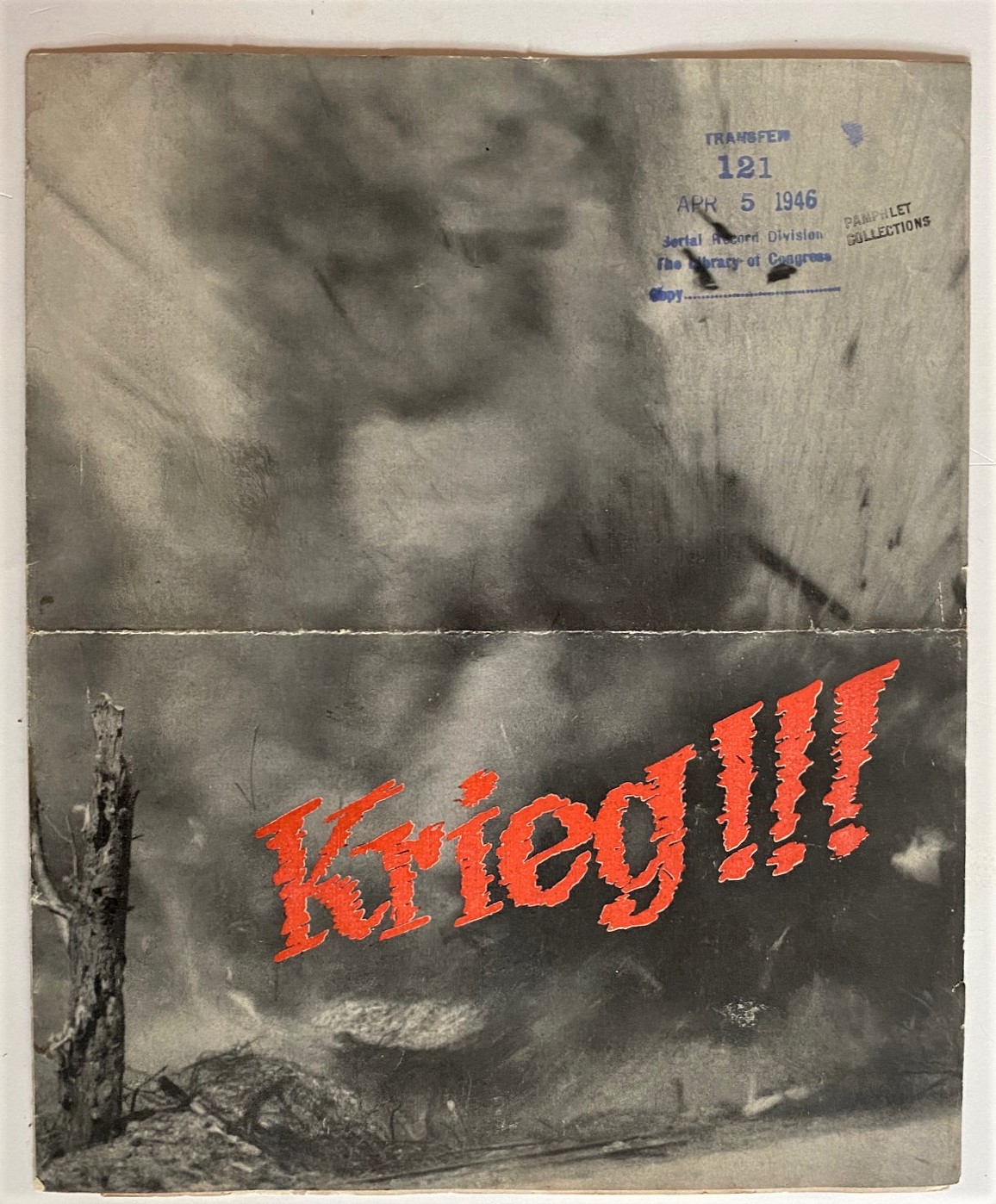
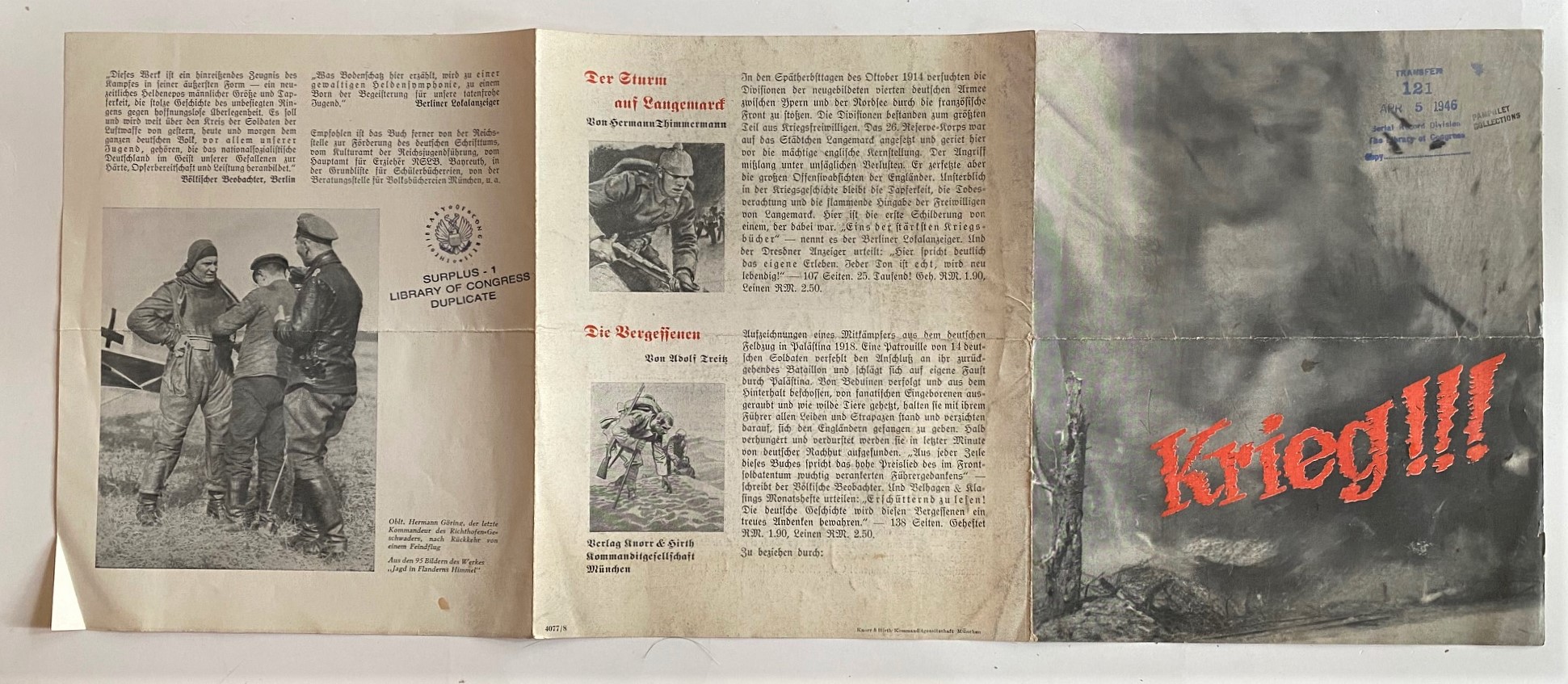
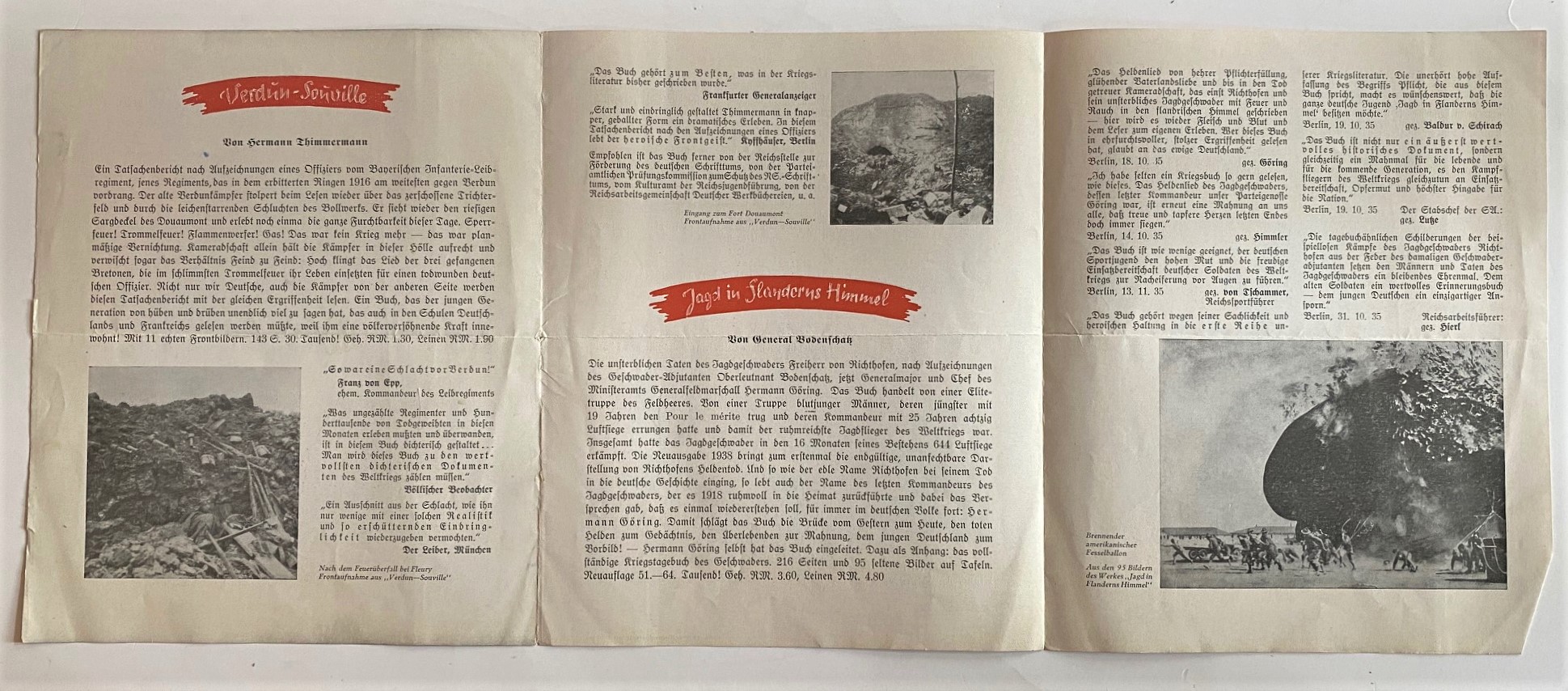
    IMG_7074Earlier today I catalogued a small tri-folding World War I-related leaflet printed in 1936 and emblazoned Krieg!!! The cover is striking, partly because in addition to the graphics it also shows something being blown-up in real time, which was a pretty uncommon thing to make a photograph of in WWI. It turns out that this little six-page pamphlet was a collection of eight book reviews written by German military about the war. And it wound up being surprising—to me, at least—because most of the reviews seemed as evocative as the cover art.

    A number of the reviews were surprising to me because, in some way, they seemed to be a little on the unglory of war and the suffering—not anything like Johnny Got His Gun, or All Quiet on the Western Front, but different and diffident enough to make an impression. For as short as this work is there’s a fair amount of discussion of the horrors of war as experienced and then shared by both sides.

    For example, in a review for Verdun-Souville, by Hermann Thimmermann, we find the work described as “A factual report based on the notes of an officer from the Bavarian Infantry Regiment, the regiment that advanced the furthest against Verdun in the bitter struggle in 1916…he stumbles again over the shot-up field and through the corpse-staring gorges of the bulwark…and once again experiences the whole horror of these days. Barrage! Flamethrower! Gas! It was no longer a war – it was planned annihilation. Comradeship alone keeps the fighters in this hell upright and even blurs the relationship between enemy and enemy…Not only we Germans, but also the fighters from the other side will read this factual report with the same emotion. A book that has an infinite amount to say to the young generation from here and there, which should also be read in schools in Germany and France, because it has a power to reconcile people!”

    Perhaps this was not unusual to post-WWI German renditions of the war, but to my experience it certainly seemed so, especially three years into Hitler’s Germany.

    Here’s part of the review for Sowar eine Schlacht vor Verdun, by Franz von Epp, former commander of the Leibregiment: “What countless regiments and hundreds of thousands of those doomed to death had to experience and overcome in these months is poetically told in this book …This book will have to be counted among the most valuable poetic documents of the world war.”–Volkischer Beobachter And: “An excerpt from the battle that only a few were able to reproduce with such realism and such shocking urgency.” Der Lieber, Munich.

    Of particular and unusual interest is a “lost patrol” story in the review for The Forgotten, by Adolf Treib: “Notes from a fellow combatant from the German campaign in Palestine in 1918. A patrol of 14 German soldiers missed the connection with their retreating battalion and made their way through Palestine on their own. Chased by Bedouins and shot at from ambush, robbed by fanatical natives and chased like wild animals, they and their guide withstand all suffering and hardships and refrain from giving themselves prisoner to the English. Half starved and dying of thirst, the German rearguard found them at the last minute.” and continuing: “From every line of this book speaks the high price song of the leader idea, which is powerfully anchored in the soldiers at the front…Shattering to read! German history will keep a loyal memory of these forgotten people.” – Völkische Beobachter

    That said, there are some glories celebrated here, particularly for the book Jagd in Flanderns Himmel, which is mostly about German aviation, where Himmler and Goering shower the book with praise “I have seldom enjoyed reading a war book as much as this one. The hero song of the fighter squadron, whose last commander was our party comrade Goering, is another reminder to all of us that in the end, loyal and brave hearts always win” wrote Himmler. Goering heaps praise as well, concluding “Whoever reads this book with awe and proud emotion believes in eternal Germany”.

    In any event, this is an interesting document, and I’ve reproduced it all, below, if you’d like to see it for yourself.

    IMG_7076
    IMG_7076

    ·Posted by :

    ·in:


  • The U-Boat Captain’s First-Person Account of Sinking the RMS Lusitania (1915)

    JF Ptak Science Books  Overall Post 5318

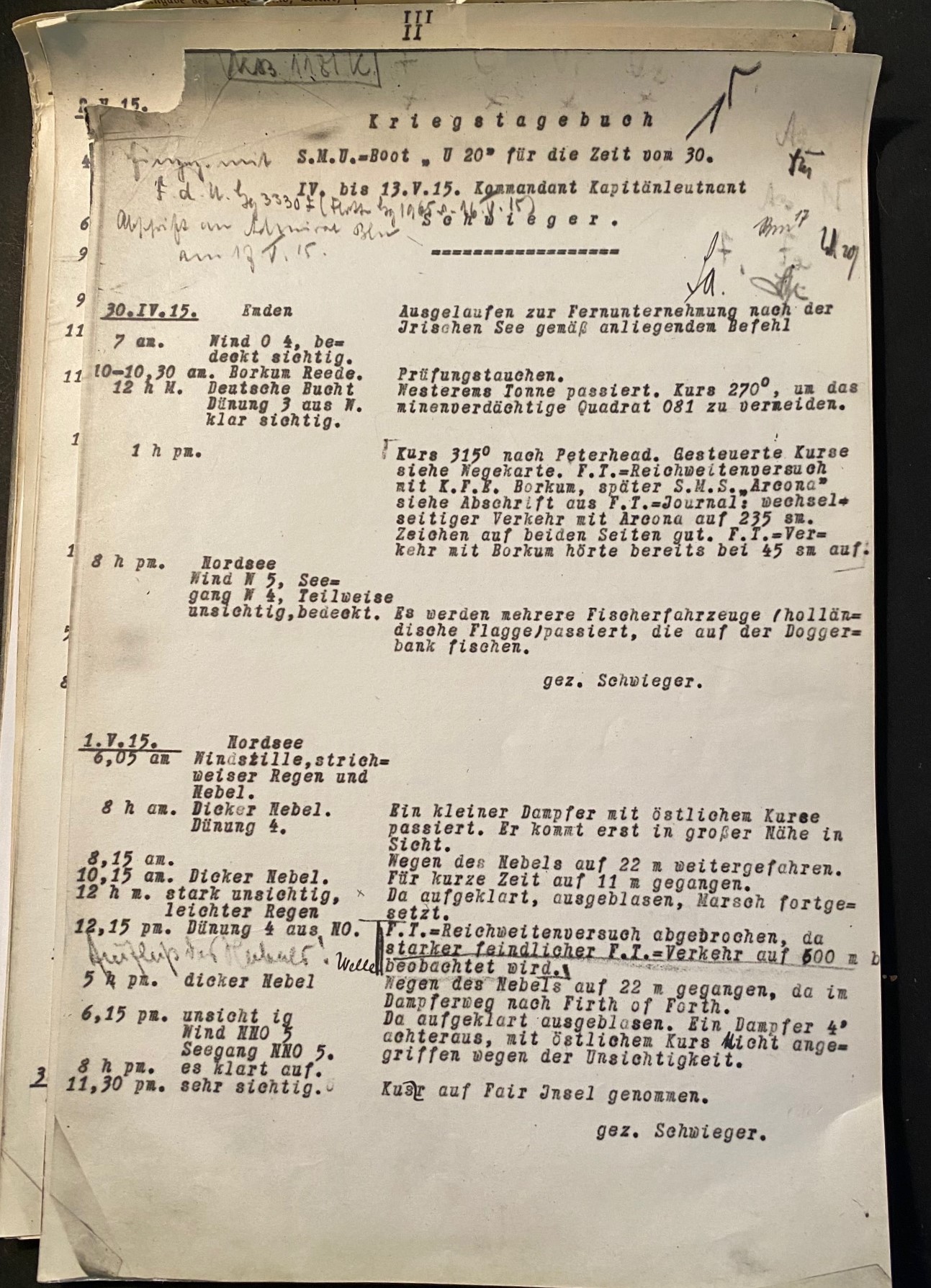
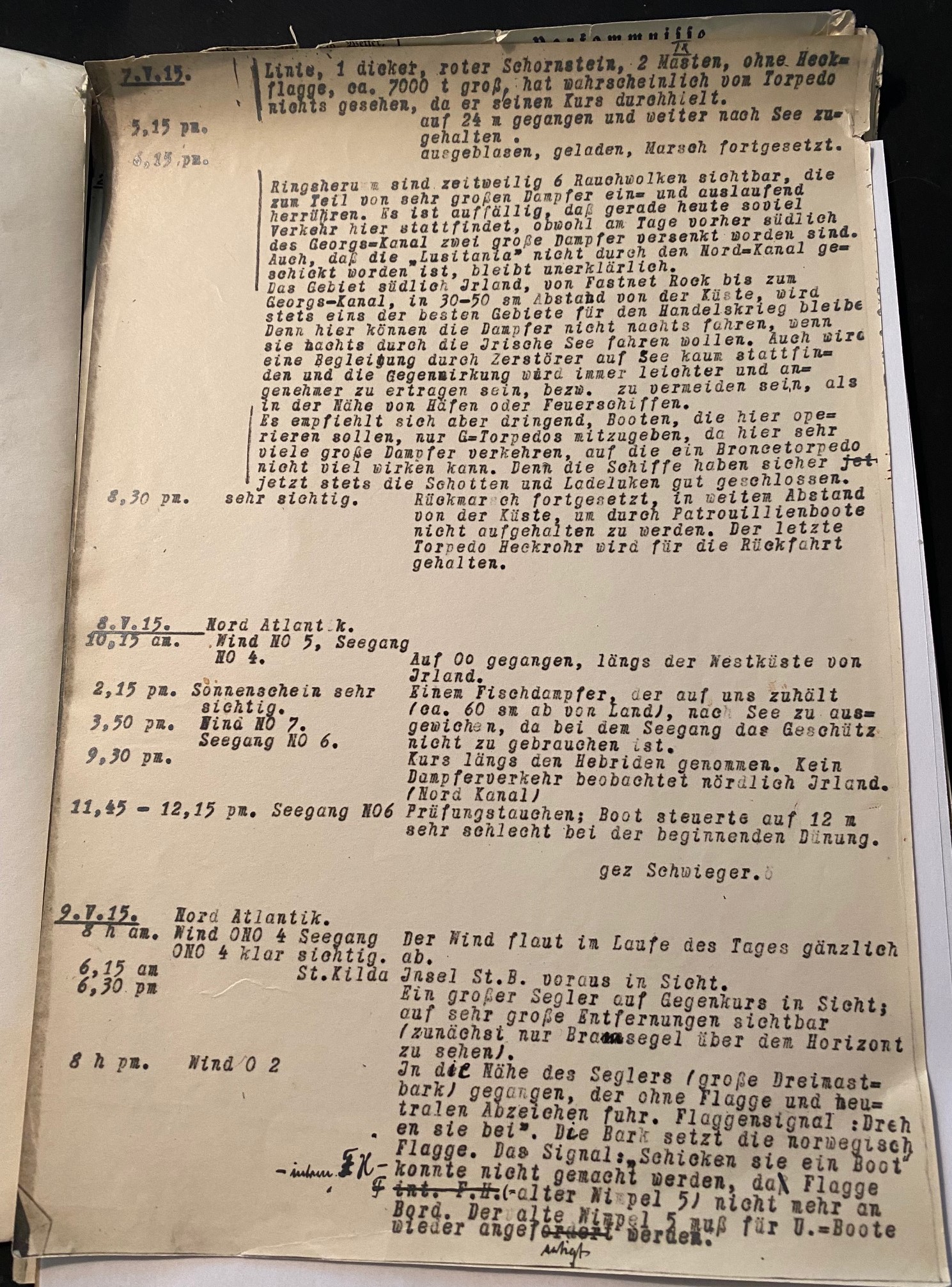
    IMG_5874The sheets presented here1 are very early photographs of the original war diaries of Captain Walter Schwieger, the captain of the German submarine SM U-20 who sank the RMS Lusitania in 1915.

    The period of coverage for these leaves extends from 30 April 1915 to 13 May 1915, the attack on the Lusitania coming on 7 May (which receives 1.5 leaves of coverage), and delineates the action by the hour. The periods before and after the Lusitania attack are highly documentary, well written, and descriptive. The story of the Lusitania itself is forensic but not without some reserved excitement, including the decision of not launching a second torpedo for the sake of not sending through many hundreds of survivors already in the water.

    A summary of the attack day—7 May—details that at 2:20p.m. Schwieger reports on tracking a possible target and then sees “four funnels” (“Schornsteine”), identifying the target as a large passenger steamer. Schwieger positions his boat and fires one torpedo “in the side close behind the bridge” followed by an “extraordinarily” large detonation, stopping the ship immediately and causing a severe listing. Schwieger then states that he sees “Lusitania” written in gold on the side of the ship.

    And then, at the end of the description of the attack on the Lusitania, when the ship was foundering, Schwieger writes that he could’ve sent a second torpedo to absolutely finish the ship, but didn’t because he didn’t want to shoot through a sea with survivors. “I would not have been able to shoot a second torpedo in this crowd of people who were saving themselves.” (“Auch hätte ich einen zweiten Torpedo dies Gedränge von sich rettenden Menschen nicht schiessen können.” pg viii 3:25 pm.)

    The Lusitania sunk in 18 minutes, with a loss of 1198 of the 1995 on board.

    The U-20 was launched 1912 and grounded in November 1916 when her crew attempted to destroy her. Their efforts were not complete, and I assume that Schwieger’s war diary was retrieved by the Royal Navy at that time. Schwieger commanded another boat—he met his fate against a mine, the boat sunk and the crew killed in 1917.

    The interpretation of the sinking of the Lusitania has been studied for a hundred years and the story is well known—it really isn’t necessary to repeat it here.

    I do not know who made the annotations—they appear on the documents that were photographed and not the photos themselves. Perhaps this will be useful for someone.

    Notes:

    1. (LUSITANIA) Schwieger, Walter, Kommandant Kapitanlieutenant (1885-1917), U-20. Kriegstagebuch S.M.U.-Boot “U-20” fur die Zeit vom 30.IV bis 13.V.15. 9 leaves, image on one side only, early photographs of the diary pages (ca. 1920’s-1030’s?). A copy of photographic sheets of Schwieger’s diary appeared in a traveling show of “Eyewitness, American Originals from the National Archives”, and also appears in a catalog for the show.

    IMG_5876

    ·Posted by :

    ·in:

    —

  • 1.8 Million Planes and 2 Million Tanks (1918)

    JF Ptak Science Books  Quick Post

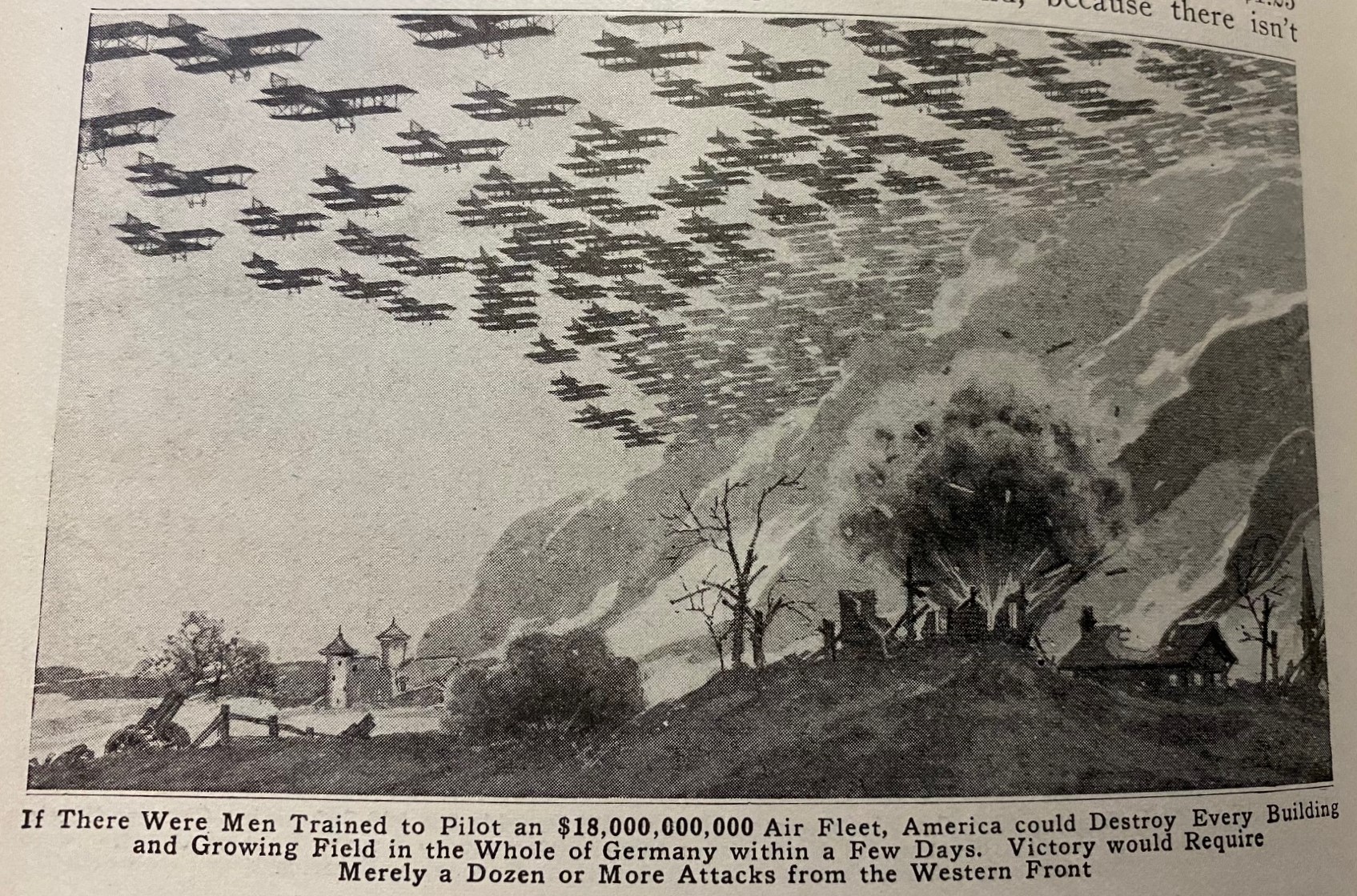
    Here’s a fine and somewhat misleading representation of the U.S. Congressional war allocation of 1918 for what was then the staggering figure of $18,000,000,000 (or about $387 billion in 2020 according to the BLS), found in the pages of Popular Mechanics for May 1918. To visualize the 18-billion, the editors displayed the amount in terms of something somewhat familiar to most readers.  For example, if the appropriation could be laid directly and only into the manufacture of airplanes (and bombs I guess) the editors guessed that the force would lay waste to all of Germany in about two days.  Guessing that each aircraft cost about $10,000 in 1918 that would mean there would be an attack force of 1.8 million planes.  Granting each a capacity of 500 pounds carriage, their entire force could deliver about 20% of the total tonnage dropped on Germany by the US and UK during WWII for each 1.8 million plane sortie.  (I’m guessing at some of the figures but I think that this is about correct.) Given that the “bomber plane” was still in its cradle, this could not have painted a very clear picture of what $18 billion dollars could buy.  Further guessing here is that there were fewer than 50,000 aircraft in existence in 1918, so imaging the 1.8 million figure would have been staggering. 

     IMG_3001

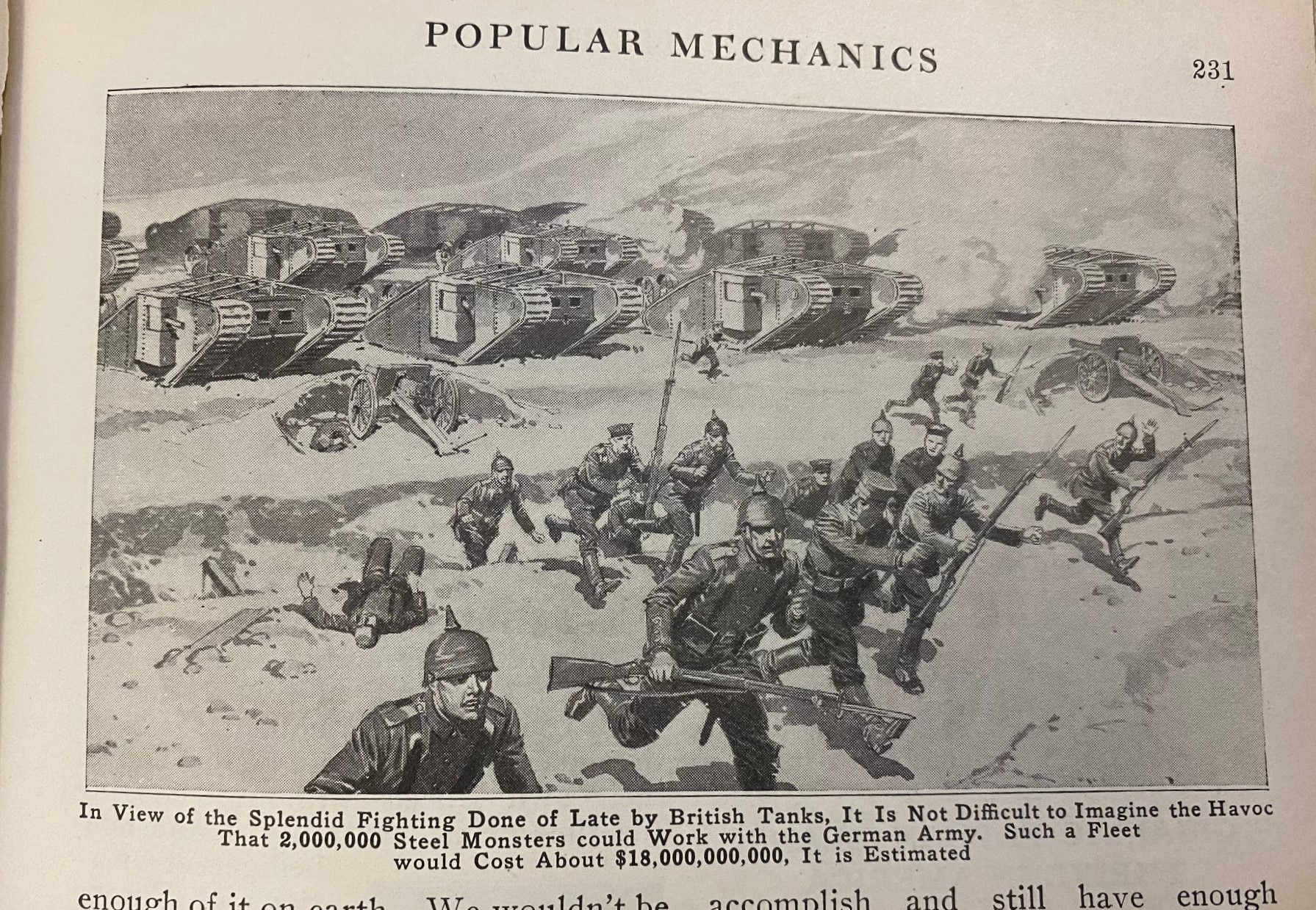
    IMG_3002Another example from the same article involves envisioning $18,000,000,000 worth of tanks, which in 1918 would cover fielding 2,000,000 of them. This of course is an enormous number, particularly having in mind that about 50,000 U.S. Sherman tanks were constructed between 1942 and 1945, which is about 3.5% of the total talked about in the article, and the largest tank battle in history at Kursk in July and August 1943 involved about 6,000 tanks between German and Soviet forces. Given too that the tank is only a few years on the battlefield at this point there was really no way that a person could visualize 2 million tanks–I suppose no commander in 1945 could have envisioned it, either.  

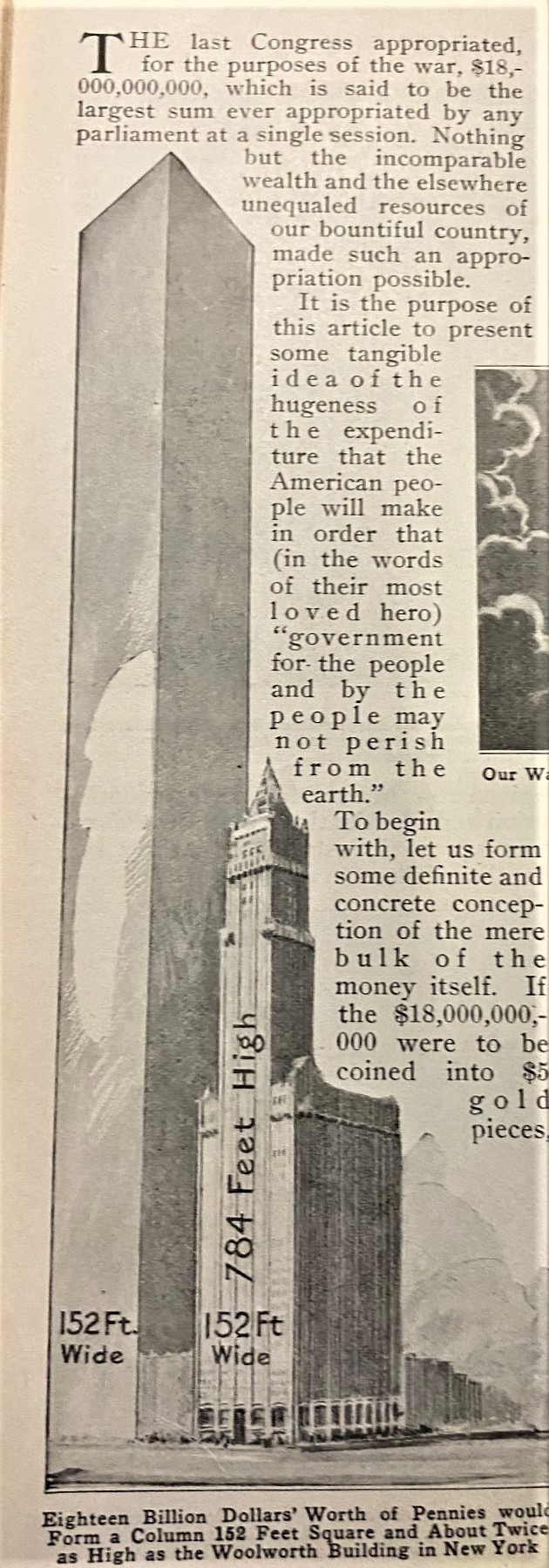
    And another example from the same article: using pennies and the Woolworth Building as comparables.  The Woolworth structure has found itself in a number of similar articles in the ‘teens, though I don’t recall seeing it compared to a 1.8 trillion penny mound, as we see below.  

    I think that the editors were just out and beyond their capacity in trying to visualize war funds in these comparative ways.

    IMG_2999


  • Justifying Chemical Warfare (1925)

    JF Ptak Science Books  Post 2904

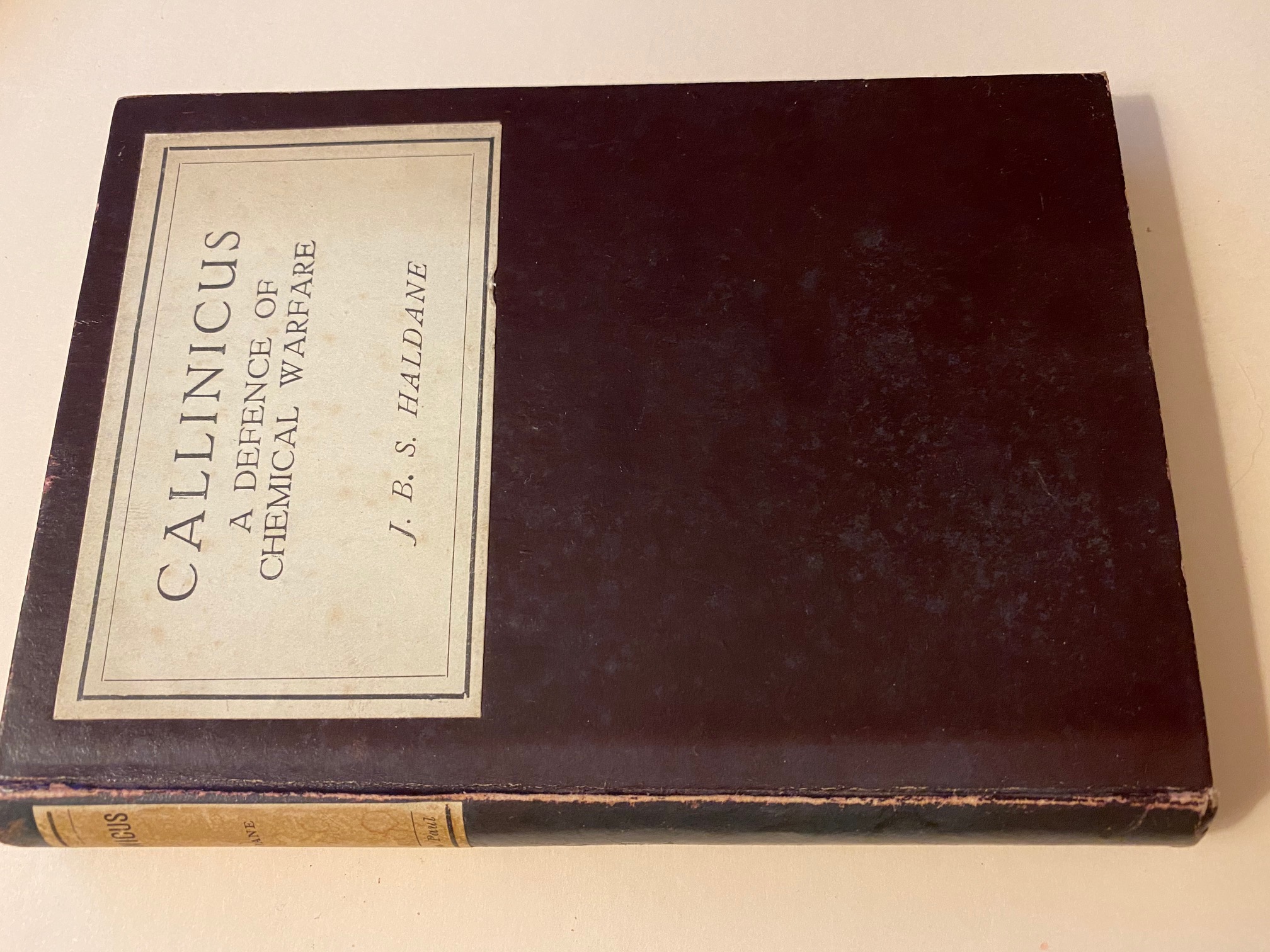
    IMG_2324

    J.B. S. Haldane (1892-1964, scientist/philosopher/veteran/Communist) contributed a provocative little one-hour read warfare and morality, making a case for the use of chemical weapons during war. I thought that this might be a Modest Proposal exercise, but it isn’t, at least to my reading of it. Callinicus, a Defense of Chemical Warfare (London 1925) is a call for expanding arms if arms is what was needed and if fighting was going to happen. Haldane would’ve been much happier with no fighting whatsoever, but if it were to be the case–again–he didn’t see much of a difference between chemical weapons and other sorts of armaments, as they both killed and wounded and incapacitated. A weapon is a weapon.

    “Why do we accept the invention of Major-General Shrapnel but prohibit the use of chemical weapons in war?” is what Haldane asks, and then proceeds to make his case.  

    The book’s title draws on the Syrian officer Callincus, who created the “Greek Fire” weapon, a flammable liquid, in in the Eastern Roman Empire in the 8th century CE. (“Callinicus1 Of Heliopolis, Callinicus also spelled Kallinikos, (born AD 673), architect who is credited with the invention of Greek fire, a highly incendiary liquid that was projected from “siphons” to enemy ships or troops and was almost impossible to extinguish.” Encyclopedia Britannica)

    An officer in 1914, Haldane was with the Black Watch (Royal Highland Regiment), and served with distinction, and did so at a relatively young age, and so was a witness2 to all manner of weaponry during the Great War. He makes a case for chemical weapons to be less grizzly than many other existing weapons and of those to come–and in the future category he gives a hat-tip to the possible invention of a weapon that sounded a lot like an atomic bomb.  It is an interesting discussion–one that backs you into a very disturbing corner, very quickly3. 

    Haldane ends the work so: “Such are the facts of chemical warfare. They will not be believed because a belief in them would do violence to the sentiments of most people.”

    Notes.

    A reminder that Haldane is the osurce for an often-repeated quote about the nature of the universe: “My own suspicion is that the universe is not only queerer than we suppose, but queerer than we can suppose.”

    1. “Born in Syria, Callinicus was a Jewish refugee who was forced to flee the Arabs to Constantinople. The ingredients of Greek fire were kept a state secret, known only by the Byzantine emperor and Callinicus’ family, which manufactured it. The precise composition is still unknown, but it is generally accepted that it was a mixture of naphtha, pitch, sulfur, possibly saltpetre, and some unknown ingredients. First used in the Battle of Cyzicus (c. AD 673) by the Byzantines against a Saracen fleet off Constantinople, Greek fire proved to be instrumental in that Byzantine victory.”–Encyclopedia Britannica

    2. Haldane also saw service during the war in the British chemical warfare program.

    3. “In Callinicus, Haldane makes the case for chemical weapons as a more humane, eugenic and ultimately more effective and efficient means of prosecuting modern warfare. In this bold advocacy, Haldane was facing an uphill battle, against the British press, who had propagandized against the ‘godless Hun’ and his poison gases, the fearful and scandalized public, and even his colleagues in the eugenics movement, who largely lamented modern warfare as dysgenic.”–Eugenics Archive (Canada) online timeline


    ·Posted by :

    ·in:

    —

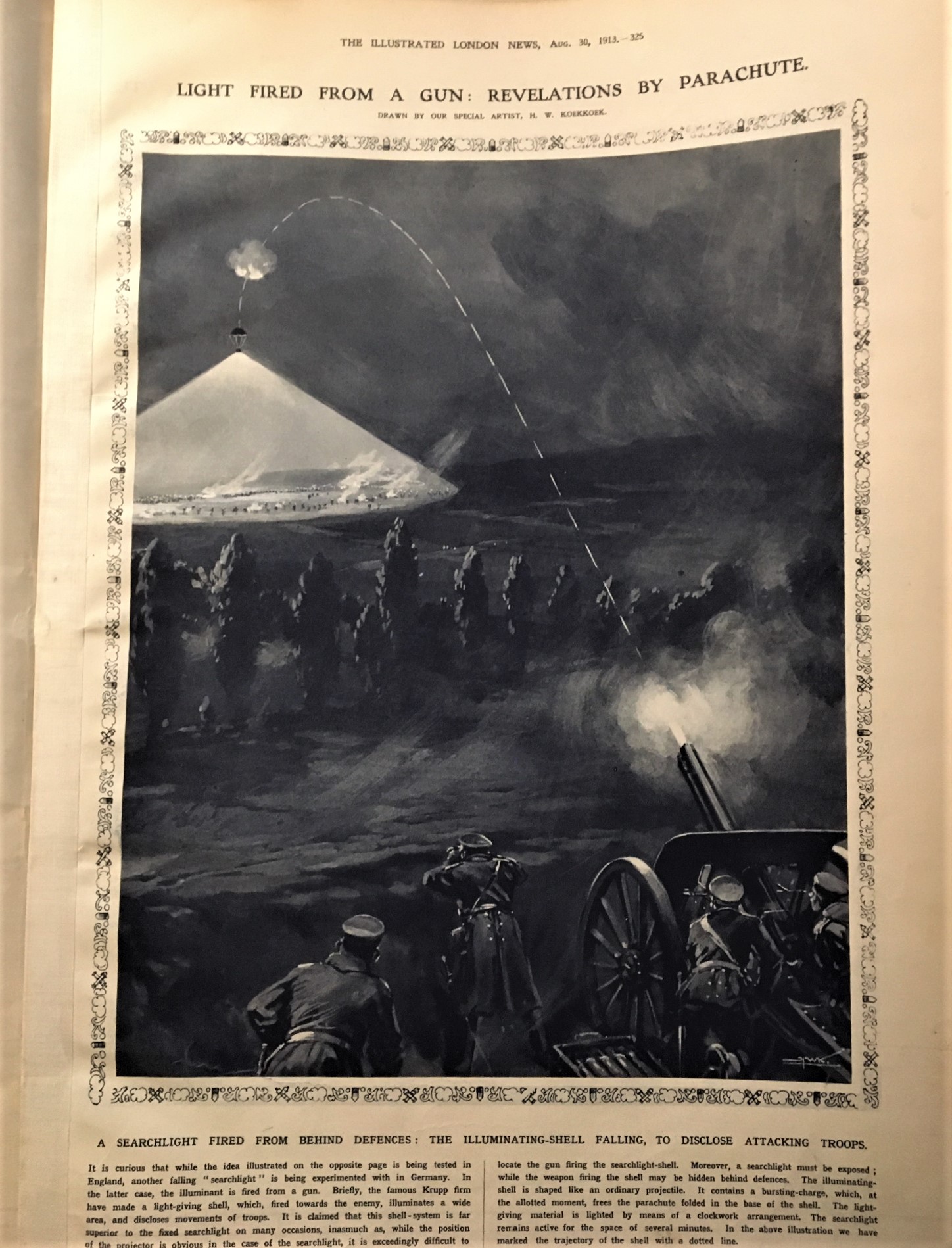
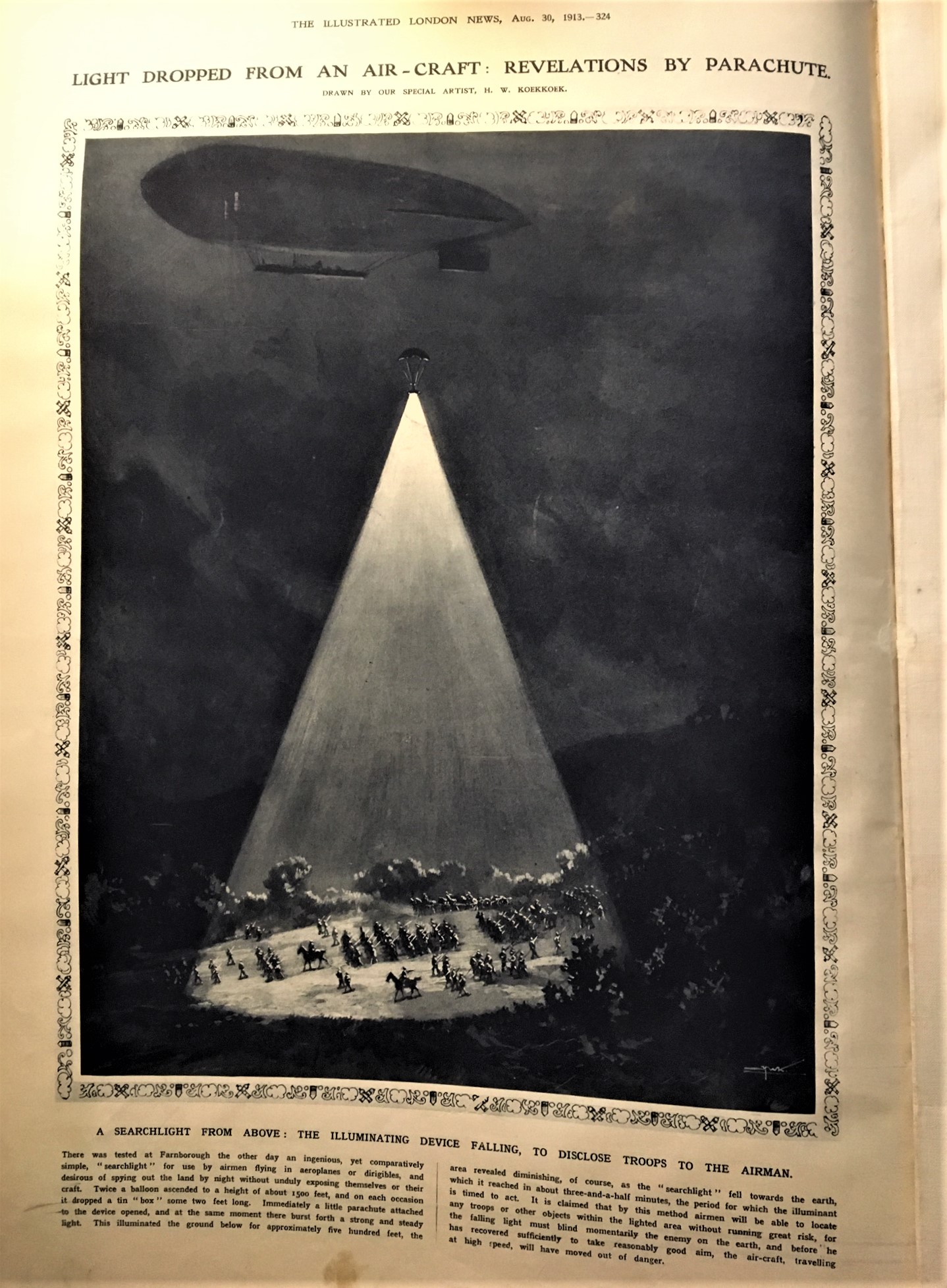
  • Light Bombs, 1913

    JF Ptak Science Books  Post 2897

    In the earliest periods of the history of bombing it seems as though the among the first generations of “bombs” dropped from flying machines were “light” or light sources, as we can see in this pair of illustrations from the Illustrated London News for 30 August 1913. These weapons appeared almost two years after Lt. Giulio Gavotti dropped an actual explosive from his plane on 1 November 1911 in a battle of the Italo-Turkish War1. Not that the exploding bombs weren’t  heavy (they weren’t) but that the feature of the weapon dropped in the 1913 case was capable of generating a penetrating or at least illuminating light.  We are told in the legend of the print that the light-bomb dropped from the dirigible was attached to a parachute which opened immediately, and from the height of 1500 ‘ at release the writer states that it would take the weapon three minutes to descend to the ground. (Of course the illuminated area would get together an tighter in descent, though it seems like there would be a good minute of so where there was some intelligence gathering possibilities.)

    Even though this package wasn’t exploding, it did provide the observers from above time to gather information on the position of the enemy and relay that data so it could be employed in tactical or strategic manners.  

    Notes:

    1. Lt. Gavotti (1882-1939) actually dropped four four-pound grenades from a height of 600′ from his Etrich Taube monoplane in action against the Ottoman Turks in Libya. This was the first instance of bombing from a heavier-than-air aircraft, bombs being dropped from balloons for several decades already by the turn of the century. Dropping bombs from balloons was deemed an illegal act of war and outlawed in the Hague Convention of 1899–but as the Wright flight was still a few years away at that point there was no provision established for bombing from aircraft that didn’t yet exist.  There were other instances of bombing from aircraft before the start of WWI, with the first instance during the Great War occurring when German Zeppelins bombed the city center of Antwerp a few weeks after the war began on 24 August 1914. The Brits launched an aeroplane attack  against two Zep bases in Cologne and Dusseldorf in response, and, well, and so on, raids and bombs becoming more sophisticated, cities becoming targets, and the race to destruction became developed. 

    ILN 1913 Light BombILN 1913 Light Bomb


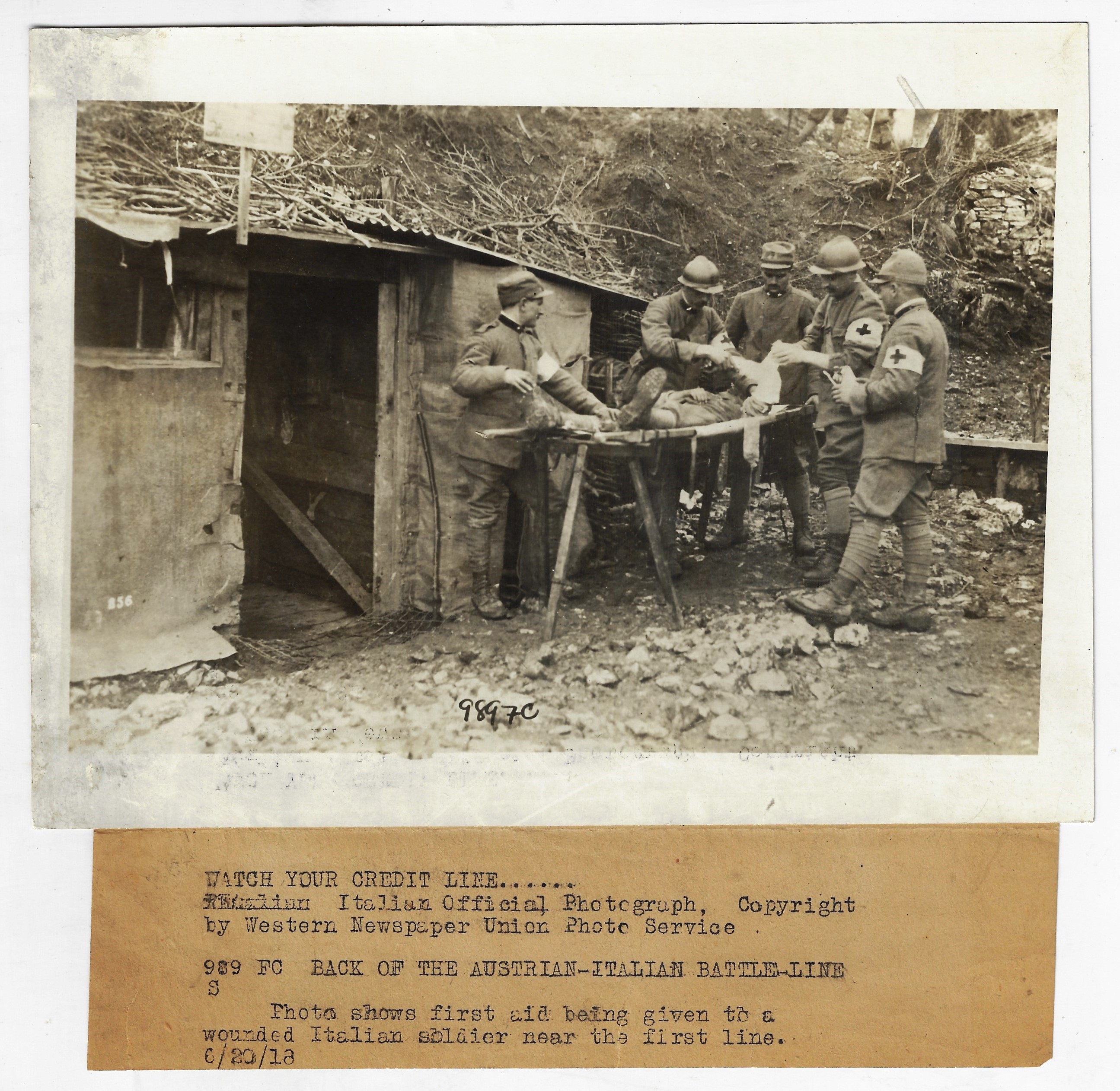
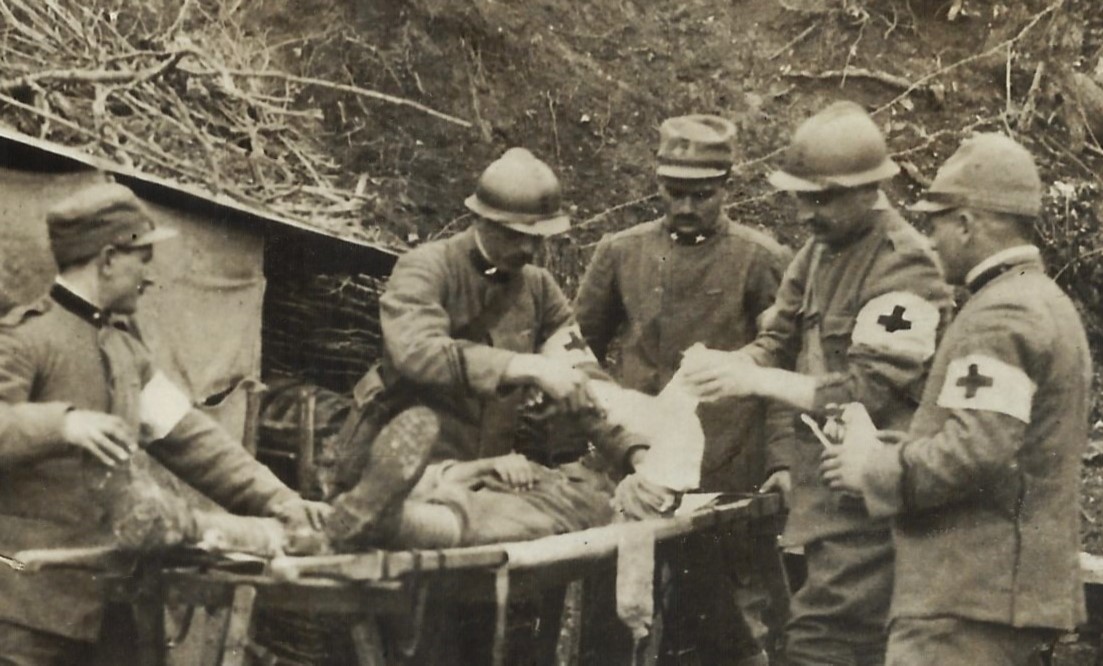
  • Front Line Field Medical Station, Italy, June 1918

    JF Ptak Science Books  Quick Post

    This is another interest image from my WWI News Photo collection–a front line Italian medical/triage post on the Italian-Austrian front, June 1918.  It is bare-knuckle bare, very rudimentary, though the soldier is receiving the attention of five medical personnel. What attracted my attention was the fifth medical aid, standing at the foot of the soldier, placing two calming hands on the soldier’s leg and foot, delivering calm and sympathy.  

    WWI Photo field hospital _1_

    Western Newspaper Union Photo Service, Itaian Official Photograph

    WWI Photo field hospital _2_

    ·Posted by :

    ·in:

    —

  • .0000015% of All of the Artillery Shells Fired in WWI (1918)

    JF Ptak Science Books  Quick Post

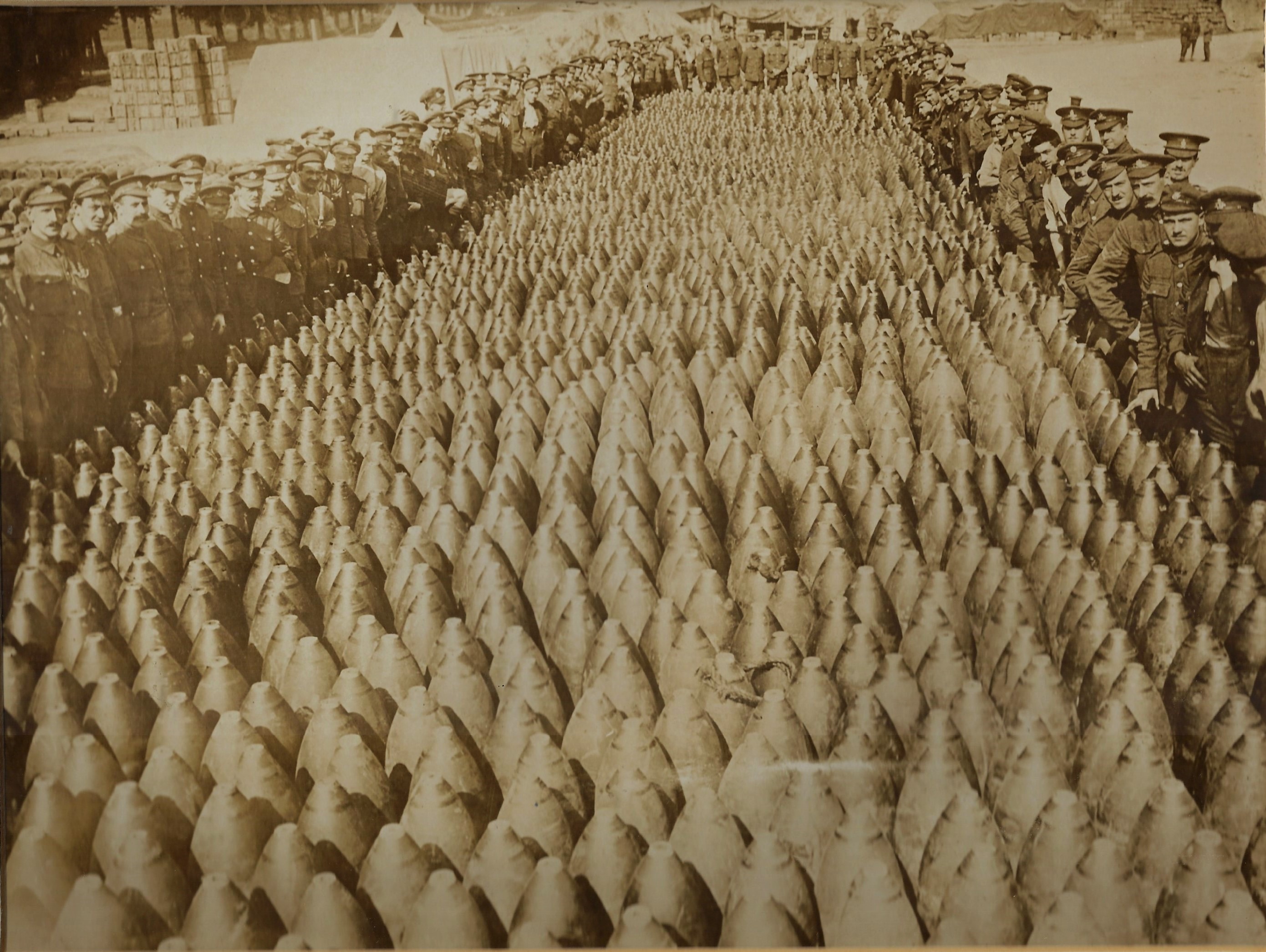
    This is another in a series of quick posts on images from my WWI photo collection. Photographs were made by pools of photographers working for several different photographic news agencies, with the content of the images generally secured and approved by the Committee for Public Information (CPI), which came into existence by executive order under President Woodrow Wilson on April 13, 1917, and which was charged with the task of wining the hearts and minds of the people of the U.S. to gain public support for the war and for American participation.   The way that many newspapers obtained the war images that they published in their papers was via a semi-centralized pool of war images.  The newspaper would request, say, a photo of German prisoners, and would contact one of these photographic agencies—for example, say, the Central News Photo Service of 26-28 Beaver Street, NYC—and purchase the rights for republication, and then print it in the newspaper along with the story.  In almost every case the photo would be accompanied by a caption mimeographed onto an attached piece of cheap paper, or have the information stamped on the reverse.

    WWI Shells 1918 _3_


    WWI Shells 1918 _3_

    WWI Shells 1918 _3_

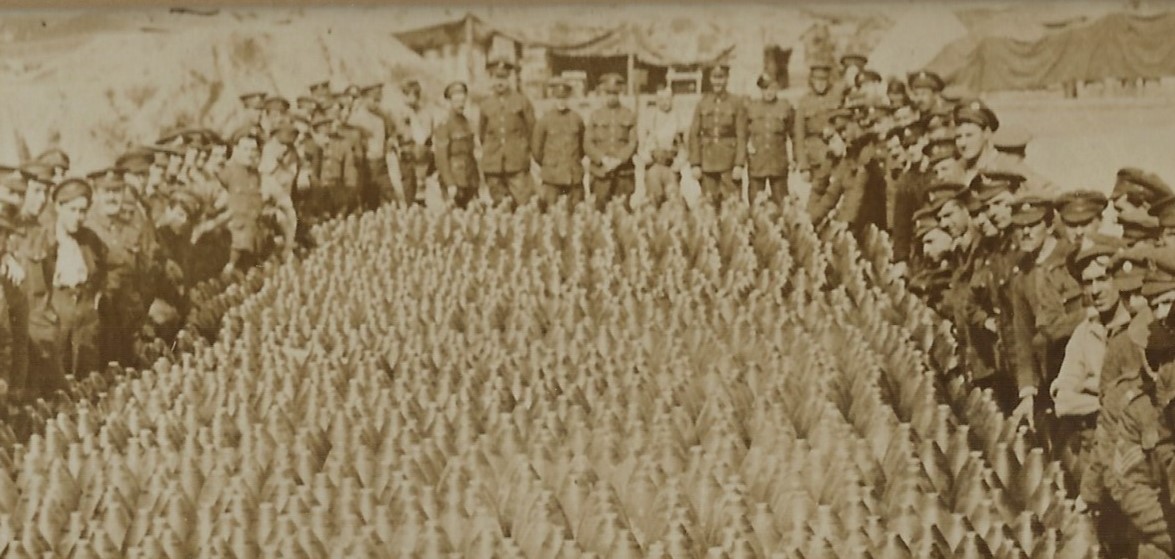
    In this photo I’m struck by the depth and breadth of the shells, and that they would represent a not very long salvo by a battery of 25 cannon.  I don’t know artillery, though it seems to me that these look like they are in the 200-300mm range. My guess is that we’re looking at 1500 or thereabouts rounds, which distributed to just 25 cannon would be 60 each which means that these shells could be used up in an hour or two of firing.  

    I’m guessing that something like 1 billion artillery shells were fired during WWI (this would be on the low end of estimates, I think) which means  that what you’re seeing here is .0000015% of the total.  For comparison .0000015% of the population of the U.S. would be 525 people. 

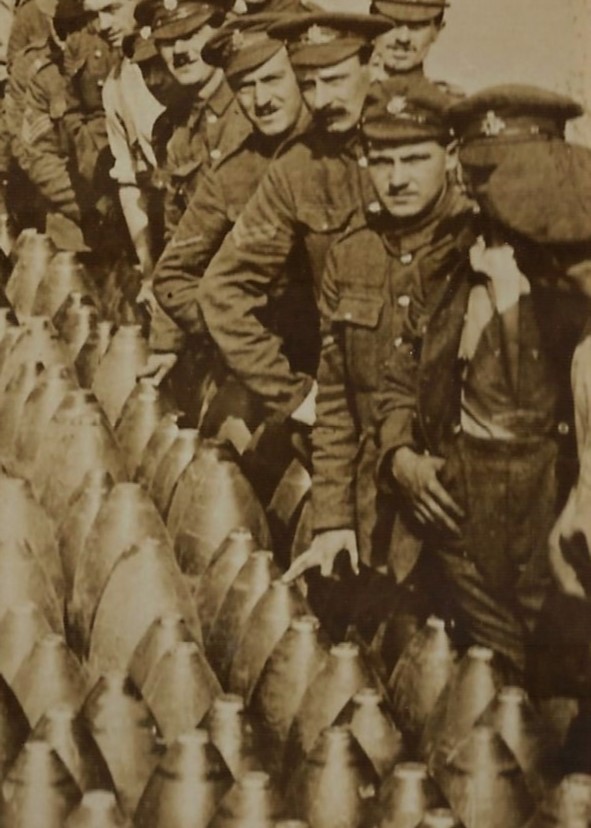
    The other noticeable thing is that of this group of soldiers (I reckon there’s a hundred or so who are directly lined up against the shells) there are only 5 or 6 who are touching the shells.  

    Estimating that the standing shells occupied 500,000,000 sq ft on base they would fill the floor space of 344 Pentagon Buildings.