A Daily History of Holes, Dots, Lines, Science, History, Math, Physics, Art, the Unintentional Absurd, Architecture, Maps, Data Visualization, Blank and Missing Things, and so on. |1.6 million words, 7500 images, 4.9 million hits| Press & appearances in The Times, Le Figaro, Mensa, The Economist, The Guardian, Discovery News, Slate, Le Monde, Sci American Blogs, Le Pont, and many other places… 5000+ total posts since 2008.

Category: World War I

  • Russian Trench Cross-Sections, 1917

    JF Ptak Science Books  Quick Post

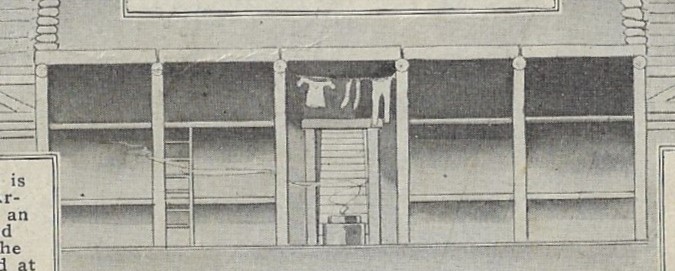
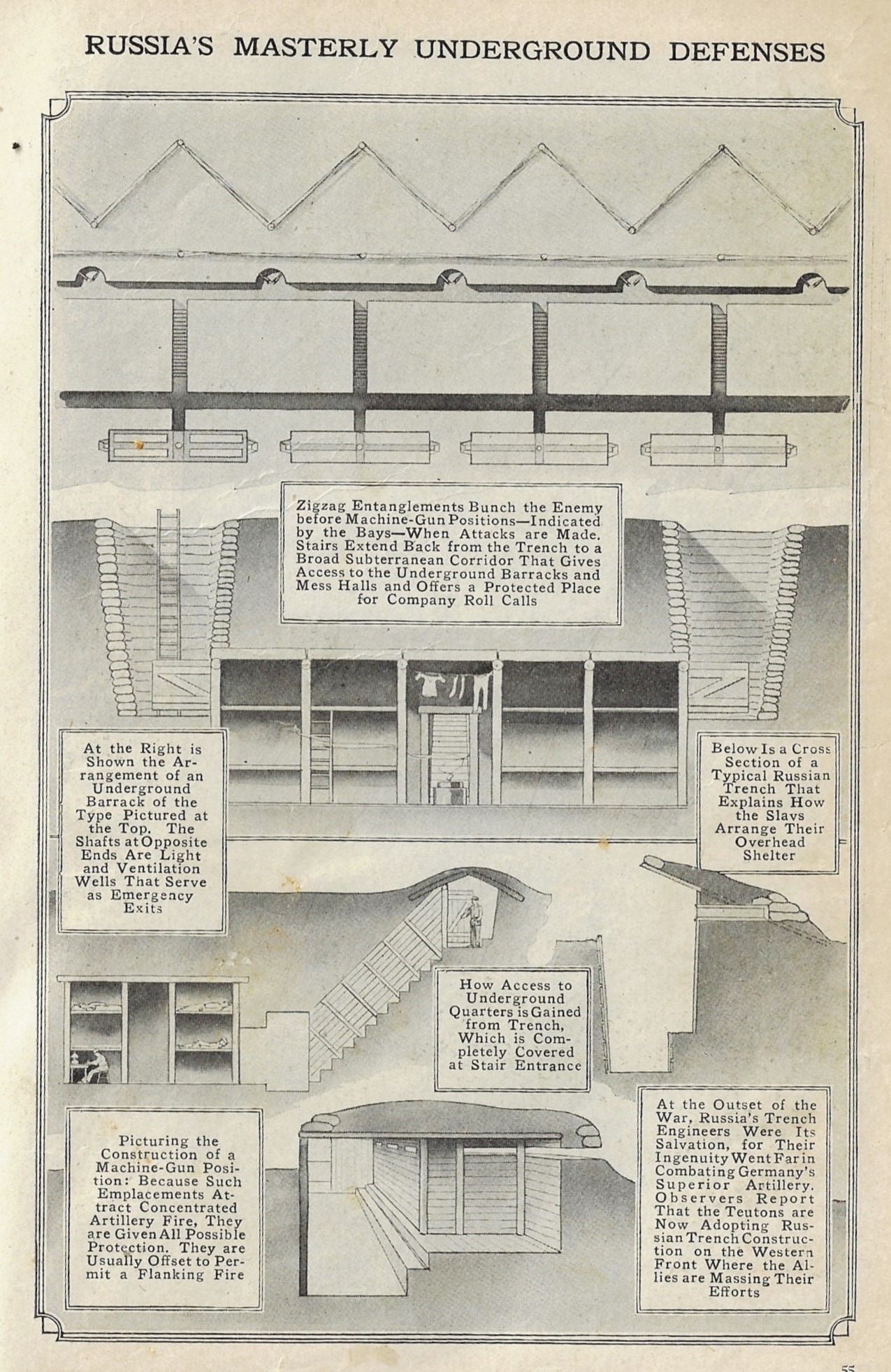
    I’ve made a number of posts to this blog on trenches/trench life (findable by entering the search term in the google box at right) and I believe that I’ve not made one regarding Russian trenches, until today. This image (“Russia’s Masterly Underground Defenses”) appears in a news-of-the-world section of Popular Mechanics for July, 1917, and includes a number of very smart smaller cross sections of division of the works. The whole of it is headed by a plan of the works, followed by  several smaller works, including the central image which shows the great depth at which the sleep chambers are set. (I also enjoy the bit of free will by the illustrator to include some tiny laundry drying out in the barracks.) Its a lovely work of an uncommon visual.

    Pop Mech 1917 Russian trenches
    Pop Mech 1917 Russian trenches

    ·Posted by :

    ·in:

    —

  • A Tank at an Amusement Park (1920)

    JF Ptak Science Books  Quick Post

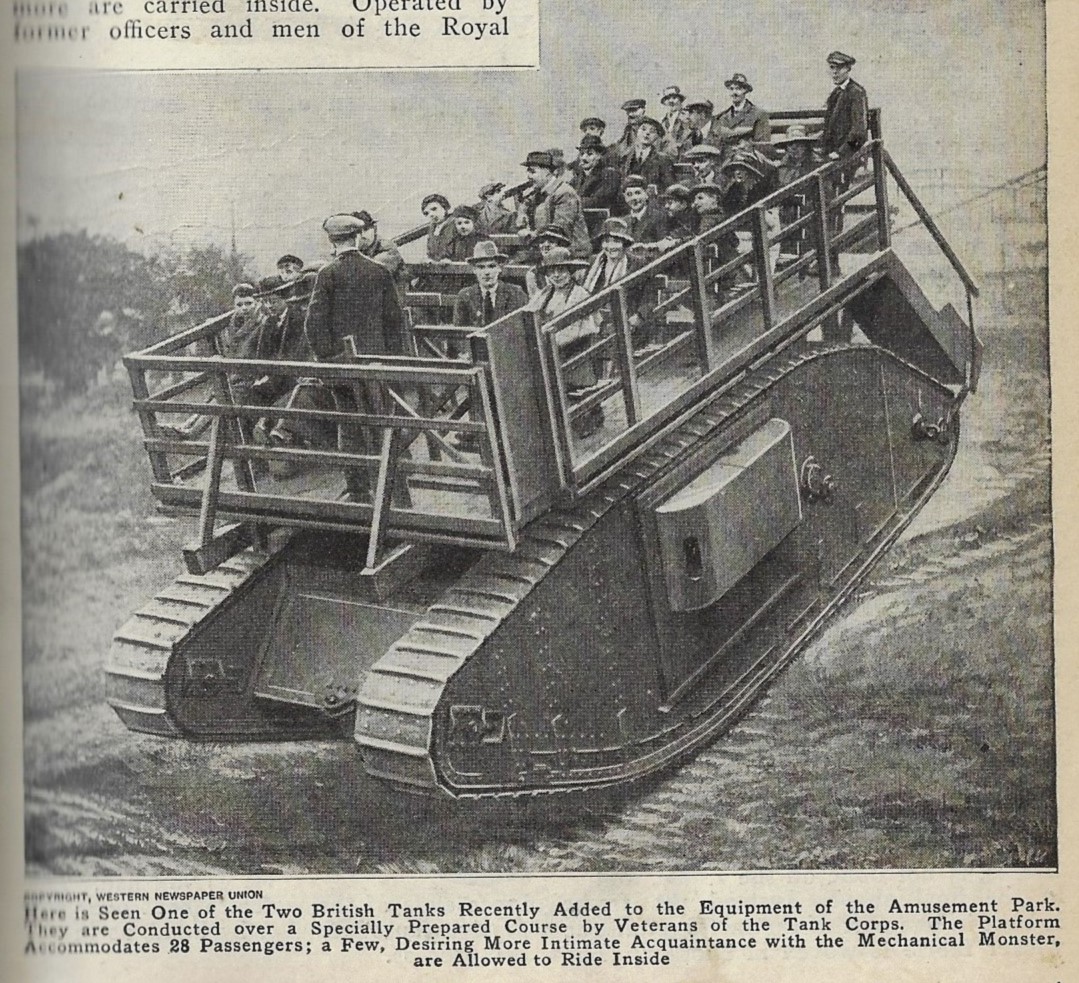
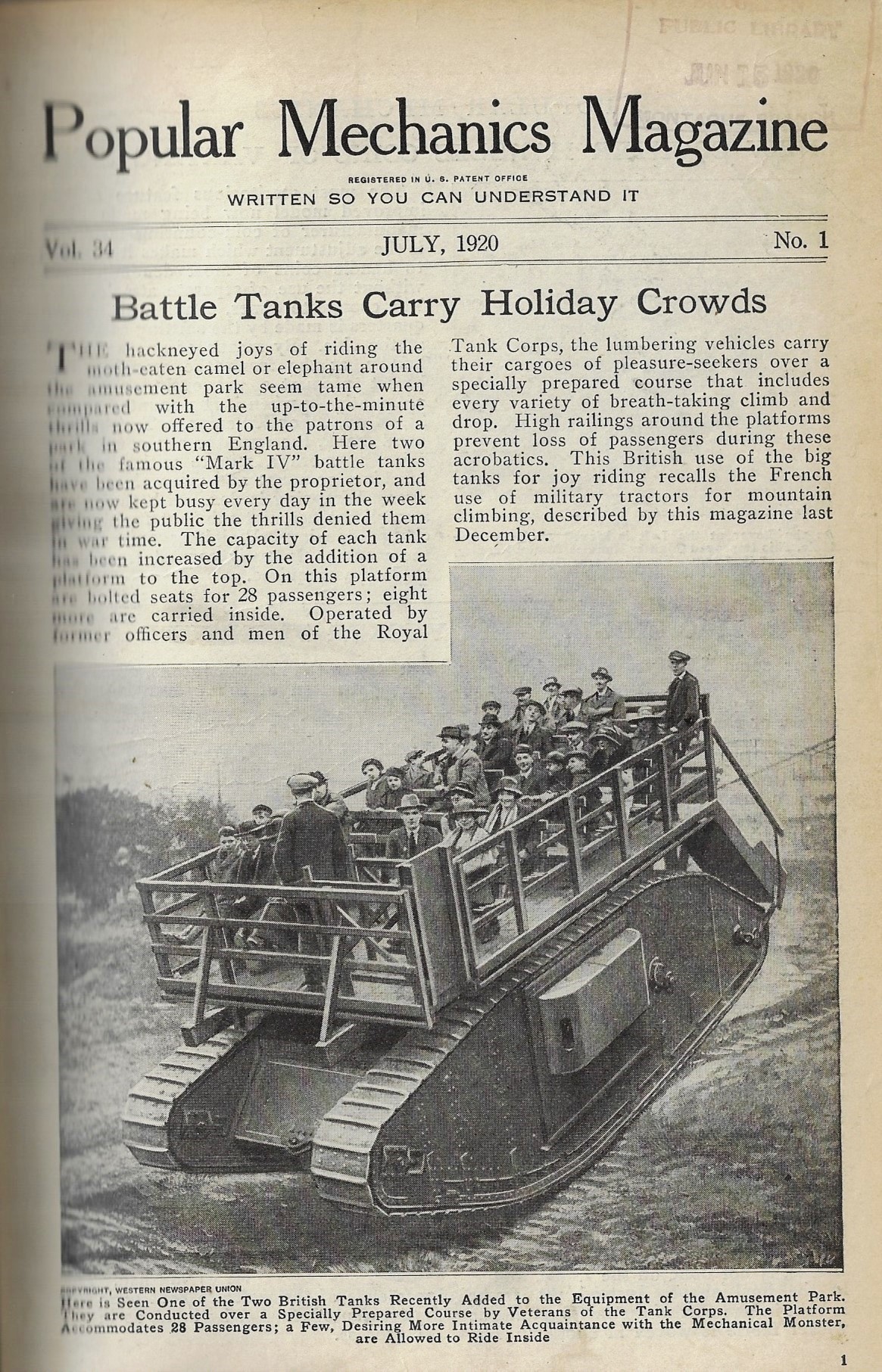
    Pop Mech 1920 tank amusement park_2_There is something lingering and heartbreaking about this image found in Popular Mechanics for July, 1920. The image shows a refitted tank being used as a curious ride at an amusement park. No doubt people wanted to put WWI behind them, as the end of the war was still only two years old or so, and the imagery of millions of people killed during the conflict was still very recent, with the hardships and loss still quite present in the minds of nearly everyone in the world.  That said, the image of the smiling faces on the retrofitted tanks a bit much, seeming to be this side of disrespectful. Seeing the “Jeep” brand doesn’t affect me like this–as the logo has almost nothing left in connection to the WWII vehicle, though I do feel a bit annoyed when I see a deluxe High Mobility Multipurpose Wheeled Vehicle  HMMWV, or Humvee) tooling around in the suburbs, begging attention in its mostly-useless incarnation, carrying with them the memory of hundreds of U.S. soldiers being killed in them. I just don’t like the idea of desensitizing the imagery of these vehicles into something sugary. 

    Pop Mech 1920 tank amusement park

    ·Posted by :

    ·in:

    —

  • Bomb-Dropping Torpedo Plane Guided by Wireless (1917)

    JF Ptak Science Books  Quick Post

    Pop  Mech 1917  aerial maps

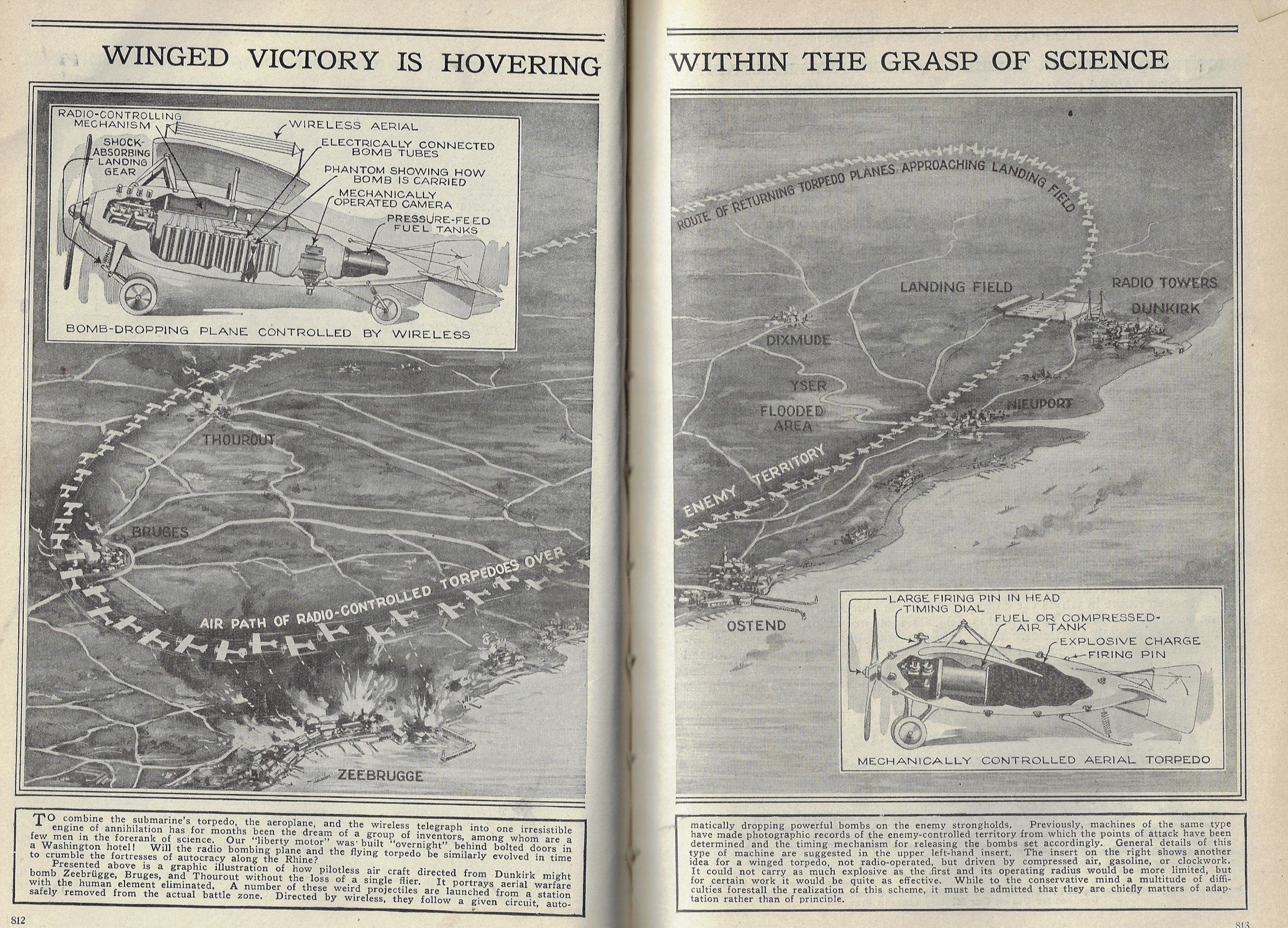
    This illustration appeared in the December 1917 issue of Popular Mechanics, just a year away from the end of WWI. This was a promotion for the idea of a remote-controlled miniature-aircraft, which was equipped with bombs and suggested to be an “irresistible engine of annihilation”.  The map displays how the aircraft–or multi-squadrons of them–could be controlled from Dunkirk to bomb targets in Zeebrugge, Bruges, and Thourout, “without the loss of a single flier”. 

    • “Will the radio bombing plane and the flying torpedo be similarly evolved in time to crumble the fortresses of autocracy along the Rhine?”.

    The small inset of the flying machine at bottom right seems to be little more than a bomb (a “mechanically controlled aerial torpedo”).


  • “Not like Soldiers, but like Devils” (1915)

    JF Ptak Science Books   Quick Posts

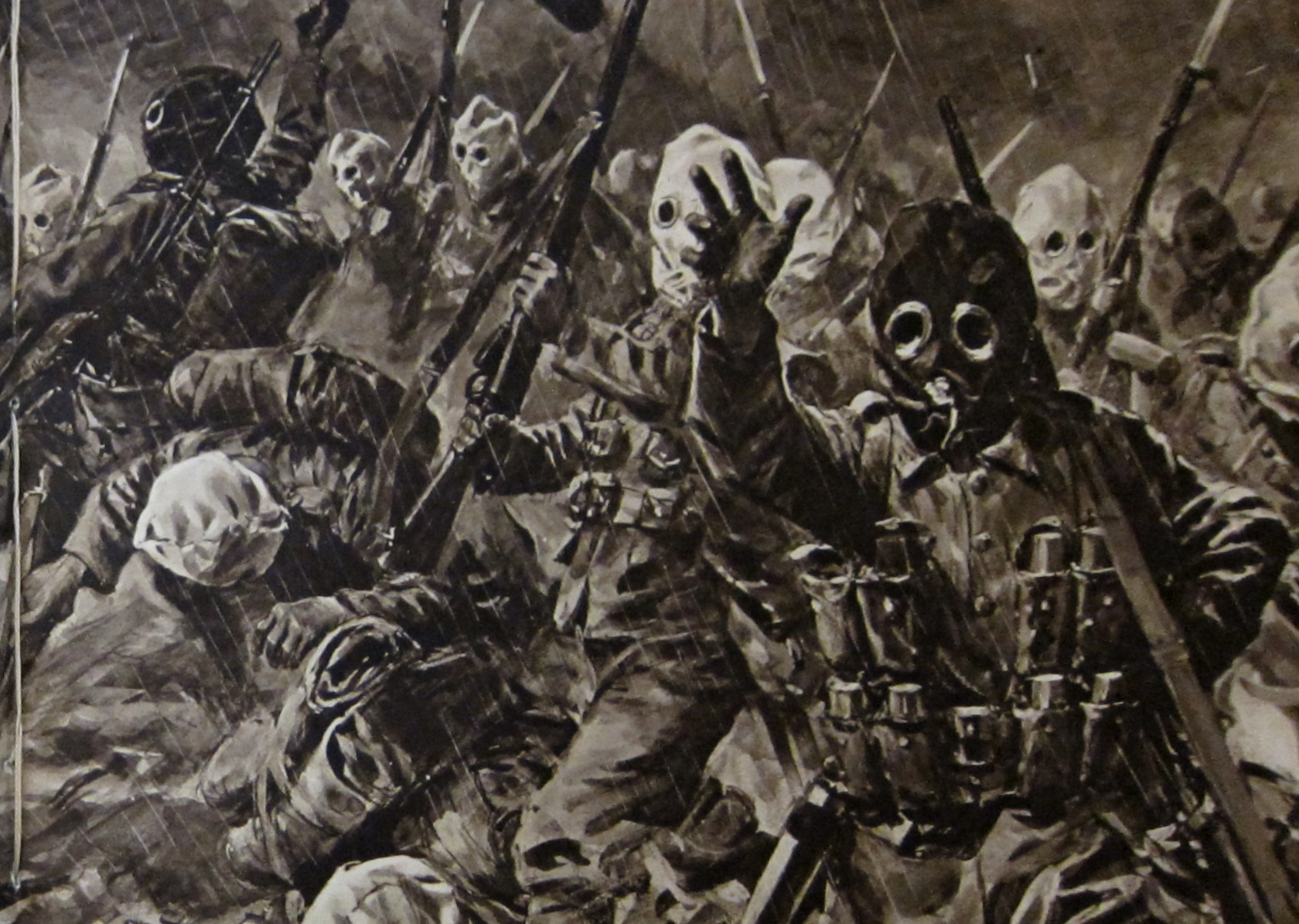
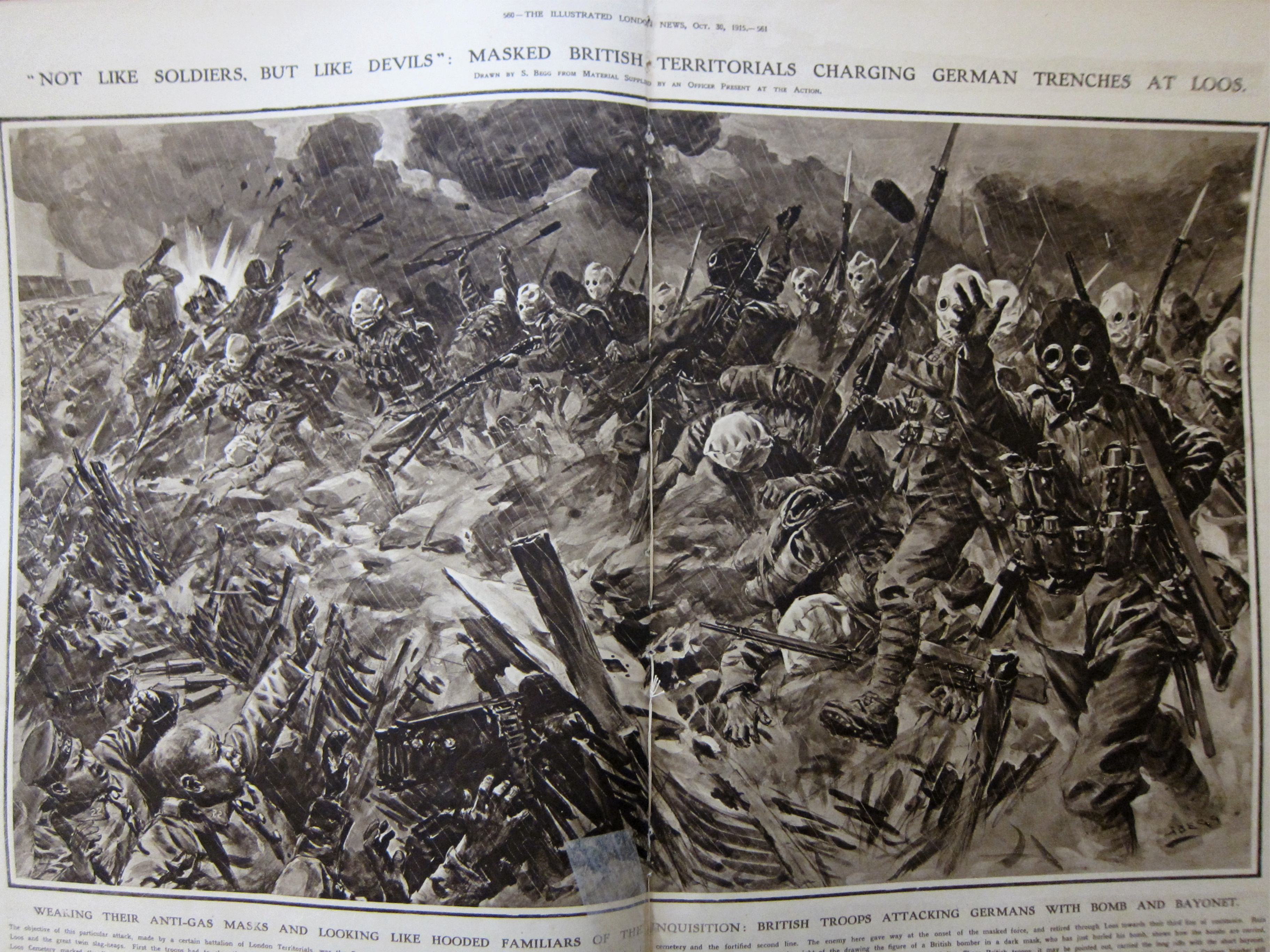
    I’ve looked through all of the issues of the very-popular magazine, the Illustrated London News, for the First World War and I think that the image below is one of the most harrowing of all of the early images of combat that I’ve seen. The artist, S. Begg, depicts a charge by British units on a German trench during the Battle of Loos (25-September–8 October, 1915) in what was ultimately a losing campaign for the British, costing them 59,000 casualties to the German 26,000.  “Not like Soldiers, but like Devils” is the title of the work, and shows British “Territorials” (evidently a volunteer force used to supplement the professional soldiers) attacking a German line with drawn bayonets and hurled grenades–a lot of grenades. For some reason the main figure in front is throwing a grenade with his rifle shouldered, unlike virtually everyone else. The Brits are wearing gas masks in the charge, no doubt expecting a gas response from the Germans–at some point during this battle the British employ their own gas warfare weapons for the first time in the war.  

    ILN 1915Masked Brit Terr _detail_

    The full scene:


    ILN 1915 Masked British Territorials

    ·Posted by :

    ·in:


  • A Trafalgar of the Air–the Battleship Aeroplane, 1907

    JF Ptak Science Books   Quick Post

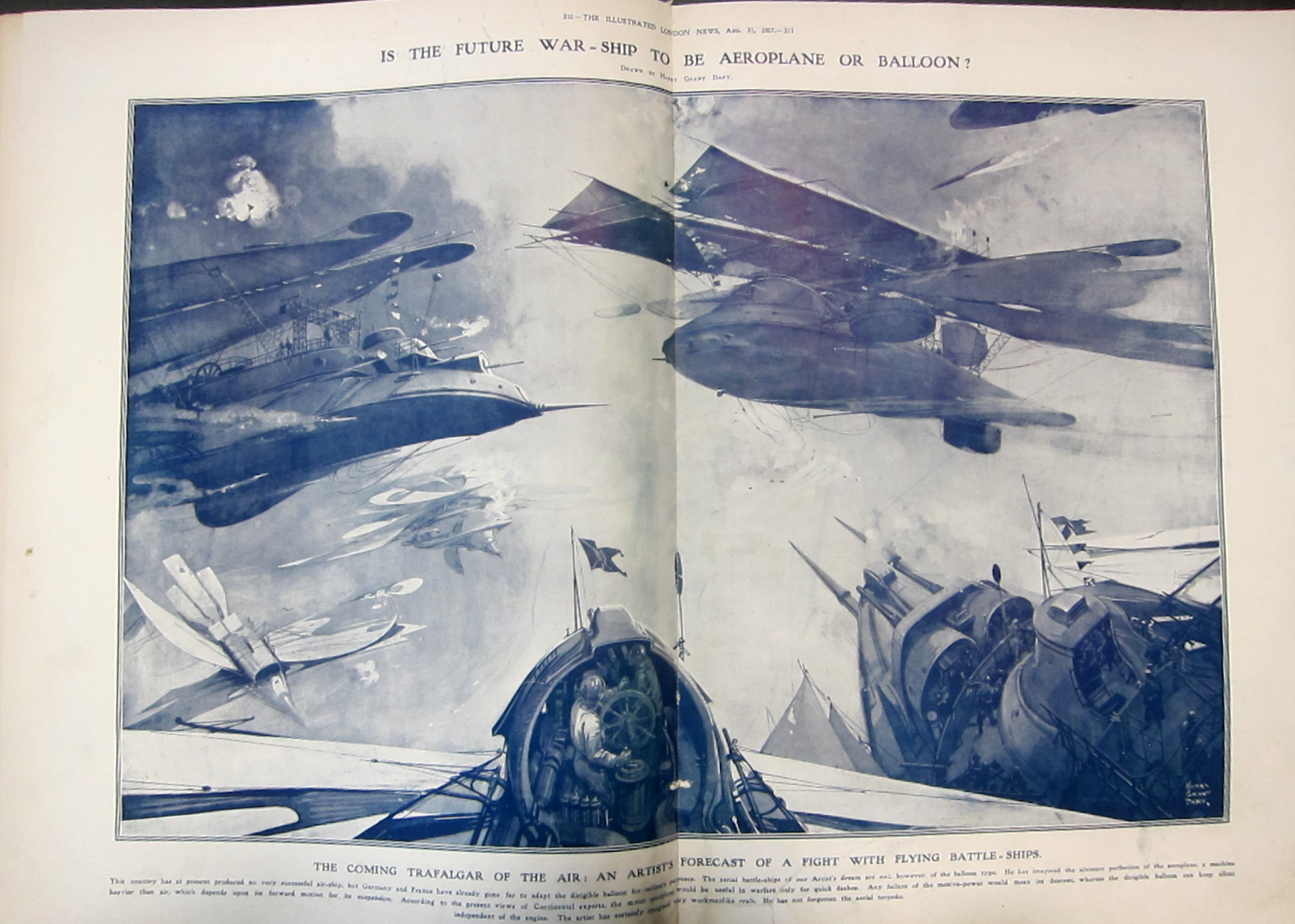
    “Is t he Future War-Ship to be Aeroplane or Balloon?”, is a glorious 2pp (16” x 23”) illustration in the Illustrated London News, published August 31, 1907, and drawn by Harry Grant Dart1 only four years after the Wrights’ powered flight at Kill Devil. It features four images of enormous aircraft as well as two smaller images, none of these seem to be the balloons in question in the title of the artwork, the artist seeming to have come down on the side of the aeroplane. That said, these aircraft are massive—iterating by the figures on deck the plane was close to 50’ tall with wings that must’ve been 100’ wide. Everything seems to be massively heavy, looking more like steam-fired ships (“flying battle-ships”) than anything else…except for their resemblance to birds and dragonflies.  Also of note in the upper right corner is a missile—an “aerial torpedo”—fired at one of the aircraft.ILN Ap 31 1907

    Notes:

    1.  Harry Grant Dart (1869-1938) was a correspondent, artist, and cartoonist who worked for the New York World, Life, and Judge, whose specialties seem to involve techno-future-vision. 


    ·Posted by :

    ·in:

    —

  • Bombing Dirigibles, from Above (1913)

    JF Ptak Scemce Books   Quick Post

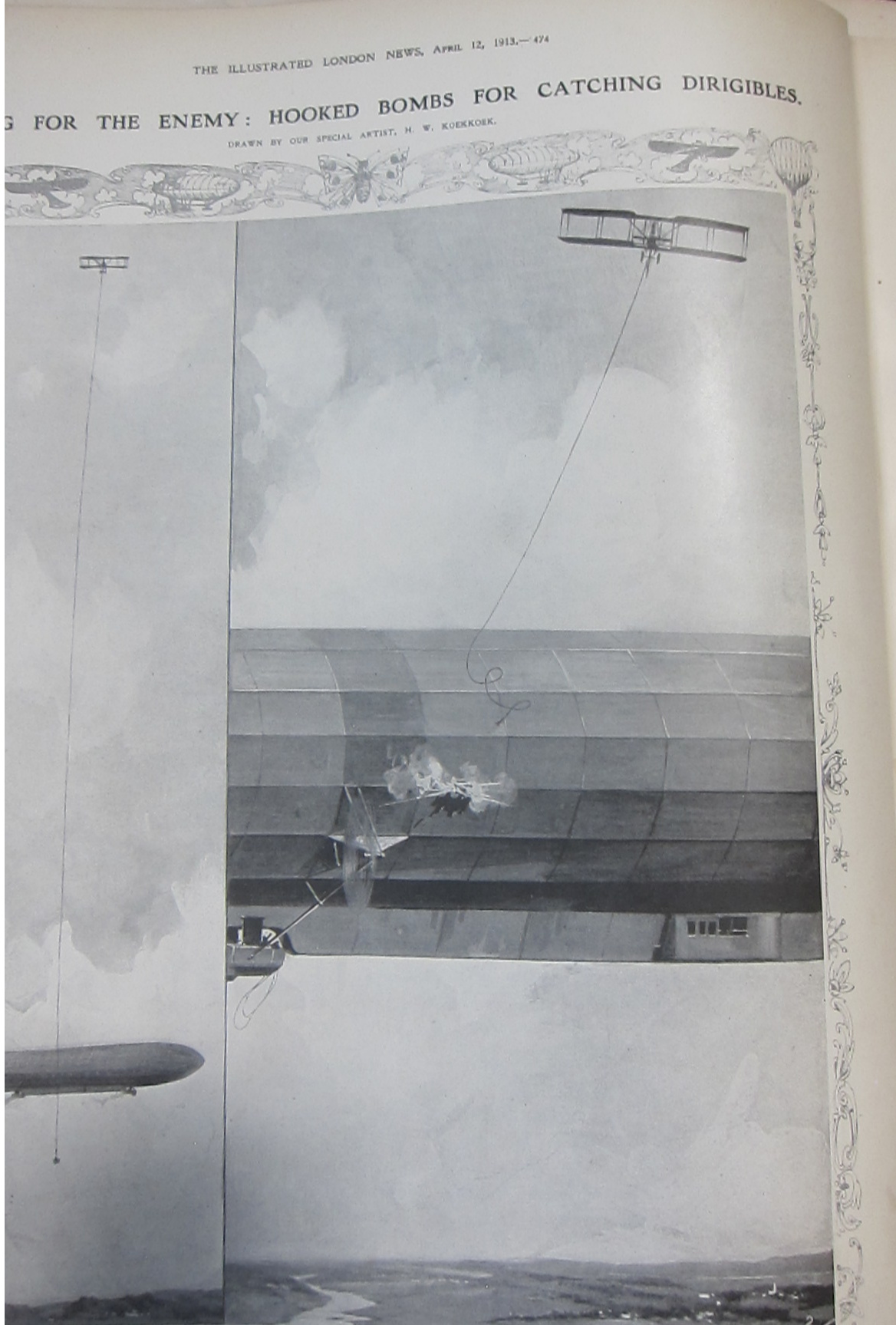
    “Fishing for the Enemy, Hooked Bombs for Catching Dirigibles”, a drawing by H.W. Koekkoek, in the April 12, 1913 issue of the Illustrated London News. Samuel F. Cody (born Cowdery, adjusting the surname of Buffalo Bill/William in his youth) was a Wild West showman at the beginning, and then a showman through his middle years in other fields, and then finally becoming an advanced pioneer in aviation. Cody was the first person to fly in England in 1906 and experimented with different (and successful designs in aircraft) as well as human-lifting kite designs, some of which were employed by the Brits in the Boer War and also used in place of observation balloons under appropriate weather conditions. There is no doubt that Cody was more on the frontier of aviation than on the U.S. Western frontier. Unfortunately Cody would be killed flying one of his experimental aircraft four months after this story appeared.

    Cody went fishing for dirigibles with this invention. The idea was to fly an airplane about 2000’ above a dirigible with a towline of the same length with a grapnle-bomb attacked to the end. The plane would try to hook the dirigible with the grapnel at which point the bomb would detach and detonate.

    ILN 1913 bombing the  dirigible

    ·Posted by :

    ·in:

    —

  • A Different Sort of Motorcycle Sidecar (1917)

    JF Ptak Science Books   Quick Post
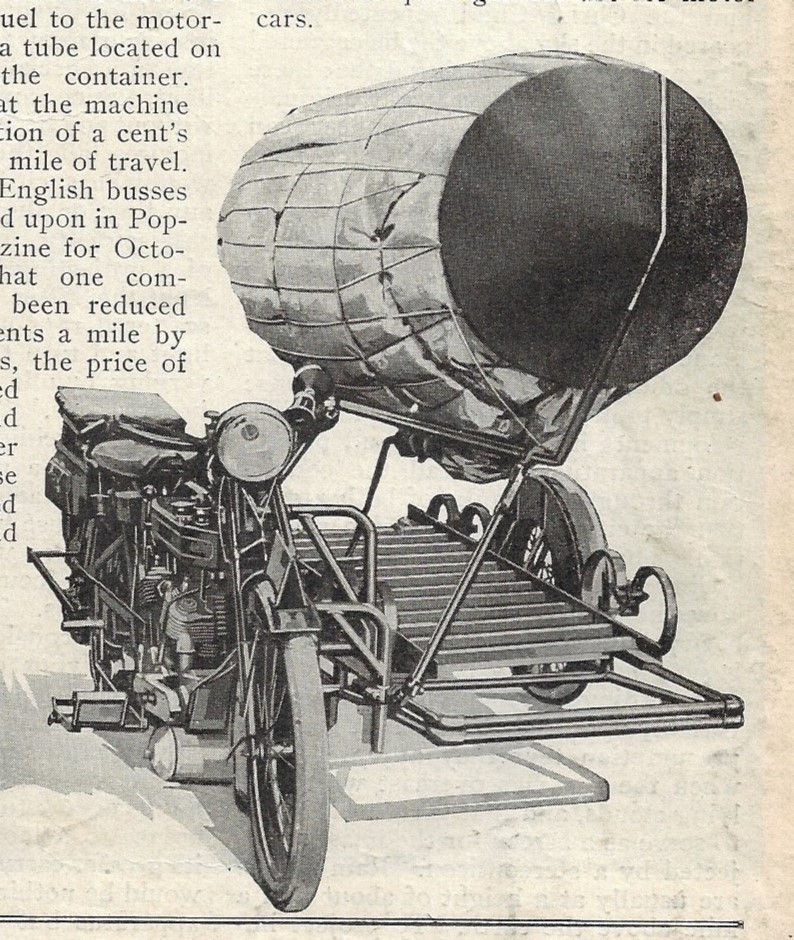
    Pop Mech 1917 gas powered motorcycleThis unlikely combination of vehicle and fuel source appeared in Popular Mechanics for June, 1917. 

    It was fueled by “illuminating gas” which was a hydrogen/hydrocarbon mix and which was made to fire street lamps and such, a destructive process introduced in the very early 19th c.  It is highly flammable. Highly.

    This suggestion for a 600 cubic ft power envelope for a motorcycle was supposed to save about two-thirds on fuel costs and replace the use of wartime gasoline, but…

    [For “illuminating gas” see the following 1869 entry from Scientific American: https://www.scientificamerican.com/article/illuminating-gas-what-it-is-and-how/]


  • The Battlefields of WWI in U.S. Land Based Context

    JF Ptak Science Books  Quick Post

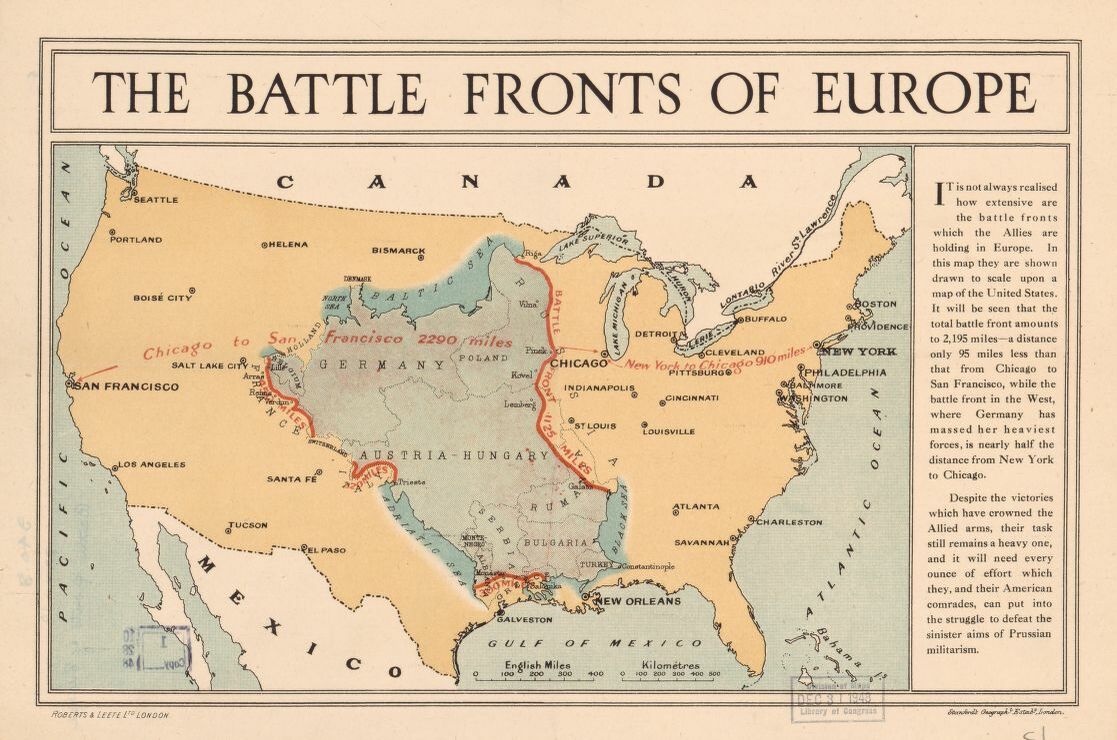
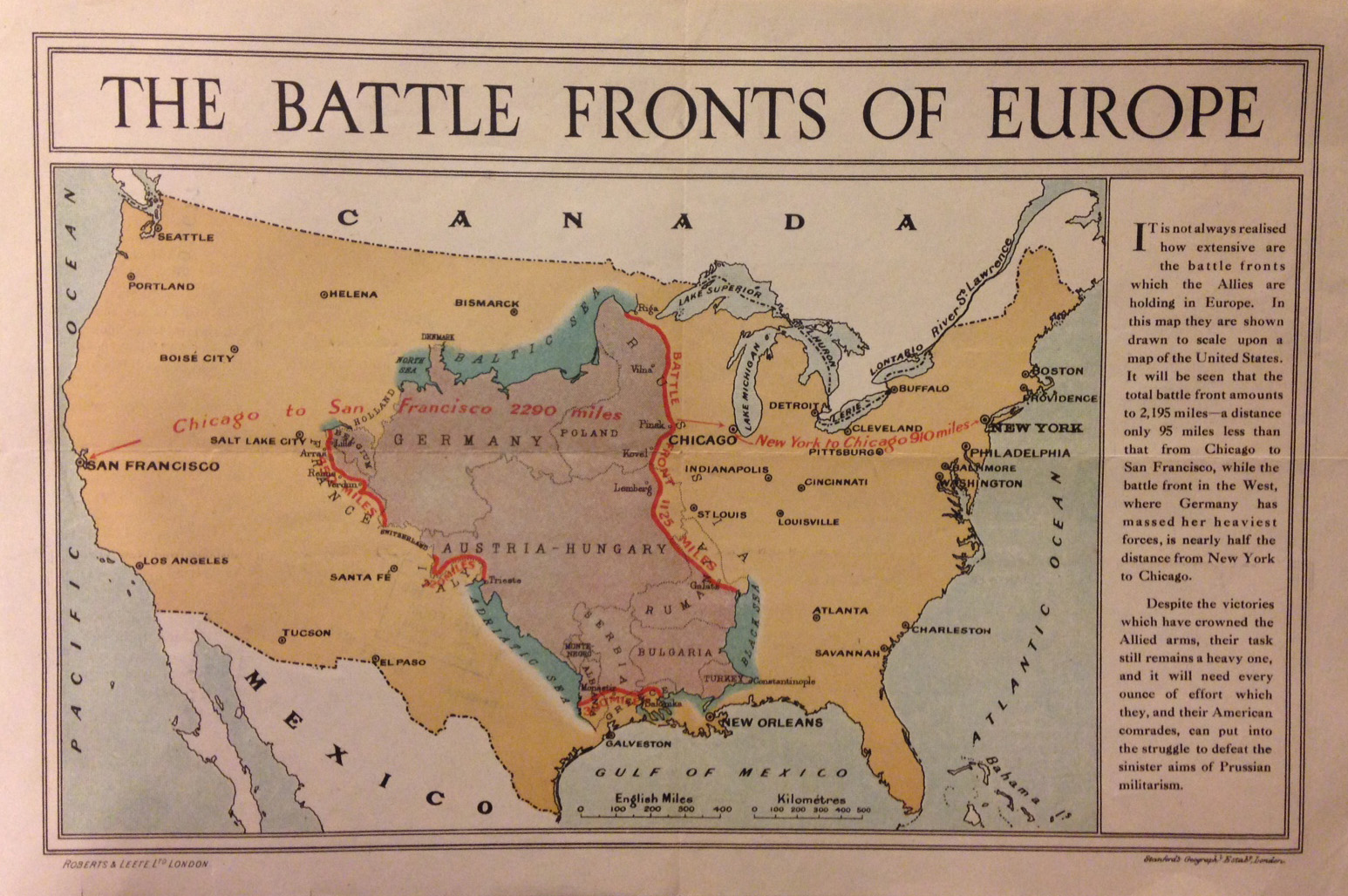
    The battle fronts of Europe (by Stanford’s Geographical Establishment, printed ca. 1917) is a useful contextualization of the major battlefields of Europe placed within a map of the U.S., showing the relative distances and differences in relation to a geography that Western Hemisphere folks might better understand. Much of the fighting was taking place in an area about the size of the middle third of the United States, which I am certain gave many readers back then (and probably now) some pause and insight. As you can see, the areas of action work their way from the Baltic across the upper Eastern Front, crossing Austria-Hungary, Romania, Bulgaria and a bit of Turkey, then west to the Adriatic and north along the Austria-Hungarian border to the Western Front of France and Germany and Belgium, all fit correct and proper into the land from the Mississippi into the Great Plains. There were about 95 million people alive in the U.S. at that point, and I’ll guess that maybe 20% lived in this Battle Front swath–that means that the dead and wounded from the war would be at least equal to the entire population of the U.S. covered by the battleground map. 

    WWI Map battlefronts LC _2_[Click to enlarge and clarify.]

    “London : Stanford’s Geographl. Estabt., [1917 or 1918]. London : Roberts & Leete Ltd, [1917 or 1918].”

    Source: Library of Congress,  https://tile.loc.gov/image-services/iiif/service:gmd:gmd5:g5701:g5701s:ct007679/full/pct:25/0/default.jpg


  • Lines and Trenches (1916)

    JF Ptak Science Books   Quick Post in the History of Lines series

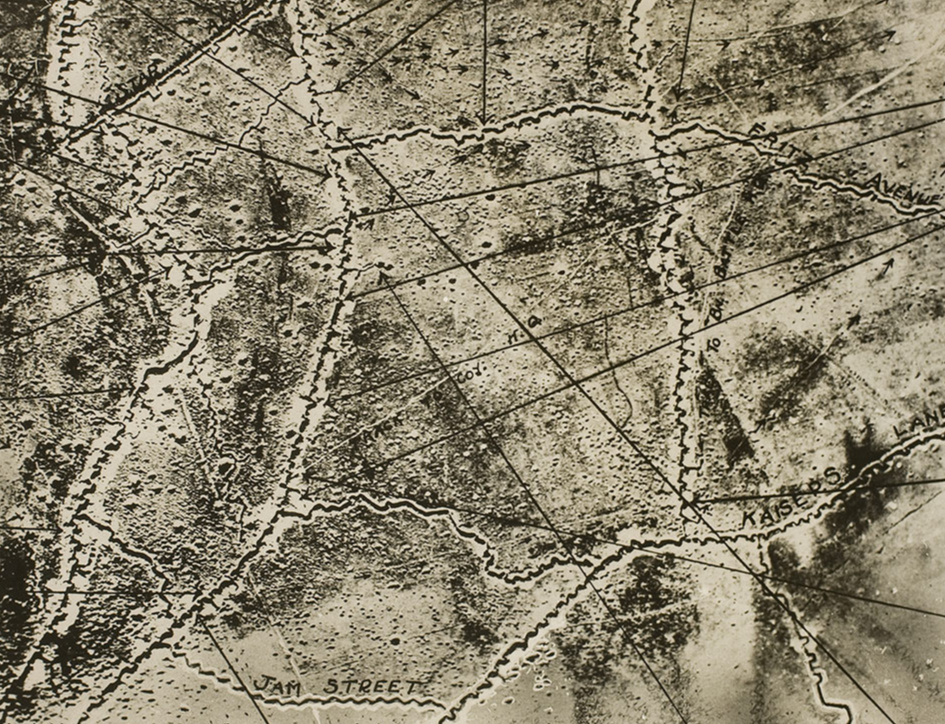
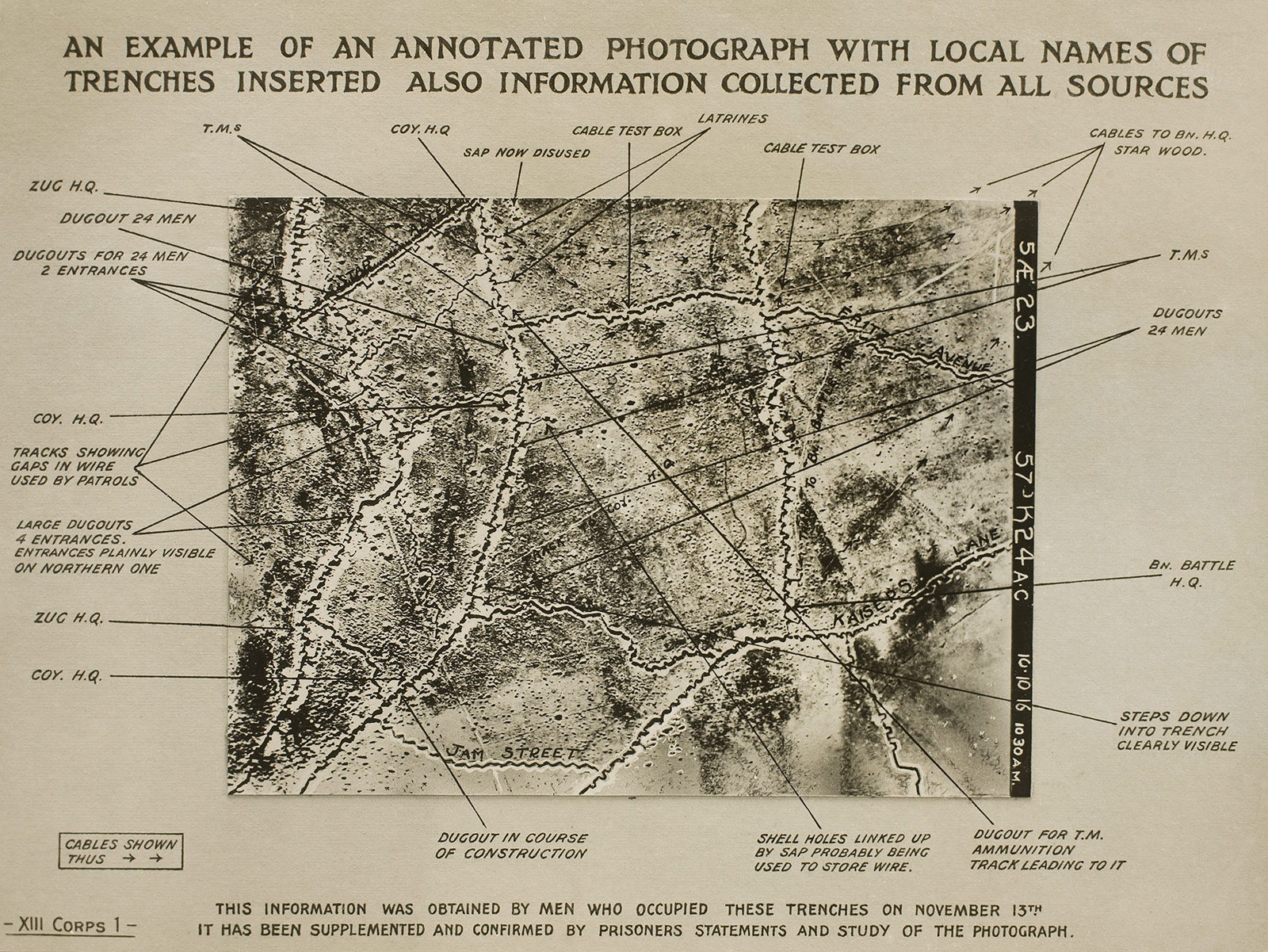
    I’ve just found an interesting example of a photo reconnaissance display of trenches with an interpretation of installations and trench names. It is interesting in and of itself, of course, but I was drawn to it because of the zig-zagged lines of the trenches explained with criss-crossed straight lines. The trenches went off at hard angles rather than long straight lines for several reasons, all for defensive purposes: first, they could offer places to use for fire cover if the trench was overrun by enemy forces, and secondly as a dispersal agent for the effects of bomb blasts within a trench.

    The photo “An Example of an Annotated Photograph with Local Names of Trenches Inserted. An example of an annotated photograph with local names of trenches inserted also information collected from all sources” is a silver gelatin print from the George Eastman Museum. The first image below is a detail from the overall image, used here just to show the accumulation of lines. The full image follows, showing dugouts, latrines, cables, ammo dumps, linked bomb craters, and gaps in the barbed wire enabling patrols to come and go without becoming hopelessly tangled in the sharp steel. 

    WWI trench names _3_

    Source of image: Art Blart https://artblart.com/tag/photographs-and-transition/  

    And the full image:

    WWI trench names _2_

    Notes: 

    Two good reference tools on names and naming practices of trenches:

    Peter Chasseaud, Topography of Armageddon: A British Trench Map Atlas of the Western Front 1914-1918

    _____. Rats Alley: Trench Names of the Western Front, 1914-1918.  Gazetteer of British trench names, as well as an appreciation of the naming practices and names of German and French trenches.


  • POWs in WWI (1916-1918)

    JF Ptak Science Books  Post 2789

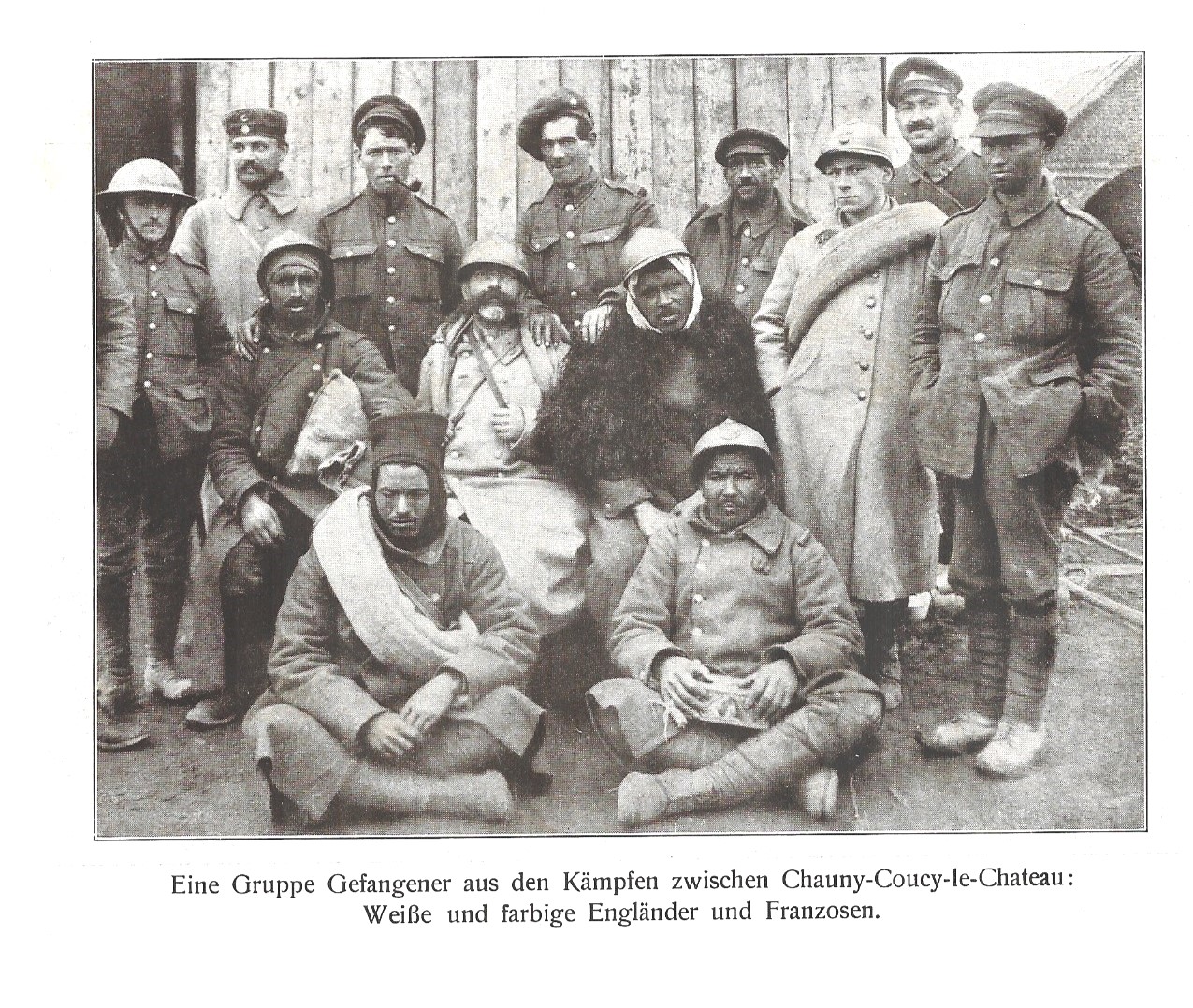
    This extraordinary photograph shows prisoners of war taken by the German army near Chauny-Coucy-le-Chateau and published in the unblinking photographic history of WWI by Hermann Rex called Der Weltkrieg in Seiner Rauhen Wirklichtkeit (printed by Herman Rutz in Oberammergau eight years after the end of the war). It is unusual to my experience to see a work like this with such an unofficial character to it. During the War the U.S. population was mostly given approved photos of the conflict, passed through censors and for the large part made by photographic pools (with ready-made captions for publication). The German side of photos in the popular press seems to me to have been grittier–this is hardly an academic appraisal, though I have leafed through every page of the war years for several journals like The Illustrated London News and Illustrirte Zeitung (Leipzig), and that is the general sense that I take away with me. The work by Herr Rex is about 600pp long, and if you work your way through the whole thing in an hour, it is a somewhat exhausting experience. Unlike most work that was done during the war, this book has a definite you-are-there quality to it, and is in many parts aggressively observational.

    The 13 soldiers were British and French including several French Colonial soldiers (differentiated by Rex as “weisse und farbige “)–they represent  .0000016% of the 8,000,000 prisoners taken on all sides during the course of the war):
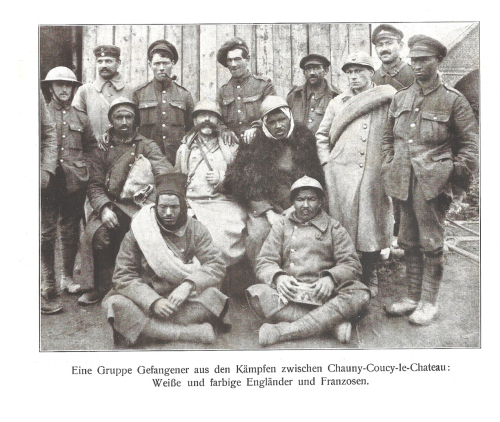
    WWI Photos Rex prisoner

    Also, here’s the very striking cover for this book–its one you won’t soon forget:

    WWI Rex cover (1)

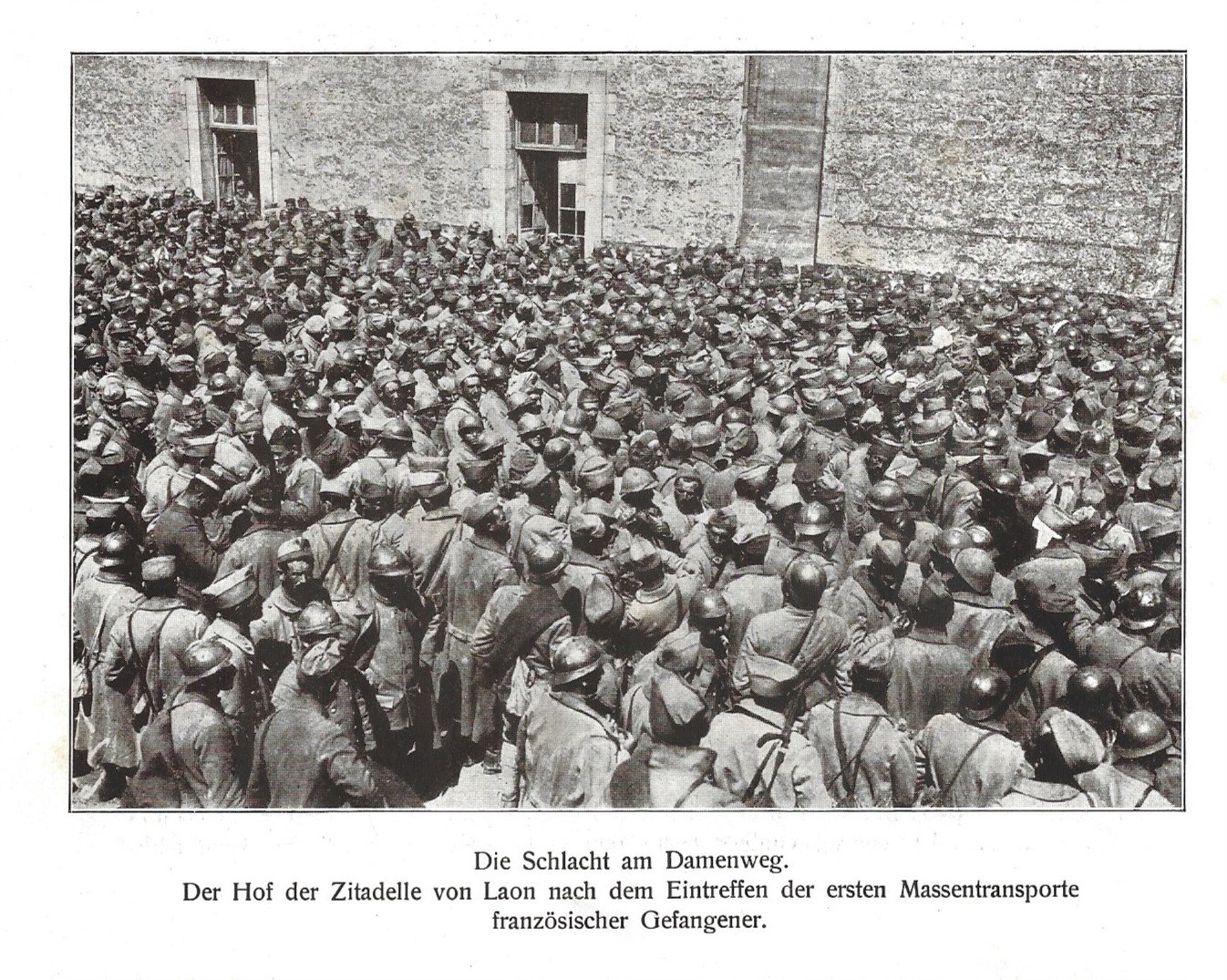
    Another image from the same source shows the movement of a large number of French prisoners–another photo of dense humanity:
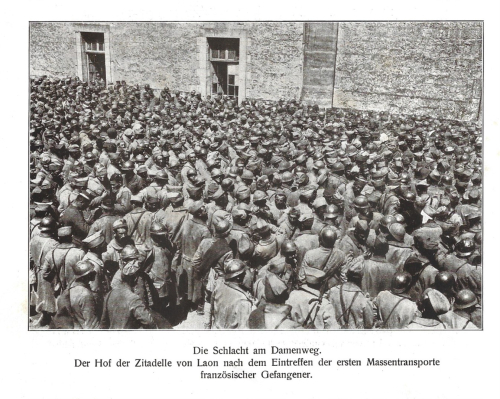
    WWI Photos rex prisoners mass French

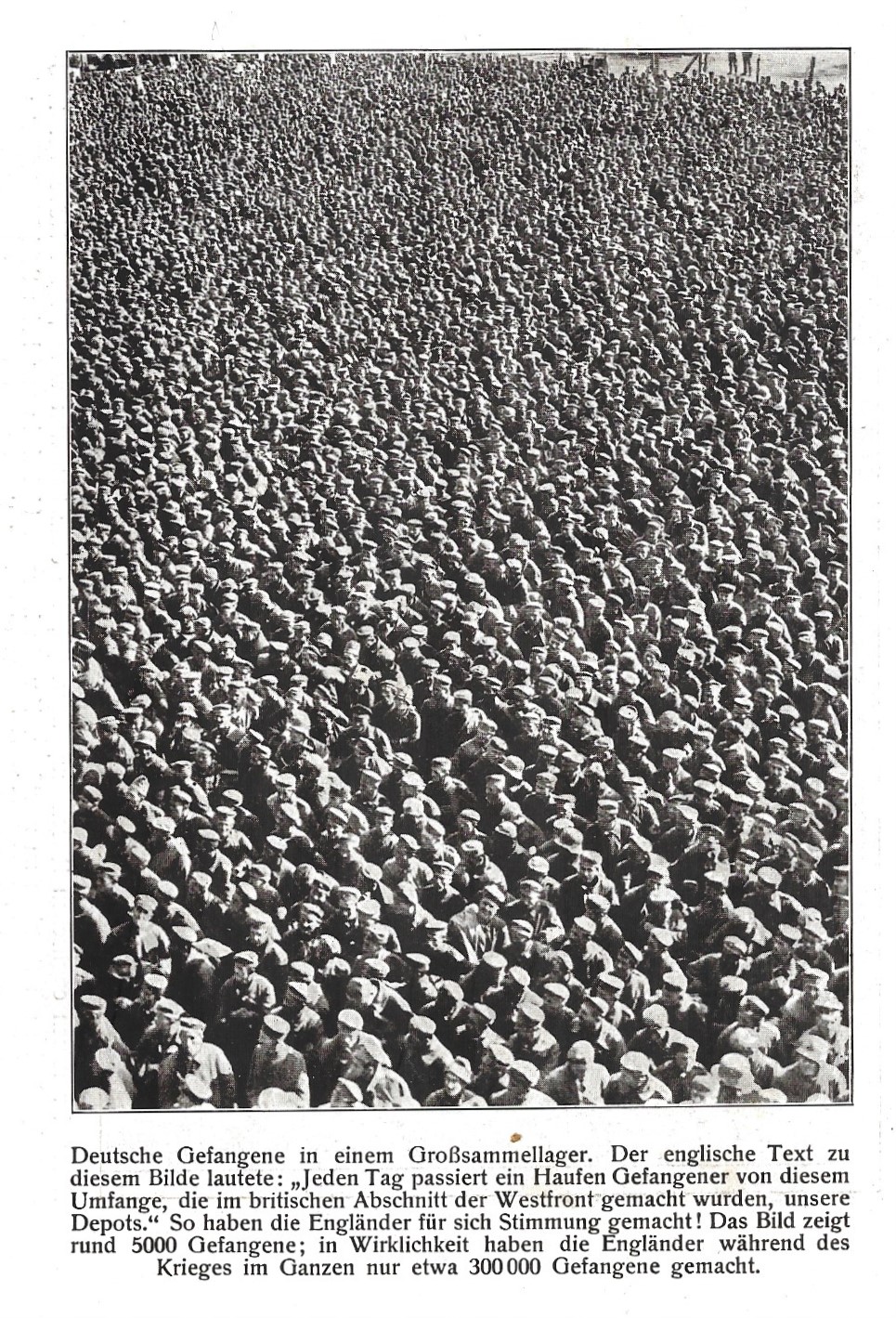
    And this extraordinary photo showing 5,000 German prisoners (or .000625% of the total number of POWs 1914-1918): 
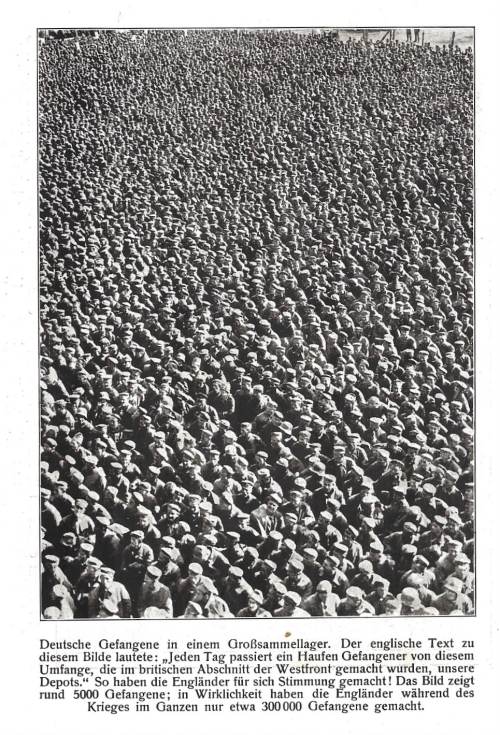
    WWI Photos Rex German prisoners

    This is not a war-as-glorious sort of book, though I’m not so sure that it is necessarily/overtly an anti-war Johnny Got his Gun book, either; at least not so much as Ernst Friedrich’s definitely anti-war book Krieg dem Krieg! (“War Against War!”) that appeared on the 10th anniversary of the beginning of the war and which was badly received by Weimar officialdom. The 200 or so photos in the Friedrich book are exactly those that would never have been published during the war, especially in the ending sequence that shows very disturbing facial wounds. The overall effect of Rex’s book–not nearly at the same level of Friedrich’s–is very effective, and definitely does not fill you with the spirit to sit down and wrap up your leggings to join your comrades in a trench. 
    ·Posted by :

    ·in:

    —