A Daily History of Holes, Dots, Lines, Science, History, Math, Physics, Art, the Unintentional Absurd, Architecture, Maps, Data Visualization, Blank and Missing Things, and so on. |1.6 million words, 7500 images, 4.9 million hits| Press & appearances in The Times, Le Figaro, Mensa, The Economist, The Guardian, Discovery News, Slate, Le Monde, Sci American Blogs, Le Pont, and many other places… 5000+ total posts since 2008.

Category: World War I

  • Christmas Mail, 1917

    JF Ptak Science Books  Quick Post

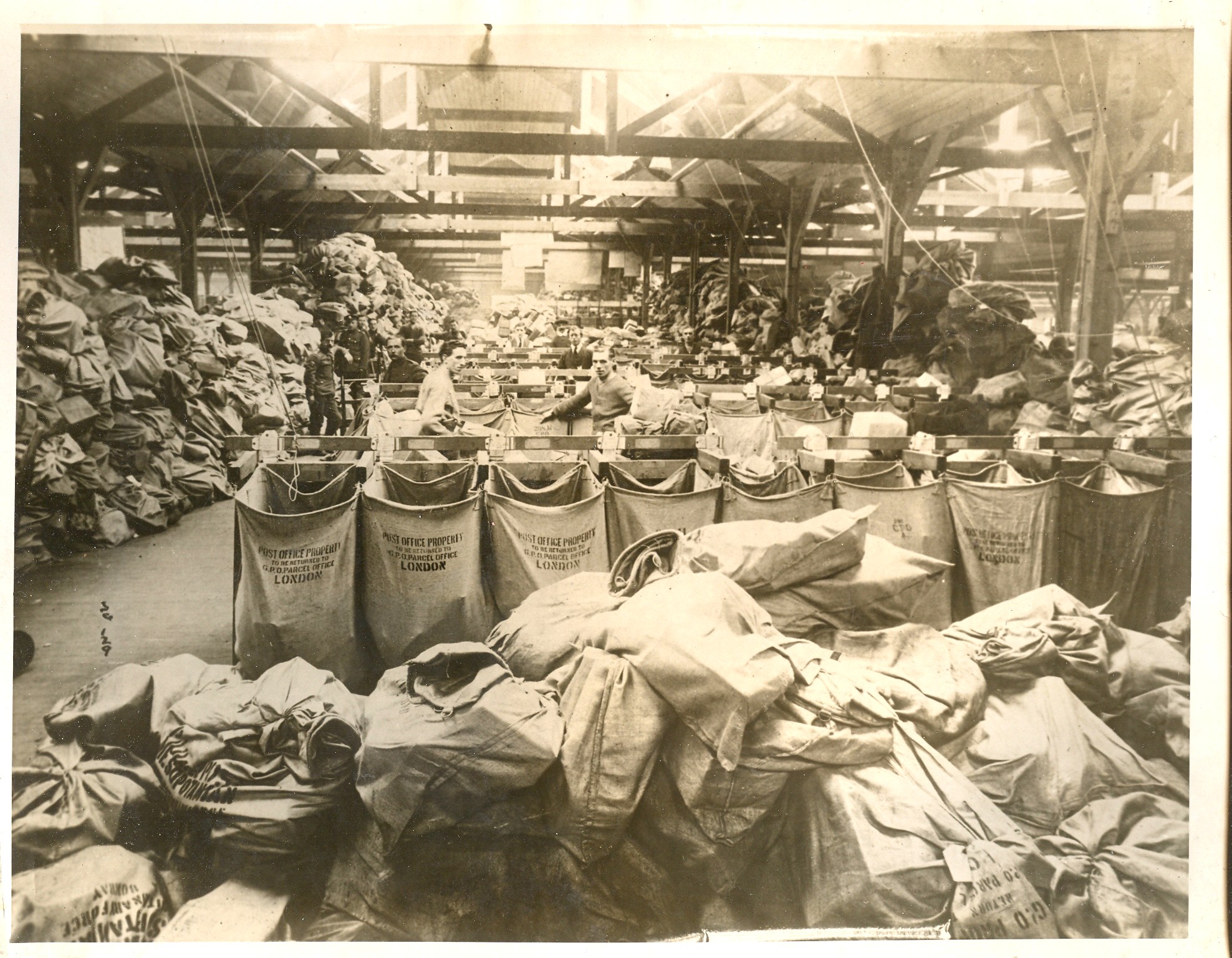
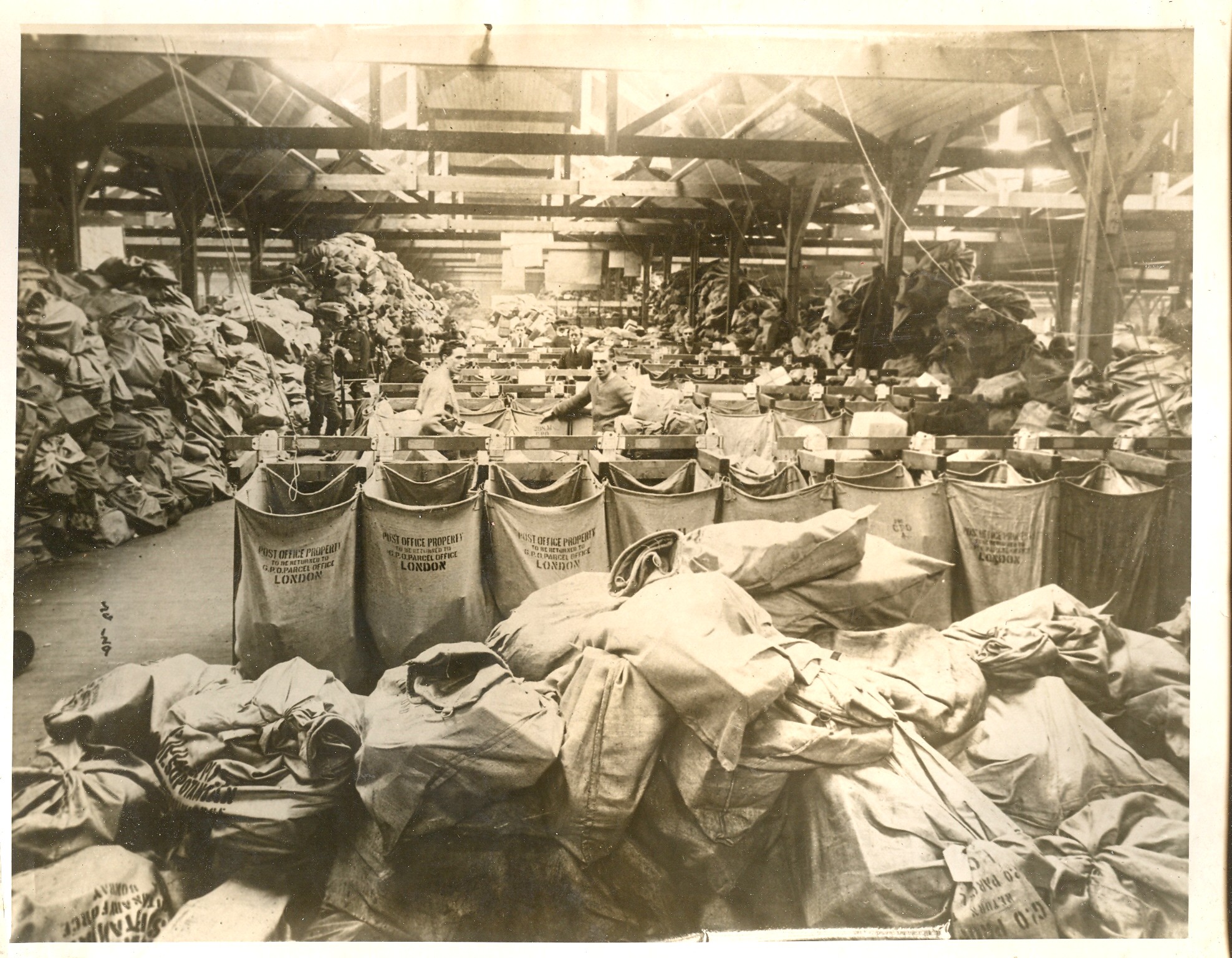
    This is the U.S. Army mail depot at Regents Park, London, braced for and under siege by  Christmastime mail in 1917. It strikes me that there may be a million items in this photo–at this time in the war there were something like 35 million people in the services for all countries dedicated to the war effort, which is approximately half the number that served in total.  If these letters in this picture were bodies, I reckon that there would be five more rooms like this necessary to tell the visual picture of the war dead and wounded.  This aside, I initially focused on the guy in the rear with the white shirt and tie, standing there pretty much overwhelmed by the task of moving all of that stuff…and perhaps with the idea that much of the mound would wind up being undeliverable because the recipient was killed.  I wonder if that mail was returned, or not?

    WWI Photo Christmas Mail


    WWI photo Xmas mail

    ·Posted by :

    ·in:


  • Invading England with 50,000 Planes (1908)

    JF Ptak Science Books    Post 2764
    Blogaeroplane_2

    Some of the most striking things in my collection/store/accumulation are the hundreds of images that portray data for display purposes–even more so, those that use a vernacular setting to put some anthropomorphic breath into a statistic.

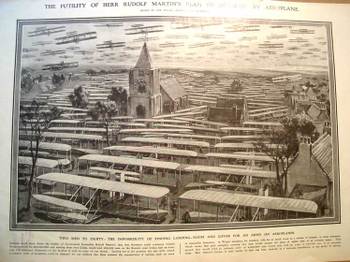
    The print that we’re looking at here appeared in the 19 December 1908  issue of The Illustrated London News and is entitled “The Futility of Herr Rudolf Martin’s1 Plan of Invasion by Aeroplane”, and reports on a possible German invasion scenario of Great Britain that was delivered in Berlin on 2 October 1908. This fantastic piece of  artwork by Hermanus Willem Koekkoek (1867-1929) graphically depicts what the author maintained was the impossibility of a German force to invade England by landing 50,000 flying machines and 100,000 men on the Kentish coast of England–undoable because “of the impossibility of finding landing-room (for the planes) and cover for an army on aeroplanes. The artist depicts a small town and what I guesstimate to be 60 planes in the air and 75 or so on the ground, leaving it to the imagination of the reader where the other 49,875 might go. He DOES make a point, and very vividly. 
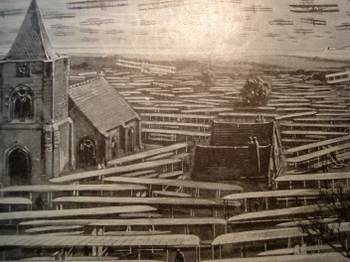
    Blogaerooplanedetail “Nothing could show better the futility of Government Councillor Rudolf Martin’s idea that Germany could construct 50,000 flying machines for 50-million pounds…and land 100,000 men on the Kentish coast from Calais within half an hour.” I would imagine that this illustration drove the point home to the folks who didn’t actually bother to read anything about the Martin defense plan. (It was in a similar way that Thomas Nast was able to control public opinion and sway political refuge and protection away from Boss Tweed. Tweed famously boasted that he didn’t care what the newspapers said about him because his power base didn’t read–he might’ve been and probably was correct here, so Nast took after Tweed via the political cartoon, and big too, and frequently; and the cartoons, even if the people looking at them couldn’t read, told the whole story graphically, and it was this that brought an end to Tweed more than anything else.)

    In 1908 Martin gave an interview to the Daily Mail in which he outlined another plan by which he felt Germany could launch 3,500 “specially design” airships (I’m guessing dirigibles) and land 350,000 (!) men in England in a half-hour. This evidently whipped itself into a frothy aeroplanitis in 1909, despite such efforts as this graphical reasoning by the ILN to dispense with the unreasonable fears.

    The airplane flown by the Wrights (the first powered heavier-than-air flight) occurred barely six years prior to these frantic events.  Their invention was still fresh (and basically “foreign”, as the Brits lagged well behind the other major powers in flight until WWI) and understandable in a way that the fears were not understandable, not really, because of the newness and exotic aspect of the possibly-threatening invention. Also it should be noted that the first heavier-than-air airplane crossing of the Channel didn’t take place until the next year, by Louis Bleriot, who claimed a 1000-pound prize for being the first to do so. The first passenger wasn’t taken across until 1910, and the first airship didn’t make a flight across until 1915. So no doubt Martin was looking into a far off future, except that the planes were still mostly of Wright design. 

    • For a tour of the chronological history of the graphical representation of quantitative data as well as innovations in statistical and representational cartography, please have a look at Michael Friendly’s fantastic work at York University https://datavis.ca/milestones/index.php?group=1900%2B–it is an historical site the way it should be done, complete with all the trimmings, as well as the usually-absent but very important citations to the original articles used in the chronology. 

    Notes:

    1. I don’t know much about Mr. Martin at all except that in Richard P. Hallion’s Taking Flight, Inventing the Aerial Age, from Antiquity to the First…. (pg 298) we find Martin being mentioned among other “popular authors” as Verne, Wells, Kipling, and Fawcett as being somewhat responsible for forming the perception of future flight. Martin was also the president of the German Airship League and author of The Coming War in the Air.


  • The Skies of the “Electrical Experimenter”

    JF Ptak Science Books   Quick Post

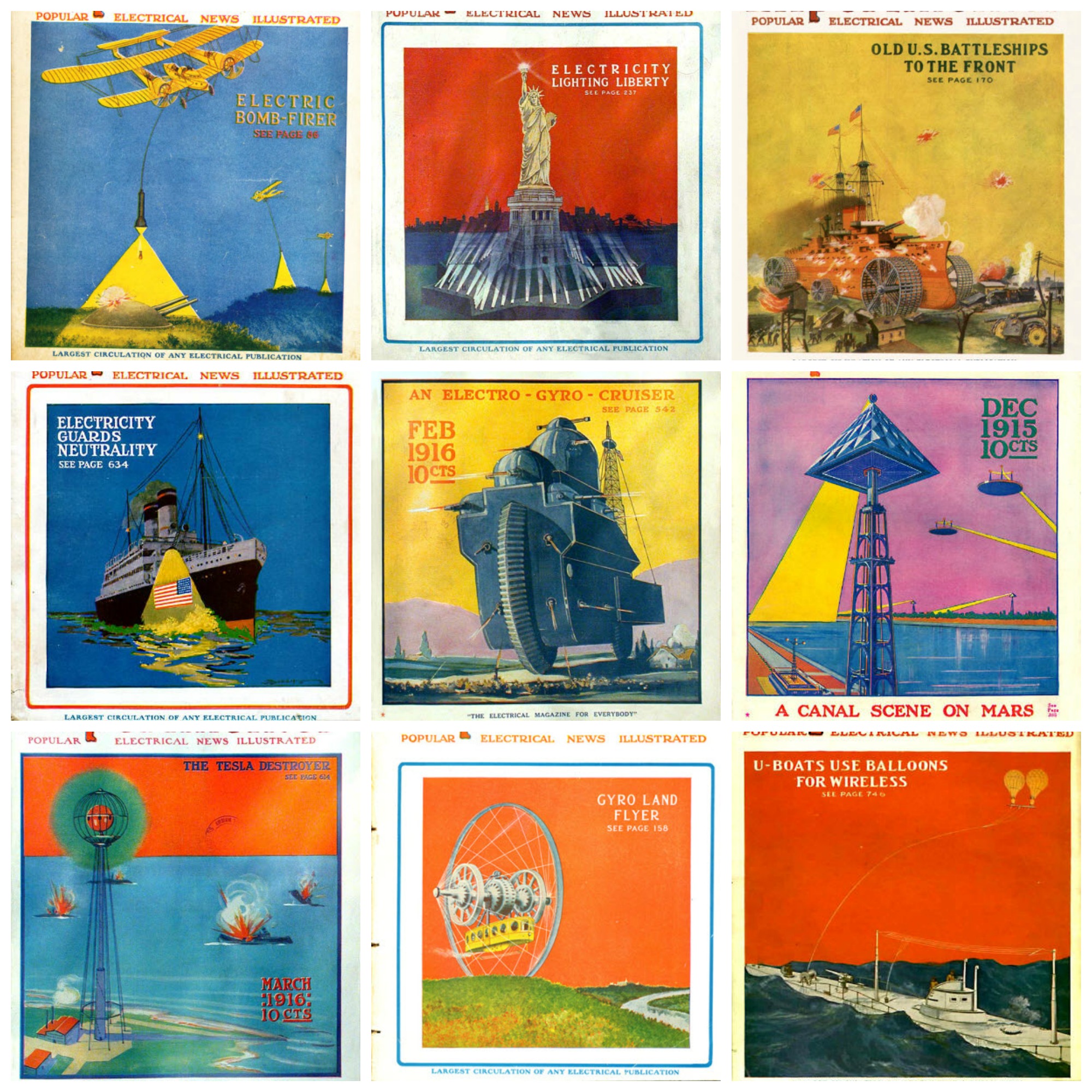
    The Electrical Experimenter is my new favorite magazine, and here’s why:

    Electrical Experimenter Skies MONTAGE _2_

    In addition to being thick and full of real electrical necessities and scientific bric-a-brac, it also held a fair amount of speculative thinking and just plain old science fiction (when sci fi wasn’t “plain” or “old”).  The EE was created and edited by the very busily creative Hugo Gernsback (1884-1967), a pioneer in science fiction, who held the magazine together from 1913 until 1929 (as the Electrical Experimenter from 1913-1920 and then as Science and Invention from then until the finale in 1931). There was evidently no holding back on cover design–at least from September 1915 until the end, when glorious ideas were display with flat design dominated by unusual and contrasting colors. For example, in the montage above, I was able to find glassy unadorned background skies that were red, yellow, purple, blue, and orange, with variation on each. Not only were the skies unusual, so were the surface colors: unusual blues, deep blacks, n=unnatural greens, purples, and so on. All of this framed some occasionally Highly Unusual and Not Expected Ideas. For example, in these WWI-era images–working right to left on the montage–there was an aerial bombing assistant of a light that illuminated the target through which a bomb could be deployed; a land battleship; an enormous motorcycle-like land megaship; a Martian canal-governing apparatus; a Tesla death weapon; an overland trolley housed in a gigantic spoked wheel; and a relatively tame portrayal of a communication system for a submarine. These are terrifically entertaining, and of course all they are are the covers. So, The Electrical Experimenter: terrific. 


  • Revisiting the Vermeer of the Tars

    JF Ptak Science Books  Reworking post 842 (from 2008)

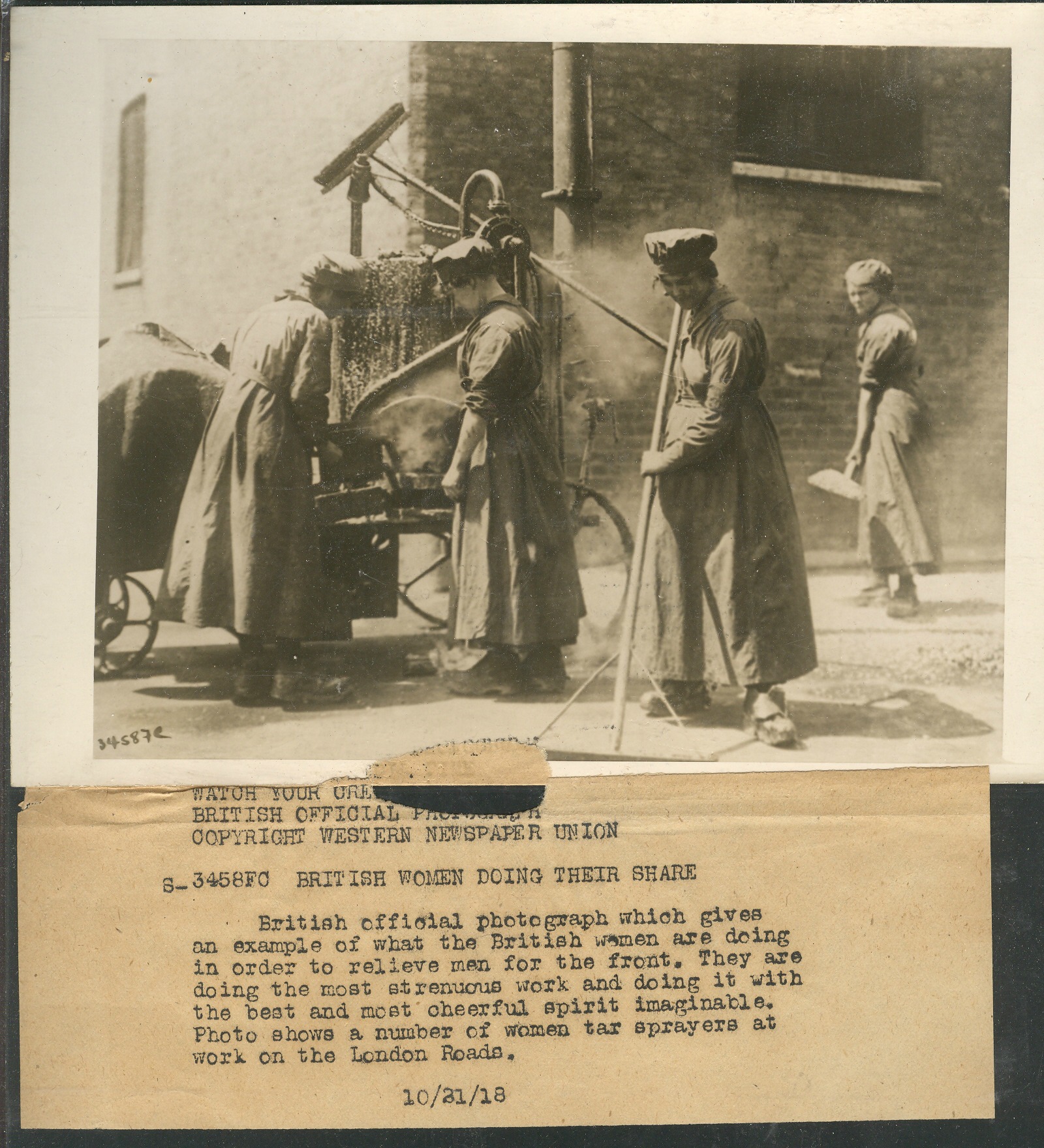
    In England, women were welcomed to the (paid) workforce during the years of the First World War (1914-1918)—their employment in traditionally male positions enabled those they replaced to go out to the front and die for their country.  Thus the women seen here in the News Photo Service Agency photograph (taken in 1918), working at spraying tar in the streets of London, were appreciated, and tolerated.  For women in England the War blasted away the contrivances of formally scheduled employment:  something like 12% of fall women in England were working as servants and house cleaners.   Come the War, women were offered jobs of revolutionary stature in a wide range and variety of work.  The Civil Service employment for women went from 33,000 in 1911 to 102,000 in 1921, and trade union membership rose 160% (357,000 in 1914 to 1,000,000 in 1918 (with men showing a 44% increase at the same time); for the most part, though, employers took advantage of the situation, and the women still generally earned less than half of the salary as comparable male workers did (or the men they replaced). 

    WWI Vermeer

    ·Posted by :

    ·in:


  • Thayer’s “New Navigable War Balloon” and Mutually Assured Destruction, (1885)

    JF Ptak Science Books  Quick Post

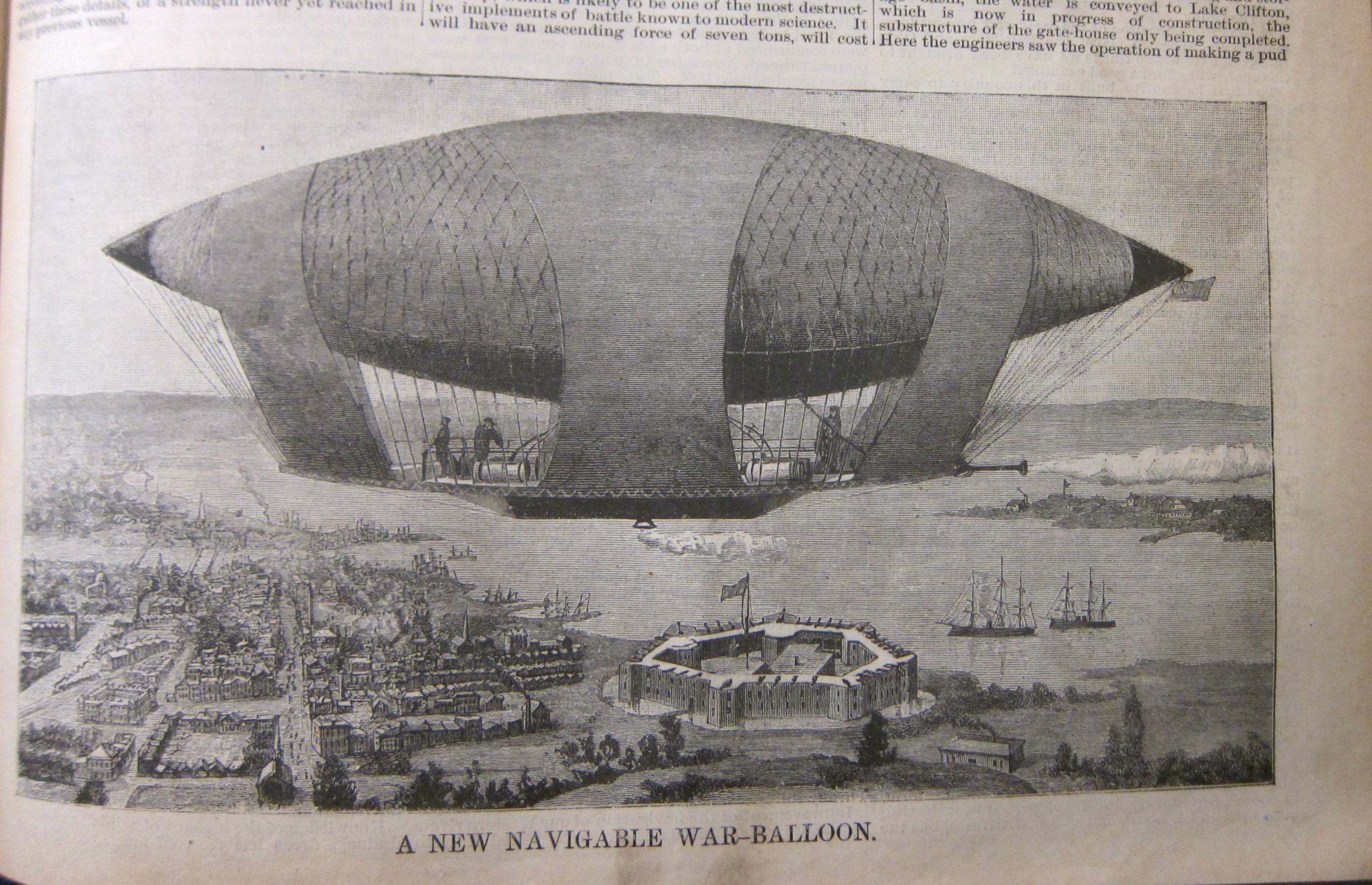
    Here’s a rather Jules Verne-y concept for a military balloon, presented to by General Russell Thayer, and published in the Scientific American Supplement in 1885.  In this iteration the aircraft is labeled a “war-balloon” but looks benign and observational; in the second image, see a month later in Harper’s Weekly, the balloon is definitely a war machine, having just bombed something with what looks like an enormous explosive. The scene here illustrates an airship in flight over a very industrialized section of a city, perhaps to drive home a propaganda point that bombing was accurate enough to be strategic and also that targets were industries and not general populations. 

    (The first aerial bombing seems to have been during the first Italian War of Independence and used by the Austrians from a  balloon against Venice in 1849; while this 1916 bombing occurred a few years after the first bomb was dropped from a heavier-than-air aircraft during the Italo-Turkish War on 1 November 1911, the Italians this time delivering the blow in Tripoli.)  

    The idea of aerial bombardment was an enormous threat, imagining death coming from above,  huge airships dropping untold numbers of bombs upon a city–I imagine that the idea came as much a blow to someone at the end of the 19th c as the threat of nuclear devastation came to those in the mid-20th c.  As a matter of fact S.L. Koter and J.E. Gessler quote an unnamed “distinguished officer in the U.S. Navy” implying much the same thinking as would be later heard as nuclear-weapons-inspired Mutually Assured Destruction (MAD): “War will become impossible because it will signify not merely great loss of life and property, but annihilation”. (Ballooning, a History; 1782-1900, p. 268.)

    It is particularly interesting to note here that Thayer, proposes to use a propulsion system that is not dependent on a propeller but rather “compressed air”.  “In the independent balloon the motor is a high pressure air compressor coupled directly to a newly devised carbonic acid gas engine and a reservoir for storing the air until sufficient pressure is obtained. The construction of the dependent balloon is similar to that of the independent ship except as regards the motive power which is here electricity…”

    Sci Am 1885 war balloon


  • 269 Miles of Dead Soldiers

    JF Ptak Science Books  Quick Post


    The Illustrated London News
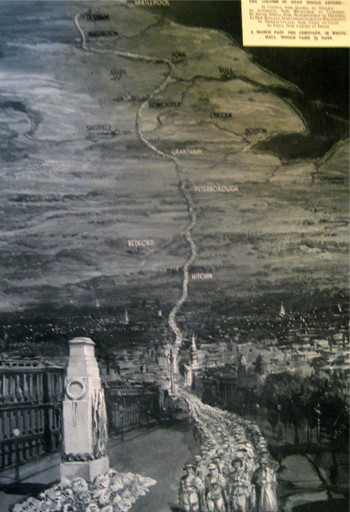
    published this very sobering image showing the general reader in London in 1933 the absolute strength and weight of the dead–and probably in a way that they had never seen before.  The image is entitled “In Memory of the 1,104,890 British Dead of the Great War”, and was drawn by D. Macpherson.  It very graphically represents all of the war dead of the British Empire for the period of the Great War of 1914-1918 (not to be called “WWI” or “The First World War” until after the second week in September, 1939, when there was a new World War from which the older one needed to be distinguished).  Depicted here are the dead as a line of men, four across, extending from London to Durhham.  The column passes from London through Hitchin, through Bedford and Peterborough and Grantham, past Sheffield and Leeds and York, and then on to Durham.  An extraordinary column of the war dead: 900,000 of the dead were not soldiers at the beginning of the war, but they sure died that way, and this map shows them all in a line, marching from  a point 269 miles distant.

    This line of dead soldiers would be 2,690 miles long including all military deaths for the war; 5,380 miles for all deaths overall. 


    Blogmarch

    Blogmarching_2


  • Excellent Crowd Scene–Soldiers Viewing a Boxing Match, 1918

    JF Ptak Science Books    Quick Post

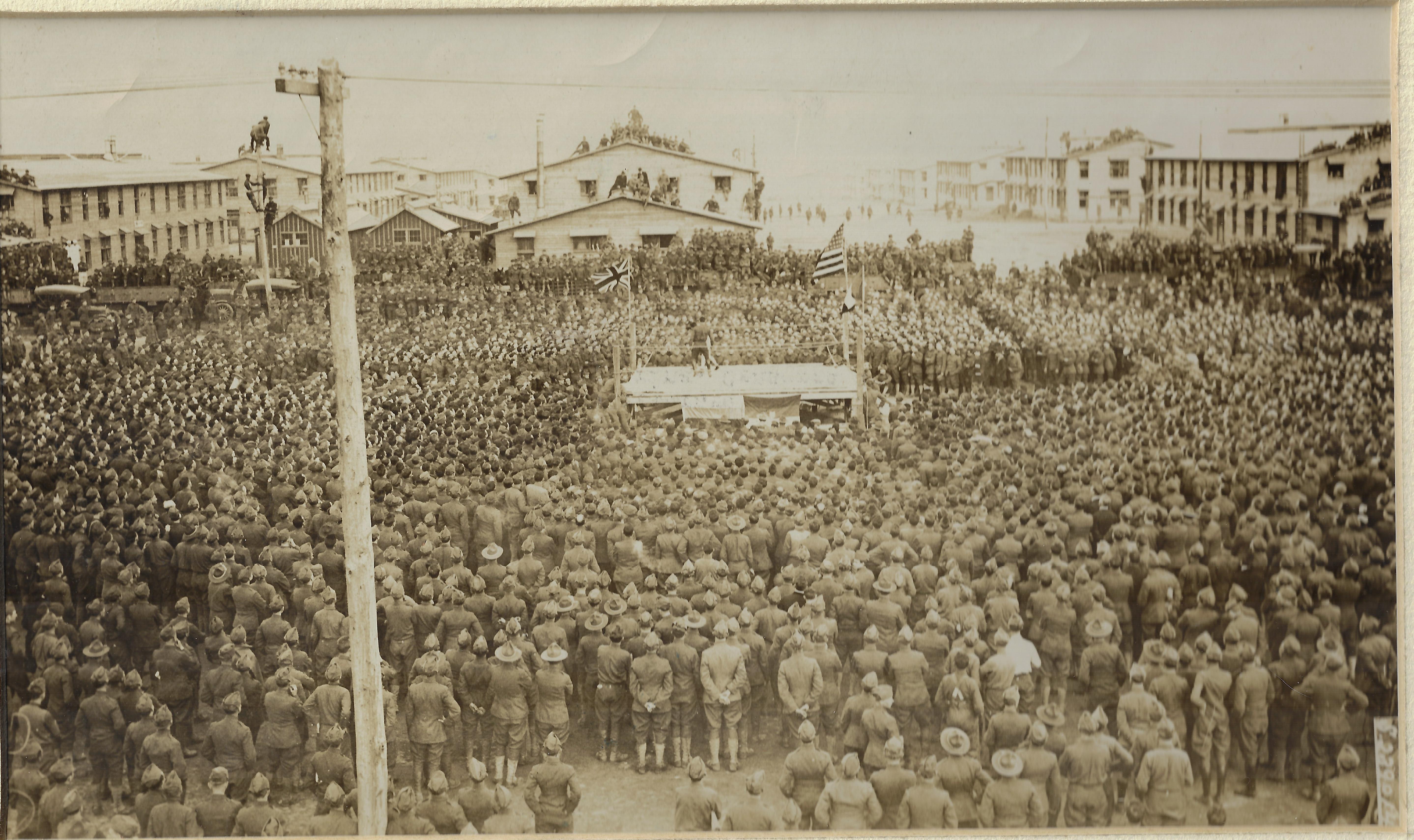
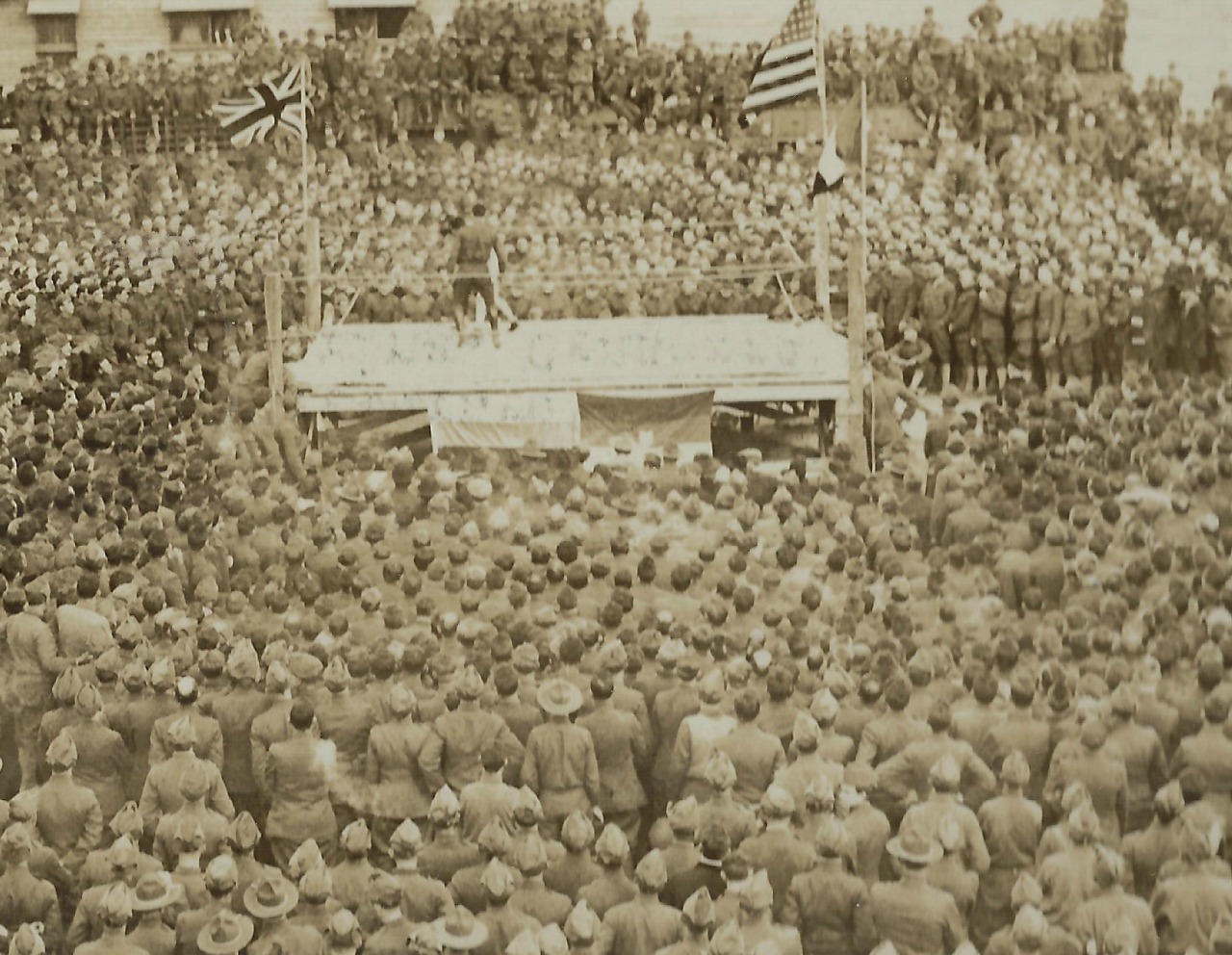
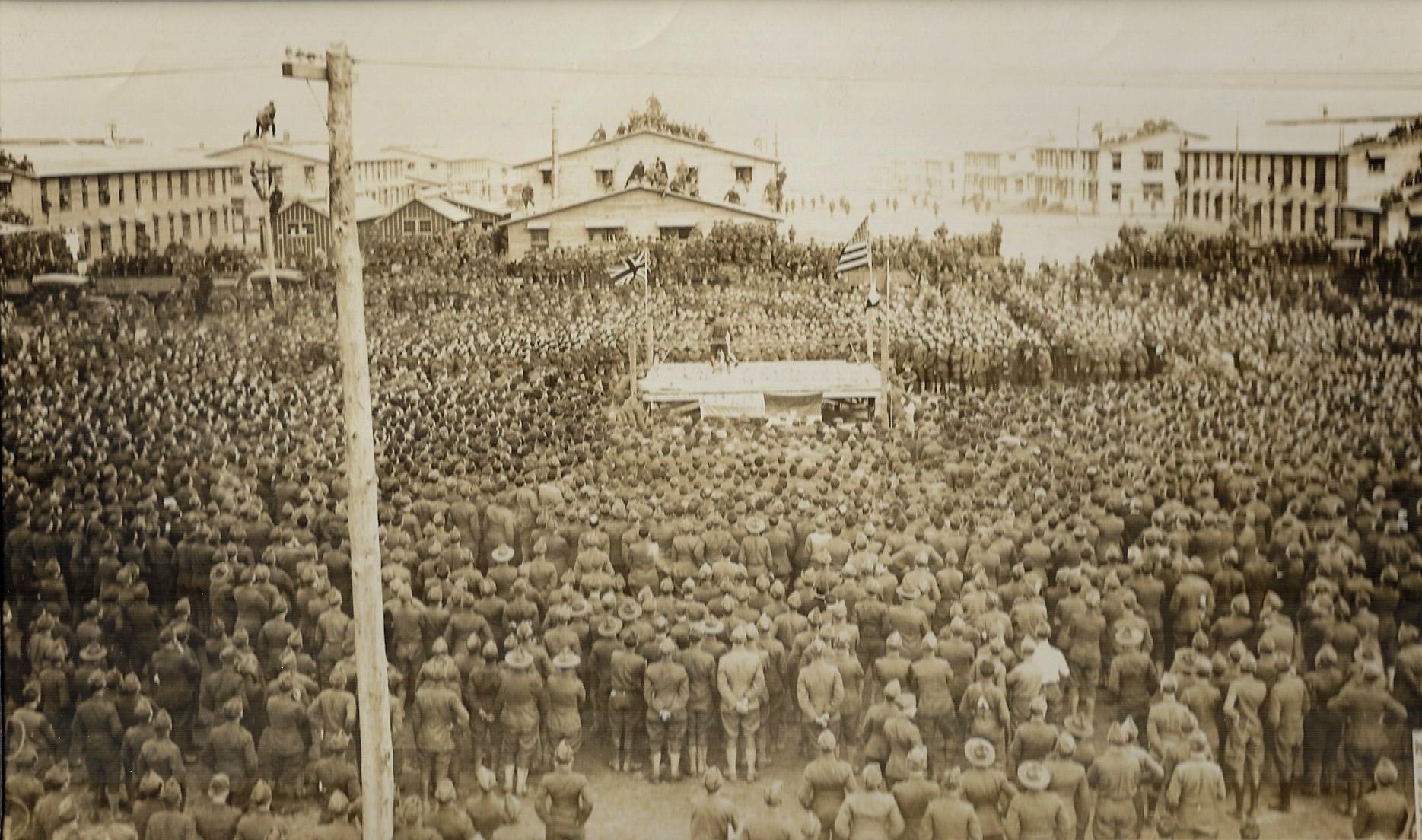
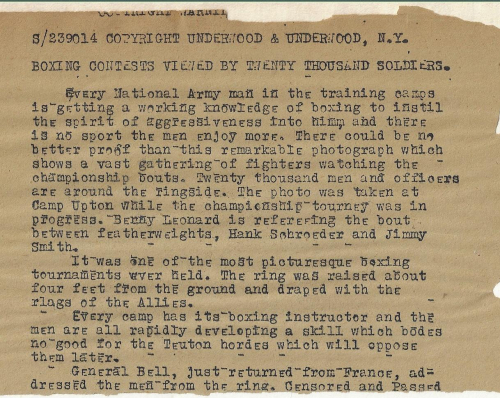
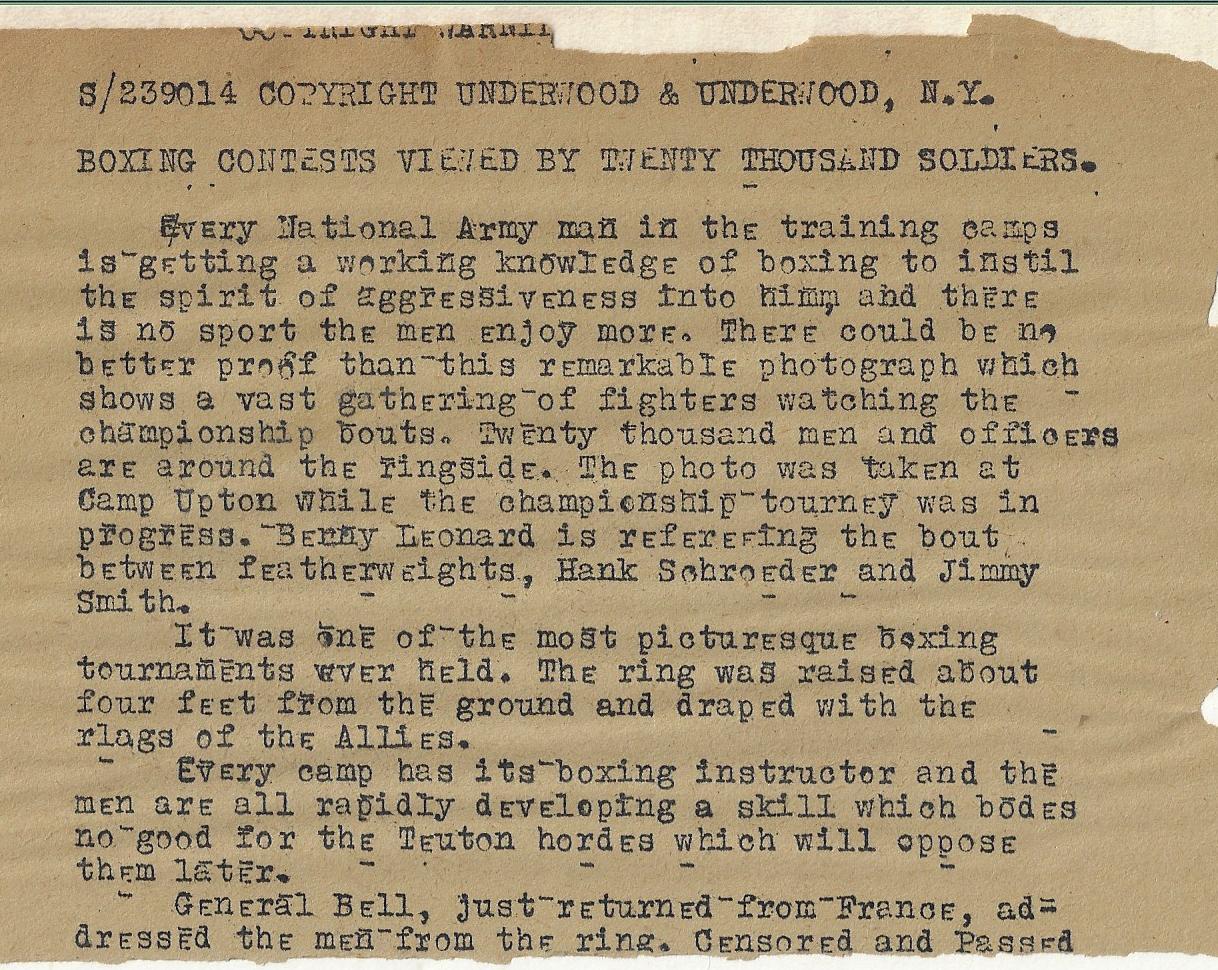
    I’ve posted probably 100+ images from a stash of WWI News Photo Service photographs that I have here (you can find some of them by clicking on the WWI Photos link at the top of each page, located just under the blog’s banner, and read about the photo services) and the one I’m hosting today is one of the few sport-centric images in the 550 item collection. This is a “championship” bout being held at Camp Upton (Long Island, NY) in ca. late 1917/early 1918. The photos usually came with a typed description of the event that was used for a caption by the newspaper or magazine that published it, and this one (reproduced below) describes the scene. I’ve tried to enlarge some of the areas of interest in the image, but the original isn’t sharp enough to allow for more than about 250% increase. But that is good enough to give the viewer a sense of the density of the crowd, and the makeshift atmosphere surrounding the event.  

    WWI Photo Boxing Photo

    And the detail:

    WWI Photo Boxing Photo detail

    ·Posted by :

    ·in:


  • Remote Control Warfare, 1917

    JF Ptak Science Books   Quick Post

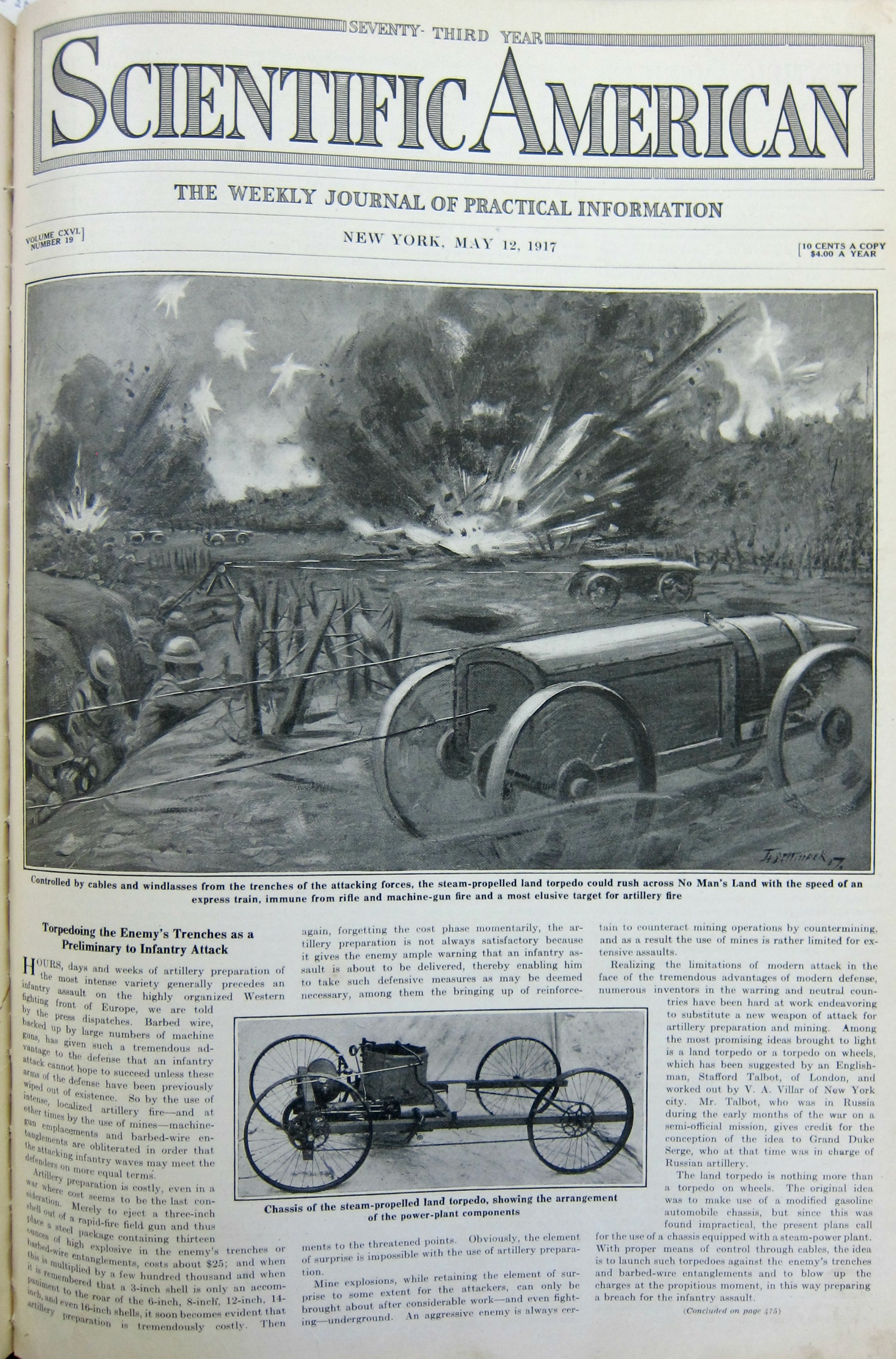
    “Torpedoing the Enemy’s Trenches as a Preliminary to Infantry Attack” is a short but powerful article on the possibility of drone strikes in 1917. Actually, it was more like a wire-guided war robot, steam-driven, trundling across No Man’s Land in a whirl of steel wheels and steam, guided from one trench to attack another, on the other side. The thing doesn’t look so functional, given the varied and terrifically uneven ground it had to traverse with a heavy (and explosive) load and its carriage and powertrain. In a way it reminds me of a Bangalore torpedo, except mobile–on the other hand, the Bangalore actually worked. 

    Ironically, the torpedo was being operated across land from one land-submerged army to another; the colorful cover of this issue pictures finding submarines by air patrol, and then eventually killing the sub with an air-launched torpedo. 

    WWI Project land torpedo


    ·Posted by :

    ·in:

    —

  • WWI Boxing Exhibition (1918)

    JF Ptak Science Books   Quick Post

    WWI Photos boxing

    This fantastic photo comes from a collection of WWI News Photo Service photographs. Given that in general photographers were not allowed free and unrestricted access to military areas (let alone battlefields) photographs were made by pools of photographers working for several different photographic news agencies. The content of the images were generally secured and approved by the Committee for Public Information (CPI), which came into existence by executive order under President Woodrow Wilson on April 13, 1917, and which was charged with the task of wining the hearts and minds of the people of the U.S., to gain public support for the war and for American participation.  

    It is somewhat both ironic and not terribly uncommon for Wilson to have run for the presidency for one thing and then doing exactly the opposite, as he did with his 1916 re-election campaign slogan “He Kept Us out of War”.  

    The way that many newspapers obtained the war images that they published in their papers was via a semi-centralized pool of war images.  The newspaper would request, say, a photo of German prisoners, and would contact one of these photographic agencies—for example, say, the Central News Photo Service of 26-28 Beaver Street, NYC—and purchase the rights for republication, and then print it in the newspaper along with the story.  In almost every case the photo would be accompanied by a caption mimeographed onto an attached piece of cheap paper, or have the information stamped on the reverse.

    WWI Photo boxing text

    Photography was just one aspect of the information distribution and control by CPI–there were also thousands of Newspaper articles, public speakers (the famous “Four Minute Men” who would give some 7 million pepper talks at the beginnings of movies and public events), radio broadcasts, films, posters, demonstrations and anti-demonstrations, and other public displays.  


    ·Posted by :

    ·in:


  • Hammer, Sickle, Skull (1919)

    JF Ptak Science Books  Quick Post

    Here’s a very provocative piece of design meant to equate death and communism–and in that there is no question.  Sowjet-Rußlands wahres Gesicht, aus eigener Anschauung und Erfahrung geschildert von drei einst begeisterten Kommunisten,  (“The Real Face of Communism, as Told from the Personal Experiences and Intuition of Three Once-Enthusiastic Communists”) was written by Friedrich Oskar Kloetzner in 1919 in the bad days of early social struggle that led to the bad days of middle and later struggle and then Apocalypse. Here, in 1919, just after the end of the war, the great supposed golem was Communism–that would of course morph and change and accommodate other fears and hatred, but for now, there were things needed to fill the vacuum left by defeat and the coming of a bad peace, and the Communists served to fill at least one of the many niches to come. 


    SOwjet-russlands


    Notes:

    The pamphlet measures 7×5″,  and is paginated 223-256. Provenance: Library of Congress.  This has a funny record in WorldCat—there seem to be 21 results in the search on this title, though this looks like a cataloging error–for all of the different “references” there are only eight libraries locating copies of this pamphlet, with half of those in Europe.)