A Daily History of Holes, Dots, Lines, Science, History, Math, Physics, Art, the Unintentional Absurd, Architecture, Maps, Data Visualization, Blank and Missing Things, and so on. |1.6 million words, 7500 images, 4.9 million hits| Press & appearances in The Times, Le Figaro, Mensa, The Economist, The Guardian, Discovery News, Slate, Le Monde, Sci American Blogs, Le Pont, and many other places… 5000+ total posts since 2008.

Category: World War I

  • On the Economic Efficiency of Poison Gas in Wartime (1921)

    JF Ptak Science Books 

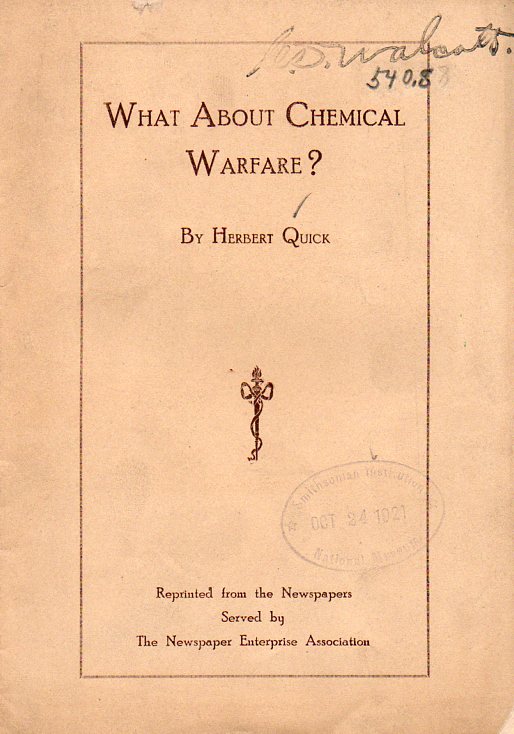
    • Review: QUICK, Herbert. What About Chemical Warfare? The Newspaper Enterprise Association (1921) 15pp.
      7×5 inches. Fine condition. WorldCat/OCLC locates 6 copies. 
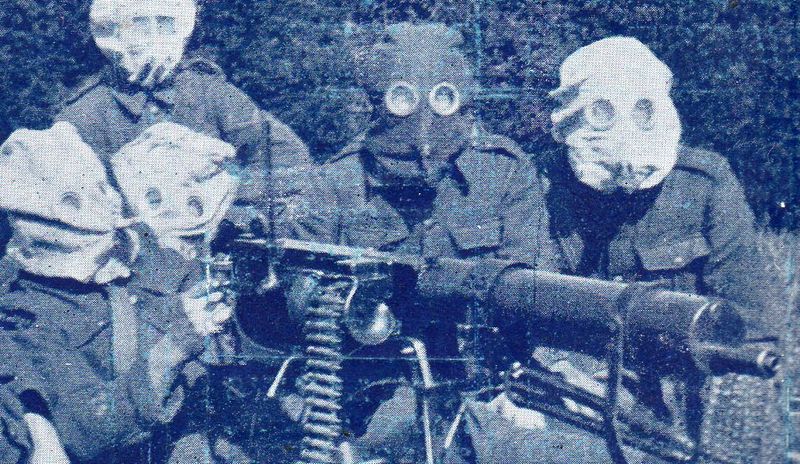
    WWI--gas machine gunb712

    [Image: Illustrated London News, October 30, 1915, detail of photo on front cover.]

    Herbert Quick did a fair amount of thinking about the military use of poison gas, and it winds up, in the
    final analysis, thinking that it was tolerable. What About Chemical Warfare? (published by the
    Newspaper Enterprises Association in 1921) is certainly a possible title for a Duck-and-Cover A-Bomb
    or You and Your Hormones kind of film. But Mr. Quick took the slow boat around his issue, thinking
    about it a little long and out loud, before coming to his final conclusion in the chapter titled “Gas
    Warfare Cheapest and Most Effective Arm of Defense”.
     

    [Internet Archive offers the full text : https://archive.org/stream/whataboutchemica00quic/whataboutchemica00quic_djvu.txt]

    He points out the enormous impact in the war effort that relatively small chemical corps played in
    WWI–something on the order of hundredths of one percent of all serving soldiers were employed in
    the combined chemical corps, saying “how small a body to produce such great results!” Which is true,
    assuming that by “great” he meant ‘widespread’, though it is unclear exactly what he was talking about.
    Quick does make a case for poison gas being not so inhuman as presented by most civilized people,
    pointing out both its high quick-death rate and survivability/recovery rates, which seems to be
    giving/taking at the same time. No matter: “But woe to the army or nation that does not keep up with
    the times. The Angel of Death will breathe in their faces” he writes.

    The author also warns that though Germany was “stripped” of her war-making capacities, he thought it
    was not so of the industries necessary to produce poison gas. He points out that Germany can produce
    these munitions in secret, and that if any “militaristic nation conquers the world in the future”, it will be
    through the use of the poison gas it developed in secret.

    Defense was also important: “in the absence of efficient defense worked out beforehand, our great
    cities might be wiped out with gas bombs dropped from aircraft”. Mr. Quick believes that protecting
    cities is possible, writing simply “preparation will prevent such a crisis”. Indeed. Unfortunately no
    ideas about this defensive posture were forthcoming, though he did bring himself around to writing
    about gas as a defensive tool. Against looters. And rioters. And snipers. “Gas puts the sniper in the
    power of his enemy” Quick writes, using the Marine action in Vera Cruz, Mexico, as a good example of
    where gas (“gas grenades”) would have come in handy.

    The bottom line is of course the bottom line, practically stating that poison gas as a weapon was
    indisputably more cost-conscious than anything else, by far, each dollar spent on chemical warfare
    being worth “from three to five hundred for the army”. Poison gas services Quick says should be
    pursued, because “gas warfare cannot be stopped until all war is stopped”.
    Gas warfare “gives the educated, intelligent nations the advantages over the people of lower
    civilizations”.

    “When both sides are prepared it is much less inhumane than war with bullets and high explosives; but
    it means horrible annihilation to the army which is unprepared.”
    It is an interesting exercise to replace “poison gas” with other types of weapons, just to see how it
    reads.

    Mr. Quick was up and down in his treatment of poison gas and war, though almost entirely down. One
    thing he didn’t see, that no one saw, really, was the use of a particular gas that was used to destroy
    millions of people, and which was developed quite in the open in Germany for many years, used for
    killing rats. The Nazis simply used it instead on people. No one saw Zyklon-B coming, and no one
    could have, even when they did.

  • Display of Information: the Naval Power of Principal Nations (1903)

    JF Ptak Science Books   Quick Post    

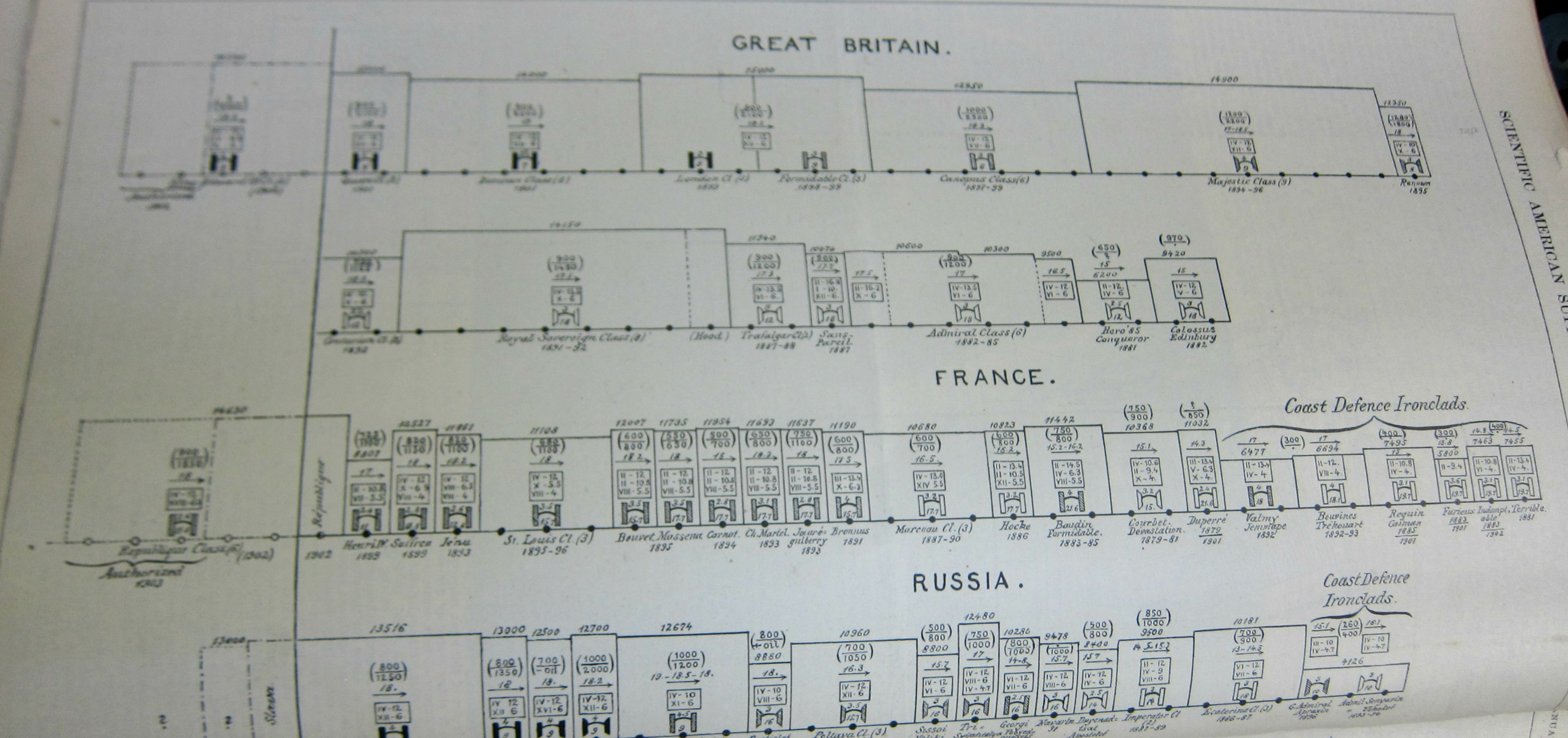
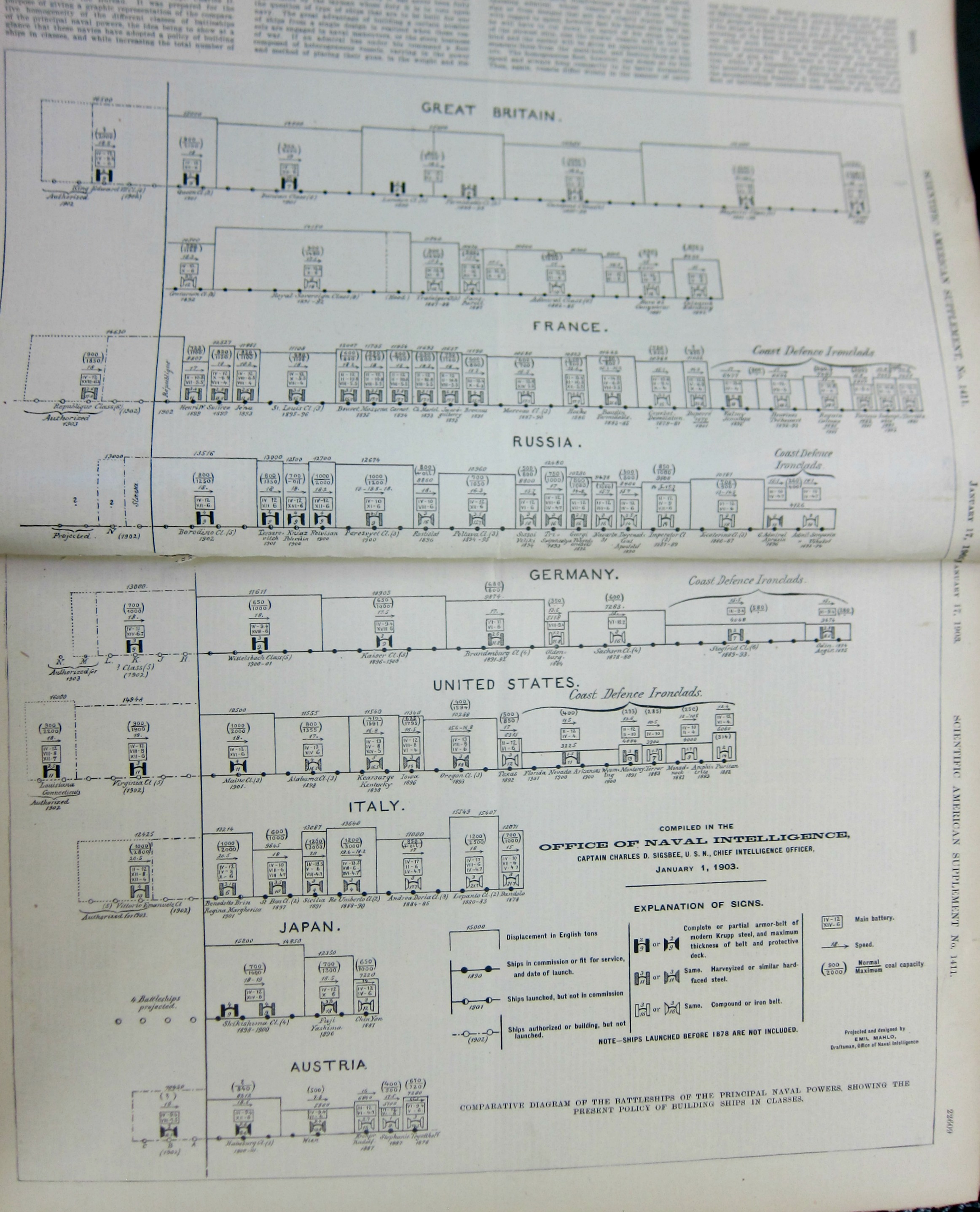
    I came upon this fine display of info this evening, a big two-page spread in the Illustrated London News, opening up to an impressive 16×26″ or so. The chart shows relative naval power (measured in this case in terms of battleships) between Great Britain, France, Russia, the U.S., Italy, Japan, and Austria. It appeared in Scientific American Supplement issue 1411, January 17, 1903 (pp 22608-9). The images are greatly expandable: 

    Datviz naval power 1903 ILN

    And in parts:


  • Internment Camp in Germany for British Civilians, 1915

    JF Ptak Science Books   Quick Post

    WWI POW civilians Ruhleben _2_ detail

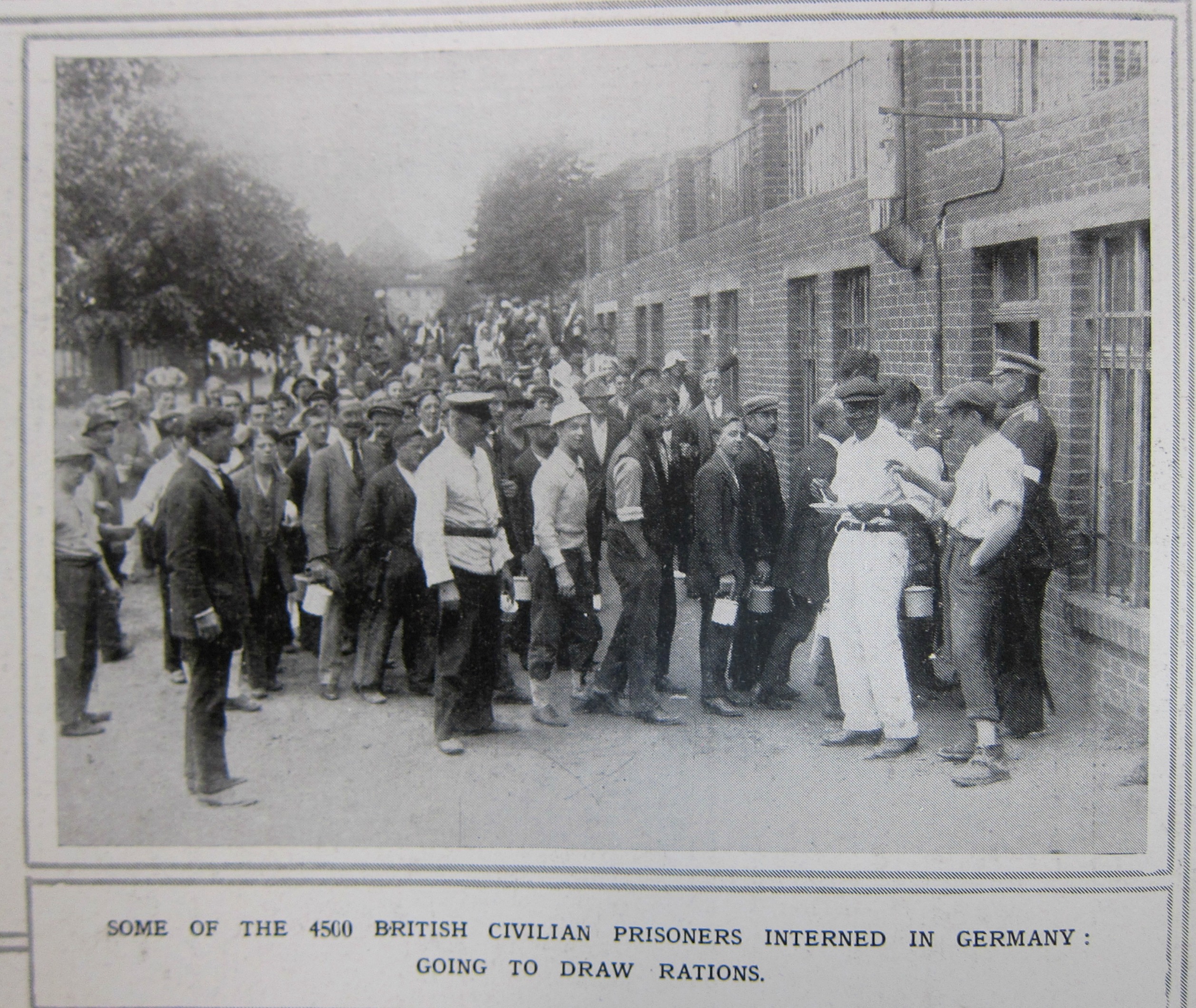
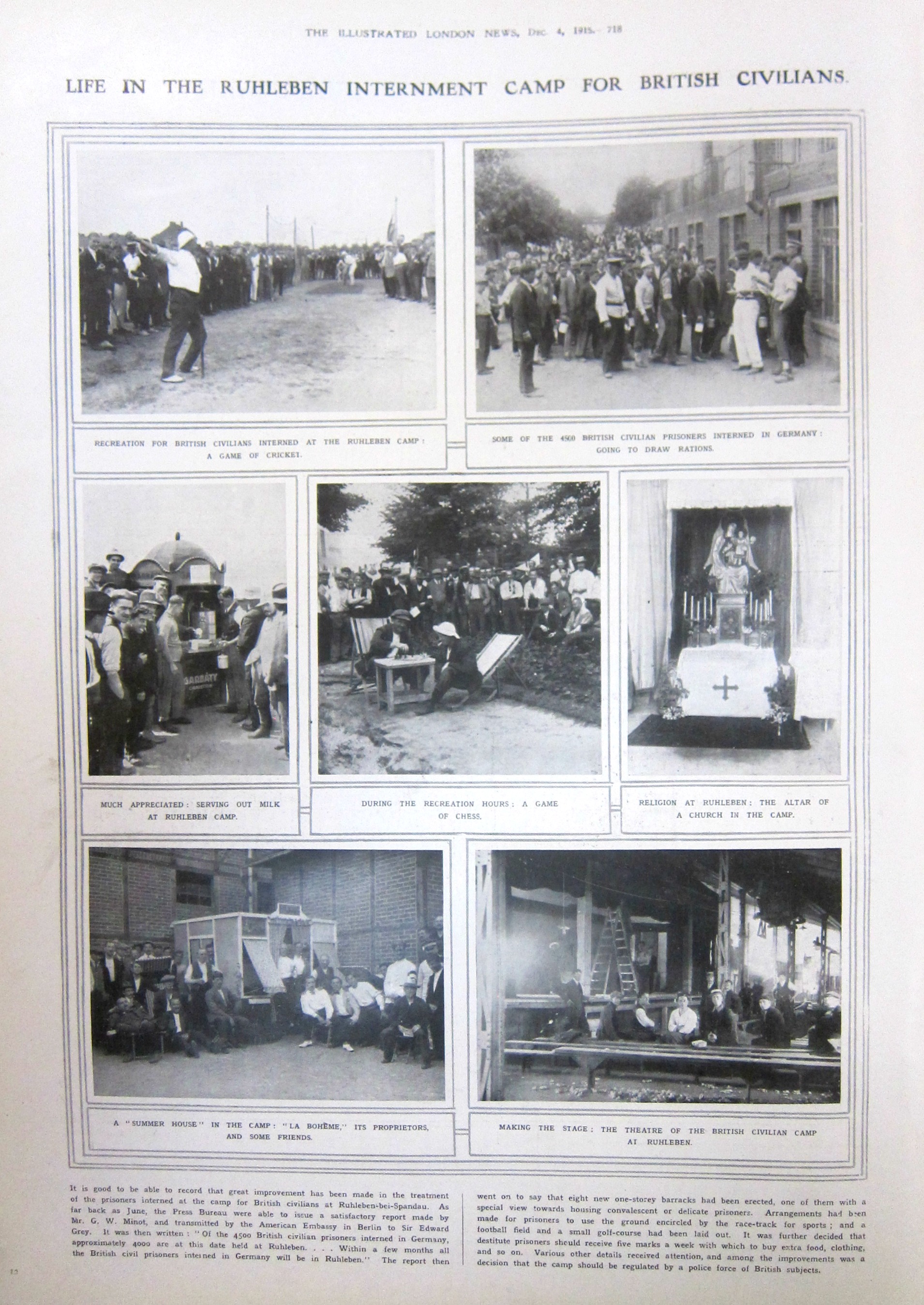
    This image was a little surprising to me when I saw it this afternoon–it occurs in the Illustrated London News for 1915 and even though I have been through all of the issues for that journal for WWI I had no recollection for it…and I certainly do not recall other similar pictures. And so there it is, a collection of photos of life inside Ruhleben Detention Camp, near Berlin, as published on December 14, 1915. (I don’t think “Ruh” is a word in German, but if it was “Ruhn” then the camp would be “Resting Camp” or “Living Camp” or some such.)   In any event the detention camps for Brits in Germany in WWI is something that is not commonly mentioned, so I thought I’d share this find. As it turns out, Ruhleben was a harness racing compound, with people housed in converted stalls–this is something I’ve encountered semi-frequently, this use of horse racing venues as detention centers, as with the internment camps for the Japanese in the western U.S. in 1942+.) Ruhleben seems to have been open and used for the duration of the war, and housed on average about 4-5,000 people at a time. (At one point one of those imprisoned here was James Chadwick, who would discover the neutron in 1932 and be awarded the Nobel Prize in physics in 1935.) 

    WWI POW civilians Ruhleben 1915

    I know that these places existed, of course, though I just do not recall seeing anything about it in the Illustrated London News or the Illustrirte Zeitung (Leipzig). 

    ·Posted by :

    ·in:

    —

  • When Did “The Great War” Become “World War I”?

    JF Ptak Science Books  Quick Post

    When does the Oxford English Dictionary establish the first uses of “World War I”, “World War One”, “First World War”, etc?

    World War, n.  

    A war involving many nations of the world; spec. that of 1914–18 or of 1939 45.First, Second, Third World War: see the first element.

    1848   People’s Jrnl. 4 250/1   A war amongst the great powers is now necessarily a world-war

    1864   G. Haven National Serm. (1869) Contents p.xx. (title)    The world war: aristocracy and democracy.

    1889   R. B. Anderson tr. V. Rydberg Teutonic Mythol. i. xxxiv. 139   From the standpoint of Teutonic mythology it is a world war [Sw. världskrig]; and Völuspa calls it the first great war in the world—folcvig fyrst i heimi.

    1900   N. Amer. Rev. Nov. 653   The South African war, following immediately upon the close of the Peace Conference at The Hague, has not yet reached its end, and already the horizon in Eastern Asia is lurid with the glare of a world-war.

    World War I  n. (also World War One, World War No.1) = First World War n. at first adj., adv., and n.2 Special uses 2b. Abbreviated WWI.

    1939   Time 18 Sept. 10/2   Exports of arms, munitions and related materials in World War I amounted..to only 25% of total exports to the Allies.

    1947   Time & Tide 29 Nov. 1269/2   The despair and cynicism that followed what it has now become fashionable to call World War One.

    ·Posted by :

    ·in:

    —

  • Graphs of Defects of American Soldiers, 1919

    JF Ptak Science Books Quick Post

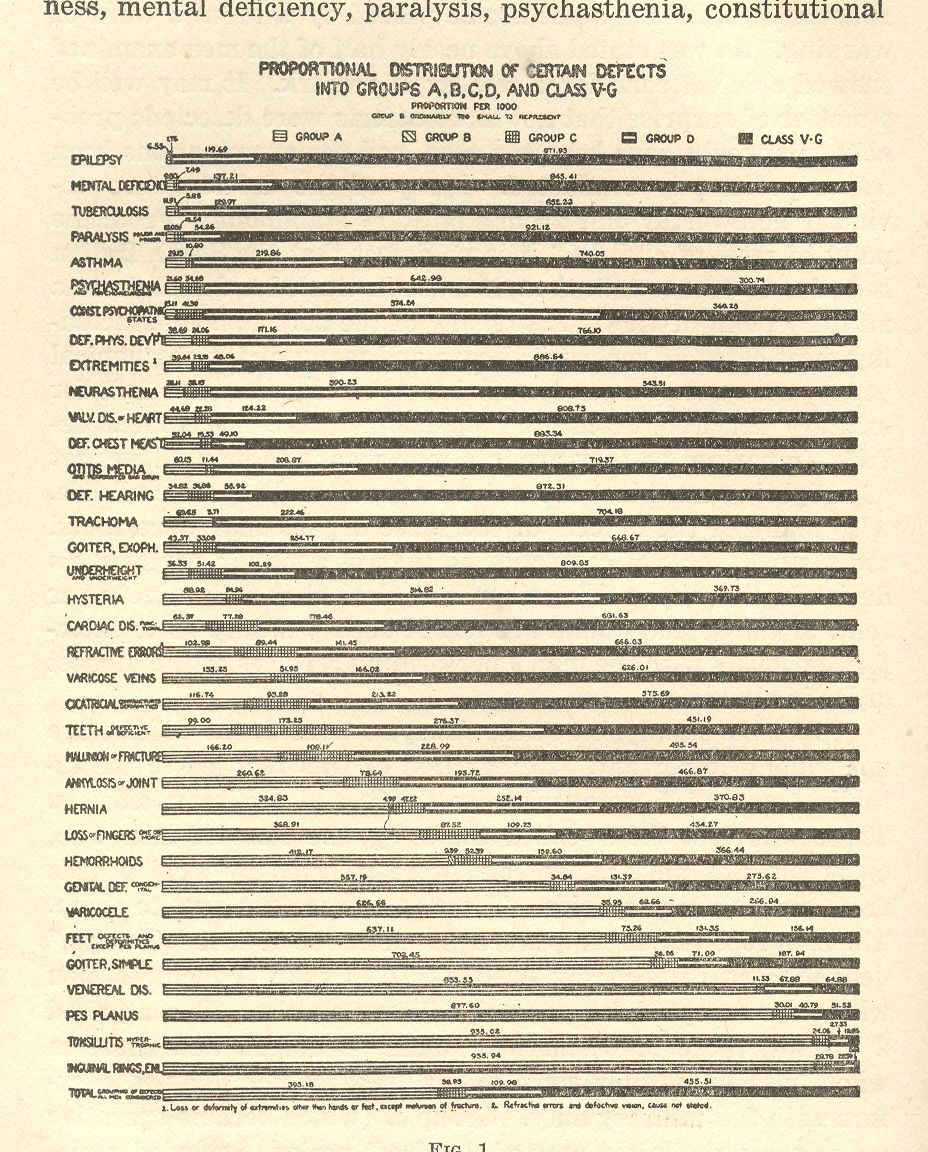
    Right at the end of WWI there appeared a famous publication on the end results of an epic study on the physical conduction of U.S. men drafted into the armed services:

    War Department: Defects Found in Drafted Men; Statistical Information Compiled from the Draft Records…the Physical Condition of the Men registered and Examined in Pursuance of the Requirements of the Selective Service Act, Prepared under the direction of the Surgeon General M.W. Ireland, Major General, MC U.S. Army, by Albert G. Love, MD…and Charles B. Davenport... 

    This huge (358pp) report was printed by the Government Printing Office in 1920 and provided more data of enlisted men than had ever exited, and for good or for ill (and for the various problems encountered in data collection and interpretation), there was a tremendous stew of bubbling bits of human failure and detractions, real and not.

     Full text via National Library of Medicine: https://collections.nlm.nih.gov/bookviewer?PID=nlm:nlmuid-9502639-bk  NIH Digital Collections

    • “This 1920 study of the men called by the selective service for the U.S. Army upon America’s entry into the Great War was ordered by the War Department, and it employed as its eugenics specialist, Charles Davenport. The study looked at many types of physical, psychological, and mental factors within this part of the male population of the United States.”
    • “The conclusion of the analysis was than an inordinately high proportion of U.S. Army draftees were defective and below average in physical fitness and psychological or mental readiness. Davenport and his colleagues also concluded that much of the American male population was not equipped for participatory democracy. This test of U.S. soldiers was thoroughly challenged at the time due to suspect analytical methods.”–University of Missouri Library   https://library.missouri.edu/exhibits/eugenics/defects.htm

    ===blog==aug 9=defect graph


  • Department of “What is It?” (#9) A New Way of “Conducting” War.

    JF Ptak Science Books   

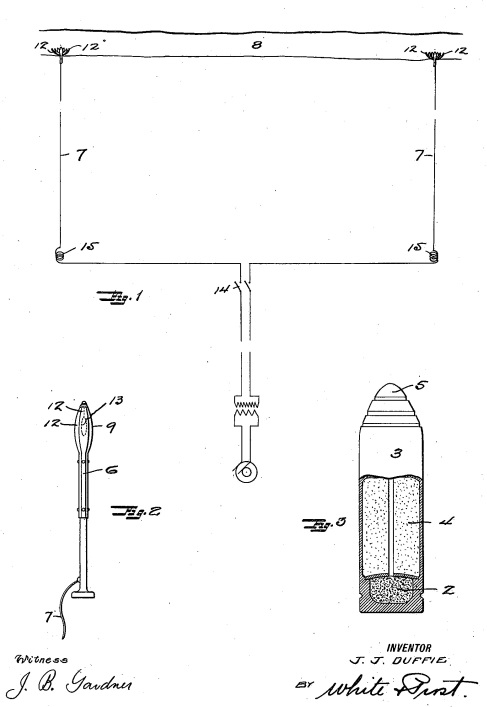
    The hint for this WIT? is already given in the title to the exercise–that said, can you figure out exactly what is going on here? It is a lot more complicated than you’d think, but at least part of the answer is pretty much a given when looking at the patent drawings.  The tricky part of the answer here is knowing how this thing would be so lethal.  

    Here’s the drawing:

    WWI trench electrocution detail

    ·Posted by :

    ·in:

    —

  • A Non-Metaphorical “Microbe” (1917)

    JF Ptak Science Books   Quick Post

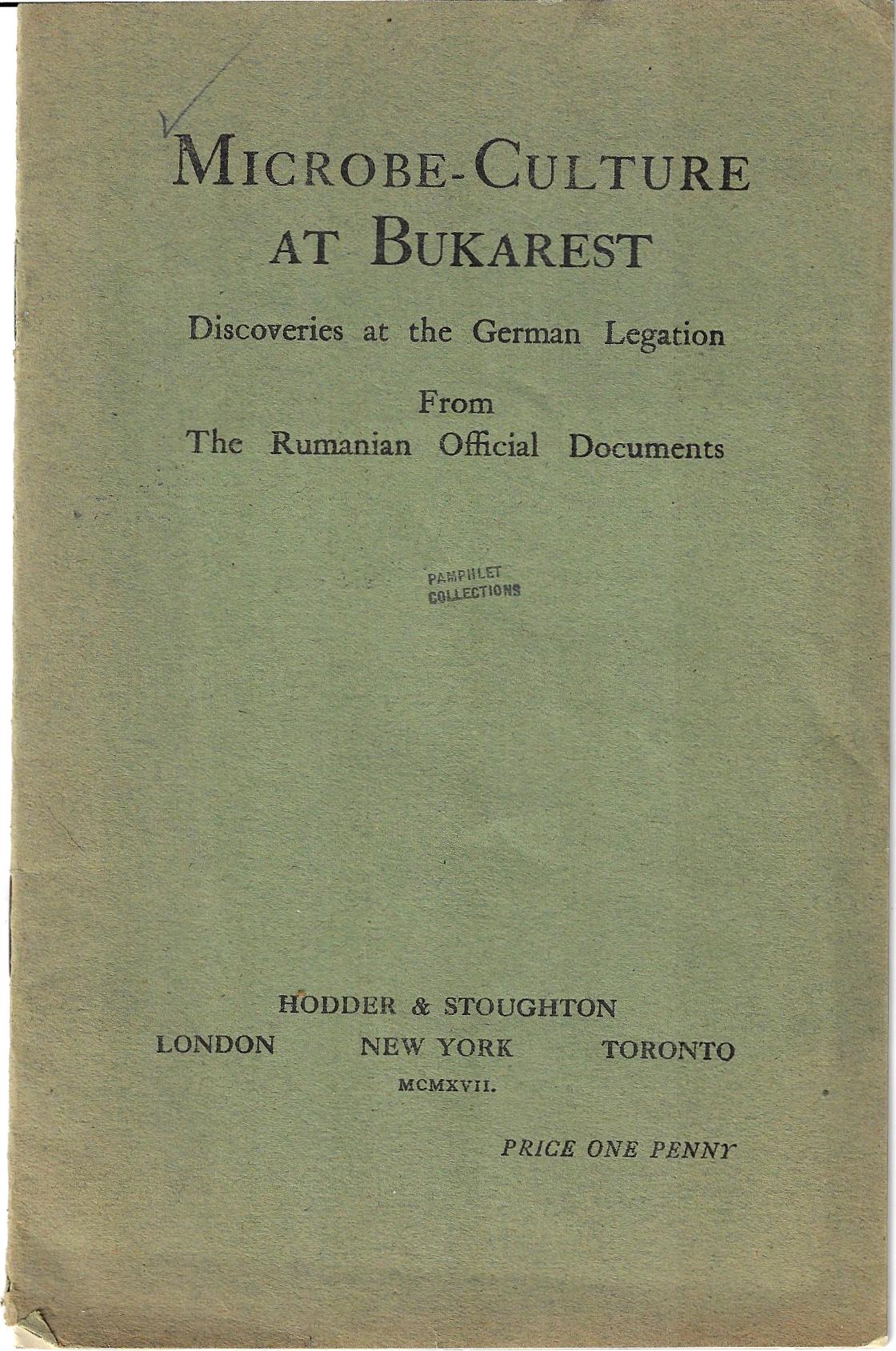
    WWI Microbe BukarestI was certain at first glance that this little pamphlet was referring figuratively to the Germans in Romania as “germs”. Romania was a neutral country for a good part of WWI though it is my impression that they never warmed to the idea of Germany as a friendly non-combatant, and so they would treat them as you would turn away from someone’s coughing fit.

    This is not the case. They were talking about real microbes, and in particular, the bacterium Bacillus anthracis that some contingent of Germans was manufacturing in Bucharest, evidently with the intent to infect horses and mules that were on their way to the Russian front, a real nasty piece of business.  Now the use of biological weapons had been around for perhaps thousands of years (in crude form), though in more recent times it wasn’t much used at all, though there are notable exceptions (as with the Japanese against the Chinese during the Sino-Japanese war that was fought for seven years leading into WWII.  The use of biological weapons had been outlawed at the Hague Conference, but that didn’t necessarily stop everybody, as this pamphlet states. So the not-metaphorical microbes were not to be used, though poison gases of all sorts was an option.  


    ·Posted by :

    ·in:


  • History of Piles: To the Victor, the (Pointy) Spoils (1919)

    JF Ptak Science Books   Quick Post 

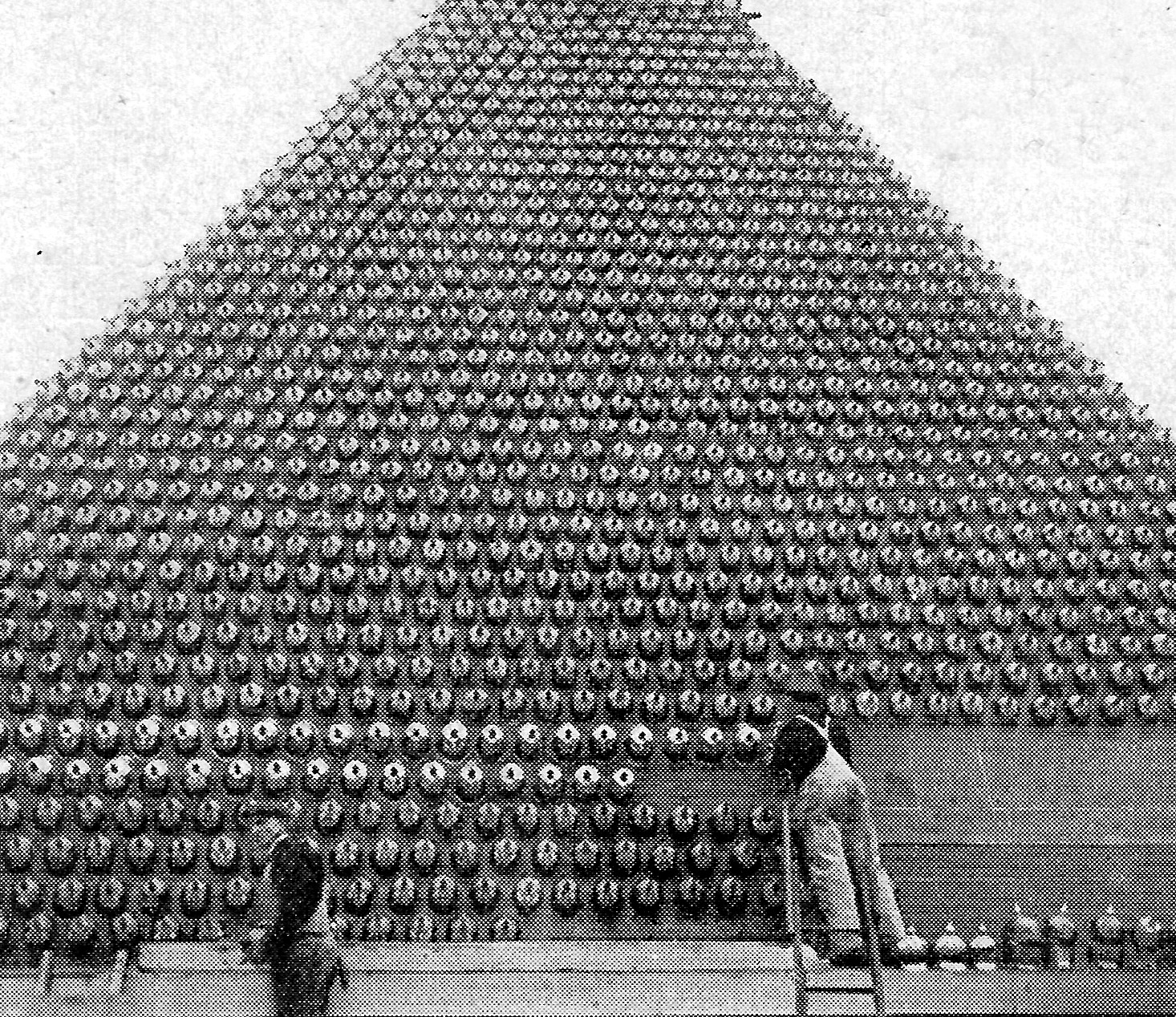
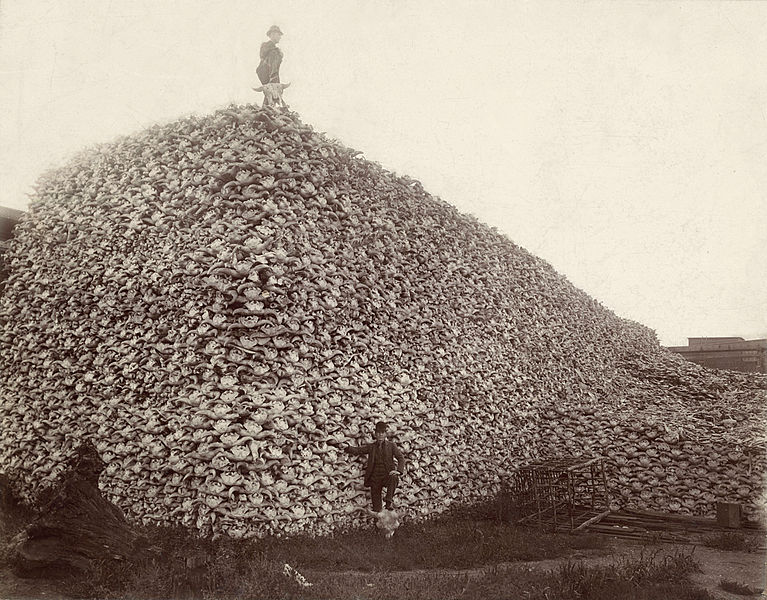
    “To the victor, the (pointy) spoils” was found in  Illustrated World in their June 1919 issue. (As it runs out, the word “pointy” is a lot older than I thought, the OED finding it in   K. Digby Two Treat. i. xv. 130, from  1644: I haue seen some very high, and pointy spire steeples do the like.)  It seems as though the captured “Hun” helmets with spikes were collected and pyramided for a war relief benefit/fund-raiser. I guesstimate that it took around 2,000 helmets to complete this display–it also reminds me quite a bit of a famous photo of buffalo skulls piled 20 feet high, waiting to be loaded onto a train car in about 1870 to be hauled away for processing into fertilizer. There’s nothing in common between the two besides the composition and the pointy parts, as the buffalo were slaughtered for many reasons all of which are terrible and none of which had to do with war, where the German helmets came from. 


    WWI Project Hun Helmet 1919 detail


    Buffalo skulls

    [Source: Wiki Commons]


    ·Posted by :

    ·in:

    —

  • Women In The Sub-Kingdom Of Pants 1918

    JF Ptak Science Books   Quick Post

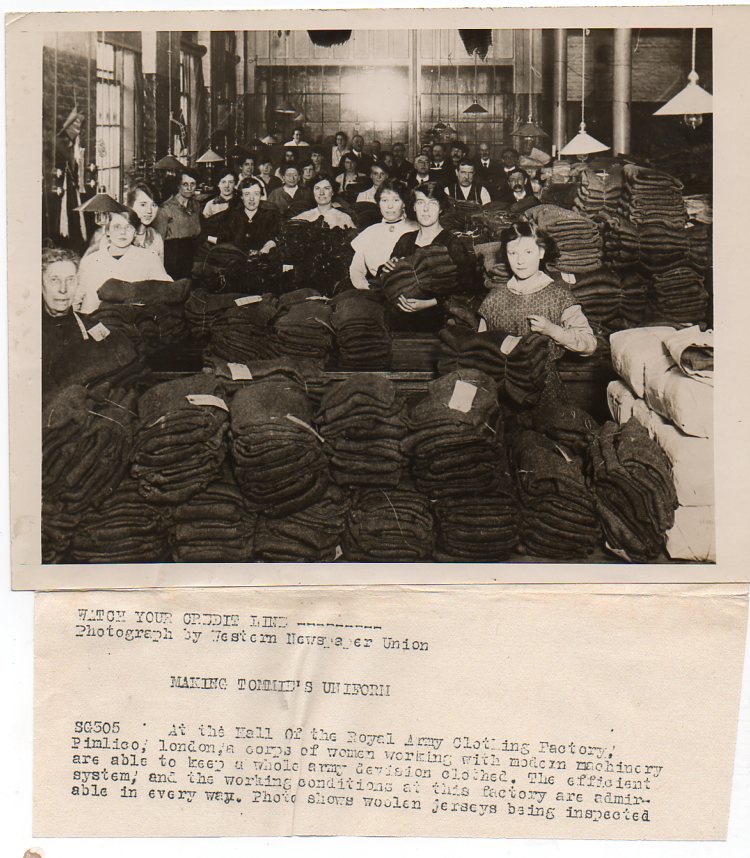
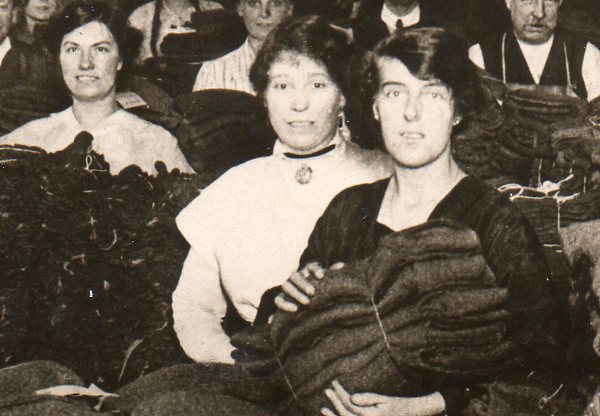
     This is a photo of a tiny piece of the army behind the army–in this case women preparing clothing for the British Expeditionary Force in 1918.  The trousers that they are handling in this image represent–in an offhand calculation–about one one hundred thousandth of one percent of the trousers that just the BEF would have worn. .00001, or some such number. When the photograph was made in late 1918, the U.K. had about four million men in uniform, which was not the total of all those who served; in the end, nearly 2.6 million U.K. soldiers were killed or wounded from 1914-1918. It took millions of people in a vast coordinated effort to support a n army of this size, and so far away. 

    WWI--e--women pants683

    Source:  part of the 500+ image collection of news photo service photographs, many of which would have the paper description attached to the image for inclusion as a caption to the image when it was published in a magazine or newspaper.

    WWI--e--women pants det682

    ·Posted by :

    ·in:

    — —

  • Color as a Secret Weapon–Air Recon, Camouflage, and Color Film (1939)

    JF Ptak Science Books   Quick Post

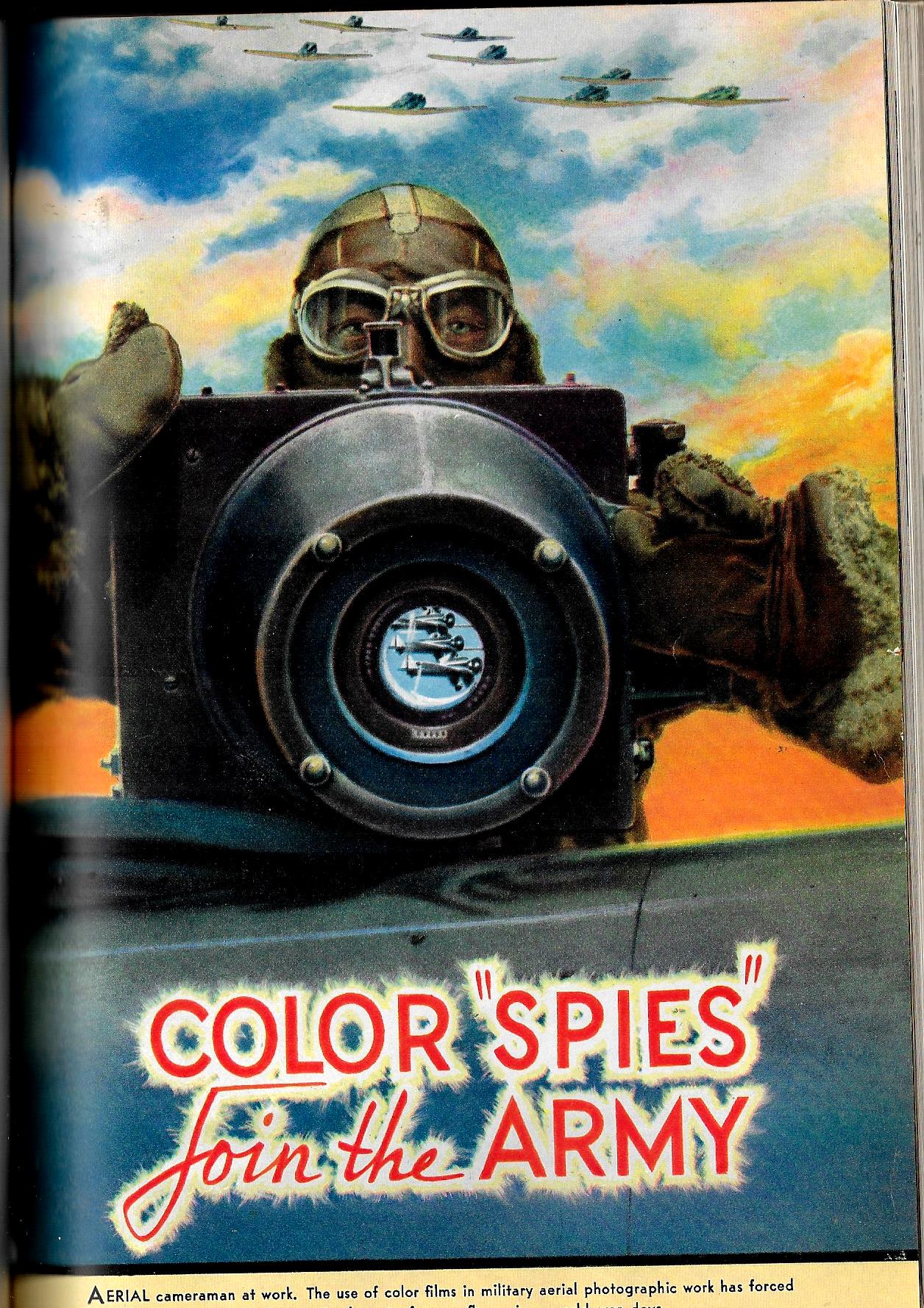
    Here’s something I never thought of before–how color air recon photography changed the application of camouflage.  Aerial photography used to reveal the hidden segments of an enemy’s position was almost exclusively limited to black and white film in the two decades or so following WWI. Color films were far slower and evidently not suited to the task until the late 1930’s–therefore, it seems, camouflage was prudently directed to disguise objects from aerial surveillance with those limitations in mind.  As this cover for an article in Popular Mechanics suggests, all that changes with the invention of faster color film that made the b+w film obsolete, and changed the way camo was used to confront mile(s) high observation.  (I also suspect that this was available to the U.S. armed forces well before this article was published…)

    Camouflage aerial recon

    [Popular Mechanics, April, 1929, page 497.]

    ·Posted by :

    ·in:

    — —