A Daily History of Holes, Dots, Lines, Science, History, Math, Physics, Art, the Unintentional Absurd, Architecture, Maps, Data Visualization, Blank and Missing Things, and so on. |1.6 million words, 7500 images, 4.9 million hits| Press & appearances in The Times, Le Figaro, Mensa, The Economist, The Guardian, Discovery News, Slate, Le Monde, Sci American Blogs, Le Pont, and many other places… 5000+ total posts since 2008.

Category: Militaria

  • New York City in Danger of Attack (1917)

    JF Ptak Science Books   Overall post 5149
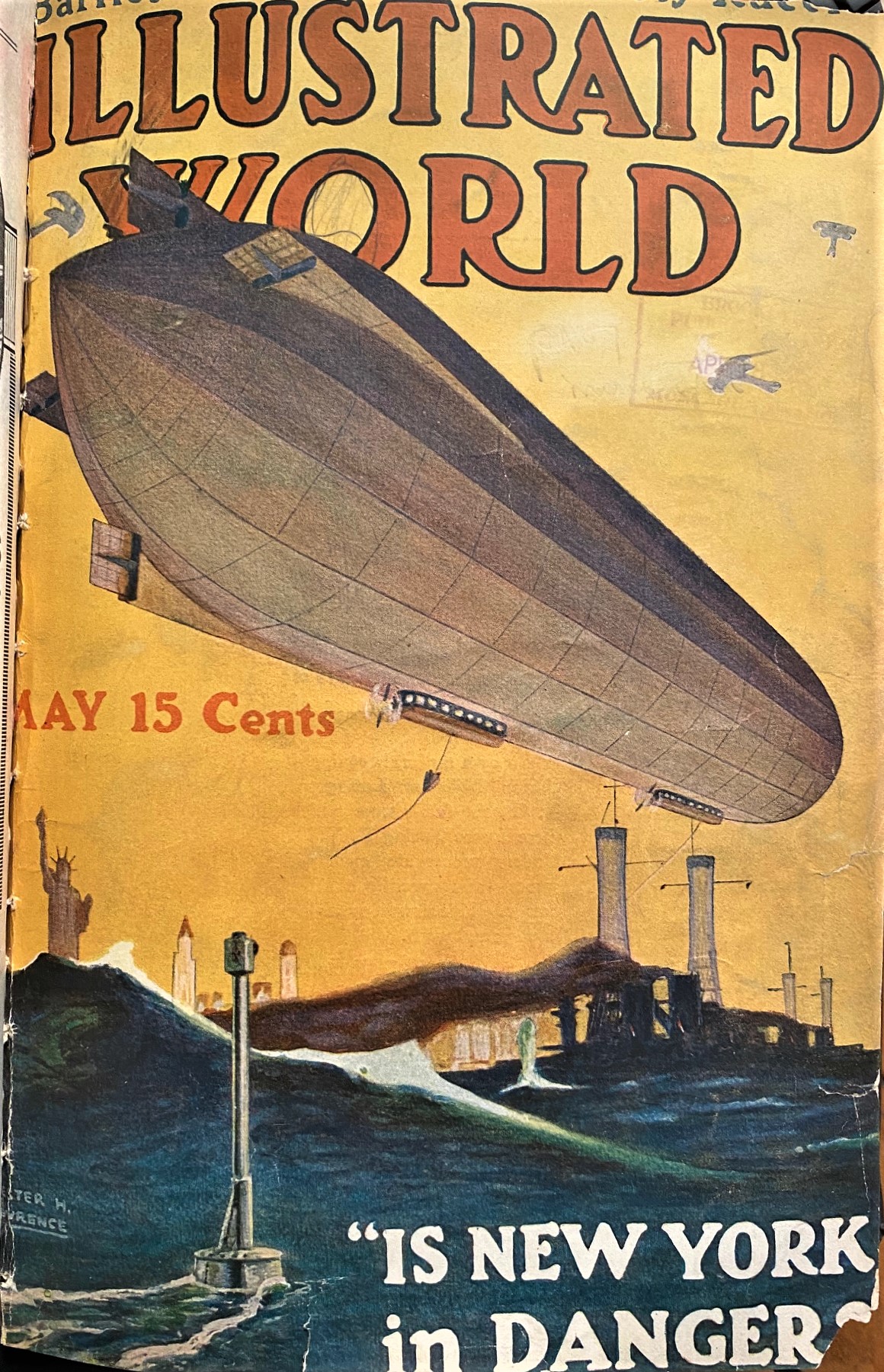
    IMG_8774The New York City harbor looks pretty rough in this picture, tall whitecaps with surprising little reflected in what should be pretty choppy water, meaning that light should be reflecting everywhere, a difficult collection of reflected reflections. 

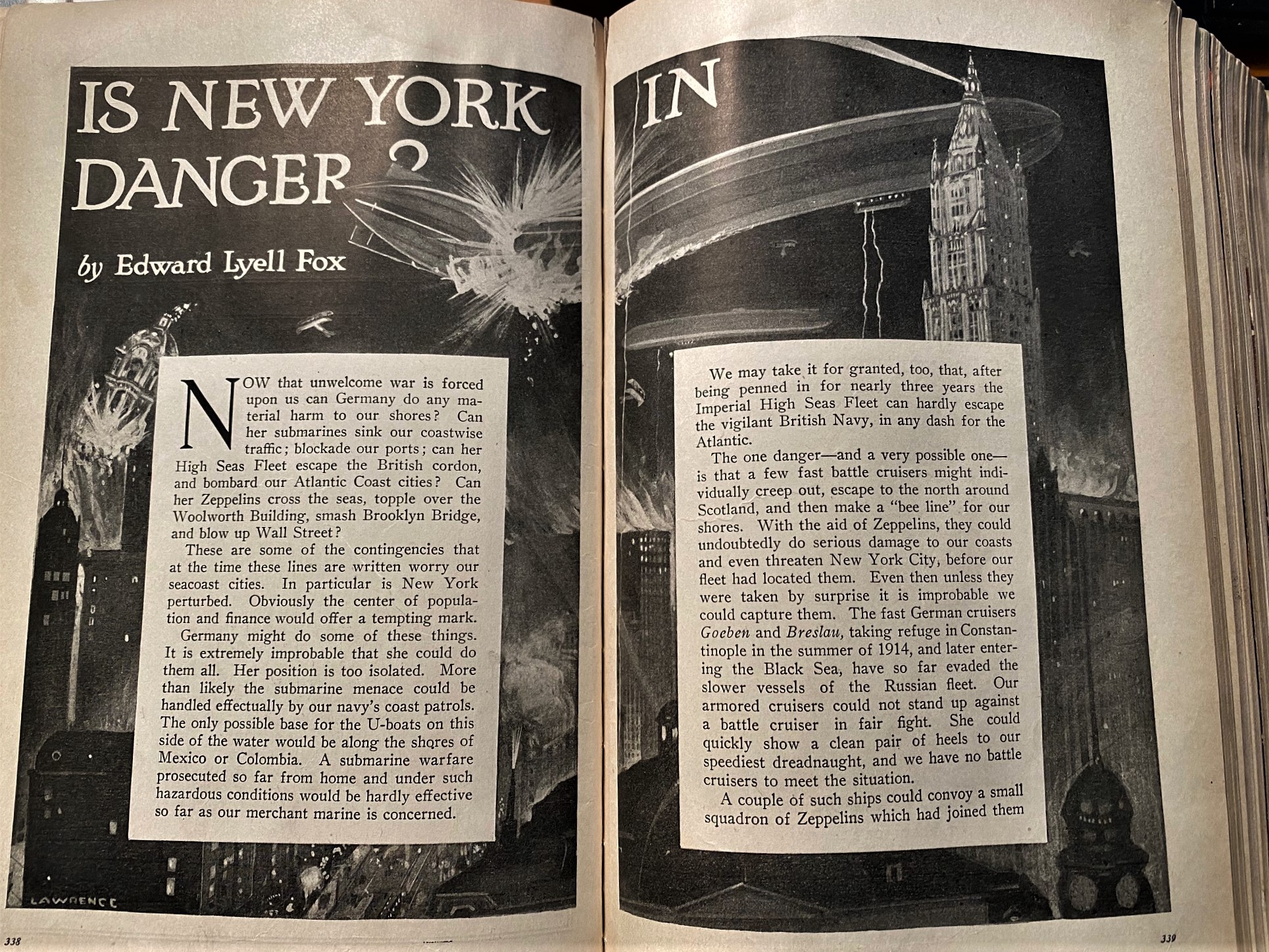
    [Image source:  May 1917 issue of the uncommon magazine, Illustrated World. The entire article is reproduced below.]

     The submarine, battleship  and zeppelin menaces were real, at least in Europe or in the Atlantic–the aeroplanes far less so.  But the applications of these fears directly to American shores were still very distant things, particularly when it came to an attack on New York City–except of course that the U.S. had just declared war against Germany, finally, just a few weeks before this issue was published.

    The war began for real in Europe in August, 1914, so the fighting had been going on there in fratricidal earnestness for two and half years, costing millions and millions their lives and limbs.  America had been isolationist and non-interventionist up until this point, remaining sweatily on the sidelines, until the capture of the infamous Zimmerman telegram, which was a coded message sent from Germany (the German Empire) to Mexico (and taken by the Brits as it was sent, the crypto-folks of Room 40 breaking the thing) suggesting that Mexico join in a war against the U.S.  It hit the American press on 1 March, and the story exploded–literally. This is what the beginning of war looks like, sometimes.
    IMG_8776

    So perhaps there was some amount of yellow journalism involved here, and some inflationary propaganda as well, and some good-old profit-taking on a half-sci-fi story–on the other hand, the German Empire did just sink 800,000 gross tons of shipping during the 30 days of April (1917), so sub fears were in general real and palpable.  The issue of them sighting the Staten Island Ferry though was quite another matter. 

    The first American soldiers would arrive for fighting in June.  The whole thing would be over in 17 months, which is well less than half of the time that the U.S. spent in WWII. 

    The United States would suffer 116,000 military deaths during its part of the war–a small fraction of the overall military deaths (9 million) and a smaller part still of overall deaths including civilians (totaling 16 million).  There would be 205,000 American wounded in this conflict, a little less than 1% of all war military casualties. 

    It would be interesting to see the coverage in England of the American invasion fears.

    [Article continues below]
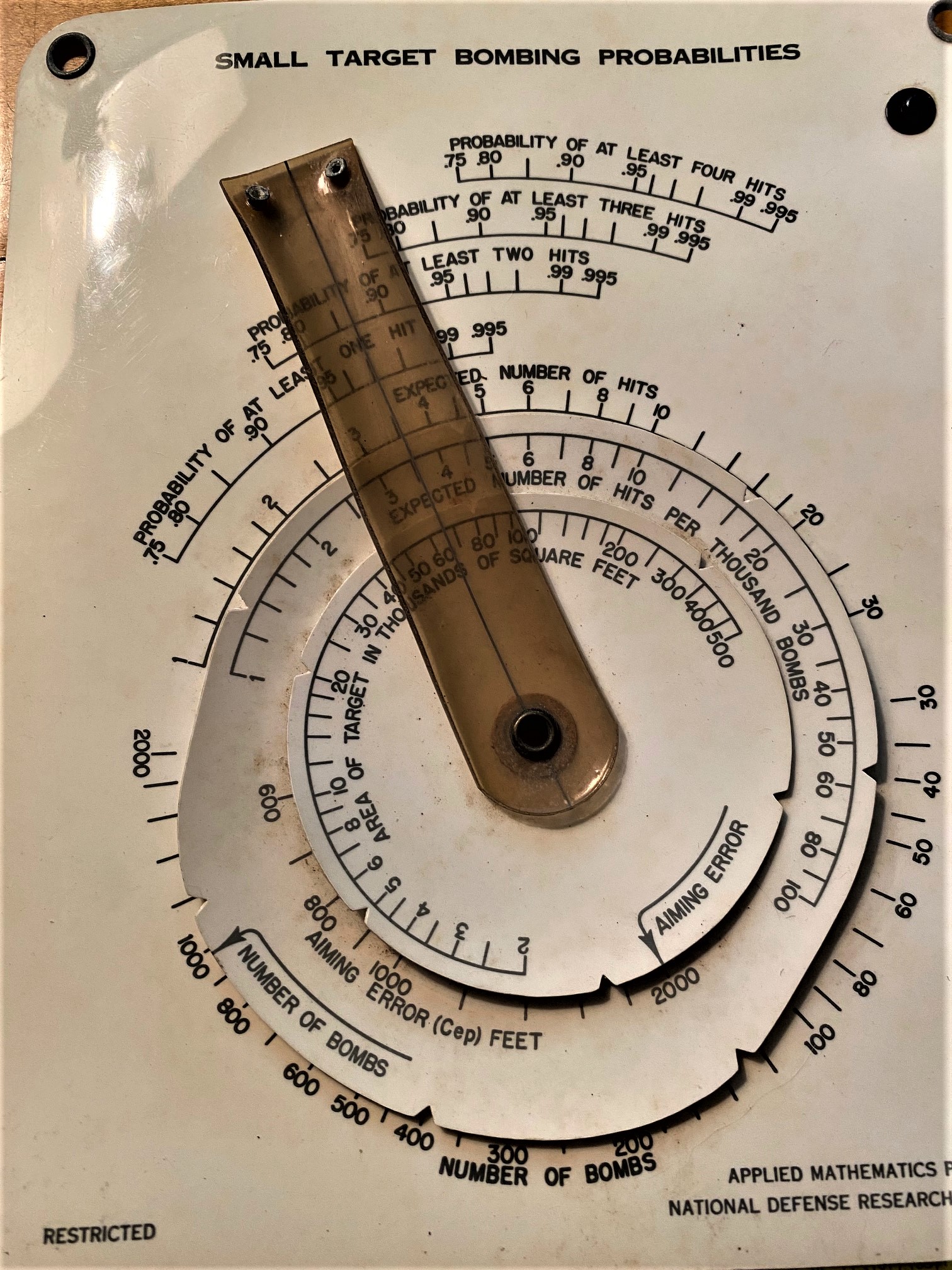

  • “Small Target Bombing Probabilities”–Bombing Calculator, 1944

    JF Ptak Science Books  Expansion of an earlier post from  2011 

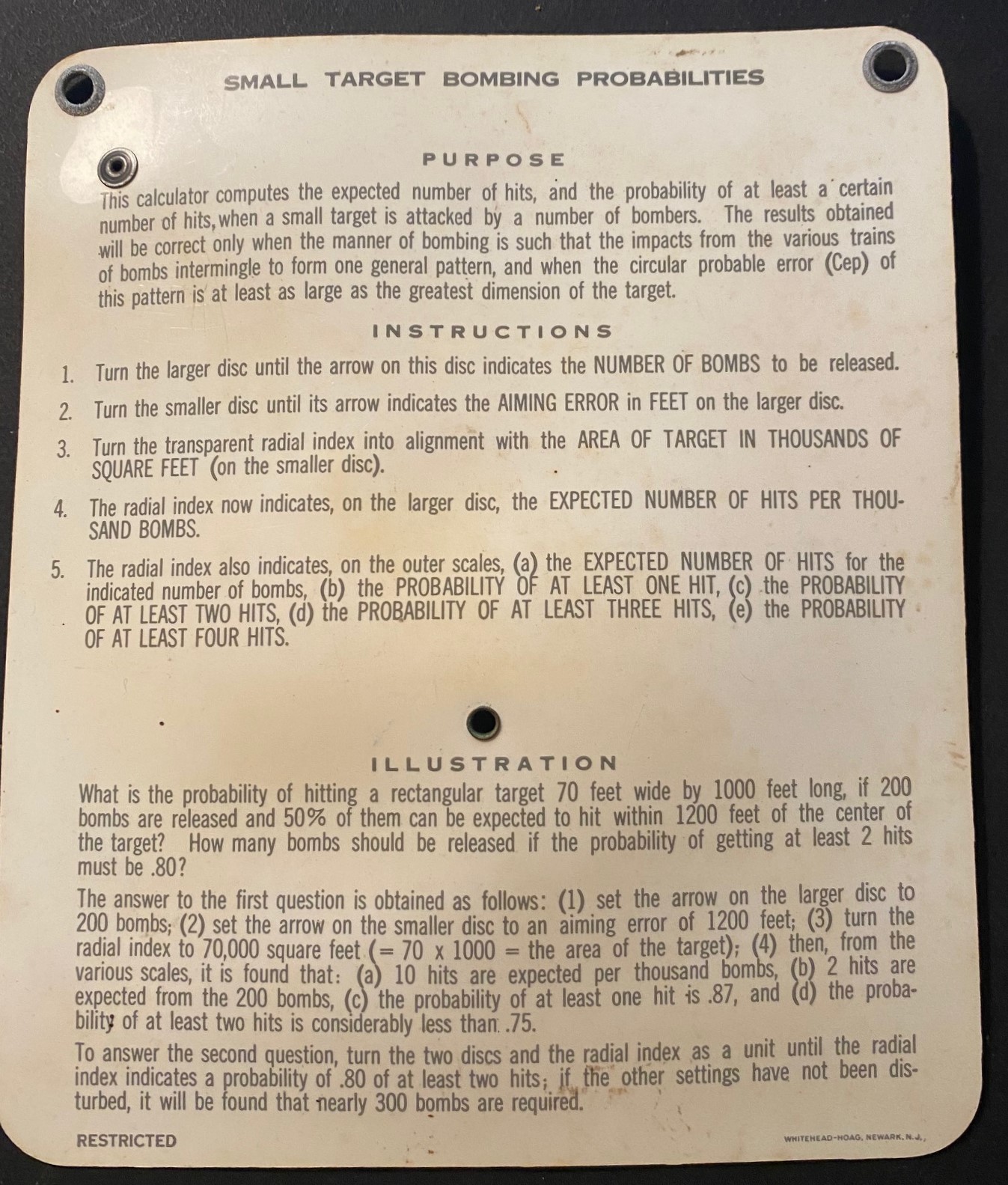
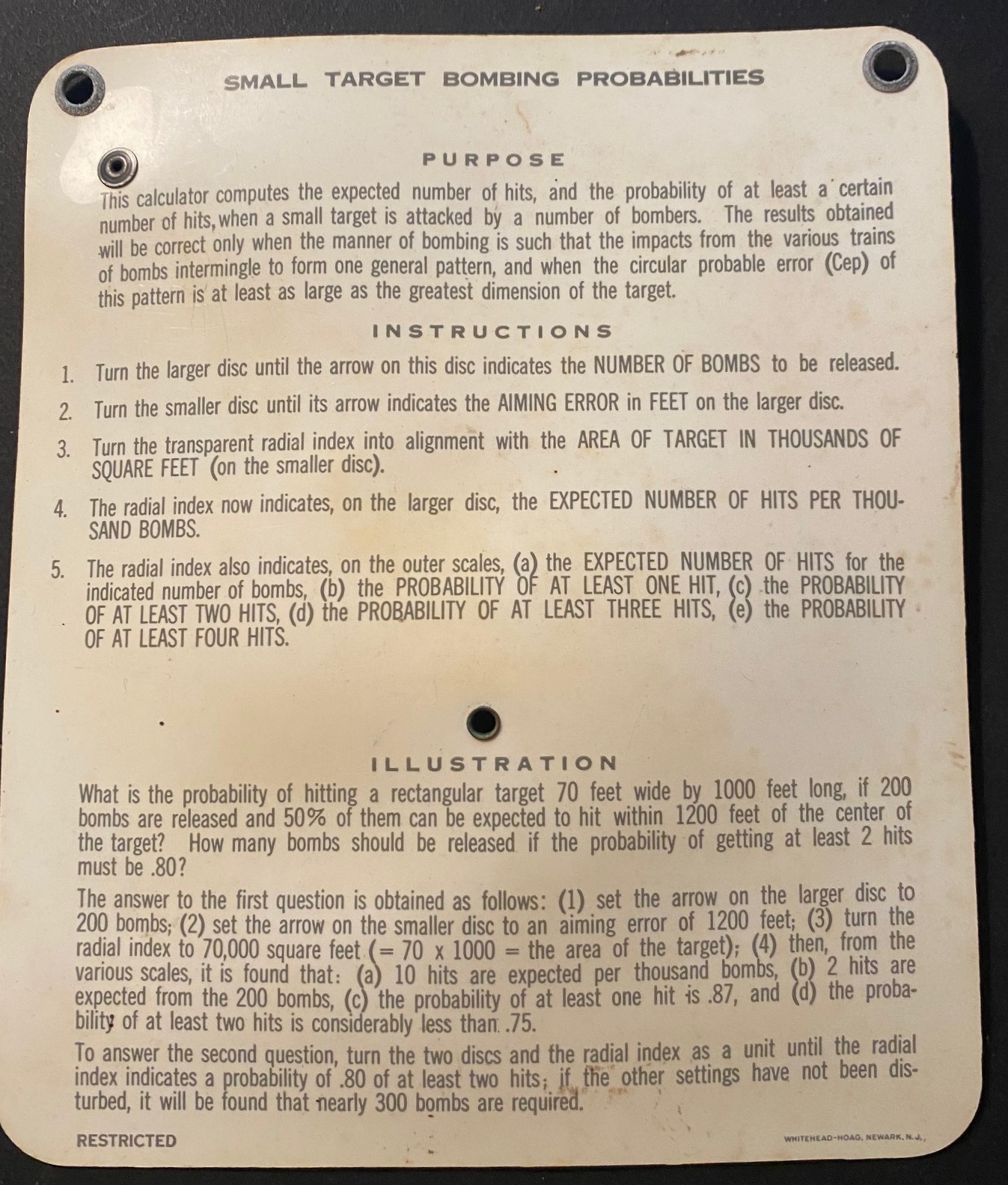
    IMG_5402I found this object in my paper-calculators box (moveable disk calculators made of paper, two going back to  Fr. A. Kircher in the 1680’s)—I’m not sure why it was there as it is not paper, though it is an interesting calculator.

    [Images are greatly expanded in click mode.]

    You can learn or re-learn an interesting lesson from it on bombing accuracy.

    The “Small Target Bombing Probabilities” calculator was issued by the little-known (in the popular sense) Applied Mathematics Panel of the National Defense Research Council (NDRC)1 in the early 1940’s during WWII. 
    IMG_5403Marked “Restricted”, it calculated the number of bombs that would successfully be delivered given (1) the number of bombs, (2) the “aiming error”, and (3) target size. It would then generate results for “(a) the expected number of hits for the indicated number of bombs”, (b-e) the probability of at least one hit to four hits.

    What is a little surprising to me was the number of bombs that didn’t find their target. For example, a 65,000 square foot target bombed with 1000 bombs and an aiming error factor of 2000 feet could expect to land 3-4 bombs on the target, with an 88% chance of landing at least two hits, 75% chance of landing three hits, and about 50% of landing at least four hits.  And so the necessity of large numbers of planes dropping a large number of bombs.  

    Notes

    1. The establishment of the NDRC was announced so: “It is announced by Science Service that the following committee has been appointed in the United States to correlate “scientific research on the mechanisms and devices of warfare”: — Nature 146, 191-191 (10 August 1940).

    “Members included: Dr. Vannevar Bush (chairman), president of the Carnegie Institution of Washington, formerly dean of the faculty of engineering at the Massachusetts Institute of Technology; Prof. Richard C. Tolman (vice-chairman), dean of the graduate school and professor of physical chemistry and mathematical physics at the California Institute of Technology; . Dr. Irvin Stewart (secretary), formerly Federal Commissioner for Communications and chairman of the Committee on Scientific Aids to Learning; Rear Admiral Harold G. Bowen, director of the Naval Research Laboratory, Anacostia, D.C.; Conwiy P. Coe, U.S. Commissioner of Patents; Dr. Karl T. Compton, president of the Massachusetts Institute of Technology, formerly professor of physics at Princeton University; Dr. James B. Conant, president, formerly professor of organic chemistry, Harvard University; Dr. Frank B. Jewett, president of the Bell Telephone Laboratories; Brigadier General G. V. Strong, assistant chief of staff, U.S.”

    ·Posted by :

    ·in:

    — —

  • Justifying Chemical Warfare (1925)

    JF Ptak Science Books  Post 2904

    IMG_2324

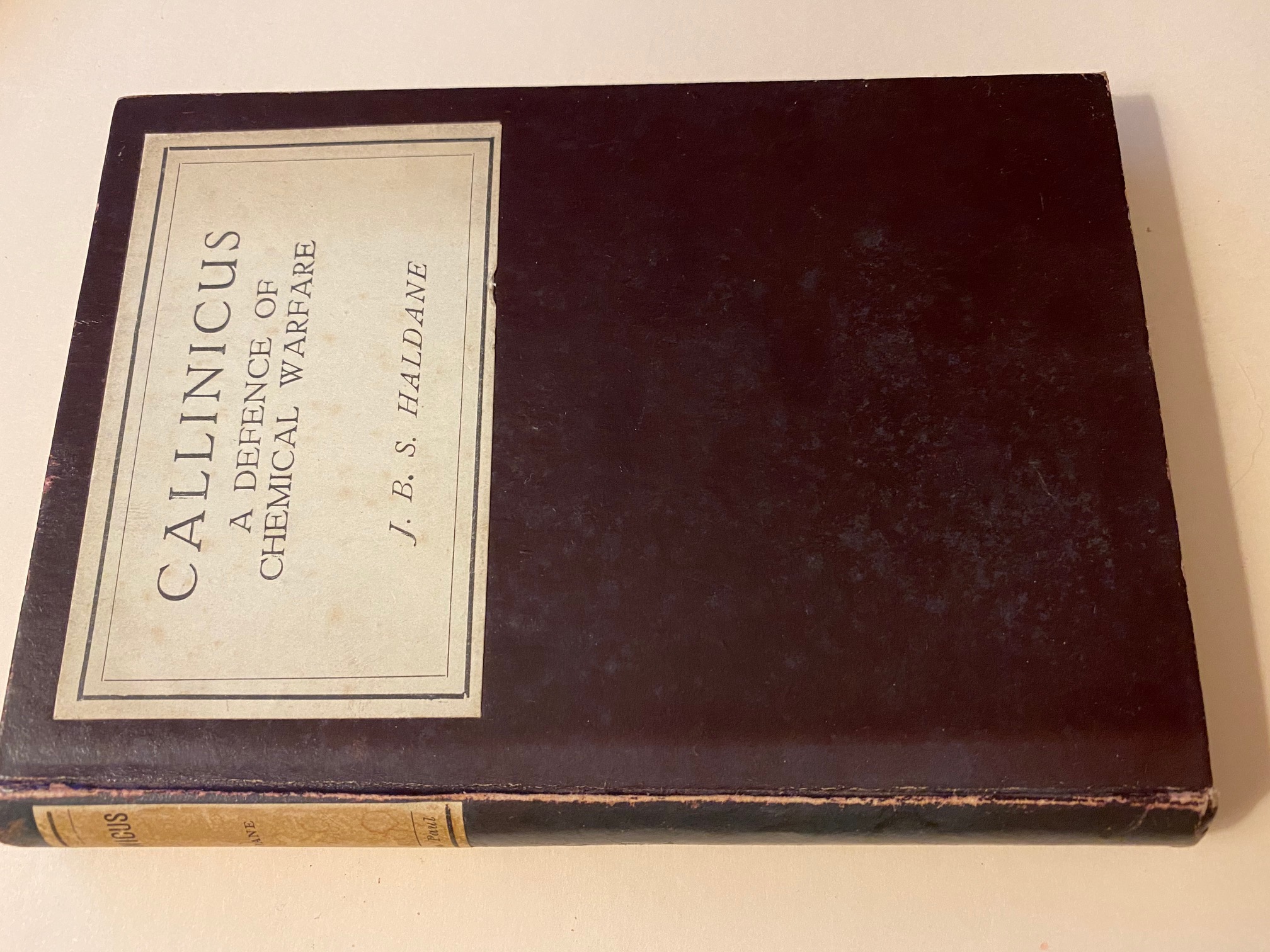
    J.B. S. Haldane (1892-1964, scientist/philosopher/veteran/Communist) contributed a provocative little one-hour read warfare and morality, making a case for the use of chemical weapons during war. I thought that this might be a Modest Proposal exercise, but it isn’t, at least to my reading of it. Callinicus, a Defense of Chemical Warfare (London 1925) is a call for expanding arms if arms is what was needed and if fighting was going to happen. Haldane would’ve been much happier with no fighting whatsoever, but if it were to be the case–again–he didn’t see much of a difference between chemical weapons and other sorts of armaments, as they both killed and wounded and incapacitated. A weapon is a weapon.

    “Why do we accept the invention of Major-General Shrapnel but prohibit the use of chemical weapons in war?” is what Haldane asks, and then proceeds to make his case.  

    The book’s title draws on the Syrian officer Callincus, who created the “Greek Fire” weapon, a flammable liquid, in in the Eastern Roman Empire in the 8th century CE. (“Callinicus1 Of Heliopolis, Callinicus also spelled Kallinikos, (born AD 673), architect who is credited with the invention of Greek fire, a highly incendiary liquid that was projected from “siphons” to enemy ships or troops and was almost impossible to extinguish.” Encyclopedia Britannica)

    An officer in 1914, Haldane was with the Black Watch (Royal Highland Regiment), and served with distinction, and did so at a relatively young age, and so was a witness2 to all manner of weaponry during the Great War. He makes a case for chemical weapons to be less grizzly than many other existing weapons and of those to come–and in the future category he gives a hat-tip to the possible invention of a weapon that sounded a lot like an atomic bomb.  It is an interesting discussion–one that backs you into a very disturbing corner, very quickly3. 

    Haldane ends the work so: “Such are the facts of chemical warfare. They will not be believed because a belief in them would do violence to the sentiments of most people.”

    Notes.

    A reminder that Haldane is the osurce for an often-repeated quote about the nature of the universe: “My own suspicion is that the universe is not only queerer than we suppose, but queerer than we can suppose.”

    1. “Born in Syria, Callinicus was a Jewish refugee who was forced to flee the Arabs to Constantinople. The ingredients of Greek fire were kept a state secret, known only by the Byzantine emperor and Callinicus’ family, which manufactured it. The precise composition is still unknown, but it is generally accepted that it was a mixture of naphtha, pitch, sulfur, possibly saltpetre, and some unknown ingredients. First used in the Battle of Cyzicus (c. AD 673) by the Byzantines against a Saracen fleet off Constantinople, Greek fire proved to be instrumental in that Byzantine victory.”–Encyclopedia Britannica

    2. Haldane also saw service during the war in the British chemical warfare program.

    3. “In Callinicus, Haldane makes the case for chemical weapons as a more humane, eugenic and ultimately more effective and efficient means of prosecuting modern warfare. In this bold advocacy, Haldane was facing an uphill battle, against the British press, who had propagandized against the ‘godless Hun’ and his poison gases, the fearful and scandalized public, and even his colleagues in the eugenics movement, who largely lamented modern warfare as dysgenic.”–Eugenics Archive (Canada) online timeline


    ·Posted by :

    ·in:

    —

  • An Early Design for a Convict-Powered Revolving Turret on a Ship (1871)

    JF Ptak Science Books   Post 2878

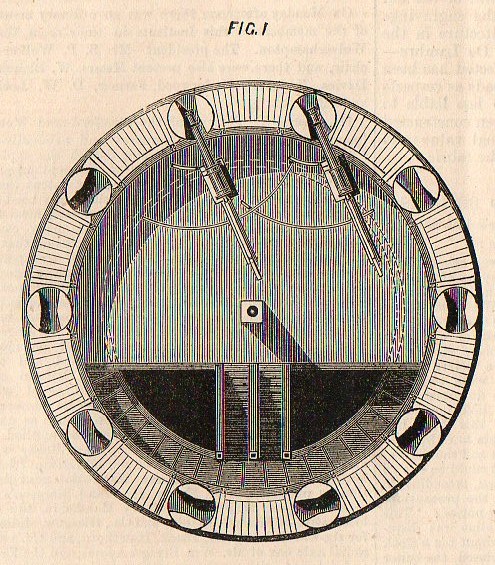
    This image (from the Illustrated London News for April 26 1871) shows a plan of the top floor of a revolving battery designed by M. Baltard in 1831.  This idea is probably ancient, though it really only had major technological legs by the 19th century. Even though Baltard is given some fair credit for the modern rediscovery of the revolving turret–and in this short article he is given premier status–there were earlier engineers at work before him.  For example, in the earliest part of the 19th century Col. John Stevens designed a saucer-shaped floating battery that was supposed to be able to fire in any direction; T.R. Timbly–slightly after Baltard–applied in the U.S. Patent Office in June 1843 for a device he called a “metallic revolving fort”.  Then came the great John Ericsson–very long on accomplishments but very short now in modern memory, he is also one of those memorialized men in marble in DC for whom people have almost no modern recognition–who in 1854 produced an “impregnable battery revolving cupola”, which led to his great innovation on the Monitor.  And as we recall, the Monitor’s defeat of the Merrimack in Hampton Roads in 1861 spelled the coming end of the wooden ship of the line–metal ships with mounted revolving turrets fore and aft would prove entirely too far superior to the 19th century wooden ship.

    Technical drwg--revovl turret circular540

    ·Posted by :

    ·in:

    —

  • The Skies of the “Electrical Experimenter”

    JF Ptak Science Books   Quick Post

    The Electrical Experimenter is my new favorite magazine, and here’s why:

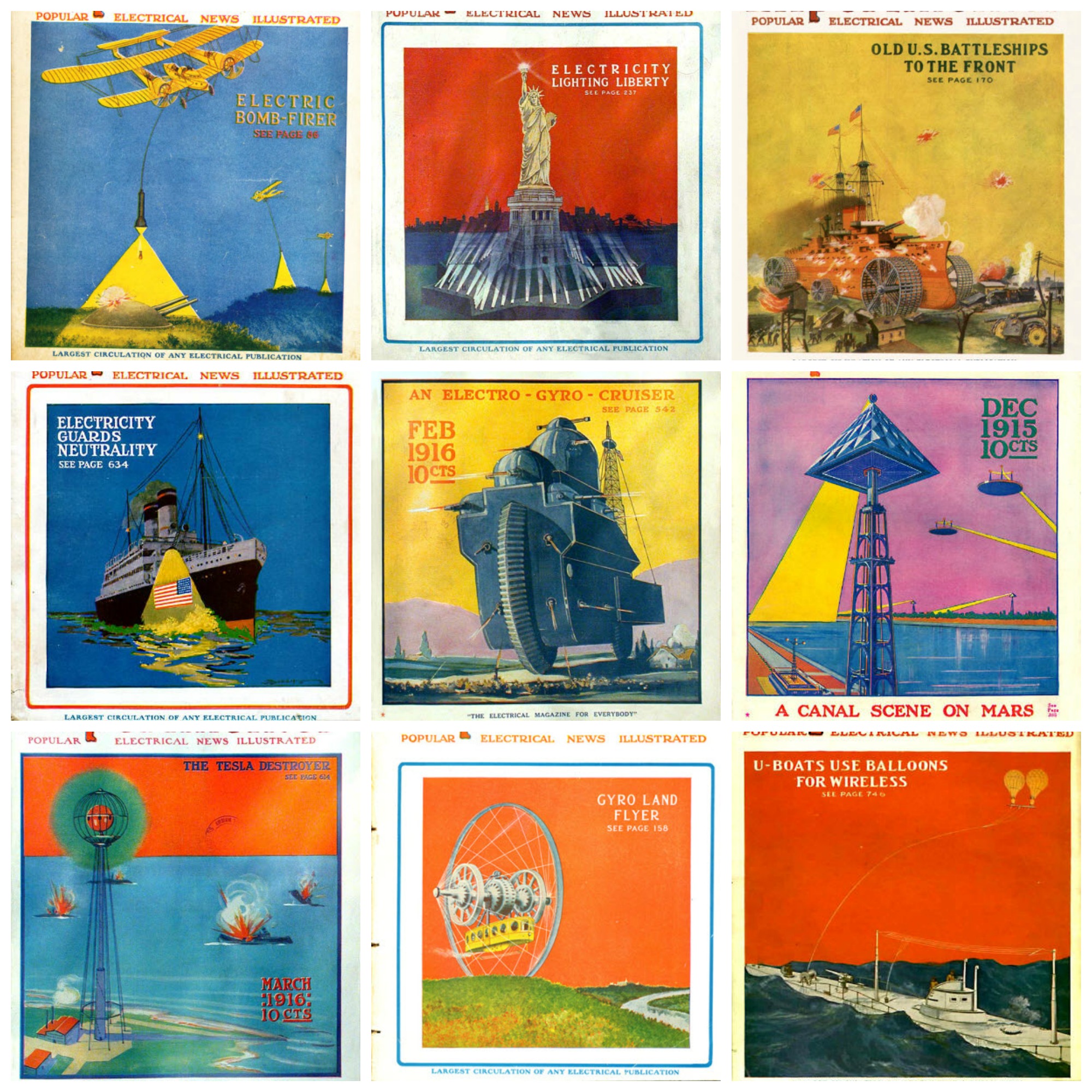
    Electrical Experimenter Skies MONTAGE _2_

    In addition to being thick and full of real electrical necessities and scientific bric-a-brac, it also held a fair amount of speculative thinking and just plain old science fiction (when sci fi wasn’t “plain” or “old”).  The EE was created and edited by the very busily creative Hugo Gernsback (1884-1967), a pioneer in science fiction, who held the magazine together from 1913 until 1929 (as the Electrical Experimenter from 1913-1920 and then as Science and Invention from then until the finale in 1931). There was evidently no holding back on cover design–at least from September 1915 until the end, when glorious ideas were display with flat design dominated by unusual and contrasting colors. For example, in the montage above, I was able to find glassy unadorned background skies that were red, yellow, purple, blue, and orange, with variation on each. Not only were the skies unusual, so were the surface colors: unusual blues, deep blacks, n=unnatural greens, purples, and so on. All of this framed some occasionally Highly Unusual and Not Expected Ideas. For example, in these WWI-era images–working right to left on the montage–there was an aerial bombing assistant of a light that illuminated the target through which a bomb could be deployed; a land battleship; an enormous motorcycle-like land megaship; a Martian canal-governing apparatus; a Tesla death weapon; an overland trolley housed in a gigantic spoked wheel; and a relatively tame portrayal of a communication system for a submarine. These are terrifically entertaining, and of course all they are are the covers. So, The Electrical Experimenter: terrific. 


  • Big, Big Guns (Real and Imagined)

    JF Ptak Science Books   Post 2763

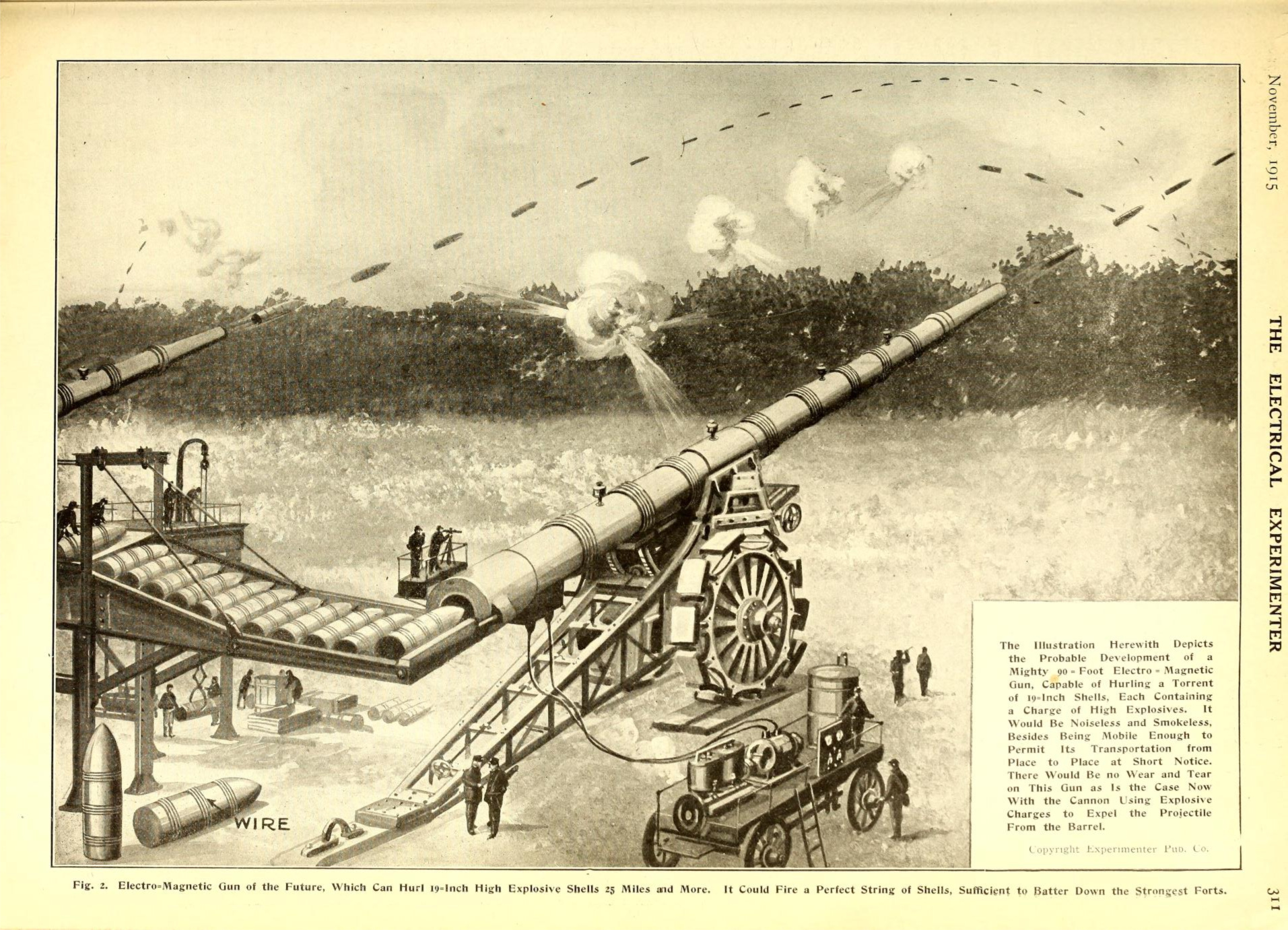
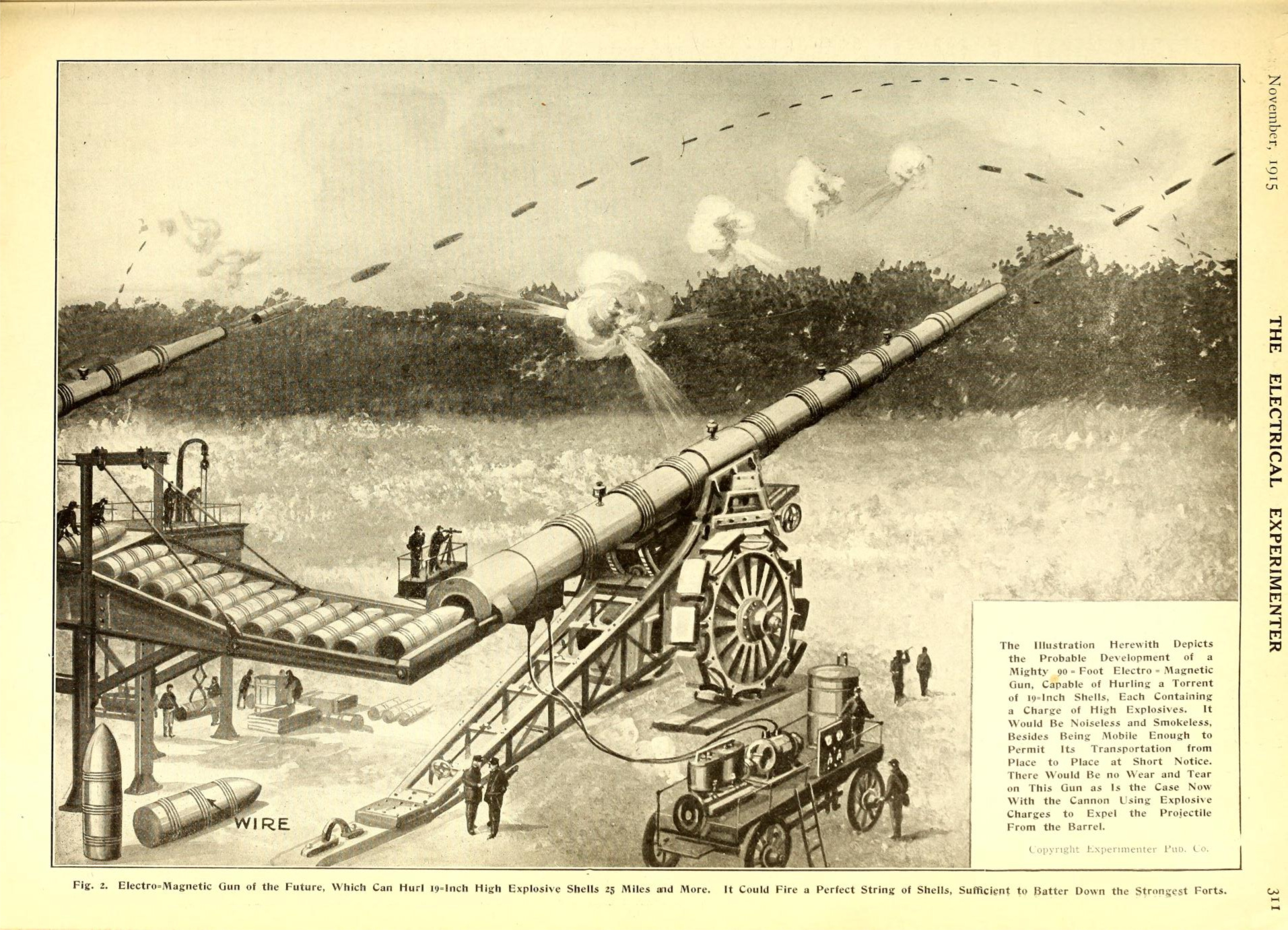
    While looking for an article on the imaginary gatekeepers of Martian canals in The Electrical Experimenter (1915) I found this illustration for a piece of speculative military tech (first image, below). The annoyingly-capitalized caption states this to be an “Electro Magnetc” gun 90′ long and rapid-firing 19-inch (480mm) HE. I guess they were somewhere along the very early reaches for the idea of what would become the contemporary EM rail gun being developed by the U.S. Navy. The power source for the gun shown above is not quite what the Navy has developed, as they employ something along the lines of a multi-million ampere pulsed DC power supply that creates the conductance to launch a shell with a muzzle velocity of 3500 m/s. At this point you don’t need explosives to cause damage at the other end–you just need a projectile. The 1915 version is far offline, except for the initial idea, which is a good one. Besides the shortcomings in the implementation realm of this weapon the writer here doesn’t have a very long vision for the future of warfare, saying that his cannon would be devastating to “forts”. This idea I thought was certainly quaint when written given that WWI was already into its second year, and unless by “forts” the writer meant “trenches”, this visioneer was very visioneering.  

    Electrical experimenter 1915 long gun[Image source: https://archive.org/details/electricalexperi03gern/page/350  Click to expand for a clearer image.]

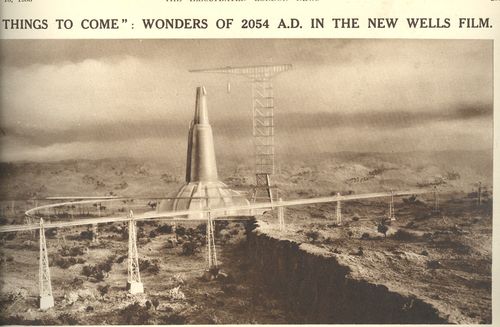
    Massive, monster cannons have existed for many years in idealized and theoretical, speculative worlds, like Tom Swift and his Monster Cannon.  In the history of early imaginary big guns H.G. Wells’ Babel-like cannon (pictured below in a still from the movie Things to Come (1936), an adaptation his The Shape of Tings to Come from 1931) is monumentally fabulous –1500 feet tall, with what looks like a  750′ base, all of which launched a 75′ tall capsule beyond the Earth’s

    Canons big wells

    gravitational pull with a spectacular explosiveness that would’ve made its occupants into instant jelly.  Tangentally-speaking here the launching of an object to escape the Earth’s gravity didn’t occur until 1946 when the highly-problematic but nevertheless-genius Fritz Zwicky fashioned a device to an experimental V-2 and via an electric explosive charge punched some object into space.


  • A Manuscript Drawing of an Early Modern Propeller (1855)

    JF Ptak Science Books   Post 2753

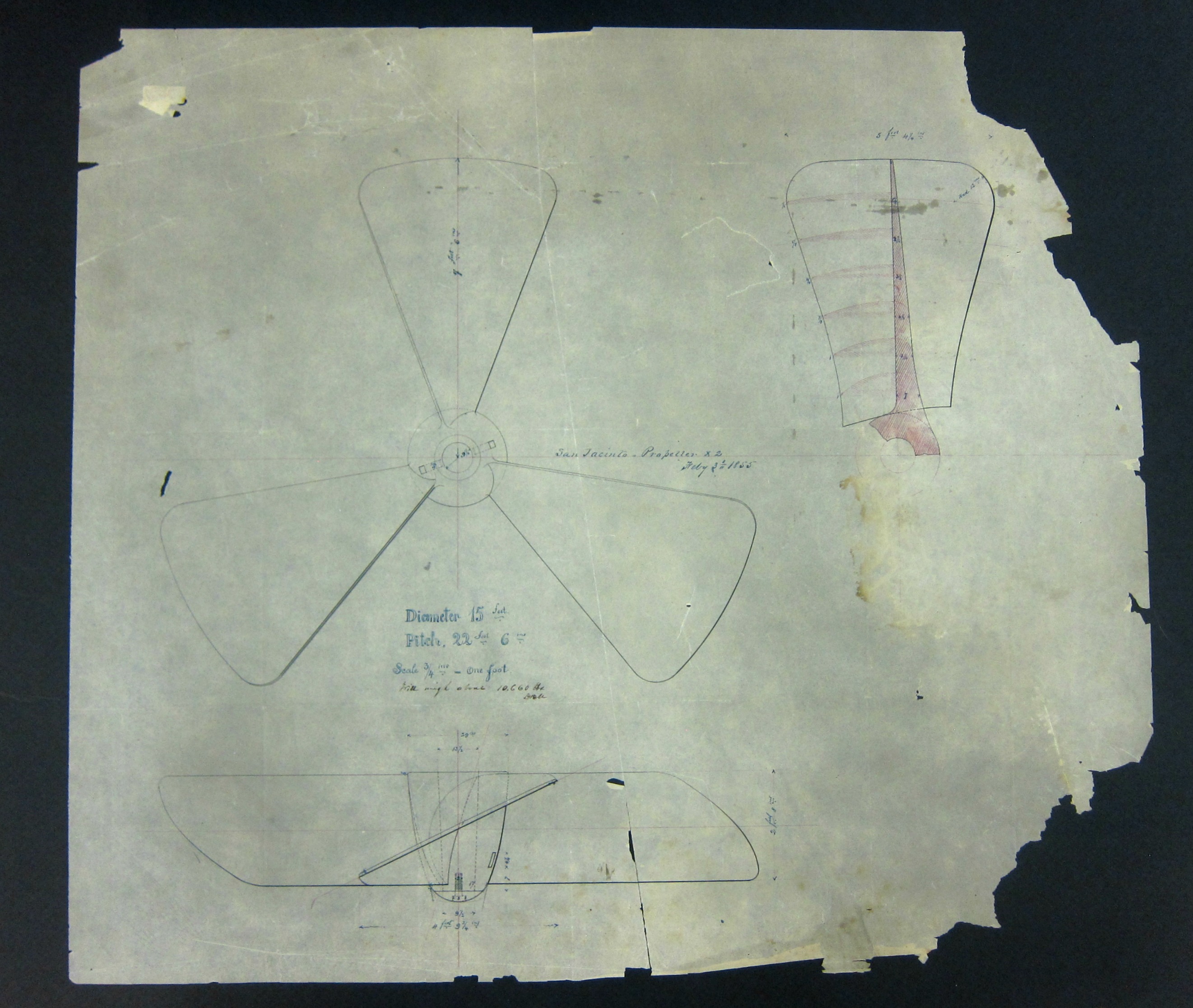
    This is an extremely early engineering drawing of a modern propeller, executed only a dozen years or so after the creation of the modern screw propeller by John Ericsson. Shearman’s creation is devoid of the extra blades that appeared on the edges of the fans of Ericsson’s first attempts, and as ultimately adopted as the standard response to this knotty fluid dynamics problem. The propeller pictured here was for the USS San Jacinto1, a mail packet that ran along the west coast in the 1850s until it was sunk operating as a blockade runner for the Confederate States in 1864. It was a pretty large propeller–more than 15 feet in diameter–and moved the ship it was attached to more than 22 feet for every revolution of the blade.

    Shearman San Jacinto full 10 megs

    ·Posted by :

    ·in:

    —

  • Orders and Instructions on Living in France and on the “Disposition” of the Jews, September 1940

    JF Ptak Science Books  Post 2751

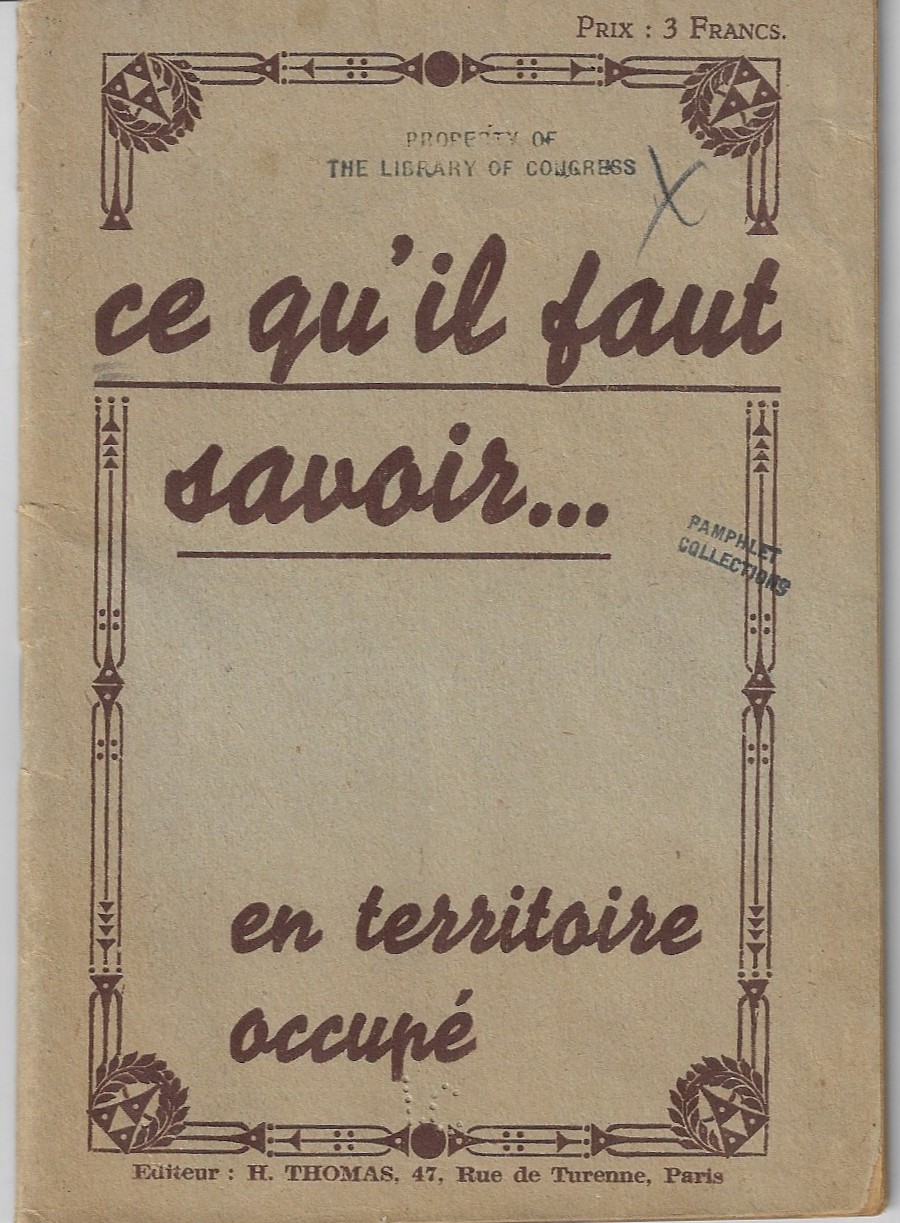
    Books covers france occupied territories JewsBy the title, Ce qu’ill faut savoir en territoire occupe1 (“what you need to know in the occupied territories”) we see that this short/small and rather plain pamphlet is an outline of expected behavior of conquered France…or shall I say “overrun” in its six miserable weeks of fighting which found no good end, all of it coming to a close on 22 June 1940, though there were strong pockets of resistance that would arise and take hold until the defeat of the Germans five years later. It is almost ephemeral, having virtually no “presence”, if appearance were to judge—it looks like nothing, nearly. It is hardly that, and represents a coming great evil.

    It contained the rules of society from the Germans and from Vichy, and in no small way dictated the expectations of the conquerors. The thinking was wide and brutal and trite, defining the occupied territories, the new justice system, economics of the occupation, and the like, as well as the “camouflage” of street lights, rates of exchange, bicycle rules, and the use of motorcycles.

    What caught my eye was the header for a two page section on French Jewry, “Les Dispositions pour les Juifs”.

    It is announced simply that the “German authorities” and of course the Vichy government have taken measures against Jews in the occupied territories.

    • (“Les autorites allemands ont pris des dispositions contre les Juifs demeurant en territoire occupe…a ces dispositions pourront en etre adjointes d’autres prises par le gouvernement francais de Vichy…”) and then went about its business.

    The first thing to do was for the Jews to make themselves available and report to authorities before 20 October 1940. It encouraged the head of a household to make a report on the entire family.

    • (“Pour le moment, les obligations faites aux juifs en territoire occupe sont les suivantes de ne pas rentrer, pour les juifs qui ont lui la zone occupe de se presenter avant le 20 Octobre 1940 a la sous-pretecture de leur arronfissement de domicile pour se faire inscribe a un registre special. La declaration du chef de familie est valable pour toute la familie.”)

    Next of course came the subjugation, demanding the identification of all businesses either run by or principally owned by Jews to identify themselves as such, with fines and imprisonment (and confiscation) the consequences of not doing so. A Jewish business was also defined as having more than 50% investment by Jewish interests.

    • (“…d’afficher en langue allemand et francais la mention entreprise juive a tout comemrce dont le proprietaire ou le deteneur est juif. Les dirigeants des communautes israelites doivent fournir. Les contraventions sont punies de prison et d’amende, ou d’une de ces deux peines. La confiscation des bien pourra en outre etre prononcee…”)

    Then comes the identification of who is a Jew, and according to this document, someone is a Jew if their grandparents were (“or appeared to be”) Jews.

    • (“Sont retenus comme Juifs ceux qui appartiennent ou, la religion juive ceux qui ont plus de deux grands-parents.”)

    Just a couple of hundred words. Two pages. And yet it outlines the basics of population control and discrimination, setting the stage for removal. All contained in this little pamphlet, which I should point out was not free, but sold for 3 Francs. There would be a many-orders-of-magnitude price to pay in the very near future.

    Notes:

    1. Ce qu’il faut savoir … en territoire occupé, (Ed : H. Thomas, 47 rue de Turenne, Paris,) 6×4”, 46pp. No doubt the work of the Nazi government. Printed ca. August/September 1940. Original wrappers. Provenance: Library of Congress, with their stamp on the front wrapper and their surplus/duplicate stamp on the cover’s back.


    ·Posted by :

    ·in:

    —

  • On Not Reporting on the Russian Winter, 1941.

    JF Ptak Science Books   Post 2748

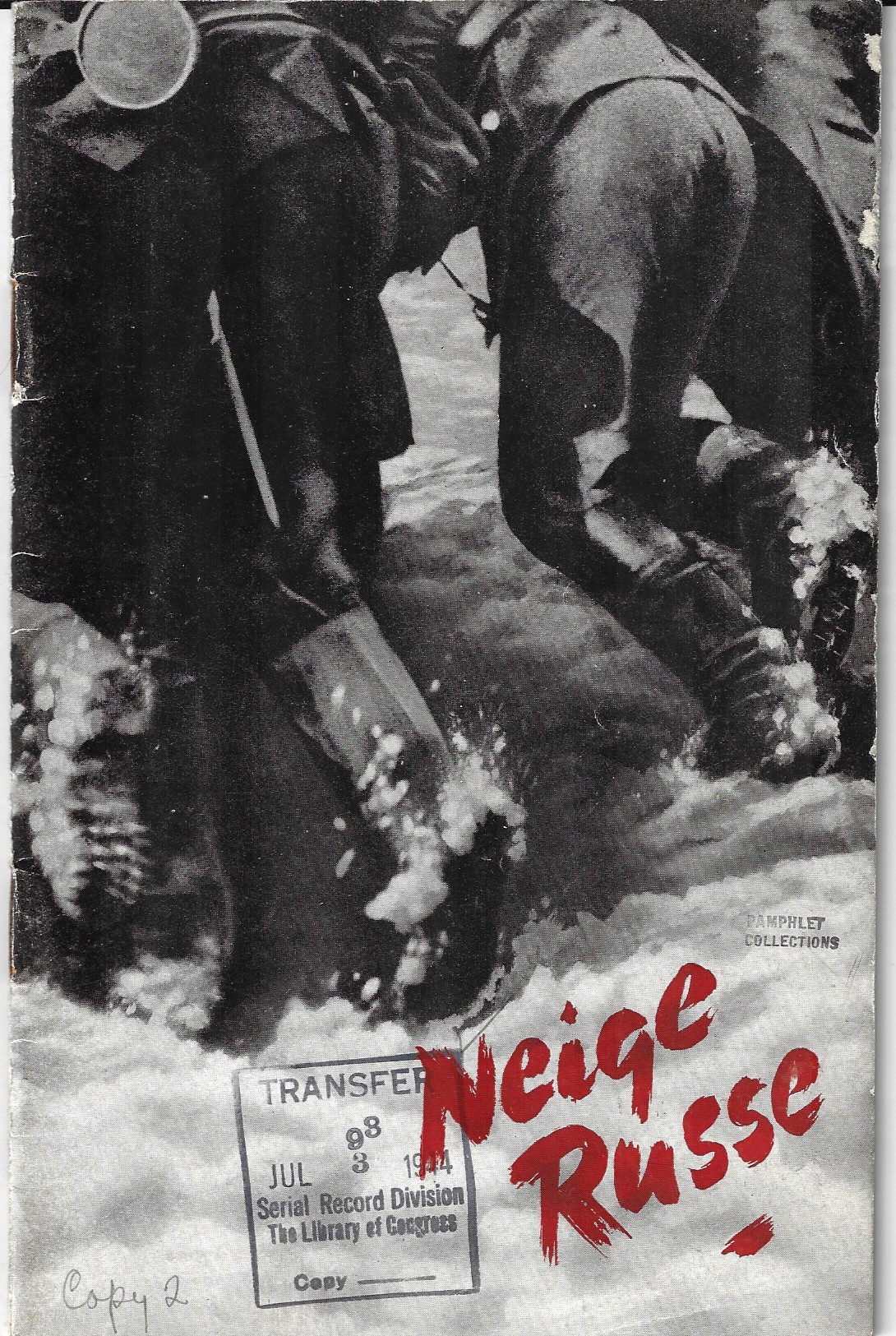
    Russian winter _2_Neige Russe is a straightforward-looking and scarce1 little pamphlet, though the cover photo is really quite provocative.  No publisher, year, or place of publication is mentioned, though it is almost certainly 19422–and as a piece of propaganda it is rather well-made, printed on a solid, heavier stock with a bit of a sheen to it, an unusually better-quality production for what it was. 

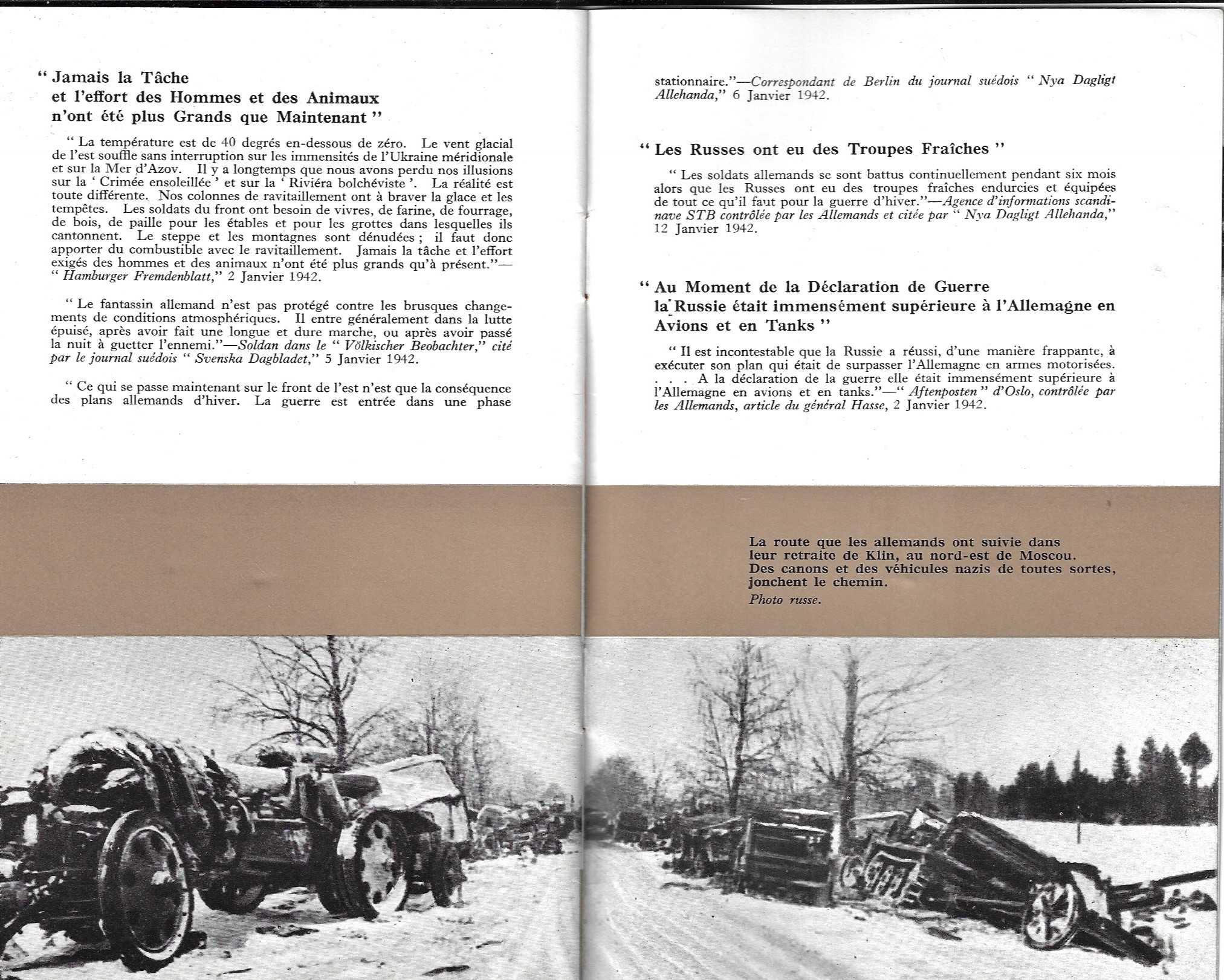
    The pamphlet is a very interesting collection of German newspaper and radio comments on the state of the winter in Russia and its effects on the German troops in the world’s largest military movement, Operation Barbarossa. The attack by the Nazis on 22 June began an enormous and horrible campaign that would last two winters, the initial vast successes of the aggressor checked and then nearly defeated in the first winter just months after the offensive began.  There are dozens of quotes taken from German sources that de-emphasize the effect of the historically impregnable Russian winter on the armies, reported mostly from October-December 1941, and of course the would be no truthful information shared by the Nazi-controlled radio or press on the effect of the winter that was engulfing the German troops–quite the contrary, if you look at some of the samples below. The winter existed, but not for Germany, and it had little effect on the troops.

    By the next winter, in January 1943, the Germans would lose entire armies to the cold and to the massive numbers of Soviet troops and tanks and artillery, and the long, slow retreat back to Germany would end in total failure 14 months later. 

    Some examples of German news reports on the winter in Russia, 1941:

    • “L’hiver n’existe qu’en Meteorology”
    • “La guerre sera decidee, en tout etat de cause, avant l’hiver” (the war will end before winter)
    • “Rien n’arrete l’avance allemande”
    • “Les Allemands n’aiment pas la terre brulee”
    • “Indomptee par les rigeurs de l’hiver”
    • “Il n’est pas Question de Prendre les Quartiers d’Hiver”
    • “Le problemedeliverestexcessivementserieuxpoulestroupesSovietiques”
    • “Apres tout, les soldats Allemands ne peuvent pas supporter le froid cokme les Siberiens”
    • “La ligne d’hiver sera tenue”

    The photos used in the pamphlet are varied of course by the source—the German images devoted to ease and possible victory, the Russian showing defeat and bitterness and deadly cold. 

    Russian winter _1_

    NOTES:

    1. It turns out that there is scarcely a mention of the work online, and only six copies are located in libraries around the world, and according to WorldCat/OCLC, these institutions are prestigious: the work is found only at Yale, Harvard, Haifa, National Library of Poland, Nanterre, and Erfgoedbibliotheek Hendrik Conscience. I had expected more of a presence, given that this pamphlet wasn’t made to be so disposable as its brethren, but not many seem to have survived.  
    2. The date is given as [1942] in the WorldCat listings.

    ·Posted by :

    ·in:


  • “Should Britain Fight?” An argument for Appeasement, 1938

    JF Ptak Science Books  Post 2753

    DocFile (2)


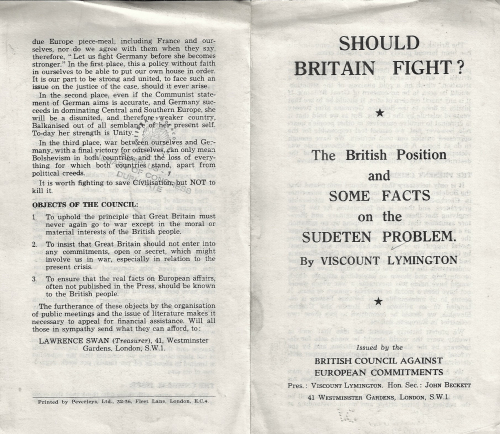
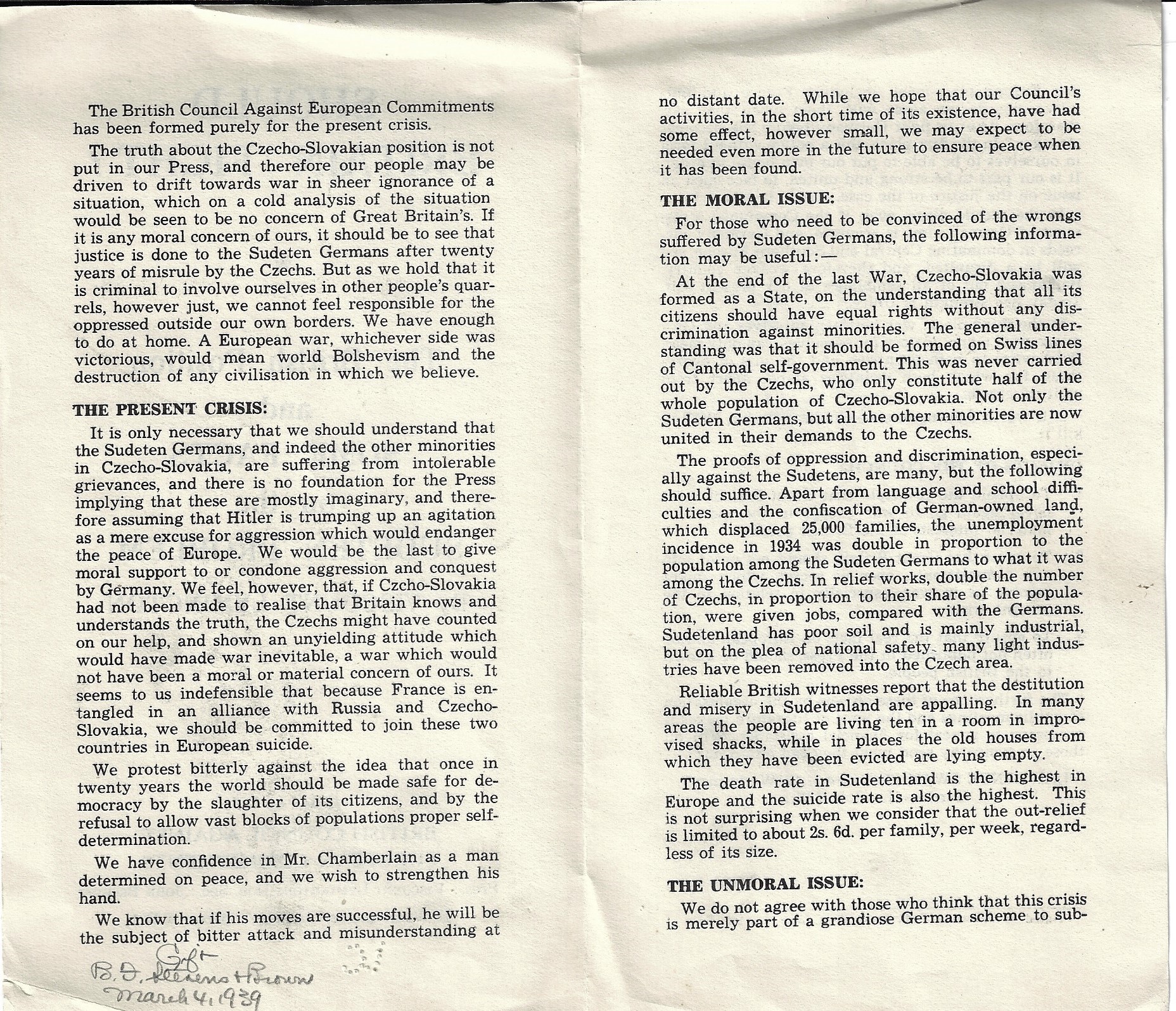
    There were some in Great Britain who just simply did not want to become involved in the European crisis, and who saw their way around the obvious to the in-obvious of what needed to be seen. That, or the source of info leading to this opinion was limited. Or, the information sources were good but the interpretation was limited. Or it was too early in the process of war…except in this case, in the pamphlet below, it was already 1938, and the issue was Hitler and Czechoslovakia.

    It is a little difficult to say when this was published in 1938–if it was published in the early Spring the Anschluss would not yet have occurred, and so no mention; but I have a feeling that this is post-Anschluss, and the event (of March 1938) is treated with silence, as it surely would not have fit very well with the writer’s denouncing of the diatribes against Hitler. My suspicion is that this was post-Anschluss and pre-Munch Agreement/Diktat (30 September), and that the entire business with Austria is left out of whatever thinking is going on here. There is a mention of strengthening Chamberlain’s hand though nothing specifically about the Munich meeting, so my general reaction is that this pamphlet was printed in the Summer of 1938. 

    The case that the author makes is that the Sudeten Germans “are suffering from intolerable grievances” and that anything to the contrary is a construction of “the Press” who were implying that the troubles were “mostly imaginary”, “therefore assuming that Hitler is trumping up an agitation as a mere excuse for aggression which would endanger the peace of Europe”, and so on. Any sort of European war coming as a result of  an involvement over Czechoslovakia, the author contends, would result in “world Bolshevism”, no matter the winning side. Thus the need for Great Britain to stay away from any possible conflict, and that its only “moral position” would be to see justice done to the Sudenten Germans.  Poland and Hungary would carve up their own slices of the rest of Czechoslovakia in October and November 1938, and then come March 1939 Germany would seep into what was left of the country, completing the death of the six-month Munich agreements. 

    And somehow the ending argument was that even if Central and Southern Europe were “dominated” by Germany, “she will be a disunited, and therefore weaker country, Balkanized out of any resemblance to her present self”.

    In any event, these sentiments were hardly unknown, in any country. The U.S. certainly had its fair share of groups espousing these beliefs, some –like the “America First” organization–held on to their keep-our-distance programs 28 months into the war, only disappearing on December 7, 1941.

    Here’s t he entire leaflet:

    DocFile (2)


    ·Posted by :

    ·in:

    —