A Daily History of Holes, Dots, Lines, Science, History, Math, Physics, Art, the Unintentional Absurd, Architecture, Maps, Data Visualization, Blank and Missing Things, and so on. |1.6 million words, 7500 images, 4.9 million hits| Press & appearances in The Times, Le Figaro, Mensa, The Economist, The Guardian, Discovery News, Slate, Le Monde, Sci American Blogs, Le Pont, and many other places… 5000+ total posts since 2008.

Category: World War II

  • The Terrible Situation of Ukrainian “Displaced Persons” at the End of WWII

    JF Ptak Science Books  

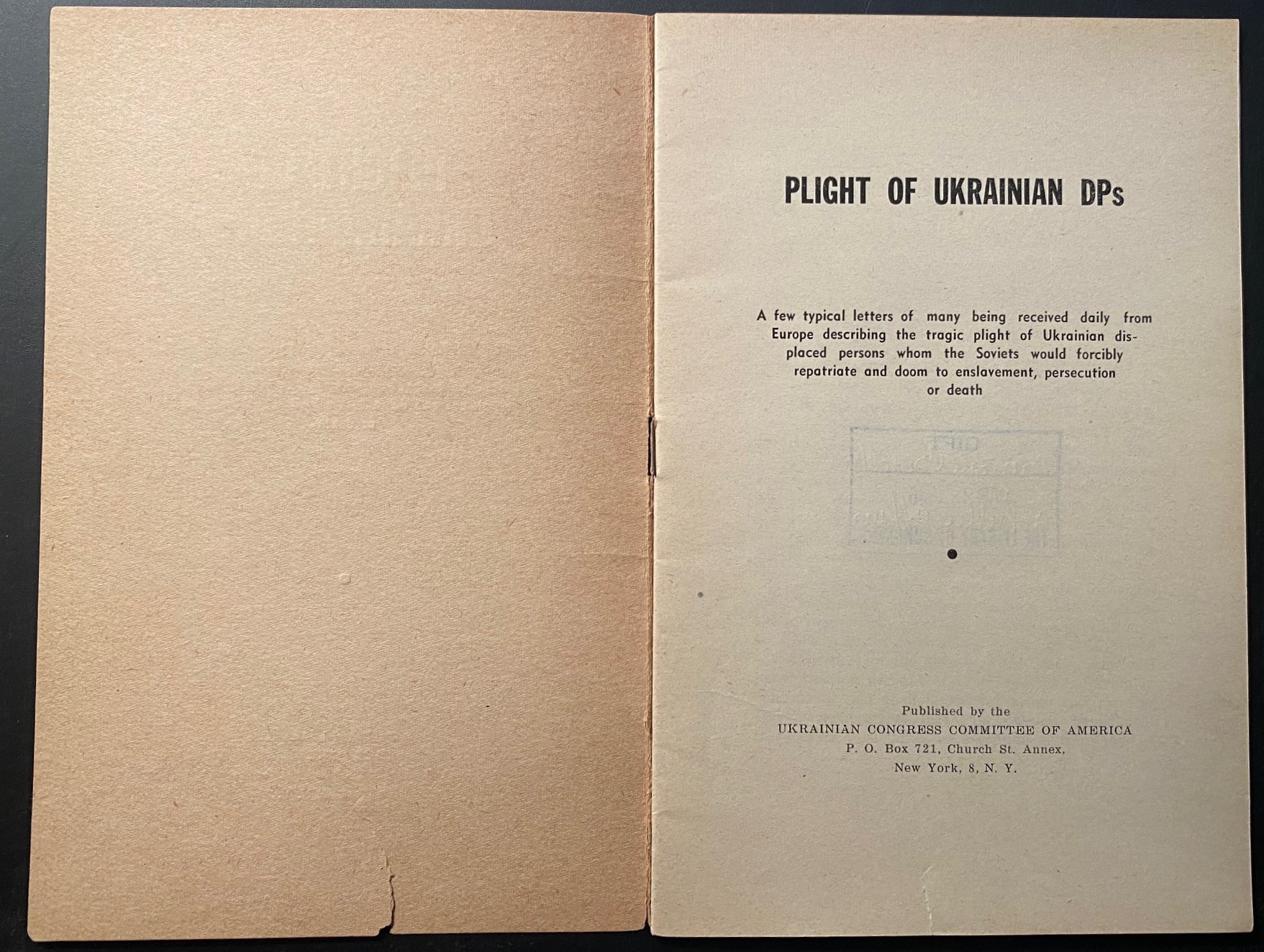
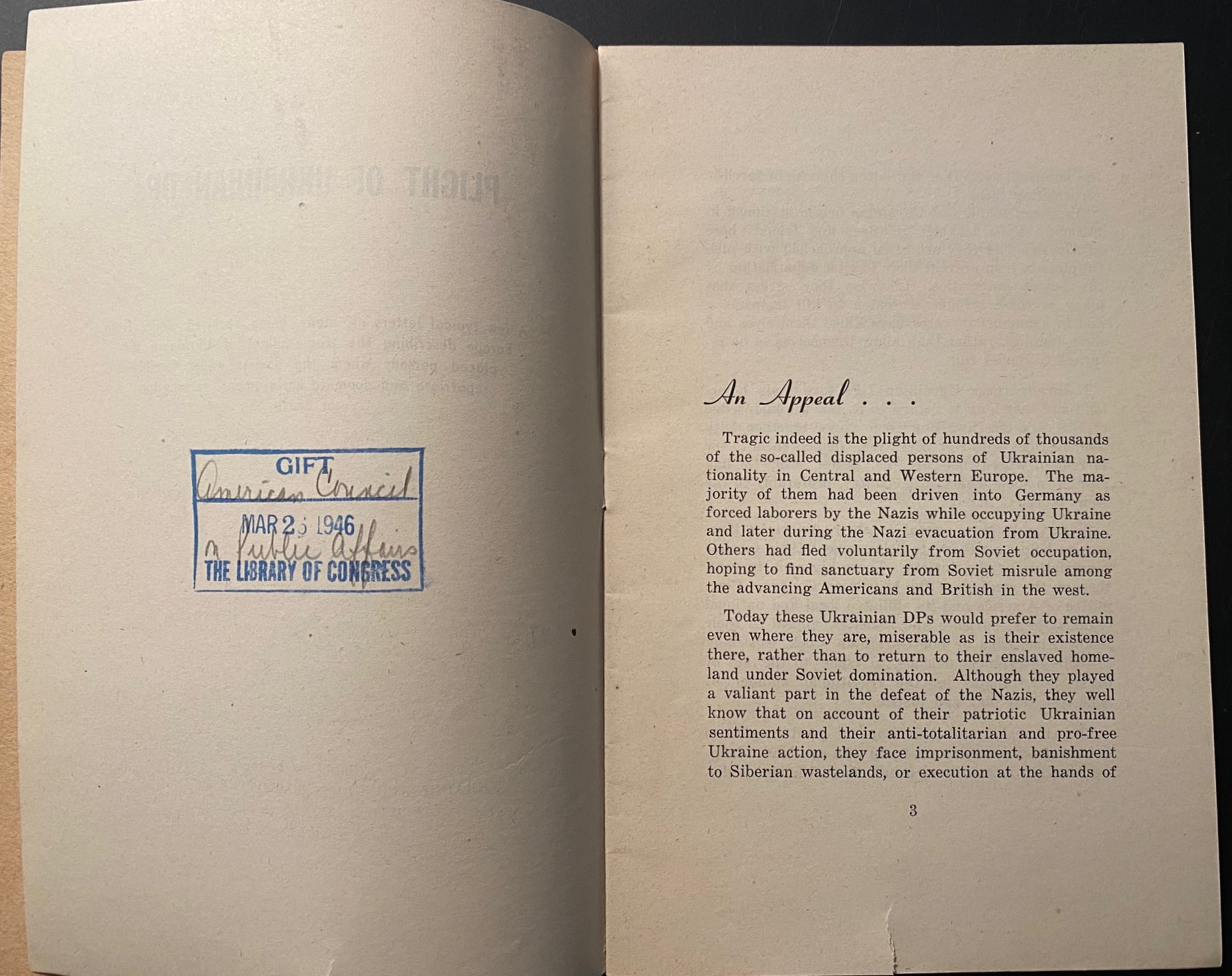
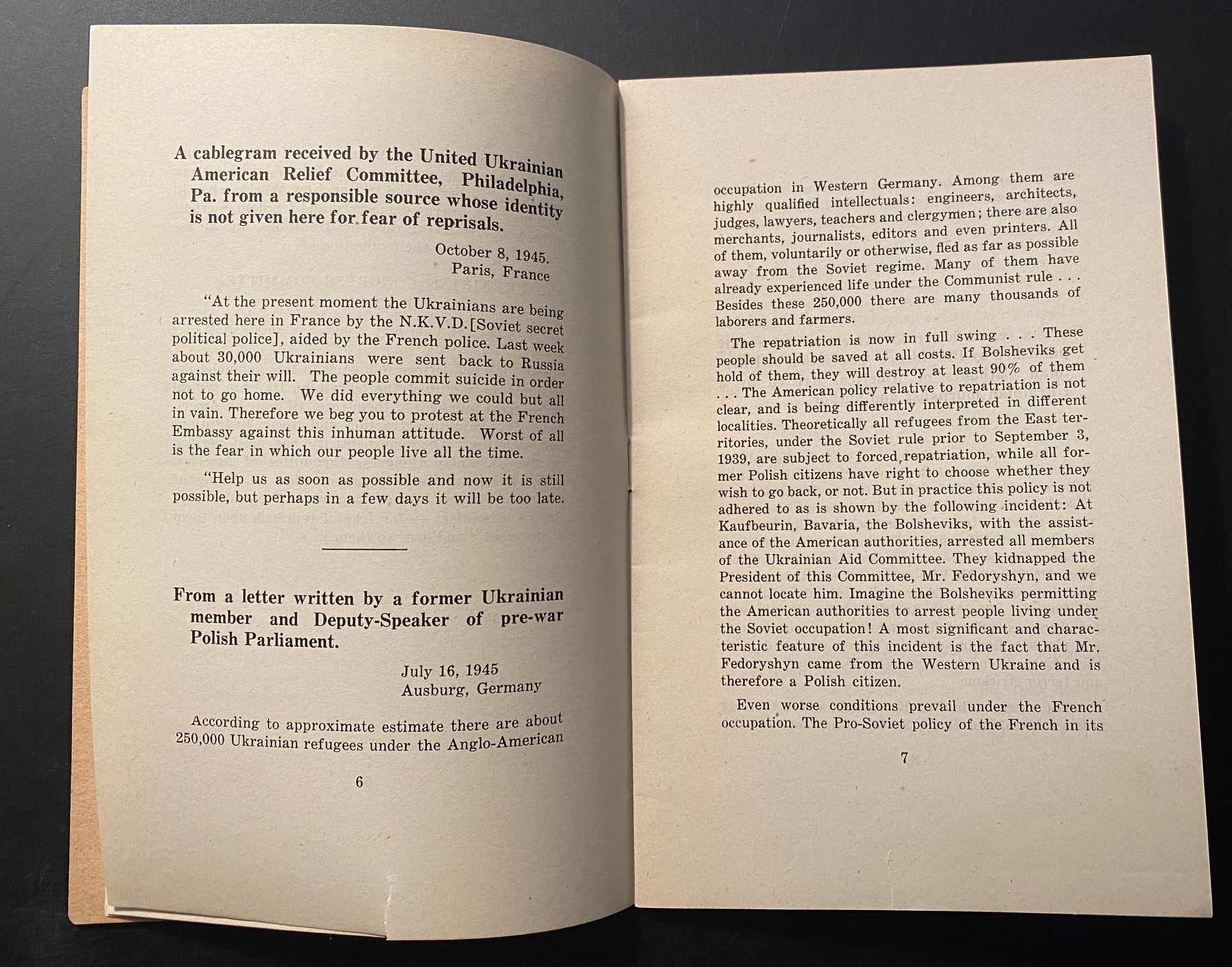
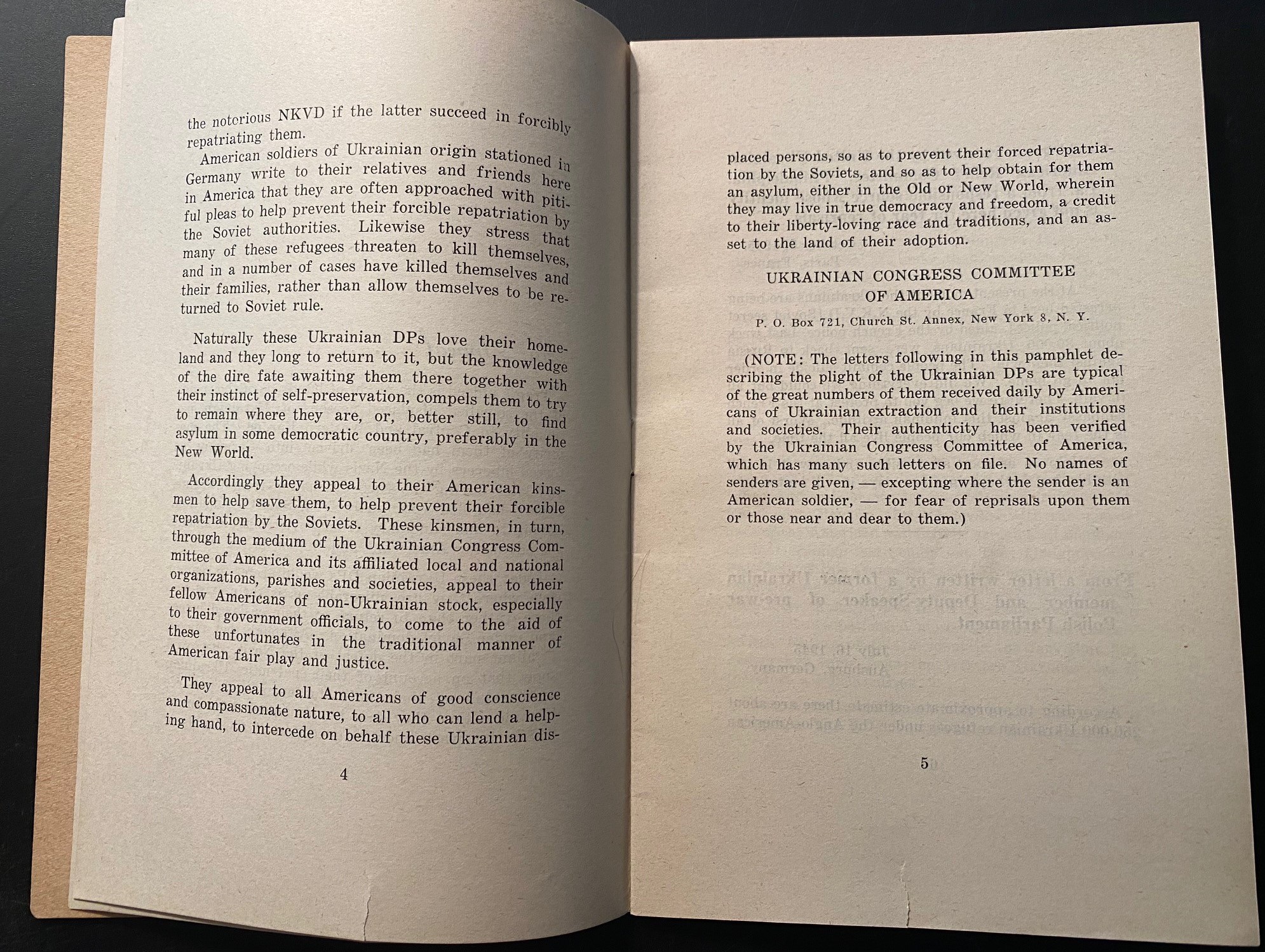
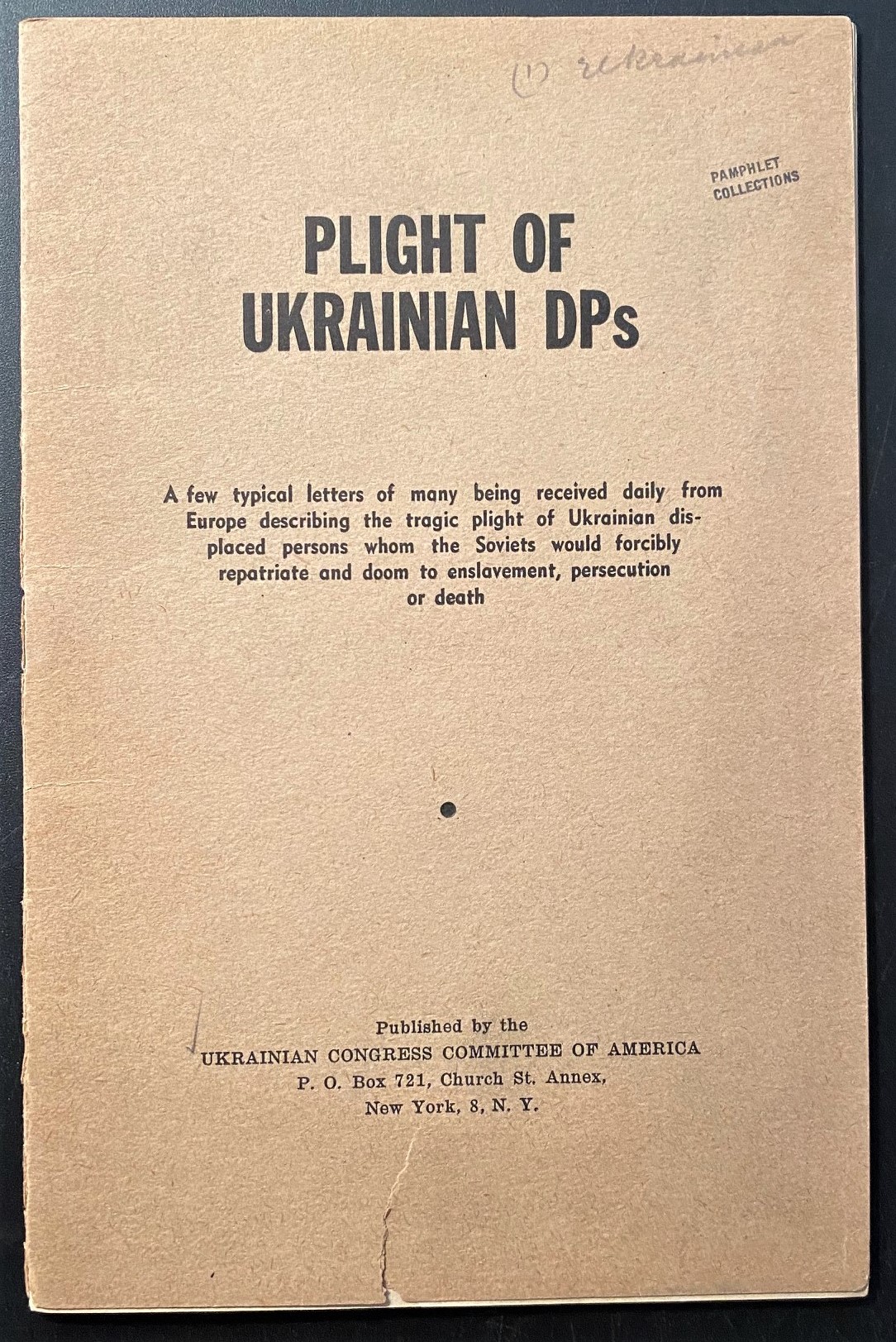
    The pamphlet Plight of Ukrainian DPs : a few typical letters of many being received daily from Europe describing the tragic plight of Ukrainian displaced persons whom the Soviets would forcibly repatriate and doom to enslavement, persecution or death, was published in 1945 or 1946 (but not later than 26 March 1946). It carries a terrific burden over its 31 pages, describes the “plight” of Ukrainian “DPs” at the end of WWII. “Plight” is a very weak word for their situation, as is the term designated them, “DP” or “displaced person”. These people–several million of them—from what I understand had been slave laborers, taken by the Nazis in the advance through Central Europe, and sent to work in German factories and fields. Many were theoretically and sub-practically paid a wage, though in general much of that went to providing themselves food and clothing and such that enabled them to work. These people were known as Ostarbeiter (Eastern Laborer), and at the end of the war many were repatriated to their country of origin. Of the 3-5 million Ostarbeiter, about 2.5 million remained alive at war’s end, with the vast majority–over 2 million–being from the Ukraine. This pamphlet details some of the terrible accounts of Ukrainians being repatriated to the Soviet Union and being treated as plagued outsiders, criminals, and worse, some simply executed, while hundreds of thousands of others were sent on for “re-education”, with many winding up in the Gulags. It was a terrible position to be in–the slave returned home after the war to be treated as a criminal, and slave again.

    In general interest I’ve made digital images of the pamphlet, reproduced in its entirety, below:
    Ukrainian DP _5_

    Ukrainian DP _2_


    Ukrainian DP _5_

    ·Posted by :

    ·in:


  • Words, Deeds, and Henry Ford (1927)

    JF Ptak Science Books   Quick Post  Overall Post 5146

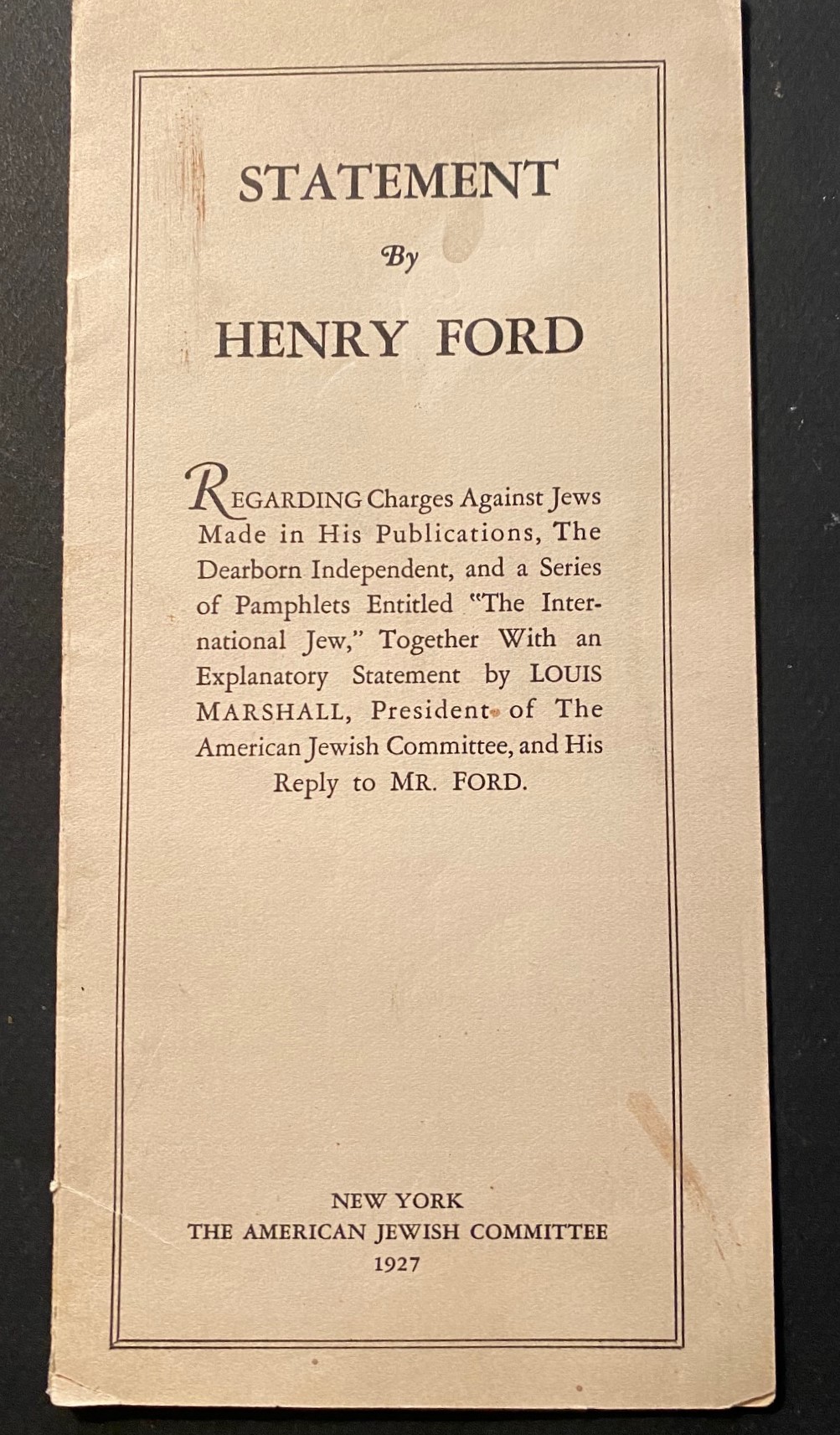
    IMG_5467 So, the Dearborn Independent was owned and published by Ford beginning in 1920 and rose to a circulation of 900,000 issues a day, the second-leading circulation in the country. It was partially put over this hallmark via incentive quotas in every Ford dealership. As no doubt is familiar to everyone in our modern world, the paper–which also published “The International Jew”– was a happy host to many anti-Semitic articles in its pages over the years. . It was bad stuff. Anyway, boycotts against the Ford company were lodged and a lawsuit emerged in 1927 concerning the paper’s ridiculous anti-Semitic stance. Ford  responded to the accusations in June 1927 saying that he had no idea that the paper had published this sort of garbage since 1920, and that he was shocked by it, and repelled. He recanted, though it seems from historical sources that the published letter of apology wasn’t written or signed by Ford. The response on the other side by Louis Marshall, president of the American Jewish Congress, was reserved, and hoped that the paper no longer published the anti-Semitic filth. Ford closed the paper by the end of 1927. In 1938, Ford accepted the Nazi award of the Grand Cross of the German Eagle, the highest medal offered by the Nazis to a foreign. Hitler had been in power for five years by this point, and his war against the Jews was years old.
    So: words and deeds…

    Notes:

    (FORD, Henry) “Statement by Henry Ford Regarding Charges Against Jews Made in his Publications, The Dearborn Independent, and a Series of Pamphlets Entitled “The International Jew”, together with an Explanatory Statement by Louis Marshall, President of the American Jewish Committee and his Reply to Mr. Ford. Published by the American Jewish Committee, 1927. WorldCat locates ONE print copy, University of Michigan. (There are 5 other copies located, all overseas, Australia, NZ,2 UK, Canada) though they all seem to be only online copies.)

    ·Posted by :

    ·in:


  • An Odd Perspective Looking Through the RAF Wellington Bomber (1941)

    JF Ptak Science Books   Overall Post 5141    

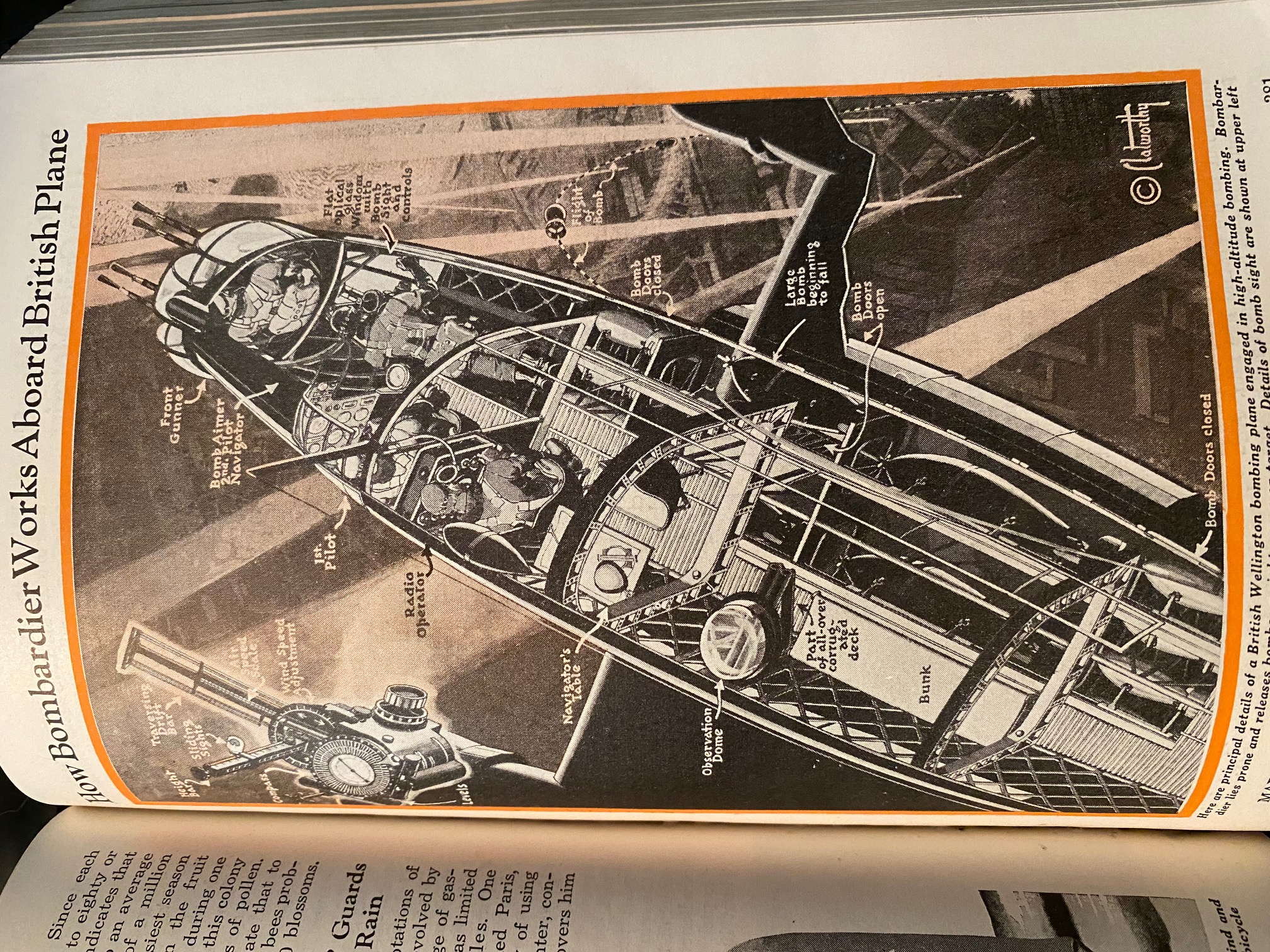
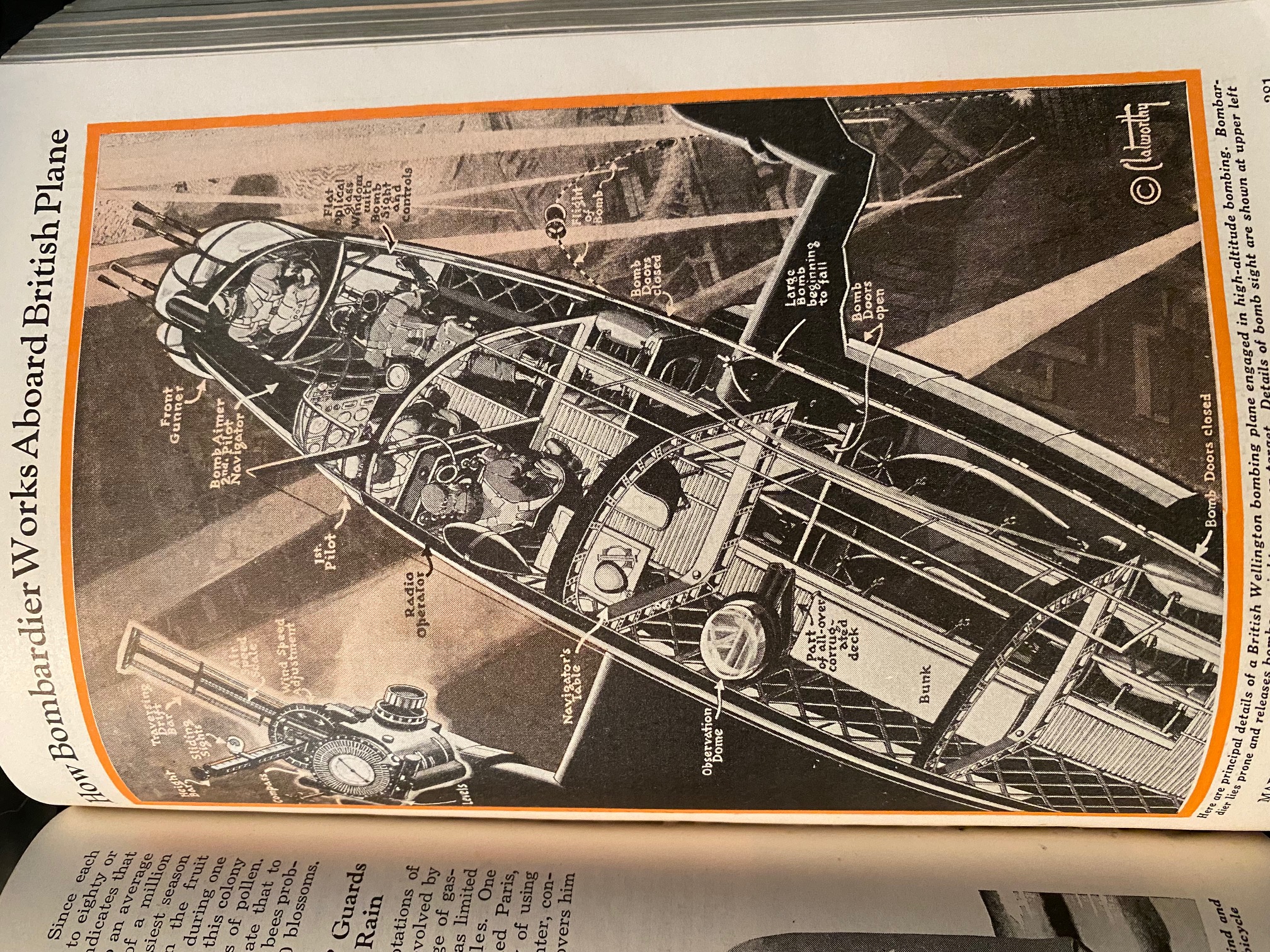
    Here’s a short notice on an unusual perspective in the combined categories of cutaway diagrams and looking-straight-down:  the (almost)-looking-straight-down bird’s-eye cutaway view!  I rarely see these two categories combined…and as a matter of fact I cannot recall the last time I posted something like this. So here it is, direct from the March 1941 issue of Popular Mechanics, showing a very oblique view from above looking through the fore section of a British Wellington bomber:

    IMG_6689

    There is an inset diagram of the sighting instrument, which I was a little surprised to see in a popular magazine published during the war.

    [Note: if you click through on the image it becomes more clear in magnification.]

    ·Posted by :

    ·in:

    —

  • “To the Knights of all Nations” June, 1945.

    JF Ptak Science Books   Overall Post 5136

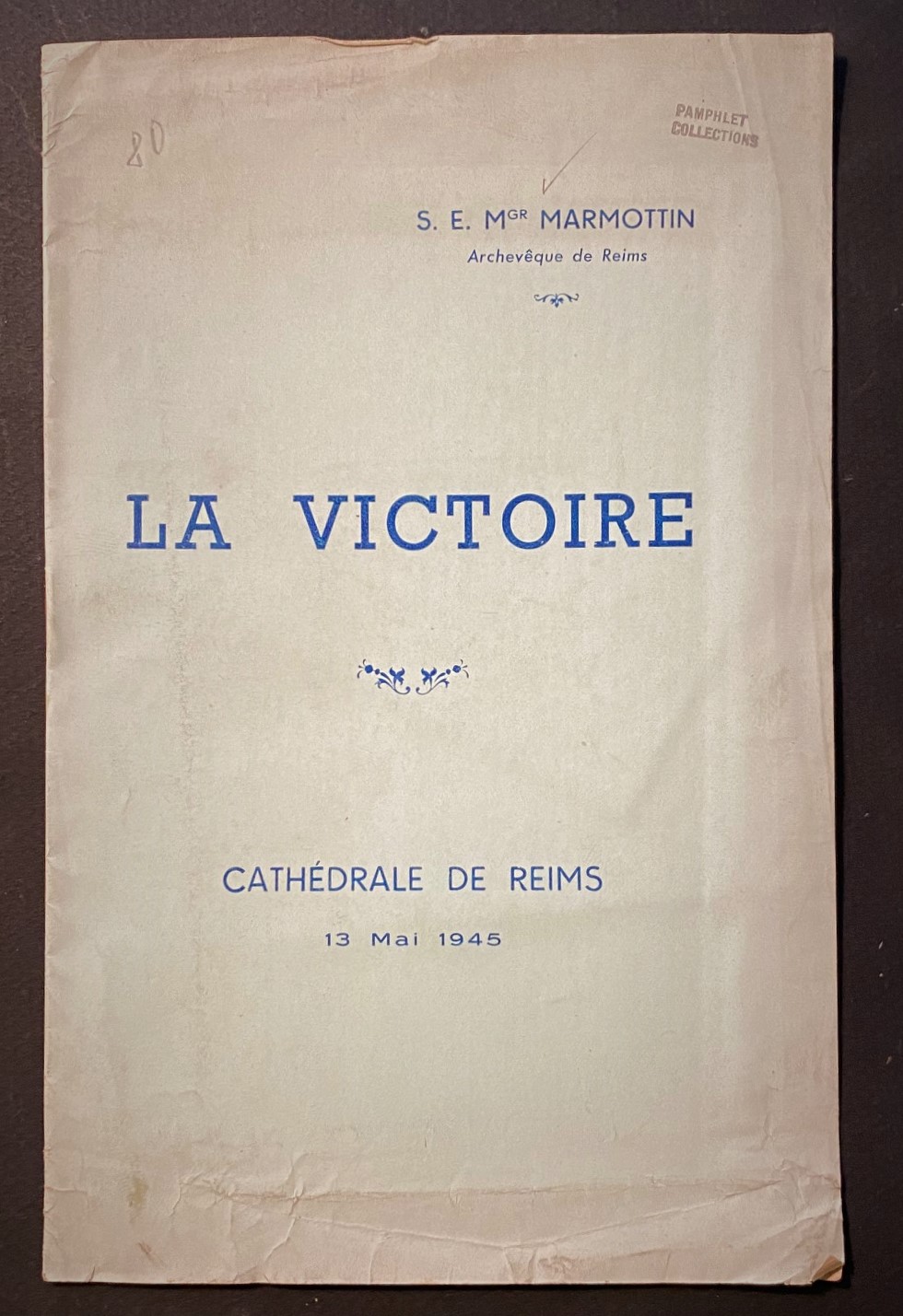
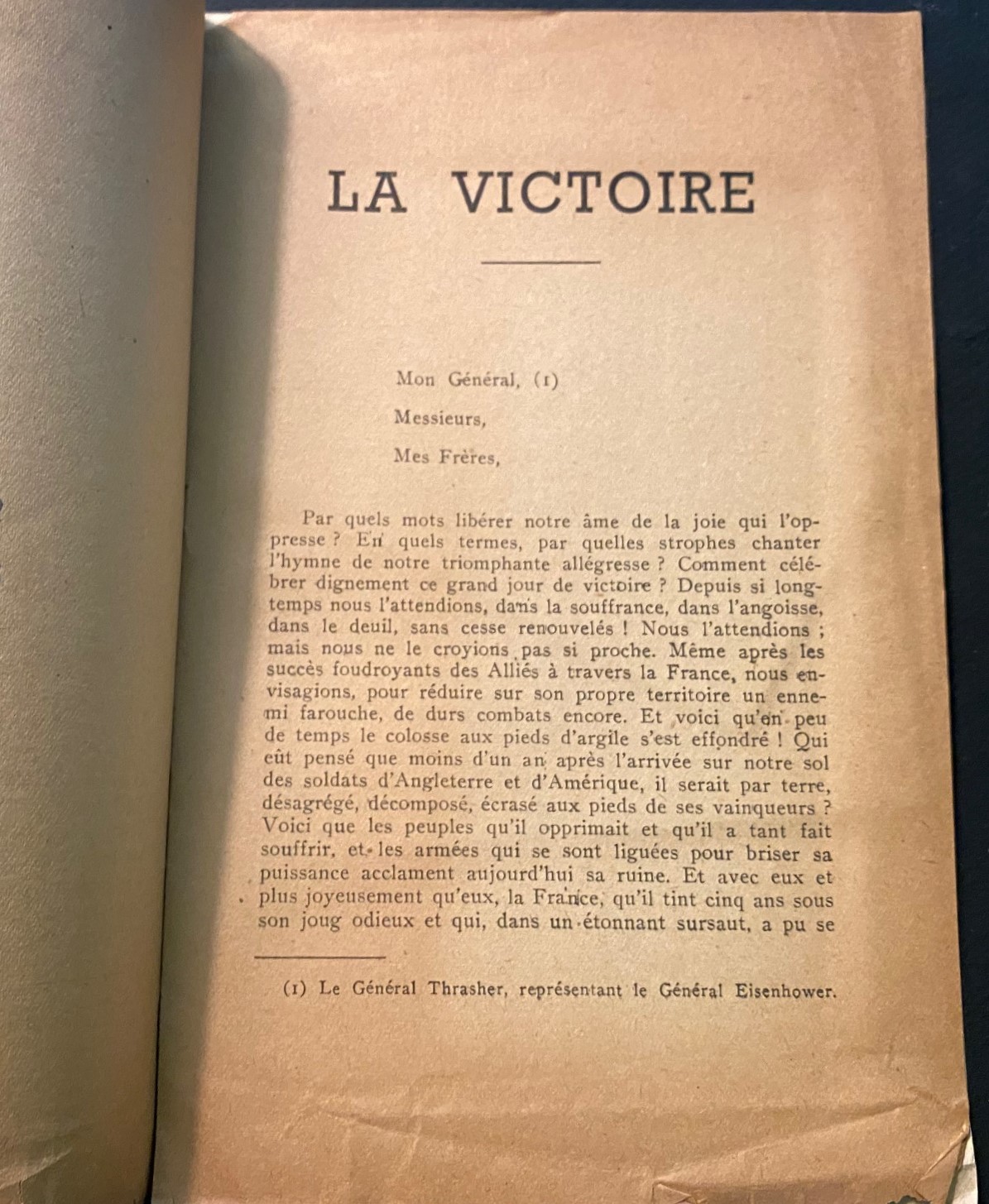
    IMG_5728“La Victoire”1 is a moving address from the archbishop of Reims, Louis-Augustin Marmottin, celebrating the end of the war, and was printed in June 1945. The monsignor  in particular notes the sacrifices and millions of deaths of “knights of all nations” on the feast of St. Joan: “Knights of all skies, sailors of all oceans, soldiers of all battlefields…” in the fight against Hitler. He writes: “Chevaliers de tous les ciels, marins de tous les océans, soldats de tous les champs de batailles. Il faudrait les saluer tous, les héros de la Pologne et de la Belgique, de l’Alsace et des Ardennes, qui soutinrent le choc initial, terrible, ceux de Stalingrad, des plaines ukrainiennes et des monts du Caucase qui les premiers connurent la victoire, ceux de l’Egypte et de la Tunisie, ceux de l’Italie et de la Normandie et de la Provence, de l’Alsace encore et de l’Allemagne, et tant d’autres dont le sacrifice a fait notre salut”–(from page 4). [““Knights of all skies, sailors of all oceans, soldiers of all battlefields. We should salute them all, the heroes of Poland and Belgium, Alsace and the Ardennes, who sustained the initial, terrible shock, those of Stalingrad, the Ukrainian plains and the Caucasus mountains who were the first to achieve victory. , those of Egypt and Tunisia, those of Italy and Normandy and Provence, Alsace again and Germany, and so many others whose sacrifice made our salvation.”] It should be noted that the cathedral’s construction began in the 13th century (followed by a complicated history of construction and renovation) and is the traditional site for the coronation of French kings, and also contains a statue to St. Jeanne d’Arc in full armor.

    IMG_5729

    Notes:

    1. MARMOTTIN, Louis-Augustin, Msgr. (1875-1960) “La Victoire. Cathedrale de Reims, 13 Mai 1945.” Printed in Reims (Imp. Du Nord Est), 1945. Original wrappers 7″x 5″, 6pp. Provenance: Library of Congress with their rubber stamp on rear wrapper. Condition: Good. The paper is somewhat browned and weakened and there are old folds here and there in the wrappers. Acceptable condition, overall. [Note: WorldCat states two years of publication—1945 and 1946—though this copy has a rubber stamped date at the foot of the title page stating “21 6 45”, or 21 June 1945.] WorldCat locates only THREE copies, all in France.

    ·Posted by :

    ·in:


  • Hitler Youth Diary for Girls, 1937

    JF Ptak Science Books   Overall Post 5134

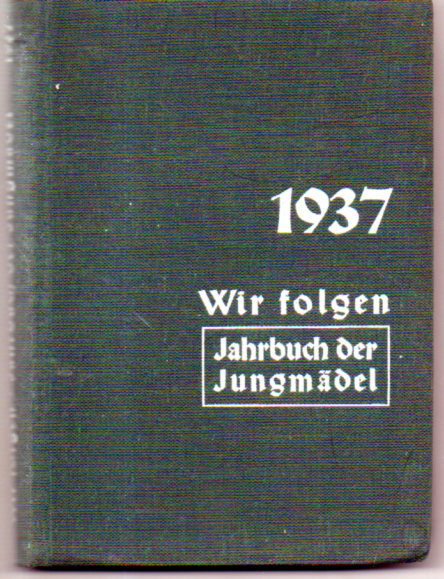
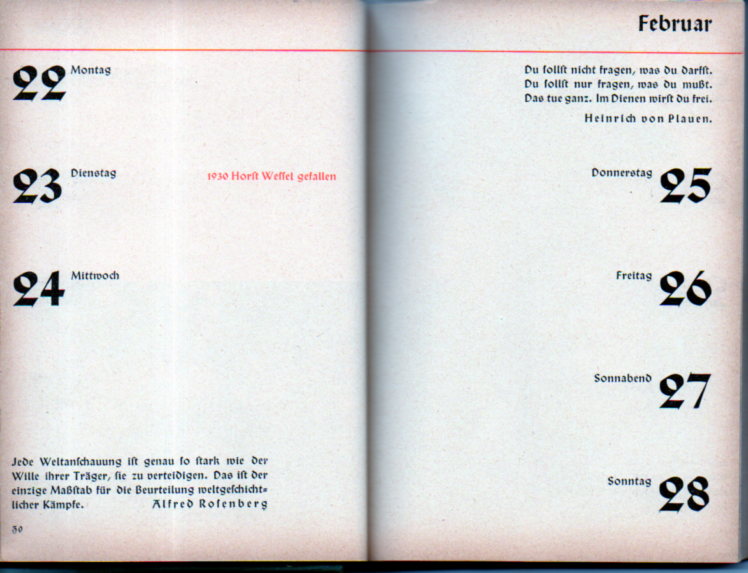
    Hilterjunge diary008There’s a bookcase in the house that has a top shelf for small books, most of which I haven’t written about, though there is a clutch of them that have gotten some exposure here on the blog, with most of them being unused diaries, and most of those being Nazi-oriented.  I’ve wondered about the people who would have sat down with those things blank-ish books, thinking about scheduling their time, or recording events, and then deciding not to. Maybe they didn’t want to be reminded of Nazi holidays and/or the birth of Hitler, or the right of duty and the proper way to respond to current events based on the policies of the NSDAP. The diaries are all pretty much like-new, and aren’t even all that old in the scheme of things, though their distance in time doesn’t match their distance in historical “space” (so to speak). 

    This diary was for German girls who were members of the Young Girls League (Jungmädelbund), which in the German stratification of Nazism was part of the League of German Girls (Bund Deutscher Mädel), which in turn operated under the broader gender-divided organization of Hitler Youth.

    It is difficult as a father of two daughters–one of whom is of the correct age to have been using this diary had circumstances been enormously different–and it is painful to imagine her looking through these pages, at the red-letter days and inspiration photographs, filling in the book and responding to these enormous and not necessarily subtle social pressures.

    “Wir folgen!” states the cover of the diary, and it meant it. “We follow”. 

    Hilterjunge diary009

    ·Posted by :

    ·in:

    —

  • “Small Target Bombing Probabilities”–Bombing Calculator, 1944

    JF Ptak Science Books  Expansion of an earlier post from  2011 

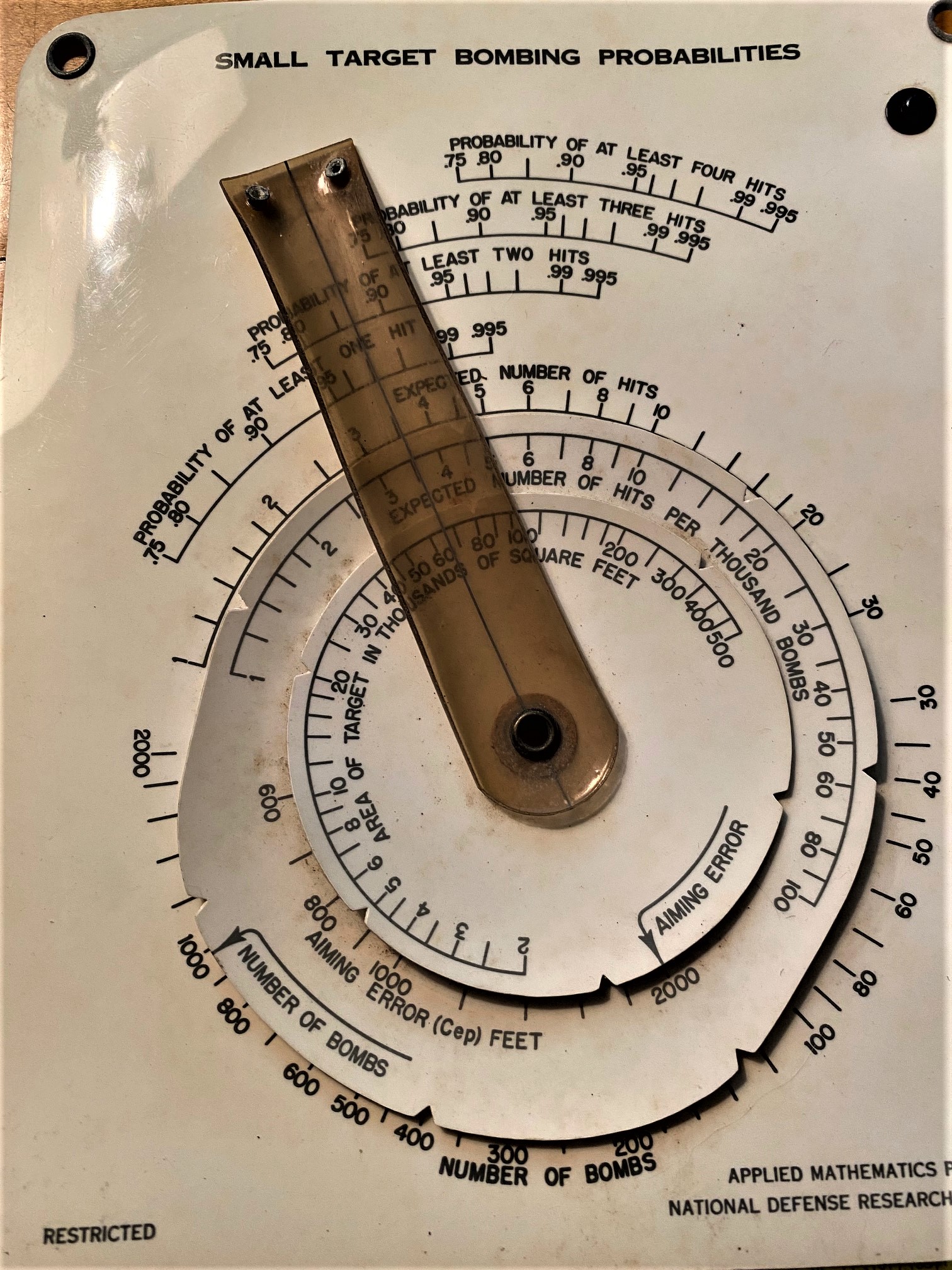
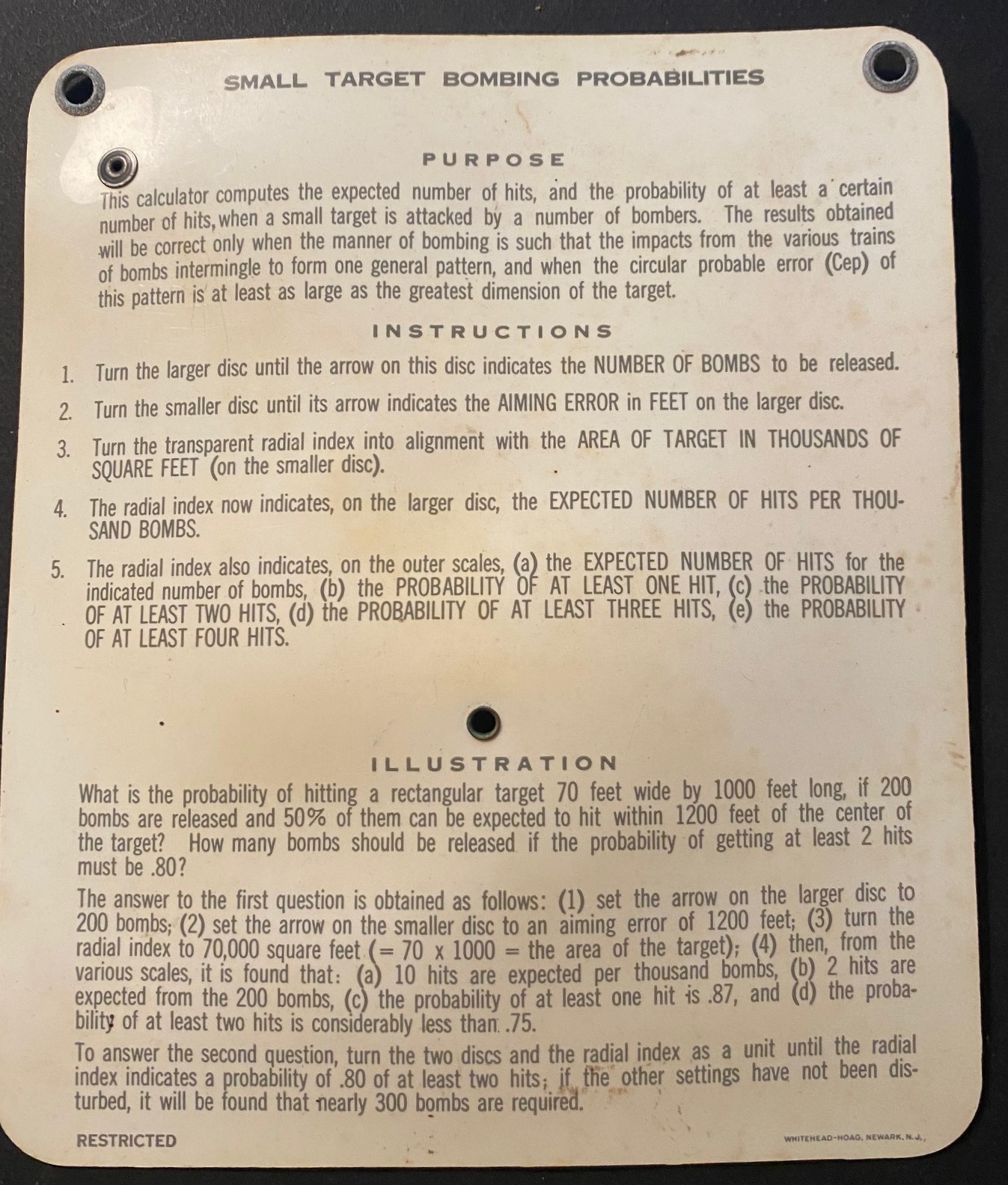
    IMG_5402I found this object in my paper-calculators box (moveable disk calculators made of paper, two going back to  Fr. A. Kircher in the 1680’s)—I’m not sure why it was there as it is not paper, though it is an interesting calculator.

    [Images are greatly expanded in click mode.]

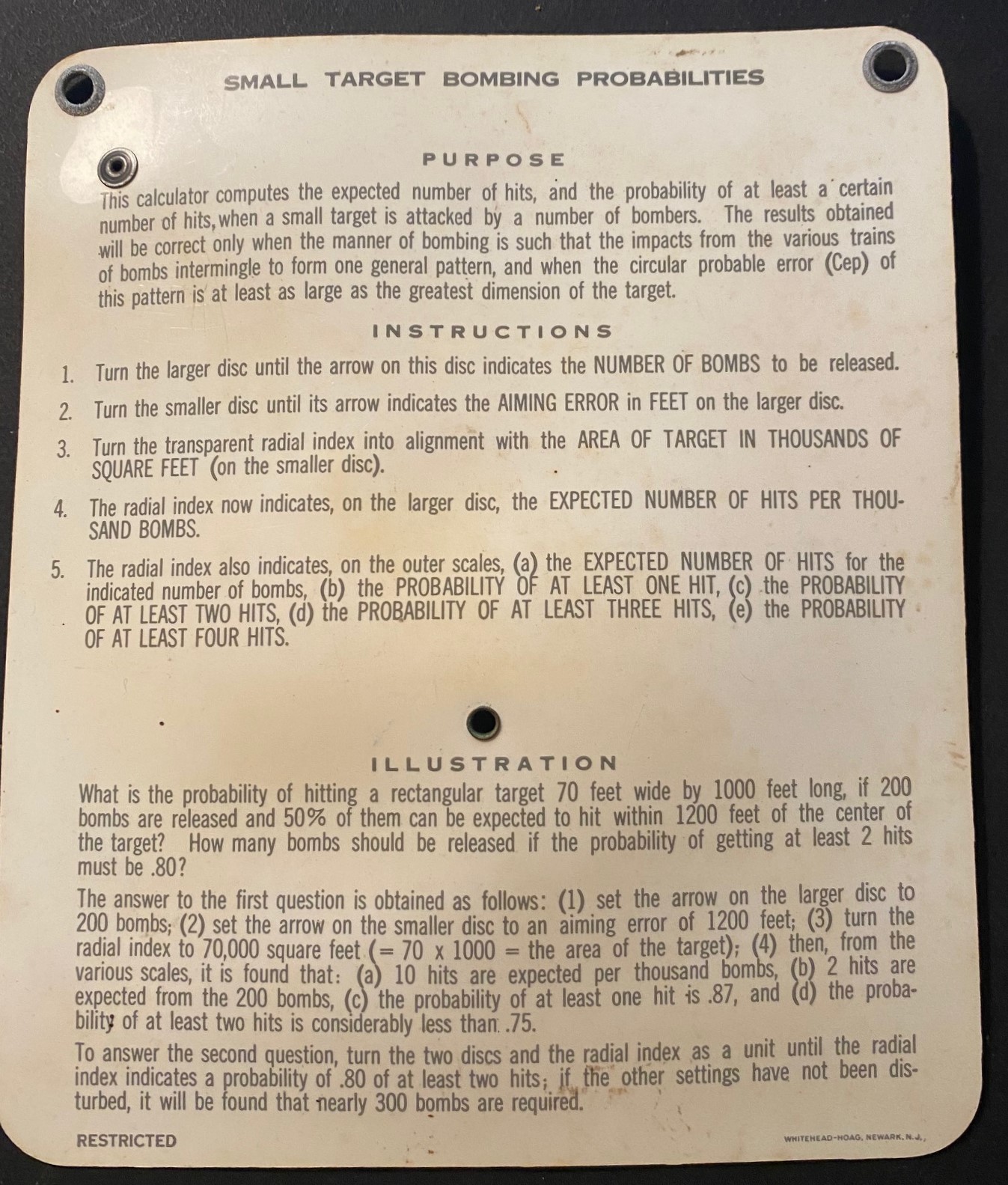
    You can learn or re-learn an interesting lesson from it on bombing accuracy.

    The “Small Target Bombing Probabilities” calculator was issued by the little-known (in the popular sense) Applied Mathematics Panel of the National Defense Research Council (NDRC)1 in the early 1940’s during WWII. 
    IMG_5403Marked “Restricted”, it calculated the number of bombs that would successfully be delivered given (1) the number of bombs, (2) the “aiming error”, and (3) target size. It would then generate results for “(a) the expected number of hits for the indicated number of bombs”, (b-e) the probability of at least one hit to four hits.

    What is a little surprising to me was the number of bombs that didn’t find their target. For example, a 65,000 square foot target bombed with 1000 bombs and an aiming error factor of 2000 feet could expect to land 3-4 bombs on the target, with an 88% chance of landing at least two hits, 75% chance of landing three hits, and about 50% of landing at least four hits.  And so the necessity of large numbers of planes dropping a large number of bombs.  

    Notes

    1. The establishment of the NDRC was announced so: “It is announced by Science Service that the following committee has been appointed in the United States to correlate “scientific research on the mechanisms and devices of warfare”: — Nature 146, 191-191 (10 August 1940).

    “Members included: Dr. Vannevar Bush (chairman), president of the Carnegie Institution of Washington, formerly dean of the faculty of engineering at the Massachusetts Institute of Technology; Prof. Richard C. Tolman (vice-chairman), dean of the graduate school and professor of physical chemistry and mathematical physics at the California Institute of Technology; . Dr. Irvin Stewart (secretary), formerly Federal Commissioner for Communications and chairman of the Committee on Scientific Aids to Learning; Rear Admiral Harold G. Bowen, director of the Naval Research Laboratory, Anacostia, D.C.; Conwiy P. Coe, U.S. Commissioner of Patents; Dr. Karl T. Compton, president of the Massachusetts Institute of Technology, formerly professor of physics at Princeton University; Dr. James B. Conant, president, formerly professor of organic chemistry, Harvard University; Dr. Frank B. Jewett, president of the Bell Telephone Laboratories; Brigadier General G. V. Strong, assistant chief of staff, U.S.”

    ·Posted by :

    ·in:

    — —

  • Resistance in Czechoslovakia, 1943 (Full Reprint of Scarce Pamphlet)

    JF Ptak Science Books  Quick Post (reprint series) Overall Post #5119

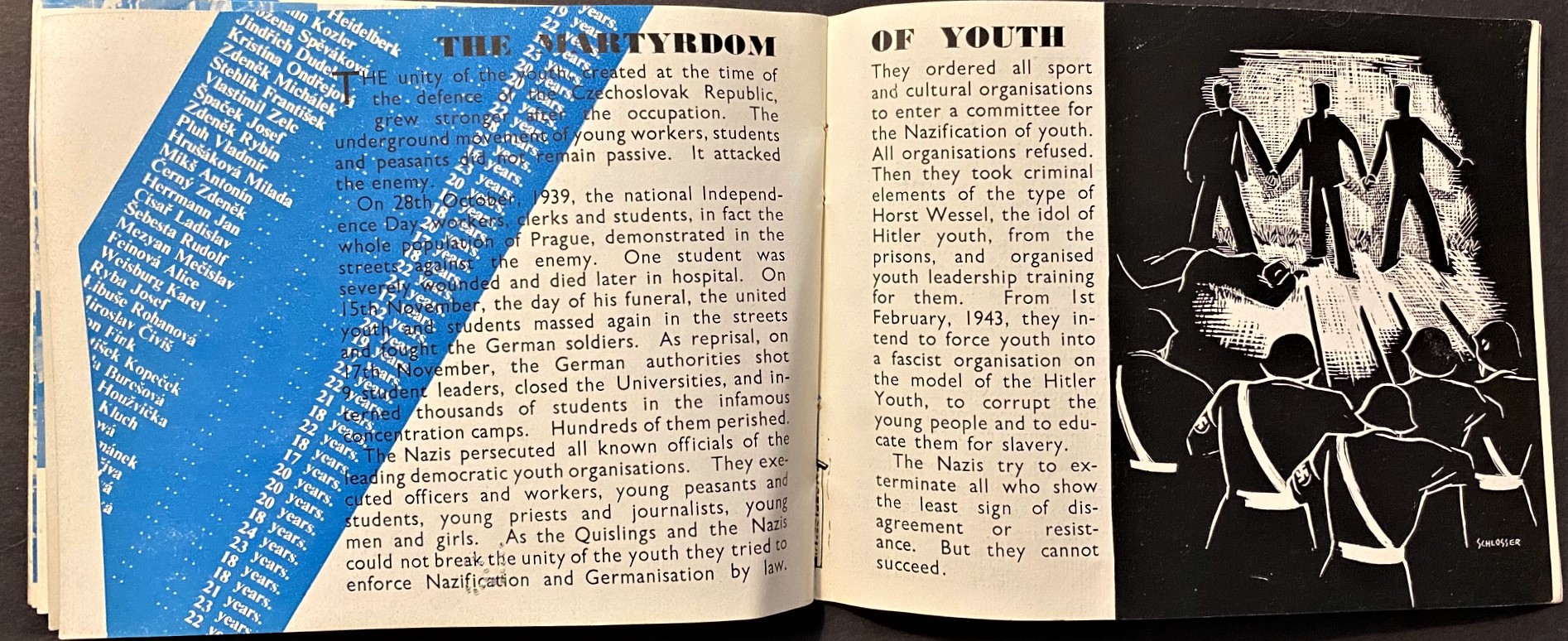
    Youth of Czechoslovakia1 was a Czech-in-exile response to the situation in the country as it stood in 1943. The situation of course was critical, and the compiler of the work, F.L. Lowidt, chronicles the state of the affairs from the end of the First World War to the occupation sometime late in 1943.  About half of the work concentrates on the war period following “the fatal policy of Munich” and the “sacrifice” of Czechoslovakia to impossibly placate Hitler.  It is a very interesting document, and as there are only a half-dozen or so located by WorldCat in libraries worldwide, I’m reproducing it here.  Of special note are the four pages or so dealing with children and the youth being used for “forced labor in Hitler’s war machine”, the “martyrdom of youth”, and the resistance movement.  

    Notes

    1. LOWIDT, F.J. (compiler); artwork by W. Slosser. Youth of Czechoslovakia. Published by the Czechoslovak Youth Committee, London (and printed by Dugdale Printing, Ltd.).[1943] No date stated but WorldCat (which locates only six copies) believes it to be 1943. My copy–a Library of Congress duplicate–has a cataloguer’s pencil notation for being received on 6 March 1943.  


    Czech _11_

    ·Posted by :

    ·in:


  • A Warning from the Sky (April 1945)

    JF Ptak Science Books  Quick Post

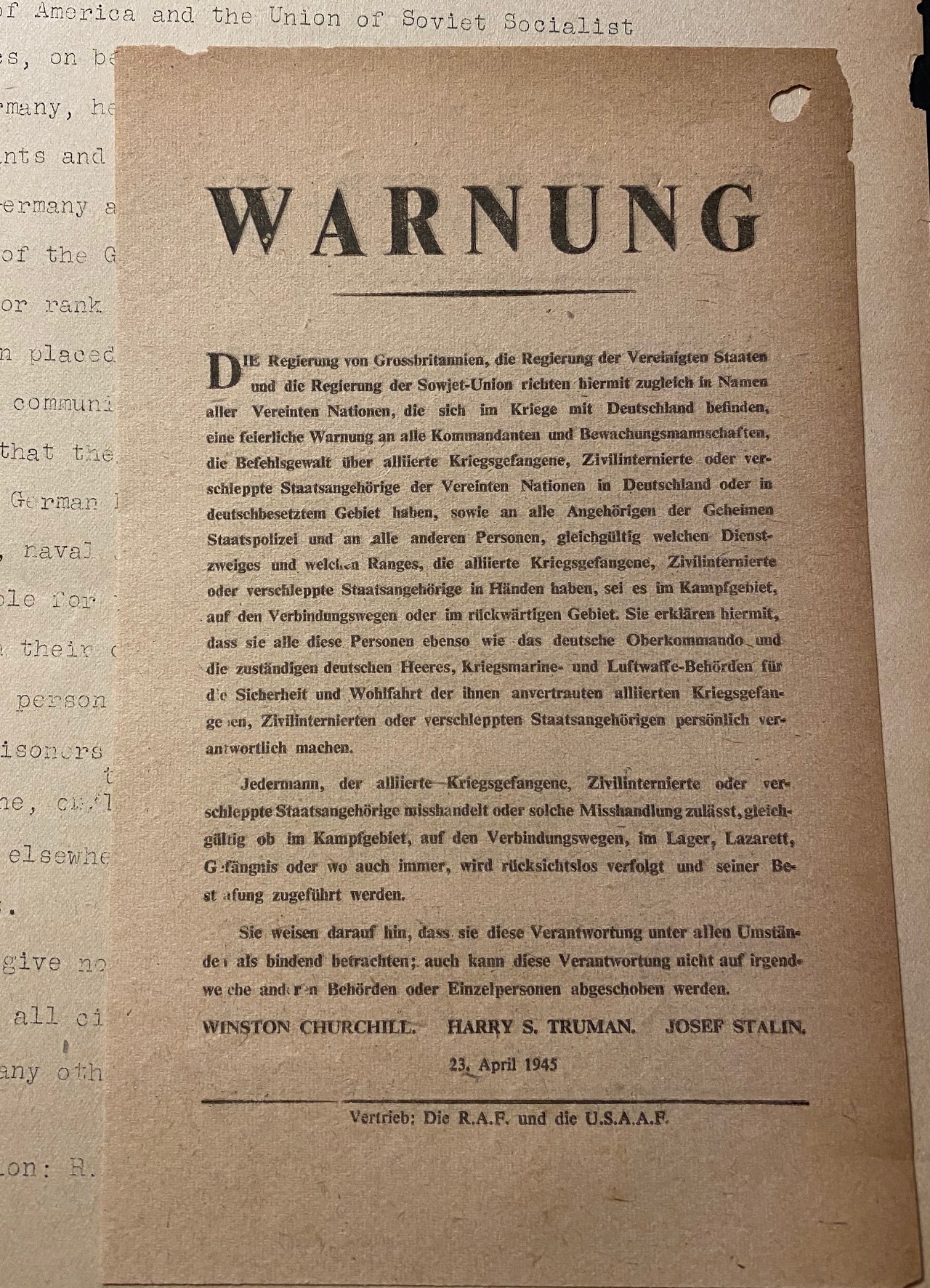
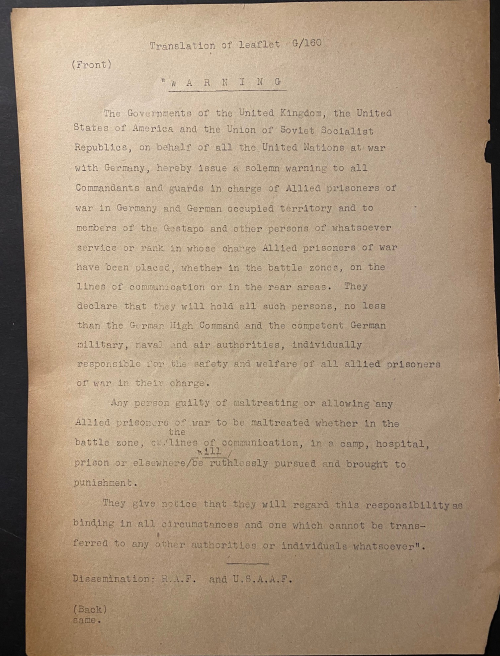
    IMG_3197This is one of the few remnants that I have of a larger collection of surrender and various sorts of propaganda leaflets dropped on the Wehrmacht and Germany in general in the last two years of World War II. (A longer post on this collection can be found elsewhere on this blog.) This leaflet, the “dissemination” of which was orchestrated by the R.A.F. (Royal Air Force) and the U.S.A.A.F. (United States Army Air Force) and were literally dropped in the tens of thousands on the remaining troops in the final weeks of the war, with the document dated 25 April 1945. (Mussolini was killed on this day, the German forces in Italy would surrender on 29 April, Hitler would commit suicide on 30 April, and the Battle for Berlin would be over on 2 May, with the unconditional surrender of the Third Reich coming in the middle of the night at SHAEF HQ at Reims.)

    This leaflet is particularly strong, warning that mistreatment of Allied prisoners in any way or form by Gestapo and its agents would not be tolerated and that if there was mistreatment then those responsible would “be ruthlessly pursued and brought to punishment”.

    This warning comes weeks after the liberations and “discoveries” of various concentration and death camps, the truths found in those places definitely helping to form bloody-minded warnings to anyone in Germany committing crimes against Allied POWs.

    Even though the propaganda bombing no doubt involved millions of pieces of paper, only a tiny fraction seem to have survived.

    Here’s the original along (and transcription) with a government-sponsored translation of the leaflet

    “W a r n i n g

    The Governments of the United Kingdom, the United States of America and the Union of Soviet Socialist Republics, on behalf of all. the United Nations at war with Germany, hereby issue a solemn warning to all Commandants and guards in charge of Allied prisoners of war in Germany and German occupied territory and to members of the Gestapo and other persons of whatsoever service or rank in whose charge Allied prisoners of war have been placed, whether in the battle zones, on the lines of communication or in the rear areas. They declare that they will hold all such persons, no less than the German High Command and the competent German military, naval and air authorities, individually responsible for the safety and welfare of all allied prisoners of war in their charge.

    Any person guilty of maltreating or allowing any Allied prisoners of war to be maltreated whether in the the battle zone, lines of communication, in a camp, hospital, prison or elsewhere will be ruthlessly pursued and brought to punishment.

    They give notice that they will regard this responsibility as binding in all circumstances and one which cannot be trans­ferred to any other authorities or individuals whatsoever.

    Dissemination: R.A.F. and U.S.A.A.F. IMG_3198

    ·Posted by :

    ·in:


  • 1.8 Million Planes and 2 Million Tanks (1918)

    JF Ptak Science Books  Quick Post

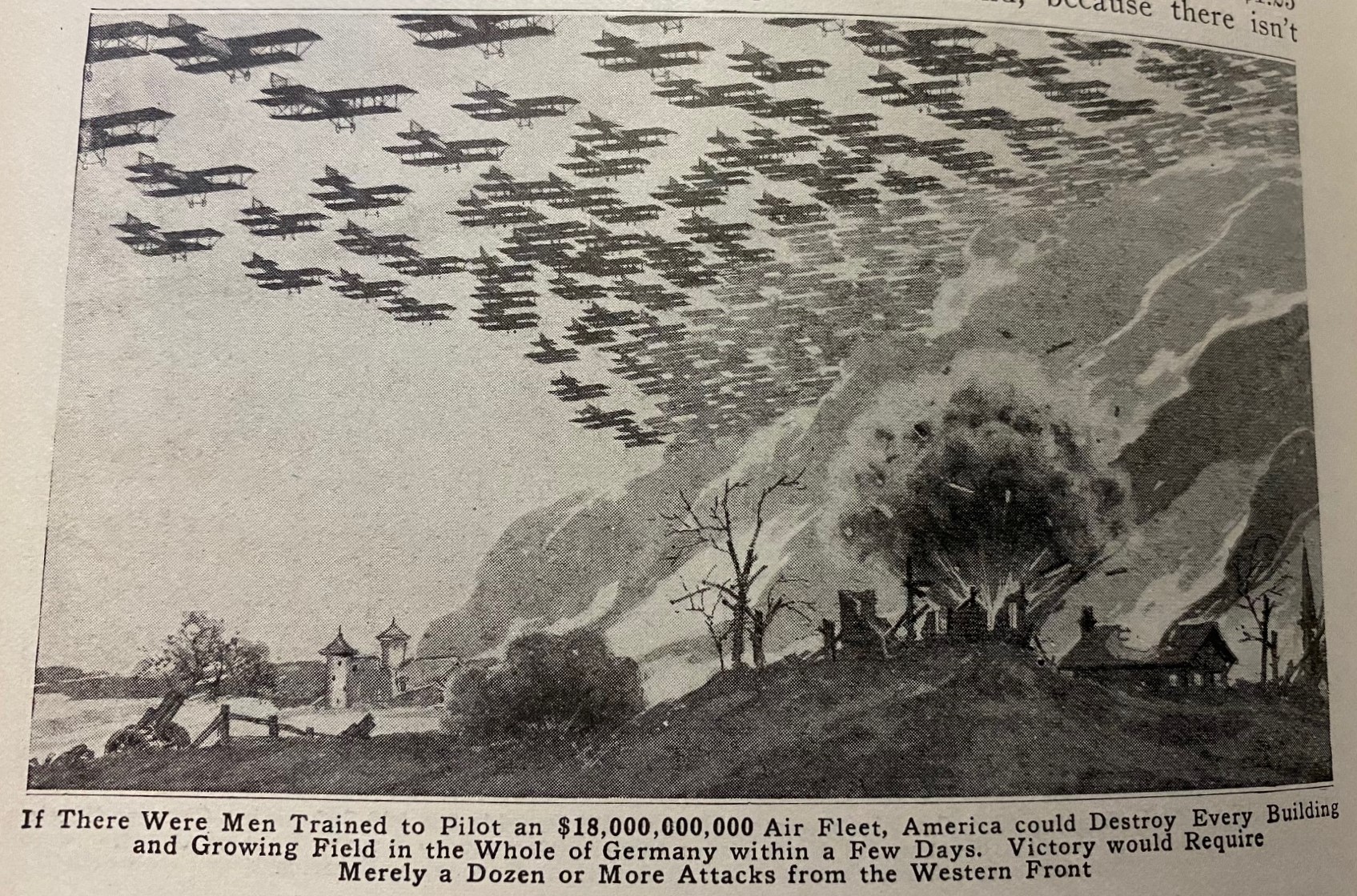
    Here’s a fine and somewhat misleading representation of the U.S. Congressional war allocation of 1918 for what was then the staggering figure of $18,000,000,000 (or about $387 billion in 2020 according to the BLS), found in the pages of Popular Mechanics for May 1918. To visualize the 18-billion, the editors displayed the amount in terms of something somewhat familiar to most readers.  For example, if the appropriation could be laid directly and only into the manufacture of airplanes (and bombs I guess) the editors guessed that the force would lay waste to all of Germany in about two days.  Guessing that each aircraft cost about $10,000 in 1918 that would mean there would be an attack force of 1.8 million planes.  Granting each a capacity of 500 pounds carriage, their entire force could deliver about 20% of the total tonnage dropped on Germany by the US and UK during WWII for each 1.8 million plane sortie.  (I’m guessing at some of the figures but I think that this is about correct.) Given that the “bomber plane” was still in its cradle, this could not have painted a very clear picture of what $18 billion dollars could buy.  Further guessing here is that there were fewer than 50,000 aircraft in existence in 1918, so imaging the 1.8 million figure would have been staggering. 

     IMG_3001

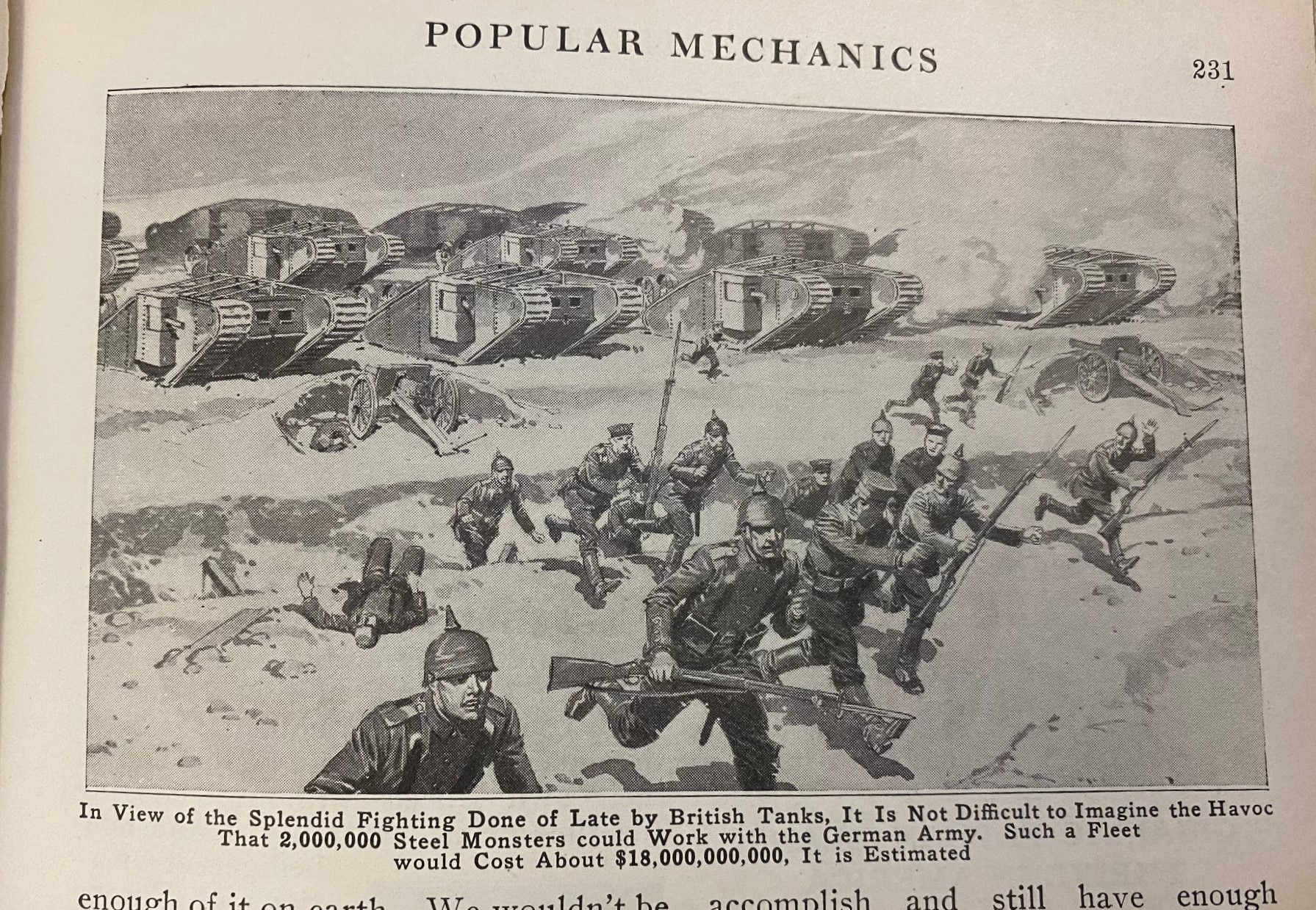
    IMG_3002Another example from the same article involves envisioning $18,000,000,000 worth of tanks, which in 1918 would cover fielding 2,000,000 of them. This of course is an enormous number, particularly having in mind that about 50,000 U.S. Sherman tanks were constructed between 1942 and 1945, which is about 3.5% of the total talked about in the article, and the largest tank battle in history at Kursk in July and August 1943 involved about 6,000 tanks between German and Soviet forces. Given too that the tank is only a few years on the battlefield at this point there was really no way that a person could visualize 2 million tanks–I suppose no commander in 1945 could have envisioned it, either.  

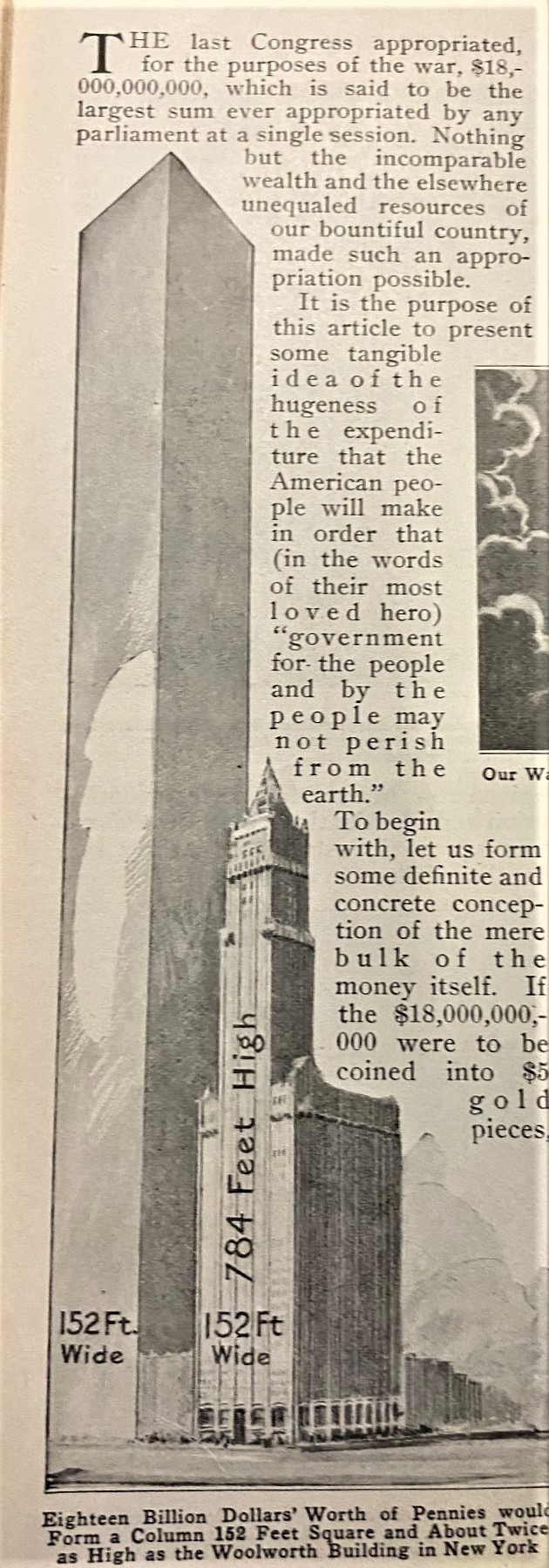
    And another example from the same article: using pennies and the Woolworth Building as comparables.  The Woolworth structure has found itself in a number of similar articles in the ‘teens, though I don’t recall seeing it compared to a 1.8 trillion penny mound, as we see below.  

    I think that the editors were just out and beyond their capacity in trying to visualize war funds in these comparative ways.

    IMG_2999


  • The Normandie That Failed (1942)

    JF Ptak Science Books  Post 2905

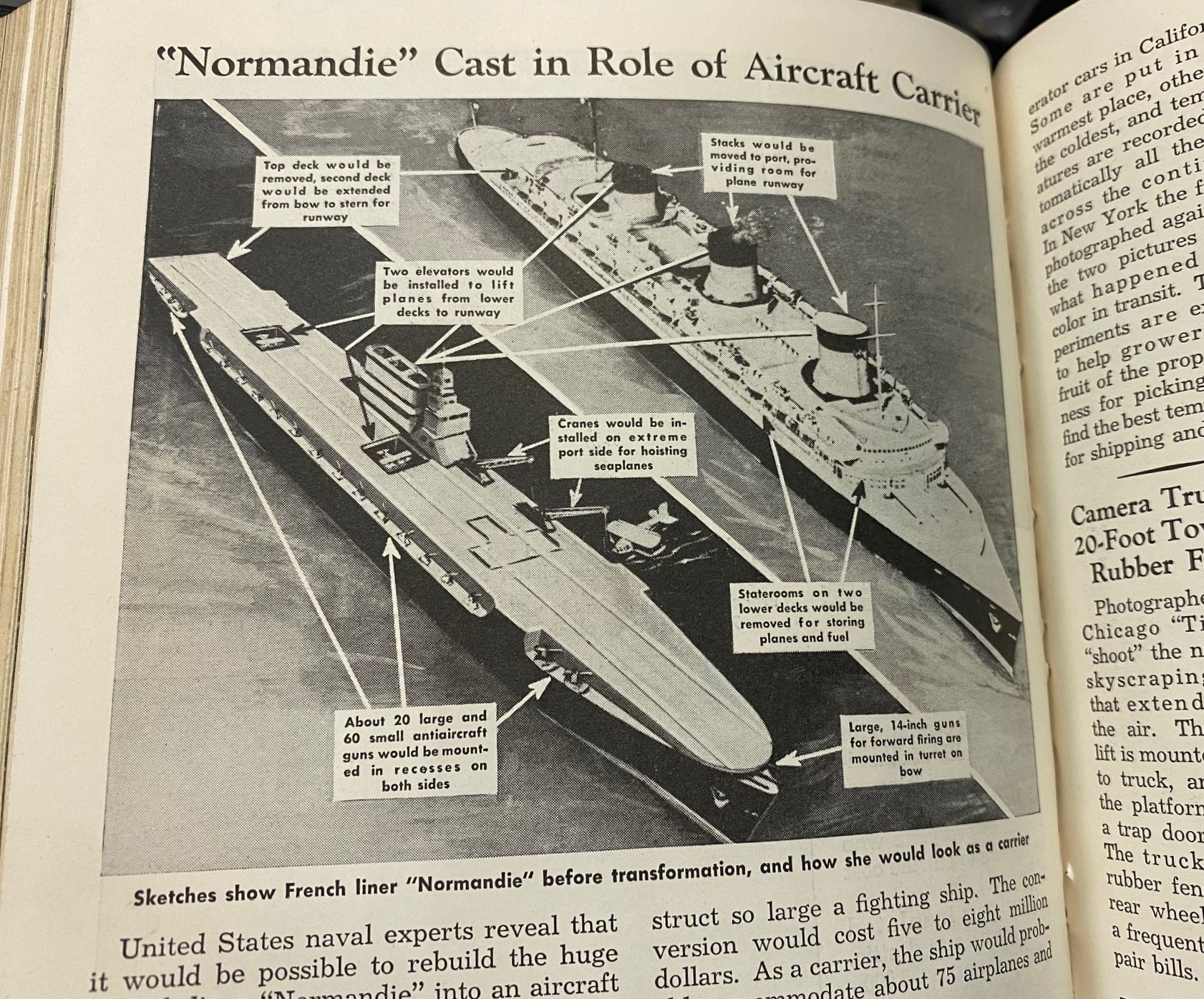
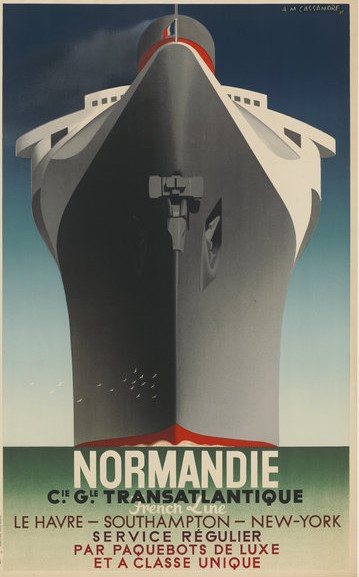
    Breezing through a volume of Popular Mechanic for 1942 I came across an article on refitting the French ocean liner, the Normandie.  The only thing I knew about her was that the ship was the subject of one of the all-time great travel posters (pictured below). The imagery for February 1942 was vastly different. It turns out that when the general war began in Europe the Normandie was in NYC harbor where it was more or less immediately interned. As a matter of fact after just a short while this great ship was tied up next to the RMS Queen Elizabeth and the Queen Mary, which meant the world’s three largest ocean liners were cheek and jowl to one another in NYC.  After Pearl Harbor the ship was put under the command of the U.S. Coast Guard, and after a very brief period the command was transferred to the USN. That’s where these plans come in, to re-purpose the ship into an aircraft carrier:

    IMG_2477

    But that was not to be and construction plans were made to transform the ship into a troop transport

    2017KC2259_jpg_lThen came the Great Misfortune.  In February 1942–the month that this Popular Mechanics was issued–the Normandie (renamed the USS Lafayette) caught fire, flamed out, capsized, and died. There was some amount of rumor and innuendo that the ship was sunk as a result of foreign intrigue, but a board of inquiry found otherwise.1 It seems that in the course of refitting that a blow ironically and tragically set on fire a pile of life preservers that were made of very buoyant by highly flammable fibre from the great kapok tree. The very effective fire suppressor was disengaged after the French sailors were led off, and, well, seemingly a lot of other unfortunate things played into one another to the critical result. It was a fatal fire for the ship. I recall seeing very unsettling pictures of the Normandie in LIFE magazine, capsized in shallow water and winter ice mud.

     There were efforts to revive her, retrieve her, bring the great ship back to life in one way or another, but all attempts failed, and the Normandie was sold for scrap in 1946 and was completely gone by 1948.

    Notes.

    1. “The investigation found evidence of carelessness, rule violations, lack of coordination between the various parties on board, lack of clear command structure during the fire, and a hasty, poorly-planned conversion effort.”–Wikipedia