A Daily History of Holes, Dots, Lines, Science, History, Math, Physics, Art, the Unintentional Absurd, Architecture, Maps, Data Visualization, Blank and Missing Things, and so on. |1.6 million words, 7500 images, 4.9 million hits| Press & appearances in The Times, Le Figaro, Mensa, The Economist, The Guardian, Discovery News, Slate, Le Monde, Sci American Blogs, Le Pont, and many other places… 5000+ total posts since 2008.

Category: World War II

  • Austrian Communist Manifesto for Democracy and Freedom (1944)

    JF Ptak Science Books  Post 2889

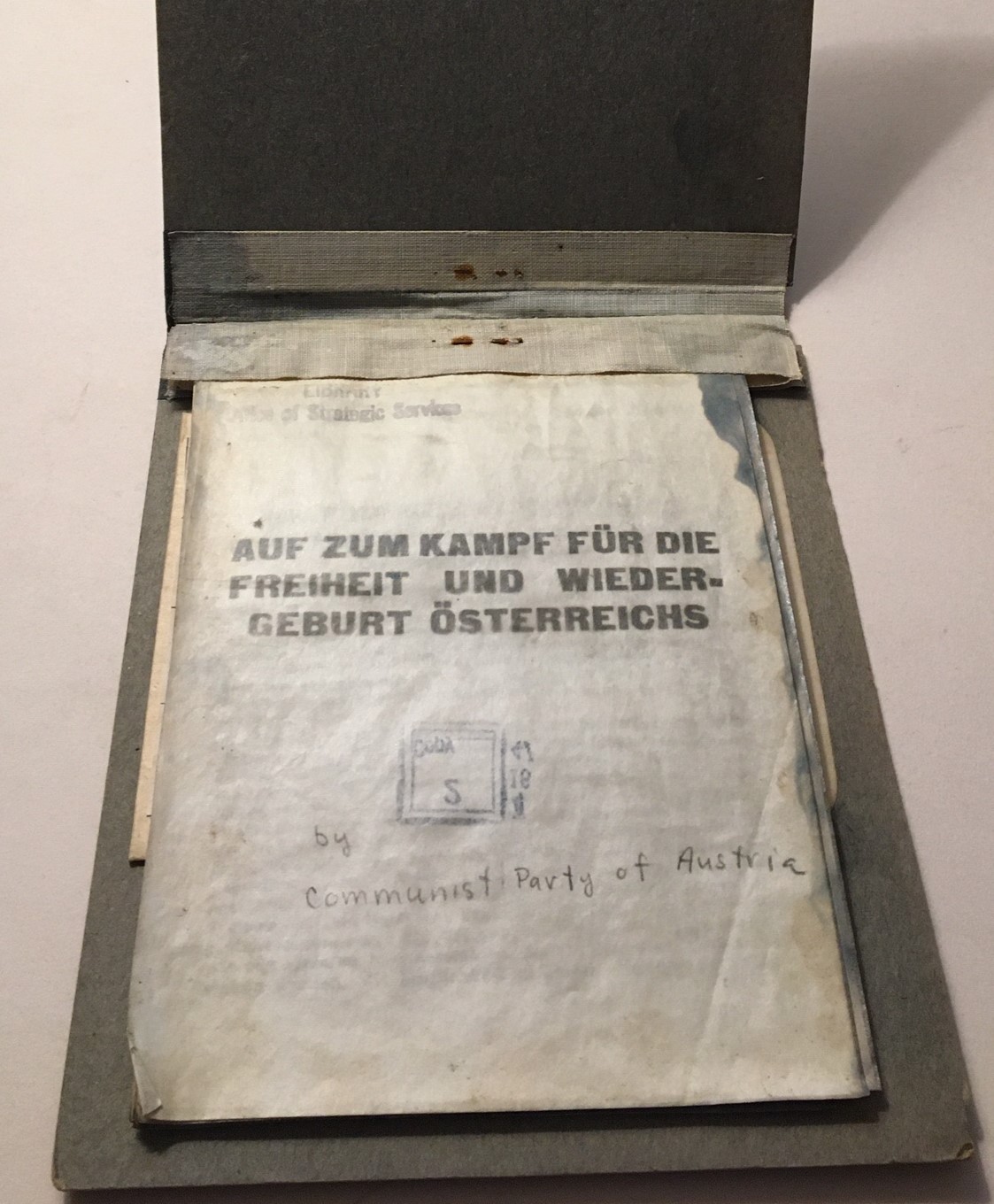
    IMG_1968First of all I mean no disrespect to the author/s of this work in discussing the pamphlet’s appearance, or those who read it with interest, or to those who studied it, or to those who may have lived it and who may have paid the price for doing so.  I thought that this small work was remarkable in content and appearance. and in the way it sounds…the book’s physical appearance seems to me to add to its history and story.

    First of all this effort was written by someone associated with the Communist Party of Austria no later than 1944 and is titled Auf zum Kampf Freiheit und Wiedergeburt Osterreuchs, or The Fight for Freedom and Rebirth in Austria (or Let’s Fight for Austrian Freedom and Rebirth).  This means that this was a highly incendiary work for an Austrian to possess in their Nazi-dominated country. The Nazis absorbed Austria (“annexed” is the word found more often describing the Nazi takeover and obliteration of Austria as a sovereign nation) Austria in March 1938 and were of course massively anti-Communist, except of course for the Communists in the Soviet Union, who Hitler externally tolerated in the public lull of his bitter hatred between the Molotov-Ribbentrop Pact and the beginning of Operation Barbarossa  on 22 June 1941, a period where he was able to use the Soviet Communists to his advantage before attacking and killing millions of Russians.  

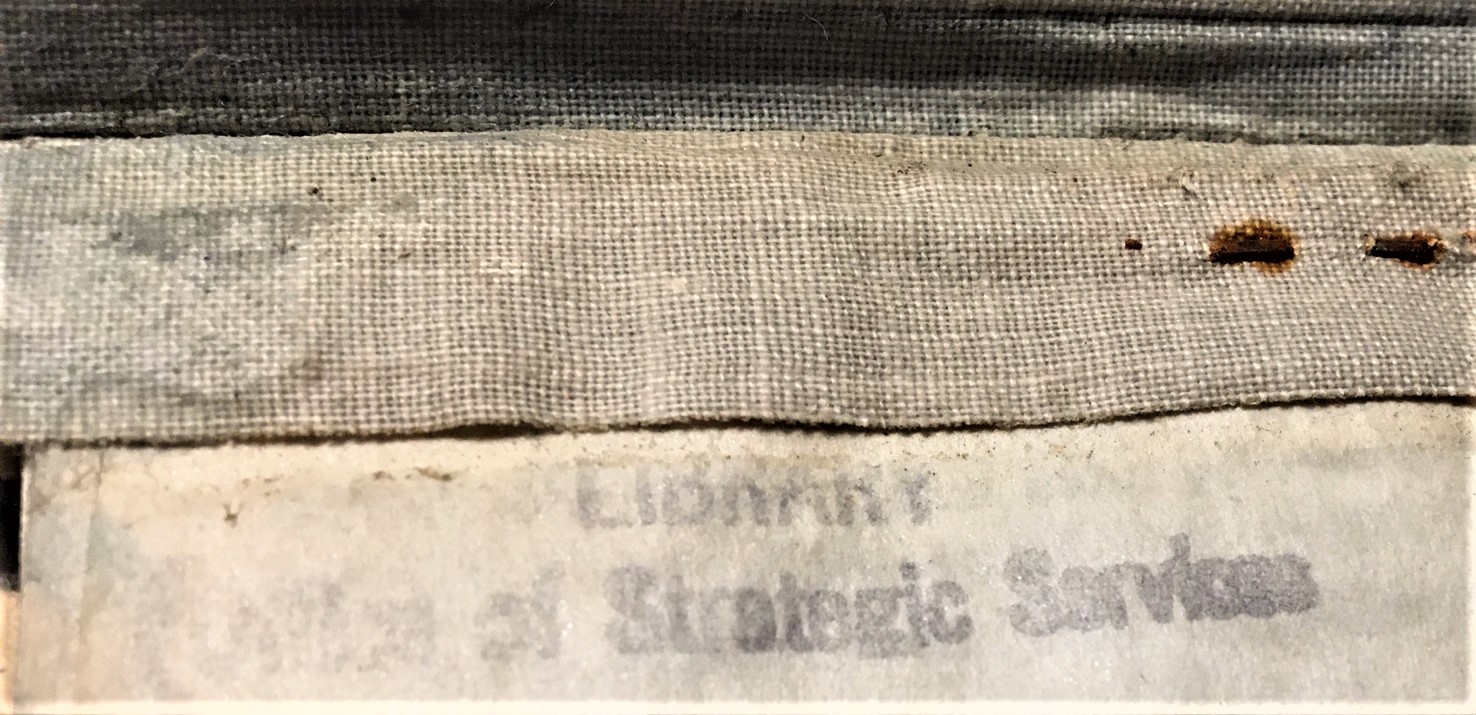
    Auf zum Kampf is a manifesto of the Austrian Communist Party written during a meeting/party congress in 1944. The copy I am working with, the copy with so much presence, is (I expect) a much-reduced photographic copy of the original that was made for the U.S. Office of Strategic Services, the OSS, the organization that morphed into the CIA.  It is 5″x 4″ and 23 pages long. It is staple bound in homemade cardboard for use in the OSS library. (It even has a borrower’s card in the rear pocket with three names, none of whom I could identify.)  The images were printed on a very thin photographic paper, and have a very exaggerated “papery” sound to them, even with the slightest touch…they have the feel of a thin vellum. It really does feel like an unusual document. 

    IMG_1969

    ·Posted by :

    ·in:


  • Interesting Photo of a Communist Demonstration, NYC, 1936

    JF Ptak Science Books  Quick Post

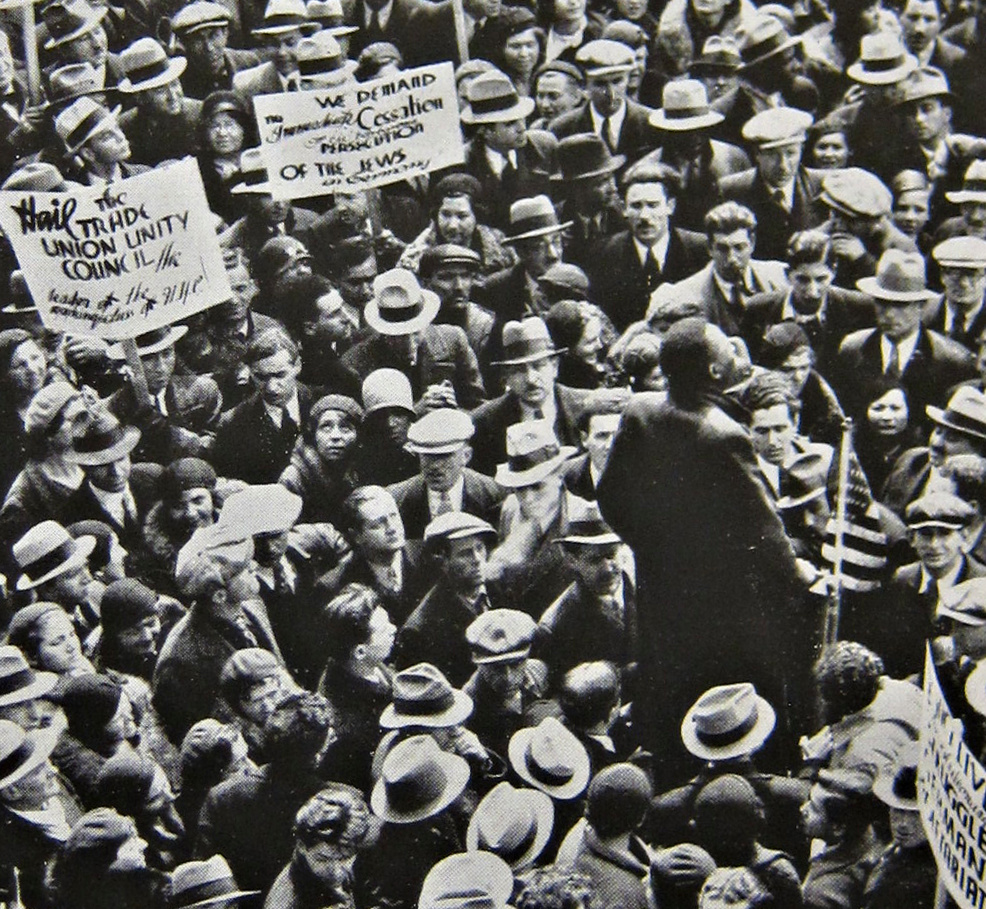
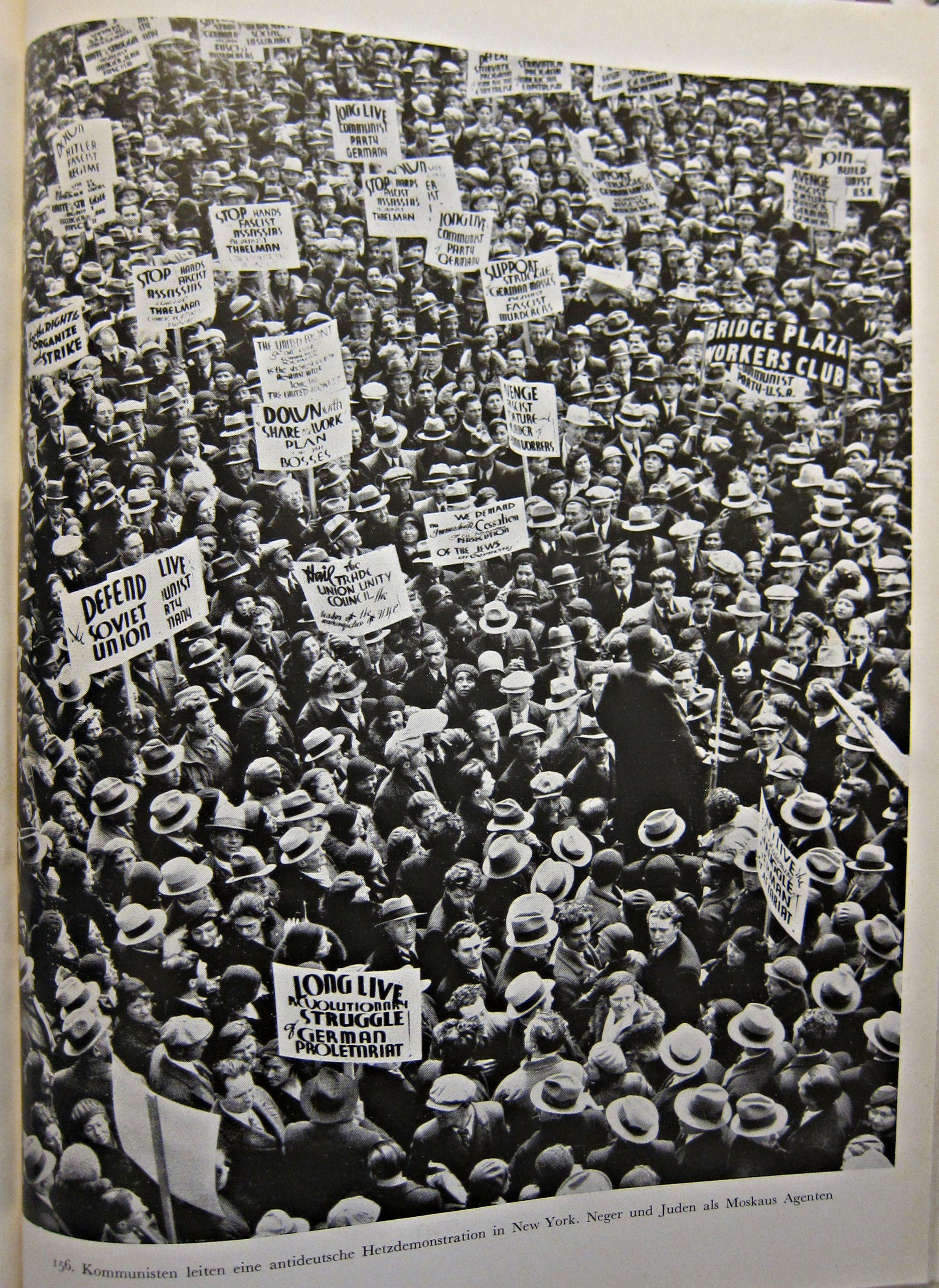
    This evocative crowd scene appears in a piece of Nazi propaganda in 1936 and supposedly (and likely) depicts a Communist demonstration in New York City.  The Nazis of course hated the Communists and much else, and the work in which this appears–Die Weltbolshewismus–is particularly grisly and nasty, illustrated with 100+ photo images as impacting as this one.  Of interest to me were the placards, one of which calls for the “immediate cessation of persecution of the Jews in Germany”, which in 1936 is not a common expression or realization. The speaker here also appears to be Black, addressing a sea of white faces. (No doubt that this was the point of the non sequitur sentence fragment in the legend identifying “Negroes and Jews” as agents of Moscow.)

    Commie 1936

    And a detail:


    Commie 1936 detail


    ·Posted by :

    ·in:

    —

  • Von Braun’s Insulting Use of the Word “Holocaust” (1950)

    JF Ptak Science Books  Post 2900

    There’s a very subdued and whitewashed biography of Wernher von Braun sleeping in a few pages of the Journal of the British Interplanetary Society1, published in March 1950, when war wounds were still wounds, and the dead still of course dead.

    Probably one of the worst examples here of gliding through history is the mention that “some 4,450 men and women were employed at Peenemunde…”. It is unclear who the author is referring to, or if he is at all making reference to the more than 20,000 concentration camp inmates and others who were slave labor and forced to work on the rocket projects, living an dying in abject squalor. It has been established that von Braun knew of the conditions and knew of these workers, but later after capture he insisted that he did not know of the KL or of the Holocaust. It is bitterly bad that a quote from him is used in this biographical minute that actually employs the word “holocaust”, though he uses it referring to the combat between two opposed forces with the same “star-inspired ideas”, and not to The Holocaust. It is also a matter of record that well into life that the conservative right-wing German nationalist von Braun had nothing to say about the Holocaust, and would not add anything to what he already hadn’t said much about. He was at least comfortable with the Nazis if not a Nazi himself, and was comfortable with the deals he made with Hitler, even in spite of being arrested by the Gestpo late in the war.

    By choosing to not address the Holocaust, and by using the term “holocaust” to describe diametrically opposed political struggles between scientific communities is a gross violation of decency. That blatantly chooses to lessen the impact of the meaning of “Holocaust” to use in a relatively trivial way is obscene. And yet, there it is.

    In any event I’ve included the two-page bio, bellow.

    Also in this issue of the journal there is a great review of a German film on rocket development and the history of rocketry that spreads out over 8pp and which was evidently released sometime during WWII. The film is reviewed by members of the Society, and the comments on it are incisive and useful. It would be great to see the film, though to know that it exists is a step forward. Of a side interest to interplanetary flight is a short reference to “Spaceship I” (pictured below)–it is all very intriguing, though outside of two images of models for the proposed dirigible-like behemoth almost no other information is presented.

    Notes:

    1. London, 1950. (von Braun, Wernher) “A Biography.” In: Journal of the British Interplanetary Society, March, vol 2 #9, pp 57-8 in the issue of pp 49-92.

    ·Posted by :

    ·in:


  • Silhouettes of Soon-to-be-Ghosts: Representation of the Vichy Fleet, November 1942

    JF Ptak Science Books  Quick Post

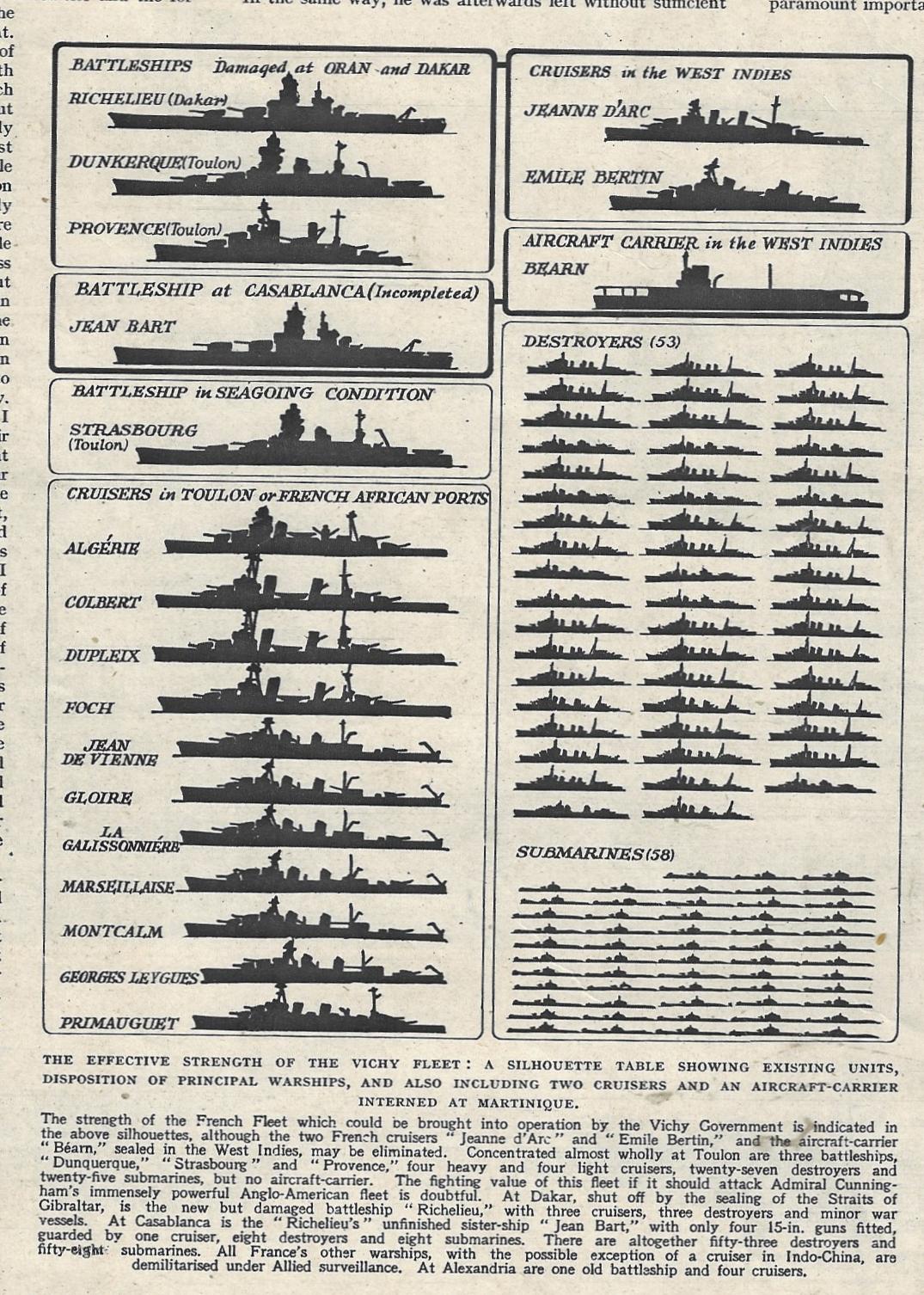
    The resistance of France to Nazi domination and rule and to the French collaborationists in Vichy began with the fall of France. Following the 10 May-21 June 1940 Battle of France, and the 22 June 1940 Armistice which effectively gave Marshal Petain control of the southern regions of France (the Nazis keeping all of northern and western France that bordered the Channel and the Atlantic) the battle for retaking France began. One of the large moments in this struggle came on 27 November 1942 when much of the remaining French/Vichy fleet was scuttled at  Toulon (east of Marseilles).  Rather than have the navy be taken by the Germans, 77 vessels were destroyed at anchor. 

    This graphic is found in the Illustrated London News for 14 November 1942 and depicts the Vichy fleet just two weeks before the scuttling action. The great majority of what is depicted here in silhouette (excepting those shown to not be at Toulon) were destroyed–silhouettes against their immediate future, the shadows of a ghost fleet. 

    ILN 1942 Vichy fleeet


  • On the Vocabulary of the Holocaust in 1939

    JF Ptak Science Books  Post 2896

    IMG_2107

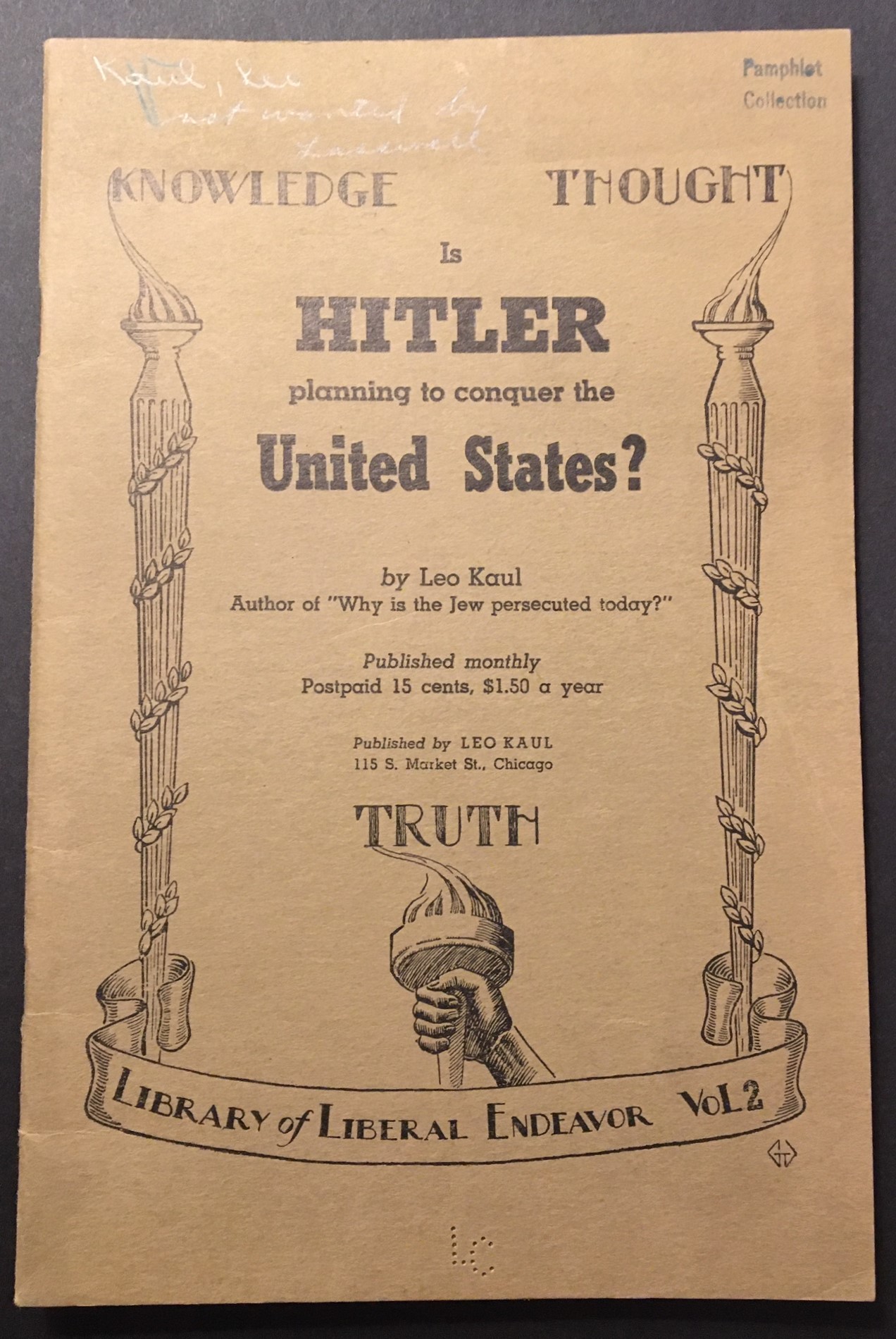
    I recently uncovered a scarce and unusual pamphlet printed in 1939 in Chicago that addressed Hitler’s threat to Europe, his designs on action in the United States, and his general threat to the world. The pamphlet under discussion here is Leo Kaul’s Is Hitler Planning to Conquer the United States?, which was published by the author in Chicago in 1939 as part of a planned monthly series of pamphlets called the “Library of Liberal Endeavor”.  This was volume two, following Why is the Jew Persecuted Today as volume one; there was a third volume planned called Hitler and Father Coughlin though it seems never to have been published. I think that Mr. Kaul–who was writing as early as 1912 and as late as 1950 and who had a business in Chicago manufacturing small bottles and porcelains–self-published these tracts hoping to establish a journal or monthly, though it appears that the existing works didn’t reach a wide audience and barely survive in libraries. 

    One part of this pamphlet that I’d like to mention here is a three-page discussion on “concentration camps” which I think is remarkable not for “exposing” them but for recording the remarks that (in 1938/9) “there have been many books written about life in concentration camps, about the liquidation of the Jewish people, and about the persecution of everyone not in sympathy with Hitler.” The German concentration camp system began with Dachau in 1933 and expanded to over 1000 (including the main and sub-camps) before the end in 1945 (this is exclusive of ghettos and other controlled environments), and there was certainly a good-sized literature on the camps–I am less certain though about the phrase “liquidation of the Jewish people” which does seem jarring to me for 1939.

    Most of the discussion of the concentration camps in this pamphlet are quotes from a work by Martha Dodd and William Dodd jr., Through Embassy Eyes, which was published in 1938.  I don’t have a copy of this though from what I could find this work is based on the collected experiences of the Dodd family, with William Dodd (sr.) being the U.S. ambassador to Germany from 1933-1937, and Martha and William being the children, each named for their parents. The daughter Marsha was later accused of being a Soviet spy, while the son William was destroyed by the Dies Commission and in spite of his accomplished past and connections was a sales clerk at a department store in San Francisco when he died in 1952. 

    I’ve reproduced the pages on the KL below:

    ·Posted by :

    ·in:

    —

  • A Too-Early Vision of the Post-WWII World (November 1939)

    JF Ptak  Science Books  Post 2890 
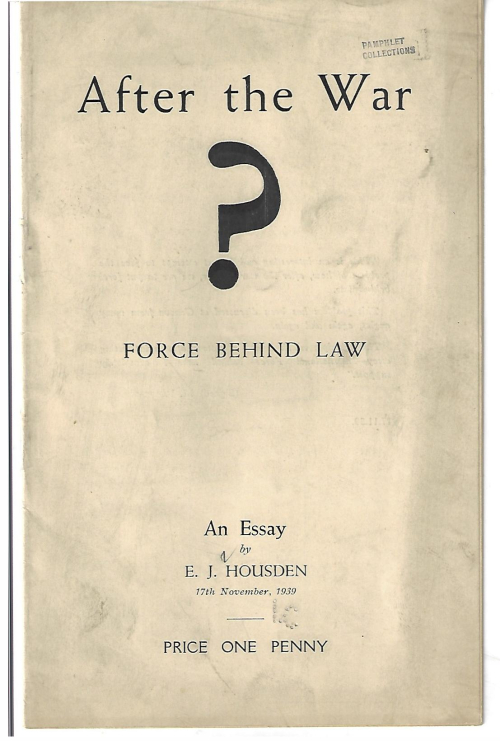
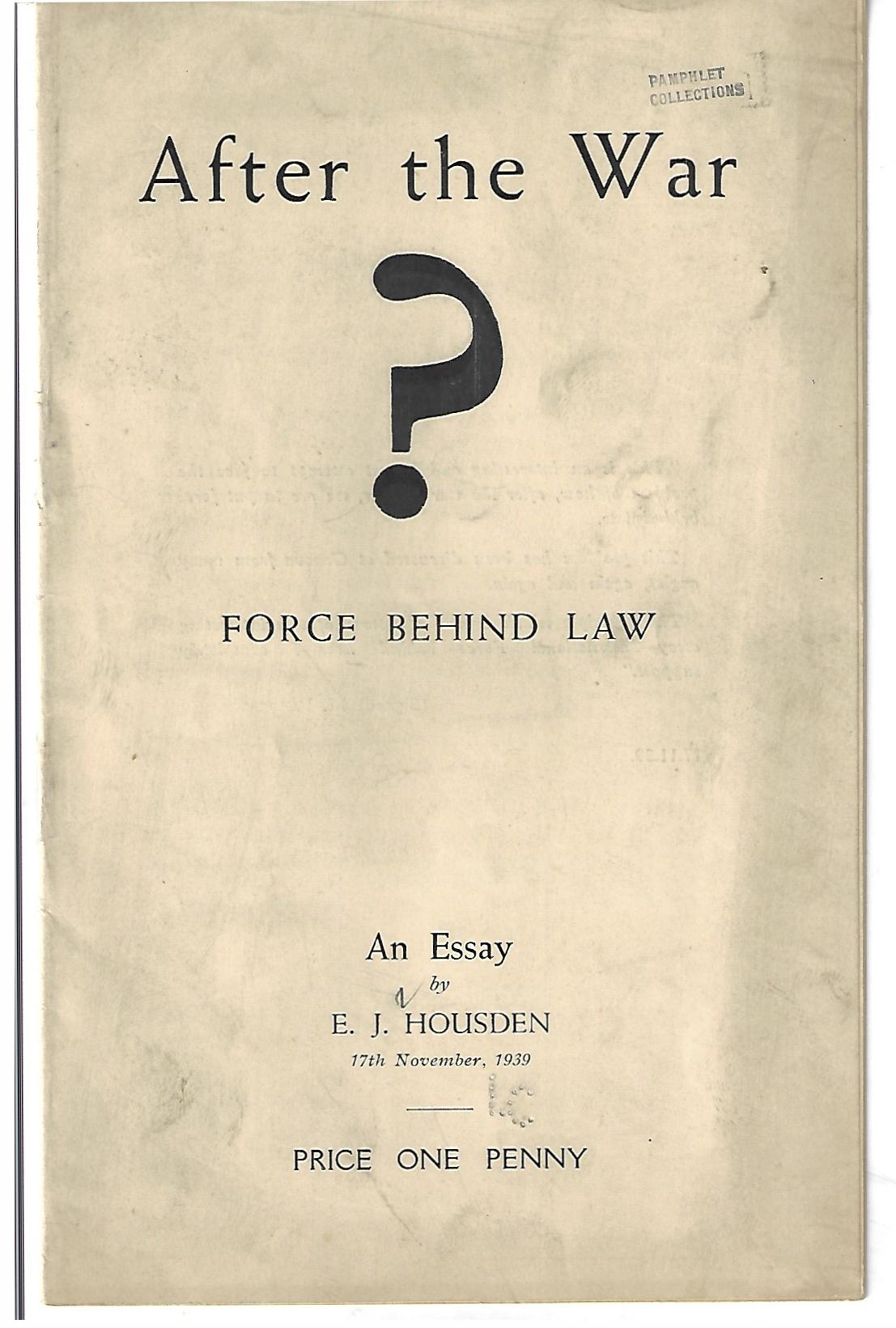
    1939 WarThis is an unusual work to my experience as the author was looking at the post-WWII scenario for the globe at such an early time in the war–November 1939–that the war as written here was known as the “1939 war”, a pre-“World War Two/II/etc designation.  World War I wasn’t really known as such until there was a World War II to differentiate it, and lo! they both came into existence at about the same time, in September, 1939. This publication is dated November 1939, though perhaps it was set into type too late in September to accommodate the new terminology. In any event, I thought it was worth making a note about.

    I don’t know much about E.J. Housden except that he may have published material in the nineteen-aughts, and that one of his pamphlets (Democracy is Fake) turns up in a census of George Orwell’s pamphlet collection. He writes about one world government, a New League of Nations, a universal army, the rollback of sovereignty, one-language, and that sort.  It was a pretty long vision for the end of the war, since there were still about 1,780 days of fighting yet to come, and that the USA, USSR, and Japan were not in it all of the way, yet.  Still. the effort is commendable, and someone needed to do thinking like this at least to establish some sort of dialog about the future.  

    While we’re at it, here’s a bit from the Oxford English Dictionary regarding the first appearances of  “World War” terminology:

    “World War I  n. (also World War One, World War No.1) = First World War n. at first adj., adv., and n.2 Special uses 2b. Abbreviated WWI.

    1939   Time 18 Sept. 10/2   Exports of arms, munitions and related materials in World War I amounted..to only 25% of total exports to the Allies.

    1947   Time & Tide 29 Nov. 1269/2   The despair and cynicism that followed what it has now become fashionable to call World War One.

    First World War  n. the war which began on 28 July 1914 with hostilities between Austria-Hungary and Serbia, and ultimately involved the majority of the nations of the world, suspended by armistice on 11 Nov. 1918.Earlier called the Great War.

    1889   R. B. Anderson tr. V. Rydberg Teutonic Mythol. 399   The giant-maids..took part in the first world-war on the side hostile to Odin.

    1914   E. Haeckel in Indianapolis Star 27 Sept. 37/1   There is no doubt that the course and character of the feared ‘European war’..will become the first world war in the full sense of the word.]

    World War II  n. (also World War Two; occasionally World War No. 2, World War Deuce) = Second World War n.

    1919   Manch. Guardian 18 Feb. 10/1 (heading)    World War No. 2.

    1939   Time 11 Sept. 38/1   Some of the diplomatic juggling which last week ended in World War II was old-fashioned international jockeying for power.

    Second World War  n. the war which began with the German invasion of Poland on 1 Sept. 1939 and ultimately involved the majority of the nations of the world; hostilities ceased in Europe on 7 May 1945 and in the Far East on 12 Sept. 1945. [1930   H. G. Wells Autocracy Mr. Parham 257 (heading)    Book the Fourth: The Second World War.]

    1942   Polit. Sci. Q. Sept. 321   The economic developments associated with the second World War have restored to American railroads a volume of traffic comparable to that which they handled before the great depression.

    World War III  n. (also World War Three, World War No. 3) = Third World War n. at third adj.and n. Special uses 2.

    1945   Duke of Bedford Let. 16 Apr. in B. Russell Autobiogr. (1969) III. i. 44   You will have to postpone your visit until the brief interlude between this war & world-war no 3.”
     

    ·Posted by :

    ·in:

    —

  • A Glimpse of a Small Part of the Big Lie, Soviet Style (June 1945)

    JF Ptak Science Books   Post 2884

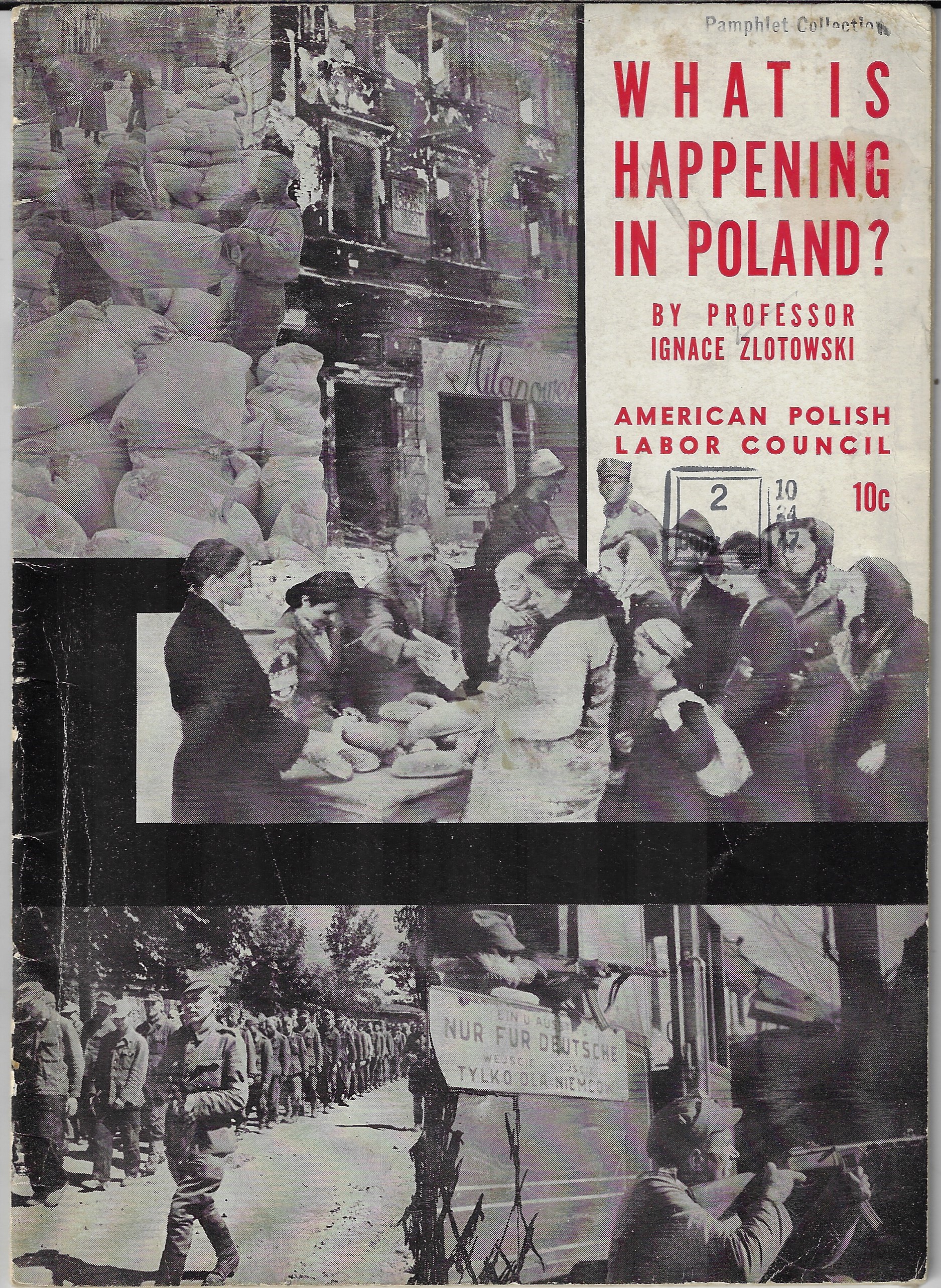
    Poland 1945 cvrThere’s nothing quite like a series of lies that is a vast series of lines, lies all the way up and mostly all the way down, lies that are built into Borgesian extravagancies with a sweetener here and there of a little bit of truth. That is pretty much what we have here in the pro-Stalinist/Soviet pamphlet, What is Happening in Poland, with an imprint of June, 1945.

    There’s a lot of difficulty in this work’s 29 pages, all of which are ultimately directed against the still-extant Polish government in exile (in London) insisting that those are the anti-democratic and anti-Soviet forces at work in Poland. The write, a physicist named Ignace Zlotowski is the author, and he makes an abundant case for the London government setting out to destabilize (and de-Stalinize) the “New Poland”.

    The rhetoric is really quite remarkable.

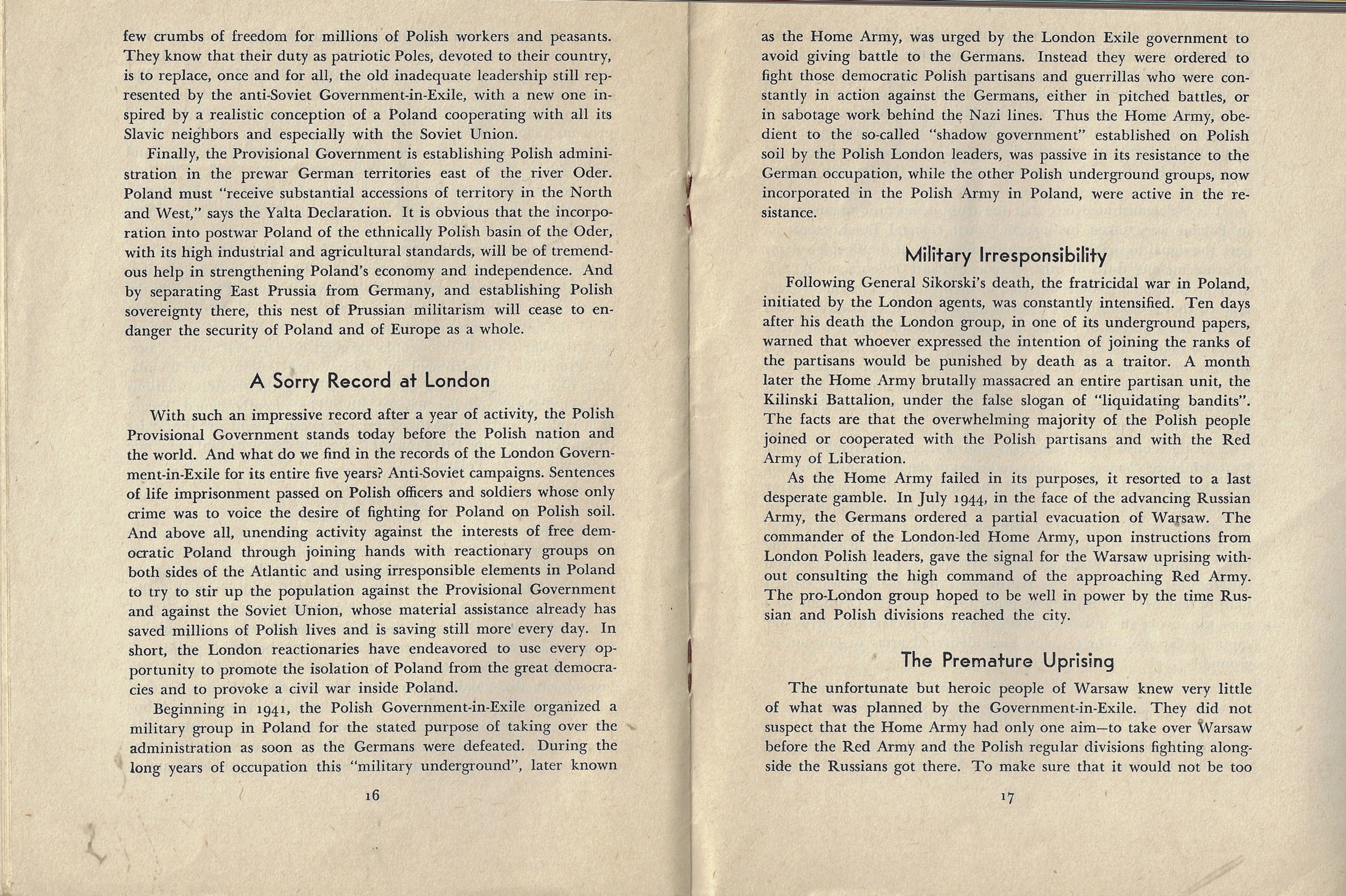
    For example, Zlotowski makes the case for the catastrophic defeat of the Polish underground in the Warsaw Uprising (1 August—2 October 1944) directly on the Polish exile leadership. Even though far away in London the government did exert considerable influence in Poland, and did organize and begin the uprising. The rest of the story and the failure of the uprising against the Nazis can be placed in squarely in the lap of the Soviets, who—even though at the gates of the city, advancing West—did nothing in this fight against the German army. The Soviet forces sat just across the Vistula, ignoring pleas from Churchill and Roosevelt to help the Poles, and waited the tragedy out, until the Germans destroyed the uprising in bitter house-by-house fighting, ultimately destroying nearly the entire city, killing some 200,000 people (mostly civilian, and mostly murdered). The Wehrmacht pushed through the city from October to January, hunting people, destroying the city almost completely. It was a strategic move by Stalin, deciding to let two enemies fight it out, allowing the Nazis to destroy elements of the population that the Soviets found to be problematic for the administration of the country once they decided to push through Poland on their way west.

    This was standard procedure for the Soviets—for example, there was the Katyn massacre, where 22,000 Polish military officers, police, and intelligentsia were executed in various parts of the Katyn forest. The Great Terror, the Great Famine, the Show Trials, the Holodomor, the Pogroms, and on and on. This was what the Polish government in exile was fighting against, and this is what they would lose to.

    This pamphlet displays just a little of that Stalinist thinking, and it is enough to understand what those people were up to.

    I’ve included (below) some of the text related to the Warsaw Uprising and the Trial of the Sixteen–we don’t have the results of the trial though they are pre-ordained, as is the fate of the fabled and heroic General Okulicki, who would be found guilty and then murdered by the NKVD in 1946. 

    Poland 1945 _5_


    ·Posted by :

    ·in:

    —

  • A Little Sturm und Drang in a Piece of U-Boote 977 Ephemera (1945)

    JF Ptak Science Books  Post 2882

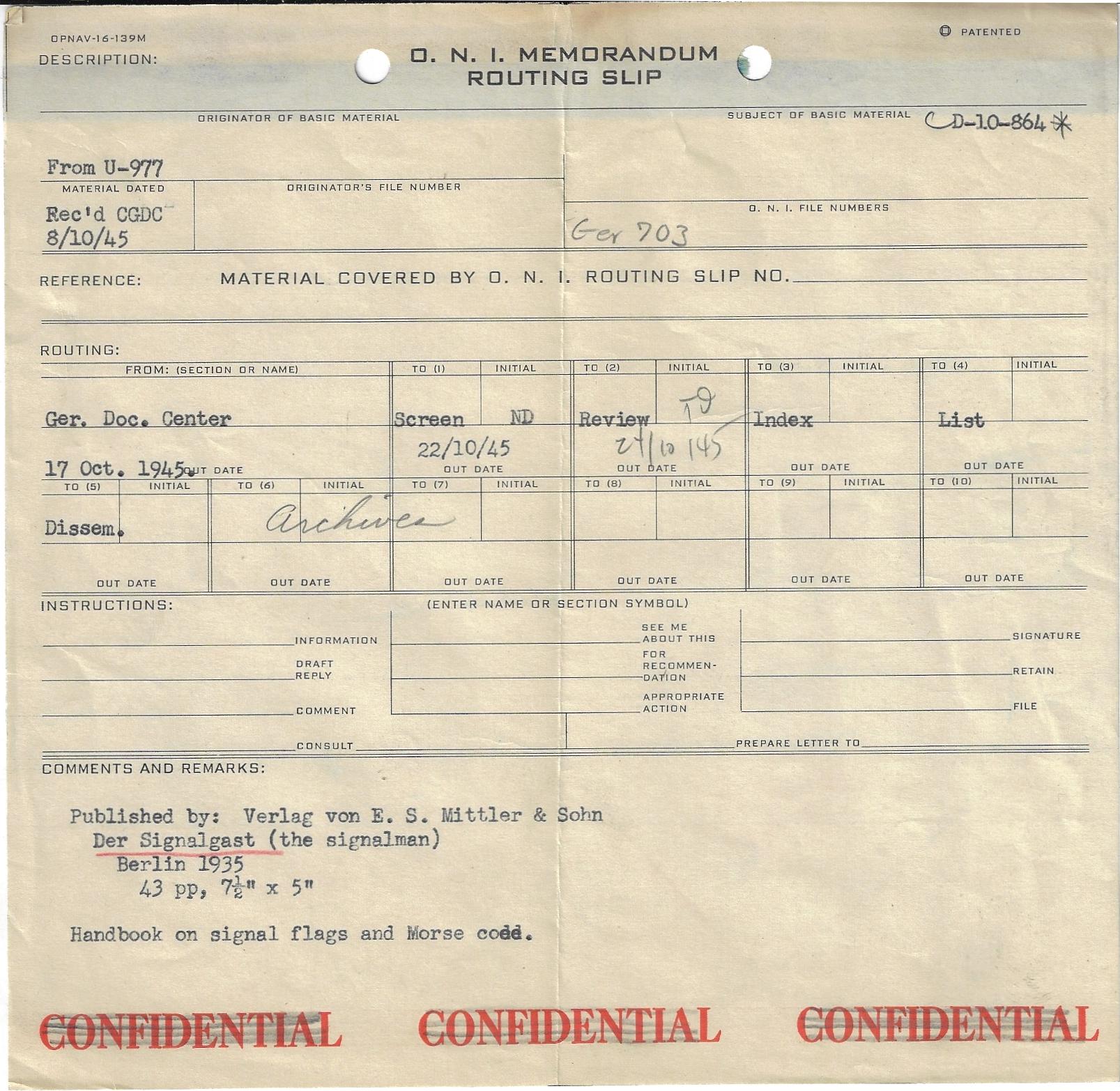
    Here’s a short tale of surprise and of some disappointment. First, the pamphlet pictured here is a standard work (Der Signalgast, Handbuch fuer Signalkunde, fifth edition, 1935) on naval communications using Morse code and flags. It seems to have been standard issue in Germany through the early 1930’s through WWII. It must’ve been quite popular because there are a number of these for sale around the web in the $10-$50 range, more towards the ten dollar range than not.

    U 977 signal US receipt_0001This copy is different because it has the Office of Naval Intelligence paperwork of having been removed and secured from the German submarine U-977, captured/surrendered at the port of Mar del Plata, in Argentina, 17 August 1945. U-977 has a provocative history after the war, making a 108-day voyage from Norway to Argentina in the supposed hopes of being able to surrender in peace. There are a number of rumor/tales/conspiracy theories offering other explanations for this long and time-consuming voyage, including transporting Hitler or his remains to Argentina, or carrying stuff of great value, or transporting leading Nazi figures, or some such. There are many stories about the U-977 voyage spread around the web—including one of legend that the boat traveled for 66 consecutive days submerged–though for my reading (and I know very little about these matters) the boat’s last captain, Heniz Schaeffer, who wrote a book about the adventure and which was published in 1952 had nothing to say about a number of the high-flying (sorry) tales of intrigue.

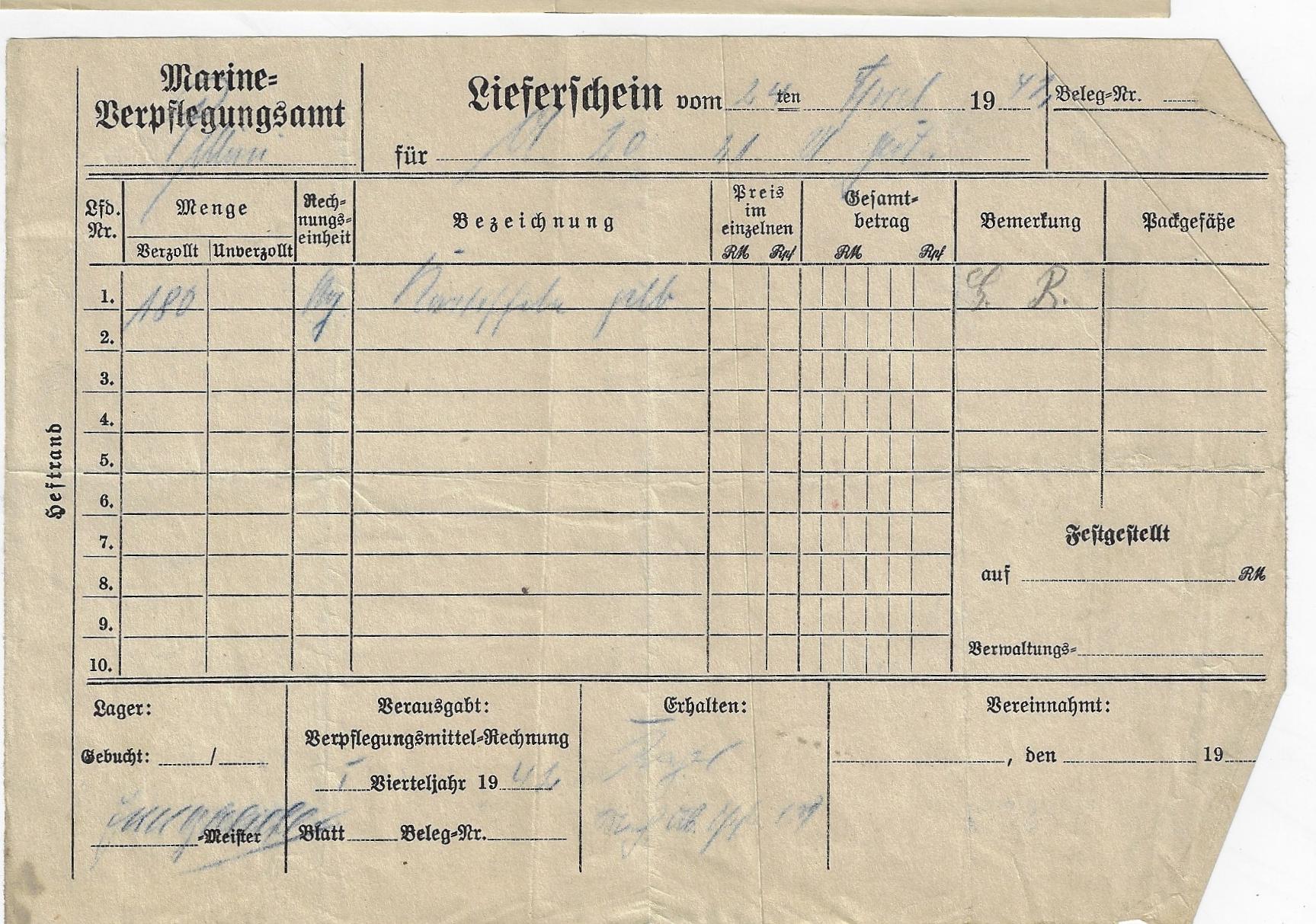
    U 977 signal receipt_0002It is interesting to me though that the pamphlet was on the submarine, and seems to have been pretty heavily used, which gives all of it together a secondary ephemeral life. The ONI paperwork is pretty straight forward; there was some secondary paperwork that was more mysterious to me, and was not readily readable as it is in Fraktur, which is hardly an alphabet basking in obviousness. Anyway once the script was punched through, all this attractive printed note was was an invoice for some sort of food loaded onto the sub on 24 April 1942. “Delivery note” is the heading from the Marine-Verpflegungsamt (Marine Catering Office), with someone signing off on having received some amount of unsalted something-or-other in the first quarter of 1942.

    It was a little deflating as I built the thing up in my head a little, not being able to read the script offhand. Anyway, there it is.

    The pamphlet does have one more mysterious piece to it—there are some notations on the title page made in German script (which is basically undecipherable to me), and I don’t know yet if it is just a few words or (hopefully) the owner’s name. I’ll have to get back to you on that. For the time being, enjoyment will have to be found in the fact that this book spent two years on a German sub, then made an enormous journey across the Atlantic at the end of the war, then made its way to Washington DC (where I bought it), and now is temporarily in western North Carolina. It has one more trip to make after the title page annotations get figured out, and that may be the last trip that the pamphlet makes.

    As it turns out the date on the food invoice predates by a couple of months the date on which the U-977 was laid down, so there’s that.

    Finally, the U-977 was escorted north to New London, Connecticut, and then used for target practice and sunk off Cape Cod on 13 November 1946. The U-977 never lost a man and never sank a ship.


    Some references:

    http://www.uboatarchive.net/U-977A/U-977INT.htm

    http://www.uboatarchive.net/U-977A/U-977Photos.htm

    “The U-977, one of the most interesting Kriegsmarine ships in history…” https://www.mhistory.net/the-last-mission-of-u-977-cruise-across-the-atlantic-and-hitlers-alleged-evacuation/

    ·Posted by :

    ·in:


  • Albert Messiah in Berchtesgaden (1945)

    JF Ptak Science Books   Post 2881

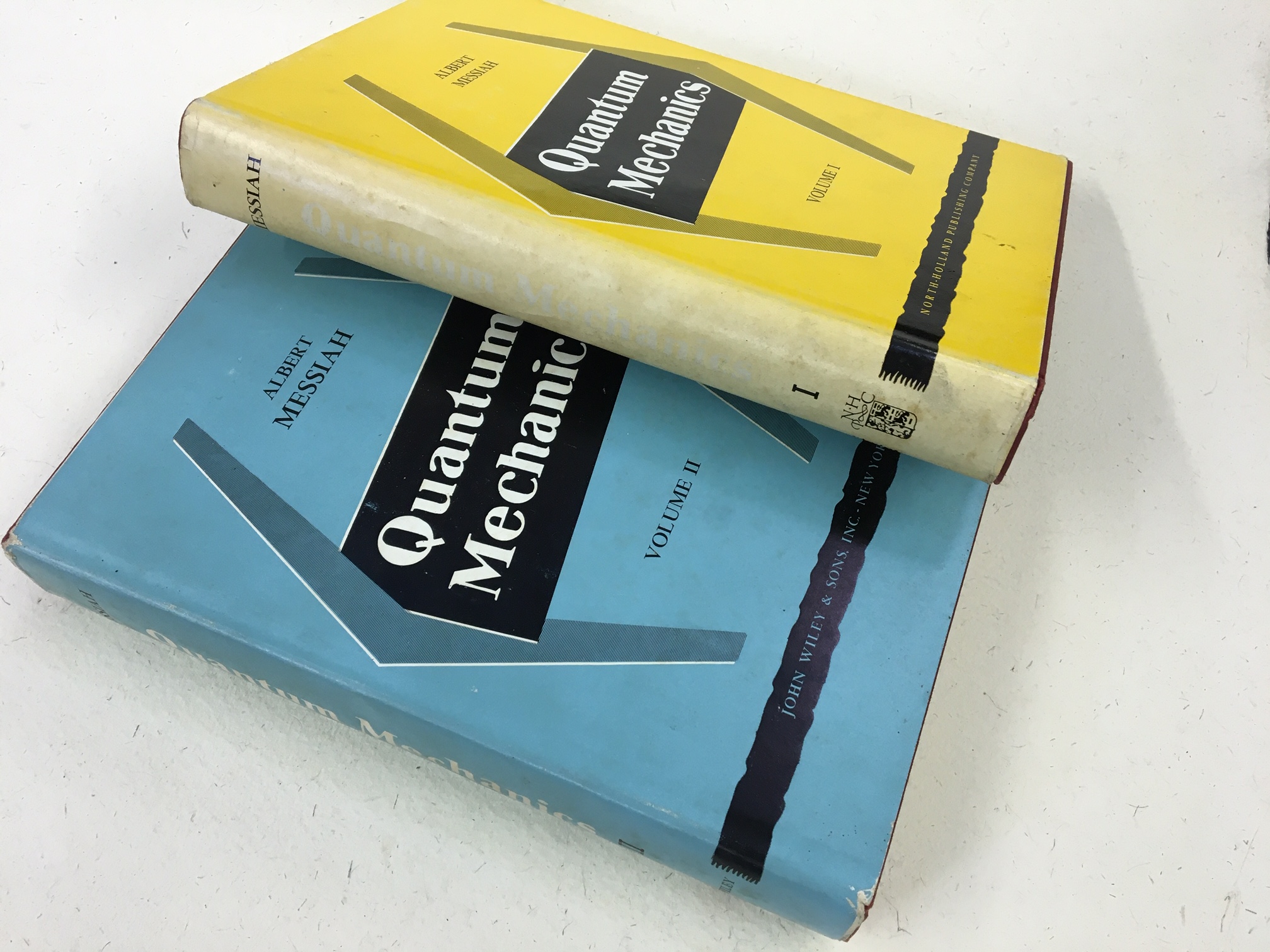
    I recently unboxed (after a long and deep in-box slumber) the classic two-volume work Quantum Mechanics by Albert Messiah. It was published in French in 1959 and soon found its way into English in 1961 (and 1962), and was a staple in the studies of two generations of physicists.

    I had no idea of Messiah’s background, which is extraordinary. I learned that he was accept to the IAS (Princeton) with only a high school education—this was due to Messiah (1921-2013) having spent his formative years from 1940 to 1945 fighting and killing Nazis. He heard Petain on the radio announcing that the gentlemanly thing to do for much-fallen-France in 1940 was to lay down arms, which to Messiah was the clarion call to resistance. He also refers to Petain as an imbecile. He recalls Petain intoning a vainglorious “…entre soldats et dans l’honneur, il fallait cesser le combat, etc. etc.” , and that he does not recall this “stupidity” being much shared at the time (“…cette stupidité n’était pas tellement partagé à l’époque.”)  This was indeed his path, as he joined the Resistance and fought for five years.

    IMG_1417 (1)

    Here are a few interesting responses to questions put to Messiah at the Ecole Polytechnique in January 2009 regarding his time during WWII:

    On a question of the lack of use of armor in 1940, Messiah says it simply was that French command sucked. (“Tout simplement parce que le commandement militaire français était un peu nul, c’est tout.”) Mediocrity was the ruler by which things were measured, and in general is very well spread. (“La médiocrité est une chose qui finalement est relativement répandue.”)

    The people who won the war, and the reason why the Resistance was successful, were those who could think and stand out from the crowd. (“Parce que l’histoire justement est faite par les gens qui se démarquent de ça, des gens qui réfléchissent et qui éventuellement prennent des risques, c’est ce qui a donné la Résistance d’ailleurs, des gens qui prennent des risques mais qui ne vont pas dans le sens de l’histoire.”)

    At the end of the interview Messiah relates being among the first to occupy Hitler’s residence/seat of government in Berchtesgaden in May, 1945. He found it very amusing and ironic that Hitler’s place would in the end by occupied by a Jew. (“…le malheureux Hitler a eu la malchance de voir son repaire occupé par un Juif.”) 

    And a Jew named “Messiah” at that.

    ·Posted by :

    ·in:

    —

  • A Sympathetic Pamphlet on the Plight of U.S. Japanese, 1944.

    JF Ptak Science Books   Post 2880

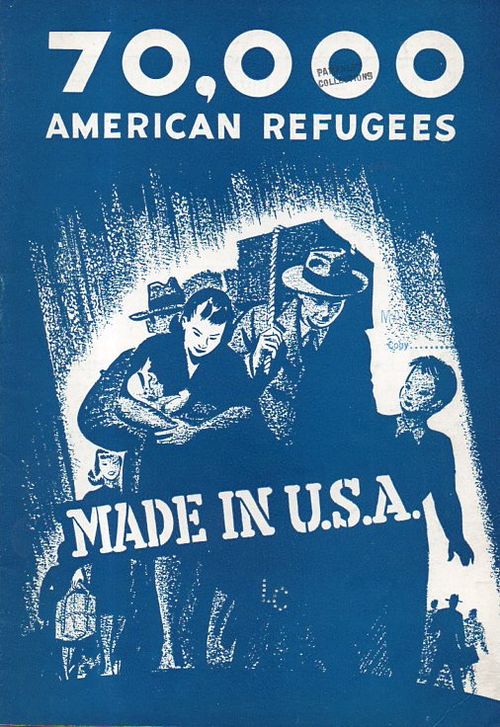
    70 000 JapaneseThis pamphlet, 70,000 American Refugees, Made in U.S.A., by Truman  B. Douglass1, was a sympathetic appeal to the deeply grave situation legislated to 140,000 Americans. They were Americans of Japanese descent, many of them U.S. citizens, who by Executive Order 9066  were ordered to stand down from their lives for the sake of national security and be removed to distant and remote internment/concentration camps  in May 1942, mostly for the duration of the war.  There weren’t that many appeals for the primacy of the rights of these people at this time–the war for the United States was newly begun via the Japanese attack on Pearl Harbor five months earlier–and the understanding was to protect the security of the country via the segregation and housing of what were seen to be the potential enemies in the existing Japanese-American population living on the U.S. west coast.

     Franklin Roosevelt’s  February 1942 Executive Order 9066 (issued 19 February 1942) to imprison more than 140,000 Americans (70,000 of whom were U.S. citizens, including children) for the duration of the war was the legal bombshell that gave the War Department the authority to authorize the removal of the Japanese  to theoretically prevent those people from engaging in sub rosa and fifth column activities and wartime terrorists fighting for Imperial Japan.

    Given that this pamphlet was in it third edition just a few months past its first appearance in October 1944 says that there was at least some interest in this political/moral anti-Executive Order 90662 position, though how much of that is from a popular groundswell of support it is not possible to say. (Also “edition” could mean “printing”, and the print run may have only been a few thousand at a time). That said I imagine that the print runs of this pamphlet were rather small given that there are only ten copies of all three editions in the collections of libraries worldwide.  And since there are many collections that should have this pamphlet but don’t–copies are found in California State University Northridge, California State Irvine, Yale, Wisconsin Historical, Cornell, Berkeley, Davis, Huntington, according to WorldCat–and no copies seem to pop into the rare book market very often at all, I suspect that not many copies were printed per edition, which means that there was a repetitive demand for the pamphlet that exhausted small print runs, which means maybe there were 2000 copies printed…not exactly “groundswell” support for what was an unpopular position).  

    The story of the removal and control of the American Japanese population is complex and deep and has been addressed in many places in print and online (and even on this blog several times), and it is not my intent to address that issue in this post.  I want to highlight what must have been a largely high-minority and mostly lonely voice of consideration and caution

    Full text available via the California Digital Library. 

    Notes:
    1.  The printing and publication information for the pamphlet:  “The Citizens Committee for Resettlement, 6501 Wydown Blvd., St. Louis 5, Missouri, 25 cents. May also be ordered separately at cost indicated. Reduced price in quantities. Community Preparation for Resettlement of Japanese Americans, published by The Committee on Resettlement of Japanese Americans, The Federal Council of Churches”.  

    ·Posted by :

    ·in:

    —