A Daily History of Holes, Dots, Lines, Science, History, Math, Physics, Art, the Unintentional Absurd, Architecture, Maps, Data Visualization, Blank and Missing Things, and so on. |1.6 million words, 7500 images, 4.9 million hits| Press & appearances in The Times, Le Figaro, Mensa, The Economist, The Guardian, Discovery News, Slate, Le Monde, Sci American Blogs, Le Pont, and many other places… 5000+ total posts since 2008.

Category: World War II

  • A Report from Warsaw including News of Treblinka, Auschwitz, and Majdanek, 1944 (Reproduced in Full)

    JF Ptak Science Books  Quick Post

    I decided to share the entire Ploish Labour Fights for Freedom, Equality, Independence because it is pretty scarce and its content is very powerful and deserves to be read. It is only 12 pages long but there is a lot in there.  The pamphlet was printed in London by Liberty Publishers in 1944, though I cannot tell if it is before/during/after the Warsaw Uprising. There photo on the front cover (“Graves of Warsaw’s defenders in one of the public squares…”) may reference those killed in the Uprising, so it may well be printed in August at the beginning of the battle, as there is no direct reference to it in the text. By the end of the Uprising there were 10,000 of these defenders who would be killed as well as 200,000 people living in the city. 

    Of particular note here are the four pages devoted to the Nazi/German treatment of children. There are also specific references to the deathcamps/KL Treblinka, Majdanek, and Oswiecim (Auschwitz). 

    (There is an impressive lineage for libraries holding this title as found in WorldCat. Of the 12 copies located worldwide, only three are in the US (NYPL, Harvard, Notre Dame); the others are found in England (University College, LSE, British Library), Israel (Yivo and National Library), France (Bib Nationale, Paris), Poland (Nardowa and Dukat), and the IISG (Amsterdam).)
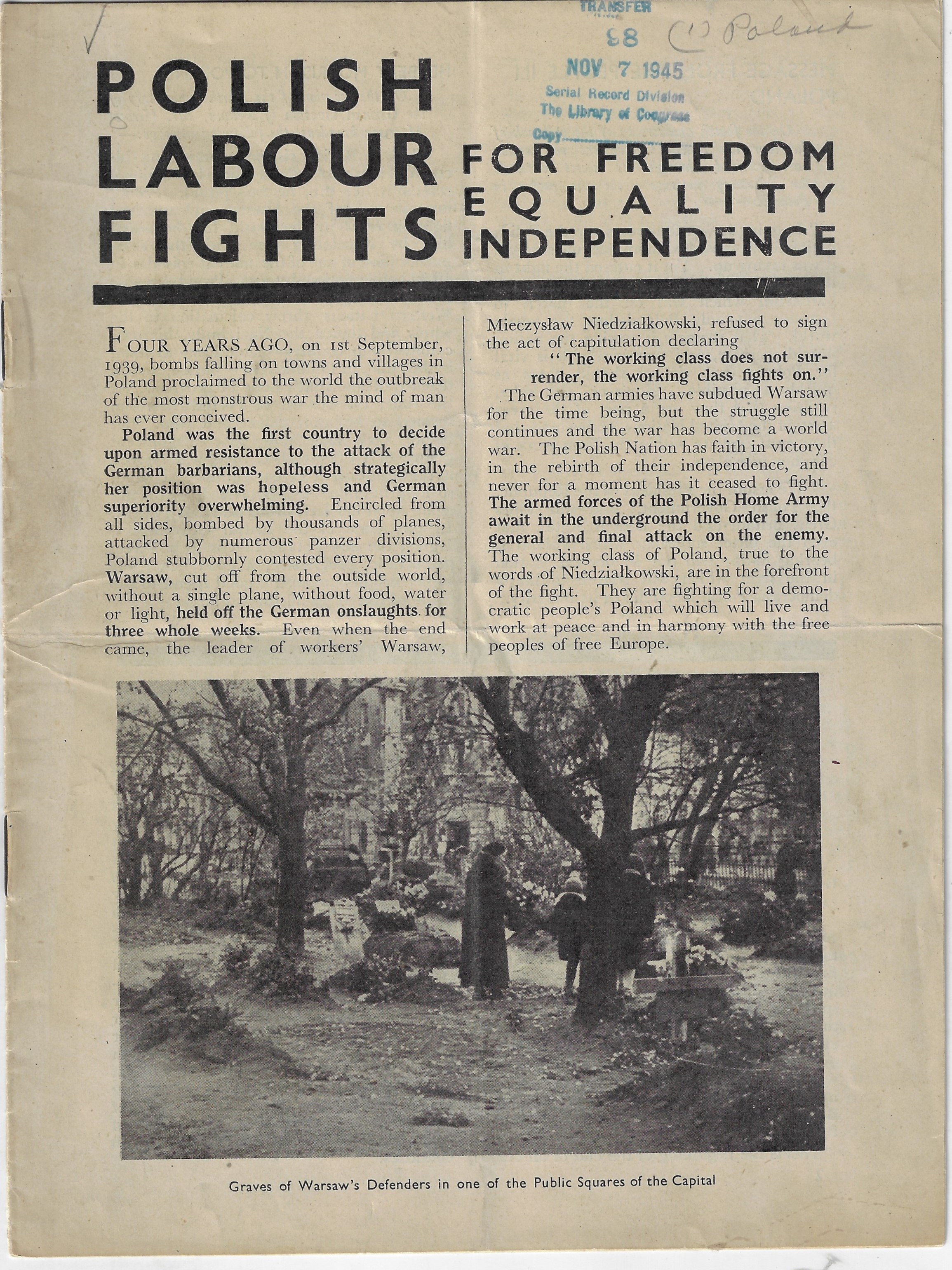
    Polish Labour Fights _1_

    This is an ocr of the original—all bold appeared in the original.

    CHILDREN ARE DYING

    “It is not surprising, therefore, if among the Polish children, who lack food, clothing and warmth in the winter, and who lead the most wretched existence, epidemics…”

    CHILDREN IN PRISONS AND CONCENTRATION CAMPS

    “The Polish children are not even spared the grimmest forms of persecution. They share with the adults the sufferings which the Germans are visiting upon the Polish nation. They crowd the prisons and die at the hands of executioners, together with the adults.”

    “Between 11th and 28th November, 1942, for example, a large number of women, together with 60 children, were brought into the Pawiak prison in Warsaw. Children from 12 years of age and upwards are being sent to the notorious camp at Oswiecim. Children under 12 sent to Oswiecim are not admitted to the barracks. They are killed on the spot.”

    “From the very beginning of the occupation the Germans have made it clear that, even when dealing with children, they will not hesitate to employ the severest measures. Immediately after the September campaign in Poland the Germans murdered, in Bydgoszcz, nearly one hundred Polish boy scouts, who faced the firing squad singing the Polish national anthem. In application of the principle of collective responsibility, when many Poles perished in mass executions for deeds they never committed, children died with their parents, either shot or burned alive.”
     

    ·Posted by :

    ·in:

    —

  • Floating Mines of the Air (1939)

    JF Ptak Science Books   Quick Post

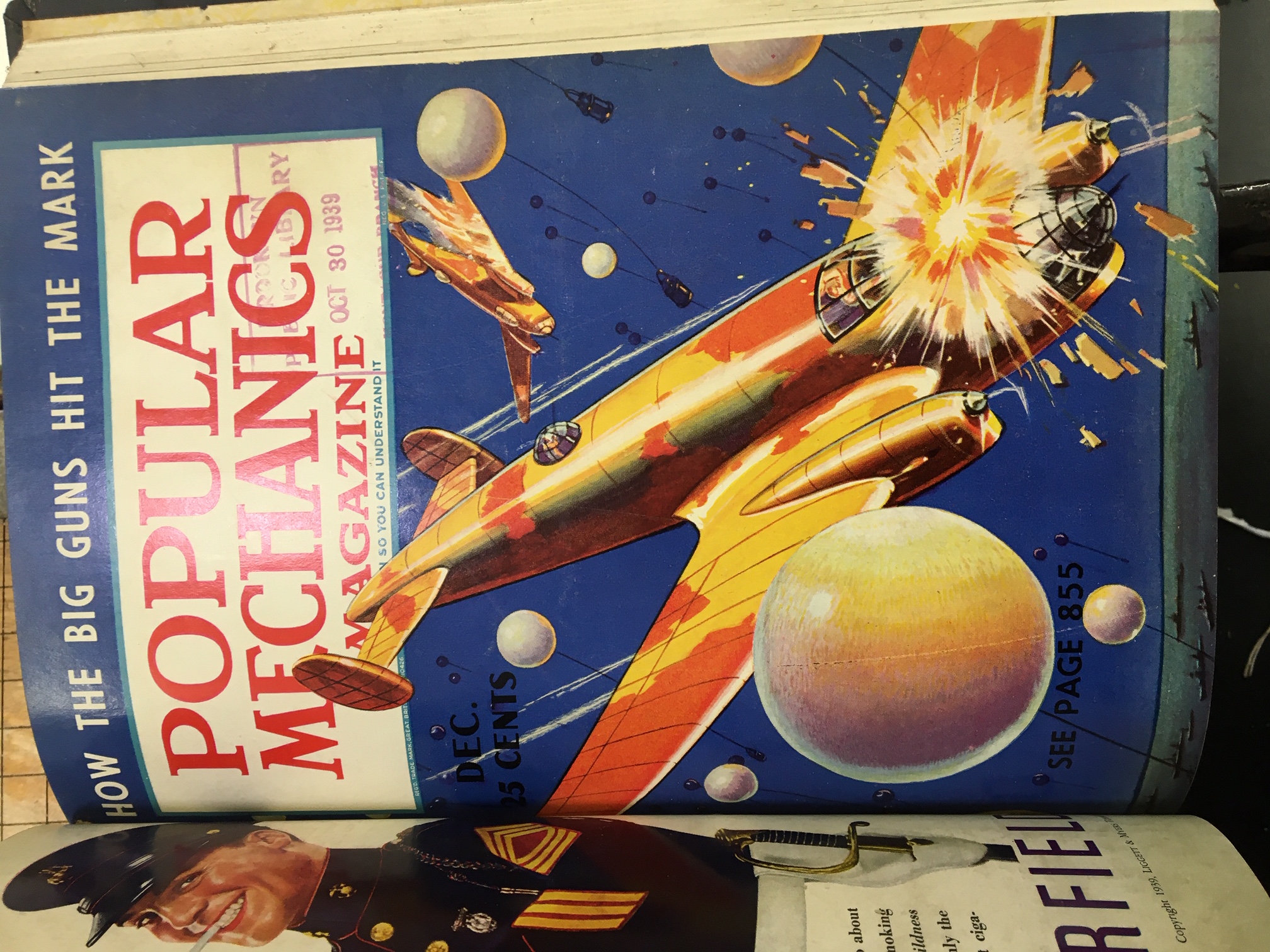
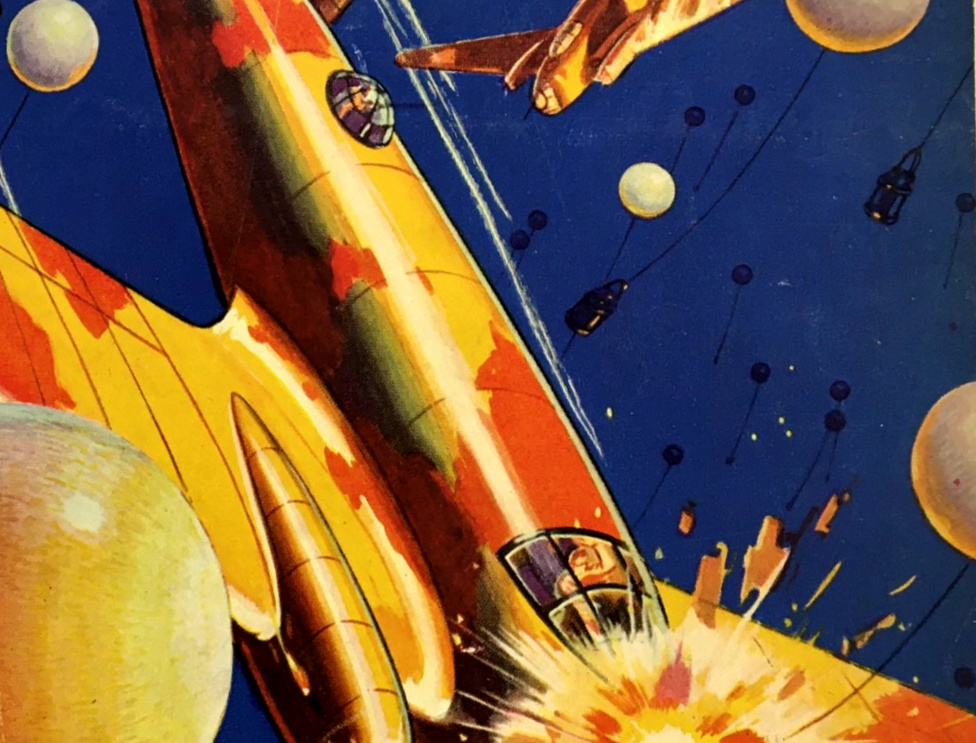
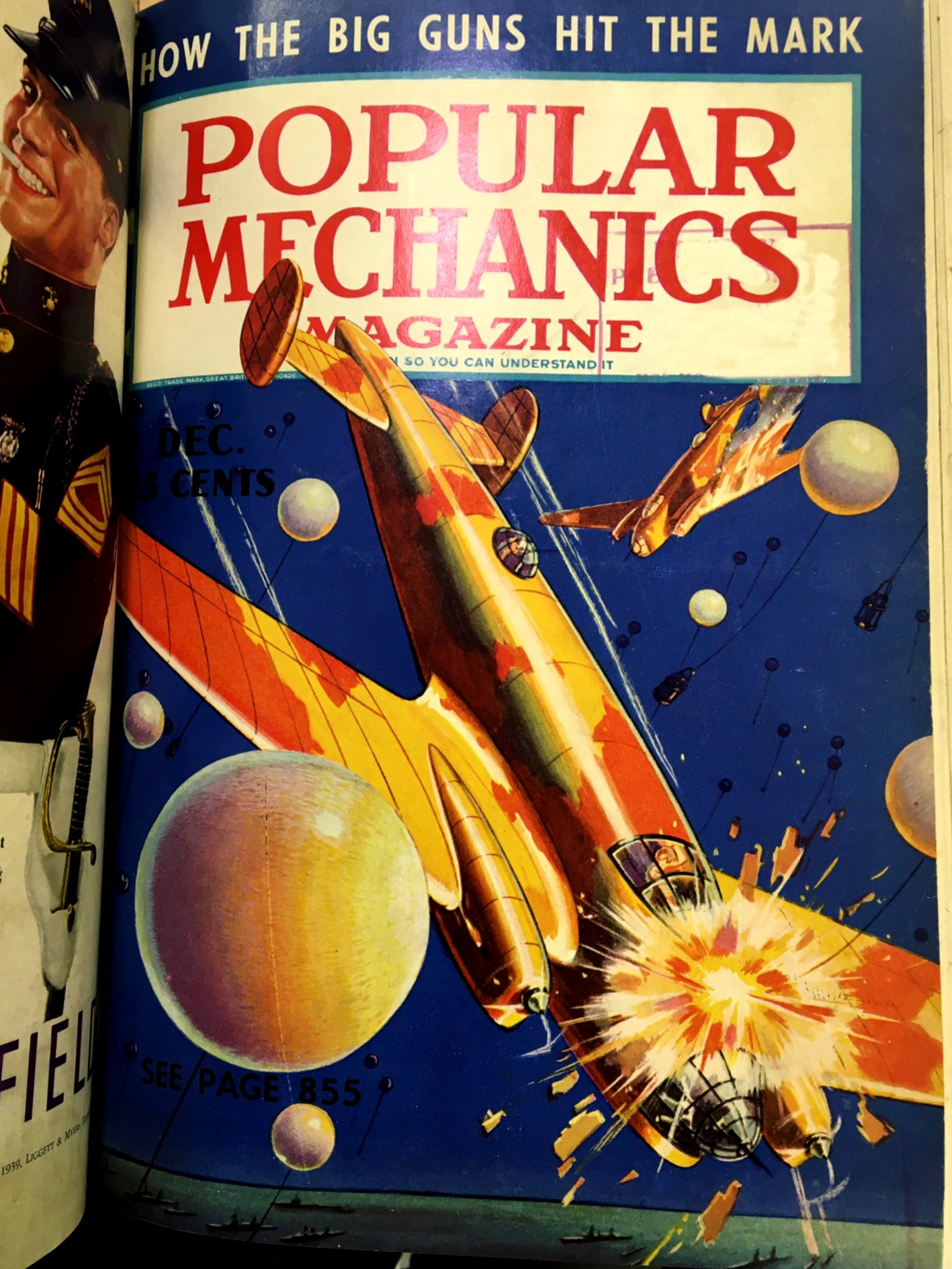
     This thrilling nail-biter from the near future appeared in Popular Mechanics for December 1939.  What we are seeing floated here (sorry/terrible) was a system of relatively primitive helium-filled air mines to guard against enemy attack from the air.  There was no doubt the (fighting) end of the European and British part of WWII there would be a very major role played by aircraft. Bombing had already been introduced on a larger scale with German practice and assistance to Franco in Spain, and of course there was plenty of evidence for air power in the crushing of Poland just a few months earlier beginning 1 September and ending 26 days later–a victory and a defeat that shocked the military world. So much of the world had entered into war in the first two weeks of September 1939, and of course the U.S.  reacted with predictable strong sentiments for isolationism.

    I remember a headline–can’t place where–reading it, years ago, announcing that the Olympic Games for 1940–that were to be held in Soviet-attacked Finland–were cancelled.

    Pop Mech 1939 Air mines color cvr detail

    There was a simple idea behind the aerial minefield–take 5′ diameter balloons, fill them with helium, attach a 40′ line to it on one end with a bomb with 4 lbs of high explosive on the other; send them aloft, and then wait for a plane to hook one of the lines with a wing or tail or something. These were to be sent aloft by the hundreds if not thousands. Maybe this could work, I dunno–but what comes to mind is what happens with the hundreds of balloons that didn’t have something run into it?  They bomb would explode on contact, so at some point, they’re all going to come down… There’d that, plus what if fighter planes came in before the bombers (once the Germans were close enough that is) and simply shot down the balloons? I imagine that they’d be used over rural areas where there could be some absorption of hundreds of falling failing bombs. Anyway, this idea seems a little problematic.    

    Pop Mech 1939 air mines color cvr

    ·Posted by :

    ·in:


  • The USAF “Flying Saucer” Prototype (1954)

    JF Ptak Science Books   Quick Post

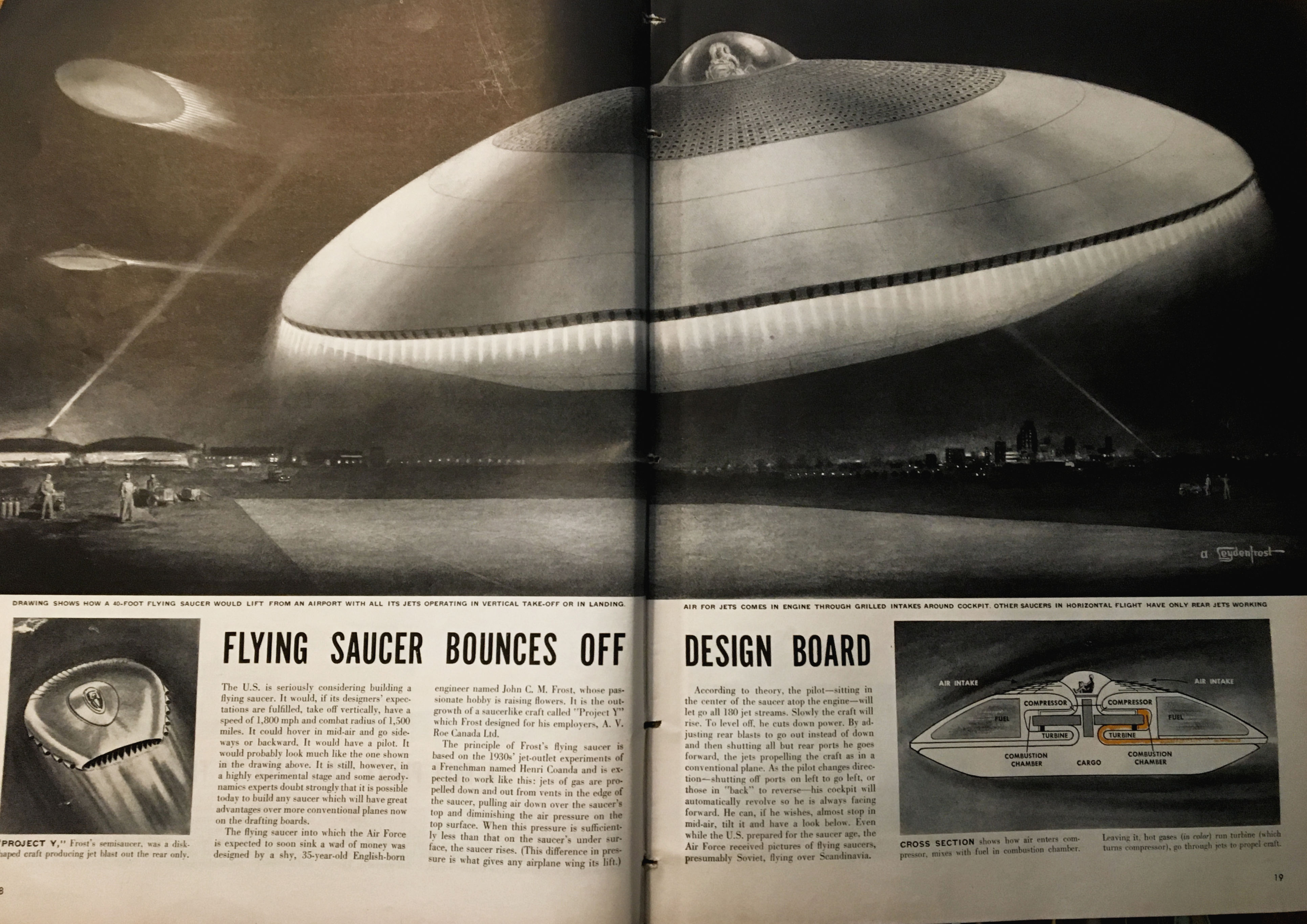
    Appearing as a splashy double-page spread in LIFE magazine for May 31, 1954 is the great “Project Y” USAF flying saucer. It was the continuation of the work carried out by John C.M. Frost (1915-1979) who was a superior engineer who worked for de Haviland and Avro Canada, and who continued his VTOL work with the Air Force under the “Project Y”. This aircraft was to fly 1500-2000 mph and have a 1500 mile range. Of course, this particular aircraft didn’t get very far for Frost, a person with numerous successes, but it did experience some fair amount of attention.

    Life 1954 Flying Saucer

    ·Posted by :

    ·in:

    —

  • Rare Document on Straggling Surrenders of Japanese Forces, September 23, 1945

    JF Ptak Science Books  Quick Post

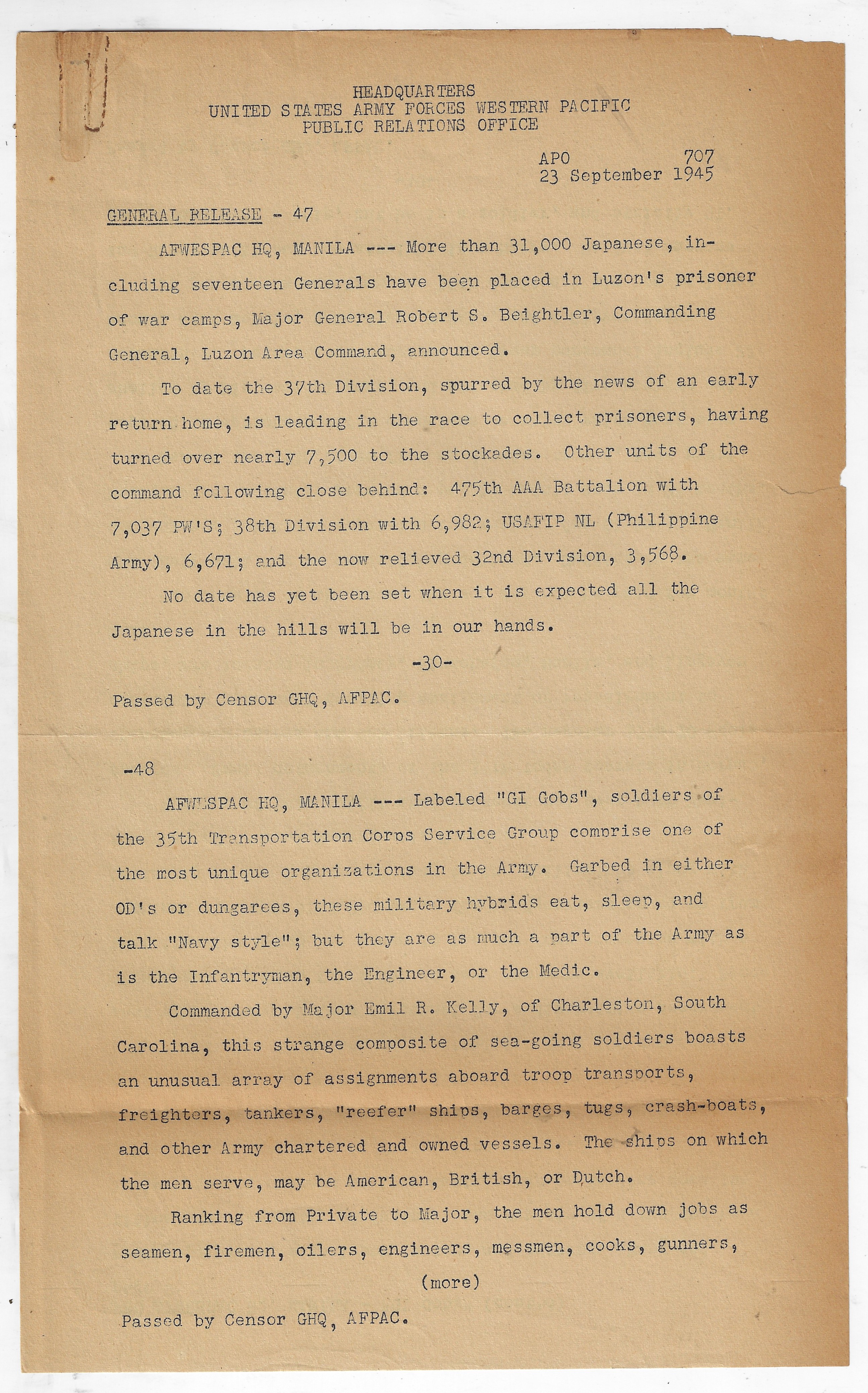
    Philippines 23 Sept 1945 Even though WWII in the Pacific was ended on 15 August 1945 (or at least the surrender was initiated then) and the surrender papers signed aboard the USS Missouri in Tokyo Bay on 2 September 1945 (“VJ Day”), there were many elements of the Japanese Army that took weeks and in some cases months to actually lay down their weapons and submit. (There are some rare cases of individual soldiers lasting for years and decades past the surrender, refusing to give in, living their lives in remote places.)

    This document–“Headquarter / United States Army Forces Western Pacific / Public Relations Office / General Release – 47, APO 707, 23 September 1945”–released by the propaganda/public relations office of the U.S. Army Force Western Pacific, details some of the process of large forces of Japanese forces in the Philippines coming in to surrender. The  rare, short document is reproduced in full, here. 

    Stating that 31,000 Japanese soldiers (and 17 generals) had already been placed under guard in Luzon’s POW camps, the three-paragraph document ends with this interesting statement:

    “No date has yet been set when it is expected all the Japanese in the hills will be in our hands.”

    ·Posted by :

    ·in:


  • Rare First-Hand Account of the Japanese Surrender in Japan and the Philippines

    JF Ptak Science Books  

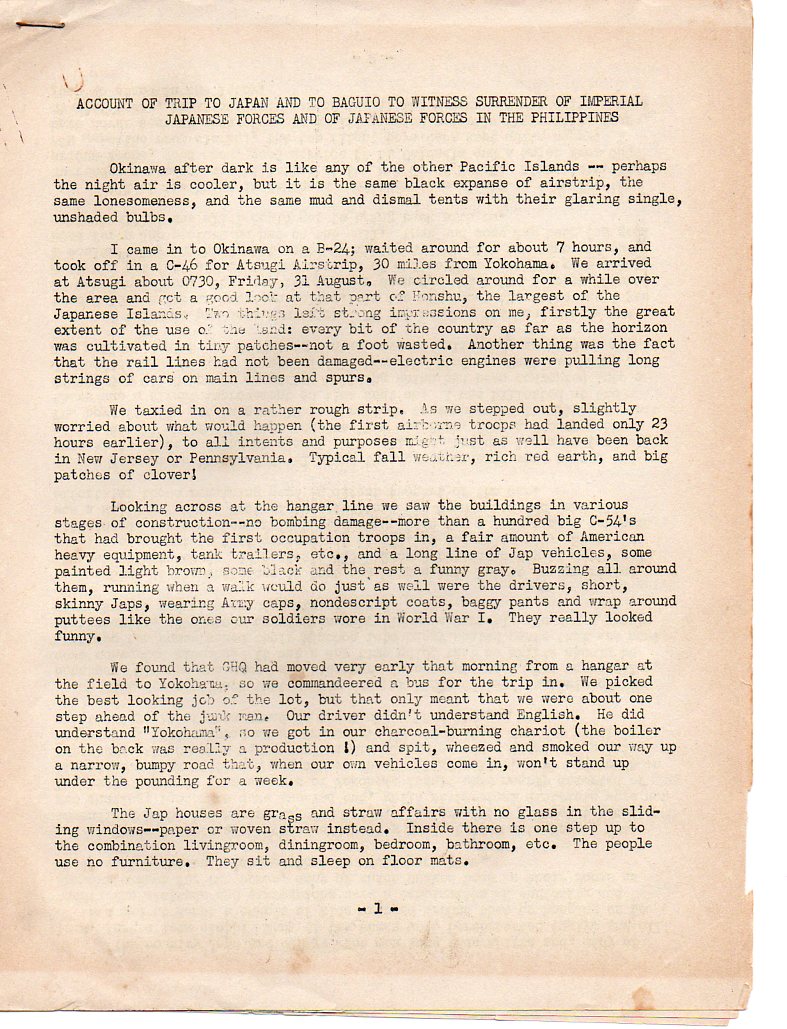
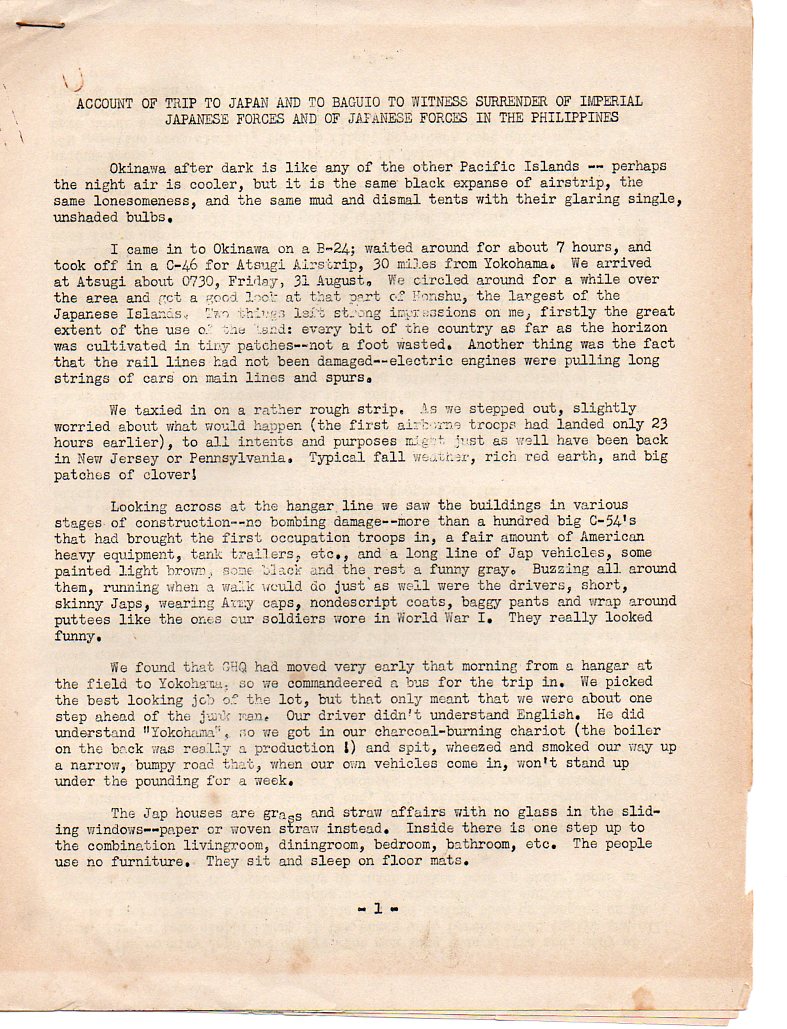
    Deglin _1_I’m doing a quick-share of this five-page document written by Lt. Col. Theodore Deglin (“PRO AFWESPAC”, Public Relations Officer, Armed Fores Western Pacific, Philippines), called “Account of a Trip to Japan and to Baguio to Witness Surrender of Imperial Japanese Forces and of Japanese Forces in the Philippines”. Its an interesting perspective coming from a PR guy who settled into the role of a public relations officer for the commanding officer of U.S. forces in the Philippines.  After serving as public relations director for Madison Square Garden (1935-1942), T.L. Deglin became a Lt. Col. in the U.S. Army (and later a full colonel) in a public relations capacity, finding himself a witness on 2 September 1945 to the Japanese surrender on the U.S.S. Missouri. He and his party then leaves immediately for Baguio (in the Philippines) to bear witness and report on the surrender of Japanese forces in the Philippines, including the arrest of the Beast of Manila, General Yamashita. What follows below is his full five-page (1750 word) description of those events.  The report is an offset-printed production, so it did see some sort of distribution, but I can find no mention of it anywhere. 

    An example of Deglin’s reporting from the desk of the USS Missouri:

    • “General MacArthur is a terrific showman. Every move of his is dramatic and beautifully timed. He spoke briefly, then instructed the Jap foreign minister to sign for the emperor of Japan and the Japanese government. The skinny, bespectacled, top-hatted minister, Shigemitsu, limped forward, pulling his game leg after him. He sat down, facing MacArthur, and had trouble getting the leg under the table. He fiddled around, picked up a pen, put it down, looked at his watch, looked around, looked at his watch again until everyone was slightly nervous, and the general looked quite irritated. Frankly, I could think of only one thing: that a kamikaze plane was going to dive out of the clouds at this time and blow us all over Tokyo Bay. No such excitement, however; the old boy signed both copies of the surrender document and limped back to his position. Then General Umezu, chief of staff for the Imperial Japanese Army, signed quickly.”

    Here’s an example of Deglin’s reporting from Baguio:

    • “The conference room was set up with a long table. On one side were a dozen high, hand-carved chairs. On the other side were four wooden folding chairs. The newsreel cameras, still photographers, and radio broadcasters were all set up in their places. Then the Japs were brought in. They were led to the side of the table where the small chairs were and started to sit down but were instructed to remain standing. They were kept standing for nearly 10 minutes; then the top generals came in and sat down. After them came a group of 15 brigadier and major generals. Then the correspondents were herded in—about 35 of them.
      The ceremony was partially designed for the radio broadcast. The surrender document was read, Yamashita was asked if he understood the terms (an interpreter stood behind him), he answered “yes,” the documents (four copies) were signed, the generals filed out, and Yamashita was turned over to the MPs for delivery to New Bilibid Prison near Manila. Incidentally, when he left Baguio he wore a string of ribbons. Guess who has them now!

    The rest of the document appears below:

    ·Posted by :

    ·in:


  • Roosevelt as Hiding in Hitler’s Shadows (1940 anti-Roosevelt campaign literature)

    JF Ptak Science Books  Quick Post

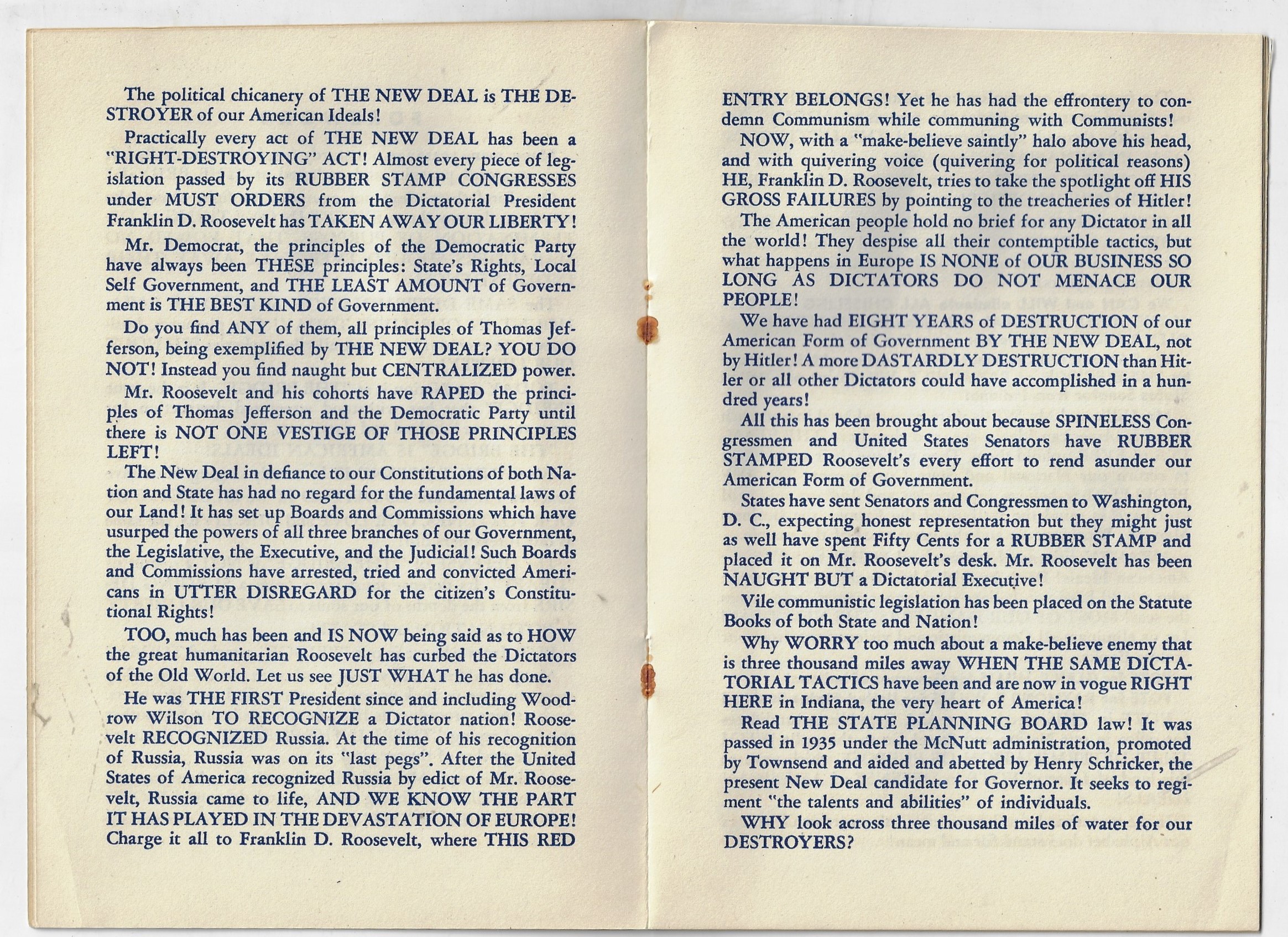
    FDR diatribe _2_I’ve together a little collection of 75 or so anti-FDR pamphlets from 1936-1944, though “anti-” is probably a little too temperate to describe the vast majority of them. Most are ripping, tearing, rending, insulting, vicious, accusatory…you get the picture. This one is special as it has FDR hiding behind Hitler. The author, Charles R. Parker, writes in his Republican-backing pamphlet on the campaign of 1940 that “Roosevelt tries to take the spotlight off HIS GROSS FAILURES by pointing out the treacheries of Hitler!…what happens in Europe is none of our business”.

    He continues: “We have eight years of destruction of our American form of government by the New Deal, not by Hitler! A more dastardly destruction than Hitler or all other Dictators could have accomplished in a hundred years!”

    It goes on like this for the length of this short, stubby, and not-well-written piece, until it falls off its own cliff.

    Roosevelt’s win in 1940 was his “weakest”, taking 85% of the electoral votes and 55% of the popular vote over Wendell Wilkie (who would be dead before the end of the war. I can’t find much about Mr. Parker, though for me he has written one of the best (where “best” equals “worst”) of the worst appraisals of Roosevelt. He finishes off the pamphlet stating “We can only vote one of two ways! We can either Vote American and choose Life, or anti-Amreican and reap Death.”

    FDR diatribe_1_

    ·Posted by :

    ·in:


  • Early References to the Holocaust and Auschwitz (1943)

    JF Ptak Science Books  Post 2835

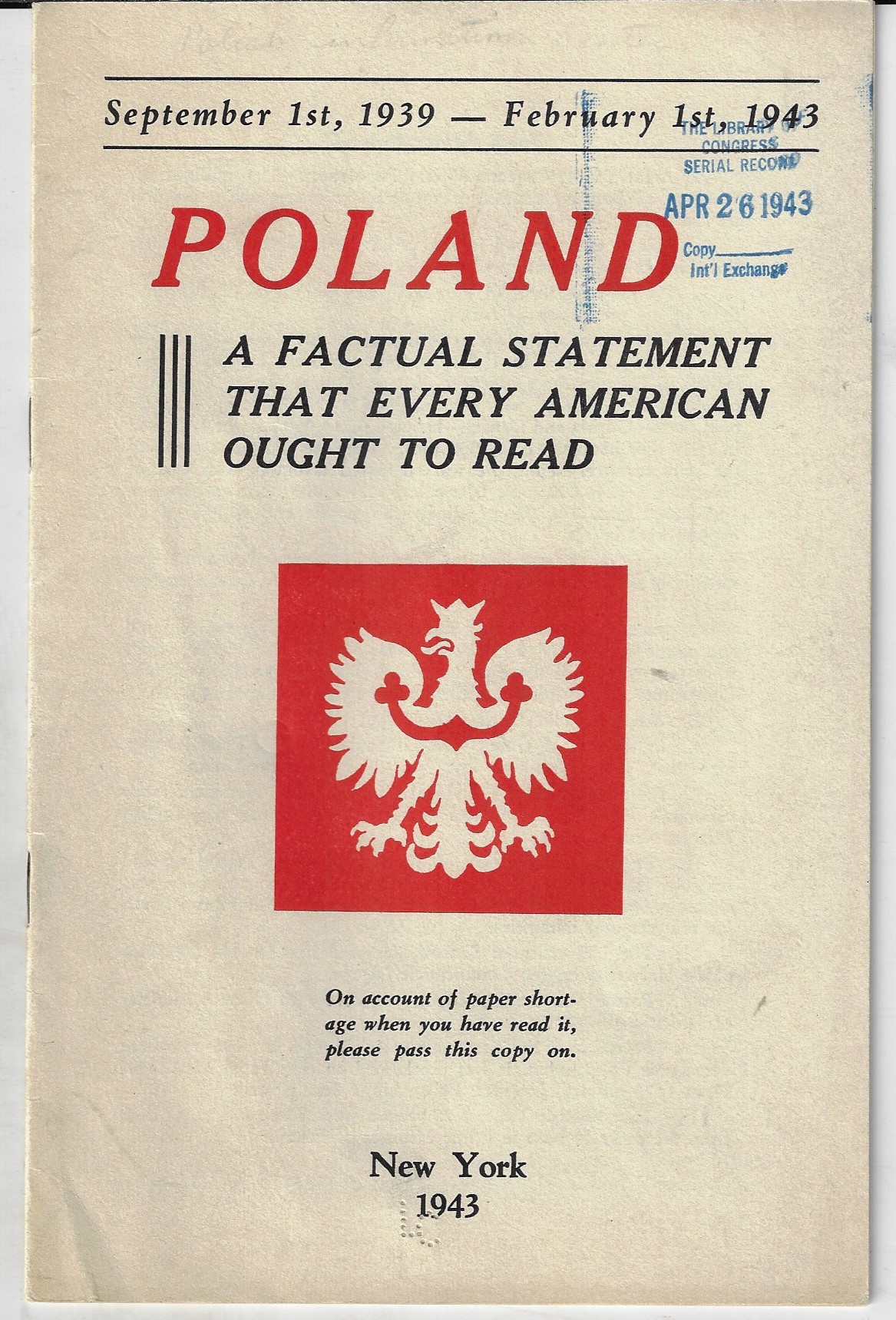
    Poland  factual statementPoland, a Factual Statement that Every American Ought to Read (published by the Polish Information Center, 151 East 67th Street, NYC) sounds like a semi-dry academic pamphlet, waiting to be ignored. But it was printed in 1943, and the audience then would no doubt have been interest in what the hell was going on there.  It turns out that there is some extraordinary reading to be done in its quick sixteen pages, not the least of which is a notice of the murder of a million Jews and a description of camp life in Auschwitz (Oswiecim). As there are only five copies of the work located in libraries worldwide (according to WorldCat/OCLC) I thought I’d reproduce its most significant section , the “German Reign of Terror” (pp 12-15). This leads with these numbers of crimes committed by the Germans: To forced labor in Germany (1,000,000 Poles); to the Government General (700,000 Poles); shot and murdered (1,200,000 Poles), starved to death (about 500,000 Poles). “It staggers the imagination to think that every tenth human being in German occupied Poland had already been shot or hanged tortured to death, starved…or deported to Germany.”

    There are other stories of mass executions, as well as a short description of Auschwitz: “More than 60,000 Poles have been murdered in the concentration camps of the Government General and the Reich. Oswiecim is the most gruesome on Polish territory. It was set up in July 1940 and consists of ten barracks, each of which is supposed to contain 400 prisoners, but actually houses 1,000 men. Prisoners wear thin cotton uniforms in winter as in summer. They were only given shoes on October 15 and had no caps before December. On arrival they had to fill out answers to 32 questions about their life, family, health, wealth and political activities. Two weeks suffice to break men above 45 years. Younger men lose their vigor and youth within half a year…”

    And this: “The Jewish population is closed up in ghettos and suffers no less than the Poles. Particularly in the last six months the Jewish population has suffered an unheard of persecution amounting to a process of willful extermination. Losses in Jewish population up to 1943 exceed one million persons killed.”

    • Note: I don’t know enough to speak about the obvious demarcation in this report between “Poles” and “Jews” except to say that it exists in the text and that I’m aware of it.  

    And so, here is the scan of the “German Reign of Terror” section:

    German Reign of Terror

    In his message to Poland broadcast on May 3rd, 1941, Prime Minister Churchill said: “Every day Hitler’s firing parties are busy in a dozen lands. Monday he shoots Dutchmen, Tuesday Norwegians, Wednesday French and Belgians stand against the wall, Thursday it is the Czechs who must suffer, and now there are the Serbs and the Greeks to fill his repulsive bill of execution. But always, all of the days, there are the Poles.”

    Let us be frank: for many reasons the world still is not fully aware of the enormity of Polish suffering nor does it realize the importance of Poland’s contribution to the Allied fight for common victory.


    ·Posted by :

    ·in:

    —

  • A Provocative Piece of Italian Fascist Anti-U.S. Propaganda, 1944

    JF Ptak Science Books   Post 2832


    This piece of propaganda from Italy in 1944 made the case for a gangster-like bloodthirsty U.S. Soldier being deployed to an immoral imperialist war in a place of ancient culture and high morals. The example it uses is LIFE magazine, which after tongue-in-cheek praise is established as a mirror of its readers’ mentality, feelings, desires, and passions, offering congratulations to Mr. Luce for establishing such a magazine that so deeply displayed the character of the United States. After this follows the propaganda rain, and the horrors that were in the pages of LIFE.

    The Italian reader is then introduced to a quick succession of stories that evidently displayed the building blocks of American culture, with LIFE focusing on vainglory, false culture, sex appeal (the main ingredient), and malignant ruthlessness.

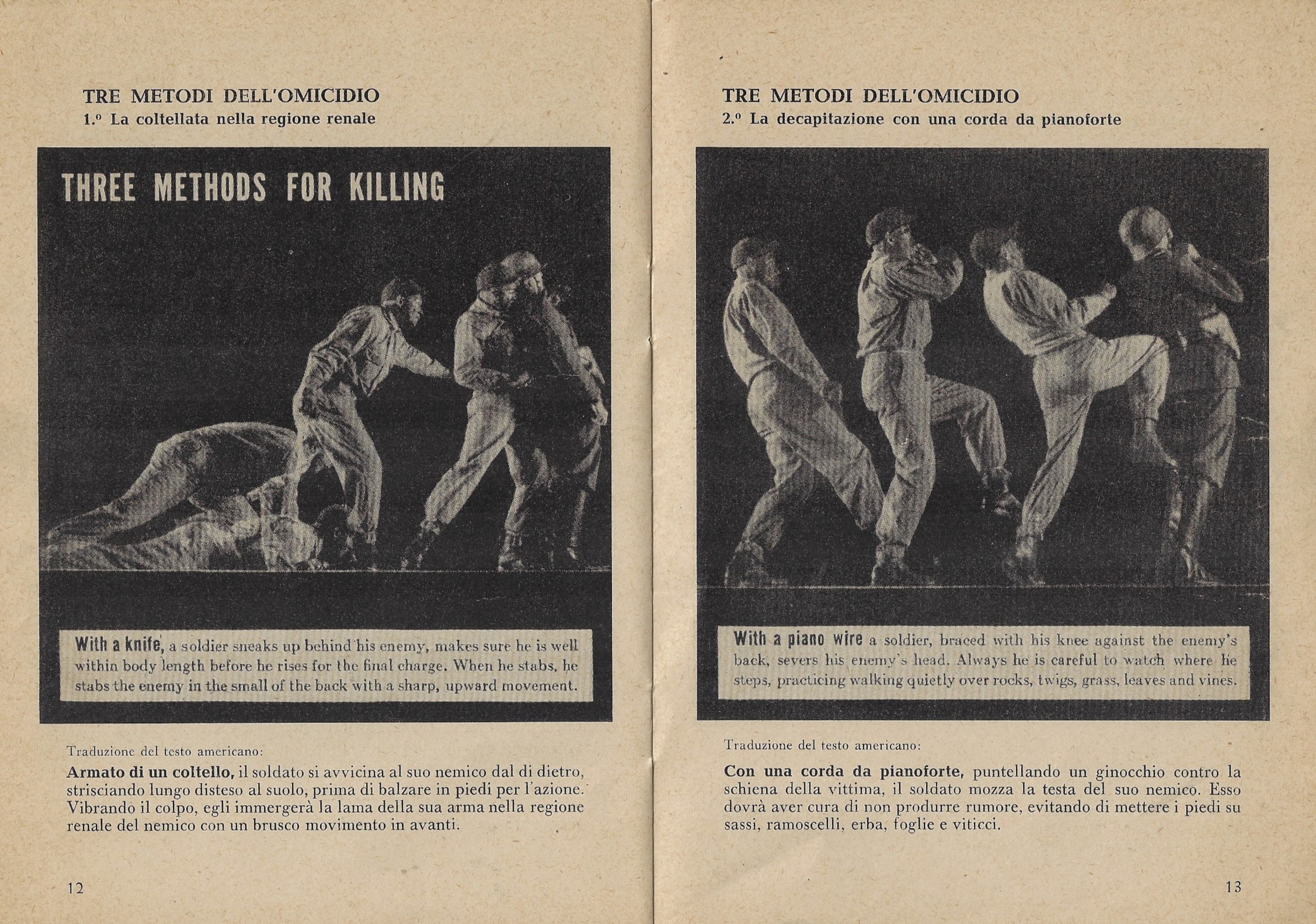
    In getting to this last part the writer of this pamphlet uses a story that appeared in LIFE on 22 March 1944–the reader warned of the horrifying nature of the photographs to follow “(ueste fotografie vi fanno orrore”)–which graphically displayed in a studio setting the stealthy killing method of the U.S. Soldier at war.

    Propaganda Italian LIFE_2_

    Propaganda Italian LIFEThe pamphlet makes the point along the “this is your enemy” lines, that this is what the U.S. was all about. And if the reader was surprised by the images, then they had no idea of what the “Ameriucan mentality” was. (“Ma se queste illustrazioni vi stupiscono, allora — vogliate scusare — finora avete avuto ben poca nozione della mentalità americana!” “But if these illustrations amaze you, then – please excuse – so far you have had very little notion of the American mentality!”)

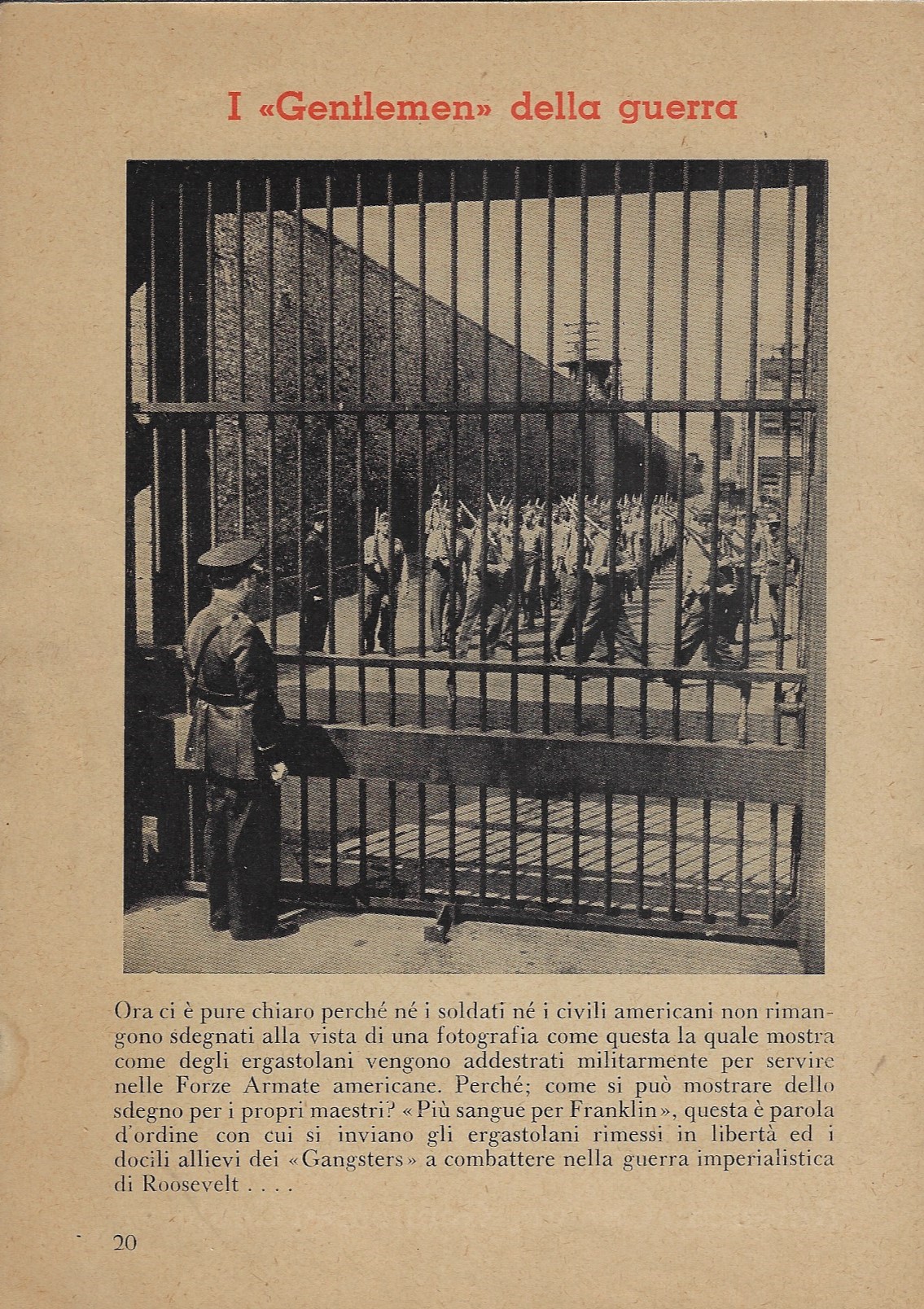
    The short (14pp) pamphlet ends with a full page picture of American “gangsters and life prisoners” in prison, training to fight for the “imperialist war of Franklin”.

    The work is certainly provocative —whether or not it was believed is unknown to me. I do know that U.S. Marines were depicted as baby murderers and baby rapists to Imperial troops, scaring the hell out of soldiers and civilians (re the native population on Okinawa) alike, further enforcing the belief and demand of a fight-to-the-death mentality because not only was this the codified way to behave, but the shame of surrender would be worsened by the treatment and torture they would receive in captivity. The results of this propaganda was horrific for the soldiers and for thousands of Okinawans. As I said, I don’t know anything at all of the effectiveness of this Italian effort, though my best guess is that the reader would’ve thought this to be bullshit  inaccurate. 


    ·Posted by :

    ·in:

    —

  • Nazi Propaganda Against the B-17 (1943)

    JF Ptak Science Books  Post 2824

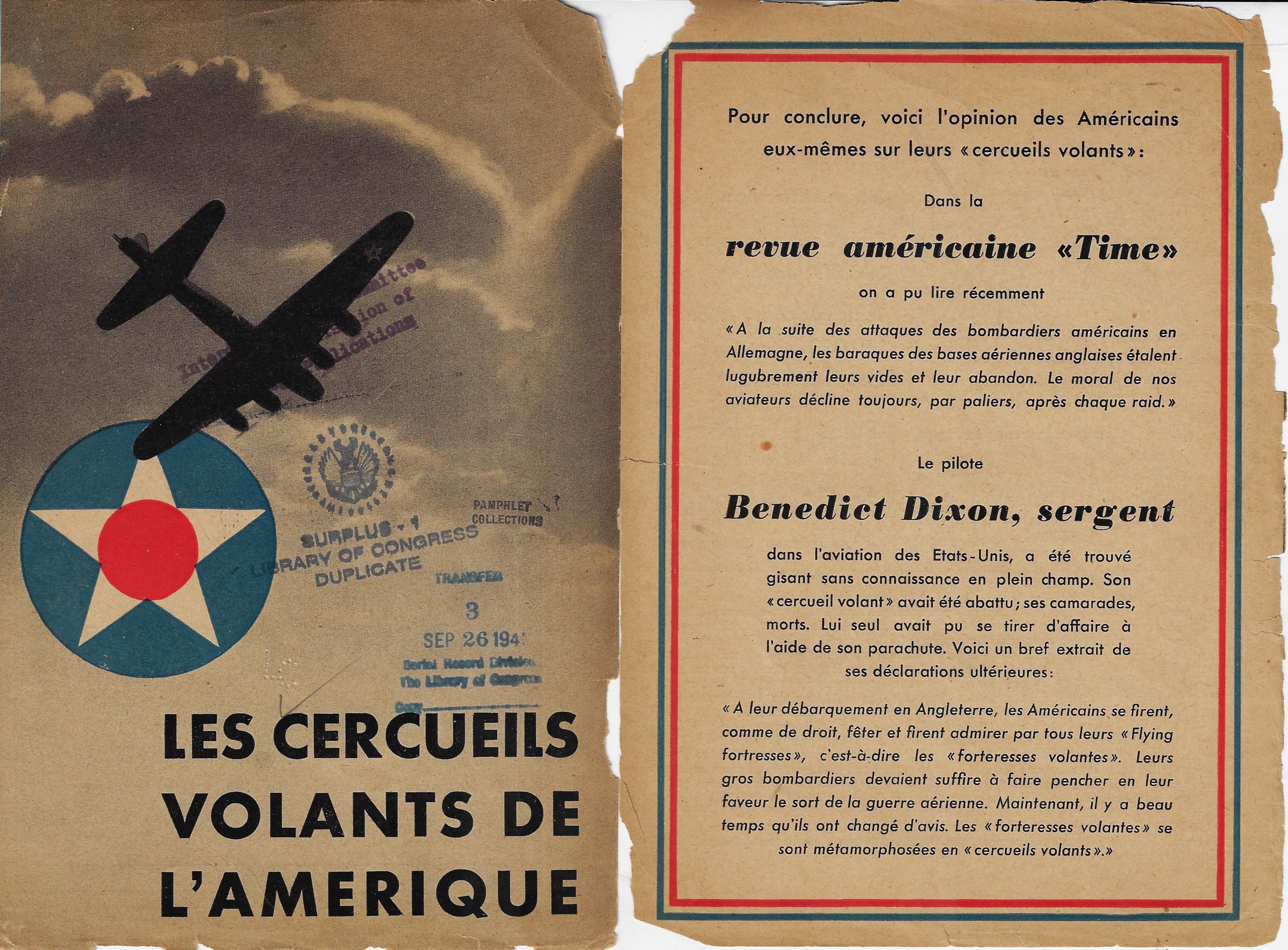
    This is quite the piece of anti-U.S. Propaganda, printed in 1943 and targeted so to speak against the B-17 Flying Fortress. (I’m not sure why this is in French, though no doubt it was focused on occupied territories in France and Belgium and other areas reached by Lingua Franca.) This was a difficult piece to work through given my tender spot for this aircraft–I’ve long admired it, and was even a passenger on one many years ago (it was much louder than I expected). As a piece of propaganda I would have expected to see more copies of this here and there, but as it turns out there is only one copy (at Nanterres) located by WorldCat–this in mind I’ve reproduced the whole of the very short work.

    B 17 propaganda _1_[Front and rear covers.]

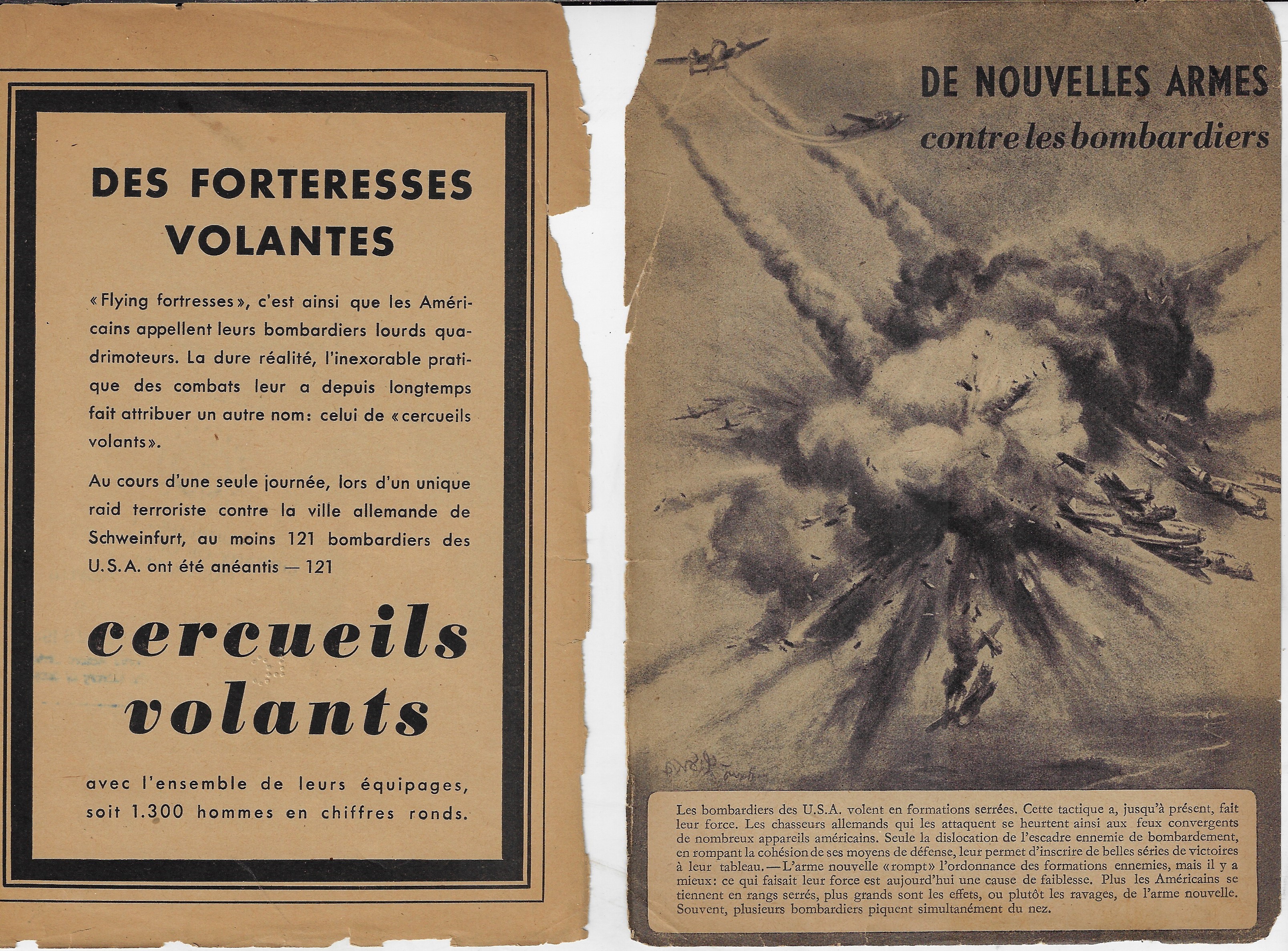
    The little pamphlet got to business straightaway, claiming on the back of the title page that the “Flying Fortress” suffered terribly at (“terrorist raid”) Schweinfurt—true enough for the 8th Air Force, though the numbers aren’t quite right. The author tells us that the “Flying Fortress” was actually “the Flying Coffin”. “This is how the Americans call their heavy four-engine lighters [the “Flying Fortress”]. The harsh reality, the inexorable practice of fighting has long since given them another name: that of flying coffins. C’est ainsi aue les americains appelent leurs bombrdiers lourds quadrimoteurs. la dure realite, l’inexorable practique des combats leur a depuis longtemps fqit attribuer un autre nom: celui de cercueils volantes.”)

    In the explosive scene on the page there’s a picture of mass destruction of B-17’s being blown out of the sky—this a result of the (“tight”) formation flying that the writer says used to be a strength, but now with new (German) weapons would prove to be the 17’s weakness. (“The greater the function, the bigger their devastation.”)

    B 17 propaganda _2_The next scene, a two-pager, is heartbreaking and brutal. “Voila ce qui les attend” it shouts–”this is what awaits them”! And then, boldly beneath the scene, the pamphlet repeats the Flying Fortress is the Flying Coffin claim.

    ·Posted by :

    ·in:

    — —

  • A Piece of Nazi Propaganda Warning of Spies, Traitors, and Saboteurs (1938)

    JF Ptak Science Books  Quick Post

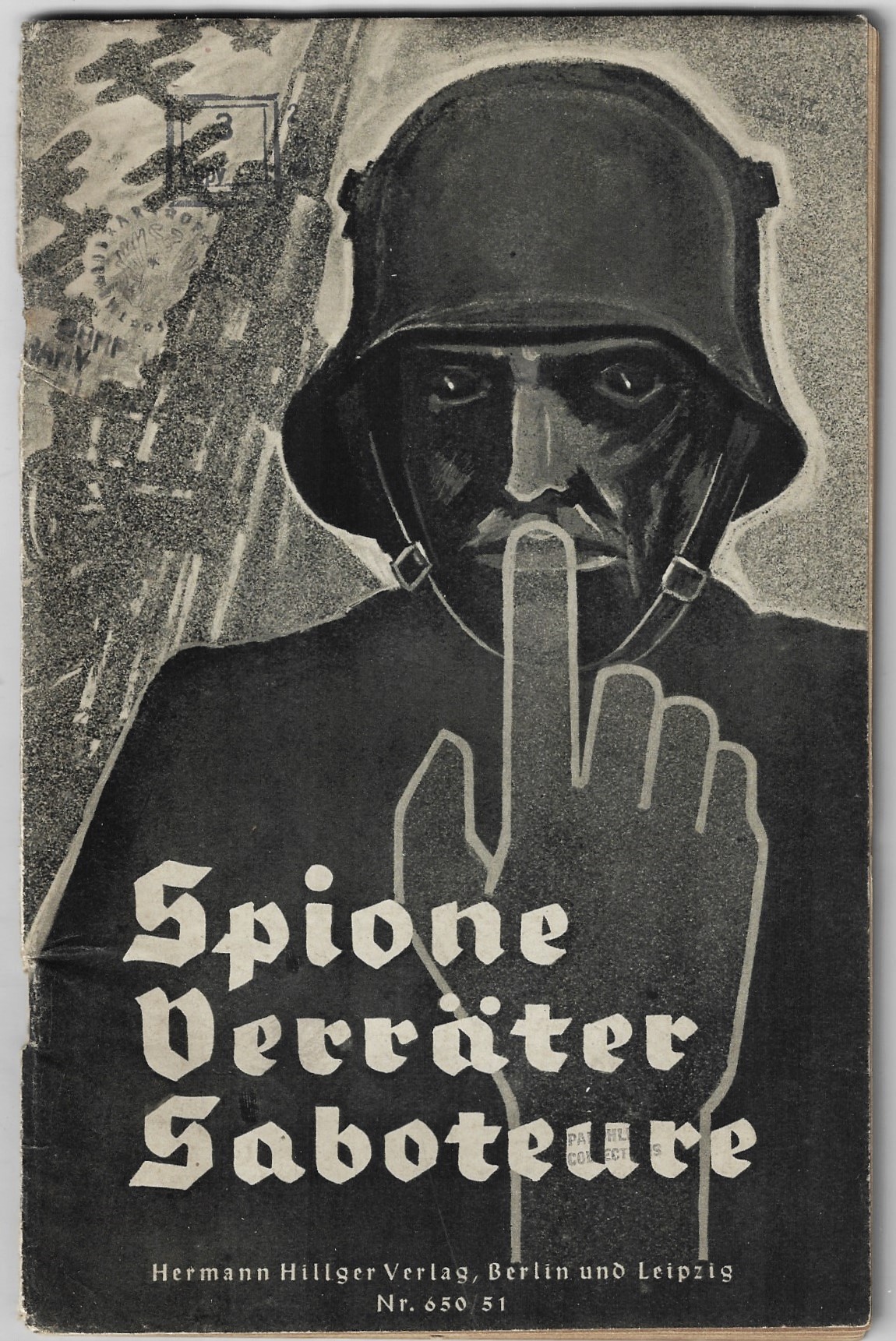
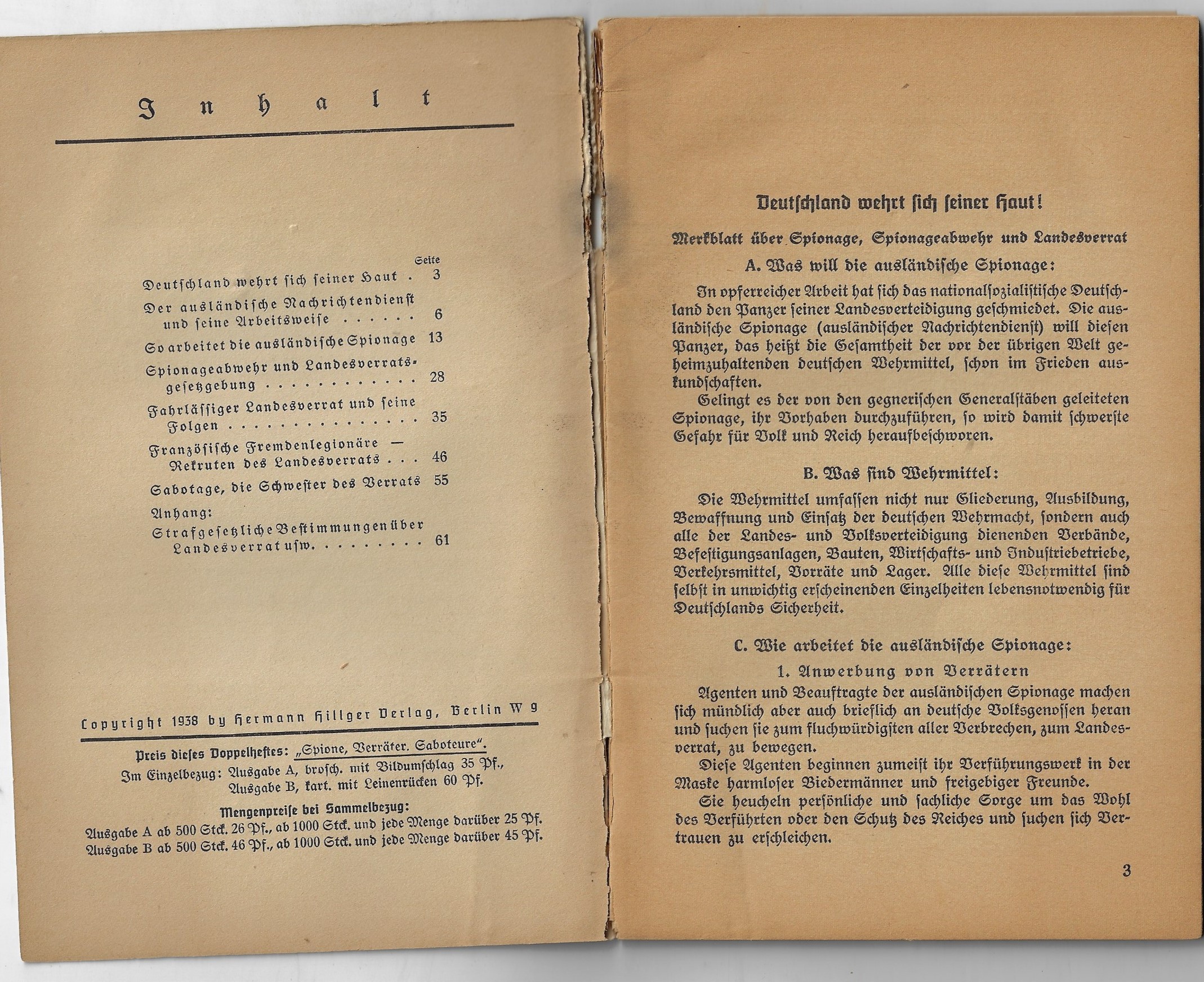
    WWII German spy coverPublished a year or so before the official beginning of the war in 1939, this piece of Nazi propaganda took aim at the people of Germany, seeming to stoke the home fires and ready folks for subterfuge and dirty tricks. Spione, Verrater, Saboteure (Spy, Traitor, Saboteur) was already in its fifth edition (whatever that means in this case), and in its 64pp it warned people about what foreign intelligence processes were like,what sort of government response and legislation might be necessary to combat foreign intrigue, and counterintelligence. It also addressed “negligent treason”(loose lips stuff) amd its consequences (severe), how traitors could be recruited in Germany, “Sabotage, the sister of treason” (“Sabotage, die Schwester des Verrats”), and then finishing off the whole lot with a bit on the recruitment of traitors (the worst of the bunch).

    It was a plea—well, demand seems more like it—telling folks that “the means of defense include not only the structure, training, arming and deployment of the German Wehrmacht, but also all associations, fortifications, buildings, commercial and industrial companies, means of transport, supplies and warehouses serving the national and national defense. All of these means of defense are vital for Germany’s security, even in unimportant details”.

    The pamphlet’s rear cover was a full page ad for a 32-page annotation of Hitler’s “Volk und Rasse” from Mein Kampf, which a reader could purchase for about a pfennig a page.

    The pamphlet makes me itch.

    WWII German spy

    ·Posted by :

    ·in: