A Daily History of Holes, Dots, Lines, Science, History, Math, Physics, Art, the Unintentional Absurd, Architecture, Maps, Data Visualization, Blank and Missing Things, and so on. |1.6 million words, 7500 images, 4.9 million hits| Press & appearances in The Times, Le Figaro, Mensa, The Economist, The Guardian, Discovery News, Slate, Le Monde, Sci American Blogs, Le Pont, and many other places… 5000+ total posts since 2008.

Category: Militaria

  • Iconic WWII Propaganda–Great Britain, 1940 (“Careless Talk Costs Lives”)

    JF Ptak Science Books    Post 2727

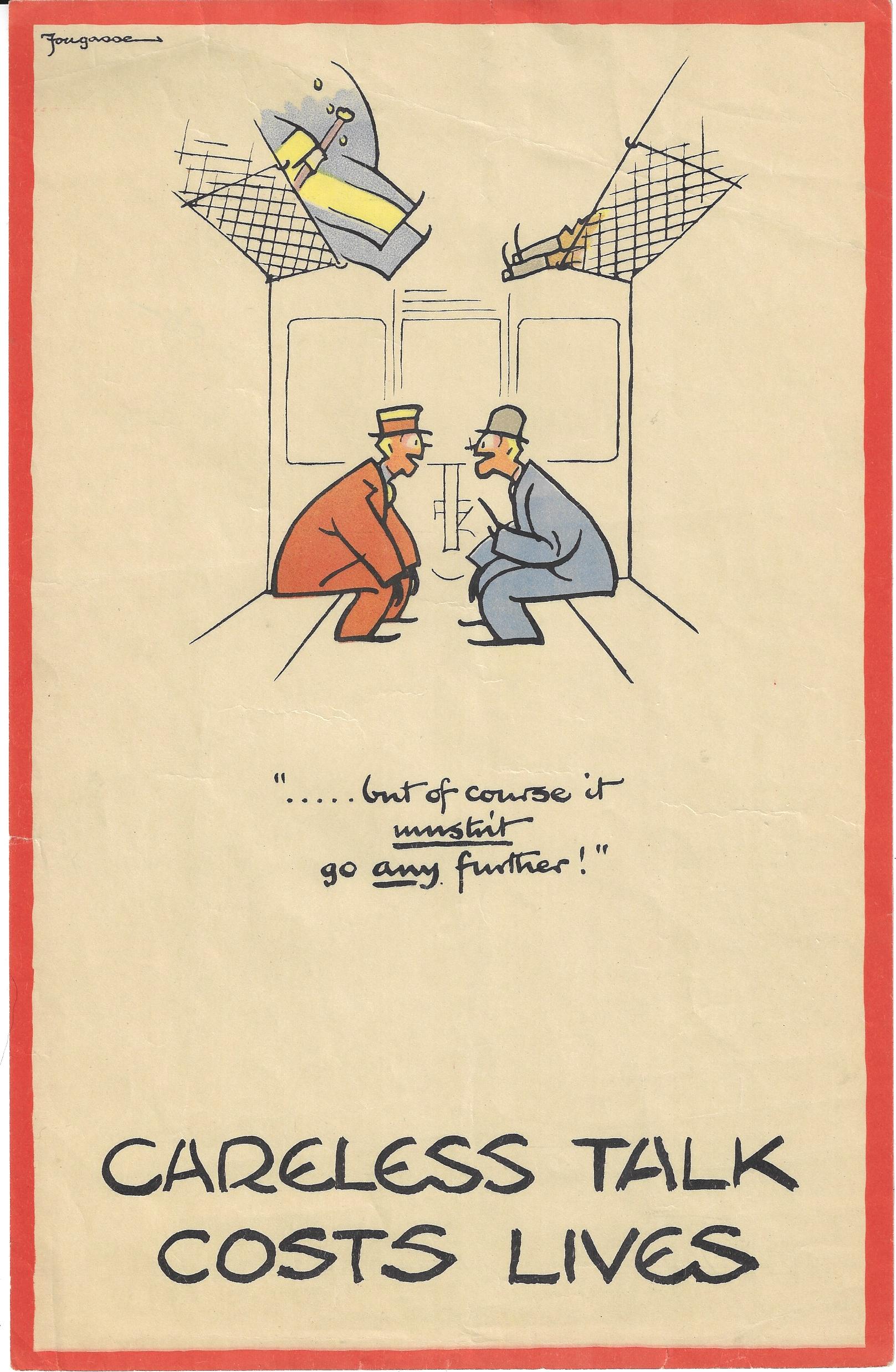
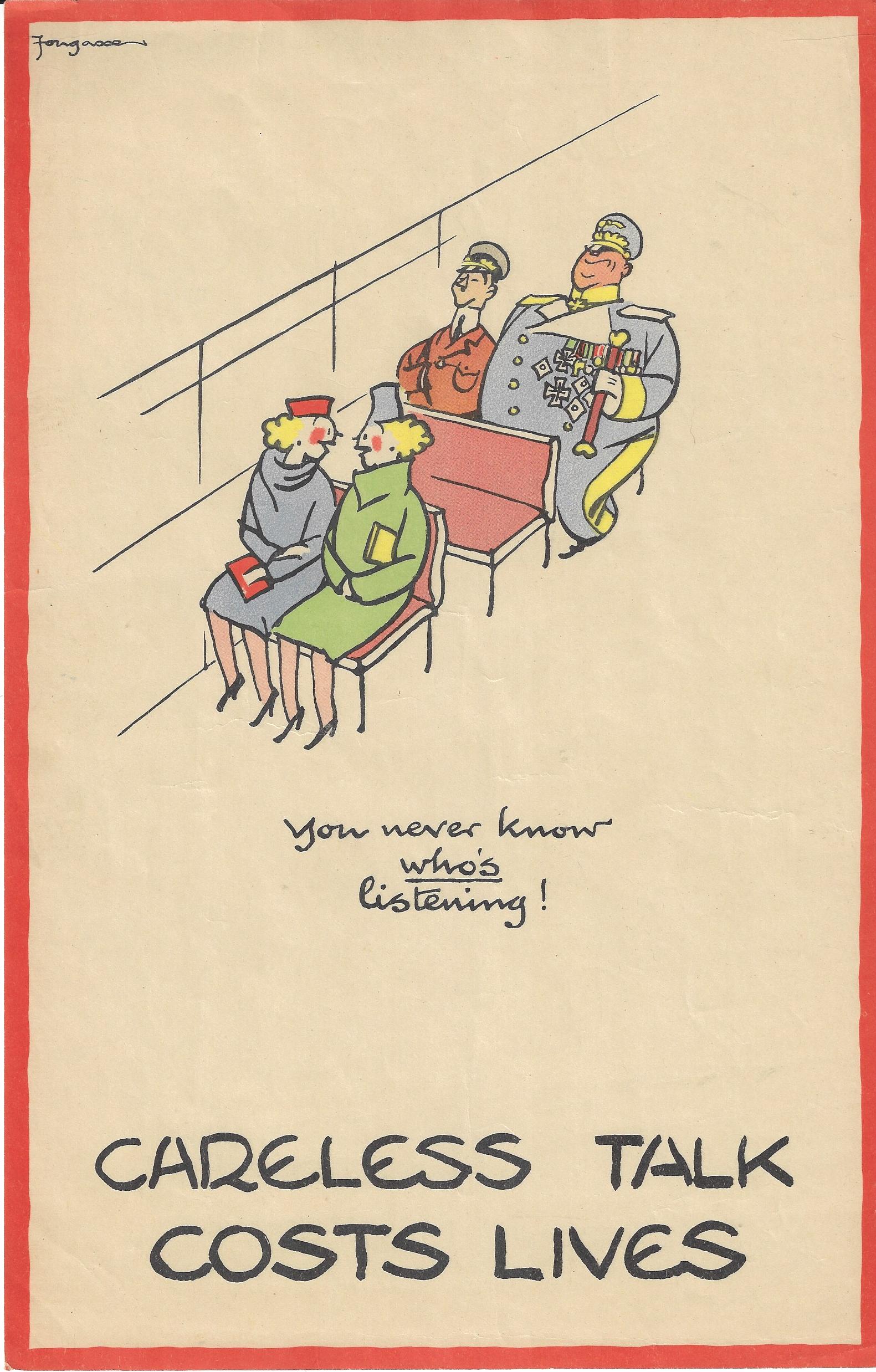
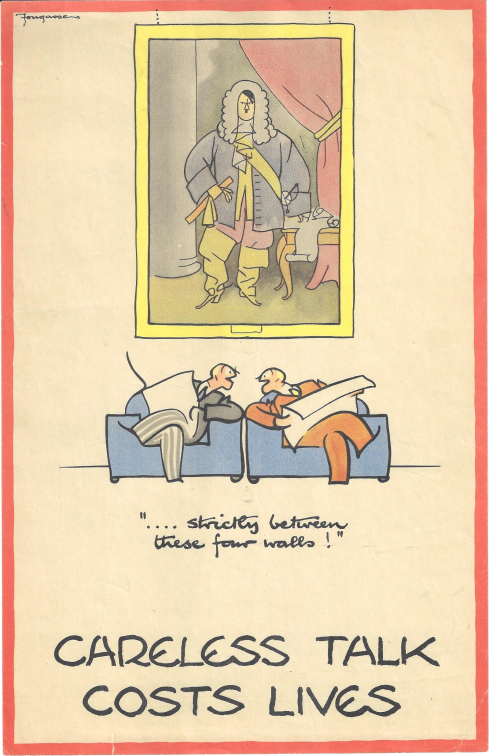
    I found these images years and years ago, and evidently had forgotten them–they surface yesterday from a long slumber, and immediately put me into mind of the very real hearst and minds campaign and of keeping secrets secret in the terrible and great struggle in the U.K. in 1940.  These are four of eight posters in the very popular “Careless Talk Costs Lives” wartime propaganda series issued by the Ministry of Information and printed in 19401. They are the very stylized work of the illustrator “Fougasse”, who was Cyril Kenneth Bird, (1887-1965), an illustrator for Punch (from 1937 to 1949) and other journals and magazines, and also a wounded vet of Gallipoli in the First War. 

    The series in general depicts people sharing a piece of possibly sensitive information that in the wrong hands and together with other pieces of info could reveal devastating secrets—and in each case there are figures lurking/loitering/disguised in the background waiting to collect the data, and generally a poorly disguised Hitler or Goering or both. Fougasse was able to make his message immediately memorable and understood because I think of his understated over-the-top visual humor. The images were funny, but the message was deadly serious. Also, you really didn’t even need to read the text to understand the message. (This is in the same vein as some of Thomas Nast’s finest work, conveying social content and a political message to the illiterate, making his devastating (and usually highly textual) cartoons understandable without needing to read them.) 

    (1) “Strictly Between Four Walls”.  In this poster (made a convenient size to be useful in virtually any small area and also abiding the wartime paper shortage) we see two men in big club chairs about to share some bit while the artwork-ensconced Hitler waits to hear the interesting parts. 

    Fougasse but of course it mustnt


    ·Posted by :

    ·in:

    —

  • A Fine RADAR Map of NYC, 1945

    JF Ptak Science Books

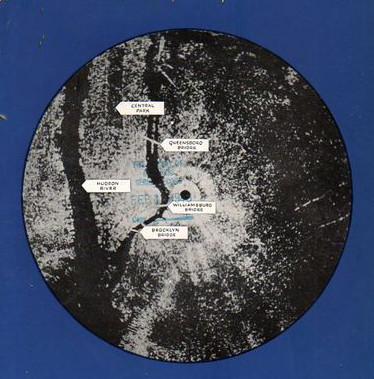
    Radar map nyc

    The history of RADAR (RAdio Deection And Ranging, and something I’ve always written in caps, for whatever that is worth) is absolutely not what I’m thinking about now–that is a long story with lots of twists and turns, complicated, complex–and it ranges depending upon location as for the most part RADAR (from the 1930’s anyway) was developed in secret, kept as a military secret.  And that’s because it was a very important development, with the victor of the Battle of the Beams being the possible victor, period.  

    Radar246

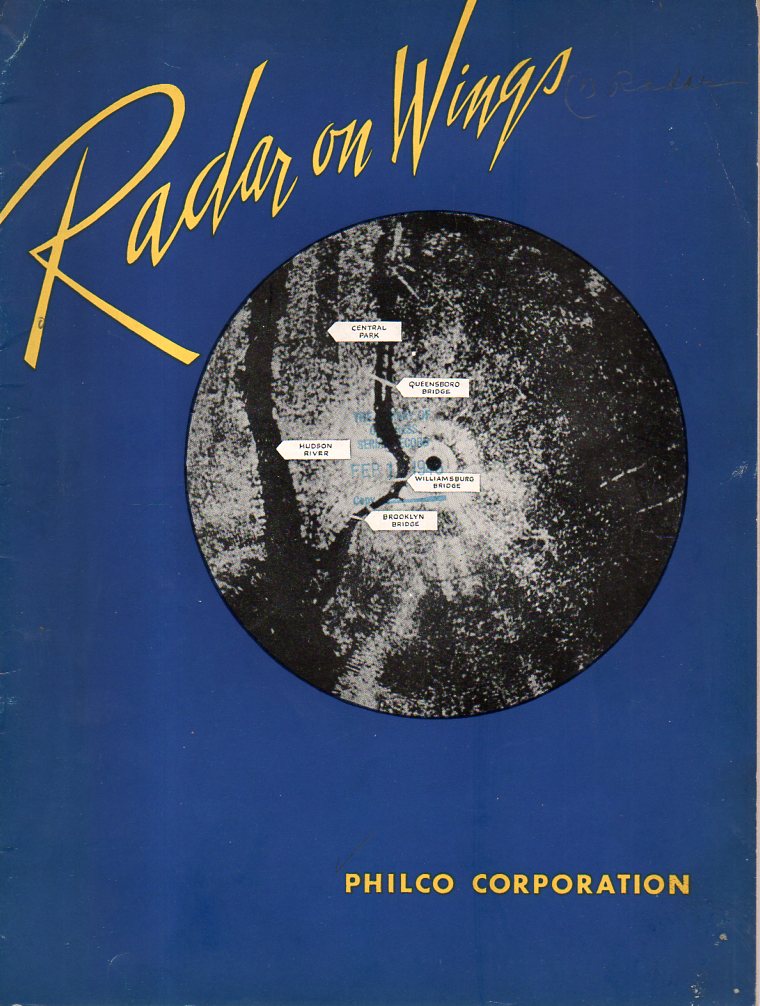
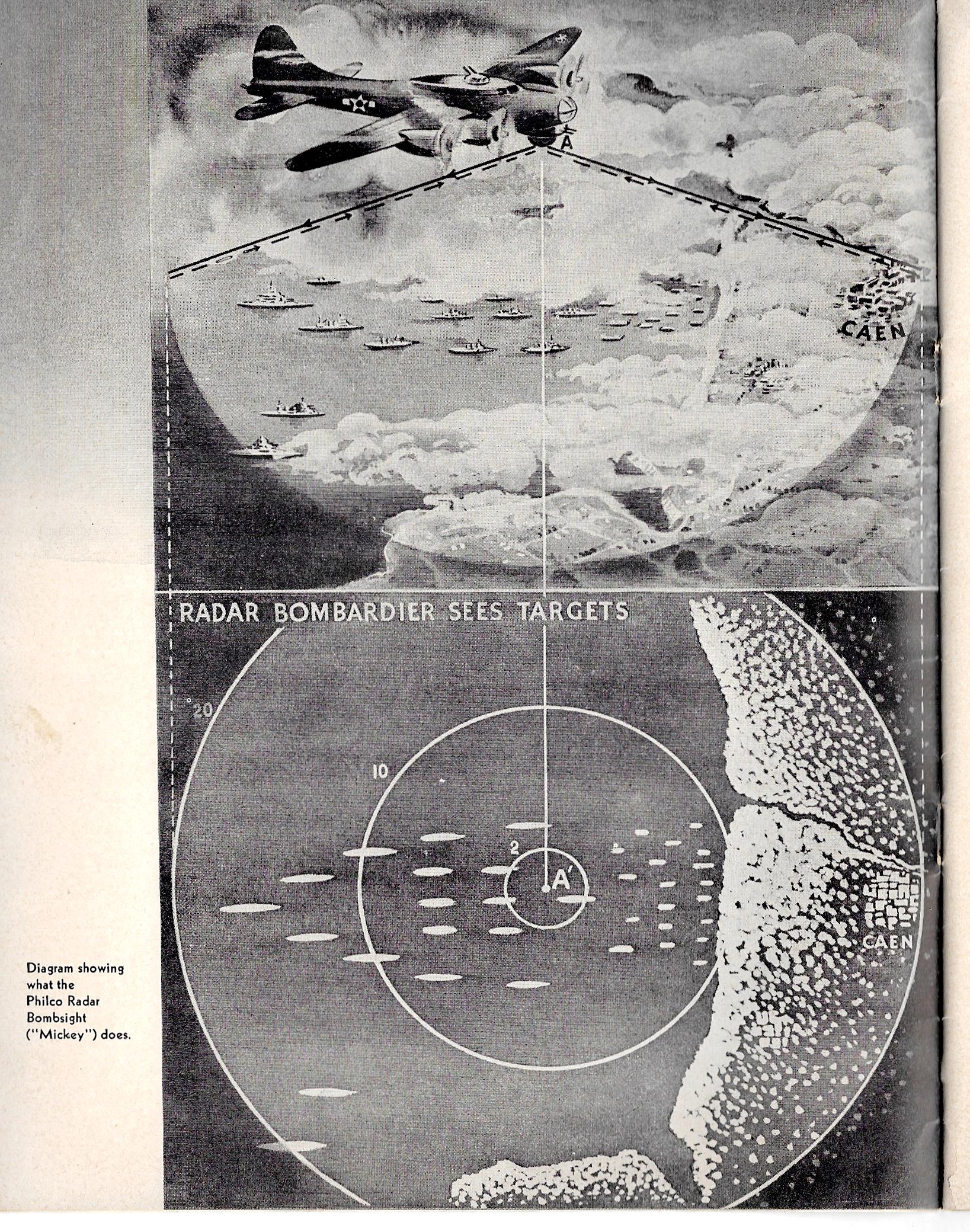
    All I want to do presently is note the significance of this particular pamphlet in the history of RADAR. This work was printed by PHILCO Corporation, (and dated December, 1945), and has an inserted leaflet stating that this “makes public for the first time the salient facts about the Corporation’s development and production of airborne radar equipment for the United States Army and Navy”.  PHILCO and other companies made significant contributions to the war capacity of the Allied forces, and–for this company in particular–much of that went unknown for quite some time afterwards, and of course there are some stories that just won’t get told. But for PHILCO the story gets told here.   RADAR 1945

    This is also a fabulous nighttime map of NYC–produced by RADAR.  

    [RADAR on Wings, Philco, 1945.  10×8″, 30pp (unpaginated) with lots of photographs and an occasional schematic.]

    ·Posted by :

    ·in:

    —

  • Graphic Design in “PM” Newspaper, September 1944

    JF Ptak Science Books   Quick Post

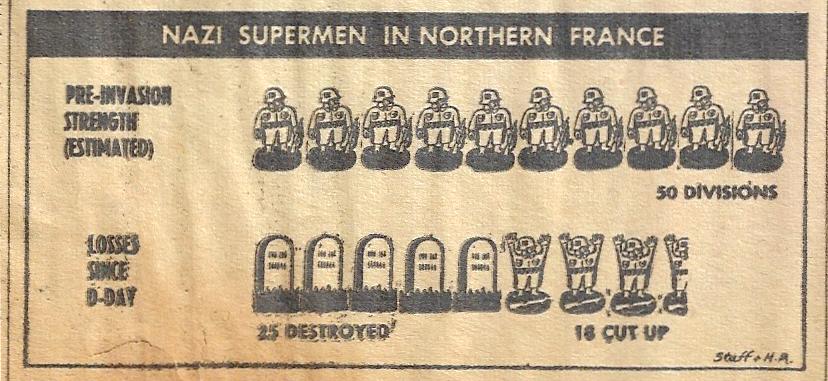
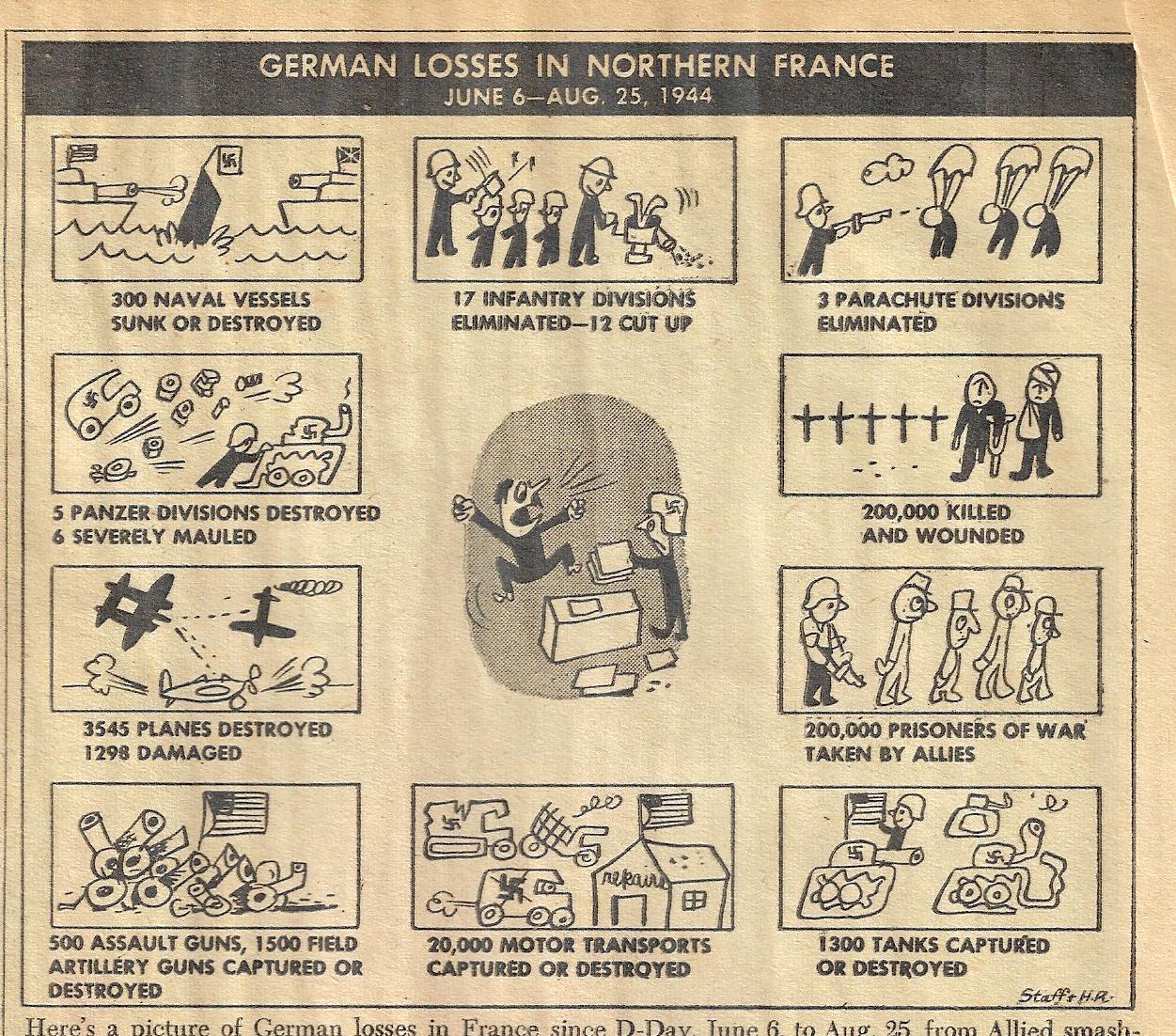
    Here’s another noteworthy, unusual, and most likely very seldom seen display of data from the excellent PM newspaper, this published September 1, 1944. (I’ve made numerous posts to this blog on PM–for more information, just search the name of the newspaper in the Google search box at right.)  The larger image below measures about 5″x5″ in the original; the “Nazi supermen” image directly below is only about 1.5’x3″, and really does make a strong graphical point about the demise of the German army in northern France. This is reporting good news to the readers, though it was hardly the true end of the story in that region–three months later, on 16 December, the Germans would begin Unternehmen Wacht am Rhein (“Operation Watch on the Rhine”), their last push against the Allied forces in the West. To the Allies this attack was known as the Ardennes Counteroffensive, and would last until 25 January, ending in disaster for the German forces. 

    Bottom line here is that the design is very compelling. 

    PM 1944 Carton Nazio losses _2_

    And another, larger image:

    PM 1944 Cartoon Nazi losses _1_


  • “Restricted” Reports of Allied Aircraft Performance, 1944

    JF Ptak Science Books   Quick Post

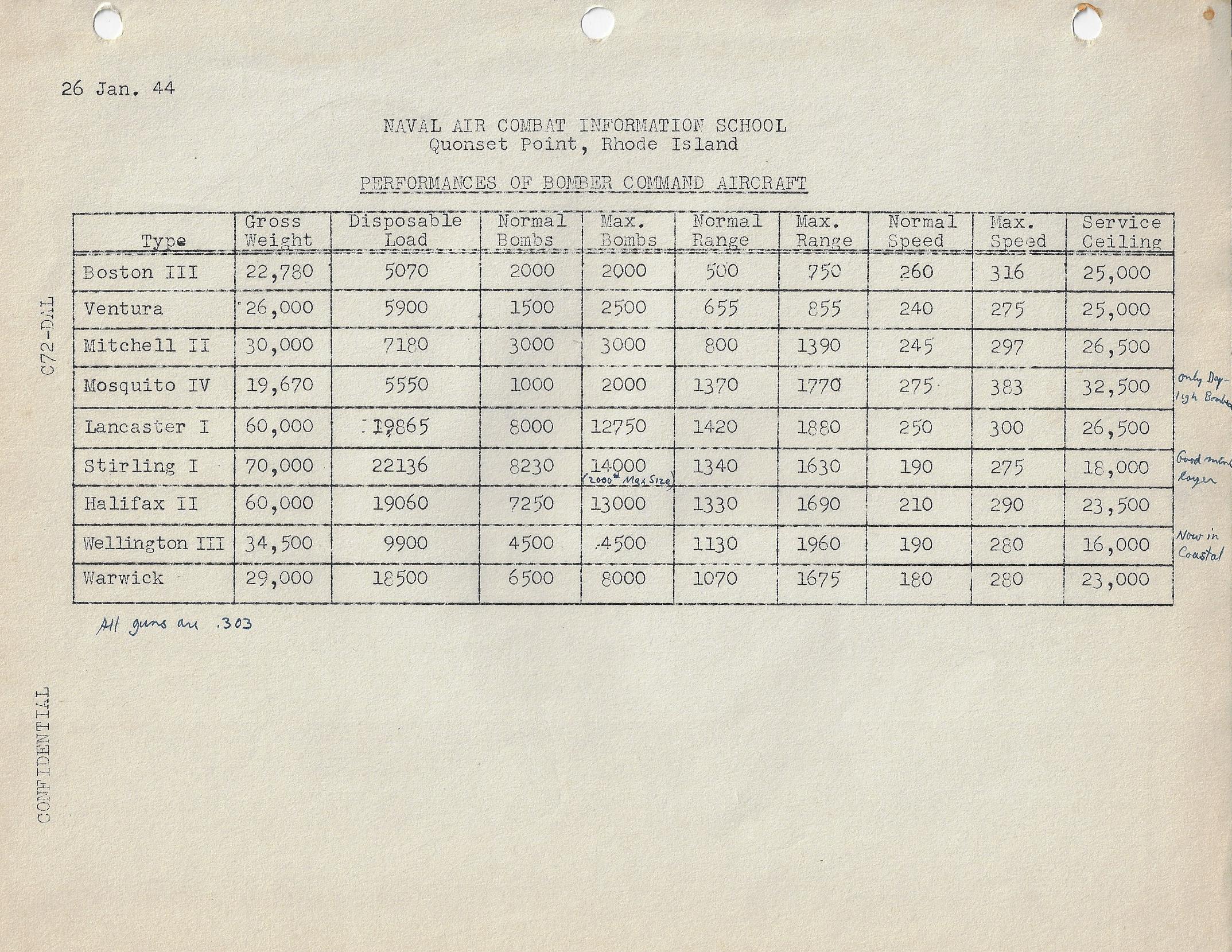
    This is another installment of interesting bits and pieces that have emerged from a notebook prepared (ca. 1944) by a naval student of the Naval Air Combat Information School at Quonset Point, Rhode Island. The printed text for the curriculum and classes for an intelligence officer given during the summer of 1944 are nearly all marked “RESTRICTED” in the typed original of the offset pages, and the entire document runs about 220pp.  It seems as though there is an elevated high-and-dry possibility here, but the fact of the matter is that there is a ton of great material, much of it unexpected. For example, in one section there was this three-page chart displaying major engineering factoids of British aircraft: 

    NACIS Air Command Bomber

    ·Posted by :

    ·in:


  • Maps of Nazi-Controlled Lands, Including Nazi Germany 1948 (Published in 1942)

    JF Ptak Science Books  Post 2718

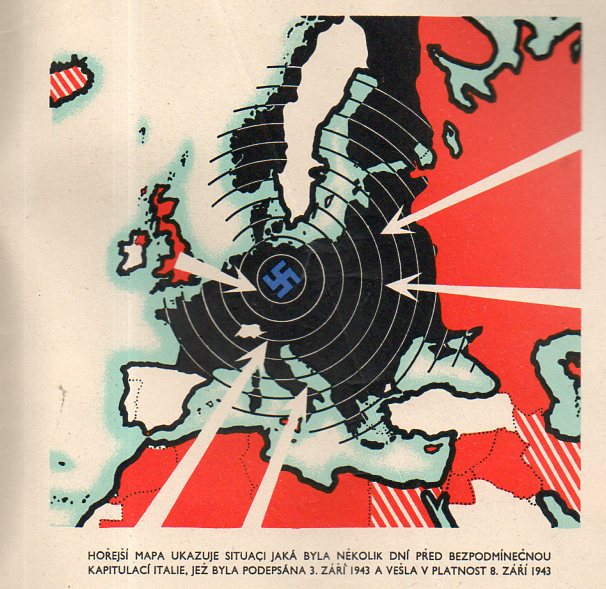
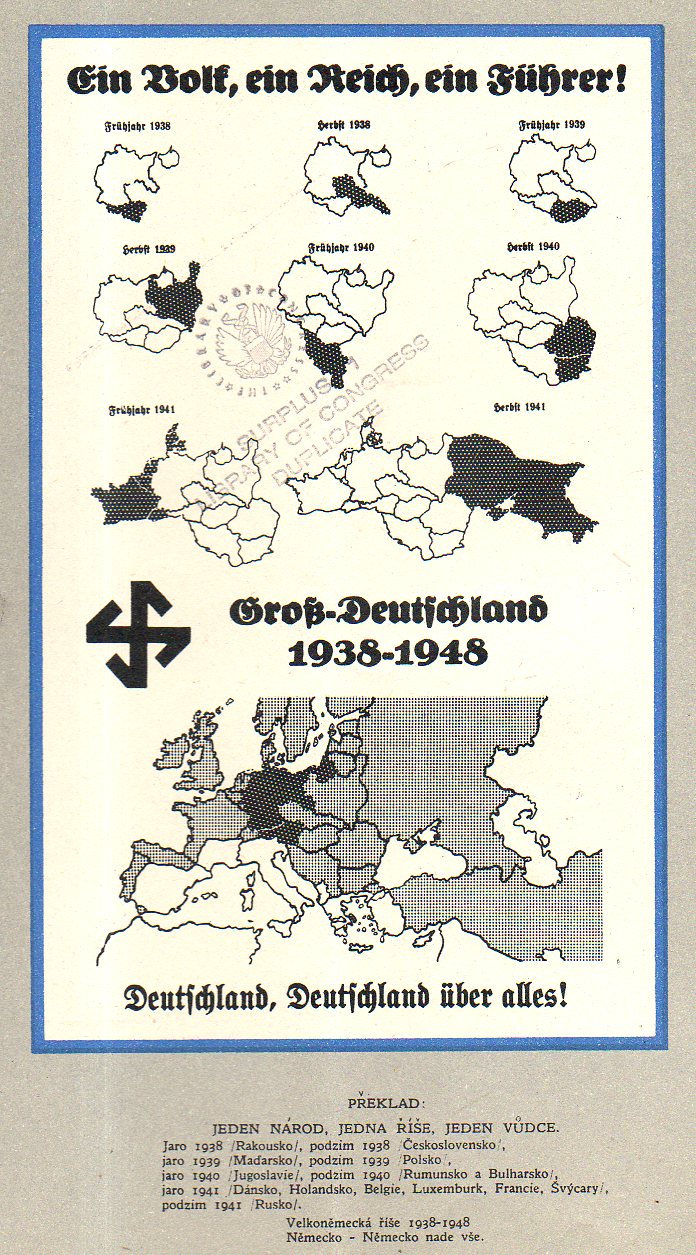
    Čtyři léta války v mapách (“Four Years of War…in Maps”), published in London, ca. 1942, is a curious, Czech-exile publication telling the story of the rise and fall of Nazi Germany in maps.  The culminating interest though shows the Nazis surrounded, and put to the final test–it is the first map I list, below, even though it was about the last map in the pamphlet. The “Ein Volk, Ein Reich…” map (the last map shown below), is a Nazi propaganda piece, reproduced here no doubt to show the audacity and hubris of the Nazi state, shows them with a vast territory, including Great Britain and the Soviet Union. I can’t recall having seen such a map depicting Great Britain as a captured entity.)

    [The pamphlet is 9″x 6″ and 35pp, with printed wrappers. It is a rare thing, this pamphlet, and it does not show up in the usual places. There are only seven copies located in the WorldCat/OCLC, all in top-notch libraries: NYPL, Yale, Harvard, Harvard Law, UC Berkeley, Oxford, and Nanterre.]

    1943:

    Maps Germany 1942183

    And the vision of the future, taken from a German design (poster? illustration?) showing the advance of the making of Greater Germany, showing countries conquered through 1940 and then countries that would be conquered, including the Soviet Union (which was to be taken in 1941) and also an occupied Great Britain, though no date is given for that.  

    1938-1948:

    Maps Germany 1938-1948175


  • On the Economic Efficiency of Poison Gas in Wartime (1921)

    JF Ptak Science Books 

    • Review: QUICK, Herbert. What About Chemical Warfare? The Newspaper Enterprise Association (1921) 15pp.
      7×5 inches. Fine condition. WorldCat/OCLC locates 6 copies. 
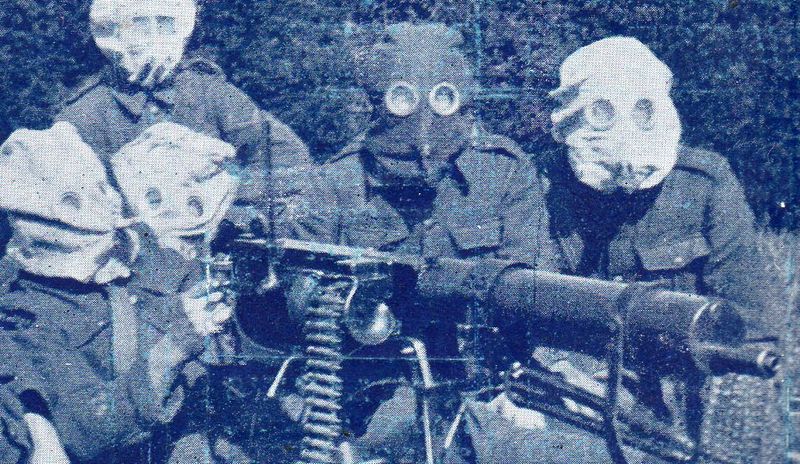
    WWI--gas machine gunb712

    [Image: Illustrated London News, October 30, 1915, detail of photo on front cover.]

    Herbert Quick did a fair amount of thinking about the military use of poison gas, and it winds up, in the
    final analysis, thinking that it was tolerable. What About Chemical Warfare? (published by the
    Newspaper Enterprises Association in 1921) is certainly a possible title for a Duck-and-Cover A-Bomb
    or You and Your Hormones kind of film. But Mr. Quick took the slow boat around his issue, thinking
    about it a little long and out loud, before coming to his final conclusion in the chapter titled “Gas
    Warfare Cheapest and Most Effective Arm of Defense”.
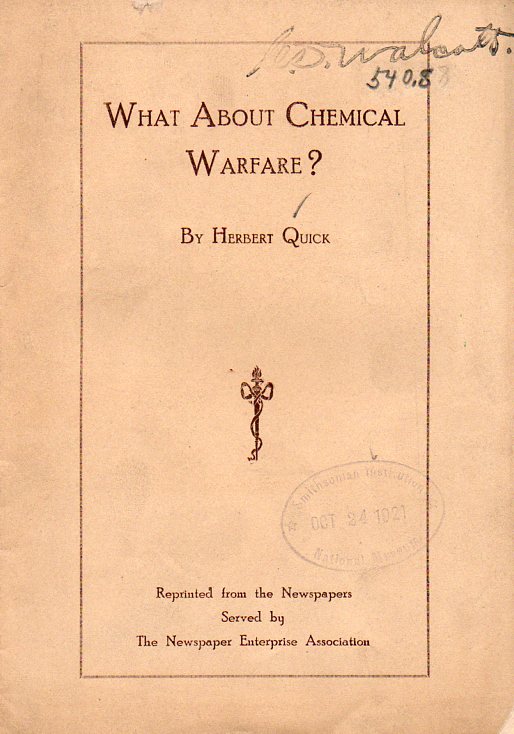
     

    [Internet Archive offers the full text : https://archive.org/stream/whataboutchemica00quic/whataboutchemica00quic_djvu.txt]

    He points out the enormous impact in the war effort that relatively small chemical corps played in
    WWI–something on the order of hundredths of one percent of all serving soldiers were employed in
    the combined chemical corps, saying “how small a body to produce such great results!” Which is true,
    assuming that by “great” he meant ‘widespread’, though it is unclear exactly what he was talking about.
    Quick does make a case for poison gas being not so inhuman as presented by most civilized people,
    pointing out both its high quick-death rate and survivability/recovery rates, which seems to be
    giving/taking at the same time. No matter: “But woe to the army or nation that does not keep up with
    the times. The Angel of Death will breathe in their faces” he writes.

    The author also warns that though Germany was “stripped” of her war-making capacities, he thought it
    was not so of the industries necessary to produce poison gas. He points out that Germany can produce
    these munitions in secret, and that if any “militaristic nation conquers the world in the future”, it will be
    through the use of the poison gas it developed in secret.

    Defense was also important: “in the absence of efficient defense worked out beforehand, our great
    cities might be wiped out with gas bombs dropped from aircraft”. Mr. Quick believes that protecting
    cities is possible, writing simply “preparation will prevent such a crisis”. Indeed. Unfortunately no
    ideas about this defensive posture were forthcoming, though he did bring himself around to writing
    about gas as a defensive tool. Against looters. And rioters. And snipers. “Gas puts the sniper in the
    power of his enemy” Quick writes, using the Marine action in Vera Cruz, Mexico, as a good example of
    where gas (“gas grenades”) would have come in handy.

    The bottom line is of course the bottom line, practically stating that poison gas as a weapon was
    indisputably more cost-conscious than anything else, by far, each dollar spent on chemical warfare
    being worth “from three to five hundred for the army”. Poison gas services Quick says should be
    pursued, because “gas warfare cannot be stopped until all war is stopped”.
    Gas warfare “gives the educated, intelligent nations the advantages over the people of lower
    civilizations”.

    “When both sides are prepared it is much less inhumane than war with bullets and high explosives; but
    it means horrible annihilation to the army which is unprepared.”
    It is an interesting exercise to replace “poison gas” with other types of weapons, just to see how it
    reads.

    Mr. Quick was up and down in his treatment of poison gas and war, though almost entirely down. One
    thing he didn’t see, that no one saw, really, was the use of a particular gas that was used to destroy
    millions of people, and which was developed quite in the open in Germany for many years, used for
    killing rats. The Nazis simply used it instead on people. No one saw Zyklon-B coming, and no one
    could have, even when they did.

  • The Soviet Union’s Statement on Being Attacked by Germany, July 8, 1941

    JF Ptak Science Books  Post 2715

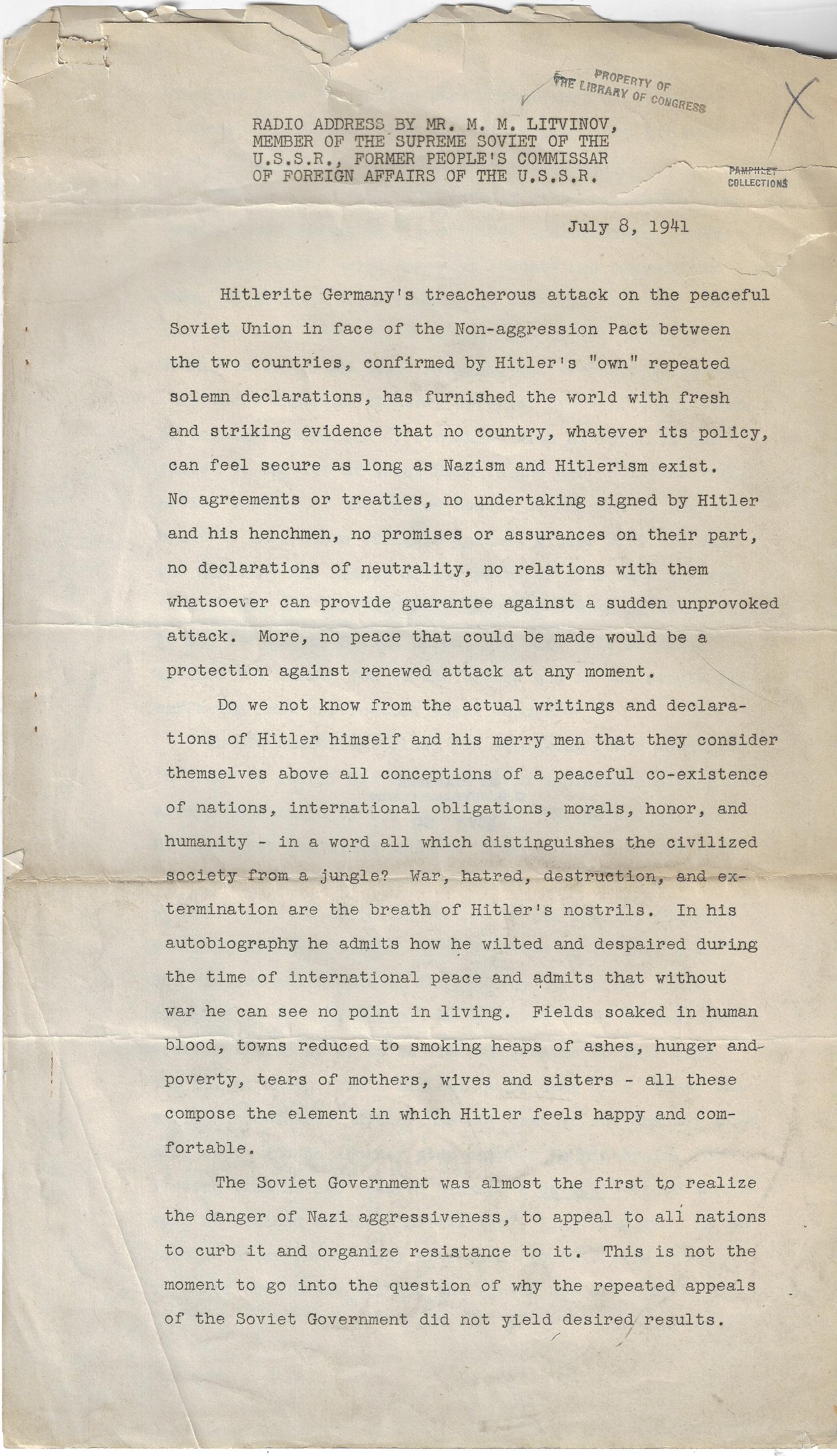
    Russia Litvinov _1_It is hard to criticize the Soviets when they were at their post WWI weakest, but I needed to point out a few, well, inconsistencies in the following statement by Maxim Litvinov. The text is that of a radio address by the mega-connected and high profile Russian revolutionary and People’s Commissar of the USSR, and it was delivered on July 8, 1941. At this point Litvinov (1876-1951)–who would in a few weeks become the Soviet Ambassador to the United States–was addressing the weeks-old attack and declaration of war made upon the U.S.S.R. by Nazi Germany.  

    It was a terrible and nearly mortal blow to the state, and Hitler’s vast overreach very nearly came to be. Still there were some bits in the address that were difficult to absorb. 

    For example Litvinov states: “Hitlerite Germany’s treacherous attack on the peaceful Soviet Union in face of the Non-aggression Pact…”  The Soviets did indeed sign a hands-off/so-no-evil Non-Aggression Pact (the Molotov-Ribbentrop Pact) with the Nazis in August 1939 and enjoyed the fruits of that special relationship, the two nations dividing conquered border states according to each other’s “sphere of influence”. So, this pact was “peaceful” only so far the U.S.S.R. is concerned, and not so peaceful for other nations.

    Then this: “The Soviet Government was almost first to realize the danger of Nazi aggressiveness…”, which seems hard to acknowledge when they shared a non-aggression pact/treaty in the early stages of WWII.

    Then the “veritable miracles of heroism” of the Red Army is “bearing the whole of Hitler’s powerful war machine and compelling him to transfer more and more forces from West to East”. I will not doubt heroism of fallen soldiers in a near lost cause effort, and it is true that the Germans would half- or mostly-exhaust themselves in the East, maybe more than that, probably, probably costing Hitler far more than he could ever have conceived. Stalin had already murdered his way through a large swath of the Soviet command structure, and was also unwilling to recognize that the Nazi attack was in fact the Real Thing. Stalin hesitated, and went incognito a little, and in general did not know what to do; he did come to his senses in short order, but a great amount of damage had already been done to Soviet defenses, and that would nearly cost him the country. But it didn’t, and the U.S.S.R. rallied, and at the cost of millions of lives killed the Germany armies in the East, and really was responsible for contributing in large part to the defeat of Nazism. 

    “Thanks to this the English people are enjoying a certain respite after twelve months of incessant bombardment…”, which was true to some degree.

    “Each blow struck now is ten times as effective and entails infinitely less expenditure and sacrifice than if it is delivered when anyone [sic] of his adversaries becomes weaker”. 

    And so on.  

    I’ve reproduced the 4-page document below.  

    ·Posted by :

    ·in:


  • A Fine and Seldom Seen Map from “PM” Newspaper: 1944

    JF Ptak Science Books   Quick Post

    Maps PM Aachen 1944 Oct

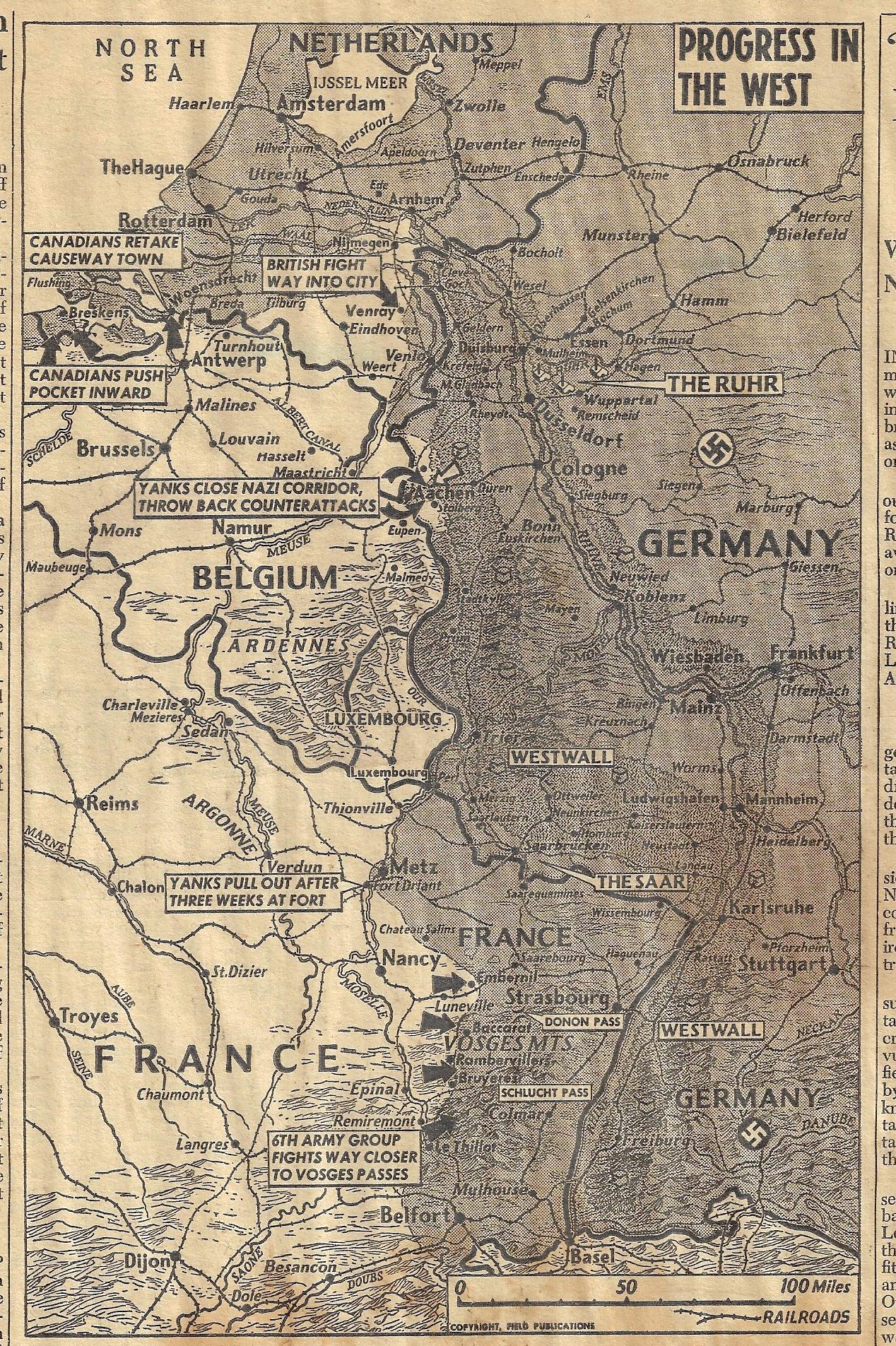
    Here’s a fine, nearly full-page (12″ tall) map that appeared in the great and now elusive newspaper, PM, showing the Allied advance into Germany , October 17, 1944. (I have written numerous times here about this newspaper–just search “PM” in the Google box at right for a number of other posts and a short history of the paper.)  The Allied forces here are nearly into Germany, nearly at the end of their victorious battle at Aachen (Oct 2-21), and pushing up against what was about the last line of defense for Germany, the Westwall (the older Siegfied Line). The Ardennes sits in the middle of this map, waiting for its own major action at the end of the year, which was the final German counter offensive, and the beginning of the end of the European war. 

    We’re going to hang out the washing on the Siegfried Line.
    Have you any dirty washing, mother dear?
    We’re gonna hang out the washing on the Siegfried Line
    ‘Cause the washing day is here.
    Whether the weather may be wet or fine
    We’ll just rub along without a care.
    We’re going to hang out the washing on the Siegfried Line
    If the Siegfried Line’s still there …

    ((Kennedy/Carr) Peter Maurice Music Co Ltd 1939)


  • A Penetrating Appraisal of Hitler, 1934

    JF Ptak Science Books   Quick Post

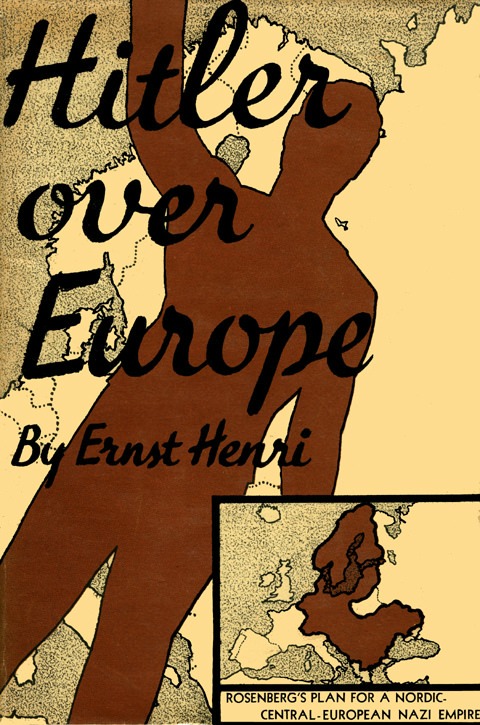
    Books cover Hitler over Europe“Ernst Henri” (a probable pseudonym?) wrote Hitler Over Europe in 1934–it is a very insightful appraisal of Nazism written early in the history of the newly-presiding party of German politics and life. This book was published in 1934 by Simon and Shuster and translated by Michael Davidson, and then published in Argentina and China the following year, and then in England by Dent in 1936. (I’ve checked WorldCat/OCLC and find the printing history a little confusing, but I think that this is about right–also there are more than 240 copies located in libraries worldwide, which means that it is or was a popular title.) 

    It is in the very first paragraph (below), where you can easily see that the author is using high octane. 

    It is interesting to set this appraisal of Hitler’s background and politics against the great Dorothy Thompson’s insights into the man when she interviewed him in 1932…and read him right and then very wrong. (“He is formless, almost faceless, a man whose countenance is a caricature, a man whose framework seems cartilaginous, without bones,” she wrote. “He is inconsequent and voluble, ill-poised, insecure. He is the very prototype of the Little Man. A lock of lank hair falls over an insignificant and slightly retreating forehead. . . .The nose is large, but badly shaped and without character. His movements are awkward, almost undignified and most un-martial. . . .The eyes alone are notable. Dark gray and hyperthyroid—they have the peculiar shine which often distinguishes geniuses, alcoholics, and hysterics…There is something irritatingly refined about him. I bet he crooks his little finger when he drinks a cup of tea.”–quote from Historynet.com http://www.historynet.com/encounter-dorothy-thompson-underestimates-hitler.htm)

    Henri, whoever he was, seems to have clenched his fist around the heart of Nazism. The book is at least worth a good solid browse:

    • The full text, Hitler Over Europe, can be found at the Internet Archive:  https://archive.org/details/hitlerovereurope009891mbp?q=%22Ernst+henri%22+hitler

    “Thyssen”

    “WHO sent Hitler?”

    “Many believe that it was the German middle class, that
    forgotten social force, which nobody thought about and
    which suddenly, in a rapid awakening, burst on to the
    political scene and smashed everything around it. So it
    seemed from without. This is an illusion.”

    ·Posted by :

    ·in:

    —

  • Debriefing Life Raft Usage by Air Combat Intelligence (1944)

    JF Ptak Science Books  Quick Post

    I was so surprised to find this 1944 checklist and review for an “Air Combat Intelligence Officer” of “Life Raft and Emergency Equipment Performance Report” (!).  It was in  a notebook prepared (ca. 1944) by a naval student of the Naval Air Combat Information School at Quonset Point, Rhode Island. The printed text for the curriculum and classes for an intelligence officer given during the summer of 1944 are nearly all marked “RESTRICTED” in the typed original of the offset pages.  The entire document is about 150pp long, and if there is interest in the contents I’d probably reproduce the entire thing–it is surprising how much can be learned and how much is revealed even in the multi-page lecture descriptions. 

    The document below addresses an odd internal issue of mine, something that I’ve sort of followed around in some fashion in reading about WWII in the air, and especially in the Pacific, and especially for the precautions and supplies aboard USAAF aircraft in the event of a ditching. I knew from incidental and second-hand reading exposure that these supplies changed quite a bit from 1942 to 1943, but I had no idea that there was such a debriefing schedule established for life raft usage. 

    I would really be interested in the answers to #17.  No doubt there is a collection of those answers, but I think I’ll just have to leave those to mystery. 

    NACIS Lifeboat

    ·Posted by :

    ·in:

    —