A Daily History of Holes, Dots, Lines, Science, History, Math, Physics, Art, the Unintentional Absurd, Architecture, Maps, Data Visualization, Blank and Missing Things, and so on. |1.6 million words, 7500 images, 4.9 million hits| Press & appearances in The Times, Le Figaro, Mensa, The Economist, The Guardian, Discovery News, Slate, Le Monde, Sci American Blogs, Le Pont, and many other places… 5000+ total posts since 2008.

Category: What is It?

  • Colossus in the Colosseum

    JF Ptak Science Books   Quick Post

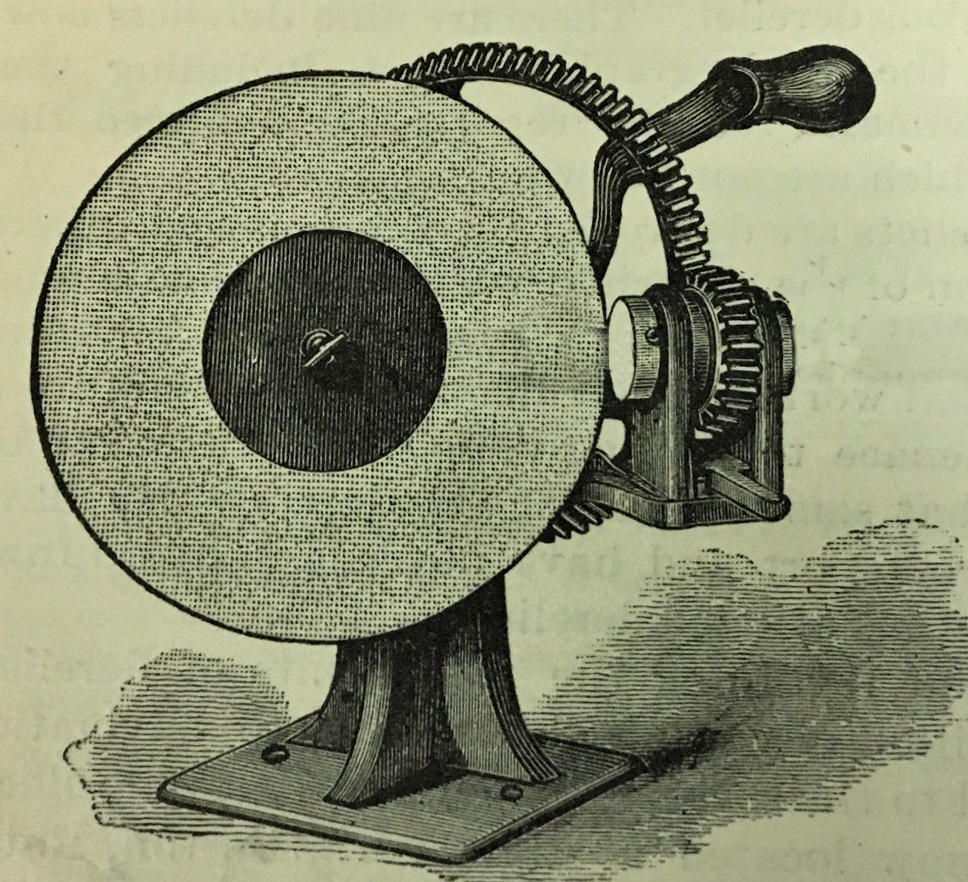
    Wimshurst machine205

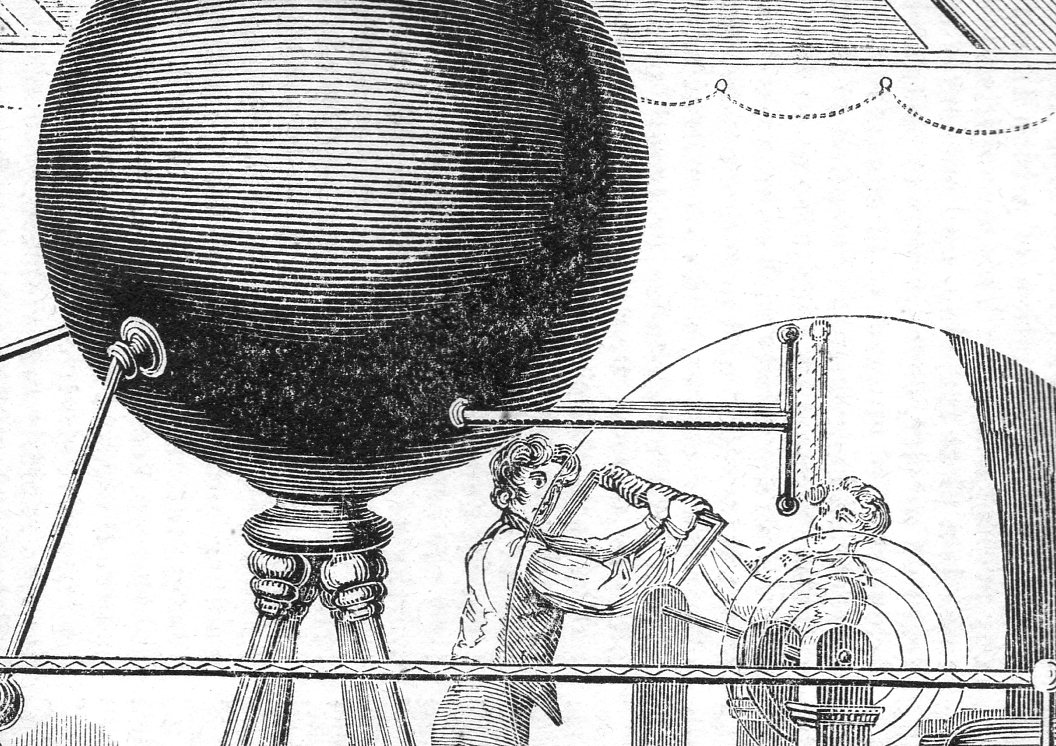
    Here’s an interesting combination of sweat and electricity–an enormous electrical device that was on display in an exhibit of “natural magic” at the Colosseum in Regent’s Park in 1839.  The large disk that the two guys are turning is actually larger in real life, being 7′ in diameter, the conductor being varnished copper, and the conducting balls being gilded–it must have been a very shiny experience, especially when they generated their electric spark.  In 1839 this was the largest electrical generating device in the world.  (I have a tiny version of that device here, something made out of old records coated with copper and found ball glasses acting as Leyden jars, all painted and varnished, the work of an 8 year old in 1925 who went on to a career in astronomy and became the most celebrated eclipse follower in the mid 20th century.)

    This monster is made just 39 years after Volta’s first battery was made,  and not long after Oersted generated the first magnetic field from an electric current in 1820, the same year as Ampere’s solenoid. There were many quick and brilliant development from then to 1839 (also the year in which Daguerre perfected his collaborative work with Niepce to produce the photographic camera), not the least of which was the  Davidson’s creation of the first electric motor car/land locomotive, again in that same full year of 1839:

    ·Posted by :

    ·in:

    —

  • Daily Dose from Dr. Odd: What is It? (1887)

    JF Ptak Science Books   Quick Post

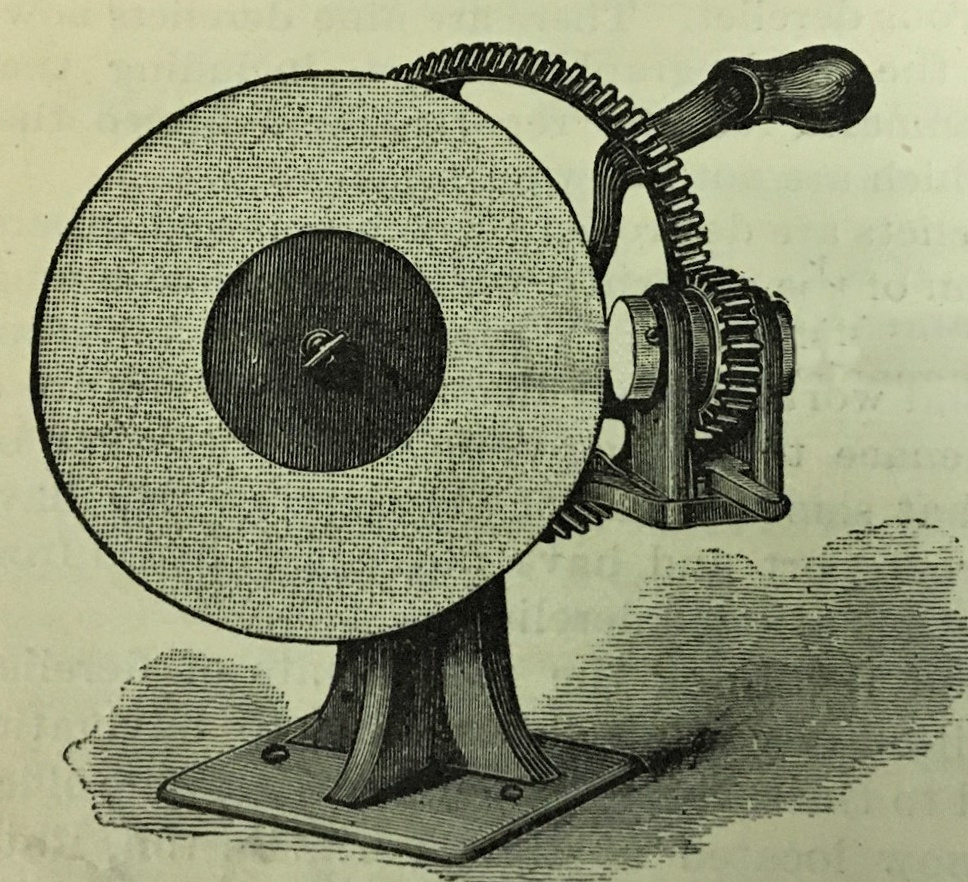
    What is it? You’ll be surprised at what this device does, given the gear, and the weight, and the utter simple beauty of the thing. 

    Answer below! 

    IMG_2275 (1) (1)


  • Life in Stone–Some Interesting Work by the Great Fr. Kircher (1678)

    JF Ptak Science Books   Post 2825

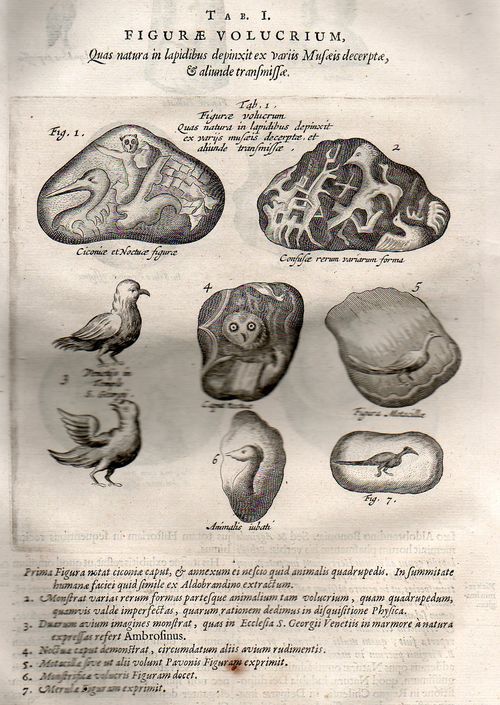
    The great semi-mystifying polymath Athanasius Kircher (1602-1680) lived for a long time and filled his life with ideas and words,  producing dozens of books during his time on Earth, some of which were never published even though written, some manuscripts lost forever. His was a massive output of extraordinary breadth.  He wasted little time what I can see, writing on a spectacular range of subjects, enlightening people, confusing people, generating great theories and some bad ideas. 

    The images below comes from his Mundus Subterraenus (“Athanasii Kircheri Mundus subterraneus in XII libros digestus… “), an edition published in 1678, and which was concerned mainly with geology and the theory of the Earth.  Kircher a product of the great Jesuit institution, the Collegio Romano, postulated the structure of the interior of the Earth, the origin of heat, the source of the tides, the composition of light, mechanics, the structure of music, linguistics, astronomy, and of course the existence of the Virgin Mary in amber.  There was also a fair amount of work on one of his side interests that populated a number of his works, alchemy and the search for the organization of materials.

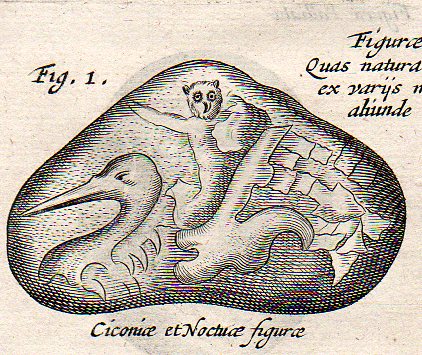
    But what I am looking at today with Kircher is the Mary-in-Amber part, his investigations (and theorizing, and documentation) on naturally-appearing, organic objects found in inorganic material–rocks and minerals–like these birds:
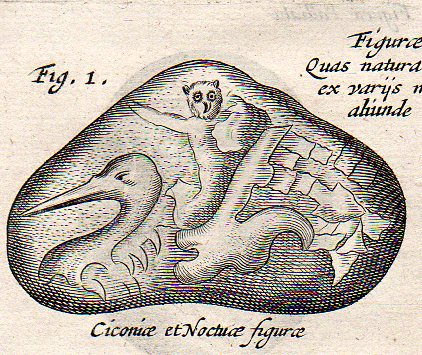
    Kircher  lapidibus birds451

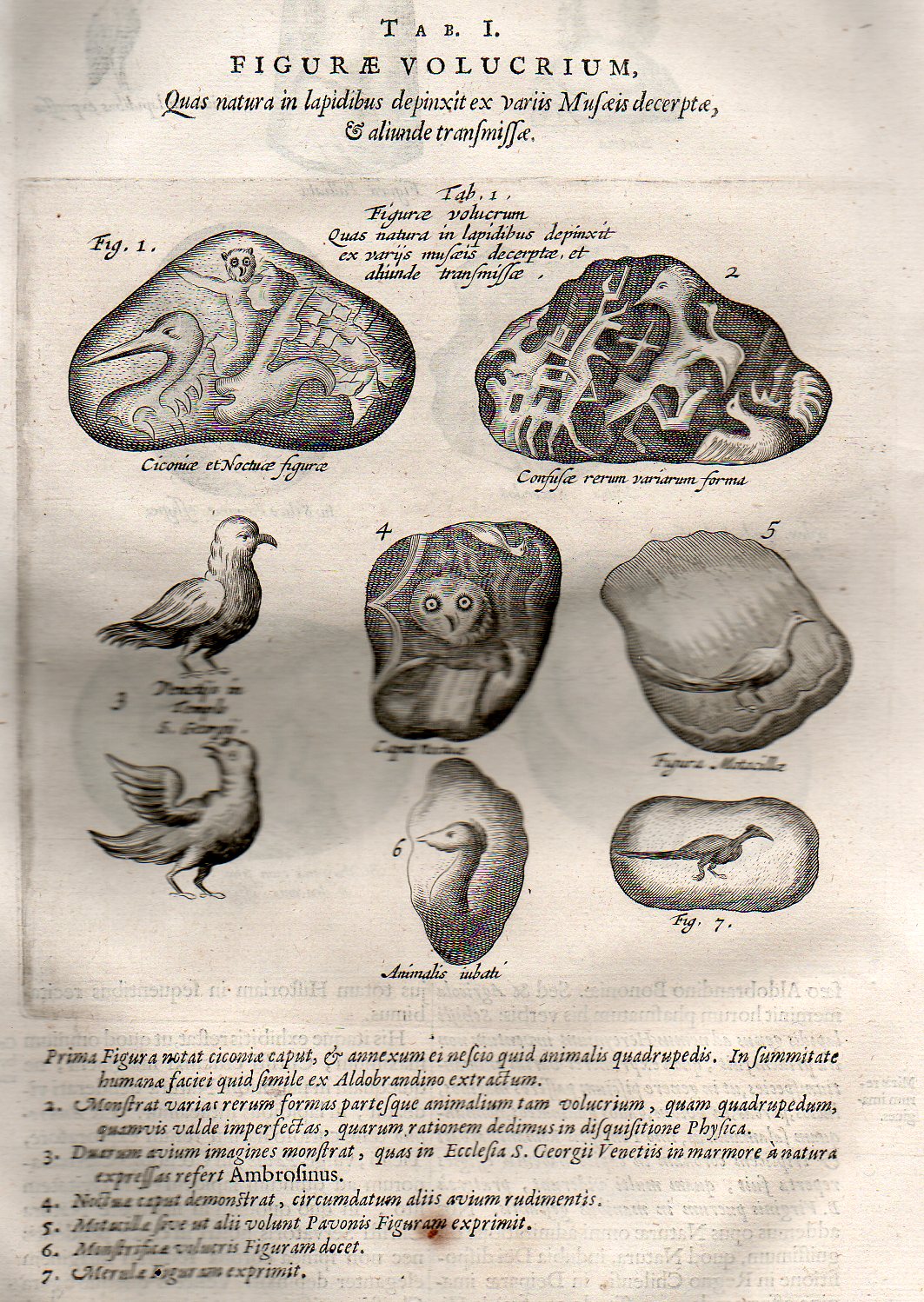
    Which is a detail from  

    Kircher  lapidibus birds449

    The engraving, entitled Figure Volucrum, quas Natura in lapidibus depinxit, ex variis Museia decerpt et aliunde transmissa (or “Figures of winged creatures, painted by nature on stones, taken from various museums, and otherwise transmitted.”) shows Kircher’s collection of anthropomorphically based inorganic items.  It is a remarkable exercise to try and place yourself within the context of the scientific world of Kircher’s time, 350 years ago, and try to explain these naturally-occurring phenomena, without even the benefits of the conception of long geologic time, or of expanded time in general.  

    The descriptive text (at the bottom of the engraving) from Kircher on these objects is translated, as follows:

    1.  The first figure represents a head of a Stork, together with some, but I do not know what, quadruped. At the top is something like a human face. Extracted from Aldobrandinot (see PI. XXIII. Fig. 1). 
    2.  Shows various forms and parts of animals, winged creatures as well as quadrupeds, although very imperfect, the cause of which we give in the physical examinations (see PI. XXIII. Fig. 2). 
    3.  Represents the figures of two birds expressed by nature on marble in the church of St. George’s, at Venice, referred to by Ambrosinua (see Vol. VII. PI. II. Figs. 3, 4). 
    4.  Shows the head of an Owl, surrounded by rudiments of other birds (see PI. XXIV. Fig. 2). 
    5.  Represents the figure of a Wagtail, or as others prefer, of a Peacock (PI. XXIV. Fig. 3). 
    6.  Shows the figure of a monstrous bird (Vol. VII. PI. II. Fig. 4). 
    7.  The figure of a Merle (Vol. VII. PI. II. Fig. 5).
    ·Posted by :

    ·in:

    —

  • Finding Anthropomorphism in an Electric Chair Patent (1897)

    JF Ptak Science Books  Quick Post

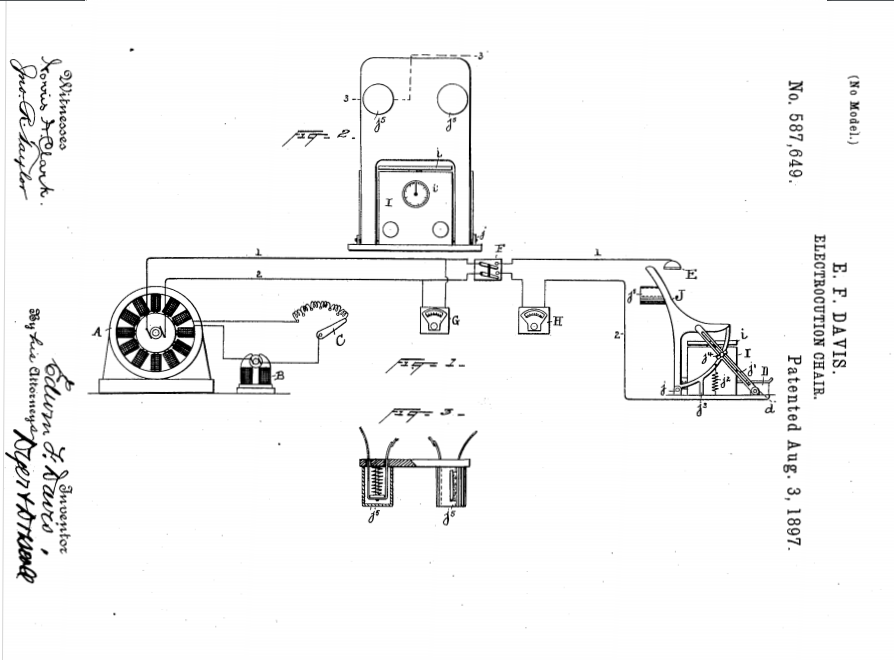
    This image of among the first electric/electrocution chairs is based on the designs of Dr. Alfred P. Southwick (1826-1898, MDS, DDS, SUNY Buffalo), who came up with the idea and started experimenting with it beginning in 1881. His was a mission of mercy, looking to find a quick if not instant salient to carry out the death penalty of a convicted murderer. NY Governor David B. Hill (1843-1910) looked to Southwick for a solution to a more humane way of executing people, establishing a distinguished panel of advisers to help him with this task. (In the small-world department, Hill succeeded Grover Cleveland as governor in 1885 following Cleveland’s election as president of the U.S.–he also acted as executioner in at least two cases while he was the Sheriff of Erie county in the mid 1870s.)

    Southwick’s design/chair was first used on the condemned criminal William Kemmler in August 1890. Most everyone who witnessed this first attempt were aghast at the spectacle; George Westinghouse is reported to have uttered that the executions “would have been better off using an axe”. Theoretically the first application of electricity kills the brain in less time than it takes the body to respond to pain. This seems not to have been the case in many instances.

    No tong afterwards Edwin F. Davis (1846-1923) conducted his own research on an effective and humane way to execute people and was awarded a patent in August 1897 for his “electrocution chair”. Davis would serve as NY state’s “electrician”/electrocutionist from 1890-1914, delivering the final blow to 240 of the condemned during that time.

    It was strange to me how anthropomorphic the design was, including the obvious head and less so for arms and feet. Overall, I think the relationship to a human form is unmistakable. 

    Electric chair patent

    Excerpt from the article illustrating the 1888 electric chair:

    “Execution by Electricity. The State of New York may pride herself in the fact that the gallows is to be banished and a more humane and scientific method of executing criminals is to be instituted. On June 4 Governor [David B.] Hill signed the bill authorizing that criminals should be put to death by an electric shock. The bill is to go into effect on January 1 1889 and new method of execution be applied in the punishment of crimes committed after date.”

    SciAm writes that “instant death” occurs with the electric chair—it doesn’t. The condemned would be lucky to have their brains damaged enough to not register pain, as it takes 45 seconds to several minutes for death to occur.

    “…the criminal is seated bound to a chair having a metal seat connected with one pole of the current. At the back of the chair there is an adjustable head rest having a metal plate on its face and a metal band which passes around the forehead of criminal. The wires may be connected with dynamo which according to the bill may be of any approved type or the current may be supplied from electric light plant or there may be a private plant arranged especially for that purpose at the place of execution. Sponges or dampened cloths should be at the points of contact with the convict to render connection more perfect. At the proper moment switch is turned by the officer and instant death ensues. The current passes along the spinal column and the brain and nerve centers. The current may be few moments to bring about complete exhaustion.”

    Scientific American, 30 June 1888, vol 58.

    ·Posted by :

    ·in:

    —

  • Tech Quiz: an Elevation of an Elevation (1880)

    JF Ptak Science Books   Quick Post

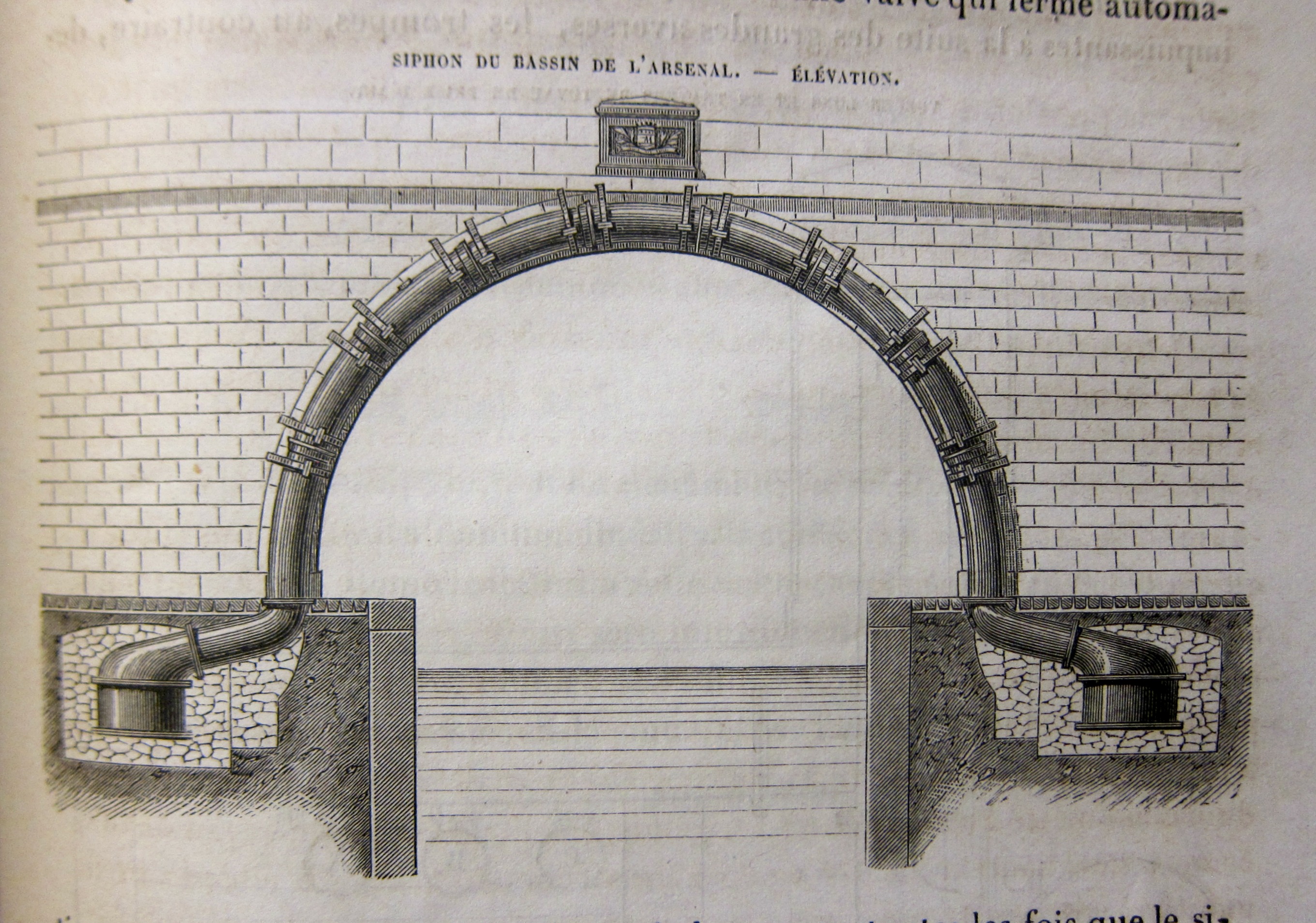
    This is just a lovely little mechanical drawing that I found in the pages of the 5 May 1880 issue of the Comptes Rendus de l’Academie des Sciences and I decided to share it. The Comptes Rendus is a very old workaday maintstay in my job, and I have become very familiar with it over the years, and in its great heyday in the 19th c it published all manner of scientific events over many disciplines, and at the highest level for each field. I’ve never really paid too much attention though to the illustrations in the journal as general “art” as I have done with other journals (like the Annalen der Physik)…why, I don’t know. In any event I was working on a two-part Pasteur paper in this volume and noticed this elevation of a “siphon” for Napoleon’s canal Saint-Martin, which is just about at the center of old Paris. 

    SciArt CR 1880 Siphon

    The structure does look a little like a headphone, and as pretty as this is, it subject matter wasn’t. This is a sewer line that would allow the sewage and etc. to flow over the canal along the arch of a bridge…which makes this an interesting problem. I mean, it is a necessary and important thing, dealing with waste, and that is exactly what this pipe was all about. 


  • The Department of “What is It?” (#2)

    JF Ptak Science Books  Quick Post

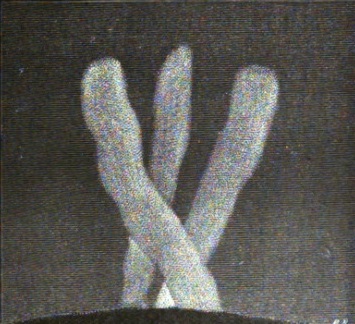
    Our “What is It?” image for today is the following:


      What is it aurora

    Hints:

    (1) this could be microscopic, but it isn’t; as a matter of fact, this is enormous;

    (2) this is a side view,

    (3) from space,

    (4) and was drawn in 1891.

    (5) That rounded bit on the bottom is the Earth.

    Answer: 

    ·Posted by :

    ·in:


  • The Department of “What is It?” (#1)

    JF Ptak Science Books   Quick Fanciful Post 

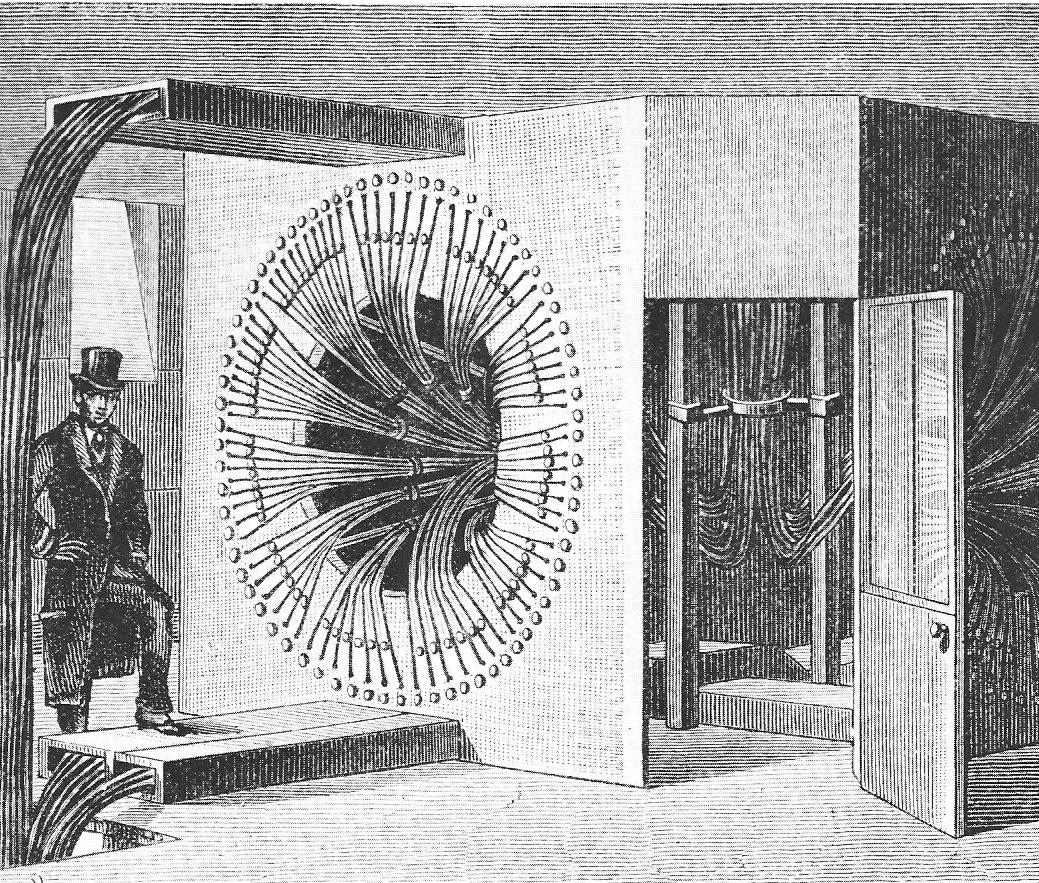
    On a recent reading graze I found this most interesting image and thought that it could be a number of things besides the thing that it really was:

    What is it Paris telegraph nodes

    So, what is it?

    A) An attempt at a Time Machine.  (Stephen Hawking said  “[i]t seems there is a chronology protection agency, which prevents the appearance of closed timelike curves and so makes the universe safe for historians”.  Feh for our story line and image! We’ll let this stand and say that this would be a Wellsian vs. Thornian time machine.)

    B)  A Victorian listening device for extreme and well-to-do introverts that allows for the home dweller to stay inside and listen to everything that is going on in the immediate vicinity of their house.  The remarkable bit here is that it was discussed that a retired physician, Manbot Fettle Dolp had one of these devices installed at his house in Kensington and actually recorded some 100 Edison cylinders worth of found sounds, an acoustical portrait of high Victorian London that without his effort would have been completely lost.

    C) A tailoring device that would automatically record all physical attributes of a customer when they passed through the thing–it turns out that physical anthropologists used the device first to record all body aspect of criminals for a database of “what criminality looks like”, but the results and tests were abandoned after it was determined that the author of the study, Rev. Fitzwilliam Fitz William, was the perfect average of the criminals he measured. Rev. Fitz William said the results were obviously “deeply and irretrievably wrong”, though he did have some thoughts on the redemption of the project when writing from his prison cell twenty years later in Reading Goal. 

    D)  The terminal of a central telegraphic station. (“The requirements of telegraphic communication on a large scale created widespread telegraphic networks. The “nodes” of a network, shown here, involved a respectably large number of circuits.”)

    Answer below the “Note”:

    Note:


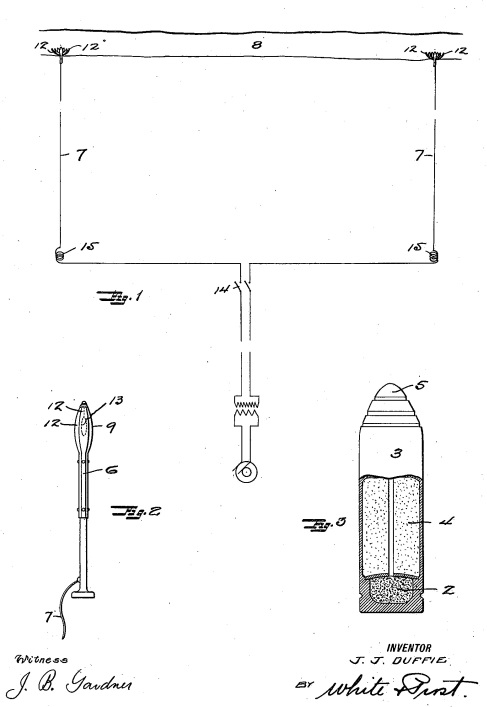
  • Department of “What is It?” (#9) A New Way of “Conducting” War.

    JF Ptak Science Books   

    The hint for this WIT? is already given in the title to the exercise–that said, can you figure out exactly what is going on here? It is a lot more complicated than you’d think, but at least part of the answer is pretty much a given when looking at the patent drawings.  The tricky part of the answer here is knowing how this thing would be so lethal.  

    Here’s the drawing:

    WWI trench electrocution detail

    ·Posted by :

    ·in:

    —

  • Department of “What is It?” (#8) What Monster-Pop Mega Thing Did This Become?


    ·Posted by :

    ·in:


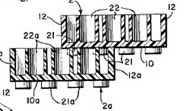
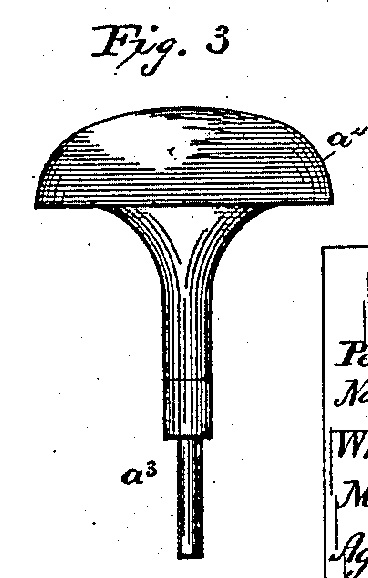
  • The Department of “What is It?” (#7): What are the Ultra Famous Holes that this Hole Puncher Punched?

    JF Ptak Science Books Quick Post

    This is one of the most important hole punchers in the history of holes, and also in the history of counting and figuring out what to do with counted things.  Do you know who filed this drawing as part of their patent report, and what famous contribution this thing made? 

    What is Itt ollerith hole puncher detail

    ·Posted by :

    ·in: