A Daily History of Holes, Dots, Lines, Science, History, Math, Physics, Art, the Unintentional Absurd, Architecture, Maps, Data Visualization, Blank and Missing Things, and so on. |1.6 million words, 7500 images, 4.9 million hits| Press & appearances in The Times, Le Figaro, Mensa, The Economist, The Guardian, Discovery News, Slate, Le Monde, Sci American Blogs, Le Pont, and many othr places… 5000+ total posts since 2008. Contact johnfptak at gmail dot com

Category: Memory, Historry of

  • A Beautiful Calendar Calculator (1562)

    JF Ptak Science Books  Quick Post

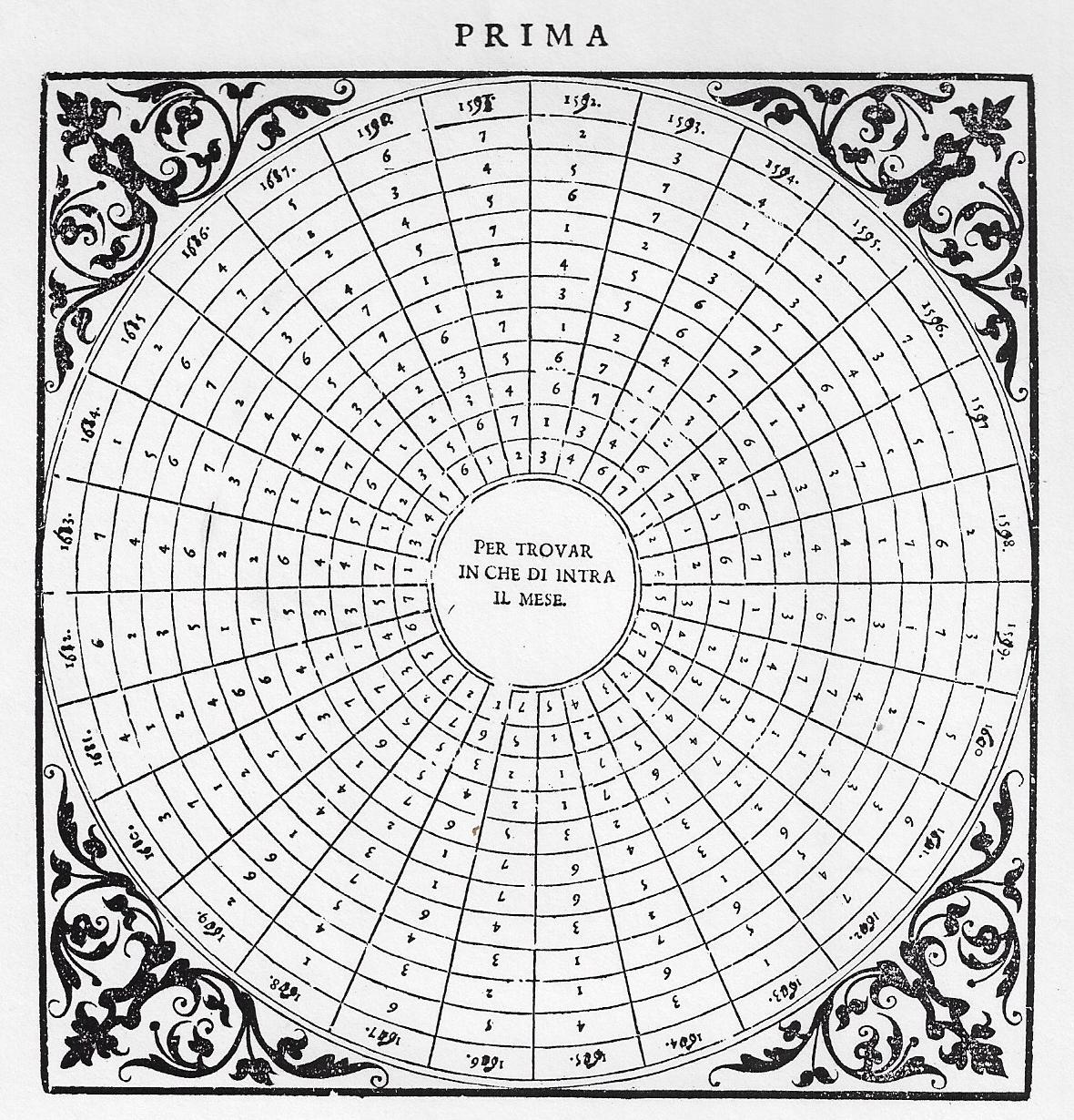
    Giorlamo Cataneo provided us with this gorgeous circular calendar calculator in his Rote Perpetue…, published by Francesco Marchetti in Brescia in 1562. This is the third-from-last of 58 such tables that illustrate this elusive work.  Cataneo (1540-1586) was an Italian engineer and architect who published at least eight works, many of them quite beautiful, including the fortifications book Dell’arte del misurare libri due, nel primo de’quali s’insegna à misurare, & partir’ i campi, which is a particularly lovely thing.

    Calendar calculator

    Illustration from:  

    Rote perpetue, per le quali si puo con qual numero di due dadi si voglia : overo con due dadi secondo l’horologio d’Italia : ritrouar quando si fà la Luna : le Feste mobili : la Patta : l’Aureo numero : l’Indittione, la Lettera domenicale col bisesto et in che giorno entra il principio d’ogni mese  di. m. Girolamo Cataneo.

    Another source for the full book, Internet Archive: https://archive.org/details/bub_gb_1ky_MGsNW3AC


  • The First Appearance of a Monument in the History of Ambiguity (1832)

    JF Ptak Science Books   Post 2678

    “Hee beganne to stande in great ambiguitee of his saftie.”–P. Vergil Eng. Hist (1846) I. 160, ca. 1560

    “Shall I make spirits fetch me what I please, Resolue me of all ambiguities”– Marlowe Tragicall Hist. Faustus  (1604)   [Both quotations via the OED]

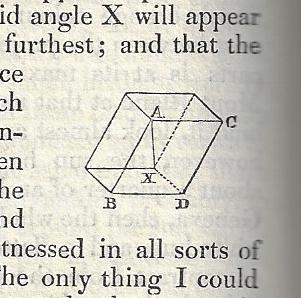
    First Appearance of a Famous Optical Illusion–the Necker Cube (Necker’s Cube), 1832

    Humans do not normally see one thing two different ways at the same time, unless they are confronted with something that Louis Necker thought up 15 decades ago. I am referring to the wide swath of humanity mostly here in the West with a mostly hard pull to binary interpretations, and not so much so for other belief systems that are more accommodating to multi-dimensional interpretations, like  say the clarity/ambiguity inherent in Taoism (though the definition of “Taoism” is usually ambiguous in itself). Also I’m speaking  more physiologically/psychologically than anything else more so than yin-yang metaphysics.  

    Buried in an interesting (and illustrated) article in this Philosophical Magazine1 of 1832 is the first appearance of one of the most famous optical illusion images of all time–the Necker Cube. this construction–named for Louis Necker–has now been used for many years in tests on human perception (and in some areas for psychological interpretation, depending on who sees what and when).   In its original appearance the cube is mostly given a textual description but it does appear once as a tiny rhomboid–tiny or not, it really does do the trick.  (“He shows that you may see the Necker cube in either perspective, but that you practically can not see it as a flat geometrical design in the plane of the paper.”–Science 8 Jan. 37/2 . “He did not experience the usual spontaneous depth-reversals of the Necker cube—which appeared to him flat.”–Oxford Companion to the Mind, 96/1, 1987. “The reason an optical illusion such as the Necker cube outline..works is that, in some deep biological sense, you are of two minds on the question of what to see.”–Scientific American, Jan. 18/1, 2001. “It is a simple wire frame drawing of a cube with no visual cues as to its orientation, so it can be interpreted to have either the lower-left or the upper-right square as its front side…”–Wiki) 

    According to the Oxford English Dictionary it turns out “Necker Cube” doesn’t make its first appearance as a phrase for another nearly 70 years, surfacing in 1901 in an article by the psychologist E. B. Titchener in  Experimental Psychology (I. ii. ix. 309):  “The Instructor should have a few prepared as large wall-diagrams:..Schröder’s stair-figure, Necker’s cube,..the Müller-Lyer figure.” In any event, so far as I can determine, this is the first appearance of that famous construction. 

    Optical illusion


  • Darwin’s “Biographical Sketch of an Infant” (1877)

    JF Ptak Science Books   Quick Post

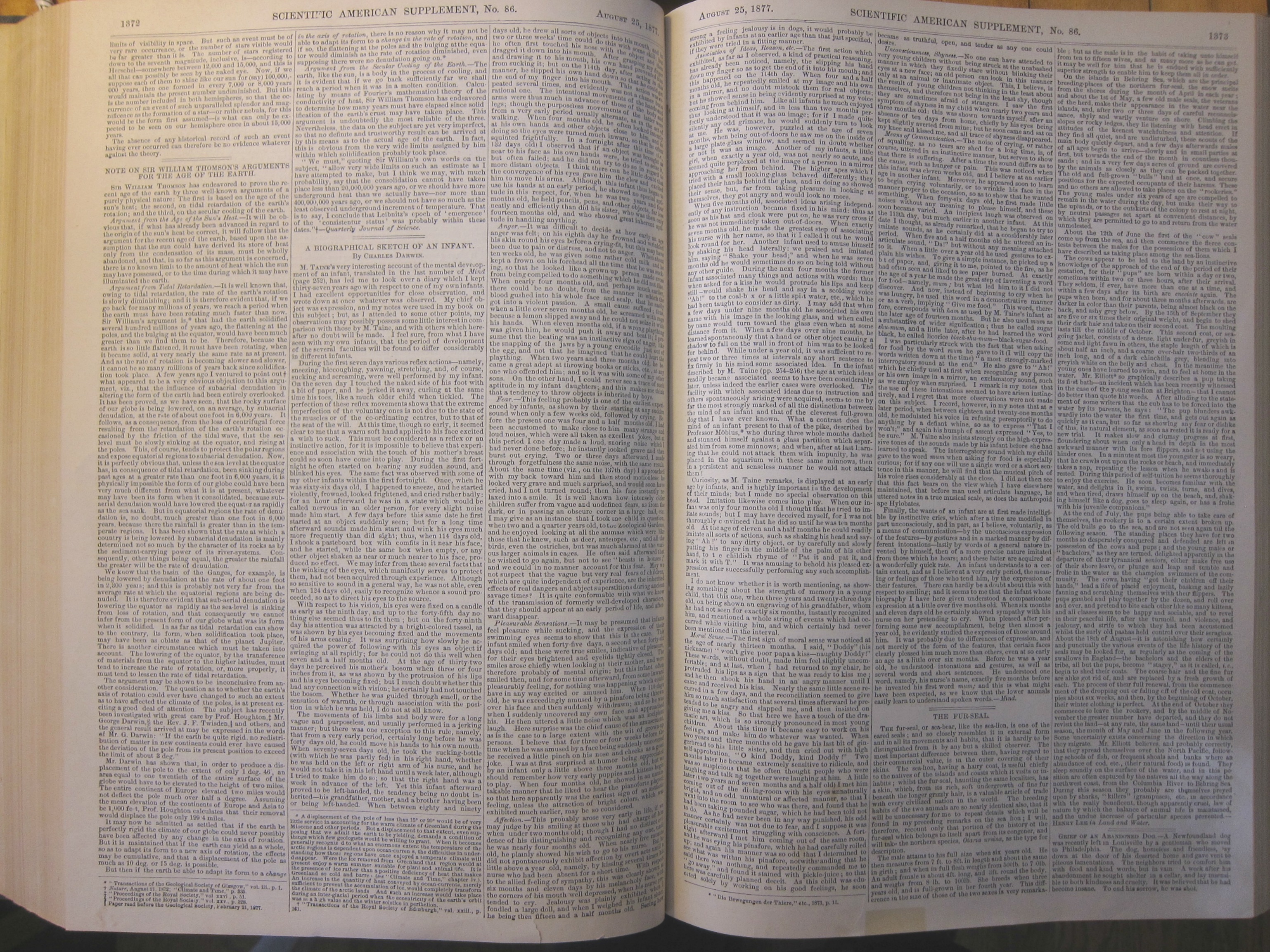
    I found a very interesting and unexpected bit in the always-fascinating Scientific American Supplement for August 25, 1877.  In the middle of the weekly issue, following a James Croll article on the age of the sun and a William Thomson piece of the age of the Earth, and just pages away from a semi-famous illustrated piece by A.M. Worthington on his observations of liquid splashes, came a long and densely-printed contribution by Charles Darwin, “A Biographical Sketch of an Infant”.  This first appeared a month earlier in Mind, and printed in nine pages–the Scientific American version is printed on two, as I show below. I find this remarkable, in a way, that the SA would do such a thing and be successful with it, fitting in as much info as possible in the least amount of space.  

    Darwin infant 1877

    {Image very expandable.]

    In any event, the article by Darwin is pretty interesting, and the experimentalist/clinical observer in him was applied to watching the first months of the birth of his first son (William Erasmus Darwin, 1839-1914). I found at the superb Darwin-Online website a reference to Darwin’s activities and the birth of William in his Autobiography: “My first child was born on December 27th, 1839, and I at once commenced to make notes on the first dawn of the various expressions which he exhibited, for I felt convinced, even at this early period, that the most complex and fine shades of expression must all have had a gradual and natural origin.” And indeed he does, establishing in his second sentence “I had excellent opportunities for close observation, and wrote down at once whatever was observed”. Darwin certainly would have had a chance for a observation as the subject’s father, but I am sure that he was being clinical/professional about the whole undertaking, and so the understatement.  

    I include my own version of the Darwin paper (below) as well as a link to the OCRd version from the Mind original from the Darwin-Online website: 

    • http://darwin-online.org.uk/content/frameset?pageseq=1&itemID=F1779&viewtype=text


    ·Posted by :

    ·in:


  • St. Peter Judges the Loyalty and Eternal Possibilities of the Confederate Soldier (?)

    JF Ptak Science Books   Quick Post

    Confederate st. peter

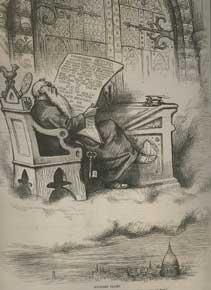
     This provocative image by the redoubtable Thomas Nast (Harper’s Weekly, 15 February 1879) shows St. Peter (with his keys to Heaven’s fortress gates dangling at his side) reading the Congressional Record’s report of Louisiana Congressman (Ezekiel John) Ellis. Ellis, a New Orleans native who served in the Confederate Army and was Congressman from 1875-1885, wrote that the Confederate soldier served in loyalty to his country and to his God. The Northern (and German-born) Nast seems to have taken exception to that, giving St. Peter the inclination to judge these soldiers for himself once their ultimate calling came.


    ·Posted by :

    ·in:

    —

  • Away, Down the Dark Tunnel of Creation….

    JF Ptak Science Books   Quick Post

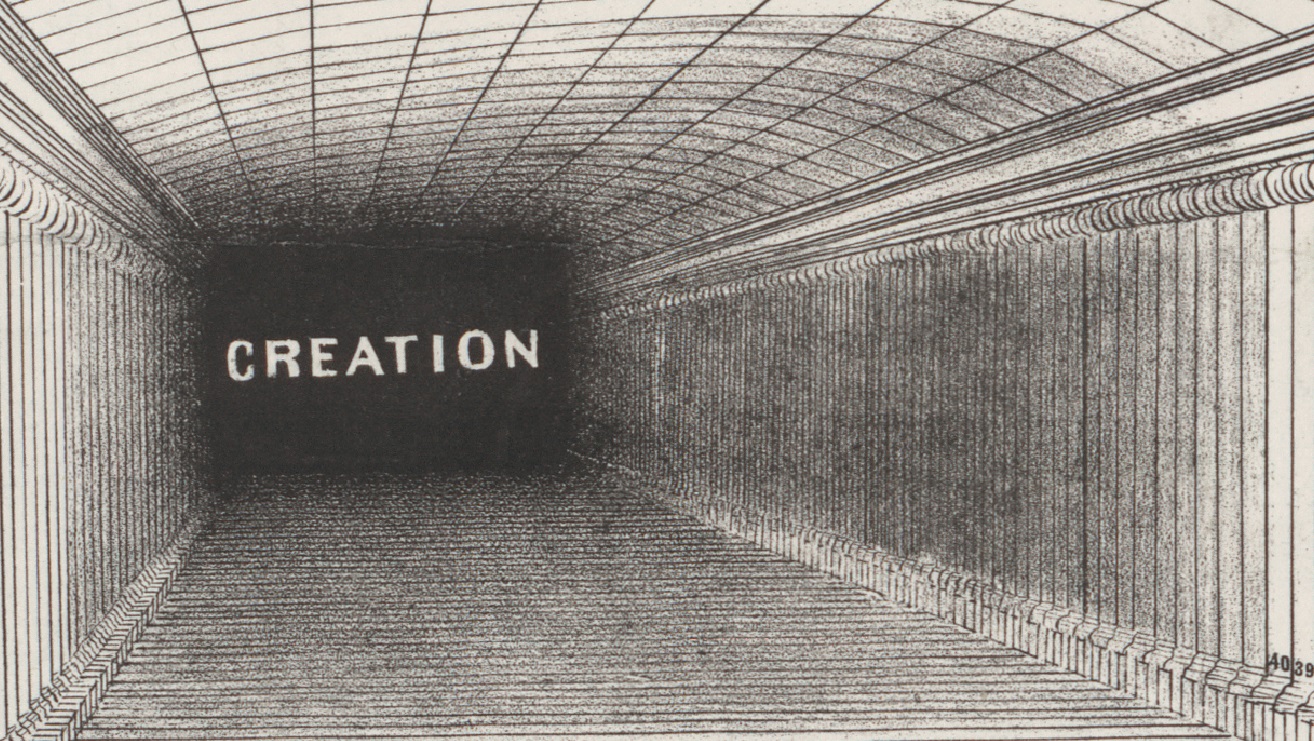
    Infographic Emma Willard detail

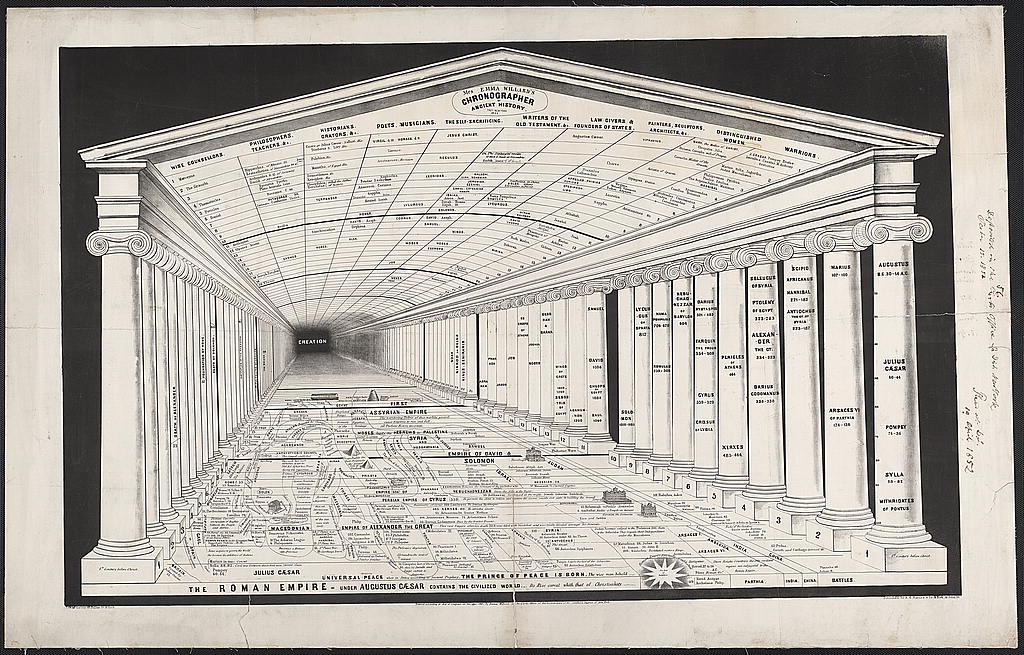
    Emma Willard (1819-1870) has been described as an “apostle” of female higher education in the U.S. She wrote some interesting texts on American history, concentrating in the telling of the story by chronology, and using some interesting visual aids to focus the readers’ attention in a condensed manner. She created several memory palaces in her imagery, making it easier and perhaps more elegant for her readers to be able to more easily record the progression of history.

    The “dark tunnel of creation” here is the background of the events of history housed by an ionic temple–in the original (from the Library of Congress) the word “Creation” is really quite small, and then surrounded by a considerable well of darkness, the millennia slipping by without index or notice, until they don’t. 

    And the full image (images via the Library of Congress, http://www.loc.gov/item/2005694445/):

    Infographic emma willard small version

    (Mrs. Emma Willard’s Chronographer of ancient history, published in Troy, New York, printed by lithography via Sarony of NYC.

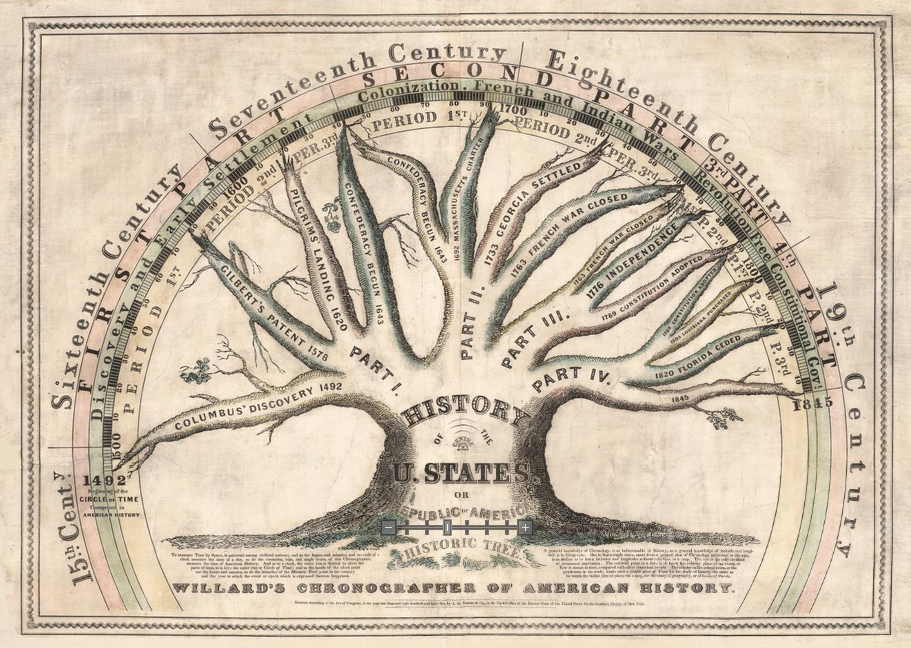
    Emma Willard also produced this beautiful chronological print, meant to be displayed no doubt on a schoolroom wall:

    Willard chronographer of american historyTree of chronology [Source: via DavidRumsey.com maps:  http://www.davidrumsey.com/luna/servlet/detail/RUMSEY~8~1~240521~5512286:Willard-s-Chronographer-of-American?utm_source=hootsuite]


  • A Note on Memory

     JF Ptak Science Books   Post 2536

    • “I think it is all a matter of love; the more you love a memory the stronger and stranger it becomes” ― Vladimir Nabokov

    Objects are synesthesic things, in their own way, something other than themselves when we attach memories to them. Like how some people can see color in music, objects have the potential for being far more than they are, and their power as story-holders don’t necessarily have anything to do with their function. The old battered and painted-over light switch that I keep in my tool chest isn’t an old beaten up spare, because it holds the memory of where I got it–in this case, it was in a trash heap outside of 112 Mercer Street in Princeton, where Albert Einstein used to live. It was old enough to have been in the house in the 1950’s, and so perhaps the man flipped it on and off–that’s what the object holds in itself for me, that spot in time. No one knows that story, and could never know it by looking at the switch swimming around in my tools–but once the object has been recorded, and photographed, and the story told, it becomes much more than itself.

    • “God gave us memory so that we might have roses in December.” ― J.M. Barrie

    Everything has this potential if your memory is deep enough, but we really don’t want that as a superpower–like Borges’ “Fumes the Memorist”, there is a comfort zone to be experienced in memory, otherwise you may wind up spending your day remembering other days and not have any time to form new memories.

    As we find out with Marcel Proust, it isn’t necessarily the sight of an object that can lead you into a long experience of memory leading to memories–it can be the sound, or the texture, or an act involving the object. Like eating a cookie. “Touch has a memory” as John Keats sad, and everything may be open for interpretation—there are all manners of triggers, as in the protagonist in Frances Itani’s The Bone Diaries, where the recollection of every broken bone is like an anatomy of memory.

    It is hard to capture a smell as part of a collection of memory memes, but you can certainly have the thing that makes it, or the packaging that contained it, and so on. (For example you can open an old book and get that Old Book Smell, that transports you to a special place, all because of that book.)

    There are places that are dedicated to the memories of objects, memories that aren’t necessarily related to themselves. There are monuments to toys in Japan, distinguished from the monuments to lost and broken toys. This is a brilliant thing because the monument can stand in validation to that favorite toy that exists only in memory, but associating that memory with a slab of marble gives that gone-toy a physical presence, and honors the good time that you had with it. (There is an interesting story in Punch magazine for 1892, “Evolution of a Toy Soul”, that long before Toy Story explores the complex existence of the being of a toy as it passes from one sort of toy to another.)

    There have been thousands or perhaps tends of thousands of memory systems implemented through the course of human history–these were essential attributes before the age of having endless and easy access to paper and writing instruments. If these were very expensive, then you’d have to figure out a way of story this information. Some of these systems were mnemonics, and some were visual-mnemonics, where you would visualize a memory theater in your mind, the interior of a building with man rooms, an din one of these rooms were several cases, and within these would be associative memories. It was a way of story information for later access, and it was the way many people kept their memories for centuries. Even though this is not much practice–unless you enjoy committing poetry (“Poetry remembers that it was an oral art before it was a written art”–Jorge Luis Borges) etc to memory–the story of how people thought about saving memories is a fascinating and useful thing to hear.

    Frances Yates The Art of Memory and Jonathan Spence’s The Memory Palace of Matteo Ricci are two fine books to read on the concept of the memory palace, each a classic in its own way. Although it was not about constructing a mental architectural memory, Jorge Borges’ “The Infinite Library” will make a good read on how to think of the organization of memory, as it is very easy to assimiliate the idea of a physical library being an external organizing device for vast amounts of memory. It might also be worth considering the opposite of this, as in the entirely fabricated memories in P.K. Dick novels, or in the memory excisions of Orwell’s 1984.

    This is memory remembered twice–not like the John Yossarian from Catch-22 remembering stuff twice and being incapacitated, but remembering once for yourself and once for the telling of it.  

    ·Posted by :

    ·in:


  • Looking at Things: an Iconic Photograph of the U.S.A., April 12, 1945

    JF Ptak Science Books   Post 425 (from 2008) expanded
    0 ebay clark


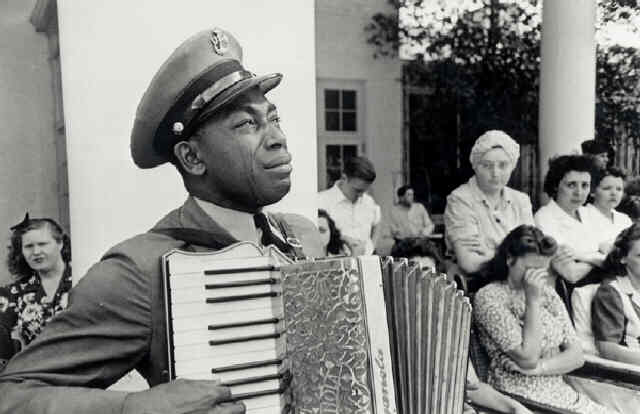
    [Image made from a private, original photograph; the picture first appeared in Life Magazine, April 23, 1945.]

    Many years ago I went to the house of a man with books to sell.  The house was terrific, with a view of the Potomac and just outside the district line–a hard thing to accomplish in housing in Washington.  The elderly gent’s house was open, airy and basically wallpapered with large format, very big photographs.  Many of the photographs I recognized–and of those, many were iconic images.  I said something simpy/obvious like, “so I see that you collect historic photographs.”  “No, I don’t” he said.  In that moment I thought he was just being a wiseacre with me.

    He quickly said, “I took them”. 

    “Oh my God”, I thought.

    I honestly didn’t know what to say–I had seen so many of them in my life, and so often, that like a lot of things, these images were just there, part of the cultural landscape.  And here was the man who took them.  After I got over my shock and came to a sense or two, I interview hi a little.  The man behind the camera’s name was Ed Clark.

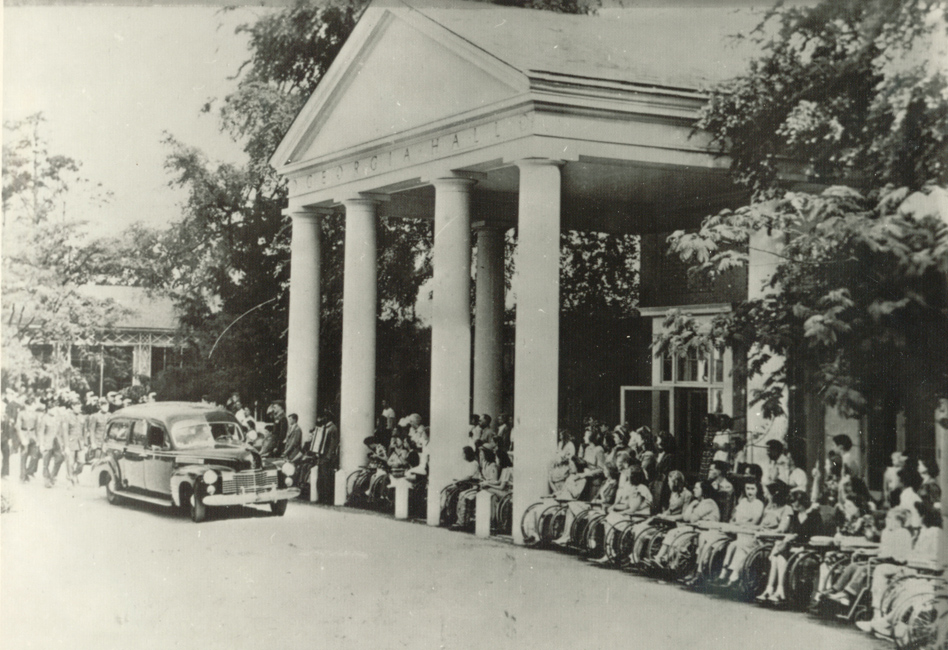
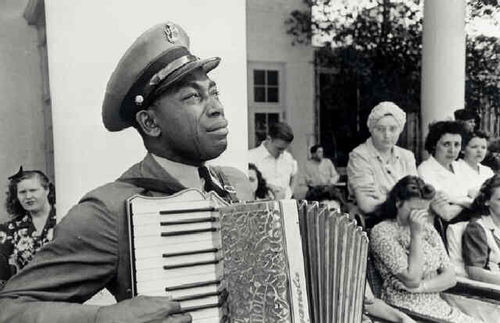
    Ed (1912-2000) was about 80 when I met him, and he was selling some books because he was getting ready to leave DC and head back home to Nashville.  He was very quick with strong recall.  I asked him about his ultra-famous photo of CPO Graham Jackson (1903-1983), preserved forever, who on the morning after Franklin Roosevelt’s death on 12 April 1945 in Warm Springs, Georgia, was playing Going Home  at the portico of Georgia Hall as the president’s casket was being taken to the train for a last ride to D.C.  Jackson was at Warm Springs to perform for Roosevelt as he had many times before when the President died on the 12th, on his 42nd visit there.

    I wondered about where the rest of the crowd was, and particularly, where the rest of the photographers were, at that moment  After all, FDR was about the most famous man in the world, and perhaps the most important, when he died in the last stretch of WWII.  Surely there must’ve been tons more photojournalist there to record the scene of FDR’s body being removed. 

    “There were” Ed said.  I asked him where they were.  He explained that they behind him, which would’ve been in front of him, actually–he was at the rear of the crowd, with every other photographer pointing their cameras forwards, recording the movement of FDR’s body.   Ed said that he turned around (“because that picture was already being made”) and found the rest of the crowd, the people who were already there at Warm Springs, watching from a respectful distance.  And it was at that point that CPO Jackson started to play his accordion, the music being one of FDR’s favorite pieces.  “They weren’t looking the wrong way”, Ed Clark said, “just not the right way”.  And Mr. Clark made the photo that everyone else missed, because they’re faced the obvious.

    Another view of Roosevelt’s casket being driven by Georgia Hall in Warm Springs. If you look closely you can see CPO Jackson standing just to the left of the hearse’s front left fender: [Source]:
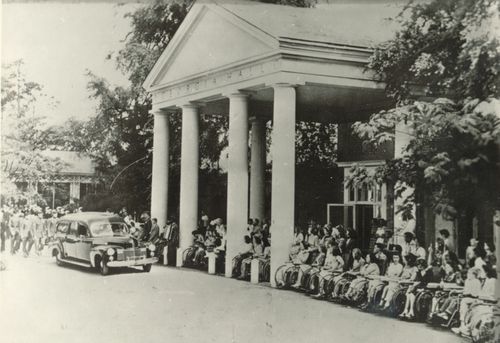
    FDR Warm Springs


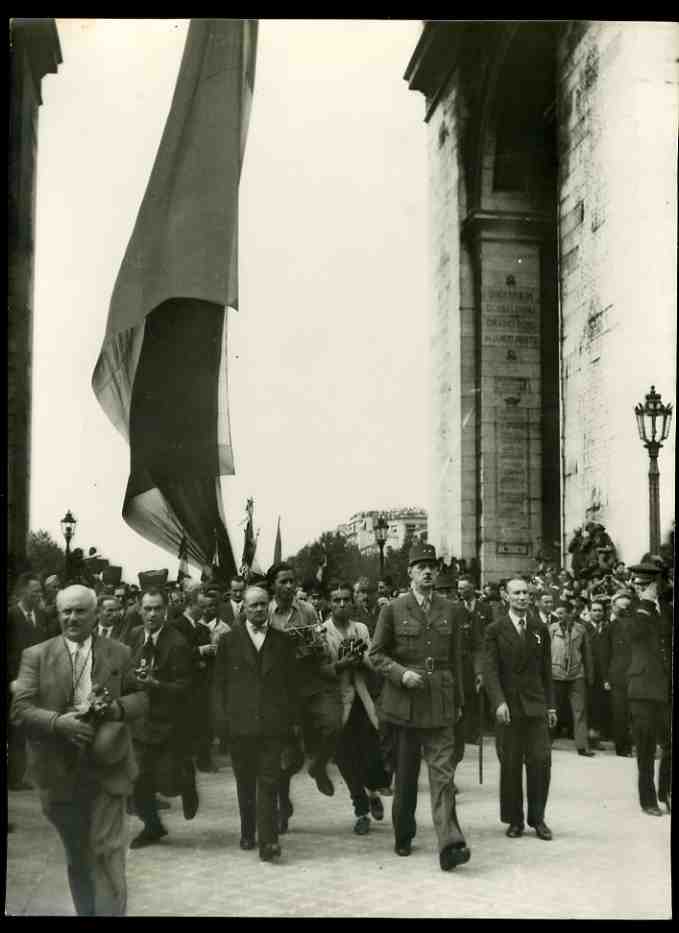
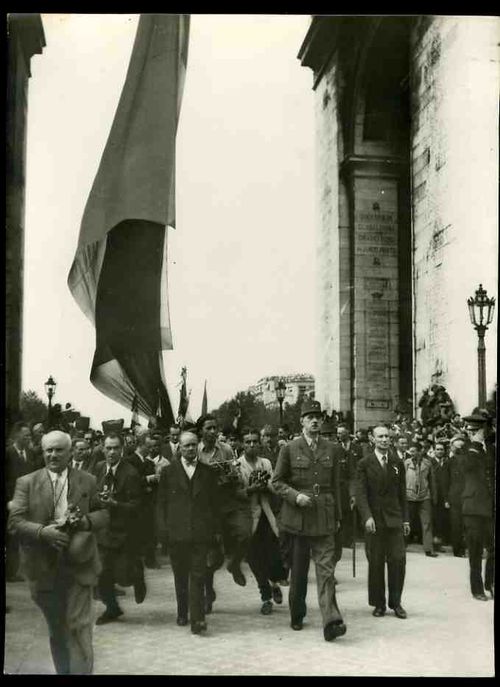
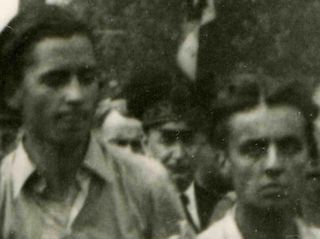
    This second picture captures both the moment and the photographers whop were missing it.  The scene is of course General De Gaulle making his triumphant return to the liberated city of Paris, walking back into the city through the Arc de Triomphe on 25 August 1944.  I am also completely certain that the picture was taken by another LIFE photographer (Ed Clark having worked their for years contributing many photo-stories and covers), Ralph Morse (my original doesn’t have any identification on the back, though it certainly looks like the others Morse made at that moment).  Morse caught De Gaulle in mid stride at the half-way point through the Arc.  And you can see the look of pain in the faces of the other scrambling photographers who must’ve been just coming to the realization that they were in the shot they had been desperately wanting to make since 1940. Their sinking feeling is pretty visceral.
    0 ebay 12 where not to belia260

    Perhaps being in the “wrong” place is just someone else’s perception until you prove them wrong.  After all, there must be some right place right time, wrong place right time, right place wrong time, wrong place wrong time hierarchy, no?–that is, until you’re smart enough to realize that there’s no such thing as “wrong”. 
    0 ebay 12 where not to belia261


  • The Writing Remains

    JF Ptak Science Books   Quick Post

    I was performing a little forensic test on a sheet of book design elements and noticed this little fella in the corner–it is only about 1″x2″ and the motto is a little difficult to read, but segregated and brightened up a little it reads loud and clear.  “Das man schreibt das beleibt”, or “the one who writes, remains” or more simply and carrying things to their logical conclusion, “the writing remains”. (It is similar to the proverb “Wer schreibt, der belibt” which is something along the lines of “Who writes, remains”.)   [Source: Decorative Vorbilder eine Sammlung von Figurlichen Darstellungen… fuer Zeichner, Maler, Graphische Kuenstler, published in Stuttgart, 1897, volume II.)


    Elements Owl365 darker

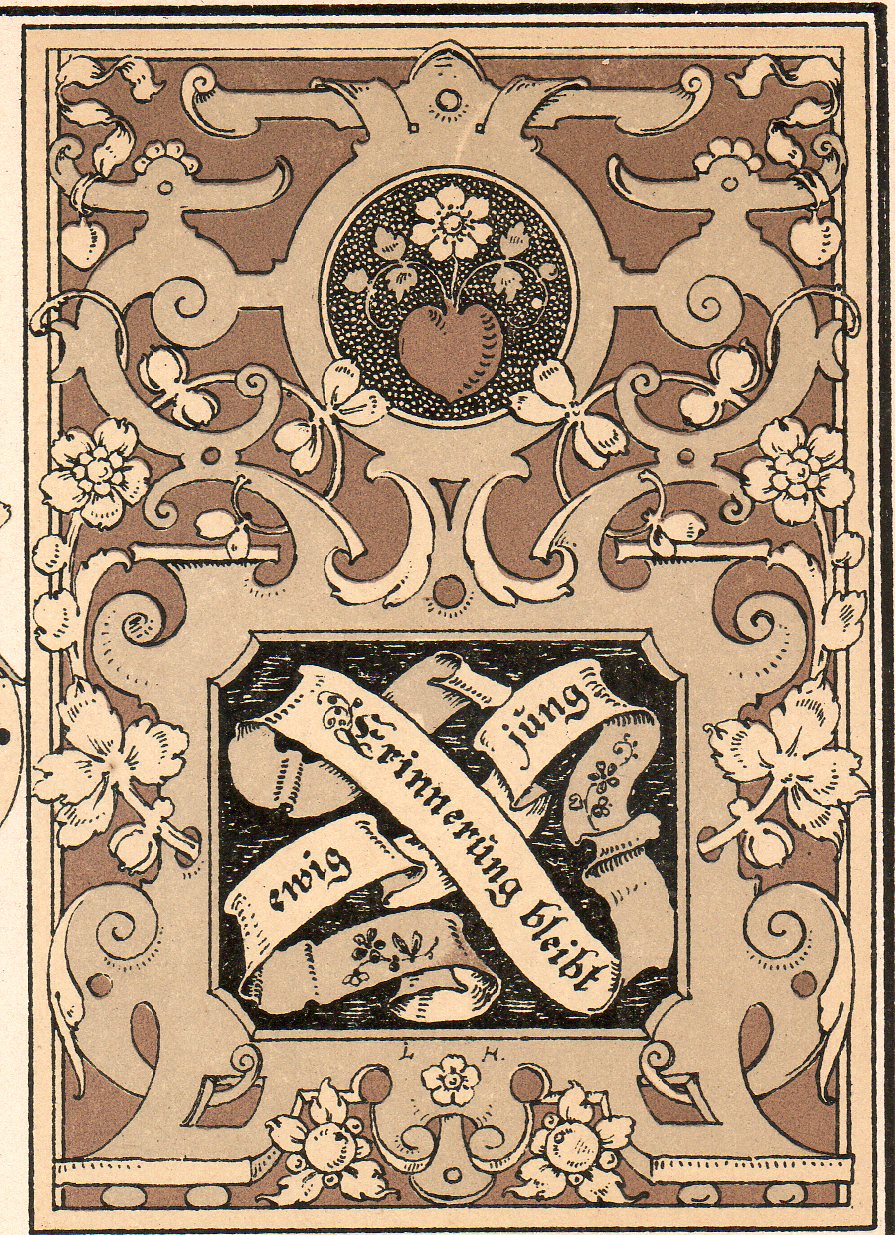
    And then there is this, to, well contradict the writing verdict?  Another very small bit from the same series.  This one says “Erinnerung bleibt/Ewig Jung”, which is something like “Memory Remains Forever Young”, which could alsdo be interpreted as memory/never/aging, which would place it alongside the above, except that it makes its statement regarding memory, which does not explicitly include writing it down. And of course we assume with the top motto that the writer remains with the writing somehow, though really for the most part all they are at the end of it all is a name.  So the two are either very similar or polar opposites–take your pick.  

    Elements Forever young366

    ·Posted by :

    ·in:


  • An Uploading Alphabet for Sending Info to The Cloud(s), 1523

    JF Ptak Science Books  Post 2141  Part of the History of Memory series 
    Follow Me on Pinterest

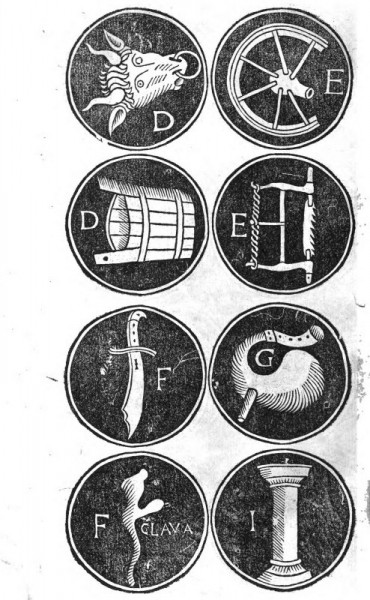
    These are some fine and early printed examples of uploading information, though it had nothing ot do of course with electromagnetic anything back in 1523.  The “Cloud” in question was the mind/brain, and the images helped to serve as placemarkers in how large amounts of memory were kept in the head, the methods available to just about anyone with a keen enough facility for organization and understanding, and the ability to develop learning mechanisms that would help to store and sort memory and info. 

    In another way, though, the process of memory was associated with the Cloud–this second attribution of the early Cloud, though–at least according to St Augustine–was God. Plato (Meno) thought along the lines of the soul learning nothing new, and that what learning was all about was recalling of the data that came to us before we were born.  Augustine–mostly in Book X of the Confessions–had  a different idea (and much more complex and elaborated than I could do justice here in a few sentences) about unconscious knowledge and memory, which was where, I think, he thought knowing God might be.  This memory (the “divine quality” in Cicero’s thought) was the storehouse of expressions in the belief that the knowledge of true things was unconscious, and that in understanding memory this knowledge becomes evident, and that at the base of it all is the knowledge of God. It is as I said much more complicated (and elegant) than this, but I think that the root of it is correct, at least so far as memory is concerned. 

    In any event, here are some of the visual clues for creating alpabetic memory palaces as found in the short (30 leaves)  1523 work by Gulielmus Leporeus, Ars Memorativa  (and available from the Bayerische Staatsbibliotek, here)


    Memoria alphabet D-I

    ·Posted by :

    ·in:

    —

  • Writing on the Clouds: a Musical Compositional Recording Machine, 1753

    JF Ptak Science Books    Post 1963

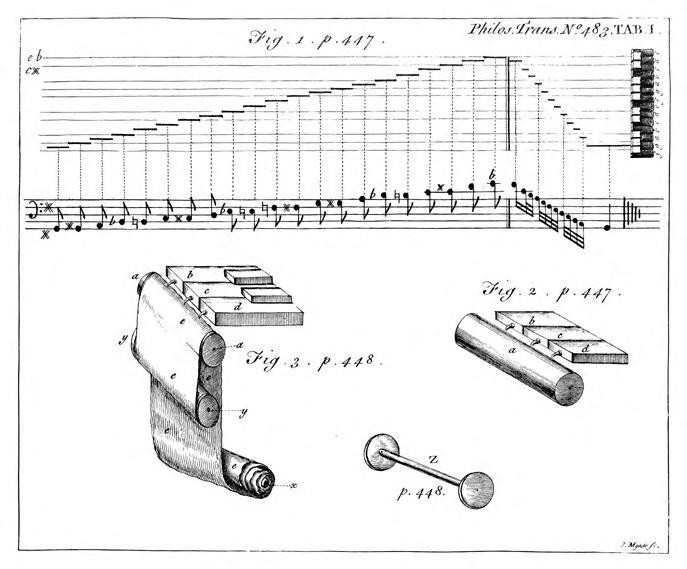
    Here’s a interesting piece of thinking communicated on the construction of  a rapid recorder for musical composition, written by John Freke in 1753 to the Royal Society, and published as  A
    Letter from Mr. John Freke F. R. S. Surgeon to St. Bartholomew’s
    Hospital, to the President of the Royal Society, Inclosing a Paper of
    the Late Rev. Mr. Creed, concerning a Machine to Write Down Extempore
    Voluntaries, or Other Pieces of Music
    ( on January 1, 1753) in the
    Proceedings of the Royal Society of London; Philosophical Transactions
    of the Royal Society,
    volume 44, pp 445-450. (John Freke, 1688-1756, was a prominent and important early surgeon, served at St. Barts from 1729 to 1755 and was a Governor of the hospital from 1736 to 1756, and was perhaps the first ophthalmic surgeon). The device was proposed by the Rev. John Creed, a machine that was supposed to catch the delicacy and greatness of improvisation, of the moments of creation of music that would could normally be lost to memory or inexactitude.  It was not the first of its kind, though it was an early attempt at finding the box of aether.

    Music machine graphic
    It was a very interesting idea, especially given the time 260 years ago. I wonder if this was influenced at all by the construction of mathematical machines?  Blaise Pascal (1623-1662–I don’t have any idea how he did what he did and live to be only 39) constructed his machine that was capable of doing addition and subtraction problems more than 110 years before this machine, and perhaps there was this hopefulness in the mechanically-reasoned approach to saving lost memories of composition.   Perhaps there was the belief that since calculations seemingly so impossible as the Earth’s (periodic 304-day that turned out to be 428-day) wobble (by Leonhard Euler, or the illustrated collection of human knowledge in the vast and controversial Diderot/d’Alembert encyclopedia, or the capturing of nature iin the systematic binomial nomenclature of the Swedish Carl Linnaeus–all taking place in this year or so brought something to bear on this seemingly inescapable problem of recording quick and complicated thought?