A Daily History of Holes, Dots, Lines, Science, History, Math, Physics, Art, the Unintentional Absurd, Architecture, Maps, Data Visualization, Blank and Missing Things, and so on. |1.6 million words, 7500 images, 4.9 million hits| Press & appearances in The Times, Le Figaro, Mensa, The Economist, The Guardian, Discovery News, Slate, Le Monde, Sci American Blogs, Le Pont, and many other places… 5000+ total posts since 2008.

Category: Brevity and Complexity

  • Found-Poetry in a Technical Work on Bubbles (1896)

    JF Ptak Science Books  Quick Post   (Overall Post 5118) 
    Bubbles “The water of those wellis sprynge vp with grete bobles.”–W. Caxton tr. Myrrour of Worlde ii. xxi. sig. h4   OED

    Rummaging again through the eminently-rummagable early years of Nature1 I found a lovely little article on the physics of bubbles. The language to me seems delightful, and it comes from the first part of a very long opening paragraph of the paper:

    “He has studied the behaviour of big bubbles and of little ones,

    of bubbles in large and small tubes,

    of bubbles of air in a liquid,

    and of one liquid in another,

    of bubbles in heavy land in light liquids,

    of bubbles in liquids of various degrees of viscosity

    and with various degrees of surface tension at their surfaces.”

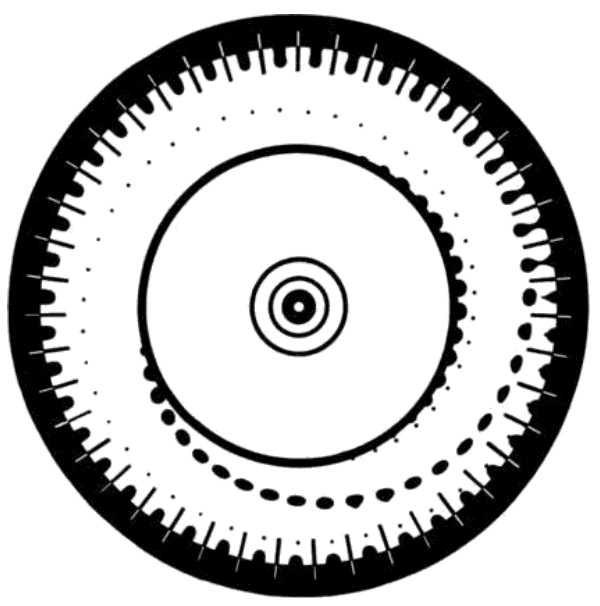
    • [IMAGE: “THAUMATROPE for showing the formation and oscillation of drops.” From C.V. Boys’ Soap Bubble and the Forces Which Mold Them, 1896.]

    In spite (or because of) the fact that bubbles are serious things, they are wonderfully named and as C.V. Boys points out in his fantastic Soap Bubble and the Forces Which Mold Them (1896), they are as magnificent as they are simple: “I do not suppose that there is any one in this room who has not occasionally blown a common soap-bubble, and while admiring the perfection of its form, and the marvelous brilliancy of its colours, wondered how it is that such a magnificent object can be so easily produced”.

    Bubbles have a long history in experimental physics2 and continue to work their magic today–when I googled this title I came up with only three pages of hits, including the following, which in their own little way beg to be read:

    • “Film thickness measurements in liquid–liquid slug flow “
    • “Effects of Bubbles on the Hydraulic Conductivity of Porous Materials “
    • “Bubble deformations and segmented flows in corrugated microchannels at large capillary numbers “
    • “Bubble transport through constricted capillary tubes with application to resin transfer molding”
    • “Transport of bubbles in square microchannels”
    • “Step-Wise Velocity of an Air Bubble Rising in a Vertical Tube Filled with a Liquid Dispersion of Nanoparticles”

    From the 1894 article:

    “EVERY student of physics has observed the motion of bubbles in tubes. Which of them has not used a big bubble to show the little ones their duty in clearing out the air when filling a barometer tube? Who has not spent his time and patience in whisking a spirit thermometer to drive a bubble out of the column? Mr. Trouton has recently communicated to the Royal Society the result of some researches on this subject. He has studied the behaviour of big bubbles and of little ones, of bubbles in large and small tubes, of bubbles of air in a liquid, and of one liquid in another, of bubbles in heavy land in light liquids, of bubbles in liquids of various degrees of viscosity and with various degrees of surface tension at their surfaces. From this enumeration it is evident that the number of different magnitudes involved is very great, and at the start it seemed almost hopeless to disentangle the effects due to each. The first matter to observe was that, as in other cases of fluid motion, two cases must be distinguished. These are the cases of slow motion and of quick motion. When the motion is slow the viscosity of the liquid causes the flow to be very simple. It entirely stops all whirling and swirling, such as is seen in the water behind a boat. When the motion is quick, on the other hand, the flow is very complicated. Whirls and swirls are set up, and the resistance is increased, owing to the increased energy that has to be communicated to the whirling and swirling liquid for each centimetre that the bubble moves. The slow kind may be described as viscous flow, and the quick as turbulent flow. The most interesting point observed in connection with the turbulent flow was that it was sometimes possible to increase the rate of flow by increasing the viscosity…”

    Notes:

    1. “On the Motion of Bubbles in Tubes”, in Nature, a Weekly Illustrated Journal of Science, 8 February 1894 (vol 49 no. 1267)/ I should point out that Nature back then was almost entirely readable by almost anyone—nowadays of course it is a vastly different story; I stopped my subscription a while back when I found out that I wasn’t understanding even the titles of some of the papers….

    2. “I have freely made use of the published work of many distinguished men, among whom I may mention Savart, Plateau, Clerk Maxwell, Sir William Thomson, Lord Rayleigh, Mr. Chichester Bell, and Prof. Rücker. The experiments have mostly been described by them, some have been taken from journals, and I have devised or arranged a few. I am also indebted to Prof. Rücker for the use of various pieces of apparatus which had been prepared for his lectures.”–C.V. Boys, Soap Bubble and the Forces Which Mold, 1896.
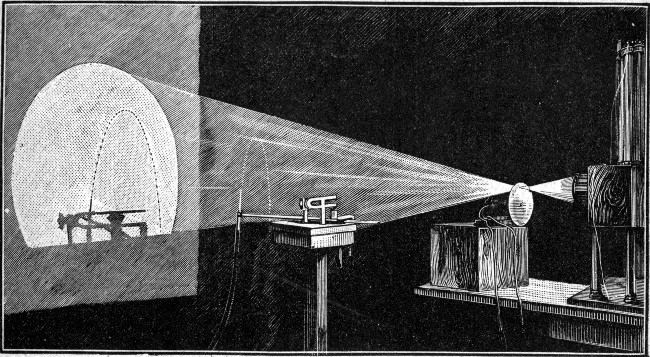
    Front“Experiment for showing by intermittent light the apparently stationary drops into which a fountain is broken up by the action of a musical sound.”–from the Boys book.  
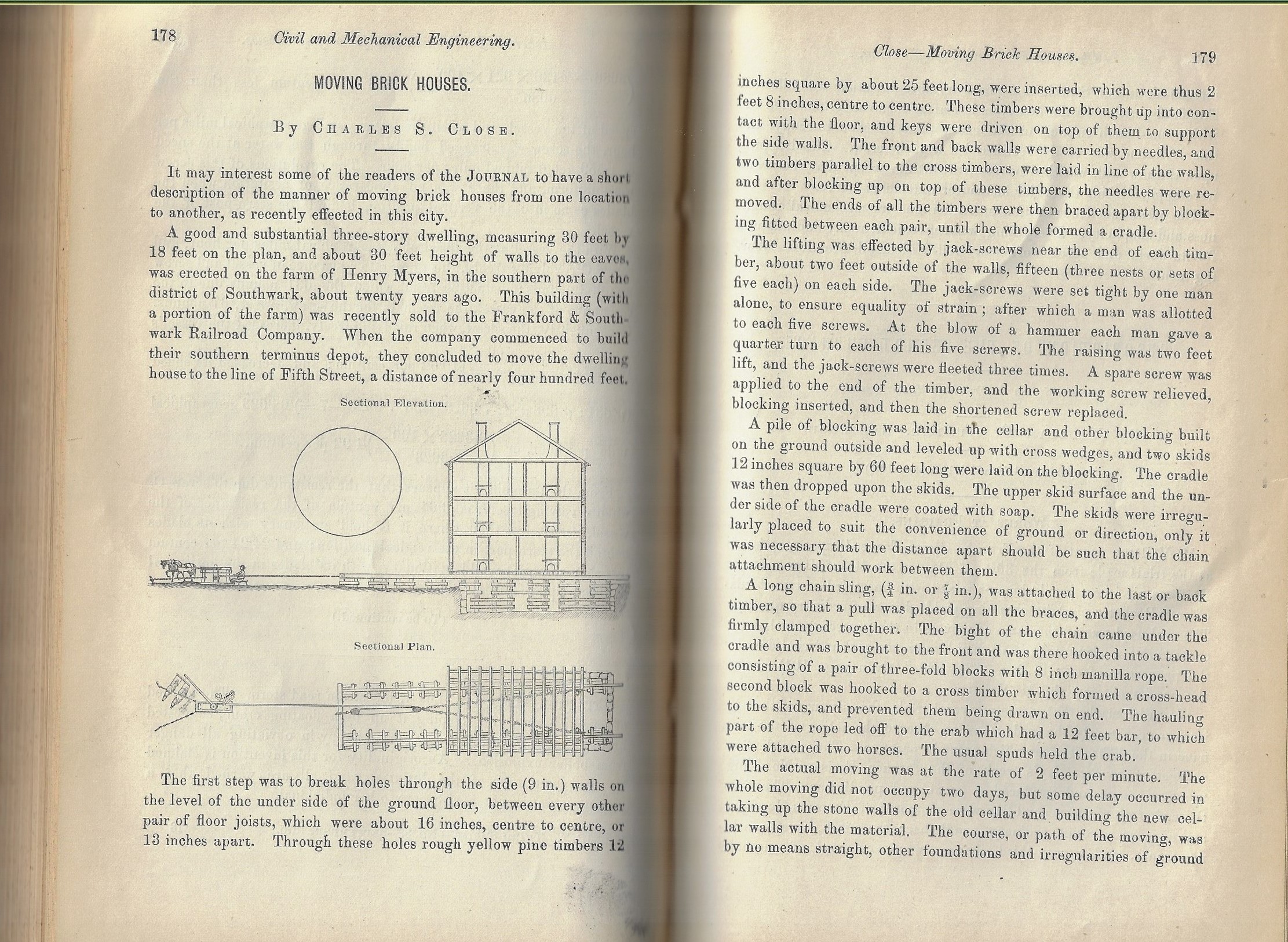

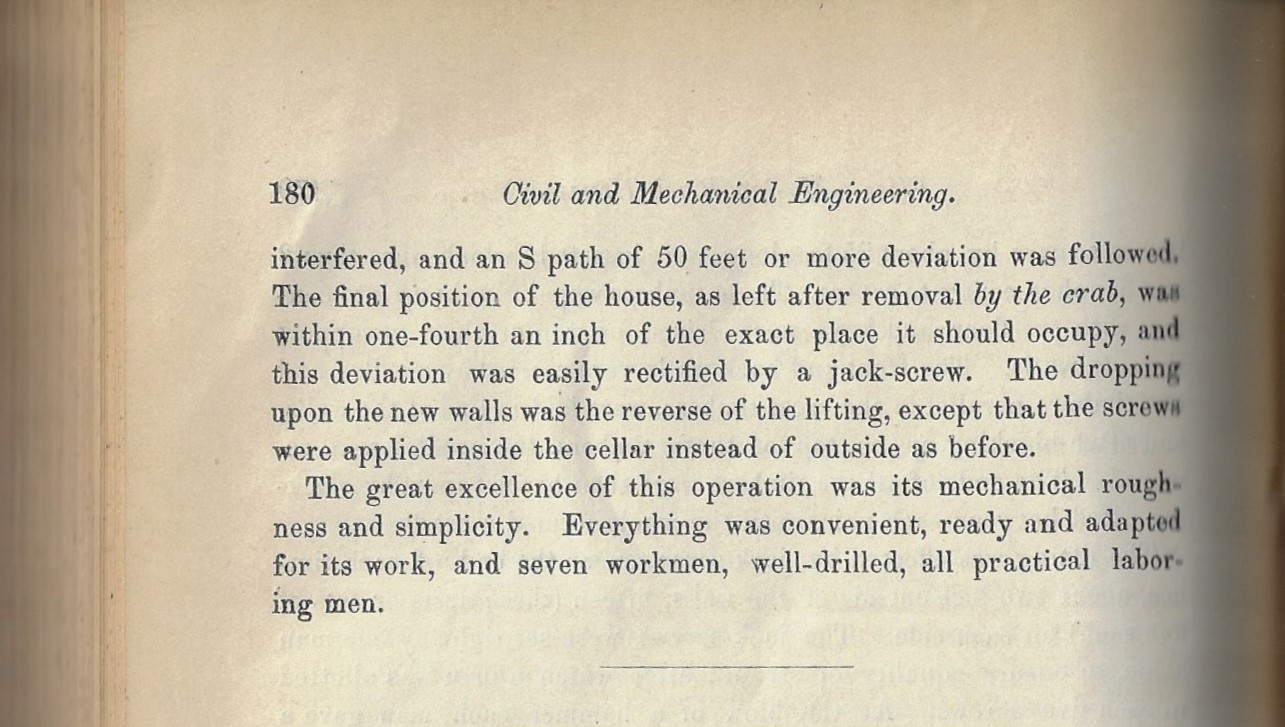
  • “The great excellence of this operation was its mechanical roughness and simplicity”–on Moving a Brick House, 1875

    JF Ptak Science Books  Quick Post

    This is one of the many small articles that appear in major sci/tech/engineering journals in the 19th century that are absolutely so filled with human spirit that it fills your heart with hope for humanity (even if everyone involved has been dead for at least 125 years.  This one is a ravishingly simple three-page report on how to move a (substantial) brick house with a few guys and a horse. The title of this post is taken from the report1, where (I feel) the writer just took a step back from his work and said “holy ____!”, and admired the sheer beauty of the simple and successful approach to a major task. And as it turned out, the house was all of 1/4″ from where it should have been, and that was quickly rectified with a screw jack.

    And about that lifting-of-the-house business–the main part of the job was done by one man and five screws, and as the writer observes with another fantastic-quote moment, “The screw jacks were set by one man alone, to ensure the equality of strain”! I know it is a technical expression, but “ensur(ing) the equality of strain” sounds very applicable to a lot of things, the equivalent of a bean thread base to a veggie stir fry. 

    Here’s the article in case you need to move a brick house:

    JFI 1875 moving house
    JFI 1875 moving houseNotes:

    1. Charles S. Close, “Moving Brick Houses”, in Journal of the Franklin Institute, 1875, vol 70/100, pp 178-180. 


  • An Episode in the History of Manure: “To barren ground with toyle large meanour add.”

    JF Ptak Science Books  Quick Post

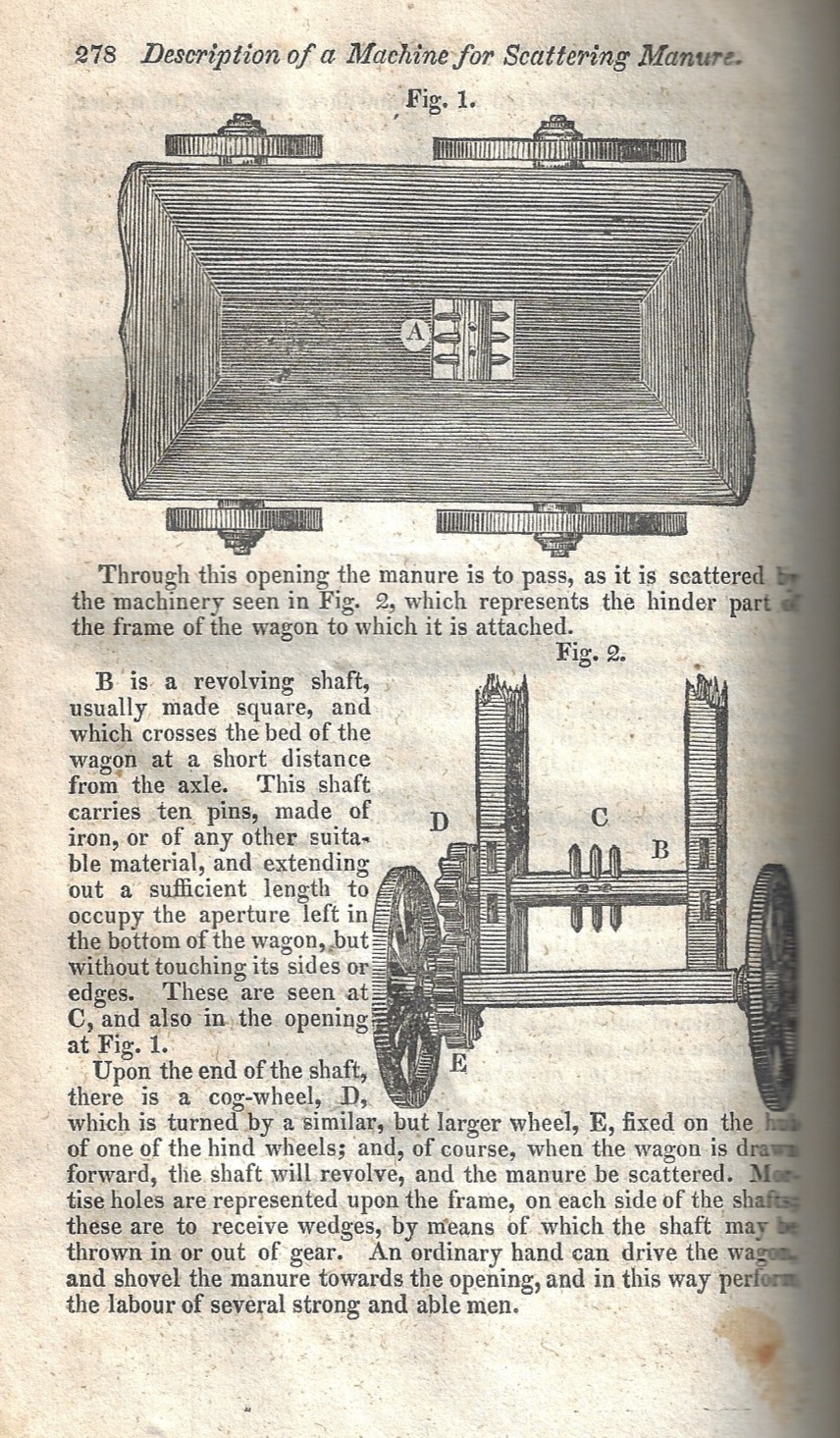
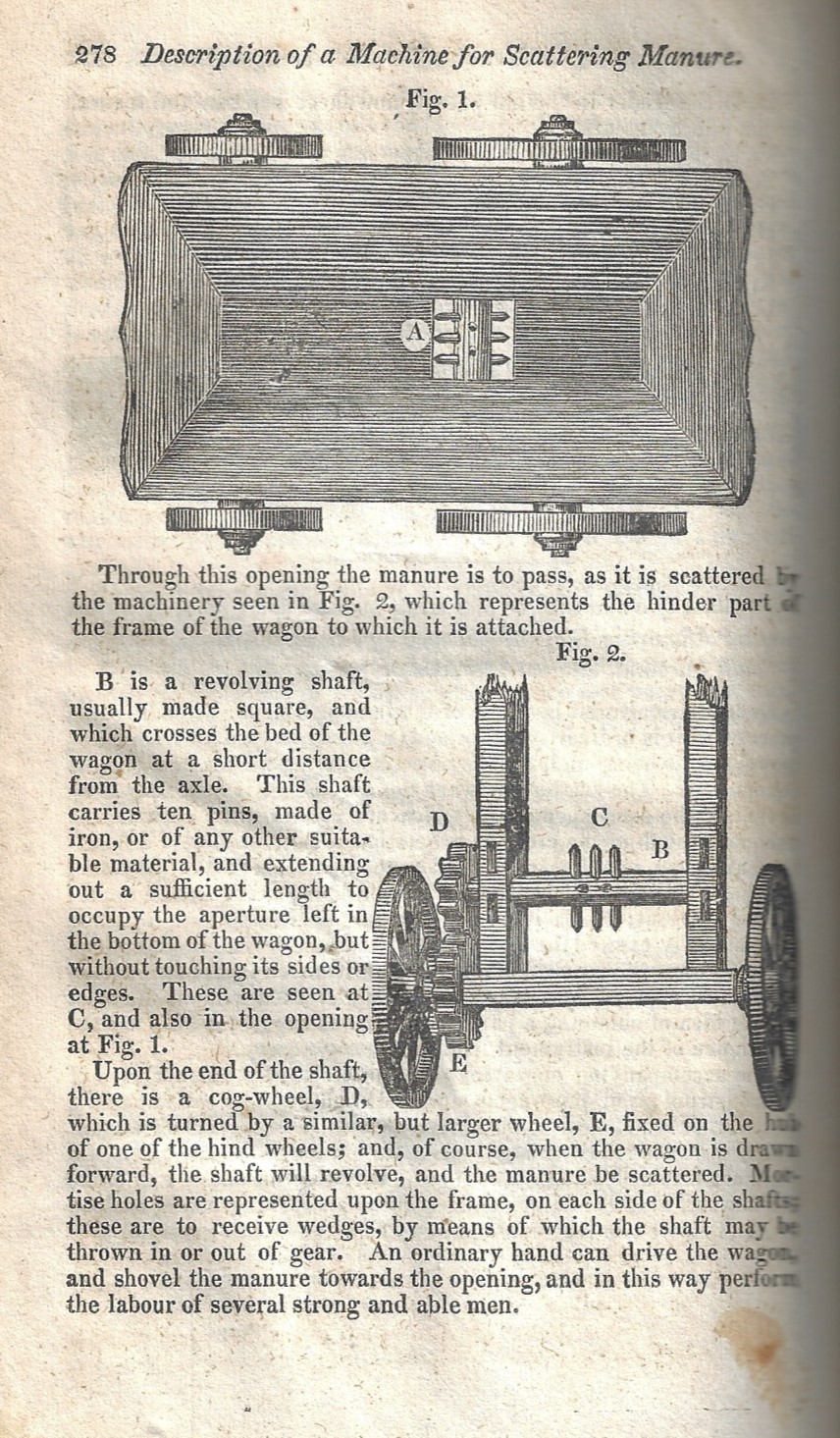
    Franklin Institute 1829 Manure spreaderOf the many things that can be said about manure you can’t say but can say about its chemical replacement is that it is made from fossil fuels and sucks good stuff from the soil and ultimately makes the farmland it is fertilizing unfarmable. That’s what popped into my head when I bumped into this woodcut of a manure spreader while farming something else in the 1829 volume of The Journal of the Franklin Institute. It’s a relatively simple improvement to a necessary and laborious job–adding the spreader made the application of manure far easier than have it slide through a jamable sluice in the bottom of a wagon, and certainly a lot easier and more thorough than spreading it by hand. 

    And just for the fun of it I checked out “manure” int he OED, where it makes appearances in English beginning in the mid 16th century, and for the hundreds of years the word has been around it has a complicated spelling history (manoure, maynor, maynure, menar, menor,  menore, meynor,  maner, meanor,  meanour, manure, mainure,  manier, manner, mayner,  meanure, menure; maner,  mannor,  mainer,  manna, manner, mannur, manor, manuer; manar, pre-maner, mannor, mannour,  mannur,  manuire, manure,  manour, mainer; U.S. regional (southern) manyo). Here are two examples of early usage that have some poetic sense to them:

    • 1664   J. Evelyn Sylva (1679) 10.   “To barren ground with toyle large meanour add.”
    • 1697   Dryden tr. Virgil Georgics ii, in tr. Virgil Wks. 85.   “In depth of Earth secure Thy cover’d Plants, and dung with hot Manure”.

    The term “Manure spreader” according to the OED comes into use around 1884, 55 years after this report–except of course this is called a manure “scatterer” which seems to imply less confidence than a “spreader:, though that may have come about due to the modesty of the inventor. 


  • A Dancingly Anthropomorphic Kinematic Instrument (1912)

    JF Ptak Science Books   Quick Post

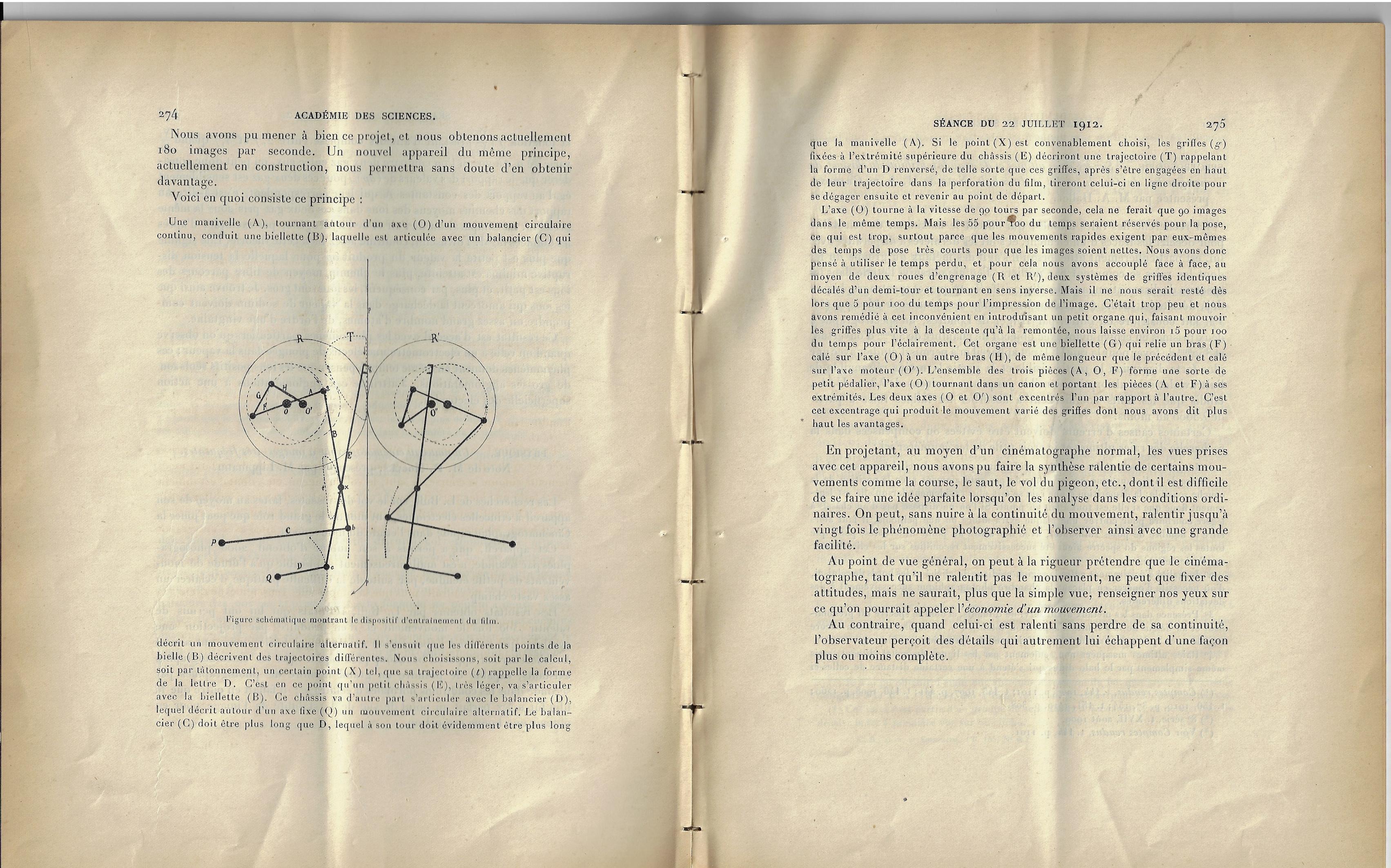
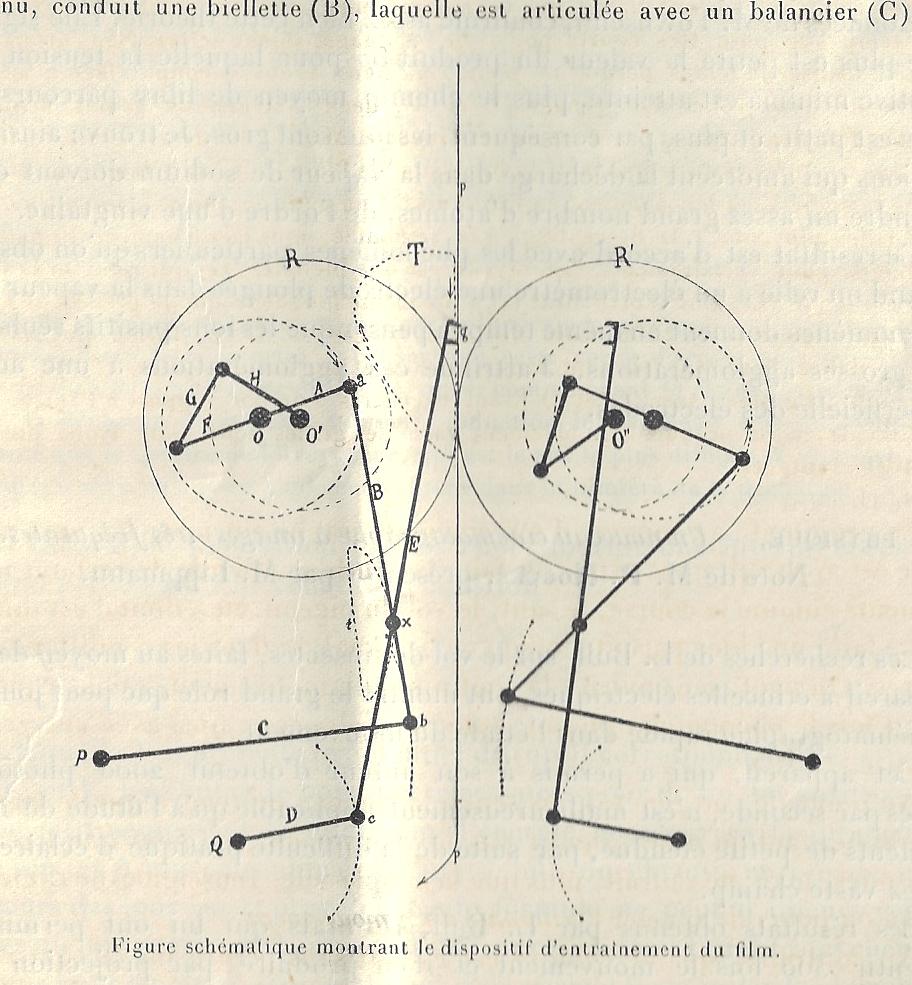
    CR 1912 Nogues kinematographThis is one of those posts where I was looking for something in the Comptes Rendus and then found something completely different. The what-it-was was something about Poincare1, at this point dead for just a week, the second titanic to disappear this year–it is really impossible to understand how he was able to do what he did in a lifespan of 58 years…of course he was a master of nearly every field, and was able to work his math problems out in his head first before writing them out, so it helped to be a multi-genius–and while not finding a notice on his death in the weekly issue I did “discover” an intriguing (and unrelated to Poincare) illustration. 

    At first I thought it would be related to an article on the depiction of motion as the drawing seemed to represent the anatomy of two dancers, and have some sort of fourth dimension/art/science relation, or whathaveyou, but then I saw it was a schematic for a part of motion picture camera–a kinematograph/cinematograph–that made 180 images per second, and would be just the sort of instrument used to study fast-moving objects in minute detail. So the schematic really did portray the essence of what the machine did, exploring the designs of motion.  

    CR 1912 Nogues _detail_

    ____________

    Notes:

    1. Poincare knew basically everything…here’s a toss-off from him that has stuck with me: “To doubt everything, or, to believe everything, are two equally convenient solutions; both dispense with the necessity of reflection.
    2. P. Nogues, “Un nouveau cinematographe a images tres frequentes”, in Comptes Rendus de l’Academie des Sciences, 22 July 1912, pp 273-275. 

  • Acrobatic Vocabulary and Found-Poetry in Night Dust Removal Technology, 1877

    JF Ptak Science Books  Post 2573

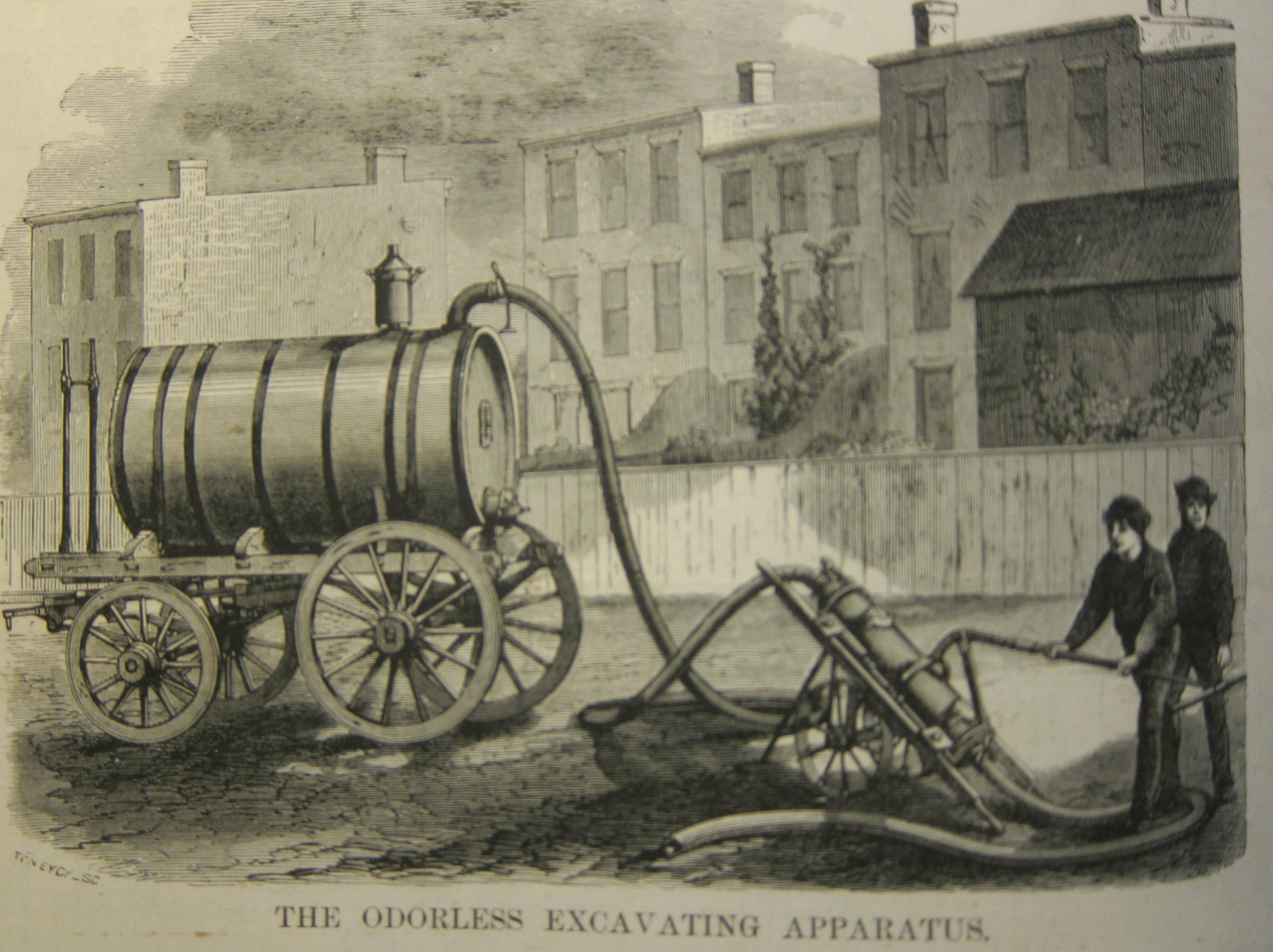
    The heavyily-lithe text of an article in the Scientific American Supplement (1877) on the virtues of the Odorless Excavation Apparatus Company of Baltimore isn’t so much “acrobatic” as mentioned in the title of this post as it is “aromatic” (or worse yet, “aroma-acrobatic”).  The OEAC of Baltimore was performing a daily routine of high importance and necessity–except that there was a high possibility of offending brittle social virtues if there was a description of what the company actually did without using far too many words. (For example: “The discharging of the contents of privy vaults during the hours of daylight, and without offence or danger to health, as well as the utilization of the matters taken from them for fertilizing purposes, has been a problem long and slow of solution.”) This was 1877, after all, and people really didn’t write too much about Daily Functions and the technology for dealing with them outside of the deep-end product of manure–and then there was a lot to say about that. Having said that, dealing with the absolutely necessary job of solving night dust/waste/dirt issues was just a difficult thing to do, in print. You can’t have the Second Industrial Revolution without people, and you can’t have the people without housing them close together so that everyone could get to work, and you can’t have closely-housed people without water and the means of getting rid of that and body eliminations, otherwise the nasty biological stuff can ensue. And thus you are left with the great need that nobody really cares to discuss. 

    Sci Am 1877 Odorless

    Here’s an example of some meandering and circuitous sentences from the 3000 words article, ideas trying to get somewhere:

    “To complete this system and render it applicable to
    the most extreme cases, as to difficulty of removal of the
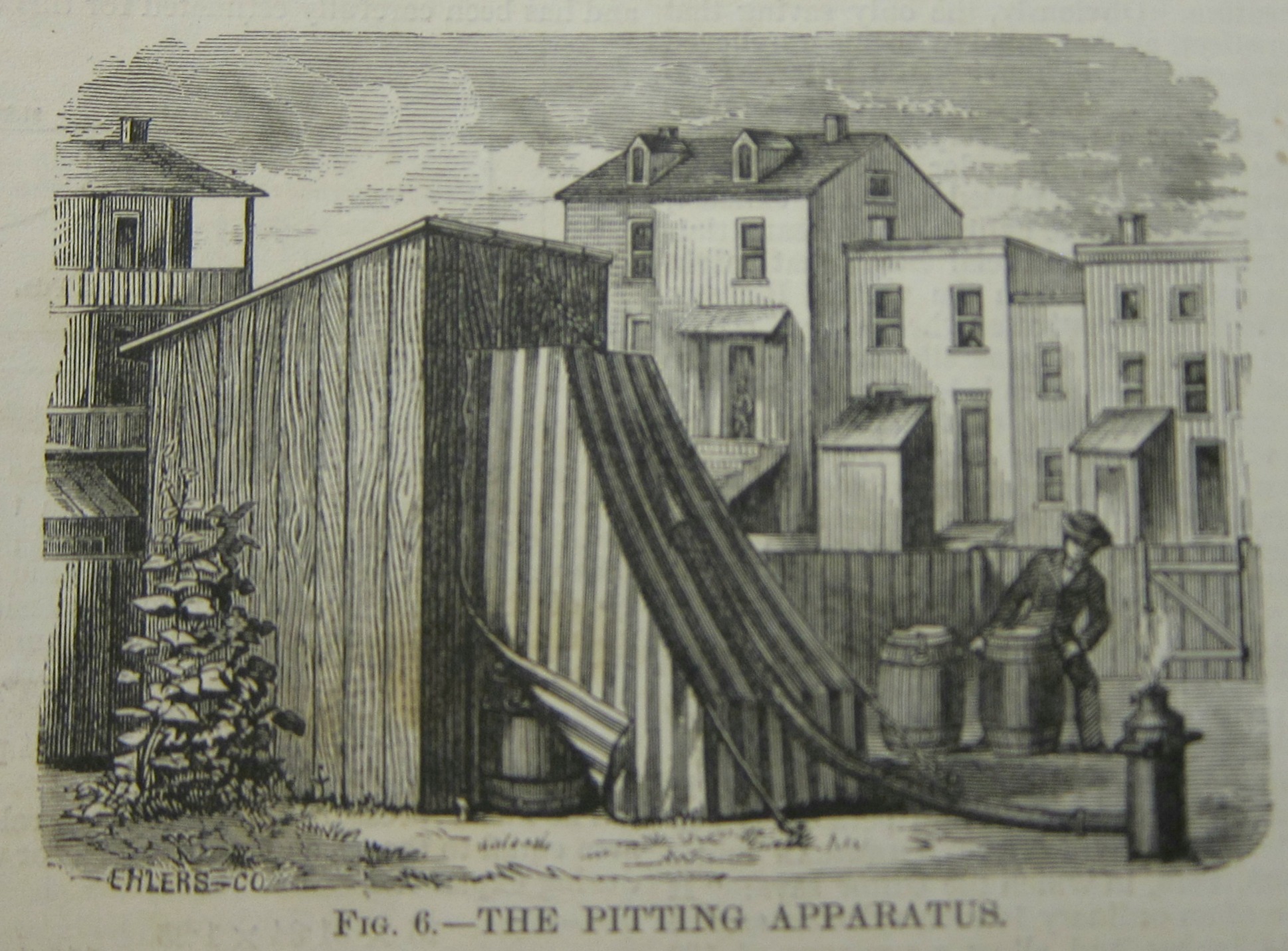
    material, the plan shown in fig. 6, and called the “ pitting”
    apparatus, is resorted to, and consists simply in covering the
    approaches to an outhouse with a kind canvas awning,
    from which is led a flexible tube to the deodorizer, to destroy
    the effects of the gases and odors generated in the disturbance
    of the material inside. The awning likewise excludes the
    operation from observation.

    “This plan is only resorted to
    in cases where the contents of the vault has become from
    long standing or other causes so unyielding as to preclude the
    use of the pump, in which case it is simply removed by
    digging, which, in its comparatively solid condition, is not
    by any means so disagreeable an operation to the workmen
    inside the awning, as was the old bucket system with the
    more liquid contents. In this way it is removed in the day
    time without offence to either sight or smell.”

    Sci Am Odorless _2_

    [Image of the privy door covered by tent, with the special apparatus, as described above.]

    And then in all of it there’s quite a bit of  Found-Poetry in the discussion of the removal of collections of night dust:

    “So far as the deprivation of these deposits of their odors is concerned, it may he said that, if a tithe of the expense

    and trouble were expended upon them with this view that is nowadays lavished upon the modern watercloset,they might be made
    as comfortable, convenient, and unobjectionable in every way
    as the best of them; and that while they may be so readily
    discharged of their contents, and in a manner so entirely un-
    objectionable as is done under the system shown in the
    illustrations, there can be no necessity of their ever becoming
    offensive or dangerous.”

    At the end of the day the article made its point and impact, and I have no doubt that there was a good amount of positive feedback for the Odorless Excavating Apparatus Company of Baltimore.


  • On Found-Poetry in a Work on Clouds by the Great Chemist, Michael Faraday (1827)

    JF Ptak Science Books   Quick Post

    Tucked away inside a volume of  The Quarterly Journal of Science, Literature,  and the Arts1  is this short contribution by Michael Faraday. Faraday is not particularly well-known for a writerly style although in his huge output of papers and books he was a very effective communicator. I found in this article, “On a Peculiar Perspective Appearance of Aerial Light and Shade” , that he was really very elegant and perhaps even poetic in describing what I think are cloud shadows– explaining the illusions created by cloud shadows, with the “aerial perspective” part perhaps not having to do with what is normally assumed to be the optical/painterly version of the term, although frankly I’m not sure.

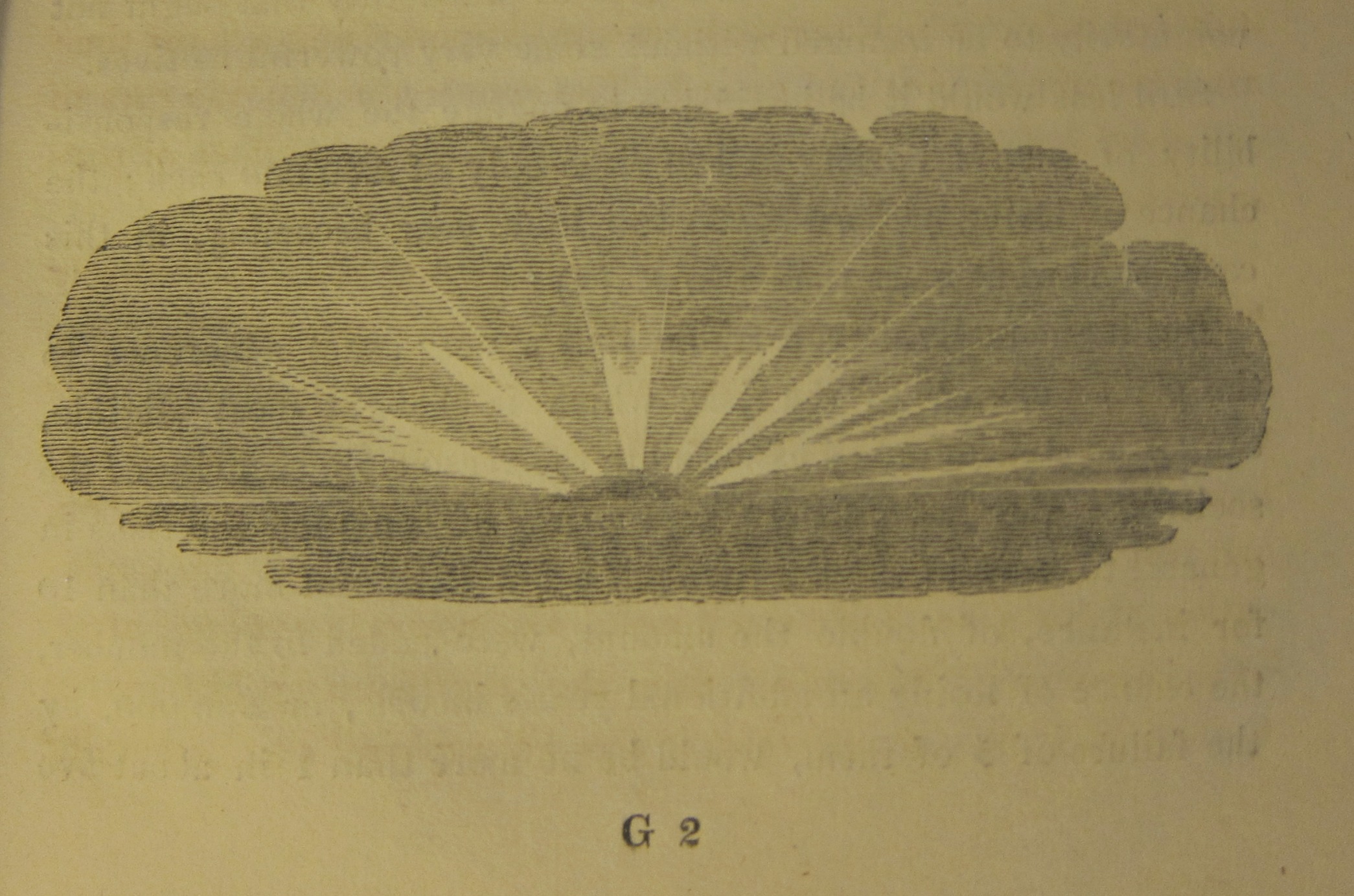
    This is the small woodcut that accompanies the three-page article, depicting the “rays” of light coming from a setting sun, which I think is charming in itself:

    Faraday clouds

    He writes:

    “Although the appearance on this evening was exceedingly beautiful and rare, and the more striking from the absence to the observer of the sun or clouds, and the complete insulation of the phenomenon, yet by close observation upon other evenings, it was found that partial effects of the same kind were very common, and from the manner in which these could be observed the explanation above given fully confirmed.”

    And the wonderful closing sentence:

    “All these phenomena with their variations were easily referrible to their causes and may be observed at almost any sun set in fine weather, but the effect of the first evening so similar in kind though so different in appearance was not again remarked. It is with a view of guarding persons who may observe the same effect against any mistake as to its origin that the appearance with its nature has been thus particularly described.” 

    I haven’t read that much in Faraday, but this does seem to be a bit of a departure–in form and content–and so I thought I’d share it a bit.  

    Notes:

    1. The Quarterly Journal of Science, Literature,  and the Arts (of the Royal Society of Great Britain). London, printed by John Murray,  volume XXII, 1827; 8.5×5”, viii, 418 pp,, 3 engraved plates.  Other interesting contributions in the volume include:  (Thomas Young), “Practical Application of the Doctrine of Chances, as it regards the Subdivision of Risks (by a Correspondent)”; (Michael Faraday, signed “M.F.” in the article), “On the Confinement of Dry Gases over Mercury”, in the Miscellaneous Intelligence section, pp 220-221; John MacCulloch, “Observations on the Geological History of the Formation of Coal”; and these shorter notices from the “Miscellaneous Intelligence” section including  Wollaston “On Electro-Magnetic Rotation” and  Becquerel “On the Conducting Power of Metals for Electricity” pp 374-378.


  • Finding Sameness, 1919

    JF Ptak Science Books   Quick Post

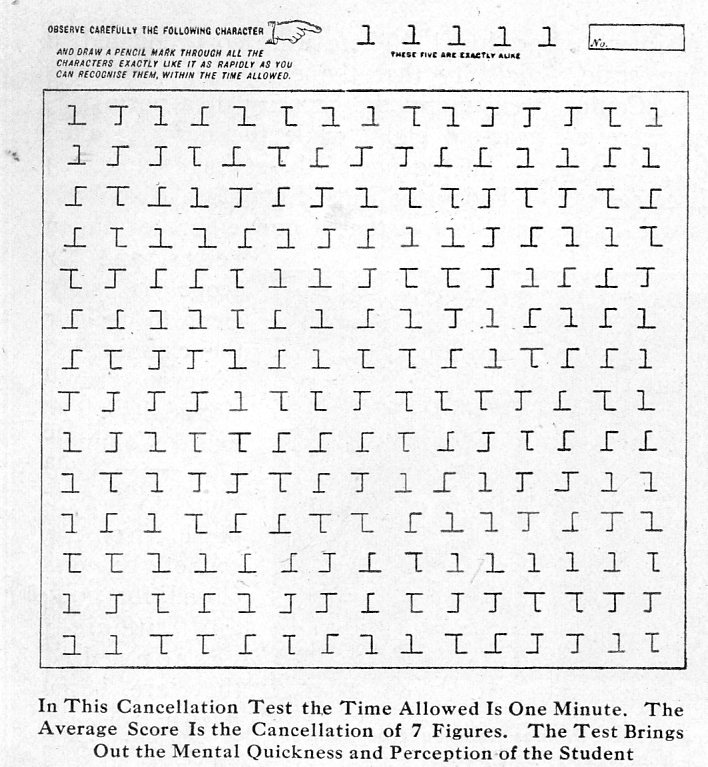
    I just found this unusual image in the page of the scarce journal Illustrated World for June 1919.  At first glance it attracted my attention for the design, and then I thought it was utilizing a Sumerian bill of sale–it turns out to be part of an intelligence test.  The subject is asked to see how many of the figures pointed out in the top line (and repeated five times) are repeated in the diagram. This is a lot easier than what I thought the test was, which was looking for five-times-in-a-row repeating symbols–after finding a few symbols repeated four times in a row and not five, I read the directions, and the test was much simpler, esp since someone had already gone through and marked out a bunch.

    IQ test451

    The cover story for this month was “electrocuting Whales”–and we don’t need to go there. 


    ·Posted by :

    ·in:

    —

  • The “Reactionary Lifter” and a Fist of Blood, 1872

    JF Ptak Science Books  Quick Post

    This design screams out –yes, the “outside scream”–for attention of some sort.  It is a five square inch ad crowded into a crowded 140 square inch page in a supplemental section to Harper’s Weekly, August 3, 1872.  The circular part is less than two inches in the original but it commands the big page, and is about the only thing your eyes can focus on until the ad is at least acknowledged and/or read. 

    Blood of life455

    The ad is for the “Reactionary Lifter”, an uninspired and slightly cumbersome name for an exercise apparatus that was made of hydraulics and pull-me devices that used the person’s own weight to exercise against.  The machine itself doesn’t seem that interesting, though the price does. At $100 it would take the average machinist or a similar skilled job probably a year to save a hundred dollars while making $10/week and then removing expenses, so this exercise machine was a significant expense. There is no mention of a price in the Harpers placement, which I guess was a good move so as not not frighten off the casual reader. 

    In any event, I liked the graphic.


  • The Eloquence of Baseball (Games), 1904

    JF Ptak Science Books  Quick Post

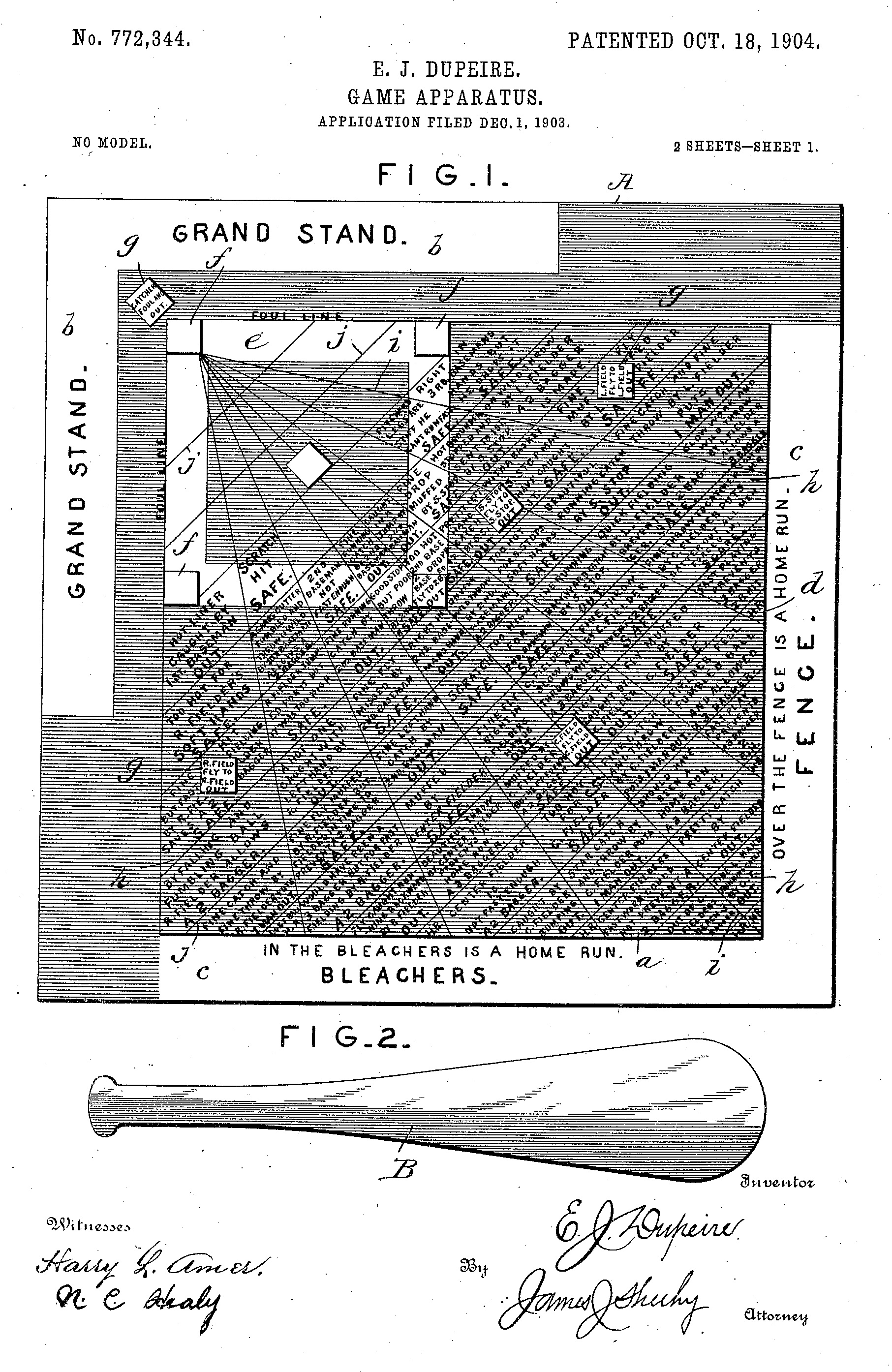
    Baseball season is either here or almost here, so picking around in old patents on baseball games in December is perfectly allowable.  This game (found at Google Patents) probably has more text on it than just about any game of any sort I’ve ever seen (and that may actually include Scrabble), and its lazy-staccato descriptions of the “play” are really quite lovely for a board game1. For example: 

    • “too hot for the right fielder’s hands”
    • “a hot one caught” 
    • “2nd baseman not fast enough”
    • “fine running catch” and “beautiful running catch” and “pretty left hand catch”
    • “good stop, poor throw”
    • “would have been a 3-bagger but for the fast fielding by the right fielder”
    • “slow work and wild throw”
    • “fly muffed”

    Patent baseball game lots of script

    [Source: https://www.google.com/patents/US772344?dq=catcher+baseball&hl=en&sa=X&ved=0ahUKEwiz0–e5L7JAhXK7CYKHWt_CPwQ6wEIVjAI]

    Notes:

    1.  I haven’t read many books on sports in my reading history, but from what I have seen over the years is that baseball literature is good enough to have its own genre. If you’re going to read only one or two baseball books in your life, consider one of these: Roger Kahn, The Boys of Summer (1972);  Eliot Asinof, Eight Men Out: The Black Sox and the 1919 World Series (1965); Jimmy Breslin, Can’t Anybody Here Play This Game? (1963);   Robert Creamer, Babe: The Legend Comes to Life (1974); Arnold Hano, A Day in the Bleachers (1955);  Donald Honig, Baseball When the Grass Was Real: Baseball from the Twenties to the Forties, Told by the Men Who Played It (1975); Bernard Malamud, The Natural, (1952).


    ·Posted by :

    ·in:

    —

  • The Art of Quarreling, 1879–Just in Time for the Presidential “Debates”

    JF Ptak Science Books   Quick Post

    “The art of disputing with dignity and decorum if it ever existed is a lost one”–Mr. Punch

    This tongue-in-cheek article appeared in the sharp and occasionally cutting demi-satire English journal, Punch, or the London Chiarivari, in February 1, 1879. It has some fresh and poignant words for advice for quarrelers, which I think in today’s vernacular would be applicable for debaters, and particularly the debater-like folks battling it out for their respective party’s nomination for the U.S. presidency.  It seems though that this present crew has gotten along using these rules without having necessarily been exposed to them. 

    In fear of being redundant and overstating the over-obvious, here are some of the most important rules to quarreling, according to Mr. Punch: 

    1) “In the first case as a sort of preliminary training for this pastime it is essential to divest yourself of all sense of good feeling fairness and self respect and get rid of all such fatal weaknesses as courtesy and openness to conviction …”

    2)  “Secondly you must set up an opinion. We say set up advisedly because the establishment of an opinion like the purchase of a carriage is an act of pure volition and has no necessary relation to the intellect or conscience. The more arbitrary and irrational this opinion the better for the special purpose in contemplation. The conviction or assumption that you are the greatest Wisest and best of mankind is very promising principle to start with.”

    3) “You must then discover somebody of a contentious turn of mind whose pet opinion is diametrically opposed to your own. You will have no difficulty in this.”

    And so on. 

    And the rest of it, in situ:


    ·Posted by :

    ·in: